Feedough Logo

Blog

  • Amazon Statistics: Usage, Revenue, & Key Facts

    Amazon Statistics: Usage, Revenue, & Key Facts

    Every 60 seconds, Amazon processes over $1 million in sales. That’s not just impressive, it’s reshaping how the entire world shops, works, and does business.

    With Q3 2025 revenue hitting $180.2 billion, the second highest in company history, Amazon proves that its growth isn’t slowing down. It’s accelerating.

    The numbers tell an incredible story. Amazon commands 37.6% of the entire US e-commerce market. They’ve built a loyal army of 220 million Prime members worldwide. But here’s what most people don’t realise: these figures represent just the tip of the iceberg.

    This article breaks down the most current Amazon statistics that matter right now. You’ll discover their latest revenue streams, workforce expansion, market dominance across different sectors, and what these numbers mean for businesses, consumers, and competitors in 2025.

    Let’s get into the data that shows why Amazon remains the most fascinating company to watch.

    What Is Amazon?

    Amazon was started as an online bookstore in the basement of its founder, Jeff Bezos. Today the company sells about 380 million products on its marketplace and is popularly called ‘the everything store.

    The Amazon marketplace is a two-sided ecommerce platform connecting buyers to third-party sellers. The marketplace provides a platform for buyers and sellers to interact and trade with each other. The buyers get to choose from multiple options available on Amazon, whereas the sellers get to connect with an established base of buyers and sell their products.

    Key Amazon Statistics

    Here are the numbers that showcase Amazon’s current position in the global marketplace:

    • Q3 2025 revenue reached $180.2 billion, marking Amazon’s second-highest quarterly total ever
    • Maintains 37.6% of the entire US e-commerce market share
    • Employs 1.55 million people globally, including 350,000 corporate employees
    • Prime membership base spans 220 million subscribers worldwide, with 180 million in the US (2024)
    • Third-party sellers generate 60% of total Amazon sales, with 1.9 million active sellers on the platform
    • AWS commands 29% of the global cloud computing market share
    • Confirmed 14,000 job cuts as part of corporate restructuring efforts in 2025
    • 2024 annual revenue hit $637.96 billion, representing a 10.99% increase from 2023

    The revenue growth shows Amazon’s continued dominance, while the workforce adjustments reflect its focus on efficiency in an uncertain economic climate. What’s particularly striking is how third-party sellers now drive the majority of Amazon’s sales, transforming the platform from a retailer into a marketplace ecosystem.

    Revenue and Financial Performance

    The numbers tell a story of relentless growth. Here’s what Amazon’s recent financial performance looks like:

    • Q3 2025 revenue: $180.2 billion
    • Q2 2025 revenue: $167.7 billion with a 13.33% year-over-year increase
    • International sales: $40.9 billion in Q3 2025 (14% year-over-year growth)
    • Twelve-month revenue ending June 2025: $670.038 billion (10.87% year-over-year increase)
    • Revenue progression: $513.98 billion (2022), $574.79 billion (2023), $637.96 billion (2024)
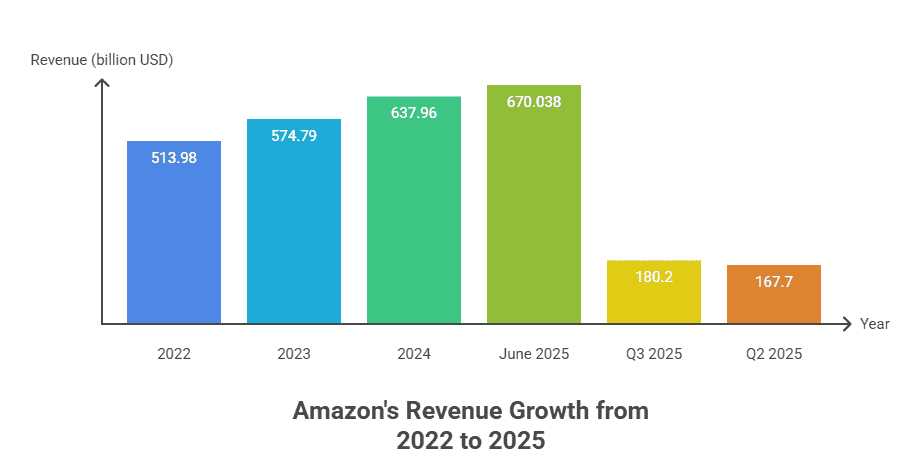
    What’s striking here isn’t just the size of these numbers, it’s the consistency. Amazon added over $60 billion in revenue from 2022 to 2023, then another $63 billion from 2023 to 2024. That’s like adding an entire Fortune 100 company to their business every single year.

    At 14% year-over-year growth, Amazon’s global expansion is outpacing its overall growth rate. This suggests they’re not just maintaining dominance in established markets; they’re actively conquering new ones. With their twelve-month revenue already crossing $670 billion by June 2025, Amazon seems well-positioned to break the $700 billion barrier by year’s end. That would make them one of the first companies in history to hit such a milestone through operational revenue alone.

    Global Workforce and Employment

    Amazon’s massive workforce spans the globe, but recent strategic decisions reveal how the company is changing its employment landscape for the AI era. Here’s what you need to know about Amazon’s employment numbers:

    • Total global workforce: 1.55 million employees
    • Corporate employees: 350,000 out of total workforce
    • Confirmed 2025 job cuts: 14,000 corporate positions (represents 4% of corporate employees)
    • US operations: approximately 950,000 workers across fulfilment centres, offices, and delivery
    • Warehouse/fulfilment workers: roughly 1.2 million globally (largest employee segment)
    • Strategic focus: layoffs target corporate/technical positions, not frontline fulfilment workers
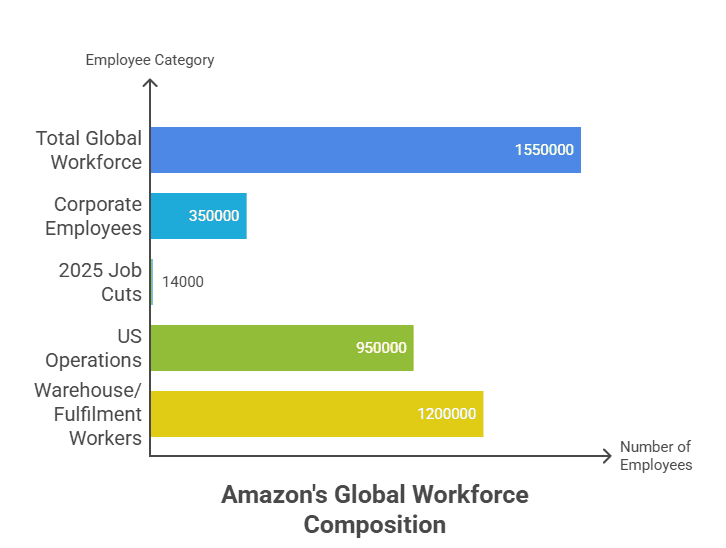
    The scale of Amazon’s workforce is staggering – you’re looking at more people than the entire population of many small countries. But what’s interesting is how Amazon is strategically restructuring this massive human operation. The 14,000 corporate layoffs represent the company’s largest corporate job cuts ever, yet they don’t touch the fulfilment centres where the majority of Amazon’s workers actually operate.

    This tells you something important about Amazon’s priorities. While they’re cutting corporate roles in response to AI automation and cost pressures, they’re keeping the warehouse workers who handle the physical logistics that customers depend on. It’s a clear signal that Amazon sees its fulfilment network as its competitive advantage – the part of the business that can’t be easily replaced by AI or competitors.

    Prime Membership and Customer Base

    Here’s what makes Amazon’s customer loyalty engine so powerful: they’ve turned shopping into a subscription service. And the numbers prove just how well this strategy works.

    The scale is staggering:

    • Global Prime membership: 220 million Prime members worldwide
    • US Prime members: 180 million (82% of global base)
    • Demographics: Millennials and Gen X constitute 63% of US Prime households
    • Age targeting: 81% of US internet users aged 18-34 have a paid Prime membership
    • Primary benefit: 9 out of 10 people get Prime primarily for free shipping
    • Additional services: Video streaming, music, gaming, grocery delivery
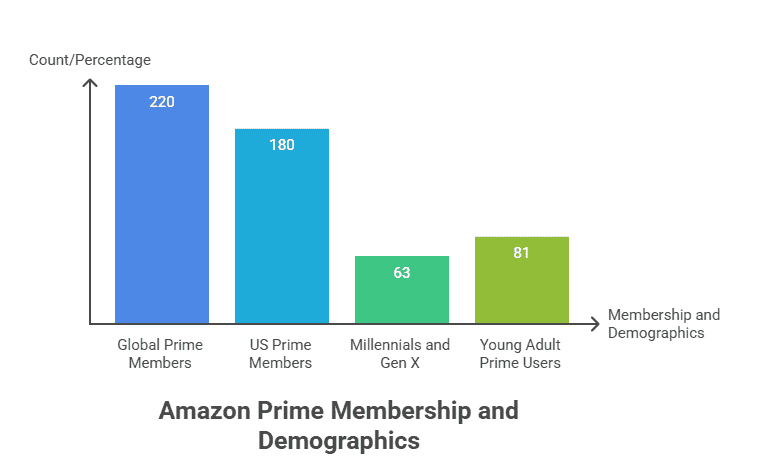
    What’s brilliant about this approach is how it flips traditional retail logic. Instead of competing for each individual purchase, Amazon gets customers to pay upfront for the privilege of shopping with them more often.

    That demographic breakdown tells you everything about Amazon’s future. They’ve captured the spending prime of two entire generations. When 81% of young adults are already locked into your ecosystem, you’re not just winning today’s market – you’re securing tomorrow’s.

    But here’s the real genius: Prime isn’t just about shipping anymore. Those additional services create multiple touchpoints throughout a customer’s day. You might join for free delivery, but you stay because your kids watch Prime Video, you listen to Prime Music during commutes, and you order groceries through Amazon Fresh.

    Each service makes leaving more painful. That’s customer stickiness at its finest – and it’s exactly why Amazon’s revenue keeps climbing year after year.

    E-commerce Market Dominance

    Amazon’s grip on e-commerce isn’t just about selling products; it’s about creating an entire ecosystem where others do the heavy lifting. Here’s how they’ve built their marketplace empire:

    • Amazon holds 37.6% US e-commerce market share in 2025
    • Third-party sellers generate over 60% of Amazon sales
    • 1.9 million active third-party sellers globally
    • 1.1 million active sellers in US (58% of global seller base)
    • 86% of Amazon sellers use Fulfilment by Amazon (FBA) services
    • 47% of small/medium sellers have surpassed $100,000 in lifetime sales

    What’s brilliant about Amazon’s strategy is how they’ve shifted from being just a retailer to being the infrastructure that powers millions of other businesses.

    The marketplace model creates multiple revenue streams while reducing Amazon’s risk. When a third-party seller lists a product, Amazon collects fees but doesn’t hold inventory risk. If the product flops, that’s the seller’s problem. If it succeeds, Amazon takes their cut from every transaction.

    That 86% FBA adoption rate shows how dependent sellers have become on Amazon’s logistics network. Sellers basically rent Amazon’s fulfilment capabilities, warehouses, and delivery system. It’s like having your own distribution network without the massive infrastructure investment.

    The result? Amazon gets paid whether they’re selling their own products or facilitating someone else’s sales. Plus, all that third-party activity generates data about what products work, which Amazon can use for their own private label strategy.

    Cloud Computing and AWS Performance

    While everyone sees Amazon as the e-commerce giant, the real profit machine runs quietly in the background. AWS isn’t just another business unit; it’s become Amazon’s financial backbone and competitive fortress.

    Here’s how AWS dominates the cloud landscape:

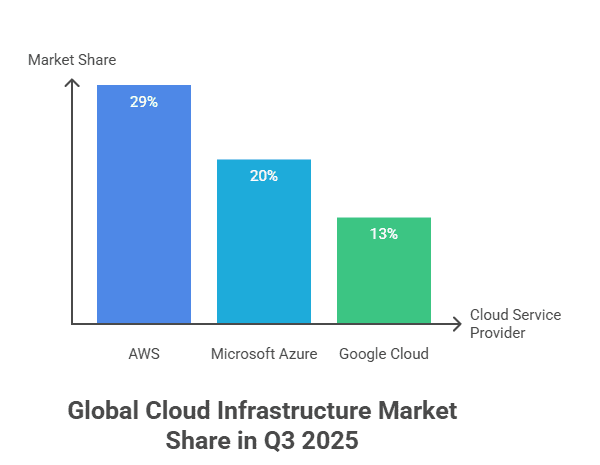
    • AWS holds 29% of global cloud infrastructure market share in Q3 2025
    • Microsoft Azure trails at 20% market share
    • Google Cloud captures 13% of the market
    • Global cloud infrastructure market expected to exceed $400 billion in 2025
    • Amazon committed over $100 billion in capital expenditures for 2025
    • The majority of capex focuses on AI and cloud infrastructure, including custom Trainium chips

    That nearly 30% market share translates to something massive. What started as Amazon’s internal infrastructure became a business larger than most Fortune 500 companies on its own.

    But here’s what makes AWS truly powerful: it’s not just about current dominance. Amazon’s betting big on the future with custom silicon like Trainium chips for AI processing. While competitors buy chips from others, Amazon builds its own. That’s the kind of vertical integration that creates real competitive moats.

    The $100 billion capital expenditure commitment isn’t just spending—it’s Amazon doubling down on AI infrastructure when everyone else is scrambling to catch up. When you’re already leading and you’re investing the most, that gap tends to widen.

    Market Competition and Future Outlook

    Amazon’s dominance doesn’t guarantee smooth sailing ahead. The retail giant faces mounting pressure from multiple fronts, even as it continues expanding into new territories.

    Here’s how the competitive landscape is shifting:

    • Traditional retailers are fighting back – Walmart and Target have invested billions in their digital platforms and same-day delivery
    • Specialised competitors are emerging – Companies like Shopify empower smaller retailers, while Instacart dominates grocery delivery
    • International markets remain fragmented – Local players like Alibaba in China and Flipkart in India hold strong positions
    • Regulatory scrutiny is intensifying – Antitrust investigations could limit Amazon’s ability to acquire competitors
    That’s where Amazon’s investments in AI and automation become critical. The company is betting heavily on machine learning to optimise everything from warehouse operations to personalised recommendations. This tech advantage helps maintain lower costs and faster delivery times.

    But here’s the thing – size creates its own challenges. Amazon’s massive logistics network, while impressive, faces increasing pressure to become carbon neutral. The company has committed to net-zero emissions by 2040, requiring significant infrastructure changes.

    Looking ahead, Amazon’s growth will likely depend on three key areas: expanding AWS globally, penetrating international retail markets, and maintaining its innovation edge in emerging technologies. The question isn’t whether Amazon will face more competition – it’s how well the company can adapt its massive operation to stay ahead of nimble competitors and changing consumer expectations.

  • Signal Statistics: Usage, Revenue, & Key Facts

    Signal Statistics: Usage, Revenue, & Key Facts

    The Signal app has attracted some major buzz recently.

    When WhatsApp’s updated privacy policy called for its users to accept that it would share user data with its parent company – Facebook, millions of users shifted to Signal in the quest for a secure messaging platform.

    What is Signal?

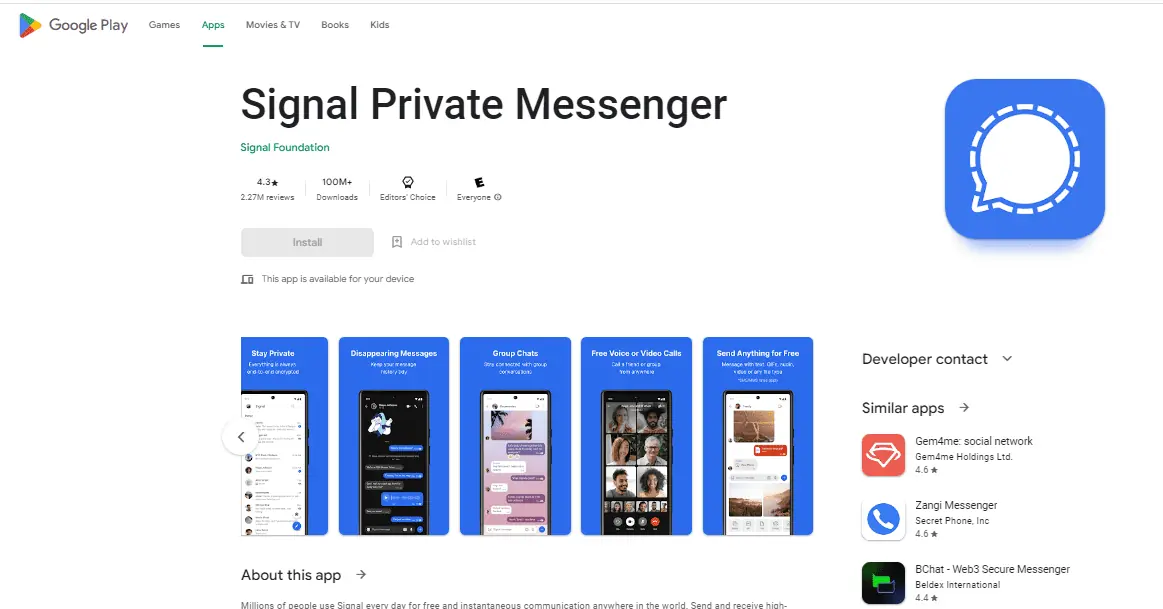
    Signal is an easy-to-use and secure messaging application that provides encrypted communications. It allows a user-friendly experience with group chats, video, image, gifs, audio, and video calling, all with end-to-end encryption. Even the app developers themselves can’t decrypt a message sent between 2 users.

    • Website: Signal.org
    • Developer: Signal Technology Foundation
    • Launch Year: 2014
    • Founders: Moxie Marlinspike and Stuart Anderson
    • Key Managerial Personnel: Moxie Marlinspike (CEO), Aruna Harder (COO), Brian Acton (executive chairman of Signal Foundation), Meredith Whittaker (BOD – Signal Foundation)
    • Headquarters: Mountain View, California

    Signal was a result of a merger of RedPhone and TextSecure programs by Open Whispers in 2014.

    Brian Acton, a WhatsApp co-founder, injected $50 billion through the Signal Technology Foundation for app development.

    Signal Statistics

    Here are some key Signal statistics focusing on the company’s usage, revenue, funding, etc.

    Download and Usage

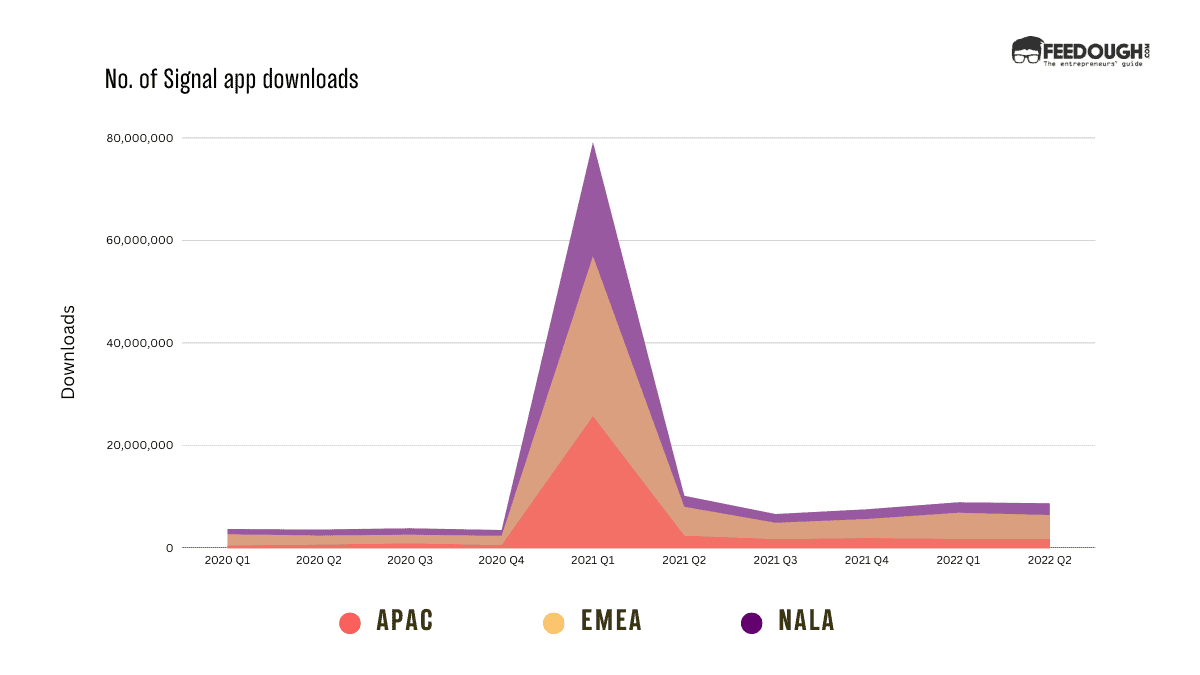
    • Signal downloads: From 50.6 million in January 2021 to 100m+ in March 2023.
    Signal Messenger
    • Signal weekly download rate: 50,000 weekly downloads till January 5th, 2021, to 7.7 million new downloads between January 6 and 11, 2022.
    • Total downloads: more than 105 million downloads as of May, 2021
    • There was a total of 80 million downloads of Signal in Q1 2021
    Number of Signal downloads stats
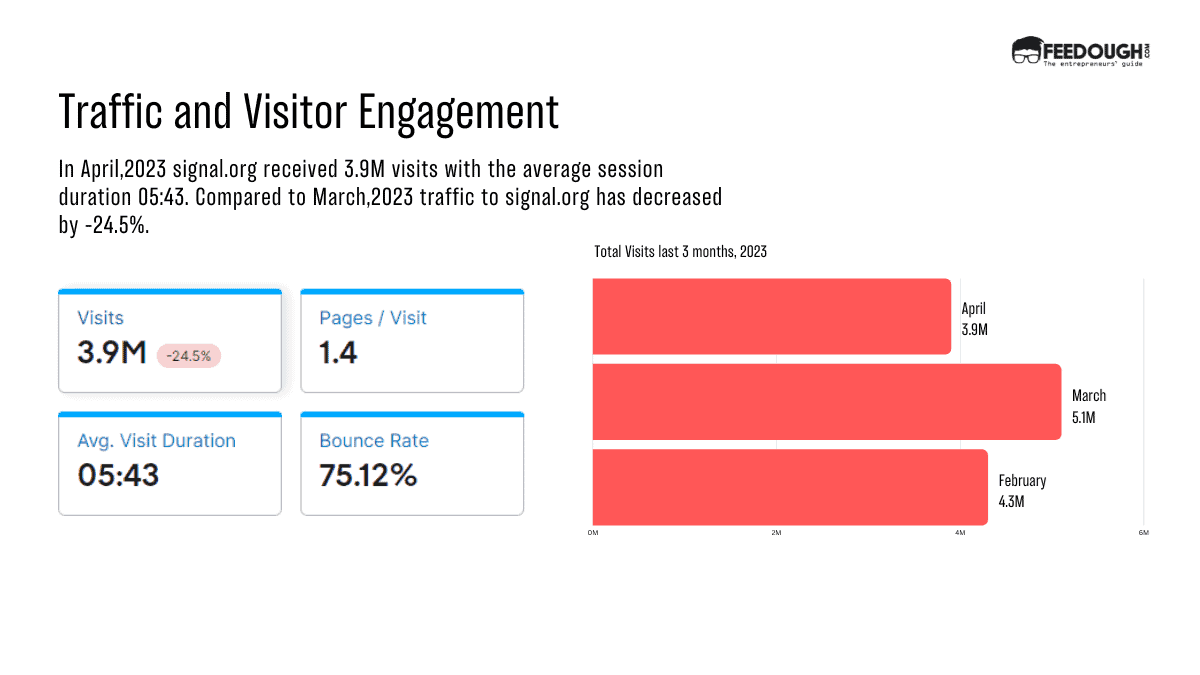
    • Signal monthly traffic and visit in 2023: April: 3.9M; March: 5.1M; February: 4.3M
    Number of Signal visitors stats
    • Installs on devices: More than 100 million Android devices.
    • Signal monthly active users:  40 million monthly active users by the end of 2021
    • Signal monthly website visits: 3.1M as of March 2023
    • Signal topping charts: Apple’s App Store in 40 countries and Google’s Play Store charts in 18 countries as the number one free app (in 2021).

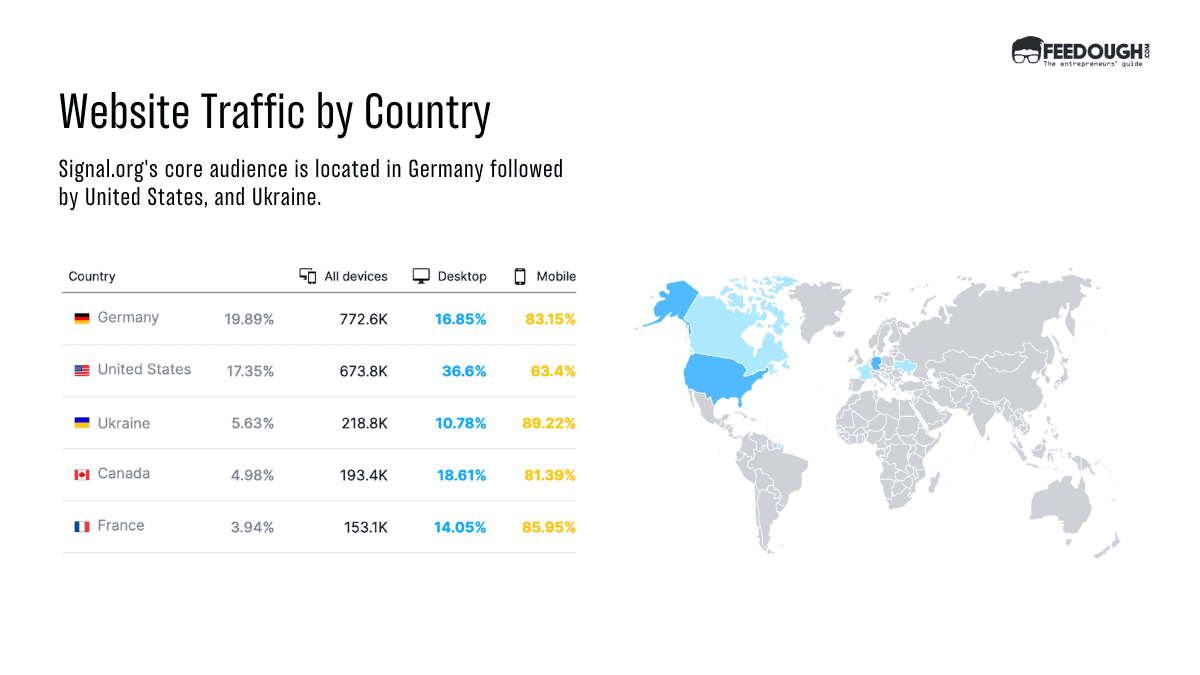
    Signal.org Website Traffic by The Top Countries Are:

    • Germany: 19.899%
    • United States: 17.35%
    • Ukraine: 5.63%
    • Canada: 4.98%
    • France: 3.94%
    Number of Signal visitors by country stats

    Signal scored the top spot among the top three IM apps in countries like India, Singapore, and Brazil in 2021.

    The app was downloaded 1.3 million times on January 11th, 2021, the highest recorded in a day, and the global installs showed a massive 5001% increase over the year and a 4200% increase in weekly downloads.

    Signal’s download rates managed to expand 3.3 million times, beating WhatsApp at 1.7 million, Facebook at 2.1 million, and Instagram at 2.3 million downloads in 2021.

    Signal, still a leader?

    Even though Signal saw a massive influx in the number of users because of its encrypted messaging policy, its moment was short-lived.

    • The decline in Signal downloads: 86% decline during February 2021 – 7 million and currently stands at 4.3 million
    • Monthly website visits dropped: -24.5% as of May 2023
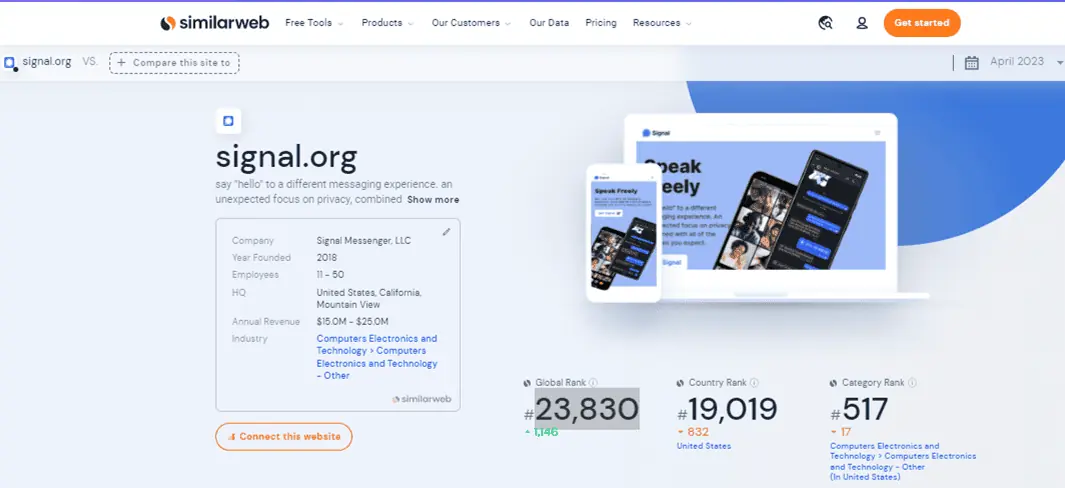
    • Position of Signal: As Signal was spotted in the top three IM apps in 2021, its Global rank dropped to 23,830 as of April 2023.
    Signal similarweb

    In an attempt to find a replacement for WhatsApp, millions of users also shifted to Telegram – another instant messaging app. Like Signal, it showed a massive increase of 282.5% in downloads from just 16.6 million in January 2020 to 63.5 million in January 2021.

    But again went down with WhatsApp’s advancements to 19.3 million in March 2023.

    Although Signal is the winner when it comes to security issues, Telegram has more to offer in terms of features. Users find all the popular features in the Telegram interface, which makes them biased towards it.

    From another point of view, infiltrating a massive army of 2.5 billion active WhatsApp users worldwide won’t come easy.

    Signal Revenue

    Signal.org, the app, is developed by the Signal Technology Foundation, a non-profit entity that mainly relies on donations and charity.

    • Largest donation:  $50 million (now $105 million) zero-interest loan by Brian Acton in 2018.
    • Users who donate: Less than 1% of Signal Messenger users donate to the Signal Technology Foundation.
    • Revenues of Signal Foundation: $14.8 million as of FY2020, a decrease from $19.4 million revenue as of FY2019.
    • Grants and contributions: $13.7 million
    • Investment Income: $895,821
    • Royalty Revenue: $220,000
    • Expenses:$21.2 million in 2020 spiked 57%  from $13.5 million in 2019
    • Assets: $66.1 million in 2020 declined -14.4% from $77.2 million in 2019
    • Liabilities: $32.7 million for 2020, -14.4% decrease from $38 million in 2019

    The Signal app provides an ad-free platform and is not dependent on the application for any source of revenue. The donation made by Brian Acton caused a major stir in the app development process.

    Other Key Signal Facts

    • The endorsements by Elon Musk and Edward Snowden played a major role in the sudden surge of downloads of the Signal Messenger App.
    • Signal servers could not handle the spike in the newly registered users, which caused them to crash on January 15th, allowing limited access to users.
    • Signal is the only private messenger app that doesn’t collect or share any user data with its developers.
    • Journalists popularly use Signal to hide sources, and the Black Lives Matter protest organisers increasingly used it for communication.

    Sources

  • What Is Advertisement? – Examples, Objectives, & Importance

    What Is Advertisement? – Examples, Objectives, & Importance

    Advertisements come in various shapes, sizes, and forms, be it a thirty-second spot on TV, a radio jingle, a newspaper promotion, or a highly personalised promotion on a social media platform.

    But how do you define an advertisement, what is its purpose, and why is it important?

    What Is An Advertisement?

    An advertisement is a paid promotional tool backed by an identified sponsor to call public attention to an offering or a brand.

    This definition of advertisement can be divided into three parts

    • It’s a paid promotional tool: Advertisements are paid promotional messages communicated by some mass communication media.
    • An identified sponsor backs it: Advertisements are backed by identified sponsors called advertisers who pay to create advertising messages, buy media slots, and monitor advertising efforts.
    • It aims to call public attention towards an offering or a brand: Advertisements are intended to inform the target audience about a particular offering or a brand or influence them to do certain tasks.

    In simple terms, an advertisement is a paid communication message intended to inform people about something or influence them to buy, try, or do something.

    Types Of Advertisements

    Advertisements can be categorised into five different types based on what advertising medium a brand uses to communicate its message.

    Print Advertisements

    Print advertisement is a mass advertisement strategy that uses hard copy printed mediums like newspapers, magazines, brochures, flyers, etc., to communicate the advertisement message to the customers.

    It is one of the oldest advertisement types that majorly target and cater to a literate audience.

    Broadcast Advertisements

    Broadcast advertisements are mass marketing tools that use broadcast mediums like TV and radio to spread the advertising message to a wider audience.

    These ads rely more on visual communication and hence can target everyone with access to such mediums irrespective of their literacy level.

    Outdoor Advertisements

    Outdoor advertisements or out-of-home advertisements are ads that reach customers out of their homes. They use mediums like billboards, buses, taxis, or street elements.

    Outdoor advertisements can be digital or traditional, but all of them are targeted to a geographically oriented target audience.

    Digital Advertisements

    Digital advertisements are technology-powered advertisements that use online or digital paid channels to communicate the marketing message to the target audience. Such ads appear online or on digital channels like websites, search engines, social media platforms, mobile apps, and other digital channels.

    Product Or Brand Integration

    It involves brand or product placement in entertainment media like TV shows, OTT series, YouTube videos, etc., where the brand is interwoven within the script without looking salesy.

    Instead of being interruptive advertisements, these ads form the script or a part of the entertainment media and communicate the message in a better-scripted manner.

    What Is The Purpose Of Advertisement?

    Even though advertisements come in various shapes, sizes, and types, they have just one purpose: communicating the brand or marketing message to the target audience by paying for it.

    What Are The Objectives Of Advertisements?

    Advertisements can be released with numerous objectives depending upon the type of business, marketing campaign, campaign requirements, etc. However, these objectives can be categorised into three prominent objectives –

    • To Inform about the brand or offering and increase the brand awareness and brand exposure in the target market.
    • To Persuade the customers to perform a specific task like buy or try a product or provide some information.
    • To Remind and reinforce the brand message and reassure the target audience about the brand vision.

    Besides these three main objectives, advertisements also focus on:

    • Building brand: One of the objectives of advertisements is to let the world know about the brand and build brand equity.
    • Increasing sales: It aims to fulfil the short-term sales goal of the business.
    • Creating demand: Advertisements aim to create both short-term and long-term demand for the brand and its offerings.
    • Engaging with the target audience: Advertisements try to develop relationships with the target audience.
    • Expanding customer base: Attracting new customers and expanding the existing customer base is one of the important objectives of advertisements.
    • Changing customers’ attitudes: Sometimes, advertisements are important to influence and change customers’ attitudes towards the brand or offerings.

    Importance Of Advertisement

    Advertisements are important for both the business and the customers.

    For The customers

    • They increase awareness: Advertisements inform the customers about the available products in the market and help them choose the best product that would solve their problems or satisfy their needs.
    • They make decision-making convenient: Advertisements communicate the brand message along with the benefits of the brand and offerings. This makes the customer decision-making process easy as the customers get to know what suits their requirements and budget better.
    • They ensure better quality: Advertisements include numerous said and unsaid promises that the advertiser must fulfil to sustain in the market. This ensures quality as a brand wouldn’t want to waste money on false promises.

    For The businesses

    • They lead to sales: Advertisements increase brand awareness and result in more sales as more and more people enter the brand’s sales funnel.
    • They create awareness: Advertisements increase brand awareness and brand exposure and inform the target audience about the offering.
    • They help build a favourable brand image: Smart advertising help develop a favourable brand image that aligns with the brand identity and helps the business achieve marketing objectives sooner.
    • They help differentiate the product: Advertisements aim to position the brand and offering uniquely in the customers’ minds. This eventually results in differentiating the offering from the competition.
    • They increase the brand’s goodwill: Advertisements reiterate the brand’s mission and vision and increase its goodwill among the target customers.

    Characteristics Of An Advertisement

    No matter what medium a business use to advertise its offerings, all advertisements come with a similar set of characteristics. These are:

    • Paid form: Advertisements are not free. A free advertisement is either publicity or public relations. Advertisements always require the advertiser to pay to develop and communicate the advertisement message.
    • Promotional tool: Advertisements form an important element of the promotion mix of an organisation.
    • One-way promotion: Advertisement involves only one-way communication of message where the business communicates its message to the target audience using different advertising mediums.
    • Targeted or non-targeted: Advertisements can be both targeted or non-targeted where the advertiser target masses or individuals according to their demographics, geographic location, attributes, and behaviour.

    Advantages Of Advertisements

    • Increases demand: Ads communicate the brand message to a large pool of audience, triggering the need to buy the business’s offerings. This, in turn, increases the offering’s demand in the market.
    • Helps in brand building: Ads work effectively in marketers’ attempt to align the brand image with their brand identity giving rise to a favourable brand in the market.
    • Plays a key role in product launch: Ads play a key role in communicating a product launch to the target audience and creating demand for the new product.
    • Boosts existing customers’ confidence: Ads also make sure to reassure existing customers about their decision in a particular brand. The advertising messages are drafted in such a way so as to generate a feeling of pride among existing customers for using the brand’s offerings.
    • Attracts new customers: Advertisements help the business in achieving its marketing objectives and gaining new customers.
    • Reduces customer turnover: Ads reinforce the brand promise by communicating the benefits of the offering, brand values, mission, and vision. This helps in gaining more loyal customers and reducing customer churn rates.
    • Educates the customers: Advertisements educate the customers about the essential product-related, industry-related, and market-related information that they should know about before, during, and after purchasing the offering.

    Disadvantages Of Advertisements

    • Increases the costs: Ads add to the business’s marketing costs that are eventually added to the product’s price borne by the customer.
    • Confuses the buyer: Too many advertisements of similar offerings with similar claims confuse buyers who tend to make wrong decisions by being influenced by such ads.
    • Can be misleading: Ads can often mislead the customers into making decisions that they should not take.
    • Can waste resources: Developing ads result in several wasteful resources that can be prevented otherwise.
    • Multiplies customer needs: While ads create demand, some advertisements may lead to developing demand for products that are often not needed in the routine life, hence multiplying customer needs that may backfire on the customer.

    Advertisements Examples

    An average human sees 4,000 to 10,000 advertisements in a day. From TVs to mobile phones to even taxis, advertisements are everywhere. Here are some examples of notable advertisements in the world.

    TV Ads Example

    TV ads are known to be visually compelling messages with

    • Audience-appropriate humour,
    • Relatable characters & situations,
    • Simple & upbeat storyline, and
    • Emotional connection.

    Old Spice’s “The Man Your Man Could Smell Like” advertisement is a great ad that has all such characteristics.

    Radio Ads Example

    Radio ads are considered great when they are

    • Attention-grabbing,
    • Novel,
    • Memorable,
    • Consistent, and
    • Emotion-laden.

    A great example of such a well-developed radio ad is The Volkswagen Mystery that featured Stephen Hawking.

    Print Ads Example

    A well-developed print ad has the following elements:

    • Attention-grabbing headline
    • The immediate benefit for the reader
    • Detailed body
    • Convincing CTA

    A great example of such a print advertisement is Ecovia: Stop the Violence.

    print advertisement

    Outdoor Ads Example

    An apt outdoor ad communicates the message quickly, memorably, and repeatedly. A good example of such an outdoor ad is Belt Up.

    outdoor advertisement

    Digital Ads Example

    Digital ads are usual ads but on digital mediums. These ads are promotional, persuasive, targeted, creative, consistent, and personalised. Fitbit Stories: “#MyReasonIs”

    Go On, Tell Us What You Think!

    Did we miss something? Come on! Tell us what you think about our article on what is advertisement in the comments section.

  • Zomato Statistics: Usage, Revenue, & Key Facts

    Zomato Statistics: Usage, Revenue, & Key Facts

    Founded by Deepinder Goyal and Pankaj Chaddah in 2008, Zomato is a restaurant aggregator and food delivery company which connects customers, restaurant partners and delivery partners to serve their multiple needs. Customers use the platform to search and discover restaurants, give and read reviews, order food, book a table or dine out. While restaurant partners get an opportunity to engage customers along with a reliable delivery service.

    How did the idea come into being in the first place?

    It has its seeds rooted in Delhi when the two founders saw people standing in a queue at lunch, waiting for their chance to order. They then came up with Foodiebay, a prologue to Zomato.

    Zomato Statistics

    Zomato has experienced rapid growth and an increased market share in the past few years to become one of the leaders in the domain of food delivery spaces in India and abroad. Thus, it becomes essential to look at the key Zomato statistics, revenue, growth, user demographics and traffic sources. So let’s delve deeper into the ocean of Zomato statistics!

    User Statistics And Demographics

    • Target customer base: 18-35 years
    • Number of Zomato monthly active users in 2023: 80 million monthly active users as of March 2023.  
    • Number of countries Zomato is present in: 24 countries
    • Number of cities is Zomato present in: 3200+ cities
    • Zomato’s market share in the food serving business: 55%
    • Total number of visits to the Zomato: 90 Billion
    • Percentage contribution of referrals to the site traffic: 1.39%
    • The per cent of direct traffic to the analysed website on desktop: 43.34%
    • Percentage contribution of social media to the site traffic: 0.80%
    • Percentage contribution of display ads to the site traffic: 0.47%
    • Zomato’s organic searches: 53.63%
    • The monthly transacting customer base grew in 2022: by 116% 

    Zomato primarily targets the 18-35-year-old target group as it is most likely to order food because of its tech-friendliness, busy lifestyle, and monetary stability. It is present in around 24 countries and over 10,000 cities across the world.

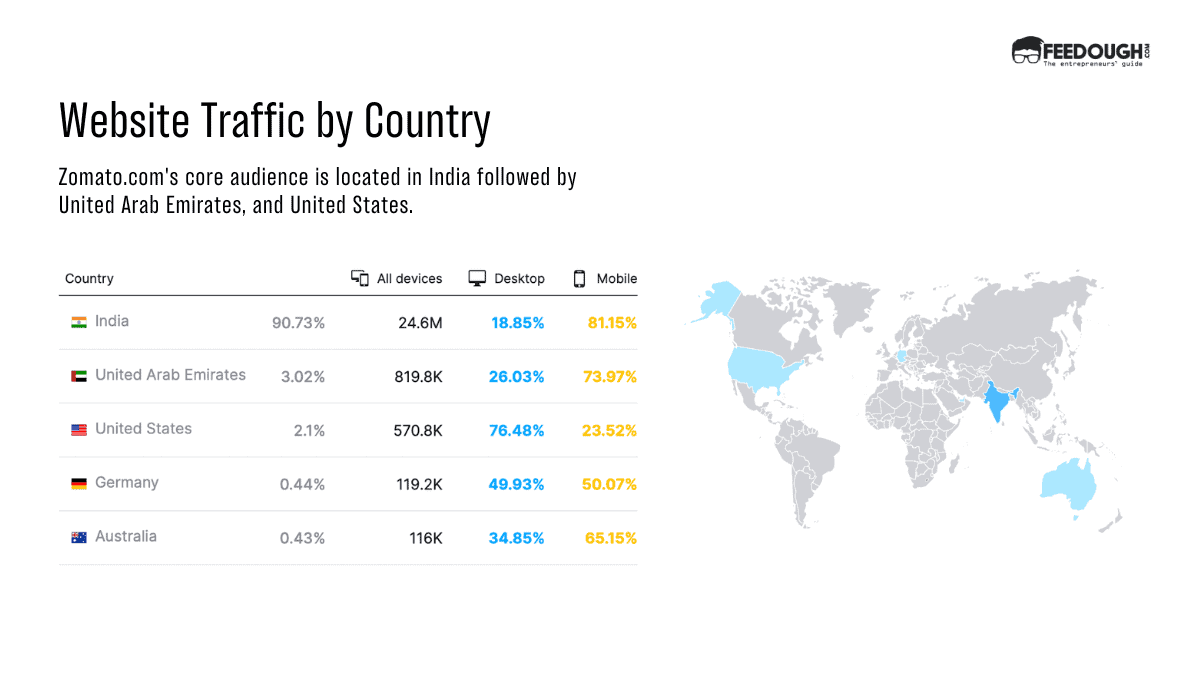
    5 Countries Zomato.com Website Traffic Are:

    • India – 90.73%
    • United Arab Emirates – 3.02%
    • United States – 2.1%
    • Germany – 0.44%
    • Australia – 0.43%
    5 Countries Zomato.com Website Traffic Are

    Zomato witnesses an average visit duration of around 3 minutes 38 seconds on its website Zomato.com.

    Restaurant Partners And Employees Stats

    • Number of listed restaurants on Zomato: 1.4 million
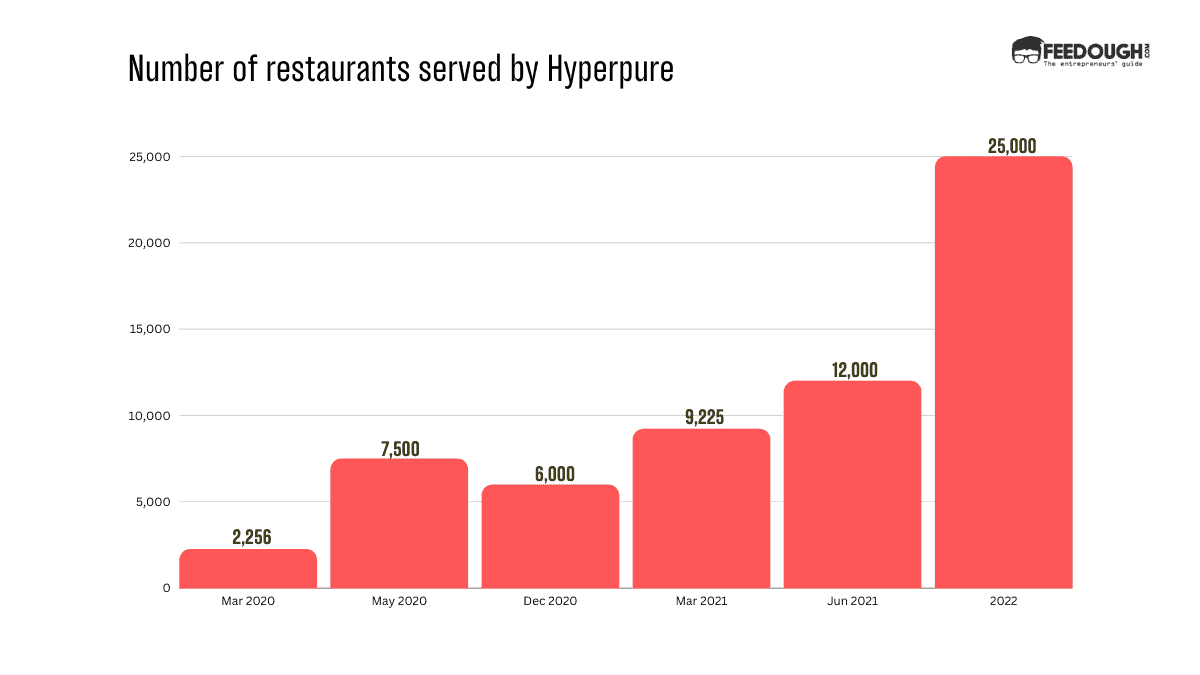
    • The number of Zomato’s restaurant partners: 21000 (They were 12000 in 2021, 6,000 restaurants in the last month of 2022, and added 3,000 new restaurants in the first three months of 2023.)
    • Number of Zomato Gold restaurant partners: 6500, and 100% of SMAAASH restaurants and pubs across India are Z Pro partners, according to ‘The Marketing Head India, SMAAASH’
    • Number of Zomato Pro restaurant partners in India: 25,443 Pro restaurant partners in India as of March 31, 2021
    • The number of Zomato employees: 8,339 employees (as per Zomato’s information)
    • The Average pay of a Zomato delivery person: ₹15000 per month

    Zomato has over 1.4 million listed restaurants and 12,000 restaurant partners. Moreover, it has over 6500 restaurant partners for Zomato Gold. In December 2020, it had around 285,000 active delivery drivers and 3,50,000 active restaurant listings on its platform in India. For the Indian market, it had 25,440 Pro restaurant partners.

    It has 8339 employees and is the 11th most visited website and 2nd most visited in India by traffic in the world for Restaurants, March 2023.

    Zomato Revenue Statistics

    • What was Zomato’s revenue in Dec 2022: 1,948 crores (The revenue rose 75% to Rs 1,948 crore from Rs 1,112 crore in Q3FY22)
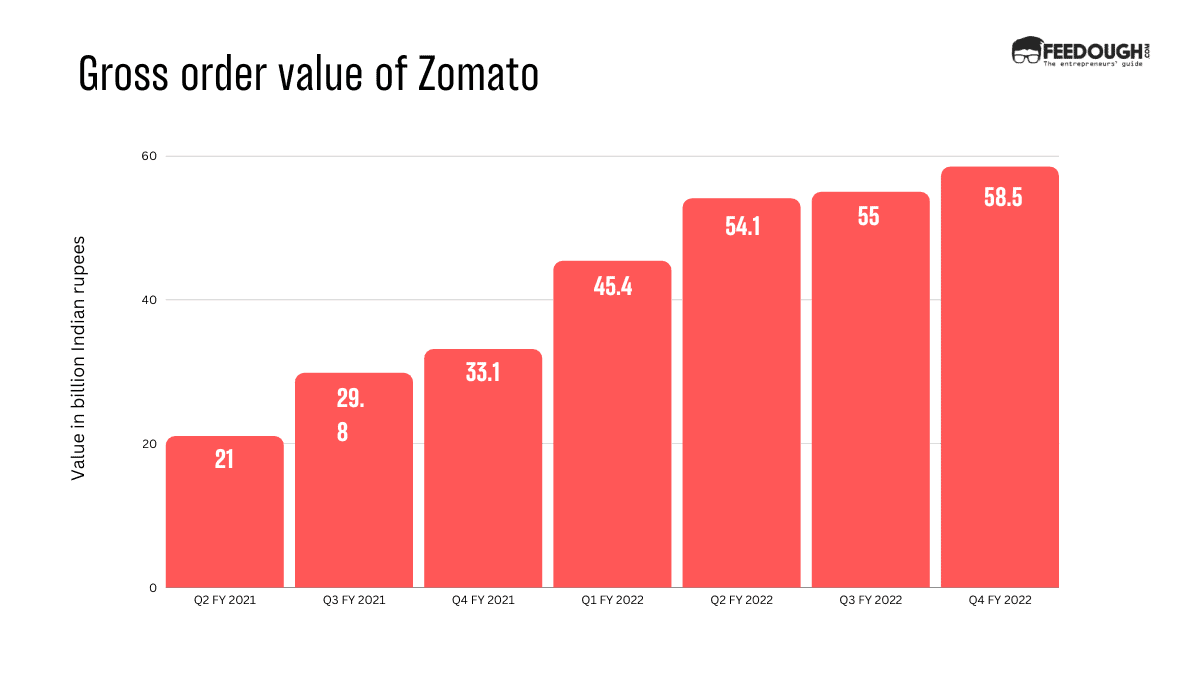
    • The gross order value of Zomato in the final quarter of 2022: 58.5 billion Indian rupees
    • Percentage of increase in Gross order value of Zomato: 2% 
    • The Average order value of Zomato in 2023:  ₹568 (From ₹395.4 in 2021 (Q4) it rose to   ₹568 in Q1 2023)

    Zomato’s revenue in the financial year 2022 jumped by 123% to Rs 4,109 crore. However, the company in February 2023 also reported a higher net loss of Rs 346.6 crore for the December quarter.

    The gross order value (GOV) of Zomato from the second quarter of the financial year 2021 to 2022  reported a gross order value of 58.5 billion Indian rupees. 

    Gross order value of zomato

    Dining Out & Zomato Gold Statistics

    • How much did the revenue for dining-out sources increase from 2019 to 2020: 20%
    • Number of Zomato Gold users: 900K 
    • Number of Zomato Gold users in India: 26000 in 2020
    • Percentage increase in the number of Zomato customers as of Feb 2023? 70%

    The dining-out business was growing steadily before the pandemic hit. There was a 20% increase in the dining out sources of revenue and significant gains in EBITDA margins across India and other international financial markets in the financial year 2020. Moreover, there was an increase in the number of Zomato Gold members by 70% as of Feb 2023.

    However, post-pandemic, this business segment experienced a blow as customers became more apprehensive of going to dine in restaurants. Thus, they introduced a ‘contactless dining’ policy where any interaction with restaurant staff or menu cards was to be avoided. Zomato Gold was rebranded to Zomato Pro with an enhanced value proposition for both the users and the restaurants, whose bills the users are supposed to pay through the Zomato app.

    Hyperpure Revenue

    Hyperpure is an initiative by Zomato that allows restaurants to buy vegetables and fruits, meat and poultry, seafood and dairy, and all other groceries they might need. It works directly with farmers and mills, that is, producers and processors, to source these products.

    It is present in 11 cities currently, including Delhi, Gurugram, Noida, Bangalore, Hyderabad, Mumbai, Pune, Kolkata, Chennai, Ahmedabad and Chandigarh and serves more than 25000 merchants per month. It experienced growth during the first wave of COVID since restaurants found it to be a viable option, and it is still taking off as the restaurants find it a suitable facility to get their stuff delivered to their doorstep. 

    However, the second wave could not accelerate its growth as much as the first did. But as it started with 6 cities in India, it kept expanding and serving better with time and rosed the growth of 169% to Rs 421 crore from the past year.

    Hyperpure Revenue
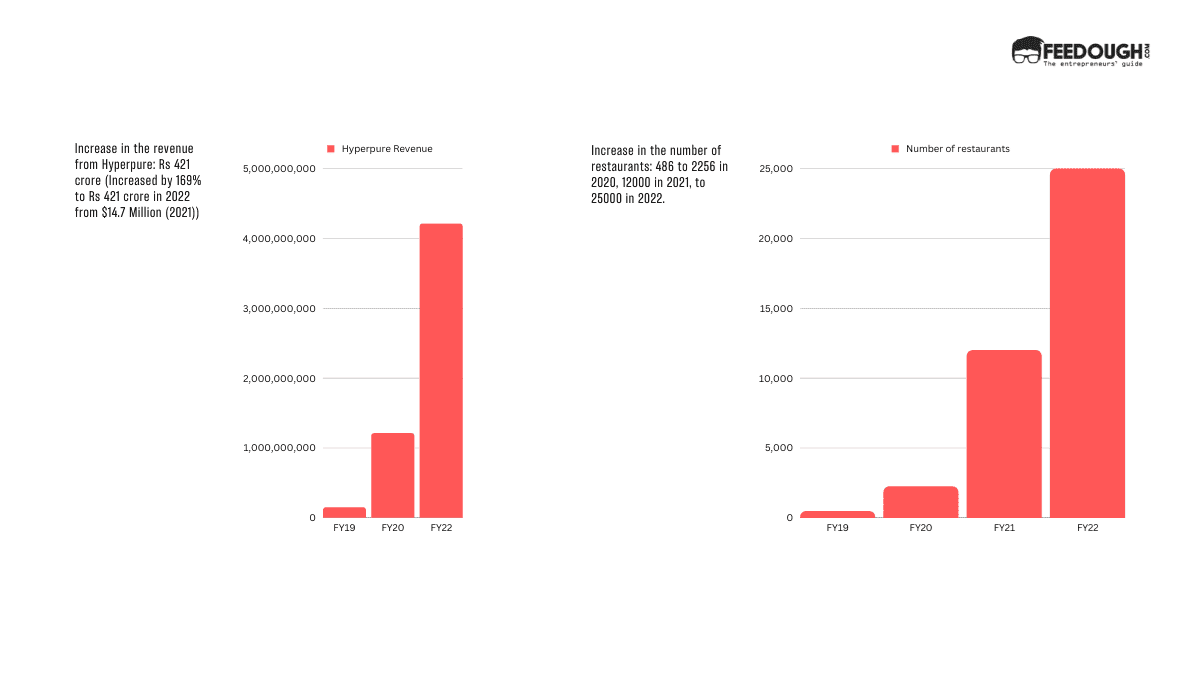
    • Number of cities hyperpure is present in:11
    • Increase in the revenue from Hyperpure: Rs 421 crore (Increased by 169% to Rs 421 crore in 2022 from  $14.7 Million (2021))
    • Increase in the number of restaurants: 486 to 2256 in 2020, 12000 in 2021, to 25000 in 2022.
    number of restaurants served by Hyperpure

    Zomato Investments

    • Number of acquisitions: 15
    • Number of investments: 14
    • Number of exits: 2
    • Total funding amount: $2.6 billion

    Zomato raised a total of $2.6 billion in around 22 rounds. It has made 14  investments and 2 exits so far. 29 investors funded it, and it has acquired a total of 15 organisations.

    Sources

    Go On, Tell Us What You Think!

    Did we miss something? Come on! Tell us what you think about our article on Zomato Statistics in the comments section.

  • Four-Day Workweek: Everything You Should Know

    Four-Day Workweek: Everything You Should Know

    An average adult works for 2,622 hours per year in Mexico City. The same adult will work 1,712 hours per year in Denmark. But this doesn’t mean that the person will be more productive in Mexico City. In fact, Mexico City’s GDP per hour is among the lowest worldwide, and Denmark tops the list of productivity per hour.

    Moreover, the current working scenario results in 52% of the employees experiencing burnout affecting their well-being and production capacity.

    These stats made companies realise the need to update their working structure and move towards a four-day workweek. Though unexpected at first, most companies had a positive experience with a 4-day workweek schedule and wish to continue it in the future.

    That being said, the first question that may come to your mind would be if a four-day workweek even possible? Would it suit every industry? In the bigger picture, you would question the productivity levels? What if the employees have to work on reduced pay?

    Read on as we are here to answer all your questions.

    What Is A Four-Day Workweek?

    A four-day workweek is a compressed work schedule where the employees work only four days a week and get three days off with no reduction in pay.

    This arrangement calls for a typical working week, but employees are expected to work four days a week instead of the usual five. At the same time, it doesn’t involve increasing the number of working hours per day. The employee still engages for seven-to-eight hours a day. Hence, it demands a shorter workweek along with reduced hours.

    Buffer, the social media managing platform, experimented with the idea on its 89 employees. Even though the workweeks were shortened, there was no change in the payscale. Employees were happier and managed to get more work done with lower stress levels.

    How Does A Four-Day Workweek Work?

    Generally, employers have two different approaches to implement a four-day workweek – 40-hour week and 32-hour week.

    1. 40 hour week: This is a compressed working schedule where employees work for the usual 40 hours in a week but over four days. This implies that an employee is expected to work 10 hours a day and get three days off. However, when companies tried to compress 40 hours in a four-day schedule, it led to severe employee burnouts. So, this is a less prevalent working arrangement.
    2. 32 hour week: It suggests a relatively shorter working week with reduced hours. So, the employees work for only 32 hours in a four-day workweek and continue working 8 hours a day.

    Based on the needs of the business and employee preferences, the employer can identify any day of the week as an ‘off’. They can either offer a long weekend off or any day midweek as the employee deems it to be fit.

    But,

    Does a four-day workweek require a reduction in pay?

    It doesn’t. This working arrangement doesn’t just benefit employees, but it is also beneficial for the employers who see increased productivity and a 20% reduction in variable overhead expenses like electricity and energy consumption.

    Moreover,

    Is a four-day workweek even possible?

    In a place where work is measured in terms of working hours, you might fear harming productivity levels due to a four-day workweek. But with the recent developments in AI technology, it is possible to achieve the same output or sometimes even more in the same time as earlier. This encourages the notion of measuring work in terms of the output generated, and a four-day workweek becomes easier to implement.

    Now, what about employers? Why would they implement such a scheme?

    Is Working Four Days A Week Good?

    Working for long hours for many consecutive days causes employee fatigue and high stress levels. By the end of the week, employees become so overworked that they tend to become unproductive. They cannot concentrate, and it can severely affect productivity, profits, and the well-being of the employees and the company.

    The concept of a four-day workweek comes as a relief from improper working hours. It offers a flexible schedule that allows you to accommodate both personal and work requirements effectively. Moreover, it also allows the employer to shed the non-productive hours of their employees.

    Has any company benefited from such an arrangement?

    Perpetual Guardian switched to a four-day workweek during a trial by shedding hours from 37.5 to 30 but maintained the pay scale. After a significant run, they claimed a 20% rise in productivity and reduced staff stress levels. The employee work-life balance, which was earlier 54%, jumped to almost 78%. Just by setting productivity as a goal, they focused on results and not working hours.

    As a result, the four-day workweek is continuously being proved to be viable for both employees and employers.

    What Are The Benefits Of A Four-Day Workweek?

    The concept of four-day workweek comes with its own set of advantages for both the employers and the employees.

    For Employees

    The employee benefits for a four-day workweek are quite evident in the workspace.

    • Reduced stress: Employees tend to be happier when they take pleasure in their work and careers. Longer working hours wear them out, and the burden of managing everything is exhausting. With an extra day off, they will have time to accommodate everything and enjoy a flexible work schedule.
    • Better work-life balance: When you have more time for non-work activities, they are less likely to distract you during working hours. You will be more concentrated at work with sufficient time to administer your personal life as well. It promotes a better work-life balance.
    • More job satisfaction: The search for satisfaction begins with working less. With such a favourable situation, people are happy to have the time and energy to develop their personal and professional life without sacrificing either.
    • Increased equality: A 5-day workweek demands a lot of commitment, and it is difficult for people with childcare responsibilities to manage. This causes them, especially women, to leave jobs. A flexible four-day work schedule encourages an equal workplace as employees can spend more time with family, friends with a proper work-life balance.

    For Employers

    The concept of the four-day workweek isn’t alluring only to employees. It benefits the employer even more.

    PPC Protect, a SaaS solution for analysing web traffic, shifted to Monday-to-Thursday week. Not only did the average employee productivity increase, but they were also surprised to find out 16% increase in their task completion processes. With a boost in job applications, positions got filled up faster and were most likely to remain in the position without switching jobs

    We can say that employers have their own set of advantages.

    • Increased productivity and efficiency: Researchers have concluded that better-rested employees are more productive and committed to their jobs. One of the most overworked nations, Japan, jumped productivity by almost 40% during a short workweek trial in Microsoft.
    • More employee engagement: Studies found that even though working hours were reduced by 20%, the time spent by employees on leisure and other non-work websites during office hours fell by 35%.
    • Employee recruitment and retention: Four-day workweek proves to be tempting employee recruitment and retention strategy as people are tempted to work in such an environment.
    • Reduced carbon footprint: Even one day off can result in huge savings in terms of fuel and power. No one has to commute, and the energy requirements of the office buildings are reduced. Companies have a huge cut in their expenses with an added environmental benefit.

    What Are The Disadvantages Of A Four-Day Workweek?

    While there are several success stories of a four-day workweek trial, this arrangement doesn’t suit all. If your company needs a quick response to business opportunities or robust customer assistance, as in the case of a sales-based organisation, then cutting off the fifth day might backfire on you.

    One wrong approach and your whole business might be affected. For the Slumber Yard trial, authorities compressed the workweek into four days of 10 hours each. But with such long hours, employees got weary and tiresome by the end of the day. They were found surfing over the net, snacking, or chit-chatting, which caused a spike in expenses. The trial failed because of the wrong approach, but even with a planned strategy, your organisational requirements may make it through. The State of Utah dropped its four-day week program even after an increase in productivity and employee morale. Unhappy customers who were unable to access services on Fridays resulted in the withdrawal of the program.

    So, even when a four-day workweek has a lot of advantages to its credit, it can also lead to some issues if you don’t have the right support and technology.

    • Wrong approach: Many confused the concept of a four-day workweek with a compressed working schedule. When an employee is expected to work for 10 hours a day, it would seemingly decrease productivity levels and hamper the employees’ work-life balance.
      For a strategy to generate effective results, one needs to have a calculative approach. To achieve the desired outcomes, a four-day workweek should have a standard 7-8 hour workday.
    • May affect consumer satisfaction: Some companies claim strong customer service, and if their customers are unable to reach out for support because of reduced working hours, they will be disappointed.
      An effective solution would be to use AI assistance like chatbots and AI-powered websites to resolve customer issues when office staff isn’t available.

    Which Country Has A Four-Day Workweek?

    Though the four-day workweek is a relatively new concept, it has become highly viable for companies. Based on the results of these trial runs, many countries are looking to make this arrangement full-time.

    The transition to a four-day workweek won’t be the same for the US as in other countries, but it sure will be implemented as we continue down the road.

    Iceland

    Where a four-day workweek was popular for private companies, Iceland is one of the first countries that adopted the largest trial in the public sector. The trials were conducted over two years – 2015 and 2017 where over 1.3% of the total workforce, that is, 2500 workers shifted from working 40 hours to 35-36 hours.

    The trials turned out to be a massive success as the employees declared themselves to be healthier, relaxed, and more focused. Productivity levels were the same or improved in the majority of the workplaces. As of today, 86% of the workers work shorter weeks or are in the process of opting for it.

    New Zealand

    New Zealand’s Prime Minister Jacinda Ardern expressed support for the concept of a four-day workweek as it would help employees improve their work-life balance and increase domestic tourism.

    60% of the country’s tourism industry involves domestic tourism, and a shorter workweek would encourage employees to take trips around the country, thus contributing to the industry.

    Sweden

    Swedish government offered the workers to work six hours a day on full pay as a part of the shorter workweek experiment. Even after the trial ended, the workers claimed they appreciated the arrangement as they remained energised. They collectively want shorter workweeks to be permanent.

    The employees now wish to do smart work instead of hard work for long working hours and thus achieve optimal and effective results.

    Pennsylvania (USA)

    Recently, Diamondback covers, which manufactures metal truck bed covers in Pennsylvania, shred 5 hours from the 40-hour workweek of factory workers and offered full payment for the same.

    Though they expected a major hike in labour costs regarding the 12.5% dip in working hours, it turned out to be 3% only. Well-rested employees are more efficient in their tasks and work better with a flexible work schedule.

    Japan

    Japan is infamous for having a culture of overwork in offices. In the recent guidelines, the government proposed an option for companies to opt for a four-day workweek.

    Microsoft Japan tested this idea by giving its 2300 employees Fridays off for about a month without a reduction in pay. You will be shocked to know that they found a major increase in productivity by 40%. Employees claimed to be happier and more attentive to their work.

    Working long hours causes people to be worked up till the end of the day, which results in low productivity levels. Having a shorter week lets the employers shed the non-productive hours and maintain efficiency.

    Should You Implement A Four-Day Workweek?

    Whether you should implement a four-day workweek schedule completely depends on the requirements of your organisation and what your employees want. If they want a flexible and improved working schedule, then go for it but start with a trial run so you can test its effects on the organisational goals.

    Not far down the road, there will soon be a time when AI manages to exceed human capabilities. Then a four-day workweek would be even easier to implement as the advancements in technology would not let the production levels diminish.

    A four-day workweek also promotes social welfare with the possibility to uniformly divide workloads between the ‘overworked’ and the ‘unemployed’.

    With the increased successes of the trials of four-day workweeks, everyone is looking to avail the scheme’s benefits and use it to their advantage.

    Go On, Tell Us What You Think!

    Did we miss something? Come on! Tell us what you think about our article on four-day workweek in the comments section.

  • What is Break-Even Analysis & How to Do It? [Complete Guide]

    What is Break-Even Analysis & How to Do It? [Complete Guide]

    You may have a brilliant idea that inspires you to start a company or launch a new product. Or perhaps you’re just considering expanding your product line or recruiting more people. But, starting a business or continuing one is not all hunky-dory. In fact, it is always risky. Thus, it’s a good move to keep your risk to a minimum before diving in.

    But, how can you assess whether your business plans make any financial sense or not? Because, in the end, the ultimate goal of every business is to make money. Or, how can you determine whether a possible investment would at least cover the costs connected with launching a new product or purchasing new equipment?

    Well, conducting a break-even analysis is your go-to approach to understand when you can expect to start making a profit. In fact, it is an efficient financial measure for every entrepreneur or small business owner out there as it can provide them with information on whether they’ll need to borrow money to keep their business afloat or if their venture is even worth pursuing.

    But, what is break-even analysis, though? Or what even is a break-even point?

    Worry not. We’ve got you covered. Everything you need to know about break-even analysis, including how it works and its benefits and limitations, is right here.

    What Is Break-Even Point?

    The Break-even point is the point at which total revenue is equal to the total cost. This implies that at the break-even point, your company is bringing in the same amount of money as you need to meet all of your costs. In other words, at the break-even point, all costs are paid, and there is no profit or loss.

    Once you pass the break-even point, you gain money (profit); below break-even, you lose money (loss).

    Thus, the break-even point determines the amount of sales necessary to cover total costs, including the company’s fixed and variable costs, in either unit (quantity) or revenue (sales) terms.

    For example, XYZ Company spent $50,000 on manufacturing costs and received $50,000 in revenue. In this scenario, the company is at the break-even point, which implies it didn’t lose money but didn’t make any either.

    What Is Break-Even Analysis?

    Break-even analysis is an analytical approach for determining the level of output and sales volume at which a business ‘breaks even’, that is when revenues are adequate to cover all costs.

    It is one of the most commonly used concepts in financial analysis which is not only limited to economic use, but is also used by entrepreneurs, accountants, financial planners, managers, and even marketers as it helps to determine the number of units or dollars of revenue required to cover all costs (fixed and variable costs). Hence, it is also known as “cost-volume-profit analysis”.

    Also, the analysis is beneficial to all aspects of a business because it enables the staff to determine necessary outputs and strive toward achieving them. Most importantly, it’s a financial calculation that helps a business to address crucial questions such as:

    • What is the least amount of goods or services it needs to sell every month?
    • What price will bring those numbers into line with its break-even calculation?
    • What is the price at which it can make a decent profit?
    • What are the projected profits and losses at any given output level?
    • What is the bare minimum of sales required to avoid a loss?
    • What effect would raising or lowering prices have on your profit margins?
    • What impact will rising costs have on your break-even point?

    How Does Break-Even Analysis Work?

    To conduct a break-even analysis, it is essential to calculate the break-even point. This is done using a simple mathematical calculation.

    Calculating The Break-Even Point

    When total costs (TC) equal total revenues (TR), you’ve reached break-even, or

    TR = TC

    Now, to proceed further, it is important to have a reasonable understanding of each element that goes into the calculation of the break-even point.

    • Fixed Cost: Any costs that stay unchanged regardless of how much product you sell are fixed costs. This includes rent, equipment costs, interest paid on capital, insurance, and labour.
    • Variable Cost: Variable costs are those costs that vary based on the amount of product you sell. This includes payment processing, hourly labour payroll costs, sales commissions, and raw material, utility, and shipping costs.
      The total variable cost (TVC) is computed by multiplying the unit variable cost (VC) by the number of units produced (n). For example, if producing one item costs $50, and you make 5 of them, then the total variable cost is $50 x 5 = $250. Thus,
      TVC = n x VC
      Now, Total cost (TC) is the sum of total fixed cost (TFC) and total variable cost: TC = TFC + (n x VC).
    • Total Revenue: Total revenue is the total amount of money earned by the company by selling its offerings during a period of time.
      The total revenue is calculated by multiplying the unit sales price by the number of units produced or sold: TR is equivalent to n x P, where P is the unit price. Thus,
      TR = TC 
      n x P = TFC + TVC
      n x P = TFC + n x VC
      n x P - n x VC = TFC
      (P - VC) n = TFC

    Solving for n gives the number of units you need to break even:

    n = TFC/(P – VC)

    Let’s have a look at an example to get a better understanding of this calculation.

    Company A sells and produces footballs and has a total fixed cost of $150,000.  The variable cost of producing footballs is $20 per unit, with each football selling for $70. You can calculate Company A’s break-even point using the break-even point equation:

    n = TFC/(P – VC)
    = 150,000/ (70-20)
    = 3,000

    So, to break even, Company A would have to sell 3000 footballs.

    Now, getting back to our calculation.

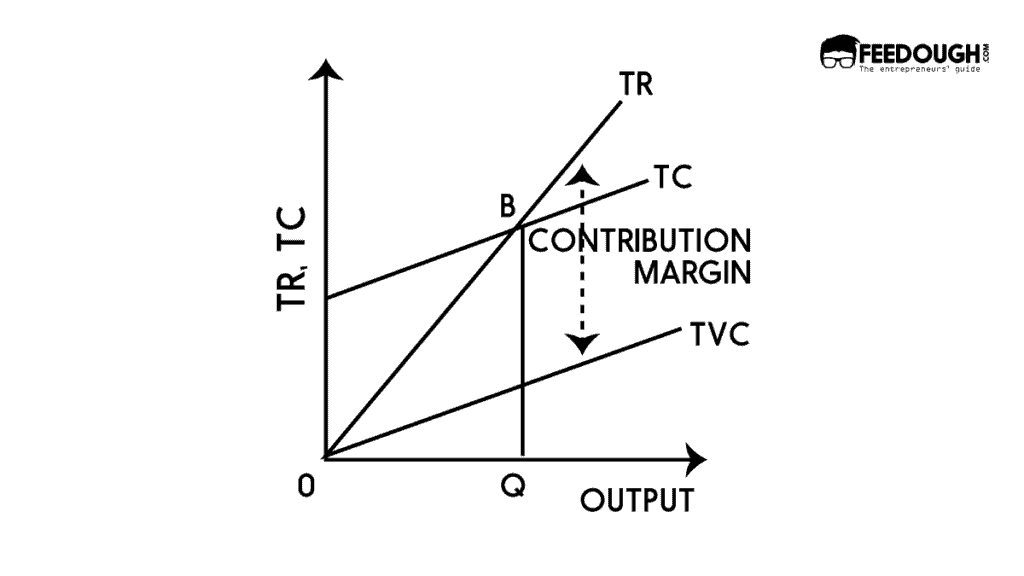
    The figure (P – VC)  is important and is known as the Unit Contribution Margin (C). It represents the marginal profit per unit, or alternatively, the part of each sale contributing to fixed costs. By definition, unit contribution margin is the difference between the product’s selling price and its total variable cost.

    For instance, if a briefcase is sold for $100, the total fixed cost is $15,000, and the variable cost is $70 per unit, then the unit contribution margin is $30, and it helps to cover the fixed costs.

    Thus, the break-even point can be calculated more easily as the point where:

    Total Contribution = Total Fixed Cost

    Unit Contribution x Number of Units = Total Fixed Cost

    Number of units (n) = Total Fixed Cost (TFC)/ Unit Contribution (C)
    break-even analysis formula

    Alternatively, the break-even point in terms of revenue (currency units, a.k.a. sales dollar) can be computed by dividing the total fixed costs by the contribution margin ratio. The contribution margin ratio is the contribution margin represented as a percentage of sales. It is calculated by dividing the unit contribution margin (C) by the sale price (P).

    Break-even (in sales) = TFC/ C/P

    For example, in the previous example of the briefcase, the contribution margin ratio is 30% ($30 contribution margin per item divided by $100 sale price per item). So, the break-even point in sales dollars is: $50,000 ($15,000 total fixed costs divided by 30% =  $50,000)

    The next step is plugging in your data in a spreadsheet and then converting the spreadsheet into a graph. This graph will help in computing the break-even points for each level of sales and product price.

    Graphical Representation Of The Break-Even Point

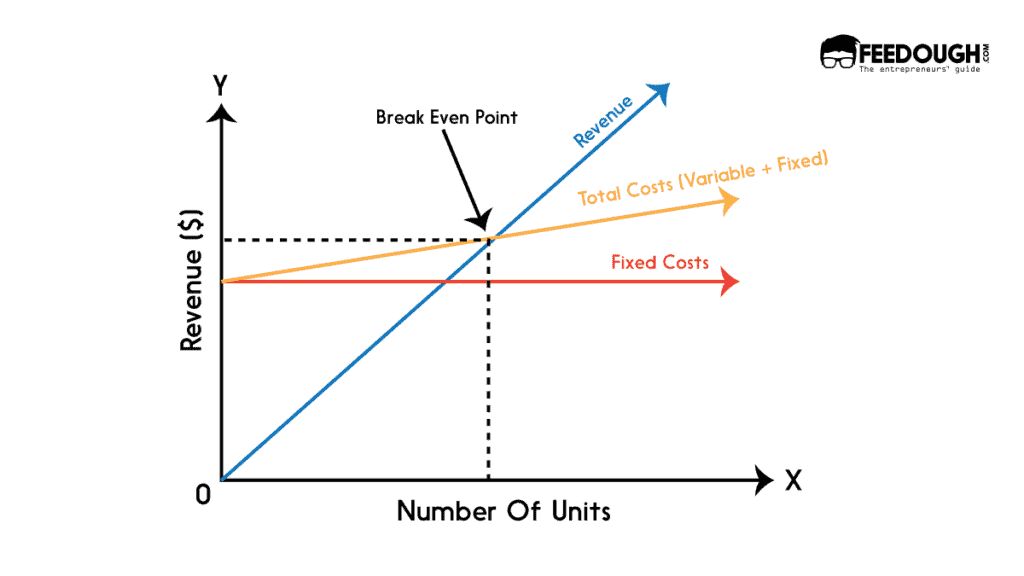
    The break-even analysis can be represented graphically using a break-even chart. The break-even analysis chart shows the various costs incurred at different sales levels.

    Explanation

    • The X-axis (horizontal) represents the number of units sold.
    • The Y-axis represents the sales revenue generated in dollars.
    • The red line represents the total fixed cost, showing that the costs are constant regardless of output level.
    • The Income line (blue line) depicts the amount of revenue generated as the number of units sold increases.
    • The yellow line is the total cost line (fixed and variable costs) that depicts how costs incurred by the business fluctuate as the number of units sold increases.
      Also, it is important to note that costs do not start at zero. These are the costs that are your fixed costs. Your costs start to rise as soon as you make your first sale (fixed costs + variable costs of selling one unit). Your costs will continue to rise as more units are sold. But they do not rise at as steep a rate as your revenue does when you sell more units. 
    • The point on the diagram where the revenue and total cost curve intersect is the break-even point where total costs equal revenue, and the company neither makes a profit nor a loss. Thus, the break even point is often known as the “no-profit” or “no-loss” point.
    • When you sell more quantities of goods, your costs fall below your revenue, resulting in a profit. Here, the revenue curve lies above the total cost curve. Thus,
       Profit when revenue> Total Variable cost + Total Fixed cost 
    • When you sell more quantities of goods, your costs exceed your revenue, and you’re making a loss. Here, the total cost curve lies above the revenue curve. Thus,
      Loss when revenue < Total Variable cost + Total Fixed cost

    Now, it is important to note that no economic theory is complete without assumptions, making the complex theory simpler and easier to understand. Hence, the assumptions that underpin the break-even analysis are as follows:

    • The revenue and cost functions are both linear.
    • Variable costs vary proportionately with output.
    • The total costs are classified into fixed and variable costs. It ignores semi-variable costs.
    • The volume of sales and volume of the production are equal. It means that there is no opening or closing stock.
    • The sale price is constant.
    • There is no change in technology and productivity.
    • There is only one product. In the case of multiproduct, the product-mix remains constant.

    Also, for your company to earn more profit, the break-even point must be lowered. Here are the most efficient methods for reducing it.

    • Increase product prices: If you increase the price of your product, you won’t need to sell as many units to break even. The marginal contribution will be greater per unit sold. But, also consider what the market is willing to pay. You won’t need to sell as many units, but you’ll still need to sell enough—and customers may demand a better product or better customer experience if you charge more.
    • Lower fixed costs: You’ll need to sell fewer units to break even if you can reduce your fixed costs. For instance, if you’re considering launching a retail business, but the numbers don’t add up, try selling online instead. By choosing this option, you are lowering your fixed cost of the rent. Also, you can go for outsourcing as it may enhance your company’s profitability by lowering manufacturing costs as production volume increases.

    Why Does Your Business Need To Perform Break-Even Analysis?

    A break-even analysis can help you determine the level of performance your company must achieve to avoid losing money. Thus, making it an important part of financial predictions for new or expanded product lines and businesses. 

    In addition to this, it assists you in figuring out how much seed money or startup capital you’ll need, as well as whether or not you’ll require a bank loan. Hence, there are several benefits of break-even analysis for your business as it helps in:

    • Assists in identifying the point of profitability: The objective of any business is to become profitable as quickly as possible. To make sure you’re on the right track, pay attention to your figures right away. You risk not making a profit if you don’t determine the break-even points for your products or services (or not as much of a profit as you believed you would).
      Once the break-even point is achieved, the break-even analysis aids in determining the company’s remaining/unused capacity.
    • Formulate a pricing strategy: Break-even analysis provides you with a far more solid foundation on which to price your items. Here, the selling price is a critical factor. Make use of the break-even charts to see the impact that changes in selling prices have on overall profitability. Also, periodically examine your present financial status to determine how patient you can be in order to achieve your break-even point.
    • Control and monitor costs: Even though your variable costs are subject to change, your fixed costs, like insurance or web development fees, must still be covered. You can do this by performing a break-even analysis. It is done by realising the direct impact of costs (both fixed and variable) on a company’s profitability, thus keeping the costs under control and within a certain range.
    • Set revenue targets: A break-even analysis may also be a useful tool for determining precise sales targets for your team. This is done by settling on revenue objectives that have a specific figure and a timeframe in mind.
    • Obtain funds: Break-even analysis is typically a critical component of company strategies when it comes to receiving funding. You’ll need to perform a break-even analysis if you want to obtain funding for your business or startup as you must demonstrate to the investors that your strategy is viable. Furthermore, the break-even point will make you more comfortable with the idea of taking on additional debt or financing.
    • Reduce risk: Some business concepts aren’t meant to be pursued. Break-even analysis can help you reduce risk by guiding you away from investments that are unlikely to be successful. Also, it will assist you in avoiding failures and limiting the financial impact of poor decisions on your company. On the brighter side, it will make you face reality about the potential outcomes.
    • Budget and Set Goals: Break-even charts and calculations should be utilised in the budgeting process since the company knows exactly how many units must be sold to break even. Furthermore, the firm is aware of the profits it will be able to generate at certain stages, which may be simply represented on a break-even chart.
    • Make better and smarter decisions: Any company strategy should include a break-even analysis. If you wish to take on investors or other debt to support your firm, it’s typically a necessity. You must demonstrate that your strategy is viable. Furthermore, if the analysis appears to be positive, you will feel more comfortable taking on the financial load.

    Now that we have established the importance of break-even analysis. The next important question is: when do you need to do a break-even analysis? Let’s find out.

    When To Use Break-Even Analysis?

    Basically, each time a company contemplates adding costs, it should conduct a break-even analysis.

    Thus, break-even analysis should be used to assess the risk and value of any business investment, particularly when one of the following situations occurs:

    • Starting a new business: Break-even analysis is a great tool to use when you’re starting a new business since it enables you to see if your idea is viable. It also supplies you with data that you may utilise to design your pricing strategy.
    • Expanding your business: According to Rob Stephens, founder of CFO Perspective, your business should use break-even analysis to determine how long it will take any planned investments or changes in your business to become profitable.
    • Creating a new product: When creating a new product, it’s also a good idea to perform a break-even analysis, especially if it’s a high-cost endeavour.
    • Lowering pricing: Firms may need to decrease their price approach to compete in a certain market sector or product. As a result, when decreasing prices, firms must determine how many more units they must sell to counterbalance or compensate for the price reduction.
    • Changing the business model: Finally, if you change your business model – such as introducing a new sales channel or adjusting your distribution strategy – your expenses might drastically change, so a break-even analysis is always a smart idea. When making business changes, there are many possibilities and what-ifs to consider, which makes choosing which scenario to pursue more difficult. Business executives will benefit from BEP’s ability to simplify decision-making to a series of yes or no questions.

    Limitations Of Break-Even Analysis

    Even though the break-even analysis is useful for making business decisions and more, the limitations of a break-even analysis should not be overlooked.

    • Data constraints: Since the break-even analysis is based on accounting data, it is subject to data limitations such as the omission of imputed costs, arbitrary depreciation estimates, and inaccurate overhead cost allocation.
    • Dependent on accurate data: The precision of your break-even analysis is determined by the accuracy of your data. You won’t obtain a trustworthy result if you don’t enter the correct data into the algorithm.
      Thus, break-even analysis may not be the most effective tool in your arsenal if your estimates are incorrect or you’re dealing with fluctuating costs.
    • Not a predictor of demand: It’s necessary to keep in mind that a break-even analysis isn’t a demand predictor. It is just a supply-side, that is, costs-only study, as it doesn’t tell you anything about how much the product will sell at these different prices or how many people will want to buy what you’re selling.
      The analysis only identifies how many units you need to sell to break even. It’s also worth noting that demand isn’t consistent. The number of people willing to buy your stuff will vary as your pricing changes.
    • Ignores elasticity of demand: The elasticity of demand is an economic measure that denotes the responsiveness of quantity demanded to a change in one of its determinants. These determinants are price, income, and preference, which affect the quantity demanded of a good or service. The demand for a good is said to be elastic if the quantity demanded responds substantially to changes in one of the determinants.
      As far as the break-even analysis is concerned, it completely ignores the concept of elasticity of demand and the prospect that varied prices or other variables will result in varying levels of quantity demanded.
    • Ignores the competition: Another drawback of break-even analysis is that your competitors aren’t taken into account. The knowledge about the new entrants to the market is crucial as they have an impact on the demand for your items. Their development in the market can even force you to adjust your prices, affecting your break-even point, that’s how much influence they have on your business.
    • Too simplistic: The formula for calculating the break-even point is straightforward. Many firms sell a variety of items at different rates. That subtlety is difficult to incorporate in the break-even formula. For that, you’ll have to deal with one product at a time or make an average pricing estimate based on all the items you’ll be selling.
    • Limited products: The break-even analysis is based on limited products and a small geographic area. Today’s business produces a wide range of products and operates several departments or facilities, all of which cannot be grouped together and shown on a single break-even chart.
      As a result, the scope of this analysis is confined to a single product of a particular business.
    • Short-Run Analysis: The break-even analysis is only useful in the short term, but it is not quite an effective tool for the long-term. Like in the case of fixed costs, your fixed costs remain the same over the short term. They could, however, vary over the long run. For instance, if your company grows and you decide to move to a larger office and hire more workers, your rent and salary bill will go up. In such a case, our break-even calculation gets befuddled. So, usually the break-even analysis is employed in the early phases of decision-making for this and other reasons.

    Due to such limitations, the break-even analysis has fallen out of favour with financial experts in recent years. It’s perfectly acceptable when performed correctly, and it may be beneficial, but it’s not appropriate for all organisations or situations.

    So, the financial experts recommend incorporating a break-even analysis together with other profitability indicators like net profit margin to get the most accurate picture of your business’s financial health.

    Go On, Tell Us What You Think!

    Did we miss something? Come on! Tell us what you think about our article on break-even analysis in the comments section.

  • OnlyFans Business Model | How Does OnlyFans Make Money?

    OnlyFans Business Model | How Does OnlyFans Make Money?

    As a platform that has recently become popular for NSFW content, OnlyFans is one of the most controversial businesses of recent decades. It attempted to disrupt the ‘sex industry’ with its new features and immensely different business strategies.

    Surprisingly, it succeeded. Launched in 2016, OnlyFans became profitable in less than four years of its launch. While a major portion of its data is still undisclosed, experts have been trying to get more and more information about the company. What is it that has made this business work? Will it be profitable in the long run? Is OnlyFans really a unicorn in disguise?

    Let’s decode OnlyFans business model.

    What Is OnlyFans?

    OnlyFans is a content subscription-based service that brings creators and influencers in direct contact with the consumers of their content or their ‘fans’. It is a social media platform that helps them earn directly by satisfying their audience’s requirements and thus, ‘monetise their influence’.

    The creators on the platform form a mix of health experts, artists, chefs, sex workers, and everyone else who has something to attract and influence people on.

    Tim Stokely started OnlyFans in 2016 as a family business. Stokely saw how virtual sex workers rely heavily on the producers of A-grade movies to earn. Also, since social platforms like Instagram don’t allow NSFW content, they have no place to interact with their fans and build their community.

    While a few workers use Twitter and the likes to accept direct requests from their fans, most of the work is unorganised and done under the table. Therefore, Tim partnered with his brother, Thomas Stokely, and his father, Guy Stokely, to establish a social media network more friendly to sex workers.

    The platform attracted a lot of people from different walks of life. Two years later, Leonid Radvinsky, the infamous ‘porn entrepreneur’, acquired a 75% share of Fenix International Limited, the company that owns OnlyFans. Since then, the platform has focused more on adult content.

    Who Are OnlyFans’s Customers?

    The customer segment of OnlyFans comprises content creators (aka the ‘influencers’) and content viewers (aka the ‘fans’).

    • Content creators post images, videos, and textual matter on the platform to satisfy their audience’s requirements and earn. They create content on various topics like fitness, art, food, travel, etc. Several celebrities like Cardi B, Blac Chyna, and Chad Johnson also have OnlyFans accounts to interact with their fans and popularise their upcoming works.
    • Content consumers are the loyal fans of these creators willing to pay for accessing their content and interacting with them. Many of the consumers joined the platform because of boredom during the COVID-19 pandemic. When Cardi B announced that she would be starting an OnlyFans account before the launch of ‘WAP’, the growth accelerated so much that its first BTS video brought $1000 in tips.

    However, most of the platform’s customers are sex workers and consumers of pornographic content.

    What Value Does OnlyFans Provide?

    OnlyFans brings content creators in direct contact with their audience. While the creators benefit from a direct payment mechanism, their fans enjoy interactions with them.

    What Value Does OnlyFans Provide To Content Creators?

    OnlyFans helps creators monetise their influence by hiding their content behind a paywall; that is, it can only be accessed when paid for. This way, they are not dependent on brands to pay them for partnerships, but they can directly earn by providing content pieces to their fans in exchange for money. The platform also facilitates interaction and engagement through live shows and paid direct messages. It further helps in the personal branding of these creators who can now know the requirements of their fans to optimise viewership and build their communities.

    Now, sex workers don’t have to rely on the exploitative porn industry; they can now directly engage with their audience, satisfy their requirements, and earn therein. Although other platforms let them interact with their fans over voices and cams, they are unorganised and charge heavy commissions. On the other hand, OnlyFans offer safety, security, and privacy in exchange for a flat 20% commission.

    The creators of mainstream content (non-NSFW work) also benefit from direct interaction with their fans. Several influencers opt for posting their artworks, cooking, fitness-related suggestions, etc., on the platform. Music celebrities like Cardi B, Swae Lee, and The Dream have used the platform to hype their upcoming works.

    However, it is difficult for new creators to monetise their content despite facing less competition than on social sites like Instagram. OnlyFans is better for influencers with an ideal fanbase on any other platform.

    What Value Does OnlyFans Provide To Consumers?

    OnlyFans lets the audience of the creators interact and learn more about them. These consumers get access to exclusive textual content, pictures, and videos from their favourite creators. They may also specify their requirements through direct messages and have them fulfilled in exchange for a small fee. This way, they feel like a part of their community.

    There is no doubt that most of the consumers are on the site to access pornographic content. They can subscribe to their favourite stars, request personalised content, and interact and tip them for their services. Thus, it is a win-win situation for all the parties.

    How Does OnlyFans Work?

    OnlyFans protect its content behind a paywall; that is, one has to pay to access them. This amount goes directly to the creators of the content. This is how the platform brings creators and their audience in direct contact.

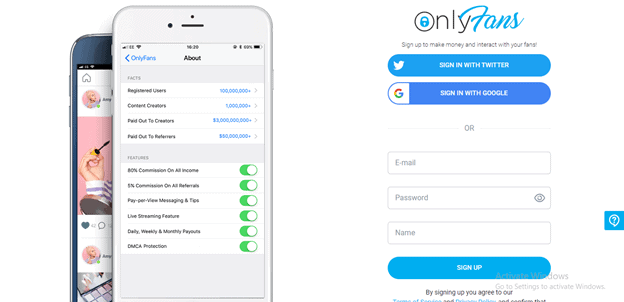
    One can sign up on OnlyFans through their email ID or use a Twitter or Google account to sign in. An important thing to note here is that the platform doesn’t differentiate between a general and a creator’s account. One account can be used in both ways.

    how does OnlyFans Work?

    Also, the platform asks one to verify their identity by providing a government-issued ID card. It is strict about not letting in anyone under the age of 18.

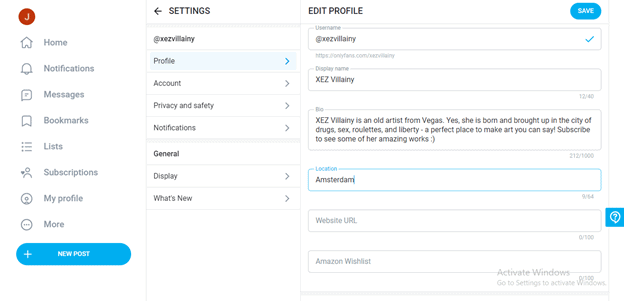
    After one has created their profile, they can update it by filling in the relevant details, changing their usernames, and adding a bank (to earn) and/or card (to subscribe).

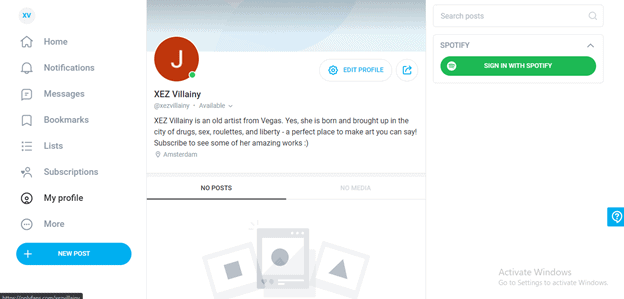
    Onlyfans profile

    The platform also allows its users to link their Spotify accounts and Amazon wishlists.

    Onlyfans Signup

    The first thing a new user sees on opening the account is the OFTV or OnlyFans TV, a free video channel that partners with creators across OnlyFans to help new users reach their content. OnlyFans also starts suggesting creators for new users to follow.

    Onlyfans OFTV

    How Does OnlyFans Work For Creators?

    New creators have to give their bank details before fixing their subscription rates. They may opt to keep their content free of charge to gain more followers. It has been seen that while celebrities, Instagram influencers, and famous porn artists get paid from the start, others earn little or no amount. There is a huge pay gap on OnlyFans as creators need to have an influence strong enough to monetise.

    OnlyFans allow them to earn in three possible ways:

    • Subscriptions: On this platform, creators hide their content behind the paywall of subscription. They can fix the rates to anywhere between $4.99 and $49.99. They can also offer discounted subscription bundles for a few months to their fans.
      Onlyfans subscription
    • Paid Direct Messages: These are usually PPV (pay per view) images and videos that creators send in response to their fans’ demands. They compose messages for individual accounts with attached visuals and add a price tag to those DMs. While regular paid private messages have a cap of $100, PPV messages are capped at $50.
    • Tips: Tips are the best way to engage users and build a loyal fan base on OnlyFans. While the minimum tipping amount is $5, creators like Monica Huldt have been earning over $100,000 on OnlyFans despite charging only $6.50 for a subscription; that’s the power of tips. Fans can also send non-monetary tips, that is, gifts by accessing the creators’ Amazon wishlist. An important point here is that tips are capped at $100 in the first four months of a creator’s activity, following which it rises to $200.
    • Payment mechanism: The influencers on OnlyFans receive a payout every 21 days. As already mentioned, the platform takes a 20% cut for its services and transfers the rest 80% to them.

    Besides posting content and engaging with their audience, influencers host lives and engage in mass messaging to strengthen their brand further. OnlyFans offers services to facilitate these events. It also allows the creators to assess their overall support and thank their top fans of the month.

    Moreover, the platform aims to eliminate the concerns of its creator customers regarding the privacy and security of their content. While it has established a DMCA team to look into copyrights violation, privacy is pretty much in the hands of the users. OnlyFans assures that it won’t reveal their data to their subscribers and penalise anyone who tries to take screenshots or share their content outside the website. It also strictly advises the users not to reveal any of their detail. However, the platform does share the information with third-party companies for ‘verification purposes’.

    How Does OnlyFans Work For Consumers?

    Consumers need to add payment cards before subscribing to a creator. Even if an influencer’s content is free, they need to give their payment information before accessing their content.

    Once this is done, they may start searching for their favourite artists and enjoy their content. Consumers can engage with them through comments and direct messages and send tips for good posts. They can also interact with the creators to learn more about them and get their wants in the form of PPV direct messages. They get a chance to be a part of their favourite creators’ community.

    OnlyFans Referral Programme

    Under this program, anyone who refers a creator to OnlyFans gets a 5% share of their earnings in the first year up to $1 million. At first, the company used to pay 5% earnings for life, but now it has changed its policy. However, since most new creators don’t earn well on the platform, the program doesn’t benefit many people.

    Onlyfans Revenue Model: How Does OnlyFans Make Money?

    OnlyFans follows a commission-based revenue model. It earns by taking a 20% cut from its creators’ income.

    On the other hand, the company mainly incurs expenditure on solidifying its hosting and payment-processing services, and conducting the referral programme. Lately, it has been working and spending hard on strengthening privacy and security services. Reports also claim that OnlyFans might try to reduce NSFW content to attract more mainstream celebrities and their fans.

    While official data is not available, a Bloomberg report mentions that, in 2020, OnlyFans generated more than $2 billion in sales and $400 million in net annual sales. Also, it is profitable!

    A major reason for the company’s success is that it has disrupted one of the most successful industries of the current decades: the virtual sex industry. After Radvinsky’s takeover, the platform has strengthened its reputation for ‘homemade porn’. This has struck several debates among the post-modernist and conservative groups regarding the ethics of the company.

    However, one cannot let the genius of the founders go underappreciated. As opposed to the linear businesses like Airbnb and Uber, OnlyFans follows a multiplicative model; that is, while an Uber driver needs to engage in one more drive to fuel the company’s revenue, a picture on OnlyFans can generate multiple tips.

    Thus, OnlyFans seems to be a billion-dollar business on its path to grow into a multi-billion dollar enterprise.

    Go On, Tell Us What You Think!

    Did we miss something? Come on! Tell us what you think about our article on OnlyFans Business Model in the comments section.

  • What Is MarTech? – Use Cases, Examples, & Future

    What Is MarTech? – Use Cases, Examples, & Future

    Technology powers almost every aspect of marketing today – from product development to refining target audience, to executing promotional strategies; marketing without technology today is a lame horse in the horse race.

    The advent of the internet has drastically affected the customer buying journey, and the customers have become more demanding now – asking for more personalisations, options, and distribution channels.

    To meet these needs, modern marketers came up with numerous technology-powered marketing tools, collectively known as martech.

    What Is MarTech?

    Marketing technology or martech refers to using technology and tools to plan and execute marketing strategies that assist in achieving marketing objectives.

    Often confused to be limited to digital marketing campaigns, martech today powers every aspect of modern marketing by helping marketers plan, create, execute, and automate their efforts, reducing the number of person-hours required to execute the marketing strategy.

    Martech intends to complement all aspects of marketing –

    • Product: Martech helps users forecast demand and conduct trend analysis to map a buyer persona and customer journey. The business uses all this to develop its products to be sold in the market.
    • Price: Marketers need assistance to set the right price of products for the right customers. Martech helps in the process by considering all the factors like the needs and wants of the customers and helps find the best price.
    • Place: It helps businesses choose the right channel of distribution to maximise operational efficiency. It automates the flow of information between marketing departments, managing inventory levels, warehouses, and other logistics. The distribution structure is digitised to streamline all sales processes.
    • Promotion: Modern technology helps businesses gather insights into customers to create and circulate effective ads to market their products better. This attracts the customers and allows them give a more personalised experience.

    Often, the marketing team uses a set of different marketing technology tools to assist them in overcoming marketing challenges and fulfilling their tasks. This set is referred to as the marketing technology stack.

    Challenges to Marketing

    Marketing is an uphill struggle that starts way before product development and often never ends. It comes with its own set of challenges that marketers have to overcome to offer a saleable product that makes profits. These are:

    1. Product Development: The biggest challenge a marketer faces is identifying the needs, wants, and desires of the target customer and predicting the best saleable solution for the same.
    2. Data Collection, Management, and Analysis: Today, every marketing step, be it big or small, revolves around data. Marketers identify industry trends, customer needs, product requirements, growth projections, SWOT, etc., using data analytics. However, collecting, managing, and analysing such massive data proves to be a challenge for marketers.
    3. Branding: Developing a brand in the competitive market is a marketing task that often poses a challenge to marketers. Often marketers fail to identify the perfect brand positioning that aligns with the market demand. Another challenge that marketers face is to align their brand image with the brand identity.
    4. Promotion: Marketers wish to choose the best promotional strategy to put in motion, but with so many variables in consideration, it is difficult to predict the outcome and effectiveness of a strategy. Moreover, personalised promotion poses a challenge for marketers.
    5. Relationship Management: Traditional marketing strategies often limit marketers in maintaining relationships with all the customers as it requires data management and one-to-one relationships, that require more workforce.
    6. Efficient Management Of Resources: One of the biggest marketing challenges is to manage limited resources better and direct them to a fruitful outcome. Traditionally, marketers used the trial and error method to find the perfect solution to a problem, but the process itself requires substantial resources.
    7. Sales: Even if a target market is well built, pushing the customers through the marketing funnel is a challenge. From lead generation, where the customer becomes aware of the offering until the actual purchase, marketers play an integral role.
    8. ROI Optimisation: Finding the best performing marketing, sales, and distribution channels require data analysis and management. Marketers often struggle to find the perfect balance of strategies that result in the most return on investment.
    9. Brand Experience: Maintaining a holistic identity around all the customer touchpoints and developing a brand experience across numerous online and offline channels pose a big channel for the marketing team.

    MarTech Use Cases

    A combination of digital tools that marketers use to make marketing campaigns and strategies more effective is a martech stack.

    The martech stack makes several marketing challenges easier to handle by making difficult marketing processes simple. Its use-cases include:

    Data And Analytics Solutions

    Marketers have a way to collect statistical data, interpret it and validate it for further trend and demand analysis. Today, technology-powered software takes several attributes into account to generate results and trends, which helps marketers to analyse buyer behaviour. They also provide a quantifiable measure of the effectiveness of marketing campaigns and messages. Software like Google Analytics, Oribi, etc., makes it easier to collect website and application data and execute marketing strategies. One can even use tools like Authentiq, ConsentEye, etc. to better make legal data compliance.

    Advertising And Promotion

    Martech has made microtargeting and personalisation possible. Advertisers today can use platforms and tools like Google Adwords, Facebook Pixel, etc. to power their advertisements using data and target the same to the most relevant users – the users who have visited their website, has certain interests, or buy products from their competitors, etc.

    Several other advertising tools find their place in the martech stack. They include display and programmatic advertising tools like SmartyAds to video advertising platforms like Vidsy.co, to even PR tools like PRMax.

    Commerce And Sales

    Sales automation includes the automation of all the processes from lead acquisition to conversion. Martech tools enable the easy flow of information among sales, marketing, distribution, and logistics throughout the supply chain.

    Streamlining all these administrative tasks improves operational efficiency and flexibility. Inventory levels can be controlled to balance with customer demand.

    Sales-oriented martech tools drive lead generation, automate sales processes, and improve customer experience to help convert leads to customers.

    Content And Experience

    With a marketing stack, developing a holistic experience for the customers is easy. Marketers use mobile application builders like Appypie, video marketing tools like invideo, email marketing platforms like MooSend, and content marketing tools like BuzzSumo to develop holistic marketing campaigns.

    Today, Content Management System (CMS) helps marketers build a website to manage the web presence without any specialised technical knowledge. The marketers also make use of both pull and push marketing strategies using search engine optimisation (SEO), search engine marketing (SEM), and social media marketing (SMM) to increase the visibility of websites on search engine result pages.

    Customer Relationships

    Customer relationship management is a set of strategies and practices which manage the company’s relationships and interactions with customers throughout the customer lifecycle. These strategies include reminders, contact and task management, and a record of reports. Martech stack like Hubspot, Salesforce, etc., makes it easy for marketers to maintain such records and build valuable relationships with customers and prospects.

    Moreover, such tools also help automate repetitive tasks such as email and mobile marketing, social media posts and ad campaigns. It increases efficiency and also provides a personalised experience to customers – emails and messages are automatically triggered based on particular choices of the customers – reducing the workforce and cost.

    Marketo is a SaaS-based platform that helps marketers automate and measure marketing engagement, tasks, and workflows.

    Social and relationships

    With the advent of the internet and social media, social media marketing has become an important marketing channel. Social and relationship tools help make social tasks like SMM, event management, meetings, webinars, advocacy, influencer marketing, community management, etc., easier.

    SMM tools like Buffer enable marketers to manage their online presence by creating and scheduling posts across various social media platforms, monitoring conversations and trends, and doing collaborations. The main aim is to engage with the audience and attract their attention.

    Event management tools like GoToWebinar makes creating and managing webinars, meetings, and video calls easier. Moreover, some bots make handling social relationships smoother.

    Management

    Martech stack also provides internal talent management, collaborations, and product management solutions. Tools like Marvel, Notion, etc., make it easy for teams to connect with other members and manage projects better.

    Martech is one industry with a daily influx of innovation and new tools. Here are some examples of top martech tools that are important to marketers’ lives today.

    1. Hootsuite: It is a social media marketing tool that helps users manage social media channels and launch marketing campaigns. It provides a dashboard from which the users can schedule posts across all the social media platforms and simultaneously measure ROI.
      hootsuite martech
    2. Salesforce: It is the biggest Customer relationship management (CRM) software in the market. It offers a system ‘lead to conversion’ approach that integrates contact management, collaboration tools, customer engagement and task management, and the data collected. All the departments of a business are offered to view the same customer from different aspects.
      salesforce martech
    3. GetResponse: It is a marketing tool that helps businesses build and maintain contacts and coordinate marketing campaigns. Though it is mainly an email marketing software, it allows the user to create landing pages, webinars, surveys, and publish newsletters. It has a user-friendly database that allows the user to create campaigns and manage mailing lists within the software.
      getresponse
    4. ContentGrow: It helps marketers overcome one of the biggest challenges to marketing  – content creation. Companies that wish to outsource their work of creating content can list them on their website. They select freelancers who suit the profile and budget requirements of the company and help in the process.
      content grow
    5. Google Analytics: It is the most popular web analytics tool used to collect information from websites and track web activity. The elements of the information collected include session duration, pages per session, website performance, and other visitor insights. It provides statistics and basic tools for marketing and SEO.
      google analytics

    Impact Of Technology On Marketing

    The introduction of technology in marketing has completely transformed marketing campaigns. Companies focus on making them more personalised and immersive to provide a better customer experience.

    Improves Efficiency

    The introduction of technology in marketing leads to the automation of many laborious tasks. This causes a reduction in costs and person-hours required to execute the marketing strategy. Marketers have more time to strategise and invest it in forming a combination of company-suited marketing tools.

    Actionable Insight Into ROI

    Attributes like higher ranking in SERPs, clicks, or page views per order placed give marketers an estimate of how the ROI will turn out.

    A strong connection is established between marketing activities, campaign investments, and sales results. It gives a close to the actual figure of leads and customers generated through marketing, if not completely accurate.

    Rise In Purpose-Driven Marketing

    Nowadays, customers no longer want to remain on a buyer-seller basis. They wish to build brand relationships by establishing trust and belief in the company values. This constitutes purpose-driven marketing.

    Now, technology allows the marketer to analyse elements that matter to the customers and make sure they align with the brand offerings, which further acts a catalyst to build trust.

    Improved Customer Experience

    The internet has allowed customers to explore and learn about the product and services they wish to buy before even going into a shop or contacting a salesperson.

    Content marketing plays a huge role in this process, and with the help of associated tools, marketers aim to deliver a personalised customer experience.

    Easy Collection And Organisation Of Data

    Marketers can now operate using vast quantities of data at their fingertips stored in electronic form. This enables a hassle-free analysis and provides deeper insights to marketers about their target audiences. This saves the marketers from skimming through raw data and wasting their time on it.

    Increased Budget Allocation To Grow Revenue

    Integration of technology with business operations requires a huge commitment in terms of finance which concerns marketers. The amount of investment depends on the type of technology used – some require high-level implementation while some have minimal integration. Either way, it gets justified later as the revenue amount outnumbers the amount used for investment.

    Based on previous years’ results, budget allocations towards marketing are increased, thus boosting revenue.

    Future Of Martech

    Once the technology is introduced in marketing, there is no going back. As businesses shift from traditional methods to modern methods, they are increasingly inclined towards technological advancements.

    New startups will emerge in the future, probably introducing even more martech tools for assisting marketing campaigns.

    More and more businesses are moving forward by investing in marketing technology to build their stacks and foster the company’s growth.

    Go On, Tell Us What You Think!

    Did we miss something? Come on! Tell us what you think about our article on marketing technology in the comments section.

  • What Is Buyer’s Remorse & How To Avoid It? [Complete Guide]

    What Is Buyer’s Remorse & How To Avoid It? [Complete Guide]

    Have you ever put something in your shopping cart only to regret it later? Well, you’re not alone. We’ve all been there.

    It starts with a hasty or heavily influenced purchase decision. However, as soon as the money exchanges hands and you own the item you’ve been dreaming of, you start to experience an uneasy knot in your stomach. You begin to doubt your decision and whether or not the purchase was justified.

    “Do I really need it?”

    “Is it really better than the one I didn’t buy?”

    This feeling that you experience is buyer’s remorse.

    Don’t worry, it’s entirely natural, and it’ll pass once you’ve adjusted to your new purchase and the shock of spending money has worn off.

    But the question is: Why do you respond in this manner after making a significant purchase? Is there a way to avoid buyer’s remorse the next time you buy something big? Or is there a way for you as a seller to prevent buyer’s remorse for your customers?

    Let’s find out.

    What Is Buyer’s Remorse?

    Buyer’s remorse is a feeling of regret or anxiety after having made a purchase. It might happen with something as trivial as a cup of coffee or something as important as real estate or a car, and often the guilt is accompanied by stress and panic.

    It is a term used to describe a period of mental discomfort or a strong negative reaction to a purchase that can be linked to a variety of factors resulting from conflicting beliefs and attitudes. It can be the fear of overspending, discovering a better deal, worrying that you haven’t made the best decision, or simply being depressed because the purchase you made isn’t exactly what you wanted.

    Types Of Buyers Remorse

    types of buyer's remorse

    According to recent research in the United Kingdom, 82% of customers expressed regret or guilt over a previous purchase.

    Usually, this feeling arises from two categories of post-purchase regret. They are:

    Outcome Regret

    It’s the regret you experience from your purchase outcome. It is triggered when you get the feeling of “This product isn’t what I needed.”

    • Regret due to forgone alternatives: When you chose one alternative over others, and the forgone alternative has a perceived better outcome than the current outcome.
    • Regret due to a change in significance: When the actual utility get from the purchased product is less than the perceived utility. In simple terms, the purchased product is unable to meet your expectations.

    Process Regret

    It occurs when you give yourself the blame for having a faulty purchase process.

    • Regret due to under consideration: When you wish, you should have put more effort into making the purchase decision.
    • Regret due to over consideration: When you wish you could have made less effort to obtain the desired result.

    Psychology Behind Buyer’s Remorse

    Most of the time, buyer’s remorse is stated as a natural human reaction arising from a feeling of caution. However, psychologists believe that the phenomenon of buyer’s remorse is associated with the psychological notion of cognitive dissonance and the approach and avoidance mechanisms.

    Cognitive Dissonance

    Cognitive dissonance is a feeling of psychological distress that happens when you’re at odds with your thoughts.

    After every purchase, you go through a period of post-purchase rationalisation, convincing yourself that you made the right decision by weighing the positives over the negatives. However, when this process leads to doubt, there is buyer’s remorse.

    Buyer’s remorse or psychological pain is a form of cognitive dissonance that is more likely to occur when you invest a substantial amount of resources, such as money, time, and cognitive resources, in purchasing an item.

    There are three key aspects linked to cognitive dissonance and buyer’s remorse:

    • Effort refers to the resources invested in a purchase, like time and money, proportional to the transaction’s importance. Buyer’s remorse is more likely to occur when purchases necessitate a lot of effort but don’t yield many benefits.
    • Responsibility alludes to the fact that the purchase was made voluntarily. If you had a choice and made the purchase at your own free will, you are more likely to feel dissonance as you don’t have anyone else to blame for those erroneous purchases.
    • Commitment refers to the continuation of an action. Simply put, it means that now that you have made the purchase, you’ll have to live with that new-found, potentially not-as-cool-as-you-thought object for quite some time.

    The Approach And Avoidance Mechanisms

    Another theory behind the psychology of buyer’s remorse is given by Art Markham, a psychology and marketing professor at the University of Texas. According to his research, buyer’s remorse is grounded in two distinct processing systems: the avoidance motivational system and the approach motivational system.

    The avoidance mechanism instructs you to avoid the purchase by providing justifications. On the other hand, the approach system encourages you to pick your happiness; it is more concerned with immediate gratification than long-term effects.

    For instance, when you go shopping, the approach system has the upper hand. Markham explains,

    “When you see a new pair of shoes, a terrific dress, or a fantastic top, you think about how much you want to own it. Then, you’re purely governed by the approach system while your avoidance system plays a negligible role. However, once you’ve made the purchase, the approach system is switched off, and avoidance concerns take their place, and you start to consider all of the implications of your purchase.”

    This is how buyer’s remorse manifests itself.

    What Causes Buyers’ Remorse?

    Buyer remorse is never the cause of regret. It is the regret resulting from several triggers that include:

    Expensive Purchases

    Expensive offerings often result in both outcome regret and process regret as they involve all three cognitive dissonance elements – effort, responsibility, and commitment.

    The more expensive an offering is, the more unlikely it is that you buy it without thought or effort. Expensive offerings make you compare it with alternatives, resulting in a process regret.

    Moreover, such offerings may also result in outcome regret as you might have raised your expectations depending upon the money you pay for it.

    Impulse Purchases

    Impulse purchases result from a strong, sometimes irresistible urge to buy the offering. Social media, fear of missing out, and other factors disrupt the usual buying process of customers, making them make decisions powered by emotions rather than rational thinking.

    Today, there’s an increasing trend of people making purchases because they saw a product online, irrespective of whether they need it or not. Moreover, many customers belonging to the younger generations buy something “simply for the gramme” (read: simply to show off on social media).

    It might sound ludicrous to purchase to please a social audience, but social media and FOMO form a strong trigger for spontaneous purchases, resulting in increased buyer’s remorse.

    In fact, Gen Z has the highest percentage of buyer’s remorse, with 70.8% of them agreeing to the fact that they bought an item simply to look cool in the eyes of their social media audience.

    External Stimuli

    External stimuli are marketing cues used by marketers to attract and lure customers to buy their offerings. It constitutes advertisements, personalised marketing, targeted marketing, in-store promotion, sales promotion, etc.

    Today, marketers know more about your interests than you do. They use this data to stimulate your demand for their offerings.

    Strategies like marketing scarcity, discounts, targeted advertisements, remarketing, etc. make sure you fulfil your desires by making a purchase.

    For example, you become a prime target for remarketing tactics when you leave a website without completing a purchase. The brand makes it their mission to make you complete your purchase and excute this plan using methods such as social media ads, discount pop-ups, and other intrusive methods.

    “Have you forgotten anything?” Emails and advertisements like this assist brands in devising strategies to entice you to buy things that you may later regret.

    Interpersonal Influence

    Interpersonal influence is the degree to which others influence your decision. It includes two dimensions –

    • Informational influence: It is how you perceive information gathered from knowledgeable others as your evidence of reality. For example, when you rely on your techy friend’s advice on buying a good laptop.
    • Normative influence: It is how your purchase decisions are influenced just to maintain your image in the eyes of significant others. For example, when you buy a 55 inch TV instead of 43 inch TV just to look good in the eyes of your office friends.

    The more susceptible you are to interpersonal influence, the more chances are that you will suffer from post-purchase regret.

    Paradox Of Choices

    Several solution options to one problem often result in cognitive dissonance as the option you choose may lack some of the features the other option had to provide. Moreover, it also leads to the regret of over consideration, where you feel guilty of spending too much time to something that could have been done sooner.

    But, you are unlikely to be disappointed with your purchase if you know your triggers and take some simple, meticulous precautions before purchasing. So, what are these precautions? Let’s find out.

    How Can Customers Avoid Buyer’s Remorse?

    When you realise you’ve overspent your budget or the psychological “high” of the purchase wears off, it leaves you with buyer’s remorse. But, buyer’s remorse is hard-wired into our minds, so it’s unlikely to escape it completely.

    So, when temptation rears its ugly head, remember these guidelines that will help you to improve your financial decisions and reduce the amount of regret you experience.

    Practice Setting Shopping Boundaries

    Your purchases would become much more deliberate once you remind yourself to budget. Start debating your inner voice whether you actually want or need the item.

    Learn to see urgency as a red flag and make purchase decisions by separating your emotions and examining your needs and finances.

    If it isn’t something you’d use and enjoy practically every day, it’s probably not a good use of your hard-earned money.

    Equate Price To Work Hours

    Take a few minutes before purchasing to calculate how many work hours it will take you to recoup the cost of the item.

    For example, if you earn $100 a day and decide to buy $500 worth of home decor at the spur of the moment, it will take you around five days of work to cover the expenses.

    So, do this simple calculation, every time you’re tempted to buy something that isn’t on your shopping list.

    The knowledge that the “extra” item that you’re currently swooning over can cost you days of work may persuade you to reconsider your purchase.

    Research Before You Buy

    Have you done any research on the item before purchasing it? If you answered no, you should seriously begin incorporating research into your purchasing strategy.

    The more information you have before purchasing a product, the less likely you will regret your decision afterward. This is because knowing what you’re buying and reading reviews can assist you in fathoming what you’re getting yourself into. But also learn to stop your research when you get your answer of “Whether this product will solve my problem or not?”.

    Wait For 72 Hours

    Before purchasing anything expensive you’ve had your eye on, take a step back and wait, rather than hopping online or running to the store immediately.

    This one does need a lot of willpower, but it is effective. Creating a buffer between a stimulus (the item you want to buy) and the final response (purchasing or not buying that thing) can help you determine whether you bought something on impulse or if it’s something that will add true worth to your life.

    Experts recommend deliberating about a purchase for at least 72 hours before making a choice. If you still desire the item after this period, you’re less likely to be disappointed with your purchase.

    Avoid Shopping Apps

    The average U.S. smartphone user spends three hours and fifteen minutes daily on their phones. A significant portion of that time is spent on various apps, including a shopping app.

    Scrolling through Instagram and seeing an enticing sponsored post or “window” shopping on a secondhand or retailer’s app becomes addicting and can breed buyer’s remorse.

    In fact, 64% percent of the respondents in a survey admitted they would save money if they stopped buying things online.

    So, delete any non-essential app and unsubscribe their email alerts that encourage you to spend so that you don’t have to deal with the consequences later.

    Use Cash Instead Of A Credit Card

    This can help you stick to your budget and avoid racking up credit card debt. Don’t be fooled into thinking that spending all of the money in your wallet won’t result in some buyer’s remorse.

    Stick To Your Shopping List And Follow A Budget

    Before you go shopping, make a comprehensive list of what you want to buy so that you don’t end up buying things you don’t need and regret afterward. Thus, this list can help you stay on track.

    For instance, before you start out looking for a house or a car, establish a list of the features you absolutely want. Set a budget and stick to it. Don’t get sucked into paying thousands more for features you didn’t even realise you needed.

    Also, remember to stick to your budget. Even if you shop with credit cards, you have to keep your spending under control.

    Lastly, if you frequently have buyer’s remorse, enlist the support of a close family member or friend to help you stay accountable for your purchases.

    How Can Sellers Prevent Customers from Buyer’s Remorse?

    Without a doubt, as a customer, one must be mindful of buyer’s remorse.

    Even yet, the sellers equally must make their customers feel at ease with their purchase and not make them feel as if they have made a mistake in placing their trust in them.

    A seller devotes a significant amount of effort and resources to build strong customer relationships only to discover that their customer has buyer’s remorse and has started to detest their relationship with you.

    So, buyer’s remorse is also a nightmare scenario for a seller.

    Thus, preventing buyer’s remorse among the customers is not only an ethical move, but it can also pay off in terms of a better brand reputation and long-term sales.

    Here are some steps that can help a seller prevent buyer’s remorse in their business.

    Provide Value To The Customers

    Customers expect sellers to value them and provide a good customer experience. Thus, as a seller, one needs to analyze their customer’s journey data and find out as much about their customers. This will help them in understanding the foundations of their relationships with the customers. It will also help them see things through the eyes of the customer, thus, allowing them to focus on actions that will benefit them. As a result of this, the customers will be less prone to have post-purchase regrets.

    Recognise The Causes

    To assist customers in avoiding buyer’s remorse, a seller must first understand what causes it.

    Though every person is different, post-purchase regret is commonly caused by two factors:

    • Outcome regret, or
    • Process regret.

    The key to avoiding buyer’s remorse is to provide precise and thorough information to the customers. Sellers must demonstrate that there is nothing to conceal by offering transparent information and removing the fine print from their goods. If a seller can do this, they’ll drastically lower their chances of misleading potential buyers.

    Educate The Customers

    A company can portray itself as trustworthy and gain public trust by successfully educating its customers about its product.  Another advantage of investing consistently in educational content is that sellers can eventually establish themselves as thought leaders in their field.

    Excellent resources for educating potential customers are through a company’s blog. Aside from blogging, social media can be used to disseminate educational content.

    For instance, Diamondere, a leader in online jewellery sales, provides good educational content even if it means losing a transaction now and then. This company does an excellent job of being upfront and honest with customers throughout the process.

    Strategy used by Diamondere to prevent buyer's remorse

    Providing Timely Responses And Contact Information

    Sellers must provide direct phone numbers, email addresses, and links guaranteeing that if a customer has any concerns, someone will respond within a certain amount of time and that someone will work closely to help them.

    This way, the customers will never feel on their own, and after they’ve figured out how to utilise the product, they’ll be less likely to abandon it. Also, customers want to find the most relevant information in the shortest period of time. Thus, a company can generate more leads and sales opportunities if it responds promptly to its customers’ inquiries.

    Applying A Lenient Return Policy

    Peace of mind is important to online shoppers. They want to be able to return the goods and get their money back as soon as possible if the product does not fit them. Thus, for a seller extending their return date is one modest tweak that might improve sales and decrease buyer’s remorse.

    A flexible return policy earns the consumer’s trust because customers have ample time to test the item and determine if it fits them or not.

    Zappos, for example, is a well-known online shoe shop with a flexible return policy. The company gives a full refund for items bought within 365 days of purchase.

    Buyer’s remorse can strike even the most devoted customers. There will always be that one buyer who will regret their decision and return goods. However, businesses can reduce their losses using the correct approach and strategies.

    As far as consumers are concerned, don’t be too harsh on yourself. Just because you’re regretful now doesn’t imply you didn’t genuinely want the goods or that you made a poor decision. Simply be cautious the next time you’re considering purchasing anything, and consider taking a break to evaluate if you truly need that item after all…

    Go On, Tell Us What You Think!

    Did we miss something? Come on! Tell us what you think of this article on buyer’s remorse in the comments section.

  • How To Make Money On Twitter: A Guide

    How To Make Money On Twitter: A Guide

    You can be a journalist, blogger, content creator, or just information consumer intrigued about how can you make money on Twitter.

    But fret not. Unlike other social media channels, you don’t have to focus on just videos to become eligible to earning money on this platform. All you need to do is have decent followership ready to pay for what you post or do. Even if you don’t have a good followership, there are still numerous ways you use to get some money out of this platform.

    But if you’re new to this social media platform, here’s a brief introduction of Twitter for you.

    What Is Twitter?

    Twitter is a microblogging social networking platform that lets you post and interact with up to 280 characters long messages or microblogs.

    Today, one in every five adults in the USA use Twitter to consume short textual or visual information, participate in discussions, or share content. While majorly used for consuming news and keeping up with the trends, people also use Twitter to engage and interact with influencers and celebrities.

    why people use Twitter
    Source: American Press Institute

    But unlike Instagram, Twitter isn’t a visual-oriented social media network. People do have personal brands here, but it’s powered by expertise, experience, and information; rather than video trends.

    So, building a brand on Twitter is different from building your brand on Instagram, Facebook, or Snapchat. So the question arises –

    Is it possible to make money on Twitter?

    Well, if you have good followership and a renowned personal brand, there are numerous ways to make money on Twitter. You can even have a career dependent on Twitter, just like what people have with Instagram.

    Moreover, bonus points for you if you have a verified profile as it opens even more revenue streams on Twitter.

    How To Make Money On Twitter?

    Twitter is a game of followership. As long you have followers that engage and interact with you and your content, there are numerous official and unofficial ways to earn money on Twitter. Some include asking for money directly from your followers, while some include other money-making tactics.

    Here’s how it works –

    Build & Monetise Your Following Using Ofiicial Methods

    A few years back, Twitter didn’t care much about paying its creators or helping them make money using the platform. It focused on developing a network effect, starting discussions, developing trends, and making sure information came first to Twitter, so its advertisers and partners get most of the consumer insights and target perfection.

    Today, with the decline in advertisements, Twitter has slightly pivoted its business model. It wants you to build communities and make money out of them while sharing some of the profits with the platform.

    Super Follows

    Twitter super follows
    Source: Twitter

    If you’re over 18 years of age and have at least 10k followers on the platform, you can use Super Follows to create a recurring monthly income source out of Twitter.

    Super Follows feature allows you to open an option for your followers to pay to Super Follow you. By paying, they’ll receive bonus content like exclusive tweets and personalised replies, and badges that identify them as your Super Follower when they reply to your tweets.

    You can set the value of your exclusive content at  $2.99, $4.99, or $9.99, and for every Super Follow subscription,  you earn 97% of revenue.

    To apply for the Super Follows, click on Menu and select monetisation option. Once done, you’d need to fill out an application and accept the Super Follows Terms.

    Ticketed Spaces

    Twitter Ticketed Spaces

    Ticketed spaces let you create unique and exclusive live audio experiences by hosting workshops, interviews, or casual conversations with your loyal fans and followers. It’s similar to Clubhouse’s business model

    Usually, hosting and participating in a Space is free. But If you have over 1,000 followers and run three Spaces a month, you can create a Ticketed Space where they pay to join.

    Consider Ticketed Space to be a live paid audio event where the entry can be as low as $1 and as high as $999.

    The best part?

    You get 97% of the revenue earned.

    To apply for Ticketed Spaces, click on Menu and select the monetisation option. Select Ticketed Spaces, fill out the application, and you’ll be good to go.

    Tip Jar

    Tip Jar Twitter

    Tip Jar is a one-time tip or donation feature provided by Twitter where your followers can send you tips for the amazing work you do.

    Click on edit profile on your Twitter profile page. If you’re eligible, you’ll see the Tip Jar option in that menu. Use it to set the payment methods you’d like to use to receive payments. Your followers can use several payment platforms to send you tips, including Bandcamp, Cash App, Patreon, PayPal and Venmo. Once done, the tip jar will appear next to the Follow button on your profile.

    Twitter Amplify

    Twitter Amplify

    If you have a verified creator on Twitter who develop videos, you can use video monetisation programs offered by Twitter called Twitter Amplify. Amplify offers two different video monetisation programs –

    • Amplify Pre-Rolls: An opt-in advertising program to serve pre-roll ads against the video content you share on Twitter.
    • Amplify Sponsorships: A way to align your video content with via a one-to-one sponsorship with an advertiser.

    If you’re eligible, you’ll see a monetisation tab in the top navigation bar of the platform where you can enable Monetise all new videos with Amplify Pre-roll option. Or you can select monetise this video button within your Media Studio library to opt for Amplify Sponsorships.

    Build & Monetise Your Following Using Unofficial Methods

    The problem with official Twitter monetisation methods is that they require you to meet certain prerequisites related to followers, verification, content, etc.

    However, if you think you can host and hold a good conversation over Twitter, you can try these unofficial Twitter monetisation methods –

    Sponsored Tweets

    Several third-party platforms (like Sponsored Tweets, Network Niche) connect you with brands that want to run campaigns on Twitter. You take part in their campaigns and get paid per tweet.

    Sell Your Products

    One strategy that you can use even if you don’t have good followership is to sell your offerings (digital and physical products) by adding value to the existing conversations on the platform. If someone is looking for an eCommerce guide, you can help them and even promote your ebook or course that they can buy outside Twitter.

    Affiliate Marketing

    Affiliate marketing is similar to selling your products, but it involves selling someone else’s products and getting a commission whenever someone you refer buys that offering.

    Usually, the brand you work with provides you with a unique link to refer its offerings to other people.

    On Twitter, you make money using affiliate marketing in a similar way as you sell products. You add value to existing conversations or develop your discussions and insert the link at the apt time.

    Go On, Tell Us What You Think!

    Did we miss something? Come on! Tell us what you think of this article on how to make money on Twitter in the comments section.