Feedough Logo

Blog

  • Digital Advertising: Definition, Types, & Examples

    Digital Advertising: Definition, Types, & Examples

    The rapid development of technology has changed how the world works. User behaviour and media consumption has taken an entirely different route, thanks to the internet. This change has forced marketers to follow and adapt to the changing marketing channels. Even advertising isn’t limited to traditional channels anymore. It’s now the era of digital advertising.

    Just like traditional advertising, digital advertising comes in numerous shapes, sizes, and forms. The basic principle behind digital ads is the same as that of conventional ads. Still, these ads have their own set of importance, types, advantages, disadvantages, and even operations that differ from traditional ads.

    But what exactly is digital advertising?

    What Is Digital Advertising?

    Digital advertising is the action of calling public attention to an offering through online and digital paid channels by an identified sponsor.

    Precisely, digital advertising is any form of advertising that appears online or on digital channels like websites, search engines, social media platforms, mobile apps, digital OOH, and other channels that can be accessed digitally.

    Digital advertising is a branch of digital marketing and deals only with the promotional mix, and not with other Ps of the digital marketing mix.

    Characteristics Of Digital Advertising

    Digital advertisements come with their own unique set of characteristics. These are:

    • Paid form: Digital advertising, just like other forms of advertising requires the advertiser (also called the sponsor) to pay to create the advertising message and creative, buy advertising space or slot, and monitor advertising efforts.  
    • Measurable: Digital ads are highly measurable in terms of how many people view them and how many people interact with them. Often, advertisers are even able to calculate accurate ROI of these ads.
    • Goal-oriented: These ads are always backed by goals – to promote, sell, increase exposure, etc.
    • Data backed: Digital ads are backed by data of what they are about, whom they are targeted at, and how the target audience interacts with them. Data forms the backbone of digital ads.
    • Personal or non-personal: Ads on digital media can be highly personalised based on user activity over the internet or non-personal with a motive to enhance brand awareness.

    Evolution Of Digital Advertising

    The internet has changed the landscape of advertising. At the beginning of 90s, the investment in the digital advertisement was zero. But over the years, in 2025, digital advertising is expected to cross over $500 billion worldwide.
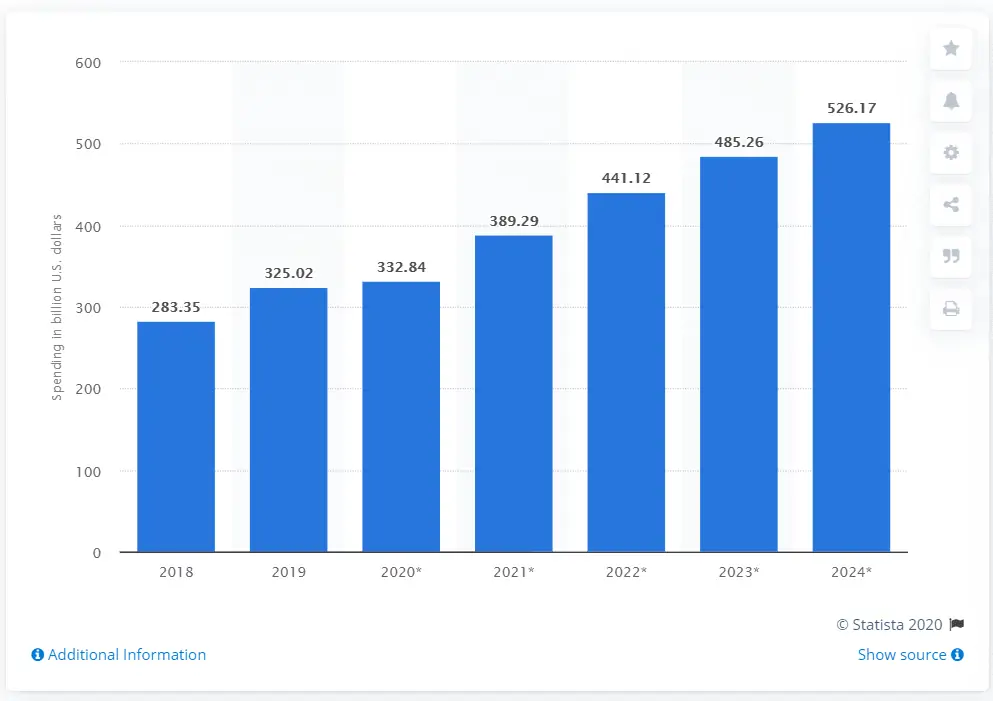
    Evolution Of Digital Advertising

    It all started in 1994 when hotwired.com, a Wired website, released the first banner ads on its website.

    first banner history

    The same year saw the development of HTTP cookie that helped the advertiser and publisher track user behaviour.

    Soon after, in 1996, Flash was introduced, which formed the framework for web advertising.

    In 1997, pop-up ads were discovered and found wide usage all over the internet.

    In 1998, Google launched and brought a concept of minimal search engines. The company started monetising in 2000 and paved the way for pay per click advertising and search engine marketing.

    Mobile advertising also started in the year 2000.

    In the early 2000s, Facebook launched and brought in its hyper-targeted ads model that used user interests and demographics for advertising. This started the trend of targeted ads.

    The late 2000s and early 2010s saw the launch of YouTube, Smartphones, iPad, Instagram, Snapchat, Internet of Things, and Real-Time Bidding that later changed the advertising scenario to:

    • Bidding
    • In-app and mobile
    • Microtargeting

    The digital advertising agency is still growing, and everyday finds its application in a new channel.

    Types Of Digital Advertising

    The digital media landscape is vast. It caters to every activity of the user on a digital device and the web. Digital advertising makes sure to tap the user’s attention on every touchpoint it can. Thus, it can be divided into different types depending upon the type of ad, channel, and the ad’s intent.

    Search Ads
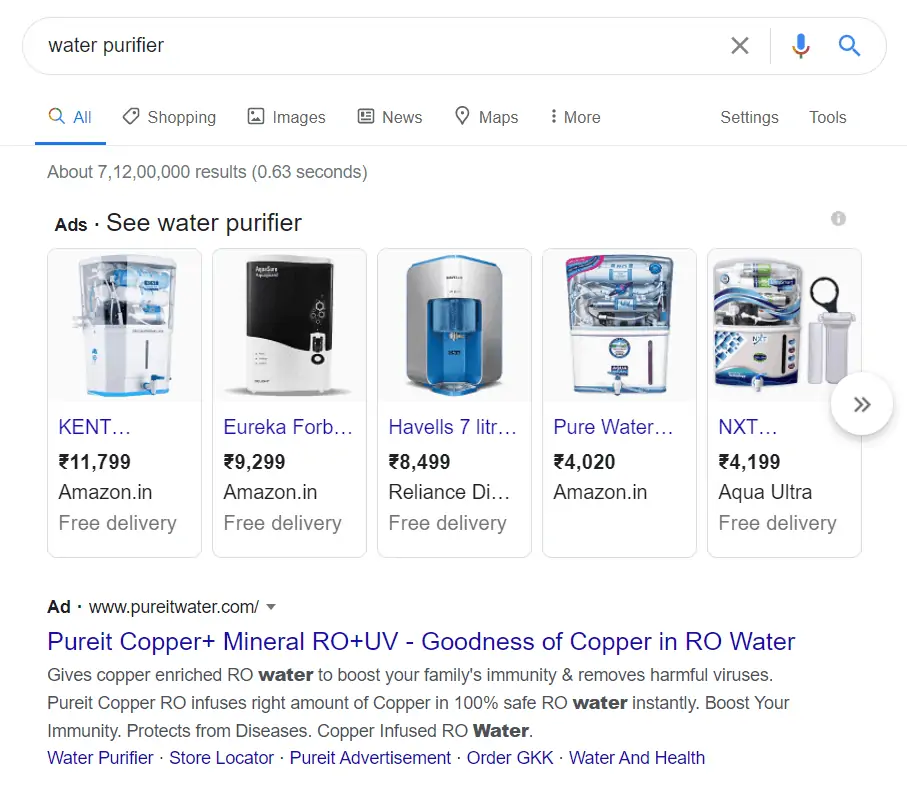
    search ads

    Also called search engine marketing, this type of advertising uses search engine results to promote the offering. Advertisers target keywords that people search for on a search engine and push their webpages at the top of the results by paying such search engines like Google, Bing, etc.

    Such ad campaigns are intent oriented and are also called pay per click or PPC campaigns as they’re paid for by the advertiser only when a user clicks on the result.

    These ads are further divided into search ads, shopping ads, maps ads, etc. depending upon the search engine they’re listed on and the intent behind the target user’s search.

    Display Ads

    digital ads

    Display advertising is the most common form of digital advertising. It comprises images, text, and animation, and shows up as banners on websites and blogs.

    These ads can be personalised according to the user activity on the internet or non-personalised and are usually released to increase brand exposure, offer exposure, and fulfil other such motives.

    Usually, display ads are further categorised as:

    • Traditional Display Ads: These ads have fixed sizes and occupy a fixed space irrespective of the device the website is loaded on.
    • Responsive Display Ads: These ads adapt to the size of the screen a website is viewed on.

    Native Ads
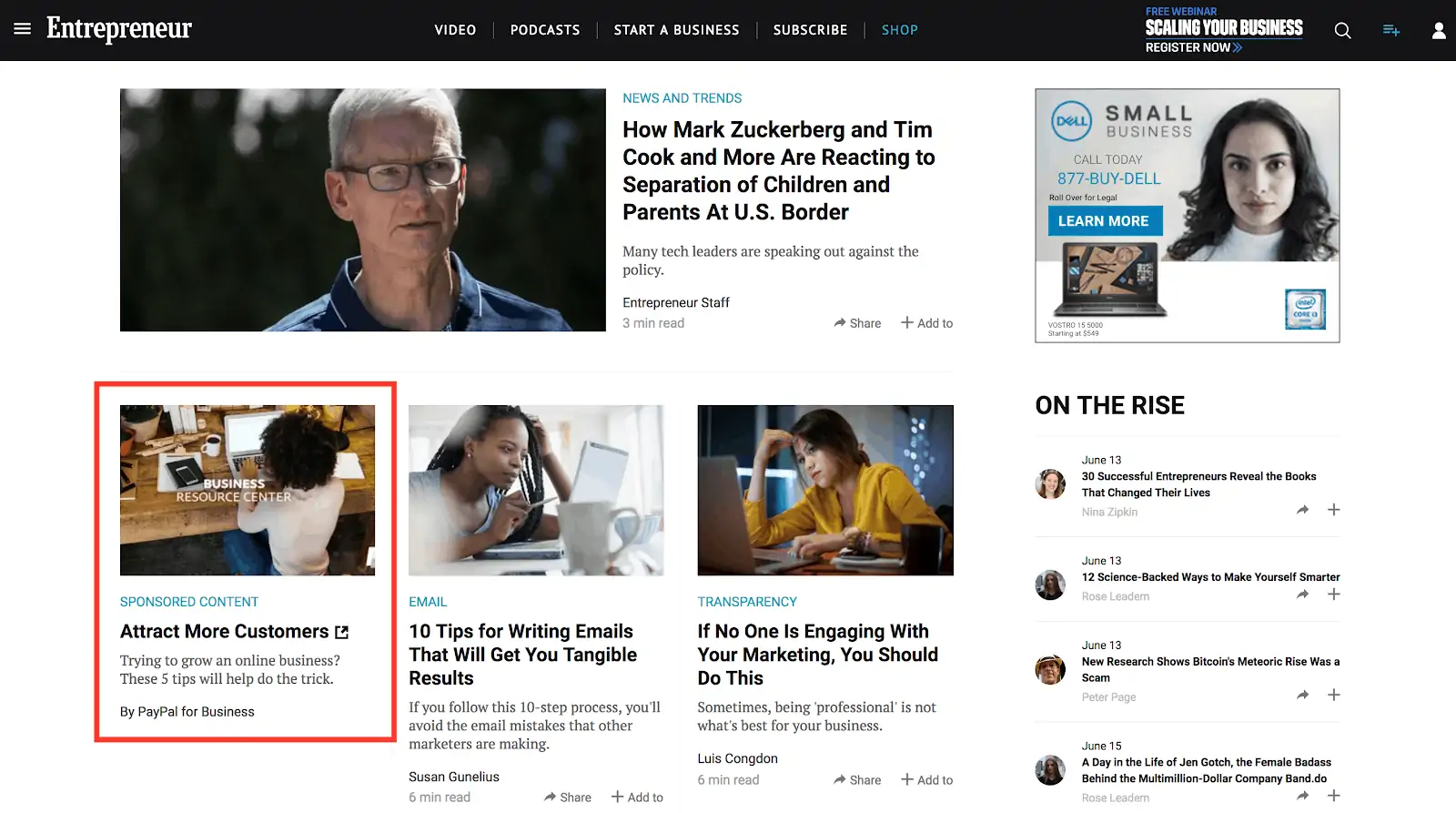
    Native Ads


    Source: LinkedIn

    Native ads are camouflaged ads that blend with the content they are added to. Sponsored listings within or after blog posts form an example of native ads. These ads result in better user interaction when compared to other forms of digital ads because of their property of matching the structure and function of the platform it appears on.

    Video Ads

    Video ads are digital ads used to promote an offering using videos or motion graphics that play before, during or after streaming content, or as a standalone banner or native ads.

    Used mostly on video streaming platforms like YouTube, Facebook Watch, etc. video ads are also used on websites and blogs as out-stream ads to gain website users’ attention.

    Audio Ads

    Audio ads are used majorly on audio streaming platforms like Spotify, LiveXLive, Pandora, etc. The advertiser gets into a contract of the streaming platform or the content creator to add the brand’s ads within, before, or after the content.

    Mobile Ads

    mobile ads

    Mobile ads are digital ads that are delivered on mobile devices. These ads use two different platforms:

    • Mobile Web: These are the websites, blogs, and webpages arranged to fit the mobile screen sizes.
    • In-App: Mobile applications are specialised applications developed to target specialised moments. These apps are easy to download, navigate, and involve a higher retention rate than other channels.

    Remarketing Ads

    remarketing ads

    Remarketing ads are digital ads targeted to a brand’s online visitors with a motive to bring them back on the website or application, or perform an action. For example, a brand targeting its ecommerce store’s visitor through ads to make him complete his/her incomplete transaction. Another example could be of an event brand that targets its website visitors with informative ads of new events that they could attend.

    Social Media Ads
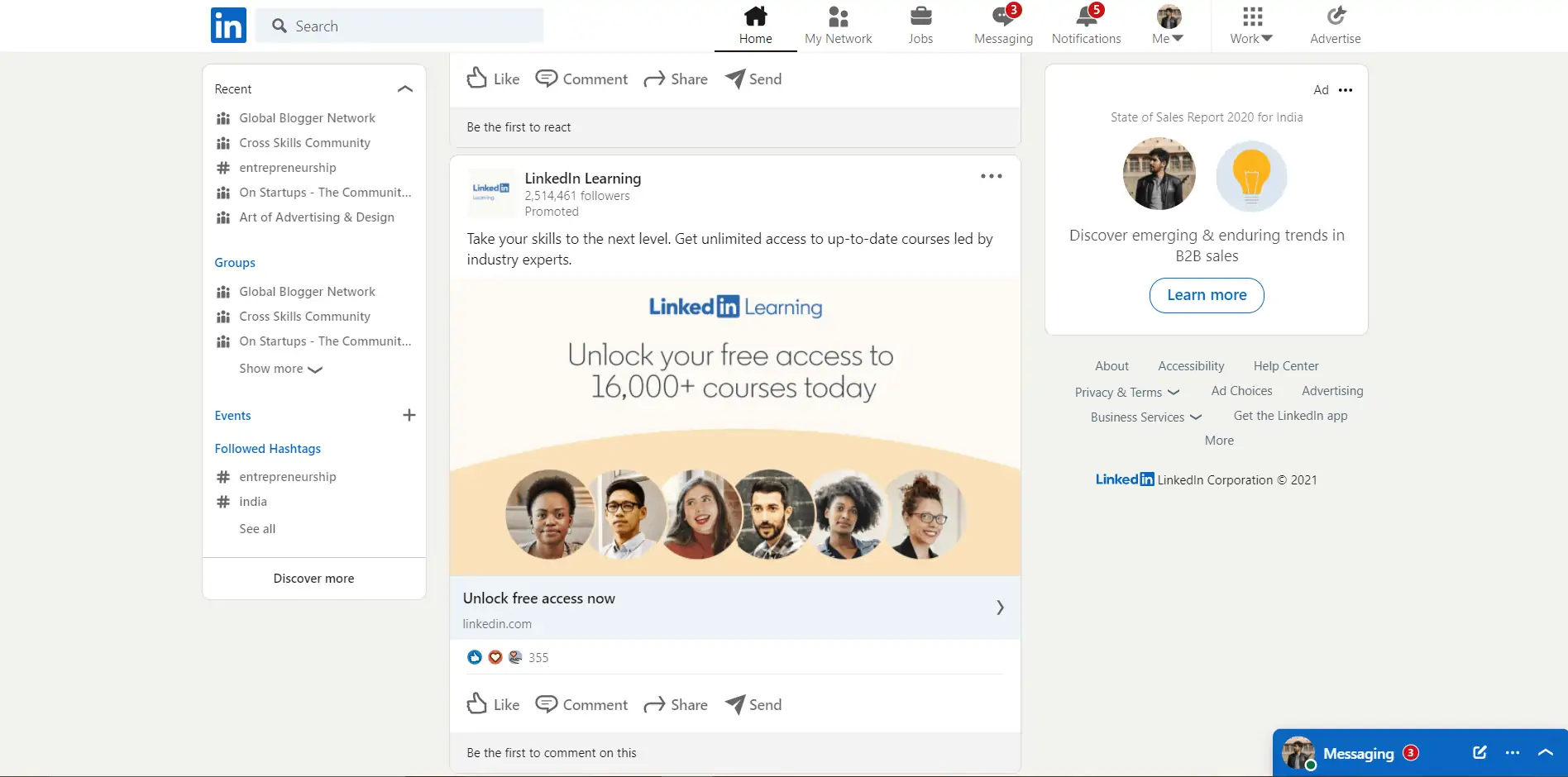
    Social Media Ads

    Social media ads appear on social media platforms like Facebook, Instagram, Snapchat, Reddit, LinkedIn, etc. These ads can be display ads, native ads, video ads, audio ads, remarketing ads or mobile ads.

    Social ads are hyper-targeted ads that target the users depending upon their demographics, locations, interests, and even psychographic and behavioural interests.

    Influencer And Curator Ads

    Influencer ads and curator ads are comparatively new ad forms where a brand directly contacts the content developers and/or content curators with good followership to place the brand or offering in their content. This helps the brand to gain exposure and trust of the influencer’s followers.

    How Does Digital Advertising Work?

    Even though digital advertising is different from traditional advertising, it works in a way similar to the latter. There are parties involved, a contract backs the transaction, and the creative and the ad copy is developed to meet the advertising goals.

    Parties

    A typical digital advertisement involves three different parties:

    • Advertiser: It’s the brand that creates and funds the advertisement. For example, Nike with its campaign ‘Just Do It’.
    • Advertising Network: It’s the middleman that connects the advertiser with the publishers and the advertisement space providers. For example, Google runs AdWords for advertisers and AdSense for publishers.
    • Publisher: A publisher is anyone who owns a digital property and is willing to monetise that property by selling ad spaces. For example, Feedough.com.

    Generally, an advertising network acts as a mediator that connects an advertiser with numerous publishers or digital property owners.

    However, in cases of big players like with social media advertisements, the publisher, like Facebook, LinkedIn, etc., becomes the advertising network itself.

    Structure

    Every digital advertisement is backed by a goal or a motive. It could be to get more exposure, more leads, remarketing, or more action performed. And this goal forms the spine on which the advertisement’s structure stands on.

    Besides the goal, the advertisement structure includes the following:

    • Medium: Which medium will the ad use to reach out to the users?
    • Creative: What will be the graphic and textual content of the ad creative?
    • KPI: How will the advertiser measure the return on investment for the advertisement campaign?

    Contract

    A variety of contract models exist for digital advertising. These are:

    • Pay Per Impression (PPI): The advertiser pays a fee every time an ad is displayed to the user, no matter if an action is performed over the ad or not.
    • Pay Per Click (PPC): The advertiser pays a fee every time an ad is clicked on.
    • Pay Per Action (PPA): The advertiser pays a fee every time the user performs an agreed action. The action could be anything from filling up a form, signing up, registering for something, or buying a product.

    Generally, more than one advertiser applies for a single ad space which increases the competition. Space is then provided to the advertiser who bids the most. This process works real-time and is called real-time bidding.

    Digital Advertising Vs Traditional Advertising

    Traditional advertising is offline advertising. It involves using channels like magazine, newspaper, television, radio, direct mail and billboards to advertise an offering or an idea. These ads differ considerably from digital advertising.

    Digital Advertising
    Traditional Advertising
    Definition
    Digital advertising is the act of calling public attention to an offering or an idea through online and digital paid channels by an identified sponsor.
    Traditional Advertising is the act of calling public attention to an offering or an idea through offline paid channels by an identified sponsor.
    Medium
    Online and digital channels like website, search engines, social media platforms, etc.
    Offline channels like radio, television, newspaper, etc.
    Data-Driven
    Digital ads development, deployment, and measurement are backed by data.
    It isn’t possible to get accurate data to back all traditional advertisements.
    Communication
    Digital ads include both single sided communication and two-sided communication. The user gets to interact with the advertisement.
    There’s no way for a user to interact with a traditional advertisement.

    Pros And Cons Of Digital Advertising

    Digital advertising comes with its own set of advantages and disadvantages that sets it apart from traditional advertising. 

    Advantages

    • User-Targeted: Digital advertising is highly user-targeted and can even be microtargeted to the target audience’s smallest section.
    • Inexpensive: Considering the ROI of digital ads, it is considered an inexpensive form of promotion.
    • Data-Backed: Digital ads are data-backed. This data can be used to develop campaigns that were not possible before.
    • Interactive: Digital ads can be made interactive, increasing engagement and proving beneficial for both the advertiser and users.
    • Real-Time: Changes in digital ads can be made real-time. Even the analytics and data can be collected in real-time. This proves to be a great advantage.
    • Global Coverage: It’s easy to launch digital ads to a worldwide audience without even going to such places.
    • Wide Range Of Formats: Digital ads come in numerous shapes and sizes, and the scope is still untapped. 

    Disadvantages

    • Limited Audience: Only 59 percent of the global population uses the internet. The rest don’t have access to it yet. So, if the brand’s target audience doesn’t have internet access, digital advertising could be of no use.
    • Competition: Many advertisers bid for one ad space that increases the competition and prices of ads.
    • Increasing Ad-Blockers: Ads are everywhere. This bugs digital users who look for ways to block such ads.
    • Requires A Specialised Skillset: Running digital ads requires a specialised skill set to develop and optimise ads and bidding for the same. 

    Digital Advertising Examples

    Here are some examples of each type of digital advertising to understand the concept better.

    Search Engine Marketing
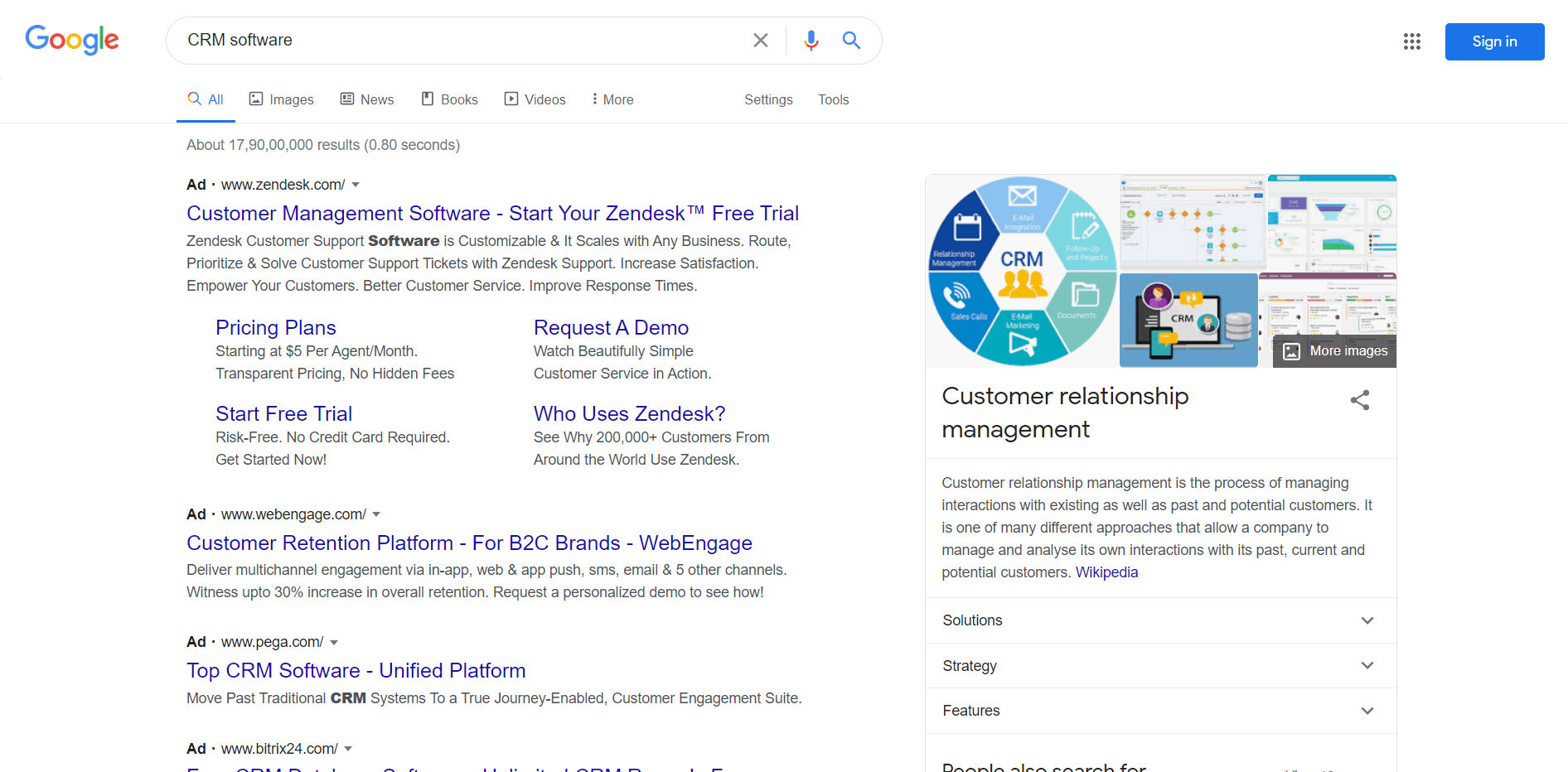
    search engine marketing

    Search engine ads usually appear as native ads on search engines like Google. Such ads appear at the top of the results and are prefixed with the term ‘Ad’.

    Display Ads
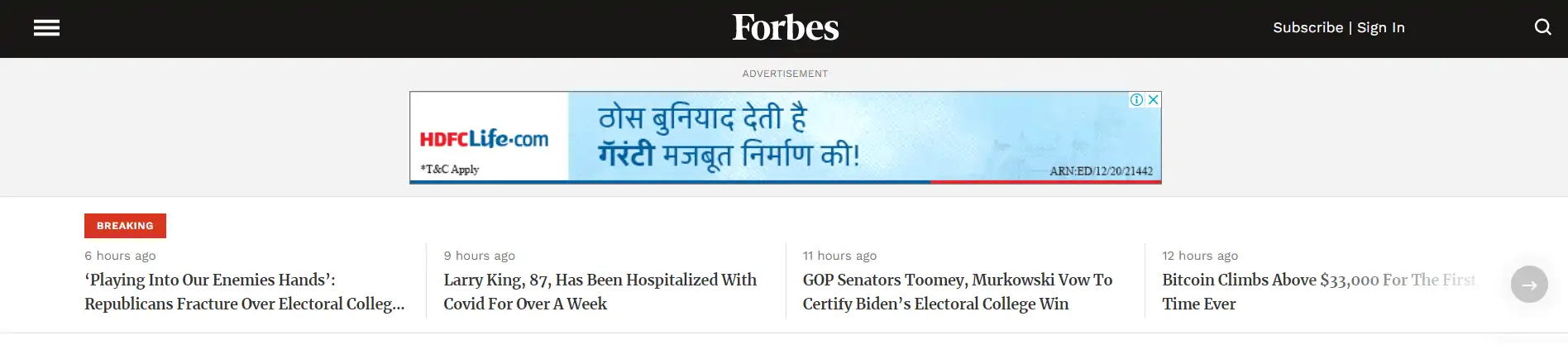
    display ad

    Display ads occupy a particular space on publisher’s digital property in return for money.

    Social Media Ads

    social media ad

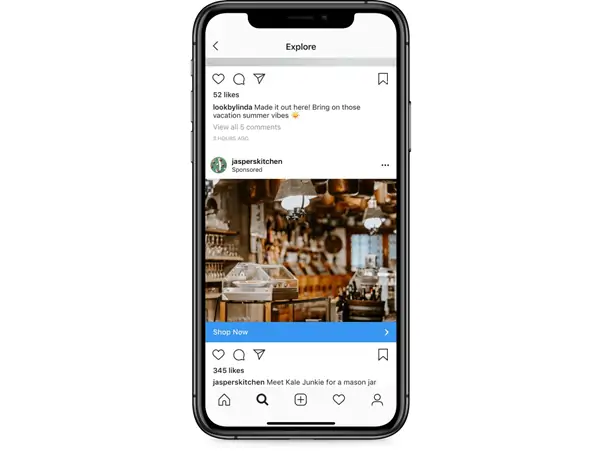
    Social media ads usually appear as native ads on social media channels like Facebook, Linkedin, etc. However, these ads do carry a tag of ‘ad’ or ‘sponsored’ on them.

    Mobile Ads
    mobile advertising

    Mobile ads are specific to mobile websites and apps. These ads are developed in sizes that cater mainly to the mobile audience.

    Video Ads

    Video ads are usually developed to promote to video consumers before, after, or in their video.

    Remarketing Ads

    remarketing ads

    Remarketing ads are tailor-made ads including offers and other CTAs designed especially for the users who visited a particular website or webpage.

    Go On, Tell Us What You Think!

    Did we miss something? Come on! Tell us what you think about our article on digital advertising in the comments section.
  • Monopolistic Competition: Definition, Characteristics, & Examples

    Monopolistic Competition: Definition, Characteristics, & Examples

    In today’s growing economy, it is impossible to identify markets that witness a perfect competition or even a pure monopoly. However, there does exist a market structure that lies in-between these aforementioned polar opposites.

    In 1933, Mr. Edward H. Chamberlin published the Theory of Monopolistic Competition, through which he popularised the concept of a monopolistic competition form of market structure.

    But what is monopolistic competition?

    Let’s find out!

    What is Monopolistic Competition?

    Monopolistic competition is a market structure where the market has numerous players who offer products or services that are similar but not perfect substitutes.

    To further simplify this concept, let’s break it into three parts-

    • Market structure: A market structure is how a market is organised. It explains the competition in the market and how different players are connected to each other.
    • Numerous firms: There exist several competing firms in an industry that witnesses monopolistic competition.
    • Differentiated offerings: Product differentiation refers to the distinguishing of a product or service from those of other firms. This causes these products to be imperfect substitutes of each other.

    Characteristics of monopolistic competition

    A monopolistic competition form of the market structure shows certain characteristics. These are:

    • A large number of Sellers – There exists a large number of sellers in a monopolistic competition.
    • Differentiated goods – Goods produced by different industries are non exactly the same as each other. Their differences can range from minor to major. These differences cause consumers to prefer one brand over another. An example of this could be the toothpaste industry. The taste of one toothpaste brand differs from the taste of the toothpaste of another firm, making them imperfect substitutes.
    • Freedom of Entry and Exit – There exist no barriers to entry in monopolistic competition. Firms in an industry are free to enter and exit at their own will. However, one should note that entering and exiting an industry that exercises monopolistic competition is not as easy as it is in a perfectly competitive market.
    • Selling Cost – Selling costs are the costs incurred by firms on the marketing, adver­tising and sales promotion of their product. These costs are necessary in order to persuade consumers to choose one product over another. The cost incurred for this purpose constitutes a major part of the total cost in monopolistic competition.
    • Non-Price Competition – Monopolistic competition witnesses a non-price competition wherein competing firms compete using sales promotion, positioning strategies, and other marketing strategies.
    • Lack of Perfect Knowledge – Buyers in a monopolistic competition lack perfect knowledge. A customer believes a certain good is superior to the goods produced by another firm, just because of the differential positioning strategies used.

    Monopolistic Competition in the short run

    Monopolistic Competition in the short run

    In the short run, the firm tries to maximise its profits. In order to maximise its profit, the firm strives to produce a quantity which ensures the firm’s marginal revenue (MR) is equal to its marginal cost (MC). Therefore, the quantity produced is at the point where the MR intersects MC.

    At that output, the firm collects a price based on the average revenue (AR) curve.

    At the collected price, the firm gains a profit which is equal to the difference between the firm’s average revenue (price) and average cost, multiplied by the quantity.

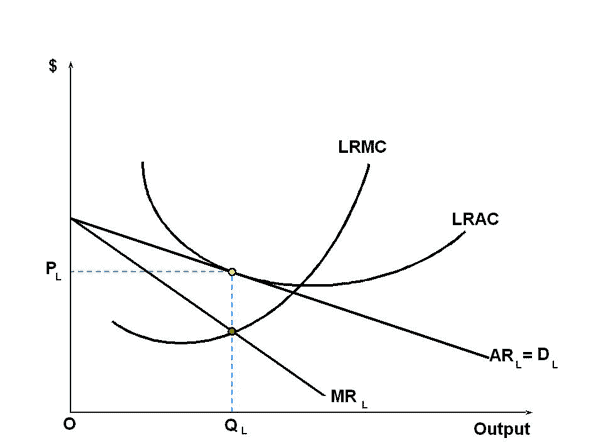
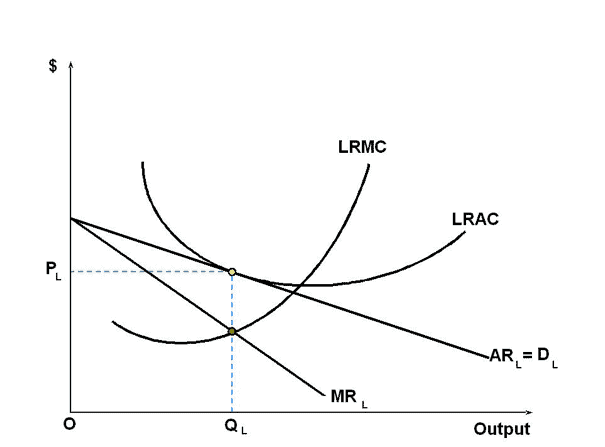
    Monopolistic Competition in the long run

    Monopolistic Competition in the long run

    In the long run, the firm continues producing at the point where marginal cost (MC) intersects marginal revenue (MR).

    However, in the long run, the demand curve shifts leftwards as other firms enter the market. This is because, now, the heightened competition leads to demand being distributed among all the existing firms as well as the new entrants. Thus, the demand experienced by the firm sees a relative decline. This causes the firm to lower its price until it is equal to the average cost.

    Since the average revenue (AR or price) is equal to the Average Cost (AC), the firm does not gain any economic profit.

    Examples of monopolistic competition

    Below are some common examples of industries that witness monopolistic competition:

    • Fast food companies – Fast food companies like McDonalds, Burger King, Wendy’s, In-and-out and many other fast food companies sell burgers which cannot be perfect substitutes of each other.
    • Soap industry – Dove, Dial, Irish Spring, Caress, Olay and many other soap brands are produced by numerous firms.
    • Cereal industry – Cheerios, Froot Loops, Frosted Flakes, Honey Bunches of Oats and many other cereal brands are produced by several other firms.

    Advantages of monopolistic competition

    Some of the advantages of this form of market structure are:

    • Increased competition – New firms face no barriers to entry, and so increased competition can be witnessed in a monopolistic competition form of market structure. This leads to firms employing more efficient means of production, innovation, producing better quality products, et cetera in order to stay in the game.
    • Diversity for consumers – With more firms in the market, consumers can choose from a variety of products and services. If the price of one product rises, they always have the option of opting for another product. If the quality of one product degrades, the consumer could always choose a product produced by another firm.
    • Better quality products and services – Since there are several competing firms in a monopolistic competition form of market structure, every firm is compelled to strive for quality in order to maintain their existing consumers and attract new consumers. If the firm fails to do so, it will simply lose customers as there are other firms in the market who promise better quality.

    Disadvantages of monopolistic competition

    Some of the disadvantages of this market structure are as follows:

    • Shift of focus– firms employ advertising and marketing teams and services in order to create brand awareness among consumers. Due to this, a shift of focus is seen. Firms now focus more on attracting attention rather than focusing on bettering their product. More importance is laid on how the firm presents its product rather than focusing on what is being delivered.
    • Increased prices due to selling costs – Selling costs constitute a large part of the total cost of a product. Firms extract these added costs from their consumers, who then have to pay a higher price for the product due to these selling costs.
    • Pricing strategies that hurt other players – big firms often employ pricing strategies that may hurt smaller firms in the industry. They do so by engaging in pricing strategies like predatory pricing, where the price charged for a product is below average cost. In such cases, smaller firms are compelled to exit the industry as their average costs are higher than the price charged for the concerned product in the market by the big firm.

    Go On, Tell Us What You Think!

    Did we miss something? Come on! Tell us what you think about our article on monopolistic competition in the comments section.

  • Oligopoly: Definition, Types, Characteristics, & Examples

    Oligopoly: Definition, Types, Characteristics, & Examples

    As economies continue to develop, various industries witness a rise in competing forces. Due to this, it is often difficult to come across industries that house just monopolies (single seller) or duopolies (two sellers). However, one may easily come across a multitude of industries that house only a small number of dominant players or firms. Such market structures are called oligopolies.

    But what exactly is an oligopoly?

    Let’s find out!

    What is An Oligopoly?

    An oligopoly is a market structure wherein a small number of dominating firms make up an industry. These firms hold major chunks of the overall market share for a commodity.

    The Greek word ‘oligos’ means “small, or little” and the prefix polein finds its roots in Greek, meaning “to sell”. Hence, the word oligopoly translates to small number of sellers.

    To understand this concept better, let us break it down further –

    • Market structure: A market structure is how a market is organised. It explains the competition in the market and how different players are connected to each other.
    • Small number: Oligopolies exist in industries that only house only a small number of key players. This number could be anything more than two. While there is no upper limit to the number of firms that exist in an oligopoly, the number is essentially low enough that the move that one firm makes significantly affects all the other firms in an industry.
    • Dominant firms: Dominant firms, or key players, are the firms that hold a significant market share in an industry.

    Characteristics Of An Oligopoly

    An oligopoly displays characteristics that are different from other market structures. These characteristics are as follows:

    • Interdependence: The firms in an oligopoly are interdependent. This is because every firm’s strategies affect the market condition for that product. For example, if Netflix were to reduce its subscription fees, Amazon Prime Video would likely suffer a loss of consumers, and hence, Amazon too would consider changing its pricing strategy.
    • Group behaviour: Preference is given to group behaviour in an oligopoly. In that way, the interest of all firms is protected.
    • Advertising: Advertising is of great significance when it comes to an oligopoly. This is because advertising is an important competitive mechanism that firms have to employ in order to “stay in the game”.
    • Competition: In an oligopoly, dominant firms constantly try to outdo their rivals in order to grab a higher market share.
    • Barriers to entry: Barriers to entry prevent other firms from entering the industry.  Oligopolies have high barriers to entry in order to gain or maintain a greater market share.
    • Lack of uniformity: Firms in an oligopoly may not necessarily be of the same size. Therefore, we see an asymmetry in the sizes of firms.
    • No price competition: Firms in an oligopoly practice rigid pricing. This is because lowering the price to win a greater market share would only lead to competing firms retaliating by charging even lower prices. This would lead to an unnecessary price war that would benefit none. Hence, no price competition is witnessed in an oligopoly.
    • An indeterminate demand curve: One cannot predict what the demand curve of a firm would look like. This is because of the uncertain nature of an oligopolistic market structure, wherein the strategies of one firm affect the demand other firms experience.

    Examples of Oligopolies

    Below listed are a few examples of oligopolies:

    • Music Streaming Applications (Global): Players like Spotify (30% of the total market share), Apple Music (25%), and Amazon Music (12%) dominate the industry.
    • Video Streaming Services (USA): Players like Netflix (51% of the total market share), Hulu (31%), and Amazon Prime Videos (14%) dominate the video streaming industry.
    • Airline industry (USA): Players like American Airlines, Inc., Delta Air Lines, Inc., Southwest Airlines, and United Airlines Holdings fly just under 70% of domestic passengers in the USA.

    Types of Oligopolies

    There exist four types of oligopolies in an economy. These are:

    • Pure Oligopoly: If the firms in an oligopoly produce perfectly homogenous goods and services, it is referred to as pure oligopoly. While such oligopolies are seldom found – as firms in an oligopoly often engage in product differentiation – such oligopolies are prevalent in steel, copper and aluminium industries.
    • Imperfect Oligopoly: If firms in an oligopoly produce differentiated products, it is known as an imperfect oligopoly. For example, the automobile industry, wherein firms engage in adding different features, innovations and designs to their car models which consequently make them stand out in the car market.
    • Collusive Oligopoly: When the firms in an oligopoly cooperate with each other and then come to a common agreement with regards to the price and the output, it is known as a collusive oligopoly.
    • Non-collusive Oligopoly: When the firms refuse to cooperate with other firms in the oligopoly and instead decide to compete with each other, it is referred to as a non-collusive oligopoly.

    Duopoly: A special case:

    A duopoly is a market structure wherein just two firms dominate an industry.

    It is regarded to be a form of oligopoly.

    Examples of duopolies:

    • Soft drinks industry: dominated by The Coca-Cola Company and PepsiCo.
    • Mobile operating systems: dominated by Android and Apple iOS.

    Advantages of Oligopolies

    In an economy, oligopolies have several advantages. Some of these are as follows:

    • Price stability: As there is practically no price competition in an oligopoly, prices of commodities and services are stable.
    • Lower prices: If a product is priced too high, consumers always have the option of approaching commodities produced by another firm in the industry. Hence, firms are compelled to balance creating profits with their aim of attracting new consumers. This leads to firms charging lower prices for their products.
    • Innovation: Firms in an oligopoly invest in innovations as this attracts more consumers. Firms scramble to bring out new innovations to have an edge over their rivals. Consequently, these innovations allow them to capture a greater market share.

    Disadvantages of Oligopolies

    When viewed from the economy’s point of view, oligopolies have their disadvantages. Some of these disadvantages are listed below:

    • Less Choices – As only a few firms dominate the industry, consumers have limited options. Potential entrants are kept out of the industry by the various barriers of industry, and hence, they are unable to offer their products in the market.
    • Reduced competition – Cartel-like behaviour witnessed in collusive oligopolies significantly reduces competition.
    • Barriers to entry could cause a potential loss to the overall economy – New entrants have the potential to bring out new innovations for the economy and gain considerable profits for the same. Due to barriers of entry, these potential entrants aren’t given the opportunity to do so. This causes a potential loss to economic welfare.
    • Inefficient – It has been observed that oligopolies typically under-allocate resources. This makes oligopolies inefficient when it comes to allocation of resources and productivity as well.

    Go On, Tell Us What You Think!

    Did we miss something? Come on! Tell us what you think about our article in the comments section.

  • The 8 Biggest Fundraising Mistakes Entrepreneurs Make

    The 8 Biggest Fundraising Mistakes Entrepreneurs Make

    About 6 million new businesses start in the USA every year. Of these, only 70,000 get angel investment, and less than 5,000 get venture capital. That is, the remaining 5.92 million businesses either bootstrap or make inevitable fundraising mistakes that prevent them from raising funds.

    So, if you don’t want to be in the 98% of the businesses who fail to raise external funds, you need to avoid certain fundraising mistakes. 

    But the problem is that entrepreneurs realise these mistakes only after they make it and get rejected. 

    But fret not, we’ve listed down the eight biggest fundraising mistakes that you need to be wary of while approaching the investors, pitching to them, and signing contracts.

    Assuming Valuations And Demands

    The biggest fundraising mistake you can make is to assume how much money you’ll require and what should be the pre-money valuation of your startup.

    The problem?

    Investors won’t believe the same unless you show them growth figures, traction, or material evidence to back up your claim.

    Precisely, you shouldn’t claim your startup to be valued at $1 million just because you think it’ll work out. Startup valuation depends on a lot of factors like:

    • Current revenue (if applicable)
    • Current traction
    • Traction trend
    • Industry
    • Industry trend
    • Market share of the startup
    • Market share acquisition forecast
    • Founding Team
    • Burn rate
    • Churn rate
    • Investor’s interest, etc.

    Your startup’s valuation is derived from the current position and the future projection of growth. In the usual scenario, the current revenue and revenue growth is taken into account. In startups with less or no revenue, valuation methods like Berkus Method, cost to duplicate, discounted cash flow method, etc. are used.

    Make sure your valuation is justified before heading to the investors.

    Moreover, as an entrepreneur, never be greedy. Overfunding may kill your startup just like underfunding might. Investors often offer a temptation of higher funding amount in return for a higher stake. This offer, though tempting, may prove to be a setback in future rounds.

    Always know how much you’re planning to raise. Usually, this amount is calculated by calculating the burn rate and cash runway before the next round of funding (which is generally 12 to 18 months later).

    Relying On One Source

    If you’re a new entrepreneur, you should know that once you move ahead of your seed round, there’s usually more than one investor who invest in your startup. 

    One investor usually leads the round, but it witnesses a few who follow the lead.

    So, you need to make a list of a lot of investors, reach out to them, and segregate them into group A, group B, and group C; where group A is highly likely to invest in your company and is someone you would like to work with. Group B and C consists of investors who are less likely to invest.

    Usually, it’s better to have more than one investors interested in your startup as it puts more pressure on them.

    Substandard Pitch Decks

    A big mistake entrepreneurs make is not focusing much on the pitch deck. While many dream of millions as an investment, they don’t put much effort into the pitch deck to prove the need.

    It would help if you understood the difference between an email deck and a presentation deck. Learn how to develop both and when to use what.

    Email decks are text-heavy as you’re usually not there to present the same. So, you have to predict the questions that might arise and answer them using data in the email deck.

    Presentation decks, on the other hand, should supplement your presentations. They should be graphics-heavy.

    But whatever you do, make sure to spend some time developing a good-looking, polished pitch deck that reassures the investors that you are serious about the partnership and know what you’re doing.

    Relying On Cold Emails

    Sending the same email to a list of investors could be the worst mistake you can do. Fundraising isn’t a usual business process where you’ll get replies to your cold emails.

    You need to do your homework and reach out to the investors using a channel they respond to. Most of the investors prefer recommendations from their partners or the founders of startups they’ve already invested in. Try to contact them first.

    And even if you do rely on email. Make sure to do your research and write a personalised email tailored to the requirements of the investor.

    Non-Familiarity With Term Sheets

    Term sheets are facts of external fundraising. The problem with the entrepreneurs is that they rely heavily on lawyers without even knowing the intricacies of what’s been agreed upon.

    Even if you don’t want to get into the details, you should know the basic of term sheet. It usually has two sections – the economics and the ownership. It includes the extent to which an investor will be participating in the decision-making process and how much will he get upon the liquidation of the company, along with other terms.

    Read books, talk to consultants, and learn as much as you can about the term sheet before you go for fundraising and signing such documents.

    Not Focusing On Personal Branding And Selling

    When it comes to startups, the investors weigh the experience and the brand of the team members along with other factors. You may not want the investors to doubt your capabilities.

    So avoid this common mistake of not selling your team. Sell their qualifications, experience, and the skillset. If you can’t add the same to a slide, find ways to portray or showcase the same and impress the investors.

    No Planning

    Fundraising is a task that one should take only with a proper plan. You should not wander around thinking you’ll find a way to the perfect investor.

    Make a plan. Decide what type of investor do you need to woo at what stage of your startup. Reaching out to wrong investors at wrong time may not only waste your time but may also close your gates to that investor in future as well.

    If you’re looking for seed funding, go to incubators, accelerators, or angel investors. If you’re looking for late-stage funding, go to experienced venture capitalists. Make a plan and stick to it.

    Focusing Just On Money

    One of the biggest misconceptions new entrepreneurs have is that fundraising is all about money.

    Never make this mistake.

    Business and startup investments are partnerships. This is when investors show faith in you, mentor you, and provide you with the resources, both monetary and non-monetary to help you grow.

    So, make sure to look for more than just money. Look for investors who have experience in the niche you operate in. Look for investors who have a good network that you can use to grow your business. And look for investors who have more than just money to give.

    Go On, Tell Us What You Think!

    Did we miss something? Come on! Tell us what you think about our article on fundraising mistakes in the comments section.

  • Outsourcing: Definition, Types, Pros, Cons, & Examples

    Outsourcing: Definition, Types, Pros, Cons, & Examples

    Business tasks are not limited to just the core offering. There’s a network of functions and processes that are linked to the core task. For example, a smartphone brand’s responsibilities are not limited to just developing, designing, and selling smartphones. It also includes R&D, manufacturing, assembling, marketing, customer relationship management, software development, repair, replacement, and much more.

    While the company can do all these tasks by itself, the more preferred practice is outsourcing some of these tasks to third parties that are experts.

    What Is Outsourcing?

    Outsourcing is a business practice where a company hires a third-party to perform its tasks, operations, jobs, or processes, rather than doing the work in-house.

    The word outsourcing is a portmanteau of outside and resourcing, which means paying an outsider (company, freelancer, or other business) to get the work done. This work includes business processes (like payroll, claim settlement, etc.), operational tasks (like assembling, distribution, etc.), and/or non-core functions (like legal functions, hiring, etc.) depending upon the nature and type of business.

    Types Of Outsourcing

    There’s no one type of outsourcing that fits all needs. It is categorised into different types based on the kind of activity outsourced and the location it is outsourced to.

    Based On The Type Of Activity

    Outsourcing can be categorised into three types based on the needs of the business. These are:

    Business Process Outsourcing

    Business process outsourcing is the most common type of outsourcing. It refers to contracting a business process to a third-party service provider who excels in performing such tasks. Usually processes that deals with repetitive tasks like support processes, administrative processes, and/or non-core management processes are outsourced. For example:

    • IT Outsourcing: It refers to outsourcing technology-related services and resources for a part or the entirety of an information technology department, function, or process. For example:
      • A small business signing a contract with a third-party service provider to develop its mobile application and website.
      • A SAAS company signing a contract with a third-party service provider to store and manage its user data.
    • Manufacture Outsourcing: Manufacturing costs can be extremely high as it requires the business to buy/rent/lease space, machinery, and hire a specialised workforce. To save this cost, a business may outsource the whole manufacturing department through a contract with a third-party manufacturer. For example:
      • A smartphone company outsourcing its product manufacturing to a company in China.
      • A TV brand outsourcing its parts manufacturing to another country.
    • Operational Outsourcing: Certain operational processes like repairs, supply, distribution, etc., are often outsourced to third parties.
    • Other Process Specific Outsourcing: Other specific processes like customer support, bookkeeping, accounting, healthcare, engineering, etc. that are driven by set procedures and rules can be outsourced to third-party service providers. For example:
      • A small business may outsource its telephonic customer support to a third party.
      • A digital marketer in the USA may outsource his management processes to a virtual assistant in India who handles the emails and schedules meetings for him.

    Knowledge Process Outsourcing

    Usually, there are tasks that are important but too complex for the in-house team to perform. Such tasks may require the team to have additional training and/or a professional license to meet the requirements. Since this isn’t that feasible for every company, most outsource these professional tasks to the third-party service providers that have a high level of subject matter expertise.

    For example:

    • A small business may sign a contract with a financial service provider to do its taxes and help it prepare its income statements.
    • A fragrance brand may appoint a third-party to handle research and development.

    Project Outsourcing

    Usually, when the demand exceeds the resources of a company, it may decide to outsource an entire project to an external service provider. For example:

    • Legal companies may outsource their workload to freelance attorneys to keep up with their workload.
    • An advertising agency may outsource its projects to a freelance copywriter.

    Based On Location

    A company may outsource its work within the country, in a nearby country, or some other part of the world.

    • Onshore Outsourcing: Also called onshoring or reshoring, this outsourcing type involves outsourcing business operations to the same country as the company’s headquarters. For example, a company in New York outsourcing business operations to California.
    • Nearshore Outsourcing: Nearshoring involves outsourcing business operations to geographically close countries. For example, a company in New York outsourcing business operations to Mexico City.
    • Offshore Outsourcing: Offshoring means outsourcing business operations to far off countries. For example, a company in New York outsourcing business operations to India.

    Reasons For Outsourcing

    The most basic answer to ‘why do companies outsource?’ is because outsourcing benefits the company in some way or the other. Some of the reasons why company outsource are:

    • Growth Opportunities: Often, limited resources limit the growth of a business. Outsourcing helps overcome such limitations.
    • Temporary Processes: Outsourcing temporary processes helps the business focus more on core tasks that drives long-term revenues.
    • High Costs: There are times when performing a task in-house prove to be costlier than getting it done somewhere else. In such cases, outsourcing proves to be a better option.
    • Benefit From Other’s Experience: Usually, processes are outsourced to third-party service providers who provide their expertise to the business after signing the outsourcing contract.
    • Better Focus: By outsourcing, the business shifts its focus to the processes that matter more.

    How Does Outsourcing Work?

    Outsourcing works on a simple concept of agreement between two parties. The host business decides on the processes or projects that need to be outsourced. It then finds the partner company either on some outsourcing websites, through recommendation, or other means.

    These two parties sign contracts for the work that needs to be done. Different contracts come with different terms that include the use of the brand name, quality instructions, competitor affiliation, etc.

    The outsourcing companies usually hire its own staff and works from its own office. Moreover, this outsourcing company operates on a business model that may be completely different from the partner company. For example, Apple’s business model revolves around the development and sales of its products to the final consumer. Its outsourcing partner Wistron that assembles iPhones operates on just a manufacturing and warehousing business model that’s different from Apple.

    Outsourcing Pros And Cons

    This business practice comes with its own set of advantages and disadvantages. These are:

    Outsourcing Advantages

    • Reduced Costs: Outsourcing, especially offshoring, helps the company reduce its costs.
    • Better Focus: By making others do the non-core tasks, businesses focus better on the profit-driving core tasks.
    • Increased Efficiency: Outsourcing involves handing the work to the experts. This results in more efficiency.
    • Better Innovation: With more people comes new and innovative ideas.
    • Shared Risks: Risks are shared between two parties through a contract.
    • Targeted Efforts: Outsourcing also helps in targeted efforts as the tasks are handed to the experts.

    Outsourcing Disadvantages

    • Lack Of Control: Since outsourcing companies operate on their own, there’s a lack of control.
    • Communication Problems: Usually, there’s a communication problem when the two companies operate in different time zones.
    • Security Risks: Outsourcing involves the sharing of sensitive information. Since the other company is an independent body, there’s always a risk of security.
    • Financial Risks: Often, when important tasks are handed to a third-party service provider, any failure to perform the task or other problem may pose financial risks to the business.

    Outsourcing Examples

    Almost every company that exists today outsource some tasks to third parties to operate better at least once in its lifetime. Some examples of the big companies that benefitted fro

    Whatsapp

    In its early days, Whatsapp founders outsourced the task of app development to a Russian developer, Igor Solomennikov, whom they found on RentACoder.com.

    P&G

    P&G outsources its research and development process to different third-parties service providers all over the world. This has worked wonders for the company, such that the company now gets 50% of its innovation from outside.

    Apple

    Apple iPhones, even though designed in the USA, are manufactured in countries like Mongolia, China, Korea and Taiwan. The company does this to save not only money but also time.

    Outsourcing vs Insourcing

    Basis
    Outsourcing
    Insourcing
    Definition
    Outsourcing is a business practice where a company hires a third party to perform its tasks, operations, jobs, or processes rather than doing the work in-house.
    Insourcing is a business practice where a company uses its own personnel and resources rather than outsourcing it to a third-party service provider.
    Benefits
    More efficiency
    Low costs
    More innovation
    Better focus on other activities
    More control
    Better communication
    More opportunities for own personnel
    Less security risk
    Limitations
    Less control
    Communication problems
    Less opportunities for own personnel
    More security risk
    Less efficiency
    High costs
    Less innovation
    Divided focus

    Go On, Tell Us What You Think!

    Did we miss something? Come on! Tell us what you think about our article in the comments section.

  • What Is Beta Testing? – A Detailed Guide

    What Is Beta Testing? – A Detailed Guide

    No one wants to launch a faulty product in the market. But often, there are bugs, flaws, and errors that are not visible to the developers. In such cases, the developers release the offering to the real users (usually a limited number) but with a disclaimer that the offering is a beta test and might be unstable. These users give feedback to the developers, which is then used to perfect the final product.

    But what is beta testing, and how is it different from other forms of early-product-testing?

    What Is Beta Testing?

    Beta testing is a type of user acceptance test where a nearly finished product is offered to real users to evaluate in the real environment and provide feedback.

    Also called end-user testing, beta testing is known to stand out because of its unique features. These features are imbibed in its definition –

    • Type Of User Acceptance Test: Beta testing is also called user testing or customer validation. It aims to perfect the product by letting a sample audience try the product and validate its proposition. This test involves getting data in the form of experiences of the early users, which is then used to make final changes before releasing the product commercially.
    • Nearly Finished product is offered: the beta version is a nearly finished version of the offering that’s refined more using the user experience data and feedback.
    • Real Users: Beta test is done by inviting users from the actual target audience to test the offering.
    • Real Environment: The beta version is almost a finished version of the product released to the actual market where the consumer uses the offering just like he/she would use the final offering. Precisely, beta versions are released in a live production environment.
    • Feedback: Feedback forms an integral part of beta testing. The users who take part in beta testing are asked to fill up feedback forms where they state the bugs, errors, and suggestions on how the user experience of the product can be improved before it is made generally available (GA).

    Beta testers are real users of the offering who use and test it in a production environment operating on the same hardware, networks, etc., as the final release. These are among the first early adopters who get a chance to experience the final offering and test it for security, reliability, and other factors before it is released to the general audience.

    Why Is It Called Beta Testing?

    Testing stages are denoted by Greek letters. Since it’s the second phase of testing after alpha testing, it’s called the beta testing phase.

    When Is Beta Testing Done?

    Beta testing is performed after the alpha testing is done and the product’s concept is validated, but before the actual product is released in the market.

    Usually, beta testing is done when the product is almost 90%-95% completed and is stable enough to be used in the production environment. Usually, a product in the beta test stage fulfils the following requirements:

    • The product is in the feature-complete state. All the product features that are planned for the final release are ready and included in the test product.
    • The product is stable enough to be launched in the real environment and not a lab environment.
    • Product documentation (including Setup, Installation, Usage, and Uninstallation) is detailed out and reviewed for correctness.
    • Procedure to collect bugs and feedback is developed and ready within the test product.

    Beta Testing Vs Alpha Testing

    Alpha Testing
    Beta Testing
    Definition
    Alpha testing is performed by the internal audience to identify the bugs and errors before the product or software is released to the real users.
    Beta testing is performed by the real clients of the products who identify the bugs and give feedback to improve the offering before it is made generally available.
    Testers
    This test is performed by the internal audience or a very limited number of specialised testers hired for the same.
    The tests are performed by the real clients who’ll be using the product in future.
    Number Of Users
    It witnesses a very limited number of testers.
    It witnesses fairly large yet limited number of testers. But the number of testers is more than the alpha stage.
    Environment
    Testing is done in a development environment
    Testing is done in a production environment
    Motive
    Alpha testing is done to ensure that all the known bugs and errors are removed before the real customer tries the offering.
    Beta testing is done to ensure that the offering is fully ready and free of any bugs before it is made generally available for the public.

    Purpose Of Beta Testing

    Beta test is almost a final product that is built based on the finding of the alpha testing phase. The sole purpose of the beta version is to ensure that the final product that will be generally available will:

    • Be free of bugs and errors,
    • Meet customers’ expectations,
    • Be approved by the customers,
    • Have a smooth user experience, and
    • Have real-world compatibility.

    Importance Of Beta Test

    Traditionally, the new product development process saw just four phases: (1) concept (2) design (3) build (4) launch. This process didn’t consider market validation, testing for errors, improvement before launch, etc.; which made many products die as soon as they were launched in the market.

    This is why the testing phase was added to the process. This phase steadily increases the probability that the product will succeed when it is launched in the market.

    How Long Does Beta Testing Last?

    Usually, an ideal beta test lasts between four and eight weeks.

    But since different tests come with different requirements, it can last anywhere between two and twelve weeks.

    Types Of Beta Testing

    Beta tests can be categorised into various types depending upon the number and types of testers and the goals and objectives of the tests.

    Based On The Type And Number Of People

    • Closed Beta Test: Also called private beta, this version is released to a limited group of individuals who get to become a tester by invitation. Generally, this version of the beta test is closed to the general public, and every tester is approved before he is allowed to test the offering. This is done so as to examine the offering’s core structure, stability, and general public reception. Games like Valorant and Crucible were launched in closed beta to make them error-free and public ready before the actual launch. 
    • Open Beta Test: Also called public beta, this version does not restrict access and allows anyone to become a beta tester. Usually, this version is launched after the closed beta test version and helps the developers collect quantitative data about the usage and interaction patterns. Gmail and Yahoo! was launched as an open beta where the companies collected data for years, improving the UI, UX, and backend before the offering was launched for the general public.

    Based On The Type Of Tests And Goals

    • Traditional Beta Testing: Traditional beta tests involve distributing the test version to the target audience, collecting feedback and data in all aspects, and implementing changes. Only users belonging to the intended target audience are allowed to test the offering.
    • Public Beta Testing: Similar to open beta testing, public beta tests involve distributing the test product to end users worldwide with the aid of online channels. Feedback and data is also collected using the same channels, which is then used to make the required changes and modifications.
    • Technical Beta Testing: Technical beta testing involves releasing the product to internal groups of people (like employees, consultants, etc.) who provide the developers with the required data and feedback.
    • Focused Beta: Focused Beta are released to the public with an aim to gather feedback on specific features or components of the offering. 
    • Post-Release Beta: In post release beta testing, a product is released to the market and data, and feedback is collected to make improvements for the future versions of the product.

    How Does Beta Testing Work?

    While different developers choose different types of beta tests according to their requirements, the process they follow usually remains the same. This beta testing process involves five steps:

    1. Planning: Planning always precedes the beta test phase. This stage involves defining goals, strategies, and requirements like test management, the number of participants involved in testing, time for the testing of an application, feedback collection process and procedure, etc.
    2. Recruiting: This stage involves the business to choose the right people for beta testing. It is done depending upon the type of beta test and the requirements.
    3. Release: Once the testers are recruited, the offering along with product documentation like user manuals are released or distributed to the testers to use and test.
    4. Feedback Collection And Evaluation: This stage involves the developers to collect user data and feedback from the users either directly or indirectly to improve the offering according to the end-user viewpoint.
    5. Closure: The beta testing phase comes to an end once all the features and components become bug-free.

    Advantages And Disadvantages Of Beta Testing

    Beta testing comes with its own set of advantages and disadvantages. These are:

    Advantages

    • It provides with an additional level of testing and product validation that increases the probability of the product’s success in the market.
    • It helps in uncovering unexpected errors that may have resulted in a bad image if it were found in the final product.
    • It helps in analysing customer feedback before the release of the actual product.
    • It helps in determining the actual status of the product before release (whether it is ready for the release or not).

    Disadvantages

    • Often times, in public beta or open beta, there’s a risk of deteriorating brand image of the product doesn’t fit the expectations.
    • It can result in a product failure in case of poor test management and feedback collection process.
    • Finding the right beta testers is a challenge.

    What Comes After Beta Testing?

    Beta test is usually followed by gamma testing (also called release testing) that ensures that the product is market-ready and fulfils all the security and functional requirements. Usually, this phase doesn’t result in a major modification of product unless the detected bug is of a high priority and severity.

    Go On, Tell Us What You Think!

    Did we miss something? Come on! Tell us what you think about our article on beta test in the comments section.

  • What Is After-Sales Service? – Types & Examples

    What Is After-Sales Service? – Types & Examples

    Customers are the biggest asset a business can have, and this asset is built through satisfaction and relationships.

    A customer is satisfied only when the offering provided to him matches or surpasses the promises made. To guarantee this, businesses provide quality offerings along with after-sale services.

    But what exactly is after-sales service? Why is it important? What are its types?

    Here’s the answer to all.

    What Is After Sales Service?

    After-sales service, also called after-sales support, refers to the services and support a business offers to the customers as part of its customer satisfaction and customer retention policy after the offering is sold.

    This after-sales service definition can be divided into three parts for better understanding:

    • Services and support provided to the customers: After-sales services include all the services provided to the customer by the manufacturer, retailer, or a third-party customer service or training provider concerning the offering.
    • As part of customer satisfaction and customer retention policy: After-sales services form a part of the marketing strategy targeted to increase customer satisfaction, brand loyalty, and word-of-mouth-marketing by fulfilling what’s promised to the customers. 
    • After the offering is sold: Such services are provided after the customer has paid for the offering. 

    Types Of After-Sale Services

    After-sales services constitute all the services and support provided after the product sale. These include –

    • Usage: Guidance on how to use the offering.
    • Education: User training, courses, etc.
    • Assurance: Guarantee, Warranty, Upgrade, Return, Replacement, etc.
    • Assistance: Product configuration, installation, reinstallation, relocation, etc.
    • Support: Online and offline support, 
    • Reward: Loyalty rewards, offers, referral rewards, etc.

    The business offers all these services to reaffirm to customers that their decision to rely on the brand is justified and that they should stick with the brand for the long term.

    Importance Of After Sales Service

    Complex products, expensive products, or products with long lifespan often require the seller’s involvement to aid the customers in setting up and/or using the offering. Sometimes, marketing efforts also require the seller to provide the customers with some guarantee of usage and product lifespan to aid the sales.

    All these constitute after-sale services and are important towards the fulfilment of the short-term and long-term goals of the organisation, like:

    • To get more customers on board.
    • To prove that the product is worth buying.
    • To reaffirm customers’ decision of relying on the brand.
    • To retain customers and make them buy from the brand again.
    • To build relationships with the customers.
    • To enforce referral and word of mouth marketing strategies.

    After Sales Service Examples

    The rise of competition in every industry has resulted in the rise of various types of after-sales services that are both customer and niche specific. Here are some examples of the best after-sales services offered by top brands.

    After Sales Support – Lenovo Vantage

    Lenovo is a famous computer and laptop brand that offers after-sales support in the form of Lenovo Vantage – an application pre-installed in Lenovo devices to help users update their drivers, run device diagnostics, request support and discover apps.

    The application makes it easy for the users to diagnose the problem with their system and even connect with the Lenovo help centre from the same application if they face any difficulties.

    Guarantee and Warranty – CamelBak

    Camelbak deals in adventure products like backpacks, bottles and accessories. The company boasts the quality of its products and to prove this, provides after-sales support in the form of The Got Your Bak™ Lifetime Guarantee scheme.

    User Training – GetResponse Courses

    GetResponse is an online platform providing solutions for email marketing, landing page, webinars hosting and more. As a part of its after-sales service, the company provides its customers with specialised courses that help them learn the importance and intricacies of the online marketing techniques and how they can use the company’s offering for the same.

    Free Installation – Air Conditioner Retailers

    Air conditioner brands and retailers often offer a free installation service to customers. This service is usually charged for when ordered otherwise.

    Return & Replacement – Amazon

    Amazon, to enhance customer satisfaction and boost online sales, offers a free return and replacement service where the customers can return and/or replace the products if they don’t meet their expectations. This after-sales service strategy has really helped Amazon in tapping new markets that were devoid of ecommerce.

    Go On, Tell Us What You Think!

    Did we miss something? Come on! Tell us what you think about our article on after-sales service in the comments section.

  • What Is Peer-To-Peer?

    What Is Peer-To-Peer?

    The IT world witnesses two significant types of network architectures: the client server-network and the peer-to-peer network. The internet revolves around the client-server network where a single central computer acts as a server, stores all data, and handles all the interaction with the internet users. But this model has raised many eyebrows as, usually, a third-party handles and stores data. Moreover, unethical practices are not possible in this network architecture as the server can be legally closed at any time.

    Hence, peer-to-peer network architecture came into existence. This model involves direct communication between two parties without a third party/computer/server involved.

    What Is Peer-To-Peer Network?

    Peer-to-peer or P2P is an IT network architecture where two or more computer systems connect to share resources without intermediation by a third party.

    This system is further adapted into the P2P service and P2P business model.

    • P2P Service: A peer-to-peer service is a decentralised platform where two parties connect and transact with each other without the involvement of a third party.
    • P2P Business Model: A business model that enables its users to connect with other users to transact and fulfil its tasks without the business acting as an intermediary is a peer-to-peer business model. BitTorrent runs on a P2P business model that lets its users connect with other users and share files.

    How P2P Works?

    P2P is different from the usual internet model that requires a server to be an intermediary between different clients. For example, if person A wants to send a message to person B via a client-server network, he has to send the message to the server first, which then forwards the message to person B. It’s similar with internet browsing – a user accesses the website that is hosted on a third-party server.

    The peer-to-peer system, on the other hand, goes away with this requirement of an intermediary and connects the participating parties directly. For example, for person A to send an email to person B, the P2P platform will connect A’s system to the B’s system and let A send the message directly. The only requirement here is that both the systems are online at the same time.

    For file sharing, the user uses the platform to locate computers that have the file he is looking for. These computers are called peers or nodes, and they upload the file on demand. Here’s how this works –

    • A user runs a P2P software to send requests for the file he wants to download.
    • The software queries other systems/computers that run the same software.
    • When the software finds the file that the user is looking for, it starts the transfer. The process of hosting a file to be downloaded by others is seeding, and the process of downloading a hosted file is called leeching.
    • If the file is located in more than one system, the file-transfer load is distributed among them.

    P2P Examples

    Peer-to-peer network was brought into commercial use by Napster that let users discover and download music files from a network of peers who were also running Napster. This resulted in the development of a community that shared music files without anyone having to buy music.

    Today, torrents play a major role in running the P2P economy. BitTorrent and utorrent are two most famous torrent clients that aid file sharing (legal and illegal) among connected systems. In fact, according to Chron, torrent traffic makes up 20 percent to 40 percent of all Internet use.

    Besides file sharing, P2P architecture is also seen in –

    • Financing and P2P Lending: Peerform, LendingClub, and Prosper etc. offer peer-to-peer financing options. These platforms help the borrowers and lenders to enter into a contract directly instead of having a third party like bank interfering in the deal.
    • Monetary Transactions: Bitcoin and other cryptocurrencies have made it possible to transact monetarily using a P2P framework. These cryptocurrencies are transferred directly from one person to another person instead of heading to the bank first.

    Characteristics Of Peer To Peer Network

    Peer-to-peer networks have specific characteristics that make it stand out. These are:

    • The network is self-organised and doesn’t require a third-party organiser.
    • The resource sharing capacity of the network depends directly on the number of participants. More participants lead to a better capacity.
    • All the peers or nodes are both resource users and providers. So, if the participants increase, the resource sharing capacity also increases. This is different from the client-server network where the server is overwhelmed with an increase in the number of users.
    • The network is heterogeneous due to different bandwidths, on-time, and computing power.
    • The availability of data is not always guaranteed as it depends on other peers availability.

    Peer To Peer Network Advantages And Disadvantages

    Just like every IT infrastructure, the peer-to-peer model comes with its own advantages and disadvantages.

    Advantages

    • Each peer manages itself. Hence the network manages itself as soon as peers join it.
    • The cost of setting up, operating, and managing a server is saved.
    • It’s easier to scale as scaling doesn’t require more funds but more peers.
    • None of the peers are dependent on others for their functioning.

    Disadvantages

    • The data can’t be backed up or stored once the peers leave the network.
    • There’s a security risk of peers as there isn’t a third party managing the network.

    Go On, Tell Us What You Think!

    Did we miss something? Come on! Tell us what you think about our article in the comments section.

  • Monopoly: Definition, Types, Characteristics, & Examples

    Monopoly: Definition, Types, Characteristics, & Examples

    Economies around the world witness a combination of different market structures. While there’s a lot of competition in most industries, some industries witness just one seller. There exists no competition in such industries as there are virtually no other players. Such market structures are termed as monopolies.

    But what exactly is a monopoly and how does it work?

    Let’s find out.

    What is a monopoly?

    A monopoly is a market structure that consists of a single seller who has exclusive control over a commodity or service.

    The word mono means single or one and the prefix polein finds its roots in Greek, meaning “to sell”. Hence, the word monopoly literally translates to single seller.

    To understand the concept better, let’s break the definition into three key-phrases –

    • Market structure: A market structure is how a market is organised. It explains the competition in the market and how different players are connected to each other.
    • Single seller: A single seller is the key characteristic of a monopoly. This means that only a single seller is solely responsible for the production of output of a certain good.
    • Exclusive control: Exclusive control, in this context, is the power an entity has over the production and selling of the concerned offering.

    Characteristics of a monopoly

    A monopoly displays characteristics that are different from other market structures. These characteristics are as follows:

    • Single seller – A single seller has total control over the production, and selling of a specific offering. This also means that the seller has no competition and holds the entire market share of the offering that it deals in.
    • No close substitutes – The monopolist produces a product or service that has no similar or close substitute.
    • Barriers to entry – In a monopoly market structure, new firms cannot enter the industry due to barriers like government regulations, contracts, insurmountable costs of production, etc.
    • Price maker – A monopolist has the power to charge any price for its product of service.

    Types of monopoly

    There exist several different types of monopolies in an economy. These different types of monopolies are listed below:

    • Private Monopoly – A private monopoly is one that is owned by an individual or a group of individuals. These monopolies mainly aim for profits.
    • Public Monopoly – A public monopoly is one that is owned by the government. These monopolies are set up for the welfare of the masses. An example of a public monopoly would be the U. S. Postal Service.
    • Pure/ Absolute Monopoly – The monopolist controls the entire market supply for its product without facing any form of competition. This is possible because there is absolutely no close or remote substitute available in the market.
    • Imperfect Monopoly – The monopolist controls the entire market supply for its product as there is no close substitute, but there is a remote substitute for the product available in the market.
    • Simple Monopoly – A simple monopoly is one in which a single seller sells its product or service for a single price. There is no price discrimination in a simple monopoly.
    • Discriminating Monopoly – A discriminating monopoly is one where a single seller does not sell his product or service for a single price. Price discrimination is witnessed wherein prices may vary from region to region, or people coming from different economic backgrounds may be charged a different price, etc.
    • Legal Monopoly – A legal monopolist enjoys government approved rights like trade mark, patent, copy right, etc.
    • Natural Monopoly – A natural monopolist enjoys or benefits from natural factors like locational advantages, locational reputation, natural talents and skill sets of the producers, etc.
    • Technological Monopoly – When a firm holds a technologically superior position that other firms cannot compete with, the firm is said to be a technological monopoly.
    • Joint Monopoly – When two or more firms join hands in order to form a monopoly, it is referred to as a joint or a shared monopoly.

    Monopoly Examples

    Some examples of monopolies which have great historical significance are listed below:

    • Andrew Carnegie’s Steel Company (now U.S. Steel): From the late 19th century to the early 20th century, Carnegie’s Steel Company maintained a singular control over steel in the US market.
    • American Tobacco Company: Incorporated in North Carolina on 31 Jan. 1890 by James B. Duke, American Tobacco Company maintained a singular control over tobacco in America till 1906 and controlled four-fifths of the entire domestic tobacco industry other than cigars.

    Barriers to Entry: How a Monopoly Maintains its Power

    Several factors and strategies allow a monopoly to maintain the power that it holds in an industry. These essentially pose as barriers to entry to potential entrants. Some of these are:

    Economies Of Scale

    When it is said that the production of a certain commodity has become efficient, it means that the firm does not have to spend large amounts on the cost of production. After existing in the market for a considerable period of time, output can be generated at a larger scale with fewer input cost. This is known as economies of scale.

    Due to this phenomenon, the output generated by a monopolist is large, with lesser input cost. In case a new firm tries to enter, the cost of production would be higher than that of the monopolist and the output generated would be lower than the monopolist. It is, hence, evident that the new entrant would be at a disadvantage in terms of production costs. Hence, the monopolist gains a cost advantage.
    This inevitable disadvantage deters potential entrants and so, economies of scale poses as a barrier to entry.

    Strategic Pricing

    Strategic Pricing allows a monopolist to charge any price for their offerings. The price may be set to be extremely low – predatory pricing – in order to prevent any firm from entering the market. This is often done by a monopolist to demonstrate power and pressurise potential and existing rivals.

    Sometimes, a monopolist often sets the price of its product or service just above the average cost of production of the product/service. This move ensures no competition. This is because if a competitor too decides to charge the same price for the commodity, the competitor will face losses as the cost of production for the monopolist is far lower than the competitor’s cost of production.

    Ownership Of Essential And Scarce Resources

    Monopolies that first enter a market have access to resources that it may choose to keep for itself. Due to this, these scarce but essential resources are made unavailable to the potential entrants.

    This is often the case with natural monopolies.

    High Sunk costs

    Sunk costs are those which cannot be retrieved in the case a firm shuts down. These are costs that are essential for the firm, like advertising costs, but cannot be recovered.

    With the existence of a large monopoly, the risk of a potential entrant going out of businesses always looms. Hence, these potential entrants hesitate when it comes to taking a risk that could cost them too much. This consequently poses as a barrier to entry.

    Contracts

    Monopolies maintain their power by creating contracts with suppliers and retailers.

    Consumer Brand Loyalty

    Consumers often develop trust and loyalty with firms that offer them quality products and services. A sense of familiarity that generates consequently deters them from going elsewhere to satisfy their demand. This does not allow other entrants a chance. Hence, they find it difficult to capture market share for the product and service that they offer.

    A great example of a company using this technique to develop a monopoly is Google.

    Advantages Of Monopoly

    Monopolies are advantageous to economies in some ways. Some of these reasons are listed below:

    • No price wars – Price wars often discompose markets. In the absence of price wars, consumers enjoy a certain degree of certainty with regards to the prices they pay for a commodity. Hence, this becomes an advantage that monopolies bring to consumers in a market.
    • Large economies of scale – A monopoly has the power to produce large quantities of output at low input costs. Thus, they can and provide them to the masses at lower costs. But this advantage would benefit consumers only if the monopoly is ethical.
    • More research and development- A monopoly tends to feel confident about its market share. This encourages them to go ahead and invest more in research and development. Research and development leads to the generation of new goods and services as well as enhanced manufacturing efficiencies which eventually benefits consumers.

    Disadvantages Of Monopoly

    The disadvantages of a monopoly in an economy often outweigh its advantages. Below listed are the disadvantages of a monopoly:

    • Affects the quality of products and services offered – Due to a lack of competition, monopolists often do not realise the need to upgrade. They tend to not engage in innovating, and so, many monopolies go out of trend for the same. A good example of this could be Blackberry, a cellphone brand that captivated the global market in the early 2000s but has now been compelled to discontinue making its own smartphones in 2016. Monopolies also offer inferior products and services in an attempt to save on the cost of production. Since there are no close substitutes, consumers have no option but to buy these inferior products.
    • Higher prices – A monopoly is essentially a price maker. Monopolies have the power to determine the price of their commodity without having to analyse competitor prices since there are virtually o competitors. This allows them to indulge in charging excessive prices for their commodities.
    • Price discrimination – This selling strategy is employed by monopolies wherein they charge different prices for the same product in different markets. They charge a price based on what they think the consumer would agree to. For example, a product that is being sold at a relatively affluent area would be priced more than the same product that is being sold at a poor.

    Go On, Tell Us What You Think!

    Did we miss something? Come on! Tell us what you think about our article in the comments section.

  • Brick And Mortar: Definition, Examples, & Challenges

    Brick And Mortar: Definition, Examples, & Challenges

    Traditionally, when the world wasn’t civilised, businessmen used to scout for customers themselves. Later, when towns and cities developed, these businessmen started doing businesses in physical shops. Customers who desired the offering used to visit such shops to conduct trade face-to-face.

    This business model exists even today and constitutes a majority of offline businesses. It’s the brick and mortar business model.

    What Is Brick And Mortar?

    Brick and mortar is a business model that involves a physical presence of the business which offers face-to-face customer experiences.

    In simple terms, brick and mortar:

    • Is a business model: A business model is how a business operates and makes money. Brick and mortar is a model where the business operates offline in a building or other structure and makes money via face-to-face transactions.
    • Involves a physical presence of the business: Brick-and-mortar businesses operate in an office or store that the business owns or rents.
    • Offers face-to-face customer experiences: This model involves face-to-face interactions of the employees and customers where employees and other staff focus on answering customer questions and provide them with an experience.

    Precisely, a brick and mortar is a traditional street-side business where the owner rents, leases, or buys a shop where the customers visit, interact with staff in person, touch and feel products, and buy the products in person.

    How Does a Brick-and-Mortar Work?

    Brick-and-mortar businesses are true opposites of ecommerce stores. These businesses operate offline in a rented or owned store, office, or factory.

    Furthermore, the store hires employees as salesmen who give a personalised experience to the customers, often resulting in developing a relationship with them. The customers get to touch, feel, and even try the products before buying. Such businesses also focus on personalised marketing efforts wherein salesman and other staff suggest, upsell, and cross-sell based on customer’s preferences and their relationship with the business.

    Brick And Mortar Examples

    While ecommerce has started getting the spotlight, brick and mortar businesses still account for 94% of the total retail sales. This model powers numerous brands like:

    • Walmart: It’s the world’s largest brick-and-mortar retailer that promises lesser prices. Walmart operates 11,400 stores under 55 banners in 26 countries.
    • Target: Target operates retail shops that deal with everything from groceries to pets.

    Other small examples of brick and mortar businesses are local grocery stores, banks, pet stores, gyms, etc.

    Advantages And Disadvantages Of Brick And Mortar

    B&M businesses have their own set of perks and cons. And with the advent of the internet and ecommerce, this list of advantages and disadvantages has just increased.

    Advantages

    • Physical connection: The biggest advantage of a bricks-and-mortar store is that the business gets to establish a physical connection with its customers, which, in turn, increases brand loyalty.
    • Convenience: A physical store makes it convenient to feel and try the product and get it instantly.
    • Expertise: Store employees provide expert guidance and suggestions to help customers get the most out of their resources.
    • Experience: Physical stores often use a mix of human interaction, decoration, and activities to develop an experience worth remembering for the customers. For example, a restaurant with Jazz music and beautiful lightings and decoration could turn out to be an experience for customers.

    Disadvantages

    • High costs: Brick and mortar model requires the business to rent or purchase a physical place, get employees on board, and spend more variable and fixed costs to maintain the store and experience. This increases the cost substantially.
    • Geographic limitations: Having a store at one place limits the customers a business can serve to that geographical area only.

    Brick And Mortar Challenges

    According to data by Statista:

    • 67 percent of millennials prefer to shop online,
    • 56 percent of gen-x prefer to shop online, and
    • 41 percent of baby boomers prefer online shopping.

    Such rising demand for online stores resulted in a great challenge for brick and mortar businesses and a never-ending debate of online retailers vs brick and mortar stores.

    Online retailers have the upper hand over brick and mortar stores in the form of

    • Low Costs: Online businesses saves a lot of costs as they don’t have to rent or buy space, hire frontline employees, and pay for store maintainance.
    • Wider Market: Online retailers serve to a wider geographical area compared to the retailer stores. They often target multiple cities or the whole country if they have the resources to deliver to them. Usually, these retailers partner with delivery partners who help them deliver to a wide geographical area.
    • Better prices: Since not operating offline saves a lot of money, and since catering to wider market increases economies of scale, online retailers get to price their goods at a price lower than B&M stores.
    • More Offerings: Since there is no shelf space limit, online retailers tend to provide more offering varieties compared to offline retailers.
    • Data-Backed Surveillance: Operating online gives more freedom to track leads and target them with personalised ads to convert them.

    Go On, Tell Us What You Think!

    Did we miss something?  Come on! Tell us what you think about our article in the comments section.