Feedough Logo

Blog

  • What Is Customer Retention Rate?  How To Calculate It?

    What Is Customer Retention Rate? How To Calculate It?

    The economics of modern businesses like telecom, insurance, SAAS and other subscription-based businesses differs considerably from businesses operating on traditional business models. These businesses only work well when customers stay with them for an extended period paying recurring costs.

    In simple terms, customer retention is the key to modern business survival.

    Why, you ask?

    Well, today’s businesses witness a high customer acquisition cost compared to what recovers in a single sale. This cost is only recovered if the customer stays with the business for long.

    In fact, it costs five times more to acquire a new customer than it does to retain an old one.

    What Is Customer Retention Rate (CRR)?

    Customer retention rate is the percentage of customers that the business retains over a period of time.

    In simple terms, retention rate represents the percentage of loyal customers of the business. These loyal customers are satisfied customers who continue to do business with the company more than once.

    The retention rate is expressed as a percentage of the company’s existing customers who continue doing business with the company. These include –

    • Customers who renew their subscriptions within a specific time period, and
    • Customers who repeat their purchases within a specific time period.

    The purpose of customer retention rate metric is to monitor the business’s performance and its ability to attract and retain customers.

    Importance of Calculating Retention Rate

    Retention rate is the reverse side of the churn rate – the metric that calculates how many customers leave your business in a month. Both these metrics are important as they help to calculate the lifetime value (LTV) of your customers which, in turn, enables you to determine how viable your business is.

    In simple terms, calculating customer retention rate is important to:

    • Predict revenue: According to Adobe’s Digital Index Report, in the US, 40% of revenue comes from returning or repeat purchasers. This means that the businesses need to acquire five new customers to equal one repeat purchaser. Hence, higher the retention rate, the more is the customer’s lifetime value which implies more revenue for your business.
    • Analyse customer service: By tracking the percentage of customers who retain within a time period, you can get a clear picture of how well your business’s customer service department is performing and how successful you are in fulfilling the promises made to the customers.
    • Strategise loyalty and other programs: A good retention rate also means that you have a good relationship with the customers which you can capitalise on by:
      • Upselling, cross-selling, and
      • Releasing a referral program and reducing your customer acquisition cost..

    How to Calculate Retention Rate: Customer Retention Rate Formula

    Customer retention rate calculation is simple. All you need to do is use this straightforward formula:

    Retention rate = (Number of customers who continue business / Total number of customers at the beginning of the period) * 100

    This customer retention rate formula considers three variables:

    • Time period: This is the period of time for which the retention rate is calculated. It could be days, weeks, months, or years.
    • Customers who continue business: These are the retained customers who continue doing business with your company.
    • Customers at the beginning of the period: These are the total number of customers who existed at the beginning of the period.

    Retention Rate vs Churn Rate

    Churn rate and retention rate are the two sides of the same coin. While churn rate calculates the number of customers who stopped doing business with the company, retention rate calculates the number of customers who retained.

    These two metrics are inversely correlated. A company with a low churn rate would, by default, have a high retention rate.

    Retention Rate Example

    Let’s assume a company XYZ has 2000 customers on 1st January 2020. During the year, 200 out of these 2000 customers left the company.

    The retention rate of XYZ would be: (1800/2000) * 100 = 90%

    The churn rate of this company would be: 10%

    What Affects Retention Rate?

    Customers will stay with your company till the time they find a reason to. While this reason varies from industry to industry, it is often derived from:

    • Customer Satisfaction: It is a comparison between customer expectation and customer experience. If the experience is higher than the expectation, customers are more inclined to remain with the business.
    • Customer Success: It is when the customers realise their goals with the help of offering. In such cases, they are more likely to remain with the business and use its offering again.
    • Customer Reliance: The more the customers are dependent on the offering for their tasks, the more are the chances of them remaining with the business.
    • Barriers To Leave: If the customers are bound by an agreement, or might have something to lose, they might find it difficult to leave and might decide to retain with the business.

    What’s a Good Retention Rate?

    While every business aims for a 100% retention rate, it is usually not possible to be this perfect.

    So, what exactly could be considered a benchmark retention rate?

    Well, it varies for every industry. Here are some examples of good annual retention rates of different industries as calculated by Profitwell:

    • Retail: 63%
    • Banking: 75%
    • Telecom: 78%
    • IT Services: 81%
    • Insurance: 83%
    • Professional Service: 84%
    • Media: 84%

    For SAAS, however, the average monthly retention rate is 93-95%, and a retention rate of 95-97% is considered to be good.

    For a subscription box service, the average monthly retention rate is 80-90%, and a retention rate above 90% is considered to be good.

    Go On, Tell Us What You Think!

    Did we miss something? Come on! Tell us what you think about our article on How to calculate customer retention rate in the comments section.

  • How Different Generations Use Social Media

    How Different Generations Use Social Media

    With the advent of the internet, the world has turned into a global village. Humans, who are essentially social beings, have created internet-based ways to stay connected at all times. These internet-based platforms that allow us to stay connected are referred to as social media.

    More than two-thirds of all internet users around the world find themselves on social media. Due to this urge to stay connected, the past decade has seen a substantial rise in the number of social media platforms like Facebook, Instagram, and Twitter among others.

    Contrary to popular beliefs, these platforms attract not only the youth but also those of older generations. Roughly 3.8 billion people use social media. Although, the motives for adopting and using social media differ for different generations. While some wish to stay connected with old friends and family, others simply wish to have a platform to share their opinions.

    Now, let us take a look at the different motives and habits of social media users. We will also examine how the personality and traits of individuals seemingly affect their social media habits.

    Generation Z

    Gen Z is a demographic cohort constituting people born between 1996 and 2015.

    People belonging to this generation are digital natives – they’ve not seen a time before the internet or high-tech devices. Gen Zs have had their experiences with social media from an early age and have included this phenomenon as a part of their daily lifestyle.

    Gen Z’s choice of social media platforms and content can be more accurately assessed if you know the characteristics of this generation –

    • Always Online: A survey conducted by Pew Research Center resulted that almost 45% of Gen Zs are always online, mostly on their mobile devices.
    • Have Unparalleled Access To Smartphones: Almost 95% of Gen Zs have a smartphone or access to one.
    • Loves Visuals: Gen Zs are visual learners. They are driven by visual content like photos and videos than written or textual content.
    • Privacy Conscious: Gen Z cares less about their data being used for personalised recommendations. But they do care for privacy on the whole. They don’t want to be spied upon.

    What Do Gen Z Use Social Media For?

    Generation Z use social media with a motive to –

    • Share daily life updates: Gen Z considers social media to be a place to keep everyone updated about their daily lives. They are the ones who post most pictures and updates about their lives on social media.
    • Develop A Personal Brand: Gen Zs are more driven towards individual achievements than any other generation. This makes them focus on their personal brand more than others. Gen Zs are content developers who use social media to develop their own brand.
    • Communicate with friends: Unlike older generations, people belonging to Gen Z are more connected to their friends via text, video calls and “snaps”.
    • Get over FOMO: FOMO, or the fear of missing out, too compels Gen Zs to keep a check on social media for updates from friends and acquaintances. They do so as they don’t want to miss out on current trends or glimpses that their friends share.
    • Make Most Of Micromoments: People belonging to this generation often check their social media newsfeeds and other applications regularly for a few minutes consuming a lot of short-form content.

    Gen Z’s Favourite Social-Media Platforms

    Gen Z’s characteristics and motives clearly indicate the social media platforms they use most. They prefer a platform that:

    • Is populated by visual content
    • Helps them develop their own brand
    • Lets them communicate with ease
    • Is more personal

    Hence, the obvious platforms that fit these descriptions are –

    Instagram

    Around 52% of Gen Zs use Instagram.

    The reason?

    Well, Instagram is specifically developed to target the digital natives. It’s an ecosystem that capitalises on the micromoments requirement. The platform makes use of –

    • Portrait orientation: Since Instagram’s aim is to capitalise on micromoments, it keeps its orientation to be portrait to make scrolling and content consumption easier.
    • Short-form relevant content: Instagram constitutes mostly short-form content like stories, short videos, etc. that can be consumed within seconds.
    • Messaging: The platform has a handy text, image, and video messaging functionality that lets Gen Z users connect with other users with a tap.
    • Sharing: The posts can be shared with other users easily.
    • Brand building resources: Instagram is a content ecosystem which provides resources to build a brand online. The ecosystem revolves around followership where users follow other users to show support.
    • Social networking: Users can like and comment on others’ posts which further aids smoother social networking.
    • Aesthetic appeal: Gen Zs are strongly influenced by the visual-oriented content posted by other users.

    Snapchat

    51% of Gen Zs in the US check Snapchat on a regular basis. It is the top social media application among US teens.

    The reason?

    Snapchat is considered to be privacy centric by Gen Z. It’s one such platform which is not flooded by older generation. Moreover, it involves self-deleting messages which teens prefer.

    Besides this, here are other reasons why Snapchat found its way in Gen Z’s lifestyle –

    • Selfies and filters: Snapchat is known for its filters and provides its users with a rather unique selfie experience.
    • Celebrity lifestyle Information: An additional reason why Snapchat is so popular among this generation is that, like Instagram stories, Snapchat also enables users to follow their favourite celebrities and their lifestyles.

    YouTube

    Gen Zs are visual learners. They prefer to learn on YouTube than learning through apps, textbooks, etc. In fact, nearly 60% of Gen Zs prefer learning on YouTube, making this platform a go-to social media network for long-form content.

    TikTok

    TikTok was designed specially to cater to Gen Z. It focuses on short-form content, makes scrolling really easy, and is really easy to use.

    But the north-star of TikTok is the emotional promise that anyone can go viral. Gen Z’s love for fame attracts them to this platform.

    Gen Z’s Preferred content On Social Media Platforms

    Social media is used by Gen Zs primarily during micromoments to check on the world.

    They also find themselves being increasingly influenced by the content they find online. Gen Zs look for inspiration and ideas. They often end up following social media influencers for the same.

    How much Time do Gen Z Spend on Social Media daily?

    On an average, Gen Zs spend about 3 hours on social media per day.

    Millennials

    Millennials is a demographic cohort constituting people born between 1981 and 1995.

    This generation is considered to be more educated and technologically advanced than its previous generations. The people belonging to this generation are most adaptable as they’ve lived a life before and after the advent of internet. They are more focused on social issues and are not afraid to take a stand.

    Millennials choice of social media platforms and content can be more accurately assessed if you know the characteristics of this generation –

    • Tech Savy – Even though millennials are not tech-reliant, they are tech savy. They make sure to use the available tech to get their job done.
    • Early Adopters: This generation has witnessed so many changes that it has become a characteristic to look for something new.
    • Multi Taskers: Millennials is the pioneer generation with infinite choices. This made them multitaskers who live an on-the-go lifestyle.
    • Privacy-conscious: Millennials care for their privacy more than other generations.
    • Achievement-Oriented: Millennials seek the best possible outcome and even work hard to achieve it. They are even not afraid to question things.

    What Do millennials Use Social Media For?

    Millennials loves attention, connection, and recommendations. They use social media to –

    • Stay in touch with their friends and family and even make new connections. Millennials love the idea of new.
    • Overcome their FOMO and check on the latest updates. More than ¾ of millennials admit on being influenced or purchasing products based on the Instagram they follow.
    • Stay informed about different world issues.
    • Find something entertaining to read or watch.
    • Share content.

    Millennials’ Favourite Social-Media Platforms

    Millennials’ characteristics and motives clearly indicate the social media platforms they use most. They prefer a platform that:

    • Is populated by both textual and visual content
    • Provides with news and trends
    • Is focused more on content consumption
    • Lets them communicate with ease
    • Lets them learn at their own pace
    • Is more public

    Hence, the obvious platforms that fit these descriptions are –

    Facebook

    Being the pioneer users of Facebook, millennials are so accustomed to using Facebook and are so in pressure of the network effect that they are stuck with it now.

    Moreover, Facebook is developed just to cater to the needs of this generation –

    • More textual content,
    • Link outs,
    • Easy scrolling,
    • Easy sharing,
    • Easy communication with others.

    Facebook is a great platform for millennials to consume content and even get news of the world.

    According to the 2020 Consumer Culture Report, 77% of millennials use Facebook daily.

    Twitter

    Millennials care more about the world and social issues than other generations. This is why they’re so fond of the micro-blogging website Twitter.

    In fact, almost 61% of Twitter Users Are Millennials. They get their daily dose of news, trends, and even gossip from this social media network.

    Moreover, the platform also forms their voice to support their causes.

    Instagram

    Instagram suits millennials’ on-the-go lifestyle. They get to consume short-form content during their breaks and even share their life with the world.

    Moreover, Instagram also allows users of this generation to show their aspirational personality and build a brand.

    YouTube

    In the words of Google

    • Millennials are self-starters and doers: They like to learn things at their own pace.
    • For millennials, self-improvement trumps self-promotion: Millennials look for ways to improve their health, lifestyle, and take other recommendations to improve themselves.
    • Millennials like to dream: Millennials like to view a world in a different perspective through the eyes of other people.

    All these requirements are catered to on Youtube which forms a go-to social media platform for millennials.

    Millennials’ Preferred Content On Social Media Platforms

    Millennials prefer both visual and textual content. They like reading opinions and even love recommendations.

    In fact, social media play a big role in how millennials shop.

    Beside this, the users of this generation typically are more likely to share content that they find appealing and informative with their friends and families.

    How Much Time Do millennials Spend On Social Media Daily?

    Millennials spend about over 2.5 hours on social media each day.

    Generation X

    Generation X is a demographic cohort constituting people born between 1965 and 1980.

    This generation has lived through difficult economic times in the 1980s and has a specific set of characteristics that set them apart. They are –

    • Independent: This generation grew up with minimal adult supervision and thus learned the value of independence from early age.
    • Resourceful: Gen X’s problem-solving skill is more developed because of their experience.
    • Technologically Hybrid: They’ve seen a life before and after internet and are more technologically hybrid in doing work. But they are not the master of technology as the other two generations that came after them.
    • Financially Literate: Gen X saw the great depression. Hence, they know the value of money and are more careful with expenditures. Moreover, these people have started families, making them more conscious while spending.
    • Privacy Conscious: Gen X doesn’t like the idea of putting their personal lives on display on social media.
    • Advertisement Haters: Gen X has seen influential advertisements of the moon landing, the Cold War, the internet revolution, and the Y2K crisis etc. so they have a prejudice against advertisements.

    What Do Gen X Use Social Media For?

    Gen X loves information – be it related to their connections or the advertisement they saw on TV. They use the internet and even social media to consume as much information as they can (which can even be fake news).

    They use social media to

    • Stay in touch only with people who matter – their friends and family.
    • Share their opinions with people who matter.
    • Research.
    • Consume information.

    Gen X’s Favourite Social-Media Platforms

    Gen Z’s characteristics and motives clearly indicate the social media platforms they use most. They prefer a platform that:

    • Is easy to use and operate
    • Is more visual (since they’re generation that grew up with television)
    • Provides with news and trends
    • Is focused more on content consumption
    • Lets them communicate with ease
    • Gives them importance
    • Provides a feeling of nostalgia (connect with friends, provide past information, etc.)

    Hence, the obvious platforms that fit these descriptions are –

    • Facebook
    • Youtube
    • Instagram

    Facebook

    Those belonging to Generation X tend to be non-experimental. They stick to platforms that they are familiar with, and tend to steer away from trying out new platforms. Facebook is relatively the easiest to use social medium that most Gen-X’ers are familiar with, and hence, Facebook remains the most popular among this generation.

    In fact, over 95% of Gen X’ers use Facebook.

    They use it to connect with people who matter, consume information, get news and trends, and even share their opinions with ease.

    YouTube

    In the words of Google, Gen Z use YouTube to –

    • Embrace nostalgia: Gen X likes to view embrace nostalgia, be it in the form of past entertainment, people of the past, past advertisements, or even past pop culture.
    • Get news: Youtube is the go-to news source for Gen X.
    • Do things themselves: Since these people are more self reliant and independent, they use YouTube to master DIY skills and do work themselves.

    Instagram

    Unlike platforms like Snapchat and Twitter, which require time to figure out thoroughly, Instagram is easy to figure out.

    Moreover, it provides an easy and visual access to know more about the brands and people who matter.

    Gen X’s Preferred Content On Social Media Platforms

    Gen X love visuals. They want to see more of their connections.

    And when it comes to consuming content, they prefer personalisation and getting more importance.

    How Much Time Do Gen X Spend On Social Media Daily?

    This generation, on an average, spends a little less than an hour per day on social media.

    Baby Boomers

    Baby Boomers is a demographic cohort constituting people born between 1946 and 1964.

    People belonging to this generation are the natives of the old media – newspapers, TV, radio, etc. They’ve seen the most dramatic change in technology and are arguably more used to changes. This is the generation that used to write letters to their friends and hence, love the idea of textual messages.

    However, this generation is still not used to the idea of using smartphones to the fullest – majorly because of their old age. They are the ones who use the pointer finger instead of thumb to use smartphones.

    What Do Baby Boomers Use Social Media For?

    Unlike other generations, baby boomers still are reliant on old media. They still read magazines and watch TV.

    But they do use social media, majorly to remain in contact with their friends and family. Baby boomers have spent most of their lives without any social media. Hence, they lost touch with friends. In the age of social media, reconnecting with is considered their biggest motives behind creating a social media account.

    Baby Boomers Favourite Social-Media Platforms

    Contrary to what many may think, an overwhelming 82.3% of baby boomers use at least once social networking site. 

    Facebook

    About 75% of all baby boomers in the US have an account on Facebook. It is undoubtedly considered the key medium of connecting with family and friends, and so it is no surprise that Facebook is the most popular medium among baby boomers.

    YouTube

    50% of all baby boomers online engage in watching videos online, with about 82% of these opting for YouTube for their video requirements.

    YouTube does not really facilitate social networking like Facebook and Instagram, and is a platform that allows users to access Television content like the news and their favourite shows. This provides with both, information and entertainment, on demand.

    baby Boomers Preferred Content On Social Media Platforms

    Informative videos, preferably ones that are slow-paced, are a favourite among baby boomers. However, they don’t mind reading texts as well, especially if it’s in their native language.

    Facebook and YouTube happen to be their favourite platforms for videos. Videos keep them engaged, allow them new insights and teaches them new things that keep them up to date in the modern world.

    How Much Time Do Baby Boomers Spend On Social Media Daily?

    Baby boomers tend to be heavy internet users. On an average, they spend about 2 hours on social media per day.

    Go On, Tell Us What You Think!

    Did we miss something? Come on! Tell us what you think about our article on How Different Generations Use Social Media in the comments section.

  • What Is Customer Acquisition Cost (CAC) – Formula & Example

    What Is Customer Acquisition Cost (CAC) – Formula & Example

    Acquiring new customers isn’t easy. It not only requires sales efforts but there’s also a monetary cost involved. This monetary cost could be as low as $1 for a $500 offering or as high as $1500 for the same product.

    Hence, it’s really important to calculate how much it will cost to get a new customer on-board to keep the business profitable for the long run.

    But what is customer acquisition cost? What all does it constitute? How do you calculate it?

    Here’s a guide answering all such questions.

    What Is Customer Acquisition Cost (CAC)?

    Customer acquisition cost (CAC) is the total cost a business incurs to earn a new paying customer over a specific time period.

    This cost includes marketing and sales costs and salaries paid to the employees to get the customer on board.

    CAC and the lifetime value of the customer are considered to be the defining factors in whether a business has a viable business and revenue model or not.

    The lifetime value (CLV) tells how much a customer brings in over his lifetime. This metric, when compared with the cost of acquiring that customer (CAC), results in the profit that the business earns throughout the customer’s lifetime.

    Importance Of CAC

    The cost of acquiring a customer is an important metric for both: the business and the investor who invests in that business.

    • From the business’s perspective, this metric conveys the business model’s viability and what should be improved to earn more profits. A high CAC and low CLV means the current acquisition process needs improvement and a low CAC implies that the business is spending money efficiently and shall see higher profits.
    • From the investor’s perspective, this metric is essential to calculate how much investment the business requires to stay afloat. Moreover, it also conveys the viability of this investment for the investor as it helps to calculate the ROI.

    For example, investing $1 million in a startup to help it market itself and reach out to customers is only justified if the startup is viable enough to earn more than the invested amount – the lifetime value should be more than the cost of acquisition.

    Even though CAC is a niche agnostic KPI, it is more often used by businesses operating on a SAAS and subscription-based model. Customers of such businesses stay for long, paying in a recurring manner, making their LTV more than their CAC.

    How To Calculate CAC

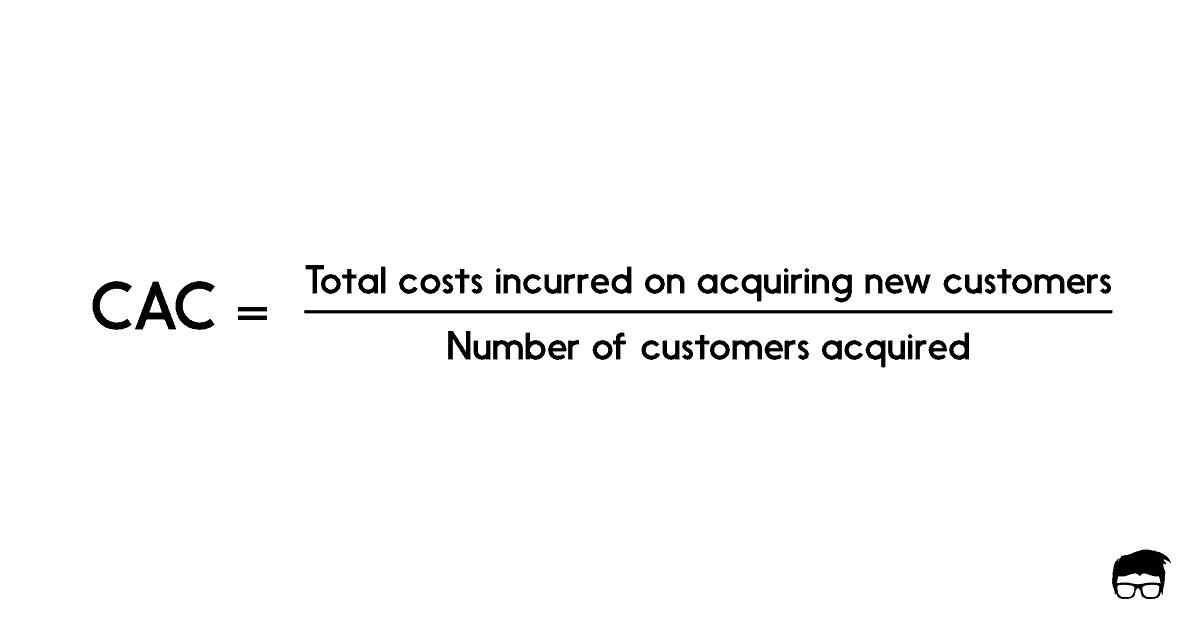
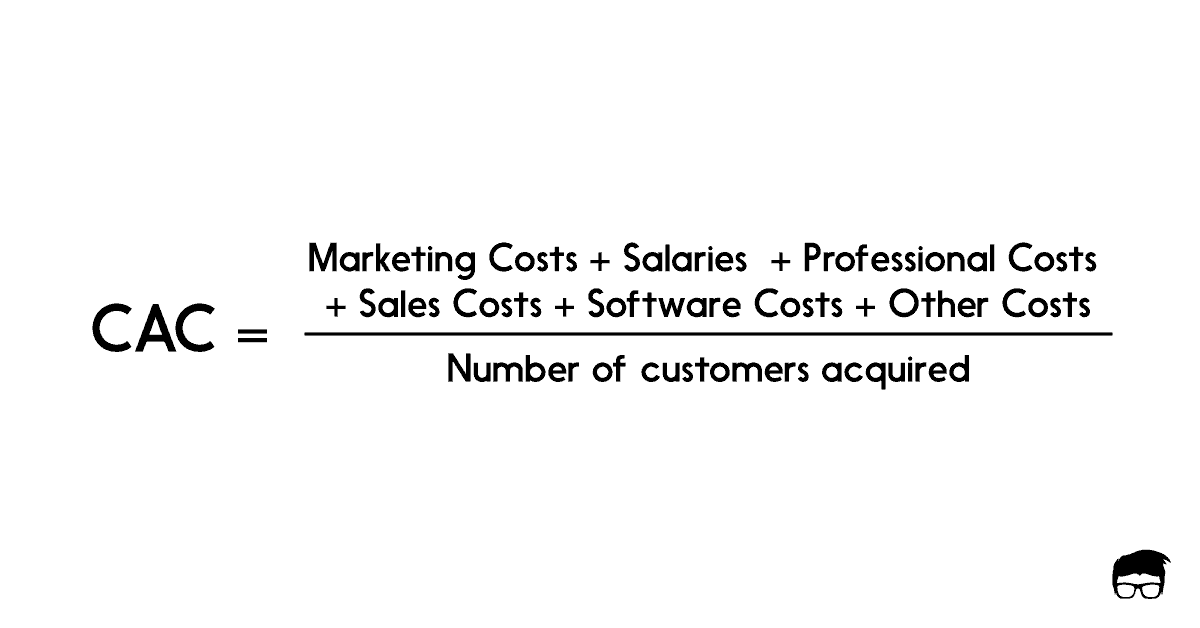
    Generally, CAC is calculated by dividing all the costs spent on acquiring new customers by the number of customers acquired in a specific time period.

    CAC = Total costs incurred on acquiring new customers in a specific period / number of customers acquired in a specific period

    customer acquisition cost formula

    This cost includes all the sales and marketing costs, which is further divided into:

    1. Marketing Costs (M): The total marketing cost for acquiring customers. This cost includes advertising costs as well.
    2. Employee Salaries (E): The salaries associated with marketing and sales.
    3. Professional Costs (P): Costs incurred for professional services like designing, consultancy, etc.
    4. Sales Costs (S):  Sales associated costs (eCommerce commission, brokers, etc.).
    5. Software and tools cost (ST): These include all the expenses incurred to buy, run, and operate the software used in the marketing and sales process. 
    6. Other Costs (O): All the additional overheads associated with marketing and sales, like rents, equipment, etc. allocated to marketing and sales employees.

    So, a better formula of CAC would be:

    CAC = (M+E+P+S+ST+O) / CA

    customer acquisition cost formula

    Example of Customer Acquisition Cost

    Suppose an ecommerce store XYZ launched several marketing campaigns last year, and the costs include –

    Marketing Campaign
    Marketing Costs
    Salaries
    Sales Costs
    Professional Costs
    Acquisitions
    Marketing Campaign Q1
    $50,000
    $20,000
    $10,000
    0
    1,000
    Marketing Campaign Q2
    $50,000
    $20,000
    $15,000
    0
    1,200
    Marketing Campaign Q3
    $50,000
    $20,000
    $25,000
    $10,000
    2,000
    Marketing Campaign Q4
    $50,000
    $20,000
    $10,000
    $10,000
    2,800
    Total
    $200,000
    $80,000
    $60,000
    $20,000
    7,000

    The CAC for XYZ for the year would be: ($200,000 + $80,000 + $60,000 + $ 20,000) / 7000 = $51.43

    CAC And CPA

    One important KPI that people often confuse customer acquisition cost (CAC) with is cost per acquisition (CPA).

    CAC explicitly measures the cost per paying customer acquisition.

    CPA could be anything other than a paying customer. It could be a lead, an activated user, a new free trial registration, etc.

    These two terms are related because CPA is a lead indicator to CAC, but they are not the same.

    For example, Spotify spends enormous amounts on getting new free users on board. These free users acquisition cost is referred to as cost per acquisition (CPA). Some of these users become paying user of the application, and such costs get translated to CAC.

    So, in freemium and SAAS products like Spotify, Dropbox, SEMrush, etc. CAC also includes CPA (Cost to acquire free users + cost to develop free product + cost to support free product) as such costs come under marketing expenses as well.

    CAC (Freemium) = cost to acquire free user + cost to develop free product + cost to support free product + cost to convert free user to paid user.

    CAC And CLV

    CAC is rarely calculated without CLV. It’s really important to compare the acquisition cost with the customer’s lifetime value to calculate the profits a business earns and check the viability of the business.

    The ratio of CLV to CAC is important as it signifies the ROI:

    • 1:1 – the business is at break-even (no profit, no loss). A 1:1 ratio means that the customer ends up paying exactly what the business paid to acquire them. Having such a ratio conveys that the business should do something to reduce the acquisition cost or to increase the LTV.
    • Less Than 1:1 – this means that the business is paying more to acquire the customer than what the customer pays back. This signifies a faulty marketing and financial strategy that needs to be improved.
    • 3:1 – it’s a good level ratio that signifies that the business earns more than what it spends on acquiring the customer.
    • Higher than 3:1 – Usually, businesses having more than a 3:1 CLV to CAC ratio sustain for the long term.

    Go On, Tell Us What You Think!

    Did we miss something?  Come on! Tell us what you think about our article on customer acquisition cost in the comments section.
  • What Is White Label? – Process, & Examples

    What Is White Label? – Process, & Examples

    Not every business develops its offering intending to operate on a B2C model (customer-facing model). Some focus on getting resellers and even let such resellers to sell their offerings under their own brand name.

    This type of business operations is called white labelling, and the product that’s offered is called a white-labelled product.

    Businesses usually choose this model when they desire to focus just on the manufacturing and production, and not on how the product is marketed, promoted, or sold in the market.

    What Is White Labelling?

    White labelling is a process where one business produces a re-brandable and re-sellable product or service that another business sells under its own brand.

    In simple terms, this process lets two businesses join hands and divide the tasks of manufacturing and selling while the seller takes the benefit of building a brand out of such offering.

    What Is White Label?

    White label is a business model where a manufacturer produces an unbranded offering and signs an agreement with other resellers to sell it under their own brand name.

    This business model often involves signing agreements with one or more sellers, who rebrand the offering and even sell the same offering at different price tags depending upon their own brand equity.

    How White Labelling Works?

    White labelling involves an agreement between two parties –

    • Manufacturer: The business that develops a re-brandable and re-sellable product. The only task of the manufacturer is to develop a good quality un-branded product that has a demand in the market.
    • Reseller: The business that buys the product from the manufacturer and sells the same under its own brand. Reseller works on building its own brand, marketing, and promoting the product in the market to get sales. The reseller customises the product according to its brand guidelines and presents it as its own offering to the end consumer. By doing this, it makes the customers believe that the product is unique to its brand.

    The white labelling process involves a legal-agreement between these two parties that includes a set of specific and detailed provisions like:

    • The relationship between the two parties: Are they partners or just two businesses in trade?
    • The manufacturing and development of products: Can alterations be made to the existing process and special requests be entertained by the manufacturer?
    • Product packaging: How the product should be packed, and what are the guidelines for labelling? Will the manufacturer apply the label of the reseller or it has to be done by the reseller himself?
    • The Rights of both the parties: Can the manufacturer sell the product to other resellers as well? If not, what are the restrictions?
    • Responsibilities of both the parties: Who handles what (like after-sale services, warranties, order fulfilment etc.)
    • Pricing: How the costs and profits are divided?
    • Intellectual property rights: Does the manufacturer hold ownership of the product formulation? Who owns the intellectual property rights?
    • Other terms

    White labelling is a lot common in the software industry where the offering manufacturer signs such contracts with more than one seller, resulting in different brands selling a similar offering.

    Advantages And Disadvantages Of White Label Products

    Deciding to buy a generic product from a manufacturer, customising it, building a brand out of it, and selling it as the brand’s unique product does has its own pros and cons for both the manufacturer and the reseller.

    Advantages To The Manufacturer

    • Ready Demand: The white-label product manufacturer usually chooses the niche that already has a proven demand. Such demand comes with an assurance that whatever it’ll produce, there’ll be business buyers who’ll buy it.
    • Saves marketing and promotion cost: Manufacturers save a lot of time, money, and effort that could have been spent if they chose to sell the products directly to the customers.
    • Economies of scale: Usually, white labelling involves signing agreements with more than one seller. This helps the manufacturer make use of economies of scale while manufacturing. Moreover, focusing just on manufacturing helps in finding or developing cost-effective ways to make the offering.

    Advantages To The Reseller

    • Easy market entry: White labelling makes it easy for new businesses to enter the market.
    • Saves manufacturing costs: Manufacturing costs of developing certain products can be a lot as it involves buying machinery, renting space, and hiring workforce. White labelling protects the reseller from such expenses.
    • Helps In Focusing on brand building: White labelling helps resellers focus most of their time, efforts, and other resources in building a trustable brand in the market that aids sales.
    • Aids Expansions: White labelling is a great option for resellers who want to scale fast and add new offerings to their portfolio without investing much in manufacturing them.
    • Discounted Sales: The saved costs of manufacturing enables the resellers to sell the offering at a discounted price. 

    Disadvantages To The Manufacturer

    • No name in the market: Manufacturers are not able to develop their own brand in the market or face customers. 
    • Reseller Dependency: They have to depend on resellers for sales.
    • Limiting Terms: Sometimes, resellers and manufacturers sign agreements that prevent the manufacturers from entering into a similar contract with the reseller’s competitors. This prevents growth of the manufacturer.

    Disadvantages To The Reseller

    • Manufacturer Dependency: Resellers have to depend on manufacturers not just for the initial products, but also for repairs, and warranty fulfilment.
    • High Competition: There are times when the manufacturer offers the same offering to more than one reseller. This increases competition in the market.
    • Limited Customisation Options: Since the manufacturing isn’t in the hands of the reseller, customisation is limited.

    White Label Examples

    White-labelling, even though, more prominent in the software and SAAS industry, is seen everywhere from fashion to food industry. Here are some examples:

    Fenty Beauty

    Fenty Beauty is a cosmetic brand launched by Rihanna. The company has signed a deal with Kendo holdings that that manufactures cosmetics as white-label products for the brand. The same manufacturer produces makeup for other companies like Kat Von D, Marc Jacobs, Lip Lab, Bite Beauty, etc.

    Social Media Management Software

    Often in the SAAS industries, white label products are offered as scripts or APIs that can be used by the resellers under their own brand name.

    There are specialised marketplaces like Code Canyon that helps developers sell such scripts to the resellers.

    Social media management software is one example of such scripts.

    Credit Card Processing

    Often, banks partner with white-label service providers who do the field-job of collecting the information of the leads before the credit card goes into processing.

    AliExpress Dropshipping

    Aliexpress is an ecommerce marketplace based in China that lets resellers sell its products under their own brand name.

    This model is called dropshipping. In this model, the seller on AliExpress handles the manufacturing and shipping of the product while the reseller only focuses on building a brand and getting sales.

    White Label vs Private Label

    While mistaken to be same, white label is not same as private label.

    White Label
    Private Label
    Definition
    White labelling involves buying an unbranded offering from a manufacturer who often sells the same offering to other resellers as well.
    Private labelling involves signing an exclusive contract with a manufacturer who develops the product according to the needs of the seller, who then markets and sells it under its own name.
    Customisation
    It doesn’t involve much customisations.  
    It involves customisations.  
    Exclusiveness
    White label manufacturers are not exclusive to a reseller.
    Private label manufacturers are exclusive to resellers
    Example  
    Kendo is a white label manufacturer that provides products to Rihanna’s Fenty beauty as well as Kat Von D, Marc Jacobs, and Lip Lab.
    365 Everyday Value is a private label line of Whole Foods. It is exclusive to the brand.

    Go On, Tell Us What You Think!

    Did we miss something? Come on! Tell us what you think about our article on white-label products in the comments section.
  • What Is Churn Rate? – Meaning, Types, & Formulas

    What Is Churn Rate? – Meaning, Types, & Formulas

    According to Stanford, every business that exists today might become a subscription business soon. And with the subscription-based business model comes the requirement of calculating KPIs like:

    • How many customers get on board every month, and
    • How many customers leave the business every month?

    The churn rate, even though a metric used to calculate the second performance indicator, is one of the essential KPIs suggesting how good or bad is your startup’s offering, user experience, and customer service and what all can you do to improve.

    Churn Rate Meaning

    Churn rate is the rate at which a business loses its customers during a specific time period.

    Also referred to as defection rate, attrition rate, and turnover rate, it’s a percentage of customers who discontinue business or discontinue their subscription with your organisation during a specific time period. This could happen due to:

    • Cancellation of subscription,
    • Closure of account,
    • Non-renewal of contract or service agreement, or
    • Customers choosing competitors products.
    churn rate

    While churn rate is majorly associated with customers, many businesses also use this turn to denote the percentage of employees leaving the jobs within a certain period.

    Importance Of Calculating Churn Rate

    Increasing customer retention rates by 5% increase profits by 25% to 95%

    – Research done by Frederick Reichheld of Bain & Company

    If you operate on a SAAS business model or subscription model, the churn rate is one of the defining metrics that suggest the real growth of your organisation.

    For a company to grow, its acquisition rate (the rate at which it adds new customers) should be significantly more than its churn rate.

    A high churn rate suggests that there’s something wrong with your offering’s pricing, quality, positioning, or after-sale services; and something should be done to retain more customers. This high churn rate is detrimental to your company’s profitability and often represents slow or negative growth potential.

    Types Of Churn Rate

    Generally, four types of churn rates exist based on how the customer leaves the business. These are –

    • Pro-active Churn: This type of churn rate comes from customers proactively stopping business or cancelling their subscriptions.
    • Reactive Churn: This happens when the customer forgets to do business, subscribe again, or perform an action which automatically cancels the subscription.
    • Happy Churn: This happens when the customers who finish using the offering cancel their subscription, with a positive experience. Such customers often renew the subscription on a later date.
    • Fake Churn: Fake churn is when a prospective customer cancels his/her subscription before the trial period expires. Such customer either doesn’t pay during this period or makes use of the money-back guarantee to get back what he paid.

    Moreover, the churn rate can also be categorised into two types based on the churn metric –

    • Revenue Churn: It’s a measure of the lost revenue.
    • Customer Churn: It’s a measure of the lost customers.

    How To Calculate Churn Rate?

    Calculating client churn rate is easy. The most straightforward formula requires the startup to keep track of the following metrics:

    • Number of customers lost during a specific period.
    • Number of customers at the beginning of the period.

    However, different businesses prefer to use different formulas to calculate churn rate according to their accounting standards. Moreover, Netflix’s shareholders even sued the company in 2004 over its improper calculation of churn rate.

    The case was later dismissed with a ruling that is no single industry-wide definition of churn rate.

    But there indeed are two most commonly used churn rate formulas that are used widely to calculate churn rates of SAAS and subscription-based businesses.

    The Simple Approach

    churn rate formula

    Churn rate is calculated by dividing the number of customers lost during the period by the number of customers at the beginning of that period.

    Mathematical formula of calculating churn rate the simple way is:

    Customer Churn Rate = (Number of customers lost in a period/number of customers at the beginning of the period) * 100

    For example, if at the beginning of July, your startup had 10,000 customers. However, due to a recent update to its pricing, it lost 10% customers that month. It added another 2000 customers the same month, of which 500 churned out as well.

    The churn rate for your startup for July would be –

    • Customers at start of the month: 10,000
    • Customers at the end of the month: 10,000 – 1000 + 2000 – 500 = 10,500
    • Net gain: 10,500 – 10,000 = 500
    • Total Churns in July: 1000 + 500 = 1,500
    • Customer Churn Rate: (1,500/10,000) * 100 = 15%

    Now, the problem with this way of calculating churn rate is that it doesn’t consider the acquisition of new customers per month. Even if the business added 2000 users in July, the churn rate wasn’t affected by it.

    Moreover, the same formula will give a different churn rate even if the trend continued for the next month –

    • Customers at start of the month: 10,500
    • Customers at the end of the month: 10,500 – 1050 + 2000 – 500 = 10,950
    • Net gain: 10,950 – 10,500 = 450
    • Total Churns in July: 1050 + 500 = 1550
    • Customer Churn Rate: (1550/12500) * 1000 = 12.4%

    Now, this formula reported the churn rate for the August to be lesser than July even though the business made no progress.

    The Shopify Approach

    churn rate formula

    Shopify is a subscription-based e-commerce SAAS that allows its subscribers to set up an online store and sell their products.

    The company has launched its version of calculating churn rate where it makes use of total customer days in a month.

    A customer day is one day the customer had an active subscription. If your startup had 10,000 customers for the month of July, the total customer days would be: 10,000 * 31 = 3,10,000.

    Now, this approach requires you to calculate churns per customer day and multiply the result with the number of days in a month.

    Moreover, all the newly acquired customers are assumed to be active only for half a month.

    For example, if at the beginning of July, your startup had 10,000 customers. However, due to a recent update to its pricing, it lost 10% customers that month. It added another 2000 customers the same month, of which 500 churned out as well.

    The churn rate for your startup for July would be –

    • Customers at the start of the month: 10,000
    • Customers at the end of the month: 10,000 – 1000 + 2000 – 500 = 10,500
    • Net gain: 10,500 – 10,000 = 500
    • Days in July: 31
    • Customer Days in July: (10,000 * 31) + (0.5 * 500 * 31) = 3,17,750
    • Total Churns in July: 1000 + 500 = 1,500
    • Churns Per Customer Day: (1500/3,17,750) * 100 = 0.47%
    • Monthly Churn Rate: 0.47% * 31 = 14.57%

    Now, if the same trend followed in August, the churn rate would be –

    • Customers at the start of the month: 10,500
    • Customers at the end of the month: 10,500 – 1050 + 2000 – 500 = 10,950
    • Net gain: 10,950 – 10,500 = 450
    • Days in August: 31
    • Customer Days in August: (10,500 * 31) + (0.5 * 450 * 31) = 3,32,475
    • Total Churns in July: 1050 + 500 = 1,550
    • Churns Per Customer Day: (1550/3,32,475) * 100 = 0.47%
    • Monthly Churn Rate: 0.47% * 31 = 14.57%

    As you can see, this approach gives a better the monthly churn rate remains the same as the trend remains the same and

    Factors Affecting Churn Rate

    While customers rule the market, it’s up to the business to make customers want more. The following factors help the business in doing the same –

    • Customer Experience: It is your customers’ holistic perception of their experience with your business or brand. A bad customer experience often increases the churn rate and vice versa.
    • Customer Expectations: It encompasses everything that a customer expects from the offering or the brand. It is often influenced by promotional messages and gives shapes to the customer experience. A higher customer expectation but a lower customer experience increases the churn rate and vice versa.
    • Customer Investment: It includes both monetary and non-monetary customer investments. The more a customer invests, the more he expects from the business to return. 
    • Utility and Value: Utility and value is directly correlated to how satisfied is the customer with the offering and the service. A high utility reduces the churn rate and vice versa.

    What Is A Good Churn Rate?

    Generally, in SAAS and subscription-powered industry, the average churn rate is 5% per annum. This means, if your startup has 1000 customers in a year, it’s not bad if you lose 50 of them over the course of that year.

    However, an ideal churn rate is 3% or less.

    Go On, Tell Us What You Think!

    Did we miss something? Come on! Tell us what you think about our article in the comments section.
  • What Is Burn Rate & Startup Runway?

    What Is Burn Rate & Startup Runway?

    Generally, your startup will not be profitable during its early stages. By not profitable, I mean that you’ll spend more than you’ll earn.

    This is usually the most common reason why your startup might require external funding.

    But the investors at such an early stage often look for a metric to understand the cash outflow rate and how much time it will take for your startup to use all of the invested money.

    This is when the concept of burn rate and startup runway comes in.

    What Is Burn Rate?

    Burn rate, or cash burn rate, is the rate at which the business uses up its cash reserves or cash balance.

    It is essentially a measure of the net-negative cash flow – how much money your startup spends and how quickly it spends it.

    Usually, burn rate is quoted in terms of cash outflow per month. Hence, its better definition would be the actual amount of cash a business spends in one month.

    For example, if your business has a burn rate of $10,000, it means it spends $10,000 per month.

    While this burn rate is generally expressed in months, it can also be expressed in terms of days, weeks, and years, depending upon your requirements.

    Types Of Burn Rate

    Burn rate is categorised into two types: gross and net.

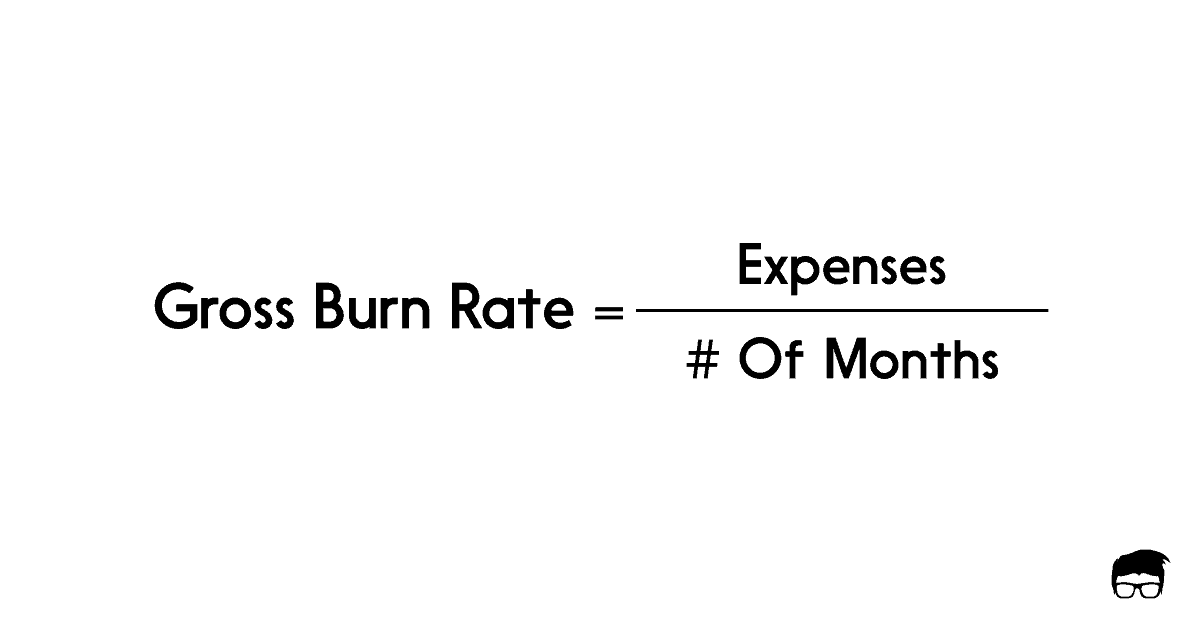
    The gross burn rate is the total amount of cash the business spends in a month.

    The net burn rate, on the other hand, is the net-negative cash flow after taking into account the revenue, if generated.

    For example, if your business spends $20,000 per month but also earns a revenue of $5,000 per month, its gross-burn rate is $20,000, but the net-burn rate is $15,000.

    How To Calculate Burn Rate?

    Calculating startup burn rate is straightforward. It’s the total amount of cash decreased in one month. It doesn’t include outstanding obligations or money that’s on its way. It’s just your business’s negative cash flow.

    Gross Burn Rate Formula

    gross burn rate formula

    You calculate gross burn rate by dividing the total expenses by the number of months. For example, if the total expense for three months is $90,000, the gross monthly burn rate would be 90,000/3, which comes out to be $30,000.

    Net Burn Rate Formula

    net burn rate formula

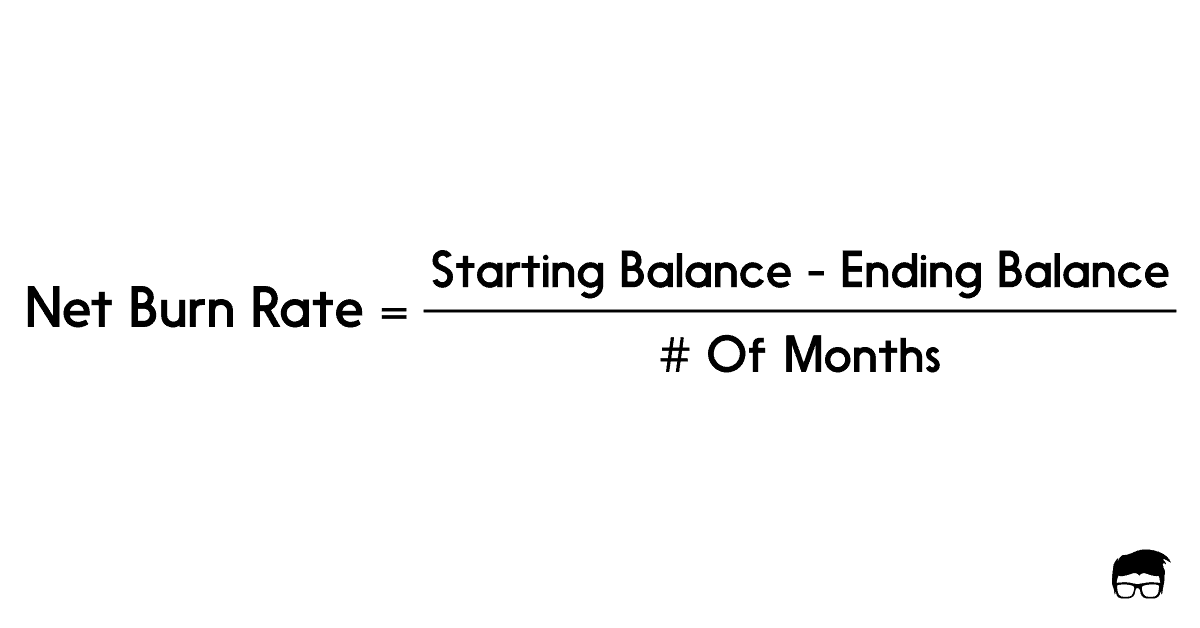
    You calculate the net burn rate by dividing the net cash outflow by the number of moths. The net cash outflow takes into account the revenue generated during the specified period. It is calculated by subtracting the starting balance of the period by the ending balance of that period (starting balance + revenue earned – expenditures). For example, if your startup received a funding of $60,000, earned a revenue of $10,000, but incurred an expenditure of $40,000 in 3 months, its net cash burn rate would be (60,000 + 10,000 – 40,000)/3, which comes out to be $10,000.

    What Is Startup Runway?

    Startup runway, also called runway or cash runway, is the amount of time a startup can operate at a loss before running out of money.

    In simple terms, it refers to the period after which your startup can’t survive in the market if the income and expenses remain constant.

    How To Calculate Cash Runway?

    startup runway formula

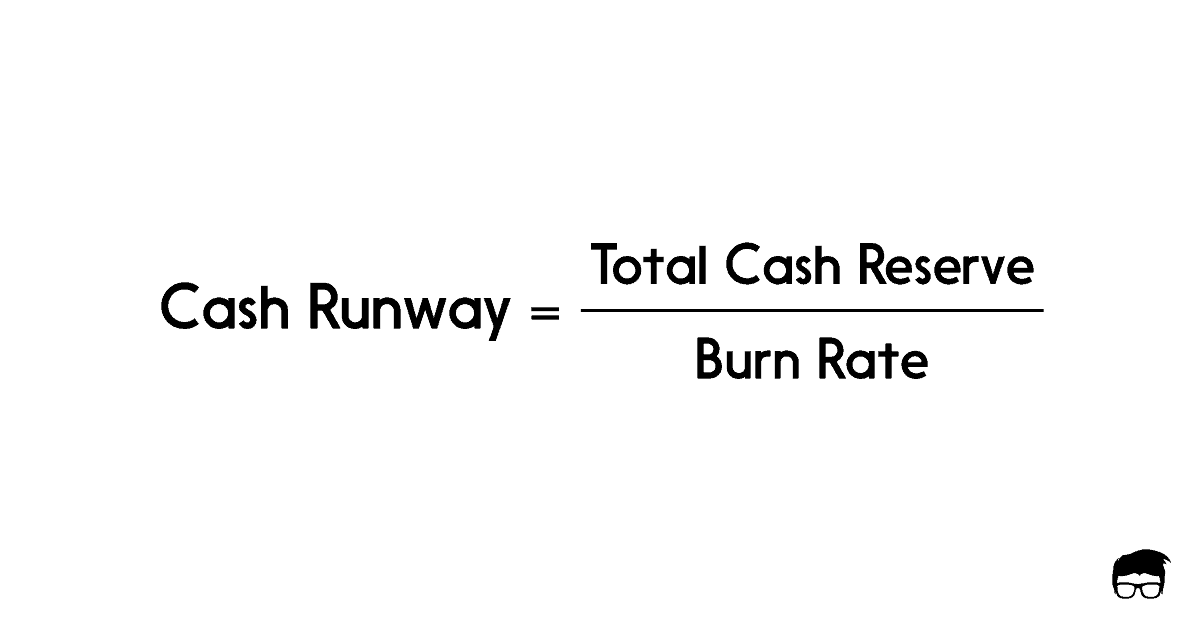
    Suppose you have a startup that got an investment of $100,000 and doesn’t have money otherwise, is running at a burn rate of $20,000 a month. It has five months before it runs out of cash and gets itself in serious trouble.

    We reached this figure by using this simple cash runway formula: Total Cash Reserve / Burn Rate.

    Total cash reserve is the total amount of money that your business can spend. It is the sum of investment and total revenue.

    Why Is Calculating Burn Rate And Cash Runway Important?

    According to CBInsights, cash crunch is the second leading cause of startup failure. Calculating the burn rate helps you answer when and why will your startup run out of cash, and how can you prevent from failing due to the same. Besides this, calculating burn rate and cash runway is essential as it helps to – 

    • Calculate the time your business has before it should be profitable or get another round of funding.
    • Decide on whether to prioritise fundraising at present or at a later stage.
    • Develop a viable budget.
    • Develop strategies to cut down on expenses or increase revenue.
    • Get realistic data of when your business can become profitable.
    • Make sure whether your business is moving in the right direction or not.

    Moreover, investors always consider burn rate to be an essential factor before investing in a startup.

    What Is A Good Burn Rate And Cash Runway?

    For most startups, a cash runway period of 12-18 months is considered to be good.

    While most experts prefer the runway period to be around 18 months irrespective of the funding round, CBInsights has estimated the median time lapse between funding rounds –

    Hence, a good burn rate is one that can help your startup stay afloat for 12 to 18 months without requiring external funding in between.

    How To Reduce Burn Rate?

    A low burn rate suggests that your startup is growing and might sustain for an extended period.

    A higher burn rate, however, usually suggests that the cash supply is depleting faster than it should, which indicates that the startup is at a higher likelihood of entering financial distress.

    Here are the ways you can use to reduce your business’ burn rate.

    • Increase The Revenue: Revenue adds to the cash reserve and reduces the net cash burn rate.
    • Cut Off Unprofitable Revenue Streams: You can ditch unprofitable or loss-making revenue streams and direct such resources towards the streams that can benefit your startup.
    • Reduce Payroll Expenses: Smart hiring always reduces the expenditure of your business. The process involves deciding the positions beforehand, hiring multitaskers, and keeping the organisational structure flat. 
    • Reduce Or Defer Other Expenses: Reducing the expenditure and deferring the payments helps keep the cash flow positive or less negative for some time.
    • Cut Off Unnecessary Costs: Unnecessary costs that don’t help your business in core activities can be reduced to reduce the burn rate.
    • Encourage Cash Sales: Cash sales increases the cash inflow and reduces the cash burn rate.

    Go On, Tell Us What You Think!

    Did we miss something? Come on! Tell us what you think about our article on burn rate and cash runway in the comments section.
  • Small and Medium Enterprise (SME) – Definition, Characteristics, & Examples

    Small and Medium Enterprise (SME) – Definition, Characteristics, & Examples

    Every business has a journey. Their endings might be different but starting is always the same i.e. from a small-scale business to a large-scale business. But in many cases, the business might remain small/medium-sized throughout its life-cycle. These types of businesses come under small and medium enterprises (SMEs).

    The number of SMEs in the world is way more than large companies and employs many more employees collectively. Each country has its own standards to identify SMEs.

    So, let us understand the concept of SMEs.

    What is SME?

    Small and medium enterprises are privately owned businesses whose capital, workforce, and assets fall below a certain level according to the national guidelines.

    Local restaurants, grocery stores, garages, etc. that serve a hyperlocal target audience usually fall under the blanket of a small-to-medium-size enterprise as they generate less revenue and operate with less than a certain level of workforce and assets.

    Legal Definitions Of SME In Different Countries

    Legal definition and standards for identifying a small business vary from country to country.

    India

    In India, SMEs are identified on the basis of the investment.

    In the case of small enterprises:

    • The manufacturing sector’s investment in plant & machinery should be more than 25 lakh rupees and less than 5 crore rupees.
    • The service sector’s investment in the equipment should be more than 10 lakh rupees and less than 2 crore rupees.

    In the case of medium enterprises:

    • The manufacturing sector’s investment in plant & machinery should be more than 5 crore rupees and less than 10 crore rupees.
    • The service sector’s investment in the equipment should be more than 2 crore rupees and less than 5 crore rupees.

    USA

    In the United States, the definition of SMEs changes according to the industry.

    • Agriculture: a maximum of $750,000 average receipts.
    • Mining: a maximum of 250 to 1,500 employees.
    • Utilities: a maximum of 250 employees (for renewable electric power generation subsectors) to 1,000 employees (for electric power and natural gas distribution businesses).
    • Construction: a maximum of $36.5 million in average receipts.
    • Manufacturing: a maximum of 500 to 1,500 employees.
    • Wholesale Trade: a maximum of 100 to 250 employees.
    • Retail Trade: a maximum of $7.5 million in average annual receipts (for one-third of retail trade industries). A maximum of 100 to 500 employees for the rest of the sub-industries.
    • Transportation and Warehousing: a maximum of 500 to 1,500 employees. A maximum of $7.5 million to $37.5 million in average annual receipts for some sub-industries.
    • Information: a maximum of 500 to 1,500 employees, and a maximum of $7.5 million to $38.5 million in average annual receipts.
    • Finance and Insurance: a maximum of 1,500 employees, and a maximum of $32.5 million to $38.5 million in annual receipts.
    • Real Estate, Rental, and Leasing: a maximum of $7.5 million to $32.5 million in average annual receipts.
    • Professional, Scientific, and Technical Services: a maximum of 1,000 to 1,500 employees or a maximum of $7.5 million to $20.5 million in average annual receipts.
    • Health Care and Social Assistance: a maximum of $7.5 million to $38.5 million in average annual receipts.

    UK

    In the United Kingdom, SMEs are defined on the basis of the number of employees, turnover, and balance sheet total.

    In the case of small enterprises, turnover should not be more than £6.5 million, a balance sheet total of not more than £3.26 million, and employees not more than 50.

    In the case of medium enterprises, turnover should not be more than £25.9 million, a balance sheet total of not more than £12.9 million, and employees not more than 250.

    South Africa

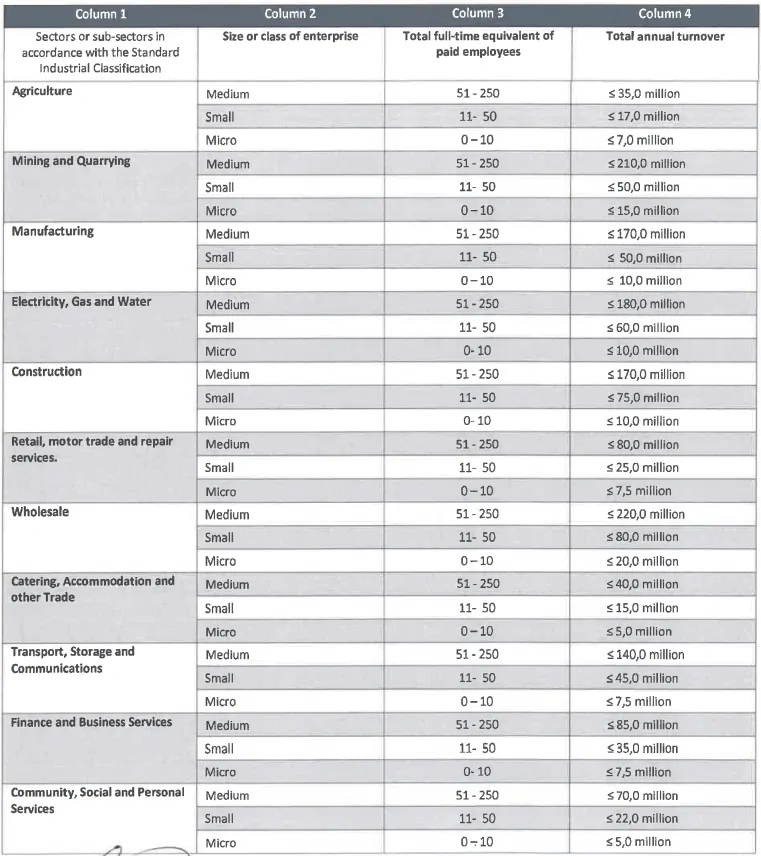
    In South Africa, the previous definitions of SMEs were amended in 2019.

    Now, there SMEs are identified on the basis of two measures instead of three. They are – `total full-time equivalent of paid employees’ and `total annual turnover’.

    Small and medium enterprises singapore

    Singapore

    In Singapore, the Ministry of Trade and Industry re-defined the definition of SMEs in 2011.

    SMEs are defined as businesses having an annual sales turnover of S$100 million, or that employs not more than 200 workers.

    Characteristics of SMEs

    Irrespective of different definitions of SMEs in different countries, the characteristics of such businesses remain the same.

    • Limited Investment: The capital requirement of an SME is less as it operates on a small scale.
    • Labor-Intensive: SMEs usually don’t require heavy or sophisticated machinery. Hence, it uses more labor-intensive techniques.
    • Less Number of Employees: SMEs requires a smaller number of people as compared to large corporations, due to their small scale of operations.
    • Local Area of Operations: SMEs operate locally and remain there for longer periods of time (years or maybe decades) which helps it to build a strong relationship with local customers.
    • Management: In most cases, a single owner or a small group of individuals handles the management of the business.

    Importance of SME

    Nowadays, SMEs have become the supporting pillar of any economy in the world in many ways. Without them, the economy cannot survive.

    The importance of SMEs can be highlighted by the following points:

    Utilization of Local Resources

    Opening up of small and medium-sized businesses in rural areas or small towns helps in better utilization of resources in that particular area. If a town is rich in iron ore mines, then factories will open up for the effective utilization of that resource.

    Employment Generation

    SMEs are the best solution to unemployment in any country. It provides job opportunities for local people. Especially, in developing countries like India, where unemployment has been a major problem, these businesses provide relief.

    Opportunities to New Entrepreneurs

    The major role of SMEs in any country is to cultivate new entrepreneurs. Since small businesses are easier to set up and require less capital, it creates a perfect option for young entrepreneurs to test their skills and grow.

    Development of Local Areas

    The development of an area largely depends upon the number of businesses it has. Setting up small businesses helps in providing employment to the local population and removing regional imbalances.

    Improvement Of The Quality of Life

    SMEs help the locals by providing them jobs. This increases the per capita income of the household which improves their quality of life.

    Advantages of SME

    Some of the main advantages of an SME are:

    More Flexible

    SMEs are more flexible when it comes to adapting to change. This is because they are small in size, runs on a simple business model, and are closer to their customers. This helps SMEs to identify any kind of opportunity that arises in the market before any competitors.

    Close Relationship with Customers

    This is one of the greatest perks of SMEs. While large corporations pour a lot of money to connect with their customers, SMEs do it easily.

    SMEs operate locally and have a smaller customer base, which makes it possible to maintain close relationships with its customers.

    Fast Decision-Making

    In most cases, small and medium-sized businesses are run by an individual or a small group of people. So, decisions are taken fast as compared to large corporations where it takes time to debate and arrive at a decision.

    Better Communication

    SMEs usually employs a small group of people. There is no need for a separate department for hiring employees, all the activities are managed by the owner. He/she keeps track of all the employees and communicates with them effectively.

    Better Control Over Business

    The owner manages all the operations of the business effectively as it is small in size. This leads to better control over the business.

    Disadvantages of SME

    Everything has its pro and cons and SMEs are no different. So, let us look at some of the disadvantages of SMEs.

    Less Use of Technologies

    Due to less capital, SMEs rely heavily upon labor-intensive techniques instead of capital-intensive techniques. Another reason is that small businesses run on a traditional business model that requires less use of modern technologies.

    Difficulty In Funding

    Acquiring funds for an SME is not easy as banks hesitate to hand out loans. This is because a lot of businesses don’t last long.

    The owners of SMEs mostly get their funding from family & friends or use their own savings.

    Less-Skilled Employees

    Highly skilled employees demand higher pay. So, due to less capital, SMEs settle for less-skilled employees.

    Risk

    Risk is always there in running a business, even if the business model is structured to be risk-free, it cannot be eliminated completely.

    Stress

    It is not easy to manage all the departments of the business alone. This is why, many times, managing becomes a burden and takes a toll on the mental health of an entrepreneur.

    In the initial stages of setting up a business, entrepreneurs do extra hours of work ignoring their health which leads to many mental health problems like anxiety and stress. 

    Startups vs SMEs

    Small and medium-sized businesses are often confused with startups. Many young entrepreneurs call their small business a startup. In businesses, the use of proper terminologies is important to avoid any problems that might arise out of it in the future.

    This happens because of a lack of knowledge about the two terms. So, let us understand the key points of difference between the two.

    • Technology: Startups usually use high-end modern technologies while SMEs require less use of technology.
    • Business Model: Startups choose an unconventional business model, while SMEs choose a tried and tested business model.
    • Innovation: A unique feature of a startup is disruptive innovation. Startups create new offerings or innovate the existing ones, while SMEs deal with existing offerings.

    Go On, Tell Us What You Think!

    Did we miss something? Come on! Tell us what you think about our article on Small And Medium Enterprises (SME) in the comments section.
  • What Is Debt Financing? – Types, Sources, Pros & Cons

    What Is Debt Financing? – Types, Sources, Pros & Cons

    Usually, during the initial stages of the startup, the money comes from the pockets of founders and cofounders. But soon, as the startup grows, this money inflow isn’t able to keep up with the startup’s growth. It is when the founders need to make a tough decision of whether to raise money by diluting ownership (equity financing) or by taking loans (debt financing).

    While equity financing requires no repayment and doesn’t even act as a liability to the startup, it dilutes the ownership and the decision-making process. This makes many founders choose debt financing as a capital financing method, that requires repayment along with interest.

    What Is Debt Financing?

    Debt financing is the method of raising capital by selling debt instruments to individuals or institutional investors.

    By purchasing such instruments (notes, bills, and bonds), the investors become the creditors to business and receive a promise to receive payments (with interests) based on the debt financing agreement.

    Characteristics Of Debt Financing

    Unlike equity financing where company’s shares are sold to the investors, debt financing doesn’t dilute the ownership of the company and the founders maintain their decision-making rights. But it comes at the cost of an additional liability in the form of a loan to the business.

    • The investor is the creditor: Debt financing involves taking loans from investors (usually banks, high net-worth individuals, angel investors and groups, and venture capital firms, etc.). Such investors become creditors to the business who have the right to get repaid even if it requires to sell business’s assets.
    • Investment is a liability: The business signs an agreement with the investors promising them to repay the loan along with agreed-upon interest within the specific time period. This forms a liability to the business.
    • Ownership isn’t dissolved: Taking monetary investment in the form of debt doesn’t dissolve the ownership of the founders and they enjoy full control over the business.

    How Does Debt Financing Work?

    Debt financing involves selling of fixed income instruments like notes, bills, and bonds to the investors to obtain capital investment required for the business to run, grow, and expand. These instruments come with a promise of repayment along with the agreed interests at some agreed date in the future. If the company goes bankrupt, these lenders have a higher claim on the liquidated assets than the shareholders.

    Generally, startups go for debt financing when their valuation is hard and equity financing isn’t possible. Such funding is provided after considering the –

    • Creditworthiness of the founders,
    • Creditworthiness of the business,
    • Future potential valuation of the business, and/or
    • Current growth graph of the startup and its future milestones.

    Debt instruments come with a stipulated date pre-scheduled for repayment and both the parties are required to follow it strictly. Moreover, certain assets are kept as a security against such debt or certain terms and conditions are mentioned, called covenants. In case the startup fails to repay the debt, the investor usually gets the rights to recover his investment by seizing the collateral assets or through other means decided in the terms.

    Types Of Debt Financing

    Debt financing can be categorized into different types depending upon the time-period between the investment and repayment and the type of loan granted.

    • Short-Term Loan: Money borrowed to meet the working capital costs and short-term expenditures like administrative costs, rents, maintenance, etc. come under the head of short-term loans. Usually, the company’s assets are not kept as securities for short-term debts.
      • Bills: These debt investments mature within a year and don’t come with interest payments. Rather, they are sold at a discount to their face value, and investors get the full amount upon maturity.
      • Revolving Loan: Often provided by the financial institutions or an investor as a line of credit that the startup can withdraw, repay, and repeat over and over again. 
      • Cash Flow Loan: Such loans allow the company to borrow money based on its projected future cash flow, which is held as security. Unlike usual instalment loans, startups repay such loans as they earn revenue that was used to secure the loan.
    • Long-Term Loan: It’s the investment, extending for more than a year, required to develop and work on the infrastructure, growth, and other long-term strategies. Such loans require the startup to keep the company assets as securities or collaterals along with accepting certain terms and conditions, called covenants.
      • Notes: Notes are debt instruments with maturity from two to ten years. They pay interest periodically (annually or semi-annually).
      • Bonds: Bonds are debt instruments having maturities of greater than ten years. They pay interest periodically (annually or semi-annually).
      • Mezzanine Financing: It’s a hybrid of equity and debt financing where the lenders provide the companies with a loan with specific terms that include repayment in the form of equity interest if cash flow isn’t available. In simple terms, the mezzanine lender has a warrant enabling him to convert the security into equity at a predetermined price per share if the borrower company fails to repay the loan on time or in full.
      • Convertible Notes: Convertible note is a hybrid-debt-equity-investment, ranging from 18 to 24 months, used to invest in early-stage startups that the investor can choose to convert into common shares at a later time or an event when it is easier to determine the company’s valuation.

    Sources Of Debt Financing

    Different types of debt financing come from an equally different number of sources. These are –

    • Banks and Financial Institutions: Banks and credit unions provide both short term and long term secured loans to the business.
    • Individual Private Investors: Private investors are usually among the friends, family, and fools who trust in entrepreneur with their money and invest considering the entrepreneur’s credibility along with the business.
    • Angel InvestorsThese are high net-worth individuals who invest during the early stages of the startup. Usually, they invest using convertible notes or convertible equity contracts, but there are also times when they offer just debt.
    • Venture Capital Firms: These are professional investment firms formed by the association of high-net-worth individuals, angel groups, angel investors, and corporations who invest in high-potential startups.
    • Crowdfunding PlatformsPlatforms like Lending Club, Prosper, etc. form middlemen that help the business raise small amounts of money from a large number of investors to fulfil its debt investment needs.

    Debt Financing Pros And Cons

    Debt financing comes with its own set of advantages and disadvantages.

    Debt Financing Advantages

    • Ownership Rights Are Not Diluted: The investors who invest in the form of debt become the creditors of the business and have no right in the decision making of the business.
    • It’s Faster Than Equity Financing: Equity financing takes considerable time as it involves pitching, negotiations, term sheets, etc. Debt financing, on the other hand, is a comparatively faster process.
    • The Options Are Flexible: Debt financing comes with varied options depending upon the type of loan required and the time period for which it is required.

    Debt Financing Disadvantages

    • Is A Liability: The biggest disadvantage of debt financing is that it’s a liability that needs to be written off on or before the due date. 
    • It’s Expensive: The interest on debt can rise up to 30% of the principal amount that can prove to be very expensive to the business.
    • Hard To Qualify: Debt financing requires numerous background checks, business credibility checks, individual credibility checks, along with other formalities that make it hard to qualify for the same.

    Equity Financing vs Debt Financing

    Both equity and debt financing come with their favourable and unfavourable terms that may suit or not suit the business.

    Debt Financing
    Equity Financing
    Liability
    Is a liability
    Isn’t a liability
    Investor Status
    The investor is the creditor
    The investor becomes a shareholder of the business.
    Qualification Requirements
    It requires good creditworthiness of the startup and the people behind it.
    It requires a competent team, a validated market opportunity, a well-defined business model, and a growth plan.
    Effect on cash flow
    It requires the startup to pay periodic interests and affects the cash flow of the business.
    It doesn’t require the startup to pay periodic interests on investment so it doesn’t affect cash flow.  

    Go On, Tell Us What You Think!

    Did we miss something? Come on! Tell us what you think about our article on debt financing in the comments section.

  • What Is Equity Financing? – Types, Sources, Pros & Cons

    What Is Equity Financing? – Types, Sources, Pros & Cons

    Running a successful startup requires a lot more than just a great idea. It also involves a lot of money; and this money is generally sourced by taking loans (debt financing) or selling equity (equity financing).

    While loans are preferred by entrepreneurs who don’t want to dilute their decision-making power, it is usually considered a significant liability that keeps the startup from climbing ladders with ease.

    On the other hand, equity financing is usually a go-to-strategy for most founders to raise funding, get strategic guidance, and run a successful long-term startup.

    But what exactly is equity financing, how it works, and what are its sources?

    Let’s find out.

    What Is Equity Financing?

    Equity financing is the method of raising capital by selling the company’s shares in exchange for a monetary investment.

    In simple terms, equity financing refers to selling a part of the company’s ownership. The person or persons who invest via equity financing are referred to as the company’s shareholders as they buy the shares and receive an ownership interest in the company.

    The proportion of the ownership that is sold to the investor, however, depends upon the amount invested and the company’s worth.

    For example, if the company’s post-money valuation comes out to be $100,000 at the time of the investment and the investor invests $40,000 in return for equity, he now owns 40% of the company.

    Typically, startups prefer this type of funding over taking loans as

    1. Loans are considered to be liabilities that often slows down the startup’s growth.
    2. They are hard to get as startups operate in a highly risky business environment.

    How Does Equity Financing work?

    To sustain, grow, and expand, a startup requires additional capital that usually comes in in the form of equity financing.

    Even though the term is a standard for selling company’s shares, equity financing works differently during different stages of the startup –

    During the initial stages (pre-seed and seed funding round), when the startup valuation isn’t possible, equity financing witnesses the signing of convertible equity notes like SAFE, KISS, convertible notes etc. where investors invest in the startup in exchange for a right to get shares when the valuation is possible. Founders’ friends and family, angel investors, and accredited investors invest during such rounds.

    In the other rounds (like Series A, Series B, etc.), when startup valuation is possible, other equity instruments like common stocks and preferred stocks are provided to investors like venture capitalists, angel groups, corporate investors, etc. in exchange for monetary investment.

    All such equity offerings are counted as private equity and witness fewer restrictions and investment guidelines from regulators like the Securities and Exchange Commission.

    Once the company gets large enough, it goes public and sells common equity to institutional and retail investors. Such equity offerings are available to all types of investors in a stock market and are considered to be safer as a body like SEC regulates them.

    Importance Of Equity Financing

    Capital is vital for a business to stay afloat. Equity financing brings in this much-required capital in the form of partnered ownerships and helps the company –

    • Stay away from additional liabilities: Debts are liabilities that take interest from the working capital of the company. This prevents the company from working at its full potential.
    • Raise the exact money required: Equity investments usually amount more than debt investments as they come with a reward of shares ownership. This helps the company raise more than it would have using debts.

    Types Of Equity Financing

    Generally, equity funding can be categorised into six types according to the type of contract signed. These are –

    1. Equity Investments: These are simple equity financing contracts where equity is provided in exchange for monetary investment by the investors.
    2. Mezzanine Financing: It’s a hybrid of equity and debt financing where the lenders provide the companies with a loan with specific terms that include repayment in the form of equity interest if cash flow isn’t available. In simple terms, the mezzanine lender has a warrant enabling him to convert the security into equity at a predetermined price per share if the borrower company fails to repay the loan on time or in full.
    3. Convertible Notes: Convertible note is a short-term hybrid-debt-equity-investment tool used to invest in early-stage startups that the investor can choose to convert into common shares at a later time or an event when it is easier to determine the company’s valuation.
    4. Royalty Financing: Royalty financing is equity financing in the future sales of the product. In this type of funding, the investors expect to receive a percentage of revenue received from the sale of the company’s offering(s).
    5. Equity Crowdfunding: This type of equity financing involves the company selling its shares to a crowd of people instead of one or a few key investors.
    6. Initial Public Offering: IPO takes place when the company goes public and lists its shares on a publicly-traded market like New Your Stock Exchange. It requires the company to comply with the guidelines established by the regulatory body of the country.

    Sources Of Equity Financing

    The different types of equity finance come from other sources. These are –

    1. Individual Private InvestorsThese investors invest in the business during the very early stages. They usually come under the FFF (friends, family, and fools) circle who trust the entrepreneur than the company.
    2. Angel Investors: These are high net-worth individuals who invest in high growth businesses in return for a share in the business. Along with monetary investments, these investors also contribute their expertise and network to help the business progress even more. Usually, angel investors use their personal funds for investments.
    3. Venture Capital FirmsVenture capital firms are professional investment firms formed by a group of high-net-worth investors, corporate firms, and other professional investors, that funds business ventures in exchange for an equity stake. Unlike angel investors, venture capital firms use money from the pool of funds collected from the group members. Such firms also have boards that make such decisions, and strategic teams that help the startup with its non-monetary requirements.
    4. Crowdfunding PlatformsCertain crowdfunding platforms like AngelList, CircleUp, Fundable, etc. act as an intermediary between the company and the group of lenders who provide monetary investment to the company in return for equity ownership.
    5. Stock Market: Stock market is a regulatory market that helps the company get public and offer it shares to be freely traded by the public.

    Equity Financing Pros And Cons

    Equity financing comes with its own set of advantages and disadvantages.

    Equity Financing Advantages

    • Comes With Less Risk: For businesses that struggle with positive cash flow, equity financing poses less risk as it doesn’t have to repay hefty interests every month.
    • Doesn’t Require Certified Creditworthiness: Usually, debt financing requires a background check and is only possible if the borrower has good creditworthiness. Moreover, it’s not possible to raise a considerable amount as loans for a startup. Equity financing comes out as a rescue for such startups.
    • Helps Maintain Good Cash Flow: With no interest repayment, the company makes use of its cash flow to grow its business and the value of its share.
    • Is More Than Just Monetary Investment: Usually, by selling shares to industry experts also helps the company make use of such investors’ expertise, skills, and network for the good of startups.

    Equity Financing Disadvantages

    • Dilutes Ownership Rights: Selling out company shares in exchange for monetary investment dilutes the ownership and decision making authority of the founders.
    • Shares Profits: Selling shares means the founders also have to share the profit amount with other owners depending upon the ownership percentage.
    • Can Result In Potential Conflicts: Since decision-making authority is shared with other shareholders, this can result in potential conflicts if there are differences in vision, management style, and business running outlooks of different shareholders.

    Equity Financing Vs Debt Financing

    Both equity and debt financing come with their favourable and unfavourable terms that may suit or not suit the company.

    Equity Financing
    Debt Financing
    Process Speed
    Takes considerable time as the company is required to comply with all the regulations and it’s not easy to negotiate with the investors.
    It’s faster when compared to financing through equity.
    Ownership Dilution
    Requires the founders to dilute their ownership rights and share it with the investors.
    Doesn’t involve dilution of ownership.
    Creditworthiness
    Team’s past performance and ability matters more than the creditworthiness of the business.
    It depends fully on the creditworthiness of the company or the individual who takes the loan.
    Effect On Cash flow
    It doesn’t require the startup to pay periodic interests on investment so it doesn’t affect cash flow.
    Debt financing requires the business to pay periodic interests on investment and affects cash flow.

    Go On, Tell Us What You Think!

    Did we miss something? Come on! Tell us what you think about our article on equity financing in the comments section.

  • What Is Simple Agreement for Future Equity (SAFE)?

    What Is Simple Agreement for Future Equity (SAFE)?

    Startup funding during the initial stages of the startup is crucial for the company’s survival in the long run. However, in most cases, startups during such early stages don’t generate revenue and often operate in a very risky business environment. This makes it hard for the investors to value such startups at the time of the investment.

    But this doesn’t stop them from investing in potentially profitable startups. They invest using the concept of future equity – the investment amount converts into equity not immediately but upon the occurrence of future events or fulfilment of future conditions.

    This is where Simple Agreement For Future Equity (SAFE) kicks in.

    What is Simple Agreement for Future Equity?

    Simple Agreement for Future Equity (SAFE) is an investment contract used to invest in early-stage startups in return for the rights to subscribe for new shares in future, usually at the next preferred stock financing round or a liquidation event.

    To understand the concept better, let’s break the definition into three key-phrases –

    • Investment contract:  SAFE is not an equity or a debt. It is just a legal agreement where an investor invest in a startup in return of a right that he’ll get to subscribe for new shares in the company in future upon occurrence of certain events like – equity financing, a liquidity event, or a dissolution event.
    • Used to invest in early-stage startups: SAFE is used just to invest in early-stage startups when the valuation isn’t possible.
    • In return for the rights to subscribe for new share: Safe provides a safeguard for the early investors in the form of a right to subscribe for new shares in future.

    Y Combinator introduced this concept of SAFE as an alternative to convertible note that acted as a debt to the startups who were required to pay interest on it.

    Characteristics Of SAFE

    SAFE is a distinct future-equity agreement with the following characteristics –

    • No expiration date – SAFE never expires. It only converts upon the occurrence of certain events like equity financing, liquidity event, or dissolution event. If such events don’t take place, SAFE continues to exist unless otherwise stated in the terms.
    • No Interest Rate – It isn’t debt, so it doesn’t bear any interest.
    • No qualifying equity round description – SAFE can convert at any equity funding round when the valuation of the business is possible. There isn’t any predetermined minimum qualifying amount to be raised at the equity financing for SAFE to be converted.
    • Deferred Valuation Clause – The valuation of the company is deferred to the future.
    • Issuance of shadow stock – The stock issued to SAFE investors is commonly called ‘shadow preferred stock’. It differs from the preferred stock (the “new investor preferred stock”) which is issued to the new investors at the time of preferred stock financing that triggers the SAFE conversion. Even though this shadow preferred stock is intended to have the same rights as that of new investor preferred stock, what differs is the liquidation preference, conversion price, and dividend rate of the shadow preferred stock. These are calculated based on the price per share of the shadow preferred stock instead of the price per share of the preferred stock offered to new investors.

    SAFE is issued to the investor by the startup company. The founder is never required to pay back the money raised out of his personal assets.

    How SAFE Works?

    Suppose Mr X invested $50,000 in a startup through a SAFE. In two years, the startup went for another fundraising round from an angel investor who agreed to buy 10% of the company for $2M. The post-money valuation of the company comes out to be 20M.

    Now, the pre-money valuation: Post-money valuation – new investment = 18M

    Supposing the startup had 18,000,000 shares before the angel investor’s investment, the price per share comes out to be $1.

    Supposing, the SAFE didn’t have any special terms in it, Mr X gets 50,000 shares of the startup he invested in.

    However, SAFE usually comes with specific terms to give preference and benefits to such early investors.

    SAFE Terms & Key Parameters

    There’s more to just the simple definition of SAFE. Even though it’s not a loan like a convertible note, it does come with certain terms and key parameters that are similar to it.

    Valuation Cap

    It’s the maximum valuation at which SAFE can convert into equity. This is a way for the SAFE investor to get a better price per share than the investors who invest later.

    By using a valuation cap, the investor fixes the maximum valuation at which SAFE can convert into equity. That is, if the cap is 5M and the company ends up raising money at a valuation of 10M, the investor is entitled to convert his SAFE at a share price equivalent to 5M.

    Example: SAFE with a valuation cap but no discount

    Let’ assume that startup XYZ raised its seed funding of $50,000 from an Angel investor, Mr A, by writing a SAFE with a $5M valuation cap and no discount.

    Next year, the company went on to raise its Series A investment at a pre-money valuation of $10M at a price of $10 per share.

    Now, even though the company is valued at $10 million, Mr A will be able to convert his SAFE into equity shares at the valuation of $5M. That is, he’ll get the shares at a price of $5 [5M/10M*10] instead of $10 per share, and will be able to convert his investment into 10,000 shares which would have otherwise cost him $100,000.

    Discount

    Sometimes, SAFE comes with a discount to woo early investors. SAFE discount is the valuation discount the investors offering a SAFE receive relative to the investors in the subsequent financing round. Such discounts typically range from 10–30%.

    Suppose a SAFE is issued with a 20% discount. This means if the SAFE investor invested $40,000 in a startup whose price per share at the time of future investment comes out to be $10, he’ll get the share at a 20% discounted price, which is $8. This means he’ll get 5000 shares instead of 4000.

    Example: SAFE with a valuation cap but no discount

    Let’s assume that a startup XYZ raised its seed funding of $60,000 from an Angel investor, Mr B, by issuing a SAFE with a 40% discount.

    Next year, the startup went on to raise its next investment at a pre-money valuation of $10M at a price of $10 per share.

    Now, unlike other investors, Mr B, will get a 40% discount on this price per share if he wants to convert his debt into equity. This comes out to be $6 per share, and he’ll be able to convert his investment into 10,000 shares [60,000/6] which would have otherwise cost him $100,000.

    Example: SAFE with both valuation cap and discount

    In cases when both the valuation cap and the discount clause is included in SAFE, the investor weighs both the options at the time of valuation and converts his SAFE at the lowest possible rate.

    Suppose XYZ LTD raised $50,000 from Mr C by issuing a SAFE with a $5M valuation cap and 40% discount.

    If at the next funding round, the company is valued at $10M at a price of $10 per share, the 40% discount will convert Mr C’s investment at $6 per share.

    The valuation cap, however, would result in $5 per share [5M/10M*10], which would be the actual price at which Mr C’s SAFE would convert to shares.

    Most Favoured Nation (MFN) Clause

    In some cases, a startup takes funding from more than one investors before actually going for a preferred equity funding round. To do this, it may also write two different SAFE to different investors. Now, a most favoured nation clause, or an MFN clause, keeps the later investors from getting better terms than the previous investors.

    Suppose a startup raised an investment from Investor A by writing a SAFE. After a year, the company raised another investment from investor B by writing another SAFE but providing more favourable terms to him.

    Now, the MFN clause allows investor A to elect to inherit any more favourable terms that are offered to investor B or any subsequent investors prior to the next equity round.

    Pro-Rata Rights

    Pro-rata right gives an additional right to the SAFE investor to participate in the subsequent funding round to maintain his/her ownership percentage in the company.

    Suppose an investor bought 10% of a company in return for SAFE. In the subsequent round, if his/her share value dilutes because of the influx of new investment, (s)he can invest the amount required to regain his ownership percentage.

    SAFE vs Convertible Note

    While SAFE has reasonable benefits for entrepreneurs, many investors still focus on signing an IOU in the form of convertible notes.

    SAFE
    Convertible Note
    Is neither a debt nor an equity.
    Is a debt.
    Doesn’t carry an interest rate.
    Carries an interest rate.
    Doesn’t carry a maturity date.
    Carries a maturity date
    Doesn’t carry a minimum threshold for qualified financing.
    Carries a minimum threshold for qualified financing.

    In essence, SAFE notes mean less risk for the founder and more risk for the investor, and it’s the total opposite when it comes to the convertible notes.

    Go On, Tell Us What You Think!

    Did we miss something? Come on! Tell us what you think about our article on simple agreement for future equity (SAFE) in the comments section.