
Feedough Logo

Blog

  • Entrepreneurial Qualities: 11 Proven Qualities of Top Entrepreneurs

    Entrepreneurial Qualities: 11 Proven Qualities of Top Entrepreneurs

    What do Bill Gates, Jeff Bezos, Henry Ford, Oprah Winfrey, and JK Rowling have in common? Well, besides the fact that they are top entrepreneurs, there are certain entrepreneurial qualities which make them stand out of the crowd.

    In this fast-growing competitive world, the startup ecosystem has become a magnetic force attracting more and more visionaries to start their entrepreneurial journeys. But 90% of startups fail within the first 5 years of their existence.

    Why?

    Because most of those visionaries lack what it takes to be an entrepreneur. Starting up isn’t an overnight success. You need to work hard and have certain entrepreneurial qualities to manage your startup and everyone associated with it if you want to taste success in future.

    Here’s a list of 12 proven entrepreneurial qualities to help you understand what it takes to be a successful entrepreneur.

    Self Discipline

    “All success begins with self- discipline. It starts with you.” – John Quincy Adams

    The main reason so many entrepreneurs under-achieve and fail is because they lack self-discipline. It is the basic requirement of any leader. Successful entrepreneurs are disciplined enough to take each and every step very precisely towards the achievement of their respective targets and avoid any distractions.

    Warren Buffett, one of the wealthiest businessman in the world, ruled out paying attention to almost everything except business so that he could focus on his ultimate goal.

    warren buffett startup quote

    Passion

    The simple phrase – “people with passion can change the world” – holds the secret to entrepreneurial success. Passion is everything. Following your passion is the secret to overcoming the setbacks you’ll face as an entrepreneur. It’s also a secret weapon which will help you build resistance against all naysayers who will question your vision.

    Entrepreneurs who are passionate about their work achieve success much early as compared to others. They are more persuasive, motivated, and have a larger network and more social capital.

    “You’ve got to find what you love,” Steve Jobs said, “The only way to do great work is to love what you do. If you haven’t found it yet, keep looking. Don’t settle. As with all matters of the heart, you’ll know when you find it.”

    steve jobs startup quote

    Integrity

    As an entrepreneur, your personal integrity is critical for getting and keeping the support of investors and team members.

    But in a practical sense, what does it really mean?

    Well, it is the quality of being honest and having strong moral ethics and values. As an entrepreneur, integrity act as a driving force towards the achievement of goals. Jon Huntsman, Sr. stands out as a leader of enormous integrity. In his book, Winners Never Cheat, he wrote that while bribery might seem to offer a temporary advantage, it “cheapens the way business is done, enriches only a few corrupt individuals and makes a mockery of the rules of play.”
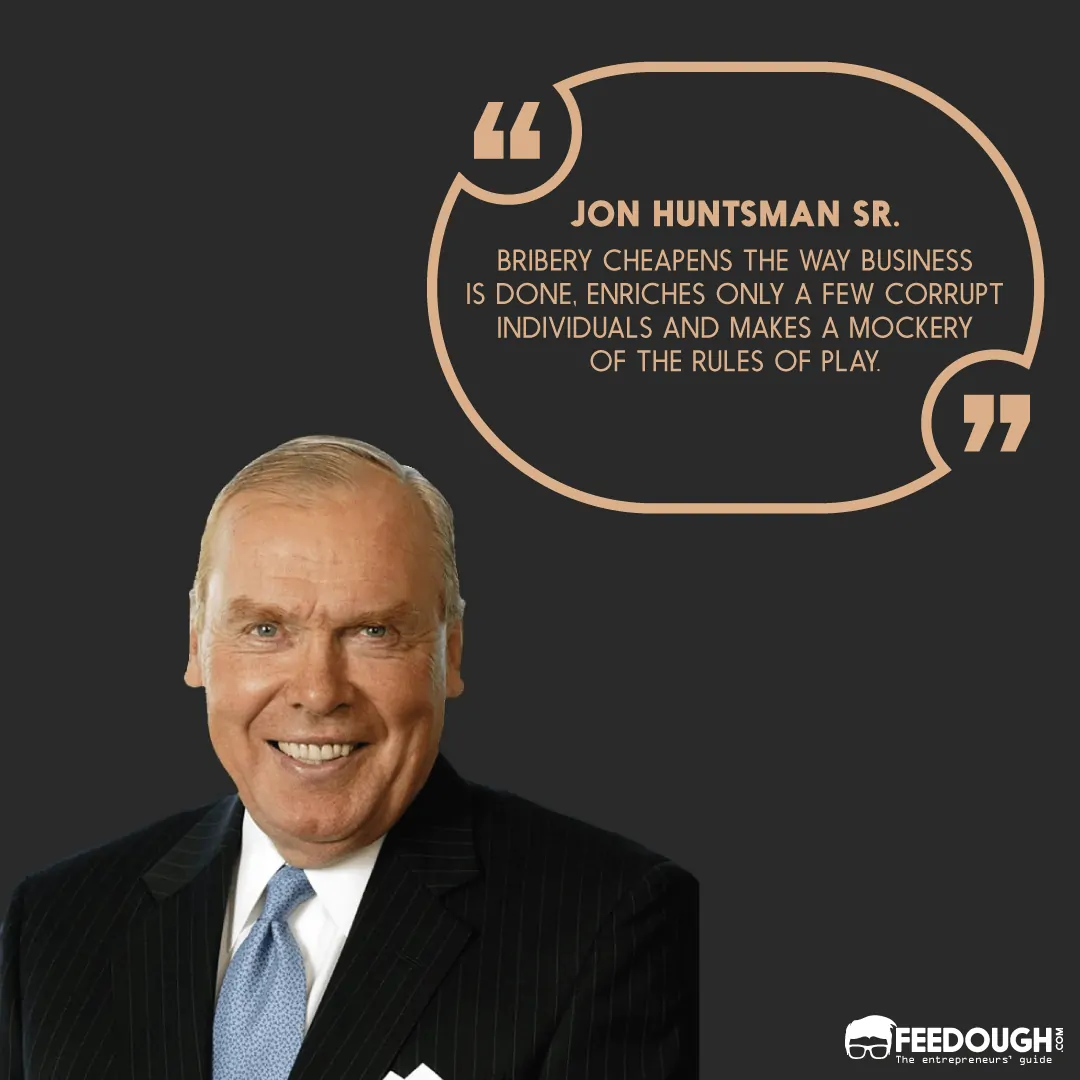
    jon huntsman quote

    Persistence

    Building a successful business is like climbing a mountain: it’s an uphill battle most of the way, but the view from the top is very spectacular.

    Persistence is a necessary part of achieving a summit, and it’s also vital to creating success as an entrepreneur. It is an indispensable quality that goes hand in hand with all great success in life. Henry Ford has a quote attributed to him that makes sense.

    “Apprentice yourself in failure.”

    When he began his career at twenty-three, he suffered through a great loss. It is the result of his persistent efforts that he got a marvellous rise through the establishment of Ford Motor Co.
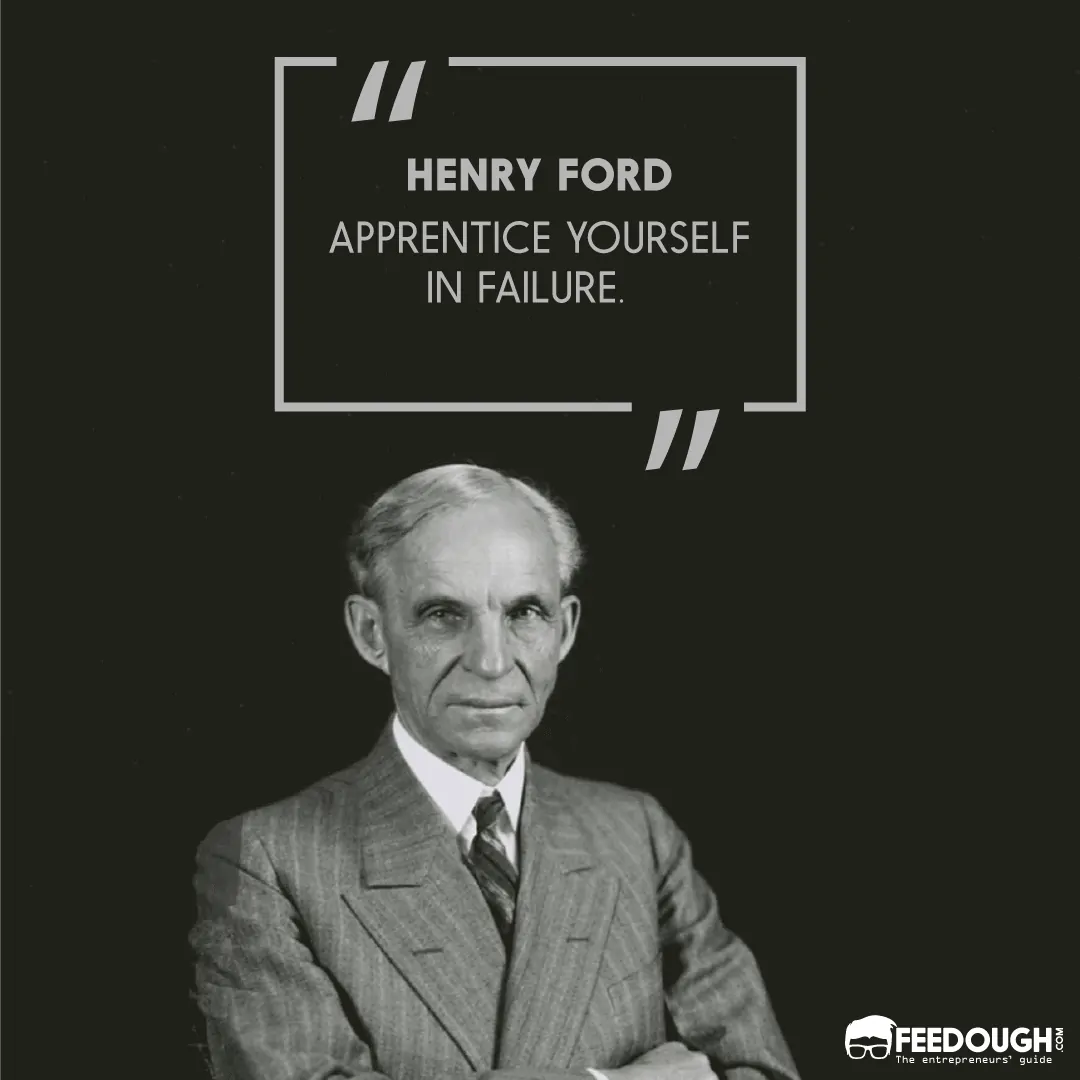
    henry ford quote

    Open-Mindedness

    This personal quality is very important for entrepreneurs. An entrepreneur must be determined. The true realization of any event or scenario can be a successful opportunity only if it’s recognized earlier. For this recognition, an open-minded attitude is required.

    Open-mindedness enables the entrepreneur to know and learn from the competition. When Jeffrey Preston Bezos founded Amazon, he knew that his company would need to focus on a specific problem in order for his small business to make any headway. So, he focused himself and his company on customer satisfaction. As a result, Amazon has been able to properly prioritize projects while avoiding initiatives that distract from the company mission.

    jeff bezos quote

    Self-Confidence

    Self-confidence is the key entrepreneurial skill for success. It is concerned with how a person feels about his ability, idea, and execution. It helps in improving the level of success because it increases self-esteem.

    Confident entrepreneurs have the I can do mentality; they don’t wait for things to make happen. So, confidence is a must need quality for every entrepreneur.

    Thomas Edison Quote

    Self-Starter

    A good entrepreneur needs to be a self-starter. A self-starter is one who seizes a new window of opportunities and begins the work or undertakes the project on his own initiative. Self-starters don’t wait for others to come and help them.

    Entrepreneurs need to develop this quality as it removes the initial doubt and makes them more efficient to achieve their goals.

    Walt Disney started off as a farm boy drawing cartoon pictures of his neighbour’s horses. He believed that his passion can be turned into a successful career and started his journey as a pioneer animator. It was because of his self-starter attitude that we got to witness Mickey Mouse and thousands of Disney characters develop the animation industry as it is today.

    walt disney startup quote

    Creativity

    Imagination and creativity are the keys to turning basic ideas into concepts and then into reality.

    Creativity helps in eliminating the limits of entrepreneurship by not only helping entrepreneurs create creative products but also helping them in finding new markets (or niches), coming up with innovative value propositions, and marketing their products in a way no one else does. Creative entrepreneurs are much more capable of dealing with their problems effectively and efficiently and developing innovative solutions to the world’s problems.

    Take Whatsapp for example. Most of the people still don’t know how Whatsapp makes money even though they interact with businesses all day on the same app.
    robert iger quote

    Competitive Spirit

    Entrepreneurs should always be ready to give and face competition. Many reputed companies are on top because their entrepreneurs know how to deal with the competition in the market and maintain stability and growth.

    Mark Zuckerberg, the founder and CEO of the world’s most popular social networking site – Facebook, analysed scenarios more deeply than his competitors like Google +, Snapchat, Myspace, etc. and came up with more creative and effective solutions to every challenge. This entrepreneurial quality made him stand at the top where no competitor is even close to reaching where he is right now.
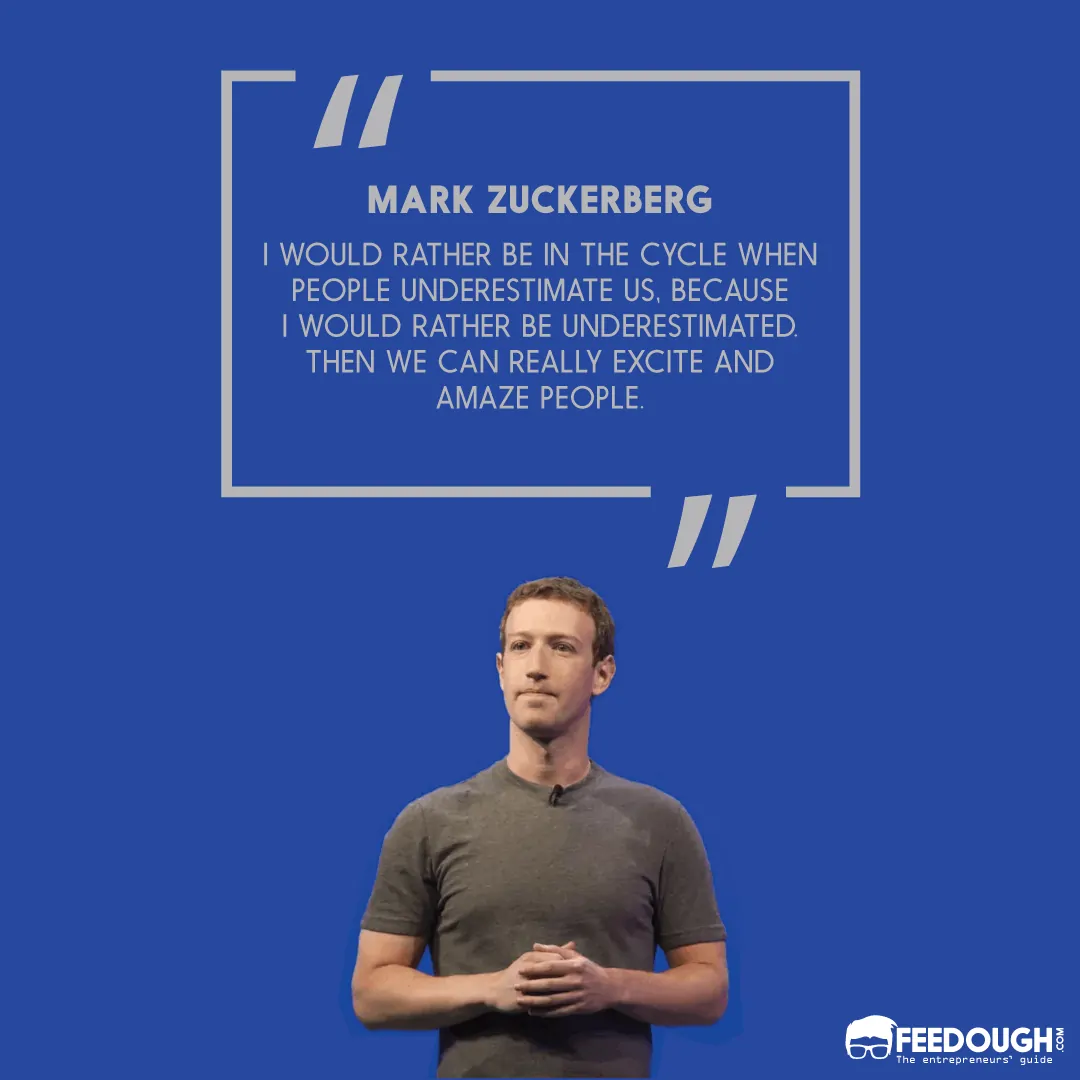
    mark zuckerberg quote

    Planner

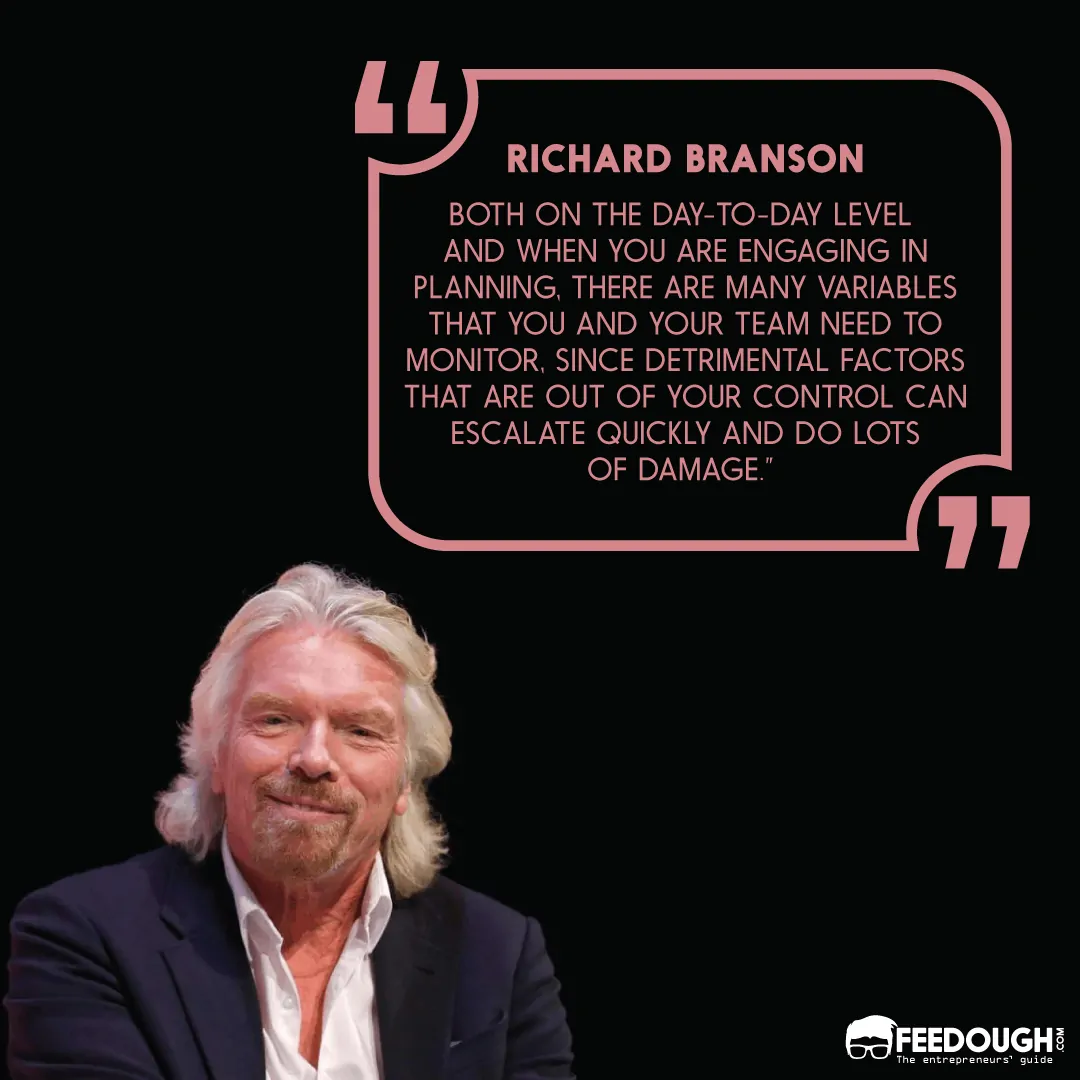
    Without planning the business becomes directionless. It is a must-have entrepreneurial quality or anyone thinking of starting a business. A plan sets the goals and keeps the business on track while on the journey to achieve those goals.

    Entrepreneurs are required to be good planners as the ecosystem the do business in is highly dynamic and greatly influenced by internal and external factors which often require both long term monitoring and planning, as well as immediate replanning.
    richard branson quote

    Positive attitude

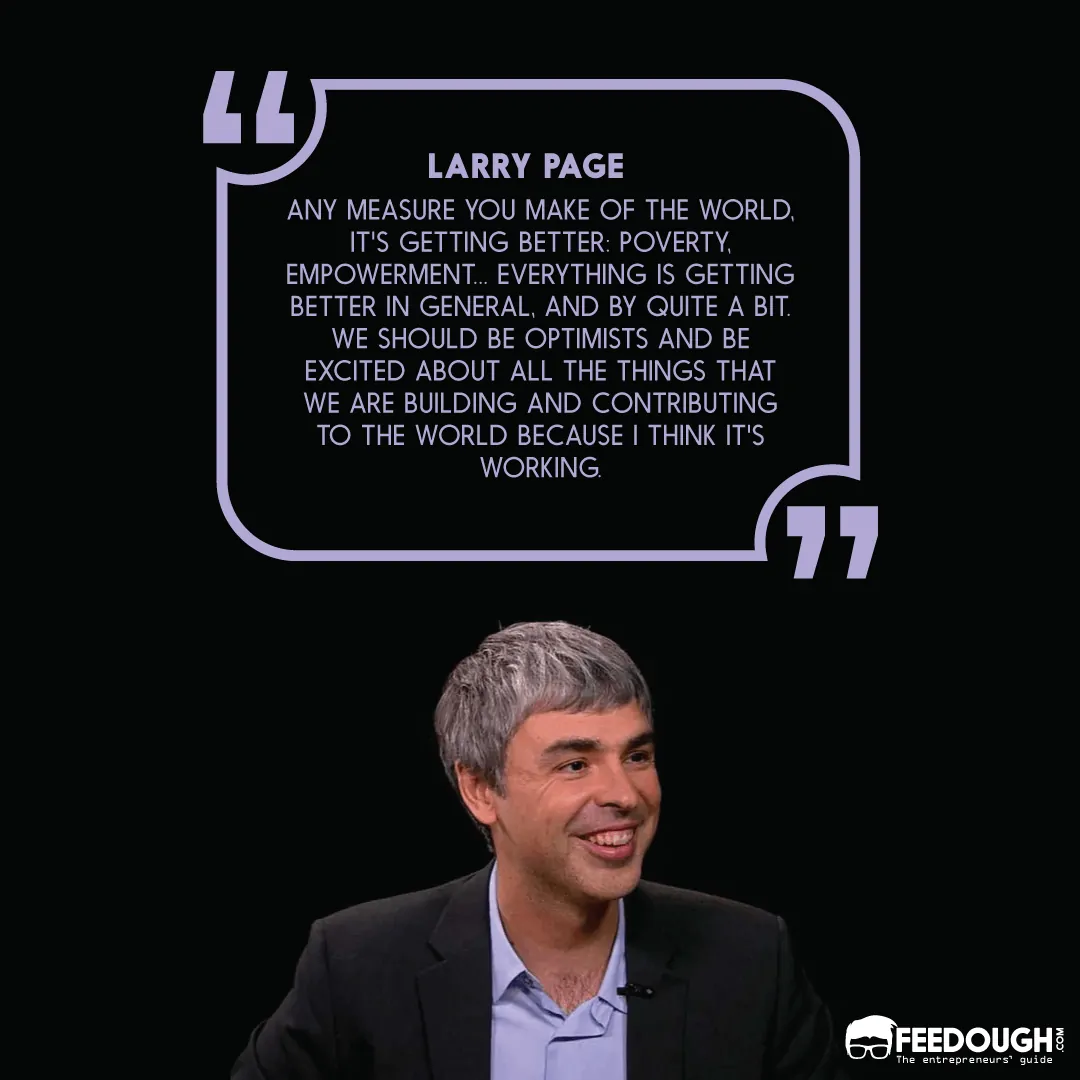
    A positive attitude and outlook is a must for successful entrepreneurs. Being an entrepreneur doesn’t mean to start a company, it means to build up your mindset and attitude to face success, failure and to overcome fears. All these can be possible if one has a positive vision towards life.
    larry page quote

    Can you identify these entrepreneurial qualities within you? Make sure to hone them and you could be the next one enjoying the spoils of life as a successful entrepreneur.

    Go On, Tell Us What You Think!

    Did we miss something? Come on! Tell us what you think about our article on entrepreneurial qualities in the comments section.

  • 5 Effective Ways Workplace Feedback Benefits Your Business

    5 Effective Ways Workplace Feedback Benefits Your Business

    Constructive criticism is a vital part of your employees’ and organization’s ongoing development. The constant give and take of opinions and suggestions serve as a crucial gear in the clockwork of your company’s workplace culture and helps your team learn from their mistakes, as well as helps build confidence.

    In fact, it was Bill Gates who said “We all need people who will give us feedback. That’s how we improve.” And while starting a culture of feedback within the workplace may already exist in your organization, its success completely depends upon how you and your team embrace it.

    Feedback in the workplace should be spontaneous and regular. Constructive feedback can reinforce positive behaviour in the workplace, balance any negative performance and ensure that strong workplace culture is maintained within your organization. But as easy as it is to provide positive feedback, providing negative feedback can be difficult, and avoiding doing so can be a disadvantage, in hindsight.

    So, it is important to understand the significance of workplace feedback and how it can benefit your business.

    Significance of Workplace Feedback

    Your employees are always fond of being involved and acknowledged as an integral part of your organization, and workplace feedback makes it possible to do so. Workplace feedback also provides guidance to your employees and gives them an idea about their performance at work and how they can improve.

    • Feedback isn’t just influential and authoritative, but it is also a widely used management device that you always have at your disposal.
    • Taking the time to provide feedback not only helps build employee confidence and a strong and supportive workplace culture but also helps you understand your team better.
    • Feedback also allows you to tackle a problem from different and innovative perspectives.
    • Building feedback into your day-to-day encounters in the workplace can help your employees develop rapport.
    • Encouraging feedback in the workplace encourages your employees to feel comfortable to provide and receive feedback themselves.

    Benefits of Workplace Feedback

    There are many advantages to providing and receiving workplace feedback. When your employees feel comfortable with sharing, asking for and receiving an analysis of their performance at work, there are notable changes in the way your business operates. Here are 5 ways workplace feedback can benefit your business:

    • Job Satisfaction- An employee who feels valued and acknowledged for their role in the company is more satisfied with their job.
    • Increased Productivity- Workplace feedback can help you understand how you can shift employees to different departments to increase productivity.
    • Improves Performance at All Levels- Feedback provides insights into how your leadership skills and how your employees’ work affects the overall performance in your workplace.
    • Increases Employee Engagement- When your employees feel valued and recognized for their efforts in the workplace, they are more engaged.
    • Improves Employee Retention- Employees stay longer where there are opportunity and investment in their growth and success.

    Job Satisfaction

    Collecting feedback from your employees can reveal what they think about the organization they represent. Getting their perspectives about the opportunities for advancement and the benefits they receive can help you shape the perks, opportunities, training programs and operating procedures you offer to new hires in the future. Feedback can help you, as the employer, as well as your Hiring Managers,  to understand what new talents are looking for in a job.

    According to a 2017 Gallup poll, 51% of employees are on the lookout for better job opportunities, which implies that almost half of your work-force could potentially be unsatisfied with their current job. Constant feedback can help you understand your employees better and help them feel valued and recognized in the workplace.

    Increased Productivity

    Constructive feedback in the workplace can be given in a way that suggests room for improvement and focusing on what to do to achieve the company’s goals. By approving and praising your employees’ achievements and encouraging to do even better, you boost their confidence and make your workplace a supportive and productive environment.

    Workplace feedback also allows you to assess the current situation in the different departments of your company and helps you understand how you can regroup your employees to improve productivity in your workplace.

    Improves Performance at All Levels

    Feedback is a critical component in improving the performance of your employees in the workplace. Not only is it important for you to share feedback with your employees regarding your business and their performance, but it is also important that they feel comfortable with sharing their opinions with you.

    As the amount of feedback exchanged increases between you and your employees, it provides you with insight into the impact of your leadership skills in the workplace as well as the overall performance of your team. Regular feedback ensures that everyone in your company is able to make better decisions, thereby significantly improving the overall performance of your employees.

    Increases Employee Engagement-

    There is a strong correlation between feedback exchange and employee engagement rates. Not only does workplace feedback have the potential to resolve issues quickly and effectively but it also creates a way for the team and individual efforts and successes recognized on a more regular basis.

    Workplace feedback isn’t just about development, it is also an opportunity to encourage your employees’ achievements. It is understandable that when your employees feel recognized and valued for their efforts towards the organization, they also feel motivated and engaged. In fact, according to a survey by Achievers, 72% of those surveyed mentioned that feedback through employee recognition had the greatest impact on employee engagement rates.

    Improves Employee Retention

    Providing employees with regular feedback on their performance and career progress can help to improve staff retention in the workplace. According to Qualtrics, while 60% of the employees in the U.S. reported that they have the means to provide feedback regarding their experience at work; only 30% said that their feedbacks were taken under consideration by their employer.

    Encouraging your employees to regularly communicate their thoughts will establish that their opinions are respected and valued in the workplace. Workplace feedback, when done regularly, also allows you as the leader to recognize and make adjustments at work when required, thus improving employee retention rates.

    Bottom-Line?

    Annual and quarterly workplace feedbacks are now a thing of the past. In today’s fast-paced development, regular feedback helps you and your employees to reorient and discuss important matters in a timely manner. The growth of a business doesn’t happen overnight, but by implementing a structure of workplace feedback, you will notice a significant amount and pattern of heightened productivity in your workplace.

    Go On, Tell Us What You Think!

    Did we miss something? Come on! Tell us what you think about our article on workplace feedback in the comments section.

  • The Importance Of Management In Business

    The Importance Of Management In Business

    Almost 90% of startup businesses fail miserably within the first five years of starting up, of which almost 90% fail due to poor management.

    Management has always been a core aspect of every business. But unlike the old times, managing the organisation has become a more difficult job due to the increasing competition in the internal as well as the external business environment. Good management can bring the company profit and reputation while poor management can just throw the company out of the competition.

    Let’s take an example of management:

    Suppose John opened up a small restaurant. Selling quality food to the customers and gaining their loyalty is his aim but that’s not his only duty.

    To make his business run smoothly he needs to take care of things like planning menus, maintaining an inventory, ordering what’s required, planning the budget, maintaining the standards, dealing with customers’ complaints, hiring and training staff and a lot more.

    If even one of them is overlooked his business will suffer a huge blow.

    That’s where management comes into play. John and his staff can share the duties and work together to attain the goal of the restaurant. To avoid failure they need to work in a coordinated and planned manner. This ensures that no duty is overlooked and the business runs smoothly.

    What Is Management?

    Management is the process where a person plans, organises, directs and controls the activities and resources of the organisation or company to achieve its goal in an effective and efficient manner in an ever-changing environment. It is the process of supervising and controlling the business affairs of the organisation.

    Management also involves establishing a business environment for the employees and employers so that they can work together to achieve the organisation’s goal successfully and competently. It guides a group of people to combine their works in a planned manner so as to attain the goal of the organisation.

    According to Paul Hawken,

    Good management is the art of making problems so interesting and their solutions so constructive that everyone wants to get to work and deal with them.

    The Importance Of Management

    The importance of management can never be underestimated or ignored as it’s a proven fact that the success of a company entirely depends on how well it is managed.

    Here’s why management is important for any business:

    Aligning Goals

    A company consists of employers and several employees who work together. Everybody has their own goals. Management gives them a common direction to achieve their goal together.

    For example:

    The goal of a company is to maximize their output and profit. The goal of an employee is to get the most out of the company in terms of both salary and recognition. Management helps in aligning these two goals by using effective employee motivation strategies which makes him give his best to the organisation.

    Best Utilisation Of Resources

    The proper utilisation of resources is really important for an organisation which operates in a competitive environment. Management helps in the division of work and prevents the employees from under-performing or getting overburdened with work.

    Every employee has their own field where they expertise. Through management, the employees are given work related to their field of knowledge. It increases the speed and accuracy of work.

    Moreover, management also makes that the work is standardised so as to reduce wastage when it comes to other resources.

    For example:

    Management makes sure that the person who is good in sales is given work in the sales department only and not in any other department. Also, it provides him with proper training to make sure that not much time isn’t wasted on making him learn during actual sales visits.

    Reducing Cost

    Management helps to combine all the factors of productivity and organise them. It involves the best utilisation of resources which prevents wastage of time and efforts, which eventually reduces the wastage of money. Therefore management gives better ROI (Return on investment).

    Reduction in cost helps in getting a good position in the market and keeps the company ahead in the competition.

    Increasing Efficiency

    The main aim of the company is to get the most efficient result i.e. to achieve maximum profit by maximizing the output and minimizing the input.

    Management involves the optimal utilisation of resources and helps in cost reduction. These two factors consequently increase the efficiency of the company.

    Surviving In A Dynamic Environment

    A company operates in a dynamic environment where a number of external factors like political, social, economical etc. affect its functioning. This makes it almost obligatory for the company to be flexible and change its short term goals and working styles according to the changing environment.

    Management helps the company to adapt to the changing environment in order to remain successful.

    For example:

    The leader in fast food, McDonald’s, had to make many changes in its menu to survive in the Indian market which was dominated by vegetarians.

    Tackling Competition

    Proper management always aims at sound functioning of the organisation and reduces the failure rates. Thus, helping to overcome tough situations and keeps the organisation ahead of competitors.

    In the modern business environment, one can pursue their organisation in large markets through proper management.

    Essential For The Welfare Of The Society

    Good management not only reduces difficulty of the task but also prevents the wastage of costly and rarely available resources.

    Management helps in providing good quality of services and products which increases the living standard. It also leads to more profit of the organisation and thus providing fair wages and generating more employment opportunities.

    Examples Of Business Failure Due To Ineffective Management

    Enron Management Failure

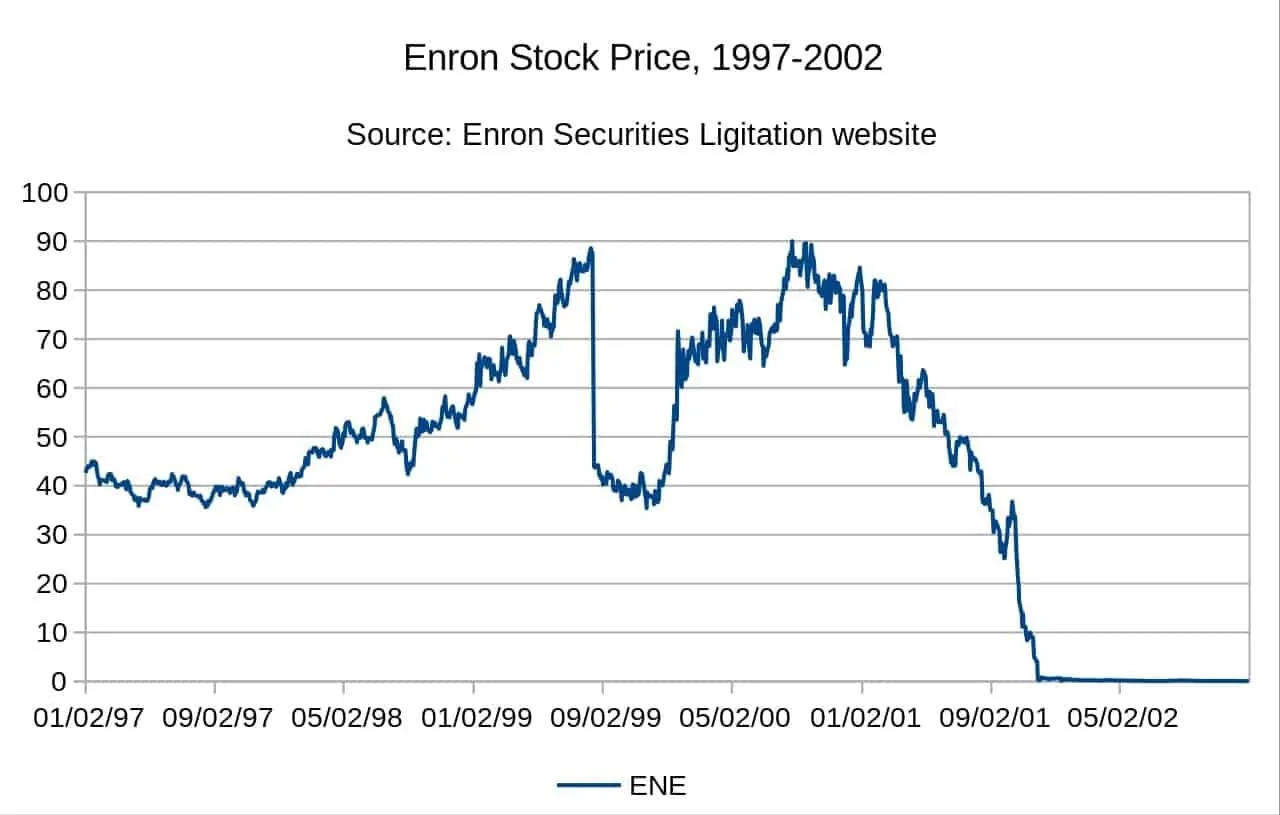
    Enron, at the starting of 2001, earned $100 billion in revenue and had 29,000 employees. But the company went bankrupt on December 2, 2001. The shares of Enron worth $90.75 during its peak time but were trading at $0.26 when the firm declared bankruptcy on December 2, 2001.

    Why?

    Because Enron’s executives used accounting loopholes and false report to hide billions of dollar debt due to failing projects and deals. They mislead the entire company and forced the auditors to delete and hide the evidence from the directors.

    enron share prices

    Because of poor management, leaders failed to recognise all these loopholes and the company finally went bankrupt.

    Compaq Management Failure

    Compaq was the largest supplier of PC systems and was one of the most successful companies in the 80s and 90s.

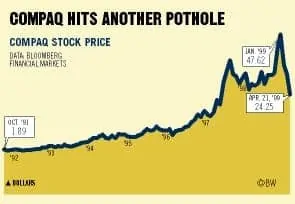
    In 1991 Eckhard Pfeiffer became CEO and planned to expand the business and focused away from the audience and market. Compaq acquired a service business, Digital Equipment Corporation, for $9.6 billion 1998. The problem here was that even though the merger looked good on the outside, the management didn’t consider that DEC developed many products that were of no use to Compaq and would have added extra burden to the company.

    compaq share prices

    Even though the company was successful in divesting some parts of DEC and other not-profit making investments like Altavista, the company lacked direction and honesty. The top executives including the CFO Earl Mason and CEO Eckhard Pfeiffer became a part of several scandals and were forced to quit. As a result, the company lost to Dell first and then to other competitors.

    Thus, due to poor management of the CEO, the company was ousted in 1998 and was purchased by Hewlett-Packard in 2002.

    Bottom-line?

    To conclude, management is important for every business as it can make or break it. Good management can give the business a boost and take it ahead in the competition. So, turning a blind eye to it is not an option.

    Management skills are required in every industry and every walk of life. So, it is very important to know what role management plays and how great an impact it can have on business.

    Go On, Tell Us What You Think!

    Did we miss something? Come on! Tell us what you think about our article on the importance of management in the comments section.

  • Idea vs Concept – Explaining The Difference

    Idea vs Concept – Explaining The Difference

    I’d like to break this to you at the earliest:

    Having a good idea for a business isn’t enough to make it a runaway success. You need to create a concise business concept if you ever want it to get off the ground.

    Have a great new idea?

    It is risky to directly to start based on the idea alone. A business is not built on ideas alone, but on well-defined concepts and plans. So instead, work on turning your ideas into tangible concepts that you can incorporate into your business plan.

    What Is A Business Concept?

    A concept can be thought of as a well-defined idea that has been tested for its credibility.

    A business concept is an idea for a business that has information such as the service/product, the target audience, and a unique value proposition that gives a company an advantage over competitors.

    When it comes to businesses, there exists a clear distinction between idea and concept.

    Difference Between Idea And Concept

    An idea can be referred to as a “mental construct” of a business possibility/opportunity that you come up with.

    A concept can be viewed as a form of an idea that has gone through the process of fine-tuning and is less inconsistent.

    A Business Concept is usually a statement or two that captures the essence of your product or service

    Here’s an example.

    Business Idea: I would like to start a fitness centre.

    Business Concept: I plan on starting a fitness centre that focuses on providing Zumba classes to working women.

    Since you figured out that there is a lack of Zumba centres in your locality, you have focused your sights on Zumba as your business concept rather than starting a generic fitness centre. Moreover, you did your research and found out that these centres are well preferred by working women, hence you decided them to be your target audience. This concept can be refined upon further analysis and help in creating a solid business model.

    Here’s another example-

    Business Idea: I would like to start a hotel chain.

    Business Concept: A line of affordable hotels that caters to a broad range of customers needs including families, seniors and pet owners.

    You have a defined target audience and plan to focus on providing affordable rooms. You could, upon further research, add other things like family-frequented hotels to feature play areas for kids and so on.

    It’s time you start converting your ideas into concepts. Here’s how you go about –

    Steps to turn your Ideas into Concepts

    The first course of action is to elucidate upon your idea by taking the following steps along with answering the usual questions like “What is your offering?” and “What does your product/service do?”.

    Find Your Target Market

    Find out segment within the business’s serviceable market. Figure out your target market. Find out where and to whom you’d like to sell your products and services and direct your marketing efforts to.

    When you go about finding and defining your target market, make sure you:

    • Analyze Your Customer Base: If you’re already in business, the best way to define your target market is to collect your customer data and to analyse it.
    • Figure Out Your Competitors: Unless your idea is revolutionary or game-changing, there will be existing businesses operating along your field of interest. Make sure you identify your competitors and their marketing tactics as early on as possible.
    • Analyze Your Competitors’ Customer Base: Analyse your competitors’ customer base; Who they target through their marketing efforts? Where do they sell their products?

    Market Identification

    Once you have figured out your target market and audience, it is time for a basic check on the viability of your business idea in the target market.

    In simple terms, it refers to a process of determining whether your business idea is of any interest to your target audiences.

    This helps give you a better understanding of the target market and what it precisely requires. You can find out if your product falls into the same category you intended it to or not.

    Once rightly done, you can move forward and start working on your idea with a clear vision.

    Find The Value Proposition Of Your Idea

    You can think of the value proposition as the tangible benefits a customer will receive from consuming or experiencing your offering.

    Value Proposition is a clear statement which –

    • explains the benefits
    • explains how the offering solves customers’ problems
    • differentiates the offering from your competitors

    Create a value proposition that has its roots in your business. Make sure you keep your target market in mind. Your value proposition must focus on the benefits that your idea offers rather than what goes into it.

    Doing so will help you flesh out your idea, helping you put everything together to form your business concept.

    You’re not done yet.

    Make It Better

    You started with an idea and created a concept out of it, but none of that matters if you can’t take your feedback and test it out for yourself. Keep striving to make it better until there is nothing else left.

    You can now pat yourself on the back! You’ve turned your idea into what is now a tangible business concept.

    Once the business concept is clearly defined, the more detailed work of creating a business model and implementation may begin.

    Go On, Tell Us What You Think!

    Did we miss something? Come on! Tell us what you think about our article on Idea vs Concept in the comments section.

  • 10 Uber for X Business Ideas to Start an On-Demand App

    10 Uber for X Business Ideas to Start an On-Demand App

    We live in an era that is entirely different from the generations that came before us. People struggle to balance their personal lives and professional lives and prefer things to get done on the go. Spending over 3/4 of the day browsing the internet and mobile apps, the on-demand application concept is truly appealing to users as it serves as an efficient way to manage daily needs.

    Economy statistics show that over 22% (45 million) Americans had worked and over 42% (86.5 million) Americans had used at least one on-demand service in 2016. It’s been 3 years since then and the growth is still exponential.

    What Makes On-Demand Apps So Demanding?

    Uber for X apps or on-demand apps operate on the aggregator business model and serve as the third party between customers and service providers. Instead of spending both time and money for delayed services, most of the customers prefer paying a small fee for fast and convenient service.

    Simple And Fast

    Any on-demand startup idea offers customers a great opportunity to order products and services in a flash. Searching, booking appointments, paying, reviewing, tracking, cancelling, everything can be handled within one app. You just have to tap a button and get the desired service.

    Cheap

    Every on-demand service comes with standardized prices, but it gives both service providers and customers to choose the type of service that suits their budget. Regardless of the industry, most of the businesses offers hot deals and special discounts almost every day.

    Convenience

    The convenience of on-demand apps is not just confined to delivery. On-demand apps come very handy at every stage of a purchase right from searching for products to the product getting delivered. These apps offer users instant access to search smarter with real-time tracking delivery, different payment methods besides quick delivery.

    Transparent

    Any brands who are transparent with their customers easily gain the trust of their audience. To be transparent and build trust, on-demand service apps come with feedback systems. Feedback systems allow service providers to easily find out the gaps in their performance and correct them.

    10 Successful On-demand App Business Models

    Uber’s success has set a benchmark for all other on-demand services and inspired Uber for X or Uber of everything revolution. Here is a list of dynamic and potential on-demand business models you can gain inspirations from to start your own on-demand business.

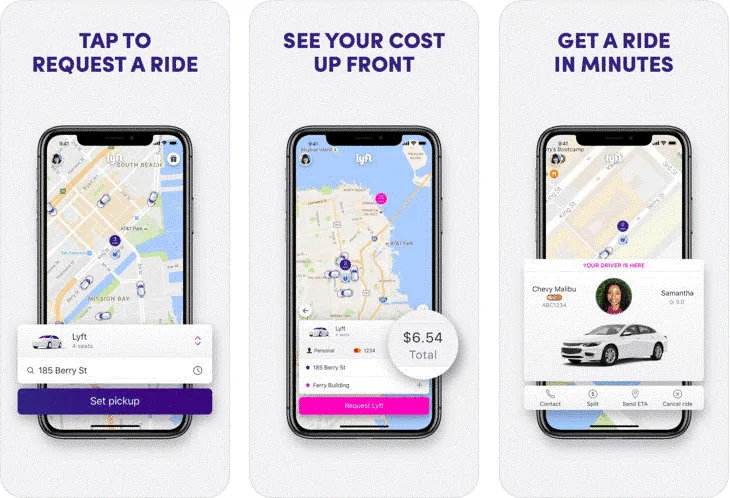
    1. On-Demand Transportation App

    on demand taxi booking app

    The Uber business model has changed the way we commute. However, when you want to create a taxi booking service like Uber, the major challenge is that Uber already exists.

    When you develop an app like Uber, focus on simplicity, efficiency, and relevance to create interest among your end-users. Bring in a significant difference even if small so that you can influence your target audience despite the competition. Incorporate unique features relevant to your audience while offering them an on-demand app for booking taxis. Say Uber for women or Uber for kids. Choose a niche and create your own blue ocean by building on an existing concept.

    1. On-Demand Grocery App

    on demand grocery app

    An on-demand grocery application to deliver groceries on the go is one of the popular on-demand startup ideas these days. Such apps offer customers the ease to buy groceries online and get it delivered the same day. Users simply have to download the app, register and order the products as required. As this idea offers a convenient way for users to do their daily shopping, more people are likely to get attracted to such businesses.

    1. On-Demand Food Delivery Apps

    on demand food delivery app

    If you are looking forward to how to build an app like Uber, but in a different niche, online food delivery can be a great pick. Online food ordering and delivery is the new type of food business that is currently trending. If you think from a user perspective, it is the most convenient way to access the most urgent requirement – food.

    With on-demand food delivery apps, food ordering and delivery have become much simpler. No more waiting at the restaurants, you can easily book a meal that will be delivered at your doorsteps soon. Moreover, you will be offered with exciting discounts and food coupons that you won’t get while dining at restaurants. Interestingly, the food delivery niche is so wide that you can focus on a particular niche like the gluten-free, keto, paleo, etc.

    1. On-Demand App For Health and Fitness

    on demand app for health

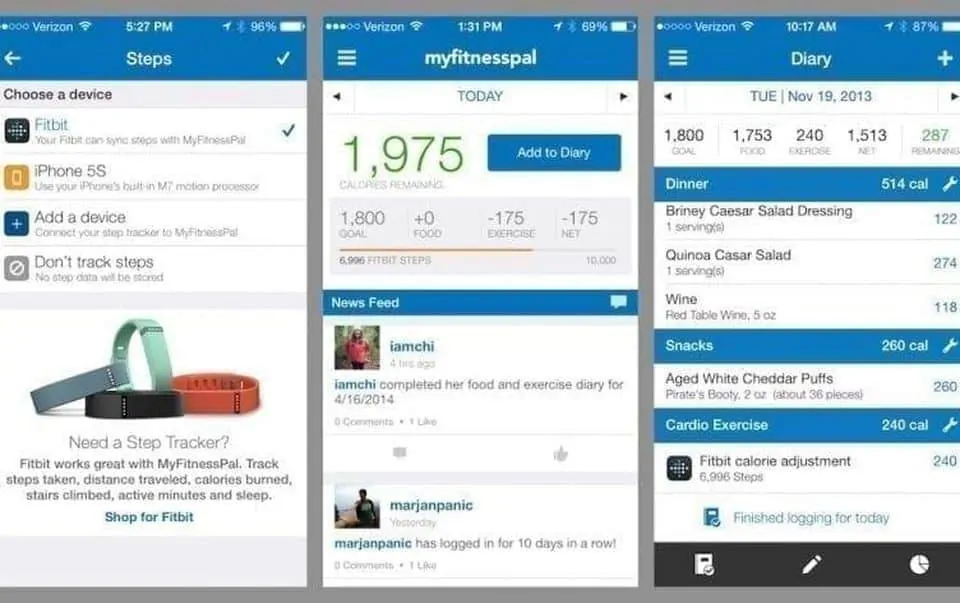
    Health and fitness are the most thriving industries considering its popularity worldwide. People are much concerned about their fitness and nutrition. On-demand health and fitness applications allow them to efficiently manage their fitness routine. Health and fitness apps make it easy for users to book exercise sessions at any fitness centres or to create an exercise routine on their own. Either way, it helps you to achieve your unique fitness goals.

    The industry is one of the best on-demand business industries to invest in. Just ensure that the best features are included in your app, and you must make the booking session feature seamless or make it easy for them to see workout videos. Personalized push notifications and booking in real time are some of the hot features an on-demand fitness app must-have.

    1. On-Demand Apps For Beauty Services

    on demand beauty app

    Both salon and spa businesses go through the difficulty of both under booking and overbooking. This is yet another incredible Uber for X startup idea that concentrates on delivering the best beauty services to users with no delays.

    A dedicated mobile app for beauty and salon services. Eliminate the need to wait to be served in the beauty salons. On-demand apps not only provide customers with the ease to book beauty services and avail as required, but they also offer great deals and offers.

    1. On-Demand Plumbing Services

    on demand plumbing

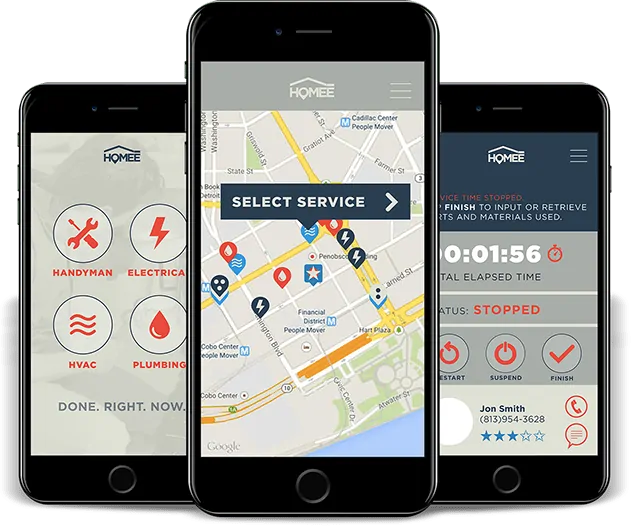
    If you wish to try to something out of the box following the Uber model of business, apps offering plumbing, repair, and handyman services are an excellent business idea. You know how difficult it is to find a repair service guy or a plumber at the time of urgency. With on-demand apps for plumbing and repair services, you can offer something robust and efficient to your customers. All a user has to do is to register and choose the desired services.

    An on-demand app for plumbing services can be beneficial to both skilled workers and users. It can be one of the best niches to get started with if you are looking to create apps like Uber for X.

    1. On-Demand Laundry Service App

    on demand laundry

    There was a time when you had to visit the laundry store for the services. But with modern technological advancements, getting your laundry done has become very easy. Even customers these days don’t prefer waiting outside the store to get their clothes washed.

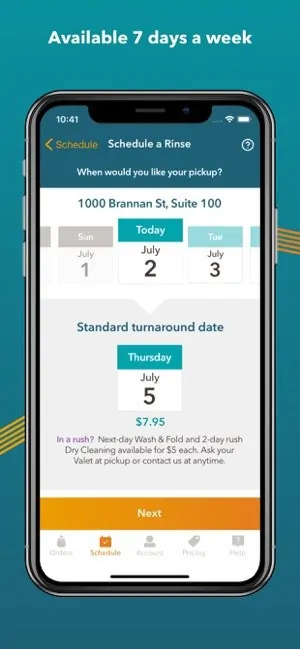
    A good laundry service app can schedule the pickup time, set preferences, give notifications and offer excellent customer support. When you get complete control over your laundry as on-demand apps cater to your requirements, there is one more reason not to do your laundry.

    1. On-Demand Educational Apps

    on demand educational apps

    On-demand education is another thriving on-demand service app that is witnessing rapid growth. Unlike other different types of learning, an on-demand educational app allows students to connect with expert teachers. It gives the flexibility of offering learning opportunities for all at the comfort of their home. These apps not only allow you to learn from experts, but you can actually get certificates after successful completion of courses.

    You can build an app that connects students with teachers who are experts in a particular niche. Teachers can be paid a percentage of the money received from the course and the remaining percentage goes to the platform.

    1. On-Demand Logistics App

    on demand logistics
    Source: Hawk Eye

    While many courier and logistics companies exist and they help you ship products from source to destination, there are several drawbacks too. The hectic process of storing and managing products may bring in unexpected errors. On-demand logistics and courier apps help to eliminate this with e-management of goods, locating, initiating shipment and delivery becomes simple and efficient.

    1. On-Demand Travel And Hospitality Apps

    on demand travel

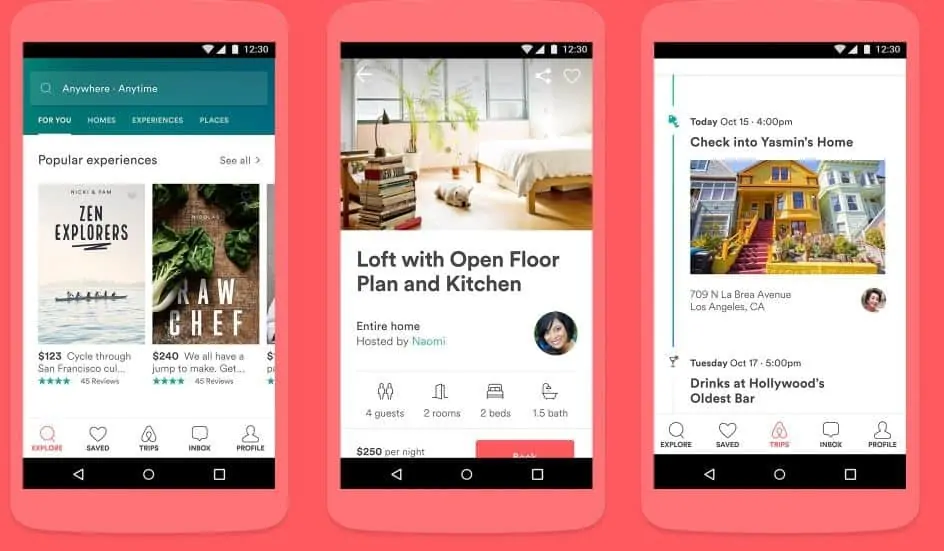
    Uber-like on-demand apps for travel is another industry that is in high demand these days. Apps like Airbnb operate on a similar business model that allows users to book stays on the go. Advancements in mobile application technology have made it easier for travellers to explore the world conveniently and instantly. Intelligent search and booking systems are the backbone of any on-demand travel or hospitality app. It allows users to perform several functions like setting up reminders, comparing prices, and notification of offers, etc. in a single platform. If you want to start a Uber business, on-demand travel is one way to enter the market.

    Such apps also offer in-app flight and cab booking services with just a few clicks without actually moving out of the application. IoT based smart destination is another innovation that offers useful data for travellers across the globe. On-demand apps are not just popular because of these exciting features, but also because they allow you to travel cashless. The travel industry is a multi-billion-dollar industry now and on combining its potential with on-demand apps, it will take your business to new heights.

    Bottom-Line?

    No matter what you sell, your customers are constantly looking for easy ways to leverage your services. There is no other better way to offer services to your customers than through a mobile app. Provided that your on-demand service business model offers something unique to your target audience; your business will see tremendous growth. You can easily connect your customers with required services, book appointments, and clear payments and do business in a few clicks. So why not give your business a boost with an on-demand mobile app?

    Go On, Tell Us What You Think!

    Did we miss something?  Come on! Tell us what you think about our article on uber for x business ideas in the comments section.

  • What Is A Sales Funnel?

    What Is A Sales Funnel?

    Profit or perish…There are only two ways to make money: increase sales and decrease costs. This quote by Fred DeLuca, co-founder of the Subway franchise, pinpoints the importance of sales in any business.

    No matter what industry you’re in, finding customers for your product or service should be your main concern. Otherwise, you can’t expect much success with your venture, even if you provide high-quality solutions to your target audience’s pain points.

    Having an effective sales funnel is the first step towards reaching steady, predictable revenue, and helping your business thrive.

    So, let’s discuss get down to the nitty-gritty of this concept and discuss how to implement it properly.

    What Is a Sales Funnel?

    A sales funnel is a strategy which tracks and documents your sales and marketing activity throughout the entire sales process from start to finish.

    Its name comes from a visual representation of the path your target audience takes on their way to purchase your product or service. There are three parts of the sales funnel – top, middle, and bottom depending on the phase of your prospects’ customer journey.

    In other words, the first time a prospect interacts with your brand, they are at the top of the funnel, and the more they engage with it, they travel down the funnel, and hopefully, convert.

    Your marketing and sales activities and tactics differ in accordance with a particular customer journey phase, which means that, for example, you won’t create the same content for the prospects who are just getting acquainted with your product or service, that is, those who are at the top of the funnel, and for the prospects who are about to convert.

    That’s why you need to understand what AIDA means.

    What Are the Four Sales Funnel Stages?

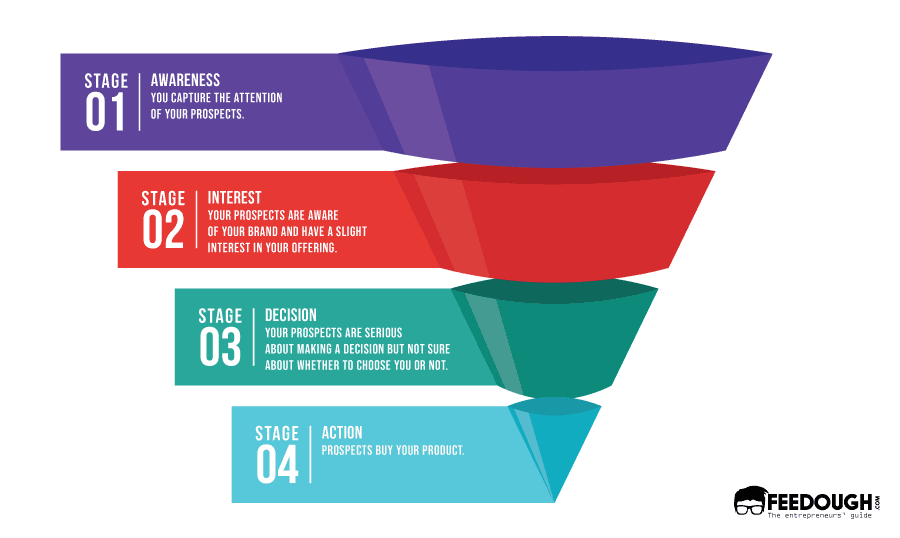
    sales funnel AIDA

    AIDA stands for awareness, interest, decision, and action, and these stages refer to your prospects’ mindset.

    In order to send your prospects the right marketing message at the right moment, you need to take these four stages into consideration.

    Awareness

    This is the stage in which your goal is to capture your audience’s attention and increase your brand awareness and recognition.

    We’re talking about the top of the funnel here, which means that you’re practically trying to target perfect strangers to whom your product or service might be interesting. Of course, this means that you should do market research and invest your money wisely – you need to collect data on your audience and understand who they are.

    If we bear in mind that 65% of businesses report that lead generation, that is, identifying potential customers and reaching out to them, is their biggest marketing challenge, it’s clear that you need to use different marketing strategies and spend significant amounts of money in order to reach as many potential customers as possible.

    This can be done through social media, content marketing, Google Ads, Facebook Ads, or email marketing. Just make sure to address your audience’s main pain points and offer practical solutions.

    Interest

    If you’ve pressed all the right buttons during the previous stage, your prospects are now aware of your brand, and they’ve reached the interest stage.

    Similarly, the awareness stage filtered those who aren’t particularly interested in what you have to offer, and those prospects who have stayed in the funnel are now officially your leads.

    Although you can start personalising and tailoring your messaging, you still have to be very careful not to alienate your prospects by being too pushy or salesy, which means that you need to continue educating and nurturing them.

    Amazing content, enriched with a lot of how-to, video tutorials, different webinars addressing your prospects’ pain points, or free e-books which will help your audience as much as possible and establish you as an authority in the field can do wonders for the success of this stage.

    Decision

    This is the stage in which your prospects are very serious about making a purchase – but they’re not sure whether you’re the one they want to do business with.

    This is the moment in which you need to engage them, reduce any potential friction, and help them opt for you. One of the ways of doing this is by doubling down on your customer support and implementing a chatbot on your website.

    Statistics say that 53% of people are more likely to purchase from businesses they can contact via a chat app.

    Namely, it’s important to respond to any questions about your product and its features that your prospects might have in a timely manner, as this is something that plays an important role in accelerating the sales process. People are impatient and they don’t want to wait until there’s an available customer support rep – they will simply bounce off your website and go to your competitors, which is why chatbots, which can serve several prospects at a time, are a must.

    Also, this is when you should make your best offer and gain a competitive edge.

    For example, “free shipping” is an open sesame to converting your prospects and closing your seals.

    Action

    We’ve reached the bottom of the funnel, and your prospects have turned into your paying customers.

    Mission accomplished, right?

    As a matter of fact, your work is far from done if you want to keep your customers. Retention is an important part of the sales process and your company’s overall growth, and it’s essential to keep nurturing your customers even after they purchase as that will make them come back.

    This means sending them regular newsletters informing them about the new product features and updates, offering them occasional loyalty perks and discounts, as well as asking your customers for their feedback so that you can make further improvements.

    The Importance Of A Sales Funnel

    The sales funnel lets you get into the shoes of your customer and see things from their perspective. This is important as you understand what your potential customers are thinking at each stage of their buying journey.

    This, in turn, allows you to create content and marketing messages that are relevant to their needs. As a result, you can nurture your prospects better and move them closer to a sale.

    The sales funnel also lets you track your progress. By understanding how far your target customers are from making their purchase decision, you can better allocate your resources.

    This is important as you don’t want to be spending too much on customers who are not ready to buy or too less on customers who are ready to buy.

    The sales funnel also helps you manage your sales pipeline better. By understanding the number of prospects at each stage, you can better forecast your sales and plan for the future.

    How to Build Your Sales Funnel?

    Based on what we know so far, it shouldn’t be too complex to build a converting sales funnel/

    Here are a couple of easy steps.

    1. Analyse your audience: As you’re not trying to sell to everybody, it’s important to understand what your target audience needs, as well as how they behave. You can use different tools in order to find out what kind of blog posts they read, how much time they spend on every particular page of your website, where they click on, or what subject lines and emails generate high open and click-through rates. Long story short, monitor all your digital marketing metrics and adjust your campaigns based on what you find out.
    2. Grab their attention: In order to do this, you need to share a lot of great content across all your digital marketing channels. Use different types of content, various strategies and kinds of outreach, and use the data you’ve collected in the previous step to personalise this outreach and use your audience’s preferred communication outlets to get in touch with them. If you’re in the B2B industry, LinkedIn should be your No. 1 channel, while if you’re in the fashion or sports industry, make sure to leverage Instagram. Also, SEO can help you target the right people with the right content, so don’t neglect this strategy too if you want to stay on your prospects’ radar.
    3. Build a landing page: Or to be more precise, a lot of them. Stats say that companies experience a 55% increase in the number of leads by increasing the number of landing pages from 10 to 15. So, the more the merrier is the rule of thumb in this case. Make sure that there’s no clutter on your landers as well as that it’s properly optimised – one, clearly stated offer per landing page and a CTA which directs your prospects towards taking a desired action.
    4. Create a drip-email campaign: Reach out to your prospects regularly but not too frequently and send them relevant and helpful content. Once or twice a week will do if you don’t want to outstay your welcome. A drip campaign can help you do this effortlessly. Top of every email with an amazing, irresistible offer which will be aligned to the content you provide.
    5. Follow up: Nurture your existing customers even after they make a purchase. Given that the probability of selling to an existing customer is 60-70% while this likelihood drops to only 5-20% when it comes to a prospect, perfectly illustrates why you should count on your repeat customers if you want to increase your profit and grow your business.

    As you can see, understanding what a sales funnel is and successfully building one is hardly rocket science. However, it takes a lot of research and planning to implement all the data you collect and tweak the process based on the results you get.

    Go On, Tell Us What You Think!

    Did we miss something?  Come on! Tell us what you think about our article on sales funnel in your workplace in the comments section.
  • Top 5 Ways to Improve Leadership Skills in Your Workplace

    Top 5 Ways to Improve Leadership Skills in Your Workplace

    As the employer, it is not only your job but also your responsibility to help your employees develop important skills and inculcate values that will help your company grow further. A good employer always makes it his priority to groom his/her employees for leadership roles so that they can assume higher positions in the workplace in the future.

    Improving the leadership skills in your workplace and preparing your employees to take on challenging roles can boost the levels of productivity in your organization and also helps you to make transitions to leadership positions at work seamless and hassle-free.

    Importance of Leadership Skills in the Workplace

    Leadership skills in the workplace are typically associated with 3 very important aspects of productivity at work: initiative, innovation and pro-activeness.

    As an employer, your ability to cultivate leadership skills in your workplace not only reflects your interpersonal skills at work but also shows how capable you are of co-ordinating, shaping and motivating your employees.

    • Initiative- A good sense of initiative implies forward-thinking and taking charge. As a result, you and your team will be more prepared to deliver solutions to any problems that may arise in your workplace.
    • Innovation- Leadership skills can improve your employees’ and your ability to come up with new methods to execute things in your organization which can boost levels of productivity.
    • Pro-Activeness- Leadership skills ensure that you and your employees are more pro-active in your duties in the workplace. It shows that your team can take on and control tricky situations at work rather than just responding to them.

    Ways to Develop Leadership Skills in the Workplace

    There are five strategies that will help you in developing leadership skills in the workplace that will not only help your employees but also you:

    • Encouraging Networking- Networking is not only a learning process, but this form of socializing in the workplace can also help you and your employees grow individually and also help with business development.
    • Mentorship Programs- Mentorship programs not only serve as a great training tool for employees, but they are also beneficial for helping new hires assimilate to the new environment.
    • Providing Opportunities for Growth- To ensure employee retention and that your employees don’t remain stagnant in their positions in the workplace, providing them with opportunities to grow prepares them better for leadership positions in the organization.
    • Providing Feedback- A successful feedback loop measures and reviews the performance of your employees to help you gauge which of your employees are suitable to rise to leadership positions.
    • Leading by Example- Your employees tend to look to you for answers; you and those at leadership positions in your workplace should be a positive role model to your employees.

    Encouraging Networking

    Networking is not only a necessity for the individual growth of the employee, but also for the growth of your organization. Encouraging your employees to network within and outside of the company can teach them how to start a conversation with strangers and build powerful connections with associates, which are important qualities in a leader.

    Networking can present business opportunities such as referrals or partnerships and a platform for your employees to share their ideas and knowledge. Encouraging them to network both inside and outside of work can not only help prepare your employees to rise to leadership positions in the company but also help them build a reputation for themselves in your industry.

    Encourage your employees to mingle outside of their departments during breaks and let them accompany you to industry events so that they can learn how to conduct themselves. These are the employees who will represent your organization and take upon leadership roles in the future.

    Mentorship Programs

    A mentor-mentee relationship is inevitably developed when you help new employees grow and advance their skills. In fact, employees often tend to look up to their employer when it comes to learning and developing leadership skills in the workplace. By maintaining a cordial relationship with your employees and encouraging them to improve, you also cultivate leadership skills in employees who will be at positions of power in the organization.

    Granted, it is not always possible as the employer to focus on all employees equally. To tackle this, you can implement mentorship programs in your workplace so that newer employees can learn from the more seasoned employees. Mentorship programs not only help new hires to assimilate but also serve as a great cross-training tool for your current employees.

    While mentorship programs help newer employees learn more about their job responsibilities, cross-training can help your employees learn from other departments in the organization. Not only does this prepare your employees for expanded responsibility within the organization, but it also prepares them for leadership positions.

    Providing Opportunities for Growth

    Employees are an organization’s most important asset, as well as the employer’s. So investing in their growth also impacts your company’s growth. To ensure the constant development of your employees and retention rates, it is important to provide them with opportunities that will season them for leadership positions within the organization in the future.

    A few ways to provide your employees with opportunities for growth are:

    • By regularly asking your employees for their suggestions,
    • Encouraging creative problem-solving,
    • Encouraging your employees to attend more work and industry events,
    • Hosting employee training workshops and programs both within and outside of the organization,
    • Encouraging your employees to meet industry professionals.

    Providing Feedback

    Continuous communication is very crucial for productivity in the workplace. According to a 2018 survey by the Society for Human Resource Management, out of the 29% of HR professionals, whose organizations use ongoing feedback, most say that it has a positive impact on the growth of the organization.

    Effective and perfect communication is an important quality in a leader and is also crucial for providing feedback. Your ability to communicate the goals and intention for your organization to your team also shapes the potential leaders in your team who will take the company forward.

    A few ways to provide feedback and maintain a feedback loop include:

    • Identifying employees who are suited for leadership,
    • Providing employees with individual feedback,
    • Discussing areas that can be improved,
    • Allowing employees to voice their opinions, ideas and suggestions.

    Leading by Example

    “If your actions inspire others to dream more, learn more, do more and become more, you are a leader.” –John Quincy Adams.

    An employee often follows in the footsteps of their employer. As the employer, you should ensure that you serve as a role model to set the bar for your employees who are suitable for leadership roles in the organization. To develop leadership skills in your employees, it is important that you set an example by exhibiting and practising qualities a strong leader must possess.

    A few qualities that you should exhibit as the role model are:

    • Motivation
    • Vision
    • Professionalism
    • Transparency
    • Encouragement
    • Optimism
    • Commitment
    • Respect
    • Discipline

    Bottom-line?

    While technical skills can take you so far, it is the soft skills that make a great leader. As the leader, it falls to you to recognize potential leaders in your organization and season them for more responsible roles that they can take on in the future. When you focus on improving leadership skills in your workplace, you also shape the company into a more positive and productive environment where your employees are given direction and purpose to achieve the collective growth of your organization.

    Go On, Tell Us What You Think!

    Did we miss something?  Come on! Tell us what you think about our article on improving leadership skills in your workplace in the comments section.
  • Moment Marketing: Explaining The Right Time Marketing

    Moment Marketing: Explaining The Right Time Marketing

    There’s a secret behind why some campaigns gain more traction than others.

    They communicate when the consumer is most willing to listen and interact.

    And trust me, the marketers behind these campaigns aren’t psychologists. They just understand the situations and consumer behaviour better than others. They know the importance of moments and when it is beneficial to capitalize on them.

    After all, in this world of overwhelming information density, the ones who stand out are the ones who know how to communicate the right thing at the right time.

    This brings us to the concept of moment marketing.

    What Is Moment Marketing?

    Moment marketing (or right time marketing) refers to the act of communicating the right message to the right audience, at the right time, in context.

    Let’s take the example of episode 3 of Game of Thrones – Battle of Winterfell. As soon as the episode was aired, social media went crazy for –

    • It being so dark
    https://twitter.com/carolineframke/status/1122672255299915777?s=20
    • Its epic dialogue – “not today”
    game of thrones not today
    Source – Tenor

    Now, this was a moment which brands could capitalize on to become a part of the conversation and get viral

    …and many did.

    But moment marketing isn’t limited to this. The strategy is called right-time marketing for a reason. It refers to being there when the consumer is most likely to engage with your message. It aims to find the path of least resistance between your brand and the customer.

    Let’s say you are watching an online Disney show with your 11-year-old daughter who just played a Disney game on your phone. Now, it’s a perfect moment for an ad with a 40% discount for your trip to Disneyland given that there are a lot more chances that you’ll consider it, taking into account your daughter’s addiction to Disney.

    So, How Exactly Do You Know It’s A Moment?

    Moment marketing isn’t that difficult when it relates to masses or segments. You just need to be aware of the present and prospective moments that are trending among your target audience and look for the best time to capitalize on it.

    Oreo was able to capitalize on it in 2013 when there was a power outage of 34 minutes during the Superbowl.

    The social media went crazy about the Twitter ad and Oreo became a star even though it didn’t sponsor the event.

    But

    Finding the right moment when it comes to the individual customer is a real task.

    This is where the smartphone and the concept of micro-moments kick in.

    Micro-Moments

    With mobile becoming an integral part of our daily lives, there is a fundamental change in the way we consume media now. The chances are that you are reading this article on your smartphone or are going to check your smartphone in another…say 5 minutes.

    Once what was predictable, our interaction with the online world is now fragmented all over the day. All it takes is just a few taps… to check the time, mail a client, text a friend, or chat on social media. And then there are other important moments like – I want to know, I want to go, I want to buy, etc. which force you to pick your phone and open an app or search on the internet.

    All these are considered as micro-moments that prove out to be a game-changer for both brands and consumers.

    For me, whenever I’m reading a novel and find a new word, I pick my smartphone, open Google and look for its meaning. Don’t you do the same?

    I bet you do!

    According to WSJ, 91% of smartphone users look up information on their smartphone while right in the middle of a task.

    Even though this looks like a small moment, it joins hands with other moments and results in shaping our preferences.

    69% of leisure travellers use their smartphones to search for travel ideas during spare moments like standing in a queue or waiting for their food at a restaurant. Nearly half of them then use an entirely separate channel to finally book the trip.

    Similarly, 82% of smartphone users consult their phones before deciding what product to buy in a supermarket.

    Now, if you don’t capitalize on the initial moments, it’ll be really hard for you to kick in during the later stages of their buying funnel.

    Your focus here should be to develop a marketing funnel which includes all these micro-moments.

    Many companies do the same.

    Take eCommerce companies for example. I usually buy my clothes from Amazon. A few months back, I used to search for Amazon coupons on the internet in case I get a discount from a coupon site.

    And not getting any coupon made me abandon my cart many times.

    It wasn’t just me, and the company noticed this.

    Some weeks later, the company ran an ad on Google targeting the keyword ‘Amazon Coupons’ and provided me with the coupons itself, hence preventing me from abandoning the cart and saving the commissions paid to the partner websites.

    This was capitalizing on the moment.

    The Right Thing, The Right Time

    Moment marketing is all about finding the right time to put on the right message. It can complement your brand communication strategy like that of Oreo’s at Superbowl or an aid to get more conversions like Amazon.

    All that matters is that you’re there to communicate your message when the customer is most willing to listen.

    Content marketing is a perfect example of seizing moments. Recently I Googled “inbound marketing” to learn more about the term just like many curious marketers do.

    The first result was of Hubspot’s. Hubspot is a company which develops tools to aid inbound marketing.

    What made me ponder was that the result wasn’t an ad to promote Hubspot’s products. It was a comprehensive article to educate the reader about the benefits of inbound marketing.

    The company actually seized this moment.

    Now if I would go for scouting inbound marketing tools, Hubspot would already be among my top considerations since I am already aware of the company and it gained my trust with that article.

    Go On, Tell Us What You Think!

    Did we miss something?  Come on! Tell us what you think about our article on moment marketing in the comments section.
  • 15 Employment Trends That Are Shaping the Future of Jobs

    15 Employment Trends That Are Shaping the Future of Jobs

    Technology continues to disrupt traditional industries, while new roles keep emerging in response to the needs of the 21st-century economy. A study by the World Economic Forum suggests that 85 million jobs will get taken over by automation by 2025, but those new technologies will create 97 million new jobs. Another study suggests 44% of workers’ skills will be disrupted in the next five years.

    In today’s rapidly changing job market, those who keep up with the latest trends will be better positioned for success. That’s why we’re here with this article to help you understand what’s happening in the employment world. We’ll be looking closely at the big changes that are shaking up how we work in 2023.

    Remote and Hybrid Work Settings Will Continue to Be the Norm.

    The year 2022 proved to businesses and companies that employees could be trusted to work from home; it also showed that the majority of workers preferred this arrangement and wanted to keep it just as it is. 

    According to a Talent Tech Outlook Study, 82% of respondents agreed that they prefer working remotely to working from the office. The study further revealed that 64% of employees experienced higher productivity working from home as compared to working from the office.

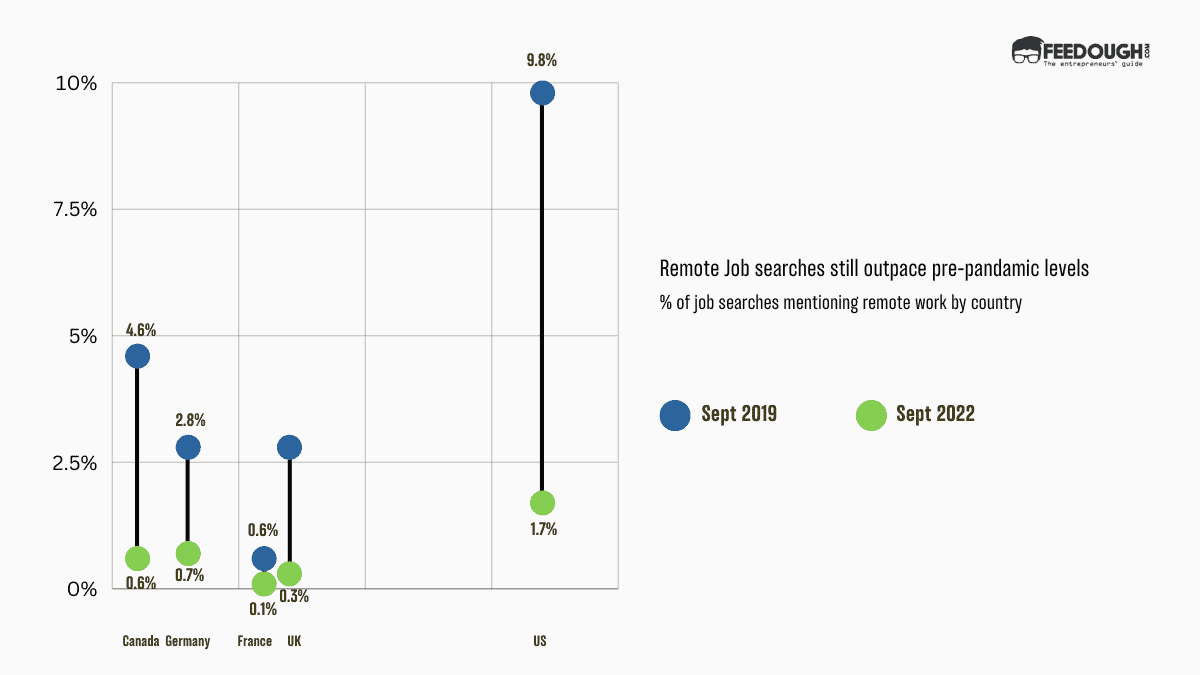
    Remote Jobs Searches

    AI Replacing Jobs

    According to a Global Mckinsey report, at least 12 million workers in the U.S. will have to change occupations by the end of 2030 due to automation and artificial intelligence. According to the study, the four categories most affected would be the demand for clerks, administrative assistants, retail salespersons, and cashiers. 

    The estimated decline for each category is over 600,000 jobs by 2030 since these jobs involve a high share of repetitive tasks, data collection, and elementary data processing, all activities that automated systems are very well equipped to handle efficiently. 

    Prompt Engineering Will Become a New Job Profile

    As generative AI continues to influence the employment landscape, a new category of professionals is emerging, i.e. prompt engineers. Prompt engineers are a new breed of AI engineers who specialise in crafting specific instructions, also known as “prompts” for AI chatbots. They work with a variety of tools and techniques to create prompts that are clear, concise, and informative, ensuring the chatbot produces the desired output.

    With salaries up to $375,000 per year and no strict requirement for a tech degree, prompt engineering is surely becoming a highly-desired career path in the current AI-driven market. Goldman Sachs estimates that the total addressable market for generative AI software is estimated to be $150 billion, compared to the global software industry, which is $685 billion. 
    Algorithmic Bias Comes Up As a New Challenge

    Algorithmic bias is the tendency of AI systems to make repeatable errors to create “unfair” or “discriminatory” outcomes. As organisations increasingly rely on AI for recruiting talent, the potential for algorithmic bias also becomes a growing concern. 

    For instance, if an AI system is trained on a dataset of resumes from mostly white males, it may be more likely to rank white male candidates higher than other candidates of colour or gender. 

    Therefore, organisations are required to be more transparent about how they are using AI, publicise their data audit, and give employees and candidates a choice to opt out of AI-led processes.

    Diversity, Equity, and Inclusion Will Be in Focus

    In the year 2023, diversity, equity, and inclusion (DEI) efforts remain a top priority for organisations worldwide. 

    According to a recent GoodHire survey, it was found that 81% of respondents would seriously quit their jobs if their company failed to display a genuine commitment to DEI. 

    According to Indeed Glassdoor Workplace Trends Report 2022, 72% of workers (age group: 18-34) said they might turn down a job offer or leave the company if they think their manager (or potential manager) didn’t support DEI initiatives. 

    In addition to potential turnover issues, companies that fail to prioritise DEI may have to face major financial losses. According to a report by Accenture, it’s been found that organisations are losing over a trillion dollars in a year due to their lack of DEI initiatives.

    Social Media Recruiting

    Social media recruiting has emerged as an increasingly popular employment trend among hiring professionals and recruiters. It is intriguing to note that a significant proportion of job seekers, eight out of ten precisely, use social media to seek employment. In fact, 73% of these job seekers aged between 18-34 found their last job successfully and did so via social media channels. 

    LinkedIn, a prominent networking platform, further underscores this trend. In fact, as per the platform’s own statistics, eight people are hired every minute through its network. 

    However, making social media a part of the hiring process extends beyond just finding the right candidates. 70% of hiring decision-makers firmly believe in screening all applicants’ social media profiles. Additionally, 67% of these hiring decision-makers acknowledge resorting to social networking sites to research potential job candidates.

    Web3, DAO’s and Metaverse Opens A New World of Opportunities

    Recently, the world of work has experienced a transformative shift due to the emergence of two significant trends: DAOs and the Metaverse. 

    The 2022 Global Workforce of the Future study revealed that nearly half (46%) of Gen Z workers think that the Metaverse will become part of their work life in the future. Moreover, this demographic not only envisions a future within the Metaverse but actively wants to work in it too. 

    Although decentralised autonomous organisations (DAOs) are less familiar to Gen Z workers, 67% of them have already worked in one or are considering doing so.

    The number of DAOs, and the number of participants in them, have increased significantly. In 2021, the number of participants from 13,000 to 1.7 million people worldwide. 

    The same goes for the Metaverse. While the adoption of remote and hybrid work has rapidly accelerated, what remains missing for many is the need for a more interactive, cohesive remote work experience. 

    Metaverse, while dismissed as a place for trivial socialising by many, can help bridge this gap. As the metaverse continues to evolve, the digital simulation of physical workspaces could fulfil the desire for connection and interaction with colleagues and team members, effectively improving company culture and engagement.

    Gen Z Lacks the Social Skills Needed to Enter the Workforce

    According to a few studies, Gen Z lacks the necessary soft skills, such as communication and public speaking, to enter the workforce. While remote work and Zoom meetings did make access to a large pool of talent quite easy, it also led to a soft-skills deficiency, which is more difficult to develop remotely. 

    A career-confidence coach, Sam DeMase, highlights this issue and says, “Working remotely for so long, they don’t have the same confidence that millennials and older generations have with public speaking and networking”.

    She further adds, “A hard skill is something you can learn on the job, but communication is a set of skills that takes time to develop.”

    Therefore if companies want to recruit young, new talent, they need to ensure extensive training is provided in these areas from their end. 

    Quiet Hiring

    Everyone could recall that viral trend of “quiet quitting” or the “Great Resignation” that took over the news, mainly in the latter part of 2022. It was all about workers valuing their mental well-being and deciding not to go “above and beyond” in their jobs and simply doing the bare minimum. But for companies, this posed a challenge – they had the staff but were losing out on valuable skills and abilities. And to tackle this issue, HR leaders came up with a solution, i.e. “Quiet Hiring.”

    “Quiet hiring” is emerging as the new workplace trend embraced by companies worldwide as of late. Quiet hiring refers to when companies are able to acquire new skills without hiring new employees. This is done by promoting existing employees to new roles, expanding their scope of responsibilities through upskilling opportunities, or hiring gig workers to undertake specific tasks. 

    Even big names like Facebook came under fire for their issues regarding data privacy. This shows that despite all the advancements that technology has made in the past, our data is still at risk. The new technology suggests that flux and complexity that big organisations are experiencing will continue well into 2019, despite attempts at securing data.

    Digital Skills Will Be High in Demand

    As workplaces increasingly become more digital, with new technologies being introduced to us left-to-right, developing digital skills becomes extremely paramount. 

    Technologies like machine learning, robotics, augmented reality, artificial intelligence, and the cloud are making inroads into just about every industry and job description that one could imagine. Research conducted by Gallup and AWS states that advanced digital skills will raise global GDP by an estimated $6.3 trillion each year. 

    As per the same study, it was also noted that U.S workers with advanced digital skills saw a pay raise (58%) than those with intermediate digital skills (40%) or those with basic digital skills (33%) compared to those who do not possess digital skills and apply them at work. 

    Green Jobs Continue to Grow in Numbers

    Green jobs are occupations or employment opportunities that contribute to preserving and restoring the environment. These jobs play a crucial role in mitigating climate change, lessening greenhouse gas emissions and decarbonising the economy. 

    The range of sectors offering green jobs is quite vast, including renewable energy, energy efficiency, waste management, sustainable agriculture, forestry, etc. Green jobs also span across different skill levels, from entry-level positions like recycling workers and energy auditors to highly specialised roles like solar engineers and sustainability consultants.

    Many businesses and corporations are committing to achieving net-zero carbon targets by 2050 or earlier, posing a great opportunity for job seekers who are interested in sustainability and wish to leave a positive environmental impact through green careers. 

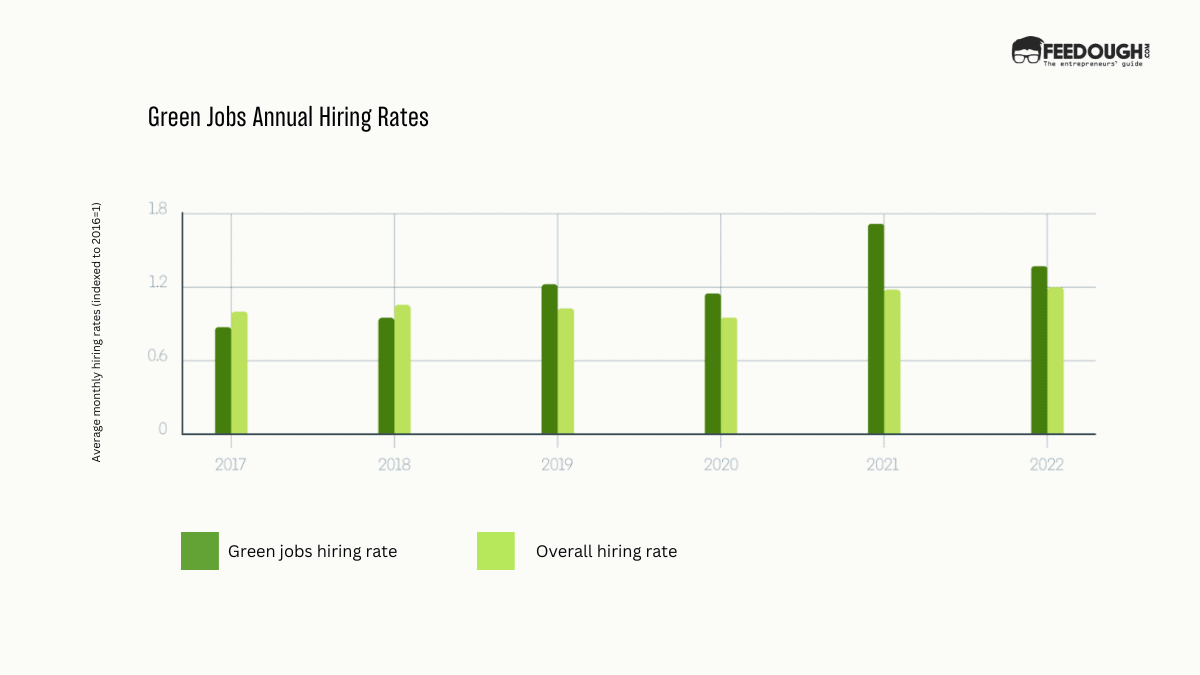
    In fact, this sentiment is mirrored in data from LinkedIn, showing hiring for green jobs consistently outpaces overall hiring.

    Green Jobs Hiring Rates

    A recent survey found that 1 in 4 (26%) of adults in Europe consider sustainability to be one of their top non-negotiables when evaluating a company’s culture and values.

    According to a report published by Deloitte, more than 300 million additional green-collar jobs can be created by 2050. This projection further highlights the profound impact that the green economy is having on job creation and economic development.

    Gig Economy Will Bloom 

    A gig economy is a labour market in which independent workers are recruited for short-term commitments rather than full-time, salaried employees. In this free market system, temporary work positions are common, and work is often characterised as small contracts known as “gigs”. 

    According to Statista, it is projected that the gig economy will generate $455.2 billion in gross volume in 2023. Gig work is becoming more than just a side hustle for many people now. By 2027, there might be more gig workers than full-time employees. While gig work has mostly been a part of the service industries, skilled workers like nurses and lawyers are also doing gig jobs through platforms like Incredible Health and Docketly.

    Even businesses are relying on gig work to tackle issues like not having enough workers, prices going up, and the economy not doing well. In fact, about six out of ten business leaders think that gig workers will replace full-time employees a lot in the next three years.

    Employee Mental Health and Well-Being 

    Companies have increasingly been focusing on creating a healthy work-life balance for their employees and prioritising their mental health. This will remain one of the key workplace trends of 2023. According to Indeed and Glassdoor Hiring and Workplace Trends Report, 90% of individuals are of the opinion that how we feel at work matters, yet only 49% report their organisation is focused on measuring and improving their well-being.

    While employees still care about how much they get paid and the benefits they receive, it’s also really important for companies to create a positive work environment. This is even more crucial now as the majority of the employees operate from remote settings. 

    In fact,  86% of the individuals say that how they feel at work influences how they feel at home. In fact, after pay considerations, stress, lack of satisfaction and happiness are the leading factors people start to look for new job opportunities. 

    Skills Over Jobs 

    In 2023, more companies are more likely to consider alternative credential programs like short courses or certificates during the hiring process and to increase their spending on in-house upskilling efforts.

    Leaders are realising that upskilling employees and creating career paths can help their organisations close skills gaps. As per the World Economic Forum’s Future of Jobs 2022 report, Business Leaders said that about 40% of their workforce will need reskilling in the near future. Another report reveals that upskilling and reskilling are top priorities for today’s workers.

    The 4-Day Work Week 

    The trials of a 4-day working week have been quite a success so far. In the 4-Day Week Global Study, 67% of the companies involved decided to stick to it rather than going back to the regular 5-day pattern. 

    Despite fears to the contrary, the amount of work done either increased or stayed the same during the trial, and employee satisfaction and wellness also improved. Another study from Henley Business School found that companies that tried and implemented the 4-day week saved about £104 billion, which is around 2.2% of their total turnover.

    According to a survey, 79% of recruiters think that by 2030, most companies will have a 4-day workweek where people still get paid the same. This means that it’s likely this idea is here to stay.

    Bottom Line?

    So far, 2023 has brought about a significant shift in how both job seekers and employers approach employment. From AI’s impact on the job market to the rise of gig economies and a deeper focus on employee well-being, it’s clear that adaptability and skills are key. As we navigate these changes, embracing flexibility, upskilling, and a focus on employee satisfaction will be key to thriving in this new era of work.

  • Slack Business Model: How Does Slack Make Money?

    Slack Business Model: How Does Slack Make Money?

    It all began in 2013 when Stewart Butterfield went on to design an online game named Glitch. While working, he realized that his team needed an effective internal communication system. This incident led to the development of Slack, a tool meant to handle teams within organizations.

    What is Slack?

    The acronym Slack stands for ‘Searchable Log of All Conversation and Knowledge’. It is a chat room for a company, which replaces email as the primary method of communicating and sharing. It is a collaboration hub where teams, regardless of size,  can work together to get things done.

    Slack launched at a time when the hegemony of Microsoft and Windows was breaking down. Thus, more and more companies signed up for Slack. They saw it as a tool to manage their data without any hassle and this resulted in the app’s rapid growth.

    The platform started with a vision to make work happen! It aimed to give a team the power and alignment it needs to do the best work, regardless of the organization’s size.

    Its mission, even today is to promote efficient teamwork by connecting departments, offices, and countries.

    Thus, the major challenge before Slack is to organize a huge amount of data and a large number of people within an organization, without compromising data security and accessibility.

    How Does Slack Work?

    The basic working principle of Slack is to bring collaboration at the fingertips. This, it does by following these 7 key features:

    Organized Conversations

    At Slack, information flows in channels. One can create as many channels as one wants. The channels are created keeping in mind the organization size and the number of teams that are working on a project.

    slack organised conversations

    Trackable history

    Slack keeps a track of all the work and makes it easier to go back to a channel and see what has been posted before. The data once uploaded on Slack is always ready for future reference, even if one archives or leaves a channel.

    Slack trackable history

    Secure working environment

    At Slack, there is assured security through two-factor authentication for an account. This implies that even if a person forgets his password, nobody except him will be able to sign in. Also, the SAML- based SSO allows secure access through an identity provider.

    Integration

    Integration sets Slack apart from a normal online instant messaging and collaboration system. Though it lacks some inbuilt project management features, apps like Google Drive, Dropbox, Twitter, etc. can be integrated with Slack and turn it into a full-fledged management app.

    Custom shortcuts and commands

    The meaning of custom shortcuts is that one can create keyboard shortcuts and other custom commands, other than the predefined ones.

    Audio and Video calls

    One can also use Slack to make audio or video calls for free, with up to 15 people at a time! This means there is no need to switch between Skype, Google Hangouts, etc and Slack to make a call.

    slack calls
    slack group calls

    Bots

    At Slack, there is a whole universe of different kinds of bots, used for different purposes. There is Slackbot which helps in note-taking and setting reminders. There is DiggBot which helps in delivering interesting websites and news to a channel. And there are several other Bots. What is fascinating is that one can create personalized Bots too!

    slack bot

    Slack Business Model

    Slack follows a freemium business model. This means that a free version is offered at first. The users can then convert themselves into paying customers if they want to use other advanced functionalities. It combines the free model with a direct sales force to get premium and even enterprise customers.

    The company has over 500,000 organizations on its free subscription plan and around 575 companies which pay $100,000 per year to the company for using its services. Other paid customers contributed to about 40% of Slack’s revenue in 2019.

    How Does Slack Make Money?

    Slack offers four subscription plans:

    1. Free
    2. Standard
    3. Plus
    4. Enterprise Grid

    Small organizations, working on a small project can use Slack’s free subscription and try and understand its working model. Slack then offers more functionalities once these users become used to it. Unlimited integrations, shared channels, guest accounts, etc. drive free users to become paying customers.

    Slack plan features

    The Free, Standard and Plus subscriptions provide a single workspace for smaller organisations. The Enterprise Grid subscription is for larger organisations. It has connected workspaces and channels, more efficient data security and higher integrations.

    Therefore, Slack primarily generates its revenue through paid subscriptions. These subscriptions are paid either on a monthly or annual basis, depending upon the number of an organization’s users on Slack.

    Following are the cost details of different subscription plans that Slack offers:

    Slack plans cost

    Who are Slack’s paid customers?

    1. Individual entrepreneurs
    2. Freelancers
    3. Emerging businesses
    4. Multinational corporations

    Organizations on Slack are of all sizes, working across the world in a wide range of industries.

    The following graph showing the yearly growth in Slack’s paid customers in two years tells that it has observed a huge amount of influx from users worldwide.

    Slack Financial Prospectus

    Is Slack Sustainable?

    Slack has gained huge popularity in the organizing world in the last few years. The flexible working environment, the ease of conversation and the assurance of data security all contribute in making Slack a perfect platform for organizational management. Coordinating through Slack also keeps things out of emails and Google Docs, which can help boost productivity.

    But, as every coin has two faces, Slack has some cons too. Though it serves as an efficient chat room for organizations, yet it may be difficult for a non-tech-savvy, to get a feel of its working environment at first. Slack is also a little less ideal for major decision making discussions and large scale collaborations. Yet, the app does the most it can. It takes the work culture from mainstream atmosphere to something unconventional and exciting.

    That being said, the financial aspect of this startup raises the eyebrows of everyone interested in it. Even though the company is valued at around $17 billion, the biggest issue the company faces is the costs. The total operating expenses of the company are around  49 percent which raises many questions on its sustainability.

    The company spends a huge percentage of its revenue on marketing and sales and it is hard to say if it will see profits in the near future. That being said, many experts call this loss as an investment for good profits in the coming future, given the users stick and the churn rate is not high.

    Some FAQs

    Before we end, here are the answers to some frequently asked questions.

    How much is Slack worth?

    According to the latest data, the net worth of the company is about 7.1 billion USD.

    How much revenue does Slack have?

    According to its S-1 filing, the firm’s revenue in the year ended Jan. 31, 2019, was $400.6 million, representing an 82% increase from the previous year.

    How many users does Slack have?

    Slack has 10 million daily active users as of now.

    What are the functions performed by a bot in Slack?

    At slack, a bot can react to posted messages, make changes to a channel, and perform many other activities. When these events happen, a data payload will be sent to the bot, and it can use that data to form a useful response.

    What are the operating systems that are required to use Slack?

    For a desktop, the required operating systems to use Slack are MacOS, Windows(7 or above) and Linux. For a Slack app to run on a mobile, the required operating systems are iOS(11.1 or above) or Android(4.4 or above)

    Go On, Tell Us What You Think!

    Did we miss something?  Come on! Tell us what you think about our article on how does slack work and make money in the comments section.