Feedough Logo

Blog

  • What Is Transactional Marketing? – Examples & Strategies

    What Is Transactional Marketing? – Examples & Strategies

    Every business’s objective is to sustain by increasing sales and maximising its profits. These organisations employ different sales techniques for achieving the same. Some build consumer relationships and capitalise on pull marketing. While some focus on realising a transaction or sale, in a way using push marketing tactics.

    Transactional Marketing is one such push marketing approach that targets a large group of individuals to achieve substantial sales. Most companies essentially practice this technique in their initial stages to capture a large audience.

    What Is Transactional Marketing?

    Transactional marketing is a marketing strategy that focuses on concluding a transaction or sale. The objective is to close the deal after reaching a point of sale.

    Companies that employ transactional marketing maximise their profits by emphasising the magnitude and efficiency of individual sales. The producers don’t put much effort into building relationships with the buyers. There is no attempt towards customer retention. Thus, there is an absence of any mental or emotional connection with the buyers.

    Transactional marketing is a traditional marketing strategy and is commonly used by companies dealing in generic product lines or services. It primarily focuses on single transactions and targets customers for short-term association.

    This marketing strategy is highly influenced by the marketing mix – the controllable variables that a firm uses to market its products. Transactional marketing uses the most appropriate mix of marketing variables to make it easier for the transaction to occur.

    1. Product – Thebusinessmanufactures an offering capable of satisfying the needs of the customer.
    2. Price – It determines a price for the offering, making it affordable for the customers and profitable for the business
    3. Place – Itchooses the right and efficient distribution channels to reduce sales barriers.
    4. Promotion – Thebusiness also ensures that the product is visible enough to grab the buyers’ attention.

    Examples Of Transaction Marketing

    Cold-calling is one of the best examples of transactional marketing. Using this strategy, the seller offers the customer a product that initially, they have no intention to purchase. Their job is to convince the customer to buy the product by assuring its utility and price. It is generally conducted over phones but can also involve personal visits such as door-to-door selling.

    Quality Value Convenience (QVC), an American broadcast television network, is another example of transactional marketing. It is a flagship shopping channel that offers the viewer a televised in-home shopping experience. The salespersons come up with different products with their demos and bring in as many customers as possible. These traders do not interact with the customers. Instead, they use monologue as their method of transmission. The moderators use eye-catching schemes, discounts, and prices to attract individuals and thus perform a transaction. The orders are generally placed through phone calls displayed on the TV screen or through any website link.

    Transactional Marketing Strategies

    There are several strategies available in the market that businesses use to utilise the concept of transactional marketing. These are:

    • Upselling & Cross-selling: Upselling is a sales strategy where the seller encourages the customer to spend more by recommending an expensive, upgraded, or premium alternative of the current consideration to maximise their purchase value. Cross-selling involves encouraging the customer to spend more by recommending related products that complement what is being bought already.
    • Bundling: This technique involves offering complementary products packaged together or services clubbed together to attract buyers.
    • Bulk discounts: Sellers often introduce enticing discounts to customers who buy more than specific quantities.
    • Sales promotion: Offering attractive short-term initiatives to stimulate the offering’s demand and increase its sales is also a well-known transactional marketing strategy.
    • Point of sale promotions: Promoting parasite products when the customer has reached the point of sale is another way of selling products. This product may or may not be related to the initial product.

    Benefits Of Transaction Marketing

    Though Transactional marketing mainly acquires short-term revenues, it can also yield some long-term benefits and help in cost control.

    • Inventory Turnover: Maintaining inventory for long durations is a costly affair and difficult to manage. Transactional marketing helps in cost reduction as it involves rapid sales and thus assuring fast-moving inventory. The products getting off the shelf make way for new products that are more in demand. It essentially benefits in clearing the seasonal items which don’t sell off swiftly.
    • Low costs: Usually,the promotional costs are lesser for one-time sales as there is no need for shaping brand image and loyalty.There is no long-term commitment and simply involves the communication of product availability and price initiation.

    Disadvantages Of Transactional Marketing

    Even though transactional marketing could be a boon for some businesses, there are some drawbacks to using this method because the main focus is price inducement. The drawbacks of transactional marketing are:

    • Brand Loyalty: There is no significant personal contact with the customers, which would otherwise ensure customer retention and brand loyalty. There is a lack of the emotional relation which drives sales in future as well.
    • Product Development: The business mainly analyses market behaviour and popular demand to build its products. There is little effort in improving product technology to stay ahead in the competitive market.
    • Reactive: The companies remain unaware of technological innovations or changes in consumer preferences. They do not react until the changes are processed in the market and it becomes vital for them to employ the same.
    • Little Emotional Attachment: The customer only looks for the lowest price while buying the product, and brand image and brand connections are blurred visions. As the customer does not remain connected with the business for long; there is less time to develop any attachment. The competitors can undercut the pricing in future times.

    Transactional marketing Vs Relationship Marketing

    Relationship marketing, as opposed to transactional marketing, focuses on building natural relations with the customer.  It aims to engage with buyers and retain them for future repetitive purchases. Patience and continuous efforts play a key role in achieving the same. People are accustomed to traditional advertising, and thus these personal connections break barriers and make way for sales.

    Basis for comparison
    Transactional Marketing
    Relationship Marketing
    Objective
    To achieve a transaction or sale through single sale criteria
    Retain and satisfy customers by building brand loyalty.
    Duration
    Short-term commitment
    Long-term commitment
    Customer Interaction
    Short-term interaction
    Frequent
    Focus  
    Gaining new customers
    Retaining existing customers
    Benefits
    Short term, as based on single sales
    Long term, as based on repetitive sales
    Competing for
    Price induction
    Consumer satisfaction

    In the end, it all narrows down to the business objective. Both the strategies have different executions and approaches but cannot prevail for long without the other. 

    Bottom-Line?

    Nowadays, it isn’t easy to catch a potential customer’s attention and attract them towards an item. People have become accustomed to the concept of forced introduction to products through rapid interruptions. They tend to overlook and move forward. Product manufacturers have to become innovative and employ such techniques that are easily spotted among the crowd.

    The dynamic business environment and saturation of push marketing tactics may result in a rapid downfall of transactional marketing in the future. The digital era of the internet, mobile phones, and handheld devices will only be a catalyst as these technologies make it easier for buyers and sellers to exchange views and establish long-term connections.

    Go On, Tell Us What You Think!

    Did we miss something? Come on! Tell us what you think of this article on transactional marketing in the comment section.
  • What Is Green Innovation? – Types & Examples

    What Is Green Innovation? – Types & Examples

    What do Tesla and IKEA have in common?

    Besides being top-tier companies, they are motivated to the cause of advocating environmentally friendly products.

    The environmental challenges have reshaped the planet, with societies collapsing as a result of its detrimental impact. The need of the hour is to shift towards a world where people and nature coexist.

    Earth can recover only with the human spirit’s resilience and innovations in seeking solutions and rebuilding after disturbances. One such innovation is green innovation. It’s a unique opportunity to go green while offering scope for growth, cost savings, productivity, and prosperity.

    With an upsurge in green consumers, many companies are now shifting to green innovation to contribute to creating a greener future. So, what is green innovation? What is its importance?

    Here’s a guide answering all the questions related to Green Innovation. 

    What is Green Innovation?

    Green Innovation refers to all forms of innovation that minimise environmental damage and ensures that natural resources are used in the most effective way possible.

    It’s one such practice that improves a company’s competitiveness, economic and environmental performance. Reduced energy use, waste recycling, pollution control, resource sustainability, and green product design are all factors to consider.

    Green innovation usually distinguishes itself from non-green innovations as it has the following characteristics:

    • It reduces negative environmental impact.
    • The target of innovation is a product, a procedure, a service, or a system.
    • It meets customer expectations while remaining competitive on the market.
    • It considers and innovates the entire product life cycle to develop a green offering.
    • Economic or environmental considerations back it.

    Importance of Green Innovation

    Why do companies tend to shift towards green innovation? This is not only a result of stringent laws or market pressure but also because implementing environmental management policies provides a multitude of opportunities for the companies.

    • It increases economic and social performance through a reduction in waste, cost, and other inefficiencies.
    • It attracts new customers. According to the Nielsen Global Corporate Sustainability Report, 66 percent of respondents are willing to pay more for sustainable products. The study conducted by Harris Interactive survey found that 77 percent of American adults purchase green products/services.
    • Green Innovation is used in the manufacturing process by companies to minimise production time and costs.
    • It improves market position and gives an edge over their competition.
    • Green innovation creates breakthroughs. For example, Patagonia is one of the most well-known activewear brands in the world. They’ve built repair centres to lower their carbon footprint. They contributed $10 million from Black Friday sales in 2016 to radical environmental groups.

    Thus, Green Innovation is the key to enabling environmentally sustainable growth as it can lead to a cleaner and safer world.

    Types Of Green Innovation

    Depending on the form of implementation and the possible consequences, Catherine A. Ramus categorised green innovation into three types. These are:

    • Green innovation that lowers a company’s environmental impact. (through re-usage and recycling of products)
    • Green innovation that tackles the company’s environmental concerns. (by decreasing the usage of harmful components)
    • Green innovation that develops environmentally friendly products and uses effective processes. (by using fewer resources or energy)

    Examples of Green Innovation

    The changing business environment and customer preferences has forced the businesses, both big and small, to go green. While one can find green innovation in almost every industry today, here are some notable examples that stood out of the crowd.

    Pavegen: Paving The Way To A More Sustainable Future

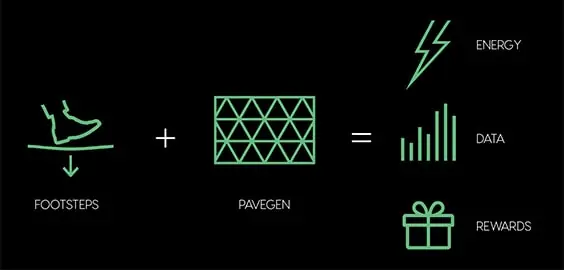
    Founded by Laurence Kemball-Cook, Pavegen’s goal is to obtain kinetic energy from the regular movement of people and transfer it into electrical energy. The weight of people walking on the top surface causes generators under the tiles to rotate, producing electricity by electromagnetic induction. It produces about 3 joules per footstep or about 5 watts of continuous power. This energy can power local applications like lighting, sensors, and data collection and transmission or can be stored in batteries. 

    Source: Pavegen

    Ulta Chaata – Intelligently Enabling Sustainability

    Even though rainwater is the purest source of water, it is squandered. Samit Choksi and Priya Choksi, co-Founders of ThinkPhi, created Ulta Chaata to preserve water in its purest form in open spaces. It consists of a steel unibody and a flexible inverted canopy. It includes solar panels for energy generation, rainwater purification (water purifier), energy storage, live lighting, active sensors, mobile controls, and a charging station. It is also a very large shading system, under which nearly 20 people can sit, or two cars can be parked. In a nutshell, it generates a single integrated product that builds green infrastructure.

    Source: Ecoideaz

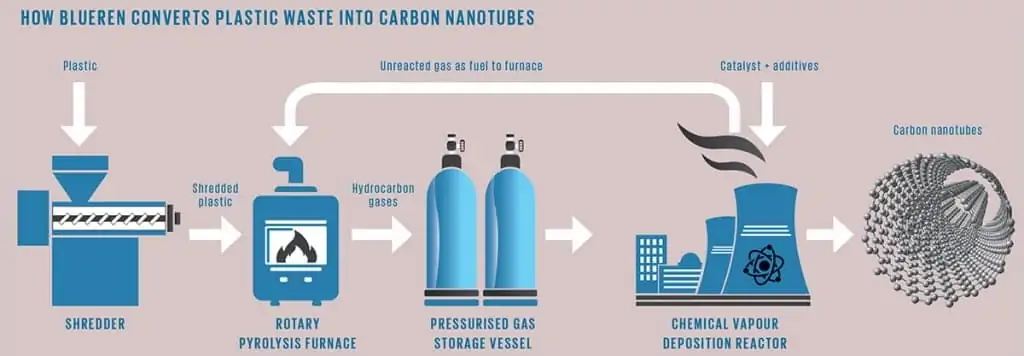
    Carbon Nanotubes: A Remedy For Plastic Problems

    While people around the globe are working to solve the plastic problem, Singapore’s BlueRen Company took things to the next level. Engineers at BlueRen have developed a manufacturing process that produces carbon nanotubes that are stronger than titanium using discarded plastics. Singapore’s skyscrapers and other buildings will be designed with the aid of these nanotubes. A carbon nanotube is a tiny carbon molecule cylinder that is 10,000 times thinner than a strand of human hair.

    Source: Singapore Magazine

    How Can Green Innovation Be Achieved?

    Companies have realised that responding to green innovation is both a challenge and an opportunity.

    Many companies are now assessing their internal processes to enhance their product lifecycle’s environmental profile, from the procurement of raw materials to final use and disposal.

    But, making the switch to green innovation isn’t easy. Thus, a company needs a clear roadmap for maximum positive impact.

    • Start by making small changes: New companies need to begin their journey towards green innovation by making small changes to their development and manufacturing process within a standard protocol.
    • Decide on the path that needs to be taken: This translates to new machinery, new ideas for the production line, and new raw materials that are environmentally friendly and profitable. Adding the “Green Element” to traditional ways of thinking will take some practice but isn’t impossible.
    • Form professional connections with organisations and stakeholders that have previously earned financial support: Creating a network of potential partners will help in achieving the goal of greening the company. It will open new doors for the company in the future, providing more opportunities. For example, companies like IBM have established collaborations that enable progress towards environmental goals while giving them a competitive edge over their rivals.
    • Rewrite the company’s rules to gain a strategic advantage: This will change the business’s underlying rules and reshape it. What does it require? It requires visionary leadership to overcome obstacles.

    Barriers To Green Innovation Initiatives

    • Lack of Urgency: Many companies sense a general lack of urgency, as long-term initiatives can jeopardise short-term profitability.
    • Neglecting 99%: Some businesses fall into the pit of focusing on enhancing 1% of their products’ environmental effect while neglecting to address the other 99%. This can damage the company’s credibility.
    • Fear of losing control: A company needs to trust collaborations while also overcoming the fear of losing control of its operations. Both parties look for mutually beneficial terms in an optimal relationship.
    • Not enough revenue: Some firms may not have enough revenue to switch to green innovation as environmental enforcement costs are excessively high.
    • Fear of failure: Some businesses resist questioning current procedures to avoid the humiliation of acknowledging that their attempts were unsuccessful.

    Go On, Tell Us What You Think!

    Did we miss something? Come on! Tell us what you think about our article on green innovation in the comments section.

  • What Is Undercover Marketing? – Strategies & Examples

    What Is Undercover Marketing? – Strategies & Examples

    The last thing any person consuming an ice cream bar would anticipate is probably that the wooden stick turns out to be Colgate’s emulated toothbrush. It is the essence of undercover marketing, where brand awareness takes place in a way most unexpected by the consumers.

    Source: Colgate

    Be it product placement in movies or shows, or influencers and celebrities being paid to spark buzz about a product casually, customers barely notice these subtle tricks of undercover marketing, a technique towards which more and more companies are inclining nowadays.

    What Is Undercover Marketing?

    Undercover marketing or stealth marketing is a marketing strategy where a company markets their product in a subtle and ‘hidden’ way, such that the consumers don’t realise that it is a marketing ploy.

    It refers to marketing and advertising products in a less obvious manner, using unconventional tactics. It is in line with the idiom “flying under the radar”. It influences consumer decisions without tipping them off the manipulation.

    Undercover marketing is considered to be a subset of guerrilla marketing.    

    For instance, before the release of the movie ‘King Kong’, a stealth marketing campaign was unleashed wherein giant King Kong footprints were made on sandy beaches. This spectacle for the public attracted many people to take photos and post about it on social media. This created a buzz and excitement for the movie release.

    Undercover Marketing Strategies

    Businesses usually employ four undercover marketing strategies to stand out of the crowd. These are

    • Ad Spies: Brands usually pay influencers to surreptitiously pitch its products to their followers without showing that it’s a paid gig.
    • Product placement: It involves featuring a product in a movie or show or other forms of mass media.
    • Buzz Marketing: This technique aims to make the target audience more receptive by making people talk about a product in a casual way to create a buzz in the market.
    • Celebrity endorsements: It helps advertise a product when public figures or social media personalities casually mention the product in organic conversations.
    • Social Validation: Posting positive reviews for the company on different industry websites or ghostwriting a blog citing the company’s success stories.

    Examples Of Undercover Marketing

    Stealth marketing isn’t new. It’s just not well known among the customers because it capitalises on that fact. Here are some of the most creative and innovative examples of stealth marketing strategies.

    Starbucks

    Product placement and stirring up fake controversies are ways Starbucks used to employ stealth marketing. There was a blooper of the enormously popular TV show ‘Game of thrones’ in which a Starbucks cup was evidently left on the table in one of the scenes. This helped it gain publicity and captured the attention of viewers all over the world. Starbucks also stirred up a fake controversy in 2015 about a Christmas cup which the consumers hated and wanted off the shelves. This tactic made the cup popular and raised the sales of the same.

    Axe

    Source: Ads of the world

    Axe body spray made minute modifications to a common exit sign by adding customised stickers of women figures of the same kind chasing the man figure. This idea was in line with the brand’s idea of men becoming irresistible to women.

    Walmart

    A couple wrote a blog, chronicling adventures in different Walmarts throughout the United States in 2006. The blog was very well received by the public and gained an enormous following. However, it lost its charm when it was publicised that Walmart itself sponsored it.

    Blackberry

    Blackberry executives launched an undercover marketing campaign which involved marketing their products in an unorthodox fashion wherein young women took to the city streets and asked random men to enter their phone numbers in their blackberry phones and promised to give them a call later. This was done in order to create a buzz about the new blackberry phone models to increase their sales.

    Advantages Of Undercover Marketing

    Executing a successful undercover marketing campaign can be difficult to pull off. However, if done, it can help in the following ways:

    • Increases brand reach: It helps reach out to customers who are otherwise cynical of traditional advertising strategies. Since they don’t realise that it is a stealth marketing move, it becomes difficult for them to avoid it.
    • Creates a pre-launch buzz: Generating a buzz that makes their product go viral and more talked about makes people more aware of it even at grassroots levels. It helps grab people’s attention and leads to raised initial waves of sales.
    • Saves money: Although these marketing strategies take more creative planning efforts, the company does not have to incur high costs for them. They help avoid any unnecessary expenditures and do not require a lot of equipment or manpower.
    • Identification of potentially interested customers: Stealth marketing helps marketers identify a specific segmented target audience with the highest potential of catering and showcasing their products. It also gives the customers the feeling that they have ‘discovered’ a product or service which is of great value to them and instils in them a desire to purchase the product.

    Disadvantages Of Undercover Marketing

    Undercover marketing is a double edged sword and any company should keep in mind the following potential pitfalls that using undercover marketing strategies might lead to:

    • Ethical dilemma: When consumers do not realise they are being marketed, they do not get an opportunity to opt out. This deceptive nature makes undercover marketing ethically dubious.
    • Damaging the brand image: The strategies might boomerang the brand and this backlash might lead to turning off potential customers from using the brand completely. For instance, Sony’s campaign promoting its PSP console took quite an ugly turn in 2006 after it was brought to light that  the enthusiastic fan videos were made by a paid actor. 
    • Legal risks: Undercover marketing gives rise to the possibility of dabbling into marketing strategies which are forbidden by the law. 
    • Potential of losing credibility: Using stealth marketing moves raises an issue of trust between the consumers and marketers. Some people see it as customer manipulation through dishonest means.

    Go On, Tell Us What You Think!

    Did we miss something? Come on! Tell us what you think about our article on undercover marketing in the comments section.

  • Two-Sided Marketplace: What Is It & How It Operates?

    Two-Sided Marketplace: What Is It & How It Operates?

    Google, Amazon, Airbnb, Snapchat, Facebook, Netflix, and YouTube have more in common than what usually meets the eye. Apart from being some of the most profitable firms, all these platforms run on a two-sided marketplace model.

    In a short period of time, two-sided marketplace companies have become extremely popular and are growing exponentially. According to the Coresight Research Report, these platforms’ revenue is expected to double from $18.6 billion in 2017 to $40.2 billion in 2022.

    So, here is a comprehensive guide explaining all there is to know about two-sided marketplaces.

    What Is A Two-Sided Market?

    A two-sided market is where buyers and sellers interact through an intermediary to fulfil each other’s needs.

    Also referred to as a two-way market or a two-sided network, this market is found in several industries providing two participating parties with network benefits. That is, the buyers and sellers both provide value to each other, and both benefit from each other. 

    What Is A Two-Sided Marketplace?

    A two-sided marketplace is an intermediary platform that brings buyers and sellers together to develop and share value through a network.

    Precisely, a two-sided marketplace has two kinds of consumers – the buyers and the sellers. This marketplace acts as an intermediary or a platform that connects sellers with customers, both of which benefit from the network.

    Examples Of Two-Sided Marketplaces

    The advent of the internet has made the two-sided marketplace business model possible. Almost all the top-ranking tech companies make use of this model. Some examples include:

    Google

    Google is a search engine that targets both consumers and advertisers. Consumers do not pay Google for any search they make. But, Google uses the consumer data to serve the advertisers. Hence, Google provides its services to both the users and the advertisers while connecting them in the process.

    Airbnb

    Airbnb also has two sets of consumers – travelers looking for rental properties and property owners looking to rent their properties. The brand works as a sharing platform. Although it doesn’t own any properties or houses, it connects the travelers and the hosts.

    Uber

    Uber works on the aggregator business model. It has two user groups – drivers who own cabs and the consumers who require a ride. Uber does not own any cars. It simply aggregates cab drivers and connects them to the customers under its own brand name. 

    Olx

    Olx operates on a C2C (consumer to consumer) business model. It has sellers who upload advertisements for the products they want to sell and buyers who have multiple options to choose from. Olx does not own any products. It simply provides a platform to buyers and sellers so that they can interact. 

    The Business model of Two-sided Marketplace

    Two-sided marketplaces operate on a unique business model that separates them from other usual digital businesses. Usually considered to be a platform that connects two parties to hold transactions, the two-sided marketplace could be an aggregator, marketplace, classifieds platform, or a P2P platform.

    The Customers

    Every two-sided marketplace has two sets of customers – the sellers who provide offerings and buyers who buy them. The marketplace helps both the consumers to interact and fulfill each other’s needs.

    The Value

    A two-sided marketplace exists because it provides value to each set of consumers by satiating their needs with its network’s help. Sellers benefit as they get buyers for their offerings without much effort. Buyers benefit as they get what they need, want, or demand through a network of sellers.

    Uber exists because it makes it easy for drivers to get customers and makes it convenient for consumers to book a cab ride.

    The Operating Model

    A two-sided marketplace operates on two strategies:

    • It provides a platform to both the consumers where they can connect and interact with each other. The marketplace doesn’t own any product, but it acts as an intermediary. It provides equal value to each user group. That is why they use the platform. Thus, it capitalises on value.
    • It capitalises on the network effect. A network effect is when each additional user raises the value of the platform for every other user. As more and more people use the platform, its value increases. For example, as more and more people use Amazon, its value in both parties’ eyes increases. More retailers would want to list their products on Amazon. This, in turn, provides even more choices to customers.

    The Revenue Model

    A two-sided marketplace makes money either from just one set of users or can choose to charge both parties. It usually uses the following four revenue generation strategies to make money.

    1. Commission: many two-sided marketplaces make money by charging a commission for the services they provide. For example, Uber charges 20-25% of the ride fee as a commission from the cab driver in return for more business it provides to them.
    2. Data Monetisation: Google, Facebook, and other data-rich companies make money by monetising their user data. They either use the data for advertisements or sell the data to third parties.
    3. Premium Services: Platforms like Tinder lure customers into buying their premium packages which usually provides more exposure on the network.
    4. Pay-To-Use: Some two-sided platforms require the consumer to buy a subscription package to use the platform’s services. For example, the Indian matrimony platform shaadi.com allows access to its network only when the user purchases a subscription.

    One-Sided Marketplace Vs Two-Sided Marketplace

    Unlike a two-sided marketplace, a one-sided marketplace derives all of its value from a single set of consumers. A simple ecommerce store like fivedollarteeshirts.com, where a single seller sells T-shirts to the customers, is an example of a one-sided marketplace.

    There is a significant difference between the two business models.

    First of all, only the two-sided marketplace capitalises on the network effect. Once a two-sided platform establishes a strong network effect of both parties, it becomes hard for competitors to dethrone it. Even if the competing product is better than the marketplace with strong network effects, it is extremely challenging to nudge the customers away from that firm. But, in a traditional market, the network effect does not exist.

    Another difference between both business models is the flow of value and revenue. In a two-sided marketplace, revenue may come in from both consumers and sellers, while in the traditional marketplaces, revenue generally flows from one side to another.

    Benefits of a Two-sided Marketplace

    The business model of a two-sided marketplace offers many advantages to all three participants: the consumer, the producer, and the platform.

    Benefits For Marketplace Buyers

    • Multiple Options: The two-sided marketplace platform offers numerous choices to the buyers. Such choices are generally not available in a traditional marketplace
    • Hassle-Free And Quick: Using a two-sided marketplace platform is usually hassle-free and saves a lot of time for the buyer.
    • Quality Products: The producers on the platform face a lot of competition. This competition encourages them to ensure the quality standards of the product and to lessen the price. 

    Benefits For Marketplace Sellers

    • More Demand: Marketplaces generate more demand for the sellers than what they would find on their own.
    • Growth Opportunities: The platform gives the producers access to a large pool of potential customers. Thus, the producer has tremendous growth opportunities to build his brand.
    • Time-Saving: a customer buys from Amazon because he trusts the platform, not because he trusts the seller. It saves a lot of time for the seller, which he spends building a reputation for himself.

    Benefits For The Marketplace Brand

    • Low Costs: The marketplace brand doesn’t own any products. All it does is connect both the parties. It saves a lot of costs that it would have spent if it were a one-sided marketplace.
    • Network effect: The network effect is the most significant phenomenon that benefits a two-sided marketplace platform. It allows the platform to grow and attract more consumers automatically.

    Challenges Of The Two-Sided Business Model

    While two-sided marketplaces have a huge potential to grow and connect different consumer groups, they face certain challenges that hinder their performance and growth.

    • The Chicken-And-Egg Problem: One of the most common challenges faced by a brand running a two-sided marketplace is the chicken-and-egg problem. This problem arises because of the network effect. It involves figuring out which side of the marketplace to target first because suppliers will use the platform only when there is a demand for their product and vice versa.
    • Ensuring Quality Standards: As an intermediary, a two-sided marketplace needs to ensure that the offering’s quality is up to standards it guarantees to the parties.
    • Platform Leakage: There is a high probability that after using a certain platform for their needs, the consumers and producers create their own networks to avoid paying the intermediary platform. It is called platform leakage. To avoid this, the marketplace needs to provide incentive and recurring value to both sides so as to retain them.
    • Building Trust And Improving Customer Experience: A two-sided marketplace connects two sets of consumers who fulfil each other’s needs. These two sets of consumers will use the platform only when they trust each other and the platform. Consumers will book an Uber only if they trust that it is worthy of their money and that it is safe for them. Thus, the marketplace must be reliable and dependable. Also, the marketplace entrepreneur needs to ensure a good consumer experience for both the user groups. 

    Go On, Tell Us What You Think!

    Did we miss something?  Come on! Tell us what you think about our article on two-sided market in the comments section.

  • How To Prevent Others From Stealing Your Business Ideas

    How To Prevent Others From Stealing Your Business Ideas

    If you’re here, I will presume you already have an idea that you’re working on or are planning to work on it in the coming future.

    But, if you’re the latter, I have bad news for you. You can’t protect just an idea. There’s no central bureau to register all the ideas you have in mind and prevent others from building on them before you do.

    But if you’re already started working on your startup and have something more than just the idea. There are ways you can prevent others from copying what you’re doing.

    But first, you need to know if getting your idea stolen is that big of a deal for you or not.

    Should You Care About Your Ideas Being Stolen?

    If you’re afraid that someone will steal your idea, you might also be afraid that someone will make your idea better and achieve your goals faster than you could. While this is true, it also states that you’re just not ready with your idea yet or not confident enough in your ability to make it a success.

    Your priority should be not to keep your idea a secret but to build and protect that idea’s spine. Is there a trade secret that could be a game-changer? The secret ingredient to your Krabby Patty? Or is there an invention that, if leaked, will stop your business idea from progressing as someone else can register it before you do?

    Say you’re working on an aggregator business that will change the industry you work in. Don’t be afraid of getting your idea leaked because there’s nothing proprietary about your business. People will copy your idea and replicate your business model within months of you starting up. They might even turn out to be better than you even though you’re the first mover in the industry.

    Remember, Facebook wasn’t the first social media network. It was just able to execute the idea better. If you are afraid that your idea of such a business could leak, believe me, that you’re never the only one thinking of that idea. Just make sure to protect the idea’s spine – make exclusive contracts with partners in case of aggregator model, to make it competitor proof.

    But if you’re working on something that is novel and can turn proprietary – say, a process, machinery, tool, composition, literary or artistic work, or a formula that’s new and unique to the industry, you can register it and get its ownership. It’ll prevent anyone else from stealing it or even imitating it.

    How Can you Protect Your Startup Idea?

    Startup idea protection comes in two stages –

    Prevent Insider Theft

    Most ideas are stolen internally. Maybe you had a tussle with your cofounder who planned to launch your competition before you even started. Or perhaps you hired an employee who later turned on to be your new competitor. In any case, protecting your idea from internal theft is essential.

    But you should know how the internal audience can steal your idea and make sure you have made the arrangements not to sink if it happens.

    • Ideas are stolen by someone with competency in the field: Your company HR is probably not the immediate threat you should be worried about. Be wary of someone competent enough to be your competitor. Your operations manager who knows your company’s ins and outs, your cofounder, or even your prospective investor can turn out to be your potential competitor in the future. Just make sure that if the person belongs to your industry and has the bandwidth to start an empire parallel to yours, be extra careful with them.
    • People don’t steal just your idea: The internal audience knows how you plan to convert your vision into reality. They know people you work with or are planning to work with, and they know your partners well. Internal theft takes away a lot more than just your idea.

    So, make sure you sign exclusive contracts with the people you work with – partners and employees – and make sure they commit to working with you alone for a defined time period. Besides this, you can use the following contracts to help protect your idea:

    • Non-Disclosure Agreement: An NDA is a legally binding contract establishing a confidential relationship between the parties involved. It prevents people you work with from sharing information with third parties.
    • Non-Compete Agreement: It prevents the people or entities you work with from starting a competing business.
    • Work-For-Hire Agreement: It prevents the people you hire to build your offering from owning anything they add to the offering. Anything they come up with, you own.

    Own The Rights To The Spine Of Your Idea

    You can’t protect an idea you plan to work on. People get the idea all the time. You can’t just register such an idea.

    But you can protect your startup if it is more than just an idea. You can register it as intellectual property:  

    • Patents for inventions.
    • Trademarks for brand identity.
    • Copyrights for ideas that are expressed.

    Patents

    A patent is a right granted to you as an inventor by the government to prevent others from making, replicating, selling, or using your inventions for a period of time.

    If your startup idea’s spine is an invention like a process, device, machinery, tool, composition, or a formula; you can register it with your government to get ownership and prevent others from getting even close to your startup idea.

    An idea can’t be patented.

    But almost anything that is more than just an idea and has a physical presence can be patented, given it has the following characteristics –

    • It should be an invention: Now, an invention is an act of bringing ideas or objects together in a novel way to create something that did not exist before.
    • It should be new: That is, your invention must meet the legal definition of “novel.”
    • It should be unique and not obvious: It shouldn’t be anything anyone can invent.
    • It must have a patentable subject matter: By patentable subject matter, we mean that it should usually belong to a patentable category and meet the government’s standards set forth.

    Generally, patents are given to the inventions falling in these categories.

    • Business methods
    • Computer software
    • Computer hardware
    • Computer accessories
    • Games
    • Internet advances
    • Jewellery
    • Machines
    • Magic tricks
    • Makeup
    • Musical instruments
    • Perfumes
    • Plants
    • Sporting Goods

    But even though you can patent your invention, you can’t patent your business model. That is, Uber can’t patent the business model it invented – the aggregator business model from being copied. Because, in the eyes of the law, it’s merely any other fundamental economic process, not an invented business model. 

    So, if you cannot patent your business model, what can you patent under the category of business methods?

    Well, you can patent financial data processing and technological inventions required to make the business model work, among others. For example, Netflix patented its computer-implemented approach for renting movies and TV shows to customers in 2003, and Amazon patented its 1-Click system, etc. All these helped them stand out from the crowd without stopping others from copying what they were up to.

    Trademarks

    A trademark is your startup’s registered identity that differentiates it from other players. You can prevent others from stealing your name, logo, tagline, colour, or even your smell by using a trademark.

    Anything that distinguishes your brand from others can be trademarked. Feedough is a trademarked name. Even our logo is registered. Coca-Cola has trademarked its Coca-Cola red colour. And Play-Doh has trademarked the smell of its offering.

    To protect others from stealing what you do, make sure you develop and register your brand identity to own it before anyone else.

    Copyrights

    A copyright is an exclusive legal right you get to print, publish, perform, film, or record literary, artistic, or musical material; and authorise others to do the same.

    You use copyrights to protect your works of authorship, including literary, dramatic, musical, and artistic works.

    Suppose you own a startup operating in the entertainment industry and wrote a script for a TV series. A copyright gives you ownership of that script and prevents it from being stolen by competitors.

    Similarly, you can register your video game, visual work, dramatic work, sounds, and audio-visual works to protect them from being stolen, copied, or imitated.

    Tips To Prevent Your Idea From Being Stolen

    Besides the basic legal protection, there are other usual and unusual practices that you can use to prevent others from stealing your business ideas. These are:

    • Share equity: People are less likely to steal your idea if they become a part of it. Make them the owners and they’ll happily help you convert your vision to reality.
    • Document Everything: Oftentimes, we leak some secrets ourselves. In order to prove that you communicated the same to others, it’s a healthy habit to document conversations, work, meetings, and email the same to the other party.
    • Make your ownership public: If you already got the ownership rights, there’s nothing to lose. Make the ownership public to stop others from copying what you already own.
    • Always do background checks: Always make sure that the person you work with or are planning to work with has a clean history.

    Go On, Tell Us What You Think!

    Did we miss something? Come on! Tell us what you think about our article on how to prevent others from stealing your startup idea in the comments section.

  • What Are Key Result Areas? How To Identify Them?

    What Are Key Result Areas? How To Identify Them?

    While destinationless journeys do appeal to many, work without clear paths and goals is inefficient. What happens here is that people waste their time and energy on tasks that yield little results and are then barely left with resources to do the actual work.

    The only way to deal with this problem is by distinguishing the important, less important, and unimportant jobs. No wonder businesses put a lot of time, effort, and money into understanding their key result areas.

    What are Key Result Areas?

    Key Result Areas or KRAs are the strategic internal or external sectors where the business strives to realise strong positive outcomes to achieve its development goals and move towards fulfilling its vision.

    Each piece of work comprises three to five critical tasks. These essential jobs on which employees, departments and, organisations need to focus are the key result areas.

    For instance, a management consultant is responsible for several activities. They –

    • Coordinate with clients to arrange meetings
    • Understand their clients’ problems and decide how to cater to their needs
    • Collect and analyse clients and their industries
    • Devise an adequate plan of action for the clients’ business
    • Communicate and coordinate with their teammates and other departments
    • Draft emails and proposals for internal and external communication
    • Present solutions and the final plan to the client
    • Contribute to the white papers produced by their company
    • Contribute to the business development activities of their company

    The above tasks don’t generate equal returns. The ones that are more important than others demand more resources. They are the key result areas of the consultant.

    Key Result Areas
    Not The Key Result Areas
    Understand their clients’ problems and decide how to cater to their needs
    Coordinate with clients to arrange meetings
    Collect and analyse data pertaining to the clients and their industries
    Communicate and coordinate with their teammates and other departments
    Devise an adequate plan of action for the clients’ business
    Draft mails and proposals for internal and external communication
     
    Present solutions and the final plan to the client
     
    Contribute to the white papers produced by their company
     
    Contribute to the business development activities of their company

    Characteristics of Key Result Areas

    Every job can be broken down into a few necessary tasks that contribute more than other pieces of work towards the functioning of an organisation. However, to be effective, these KRAs need to be outlined accurately, keeping their characteristics in mind.

    • Departments, employees and even organisations usually have three to five key result areas. There are seldom more than seven KRAs.
    • Key result areas are specific, clear and quantifiable. For example, ‘ensuring the growth of an organisation’ does not fall in the list of a department’s KRAs, but ‘customer acquisition’ does.
    • KRAs comprise the tasks essential to do the work at hand. They don’t include additional jobs that generate little returns.
    • Key result areas should be affected by the actions of the people they are outlined for. For instance, a software engineer cannot have advertisement in their KRAs because their work wouldn’t influence the company’s popularity.

    Key Result Areas Examples

    KRAs are different for each employee, department, and company. However, common basic key result areas associated with some designations are listed below:

    KRA Examples for Sales Department

    • Increase in number of sales as compared to the previous tenure
    • Increase in profit margin as compared to the previous tenure
    • Increase in the number of prospective customers approached
    • Effective implementation of online sales strategy

    KRA Examples for Marketing Managers

    • Increased brand awareness and visibility
    • Promotional activities to improve the brand image
    • Decreased marketing costs per new customer acquired

    KRA Examples for Human Resources Managers

    • Improved advertisement of job vacancy
    • Effective screening of prospective employees
    • Decrease in the cost of hiring
    • Retention of current employees
    • Decreased employee turnover

    KRA Examples for Customer Service Representatives

    • Effectively assisting customers with their queries
    • Efficient handling of customers’ complaints
    • Improved customer retention

    Importance of Key Result Areas

    Outlining key result areas is believed to be crucial to an organisation’s functioning, department’s utility and employees’ productivity.

    KRAs ensure concentration and boost productivity

    Pareto Principle says that 20% of the causes lead to 80% of the consequences. Applying that, 80% of the organisation results will come from 20% of the activities done right. Therefore, marking essential tasks help employees concentrate on them and boosts their productivity at a reduced time cost.

    They align with individual and organisational goals

    Many a time, businesses deviate from their original goals. However, it is easier to align their everyday activities with their ultimate objectives when they have their KRAs penned down. Each employee can further align their key result areas with their organisation’s and work towards its growth in its true essence.

    They assure systematic division of work

    After knowing the department’s key result areas, its supervisor can properly distribute work among the subordinates. It ensures productivity within the organisation.

    They motivate people to perform

    A department’s KRAs consist of the work specific to it. Similarly, employees know that their organisation will suffer if they don’t work on their respective key result areas. This sense of responsibility motivates them to stay on track and work better.

    They help track performance

    After an organisation knows the KRAs of their various departments and employees, it can track their progress in those fields. This will further highlight their strengths and inefficiencies.

    KRAs, KPAs and KPIs

    Key performance areas or KPAs are the internal and external areas of a business that a person or group is responsible for. They include the essential and the not-so-essential duties of an employee, department and organisation. KPAs may be inclusive of the KRAs.

    On the other hand, Key Performance Indicators (KPIs) are metrics that track an individual or a group’s progress towards their strategic goals, that is, their KRAs.

    Difference between KRAs, KPAs and KPIs

    KRA (Key Result Area)
    KPA (Key Performance Area)
    KPI (Key Performance Indicator)
    They are the essential tasks that need to be done to stay productive and useful.
    KPAs include all the areas an employee, department or organisation is answerable for.
    KPIs assess an individual, department, or organisation’s progress in their key result areas (KRA).
    KRAs are specific and measurable.
    KPAs may include broad descriptions of the roles and responsibilities of a person or a group. They may or may not be measurable.
    KPI is a metric, that is, a numeric value.
    Example – Door to door sales
    Example – Business development
    Example – Sales target, customer acquisition cost, etc.

    How to Identify Key Result Areas?

    When it comes to key result areas, there is no one-size-fits-all. KRAs vary with organisations, departments and employees. Everyone must individually identify their KRAs and work to bring about effective growth. Some points to keep in mind while going about it are as follows.

    1. Understanding the organisation’s goals – Before spotting their KRAs, one must understand their organisation’s ideals and short and long-term goals. Knowing a business is mandatory before working for its development.
    2. Discussions and deliberations – KRAs need to be SMART, that is, specific, measurable, achievable, relevant and time-bound. It is not feasible for a person to write them alone. They must talk to their colleagues, bosses and subordinates to finalise the list of key result areas.
    3. Asking the right questions – While understanding the key result areas to work on, employees must ask themselves why exactly they had been hired, that is, what is their job and contribution to the business. People heading a team must know the purpose of creating it before distinguishing between its essential and non-essential pieces of work. Also, one must remember that KRAs don’t comprise expendables. Only essential tasks should be included in the list of key result areas.
    4. Quantification – KRAs need to be measurable. However, various critical sectors like employee satisfaction cannot be measured directly, and managers have to find ways to quantify them. In this case, human resources managers do so by devising feedback forms and satisfaction surveys or by considering the number of resignations per annum.
    5. Division of work – After knowing its KRAs, the organisation or the department needs to divide the work among its employees based on their capabilities and commitments. This further assists them in figuring out the employees’ key results areas.
    6. Writing – It is better not to keep the list of KRAs verbal. The written matter is more explicit and commands more seriousness than word-of-mouth instructions.

    Tracking and Assessing Key Result Areas

    After the key result areas have been identified, one should waste no time planning how to proceed with them. Business professionals must devote enough time to working in those key result areas and keeping track of the progress.

    Since KRAs are measurable, organisations should check them at regular intervals. They should track progress in each of the critical fields via research, reports and analyses.

    Also, employees must be able to outline the areas of their strengths and weaknesses. They have to accept their inefficiencies and focus of improving.

    Moreover, people, departments and even organisations might have to restructure their KRAs from time to time. They must remember that their goal is to live up to the organisation’s vision; KRAs are there to guide the process.

    Go On, Tell Us What You Think!

    Did we miss something? Come on! Tell us what you think about our article on key result areas in the comments section.

  • What Is Point Of Sale? – Definition, Importance & Examples

    What Is Point Of Sale? – Definition, Importance & Examples

    Customers are usually relaxed while entering a store, spa or restaurant and tensed at the cash counter or when the bill arrives. Similarly, they don’t give a second thought before adding an item to their Amazon cart but delay buying it for days. 

    That’s because customers think differently at different stages of shopping. They look for more information in the initial stages, followed by interest and consideration, which doesn’t usually require any monetary payment. The sale or the purchase stage is the actual phase when the customer tends to do their calculation and weigh offering value with the cost they have to pay for it. Hence, a business needs to focus on the final touchpoint that caters to the customer during the sales stage.

    This touchpoint is categorised as the point of sale.

    What is Point of Sale?

    Point of sale is the strategic location where transactions are executed, typically a checkout counter or a virtual payment gate.

    In other words, point of sale is the place where customers pay in exchange for products. It is where customers, products and money come together to turn a decision into a purchase. Everything, ranging from cash counters in brick and mortar stores to virtual checkout gates in eCommerce websites, falls under this head.

    When understanding point of sale, it is crucial to study point of purchase as well. From a customer’s point of view, point of sale is synonymous with the point of purchase, that is, the place where customers pay for their purchase or sellers get paid for what they sold.

    However, from a marketer’s perspective, the point of purchase refers to the area around the checkout counter. It is where businesses showcase their products and execute promotional activities, be it display racks in shops or online product galleries.

    Importance of Point of Sale and Its Management

    A customer’s mind goes through different stages when shopping, and their psychology is the most vulnerable at the point of sale. This makes POS a strategic location. Effective management at the point of sale can open floodgates to higher sales and revenue.

    POS Finalises Deals

    Point of sale is where deals are struck. Here, customers pay using cash, cards, discount coupons, loyalty points, etc. An exchange made at the point of sale is called a POS transaction. While consumers make buying decisions all the time, it is here that those decisions turn into a purchase.

    Ineffective POS management can leave a bad impression on customers; they may back off or never return. Therefore, managers need to ensure a smooth checkout.

    POS Guarantees Visibility

    All the customers have to go through checkout. So, anything displayed here has higher visibility than the rest of the store (physical or virtual). When businesses display their products at the point of sale, it is called POS display.

    Chocolates kept beside the cash counter in a supermarket, and Amazon’s product recommendations are great examples of POS display.

    POS Is An Excellent Marketing Touchpoint

    Promoting something at the point of sale is called POS marketing. Marketing is all about understanding consumers’ psychology. By the time customers head for checkout, they are mentally exhausted from making all the buying decisions and are more prone to compulsive purchasing. Also, they don’t want to miss anything out, so they tend to buy necessities, edibles and forgettable items like batteries impulsively.

    A slight nudge in the form of promotional videos or even suggestions can boost a business’s revenue manifold. For instance, McDonald’s asks anyone who buys a burger if they want to switch to a combo. This drives up their revenues. 

    POS Is A Point Of Service

    Businesses need to provide excellent service to retain customers and ensure loyalty among them. Point of sale is the last place a customer visits while shopping. It gives sellers a chance to win customers’ trust and determines whether they will return or not. Conversations, offers and loyalty programmes are some ways to go about customer relationship management.

    Changes in Point of Sale Management over the Years

    In traditional retail stores, hotels or spas, employees assist customers during checkout. They talk to them, assist transactions and try to form a healthy relationship. They must ensure loyalty and retention among the customers.

    Not long back, they processed transactions manually using calculators and cash registers. However, electronic POS systems have come into mainstream usage of late. They help businesses provide services and drive revenues with ease. Since technology has simplified the tedious task of creating sales reports and managing inventories, managers now have more time to focus on other tasks at the point of sale like marketing and building customer relations. Growing competition increased the need for customer relationship management (CRM), which is best handled at the point of sale. 

    Nowadays, people prefer shopping online rather than carving time out of their schedule to buy daily items. This places eCommerce websites under the obligation of providing a smooth purchasing experience. Therefore, Virtual POS software interfaces have come into being to streamline the most hassled part of online shopping, the checkout.

    Quite many physical stores and virtual stores use POS software to manage work around the point of sale efficiently.

    Modern POS Systems

    A point of sale system is the combination of all electronic and non-electronic items required at the point of sale to process transactions and keep records. Display screens, barcode scanners, cash registers, printers, and software interfaces form a point of sale system.

    POS systems tend to increase the efficiency at the point of sale and streamline the whole business. Whether the point of sale is in a physical store or is present virtually, POS systems are deployed to assist management. When a system handles and records customers’ data well, businesses can build better relations with them through regular mails, personalised advertisements and loyalty programmes. When a system tracks and analyses customers’ choices, managers can easily suggest the right products just before checkout to drive sales through suggestive marketing. When a system streamlines the otherwise chaotic and tedious jobs, stores ensure better service to their customers.

    Understanding Physical and Virtual POS Systems

    Physical POS Systems

    Physical POS systems are deployed in physical stores, restaurants, spas and other brick and mortar businesses. From heavy computer systems to cloud-based software interfaces, they come in varied forms. However, the essential components of a physical POS system are –

    • POS Hardware – All the physical electronic equipment of a point of sale system form the POS hardware. Custom-made for their specific software, the point of sale hardware includes all the input and output devices, from barcode scanner to printer.
    • POS Software – It is the software component of a POS system. Just like a phone runs on iOS or Android, POS hardware runs on POS software that stores product details, inventory information and maintains the record. A point of sale software can be cloud-based, mobile-based or traditional (computer system based).
    • POS Terminal/ POS machine – POS terminals, also known as POS machines, are the payment accepting devices that execute card payment. A POS machine may or may not be integrated with the POS software, but it is advisable to do so for smoother management. Modern POS terminals are also equipped to read other payment channels like Google Wallet and Apple Pay.

    Virtual POS Systems

    Virtual POS is the software deployed by eCommerce websites to facilitate card transactions. It simplifies point of sale transactions which are executed using debit and credit cards.

    Online stores offer people the comfort of shopping at leisure. However, about 67.4% abandon the checkout. Of these, 10% do so because of lengthy checkout processes. Ensuring a smooth customer experience is crucial to eCommerce websites and virtual POS systems are a good way to guarantee that. 

    With upgradation coming in every day, businesses can easily be efficient at the point of sale. POS systems help secure loyal customers and generate revenue. However, managers and employees’ job is to devise an effective point of sale strategy and execute it to meet the business’s development goals. Vigilance and efforts are all it takes to sustain a business.

    Go On, Tell Us What You Think!

    Did we miss something? Come on! Tell us what you think about our article on Point of sale in the comments section.

  • Staging Environment – Definition, Benefits, and Limitations

    Staging Environment – Definition, Benefits, and Limitations

    At a time when technological advancements are so rapid, providing customers with new features is almost a new necessity. If offerings are not updated, then users can drift towards competitors.

    But developers cannot make changes in a live setting. They need a safe environment to test and add new functions to the products. A staging environment provides these safe conditions to the developers. It allows them to make changes without letting the users know.

    What Is A Staging Environment?

    A staging environment offers testers a replica of the production environment to test new codes and updates before making them live.

    This environment guarantees the exact configuration of hardware, servers, database, and caches in which the product is likely to perform. It’s a very close imitation of the production environment to guarantee proper testing. In other words, it is the precise simulation of the actual conditions to test the product.

    In simple terms, it is a stage where developers can perform various experiments on the product to discover its best version. It makes sure that the users are always provided with the best experience.

    Which Tests Are There In A Staging Environment?

    Smoke test and User Acceptance Testing (UAT) are the two types of tests in a staging environment.

    A smoke test is also known as a build verification test or build an acceptance test. It tests the essential service functionalities. This means that it tests the main functions when a new build is under development and integration.

    UAT is also known as application testing or end-user testing. It tests the performance from the user’s perspective, and it tries to ensure quality and user-friendliness. Typically, business users and product managers become testers in UAT. Besides testing the basic functionality, the user will also test whether the product’s look matches their branding, setting, and style standards.

    Other than that, developers can also perform chaos engineering in a this environment. Chaos engineering is the process of constantly breaking the code to reinforce confidence in the system.

    Although chaos engineering is generally performed in a production environment, it is also possible to perform it in a staging environment. It helps in the early detection of potential issues that a product may have in a production system.

    What Are The Benefits Of A Staging Environment?

    There are several benefits of using a staging environment. These are:

    • Staging environment allows the testers to examine the product on a near-production level in a non-production environment.
    • It offers a platform where the developers can perform an ultimate quality assurance check. This ensures that users get the best quality.
    • The developers can ensure that the new versions’ changes are working in an intended manner by releasing new features in staging first.
    • Companies can also use a this environment to give demos of their products to the customers.

    What Are The Limitations Of The Staging Environment?

    The staging environment also has some limitations, which are:

    • It is not possible to completely replicate the production environment. A Staging environment can only provide a close copy of it.
    • This environment can not test the product for the stress of high levels of traffic which is present in live conditions.
    • It can lead to more problems if the staging environment is not built properly or if it is under-utilized. For example, if the staging environment and production environment’s configurations don’t match, then the results will also be incorrect.
    • It isn’t easy to test the product for a very long period of time in a staging environment. Thus, developers cannot test issues like data corruption and memory leak.

    Staging Environment vs Test Environment

    Sometimes, people get confused between the staging environment and Test Environment because they have similar applications. They both are used to ensure that every component performs its job. Although their applications are pretty identical, developers still require both environments to perform tests. They need both environments because staging and test environment has some minor differences, which are as follows:

    Staging Environment
    Test Environment
    A staging environment duplicates the production environment to test the product.
    Test Environment helps to test a particular part of the product.
    It should be able to replicate all the requirements and correct configurations of the production environment.
    It requires a different configuration and data setup; thus, it has no such thing as a one-size-fits-all setup.
    The Staging environment is a setting to examine the complete product.
    The test environment is an environment to test individual components.
    In a staging environment, the complete product is tested under real conditions.
    While, in a test environment, the code dictates the setup of the environment.
    This environment ensures that every component will work properly in a real environment.
    The test environment makes sure that every individual component is performing its job.

    Why Is It Important To Test Products In Multiple Environments?

    During the product development process, the developers test the product in different environments like Integration, Development, Test & QA, Staging, and Production. It is quite essential to have multiple environments because it allows developers to work individually but concurrently on the project.

    For example, new functionalities can be tested in the staging while the older version is also available to users in a production environment.

    What Comes After The Staging Environment?

    Once the product is completely tested in the staging environment, the next step is to release it for end users in a production environment. It is the final stage of production. It is the live performance where the users can use, practice, and interact with the product. Thus, squashing out all the bugs before the production environment is important.

  • Pre-Seed Funding Explained: What It Is & How It Works

    Pre-Seed Funding Explained: What It Is & How It Works

    A disruptive idea marks the start of a startup. But not all ideas convert into real businesses. Some are discarded during the course and some fail. But to make sure that the startup idea can result in a profitable business, an entrepreneur needs to validate it. This validation often requires the startup to pitch in some money.

    It is where pre-seed capital comes in.

    But what is pre-seed funding, and how to get it? Let’s find out.

    What is Pre-Seed Funding?

    Pre-Seed funding is the earliest funding round where a startup raises money to validate its problem-solution hypotheses, propositions, and demand.

    Pre-seed capital is required to set the base for the business operations to start and ensure that the founders’ business is a viable one. This base is set by:

    • Validating hypotheses relating to the customers, demand, and planned offering, by conducting surveys, research and analysis.
    • Bringing key stakeholders on board like the chief technical officer, chief financial offer, etc. to help convert the idea into a full-fledged business.
    • Registering key patents, trademarks, and IP to futureproof the business.

    Pre-seed funding is usually too small to be considered an official round of funding. However, for some startups, it’s an essential inflow of capital just to set the base for something big that can disrupt the industry.

    Purpose of Pre-seed funding

    A startup raises pre-seed capital to complete all the tasks that can help it make its idea business ready. These tasks can be divided into three categories:

    • Hypotheses validation
    • Getting key stakeholders
    • Concept or invention ownership

    Hypotheses Validation

    Startups raise pre-seed capital when they need to fund their validation methods. They conduct experiments based on set hypotheses to validate their offering, market, value, or problem.

    A hypothesis consists of assumptions about the problem they are aiming to solve and success criteria.

    A startup can resort to the following methods to validate its hypotheses:

    • Market research: No matter the industry, startups need to research the target audience to validate the problem, solution, business model, and other hypotheses before converting the idea into a business. The market research may involve small focus groups, or in the case of specialised products, might involve large trials.
    • Interview: Interacting with a defined customer persona validates whether the problem actually exists or not. This can be done in the form of surveys or can include face-to-face interviews.
    • Prototype testing: A prototype is a model of the product created to check the functionality and visualise the idea. It is usually not brought to the market but presented to key stakeholders and some prospective customers. The purpose of prototype testing is to identify and fix errors.
    • Developing an MVP: A minimum viable product is the most basic version of the product with enough features to make it usable for early customers and receive feedback. It helps to identify whether people would actually pay for the product.

    Getting Key Stakeholders

    Key stakeholders are people who help the founders in converting the idea into reality. For example, a non-tech founder may require a tech cofounder to take a tech idea forward.

    Similarly, a startup may require hiring professional staff even before the idea is converted into a business. It may require funding to pay their salaries and other related costs.

    Registration And Licensing

    Before starting a business, an entrepreneur may need to register the startup as a company or a similar business structure. Besides this, it may also require funding for the following:

    • Licensing requirements: Depending upon the industry, a startup may have to pay for licenses, registrations etc. required to start its operations.
    • Intellectual property: Intellectual property rights consist of patents, copyrights, trademarks, and trade secrets. They ensure control over the concept, infection, or offering. The amount usually depends on the type of business, filing fees, number of claims and legal fees.

    Pre Seed Vs Seed Funding

    Startup funding rounds are inspired by farming. A pre-seed stage is when the founder sets the base to sow the seed. The seed stage, on the other hand, is when the founder sows the seed and converts the idea into a business.

    Pre-seed funding is raised to demonstrate whether a product can fulfil the target market’s needs. On the other hand, Seed funding is used to set up full-fledged operations for a validated business idea. It is the first official fundraising round when a startup has already gained some traction on its product. Hence, institutional investors are ready to fund a startup at this stage compared to a pre-seed round.

    Pre-Seed Funding
    Seed Funding
    Purpose
    A startup requires pre-seed funding to validate its hypotheses related to problem, solution, and the offering.
    A startup requires seed funding to convert the idea into actual business and start its operations.
    Funding Amount
    Within $50 – $250k range
    Less than $5 million.
    Investors
    Usually self-financed or from friends, family, and other non-institutional investors.
    Institutional investors like accelerators, angel capitalists, venture capitalists may invest during seed round.
    Result
    The result of a pre-seed round is a product that can generate traction in the market.
    After a seed round, business operations are up and running, and at least some revenue is being generated.

    Sources of pre-seed funding

    The first resort for raising pre-seed money is bootstrapping. Usually, startups go for external sources when they are no longer able to cover the costs. These can be as follows:

    Fools, Friends and family

    Friends and family usually pitch in during the pre-seed stage as the amount required is relatively low, and they trust the founders more than the idea. Fools are the ones who seek high returns through early-stage investments but fail to realise that it might yield zero returns.

    Incubators

    Startup incubators are non-profit organisations sponsored by public or private institutions. They are inclined toward innovation and help startups to fine-tune business ideas. They provide services such as assistance, office spaces and networking opportunities. There is no specific timeframe, and it can last for several years, giving a startup enough time and space to try and come up with a solid business model. They usually do not take much equity.

    Accelerators

    A startup accelerator is a cohort-based mentorship-driven business program that provides early age startups with financing and education. It usually lasts from 3 to 6 months. To get into this program, startups need to have an MVP at least. Accelerators take 7-10% of the equity in exchange for funds, usually in the range of $10-120k. Y combinator and 500 startups are the top accelerators based on successful exits, and their acceptance rate ranges from 1-3%.

    Crowdfunding

    Crowdfunding is a way of raising money in small amounts from a large number of individuals online. Here the startup gains access to a wide investor pool and the scrutiny of thousands of people who can help identify shortcomings in the product. Crowdfunding can be equity-based, rewards-based, donation and debt-based. The most relevant for the pre-seed round is reward-based crowdfunding as it does not necessarily require having an established business or product.

    Pre Seed Angel Investors

    Angel investors are wealthy individuals who invest their own money in exchange for equity in the company. They usually make small investments ranging from $25-100k. Being successful business people themselves, they also provide access to a large network and expertise.

    Pre Seed VC Funds

    VC firms provide equity financing to startups, usually in the Series A round. But large VC firms have now started setting aside funds specifically for pre-seed rounds also to get access to better opportunities in the later stage of a startup.

    How much do startups raise During Pre-Seed?

    Generally, the amount raised during a pre-seed round ranges from $50-250k.

    To decide on an amount to be raised, a plan is developed consisting of quantifiable milestones that have to be achieved and the cash required for it.

    The first step is to gauge the amount that the market will be interested in providing. 

    Asking for too little funds will not be of any interest to investors as it will be a waste of time listening to pitches for a meagre amount. On the other hand, a large amount will be difficult to raise without an MVP.

    Then, a monthly burn rate is calculated. It is the amount a startup spends on operations on a monthly basis. The amount raised should be enough to provide a minimum of 6 months of runway. Lastly, the pre-seed fund should be able to prepare the startup for subsequent funding rounds.

    Go On, Tell Us What You Think!

    Did we miss something? Come on! Tell us what you think about our article on pre-seed funding in the comments section.

  • What Is Consumer Awareness? – Consumer Rights & Responsibilities Explained

    What Is Consumer Awareness? – Consumer Rights & Responsibilities Explained

    There are times when the competitive market scenario leads to companies engaging in what we call “malpractices”, or practices that benefit the business at the consumer’s cost. These could be misleading advertisements – for example, the brand’s promotion calling it a sugar-free snack when it’s not really sugar-free – or even manufacturing a product that contains life-threatening ingredients – for example, excessive amounts of lead were detected in Nestlé’s Maggi noodles, an international noodles and seasoning brand.

    For consumers to protect themselves from such malpractices, they need to be aware of their rights. This would enable them to shield themselves from any malpractice from the producer’s or seller’s end.

    In short, consumer awareness is integral in the modern-day economy.

    But what is consumer awareness? What are the rights and responsibilities of a modern-day consumer?

    Let’s find out!

    What Is Consumer Awareness?

    Consumer awareness is the act that consumers perform to shield themselves from marketplace exploitation by gaining enough information about the offerings they consume and by practicing their consumer rights.

    The process of consumer awareness requires governments to intervene, as it is a matter of public welfare.

    This process involves successfully educating a consumer about their rights and responsibilities for the sole reason of their safety and protection from potential marketplace exploitation. Emphasis is laid upon making information accessible and redressal options available.

    Importance Of Consumer Awareness

    Below listed are a few points that state the importance of consumer awareness. Consumer awareness:

    • Allows a consumer to achieve maximum satisfaction at the best price.
    • Protects consumers in a marketplace from all sorts of exploitation that the producers and sellers might indulge in.
    • Protects a consumer from consuming large quantities of harmful products.
    • Motivates a consumer to save and not splurge.
    • Helps consumers solve problems regarding their purchases as they grow more aware of redressal mechanisms.
    • Enables a society to grow healthily.

    Consumer Rights

    In a marketplace, consumers are given certain rights that disallow producers and sellers to cheat or exploit them in any manner whatsoever. Below listed are a few rights that a consumer is expected to be aware of at all times when buying goods and services:

    • Right to Safety: The Right to Safety allows consumers to protect themselves from products that have the potential to hold back or even cripple their safety. Consumers have the right to protect themselves from any product that threatens their mental or physical health. This right ensures consumers that they have all the right to demand justice in the event of injury or harm caused by a product or service.
      For example, if a defective pressure cooker harms or causes injury to a consumer, they could demand monetary compensation from the producer in the consumer court.
    • Right to Information: The Right to Information states that a consumer needs to be aware of all the details of a product or service. These details include the quality, quantity, potency, standard, purity, and price of goods. Consumers should be certain of the product or service they choose to buy, and for the same, they should be aware of its details.
      For example, a consumer should be made aware of the side effects of a certain drug that he purchases from the pharmacy.
    • Right to Choose: A consumer should be allowed to choose to buy a product or service of their choice without being forced to do so. The entire decision of purchasing a certain product is solely upon the consumer. This right also ensures that a consumer has several articles to choose from, as monopolistic practices are not deemed legal.
      For example, if a consumer wishes to purchase a keyboard but the seller states that one could purchase a keyboard only if they buy the mouse as well. This would be deemed an illegal practice as the consumer has all the right to purchase just the keyboard, minus the mouse.
    • Right to Be Heard: A consumer, in the event of being dissatisfied with the product or service that they purchased, has the right to file a complaint in the consumer court. The court should address the complaint in a limited time frame, and it cannot, in any event, go unheard.
    • Right to Seek Redressal/ Have Problems Corrected: If a consumer is dissatisfied with a particular purchase, the consumer has the right to get the product replaced, or a refund could be demanded for the product. The consumer may also ask for compensation in case a product or service causes harm to them.
    • Right to Consumer Education – Consumers are to be made aware of their rights as buyers in the marketplace. They should be able to access all information and details regarding a product, and also have the right to be made aware of their rights and responsibilities as a consumer.
    • Right to Service- Every consumer is to be treated with the utmost respect in the marketplace. Consumers are granted the right to expect prompt services that meet the standard or quality of a business. This right is granted to all, irrespective of their gender, class, income, age, religion, or race.
      In the event of any form of discrimination, the consumer has the right to approach the court and seek compensation for the same.

    Responsibilities Of A Consumer

    As consumers in a marketplace, they too have certain responsibilities that they should keep in mind in order to ensure that they are protected from all kinds of marketplace exploitation. Below listed are a few responsibilities that consumers should keep in mind while purchasing a product or service:

    • The Responsibility to Be Informed: A consumer must make sure that they are informed of what they are purchasing. For example, if one plans to buy food products, they should make sure they know what it contains and whether or not it is not something that would harm them in any manner whatsoever. If one pays for a service, they should keep themselves informed of the service they purchased and have a clear idea of what kind of service they expect.
    • The Responsibility to Choose Carefully: Consumers, while making purchases of shopping products, tend to compare one product or service with another. A consumer must see to it that they make sure that they choose a product that best satisfies their needs, interests, or desires. A responsible consumer will make sure that they are getting great value at the best price.
      At the same time, one must be responsible of their environment as well. They should also be aware of the availability of resources and adjust accordingly.
    • The Responsibility to Use Products Safely: Consumers are expected to make sure they are aware of how a product is to be used and must follow the user’s instruction that is provided along with the product. Consumers should make sure they adhere to the instructions provided. For example, if a certain dosage is recommended for a particular drug, one must not consume more than what has been recommended.
    • The Responsibility to Speak Out: Consumers are expected to provide producers and sellers with adequate feedback. It is integral to let a producer or seller know if they are dissatisfied with their product or service and seek a response. This will allow the consumer to practice their right of seeking redressal if required.
      Reporting unfair practices on the part of the producers and sellers is of utmost importance as this would add to the awareness among other potential consumers of the product or service.
    • The Responsibility to Seek a Remedy: If a consumer is dissatisfied with a defective product, the consumer needs to contact the producer or seller to get a refund or replace it. This is important as a consumer pays the product’s full price and has the right to get the best value for their money. If the producer or seller refuses to solve the problem, the consumer must approach the consumer court.
    • The Responsibility to Learn Consumer Skills: As a consumer, one should make sure they have all the necessary consumer skills that make them a responsible consumer. These skills include – reading labels on packages, comparing prices and quality, paying attention to news that reports illegal practices of a certain business or company, reading consumer information publications, keeping oneself updated regarding products and their usage, etc.

    Effects Of Consumer Awareness

    Consumers in the marketplace today are more aware and alert than ever. They are aware of their rights and responsibilities and utilise them to derive maximum satisfaction by demanding value for price and shield themselves from any sort of exploitation.

    A responsible consumer would now make it a point to make sure that he is purchasing good quality products and services, check its manufacturing and expiry date, and ascertain that the product’s price matches the offering’s quality, quantity, purity, and standard.

    Keeping in mind all of these rights and responsibilities allows consumers to make sure that their rights are observed. Additionally, these rights and responsibilities also ensure consumers that they will get the best value for their money at all times and grants them the right to seek redressal if they are left dissatisfied.

    Go On, Tell Us What You Think!

    Did we miss something?  Come on! Tell us what you think about our article on consumer awareness in the comments section.