Feedough Logo

Blog

  • 5 Simple & Effective Brainstorming Techniques

    5 Simple & Effective Brainstorming Techniques

    Imagine you’ve gathered your team together for that much needed brainstorming session but the things aren’t going the way you wanted them to. There are no new ideas, the silent ones are still silent, and the team is still arguing on not so relevant topics. What’s missing from this brainstorming session? Is there anything you can do to make the brains of your team work?

    Yes, probably.

    There is something which separates a fruitful brainstorming session which leads to better ideas from a not so fruitful brainstorming session. It’s the type of brainstorming technique used by you to host the brainstorming session.

    5 Useful Brainstorming Methods To Generate Better Ideas

    Maybe you’re an entrepreneur in search of more profitable ideas. Maybe you’re a writer who wants a new idea for your next book. A journalist looking for your next big story. Or a blogger having a writer’s block. Whatever the case, brainstorming always seems to be a perfect solution to your problem. Wouldn’t it be great if you find some brainstorming techniques which can help you make your next brainstorming session more fruitful?

    Well, here’s a list of 5 useful brainstorming techniques to make your work easier.

    Brainwriting

    Brainwriting is a perfect brainstorming method to generate new ideas. This technique involves each participant to write ideas or solutions to the problem on a piece of paper. Once done, others create new ideas, variations, or piggybank on existing ideas.

    The method was developed Bernd Rohrbach in 1968 and was originally named as 6-3-5 brainwriting or 635 method or method 635 as it involved 6 people to write 3 ideas in 5 minutes on a blank 6-3-5 worksheet.
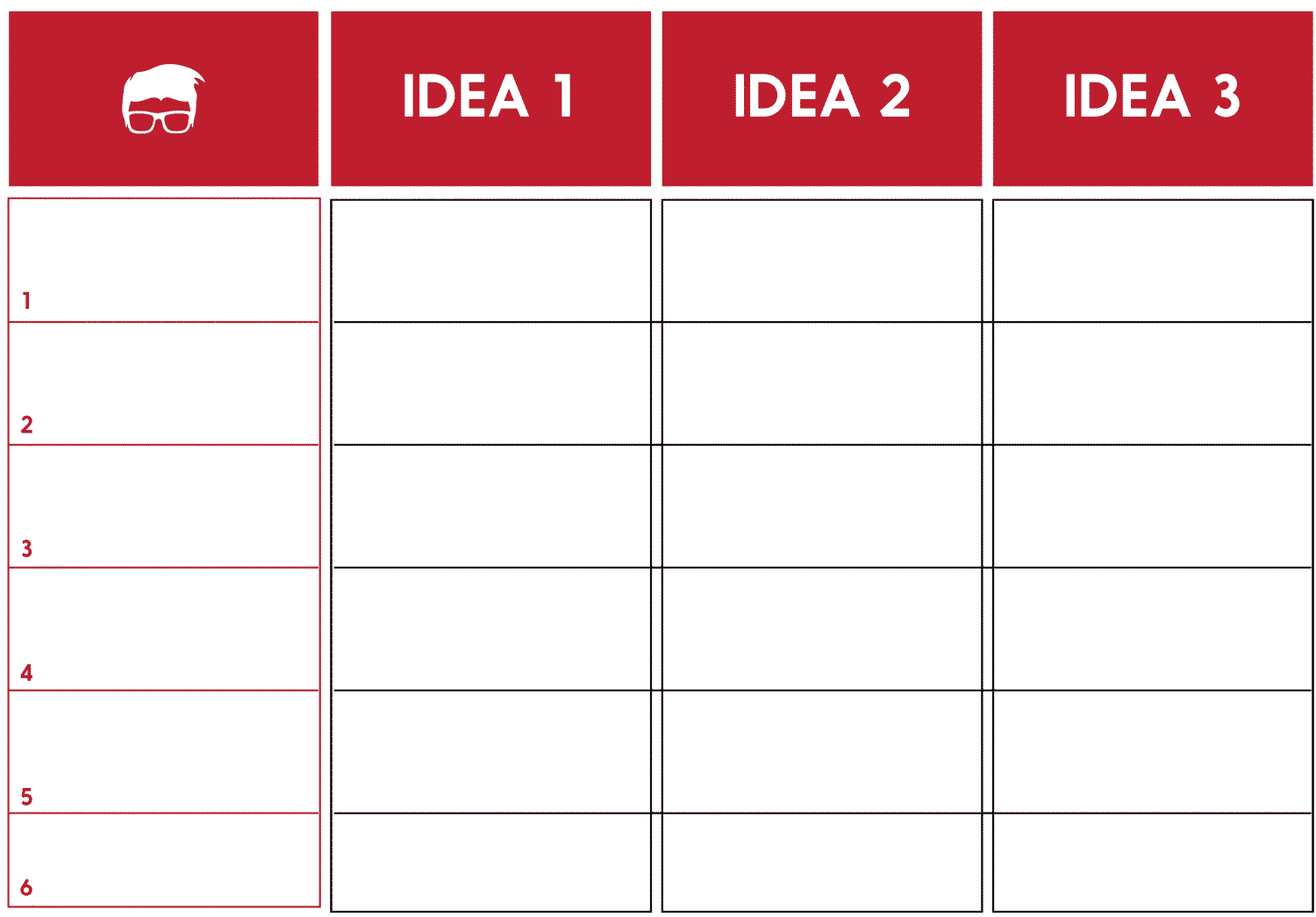
    Once written, the participant passes his worksheet to the person on his right who adds three more ideas to it. The process continues until the worksheet is complete. This results in 108 new ideas or solutions to a specific problem which can be assessed further for the best solution.

    The Negation Technique

    This technique is most useful in the product development department or during the ideation phase of the startup process. It involves writing down every possibility why the product or the idea could fail in the market, and discussing it with the group on how you can prevent it.

    The discussion isn’t limited to not so concrete facts like ‘the product will not succeed because the competitors are better’. Rather it involves diving more into ‘this particular competitor is better in this aspect and we haven’t focused on it’.

    However, this technique requires you to be experienced in handling a heated discussion and describe a guideline before starting the discussion.

    Reverse Brainstorming

    This brainstorming method is similar to the negation technique. As the name suggests, this approach tries to solve the problem in a reversed way to the flow we know. Instead of asking a direct question like “What can we do to make customers return to our store?”, you can start the discussion asking a negative question like “What can we do to make customers never return to our restaurant?” or “What can we do to drive customers away from our restaurant?” This negative question may yield answers like:

    • Make them wait for too long before entering the restaurant
    • Don’t serve them on time
    • Take their orders late
    • Shout or make noise
    • Use tricky pricing strategies
    • Differential pricing for different customers

    This brainstorming technique can make you realise your current state of affairs and can result in generation of new ideas on how to tackle them.

    Starbursting

    One of the most intelligent ways to find the answer is to ask as many questions as you can. For example, your partner came up with an idea of a new game. One question you might ask be “What’s the target market?” Answer: Teens of 14-18 age. But this isn’t enough to describe the target audience of your product. To get more clarity of the customer, you need to ask: “What are their interests?”, “Why did you choose them?”, and many such questions. This not only gives you more clarity of the product, but also helps your partner to think through other perspectives too.

    What is starbusting?

    It’s a brainstorming technique which focuses on generating questions rather than answers. It involves drawing a six pointed star with the idea or a problem in the middle and the terms ‘What’, ‘Why’, ‘Who’, ‘Where’, ‘When’, and ‘How’ on each point of the star.
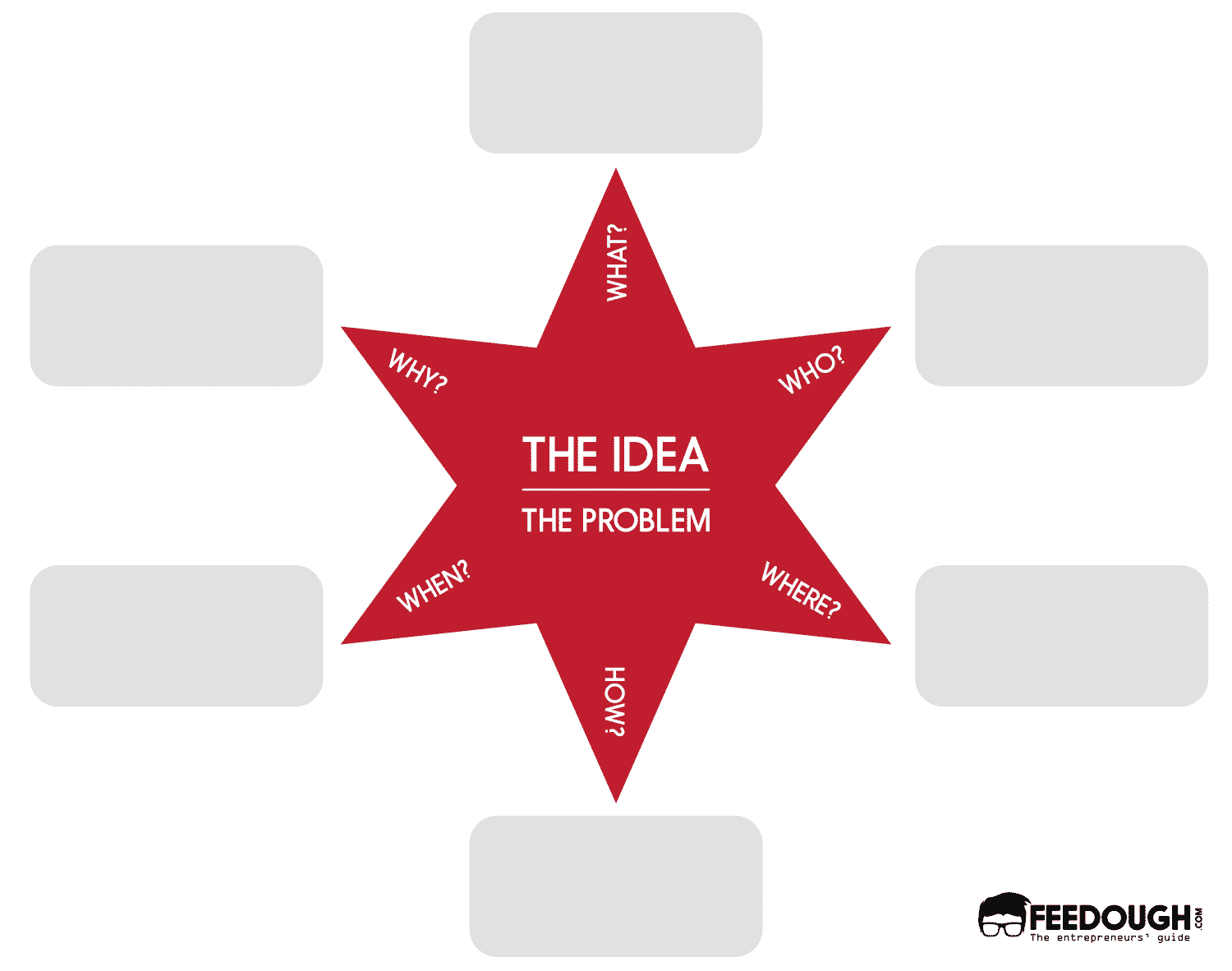
    starbursting brainstorming techniques

    The process involves thinking of as many questions as you can starting with these six. Once done, you might have your answer(or answers) with you.

    Rolestorming

    Rolestorming is an evolved version of brainstorming which involves participating members to be assigned different roles and making them see the problem through a different perspective. This brainstorming method was developed by Rick Griggs in 1985 to help the participants of a brainstorming sessions who feel inhibited to express themselves indiscriminately.

    This involves assigning everyone a role with certain characteristics, personality, strength, and weakness and making everyone to give their inputs to the discussion as per their role. This not only makes the otherwise embarrassed or not so willing contributors to contribute to the discussion but also opens the doors to creative ideas.

    It is easier to look into solutions from someone else’s perspective. Plus, rolestorming makes the participants see the other part of the story by being in other’s shoes. Rolestorming doesn’t target a person but a role and having a conversation in the first person gives the participant more confidence and ideas to defend his new role.

    Go On, Tell Us What You Think!

    Did we miss something?  Come on! Tell us what you think of this article on brainstorming techniques in the comments section.
  • What Is Microtargeting?

    What Is Microtargeting?

    What if I told you that you can target different customers and craft a personal campaign for each using predictive analytics and his/her demographic, psychographic, and other data?

    The internet has made it possible to track users’ activities, divide them into different segments according to their interests, demographics, psychographics, and target them with more appealing and convincing campaigns. This new phenomenon is microtargeting.

    What Is Microtargeting?

    Microtargeting (also called micro-niche targeting or micro-targeting or people-based targeting) is a marketing strategy that capitalises on the consumer’s demographic, psychographic, geographic, and behavioural data to predict his buying behaviour, interests, opinions, and influence that behaviour with the help of a hyper-targeted advertising strategy.

    Internet plays a great role in crafting and implementing microtargeting strategies. Facebook sells your data to advertisers in the form of demographics, interests, and likes, etc. Google Adwords uses the cookies generated from your website visits and other browsing data to target their clients’ advertisements to you. Other social media networks like Twitter, Instagram, and Snapchat, involve data selling strategies to earn revenue. All this data lead to hyper-targeted marketing strategies which direct personalised campaigns to your display screens.

    Objective Of Microtargeting

    Different customers have different opinions, interests, and different motivational triggers. The objective of microtargeting is to use this consumer data along with predictive analytics and design a more profitable holistic marketing campaign which is personalised for each consumer.

    Campaigns which are tailored as per the consumer’s interest are preferred over unrelated advertisements. It increases the consumer engagement, is more convincing, and result in better ROI.

    Do you prefer Arsenal or Barcelona? Cricket or Football? Marvel or DC? Do you prefer memes over informative videos? Are you on the side of Donald Trump or Obama? Do you live a healthy lifestyle or not?

    Most of your habits, opinions, preference and interests can be tapped using your internet browsing habits. The objective of microtargeting is to use this data to create the most convincing campaign for you to buy the product.

    Microtargeting Examples

    Advanced microtargeting was first used by the Republicans in 2004 US elections. Karl Rove, along with Blaise Hazelwood used microtargeting to target potential voters in 18 states which eventually led to their victory against George W Bush.

    Political microtargeting was again used in 2008 US elections by Obama’s team where they spent millions in technical support staff, data scientists, and database engineers and re-engineered the democratic voter database which consisted every information about the users based on their social network profile, online and offline behavioural patterns, interests, and other data. This data was used to develop a holistic marketing strategy not only to target people but the to devise the best way to target people.

    Everything from website design to social media ads and contests (like win a dinner with Obama) was targeted to the required target segment after being tested on test audience.

    The team even used microtargeting to make people convince their friends and family to vote for them.

    The same trend was followed in the recent US elections where Donald Trump spent $150 million on microtargeted Facebook and Instagram advertisements. He used this technique to suppress voters of Clinton.

    Go On, Tell Us What You Think!

    Did we miss something?  Come on! Tell us what you think of this article on microtargeting in the comment section.

  • The 7 Stages Of Restaurant Marketing

    The 7 Stages Of Restaurant Marketing

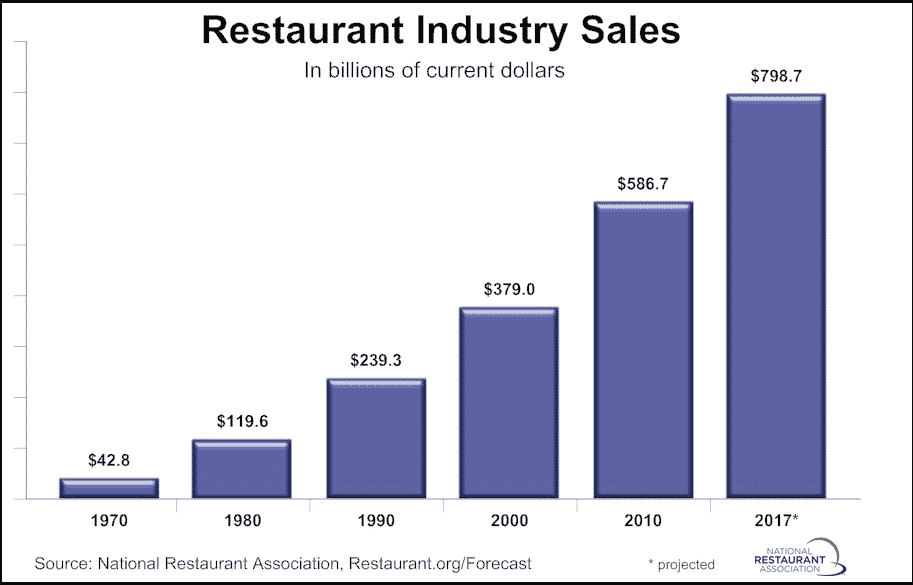
    The restaurant business is one of the fastest growing in the world. The US market records a sales figure of $799 Billion, which expands to trillions globally. It also employs 10% of the entire workforce in the US economy, underlining its growth’s significance. These figures seem unreal when viewed in light of the different additional factors that must be dealt with in the industry. The industry operates in a mix of goods and services, deals in perishable goods, has to endure the subjectivity of customers, has to bear heavy regulations (Varies tastes) and is heavily dependent on its supply chain. But these factors haven’t deterred players from entering the market.

    restaurant marketing
    source: restaurant.org

    The 7 Stages Of Restaurant Marketing

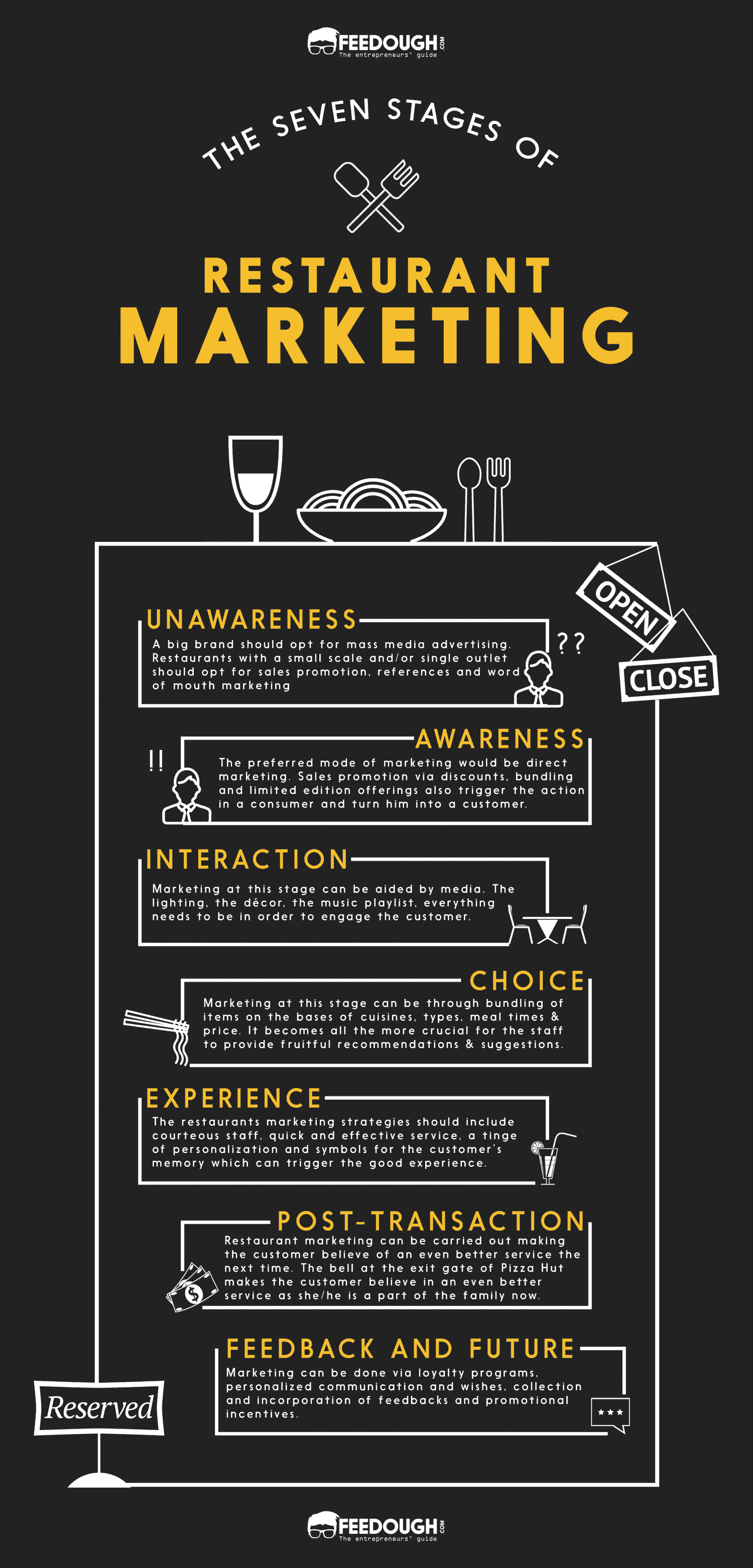
    On the outside, restaurant marketing might seem to be nothing but marketing the taste of the food. But in reality, it is much more intricate than that. There are certain stages that a consumer must pass through to finally become a restaurant customer, and restaurant marketing aids this movement.

    restaurant marketing

    Unaware and Unbiased consumer

    At this stage, the target market is neither aware of the restaurant and offerings nor has preconceived notions about it. At this stage, restaurants must undertake marketing processes to form as many positive impressions as possible. When the customer starts as a blank slate, the objective is to lay the foundation for the further steps and ensure smooth, consecutive transition

    Modes Of Restaurant Marketing At This Stage

    The modes of marketing used should depend on the objectives of the restaurant. A big brand should opt for mass media advertising which intrigues the consumer enough to try it out over its competitors and at any one of its locations. Restaurants with a small scale and/or single outlet has a limited geography to focus on. Therefore, they should opt for sales promotion, references and word-of-mouth marketing.

    Aware consumer

    Once the consumer is aware, they can be interested in the restaurant’s offering, not interested or be indifferent. The restaurant should focus more on converting the first and the third segments. They have to ensure that the interested consumer’s transition through the stages is quick and smooth and the indifferent consumer is converted to an interested one. It would require a greater proportion of resources to change the not-interested one and would only be viable with an established operation and a pool of potent feedback.

    Modes Of Restaurant Marketing At This Stage

    Direct marketing is the preferred mode of restaurant marketing at this stage. It would convince the customer to make the effort and try the restaurant’s offerings. Sales promotion via discounts, bundling, and limited edition offerings can also trigger a consumer’s action and turn her/him into a customer.

    Interaction

    This is the start of the person as a restaurant consumer. He visits the place and starts to gain information and form opinions about the restaurant. In this phase, the restaurant must market itself as a welcoming option that would accommodate the person’s expectations and tastes. As this process is ongoing, with many new customers interacting with the restaurant daily, the restaurant must always be on its toes and reduce customer attrition in the initial phase.

    Modes Of Restaurant Marketing At This Stage

    Marketing at this stage can be aided by media, which aids the restaurant in the process of information collection. The lighting, the décor, the music playlist, everything needs to be to engage the customer. Starbucks, for example, applied this mode of marketing by changing the shape of its table to circular. They noticed that quadrilateral tables formed corners occupied by customers, giving an individualistic vibe to the entering customers. Circular tables were perceived to be more open and welcoming, which appealed to the young college grads who eventually became a large chunk of Starbucks’ customer base. They devised this strategy to align with their objective of providing an unforgettable coffee-drinking experience.

    Choice

    At this phase, the focus shifts to the restaurant’s cuisine. The restaurant must present the customer with options that are in sync with the customer’s expectations and preferences. Restaurants also have to fulfil the offers that they had marketed in the initial phases with minimal glitches. This can be aided by a skilful waiter or cashier who can persuade the customer by recommending the restaurant’s preferred options.

    Modes Of Restaurant Marketing At This Stage

    Marketing at this stage can involve bundling items based on cuisines, types, meal times, and price. At this point, customers make their choices based on the limited information from the earlier phases, and therefore, it becomes all the more crucial for the staff to provide fruitful recommendations and suggestions.

    Transaction/Experience

    This is the stage when the consumer experiences the restaurant and its food. The information and opinions formed at this stage help her/him make decisions about any future engagements with the restaurant.

    Modes Of Restaurant Marketing At This Stage

    It is crucial to make this stage as memorable as possible, and therefore, the restaurant marketing strategies should include courteous staff, quick and effective service, a tinge of personalization and symbols for the customer’s memory, which can trigger a good experience. A barbeque joint in India Barbeque nation has extremely alert chefs who, along with cooking, visit tables regularly, taking real-time feedback that can be incorporated into the next serving. Customers feel as if there is a personal chef cooking just for them. The chef, along with the manager, forms a bond with the customer at this stage, which they will remember when choosing the next visit.

    Post- Transaction

    At this stage, the customers begin to process the information and share opinions amongst the group. This stage also needs to be smooth, as glitches post-meal, like bringing the wrong bill or haphazard table clearance, might ruin the whole experience.

    Modes Of Restaurant Marketing At This Stage

    Restaurant marketing can make the customer believe of an even better service the next time. Pizza Hut has a bell that customers can ring if they are happy with the service. This projects the outlet as one big family happy to serve you. This also makes the customer believe in an even better service as she/he is a part of the family now.

    Feedback and Future

    At this stage, the interaction is complete, and the restaurant must provide incentives for the customer to return and eventually be loyal. This is the stage where a new customer can be converted into a loyal one.

    Modes Of Restaurant Marketing At This Stage

    Marketing can be done via loyalty programs, personalized communication and wishes, collection and incorporation of feedback and promotional incentives.

  • Top 10 Metrics Every Product Manager Should Know & Track

    Top 10 Metrics Every Product Manager Should Know & Track

    How can a Product Manager ensure that his product stays ahead in a crowded market?

    How can a small, emerging business take on the biggies with its product?

    How to make the right use of all the data that every customer interaction generates?

    Product Management is becoming increasingly data-driven with every passing day. The role can be very challenging and data can help a Product Manager stay ahead of the competition. Numbers can make a lot of difference and make you look smarter too!

    But with so much data around you, how do you know what is useful and what needs to be chucked?

    Let’s find out.

    Here are the top 10 product metrics that Product ManagersProduct Managers should know and track:

    Customer Lifetime Value (LTV)

    As the name suggests, it is the estimated value generated by a customer over their lifetime, before they churn. It is the amount of net profit (revenue in some companies) that you can generate from a customer over his lifetime. You get this value by multiplying the average profit per month from a customer with the average lifetime of a customer in months.

    Customer Acquisition Cost (CAC)

    Every business needs to scale profitably and a Product Manager needs to understand how to do so. Acquiring customers is a big cost associated with every business. Customer Acquisition Cost or CAC is the estimated cost of getting one new customer. For example, if for every $1000 that you spend on a campaign, you get 10 customers then your CAC will be $100 for each customer. Understanding CAC is crucial if you want to focus on the sustainability of your product or business in the long run.

    Customer Conversion Rate

    The Customer Conversion Rate is a great metric to know how well you are doing to turn prospects into customers of your product. A small increase in the customer conversion rate can increase your revenues significantly. It is the percentage of prospects who end up converting to paid customers. It is measured by taking the number of new customers added a particular month and dividing that by the number of leads added during that month.

    Average Revenue Per User (ARPU)

    Average Revenue Per User or ARPU is the amount of money you get from a customer on an average every month. If your pricing remains constant and yet you are getting more ARPU with every passing month, it means what you and your team is doing to generate more value, is working. Better marketing and customer support can help in this regard.

    Churn Rate

    Churn Rate is the percentage of customers who stop using your product every month. To get the churn rate, you have to divide the number of customers lost in a month by the previous month’s total customers. It is a good indicator of product health and is absolutely critical for monthly subscription products. You cannot make your churn rate zero as no matter how good your product is, some customers will still leave. What you can definitely do is keep the churn rate healthy and continuously strive to make the product better to lower it.

    Monthly Recurring Revenue (MRR)

    Monthly Recurring Revenue or MRR means the revenue your product gets from the customers every month. It should include both New MRR and Add-on MRR. New MRR helps you get an idea of the revenue generated through new customers every month and Add-on MRR measures the revenue generated through add-ons such as additional product purchases. Add-on MRR is a good indicator of whether your customers find your product useful or not and if they are willing to increase their engagement with the product by investing more in it.

    Bounce Rate

    Bounce Rate is the percentage of visitors who land on a page but do nothing and leave. It is good for measuring the performance of specific landing pages.

    Dwell Time

    Dwell Time is the amount of time a user spends in a single session on average. Dwell time can indicate how engaging your content or product is. Digging deeper into this metric can help find many anomalies.

    Net Promoter Score (NPS)

    10 Metrics Every Product Manager Should Know & Track

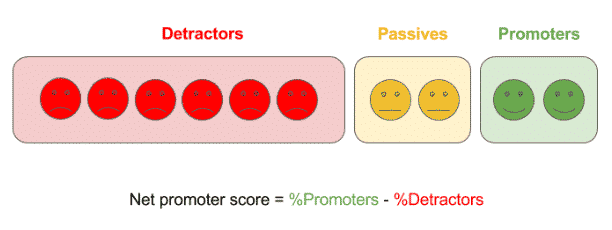
    For your product to grow, your customers need to become promoters. Net Promoter Score or NPS uses the question “How likely are you to recommend the product to someone” and asks the respondents to rate it on a scale of 1-10. Promoters are the ones who rate it in the range of 9-10 and detractors in the range of 1-6. Subtracting the percentage of detractors from that of the promoters gives you the NPS. It is to be noted that NPS is not a percentage but a whole number.

    NPS is a great indicator to know what your customers think of your product. Reviewing it monthly can help you know what you are doing right or what you need to improve. A low NPS can be a great motivator to get more feedback from your customers about your product.

    Organic v/s Paid Traffic

    Measuring traffic to your app or website from both organic and paid channels is necessary to understand how your product is growing. It helps you make better decisions about your marketing campaigns.

    Having mentioned these metrics does not mean other metrics are not important. Some might be even more important depending on the type of business you are in, for example, Cost per Thousand Impressions (CPM) in advertising or Average Order Value (AOV) in e-commerce. Metrics are an extremely important part of a Product Manager’s life. Once you become comfortable dealing with them, it will become much easier to apply the insights derived from them for the betterment of your business in terms of making product decisions, spotting future trends and evolving your product roadmap vis-à-vis the competition.

    Go On, Tell Us What You Think!

    Did we miss something?  Come on! Tell us what you think about our article on Top 10 Metrics Every Product Manager Should Know & Track in the comments section.
  • Target Market – Definition, Examples, Strategies, & Analysis

    Target Market – Definition, Examples, Strategies, & Analysis

    The demand for your product depends on the needs, wants, and luxuries of your customers. These needs, demands, and luxuries are different for different customer segments. In order to be profitable, it is always advisable to segment these customers according to their demographics, psychographics, geographics, and behaviour and direct all or most of your marketing efforts to the most profitable segment.

    What Is A Target Market?

    Target market refers to a specific and well-defined consumer segment within the business’s serviceable market which the business wants to sell its products and services and direct its marketing efforts to.

    Defining a specific target market eases the marketing decision making the process as marketers get to know about the most profitable set of customers and use most of their efforts and resources to woo them.

    How To Define Your Target Market?

    The shotgun approach rarely works. Given the current level of competition and limitation of resources, it is not viable to target everyone in the market and wait for the people to like your product.

    Target marketing makes it easier for small companies to compete with large established companies, innovators to disrupt the market, and startups and other companies to get an advantage over their competitors.

    You can follow the following steps to define a target market for your business.

    • Segment The Market: Segment your business’s serviceable market according to their demographics, geographics, psychographics, and behavioural patterns.
    • Identify Your USP: Your unique selling proposition is what differentiates you from the competitors. It is why the customers will prefer your product over others.
    • Analyze Your Customer Base: If you’re already in business, the best way to define your target market is to collect your customer data and to analyse it.
    • Analyze Your Competitors’ Customer Base: Analyse your competitors’ customer base: Who they target through their marketing efforts? Where do they sell their products?
      You can either select a similar target market or choose a slightly different segment.
    • Release An MVP: Releasing an MVP is a great practice to validate your assumptions about the target market. It is the most minimal, yet a viable product released to a few target customers to get as much feedback as possible.

    Target Market Examples

    Specifying a target market for your business is an essential step to remain viable. Trying to sell a hamburger to vegetarians will only lead to wastage of time, effort, and money and a poor brand image.

    The industry giants dominate the market because they succeed in serving the right product and service to the right person. Here are some target market examples:

    Target Market Of Facebook

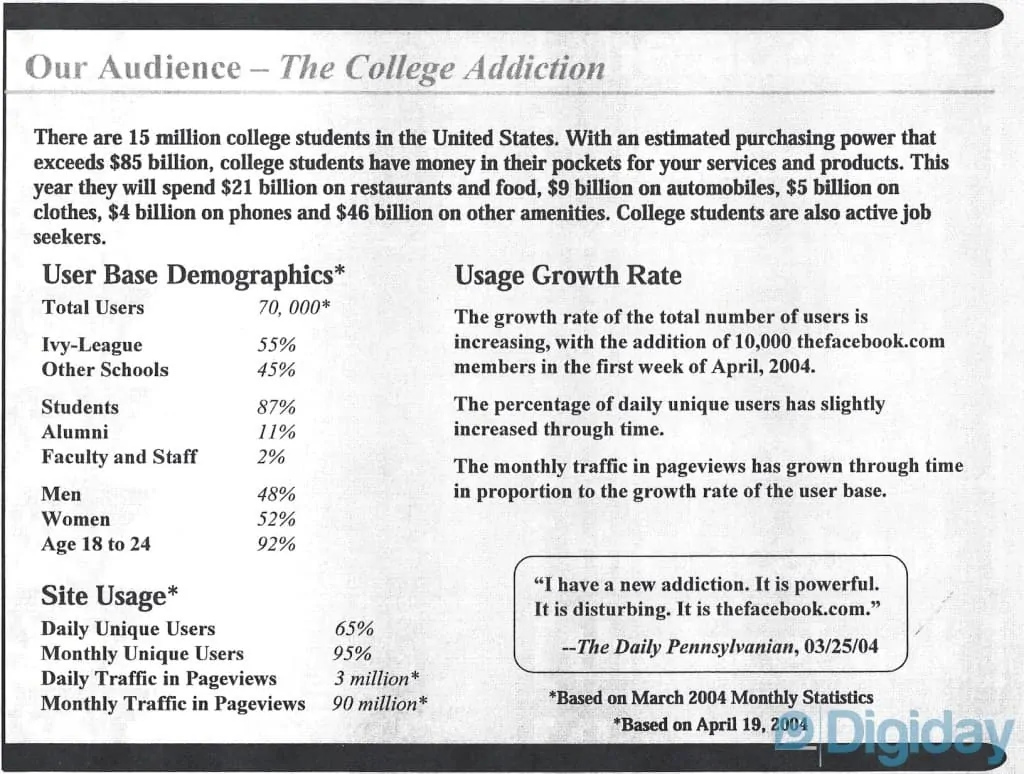
    The target market of Facebook has evolved along with the company. The founders targeted the college students of the United States in its initial years, which can be seen in its pitch deck too.

    facebook target market

    Facebook has now widened its target market and has positioned itself as a social media platform used mostly by middle-aged (25-34 years) mobile using adults in 157 countries.

    Target Market Of Snapchat

    More than 178 million users below the age of 25 (18-24), most of which are still in high school and college, preferably females, form the target market of Snapchat.

    Target Market Of McDonald’s

    McDonald’s targets students, employees, and professionals in the age group of 8 to 45 years belonging to low & middle-income groups and having an easy-going and careless personality.

    Target Market Analysis

    The target market analysis starts with yourself. You have to focus on the 5 W’s of your potential customers to select the most beneficial target market for your business.

    • Who: Start with questioning yourself about who is going to buy your product. Are they children, teens, millennials, or baby boomers? Are they males or females? Are they service classed or self-employed? What’s their yearly income?
    • What: What type of products and services do they buy now and what do they expect from it? Does your product fits their requirements?
    • When: When do they buy the product? Is it daily or rarely? When do they use the product?
    • Where: Where do they live? Where do they use the product?
    • Why: Do they buy it because it’s their need, or is it a luxury product for them?

    Once analysed, you can differentiate the profitable segment from the non-profitable ones. Once you’ve segmented the market select the perfect market segment for your business if it fulfils the following characteristics.

    • Big Enough: Is the market segment big enough to make you profits in the present as well as in the future?
    • It is still growing: A big market today can be a dead market tomorrow. Always analyze the growth statistics before moving ahead and choosing the segment as your target market.
    • Not Many Competitors: Having some competitors might be beneficial for your company. But having a market full of existing established players isn’t a good market till the time you have an exceptionally well product to position yourself differently.
    • Your Product Can Fulfill Their Need/Want/Luxury:  Does your product has all that it takes to fulfil the needs of your target customers?  

    Target Market Strategies

    A marketer can select a single market or many markets to target its efforts to. The target market strategies can be divided into three types depending upon the number of target markets.

    Multisegment Marketing

    Multisegment marketing refers to the practice of targeting more than one market segment. Some companies market the same product to different segments differently, while some manufacture different product lines to cater to different market segments.

    For example, selling auto parts to auto manufacturers and other finished products to the end-user is a multisegment marketing strategy.

    Concentrated Marketing

    Concentrated marketing refers to the practice of directing every marketing effort to a single segment of the market. For example, selling auto parts only to auto manufacturers is a concentrated marketing strategy.

    Microtargeting

    Microtargeting is a relatively new targeting strategy which involves isolation of the markets and collection of as much data as possible to target them in a personalized way. This strategy was used in the recent U.S. presidential elections.

    Target Market vs Target Audience

    Target market and target audience are similar terms which are used to denote market segments which the business wants to target to, but both the terms have different practical implications.

    While target market refers to a specific and well-defined consumer segment within the business’s serviceable market which the business wants to sell its products and services and direct its marketing efforts to, the target audience is a more narrower term and refers to the specific and well-defined segment targeted by the advertisements of the product.

    Go On, Tell Us What You Think!

    Did we miss something?  Come on! Tell us what you think of this article on the target market in the comment section.

  • Can You Patent Your Business Idea?

    Can You Patent Your Business Idea?

    Getting a great business idea is difficult, but protecting it from being copied is a bigger challenge. But can you patent your business idea to protect it?

    A patent is a right granted to an inventor by the federal government to have exclusive rights to use or license his invention for a limited time.

    Being an exclusive right to use or own the product, service etc, patents prove to be very useful when it comes to protecting your business. But can you patent your startup idea before making it public or before mentioning it to the investors or other prospective partners?

    Only Inventions Can Be Patented

    There is a difference between an idea and an invention.

    An idea is an unproven concept, thought, or opinion which is a result of your imagination. It is usually theoretical in nature and doesn’t have a definition, substance, attributes, functionality, characteristics etc.

    An invention is the result of an idea which is practical in nature (at least on papers), is in the form of a device, a process, or a composition, and has a definition, functionality, attributes, etc.

    Can you patent an idea? No.

    Can you patent an invention? Yes.

    Here’s an example to further explain the difference. Suppose you have an idea of a machine that can teleport people from one place to another. You can’t patent this idea of such a machine until you have built such a machine or have proof that such a machine can be built.

    What All Can Be Patented?

    So you want to patent your startup idea and you’re still wondering what all can you patent. Let’s dive into the types of patents to find the answer.

    • Utility Patents: These patents protect the utility or functional aspects of an invention which includes cover machines, processes, methods, compositions and anything manufactured that has a useful and specific function. These patents last for 20 years.
    • Design Patents: The design patents protect the appearance, design, shape or general ornamentation of an invention. These last for 14 years.
    • Plant Patents: Plant patents are granted to the discovery or invention of plants that are asexually reproduced

    This means you can patent your product, business model, production process, business method, product composition, design, appearance, shape, ornamentation or any other utility of functional aspect of your business if it clears the patentability test.

    What Is The Patentability Test?

    Filing a patent is not an easy job and not every application is accepted by the patent governing body of your country (like the USPTO in the USA). U.S. law requires the invention to pass a three-tiered test in order to receive a patent. The test examines the utility, novelty, and non-obviousness of the invention.

    • Utility Test: This test decides whether the invention is or will prove to be useful in the real world. An invention which isn’t useful doesn’t receive a patent.
    • Novelty Test: This tests the innovation and newness of the invention and compares it with every similar invention created in the past.
    • Non-Obviousness Test: This is the most difficult test among the three patentability tests. The invention is compared with the previous similar inventions and the patent is granted only if the differences found are not obvious to a person with skill in the relevant field.

    Do You Need A Prototype To File A patent?

    The patent laws vary for different countries but most countries do not require you to have a prototype in order to apply for a patent. All that is required is that you be able to describe the invention in a way that others can understand, make, and use it. A patent can be filed with just the description, explanation, specifications and drawings of the invention.

    Do You Really Need To Patent Your Business Idea?

    There’s no doubt that protecting your business idea from being copied should be one of your top priorities. Nevertheless, there are many other ways to protect your idea than filing a patent. Besides being a very long process, a patent also costs you a lot of money which you may not afford to spend.

    Furthermore, you can always make use of other legal and protection strategies to protect your business idea like:

    • Copyright: You can always copyright your software, book, guide or other literary, dramatic, musical, and artistic works.
    • Trade Secret: Coca-Cola hasn’t patented its taste formula, still no one actually knows the exact formula. This strategy is called a trade secret where you don’t disclose everything about your business to anyone.
    • Non-Disclosure & Non-Compete Agreements: These agreements stop the other party from disclosing your secret or using your secret for their own profit within the specified radius.

    Go On, Tell Us What You Think!

    Did we miss something?  Come on! Tell us what you think of this article on Can You Patent Your Business Idea? in the comment section.

  • What Is A Unicorn Startup Company?

    What Is A Unicorn Startup Company?

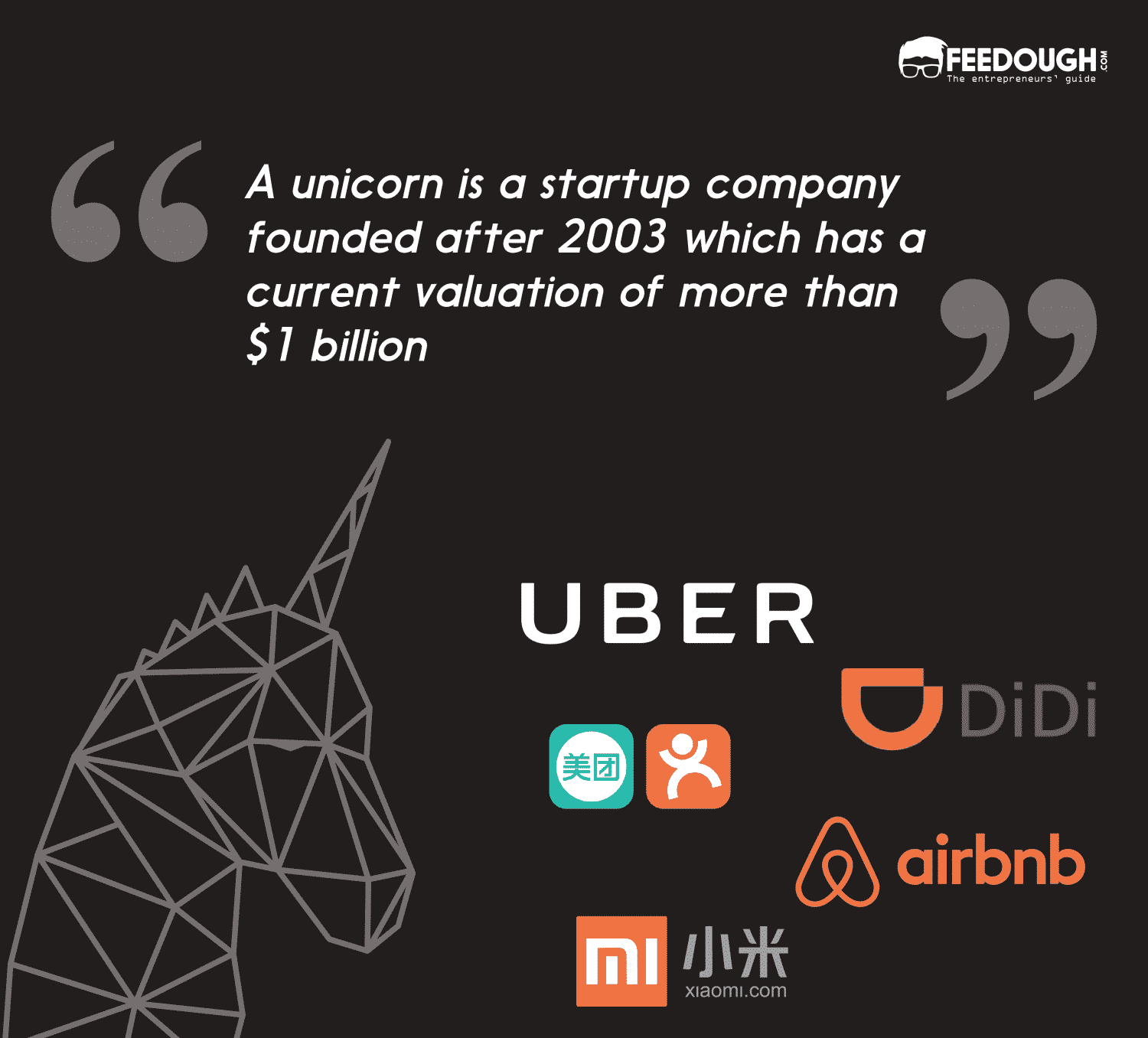
    We always talk about unicorns like Uber, Airbnb, Snap, Didi, Pinterest etc, but little do we discuss what unicorn actually means. Why are some startups given such a title? Is this title given only to the startups belonging to a specific niche? What is decacorn?

    Here’s an answer to all of your FAQs about unicorn startup companies.

    What Is A Unicorn Company?

    A unicorn is a startup company founded after 2003 which has a current valuation of more than $1 billion.

    The term unicorn was coined in the year 2013 by the founder of Cowboy Ventures, Aileen Lee, when she referred to the 39 startups that had a valuation of more than $1 billion as unicorns. The term was used to put an emphasis on the rarity of such startups.

    The definition of a unicorn startup has remained the same since then. However, the number of unicorns has increased manifold.

    UNICORN STARTUP COMPANY

    How Many Unicorns Are There In The World?

    According to a report by CBInsights, there are a total of 551 unicorns in the world, the top 5 being:

    • Bytedance, with a valuation of $140 billion,
    • SpaceX, with a valuation of $74 billion,
    • Didi Chuxing, with a valuation of $62 billion,
    • Stripe, with a valuation of $36 billion, and
    • UiPath, with a valuation of $35 billion.

    Characteristics of Unicorn Companies

    On average, around 4 unicorns are born every year. But what makes them different from other startups?

    Disruptive Innovation: Nearly all of the unicorn startups have disrupted the industry they belong to. Uber changed the way people book cabs, Airbnb capitalized on the sharing economy, Snapchat disrupted the social networking sphere, etc.

    First Mover’s Advantage: Disruption and the first mover’s advantage go hand in hand. Unicorns not only capitalize on the first mover’s advantage but maintain their positioning by constantly innovating and improving.

    Technology Paradigm Shift Capitalization: 87% of the unicorn products are software, 7% are hardware, and the rest 6 percent are other products and services. Almost all of the unicorns till now have capitalised on the market undergoing a technology paradigm shift. Uber brought taxi booking on the tap of a phone, Airbnb made sharing possible over the internet, Dropbox capitalized on cloud-based technology, etc.

    Consumer-Focused: 62% of the unicorns are B2C and their business models are focused on making things easier and affordable for the consumers. Spotify makes it easier to listen to the music of the world, Instacart lets you order groceries with a tap of an app, etc.

    Private Companies: Most of the unicorns are privately held companies that get their valuation when a bigger company acquires it or invest in it.

    Is The Term Unicorn Limited To Tech Startups?

    There are hundreds of unicorns in the world operating in the on-demand, sharing, eCommerce, retail, and 100s of other sectors. Even though most of them are tech startups, the term unicorn is not limited only to tech.

    Unicorn vs. Narwhal

    The term narwhal was coined by the CEO of Garibaldi Capital Advisors, Brent Holliday. The term exclusively refers to a Canadian based unicorn. That is, a Canadian startup company that has a valuation of more than 1 billion is called a narwhal. HootSuite, Kik, Shopify, Wattpad, etc. are a few examples of Narwhal companies.

    What Is A Decacorn (Super Unicorn)?

    A unicorn that crosses the valuation of $10 billion is called a decacorn or a super unicorn. Uber, Dropbox, Snap, SpaceX, WeWork, etc. are some famous Decacorns.

    Go On, Tell Us What You Think!

    Did we miss something?  Come on! Tell us what you think of this article on Unicorn startup company in the comments section.

  • What Is Retail Marketing? – Functions, Importance, Strategies

    What Is Retail Marketing? – Functions, Importance, Strategies

    Let’s gather some data. Wear some comfortable clothes and go for research to your nearest supermarket store. Don’t forget to carry your notepad and pen.

    Your job? To note everything about the demographics of customers visiting each section, about what all is kept at the eye-level of the customers and what’s above or below, what all did they check before putting the product in the basket or before putting it back, why did they choose the specific product, and what is kept in front of the entrance and at the billing counter. Also note the price, quantity, discounts, and in-store advertisements of the branded and the store-owned products.

    Oh, by the way, did you get a welcome greeting while entering and exiting the store?

    Everything we just talked about forms a small proportion of the big retail marketing strategies of the retailers.

    What Is Retail Marketing?

    Retail marketing refers to the range of activities undertaken in the retail store by the retailers as well as the brand to promote the products to the customers in order to generate awareness, interest, and sales.

    In simple words, everything from the interior and exterior of the retail store, to in-store advertisements, product placements, offers and promotions, and the behaviour of store representatives comes under retail marketing.

    Retail Marketing Examples

    Ikea is often cited as the best example of implementing great retail marketing strategies. The company designs its stores as mazes to stop shoppers to leave the store and end up buying more.

    Another example of smart retail marketing is Aldi which focuses on operating small stores, stocking up store-owned brands, using in-store offers 24x7x365, and stocking up products in their original shipping containers.

    Retail Marketing Strategies

    Different retail marketing strategies can be planned and employed for different types of retail outlets. The elements which should be considered while crafting a retail marketing strategy are:

    Target Market: The market segment which the retail outlet caters to.

    Retail Format: It’s the retail mix of the retailer and the type of the store (ownership-based, franchise-based, discount-store, etc.)

    Sustainable Competitive Advantage: An advantage over the competitors.

    The main objective of the retail marketing strategy is to differentiate the retail store from the competition by setting up and promoting a sustainable competitive advantage which leads to increased sales.

    The contours of the retail marketing strategy include:

    Retail Branding

    Setting up a good brand name, logo, and positioning of the retail store is among the topmost priorities of a retail marketer. Customers are more motivated to buy a product from a branded retail store than an unbranded one.

    Price Drops

    A great way to attract customers is to provide the same quality (and quantity) of goods at a lesser price than the competition.

    Limited Period Discounts & Offers

    Limited period discounts and offers increase the sales temporarily and can help in word of mouth marketing and getting more customers (and returning customers).

    Strategic Placements

    Strategically placing items to where the customers are most likely to buy them is a great strategy to increase the sales. A perfect example is the placement of small inexpensive products (also called parasites) at the billing counter.

    Strategic Store Design

    The store design is the first touchpoint for the customers. The store designed for the people it serves to performs better than the one which isn’t. A colourful and kids-friendly products placement suits a toyshop while classy look and colours suit a store selling men’s suits.

    Visual Merchandising

    The better it looks in the store, the more chances are that the customer will buy it. Smart visual merchandising strategies help increase sales substantially.

    Loyalty Programs

    Loyalty programs are designed for better company-customer relationships. These programs involve exclusive discounts and offers for regular customers.

    Strategic In-Store Advertisements

    People often prefer the advertised brand over the non-advertised brand in the store. Strategic placements of such advertisements can substantially increase the sale of a specific brand or a product.

    Training Employees To Be Smarter

    Retail store employees play a very important role in the decision-making process of customers. They can make or break a product decision of the customer with the help of their relationship and selling skills.

    Retail Marketing Importance

    The traditional dependency of retailers on manufacturers has been reversed. Today’s retailers have their own brand, their own loyal customers, and even have the power to sell, to upsell, to cross-sell, or to downsell any product using smart retail marketing strategies.

    Smart retail marketing strategies help the retailers enhance the customer’s journey in a retail store and make him perceive that his money is spent on the right products.

    • A good retail shopping experience motivates the customers to buy a product even when they have no intention to do so.
    • Shopping from a branded retail store generates a feeling of satisfaction and confidence among the customers.
    • Strategic placements and strategic store design improves the customer’s experience and help the retailers sell the products which provide them with the most profits.
    • Purchasing during limited period offers make the customers feel they have achieved a great feat by saving money.

    Retail Marketing: The Changing Scenario

    The retail industry is not the same as it was 20 years ago. There is an increase in the disposable income of the customers, their lifestyle has improved, and the intervention of the internet in commerce has caused much instability in the retail sector. Even the venture capitalists now prefer startups with the eCommerce business model than business models involving traditional distribution networks.

    This has put much pressure on the marketers and retailers to increase sales in the retail stores, which eventually has led to more focus on the customer experience. Strategies are formed to improve the relationships with the customers and to make their stay in the store as hassle-free as possible.

    Walmart takes its slogan “satisfaction guaranteed” very seriously. The company trains its employees to greet customers, and assist them with their problem-solving attitude.

    Aldi has a very impressive barcode strategy where it prints 6 barcodes on the products to scan it as soon as possible and make the customers wait for as less time as possible.

    Target, the second-largest discount-retail store, started a 16,000-square-foot holiday pop-up store called Target Wonderland in December 2015.

    Retail brands now focus more on neuromarketing strategies like the more focus on retailtainment, call to action promotions, and eye-level positioning strategies along with the pricing and convenience strategies to enhance customer relationships and to increase their sales.

    Go On, Tell Us What You Think!

    Did we miss something?  Come on! Tell us what you think of this article on Retail Marketing in the comment section.

  • What Is Disruptive Innovation?

    What Is Disruptive Innovation?

    Uber. A company that turned the industry upside down with the model that they had to offer. The taxi industry was never the same again.

    You see the disruption to tradition here?

    What Is Disruptive Innovation?

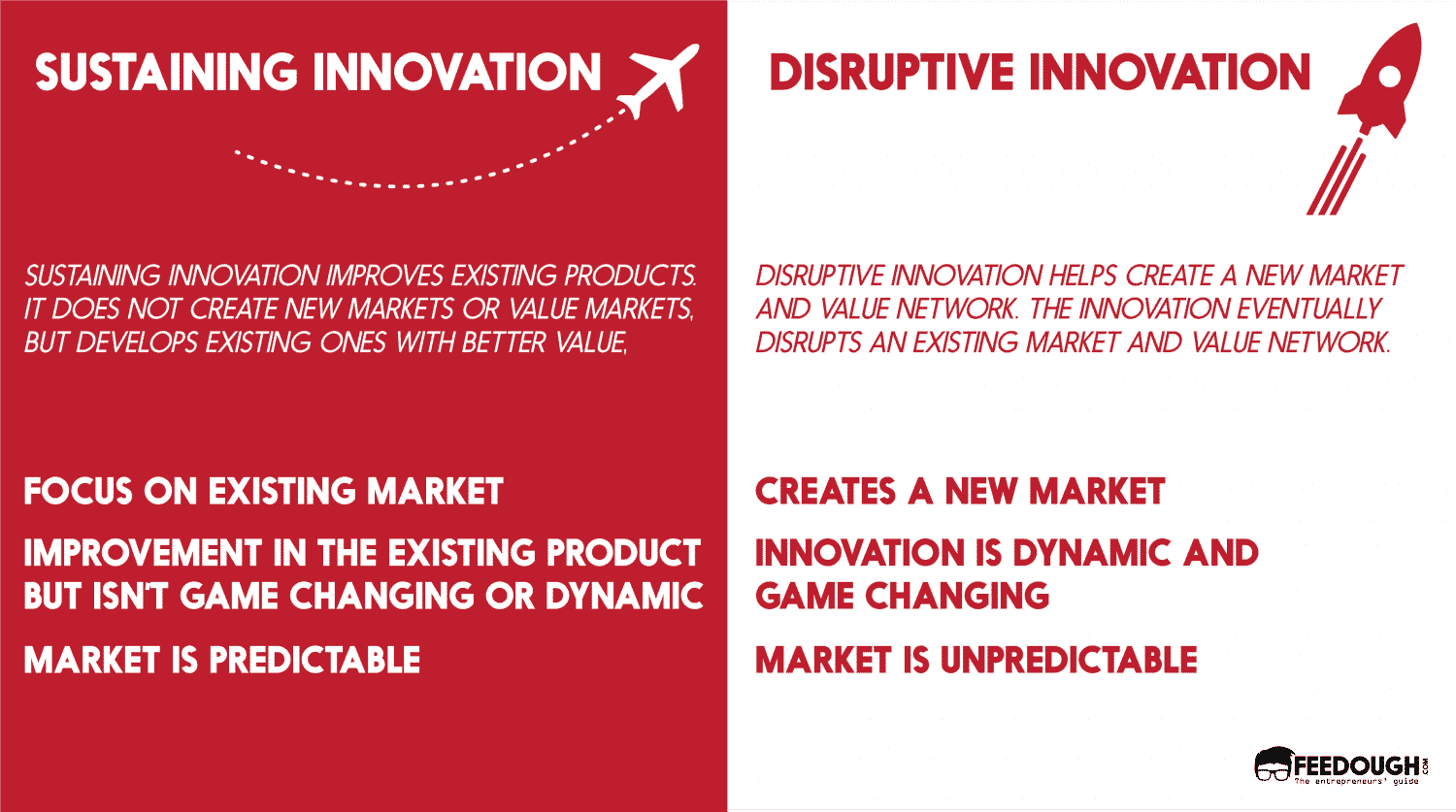
    Disruptive innovation refers to an innovation which caters to an untapped or unserved market segment and creates its own market and value network which eventually disregard the established competitors and redefines the face of the sector it operates in.

    Usually, the conditions which give rise to disruptive innovation are –

    • Untapped target segment or unserved demand of the customers
    • Few resources
    • Operational/vascular inefficiencies of the established players

    Conventionally, traditional players of the market focus on improving their existing products and services for their revenue concentration points by exceeding the needs of some segments and ignoring the others. Entrants with innovation, that prove disruptive in the long run, embark their journey by targeting the parts of the business that are still unseen, untouched and untapped, gaining a grip by offering services or products that aren’t expected from the traditional. Incumbents lose their edge, because of their failure to respond to the dynamic market.

    Simplifying Disruption

    Let’s make it simple.

    Netflix, the world’s most premium instant video streaming business.

    Classic disruption to industry, bringing a revolution into video content streaming market. The novel DVD-by-mail model shut the video rental business on its face and let a new format prosper. As an outsider, Netflix was able to see that the DVD business came along with its own hives of stagnation and challenges to piracy regulations. Consequently, Netflix created a business that offered affordability, accessibility and availability to extremely disloyal customers.

    I don’t have to be predictable about coming up with an utter “out of the box” idea. I can innovate with how to innovate. Get it?!?

    Low-End Disruption & New-Market Disruption

    Low-end disruption encompasses ventures that occupy the base of the market pyramid and provide “satisfactory” services. This segment turns out to be a mediocre profit zone for the conventional businesses and thus, when any of the new businesses introduce themselves, the incumbents move further “upward.” In other words, they channelize their operational energies towards the relatively high risk and hence higher profit zones.

    New-market disruption is about businesses that pose competition against novel products with respect to consumption in those sectors of the market that occupy lower wallet share by virtue of their demand. On the same lines as low-end disruption, the products offered here are “satisfactory” and the surfacing business turns out to be profitable at these reasonable rates.

    The main fact that distinguishes between these types of disruption falls within the fact that the former focuses on well-nurtured customers and latter sticks to potential customers.

    Remember the old Blackberry phones?

    1984 to 2007, the time when Blackberry was reigning in the market with their popular launches of innovative products and services. We can see predictable inferences from the adaptive cycle of Blackberry.

    Research In Motion’s secure data connection networks where exhausted and preserved, making the company the steering of the market in enterprise communication. Soon, the technology was floated and through innovation and restructuring, the product portfolio significantly revamped, even new products were launched like the Pager and consumer-centric products like the BBM messenger service. This kind of responsive attitude to the nuances of the product and the market made them an immensely valued organisation in 2007.

    Soon, we saw the tables turn. Apple Inc and the iPhone.

    In 2007, Apple introduced the iPhone, which Apple claims to have ‘redefined the phone’. This reinvention of an existing service as well as the product was a well-thought strategy, prepared immensely from the success of their immediate competition, who were also the largest player by way of their innovation.

    Once you witnessed this introduction of the iPhone, domino’s adaption misalignment occurred for Research In Motion’s Blackberry. I can generalise the situation here, where a business stumbles in one or more phase behind from their counterparts in terms of adapting to dynamic market conditions in the domain of pioneering innovative propositions. One of the prevalent arguments is that, in a situation of pioneers and innovation, domino’s adaption misalignment causes a company to stay one step behind the immediate competition and therefore miss out on opportunities owing to first mover’s advantage, losing on market dynamics at large.

    Perhaps that is why, nobody couldn’t spot Blackberry being wiped out of the market in a jiffy, just like the classic Nokia phones. All this happened because Apple redefined the innovation for a smartphone and all of the participants in the market either had to align or get kicked out. Because none could innovate past the innovation that decided the market’s fate for a considerably long time.

    Sustaining Innovation vs Disruptive Innovation

    sustaining innovation vs disruptive innovation

    Incumbent existing players may be developing only variations of existing popular products, only to stay in the game. No business can sell on the proposition of avoiding to innovate. Hence nitpicking on own or competitor’s product, sometimes, becomes the only innovation that some businesses offer. This is sustaining innovation.

    Breakout offerings are like fads, those that significantly up the game within an existing field of players and product. Remember the sleek Motorola Razr? With its significantly contemporary challenging design, it was a smashing success for Motorola’s business and image. Consumers couldn’t help but want it, redefining the existing data and understanding of market preferences. It became the most-selling line of clamshell phones overnight. Having said that, it faded only sooner because of the uproar only for the design.

    More than often, you work on a disruptive innovation that gets stuck down in a system that is developed around the idea of the creation of sustainable offerings. The success of any innovative project boils down to depend relatively less on the quality of the idea and somehow more on the quality of the packaging of the idea. Blasting projects exemplify the significance of establishing different parameters and procedures in advance of each undertaking so that the organization knows the benchmarks it’s aiming for and can customize their packaging accordingly.

    For disruptively innovative endeavours, gains typically require different R&D processes, relatively cumbersome funding procedure and varying performance expectations, that shall defy data in consideration.

    Risk and Reward look you into the eye. What do you do?

    Embrace them.

    By personalizing the business development procedure for any potential innovation that the organization can spot, a business can provide itself with the opportunity to generate new product revenues while simultaneously exploiting future opportunities. To justify that aim, the business should categorize its new portfolio related concepts into classes from among sustaining, breakout, or disruptive. Embracing risk and reward becomes easy here.

    You may seek to attain a healthy equilibrium of all three, so as to meet the needs of today and tomorrow. Your counterparts may be able to focus their innovation energies towards prioritizing the development of breakout fads and consciously minimizing disruptive opportunities.

    Categorizing innovations can be an effective way to arrive at the right balance of risk and reward, for that is the sole purpose of you chasing the innovative opportunity: hold the death of the market in your hand and strangle it to life of a new market.

    Disruptive Innovation Examples

    Let’s start with the retail industry. Is Aldi a result of disruptive innovation?

    Ever since the company opened its first store in 1961, its prime focus was the low cost of the goods. The company ditched big brands, focused on local sourcing, implementing thrifty practices and disrupted the existing industry by becoming the first discounter in the world.

    Coming to the modern day disruption brought by the blockchain technology. Spotify has started using blockchain to improve its payment algorithm, Russia has launched its own national cryptocurrency – Cryptorouble, Startups now prefer conducting an ICO over an IPO. And these are just 3 out of the million disruptive ideas brought in by the blockchain technology.

    Go On, Tell Us What You Think!

    Did we miss something?  Come on! Tell us what you think of this article on Disruptive Innovation in the comment section.

  • Transitioning Into Product Management From Other Roles

    Transitioning Into Product Management From Other Roles

    Have you been feeling stuck in your role for some time now without getting the opportunity to have any significant business impact?

    Do you think you have the right skills to be own a product or a product portfolio and yet have no clue how to get there?

    If any of these questions are bothering you, you might want to switch to Product Management.

    But how do you make the switch to Product Management without a degree in engineering or business?

    Product Managers come from all walks of life. Some come from a technical background, some don’t. The thing is this role varies a lot in the industry and there are certain aspects of this role which makes it unique in different companies. Many companies prefer that Product Managers have some amount of technical experience along with a sound understanding of business. Even if you do not have these, with the internet at your disposal, you can learn everything that is needed to do well in this role.

    Here we try to provide a beginner’s guide for anyone looking to transition into Product Management from their current role.

    Business Analyst

    Many Product Managers make the move from Business Analyst roles. The similarity lies in the fact that both the roles are heavily focused on customer requirements. Both need to have a thorough understanding of the market in which they operate. But unlike a Business Analyst, a Product Manager is responsible for the entire product and its roadmap. A Business Analyst takes the direction that he is given whereas a Product Manager decides that direction in the first place. Many positions open up every year in various companies for entry-level Product Managers that accept applications from Business Analysts. For many analysts, Product Management becomes intuitively the next logical step in their career.

    UX Designer

    Product Management is a logical move for many User Experience (UX) professionals as it needs similar skills and traits. After all, the focus of UX lies in understanding the needs of the users and translating those needs to a simple, intuitive and useful product. Those UX professionals who think they need to have a greater impact on the products they help develop, look forward to moving to Product Management.

    While both the roles might seem very similar from a distance, they differ in terms of responsibility, reliance and focus. Product Managers are held accountable for the product’s success, while UX designers are only responsible for the interface and usability. The focus of Product Management is much broader too, taking everything, from market feedback to competition to profit and loss, into account. Product Management also requires a lot of reliance on different teams other than UX such as sales, engineering, marketing etc. to ensure the product’s success.

    Transitioning from UX to Product Management directly translates to needing to know about every aspect of the product and the different departments responsible for the product and handling many additional responsibilities such as defining the vision and strategy of the product, product marketing, product leadership etc.

    Project Manager

    We have already written on how similar the roles of Project Manager and Product Manager sound to most people and yet how different they are.

    So, is it possible then for a Project Manager to move to a role that focuses more on the product?

    Well, yes!

    I mean, why not?

    While there might be some skills which are transferable from one role to the other, the most successful candidates in these roles bring different traits to the table. A Product Manager has to manage the concept, design, delivery, launch etc. of the product, thus they have to do a lot of long-term planning and a lot of user interaction. On the other hand, Project Managers have to worry only about a particular part of the product life-cycle for which they are responsible. They are more worried about day-to-day tasks and associated costs. They are not there for the long haul.

    Thus the transition from Project Management to Product Management requires a complete change of outlook and inculcating at least some basic sense of interaction design. The thinking has to become much more long-term since most products do not have any fixed ending unlike projects. It also means no hopping from one project to another. The focus on marketing and user experience has to become much stronger. If a Project Manager has not had that experience or is uncomfortable in these areas, then the transition might not be right.

    Engineer

    Most Product Managers are erstwhile engineers. Their background in technology often helps them become great Product Managers. But that is only a small part of what it takes to be an amazing Product Manager. After all, there exist great Product Managers who have a liberal arts background too. Product Management is a great next step for any engineer who wants to make a greater business impact.

    If you are an engineer but you are not in Computer Science or are not an active Software Developer, the simplest way to transition into Product Management would be to undertake an MBA program. It is the best way to show your business acumen. Ex-entrepreneurs are also given preference over others for this role, as a Product Manager’s role is that of leadership within a business. A Product Manager needs the 360° perspective of a business that these options can provide to an engineer who has only been exposed to technology till now, as a Product Manager needs to think of the business impact of the product more than its technical impact.

    Sales Specialist/Consultant

    Transitioning from Sales to Product Management can be tricky. One of the biggest strengths of good Product Managers is that they can talk to different teams in their own language. They will talk design with the UX/UI team, engineering with the tech team, brand management with the marketing folks and so on. If you are in Sales, you already know the Sales and Marketing side of things. What you need to do is to start understanding technology and design in a deeper sense and be able to communicate with the respective teams better.

    Being in Sales also gives you lots of customer contact. You should use that to empathise with the customer and bring out those features in the product that addresses the needs of the customers in the most cost-effective manner. A Sales guy can be the true voice of the customer.

    Other Roles

    A good way to improve your candidacy for a Product Management position would be to get an MBA. If that is not what you want from life, you can start a side project. A side project can help you get the relevant experience needed to excel at Product Management, from shipping a product to improving your technical and design skills. You can improve your technical skills by building a website or app. You can research about various ideas that would solve potential user pain points and test their feasibility. You can start building even paper prototypes. You should network with as many Product Managers as possible to understand their job and see if positions are available in their respective companies. You can start solving business cases and try to understand how the vision for a product is developed or even to improve your problem-solving process. You should familiarise yourself with the most common Product Development methodologies.

    Good product sense takes time to develop. If one keeps on reading and learning about how great products came into existence, the knowledge will start showing in the interviews too. If you are really passionate about building great products, you should be able to show that passion. Transitioning into Product Management will not seem like a big issue then.

    Go On, Tell Us What You Think!

    Did we miss something?  Come on! Tell us what you think of this article on Transitioning Into Product Management From Other Roles in the comments section.