Feedough Logo

Blog

  • What Is An Operating Model?

    What Is An Operating Model?

    A business has to do two things right to stay in the market for long – create value for the customers and find a way to make money out of it.

    Value creation refers to providing utility to the customer by getting their job done, solving their pains, and providing value additions. It forms the foundation of the business.

    But the process of creating and delivering value requires the business to have a well-defined operating model that answers the question of ‘how does the business does what it promises’. The operating model breaks the process of value delivery into components showing how everything works and who does what.

    What Is An Operating Model?

    An operating model is a conceptual structure that supports the viability of the business and explains how it operates so as to deliver value to its customers.

    The business is an intricate system designed to deliver value. The operating model breaks this system into components, showing how everything works.

    It’s an essential conceptual structure that elaborates the backend of the business. It helps:

    • The business to fill the gap between strategy and execution,
    • The leaders to identify problems that affect the performance, and
    • Other participants to understand the business concept and operations.

    The operating model forms an integral component of the business model, defining:

    • The key activities of the business,
    • The partners that help in value creation,
    • The resources the business requires,
    • How the customers are acquired, engaged and retained, and
    • The channels the business uses to deliver value to the customers.

    In simple terms, the operating model visualises the sequence of steps a business takes to create and deliver value to the final consumer and everything that supports it in doing so. This sequence of steps is the value delivery process.

    What Is The Value Delivery Process?

    value delivery process

    The value delivery process is the visualisation of how value is transferred from a business to the customer. It’s the blueprint of every step involved in bringing a product from conception to distribution, and everything in between – like purchasing materials, partnering with dealers, marketing, etc.

    For a grocery retailer, the value delivery process would work in a way similar to this:

    1. Purchase the offerings from a wholesaler or an agency,
    2. Stock the offerings in the retail store,
    3. Hire a helper to help in stocking and selling.
    4. Develop a good relationship with every customer who visits the store by assisting them in their purchase decisions,
    5. Market the offering to the customers during their store visit, and
    6. Sell the offering.

    This example represents how this grocery store delivers value (groceries and good relations) to its customers.

    But not all companies have such a simple value delivery chain.

    For example, Uber’s value delivery process would be a two-faced structure where the company partners with drivers promising them more customers, and parallelly builds a customer-oriented brand where the customer can book a cab with a few taps on their smartphones. While the driver focuses just on fulfilling cab rides, Uber makes sure to build a brand through standardised pricing, safe cabs, and other features to increase the demand of its offering.

    The Components of an Operating Model

    While the value delivery process forms an important component of the operating model, it only answers the question of ‘what is the process’, not focusing much on how the process works and how everything is linked. 

    The operating model visualises a lot more than just the work that is to be done. Its components are derived from the business model canvas that includes:

    • Key Activities: How the business delivers value using the value delivery process.
    • Key Partners: The external key stakeholders who help business in delivering value.
    • Key Resources: The important resources and inputs that go into developing and delivering value.
    • Channels of DistributionThe communication and delivery channels a business uses to deliver value to the customer.
    • Customer Relationships: The type of relationship the business has with the specific customer segment.

    Key Activities

    It includes all the value delivery processes that the business undertakes. In simple terms, it answers how the business delivers the promised value to the customers. Key activities are the most important tasks that form the spine of the business.

    For a manufacturing company, the key activities would include procuring raw materials, production, delivering the goods to customers, etc.

    Key Partners

    Key partners are all the external key stakeholders like suppliers, manufacturers, suppliers, etc., that help the company deliver the value to the end consumer.

    For Uber, the key partners include cab drivers, API providers like Google Maps, Payment Processors, etc.

    Key Resources

    It includes all the important resources and inputs required to develop and deliver value to the customer. These are the main assets the business requires to develop the end product.

    They include

    • Physical Resources: tangible resources like equipment, inventory, buildings, manufacturing plants, raw materials, etc.
    • Intellectual Resources: intangible resources like brand, patents, IP, copyrights, etc.
    • Human Resources: Employees, contractors, and other workers.
    • Financial Resources: monetary resources like cash, credit, stock, etc.

    Channels of Distribution

    Key channels of an operating model describe the channels the business use to communicate and deliver value to the customer. It includes all the marketing, sales, and distribution channels.

    Channels are the touchpoints that play an essential role in customer experience. They are categorised into two types:

    • Owned channels: are the channels owned and operated by the business, like the business website.
    • Partner channels: These are channels not owned or operated by the business. These channels provide a better reach than the owned channels.

    Customer Relationship

    It describes the type of relationship the business establishes with a specific customer segment. The relationship can be any of the several types.

    • Transactional: The business interacts with the customer only during the transaction. It doesn’t build any relationship with the customer. For example, a vending machine or a kiosk usually builds a transactional relationship with the customer.
    • Long-term: This refers to a deep, long-term relationship with the customer where the business interacts with the customer regularly. 
    • Personal Assistance: This relationship stands on human interaction where the customer communicates with a real customer representative to get help before, during, or after the buying process. 
    • Dedicated personal assistance: This relationship involves dedicating a customer representative specifically to an individual customer.
    • Self-service: A company doesn’t maintain a direct relationship with the customer but provides them with the necessary means to help themselves.
    • Automated services: It’s a mix of self-service and automated processes. 
    • Communities: Developing a relationship with the customers by developing a platform where users solve others’ problems by being a part of the community.
    • Co-creation: Co-creation is when the business takes the help of the customers to co-create value for all. For example, making the customers write reviews, taking feedback on the design, etc.
    • Switching costs: It indicates how easy or difficult it is for a customer to switch to a different alternative. If it’s difficult, a strong relationship is already built.

    Andrew Campbell’s Operating Model Canvas

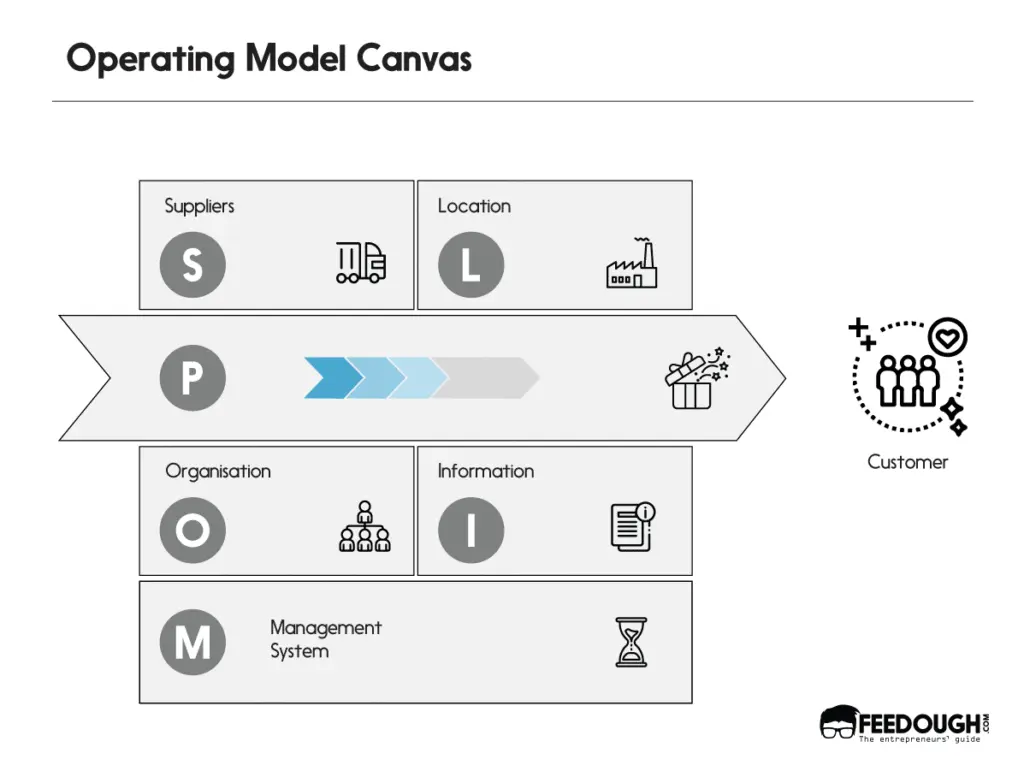
    Andrew Campbell took inspiration from the business model canvas and tried elaborating the operating model’s components into six parts, namely:

    • Process: Describing the key activities or the value delivery process.
    • Organisation: Focusing on the organisational structure – who does the work and how are they organised.
    • Locations: Where is the work done, and what assets does the business require in these locations.
    • Information: The information systems that support the work and value delivery.
    • Suppliers: The key partners who help in value creation and delivery.
    • Management Systems: Planning, budgeting, performance, risk management, continuous improvement and people management processes that the organisation utilises.
    operating model canvas

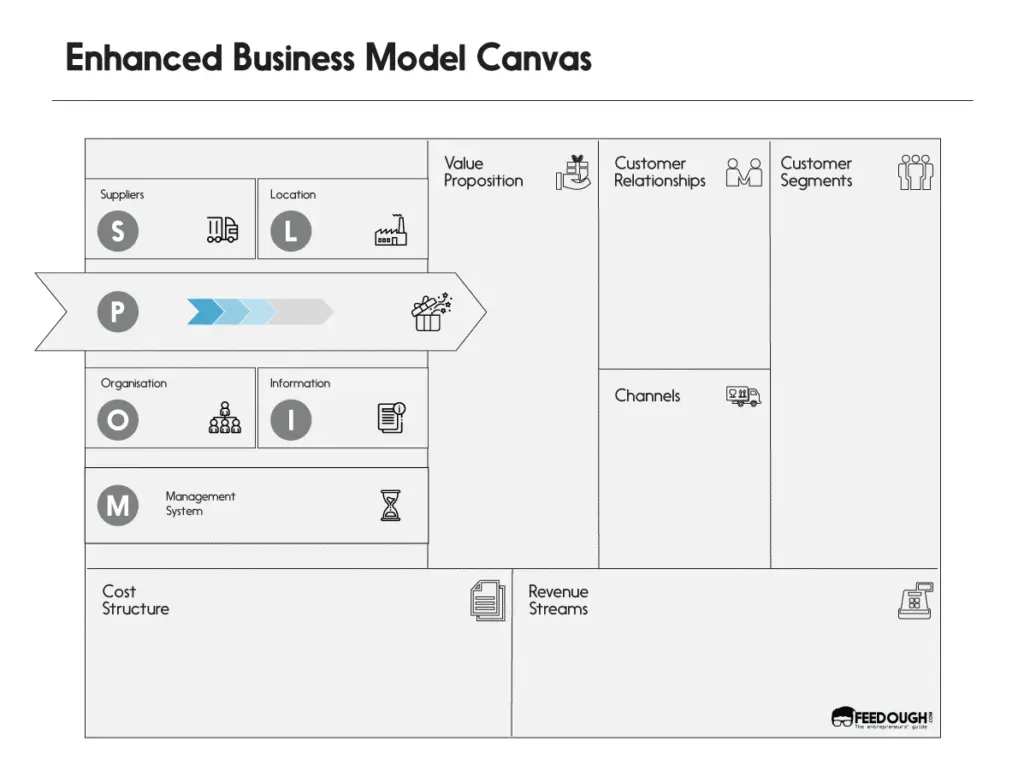
    In essence, the operating model canvas roughly populates the three most essential sections of the business model canvas while giving hints to populate the other two.

    Key Activities = Processes

    Key Partners = Suppliers

    Key Resources = Organisation, Locations, Information, Management Systems
    enhanced business model canvas

    Why Is Understanding The Operating Model Important?

    Understanding and developing the operating model before the concept is converted into an actual business or conceptualising a pivot is an important practice. It is because the operating model:

    • Is A Spine Of The Business Model: The operating model elaborates the business’s backend and defines how the business does what it promises to the customers. Without the operating model, the business model is just an idea.
    • Brings Clarity: It brings in the clarity of what needs to be done when, by whom, and what all is required to do the same. Without the operating model, complex business operations can turn into a mess.
    • Saves Resources: The value delivery process clearly allocates the resources in every step. It avoids duplication and saves resources.
    • Aids Revenue Generation: Operating model is what forms the base for the business’s revenue model. Without the operating model, the revenue model can’t exist.

    The Startup Process

    We know how important your dream business is to you. Therefore, we’ve come up with an all in one guide: The Startup Process to help you turn your vision into reality.
  • The 11 Types Of Startups That Exist Today

    The 11 Types Of Startups That Exist Today

    When it comes to startups, there’s never one size fits all. While all disruptive high-growth businesses can be termed startups, it’s still a heterogeneous group with subtypes characterised by the industry served, market disrupted, funding raised, motive, and valuation.

    Hence, while we have only one word for startup, there are different versions of this entity:

    Based On The Market

    According to Steve Blank, there are four types of startups depending upon the market type they plan to operate.

    Existing Market Startup

    This startup targets an existing well-defined market that already exists, has a demand, and is looking for a different solution that may disrupt such a market’s existing functioning. Take SpaceX, for example. The space exploration market existed but was largely untapped before SpaceX disrupted the functioning of the market.

    In an existing market, consumers’ needs and wants are explicitly known, and the competitors have their positioning set in the minds of the customers.

    New Market Startup

    This startup finds a repressed demand and builds an offering to solve it, developing a new market in the process. A new market means that the startup enabled a large number of people to do something they were unable to do before it came along.  

    There are no direct competitors in such a market, and it’s the startup that makes the consumers realise that they have a repressed demand.

    This was the case with Uber. The company developed an offering based on a repressed demand and made customers realise that they actually had a problem.

    Resegmented Market Startup

    Such startups choose a large enough market segment and further segment it into segments that can be explicitly targeted, with a more focused offering. For example, it can segment the market and target a group that prefer using an inferior product in terms of features but “good enough” to solve the problem or a group that wants a more focused solution to their specific problem rather than an offering solving just the umbrella problem.

    For example, a company releasing a virtual video-classes platform just for schools to compete with Zoom is a resegmented market startup.

    Clone Market Startup

    Some startups exist in one country but not in others. And when another startup clones the former’s business model in a different country, it’s called a clone market startup.

    For example, Uber started in the USA, but Ola copied its concept in India and disrupted the Indian market before Uber did.

    Based On Funding

    Technically, there are only two types of startups based on whether they have raised funding or not. However, such startups can be further categorised into subtypes.

    Bootstrapped Startup

    A bootstrapped startup is a high-growth disruptive business that has never raised funding from an outside investor. All of the expenses are either met by funding provided by internal stakeholders or the revenue generated.

    Unfunded startups are further categorised into:

    • Self-funded: A self-funded startup is operated through an influx of investment by the founders who take care of the startup expenses using personal finance.
    • Revenue-funded: Revenue funded startups generate enough revenue to pay off expenses and fulfil the startup’s growth requirements.

    Funded Startup

    A funded startup is a high-growth disruptive business that has had an influx of investment from external investors. This investment can be in the form of debt financing or equity financing.

    Based On Motivation

    Most of the startups are driven by the idea of disruption, high growth, and large profits. However, some others have different motivation and are categorised into three different types. These are:

    Social Startup

    A social startup is a high-growth disruptive business dedicated to solving social, cultural, or environmental issues. Tesla is one example of a social startup. Even though the company is a for-profit company, it solves a problem of fossil fuel exploitation that benefits society at large.

    Nonprofit Startup

    A nonprofit startup is a high-growth disruptive business with a sole motive to serve society and not maximise profits. Unlike social startups, a nonprofit startup doesn’t have a focus on profit maximisation.

    For-Profit Startup

    A for-profit startup is a revenue-focused business with a motive to maximise its profits. It cares less about social issues and more about how to increase its revenue and valuation.

    Based On valuation

    Startup valuation is a difficult topic to understand. These businesses are valued according to several factors like product validation, current metrics, future projections, etc.

    However, they are also categorised into two types based on their valuation.

    • Unicorn: A unicorn is a startup company founded after 2003, that has a current valuation of more than $1 billion.
    • Decacorns: A decacorn is a startup company that has a current valuation of over $10 billion.

    Go On, Tell Us What You Think!

    Did we miss something? Come on! Tell us what you think about our article on types of startups in the comments section.

  • 5 Essential Traits Of Startup Leaders

    5 Essential Traits Of Startup Leaders

    For your startup to succeed, you need to have a disruptive idea, the right investor, and unique positioning. But more than that, you need to be an exceptional leader to lead the startup and make it stay in the market for long.

    Startup leadership is a unique art that not everyone possesses. You can be an entrepreneur, but being a startup leader takes some extraordinary effort. 

    Hence, only a fraction of entrepreneurs can convert themselves into good startup leaders.

    When you start a startup, you become the steering wheel of your company. You decide the direction and the path your startup chooses. Hence, its vital for you to have good decision-making, management, and leadership skills.

    But that’s not all it requires to be a startup leader. Here’s a list of five essential characteristics startup leaders possess.

    Focused on Future Goals

    Growth in startups is the result of goal setting and implementation. Setting the correct goals, recognising and applying the best course of action are the two most challenging things in startups.

    Visionary leaders plan and define their future strategies well in advance.

    One such leader is Elon Musk, who always thinks about the future. When many space agencies are still thinking about sending their astronauts to Moon, his mission is to send people to Mars in the next five years.  

    Once the goals are set, leaders constantly think about new and innovative ideas to achieve them. They try to find minds that can assist them in reaching these goals. Every day and with every step, they try to get closer to their goals. This way, they reach the goals well before the deadline.

    Good startup leaders are ready to make sacrifices in the short-term to attain long-term success. They always find long-term fixes to the issues that arise in the journey of their startup. Shortcuts are never an option in their journey of achieving future goals.

    Ability to Take Calculated Risks

    There is a fine line between reckless decision-making and calculated risks. A good startup leader always evaluates and measures his decision before implementing them. But at the same time, they are always ready to experiment and come up with new ideas. They are never afraid of failure while taking risks.

    Michael Stelzner, CEO and founder of a US-based media company, Social Media Examiner, once wrote that the preparedness to experiment with innovative ideas is vital to business growth. According to him, if you never try out, you’ll never gain. He also talks about how taking risks and failures are stepping stones to success.

    Still, while taking risks, their consequences and dangers are evaluated. Great leaders judge whether the rewards from the risks are worth it or not before taking them. They never do something just because their competitors are doing it. They assess whether it is beneficial for their startup or not.

    Continuous Learner

    Great leaders always have a lifelong thirst for learning. Research of Harvard Business Review shows that leaders in continuous learning mode build stronger leadership skills than their peers. They keep on expanding their knowledge to innovate and become better every day. 

    In 2017, the CEO of Zomato, Deepinder Goyal, told Economics times that his mentor and founder of Info Edge, Sanjeev Bikchandani, has given him the hunger to learn from his mistakes. He also expressed that no one can be 100% right all the time, and therefore everyone has to learn constantly from their mistakes.

    Reading books & magazines, hearing podcasts, studying new market strategies, and reviewing new technologies are habits of leaders that make them constant learners. These habits help leaders to think innovative ideas and stay ahead of others.

    Adaptable to Changing Environment

    The startup is always a disruptive idea providing a solution that is new for society. Thus, the business environment is more volatile for startups compared to a regular business. Especially in new technology-based startups, advances and changes are quick and common. Therefore, leaders are vigilant to predict these advances and changes well before they take place. 

    Mark Zuckerberg has an interesting way of producing ideas and innovation to deal with changing scenarios in the field of social media. He stages “hack-a-thons”, in which programmers, developers, and hackers try to create and suggest innovative ideas for Facebook.

    A smart startup leader always has a visionary and open mind. They are open to accepting all types of ideas and thoughts to adjust quickly to the changing environment.

    Selflessness

    Generally, successful startup leaders are those who are always selfless. Before thinking about themselves, these leaders think about their vision, company, employees and customers. Selfless leaders share their knowledge, skill, and experience with other team members and focus on the startup’s overall development and growth. These leaders exhibit the quality of enabling and helping others in the organisation. 

    Mary Barra, the CEO of General Motors, once quoted, 

    “if we win the hearts and minds of employees, we are going to have better business success.”

    Successful leaders like Mary Barra understand and share the feeling of both team members and customers. Concentrating on the growth of others is the trademark of such leaders. They allow others to take the front seat and shine.

    Bottom-Line?

    The golden rule of startup leadership is never to copy leaders of other startups. You have your way of doing things. Focus on honing your skills and find a path you can venture to.

    However, never turn your back on what other people are doing to lead their startups, as you may find new ideas in doing so.

    Finally, no one can exhibit all the characteristics of a good leader. But trying to imbibe as many traits as possible will only help to become a better leader.

    Go On, Tell Us What You Think!

    Did we miss something? Come on! Tell us what you think about our article on startup leaders’ traits in the comments section.

  • Business Environment – Definition, Components, & Features

    Business Environment – Definition, Components, & Features

    Several internal and external factors directly or indirectly influence business operations. While some of these are within the business’s control, most of these are not; and the business has to adapt itself to avoid being affected by changes in such factors. Both of them combined forms the business environment.

    Today’s fast-paced business world witnesses a trend of a rather dynamic business environment – that is, it’s never stable. Hence, keeping track of these changing trends, demands, strategies, and policies is crucial in the business world. 

    But first, what is a business environment and what are the factors that influence it?

    What Is Business Environment?

    A business environment is a combination of internal and external factors and forces that significantly influence the operations of a business.

    The business environment comprises an internal and external environment that directly or indirectly affects business operations.

    • Internal Environment: It includes all the factors that are well within the control of a company. These factors are relatively predictable and can be worked on by the company to eliminate forces that negatively impact its operations. 
    • External Environment: It includes factors that exist outside the company’s control. They tend to be unpredictable as a company cannot possibly control or predict a change in them. Their unpredictable nature has the potential to abruptly hinder or even boost a company’s functioning. 

    Components Of Business Environment

    The business environment can be categorised into two types based on the factors within the control or outside the control of a business.

    Internal Environment

    The internal business environment constitutes several internal forces or elements within the control of a business that influences its operations. These include:

    • Value System: It is the ethical belief that guides the business towards achieving its mission and objective. The value system includes all components that form a business’s regulatory framework – organisational culture, climate, work processes, management practices and organisational norms.
    • Vision, Mission, and Objectives: The vision, mission, and objective of a business relate to what it wants to achieve or accomplish in future. It is the reason why the business exists.  
    • Organisational Structure: It outlines how the activities are directed within the organisation to achieve its goals. It includes the rules, roles, and responsibilities, along with how tasks are delegated and how the information flows among the organisation’s levels.
    • Corporate Culture: It is a powerful system of shared norms and attitudes that works as a homogenising factor for an organisation’s employees and gets appropriated by them.
    • Human Resources: Human resources form all the employees and other personnel associated with the business. It forms the most valuable asset of the organisation as success or failure depends on it.
    • Physical Resources and Technological Capabilities: It includes tangible assets and the technical know-how that play an essential role in ascertaining the business’s competitive capability and future growth prospects.

    External Environment

    External components are those factors that a business cannot control. These exist beyond a business’ jurisdiction and supervision limit. External components influencing a business environment are further classified into two categories:

    • Micro Environment
    • Macro Environment

    Micro Environment

    Micro environment is the business’s immediate external environment that influences its performance as it has a direct bearing on the firm’s regular business operations.

    It includes factors outside of the business’s control but can be analysed and worked upon by managing the business to prevent any business losses. 

    Micro factors include:

    • Customers comprise the target group of the business.
    • Competitors are other market players who target a similar target group and provide similar offerings.
    • Media is the channel the business use to market its offering to the customer.
    • Suppliers include all the parties that provide the business with the resources it needs to perform its operations.
    • Intermediaries comprise the parties involved in delivering the offering to the final customers.
    • Partners are all external entities like advertising agencies, market research organisations, consultants, etc., who conduct business with the organisation and satisfy customer needs.
    • Public includes any group with actual or potential interest in the business’s operations or a group that affects its ability to serve its customers.

    Macro Environment: PESTLE

    The macro environment includes remote environmental factors that influence an organisation. The extent of influence a macro element can have on a business is significant as they usually affect the industry as a whole. 

    These factors are classified under PESTLE: P – Political, E – Environmental, S – Social, T – Technological, L – Legal, E – Economical.

    Pestle Analysis Business Environment
    • Political Factors comprise government policies, political stability, corruption in the system, tax policies, labour laws, and trade restrictions that affect the business or the industry.
    • Economical Factors relate to the economy of the country. They include economic growth, exchange rate, interest and inflation rates, etc.
    • Social Factors comprise the demographics of the country. They include population growth rate, age distribution, career attitudes, health consciousness, etc.
    • Technological Factors pertain to innovation in technology that affects the operations of the business. This refers to automation, research and development activities, technological awareness, etc.
    • Legal Factors are laws that affect business operations. They include business-specific, industry-specific, and even state-specific laws.
    • Environmental Factors comprise of all those that influence or are determined by the environment a business operates in. It includes the weather, climate, environmental policies, and even pressure from NGOs to care for the environment.

    Importance of Business Environment

    The market is essentially flooded with competing businesses. It is, thus, integral for a business to keep a lookout for the forces that affect it. 

    Emphasis is laid on maintaining continuous interaction with a company’s business environment. Understanding this environment allows companies to –

    • Plan For Long Term: A sound knowledge of the business environment helps the company know its advantages and limitations, making it easier to choose the better positioning and plan to stay in the market for the long term.
    • Identify Opportunities and Trends – Timely analysis allows a company to identify and consequently explore new opportunities and better performance ideas. A business opportunity is a factor that, upon identifying, allows the initiation of a business venture or aids the development of an existing business. An example of this is Nokia, a company that has previously held a whopping 49.9% of the global market share for mobile phones. However, the company did not adapt to the market’s changing demands as it failed to analyse new trends. Keeping a constant lookout for the new trends that rival firms are setting allows the company to adapt accordingly.
    • Identify threats – Identifying potential threats to the business is another reason why a company needs to keep a watch on its environment. Threats are factors that have the potential to hurt a business. Steering clear of any possible threats ahead of time is integral for the survival of a company. Staying updated and adapting to the turbulent state of the overall business environment grants the company better flexibility when it comes to coping when a sudden, unexpected threat approaches the company. Understanding these conditions and forces thoroughly allows analysts to determine what direction the company should steer towards to stay relevant in the market.
    • Gain First- Mover Advantage – A company gains the first-mover’s advantage if it succeeds to identify market demands at the right time. This allows the company to create its brand and gain brand recognition which benefits the business in the long run. As time passes, competitors try to enter the market after having examined the product’s expansive market demand. By that time, the first mover has plenty of time to establish strong customer loyalty and hence a significant market share which will be hard to compete with. A closer look at the history of Amazon shows how Jeff Bezos had recognised the power of the internet after having come across a statistic that claimed that the internet would change the way businesses operate. Identifying the internet’s potential ahead of time has made Amazon the world’s largest e-commerce company today.

    Features Of Business Environment

    A business environment is:

    • Dynamic: The constant changing of the environment – be it socially, politically, economically and technologically – results in the dynamic nature of the business environment. A heavy interrelatedness of factors that consequently lead to this ever-changing environment is witnessed.
    • Unpredictable: Due to its dynamic nature, an air of uncertainty always persists. Precognition is impossible, and hence, there is no way to foresee a future event that might impact the business environment. 
    • Complex: The interrelatedness of factors and circumstances form a rather tangled environment which is often difficult to analyse. It is an arduous task to keep track of the sources and their impacts on conditions and forces that make up the business environment. Hence, it is a complex task to measure the relative impact a certain force may have on a business.
    • Susceptible: It is difficult to foresee the impact a slight change in the environment can have on a business. An insignificant change may influence a company’s operations largely. It has the potential to impact a business’ entire existence, its revenue and development. 
    • Relative: The business environment is not the same at all places. It varies from place to place. The political crisis in one nation affects the business environment only in that nation, not elsewhere. Hence, the business environment is a relative concept.
    • Multiple-angled: A social, political or economic occurrence may have different impacts on different businesses. A political move that seems beneficial for one business might seem threatening to another. Hence, there exist multiple perceptions in a business environment.

    Go On, Tell Us What You Think!

    Did we miss something?  Come on! Tell us what you think of our article on the business environment in the comments section.

  • 5 Effective Ways To Monetise Your Email List

    5 Effective Ways To Monetise Your Email List

    Love them or hate them, but you can’t deny that emails are still an essential part of any successful business. Your users love to subscribe to email lists. In fact, according to one DMA report, 60% of users sign up for at least one email newsletter to receive offers and sales.

    If you’re reading this, you might also have one such email list or plan to develop one.

    Now, most people think that if you don’t sell an offering, your email list can only be used to build your brand and keep your users engaged.

    But little do they know that there are lucrative ways that you can use to monetise your email list and make money out of every email subscriber you add to that list.

    Let’s find out how.

    Start A Premium Membership

    If you’re an infopreneur or someone who sends informative emails to your list, you can use a freemium membership strategy where the current list subscribers continue to receive the emails they usually do. But the premium subscribers get to join the special community where they may have benefits like:

    • Membership to premium Facebook/WhatsApp/Telegram group
    • One-to-one consultancy
    • Free ebook
    • Free course
    • Premium weekly emails, etc.

    But you can opt for this only if your emails have a reasonable open rate, you get to engage with your audience over emails, and if your content is worth paying for.

    A great example of a premium mailing list is Hot Pod. The company lets its users subscribe for the premium emails at $7 per month.

    Integrate Advertisements

    Emails have started becoming a lot like websites. They’re not limited to just texts. You might already be using images or HTML in your emails.

    But what if you could partner up with a third-party email ad network that provides you ads for your emails that you get paid for?

    Email ads exist and are on the rise. There are a few well-known ad networks that you can start working with before you reach out to brands yourself. These are:

    • PowerInbox
    • LiveIntent
    • Passendo
    • Kevel

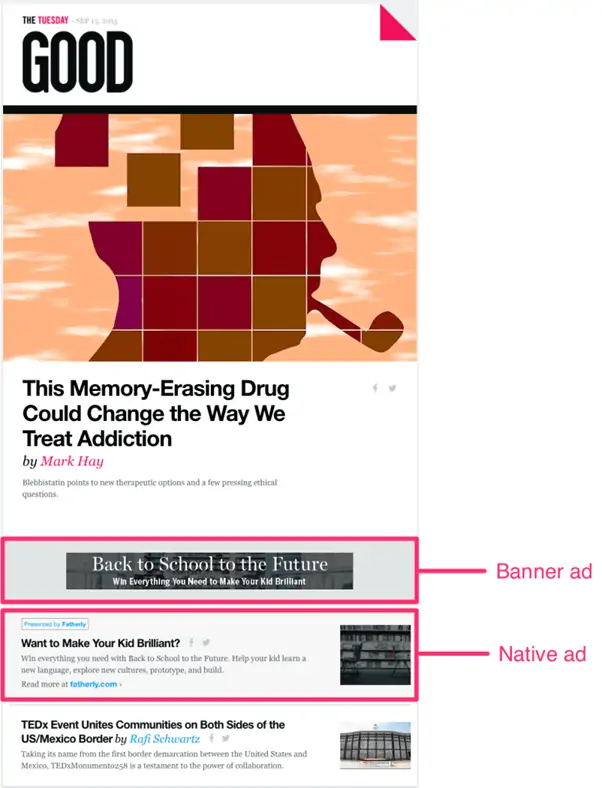
    Email ads are similar to ads on your website. They come in different shapes and sizes like

    • Display or Banner ads: Display ads are static image, animated, or video ads embedded in an email that occupy a pre-defined space and stand out from the rest of the content.
    • Native ads: Native ads are camouflaged ads that mimic the email’s content but are supported with a ‘sponsored’ or ‘advertisement’ tag to make it stand out.
    email ads
    Source: beefree.io

    Earn From Affiliate Marketing

    Affiliate marketing is a revenue earning strategy where you promote another company’s products and charge a commission for every sale that you make. For example, if you have an email list of fashion enthusiasts, instead of just sending them just fashion tips and guides, you can also include affiliate links to Amazon or other ecommerce stores while recommending places to buy or offers.

    This requires you to have a partnership with such stores that pay you commission for every lead that turns into a customer.

    It isn’t as hard as it seems.

    You don’t need to send cold emails to your prospective partners.

    Most brands like Amazon, Etsy, etc., have their portals to help you register as their affiliates. Other not-so-big brands usually involve a middleman like Impact, Rakuten, or Share A Sale to find affiliate partners like you.

    Develop Your Online Store

    If you have a good set of followers that find you to be an opinion leader, it might be a great idea to set up your store and sell products or services that they usually look for in your niche.

    Starting an email store is just like running a regular ecommerce store. The email will only work as the top of the funnel. Your store will be on your website or an existing ecommerce marketplace like Amazon or Ebay.

    You can even work on developing a tripwire offer exclusively for your email subscribers. A tripwire offer is an irresistible, low priced offer designed specially to convert an audience into customers. This tripwire makes your subscriber stumble into the world of your ecommerce store, where you can use other strategies to upsell or cross-sell.

    Host An Event

    It’s the new era of virtual events – with both on-demand and live webinars, conferences, and workshop hosted online.

    Usually, getting an audience to pay for such events is an uphill struggle. However, if you already have an email list with people who are already aware of who you are and what you’re good at, it’ll be easier for you to convert them into paying customers to attend your event.

    You can choose from any of this virtual event:

    • Conference: Conferences are large events where renowned speakers or industry experts are invited to speak on relevant topics. Sometimes, such events are so big that more than one talks may take place simultaneously. 
    • Webinar: A webinar is an online seminar where renowned speakers or industry experts speak on some topic of relevance. Such an event can be pre-recorded or live, followed by a Q&A session.
    • Workshop: A workshop is a smaller event focused on training and information exchange between experienced players and newcomers. It has a limited audience and usually two-way communication.

    Sell Your Book

    If your subscribers already love the information you send them, publishing your book or an eBook would be a lucrative monetising strategy.

    Once published, make your emails sound freemium. That is, you still send them informative emails but use your narratives to make them want more. Once they’re curious for more, pitch in your book.

    Selling a book to your subscribers is far easier than promoting it to people who don’t even know you.

    Develop And Sell Your Course

    Courses are on the rise – especially the video courses. It is because of the changing trends of decreasing textual content consumption and increasing video consumption.

    So, if you already have an email list that you send informative content to, starting and selling a course on the same topics might prove to be a rewarding strategy, and you might be able to monetise your email list properly.

    You can host the course on your website or even use video hosting websites like Vimeo.

    If you feel that your audience will hesitate in buying your course, try offering them a free trial of a few videos to woo them. If the course provides utility, this strategy can work wonders.

    Sell Emails For Money [Not Recommended]

    A not so recommended strategy to make quick money from an email list is to sell or rent the list to third party vendors.

    Businesses look for niche email lists they can send their promotional or cold emails to. They are even willing to pay a good amount if the list is unique and hard to compile.

    To sell your email subscribers data, you need to make a list of businesses that operate in your niche and who might require such a list. Send them cold or personalised emails about your offer, and you might get lucky.

    However, this email list monetising method is usually unethical and might be illegal in some countries that respect privacy. So, make sure you read about the law of your country and the country your subscribers reside in before you even think of monetising your email lists by selling them.

    Go On, Tell Us What You Think!

    Did we miss something? Come on! Tell us what you think about our article on email list monetisation in the comments section.

  • What Is Publicity? – Characteristics, Types, & Examples

    What Is Publicity? – Characteristics, Types, & Examples

    Today’s market is so saturated that sponsored forms of communications like advertising, sponsorships, and direct marketing find it hard to get the needed attention the brand pays for.

    However, there’s a non-paid form of promotion that finds its way to get people’s attention through organic media reach. It’s an element of public relations called publicity.

    But what is publicity, what are its types, and how it differs from other promotional mix elements?

    Let’s find out.

    What Is Publicity?

    Publicity is the communication about a brand, offering, or a business by placing commercially significant news about it in the media without paying for time and space directly.

    In simple terms, publicity is the movement of information to the public via media coverage and other non-paid mass media sources.

    Publicity is not a process but a result of a good public relations strategy where the marketers succeed in providing favourable information to media and other third-party outlets like bloggers, vloggers, podcasters, etc.

    How Does Publicity Work?

    Usually, brands appoint a publicist who is entrusted with the job to generate and manage publicity for the brand, offering, business, or a public figure by persuading the news media to report about the same in the most positive way possible.

    Publicists identify newsworthy aspects of brands and offerings like speeches, interviews, comments, or social work by the brand representatives, ambassadors, etc. and present the same media outlets as possible reportage ideas. 

    While publicity doesn’t require brands to buy advertising time and space, it does require them to put in efforts. Publicists use multiple ways to generate news stories about the brand. These are:

    • Press release: A press release is a short, compelling story written in a specific format to inform local media outlets about newsworthy events or business information. It could be related to general news, launch release, events, new products, or expert positions of a brand on a particular matter.
    • Networks: Public relations specialists and publicists develop media personnel relations to increase their brand’s media coverage.
    • Digital Media: Brands also use digital marketing strategies like social media marketing to get the attention of the target audience and media outlets.

    Objective Of Publicity

    The main objective of publicity to garner public exposure, awareness, and attention to channelise the information about a brand or an offering to build its goodwill, stimulate demand, or change public opinion.

    Besides this, publicity aims to:

    • Build Brand Image: Publicity aims at communicating brand values, mission, and vision through trustable channels like news outlets, blogs, and opinion leaders. This helps the company build its brand image organically.
    • Remove Misunderstanding: Often, a company may be a victim of misunderstanding or misinformation among the target audience. Publicity aims at removing such misunderstanding and maintaining the goodwill of the company.
    • Stimulate Interest and Demand: When the product information reaches the target audience organically, it automatically stimulates their interest and increases the product’s demand.
    • Communicate Reliable Information: There are certain information that can’t be communicated through advertisements. Such information is often propagated through publicity.

    Characteristics Of Publicity

    Publicity has the following five characteristics:

    • Non-Paid Form: Publicity is a non-paid form of promotion. All of the media coverage is organic.
    • Driven By Media: Publicity depends on media outlets that give a viral blow to the shared information by publicising it.
    • No Control: The brand has no control over message, time, frequency, information, and medium. 
    • Focuses On A Broader Audience: Publicity isn’t targeted marketing. It focuses on the shotgun approach, where the information is publicised to a broader audience.
    • Credible: The target audience considers publicity to be a more credible form of communication as it uses trustworthy channels like news outlets.
    • Short-Term Focus: Publicity is a promotional strategy focused on fulfilling short-term goals like a product launch, event promotion, etc.

    Importance Of Publicity

    Publicity adds credibility to the overall communication message. It gives the target audience a reason to talk about the brand and, in turn, increases the effectiveness of word of mouth and viral marketing.

    Publicity is considered an important promotional tool. This free placement of message in the media creates public awareness and attention around a brand that develops brand image, stimulates demand, and assists sales efforts.

    Types Of Publicity

    Based on User sentiments

    Depending upon the sentiments of the target audience, publicity can be categorised into positive and negative publicity.

    • Positive Publicity: This is when positive sentiments about a brand accompany the information that’s publicised by the media or other sources. It positively affects the brand image and often increases the demand for its offerings.
    • Negative Publicity: It is when negative sentiments about a brand accompany the information that’s publicised by the media or other sources. It could negatively affect the brand image and can even deteriorate its current demand.

    Based on Information Propagation

    Publicity can also be categorised into eight types depending upon how the information is propagated:

    • News: News is information about current events provided through an identified media outlet. An example of such publicity would be an article by Forbes on how Toyota improved its employee policy during the covid19 pandemic.
    • Product Release: Big brands automatically gain the attention of public, media, and even influencers during new product releases. This hype results in publicity.
    • Emergency: Emergency situations or steps like mass hiring or mass firing of employees, etc., get the attention of the world organically.
    • Offers: Attractive offers often get publicity by word of mouth.
    • Conferences: Notable conferences get the attention of the industry players as well as the target audience.
    • Events: Events that host influencers, industry experts and other notable personalities or those who stand out of the lot gain much popularity among media and other information outlets.
    • Partnerships: Partnerships increase a company’s publicity horizon as it gets free publicity whenever the partner gets attention. Moreover, partnerships attract eyeballs of investors, financial analysts, and other enthusiasts.
    • Digital Activity: Digital activities like tweets, posts, images, etc., often result in getting followers, media, and public attention.
    • Social Efforts: A brand giving back to society often gets appreciation by the public in the form of positive publicity.
    • Marketing Communication: Often, paid marketing activities also result in organic publicity. For example, an advertisement can be considered to be offensive by a media outlet that can lead to negative publicity.

    Publicity Examples

    Every day, news comes out with a new example of publicity – a brand holds a press conference, releases a new product, distributes a press release, does a social activity, or gets famous just because of that one tweet.

    Here are a few examples of publicity that explain the concept better.

    Reebok Backing Shakira Tour

    Reebok held a press conference in 2002 to let the world know that the company would sponsor Shakira’s worldwide concert tour.

    In return, Shakira became the brand ambassador of the brand and did some advertisements for them.

    Star Wars: Passing The Baton

    Till 2018, Star Wars had the record for the biggest opening weekend. But Avengers broke the record by collecting over $250 million. Instead of being bitter, LucasFilm congratulated Avengers by posting a tweet with a picture handing over a baton.

    This heart-warming tweet earned the respect of movie lovers and media alike.

    Johnnie Walker: Jane Walker

    Johnnie Walker is a whiskey brand with a male mascot. However, to honour achievements of women throughout history, the company launched a female version of its whiskey on International Women’s Day called the Jane Walker.

    The company launched this limited edition bottles in march 2018 and even pledged to donate $1 for every bottle sold to organisations that empower women.

    This brought the company into the limelight for a short timespan, and the company enjoyed good publicity.

    Jane Walker

    ALS Ice Bucket Challenge

    ALS association’s Ice bucket challenge is probably the best example of publicity till now. The organisation succeeded in giving rise to a viral trend where people would dump a bucket of ice water over their heads to raise money for the ALS Association and research on the disease. 

    Over 2.4 million people took part in the challenge and helped the organisation raise more than $115 million.

    What Is A Publicity Stunt?

    A publicity stunt is a planned event designed to get viral and attract public attention and press coverage.

    For example, Oreo convinced pop star Lewis Capaldi to lick its biscuits and then auctioned it as a part of its charity stunt.

    Publicity stunts are pre-planned and are usually a part of bigger marketing campaigns. These stunts usually add the virality touch to such campaigns and bring the brand into the spotlight for a short period.

    Publicity Vs Advertising Vs Public Relations

    Publicity
    Public Relations
    Advertising
    Definition
    Publicity is a non-paid promotion of a brand where media or other viral communication tools are involved in transferring information from the brand to the public in an organic manner where the brand has very little or no control.
    Public relations is a strategic communication process companies, individuals, and organisations use to build mutually beneficial relationships with the public.  
    Advertising is the action of calling public attention to an offering through paid announcements by an identified sponsor.
    Type of promotion
    It’s a result of public relations, publicity stunt, or marketing communication.
    It’s a strategised process of managing the release and spread of organisation-related information to the public to maintain a favourable reputation of the organisation and its brands. 
    It’s a paid tool for promotion of offering, brand, business, or ideas by an identified sponsor.
    Objective
    Its objective is to get media attention to the brand or offering for a short term.
    Its objective is to develop the brand image over a long term.
    Its objective is to communicate the desired information to the public, to persuade them to buy the offerings, or to reinforce the brand message.
    Earned
    Earned
    Paid
    Control
    No control over the information.
    Less control over the information.
    More control over the communicated information.

    Advantages And Disadvantages Of Publicity

    Like other elements of the promotion mix, publicity comes with its own set of advantages and disadvantages. These are:

    Advantages

    Publicity is considered an effective form of promotion as it can make the brand go viral within hours or days. It has the following advantages:

    • Economical: Publicity brings in free attention from the media and the public. Hence, the only cost a business incurs is to strategise and execute the activity or stunt, which will result in public exposure, awareness, or attention.
    • Credible: Since publicity uses trustable channels like news outlets, influencers, and opinion leaders, it is considered to be a more credible form of communication compared to advertising and other paid forms.
    • Innovation: An activity, conference, or stunt needs to be innovative in order to gain publicity. Hence, publicity always come with innovation.
    • Viral: Virality is a characteristic feature of publicity. A publicity stunt, event, or activity always spread like wildfire without the brand paying for the same.

    Disadvantages

    Publicity also comes with its own set of disadvantages. These are:

    • No Control: When it comes to publicity, the brand has no control over the message, medium, or the narrative of the publicised information. It could even backfire on the brand. 
    • No Guaranteed Results: It’s not guaranteed that an event will be publicised. Hence, there’s always a chance that the cost of the preparations may go in vain.
    • Requires Specialised Skills And Efforts: Not everything receives positive publicity. It requires specialised skills and efforts to get the needed attention and make something go viral.

    Go On, Tell Us What You Think!

    Did we miss something? Come on! Tell us what you think about our article in the comments section.

  • What is Gamma Testing? – A Detailed Guide

    What is Gamma Testing? – A Detailed Guide

    Every firm wants to deliver a quality bug-free product to its customers. Thus, testing becomes a crucial step in the manufacturing process. It is carried out at different stages of the product development process to ensure that product is free from all kinds of errors and faults. 

    Out of all the testing stages, the one conducted at the final stages of the product development process is known as acceptance testing. The process of acceptance testing is carried out in three phases, out of which the third phase is called gamma testing.

    Gamma testing aims to check the product’s performance, quality, safety, and functionality. It marks the end of the testing process and indicates that the product is now fit to work in any condition without any issue. 

    What is Gamma Testing?

    Gamma testing is the final step of acceptance testing, which confirms that the product fulfills all the proposed requirements and is completely ready to roll out in the market. While performing gamma testing, primary attention is on product security and usability. 

    During this phase, the product is 99% complete, and there is no enough space for any enhancement even after receiving suggestions and feedback. The product development team goes for changes in the product only if the severity of the issue or risk is very high.

    The product is often referred to by several names such as release candidate, gamma, or delta during the gamma testing phase. It is called a release candidate because it has the potential to be the final product that can be released into the market if no significant bugs emerge in this phase.

    Purpose of Gamma Testing

    The purpose of this final testing before the launch of the product is to check the product’s performance in real environment and to make sure that the product is ready for market release according to all the specified requirements.

    It allows gathering all the useful insights related to the performance of the product.

    Gamma testing is implemented to test the product from the point of view of the actual users. This kind of testing helps to improve the probability of a product’s success in the market.

    How Is Gamma testing Performed?

    In gamma testing, the product is first distributed for use among a small group of end-users. This group mostly includes those people who are certain to use the product after its launch. After that, feedback is collected from these users about some major specifications of the product. This feedback is then used to improve the quality and safety of the product.

    When is Gamma Testing Conducted?

    Gamma testing is the last step of acceptance testing and is carried out just after beta testing. It is the final stage of the product development process after which the product is released into the market. 

    In Gamma testing, the product is in its third phase of acceptance testing, and therefore the name of this testing is derived from the third Greek letter that is “Gamma”.

    Alpha Testing vs Beta Testing vs Gamma Testing

    Alpha Testing
    Beta Testing
    Gamma Testing
    Alpha testing is the product’s initial testing for all possible bugs and issues before introducing it to the external testers.
    Beta testing is the second level of product testing performed to find out bugs or issues missed during alpha testing.
    Gamma testing is the final product testing level performed to gather suggestions and feedback about certain product specifications.
    In-house developers and QA staff perform this test in a controlled environment.
    External testers and developers carry it out in a real environment.
    It is performed by a small group of end-users who are certain to use the product after its launch.
    During alpha testing, the reliability and security of the product are not analyzed in-depth.
    During beta testing, more focus is on the reliability, security, and robustness of the product.
    During gamma testing, the main emphasis is on checking the product’s safety.
    The product is tested in controlled lab conditions while performing alpha testing.
    The product is tested in a real external environment during beta testing after completing alpha testing internally.
    The product is tested in external conditions by a small group of end-users by skipping all the in-house activities during gamma testing.
    In alpha testing, all the issues and bugs are addressed immediately by the product development team.
    In beta testing, the issues and feedback collected are implemented in the forthcoming versions of the product.
    In gamma testing, the issues or feedback collected are not implemented unless the severity of it is very high.

    Advantages and Disadvantages of Gamma Testing

    Gamma testing comes with its own set of pros and cons. These are:

    Advantages

    1. Gamma testing allows measuring the quality of the product from the perspective of end-users.
    2. In gamma testing, all the in-house testing activities are skipped, which saves a lot of time and effort.
    3. High skilled testers and developers are not required for gamma testing and is conducted by gathering feedback from a small set of end-users.
    4. There is no need to develop any simulated test conditions during gamma testing as all the testing is done in real conditions.
    5. As gamma testing involves a minimal number of end-users, it is easy to collect comprehensive feedback on the product from them.

    Disadvantages

    1. It isn’t easy to control the complete testing process because the prominent participants in gamma testing are end-users.
    2. It is vital to select the right set of genuine and reliable end-users since there is always a chance of wrong feedback being provided by them.
    3. Important data related to the product’s specifications and functions might get leaked while conducting this kind of test.

    Why is Gamma testing becoming a thing of the Past?

    Nowadays a very few companies carry out gamma testing.

    A majority of companies refrain from conducting gamma testing because of the limited time cycle, competitive pressure, and more emphasis on quarterly profits. Thus, with each passing day, gamma testing is now becoming a trend of the past.

    Go On, Tell Us What You Think!

    Did we miss something? Come on! Tell us what you think about our article in the comments section.

  • What Is Alpha Testing? – A Detailed Guide

    What Is Alpha Testing? – A Detailed Guide

    Every company wants its target market to accept the product it has to offer gladly. While many companies predict demand in the first instance, several others validate their assumptions using acceptance testing.

    The company performs some of these tests internally, while some are performed by releasing the product to the actual audience.

    Alpha testing, a part of the user acceptance testing, is the firms’ preliminary internal testing before offering the product to the external testers or early users. It ensures that the product fulfills all the requirements and attains a minimum level of quality before offered to the target audience to try.

    What Is Alpha Testing?

    Alpha testing is a type of acceptance testing where in-house team of developers, designers, and quality assurance staff test a product for all possible bugs, flaws, and issues in a controlled lab environment. 

    Often referred to as usability testing, alpha testing is known to stand out because of its unique features. These features are imbibed in its definition –

    • Type Of Acceptance Testing: At the time of an alpha test, the product is almost ready for use. All that is left is to remove the bugs, flaws, and issues by letting a sample audience try the product and validate its proposition.
    • Done by in-house team of developers, designers, and quality assurance staff: Alpha testing involves tests and feedback by in-house team of experts. The end-user isn’t involved in this test.
    • Test for all possible bugs, flaws, and issues: The aim of an alpha test is to get rid of all the possible bugs, flaws, and issues that the internal team can find.
    • In a controlled lab environment: The alpha version of the product isn’t a finished product. Hence, it is not released in a real environment for end-users to test.

    Alpha Testing also helps the testing team to make sure that the product is functioning in the same manner in which it is intended. Thus, the company appoints experts, who understand the industry and the offering, to test its design, working, and behaviour.

    It is the last testing phase before sending the product for beta testing, where the actual users test the product in a real environment.

    When is Alpha Testing done?

    Alpha testing is the first step of acceptance testing and is carried out before beta testing. It is conducted at the final stages of the product development process.

    It is the early end-to-end testing of a product and therefore its name is derived from the first Greek letter “Alpha”.

    Before performing alpha testing, it is essential to form a list of all the design specifications and functional requirements needed to be tested. According to this list, the testing team can develop a plan to test each specification and requirement included in the list.

    What are the Phases of Alpha Testing?

    Alpha testing is performed in two phases: 

    1. Initial Testing Phase conducted by In-house Developers: In this phase, the internal developers carry out the testing. These developers may use anyone out of hardware-assisted debugger or debugger software to improve the process. The main purpose of the developers is to identify and remove the bugs as quickly as possible.
    2. Application Testing Phase conducted by QA Team: The quality assurance team carries out this phase of testing. They make use of both black box testing and white box testing technique in this phase. 
      The testing method in which the tester knows the internal structure, design, and implementation of the item to be tested is known as the white box testing method, and the method in which the tester does not know the internal structure, design, and implementation is called as black box testing method.

    What are the steps involved in Alpha Testing?

    Alpha Testing involves the following six steps:

    1. Listing of requirements: Alpha testing starts with reviewing design specifications and listing all functional and non-functional requirements.
    2. Planning: The second step is to develop an extensive test plan and form all the required test cases.
    3. Checking for issues: Only after generating the test plan and the test cases, the test team can now start alpha testing. Checking for bugs and defects in the systems is the first priority in this step.
    4. Logging issues: In the fourth step, issues are logged in a separate system whenever the team finds a bug or defect.
    5. Fixing issues: The members of the development team then fix these issues.
    6. Retesting: Once the development team solves the issues then the software product is again sent back to the testers to retest. This cycle continues until zero defects are found.

    Advantages and Disadvantages of Alpha Testing

    Alpha testing comes with its own set of advantages and disadvantages. These are:

    Advantages 

    • As alpha testing includes both testing techniques that are white-box testing and black-box testing, it allows the testers to carry out thorough and detailed testing.
    • While performing alpha testing, a simulated environment is created to test the software in an environment similar to the external environment. Testing in simulated conditions helps the testing team to improve the software quality.
    • Alpha testing gives the testing team a chance to gather all the software’s usability and reliability insights.
    • The various in-house tests conducted during alpha testing develop confidence in the software team that the software is now ready and can be used in any conditions.

    Disadvantages

    • In alpha testing, the product is tested at a very high level using both black box and white box testing techniques due to which its execution time is very long.
    • As alpha testing is performed in-house and not in an external environment, it cannot test some software aspects like maintainability and in-depth security.
    • Internal testers and developers perform alpha testing instead of the actual customer. Hence, there is always a chance that they might ignore some defects due to deadlines.
    • Sometimes alpha testing is not considered worthy for small projects because the time and efforts required in alpha testing are equivalent to an IT project.

    What comes after Alpha Testing?

    The next step after alpha testing is beta testing which tests the product in real conditions. In beta testing, the product is distributed among a small number of end-users who test it for any bug, issue, or flaw that was not addressed during alpha testing. The end-users then send their feedback to the developers. The team of developers provides solutions to the issues raised in the feedback either immediately or in the upcoming version of the software.

    Alpha Testing Vs Beta Testing

    Alpha Testing
    Beta Testing
    Alpha testing is the product’s initial testing for all possible bugs and issues before introducing it in the market.
    Beta testing is the second level of testing of the product to find bugs and issues that are not addressed or missed during alpha testing.
    In-house testers and developers carry it out in a controlled lab environment.
    External testers and developers carry it out in a real environment.
    This test may require a very long execution cycle to complete.
    This test mostly gets executed in just a few weeks.
    Issues and flaws found out during alpha testing are addressed immediately by the developers.
    Many issues and feedback collected from the users during beta testing are addressed and implemented in the forthcoming versions of the product.
    The main objective of alpha testing is to provide the user with the best quality product that is free from all issues and bugs.
    The main objective of beta testing is to develop an issue-free product and also to make it more user friendly according to the feedback of the end-users.

    Go On, Tell Us What You Think!

    Did we miss something? Come on! Tell us what you think about our article in the comments section.

  • What Is Barter? – Definition, Characteristics, Pros & Cons

    What Is Barter? – Definition, Characteristics, Pros & Cons

    The present monetary system is complex. Backed by fiat currencies, the system involves many parties – buyer, seller, banks, and even government, just to carry out one single transaction.

    However, this was not always the case. 

    Today’s era of digital currencies is a product of centuries of a developing monetary system that finds its roots in a little known concept of barter.

    Barter was easy, involved just two parties (usually), but was highly inefficient. 

    But what exactly is barter and how it works? How is it different from money trade?

    Let’s find out.

    What is Barter?

    Barter is an act of exchange involving goods or services without the use of money or any other monetary medium. 

    In simple terms, it involves a direct trade of commodities without the use of money, where the exchange is reciprocal and the trade is negotiated in a way where each party gets what it desires for, in an even amount to what it offers in exchange.

    When an entire economy utilizes a similar way to transact, it establishes a complex whole system of exchange, known as the barter system.

    To understand the barter definition better, take this example. Mr. A owns a poultry farm and deals in eggs. Mr. B is a farmer who deals in wheat. Now, in a barter system, Mr. A can get a kilogram of wheat flour from Mr. B in exchange for some eggs of similar worth.

    How Barter Works?

    Bartering is the oldest and one of the simplest forms of commerce.

    The way a barter works is pretty straightforward. The participating parties negotiate and exchange one valuable product for another.

    Generally, barter occurs between two parties (bilateral barter) but can involve three (triangular barter) or more than three parties (multilateral barter).

    Bartering involves double coincidence of needs and mutual valuation of the same. For example, a shepherd can trade his wool to a farmer in exchange for some wheat. However, the quantity or volume of the same requires both the parties to negotiate and come to a conclusion. This negotiation depends on needs and wants of the parties and the timing of the trade. In winters, the shepherd may have an upper hand in the negotiation while in summers, he might have to settle for less.

    Some people confuse barter system with the gifting economy. However, barter system involves bilateral or multilateral trade and immediate reciprocal exchange, different from the gifting economy where the exchange could even be unilateral and be delayed in time.

    Characteristics Of Barter

    The construct is rather modest and has the following characteristics:

    • Immediate reciprocal exchange: Bartering involves immediate exchange of goods, where the exchange is reciprocal. This means that the trade is negotiated in a way where each party gets what it desires for in an even amount to what it offers in exchange.
    • Double coincidence of wants: It requires both the parties to want what the other party has to offer. If any party is not interested in the other party’s offerings, the trade doesn’t take place.
    • Eliminates the use for money: Barter is direct trade. It involves immediate swapping of goods and chattels with no medium of exchange involved.
    • Limited circle of trade: People do not want goods of compromised quality. Therefore, bartering occurs within a circle of trusted people. This acts as a restraint to the free flow of trade across communities and geographical locations.
    • No focus on economic growth: A barter economy is focused on fulfilling the essential needs of humans, not on economic growth. As a consequence, the pace of modernization stagnates.

    Advantages And Disadvantages Of Barter

    Like other monetary systems, barter comes with its own set of advantages and disadvantages. These are:

    Advantages

    The advantages of the barter system include:

    Simplicity

    As efficient as the present monetary system is, the intricate complexities inherent can’t be denied. On the contrary, the barter system is stripped of all menace. It involves a direct give and take of the commodities.

    No Real Concentration Of Power

    There is a limit beyond which commodities can’t be stored and hence the extreme concentration of wealth is a bleak possibility.

    No Overexploitation Of Natural Resources

    In a barter ecosystem, people tend to be a jack of all trades. People on their own try to produce or manufacture goods of utility. The quantum of production is enough, not plentiful. Thus, degradation and greedy exploitation of natural resources remain relatively contained. 

    Disadvantages

    There exist five major disadvantages to bartering. These include:

    Double Coincidence of wants

    Under the barter system, a double coincidence of wants is an essential prerequisite for an exchange to occur. Double coincidence refers to the mapping of people’s wants 1:1. 

    For example, A person wants cloth and is willing to trade his wheat for it. Now he must find someone who not only desires wheat but also has cloth to trade for it. It is impossible for someone to come across such a person each time a need arises. Oftentimes, many intermediary transactions have to be undertaken to eventually be able to attain the commodity desired in the first place.

    Lack Of Common Measure Of Value

    Even if people with congruent needs meet each other, another dilemma is around the proportion in which one good should be exchanged for another. There is a void when it comes to a common measure of value. The problem is fixed in a manner lacking much thought to it.

    An exact value cannot be assigned to the good in a barter system. The rates of exchange for it will be as many as the number of types and qualities of goods that it can be traded for.

    Difficulty In Deferring Payments

    Deferred payments are debt obligations to be repaid in the future. However, in a barter economy, the promise of a future repayment can lead to conflicts of many kinds. These conflicts as explained by an economist, Chandler may include:

    • Disputes over the quality of goods or services to be repaid in.
    • Controversy over changes in the value of the commodity over a period of time.
    • Inability to agree upon the nature of goods to be used in fulfilling the obligation.

    Indivisibility of Goods

    An inability to peg an exchange rate to goods of indivisible nature happens to be an important limitation of barter trade. 

    Suppose, the agreed-upon value of one ox is two sheep. Now, if a person wants 1 sheep, then he must give up half of an ox to be able to procure one sheep. This is impossible. The only route out of it is if the person agrees to barter the whole of an ox for a single sheep. This leads to losses for the party sacrificing an ox. This problem is done away with now. The present monetary ecosystem assigns a value to all goods in terms of a currency with so many denominations.

    No Storage Of Value

    In a barter ecosystem, goods and commodities exchanged are the precious store of wealth but are they the most efficient at it? Most certainly not. This is because of the following reasons:

    • Commodities especially food items are perishable in nature.
    • The quality of goods can deteriorate due to proliferation or other environmental factors if stored for long durations.
    • Commodities are a store of value but storing themselves requires space that involves incurring expenses.

    Barter vs. Money trade

    Barter Trade
    Money Trade
    It involves a direct give and take of goods.                 
    It includes currency in the form of paper notes, coins, or digital tokens as a mode of transaction. 
    It doesn’t have a scientific measure of value.
    It has a well-established means to arrive at a definite value of all goods.
    Double coincidence of wants is a prerequisite.
    Double coincidence of wants as a concept itself doesn’t exist under this system.
    The transaction is always immediate.
    The transaction can occur both- Instantaneously and on a deferred basis.

    Go On, Tell Us What You Think!

    Did we miss something?  Come on! Tell us what you think about our article in the comments section.

  • Chief Technology Officer (CTO) – Definition, Roles, & Responsibilities

    Chief Technology Officer (CTO) – Definition, Roles, & Responsibilities

    Every company has a C-suite leading it. This C-suite or chief-suite constitutes the senior-most executives responsible for the core strategic direction of the organisation.

    One of the members of this C-suite is the chief technology officer (CTO) who handles all the technical priorities of the company. He is responsible for the technology infrastructure of the organisation and makes sure to fulfil the short term and long term technology needs of the organisation.

    But the definition of CTO and his roles are not limited to this. Since it is an executive-level position, there are a lot more responsibilities on CTO’s shoulder.

    Here is a guide explaining the CTO’s roles and responsibilities, the skills required to become a CTO, his salary, and the famous CTOs of all time.

    Who is a CTO?

    A chief technology officer (CTO), also called chief technical officer or chief technologist, is a chief-level executive in charge of the company’s technological priorities, infrastructure, and R&D. 

    This executive holds the highest post in the technological department and is responsible to:

    • Set technical vision of the business and lead the technological department,
    • Examine the organisation’s short-term and long-term technology needs and makes investments to help the company reach its goals,
    • Make technology-related decisions on the behalf of the company.

    A CTO plays an integral role in a business. Take Gerri Martin-Flickinger, the CTO of Starbucks, for example. She led the development of the company’s mobile ordering system, while also having had managed the development of voice ordering and social gifting. This strategy worked wonders for the company’s business-customer relationship.

    A chief technology officer reports directly to the chief executive officer (CEO) – the individual who heads the entire business.

    What Does A CTO Do?

    A few decades ago, chief technology officers were only famous with dot com or tech companies. The recent growth of the internet, smartphones, and user-intent based offerings has substantially increased a CTO’s role in other organisations as well.

    Today, the role of CTO grew exponentially in industries like healthcare, corporate, telecommunications eCommerce, and even retail.

    They are known as the “growth hackers” of an organisation because they are responsible for changing and handling a company’s technicalities through innovative tech ideas.

    The functions, roles, and duties of a chief technology officer vary according to the company and its nature. It includes:

    • Developing a long-term technical strategy: CTOs effectively and continually ensure that the company is going in the right technological direction. They ensure that the company has the right technical offering and an excellent technical vision to keep it afloat in the tech-powered competitive space.
    • Technological innovation: CTOs are responsible for making amendments to the offering’s technical aspects depending upon what’s needed presently or will be in demand in future. The do this by putting efforts in research and development, quality assurance, and product testing.
    • Business transformation: CTOs are in charge of making changes in the business’s technology to align it with its objectives better.
    • Leadership and management: CTOs are essentially the face of a company’s technological department. They manage employees working under them, are accountable for their actions, and even pose as role models to them. Besides this, they also provide options to the CEO about the possible technologies that the company can employ to fulfil a particular need. Additionally, they lay down the cost of this technology.
    • Optimisation of internal tech infrastructure: The efficiency of the technology employed internally plays a significant role in determining a business’s growth. The CTO is responsible for the optimisation of the internal business operation processes using technology.

    Types of CTO

    The nature of the role of a CTO differs from business to business. Access Alto identified four broad categories of CTO:

    • Infrastructure leader: The CTO is responsible for the data, maintenance, security and network of a business. A CTO of this type also is incharge of the technological roadmap of business.
    • Technology Planner: Conceptualises and forms a business’s technical strategy while keeping the business’s objectives in mind.
    • Consumer-focused: Focuses on delivering customer excellence and plays the integral role of a channel between the business and the customer. Aims to smoothen consumer experience in UI and UX.
    • Great Thinker: Thinks out of the box and aims to stretch the boundaries of how the business employs technology. This also means that a CTO of this type plays an integral role in setting the business strategy. This involves creation of new technology and examining target market thoroughly. 

    Average Salary of a CTO

    In 2020, the average salary of a CTO in the USA stood at $161,525.

    The bottom end of the salary range of a CTO was seen to be $96,915, while a CTO positioned at the top end of the salary range earns $350,510.

    Additionally, the average annual bonus and benefits that a CTO receives is $11,307.

    In India, the average base salary of a CTO is ₹2,979,000 per year.

    In the UK, the average base salary of a CTO is around £94,783, while in Australia, it is AU$156,070.

    Examples of famous CTOs

    Below are examples of famous CTOs who contributed significantly to the success of the business:

    Mark Russinovich, CTO of Microsoft Azure

    Mark Russinovich

    Mark was responsible for the scaling up of Microsoft’s global cloud computing business. Moreover, he contributed significantly to the tech community through education, promotion, and community engagement.

    Aristotle Balogh, CTO of Airbnb

    Aristotle Balogh

    Aristotle Balogh transformed the Airbnb platform into an AI-backed, customer-first experience. His main focus was creating a smooth design which would form connections within communities. This facilitated the creation of a truly immersive and personalised search experience for their customers.

    Rathi Murthy, CTO of Verizon Media

    Rathi Murthy

    Rathi Murthy is the woman behind the company’s global media strategy. Murthy also oversees the company’s aim to innovate media applications for upcoming technologies – like extended reality, Artificial Intelligence, machine learning, and 5G.

    CTO vs. CIO

    A CIO or chief information officer and CTO (chief technology officer) are core executives managing different organisation departments. CIO looks onto the internal matters and IT sector of a company. On the other hand, CTO deals with external technical affairs to improvise the company’s services.

    Few key differences between CTO and CIO are-

    • CTO work on the technical infrastructure to gain potential growth in marketability and scalability of a product. In contrast, CIO heads the internal affairs and plans the strategy to improvise the IT department.
    • CTO improves the social presence of the company by leading various technology related summits and seminars. In contrast, the CIO looks after the potential business partners to increase sales and gain new projects for the company.
    • CTO ensures that technologies are used efficiently and securely. In contrast, CIO improves the Collaborating process with ISPs and vendors to drive productivity.

    Go On, Tell Us What You Think!

    Did we miss something? Come on! Tell us what you think about our article on chief technology officer in the comments section.