Feedough Logo

Blog

  • What Is Brand Hierarchy? How To Develop One?

    What Is Brand Hierarchy? How To Develop One?

    Brands distinguish their products from competitors through various factors like a name, promise, positioning. But how do they distinguish between their own products? What is the difference between Dell Inspiron 14 and Dell Inspiron 15, other than the product features?

    The difference is denoted by an architectural factor, known as ‘brand hierarchy’.

    What Is Brand Hierarchy?

    A brand hierarchy is the systematic branching structure of a brand’s distinctive elements for its sub-products.

    When companies begin to diversify their products, with new products and different positioning schemes, they graph a brand hierarchy to help with the identification of their products and services. A brand hierarchy helps inculcate the vital brand elements and modifications within the products.

    For example, think of Amazon. Amazon provides e-books services, e-shopping services, AI products, etc. But people do not refer to Amazon for all this at once. They refer to Amazon Kindle or Amazon Prime or other hierarchies that Amazon has developed. These hierarchies contain distinctive elements through their name, logo, and brand identity that helps differentiate between the products as well as reduces confusion for customers.

    Brand Hierarchy Levels
    brand hierarchy levels

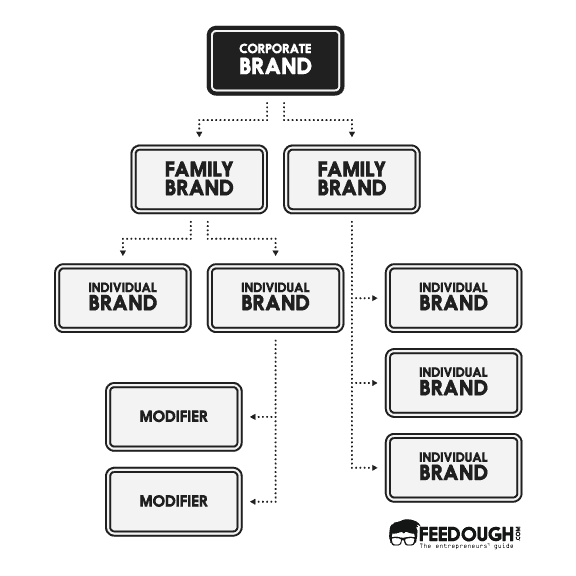
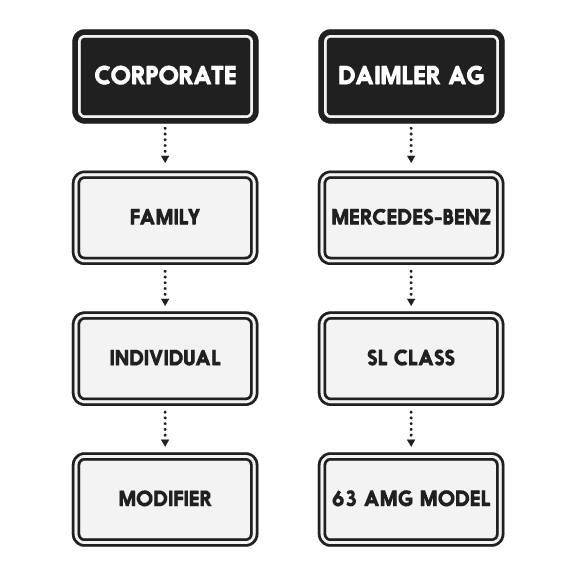
    As the name suggests, brand hierarchy is a hierarchical structure. It constitutes multiple levels. These levels start from the corporate brand to the family brand, to individual brand, and lastly to the modifier and descriptor. Here is a comprehensive description of all the levels with the example of Mercedes:
     brand hierarchy example

    Corporate Brand

    The highest level of the brand hierarchy is the corporate brand. This is the main company/corporate brand.

    For instance, we commonly refer to Mercedes cars as part of the brand Mercedes. But the corporate brand of Mercedes is actually Daimler AG. Daimler is the over-arching corporate brand to other family brands under it.

    Family Brand

    The next lower level in the hierarchy is the family brand. It is also known as the ‘range brand’ or the ‘umbrella brand’. It is called the ‘family’ brand because it may have a range of products under it, but it is not the corporate brand.

    For instance, Mercedes-Benz Cars & Vans, and Daimler Trucks and Buses are the family brands to Daimler AG. Then under Mercedes-Benz Cars, they have various classes and cars.

    Many times firms may not have a corporate brand over them. In such a case the corporate brand level and family brand level collapse as one. A very famous example of this is Apple Inc. It is the corporate brand and family brand for itself since:

    • It has no corporate brand
    • It has a range of products under it

    Individual Brand

    Individual brands are linked only to a single product category. This doesn’t mean it has only one product. It can have multiple product versions, models, colours, etc.

    For instance, the Mercedes family brand has individual brands like the SL class and GLC class. So SL class is one individual brand below the family brand – Mercedes.

    Product Modifier And Descriptor

    The product modifier and descriptor is the smallest and lowest part of the brand hierarchy. It helps customers identify the various products under the individual brand.

    For instance, under the SL Class individual brand, there are various models like – 63 AMG, 65 AMG Roadster, etc. These models are the product descriptor. They are not further sub-divided, but they give more information about the product model and help customers differentiate between models of the same individual brand.

    How To Create A Brand Hierarchy

    Brand hierarchy strategies are created when you begin to engage with multiple product lines. In such a situation it becomes stressful for a business to manage the diverse range of products, and it becomes confusing for customers. Brands also tend to take heavily passionate decisions and release distinctive ranges of products but execute the management poorly. Have a look at Sony for example. Sony has not been able to ace the tech industry despite its exceptional quality. This is largely because it uses the same corporate brand for all it’s products whether mobiles, cameras, digital books, toys, and even its music label.

    Luckily, creating a blueprint for your brand hierarchy is not as hard as it may seem. Here are 3 simple steps to help you build your brand hierarchy:

    Identify Your Product Groups

    Begin with identifying what are the products or services that your brand is offering. Ask yourself the question –

    Can these products be separated and segregated into categories?

    The first step is all about analysing your current brand structure. To do so, you can analyse what your employees and consumers find confusing about your product range. When your brand’s name comes up are they too confused about what you sell?  Based on this analysis divide all individual products into broader categories.

    For example, if you are Procter and Gamble. Your product lines are – detergent, grooming products, baby care products, etc. These are far too diverse and so you must create a brand hierarchy.

    Determine Your Levels

    Now that you know about your product categories, you need to determine how many levels do you want to divide the products on. To determine your levels, make sue of two principles:

    Principle Of Simplicity

    Do not complicate your hierarchy with multiple divisions and sub-divisions. Keep it simple. If you need 2 levels, stick to 2. If you need 4 levels, stick to 4.

    For instance, Starbucks sells a wide range of products like – Coffee, Tea, Mineral Water, and Kitchen merchandise. Their products are different, but not majorly different. Therefore, they decided to stick to two levels. The corporate brand and the family and individual brands were combined with the products. Though a few descriptors like freshly brewed, cold brewed, etc. do exist to avoid confusion of customers.

    Principle Of Clarity

    Make sure your hierarchy is clear. The purpose of a brand hierarchy is to minimise confusion, not create more. Let’s say your product mix constitutes mobiles, buildings, and insurance policies, like Samsung you definitely require a brand hierarchy. But if it is not very diverse, and closely related then you must have a minimum number of fo levels clear for your consumers to understand.

    Creating The Brand For Each Level

    Your brand hierarchy is coming alive. You have separate brand categories ready to be launched. But before you complete this, you need to plan your branding strategies for the brand at each level.

    Brand Elements

    Create associations for your brand through brand elements. This step may be a lengthy and time-consuming step. But by creating a brand hierarchy you have given birth to smaller brands and product models under a larger corporate brand. As any new brand would require you to create the brand elements from scratch so do these new baby brands.

    Principle Of Commonality

    While moulding your new individual brands find a common aspect for your customers to cling onto. For instance, Apple uses the alphabet ‘I’ with its products, McDonalds uses ‘Mc’ with all its dishes. Such common aspects intrigue the interest of customers and help them create associations with your products.

    Marketing Strategies

    A big part of creating your brand is determining the marketing channels for your brand. Will a referral marketing strategy suit your product or an influencer marketing strategy? While determining your marketing plan you will also have to make note of :

    • What are your marketing goals?
    • Who is your target audience?
    • What are the metrics that you want to track?
    • What is your budget?

    Importance Of Brand Hierarchy

    Marketers create brand hierarchies for numerous reasons. Brand hierarchies are important because as products become more different it becomes difficult for brands to retain their product meaning for consumers and employees. Therefore, through a brand hierarchy brands can evoke specific associations across numerous products. The following are reasons why brand hierarchies have become increasingly important today:

    Prevents Customer Confusion

    When customers are offered too many choices under one brand name it creates confusion. Confused customers will never understand your offering and therefore may not buy your products at all. Through a brand hierarchy, consumers can understand what brand sells exactly what products. It simplifies the choices that consumers need to make.

    Helps Future Business Planning

    Successful branding is affected by numerous factors, but a planned out hierarchy if one of the important elements. If a proper structure is not in place, it gets hard to allocate resources and budgets. With a brand hierarchy, every new brand can build its own elements, associations, and style guide. Brand hierarchies also help plan what marketing materials and financial resources would each brand need.

    Attracts Focused Attention

    When your brands are segregated through a hierarchy you can build a specific brand strategy for each product. This way you prevent brands from competing with each other. Each brand will have its own story to tell and it’s own target audience to market to. This difference will serve as a guiding focus for the purchasing decisions of your target audience.

    Provides A Clear Overview

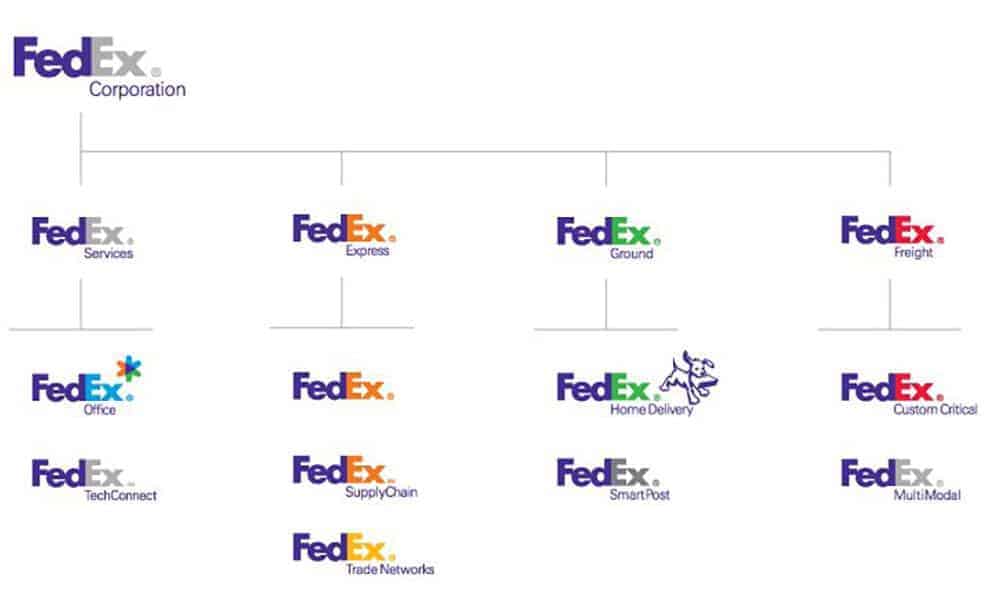
    Brand hierarchy is important because it helps understand a brand’s architecture from a bird’s eye view. If you have multiple products under one corporate brand with no division, your brand structure will look too unorganised and muddled. Therefore, a brand hierarchy helps in having all your specilised brands and products at one glance.
     brand hierarchy FedEx example
    Image Source – Element Three

    Brand Hierarchy Examples

    Numerous brand hierarchies exist in the real world today. Here are a few examples of the most well-known ones:

    Fiat Chrysler Automobiles
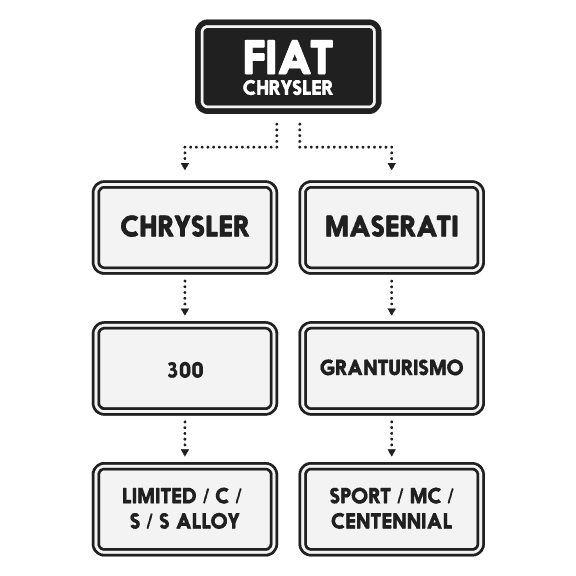
     brand hierarchy Fiat Chrysler Automobiles example.

    The FCA group designs, manufactures, and sells vehicles and their parts worldwide. They are the corporate brand with numerous family and individual brands under them.

    The brand hierarchy looks something like:

    • Corporate brand: Fiat
    • Family brands: Abarth, Alfa Romeo, Chrysler, Dodge, Fiat, Jeep, Maserati, etc.
    • Individual brands: Jeep Compass, Maserati GranTurismo, Chrysler 300, etc.
    • Descriptors: Jeep Compass sport plus, Maserati GranTurismo Sport, etc.

    Mondelez International
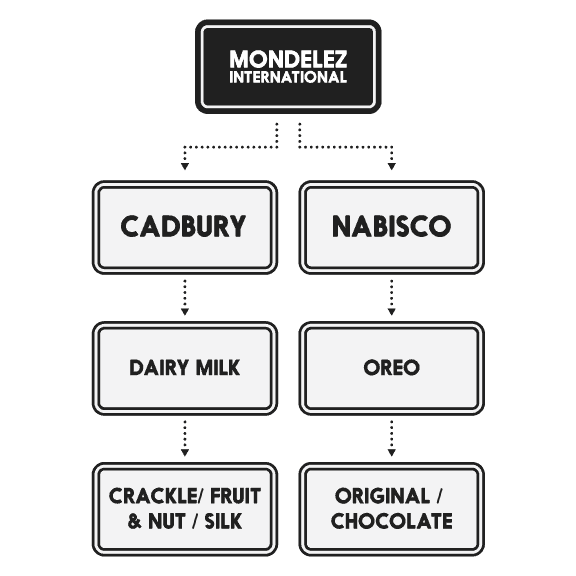
    Brand Hierarchy Mondelez International Example

    The Mondelez International group is one of the largest snack companies in the world. Ever heard of Oreo, Cadbury, Toblerone, Chips Ahoy cookies, etc.? Did you know these are all family brands under the corporate Mondelez International.

    The brand hierarchy looks like this:

    • Corporate brand – Mondelez International
    • Family brands – Cadbury, LU biscuits, Nabisco, etc.
    • Individual brands – Dairy Milk, 5 Star, LU Prince, Oreo etc.
    • Descriptors – Dairy Milk Crackle, Dairy Milk Silk, Oreo Strawberry, etc.

    Pepsico
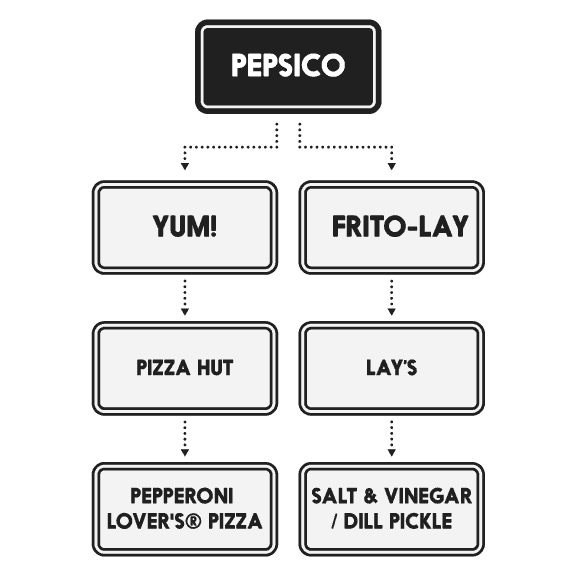
    Brand Hierarchy Pepsico Example.

    Pepsi Co. is another large snack and beverage company in the world. But did you know that Pepsico also owns Taco Bell, Pizza Hut, and KFC?

    Let’s have a look at Pepsico’s brand hierarchy:

    • Corporate brand: Pepsico Inc.
    • Family brand: Pepsi, Frito-Lay, Yum, Quaker, etc.
    • Individual brand: Diet Pepsi, Lay’s, Pizza Hut, Taco Bell, Lipton, Tropicana, etc.
    • Descriptors: Doritos Cheese, Lays Classic, Lipton Lemon, etc.

    Go On, Tell Us What You Think!

    Did we miss something? Come on! Tell us what you think about our article on brand hierarchy in the comments section.
  • Everlane Business Model | How Does Everlane Work & Make Money?

    Everlane Business Model | How Does Everlane Work & Make Money?

    The retail industry is a highly competitive market. The profit margins tether on extreme ends in most of the cases – either the company operates on paper-thin margins that barely cover its costs or charge prices that are more than enough to compensate for any overhead that the company might run into.

    So, how did Everlane, an online retail startup manage to not just thrive but create a niche for itself, netting millions in such a cut-throat market as the clothing industry?

    What did Everlane do differently?

    Let’s find out.

    History of Everlane | The Creation of Transparent Retail

    Everlane is an American clothing retailer that was started in 2010 by Michael Preysman and Jesse Farmer. Everlane is based in San Francisco, California and initially, Everlane operated solely as an online retailer but soon expanded its operations to include physical retail stores.

    everlane logo
    Everlane Logo | Source: Everlane

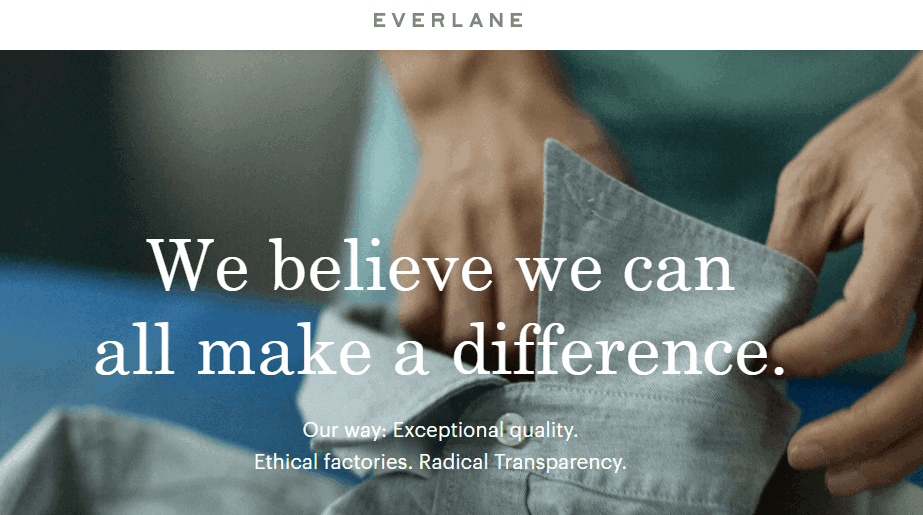
    The founders set out with the mission of creating a company that sold its products with transparent pricing – one were the customers can easily see the breakdown of costs that are involved when manufacturing and getting the product to their hands.

    everlane transparent pricing
    Radically Transparent | Source: Everlane

    Everlane is known to focus on selling luxury clothing that is reasonably priced. Apart from clothing, Everlane also sells other accessories such as bags, shoes and coats.

    For the first few months, Everlane grew at a steady pace and was able to gain a massive user base in the subsequent years – mostly via word-of-mouth marketing. It received around $1.1 million in 2015 – 5 years after starting – as seed-funding and this helped it grow in scale while expanding its operations.

    Everlane Business Model

    Everlane follows Direct-to-Consumer (DTC) business model – a quite popular Business-to-Consumer (B2C) model, wherein Everlane has no middle man in its operations and the customers can buy products directly from Everlane.

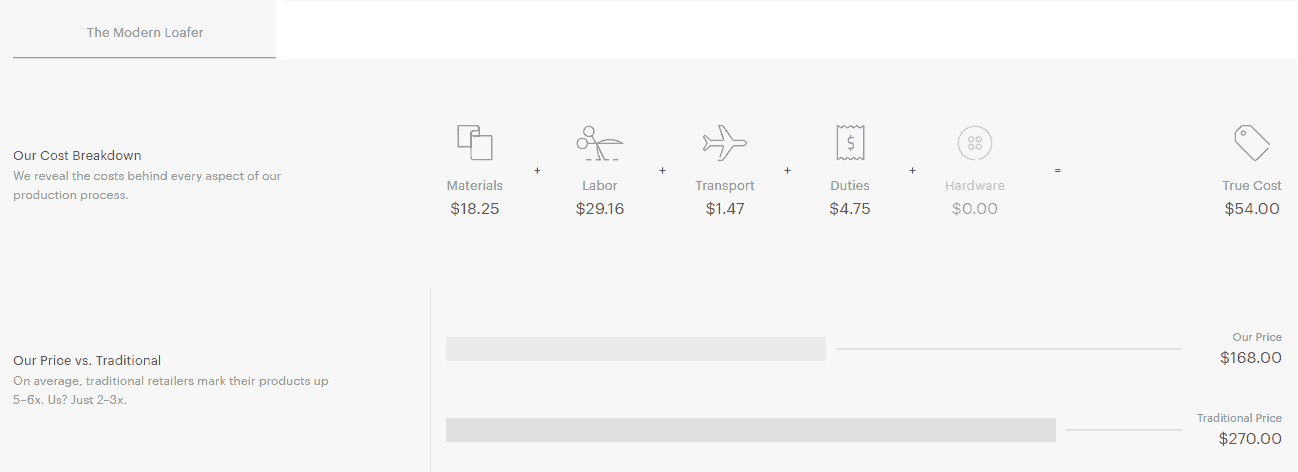
    Everlane’s DTC model is complemented by its highly transparent approach of letting its customers know the exact steps and the cost incurred that each product went through before reaching their hands.

    everlance price breakdown
    Everlane’s Example Cost Breakdown on one of its product | Source: Everlane

    How Does Everlane Work?

    Everlane markets itself solely on its “transparent approach” and tries to educate customers on the behind-the-scenes operations such as to how it sources its raw materials, to the manufacturing and such. This novel yet simple idea seems to have helped lend it recognition and massive word-of-mouth publicity.

    Apart from the “radically transparent” approach adding to Everlane’s value proposition to consumers and investors, its product line-up consists of luxury, high-quality products that are sold at considerably less price.

    How Everlane Prices Its Products | Everlane Pricing Model

    Shrewd Pricing Placements

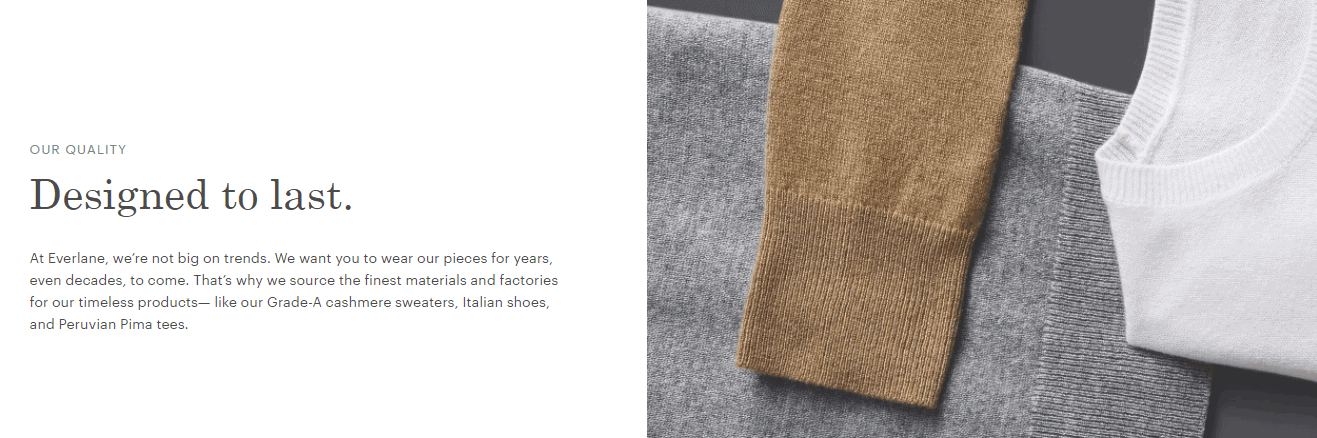
    everlane luxury products
    Everlane focuses on luxury ‘staple’ products | Source: Everlane

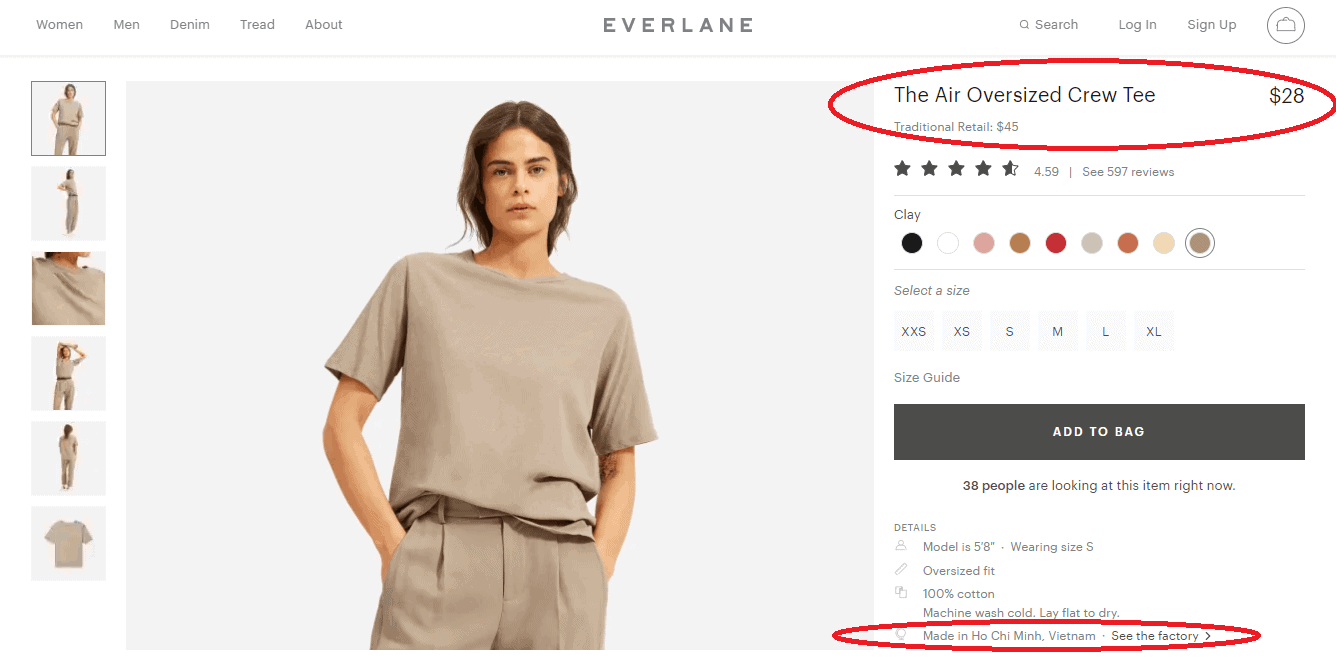
    Everlane prices its products in a well-thought and kind of shrewd manner: it lists the competitor’s price and right below its price to help customers see the competitor’s mark-up for a similar product compared to Everlane’s price. It also lists other details such as the factory the product was manufactured in, helping increase its credibility.

    everlane price comparision
    Source: Everlane

    Building Itself Around the “Choose What You Pay” Model

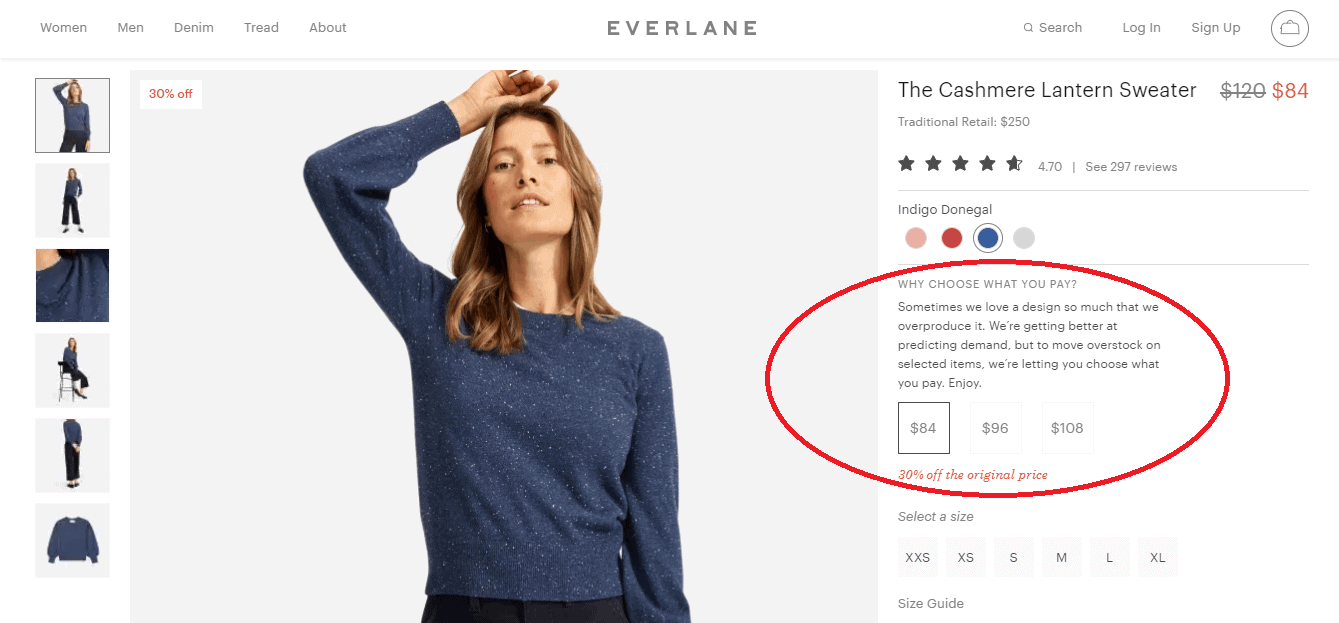
    Everlane also puts further emphasis on its “transparent” approach with its frequently held “Choose What You Pay” sales wherein it offers overstocked items with three different price choices to choose from.

    everlane choose what you pay
    An example of “Choose What You Pay” product page | Source: Everlane

    The base price covers the basic costs while the other two prices help cover overheads.

    choose what you pay
    Source: Everlane

    This not only helps Everlane stand out from a crowd of competitors, but it also help build a premium brand image for Everlane and creates a sense of connection with its customer since they seem to be the only ones telling the truth in a market filled with markups and cut-throat pricing.

    The Power of ‘8’

    Notice how Everlane prices most of its products to end with a ‘0’ or ‘5’ or ‘8’ across all product ranges and offerings.

    everlane specific pricing
    Most of the prices end with an ‘8’

    This specific pricing strategy helps achieve two things:

    It feels as if Everlane actually thought and considered their prices for each item that they sell individually and not just marked everything that ended with a ‘9’. You see, customers are used to seeing prices of products usually ending with a ‘9’ and companies do that to make their product seem cheaper when they are not. On not pricing every product to end with a ‘9’, Everlane subtle nudges the customers to feel as is they are not haphazardly pricing their products but taking the time to price it right.

    This also makes the products look a bit more premium while the “transparent pricing” helps customer believe that they are getting a premium product for the “right” price.

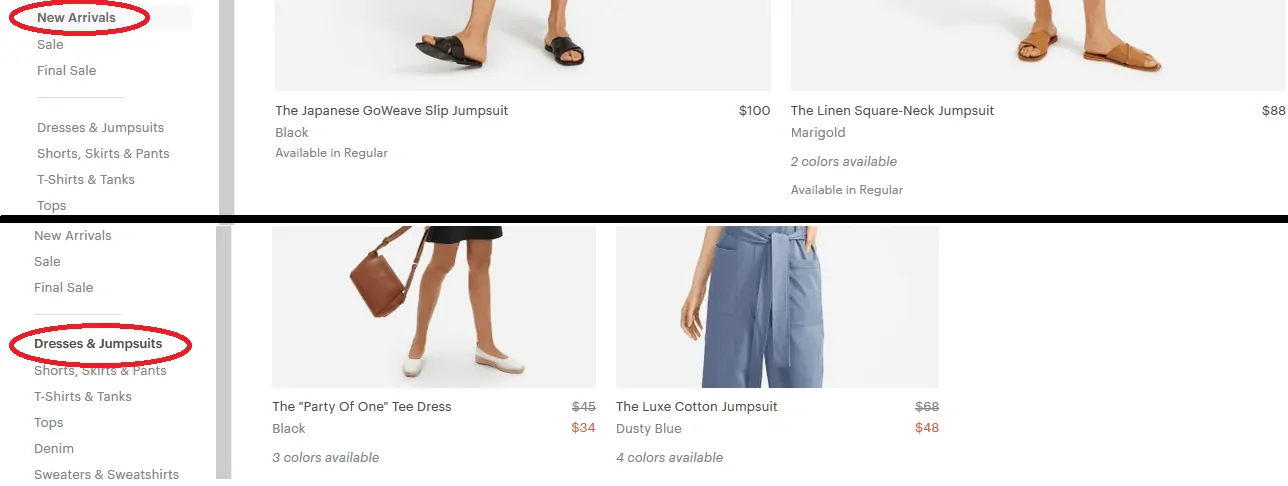
    “Higher Priced” New Arrivals

    Everlane tends to price their “new arrivals” at a significantly higher price than the rest of their offerings.

    everlane new arrivals

    Not only does this make customers perceive the brand to be more “premium” than it actually is, but it helps later on when Everlane can reduce the prices to a more reasonable range and make it look like the premium products are now on discount. It’s a win-win at both stages.

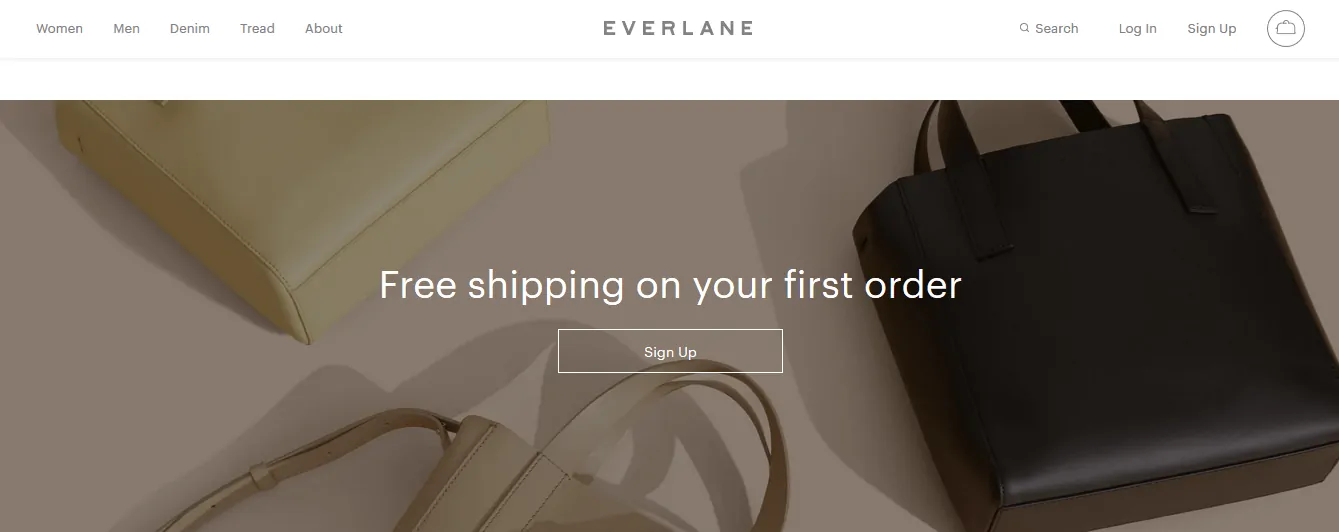
    Free-shipping on Customer’s First Order

    Everlane captures its customers better than most companies tend to do by offering well-thought-out additions such as free shipping on every customer’s first order.

    everlane free shipping

    This simple yet thoughtful additions of providing free shipping at the start helps increase customer loyalty to its brand and doing so does not even affect the margins by much and the benefits outweigh everything else.

    Which brings us to –

    Everlane’s Key Partners

    Celebrities & Influencers

    Everlane has benefited from the great publicity that it receives from bloggers, influential personalities. This is further boosted by many well-known celebrities even endorsing or using Everlane products in public.

    everlance social media
    Meghan, Duchess of Sussex seen wearing an Everlane tote | Source: whowhatwear

    Factories

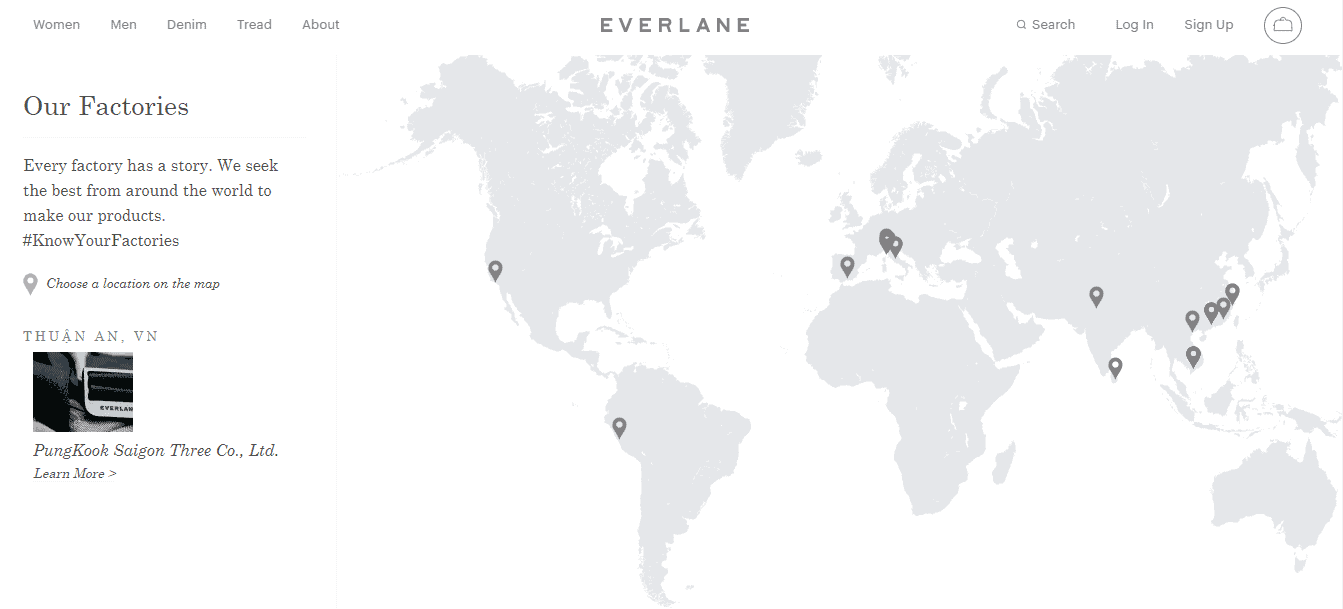
    Everlane prides itself on using only ethically sound and safe factories to manufacture its products.

    everlane factories
    List of Everlane’s partnered factories | Source: Everlane

    Everlane selects and works directly with factories around the globe and attributes as a more “hands-on” approach that helps them provide high-quality products at a reasonable price.

    Distributors

    Everlane outsources its shipping and distribution to a large, family-run distribution centre outside of Chicago for its entire line. Working with a single distributor helps Everlane to manage distribution costs with fine control.

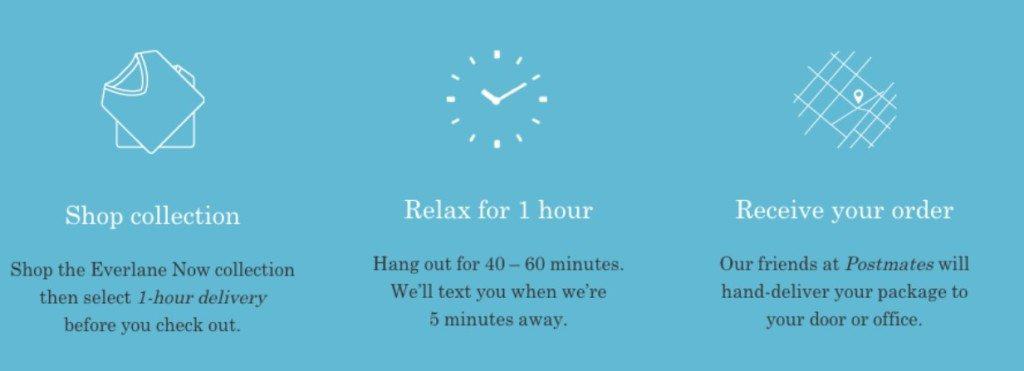
    Everlane has also partnered with Post Mates, an on-demand grocery delivery service, to provide its customers with the option of getting certain products delivered within an hour from ordering. This 1-hour delivery is applicable only for products under the Everlane Now collection.

    everlane now
    Source: Everlane

    So –

    How does Everlane make money if it sells at a lower price than the rest of its competition?

    How Does Everlane Make Money? | Everlane’s Revenue Model

    Retail Sales

    Everlane is through and through retail business and makes most of its revenue from retail sales via its online and physical stores.

    Everlane manages to keep costs down with its aggressive inventory management. It usually manufactures less than the estimated demand – quite the opposite of what most companies do – and maintains a simple product line with less variability in design and colours.

    Final Thoughts

    Everlane’s approach and its business model seems simple enough but works. This might be attributed to a few reasons –

    Today’s consumers are more aware and brand-conscious. News travels fast and any misgivings in the method of sourcing and manufacture are not taken lightly. The ethicality of manufacturing & selling products have also become a major factor that customers consider before choosing to buy from a certain brand. Everlane has managed to create a good image everywhere – be it in media or among the consumers.

    All this has helped in Everlane’s growth and popularity in the clothing industry and this trend only seems to continue upwards as things currently stand.

    Go On, Tell Us What You Think!

    Did we miss something? Come on! Tell us what you think about our article on Everlane Business Model in the comments section.
  • SaaS Marketing: A How-To Guide

    SaaS Marketing: A How-To Guide

    Have you, in the last five years, used a C.D., floppy drive, or a camera with a film tape?

    Probably not.

    Chances are that most of you are not even relying on purchased software to do your tasks anymore. Most of the tasks are now performed online on the cloud on web-based applications like Google Drive, Onedrive, Dropbox, Spotify, Audible, etc.

    These software on the cloud are often provided as software as a service where you don’t actually buy the software, you buy a subscription or pay as you go for the service used.

    But how do companies sell such online software to you? More importantly, if you want to market software as a service, how do you market it successfully?

    Welcome to the era of SaaS marketing.

    Here is a comprehensive guide to help you understand what exactly does SaaS marketing means, how does it work, and how can you use it to market your software.

    What Is SaaS Marketing?

    SaaS marketing refers to marketing software as a service through cloud-based applications, usually by way of a subscription model.

    Under this form of marketing companies sell web-based software services. Such services are usually sold through pay-as-you-go models like a subscription plan.

    What Is A SaaS Product?

    A SaaS product is a third party application that is accessible over the internet with no physical connection to any device.

    Some examples of SaaS products are Google Drive, Onedrive, Dropbox, Slack, Hubspot, Wordpress, etc.

    SaaS is one of the three categories of cloud computing services. The other two are:

    1. IaaS – Infrastructure as a Service
    2. PaaS – Platform as a Service

    In such a SaaS business model, businesses host and manage servers, databases, and the codes required for an application to function, while the user access and using just a basic computer and internet.

    Some of the top SaaS providers comprise of Salesforce, Oracle, and Microsoft.

    SaaS Marketing vs Traditional Marketing

    The three main differences between SaaS marketing and traditional channels of marketing are:

    Sale Of An Intangible Product

    Convincing a user to buy an invisible software is what SaaS marketing is all about.

    Unlike traditional software, where the user had to make sure his system is up to the mark to run a product bought the market, SaaS platforms do not need any kind of physical installation of the application. A SaaS business hosts, maintains, and updates the application automatically.

    What is offered to the user is a service that solves his problem over the web.

    Shorter Sales Cycle

    When it comes to B2B sales, several businesses consider 12 months to be a good sales cycle.

    However, when it comes to SAAS sales, the average sales cycle is about 84.3 days.

    With SaaS products, there is no window-shopping. The whole buyer’s journey differs. The user reaches the brand website after doing some online research which was triggered by a need or want. The marketer nurtures this lead by providing a trial or demo of the product and the user either becomes a customer within two-to-three months or churns out.

    There are no long and drawn out sales engagements and follow-ups like B2B sales. Software is getting improved by the minute. Therefore, SaaS customers and businesses actually convert to purchase very analytically and quickly.

    Long Term Customers

    SAAS sales doesn’t end with just the sale of the offering. It runs on a subscription model where most of the revenue comes from the existing customers. Often, 80% of the revenue comes from just 20% of the customers. These 20% customers are the long term subscribers of the offering.

    How To Create A SaaS Marketing Strategy?

    Developing a SaaS marketing strategy is similar to developing any other marketing strategy. All you need to do is to develop a marketing funnel after understanding the consumer behaviour and the buyer’s journey.

    Consumer behaviour is the study of how consumers make decisions about what they need, want, and desire and how do they buy, use, and dispose of goods.

    The buyer’s journey refers to the steps that a buyer goes through before purchasing a product.

    In simple terms, to develop a SaaS marketing strategy, you first need to understand why consumer will buy your offering and what will lead to this purchase.

    Once this is done, you develop a SaaS marketing funnel.

    A SaaS marketing funnel is the sales and marketing process of your SaaS business panned out from start to end. It includes the entire process of how you introduce your product to potential customers, how you convert, how you upgrade and nurture the relationships with existing customers, etc.

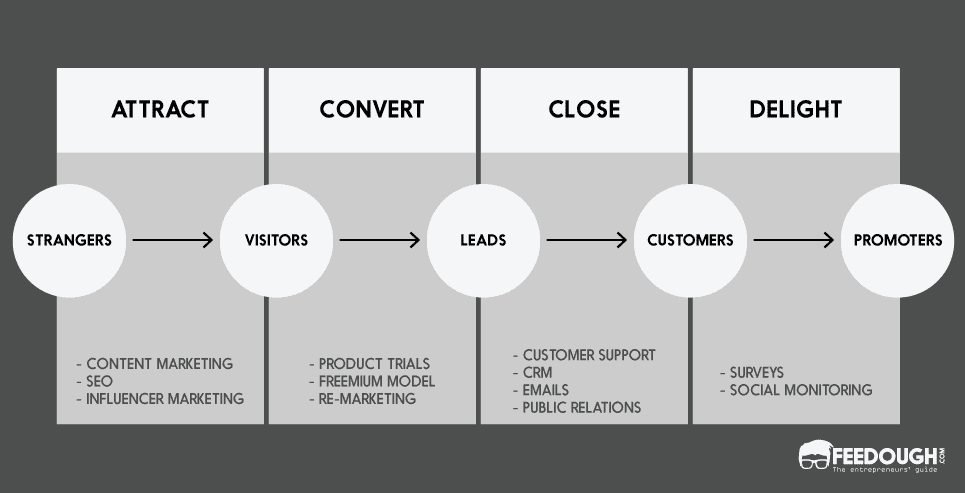
    SAAS MARKETING FUNNEL

    To begin creating your SaaS marketing plan, follow the 4 primary stages of the funnel:

    Stage 1 – Brand Awareness – Attract

    The first step toward any marketing process is to attract strangers to notice your brand or the offering.

    This stage usually involves using these SaaS marketing strategies –

    Content Marketing & SEO

    Content marketing is a widely used SaaS marketing strategy. Numerous SaaS marketers like Dropbox, Intercom, etc make extensive use of this.

    It is a strategic approach where you identify the buyer’s journey and provide him valuable, relevant, and consistent content to answer his questions and clear his doubts regarding the niche you operate in.

    A successful content writing strategy must make sure to provide engaging and attractive features in its content. Think about what are people buying your SaaS product for? Is it for entertainment or data management or marketing? Create content focusing on such interests and your product and optimize it for the search engine.

    According to research, 60% of shoppers begin their research on a search engine. That’s where they search if the offering for their need exists, the best offering out of the lot, what factors to consider while subscribing to the offering, and how to get a deeper knowledge about the niche. This is where content marketing helps you to establish a brand image.

    For instance, Hubspot made tremendous sales by engaging in a rigorous content marketing strategy. They create content related to the marketing domain about aspects directly/indirectly related to their marketing services.

    Influencer Marketing

    You can also make use of influencers to market your software as a service, depending upon the niche. This strategy involves partnering with known influencers in the niche you operate in to promote your offering or brand to the target audience to increase exposure and sales.

    Audible is a perfect example of a SAAS company that successfully integrated an influencer marketing strategy to attract customers. The company partnered with an influencer marketing agency to promote its #newyearnewme campaign to increase its brand exposure.

    The results were in the brand’s favour.

    audible influencer marketing

    Stage 2 – Convert

    Once the brand awareness is spread and the potential customers start visiting the offering’s website, the next stage would be planning how to make them convert.

    Some strategies that help you convert visitors to customers are –

    Product Trials

    If you were a traditional business, giving away free product trials would might not make sense to you.

    For SaaS businesses, it’s quite the opposite.

    Product trials and free usage are win-win for SaaS marketers. How?

    Imagine if you want to buy 1TB of online cloud storage space.

    Google Drive is one contender for it (It costs $9.99).

    Dropbox provides it too, and so does Amazon Drive, Onedrive, etc.

    Now, since most of these services are priced similar and even offer similar features, there is a lot of customer friction in attracting the customer to your offering.

    Let’s take another scenario –

    You just found out that a new remote workers management platform is released with most of the features you wanted for your team. The SAAS is priced at $10 per person per month and you have a team of 20 people.

    Now, since this is a new platform and there aren’t much reviews about it, it’ll not be a nice decision to dedicate $200 to it per month before even trying it.

    Not only you, but most SaaS customers would choose to get a free trial. ‘Free’ is like the oil to make your SaaS marketing engine run smoother and quicker. Product trials may include:

    • Time-bound trial. Example – Netflix 30-days trial.
    • Usage-based trial. Example – Buffer’s 3 social media network limit in trials.

    Freemium Model

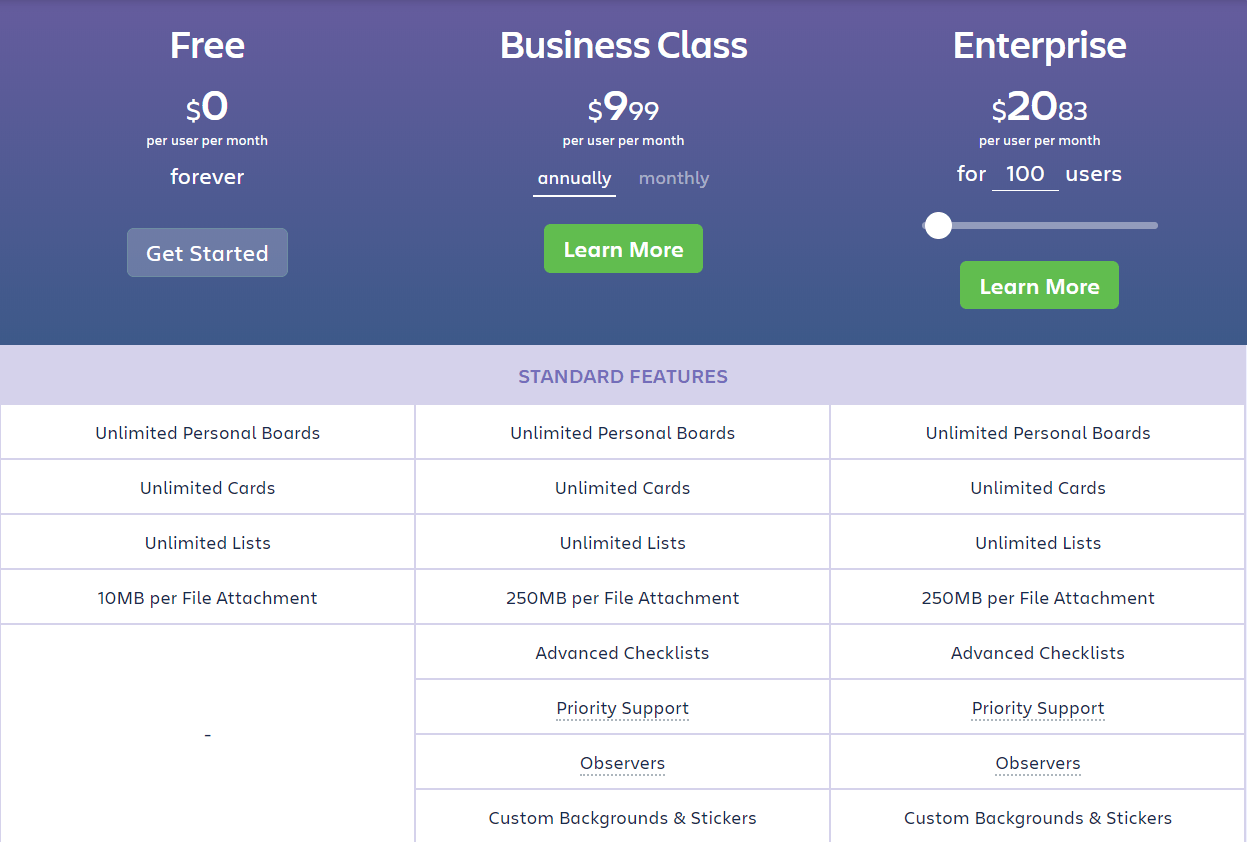
    Freemium is an internet-based business model where the basic services are provided free of charge but charges are levied on additional premium features. That is, you get to use the basic functionality of the SaaS for free but would be asked a price if you wish to upgrade or want an addon.

    Trello is a great example of an SaaS running on freemium business model. It is a collaboration tool that helps you manage your team and work better remotely. The basic functionality of the tool is provided for free to everyone. However, to avail third party integrations and other add-ons, the user has to subscribe to the premium plan.

    trello pricing

    Remarketing

    Remarketing facilitates the conversion of customers who didn’t convert to purchase in your first attempt. This would help re-engage those people who left your website without purchasing your software. For SaaS marketers re-marketing could range from:

    • Following up with people who left your website without buying or who left too soon, with the help of paid advertisements.
    • Offering them special discounts to convince them to convert.

    Stage 3 – Customer Relationship

    SaaS models are heavily based on subscription models. This means that your customer will be in contact with you for a much longer time than a customer for any other tangible product like toiletries, household products, etc.

    Therefore, a purchase doesn’t mean that your business is over. This is where the business starts for most SaaS offerings. You need to maintain your relationship with the customer because you want them to come back to you after their subscription expires instead of your competitors.

    Whether it is through loyalty programs or customised emails keep reminding your customer that you value them. Here’s what you can do to manage healthy customer relationships –

    • Use a CRM platform to keep track of every customer.
    • Send occasional emails according to the customer relationship with the brand to increase loyalty and remind them about your offering.
    • Maintain a responsive and proactive customer support team that focuses on reducing customer grievances.
    • Have an efficient public relations strategy to maintain a good public image among the target groups.

    Stage 4 – Feedback And Referral

    So now the final stage while planning your SaaS marketing funnel would be to gain feedback from your customer and delight them. Your customer knows about your software. Your content influenced them to buy it. It’s been 6 months since your customer has been using your software. Your customer is satisfied. But a marketer’s pursuits never stop. This means that if you receive poor feedback, take it constructively and re-build and re-plan. There are numerous survey tools that you can use to get feedback and can even track social media networks and other review websites for customer feedback and experience stories. But make sure that you actually work on what feedback your customers give.

    The main ingredients of this delight stage are:

    1. Impresses customers
    2. Boosts referral marketing
    3. Immense boost in lead generation
    4. Organic promotions.

    Though this is a four-step process, it doesn’t mean that your SaaS marketing funnel ends here. You must attempt to understand what metrics matter in the SaaS industry and analyse your business according to those metrics.

    What Are SaaS Metrics?

    SaaS marketing is a difficult form of marketing because selling virtual software is different from every other form of marketing. In such a case it is vital to be aware of the metrics that matter for your SaaS marketing funnel. The top metrics to compute and analyse out for are:

    Churn rate

    Your churn rate is an important metric for SaaS marketing because of two reasons:

    1. Customer retention in the case of SaaS products is inexpensive
    2. Because of a subscription model, there is a high chance your customers leave after their subscription ends

    Churn rate will help determine how many customers leave. A high churn rate will mean – Focus on stage 3 customer relationship and stage 4 of feedback and delight of the SaaS marketing funnel. A low churn rate means – Focus on building brand authority and attracting new customers through stage 1.

    Customer Acquisition Cost & Average Revenue Per User

    Customer acquisition cost (CAC) is a useful metric for SaaS marketing because the money spent on developing software and applications is large. Therefore, you must ascertain how much additional money you spend on acquiring customers. After knowing your CAC, compare it to your Average Revenue Per User (ARPU).

    Let’s say you spend $100 on gaining one customer. You gain $74.99 per customer from your subscription cost. This means that you are under a constant loss of 25.01% because you are spending more on gaining customers than you gain from their revenue. But actually, 25% is quite low, because your customer will pay $74.99 every month, but you spend $100 on one customer only once.

    Demo-Trial Ratio

    The demo to trial ratio helps understand how many trials and demos are converting into sales. Since SaaS is heavily based on subscription and product trials, people may try to get free trials out of you every time. This would mean huge losses for your business. Measuring your demo-trial ratio metric helps ascertain how many trials turn into closed deals. Is your number high enough? Is it gradually dropping?

    Net Promoter Score

    The last metric toward a successful SaaS marketing funnel is the net promoter score. The NPS helps measure how likely are people to recommend your service to others.

    Imagine this – Your sales are average, your content is excellent, and your product trial offers are excellent. But your company has not been growing for 2 years now. You are stuck at this average stage with excellent content. What to do? In such a situation, NPS will help you understand how your customers feel about your product. Do they want to recommend it to others because it is good? Or they rather not recommend it because it is mediocre or unsatisfactory? The NPS helps the fourth stage of the SaaS marketing funnel – feedback and referral.

    Best SaaS marketing campaigns

    Canva

    Canva is a graphic designing website. It is SaaS in the sense that they offer intangible and online graphic designing tools to customers. Canva heavily relies on two models of SaaS marketing:

    Freemium Model

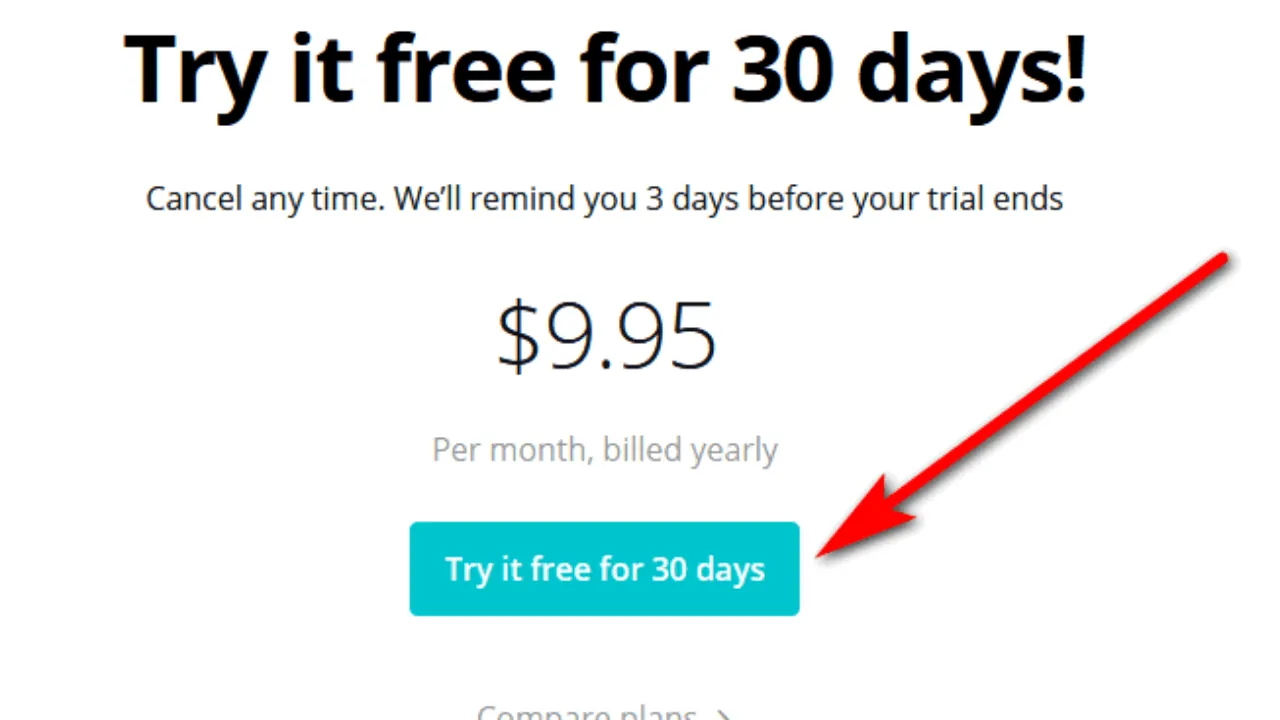
    Canva offers a set of free basic tools and templates for 30 days. The 30-day trial makes customers hooked on to the product. Once users have developed a habit of the product, it would be easier to make them purchase the service.

    Freemium Model

    Influencer Advocacy

    Mainly through social media and YouTube, Canva promoted its SaaS business. They contacted YouTubers to make video tutorials on how easy it was to use Canva, and social media influencers to share content made on Canva to show how appealing and attractive it is.

    Dropbox

    Dropbox is a file hosting service that sells cloud space for data storage. It is one of those SaaS businesses which seem difficult to market and advertise about. How often do you discuss file hosting and storage with your friends? Probably not at all. But Dropbox still managed to do it pretty efficiently. Two of the SaaS marketing strategies heavily followed by them is:

    Referral Marketing

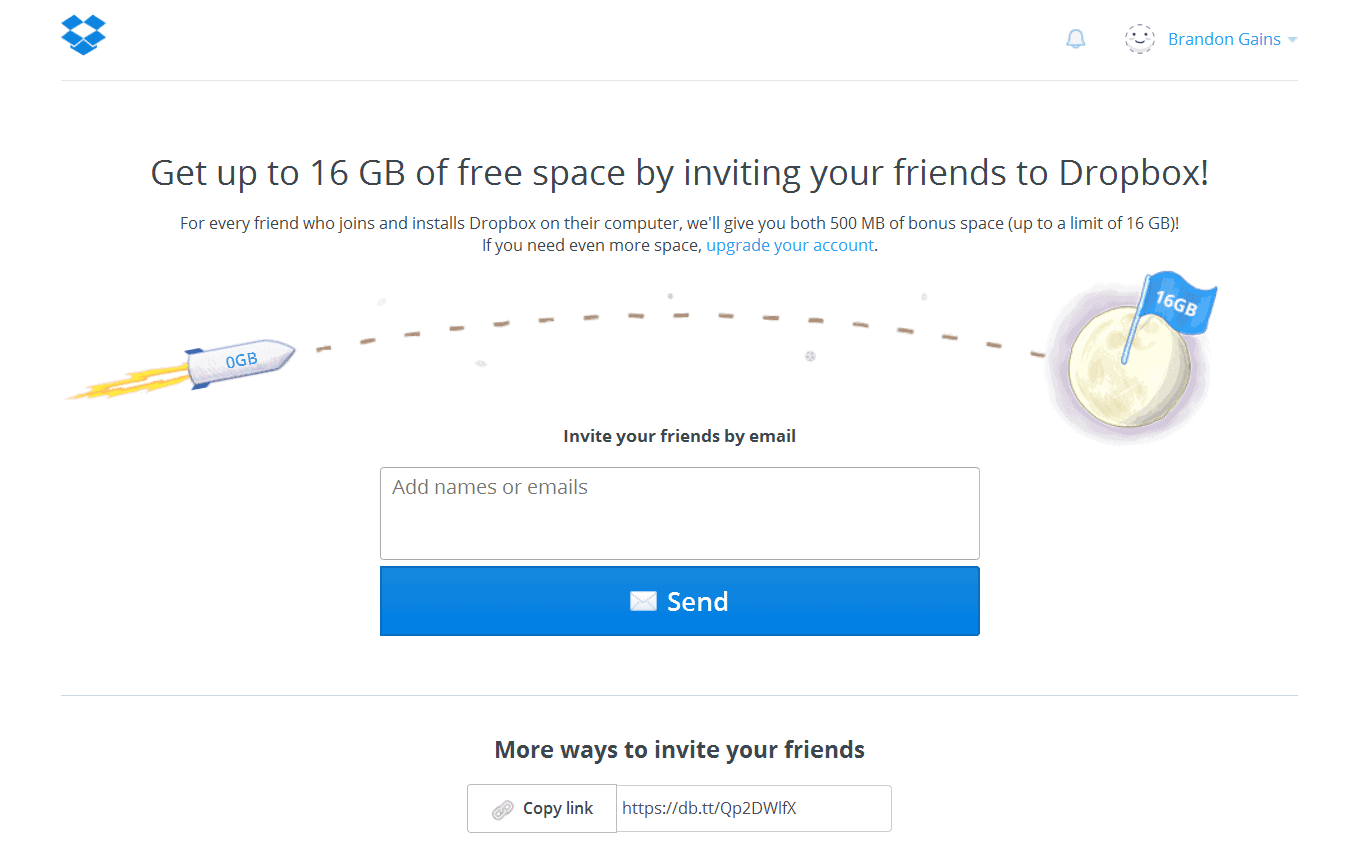
    Dropbox introduced an offer through which you could invite your friend to use Dropbox and then both of you could gain 500MB of extra cloud space. This increased Dropbox’s referrals by a big 60%.

    dropbox referral marketing

    Content Marketing

    Dropbox has a complete blog page. They use this to create content that either directly promotes their products through how-to guides and descriptions of features. They also create content that indirectly markets their service through new developments in the technology field, interesting projects taken up in the technology field, etc.  

    Go On, Tell Us What You Think!

    Did we miss something?  Come on! Tell us what you think of our article on SaaS marketing in the comments section.
  • How Does Stripe Work? | Stripe Business Model

    How Does Stripe Work? | Stripe Business Model

    The online payments sector only looks like it is going to increase in scale and size as more and more businesses and consumers become comfortable with online transactions. E-commerce is already a trillion-dollar industry as of 2019 and most of that was online, facilitated by payment processors and payment gateways.

    Payment processors have come a long way and become a major part of any business, be it physical or online. There are a countless number of payment processors out there – new and old alike.

    But even among this stiff competition in the online payments space, Stripe is often the go-to option for many businesses and individuals alike.

    So, how did Stripe become a major player in the payments industry, beating even PayPal, which had an 11-year head start over it?

    Let’s find out.

    What Is Stripe?

    Stripe is an American fintech company that offers payment processing services to individuals and businesses for making payments over the internet.

    stripe logo
    Stripe Logo | Source: Stripe

    Stripe was launched in 2009 by two brothers – John and Partick Collison – under the name /dev/payments, which was later changed to Stripe. Stripe was able to take off right from the get-go. It was seed-funded by Y Combinator – a startup accelerator and the growth of Stripe can be largely attributed to the ability to easily integrate its payment solutions into existing services.

    Growth of Stripe

    Stripe was created with the main goal of making the implementation of payment systems easier.

    Accepting payments online is a complicated task –

    It requires businesses to set up a merchant account, take care of online security, safeguard itself from frauds, comply with various standards, individually and all on their own. This gets more complicated when you factor in international payments. Setting up a merchant account with the necessary infrastructure in itself could take from days to even months.

    Stripe (and payment processors in general) makes it easier for everyone to make and receive payments. Stripe allows businesses to start making and receiving payments by just adding a few lines of code to their website or app.

    This is regarded as the main cause for their critical success – their payments system was simple, straight-forward and easy to implement. Moreover, Stripe focused on making their payment solutions developer-friendly by proving that their service was extremely simple to integrate into their customer’s existing platforms. This pushed more developers to start using Stripe rather than its competitors.

    All this growth is reflected in the current valuation of Stripe. As of writing, Stripe is valued at over $35 billion and is available in over 135 countries. Stripe also accepts payments from different payment methods such as –

    • Credit & Debit cards
    • International cards
    • MasterCard
    • Visa Checkout
    • WeChat Pay
    • AliPay
    • Apple Pay
    • Google Pay
    • Automated Clearing House (ACH) credit & debit
    • Bitcoin
    • And more

    This edges out PayPal and most other competitors in the sheer number of payment methods and currencies that Stripe accepts.

    Stripe Business Model

    Stripe follows a mix of product-based and fee-based business model – it offers payment solutions as its primary product and charges a fee for every transaction. It is to be noted that Stripe does not charge anything for getting started with their payment solutions. It is only when the transactions are made that Stripe charges its fee accordingly.

    So –

    How does Stripe work?

    How Does Stripe Work?

    Stripe functions as follows –


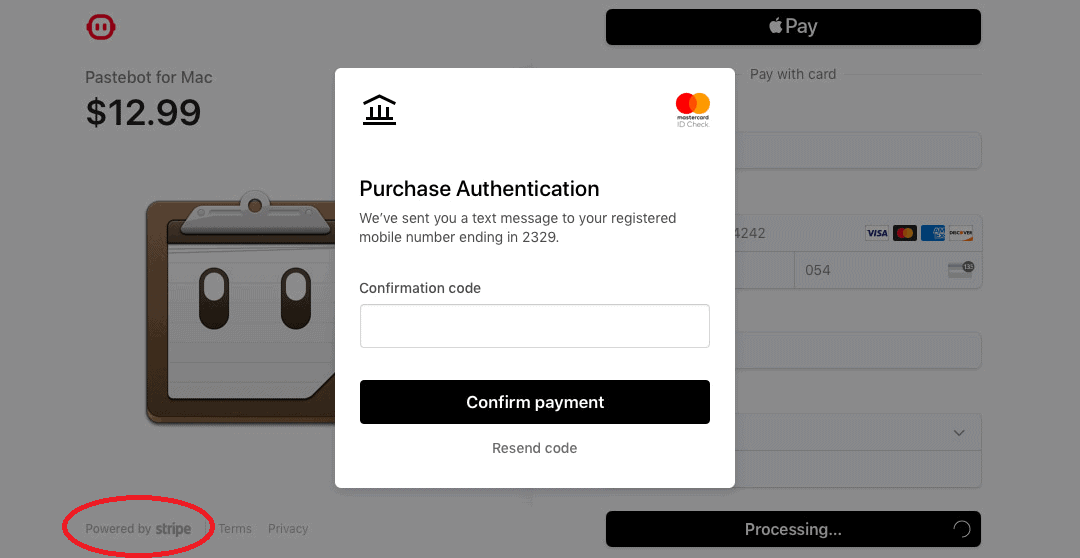
    • It allows merchants to embed Stripe’s payment solutions into their services, enabling customers to make payments.
    stripe integration
    Powered by Stripe | Source: Stripe
    • Stripe makes it possible for payments to take place without the customer’s credentials ever reaching merchants or other parties.
    • This is made possible by Stripe by tokenizing their customer’s data. This makes sure that the transaction takes place as usual and the proper entities are billed while the customer information never gets out of Stripe’s servers.

    The tokenized approach means that Stripe is held responsible for handling the payments but on the other hand, the possibilities of risk and fraud are greatly reduced since it can all be traced back to Stripe as the single entity handling the data and payments.

    Stripe’s Operation Model

    Stripe allows its users to –

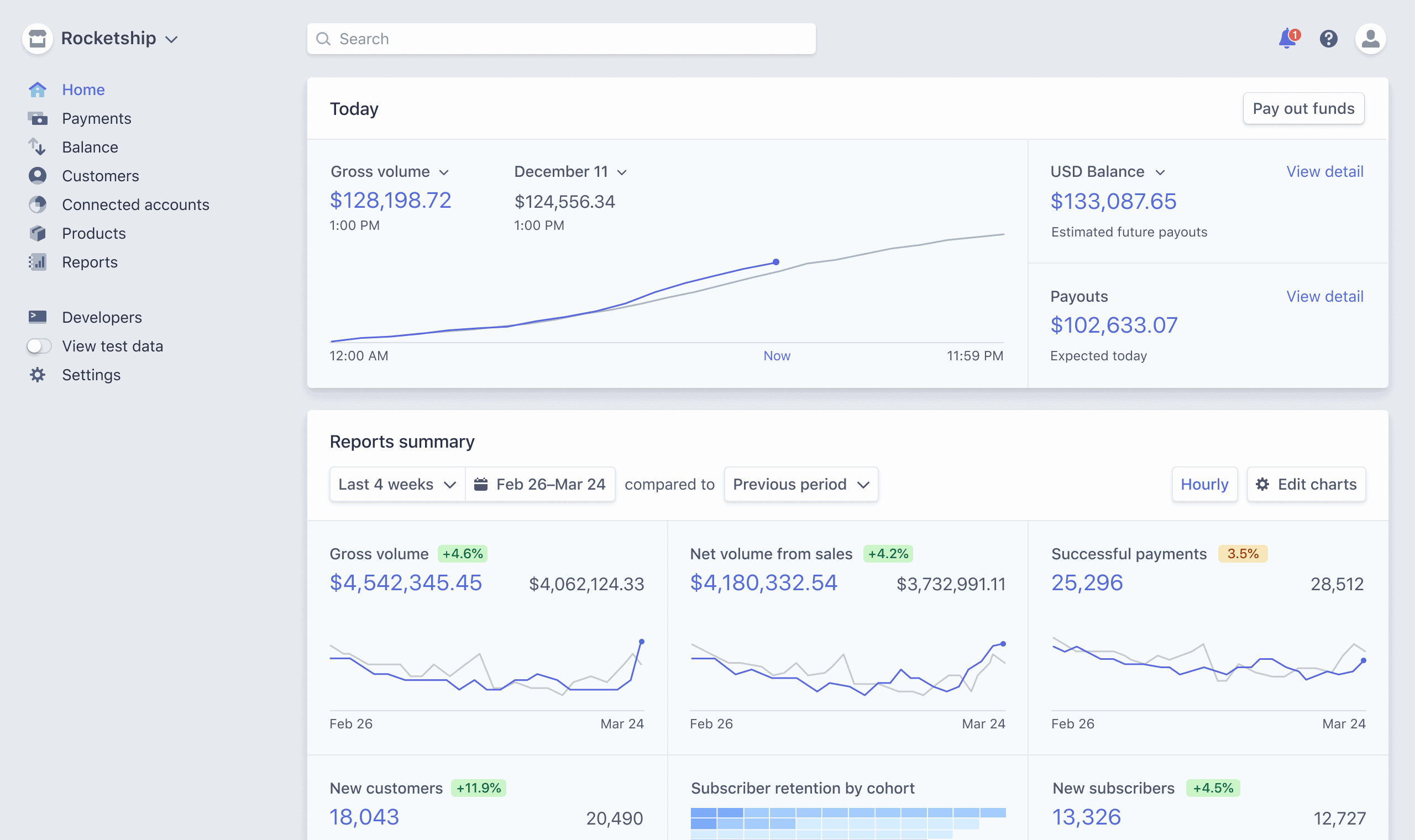
    1. Sign up and make or receive payments right-away using Stripe’s online dashboard
    stripe dashboard
    Stripe Online Dashboard | Source: Stripe
    1. Integrate Stripe’s payment solutions into their website, ecommerce stores, mobile apps & applications
    powered by stripe
    Stripe Integration | Source: Stripe

    This raises the question –

    How much does Stripe charge its users and how does it make money in general?

    How Does Stripe Make Money?

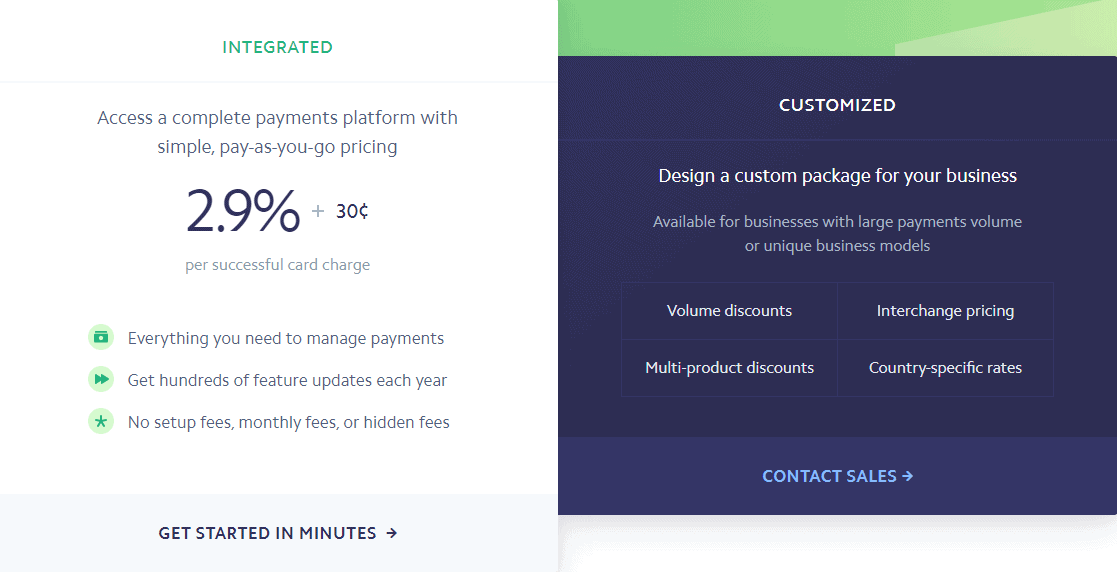
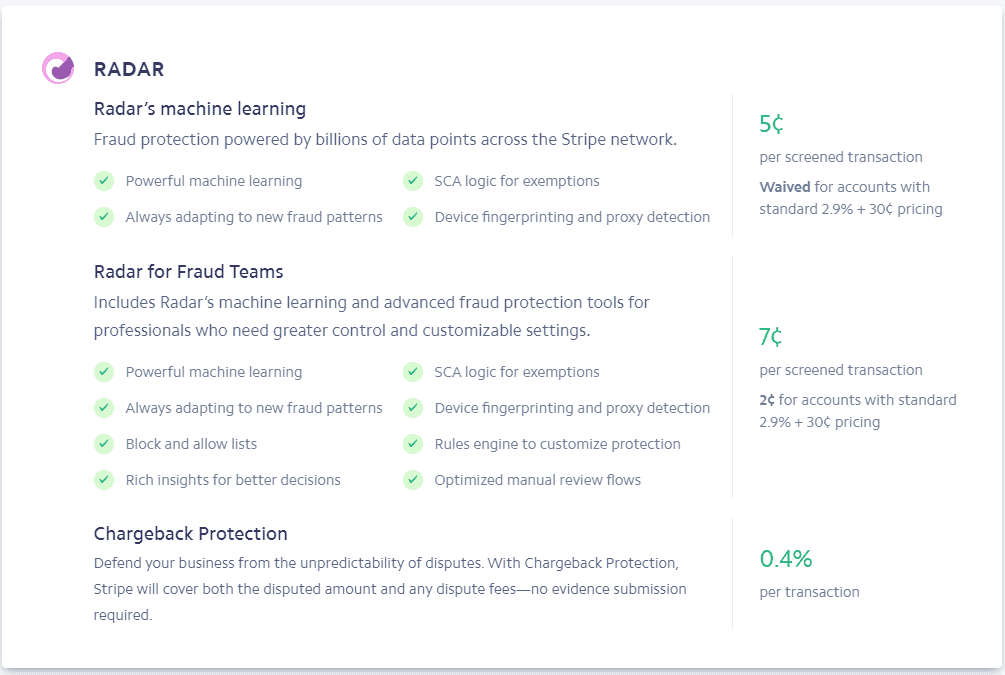
    Stripe makes money on a per-transaction basis. This is based on the Stripe plan that you choose from. Stripe users get to choose between two plans – Integrated & Customised.

    stripe plans
    Stripe Pricing (US) | Source: Stripe

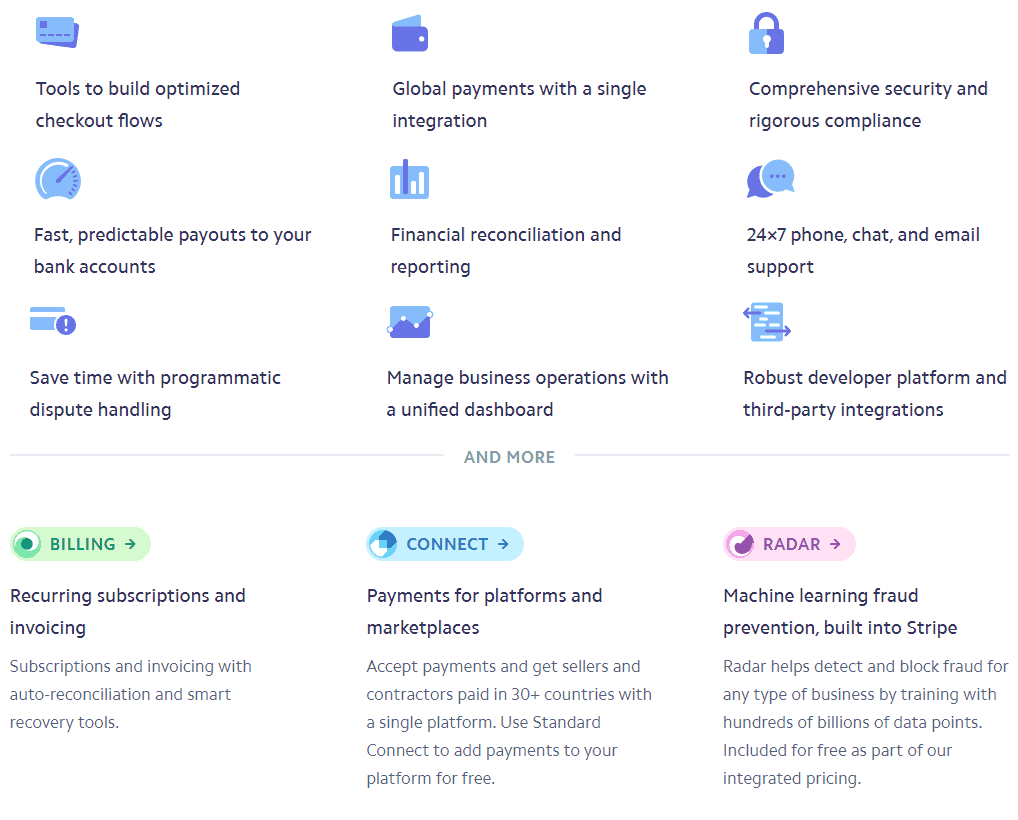
    The Integrated plan has an up-front and fixed fee and comes bundled with different software and services – such as billing tools, analytics, and fraud prevention – that complement its payment & transaction service. Meanwhile, the Customised plan caters to large businesses and enterprises that have large volumes of transactions and follows bespoke pricing.

    Integrated Plan

    Stripe has a different fee structure for the different services offered under the Integrated plan –

    stripe integrated plan
    Features & Services bundled with Stripe’s Integrated Plan | Source: Stripe

    Here’s the breakdown on a per-service basis –

    Payments Fees

    Stripe’s fees vary between payment methods. Here’s the rundown of the fees for different payment methods –

    • Credit & Debit Cards – Stripe’s Integrated plan users are charged a fixed fee – 2.9% + 30 cents for every transaction made using debit or credit cards. Do note that Stripe’s fees vary geographically, so it is better to check for your currency or location.
    stripe fees
    Source: Stripe
    • International Cards – Stripe charges an additional 1% for international payments and currency conversion
    stripe fees
    Source: Stripe
    • ACH & Bitcoin Fees – It charges 0.8% of the transaction amount as the fee for payments made using ACH or Bitcoin. However, the maximum fee that Stripe can collect from this is capped at $5
    stripe payment fees
    Source: Stripe
    • Local Payment Methods Fees – The fee is the same as the fee charged for transactions made using cards.
    stripe fees
    Source: Stripe
    • Instant Payout Fees – Though Stripe provides free payouts from your Stripe account to the bank account, it charges 1% of the total payout amount as fees in case you want to instantly credit it to your bank account.
    stripe fees
    Source: Stripe

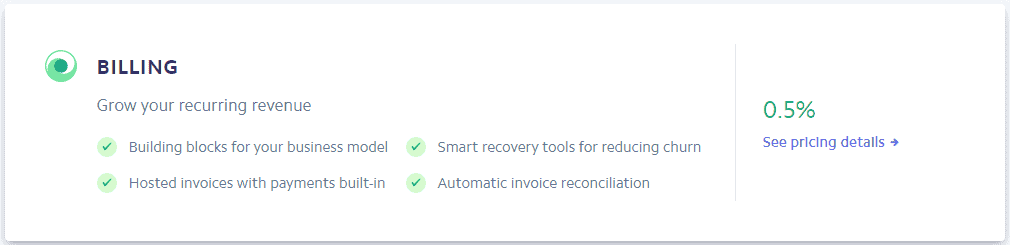
    Billing Fees

    stripe billing fees
    Source: Stripe

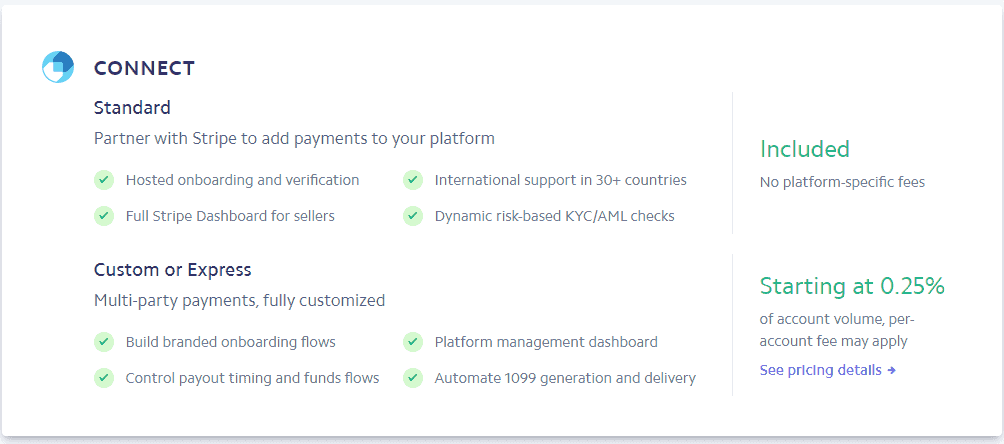
    Connect Fees

    stripe connect fees
    Source: Stripe

    Radar Fees

    stripe radar fees
    Source: Stripe

    Terminal Fees

    stripe terminal fees
    Source: Stripe

    Sigma Fees

    stripe sigma fees
    Source: Stripe

    Atlas Fees

    stripe atlas fees
    Source: Stripe

    Issuing Fees

    stripe issuing fees
    Source: Stripe

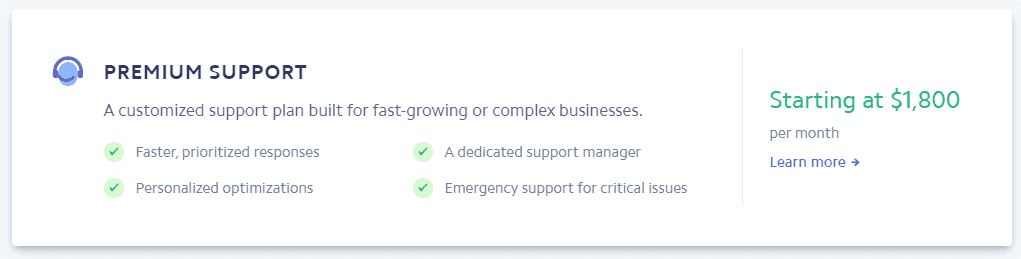
    Premium Support

    stripe premium support fees
    Source: Stripe

    Customised Plan

    The Customised Plan is a bespoke option offered by Stripe for businesses with large amounts of transactions and the fees and rates are fixed after negotiations. This plan also allows businesses to bargain and get larger discounts with their Stripe plans so that it remains economically viable for your business as well as Stripe.

    Go On, Tell Us What You Think!

    Did we miss something? Come on! Tell us what you think about our article on Stripe Business Model in the comments section.
  • The Most Successful Startups From Y Combinator

    The Most Successful Startups From Y Combinator

    There are startup accelerators and then there is Y Combinator. Y Combinator has helped fund and grow over 2,000 startups under its YC Growth Program since it was first started in 2005.

    As Y Combinator themselves put it, the YC Growth Program is –

    “Designed for founder-CEOs who are leading rapidly growing companies approaching 50 employees.”

    It accepts new startups into its program in two batches (Jan-Mar & Jun-Aug), each lasting three months.

    Here’s how it functions –

    • It provides seed-funding ($105k) for – newly formed and established startups alike. It also helps raise funds via various events and occasions.
    • It also helps the new startups establish connections with other startups and businesses, increasing their exposure and contacts.

    Y Combinator is considered to be one of the most successful startup accelerators in the world. Just the cumulative worth of the top 100 companies to have come out of Y Combinator alone is said to be over $155 billion and these companies have helped create over 50,000 jobs.

    Let’s look at the top 15 most successful startups to have come out of and benefitted from Y Combinator.

    Each of the 15 startups is valued at over $150 million as of 2019.

    Y Combinator Top 15 Startups

    Stripe

    Stripe is an American company that was founded by Patrick Collison and John Collison in 2009. Stripe facilitates businesses and individuals using its product to send and receive payments using the Internet.

    stripe
    Source: Stripe

    Stripe follows a product-based business model and was a part of Y Combinator’s Summer 2009 batch. It is currently valued at over $36 billion as of April 2020 and employs more than 2000 employees.

    Airbnb

    Airbnb is a community based online marketplace that helps connect property owners and travelers – house owners can rent out their rooms or properties to travelers using the Airbnb platform. Airbnb was founded by Brian Chesky, Joe Gebbia, Nathan Blecharczyk in August 2008.

    airbnb
    Source: Airbnb

    Airbnb follows the sharing-based business model – where it helped bring together and connect travellers and property owners. In 2009, it obtained $20,000 as seed. Airbnb is currently valued at over $18 billion (dropped from the previous $31 billion due to the COVID pandemic) as of April 2020 and employs more than 6000 employees.

    Cruise

    Cruise is an American automotive company that is currently building advanced, autonomous, self-driving cars, bikes and other electric vehicles. Cruise was founded in 2013 by Kyle Vogt (Twitch Founder) and Dan Kan and was acquired by General Motors in 2016.

    cruise automobile
    Source: Cruise

    Cruise was a part of the 2014 Winter batch of the YC Growth Program and raised around $4.3 million as seed funding. Cruise employs more than 1400 employees as of late-2019.

    DoorDash

    DoorDash is an American food delivery service that helps connect restaurants and customers by employing delivery personnel. DoorDash was founded by Tony Xu, Andy Fang, Stanley Tang in 2013.

    doordash
    Source: DoorDash

    DoorDash was a part of the 2013 Summer batch of Y Combinator program and employs more than 1800 people. DoorDash was valued at $12.6 billion as of mid-2019.

    Coinbase

    Coinbase is a cryptocurrency exchange that was founded by Brian Armstrong and Fred Ehrsam in 2012. Coinbase is based in San Francisco, California, and is one of the leading places to trade, sell, and buy digital currencies like Bitcoin.

    coinbase
    Source: Coinbase

    Coinbase follows a fee-based business model, wherein it charges users with a fee for using its platform. Coinbase was a part of the 2012 Summer batch of Y Combinator and employs more than 1000 people. Coinbase was able to raise over $600 million in funding during its initial stages of development under Y Combinator and has a market cap of around $8 billion as of late-2018.

    Instacart

    Instacart is a grocery delivery and pickup service that operates in North America and Canada. Instacart was founded in 2012 by Apoorva Mehta. The USP of Instacart lies in the fact that it promises 1-hour delivery of the groceries you ordered on its site.

    instacart
    Source: Instacart

    Instacart follows a sharing economy-based business model, wherein it acts as a platform connecting stores and consumers to provide s hyper-local on-demand grocery delivery service. Instacart was a part of Summer 2012 Y Combinator batch and currently employs more than 1100 employees. It follows a fusion of e-commerce and hyperlocal on-demand grocery delivery business model and is currently valued at over $7.5 billion as of mid-2018.

    Dropbox

    Dropbox is an American software company that provides online file hosting services for its users. Dropbox was launched in 2008 by Drew Houston and Arash Ferdowsi and has become one of the major methods for people to share files to others over the internet.

    dropbox
    Source: Dropbox

    Dropbox follows the freemium business model wherein it provides most of the services for free while the advanced features can be availed after aligning up for either of their paid plans. Dropbox was a part of the Summer 2007 Y Combinator batch and it currently employs over 2,300 employees while being valued at over $12 billion as of late-2018.

    Ginkgo Bioworks

    Ginkgo Bioworks is an American biotech company that was founded in 2009 by a group of MIT scientists – Reshma Shetty, Austin Che, Barry Canton, Jason Kelly – and Tom Knight. Ginkgo Bioworks currently helps design custom organisms using software and hardware automation.

    ginkgo bioworks
    Source: Ginkgo Bioworks

    Ginkgo Bioworks was a part of the Summer 2014 Y Combinator batch and currently employ around 270 employees.

    Gusto

    Gusto is an American company that helps provide human resource management software, along with software that helps facilitate cloud-based payrolls. Gusto was founded in 2011 by Josh Reeves, Eddie Kim, Tomer London.

    gusto
    Source: Gusto

    Gusto was a part of the Winter 2012 Y Combinator batch and currently employe over 1,000 employees.

    Flexport

    Flexport is a freight forwarding company that aims to make the logistics behind the freight forwarding industry more transparent and efficient using its robust management software and solutions. Flexport was founded in 2013 by Ryan Peterson and is based in San Fransico, California.

    flexport
    Source: Flexport

    Flexport follows SaaS business model, wherein it helps optimise shipment of goods, brokerages, trade financing and insurance using their software products & services. Flexport was as part of the Winter 2014 Y Combinator batch and currently employs over 1,700 employees.

    Rappi

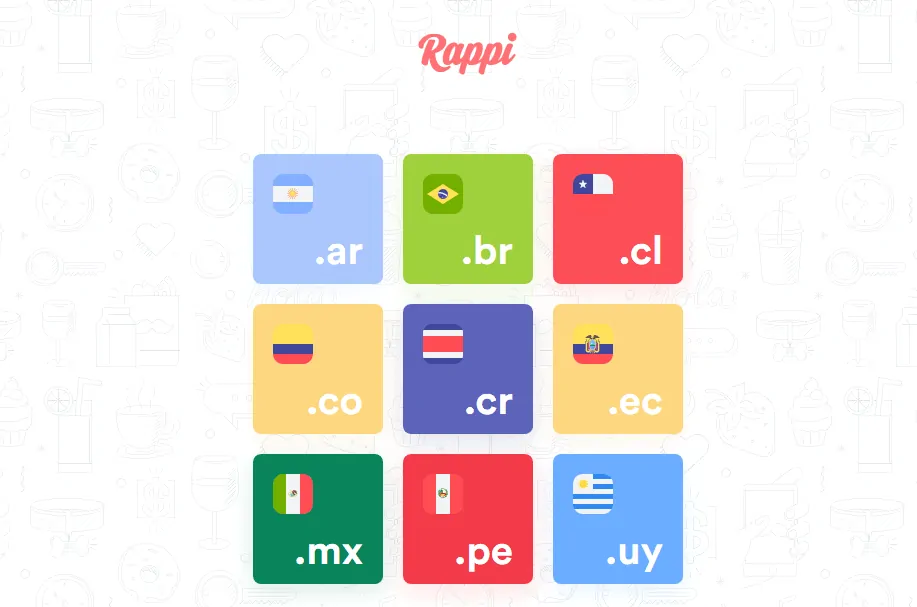
    Rappi is a Colombian startup that is developing on-demand delivery services for the Latin American regions such as – Colombia, Argentina, Brazil, Chile, Costa Rica, Ecuador, Mexico, Peru, and Uruguay. Rappi was founded in 2015 by Simon Borrero, Felipe Villamarin, and Sebastian Mejia.

    rappi
    Source: Rappi

    The Rappi app is sort of a “super-app”, wherein you can make food delivery from different restaurants and grocery stores, order medications and drugs, order alcohol, apparels, and electronics, all from within the app itself. It also allows its user to run their errands – pay bills and deliver cash – using its courier services. Rappi a part of the Winter 2016 Y Combinator batch and currently employs over 3,900 employees.

    Brex

    Brex is an American technology company that helps provide financial services such as credit cards and cash management accounts to businesses. Brex was founded in 2017 by Henrique Dubugras and Pedro Franceschi.

    brex
    Source: Brex

    Brex follows fee-based business model, wherein it charges users with a fee for using its platform. Brex was a part of the Winter 2017 Y Combinator batch and currently employs around 300 employees.

    Reddit

    Reddit is an online forum-styled, discussion & social news aggregation website that promotes itself as the “front page of the internet”. Reddit was founded in 2005 by Steve Huffman and Alexis Ohanian.

    reddit
    Source: Reddit

    Advertisements and subscription-based membership plans are the major sources of Reddit’s revenue. Reddit was a part of the Summer 2005 Y Combinator batch making it oldest company in the top 15 list to have arisen from Y Combinator and currently employs around 300 employees.

    Gitlab

    Gitlab is a DevOps platform – a set of practices that help shortens the development and updating of software – that provides Git-repo management all under a single application. Gitlab was launched in 2011 by Sid Sijbrandij and Dmitriy Zaporozhets.

    gitlab
    Source: Gitlab

    Gitlab follows a subscription-based business model, wherein it generates most of its revenue with its paid plans that offer extra features to its users. Gitlab was a part of the Winter 2015 Y Combinator batch and currently employs over 800 employees at their firm.

    PagerDuty

    PagerDuty is an American company that provides cloud-based SaaS incident reporting service. This helps IT departments improve their operations and reduce security risks. PagerDuty was founded in 2009 by Alex Solomon, Baskar Puvanathasan, Andrew Miklas.

    pagerduty
    Source: PagerDuty

    PagerDuty follows a subscription-based business model, wherein it generates most of its revenue with its paid plans that offer extra features to its users. PagerDuty was a part of the Sinter 2010 Y Combinator batch and currently employs around 500 employees.

    Y Combinator Top 100 Startups List

    Here’s a table of the top 100 Y Combinator startups – each valued at over $150 million – as of late-2019:

    StripeAirbnbCruiseDoorDashCoinbase
    InstacartDropboxGinkgo BioworksGustoFlexport
    RappiBrexRedditGitlabPagerDuty
    CheckrSegmentDockerScaleFaire
    TwitchPlanGridMixPanelAmplitudeOptimizely
    Boom SupersonicGrinMeeshoAlgoliaGOAT
    ZapierMessageBirdStandard CognitionMemeboxEmbark
    Helion EnergyEquipmentShareSendBirdRescaleGoCardless
    Rigetti ComputingRazorpayNorthRelativity SpacePodium
    BenchlingIroncladNewfrontInfluxDataWebflow
    People.aiWeeblyXenditMatterportEasyPost
    SiftThe AthleticMattermostWePayVidyard
    WeaveNurxProxyHeapPayfazz
    memsqlFivetranRipplingCleverHeroku
    FivestarsCoreOSClearTaxQuero EducationRidecell
    HelloSignGrubMarketLatticeUnbabelAthelas Inc.
    Oh My GreenLeverAtriumZeusFront
    Le ToteShipBobSnapdocsGitPrimeScribd
    GuestyAxoniLobNotableAtomwise
    FlutterwavePanorama EducationFutureAdvisorSFOXLambda School
    ZeroDown 

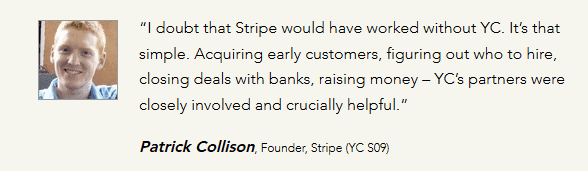
    It is worth noting that both Stripe and Airbnb – the top 2 companies in the list – would have failed if not for Y Combinator, it surely would be a different story for them now.

    stripe success founder
    Source: Y Combinator

    Own a startup or have an idea? It does not hurt to try and you too can apply for Y Combinator program to grow your startup or make your idea come to life.

    Go On, Tell Us What You Think!

    Did we miss something?  Come on! Tell us what you think about our article on The Most Successful Startups From Y Combinator in the comments section.
  • Kickstarter vs Patreon: Which Is Better?

    Kickstarter vs Patreon: Which Is Better?

    Bringing your idea to life no longer requires you to go around pitching your product to potential investors, VCs or backers to raise funds. Earlier this was the only way to gain enough capital for your project or company.

    This situation has changed after the realization of crowdfunding platforms such as the Kickstarter and Patreon. These online platforms allow you to pitch your product or idea to the entirety of the internet and obtain funding from them.

    Apart from being able to raise funds, these platforms provide flexibility with on how the funding is bought to the table – many ideas, products and services require stable, long term support rather than a large up-front donation to their cause nowadays.

    And when it comes to online crowdfunding platforms out there, Kickstarter and Patreon are the most popular – be it raising money for your new or existing venture, they are ones that generally feature on top in the list of platforms.

    So, how do they stack up against one another?

    Which one would be a good fit for your project or cause?

    Let’s find out.

    What is Kickstarter?

    Kickstarter is a crowdfunding platform that was started in 2009 by Perry Chan after coming up with an idea of allowing customers to buy tickets for a show online and the show would only take place when it reached a set amount.

    This idea was further fledged out, and thus Kickstarter was born as a crowdfunding platform. Kickstarter has helped successfully fund over 182,407 projects, with over $5 billion pledged into its projects.

    What is Patreon?

    Patreon is more of a membership platform than a crowdfunding platform. But that does not mean that it cannot be used to raise funds for projects.

    Patreon was founded in 2013 by two individuals – Jack Conte and Sam Yam – when they were trying to boost their YouTube earnings. They decided to create a separate platform where users could support their favourite creators by having them pay for a subscription plan for which they receive certain perks in return.

    Patreon not only helped support YouTubers but also helped in the conception of various products and services such as supporting creation of documentaries and such. Constant funding for newer endeavours taken up by creative professionals was made possible and easier by Patreon and its subscription-based fundraising model.

    Kickstarter vs Patreon

    Kickstarter
    Patreon
    Raising Funds
    One-Time
    Periodic & Repetitive
    Funding Payout
    Once the Funding goal is Reached (Or) Upon completion of the campaign
    Monthly Payouts
    Platform Fees
    5% of the total funds raised + transaction fee (3-5%)
    5% of the total funds raised + transaction fee (3-5%)
    Suitable For
    New projects, products or one-off ideas
    Individuals with a long term goal or gradual development or serving time

    Raising Funds

    Kickstarter

    The Kickstarter platform allows users to raise the necessary funds all at once.

    Say you create a Kickstarter campaign to fund your idea of creating an innovative power bank for mobile phones. You set your large funding goal to cover all your costs.

    Kickstarter helps in the creation of this one-time, large funding pool that helps fund that specific endeavour of yours. Also, the people backing your campaign will be ones who are completely interested or desire your product or service. This means that you have to consider marketing and promoting yourself and your product at the very least to gain the edge over the others.

    Patreon

    Patreon is a subscription-based platform where-in you can generate a recurring, periodic supply of funds. Your backers, or “patreons” as they are called, pledge a monthly fee to your endeavours.

    This usually means that the ones funding you and your projects are the ones who have already seen you accomplish the goals that you had previously set.

    Funding Payout

    Kickstarter

    A Kickstarter pays you once you complete a successful campaign. A successful Kickstarter is one where you have reached your funding goals within the specified time frame.

    Kickstarter then transfers over the entire amount that you have managed to raise for you to set out to create your product.

    Patreon

    Patreon pays you in a monthly fashion, wherein your “patreons” are charged monthly fees that they decided to donate and this is then paid to you.

    This helps create a steady, monthly-recurring cash flow to fund your projects.

    Platform Fees

    Kickstarter

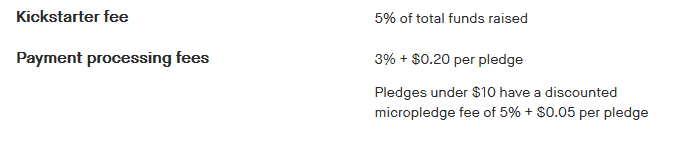
    Kickstarter takes 5% from the total amount you managed to raise during your campaign as the platform fee and also charges another 3-5% in the form of payment processing fee.

    kickstarter fees
    Kickstarter Fees | Source: Kickstarter

    In case your campaign is not successful, Kickstarter does not charge any fees and your backers are not charged any funds. The backers are charged only when the Kickstarter campaign is successful and reaches its goals.

    Patreon

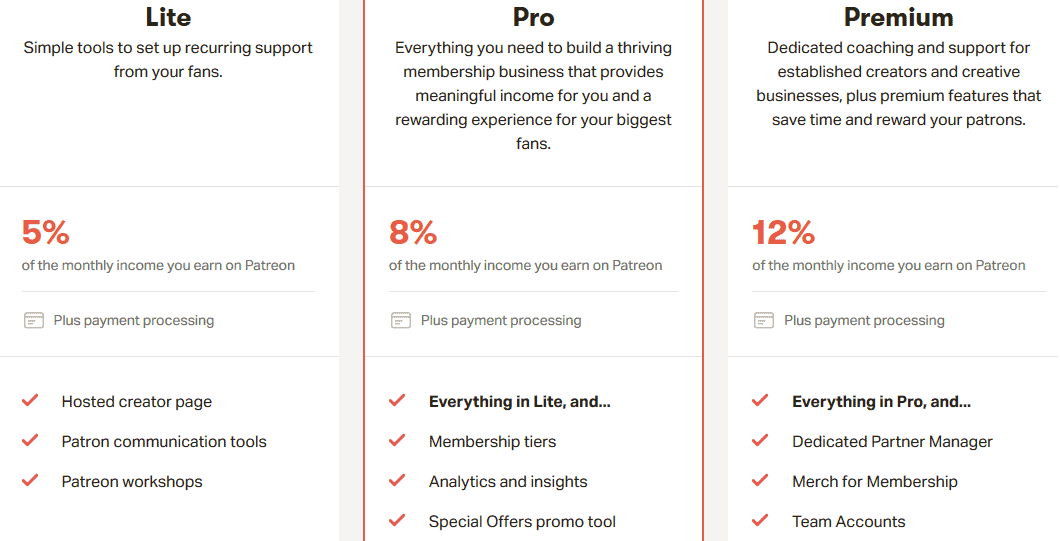
    Patreon charges from 5% to 12% of your monthly funds that you manage to raise depending on the pricing plan that you choose.

    Though getting started on Patreon is free, it offers three different plans with varying features –

    patreon plans
    Patreon Pricing Plans | Source: Patreon

    Patreon Pricing Plans | Source: Patreon

    Apart from the platform fee, Patreon also charges 3-5% fees for handling the payments –

    patreon payment fees
    Patreon’s Payment Processing Fee Breakdown | Source: Patreon

    Most Suitable For

    Kickstarter

    Kickstarter is more suitable for funding new, one-off projects or products that require a fixed amount of funding to bring to production.

    Kickstarter’s one-time funding also means that it is more suitable for those requiring large amounts of funding, say in the neighbourhood of hundreds of thousands if not millions of dollars.

    Here are a few products and companies to come out of Kickstarter Campaigns –

    • Pebble Smartwatches
    • Coolest Cooler
    • OUYA Video Game Console
    • The Everyday Backpack

    These types of one-off products would greatly benefit from a Kickstarter campaign than from Patreon.

    Patreon

    Patreon is more suitable for those looking for long term funding to help supplement their projects. Here, supporters of your projects generally come from those who already know you and are fans of your work.

    This means that Patreon works well for –

    • Content Creators – YouTube, Artists and Designers to name a few
    • Brands
    • Service providers
    • As a VIP club where people get early access and exclusive deals for providing their support

    Patreon could be your major source for funds, but most of the times it helps act as a backup source of funding that is consistent and available for larger timeframes.

    Takeaway

    Just a decade ago, if anybody would have told you that it would be possible for you to create any dream project or product using funding available from the internet, you would have scoffed at the absurdity of the idea.

    Fast forward to 2020.

    Crowdfunding, subscriptions and membership programs are everywhere, be it groceries or technology or services. Not only have these revenue models changed the way products are designed, online crowdfunding, in particular, has helped design more products.

    Want to raise funds for your obscure idea? There is a crowdfunding platform for everyone that work well for certain niches more than the others. But in the end, it all depends on how and when you wish to receive your funding.

    TL;DR:

    Kickstarter is your best bet if you have a one-off product or idea and want a large sum to get things started.

    Patreon is your best bet if you already have a userbase wanting to see more of your work and will help you fund and sustain your newer projects.

    Go On, Tell Us What You Think!

    Did we miss something?  Come on! Tell us what you think about our article on Kickstarter vs Patreon in the comments section.
  • What Is Net Promoter Score (NPS)? – A Guide

    What Is Net Promoter Score (NPS)? – A Guide

    Customer reviews, ratings, and recommendations have become the three new Rs for your business.

    Why, you ask?

    96% of customers prefer to share their experience with a minimum of 15 friends and family members instead of the company itself. This means that people are constantly sharing recommendations exponentially. So even if your logo, social media, advertisements, are all up to the mark, your customer recommendations will decide how successful your business will be.

    Now, there’s a specific metric which calculates how likely is your brand to get a recommendation.

    It’s the net promoter score.

    But before we move on to discuss how to calculate net promoter score, it’s important to understand what it means and why exactly is it important.

    What Is Net Promoter Score?

    The Net Promoter Score (NPS) is a business metric used to estimate the likeliness of customers to recommend a brand’s products or services to others.

    The people who are likely to recommend your brand are called ‘promoters’ and the ones who don’t want to recommend are called ‘detractors’. The term ‘’ lies in your net promoter score.’ refers to the number of promoters minus the detractors.

    The net promoter score is a quantitative measurement measured by surveying customers with the following question –

    “How likely are you to recommend brand ABC to your friends and family on a scale of 0-10 with 0 meaning least likely and 10 meaning most likely?”

    Answers to this question are then compiled and placed into the NPS formula.

    The NPS not only provides the likeliness of recommendation but it is important as it provides insights into the quality of your customer experience and customer satisfaction.

    Why Is The Net Promoter Score important?

    Every business wants to better their customer satisfaction rates. Net Promoter Score is a user-friendly business metric important for doing exactly this. Here are a few points explaining why your net promoter score is important:

    Customer Loyalty

    Net promoter score is important to ascertain your customer loyalty levels. Since acquiring new customers is about 5-25 times more expensive, businesses need to make sure that their existing customers are satisfied. A satisfied customer will naturally come back to your brand as well as recommend it to more people.

    Measuring your NPS over time will help you fix the loopholes that cause customer friction and therefore, help your customers remain loyal to your brand.

    Word Of Mouth Marketing

    Net promoter score is an important indicator of the word of mouth marketing and referral marketing statistics. Word of mouth marketing is an important indicator of a satisfied customer as about 80% of customers who feel satisfied with your brand tend to recommend your brand to others. It also weighs heavily for your brand because this type of marketing develops gradually and on its own.

    There is only a little that you, as a marketer, can do to analyse word of mouth marketing because it is not an active form of marketing. Measuring your NPS is important as it helps analyse this word-of-mouth traffic and boost referral marketing.

    Negative Recommendations

    Net Promoter Score is not only important for determining how many people will positively recommend your brand but also to determine how many will negatively recommend your brand. important to work with the detractors. Dissatisfied recommendations can spread like fire and be detrimental to your brand’s reputation.

    Imagine every dissatisfied customer as a customer who you lost and turned to the negative side. You need NPS to understand how many such customers have you lost and then strategise measures to get them back.

    Churn Rate

    An NPS survey is important to determine your customer churning points. It need not be restricted to recommendation probability. You can expand your survey questions to include questions about improvements, suggestions, and more constructive feedback.

    This way you can make the use of NPS multi-dimensional and analyse numerous aspects of your customer’s experience.

    Competitor Analysis

    Many times brands publicly disclose their NPS figures. You can measure your NPS and compare it with your competitor businesses. You can also use your NPS and compare it to the average of your industry’s NPS.

    This kind of comparison is important to conduct a wholistic competitor analysis as to where your business stands, what strategies work for your competitors, and what strategies work for your business.

    How To Calculate Net Promoter Score?

    Net Promoter Score can be calculated in two ways:

    Online Tools

    • SurveyMonkey – A freemium tool to measure NPS and other KPIs with monthly subscription plans
    • SurveySparrow – A freemium tool to measure NPS and other KPIs with monthly subscription plans
    • NPScalculator – A free tool to measure NPS

    Manual Calculation

    The net promoter score of a brand is measured using a survey with questions focusing on customer experience and satisfaction. After the responses to those answers are collected the following formula is used:

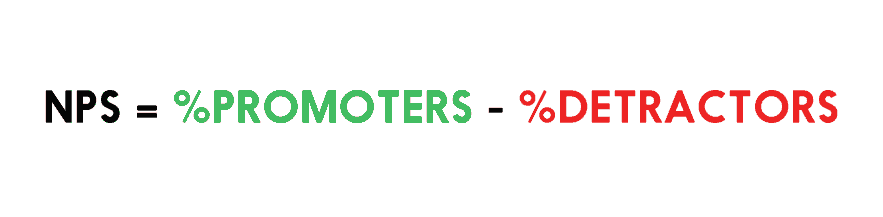
    NPS = percentage of promoters – percentage of detractors

    The resultant figure is a score that can range from negative 100 to positive 100.

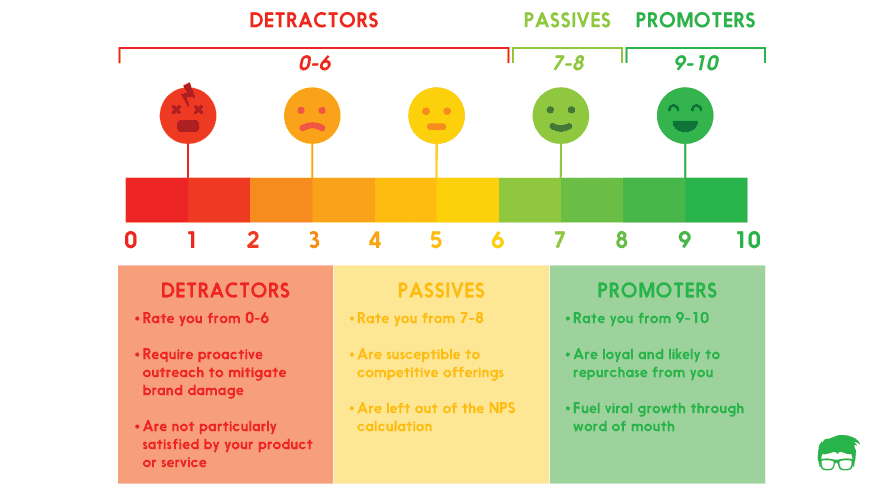
    The main question in an NPS survey is how likely is one to recommend your brand to others on a gradient scale of 0 to 10, with 0 meaning ‘not likely at all’ and 10 meaning ‘highly likely’. Based on the responses to this question consumers can be categorised into three categories:

    1. Promoters: Customers who answer the question with 9 or 10 are called promoters. Promoters are usually loyal and satisfied customers who will bring in more customers for you through referral marketing.
    2. Passives: Customers who answer the question with 7 or 8 are called passives. Passives are moderately satisfied and usually do not pass either positive or negative recommendations. Therefore, they are more likely to get gripped away by competitors.
    3. Detractors: Customers who answer the question with 0 to 6 are called detractors. Detractors are not only the most dissatisfied but may switch to your competitor at the earliest as well as discourage your brand to others.
    net promoter score

    For example – You surveyed 10 customers. 5 people responded with 9, 3 responded with 7, 2 responded with 4. The percentage of promoters would be 50% and the percentage of detractors would be 20%. Your NPS would be 50%-20% i.e. 30. It is important to note that NPS is not a percentage, it is merely calculated using percentage data.

    To begin compiling data and calculating your NPS you can either ask customers the main question of how likely are they to recommend your brand to others from 0-10, or you can create a survey with a couple of more questions. Creating an NPS survey is considered a better approach since it helps gain a wholistic view of customer experience metrics.

    How To Create An NPS Survey?

    To gain a complete view of your customer’s experience create an NPS questionnaire with qualitative and quantitative questions, both. The ‘must-haves’ to build an effective NPS survey are:

    Demographic Questions

    Include questions about age, gender, location, income, etc. This will help you target newer strategies based on broader metrics like age and gender.
    For example – 20-year-olds are mostly promoters and show high NPS, but the 40-year-olds are passives and detractors and show low NPS.

    Focus Question

    The focus question of your NPS survey would be:
    “How likely are you to recommend brandABC to others on a scale of 0 to 10, where 0 means not likely at all and 10 means definitely going to recommend.

    Follow-Up Questions

    Follow-up questions are optional. If you want to gain a uni-dimensional understanding of the probability of being recommended, then you can create your survey with the demographic and focus question. If you want to gain a multi-dimensional understanding include follow-up questions like:

    “What is the reason behind your score ?”

    “What would you suggest to help make brandABC better?”

    “Which features from us do you use the most?”

    “Have you ever felt your experience with brandABC has been disappointing?”

    “What can we do to make you a happier customer?”

    “Can we reach out to you in the future regarding your responses?”

    NPS surveys must be short and precise if you want customers to give true answers. After creating the survey you can send it out to customers through emails, subscription letters, pop-ups on your website, calls, or in-person at stores and offices.

    How To Use Net Promoter Score?

    After you have sent out surveys, you have to collect responses, organise them, and analyse them systematically. Below are methodological steps to help you calculate and make use of your NPS:

    Step 1 – Interpreting The NPS Score

    Now we need to figure out how to use this data. Begin with segregating the responses into promoters, passives, and detractors. Next, calculate your NPS. Different NPS mean different things:

    • Above 0 – Customers are happy, satisfied, and recommending your brand positively
    • Equal to 0 – Customers are moderately satisfied, and can easily switch to competitors
    • Below 0 – Customers are unhappy, dissatisfied, and probably discouraging the use of your brand

    Step 2 – Categorising The NPS Score

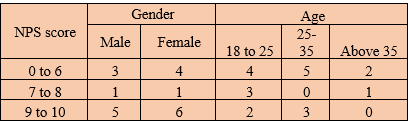
    The basic NPS has given you an idea of how your customers feel. Now we segregate these responses based on demographics. Create broader age, income, location, gender, etc. categories and then find the NPS for each.

    For instance, for a survey of 20 customers, the gender and age-wise categorization of NPS may look like:

    Step 3 – Responding To Surveyors

    If your survey had only demographic and core questions this step does not apply to you.

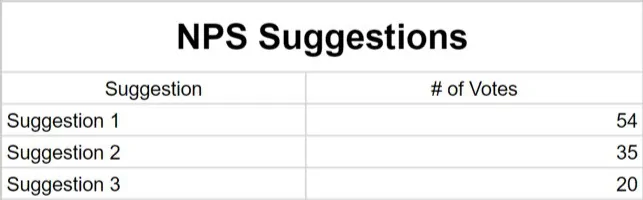
    But if your NPS survey had follow-up questions then the next step would be to make a note of all suggestions.

    Image Source – NeilPatel

    Since the follow-up questions form the qualitative part of the survey there is no way to measure it as such. But what you can do is:

    1. Make a list of the most frequently suggested feedback
    2. Respond personally to all surveyors:
      1. To Promoters – You can ask your promoters to encourage more friends to purchase your products or partner with them to be an influencer for your brand.
      2. To Passives and detractors – Send personal responses to their suggestions and problems. If they are too dissatisfied with your service send apologies. 

    Step 4 – Re-planning and Re-Structuring Based On Feedback

    Lastly, make use of the feedback and follow-up questions to re-organise your strategies. If most of your customers are complaining about your return and replacement service then you must evaluate and make necessary modifications.

    As Nichole Elizabeth DeMeré stated –

    “think of NPS, or Net Promoter Score, like rocket fuel. If you leave it alone, it won’t do much. But when you load it into a responsive, proactive, customer-driven company: blast off.”

    What Is A Good NPS?

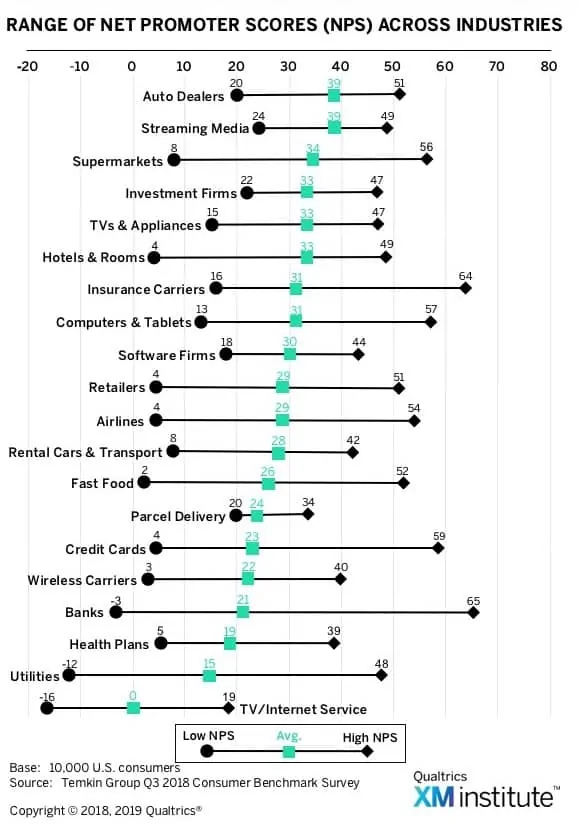
    Now that you have calculated your NPS and analysed it you must interpret whether your NPS is a good score for your business industry or not. Understanding your NPS relative to other brands and companies in the same industry will give you context to judge your standing in the market.

    For instance, if you are a cable TV provider. Yous NPS is 15. From a range of -100 to +100, the number 15 might seem too low. You might end up believing that your customers are dissatisfied and you need to make a lot of changes to your work. It is only when you use an industry-wise NPS guide you can understand that a score of 15 for a cable TV provider is a high NPS score.

    To understand more about what a good NPS is and what is not you must look at the various NPS benchmarks that exist.

    Net Promoter Score Benchmarks  

    NPS may vary from industry to industry, therefore use these NPS benchmarks by industry to understand what is a good NPS for your field:

    Image Source – Qualtrics

    Now that you are well-versed with NPS, its importance, calculation, and uses, create your NPS survey and start learning from your customers. It’s time to start asking questions using this business metric for insights into your customer’s experience.

    Go On, Tell Us What You Think!

    Did we miss something?  Come on! Tell us what you think about this article on net promoter score in the comments section.
  • Why Google Glass Failed?

    Why Google Glass Failed?

    Google Glass was this new wearable device touted to be the future of wearables and the next stepping stone after smartphones in the field of personal technology.

    google glass logo
    Google Glass Logo | Source: Article Story

    Google publicly announced the development of the Google Glass in April 2012 and officially unveiled it to the public in May 2014.

    But fast-forward to 2020, there is no mention of the Google Glass anywhere nor has the majority of the public seen the Glass in person.

    How did something so futuristic and hyped vanish into thin air?

    To find out, it helps to know about the basics of Google Glass and how it functioned.

    How Google Glass Works?

    The Google Glass looks like any other eyeglasses in the market with the only exception being the presence of a mini-computer attached to the one side of the frame with a tiny projector acting as the display.

    google glass
    Google Glass | Source: Wearable Technologies

    While you might think that it would be hard to focus on the display when it is positioned at such proximity to your eyes, but the projector beams the image using a prism directly to the back of your retina.

    The transparent nature of the prism enables light to pass through naturally, allowing you to see the rest of the surroundings while you perceive the display as a floating 25-inch television viewed from a distance of 8 feet.

    google glass demo
    What it would look like when viewing through the Google Glass | Source: YouTube

    Apart from the projector, it also featured –

    google glass specification
    Components of Google Glass | Source: Core77
    • 5 MP Camera w/ 720p video recording
    • Touchpad
    • Bone-Conduction Speakers
    • Bluetooth & WiFi connectivity
    • 16 GB of on-board storage
    • 1 GB RAM
    • Texas Instruments OMAP 4430 SoC [1.2Ghz Dual-Core (ARMv7)]

    It was a budget smartphone mounted on right your head – replete with a camera, GPS and all – acting as a heads-up-display (HUD). But for the Glass to function, it needed to be paired to a smartphone via a standalone app called My Glasses App.

    Upon connecting to your smartphone, the Glass would display your notifications and even featured a quite competent voice recognition system replying to messages in short bursts. Interacting with it could be done by two ways – either via the touchpad which allowed you to swipe as if you were using a smartphone display or via voice commands triggered by saying the phrase “Ok, Glass”.

    using google glass
    Using the Touchpad to navigate within the Google Glass | Source: eOffice

    Google Glass was built to supplement your daily activities by overlaying useful information about the current task or by providing different options for capturing the moment. It would do so by constantly monitoring the things that you were looking at via the camera, your location via GPS and your speech using its microphone.

    The list of ways in which the Glass could help augment reality and boost productivity was endless. Here are a few things that Glass could already do when it was officially launched in 2014 –

    • Act as a live text translator
    • Provide maps & navigation without having to look away from the road
    • Made capturing photos and videos easier
    • Show data about the people – collected from select social media networks – that you were meeting with

    Things would have worked out in Google’s favour only if it was the ideal universe out there, which it is not. By now, you would have already found a glaring issue with the presence of constant monitoring via the camera, microphone & GPS.

    The Glass created a massive breach of privacy.

    Why Did Google Glass Fail?

    Privacy Concerns

    Google Glass with its constant monitoring of your location and the presence of camera meant that it could be recording or taking photos at any time without users even realizing it. Due to this, the product was banned at many locations including theatres, casinos and medical centres, where it could be used to record stuff illegally.

    People have come to realize that their digital lives matter and privacy is of major concern. This situation is only going to increase as more things shift to online – be it socializing or doing work.

    The Google Glass needed the user data that it collects using the various sensors to provide useful information and that was not a tradeoff that most were willing to make.

    Failed Pricing & Marketing

    Google launched the Google Glass in stages – The product was first launched in 2013, but not to the public. Instead, it was sold to a select group of tech enthusiasts who were called “Glass Explorers” for about $1,500.

    While Google must have done so for obtaining feedback, the tech enthusiast crowd were not the right beta testers since its key features proved to unbeneficial to them. They were well-versed with their smartphones and could achieve everything that the Glass offered using their phones. This mix-up in marketing led to the Glass receiving negative press coverage right from the start.

    However, the hefty price of $1,500 also made the product unattractive among regular consumers. Even though the product was an early prototype and an experimental device, the large price tag combined with the negative press made for a poor initial impression on the public. Remember, this was at a time when the highest-end smartphones sold for around $500 and the $1,000 iPhone X was still four years away.

    Unappealing Design

    Even for 2013, Google Glass’ design was seen to be unattractive. With its asymmetrical design, fairly noticeable projector lens and the big component housing, the Glass looked more like an unfinished prototype than a premium product deserving of the hefty price tag.

    Failed Development

    Though Google promised great things to come out of Google Glass, the execution was not on point. The product was in beta stages for years, and even then, the commercial release was plagued with issues such as – mediocre battery life, constant freezes and overall sluggishness while using the device.

    This further emphasized the product’s prototype-ish nature in the eyes of the public.

    Failed To Create Demand Or Use-Cases

    The Glass as a product aimed to solve problems that never existed in the first place. Need directions? Your smartphone had apps to take care of it. Need to check your mail in a jiffy? Your phone’s lock-screen provided the same information as the HUD on the Glass would show you. It was a product that had not much demand or use for the public to be willing to invest $1,500 into.

    Google wanted to use Glass to create a new product category and in-turn create demand for said category and not the other way around. For that to work out in Google’s favour, the product had to genuinely provide the experience that it set out to achieve. Instead, what people got after years of development was a half-baked user experience which failed to bring anything new to the table other than the novelty factor of being able to view the same stuff displayed on your smartphone overplayed over your vision.

    The Aftermath

    Yes, Google Glass failed as a commercial product among the masses.

    Was it doomed from the start?

    Maybe.

    Was it a complete failure?

    No. Here’s why –

    Google Glass still lives on in the form of “Glass Enterprise Edition”. This is a niche version of the glass, which is primarily focused on leveraging the benefits of Glass in enterprise scenarios and use-cases such as in medical centres & forensic labs. Google even recently released a newer version – the “Glass Enterprise Edition 2” for around $999.

    While the commercial launch of the Google Glass failed, Google found out that its product was of great value to enterprise users and use-cases. So, Google has taken started focusing on this alone while it discontinued the regular Glass in 2015.

    There has been quite a lot of advancements made in the field of Augmented Reality (AR) and Virtual Reality (VR) since Google Glass was first launched in 2013. The AR & VR market has also gotten more competitive with newer products such as – Microsoft’s Hololens, smartglasses from various tech manufacturers and the upcoming Apple Glass. Meanwhile, Google seems to be comfortable that it found its niche for its Google Glass and looks like it will stick to it for a while.

    Go On, Tell Us What You Think!

    Did we miss something?  Come on! Tell us what you think about our article on why Google Glass failed in the comments section.
  • Why Did Blockbuster Fail?

    Why Did Blockbuster Fail?

    Before Netflix, there was Blockbuster.

    The current situation of “stream-your-entertainment-to-your-living room” was not a thing two decades back. Blockbuster started at a time before CDs became a household staple and reigned supreme in the movie-rental industry for at least a decade or two. At its peak in 2004, Blockbuster had over 9,000 physical locations.

    But, as of writing this article, the company is virtually non-existent and only one Blockbuster store remains standing.

    How did it get to this?

    Blockbuster – Redefining Home Entertainment

    Blockbuster was founded in October 1985 by a businessman named David Cook as a movie-rental store. The first Blockbuster store was opened in Dallas, Texas and it was a huge success.

    blockbuster store
    A Blockbuster Store | Source: Pinterest

    Blockbuster’s business model was simple – Blockbuster allowed its customers to rent movies from their store for a period, after which they had to return them.

    Blockbuster would rent the movies until it recovered the cost spent on acquiring them, after which it would just sell the copies for full price.

    The company would buy movies in bulk, allowing them to save a lot via discounts, and its popularity also allowed it to strike up revenue-sharing deals with movie studios.

    This enabled Blockbuster to not only provide movie rentals for cheap but also to sustain itself against local competition & stand-alone video rental businesses.

    People loved the large variety and low prices offered by Blockbuster and the fact that they could pick up movies for a small price and return it once they were done watching. Not only did this allow people with less disposable income to watch movies rather than going to theatres or waiting long for it to be aired on cable television, the experience of finding new movies that Blockbuster provided was unique.

    Within three years of being founded, Blockbuster became the largest video rental business in the US, with over 200 stores. Remember, all of this was before the internet became a household staple. This was a time when VHS tapes were just beginning to become popular, and laser discs were still a few years away from becoming the mainstream. Blockbuster became one of the very few options for enjoying movies, the other options being the theatres and cable television.

    Blockbuster was immensely successful and started expanding rapidly by franchising its stores. By 1993, Blockbuster had over 3,600 stores covering most parts of the United States and even acquired local rental shops to convert them into Blockbuster stores. Blockbuster also started expanding to other countries – it opened stores in the United Kingdom, Japan, Australia and even in parts of Latin America.

    Blockbuster did not take long to become a multi-billion dollar company and it even branched out from movies to offer video game rentals as well as music rentals.

    But, Blockbuster is nowhere to be seen today other than being referenced in movies and pop culture as a symbol of the 80s and early 90s.

    This raises the question –

    How did Blockbuster go bankrupt when it seemed like nothing would go wrong for the movie-rental giant and shrink to just a single store that exists as a relic of the past?

    Reasons For Blockbuster’s Failure

    The answer for failure of Blockbuster is not so straightforward and requires an in-depth look at how things panned out for Blockbuster. While most term Netflix to be the cause of Blockbuster’s decline, but that does not paint the entire picture here.

    Netflix & Subscription Model

    It can be said that Netflix played a role in the decline of Blockbuster.

    Netflix began in 1997, 12 years after Blockbuster began, and it operated in the same movie-rental industry as Blockbuster right from the start. What most do not know about Netflix is that it started by mailing movie rentals right to the customer’s doorstep upon signing up for its service by paying a monthly subscription fee.

    https://i.insider.com/5e73de03c48540374a53cdc6?width=1136&format=jpeg
    Netflix’s movie rental via mail | Source: Business Insider

    Not only that, for a fixed monthly subscription fee, Netflix also allowed customers to rent an unlimited number of movies that were then mailed to them and returning one was as simple as mailing it back.

    This proved to be more convenient for most customers and made a dent in Blockbuster’s customer numbers since they were able to not only have unlimited movies mailed to their doorstep but for the same amount as it would take for a one-time trip to a Blockbuster store.

    As a matter of fact, Netflix still offers the option of mailing DVDs to your doorstep.

    Also, Netflix did not beat Blockbuster by bringing movie streaming right off the bat –it was only 10 years after Netflix was founded that it bought in the option of streaming movies and other content over the internet.

    Failed Attempts At Innovating

    It is not to be said that Blockbuster was ignorant of the rising competition or the newer technologies that were cropping up as the years passed. Blockbuster even started offering its own video-on-demand service in 2001. The service was planned to allow users to rent and watch movies right from their homes using fibre optic technology.

    blockbuster video on demand
    Blockbuster’s Video-On-Demand Service in 2008 | Source: DeviceGuru

    This service would have changed the industry just as it did with its movie rentals had it seen the light of day. Remember, this was 7 years before Netflix brought its on-demand movie streaming service.

    But it never worked out in the end since Blockbuster’s partner Enron filed for bankruptcy soon after, and the technology never really worked as intended at the time. Apart from that, it was stated that obtaining large quantities of movies to make the service viable was quite harder than it had imagined it to be.

    Not Acquiring Netflix

    In 2000, Blockbuster declined to purchase Netflix for $50 million. This was considered to be a major misstep in Blockbuster’s decision-making.

    This was at a time when the internet had just become a household thing, and video streaming hadn’t been introduced. Also, Blockbuster scoffed at the viability of Netflix’s subscription-based movie rental mailing service.

    Failing To Restructure

    If Blockbuster had to compete with the convenience of Netflix, it had to change its operating model to something similar to them.

    This meant that Blockbuster had to let go of a large chunk of its revenue stream – late fees. Late fees were charged to customers returning the rental copies after their rental period had ended. For Blockbuster to move onto the subscription model meant that it had to give up on an established, well-paying revenue stream, and this could have made Blockbuster hesitate to switch its business model entirely.

    Ironically, it had to give in soon after, and the late fees were soon removed while its operation model remained the same.

    This proved to be the final nail in the coffin for Blockbuster.

    The Aftermath

    In 2010, Blockbuster filed for bankruptcy and was bought by Dish Network for around $320 million in 2011. Not long after, it was decided to shut down its physical locations along with the termination of its video-on-demand service in 2015.

    As of 2020, just one Blockbuster store remains – in Bend, Oregon – and this is because the place actually lacks high-speed internet, rendering streaming services unviable.

    While the reasons for failure would usually lie in failing to innovate or poor management decisions, that does not entirely define the case here. Blockbuster’s decline was the result of different reasons, which can be attributed to –

    • Failing to innovate “quickly”
    • Failing to restructure its operating model to change with the changing times and advancements made in technology

    Blockbuster was never ignorant of Netflix or other DVD stores. Blockbuster tried its best to change its operating model but failed to do so in the end and the rest is history.

    With the current over-saturation of streaming services, Blockbuster could play to the nostalgia and the sheer feeling of being able to own a physical copy with today’s consumers. While it seems very unlikely, one way would be to operate as a boutique experience on a smaller scale while being focused on providing streaming services.

    Go On, Tell Us What You Think!

    Did we miss something?  Come on! Tell us what you think about our article on Why Did Blockbuster Fail in the comments section.
  • What Is Leadership? – Importance and Styles

    What Is Leadership? – Importance and Styles

    Are leaders born or made?

    A study by the University of Illinois suggests that 30% of leadership ability is genetic and 70% of the leadership skills are to be developed or made.

    To be able to give a better answer to the above question, let us try to understand what leadership is and what it takes to be a good leader.

    What Is Leadership?

    Leadership is the process of social influence to motivate people to achieve a shared set of objectives.

    The two key phrases to note here are-

    1. Social influence: Leaders tend to cause a change in the behaviour of people by establishing an influencer-follower relationship with them.
    2. Shared set of objectives: The main aim of a leader is to achieve a set of goals with the help of focused efforts put in by people who believe in these goals.

    There is a need for leadership in almost all walks of like; not only in political or business scenarios but also at homes. This being said, it becomes important to know who is a leader and what characteristics a good leader possesses.

    Who Is A Leader?

    A leader is a person who takes the responsibility of leading a group of people or an organisation towards the accomplishment of a vision.
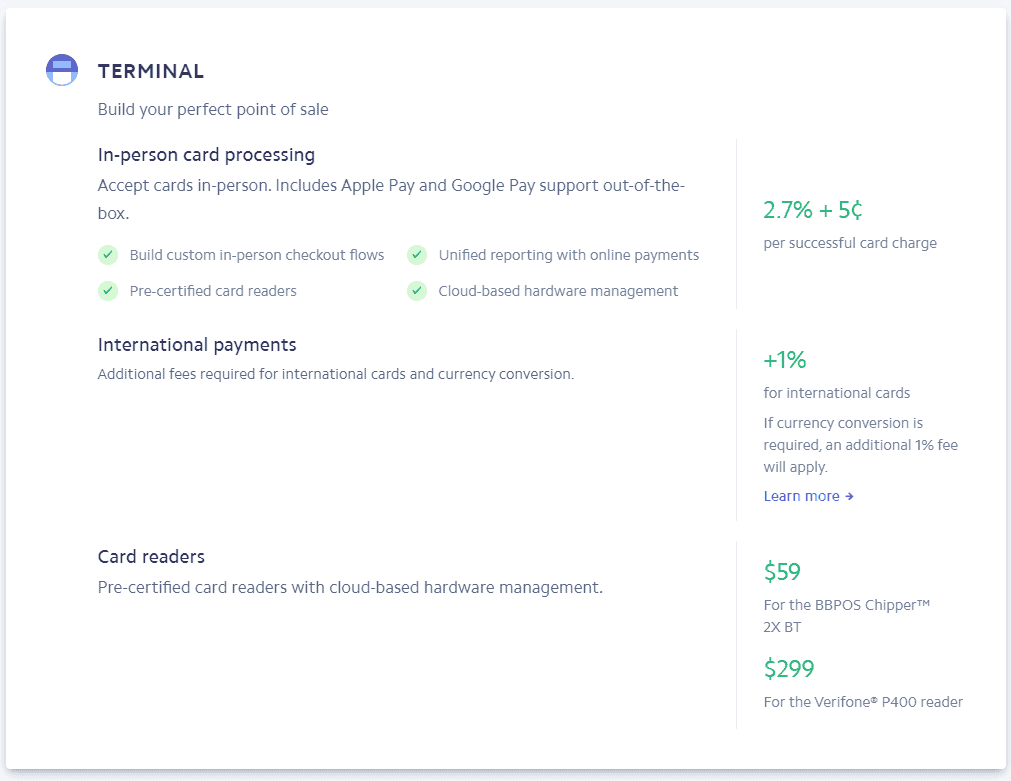
    They do so by –

    • Motivating and inspiring their followers
    • Building a sense of trust and accountability
    • Engaging followers in activities that channelise their efforts in one direction

    Characteristics Of A Good Leader

    Practically, there is no perfect structure that explains how to be a good leader, but there are some basic characteristics that a good leader may project:

    1. Vision: It is the leader’s vision that the followers try to achieve by making it their own.
    2. Communication: Possessing good communication skills is the key to get people to work towards a vision. Communication skills not only include speaking skills but it also includes listening skills. As a leader, it is as important to listen to the followers as it is to communicate the vision.
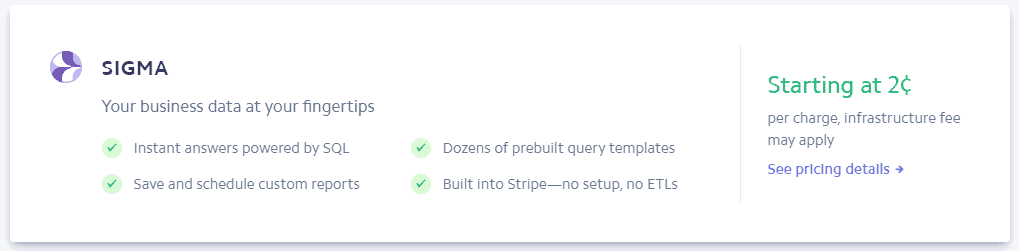
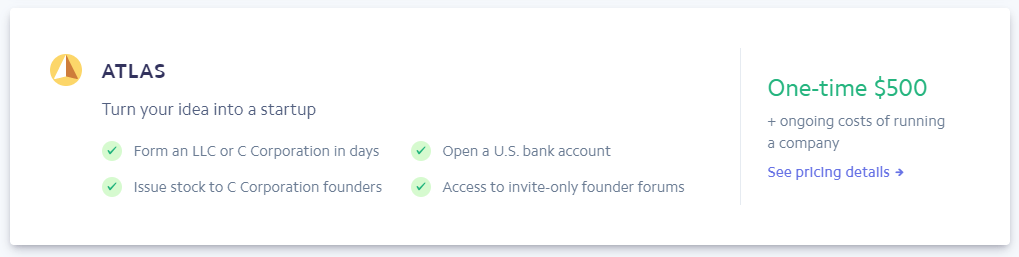
    3. Confidence: Only when the leader is confident can the followers trust them. It is the leader’s confidence in themselves and their followers that motivates the followers to accomplish goals.
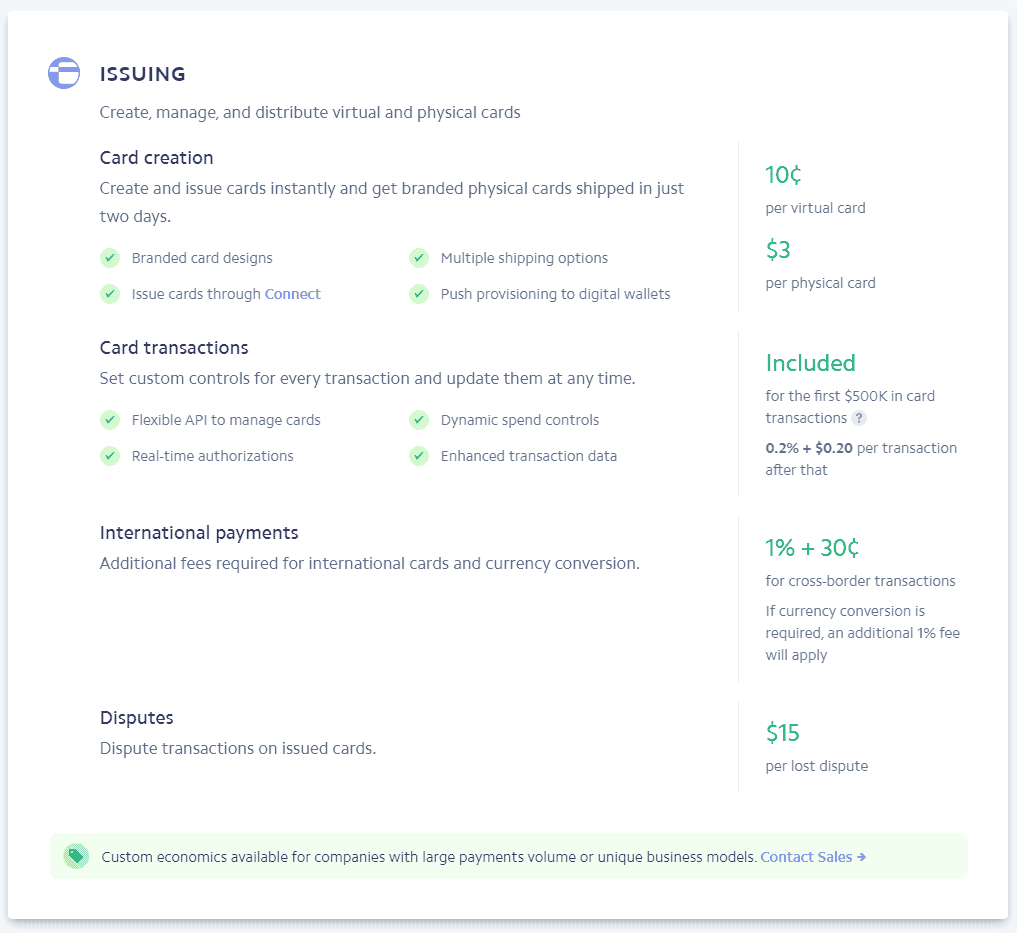
    4. Persuasion: A leader’s speech should be persuasive to influence people to work for them.
    5. Decision Making: Decision making is the most critical quality a leader should possess. Because it is the decisions of the leader that the followers look up to and it is their decisions that will affect the entire team or organisation for that matter.
    6. Empathy: Listening to the followers and understanding their problems will enable the leader to know why his or her team is not performing well and come up with solutions for the same.

    Importance Of Leadership In Organisations

    Leadership plays a vital role in organisations. Be it leadership at the senior most level or at the team level. Some reasons why leadership is important are:

    1. Keeps employees motivated: Effective leadership inspires and motivates employees to supersede their personal interests and work towards the accomplishment of goals set for the progress of a team or the organisation as a whole.
    2. Keeps everyone focused: Since a leader puts forth a clear vision for the organisation, it becomes easy for the team to focus their efforts to keep themselves aligned with the leader’s vision. It leads to channelizing the energy of the entire team in a single direction which increases the impact of the team’s efforts.
    3. Helps in conflict management: A leader helps to keep the team in coordination and harmony. Any conflicts that exist within the team can be resolved with the help of the team leader. Effective conflict management by leaders results in a team working with high productivity and with mutual respect for each other. It also leads to a positive and motivating work environment.

    Types Of Leadership Styles

    There are different leadership styles to suit different situations. Leadership can be categorised into the following styles:

    Transformational Leadership

    Transformational leadership is giving employees the freedom to be creative and take responsibility for their own decisions. A transformational leader communicates his or her vision to the employees and then let them work towards achieving that vision by letting them work in autonomy. This enables the employees to come up with new innovative solutions to achieve objectives and stay motivated.

    Some characteristics of a transformational leader are:

    • Promoting creativity
    • Providing autonomy to the team
    • Clear vision for future

    Transformational leadership is best suited for organisations that are looking to transform their brand image or bring about new innovative solutions into untapped markets.

    Steve Jobs is one example of a transformational leader. He had a vision for Apple which was worked upon by the employees of Apple. He promoted innovation which lead to delivery of creative solutions by the employees.

    Transactional Leadership

    Transactional Leadership is the antithesis of transformational leadership. Unlike transformational leadership, transactional leadership works on the principle of punish and reward. It is about getting the employees to complete their jobs by a stick and carrot approach. The leaders constantly supervise and monitor employee performance. Transactional leader’s main aim is to get the routine tasks done in the most efficient manner possible.

    Listed below are some characteristics of a transactional leader are:

    • Consistent supervision and direction
    • Extrinsic motivator
    • Rigidity in instructions

    When an organisation is looking at increasing everyday efficiency of its team with consistent reporting, transactional leadership seems to be the best fit.

    Bill Gates is one example of a transactional leader. It is said that he used to visit the product teams to make sure that the teams were on track with their activities and used to ask them questions until he was satisfied that the team is working correctly.

    Charismatic Leadership

    Leaders with a charismatic leadership style are the ones who use their personality and persuasive skills to get followers to do what they believe in. Their communication skill is the most admired by their followers. They are the ones who connect with their followers at an emotional level because they are profound communicators.

    Charismatic leaders may have the following characteristics:

    • Exceptional communication skills
    • Persuasive and assertive
    • High Emotional Quotient (EQ)

    Charismatic leadership is most effective in situations where the leader needs to bridge the emotional gap with their followers. Situations which require the leaders to empathise with their followers can be best tackled by adopting charismatic leadership.

    Political leaders like Barack Obama and Narendra Modi are examples of people with charismatic leadership style. They connect with their followers on an emotional level and communicate their message in a very persuasive way.

    Democratic Leadership

    As the name suggests, democratic leadership style practices democracy. All the decisions are made after taking into consideration all team members inputs. Though the power of decision making lies with the leader, but he or she takes into account what their team members have to say. Such a style of leadership promotes freedom of expression in the team and encourages the team members to be vocal about their opinions.

    Here is a list of characteristics that a democratic leader may possess:

    • Empowering the group
    • Fair decision making
    • Task delegation

    A team that is made up of members who are opinionated and believe in team work can be best supported by adapting to democratic leadership style.

    A jazz band portrays the democratic leadership style perfectly. Even though the band often lead by a conductor or bandleader who is responsible to ensemble various sounds and harmonies into one cohesive production, there are certain sections where each musician gets the freedom to improvise and show off their creative side.

    Bureaucratic Leadership

    Bureaucratic style of leadership is the one in which leaders generally tend to not accept ideas that are non-traditional. Bureaucratic leaders, just like democratic leaders, listen to their team member’s opinions and views but tend to reject anything that does not seem to be in alignment with a set guideline. Such a leadership style may lead to a lack of creativity in the team.

    A leader with a bureaucratic leadership style may demonstrate the following characteristics:

    • Lack of creative freedom
    • Controlled and structured leadership
    • Abider of status quo

    An organisation that wants to work as per the set rules, is resilient to change and follows a strict hierarchy can be effectively led by bureaucratic leaders.

    An example of a bureaucratic leader could be Winston Churchill. During World War when Winston Churchill was prime minister of the UK, he led the country with control, structure and power. Though his bureaucratic leadership style resulted in a victory in the Second World War for them, it also led to his downfall after the war.

    Laissez-Faire Leadership

    Laissez-Faire is a French word which means ‘allow to do’. So Laissez-Faire leadership style means letting things happen the way they are and not interfering in between. Laissez-Faire leaders tend to leave the team to be on their own and do not exercise their control powers.

    Characteristics of a Laissez-Faire leader may be:

    • Very little or no guidance to the team
    • Complete freedom of decision making
    • Facilitator of resources

    This style of leadership when followed with employees that are self-motivated and self-starters would work best. But if adopted for employees that are complacent and need a push to do tasks, it could lead to the downfall of the team.

    Warren Buffet is a famous example of a Laissez-Faire leader. He is believed to leave his team to work on its own and achieve results. He gets the resources managed by making investments and leaves it to his managers to achieve goals.

    Final Thoughts

    Some people are born leaders. But, it does not mean leaders cannot be made. Behavioural theories believe that leaders can be made by learning and observing various leaders and their leadership styles. One can always learn and practice the skills to be a leader. A notable point here is that it is important to match the right leadership style with the right situation for effective and quantifiable results.

    Go On, Tell Us What You Think!

    Did we miss something?  Come on! Tell us what you think about our article on what is leadership in the comments section.