The customer rules the market. He decides the fate of the product. The marketer today can’t really force anyone to buy his product. He can only play smart and formulate strategies which can generate awareness and spawn interest in the specified product in the minds of the prospective customers.
This has led to the development of an all-new concept – demand generation. Marketers now plan the whole funnel where they strategise the customer’s journey from when he gets aware of the brand till the point he becomes a customer (or a repeated one).
What Is Demand Generation?
Demand generation is a holistic approach to generating awareness, interest and eventually demand for an offering by strategising the communication across all the touch points in the buyer’s journey.
The process spans every department, which works in synergy to build awareness of the brand in the mind of the target customer, generate interest and strategise his journey from an anonymous consumer to a delighted customer.
Demand generation is a psychological concept where the marketer first understands the needs of the customer, dive deep into his customer journey and places his product smartly in all of the stages.
The increased frequency and smart product placements generate awareness and drive interest which eventually leads to liking, preference, conviction and then purchase.
A good demand generation strategy focuses on these seven stages of the buyer’s journey-
Awareness
Knowledge
Liking
Preference
Conviction
Purchase
After Purchase
Importance Of Demand Generation
The market is full of generic products with little tweaks. Advertising is no more the only tool that can do the job of marketing alone. An average modern person is exposed to around 5,000 ads per day.
This is where demand generation comes in. Demand generation focuses on imbibing the mind of the customer with a certain product, so whenever he thinks of buying from that industry, he goes for that intended product.
This strategy works well today as the business tunes into every stage of the customer’s buying journey. By doing so, it not only gets to market its brand but also collects vital data, which helps the company to improve the product further.
Demand Generation Process
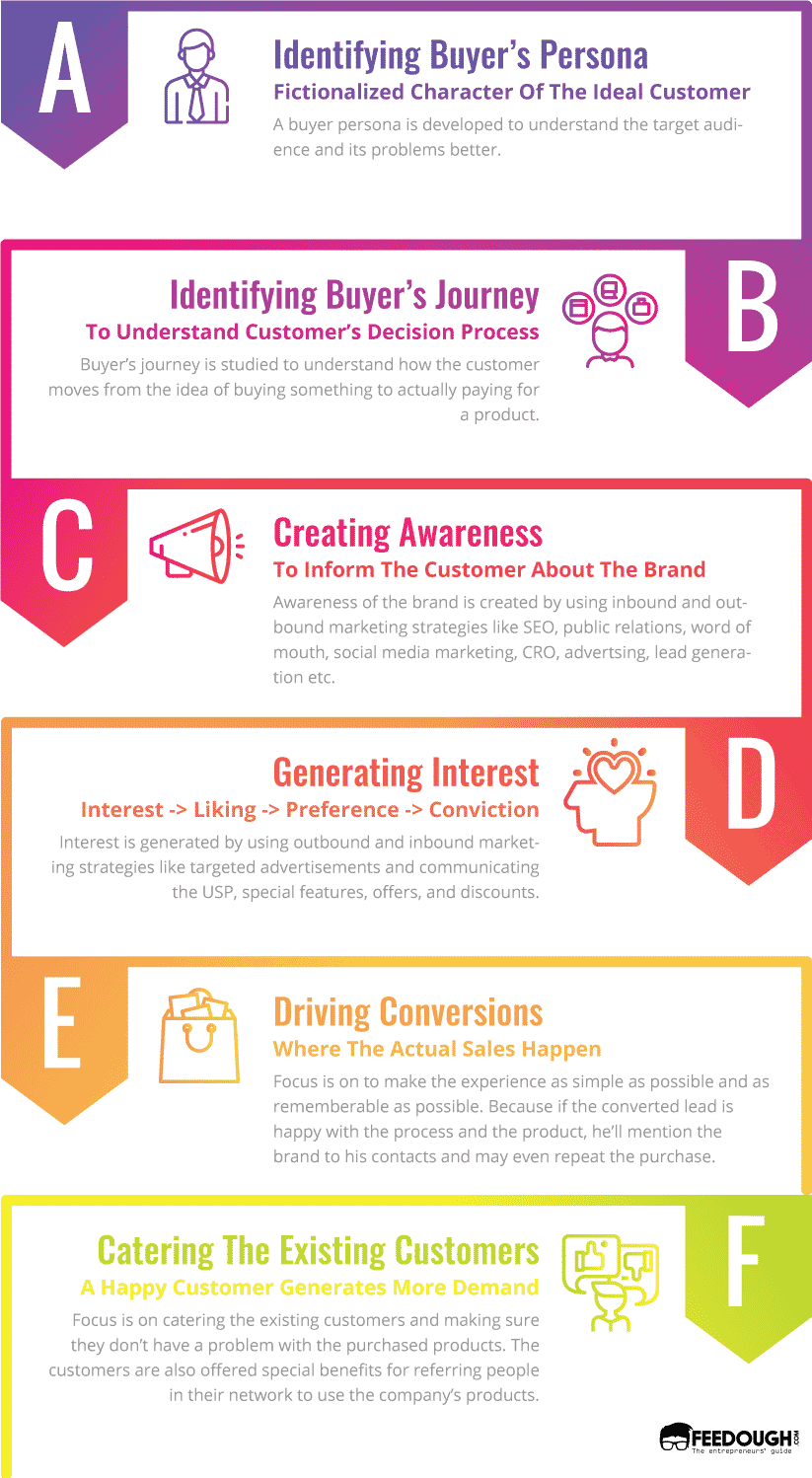
Demand generation is a never-ending process. It starts with identifying the buyer’s persona and goes on even after he has made a purchase.
It is planned in such a way that the consumer doesn’t realise that the company is influencing his decision-making process. The process makes use of both inbound and outbound marketing strategies like SEO, buzz marketing, lead generation, public relations, advertisements, and influencers and even includes referral marketing tactics to take the help of existing customers to influence their friends and family members’ decisions.
Identifying Buyer’s Persona
Demand generation starts with understanding who the target audience really is, what are its demographics, psychographics, behaviours, preferences, and problems. A buyer persona is developed to understand the target audience and its problems better.
Identifying Buyer’s Journey
Once the buyer persona is developed, the business then focuses on understanding how the customer moves from the idea of buying something to actually paying for a product. This is different for different niches, and the company has to conduct many surveys and monitor the activities of the target audience to get more insights into the buyer’s decision-making process.
Creating Awareness
After the company understands the buyer’s journey, it places its communication in all stages. The communication is designed according to the stage the customer is in. The awareness stage includes creating awareness of the brand by using inbound marketing strategies like SEO (when the user looks for niche-related information on the internet), public relations (news and other blogs), word of mouth, social media marketing, CRO etc.
Outbound marketing strategies like above-the-line advertisements, PPC, social media ads, and lead generation also play an important role in creating awareness of the brand. Companies try to collect as many leads as possible in the awareness stage.
Generating Interest
The company puts a special focus on when the customer reaches the interest stage of the journey. This is where he shortlists the brands he wants to buy from. Interest is generated by using outbound marketing strategies like targeted advertisements and communicating the USP, special features, offers, and discounts. Other than this, inbound marketing strategies like lead nourishment also play a vital role in this stage.
These strategies result in converting the interest into liking, liking into preference and preference into conviction which eventually leads to sales.
Driving Conversions
This stage involves making the experience as simple as possible and as memorable as possible. Because if the converted lead is happy with the process and the product, there are chances that he’ll mention the brand to his contacts and may even repeat the purchase.
Many companies insist users to share the brand to get more discounts. This not only delights the customers but also increases the awareness of the brand among the customer’s network.
Catering The Existing Customers
A happy customer generates more demand. This stage of the demand generation process involves catering for existing customers and making sure they don’t have a problem with the purchased products. The customers are also offered special benefits for referring people in their network to use the company’s products.
Even though many people confuse demand generation to be the same as lead generation, both are significantly different aspects of marketing.
Lead generation is a part of the demand generation strategy, which focuses on the collection and nurturing of leads to get more conversions.
Demand generation, on the other hand, is a very broad marketing aspect which focuses on the buyer’s journey and includes both inbound and outbound marketing strategies to generate demand by creating awareness, generating interest, and driving more sales.
You probably must have seen mission statements everywhere — on walls of company lobbies, official websites, inside promotional brochures, etc. Whether you are starting a new business or re-evaluating your goals, mission statements can go a long way in helping your company project a vision for its future, as they help in defining your organization’s identity and purpose.
Creating a powerful mission statement will guide your business as well as your employees to refocus and build on your brand, assisting in making decisions as it acts as a constant reminder of your brand’s purpose and your ultimate goals.
Let us understand mission statements in-depth and learn some tips to create your own.
Mission Statement Definition
A mission statement is a brief description that compiles the organisation’s functions, ideals, business goals, values, and philosophy.
In simple terms, it is a brief description of the business’s fundamental purpose.
Your mission statement expresses your strategy, your core values, vision, identity and culture. It should be able to encapsulate everything your company stands for and strives to be, in a concisely simple statement that communicates your purpose and direction to your employees, customers, vendors and stakeholders stating why and how your company adds value to their lives and to the world.
A well-crafted mission statement sets the tone for your entire brand story. It helps connect your products and services with your target audience by explaining exactly why they should purchase from you. It also provides a certain sense of direction to your business that helps you to understand if you are heading in the right path, and in making better decisions that are efficient for future-oriented goals and objectives.
Mission Statement vs Vision Statement
Both the terms ‘mission statement’ and ‘vision statement’ are often confused with each other by a lot of companies. Let us understand both these terms clearly with the help of examples.
Vision Statement
Mission Statement
A perspective on how you want the future of your company to be.
A description of your company’s business, objectives, and your approach to reach those objectives.
Outlines WHERE you want to be, communicating the purpose and scheduled foresight of your business.
Narrates about HOW you will get to where you want to be, defining the purpose and primary objectives related to your team values and customer needs.
Talks about the future.
Talks about the present leading to its future.
Vision is the ‘why’.
Mission is the ‘what’ and ‘how’.
Examples
Here are a few examples to explain the difference further –
Nike
Mission statement: Bring inspiration and innovation to every athlete* in the world.
*If you have a body, you are an athlete.”
The main components of Nike’s mission statement are: Inspiration, Innovation and Every athlete in the world. Even though this might sound a little bland at first, the statement further emphasized by Nike co-founder Bill Bowerman as “If you have a body, you are an athlete” instantly knocks off the stereotype of body-shaming and creates a hard-hitting impact on everyone who reads it giving them a strong sense of encouragement and motive to push forward.
Vision statement: “Create groundbreaking sports innovations, make our products sustainably, build a creative and diverse global team, and make a positive impact in communities where we live and work.”
Nike’s vision statement declares the underlying values and principles that the company advocates: Innovation, Sustainability, Diversity and Community. The statement is also future-oriented keeping the brand’s leading position as a strategic aim for future business development.
Tesla
Mission statement: “To accelerate the world’s transition to sustainable energy.”
Elon Musk’s mission statement has three strong components: Accelerate, World’s transition and Sustainable energy. It clearly highlights their aspirations to create a dynamic change in the world’s automobile industry with technologically integrated products that rely on renewable (sustainable) energy, while tactfully addressing concerns for environmental conservation.
Vision statement:“To create the most compelling car company of the 21st century by driving the world’s transition to electric vehicles.”
This vision statement portrays their aim to become the most compelling car company of the 21st century by ultimately advancing the best clean transport and clean energy production, building the future that they want the world to experience. This statement is perfectly in sync with the company’s mission statement as well as its beliefs and philosophy towards their future goals.
Amazon
Mission statement:“We strive to offer our customers the lowest possible prices, the best available selection, and the utmost convenience.”
Here, the three distinct characteristics are identified: lowest prices, best selection, and utmost convenience. This corporate mission statement promises attractive e-commerce services to satisfy target customers’ needs, focusing on low prices, a wide product selection, and convenient access to products and the company’s services.
Vision statement: “To be Earth’s most customer-centric company, where customers can find and discover anything they might want to buy online.”
Here, the identifiable characteristics are: global reach (depicting ‘Earth’ as the market), customer-centric approach and widest selection of products. This vision statement highlights the organization’s main aspiration to become the best e-commerce company in the world.
20 Corporate Mission Statement Examples
Following are some examples of outstanding and inspiring mission statements of successful companies to help give you a clearer idea:
Walt Disney: “To entertain, inform and inspire people around the globe through the power of unparalleled storytelling, reflecting the iconic brands, creative minds and innovative technologies that make ours the world’s premier entertainment company.”
Tumblr: “Tumblr is where your interests connect you with your people.”
Facebook: “To give people the power to share and make the world more open and connected”.
Sony: “To be a company that provides customers with kando- to move them emotionally- and inspires and fulfills their curiosity”.
Verizon Communications: The Verizon Promise- “We deliver the promise of the digital world to our customers. We make their innovative lifestyles possible. We do it all through the most reliable network and the latest technology.”
Unilever: “To add vitality to life. We meet everyday needs for nutrition, hygiene and personal care with brands that help people feel good, look good and get more out of life.”
Intel Corporation: “Utilize the power of Moore’s Law to bring smart, connected devices to every person on earth.”
eBay Inc.: “To provide a global trading platform where practically anyone can trade practically anything.”
Microsoft Corporation: “To empower every person and every organization on the planet to achieve more.”
Harley-Davidson: “We fulfill dreams through the experiences of motorcycling, by providing to motorcyclists and to the general public an expanding line of motorcycles and branded products and services in selected market segments.”
Wendy: “To deliver superior quality products and services for our customers and communities through leadership, innovation and partnerships.”
McDonald’s: “To be our customers’ favorite place and way to eat and drink.”
Starbucks: “To inspire and nurture the human spirit – one person, one cup and one neighborhood at a time.”
Google: “To organize the world’s information and make it universally accessible and useful.”
Uber: “To bring transportation – for everyone, everywhere.”
Samsung: “Inspire the world with our innovative technologies, products and design that enrich people’s lives and contribute to social prosperity by creating a new future.”
Ikea: “Offer a wide range of well-designed, functional home furnishing products at prices so low that as many people as possible will be able to afford them.”
TripAdvisor: “To give travellers a voice to share their experiences, promote consumer choice and encourage a level playing field for everyone in the industry– all within a free forum for sharing open and honest opinions.”
Walmart: “To save people money so they can live better.”
How To Create A Mission Statement?
The firmness of your brand begins with a precise, focused, and purposeful mission statement. It is a promise you make to your market, and it defines who you are and what you have to offer. Here are a few tips to help you create an impactful mission statement, especially if you’re not using a mission statement generator:
Start with a basic understanding of: What you do, How you do it, Who you do it for, and How it helps them.
Ask yourself a few questions: Why did you get started? What are you most excited to create? What do you want your brand to be known for? How will your work benefit your customers? What core values or beliefs inspire your organization?
Your mission statement should be able to invoke the emotions that you want your audience to feel about your brand and your work.
It should not be generic and vague. Make it unique and memorable. Add some witty, appealing or intriguing phrases that spark a thought in the reader’s mind.
Don’t write a long essay. A single powerful statement that is concise and specific should be able to captivate the reader’s hearts.
Make sure that the statement is in harmony with the culture, values and beliefs of your organization.
Unless you’re a solopreneur, ask some of the key members of your team to answer the above-mentioned questions or to come up with their own mission statement. Align them with your own, discuss and create a single sentence that tallies with everyone.
Your mission statement does not have to be catchy or too logical- just authentic, accurate and genuine.
If you already have a mission statement, it is a good idea to revise it to make sure it reflects your company goals as the economic circumstances and businesses evolve.
A mission statement is a key tool that captures the essence of your business goals and the philosophies that your organization believes in, boiled down to just a few compact sentences, as it represents what your company is all about.
It will also give your company a common goal that everyone will strive to accomplish together, aligning all aspects including your human resources, products/services, quality control, customer relationship, priorities, competitors, growth potential, community, etc.
Go On, Tell Us What You Think!
Did we miss something? Come on! Tell us what you think of our guide on mission statement in the comments section
The phrase ‘I am a freelancer’ gets thrown about a lot nowadays when someone is asked about what he does for a living. It could be a friend, colleague, or even your family member who left his regular 9 to 5 job to become a freelancer.
Many reasons contribute to this sudden shift in the mentality of people’s perception about jobs per se causing them to shift to freelancing.
Here’s a comprehensive guide to answer all your questions.
What Is Freelancing?
Freelancing is a contract-based profession where instead of being recruited in an organisation, the person uses his skills and experience to provide services to a number of clients.
In simple terms, freelancing is when you use your skills, education, and experience to work with multiple clients and take on various assignments without committing to a single employer. The number of assignments or tasks that you can take just boils down to your ability to deliver on them as asked from them.
Freelancing usually involves jobs (called gigs) that allow you to work-from-home situations. But don’t associate freelancing as the same as having a work-from-home job.
Freelancing doesn’t always mean that you’ll work from home. You might have to work at your client’s office too depending upon the type of work and the client’s requirements.
A work from home job involves a contract between you and a single employer who gives you a salary while freelancing doesn’t.
It is just that many of the jobs that freelancers perform can be delivered over the Internet without their presence at the company or clients place.
Who Is A Freelancer?
A freelancer or freelance worker is a self-employed person who earns money by providing services to multiple clients. These services relate to the person’s skills and are not necessarily provided to just businesses.
Freelancers either use third-party platforms like Fiverr, 99designs, etc. to get business or use their network to get more business and provide services to their clients directly.
But is it a good choice for a career? Can you sustain a lavish life while freelancing? How do you start with freelancing jobs?
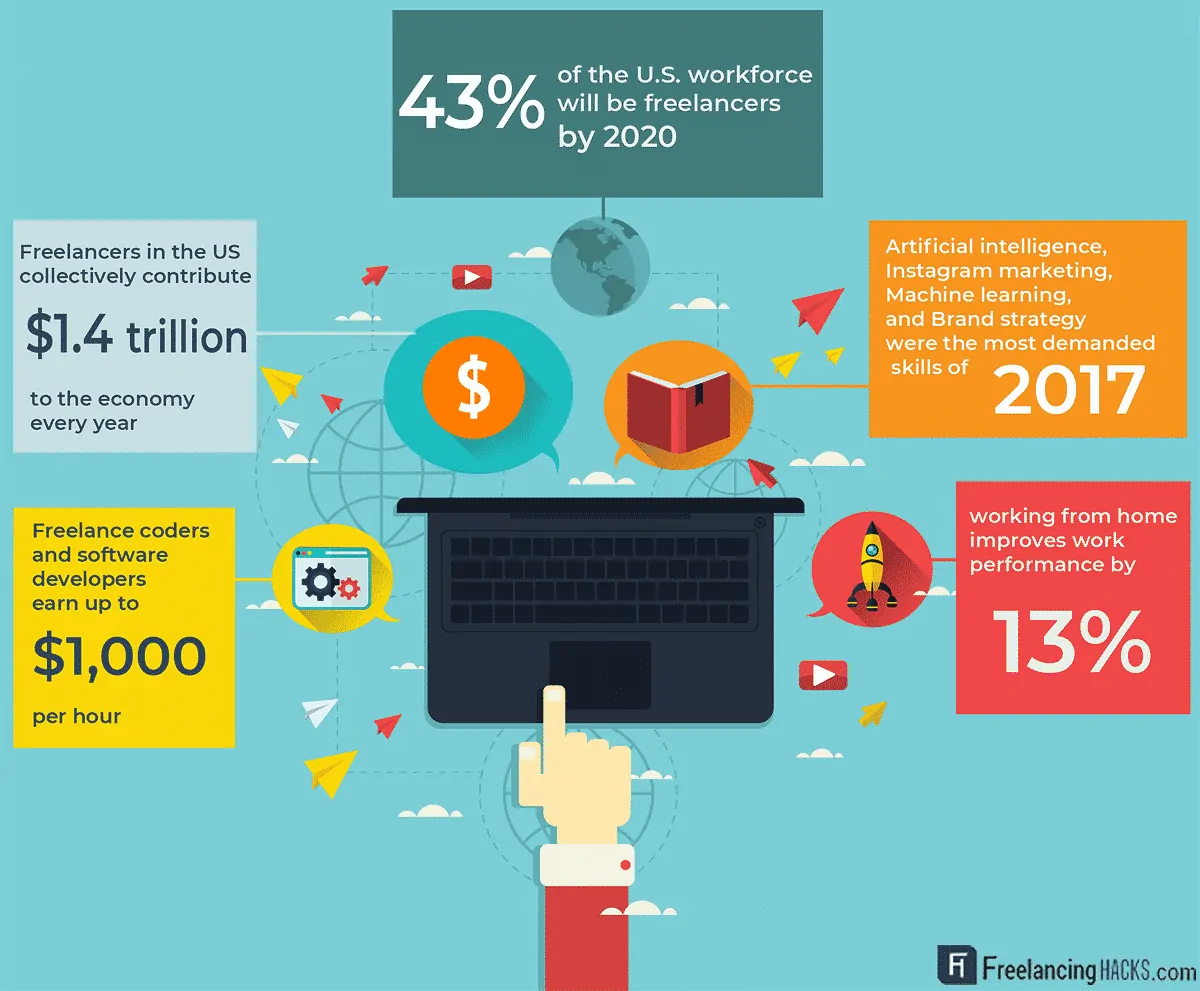
Well, when 11 percent of the working adult population in the United States is working primarily as full-time freelancers, there must be something good about this industry.
Freelancing As A Career
The rise of freelancers has resulted in the development of a new concept – the gig economy. In the gig economy, a person, instead of working for a single employer full-time and getting a fixed salary in return, works for multiple clients at his own terms and at a price he thinks his work deserves.
Freelancing is an enticing profession. It takes care of almost all the problems of a usual service-class human. According to Upwork, Americans work an average of 47 hours per week. Freelancers work an average of 11 hours less per week than full-time employed workers. That adds up to about 550 hours per year or 23 whole days.
Full-time traditional workers spend nearly an additional full month each year behind the keyboard (or wherever they work).
Here’s the annual salary of freelancers in America from 2014 till 2018:
All this along with advantages like freedom to work from anywhere at a time of your choice, being your own boss, keeping all the profits, and a lower cost of operating surely attracts a lot of people to take freelancing as careers.
But not many ends up pursuing it full time.
Why, you ask?
Well, the answer is basically embedded in our human psyche.
It is deeply rooted in our minds to look for a guarantee. A regular job provides us with a guarantee of a profession that pays at the specified time. You get a routine to follow. And this job also provides with guaranteed perks such as insurance, retirement benefits, provident fund, increments and salary hikes for performing well.
When you opt for freelancing, you lose the guarantee of any of this. There’s no surety that you’ll get recurring clients. No surety that you’ll be able to sustain this lifestyle till retirement, and even no guarantee that your income will ever increase.
Moreover, you get to handle your tax deductions, insurance, and other finances yourself.
There are also other cons to freelancing such as –
Work-life balance: If you don’t know how to separate personal life from work, freelancing becomes tougher than a regular nine to five job.
No benefits: Freelancers are in charge of their own holidays, sick days, vacations and must be good financial and time-management planners.
Difficult Clients: You may find some clients who are extremely difficult to manage. They may fail in giving the right instructions and information for completing the job or may be inaccessible to clear any doubts. This can be frustrating and might result in wasting your time.
There are always pros and cons to every profession and it’s up to you to balance it properly for a healthy footing. If you think freelancing could be beneficial for you and the cons don’t matter much. Read on to find out how you can become a freelancer.
How To Become A Freelancer?
Becoming a freelancer is just as easy as ordering something over the Internet. You visit sites that offer freelance jobs and tasks and take them on. This is a wonderful way of starting out and getting your name out there.
Here are a few sites that you can try for freelancing jobs:
Toptal: Toptal is a highly selective and exclusive platform for freelancers, known for its rigorous screening process to ensure that only the top 3% of applicants are accepted. However, you make the most money here if selected.
Fiverr: the world’s largest marketplace to look for freelance jobs. Just create an account post what you can do, add few links and you’re done.
99Designs: A perfect place to find freelancing jobs if you’re a designer.
Upwork: Upwork is a more professional looking freelance marketplace where you’ll find more business clients.
Freelancer.com: Freelancer.com is among the oldest freelance job marketplace which you can choose in your initial year when you have little or no freelance experience.
Market your services: market on social media, offer something for free or at a very less cost (helps in getting more traction), ask for referrals, and use email marketing.
We don’t suggest you leave your existing source of income and jump into freelancing per se. Try it as a part-time venture to see how it works out for you in the initial months.
It is entirely not necessary that you have to freelance full time. It is up to you to decide on whether you’d like to do it full time or keep your existing job and make a buck during your free time.
If you feel that you really like the way things are headed, it’s time to move onto the next step and make money freelancing.
Next Step
Once you feel that you can provide for yourself and work this way, the next course of action is to take on multiple assignments for multiple streams of revenue. This should include gigs that you got personally using the methods mentioned above as well as from the freelancing sites.
Another possibility is that you could make it a full-time gig. Freelancing full time also means you can create diverse forms of income. You can:
Negotiate monthly retainers
Negotiate commissions on sales projects
Create referral systems to reward clients who send you new clients
Market yourself directly: Here’s a helpful guide on marketing and creating perfect personal branding for yourself.
Take Care Of Your Finances
While in a job, most of the “money stuff” is taken care of by the company you work for. You get a regular paycheck without having to ask; your taxes are deducted automatically, and insurance is likely also taken care of by your employer.
Things are different when you’re on your own and you’d have to take care of the following by yourself:
Getting your Paycheck: This is considered to be the trickiest part to manage, be it for the freelancing veterans or the newbies. Negotiating and communicating properly with your client to get them to pay for your service at the specified time proves to be much of a challenge. Take care of this properly and you are well set to do great in the freelance field. Check out this guide on negotiating like a pro to help you gain more tips and insight.
Taxes: You need to handle your personal and professional tax complexities yourself.
Insurance and retirement benefits: You need to look for the best insurance policy and plan for your retirement yourself.
What it all comes down to is that being a freelancer and working in the gig economy means taking a lot of responsibility for your own finances, whether that’s negotiating your pay, finding insurance, or paying taxes. But if you love the freedom, flexibility, and earning potential that comes with being independent, then freelancing is an ideal situation.
The Takeaway
Freelancing is equal parts positive and negative. You just have to decide if you’re willing to take the risk that almost always accompanies it. Freelancing means professional freedom, but it also means instability and the risk of failure. And that may not be what you need in your professional life. But if you risk your stability for something more in tune with your professional goals than a traditional job, you have the opportunity to build your name and reputation and reach your professional goals.
Go On, Tell Us What You Think!
Did we miss something? Come on! Tell us what you think of our guide on what is freelancing and who is a freelancer in the comments section
Self-sustainability is important for the initial stages of a startup. If you’re self-sustainable, you have more confidence, you can take as much time as you want to develop, pivot, or upgrade. You have more say in the negotiations with partners and investors. And you see the big picture which isn’t limited to just sales and other short-term goals.
But how exactly do you define self-sustainability for a startup and when should you aim to achieve it?
Well, it’s referred to as ramen profitability; and yes, it is related to ramen noodles.
What Is Ramen Profitability?
Ramen Profitability is a situation where the startup earns enough profit to cover the founders’ living expenses.
In simple terms, a startup is ramen profitable when it earns a few dollars beyond the break even in the initial stages. These few dollars help the founders pay for their daily expenses and live by eating ramen (instant noodles).
This form of profitability is witnessed at a very early stage (within a few months of starting the operations) and is a result of founders’ sheer commitment, good research, and fewer expenses.
It is a totally different concept from traditional profitability (and many don’t even consider this to be profitability) as the latter involves an initial (huge) investment, which then leads to the break-even in few years, and then to the profits which also huge when compared to this stage. Ramen profitability can be achieved even with $5000 of monthly revenue. It could be because the startup’s expenses are really less, there are not many employees and most of the work is done by the founders and they can live on almost nothing. Card
Why Should You Strive To Achieve Ramen Profitability?
No matter how less the monthly revenue be, if the startup starts sustaining itself, there are innumerable benefits to it.
Once you earn enough money to cover your and your startup’s daily expenses, your focus shift on bigger picture like growth and development. Besides this, achieving ramen profitability also –
Validates your product-market fit hypothesis (partially) as you now have customers who are willing to pay for your offering.
Buys you more time in case you want to pivot, divert, or upgrade your business model or offering.
Gives you more say in front of the investors as now you have a more sustainable outlook and have the time to say no to the investment offer and look for a better one.
You should strive to achieve ramen profitability before pitching to the investors as this achieving this milestone addresses three of the biggest worries of investors –
Product or service which the target audience actually wants,
Entrepreneur(s) who knows the value of money (and keeps expenses low),
Getting people to pay for the offering
When three of the biggest worries why a startup fails are addressed, investors are more willing to invest on your terms and cooperate with you.
If startups need less [money], they’ll be able to get it on better terms, which will make them more inclined to take it. That will tend to produce an equilibrium.
Is Ramen Profitability A Measure Of Long-Term Sustainability?
Achieving ramen profitability doesn’t guarantee that your startup will succeed in the long run. This is just a short-term measure of sustainability. Most of the startups achieve ramen profitability in their beta stage, when the original product hasn’t even launched.
Once you grow, your policies change, new people come on board, and you expand. This is a dramatic change, the success of which is measured by traditional profitability.
Hence, while it’s preferred to be ramen sustainable before you pitch your startup to the investors, this profitability doesn’t guarantee long-term sustainability.
Go On, Tell Us What You Think!
Did we miss something? Come on! Tell us what you think of our article on ramen profitable in the comments section
Effective communication is imperative, not just for businesses but for the whole human ecosystem. For business, however, it holds a special place as the one which succeeds in communicating what it has to offer in the most appealing way wins the race.
However, communication is a two-sided process and it isn’t limited to business and its customers. A business has to work on its communication with other parties like employees, partners, Government, etc. in order to sustain in the long run.
Here’s a guide explaining the importance of communication in business.
Importance Of Communication In Business
Business communication can be divided into internal and external communication, both of which are equally important. A business should be able to clearly explain it’s offering, the company policies, and other terms to the customers, clients, employees, and other parties it deals with.
It is crucial to communicate effectively at the time of negotiations to achieve short-term and long-term goals.
Importance of External Communication
External communication is the exchange of information between a business and another person or entity in a company’s external environment. These include customers, potential customers, investors, suppliers, etc.
Communication drives business and marketing strategies. The business builds its brand and sells the offering by communicating its stance. Effective external communication is important as it helps to-
Get The Investment: Effective communication is required between startups and investors to help the company raise money for its products. It needs to convey its value proposition, objectives, and current and future stance properly in its pitch deck to appeal the investors and get the funding they want.
Build The Brand:A brand differentiates the company from other companies selling the same generic product. Effective communication is important to convey the brand message and establish the desired brand positioning in order for a company to stand out in the market.
Sell The Offering: Selling without communication isn’t possible. Both written (labels) and verbal (advertisements) communications are important to convey the intricacies of the offering and sell it to the customers.
Prevent Conflicts: Good communication and declaration of all the terms and conditions between the company and its partners, and the company and its customers prevent conflicts to a large extent.
Build Relations:Customer relationship management thrives on effective communication. Listening to the customers, answering their doubts, and providing the services they want before, during, and after sales build relationships between the two parties.
Promote The Brand And Offering: Brand promotion requires the company to convey the product features, value proposition, and the offers in a way that the target market understands it clearly.
Collect Feedback And Grow: When the brand listens to the suppliers’, investors’, customers’ and other external audience’s grievance and collect feedback, it grows much faster than those brands which don’t.
Importance of Internal Communication
Internal communication is as important as external communication. It aligns the goals and expectations of the internal audience (employees, partners, etc.) with that of the organisation. Effective internal communication is important as it helps to –
Improve Relationships: Good employer-employee communication improves the relationship between the two as both get to understand the expectations and goals of the other party. Similarly, good communication among the partners/shareholders improves their relationships as well.
Enforce Rules: The company can’t enforce the rules without conveying them to the employees and the internal audience. Communication is necessary to let them understand what the company wants from them and how it wants it to be done.
Enhance innovation: A good two-way communication enhances the innovation within the company as the superiors get to communicate and listen to employees’ new ideas and give them feedback on the same. This motivates them as they feel more like a part of the company.
Avoid Conflicts: When everyone communicates their problems and demands, it becomes easier to avoid conflicts and work in a more peaceful way.
Increases Employee Satisfaction: Good internal communication has a psychological effect on the employees as their voices are heard and they get to give their feedback on certain issues. This motivates them to perform in a more efficient way.
Align The Goals: Effective communication also helps in aligning the goals of the employees with the goals of the organisation.
Go On, Tell Us What You Think!
Did we miss something? Come on! Tell us what you think of our article on The Importance Of Communication In Business in the comments section
In earlier times, brands would shoot their communication messages out to the world and hope that if enough people who fall under their target group hear the message, they will respond. For many companies, this ‘spray and pray’ approach worked brilliantly back then.
But now, with immense growth in technology and competition, customers have become more aware, they know what they want, how to get it and they will buy from the brand that best suits their needs. Amongst the clutter, there are high chances your brand may get ignored. Hence, aimless communication will not work efficiently anymore.
Before forming a business or marketing plan, you need to know and understand to whom you are designing the plan for. You have to be cognizant of who your customer is, what do they do, where do they do it, what are their exact needs, what is their personality like, etc.
What Is Customer Profiling?
Customer profiling is the process of identifying and describing integrated profiles of your ideal customers, segmented based on different variables, namely demographic, geographic, psychographic, behavioural, RFM (Recency, Frequency, Monetary), as well as other personalised dimensions that help you to address the right kind of audience for selling your product/service.
Customer profiles, also referred to as buyer personas, are specific customer types created from an understanding of your company’s general target audience and they represent the typical users of your product/service.
Elements Of A Customer Profile
Before compiling your customer avatar, let’s look at the essential information you need to include in the customer profile.
Demographics: First begin with describing the name, age, gender, race/ethnicity of your customer.
Socio-economics: This includes your customer’s highest level of education, their current occupation, income range per month and household structure. The household description should consist of the family makeup, whether they are single, married, have kids, single with kids or living with a partner, etc.
Geographic: The geographic location should encompass your customer’s hometown, their current residential location and what characterizes the neighbourhood, town or area they live in.
Psychographic: Once the demographics are clear, identify the psychographics, that is your customer’s behaviours and beliefs, including their personality, hobbies, interests, lifestyle, values. This can also include their worries, fears, hopes and dreams, which will assist you in understanding how your business can help with that.
Behavioural: Define what influences your customer’s buying decisions, in terms of their product choice, price factor or promotions; whether the influence is external or internal; what motivates them to make the purchase and why.
RFM:
Recency- How recently has your customer made a purchase
Frequency- How often has your customer made the purchase
Monetary Value- How much money does your customer spend on the purchase
(Note: Every customer profile does not necessarily have all of the above information. You may use what is required depending on your company type or marketing objectives.)
Customer Profiling Examples
Your customer profile can either be one cumulated sketch of the user persona that represents the ideal consumer of your brand or it can be a customised profile based on the kind of business you’re running.
Several profiles can be made if you are a company that has various products and services to offer or if there is more than one problem that you can solve. It depends on the type of your company. An ideal customer profile is made for customised products/services or for just defining a model representative customer that best fits in your target audience.
Here are some customer profiling examples to help you create your own.
Customer Profile for a home/kitchen appliances company
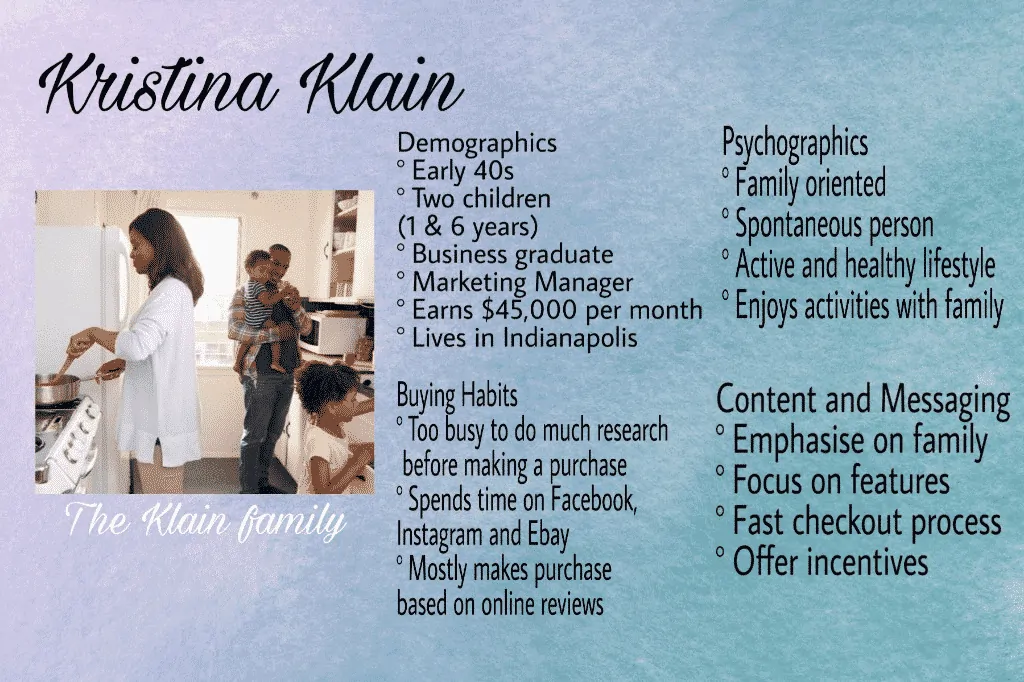
In this buyer persona example, you can get a good idea of who Kristina is by learning about her background, buying habits and her priorities. Accordingly, you can draft your communication message that will reach her more efficiently.
Customer Profile for Salon/Hair products
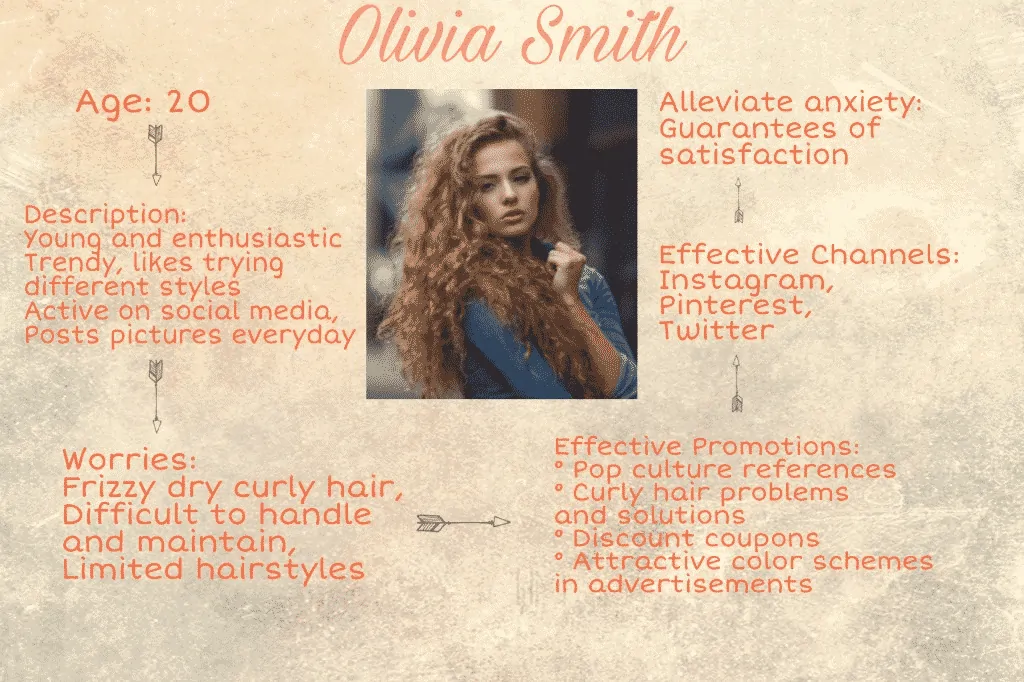
Your persona can be short and sweet as long as it includes the essential information. This example has the basic description of the kind of person Olivia is, what her pain points are, hence how you can promote your service effectively and through what channels will your message get through the right way, thus solving her problem.
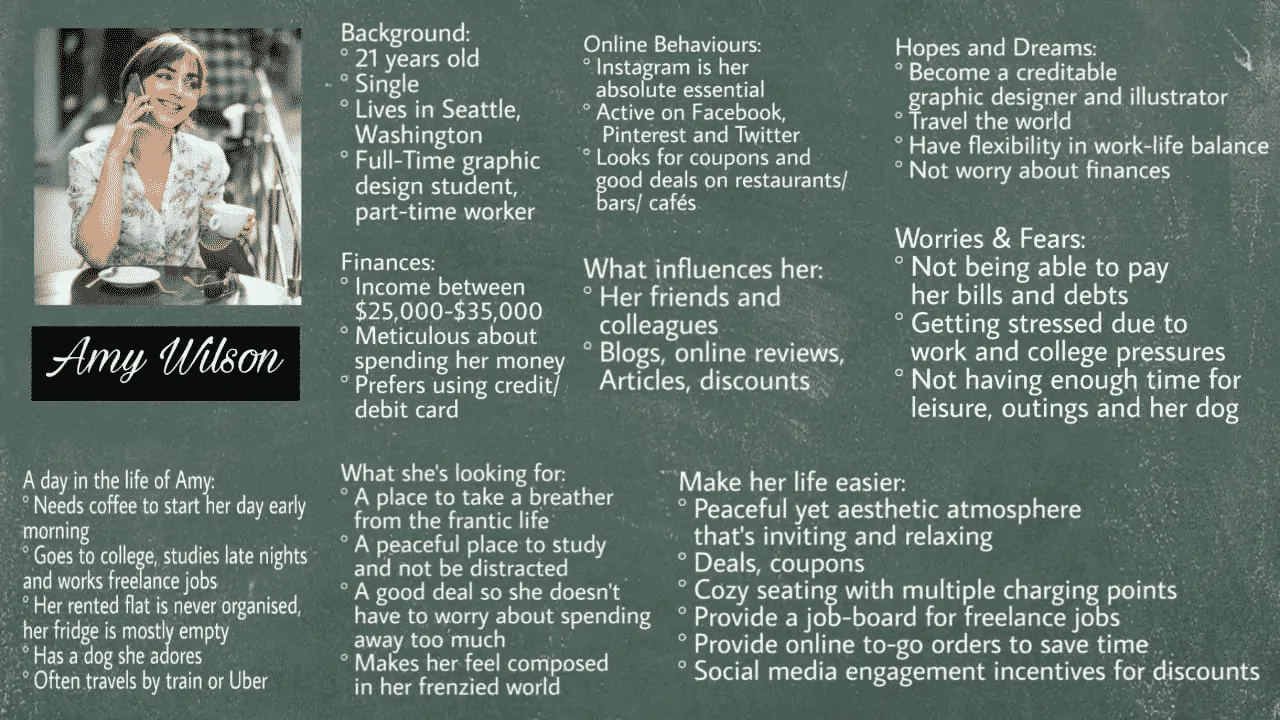
Customer Profile for a Coffee shop/ Restaurant/ Cafe
This description explains how your brand can associate with Amy’s life. It explains her personality in-depth, with an insight into her daily life and her struggles, and as a brand, how can you help her. If you ever get stuck creating your ideal profile, visualizing a day of their life can give you more clarity.
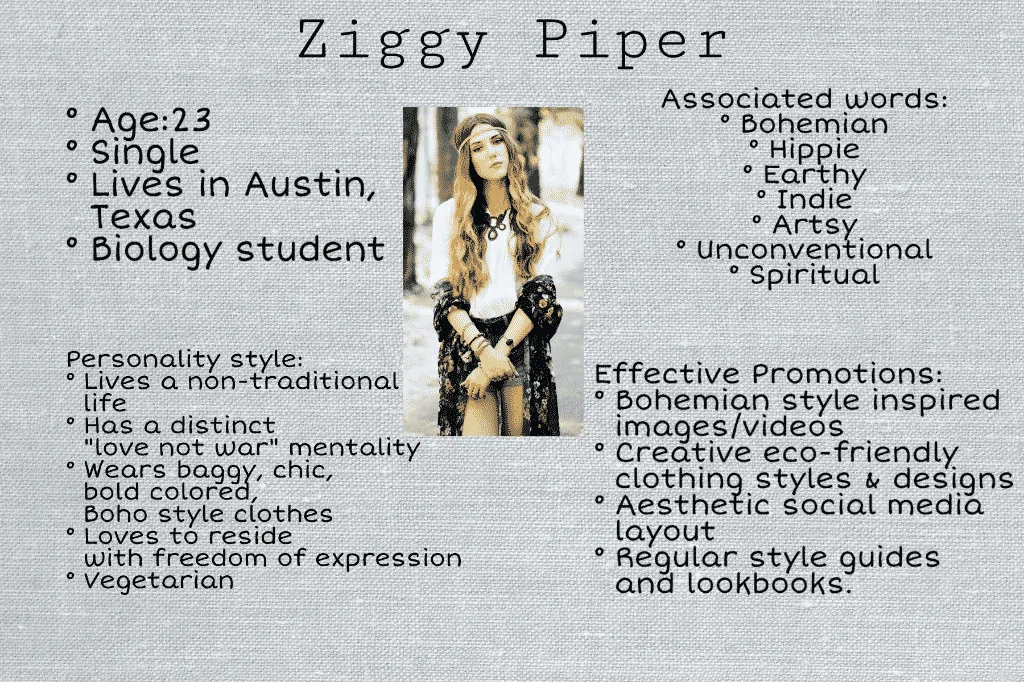
Customer Profile for a Clothing/ Accessories Company
This is a more personality based example. If your brand has a niche audience, getting an insight into their lifestyle and mindset can help you design your ideas and strategies more accurately.
Customised Customer Profile for a Wedding Planning agency
With a plethora of options available, people now demand something unique, custom, tailor-made and that which is more personal to them. If you’re a brand that specializes in customized products/services, you need to pay attention to details, understand exactly what your customer has envisioned and deliver meticulously.
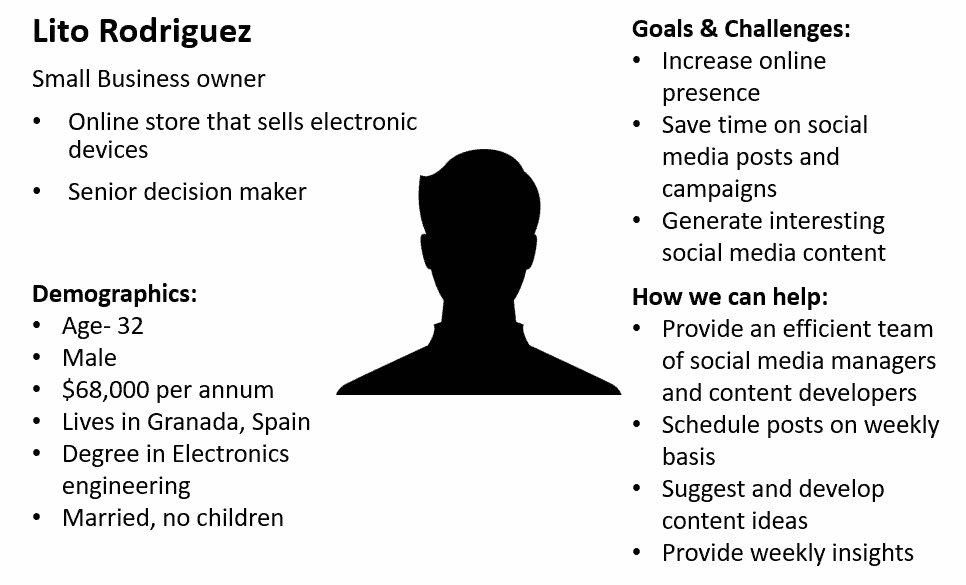
B2B Customer Profile for a Digital Marketing agency
Customer profiling is a key tool for understanding your audience accurately and increasing the performance and efficiency of your advertisements and promotional activities.
Customers are your greatest asset. It is crucial to enhance their experience and boost the relevancy of your message. Insights gained from doing customer profiling exercises will yield product upgrades and maximum customer satisfaction.
So try creating your own customer profile for your brand and look for any empty spaces your company can fill in. It might even help you come up with new promotional ideas which will be more target-oriented.
Go On, Tell Us What You Think!
Did we miss something? Come on! Tell us what you think of our article on what is customer profiling in the comments section
Every startup dreams of becoming a unicorn (a startup having a valuation of at least $1 billion). But what after that? Is it the end? Or is there another milestone the startup needs to achieve to get the ultimate success?
Well, with the ever-increasing additions to the existing unicorn club, a new goal needed to be set; a new goal which separated the best performing unicorns from average ones.
This gave the rise to the concept of decacorn.
What Is A Decacorn?
A decacorn is a startup company which has a current valuation of over $10 billion.
According to CBInsights, there are currently 18 decacorns in the world, with 10 being from the USA. Toutiao (Bytedance), a Chinese digital media/AI company is at the top of the list with the current valuation of $75 billion. It is followed by Uber with a valuation of $72 billion.
Decacorn List
Decorns are the evolved versions of unicorns. What separates them isn’t just the funding. It’s the unique business model (probably because they are the pioneers), the revenue model, and the growth rate. They’ve received such investments and have a post-money valuation of over $10 billion because they’ve shown the world an incredible growth rate that the others couldn’t. Here’s the list of all the decacorns in the world.
Company
Valuation
Country
Business Model
Toutiao (Bytedance)
$75
China
ML & AI based media content developer
Uber
$72
United States
On-demand cab aggregator + delivery
Didi Chuxing
$56
China
On-demand cab aggregator
WeWork
$47
United States
Shared workspaces provider
JUUL Labs
$38
United States
Electronic cigarette manufacturer
Airbnb
$29.3
United States
Online marketplace and hospitality service
Stripe
$22.5
United States
Online payment processing for internet businesses
SpaceX
$18.5
United States
Aerospace manufacturer and space transportation services company
Epic Games
$15
Gaming
Video game and software development company
GrabTaxi
$14
Singapore
On-demand cab aggregator
Bitmain Technologies
$12
China
Bitcoin miner
Samumed
$12
United States
Medical research and development for tissue-level regeneration
Global Switch
$11.08
United Kingdom
Large scale data centres owner, operator, and developer.
Palantir Technologies
$11
United States
Big data analytics
DJI Innovations
$10
China
Unmanned aerial vehicles (drones) manufacturer
Go-Jek
$10
Indonesia
On-demand transportation, food delivery, logistics, payment, and daily services
Infor
$10
United States
SMB and Enterprise ERP software cloud products for industries
One97 Communications (PayTM)
$10
India
e-wallet, payments bank, and online marketplace
Go On, Tell Us What You Think!
Did we miss something? Come on! Tell us what you think of our article on what is a decacorn in the comments section
Ever wondered what phenomenon results in you thinking of Coke or Pepsi whenever you are asked which soft drink you’d want?
What makes that one brand to flood your thoughts whenever someone asks you an unprompted question about its category or niche?
This is brand awareness and no, it isn’t created automatically.
Companies spend millions to embed their brands in the customers’ minds. Many have even been successful in becoming a verb in our daily vocabulary. We don’t book a taxi; we book an Uber. Don’t believe us on this? Google it to find out.
Brand awareness is the first step to positioning your brand. It’s a continuous process which not only helps in getting more customers but also brings back existing customers to buy more.
Here’s a guide to help you understand what brand awareness really is, what are its types, and how you can measure and increase it.
What Is Brand Awareness?
Brand awareness is the extent to which a brand is recognised by the target group and is associated with a product or product category.
It’s the customer consciousness of the brand when he–
Witnesses the brand along with other brands while shopping,
Talks to his friends regarding the product category,
Reads or hears the brand’s ad,
Reads or hears about the brand’s news, etc.
Buys the brand’s products,
Has other encounters with the brand or the product category.
Brand awareness is the first stage to strategically influence the customer’s decision-making process. Companies spend millions just to make their customers aware of their brands.
But, it’s still a metric that can’t be perfectly measured, and having awareness doesn’t always mean that people will buy your brand’s products. Nevertheless, brand awareness holds a lot of importance for companies, especially new ones.
Why Is Brand Awareness Important?
It is a proven fact that customers prefer known brands over unknown ones. Brand awareness is that first step to make the brand known. But the importance of brand awareness doesn’t end there. It is like a diamond, the more you polish, the more it’ll shine.
It Creates Perception
Brand awareness spreads through channels like referrals, PR, news, social media, etc. If it goes as planned by the company, it creates a positive perception in the minds of the customers.
Suppose a friend told you about a Japanese restaurant where he had a wonderful experience. Even if you don’t go to the restaurant, there are chances you’ll recommend it positively to anyone who takes your suggestions on Japanese restaurants.
It Fosters Trust
Brand awareness fosters trust. When you see people interacting with a brand and having a good experience, it builds your trust in that brand even if you haven’t tried it yet.
Suppose you visit a third world country and encounter three different restaurants; two being local restaurants and one being McDonald’s. There’s a high possibility that you’ll go for McDonald’s even if you haven’t eaten there in your country. It’s just because you know about the brand and trust its hygiene practices.
It Creates A Network
If planned well, awareness spreads like wildfire. The brand becomes a topic of discussion and it creates a network which can be used to further spread the information.
For example, TikTok never advertised itself. Its users spread awareness through its videos and through word-of-mouth as well.
It Creates Association
When done right, brand awareness results in an association. This association comes in two types –
where people think of the brand when they encounter the product category.
where they use the brand name to convey the product category.
While the second feat is really hard to achieve, many companies like Google, Xerox, Band-Aid, etc. have been successful in achieving it.
It Builds Brand Equity
The more people are aware of a brand, the more valuable it becomes. This is the concept behind brand equity. Brand equity is the value of the brand as a separate asset. It makes a generic offering to stand out just because it is offered by a certain brand.
Brand awareness builds the perceived value of the brand.
Types Of Brand Awareness
Brand awareness can be categorized into three types depending upon the perceived importance of the brand by the target group.
Knowing about the types of brand awareness is of utmost importance for marketers as the current and future marketing strategies are designed according to the current awareness of the brand among its target market.
The three types of brand awareness are –
Brand Recognition: Brand recognition is when the customer can recognise the brand and differentiate it from other brands when he comes into contact with it. This type of brand awareness doesn’t require the customer to recall the name. It just focuses on whether the customer can recognise it when it is presented at the point-of-sale or when he witnesses the visual packaging.
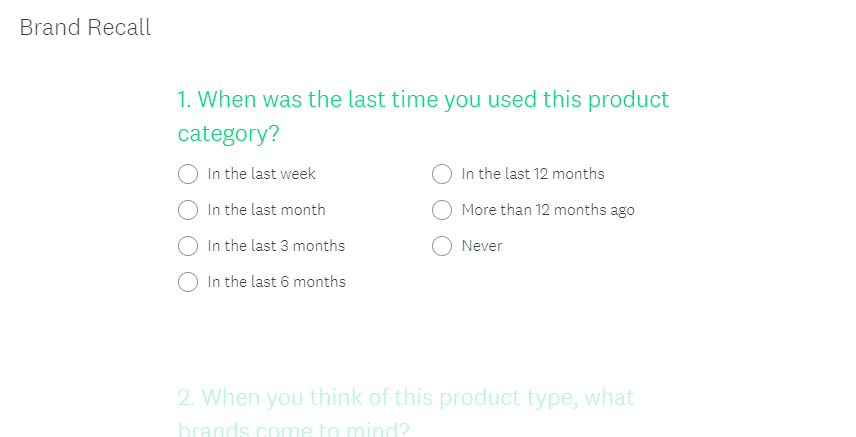
Brand Recall: Brand recall is a spontaneous recall of the brand from memory when the customer is prompted by the product category. Most users can’t recall more than 3-5 brand names. It is affected by both individual and brand factors like education level, usage, marketing strategies used by the company, etc. These brands form a part of the evoked set of the customer.
Top-Of-Mind Awareness: Top-of-mind awareness is a set of 3 brands which the customer always purchases. This is the consideration set of the customer. Getting the brand into this consideration set is the ultimate goal of every marketer.
How To Build (And Increase) Brand Awareness
Brand awareness is built by establishing a relationship with the customer where his interests are put on the top. Focus your brand awareness strategy in a way where your offering fulfils his needs without much of an effort from his side.
Focus On The Product
A strong brand awareness strategy revolves around a strong product. Make sure you are fulfilling your customers’ needs without him putting much of an effort.
Focus on creating a value proposition that’s unique, attractive, and is something that forces the customer to share voluntarily.
Whatsapp, for example, built a free instant messaging application in 2009 when most of the target audience used to communicate through paid text messages. This free IM made them share the product with all of their friends without WhatsApp forcing them to.
Focus On The Positioning And Personality
Positioning matters. Different brands use smart positioning strategies to increase their brand awareness. They might position themselves as a premium product in a market full of daily-use products, or an economic product in the market full of premium products.
Look for a desirable but unexplored positioning which could be capitalized to increase your brand awareness.
A perfect example of building brand awareness with the help of positioning and personality is Apple. The company positioned itself as the most premium brand anyone can opt for in the smartphone industry. This created a cult following which acted as evangelists of the brand and spread the brand message.
Provide Something For Free (But Keep It Limited)
Free spreads like wildfire. It isn’t just an indicator of price. It’s a very powerful emotional trigger that’s often so irresistible that it makes people try anything that’s offered at no cost, no matter if they want it or not.
Offering something for free is one of the best ways to increase brand awareness. But, when it’s mixed with the scarcity principle, the impact doubles. Provide something for free but keep it limited to increase the impact as it creates a sense of urgency and makes your customers think your offering to be more valuable than the one which is in abundance.
App sumo became a multi-million-dollar startup just by capitalizing on these two strategies.
Partner With Famous Brands
A good way to establish brand awareness is to let other famous brands talk about you to their audience. Partner with established brands; by brands we mean companies, influencers, celebrities, etc. who have good followership.
Facebook used this strategy and partnered with many niche influencers to increase the awareness of its recently launched product – Facebook Watch.
Use Social Media (a lot)
It’s hard for your target audience to get to know you unless you meet them where they are. Use social media and capitalize on the trends to establish an image among your target audience.
Behave like a person and not a robot, create posts which your users like to see and interact with, offer them rewards for sharing, and use social media to spread your brand message.
Durex is a perfect example of a company which uses social media to increase its brand awareness.
Use A Mix Of Inbound & Outbound Marketing
No doubt, advertising is a really good way to increase the awareness of the brand. However, it is a push technique and not everyone forms a positive perspective of the brand because of the advertisements and other forms of outbound marketing.
This is where inbound marketing steps in. Inbound Marketing is a pull marketing technique which uses non-intrusive and targeted strategies like content marketing, social media marketing, event marketing, and search engine optimization etc. to create brand awareness, attract potential clients, and convert them into leads and actual customers.
Use a mix of inbound and outbound marketing to get the best results. Running ads while having a blog which focuses on search engine traffic could be a great strategy to start with.
Make It Easy To Share
There are times when you can leave the awareness job to your existing customers. Just look into their habits and capitalize on what they need. Many eCommerce applications have a handy ‘share this product with friends’ or ‘ask for a recommendation from friends’ options which lets their customers share the products they are interested in. This, in turn, increases brand awareness as more people get to know about your offerings from the people they trust in.
Give Incentive To Spread The Brand
Starting a referral program or investing in an affiliate strategy is a good idea most of the times. Such strategies delegate the work of spreading brand awareness to other people usually at a lower cost than it would have incurred if you would have done it yourself. Moreover, referrals have more convincing power than your advertisements.
Set up an enticing referral program where your existing customers get something of value when they refer your brand or product to someone else. Similarly, providing good commission rates attract many talented affiliates who have good followership.
Besides this, other incentives like offering a no-ad version if the user shares the brand, giving him extra lives in a game, and providing special discounts if he gets more users on board, etc. can also be used to increase brand awareness.
How To Measure Brand Awareness
As we mentioned before, brand awareness cannot be fully measured. But you can still review the activities and collect some data to support your strategies and form new ones. Here are a few ways to measure if your brand awareness strategies are working or not.
Surveys
The best way to measure your brand awareness is to reach out to the target group and ask questions about your brand. You can either outsource it to the expert or conduct it yourself either through direct contact or with the help of online tools like SurveyMonkey, Google Forms, etc.
Traffic & Analytics
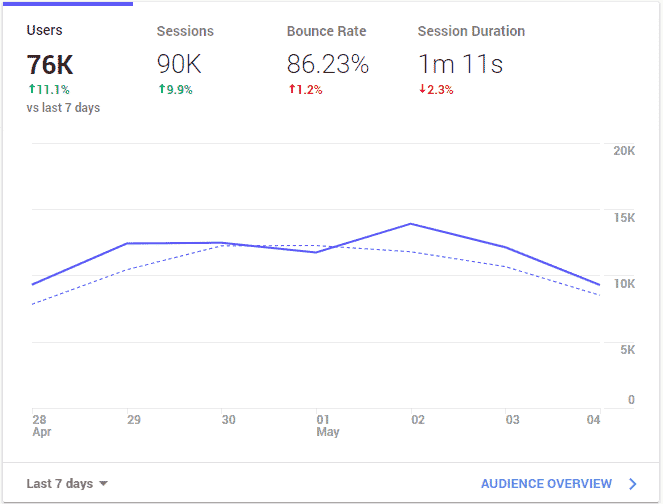
Traffic can be a great measure of brand awareness. Use analytics to find out where do you get the most traffic from. Your brand awareness strategies are considered to be working well if you get most of your traffic either directly (people typing your URL and visiting your website), through referrals (other websites mentioning your brand and/or linking to you), or through social shares (Facebook, Twitter, Pinterest, etc.).
Use tools like Google Analytics, Semrush, Ahrefs, etc. to analyse your progress.
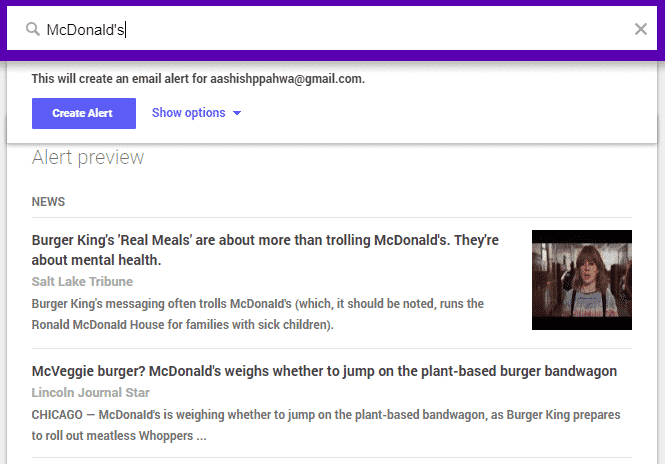
Google Alerts
Google alerts is a good way to get notified whenever someone mentions your brand. It is a free brand awareness measurement tool which emails you every time your brand name gets mentioned on a website.
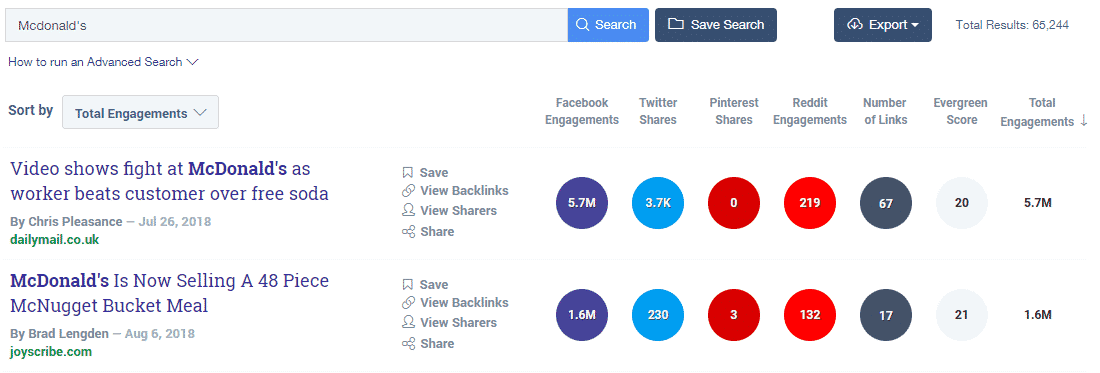
Social Mentions & Shares
Organic social mentions and shares are also a good measure of awareness. Many tools like Buzzsumo, Twitcount, etc. can help you measure social mentions and shares.
Social Engagement
An organic increase in the number of social media followers is also a result of good brand awareness. It is a reflection of how many people are aware of the brand and want to socialize with it.
Earned Media Analysis
Earned media is essentially word of mouth and promotion of the brand done voluntarily by third parties like news channels, influencers, people belonging to the target group, and others.
A good public relations company can help you in capitalizing on and measuring brand awareness through earned media.
Brand Awareness Examples
Here are two companies which use creative means to build and increase their brand awareness.
Burger King
The company has started capitalizing on the never-lasting Burger King vs McDonald’s war to increase its brand awareness. It recently launched an ‘unhappy meal’ to poke fun at McDonald’s happy meal and to contribute to the mental health awareness month.
Durex steals the show when it comes to raising awareness through social media. The company capitalizes on the present trends and creates shareable creatives which the target audience love to interact with.
Go On, Tell Us What You Think!
Did we miss something? Come on! Tell us what you think of our article in the comments section
Today, we can’t deny that startups have found a special space in the business ecosystem. They have become such an important part that our daily vocabulary is now full of startup-related words like venture capital, seed funding, venture capitalists, aggregator, etc.
The point is, people assume that everyone understand these startup lingos…which is not the case most of the times.
If you found this article on a search engine, chances are that you’ve encountered venture capital in any of your conversations but never fully understood the core concepts behind it, how it is different from angel investment, and who exactly is a venture capitalist, etc.
Well, here’s a guide answering all your questions.
What is Venture Capital?
Venture Capital is the funding investors provide to the high-growth potential startups in exchange for equity in the company.
In a simple context, venture capital is provided to startups (not any new company) which are growing at a remarkable rate and are in need of money to sustain that growth. The investor, in return, demands equity or an ownership stake in the company.
An example of this exchange would be a venture capitalist providing $100,000 to help the startup grow and in return taking a 10% stake in the company.
What Is A Venture Capitalist?
A venture capitalist is a professional investor (usually a firm) that funds startups and business ventures showing high growth potential in exchange for an equity stake.
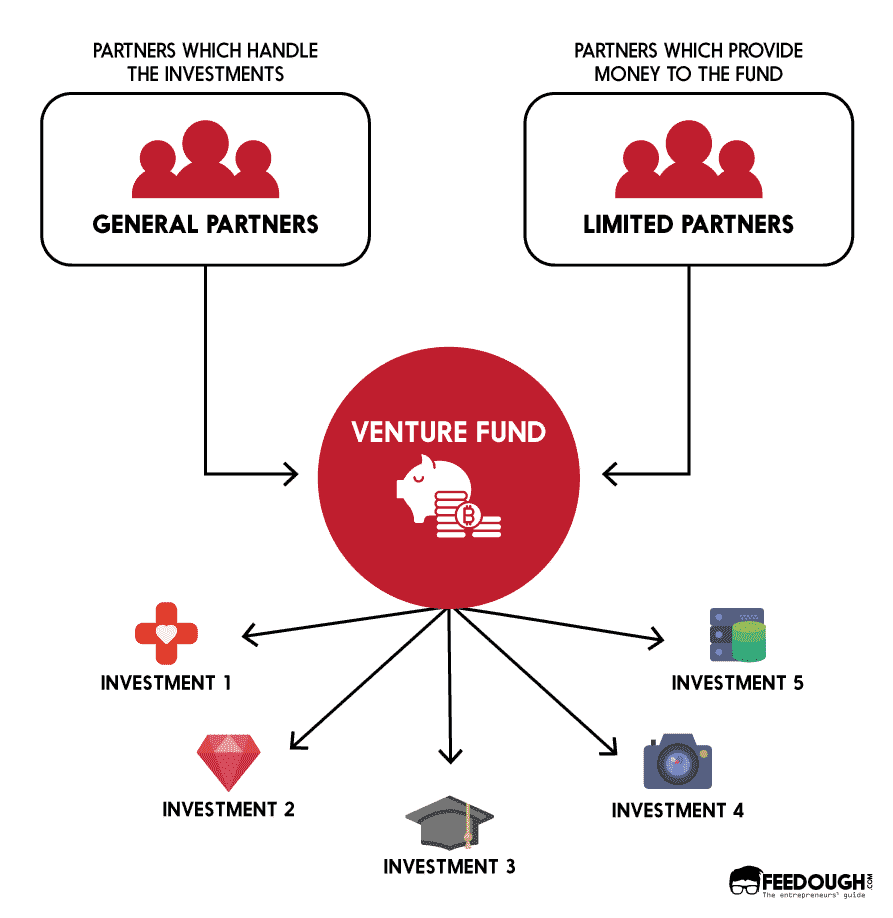
Venture capitalists are usually formed as limited partnerships where the partners invest in the VC funds. These partners are usually categorized into two types – the Limited Partners (LPs) and General Partners (GPs).
The limited partners are institutional investors which provide money to the fund, like university endowments, pension funds, insurance companies and other big corporates and high net-worth individuals.
The general partners (GPs) are active investors who make the decisions on where, how, and how much to invest. They are usually industry veterans with business, research, and entrepreneurial experiences who have a sound knowledge of their niche and the startup ecosystem.
Since their money is on the stake, VCs also provide guidance and direction to the companies they invest in and take an active part in the decision-making process too.
However, contrary to the usual belief, VCs don’t usually fund companies that have just started. As a matter of fact, less than 1% of companies receive venture capital. Moreover, raising venture capital is a lengthy and stressful process and involves a lot of examinations from the investors’ side.
But entrepreneurs still go to the VCs. Why, you ask?
Why Do VCs Exist?
A question that must have crossed your mind is why do VCs exist? Can’t startups go to the banks or financial institutions to fund their ideas and early-stage companies?
Well…they can’t.
Venture capital’s niche exists because banks are not willing to take risks funding early-stage startups (of which 9 out of 10 fail). Even if they do, they do it with high interest rates and only to the extent of the hard assets against which they can secure the loan.
Now, SBA loans do exist. But while they might be good for small businesses, startups often require a lot of funding as they plan to disrupt the whole industry.
This need resulted in an all-new niche where people (angel investors), corporates, and even financial institutions invest money in promising ventures, help them grow, and make profits by exiting with most profits.
How Venture Capital Works?
Startups raise venture capital in instalments known as venture rounds. These venture rounds sum up the types of venture capital that exists.
Pre-Seed Funding: It is required to validate the product hypothesis and build an MVP. Usually, not much investment is required at this stage and almost no venture capitalist invest during the pre-seed funding phase unless it’s one of their partners’ venture.
Seed Funding: Once the hypothesis related to the product-market fit is validated, entrepreneurs look for seed funding. This investment is used to set-up the company, build the actual product, and start full-fledged operations. Most venture capitalists stay away from seed funding as most of the financial needs of the companies at this stage (usually between $500,000 and $2 million) are met by fundings from angel investors (high-net-worth individuals) or banks. Moreover, they don’t invest in companies during the seed stage as startups have a high risk of failing during this stage.
Series A-F: Once the startup starts receiving traction in the form of the number of users, revenue, views, or other KPIs, it becomes ready to raise a series A funding to grow and expand. This is where most of the venture capitalists come in. Series A round is followed by 5 more rounds. However, according to CB Insights, only 48% of the companies go for a second round of the funding (after the seed round), and only 15% of the companies go for a Series C round.
According to HBR, around 80% of the venture capital goes into the infrastructure required to grow the startup. This includes expense investments (manufacturing, marketing, and sales) and the balance sheet (providing fixed assets and working capital).
Even though venture capital is an important investment for the startups, it really isn’t a long-term investment from the venture capitalist’s point of view. Their plan is to invest in the company’s growth until the time it reaches sufficient size and is credible enough to be sold to a corporation or any other party.
In simple terms, they buy a stake, nurture it till it becomes profitable, and exit it as soon as they can.
Venture Capital Process
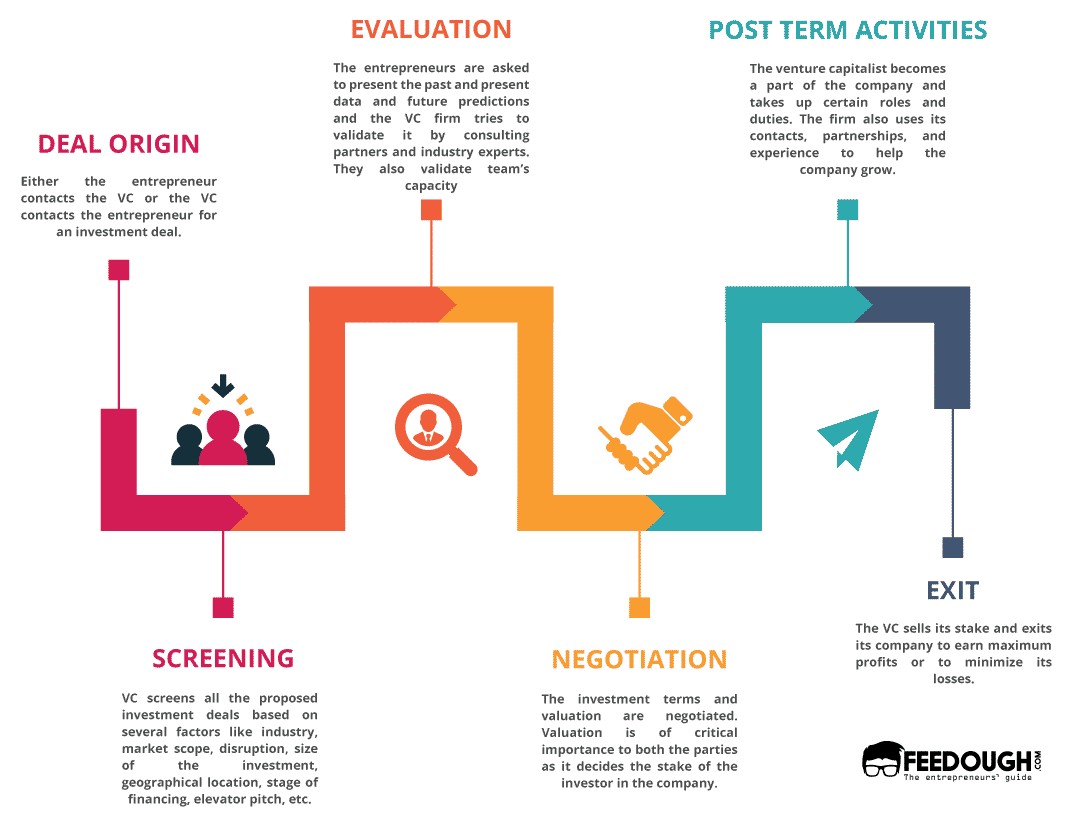
While the venture capital process is very complex and works a bit differently for different VC firms, we’ve tried to break it down into six steps which start with them getting the offer to invest and end with them exiting the company.
Deal Origination
An investment deal can originate in various ways. Either the entrepreneur contacts the firm directly, or the partners get to witness the startup in competitions, meetups, news, or become a customer themselves; or the deal can originate in the form of a referral by business partners, parent organisations, friends etc.
Screening
This stage involves the screening of all the proposed investment deals. The projects are screened based on several factors like industry, market scope, disruption, size of the investment, geographical location, stage of financing, elevator pitch, etc.
The most promising projects reach the next stage which involves a more detailed evaluation.
Evaluation
Once the potential projects are chosen from the lot, the evaluation begins.
This stage involves a lot of effort from both the parties. The entrepreneurs are asked to present the past and present data and future predictions and the VC firm tries to validate it by consulting partners and industry experts.
In the evaluation stage, the VCs not only evaluate the product’s capacity but also the team’s capacity to meet the proposed claims. The project passes this stage only if they feel that the goals are attainable and the team has relevant skills, competence, ability, and experience to make it happen.
Risk management is also done to evaluate the ROI by keeping the forecasted risks alongside.
Terms & Valuation Negotiation
Once the evaluation is complete, the investment terms and valuation are negotiated. Valuation is of critical importance to both the parties as it decides the stake of the investor in the company.
Valuation is divided into two segments – pre-money valuation and post-money valuation. The pre-money valuation is the agreed-on value of the company before the investment is made and post-money valuation is the valuation after the investment is made.
Suppose the parties agree on a (pre-money) valuation of $40M and the investor pitches in $20M, the post-money valuation will be $60 million and the investor’s stake in the company will be 1/3 or 33.34%, at the closing of the financing.
There’s no one right formula to decide the valuation of the company and both the parties have their say during the negotiation. The entrepreneur tries to keep the valuation as high as possible while the investor tries to keep it low to have a higher stake.
The valuation along with other terms are included in a term sheet developed by the VC. Here are some other elements that are included in the term sheet–
Option Pools: It’s a pool of stocks reserved for employees or future employees of the startup.
Liquidation Preference: It is a kind of safety net for the investors which gives them preference to get some money back in the case of the startup failing. In simple terms, at the time of the liquidation, the investors or other preferred stockholders get back up to a percentage (usually 100% or 1x) of the amount they invested in the company before any other common stockholder gets anything. Of course, no one gets anything if all the money is lost.
Participation Rights: Participating right or participating preferred favours the investors more. It is a type of liquidation preference where the investor gets 1x of his investment back but also gets his proportional share of any cash that remains after that. For example, say a venture capitalist with preferred stock has $1M liquidation preference with participation rights and owns 20% of the cap table. Suppose the company sells for $10M. He gets back the $1M as his preferred stock as well as the 20% of the remaining $9M, which comes out to be $1.8M, because he had participation rights. This leaves $6.2M to be divided between common shareholders and the founders.
Dividends: The terms related to dividends (cumulative, non-cumulative, and anti-dilution rights) are also decided in the term sheet.
Board of Directors: The entry of the venture capitalist makes it somewhat obligatory for the entrepreneurs to define the board of directors usually with one seat appointed to the investor.
Investor Rights: This section discusses the various rights the investor will be able to exercise in the company. Lawyers intervention is necessary to understand this section.
Founder Vesting: This section of the VC term sheet is designed in a way to keep the founders engaged with the company for the longest time. A vesting schedule is developed where the founders’ stock becomes subject to vesting based on continued employment and becomes earned usually after four years.
Post Investment Activities
Once the terms are accepted and the deal is finalised, the venture capitalist becomes a part of the company and takes up certain roles and duties. The firm also uses its contacts, partnerships, and experience to help the company grow.
However, most of the VCs don’t take an actual part in the day-to-day working of the company and only intervene when the company deviates from the set goal or at the time of a financial crisis.
That being said, the firm’s representative does become a part of the company’s board of directors.
Exit Plan
VC makes money by exiting the companies with most profits. It becomes a part of the company only to help it grow and increase the value of its shares.
An exit plan is when, how, and to whom the VC will sell its shares to minimize losses and maximise profits. It may exit through an IPO, acquisition by another company, stock buyback, or other ways.
Venture Capital Advantages And Disadvantages
It’s true that investments cannot be denied in most startups. But they have their own costs too, especially in the case of venture capital where millions are on stake.
Advantages of Venture Capital
Growth Opportunities: The influx of new capital brings many new growth opportunities along and gives the chance to the business to explore new markets and improve the operations.
Business Expertise: Besides financial backing, VCs also bring in business expertise and a different perspective. They use their experience to provide guidance and consultation and help the company make better decisions and manage effectively.
Additional Resources: VCs also lend their resources to help their new partners when it comes to critical areas like taxes, finance, personnel matters, etc.
Connections: VCs that join the company’s board usually have a lot of connections which eventually helps the company in the long run.
Disadvantages of Venture Capital
Loss of control: With the VC joining as a director of the company, the founders lose a substantial amount of control as they held previously. They now have to consult the person before taking long term decisions.
Dilution Of Ownership: The ownership stake also reduces as a proportion of the shares are given to the VC in exchange for the investment.
Go On, Tell Us What You Think!
Did we miss something? Come on! Tell us what you think of our article on venture capital and venture capitalists in the comments section.
Be it to sustain your education, or to support a non-profit organization, or to aid a cancer patient, or give your contribution to a big cause. Money is a big deal.
What if I tell you that fetching money for any of these causes, amongst a lot of others, isn’t as huge a task as it used to be? What if I tell you that all you need for soliciting these funds is to create a page on a crowdfunding site like GoFundMe?!
Apart from aiding numerous victims and helping multiple people realize their dreams by enabling them to solicit funds, these crowdfunding platforms also earn profits and sustain themselves through their innovative business models.
Let’s take a look into the business model and working of the leading name in crowdfunding, GoFundMe.
What Is GoFundMe?
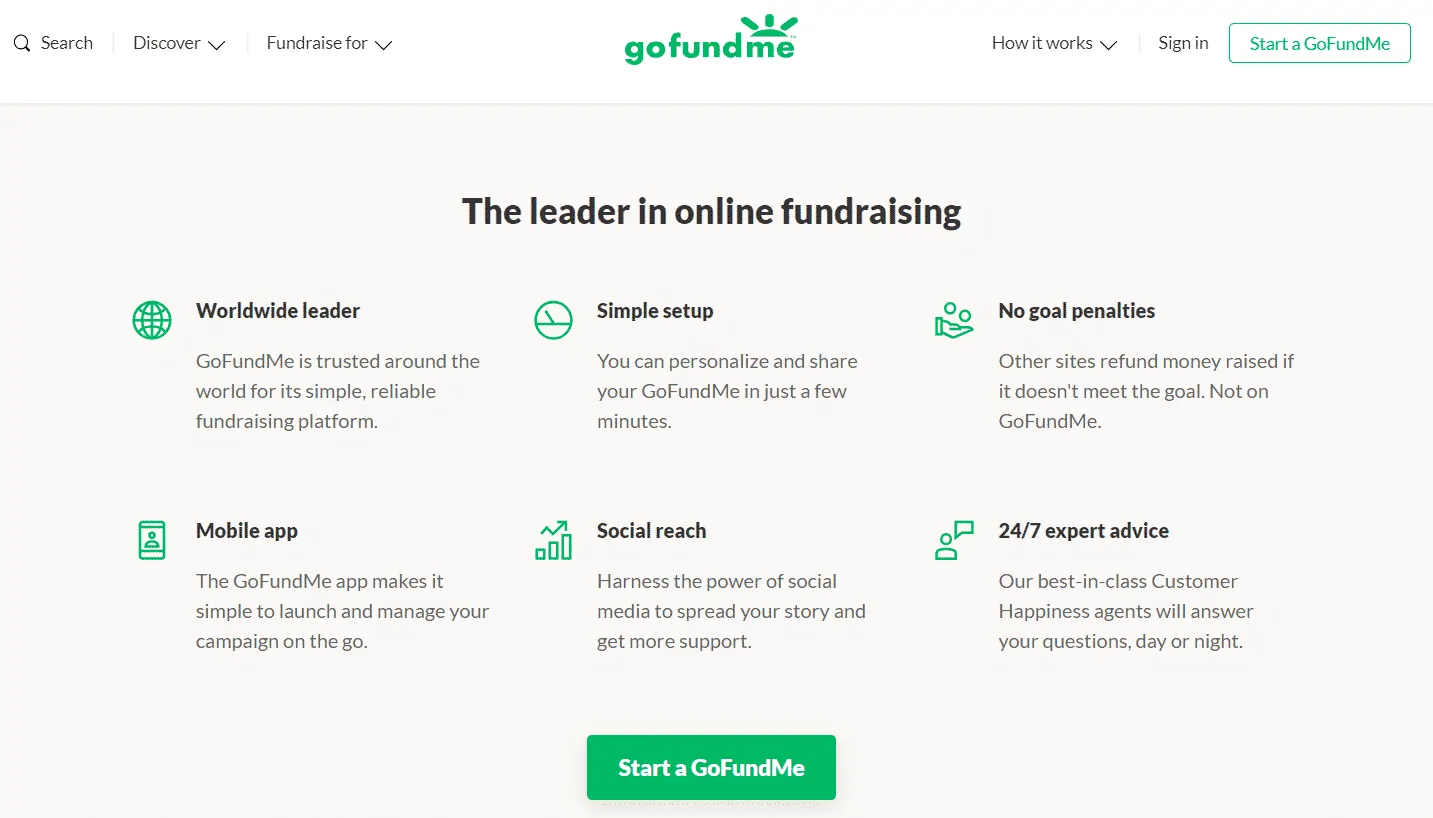
GoFundMe is the world’s largest free fundraising and crowdfunding online platform that lets people raise money for events, be it gathering donations for a cancer-stricken family member or soliciting funds to pay for college tuition. With more than 50 million donors, the platform has successfully raised over $6 billion till now.
The company is based in Redwood City and was formed by Brad Damphousse and Andrew Ballester in May 2010 with the aim of allowing users to create their own page to raise money.
GoFundMe Business Model
Initially started with a for-profit crowdfunding business model, GoFundMe shifted to a non-profit donation-based business model in 2017 after receiving feedback from the users which suggested (and demanded) all of the money to go to the cause.
Earlier, the company used to charge a certain percentage commission from the amount raised on personal campaigns. Since this wasn’t good for the brand’s image, the company decided to shift its priorities and move to a model where it survives with donations (just like Wikipedia)
But what makes this business model worth to ponder about is that according to GoFundMe’s CEO, Rob Solomon, the just donations are good enough to keep the business profitable.
How Gofundme Works?
GoFundMe can be tagged as a marketplace for crowdfunding campaigns which connects two segments –
People Who Require Funds
Anyone who wishes to raise funds for any cause, be it personal or public, can create a campaign on GoFundMe and promote it to receive donations. GoFundMe does not use any kind of All Or Nothing algorithm, which means any amount of donation made to a campaign goes to the campaign generator’s account.
You can create a campaign on GoFundMe for any of the following causes:
Medical
Emergency
Memorial
Education
Charity
Non-profit organization
Here’s how you can start your own campaign on GoFundMe:-
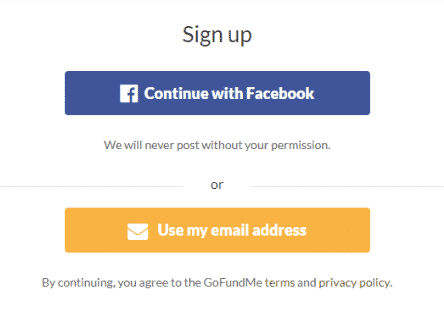
To begin with, you have to sign up with GoFundMe with either your e-mail or your Facebook account. The actual procedure begins after this. Fundraisers can have up to 5 active campaigns on one account at a time.
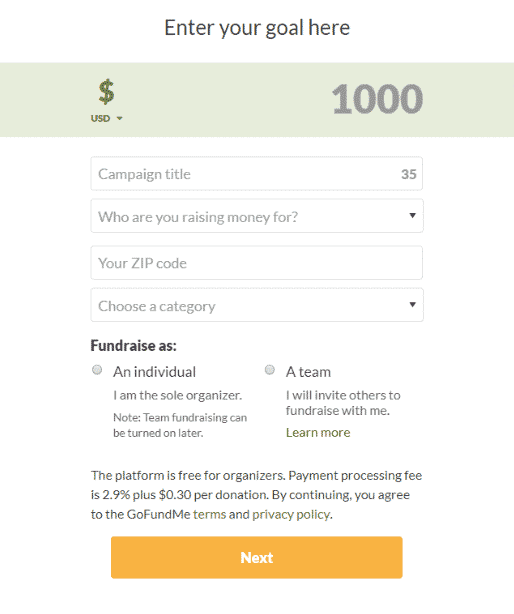
After signing up, you are asked to give details about your campaign, choose the category under which your campaign lies, mention who are you raising funds for, whether you will be fundraising individually or as a team and finally, the goal of donations you expect/ aim to receive.
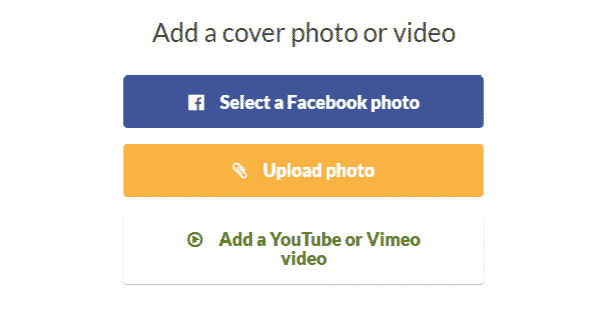
Up next, you have to add a cover picture (or video) which describes your campaign and the cause behind your call for funds.
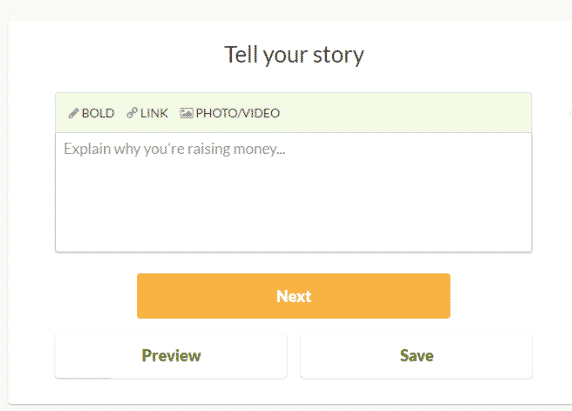
The next step includes writing your entire story. This should preferably be open and descriptive and include a bit about who you are, what you’re raising funds for, and how the money will be spent.
Finally, you have to share your campaign so that it reaches the maximum amount of people and can attract major donations. Facebook, e-mail or any other personal connectivity will help share the campaign and make it successful.
Here is an example of an ongoing fundraising campaign on GoFundMe:
People Who Are Willing To Help By Sending Donations
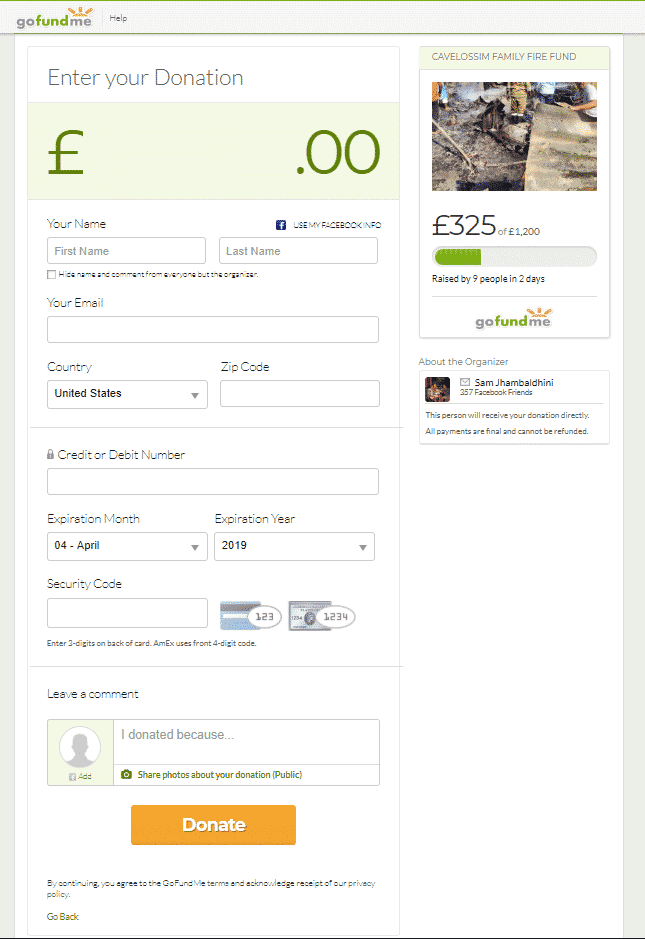
Donors can choose the campaign they want to support and can donate whatever amount they wish to. GoFundMe has a specially assigned Trust & Safety Team which ensures that all campaigns and donations are protected under the GoFundMe Guarantee.
All they have to do is to provide their details to the site by filling the following form and are eligible to donate after successful completion of the form.
How Does GoFundMe Make Money?
Before 2017, the company used to take 5 percent of donations raised on its platform, along with ~2.9 percent payment-processing fee collected on each donation, and an additional 30 cents for every donation.
But,
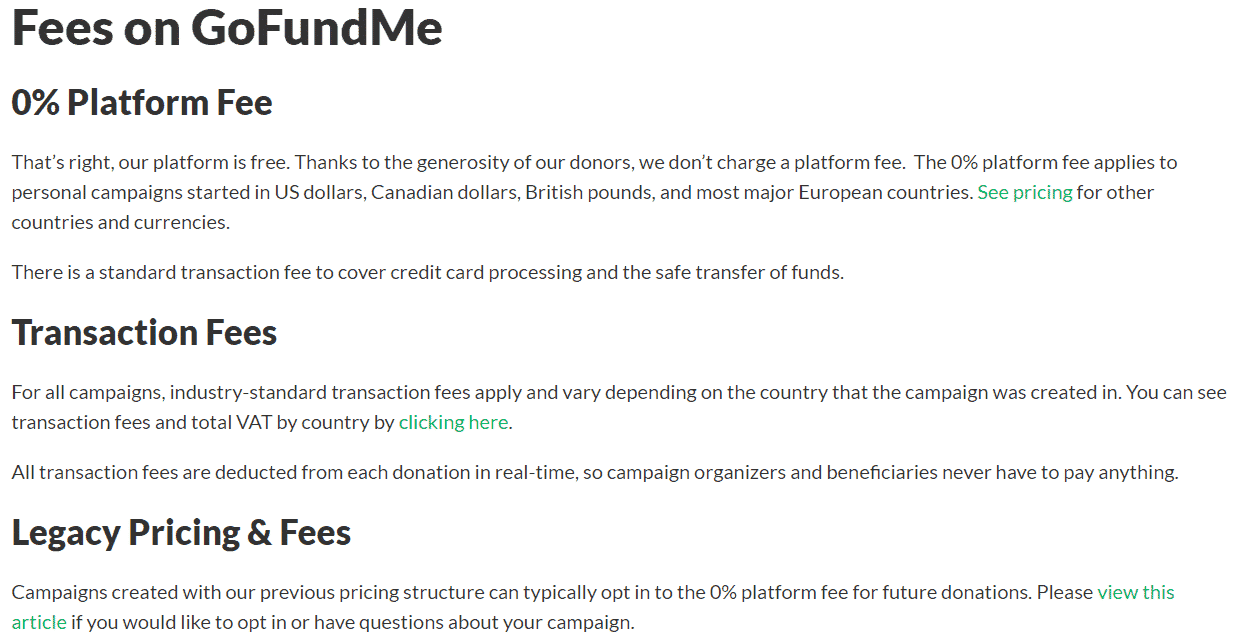
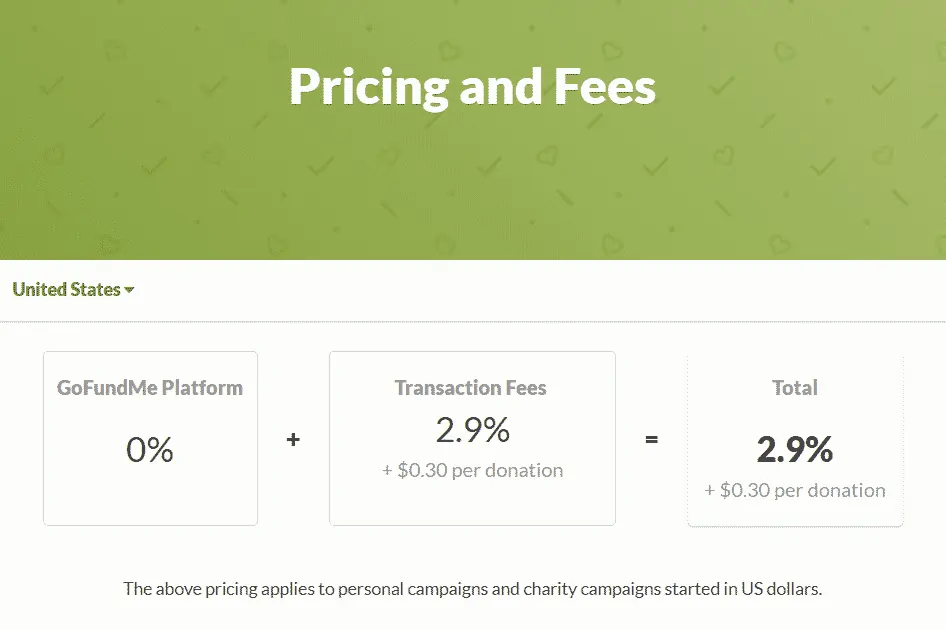
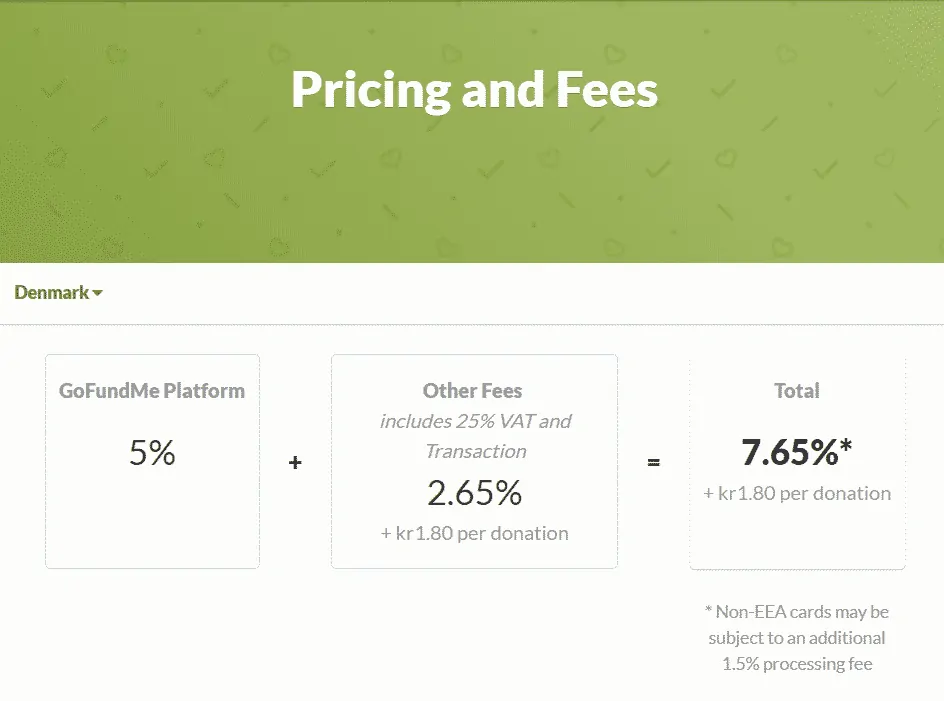
In the present date, everything else rests the same, apart from the company’s decision of 0 percent platform fee that applies to personal campaigns started in US dollars, Canadian dollars, British pounds, and most major European countries. (The business model remains the same commission-based model in some countries like Denmark)
This means that each penny donated on the platform goes only to the fundraiser. In place of the fixed 5 percent cut, the company will instead rely on optional tips to generate revenues from these campaigns according to which, donors are presented with a voluntary option at the end of a transaction to send a few extra dollars to the site.
For personal campaigns in the following countries, GoFundMe is a free platform:-
US
Canada
The United Kingdom
Australia
France
Germany
Ireland
Italy
The Netherlands
Spain
However, the site charges a standard transaction fee to cover credit card processing and the safe transfer of funds. For all campaigns, industry-standard transaction fees apply and vary depending on the country that the campaign was created in.
Here are examples of the 2 fee structures charged by GoFundMe in different countries:
Country
Platform Fee
Transaction Fee
United States
0%
2.9% + $0.30 per donation
Country
Platform Fee
Other Fees
Denmark
5%
2.65% (25% VAT & Transaction) +kr1.80 per donation
Future Of GoFundMe?
GoFundMe’s business model might seem a bit new to the ears, but it is efficient and up to the expectations of the creators. The company has had a lot of successful campaigns all over these years.
Here are a few of the most successful GoFundMe campaigns along with the huge amounts of money they’ve raised:
Support Victims of Pulse Shooting: $7,854,290
Support Victims of Pulse Shooting: $7,854,290
The Official Sacred Stone Camp: $3,133,910
March for Our Lives: $3,586,650
Veterans for Standing Rock: $1,155,660
Tree of Life Synagogue Victims: $1,181,758
Save Benny and Josh: $1,249,490
MATW Africa Project with Ali Banat: $1,204,532
Houses For Rohingya Refugees: $2,105,210
Launched in 2010, GoFundMe has become a go-to community for more than 70 million donors.
Seeing the success of GoFundMe in 2018 (even after editions in the business model), it can be said that the GoFundMe business model is a sustainable one, and the company has a bright future for itself.
Go On, Tell Us What You Think!
Did we miss something? Come on! Tell us what you think of our article on how does GoFundMe make money in the comments section.
Hey, I'm Aashish
Each week I share research backed AI oriented content in my newsletter.
There are AI ideas, AI trends, tutorials, and guides.
24k entrepreneurs read it. I'd love you to join.

![What Is Demand Generation? [The Ultimate Guide]](https://www.feedough.com/wp-content/uploads/2019/05/DEMAND-GENERATION.png)