Feedough Logo

Blog

  • How Do Insurance Companies Make Money?

    How Do Insurance Companies Make Money?

    What happens if your car crashes or your house burns down or your baggage gets lost on your next flight or you are diagnosed with a critical illness whose treatment is going to cost you tons of money? Will you dig deep into your coffers every time such a crisis occurs? What if you don’t even have the necessary amount in the first place?

    Simple. You get Insurance.

    What is Insurance?

    The human race has invented a sort of fantastic concept called insurance over its history and it has been an absolute life-saver for people all over the world. Unless you have been living under a rock all your life, you would most probably know what insurance is. The dictionary defines insurance as –

    An arrangement by which a company or the state i.e the insurer undertakes to provide a guarantee of compensation for specified loss, damage, illness, or death of the insured in return for payment of a specified premium

    Insurance has been around for centuries. Hundreds of years ago, when ships used to get destroyed and sailors used to lose their cargo, they came up with the idea that by dividing the cargo among ships, they can divide their risk too. Total financial decimation was avoided. The same principle is applied in this case as well. Thousands of people pay small amounts to cover the costs of a few in times of crisis.

    Now the premium you pay every year is just a small fraction of the total sum insured and thus you happily end up paying it up every year. But for any business to be profitable, income must be greater than the expenses. Have you ever wondered how the insurance companies operate? If what you pay to your insurance company is just a small fraction of what they pay you when you file a claim, how do they even make money? How are they even in business and a quite profitable one at that?

    To answer these, let’s dive into their business model first.

    Business Model of Insurance Companies

    The business model of insurance companies revolves around risk. The premium is decided by pricing that risk using sophisticated algorithms and statistical tools which vary across companies and types of insurance. Whenever an insurer offers a conditional payout of a seemingly huge sum, the likeliness of the insured claiming for that payout is calculated and is stretched across the entire premium payment duration.

    The amount collected as premiums from various people is collectively slightly more than what the insurer has to pay to the some of the insured every year. This is so because most of the revenue comes from the interest that is generated from investing the premium money in safe, short-term assets. This is what generates profits for any insurer and covers expenses such as commissions, salaries, administrative costs etc.

    When a customer files a claim, the claim is checked for authenticity and accuracy first before the payout is made, so that losses due to fraudulent claims can be minimised. There is insurance for everything in the world today, from life to property to car to even travel. The basic business model mostly remains the same, though the process of determining the premium amount and conditions of payout might vary.

    How Do Insurance Companies Make Money?
    How Do Insurance Companies Make Money?

    Insurance companies make money in the following two ways:

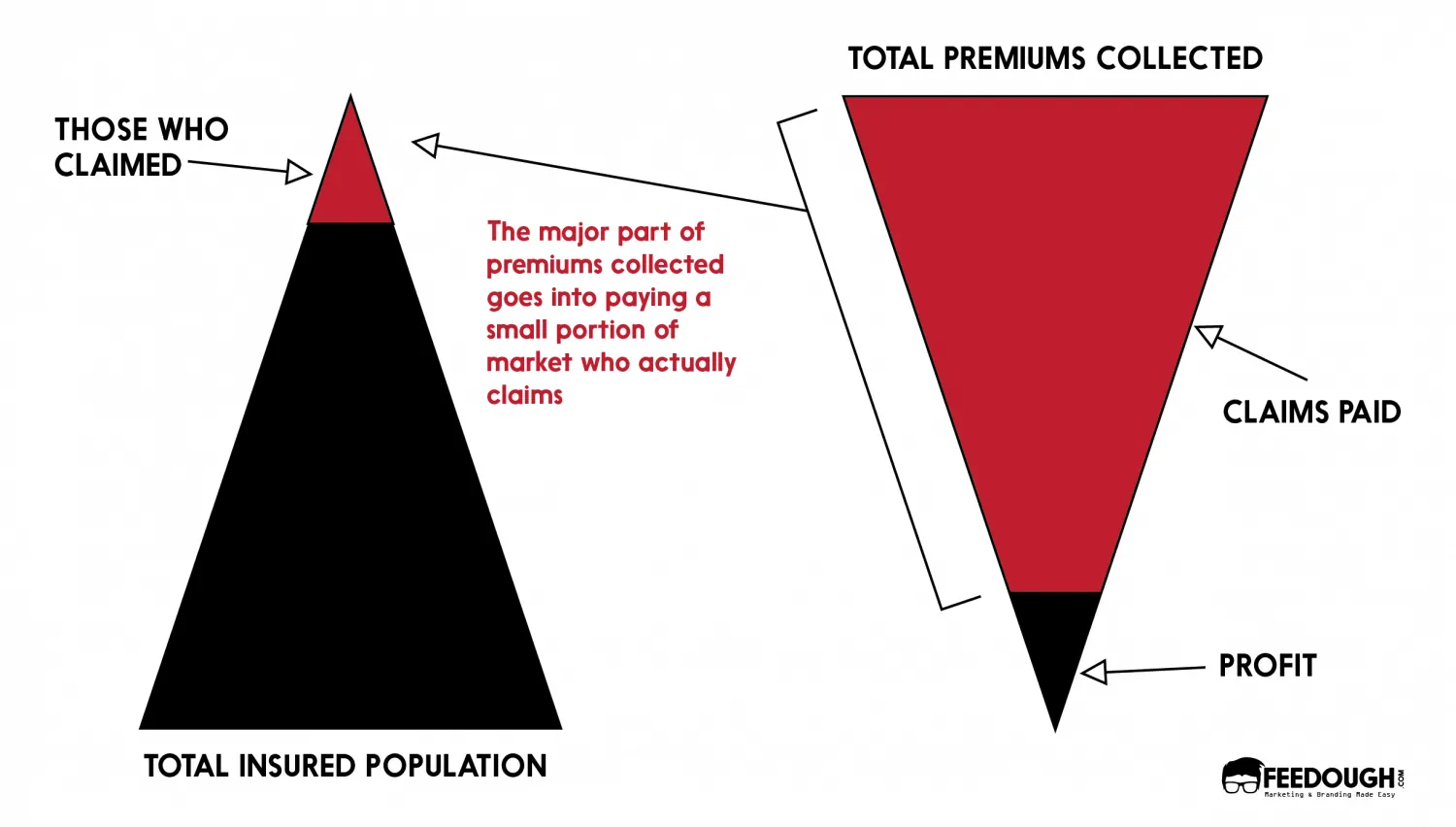
    Underwriting Income: This is the difference in the amount of money collected from the people as premiums and the money paid when a claim is filed in the hour of need.

    Investment Income: What you pay as a premium is invested further so that it accrues interest over time and that is further used to cover the various expenses of the insurer. Most insurance companies have a well-diversified portfolio and invest in both low-risk fixed-income securities and high-risk, high-return equity markets.

    Why is the Premium Different for Different People?

    The premium amounts vary for different individuals. Let me give you a simple example to explain why.

    Let’s say you have insured your health and you are a fully fit individual. Your friend has insured his health from the same insurer but he is a full-blown alcoholic and on the verge of having cirrhosis. Your friend’s probability of ending up in a hospital would be far higher than yours. As an insurance company, it makes plain business sense to charge a higher premium from your friend as there is a higher probability of him ending in a hospital and filing a claim. For all we know, someone as fit as you might never even need to visit a hospital. So the money the insurer gets from people like you is used for people like your friend. When an insurance company assumes greater risk, the corresponding premium goes up too. This is also called loading of premium.

    Do All People Get the Insurance Money at the Time of Claim?

    If yours is a genuine case and you have all the necessary documentation and proofs available, then the claims get processed without a glitch. Most insurance companies have a claim settlement ratio of more than 90%. So in 9 out of 10 cases on an average, you get the insured sum when you make the claim. If you lie about your personal and other relevant details while applying for the insurance, then it is a different matter altogether. Taking the above example of you and your friend further, let’s say your friend does not disclose about his alcohol addiction and liver condition while applying for the insurance to avoid paying the higher premium. The insurer is free to not pay anything to your friend, if they later find this out, when he makes the claim in times of need.

    You might be wondering how the insurance companies even manage to pay more than 100-200 times the premium amount when you claim it. It might seem unbelievable to you but the insurance companies arrive at the premium amount after careful research and estimations so that the premium collected every year from all people is slightly more than what they have to disburse at the time of claim. If there are 100 people insured, there will be only 3 who would file a claim and the other 97 would not. Since the insurance industry runs on volume, these odds keep the insurance machinery well-oiled and running. The extra money that remains can be carried forward and used in years when the number of claims goes up due to some reason.

    How Do Insurers Set Premiums For an Insurance Policy

    Insurance companies keep track of the claim ratio or the loss ratio for every year. This the ratio of total money paid in claims and other adjustment expenses to the total amount earned in premiums. Based on this ratio, the premiums for future years are calculated. The insurance company takes all expenses into account, including the management costs and commissions and then keeps a margin of 2-5%.

    At the end of the year, the actual payouts are compared with the original estimations and the premiums are future cases are adjusted accordingly.

    Here are the other factors that are taken into account for some of the major types of insurance:

    • Life Insurance: Life insurance companies consider the average lifespan of a person to get an estimate of how much they need to charge as premium and for how many years to cover their claim expenses.
    • Health Insurance: Health insurance companies take into account all information such as a person’s age and his past medical records, his present condition, charges for different medical procedures, related expenses, inflation etc. to decide their premium.
    • Auto Insurance: Auto insurance companies consider the age of the car to decide the premium amount. This information helps them decide how the car will perform, how often it will require maintenance, how likely it is for the car to be in an accident etc.

    We have seen how beneficial insurance can be in unexpected adverse situations. It keeps us stress-free and relaxed and also provides the insurance companies the money to invest and keep the economy running. At the end of the day, insurance is a volume game. The insurance companies operate like casinos and know that they have the odds in their favor and even if there are an overwhelming number of claims in one year, it shall balance out in the coming year. In the long run, they shall be profitable. As for you, it would be wise to insure every precious thing you own, including your life. You never know when and how life throws you a curveball. As they say, when life gives you lemons, make lemonade or better still, get insurance.


    Go On, Tell Us What You Think!

    Did we miss something?  Come on! Tell us what you think of this article on How Do Insurance Companies Make Money? in the comments section.
  • What Do Investors Look For In A Startup?

    What Do Investors Look For In A Startup?

    Steering through the world of startups can be terrifying if the entrepreneurs don’t have the right financial aids. Even though most of the entrepreneurs arrange financials on their own in the early stages of the startup process, it’s the entry of investors which take the startups to the next level.

    Investors are shrewd when it comes to investing in a startup as they always want their investments to mature and be successful. Hence it is important to know what the investors are looking for in startups before they invest their time and money.

    6 Important Things Investors Look For Before Investing

    Even though your business idea will always be at the top of the priority list of any investor, it’s uniqueness is seldom a priority. The only reason an investor invests in your startup is to get the most out of his investment. Every pitch deck should be developed keeping this in mind.

    Here’s the list of other things an investor looks for in a startup.

    A Well-Defined Business Model & Business Plan

    Having a complete, credible and clear business model is important for any startup as every investor believes that any startup without a concrete business model is on the path to failure. A business model is a conceptual structure explaining how the business operates and makes money.

    Having a well-defined business model demonstrates that the entrepreneur knows about the market and is ready to take the leap forward. Market research, idea validation, building a prototype, validating that prototype, and testing the model in a sample market is essential to validate the business model.

    A business plan, on the other hand, is a strategic plan for business’s future. It states the future goals and the routes business will take to fulfill those goals. An investor always wants the most out his investment and invests only in a startup which has its priorities straight and a business plan in line.

    Team’s Capabilities & Experience

    Building a capable and experienced team is one of the most crucial tasks of starting up. Investors believe that the risks would be lower if your team has good managerial skills, a nice chemistry, and a worthy prior experience in your domain.

    Having a strong startup team is very crucial to the fate of your startup as its success ultimately lies on the shoulders of your team. Every team member should have an expertise in the department s/he’s handling and an iron will to contribute to the fullest.

    “My criteria to invest are the founders. So I won’t check any business plans, any economic projections, spreadsheets; but (instead) I focus on the founder’s mindset (and) passion.” – Taizo Son, an investor in startups

    The Market

    Market matters as it signifies growth. Investors want to have a deeper look at your market. They want to see the potential of growth in the existing market and if your startup has the resources to accommodate a new growing market.

    The bigger the obtainable market size, the more is the chances to get benefit from economies of scale in the future.

    The companies that can emerge quickly and gain profits exponentially over the initial investments in the market due to its size are the ones ideally preferred by the investors.

    Dave McClure, founder of 500 Startups says:

    “Market size matters because most investors want to know that you’ve got a big business. Bigger is generally better.”

    Aiming at a huge market is the best way to show the investors that the startup is on the way to create an impression in the market.

    The Level Of Commercial Traction

    A quantitative evidence of market demand is always preferred over just a prediction. Showing the investors that you and your team have already taken action to build upon your business idea and the business has some clearly identifiable momentum and progress will not only motivate them to invest in your startup but also make negotiations easy for you.

    If the Month over Month (MoM) or Year over Year (YoY) development is steady, it is seen as a sign that the startup is standing differently from the rest. Mark Cuban, an investor, Dallas Mavericks, says:

    “When it comes to business, there is a simple scorecard. Are you making money or are you not making money? Are you succeeding or are you not? So when you go to raise money, always, always catch yourself and eliminate the backstory.”

    The X-Factor

    Investors look into the fact how much you can convince them to take a leap of faith. Empathy based on similar educational or work background, trusted co-investors, instinct or even impressions can prompt investors to think about the investing decisions. The best way you can pass this is by being truthful and confident while having a basic knowledge of the background of the investors. A startup might not be on par with other businesses but sometimes the X-factor could make a difference.

    Jack Ma of Alibaba investing in Paytm is one such example of the investor-founder connection as the founder considered Jack Ma as his role-model.

    Exit strategy

    People often misunderstand the term ‘Exit Strategy’.  The ‘exit’ in exit strategy refers to the money and not at the exit of the entrepreneurs. This means that the startup brings in the money and the investors get the money out. This is why every investor looks into the exit strategy of the startup. The returns are provided by the exit.

    The exiting of the investors usually happens in two ways.  A bigger company acquires the startup for enough money to give the investors the invested amount or the startup develop and flourish enough to sell shares of stock to the buying public over a public stock market like it happened with Facebook in 2012 and Twitter in 2013. Scalability is important for most investors since it gives the investment the best chance of developing quickly.

    Getting investors to invest will be difficult with numerous startups pitching against each other for funds. Having the above 6 factors into account will help the entrepreneurs achieve their objective quickly.

    Go On, Tell Us What You Think!

    Did we miss something?  Come on! Tell us what you think about our article on What Do Investors Look For In A Startup? in the comments section.
  • Your Complete Guide To Crowdsourcing

    Your Complete Guide To Crowdsourcing

    I am sure everyone must have told you how important cash-flow is for any company. You yourself would know that cash-flow is more difficult to manage in the initial days of a company when profits are marginal and customers don’t even know you exist. That is when external funding comes into the picture. And irrespective of how tempting funding from an angel investor might look, you are letting go of a part of your company for that money.

    Wouldn’t it be great if I told you that there was an equally cool option to get funding for your startup and all you had to do was to promise to take care of a customer pain-point?

    I am sure you would agree that finding good employees for your company is a big pain. Getting work done on time or finding the right fit that suits your budget is even tougher.

    Wouldn’t it be great if I told you that there is an option to get your work done from an entire community out there in a manner most probably better than you could ever imagine?

    That option is none other than Crowdsourcing.

    Let me tell you what it is and how you can get the most out of it in a very comprehensive guide.

    Crowdsourcing Defined

    The word “Crowdsourcing” was coined in 2005 and is a portmanteau of the words Crowd and Outsourcing. It is a sourcing model that uses contributions from different people on the Internet to obtain services or ideas. Crowdsourcing is the process of getting work or funding from a large group of people in an online environment, although it has been in existence even before the Internet came into existence. But the Internet is what made it the phenomenon it is today. Thus crowdsourcing is the art of problem-solving in a distributed manner, powered by the Web and social media. You share your problems with the world and the world helps you get rid of those problems. Isn’t it wonderful?

    How Can Your Startup Benefit From Crowdsourcing

    Crowdsourcing can help your company in getting much-needed funds, accelerating innovation, saving costs, increasing efficiency, engaging the end-consumers, sharing ideas and co-creating and even reinventing your business and financial models.

    Your in-house team may not have the necessary skills for a new task or there may be some jobs that need to be performed only on certain occasions.

    You might need innovative ideas for the design of your logo or the next campaign.

    Your company might be on the verge of bankruptcy.

    Crowdsourcing can help you out in all these situations and much more. There are so many ways that a group of people can be engaged to solve your various problems only by providing some incentives that it is baffling that this method is not used more in companies. Of course, the control you have on the entire process is significantly reduced but the advantages far outweigh this factor.

    Types of Crowdsourcing

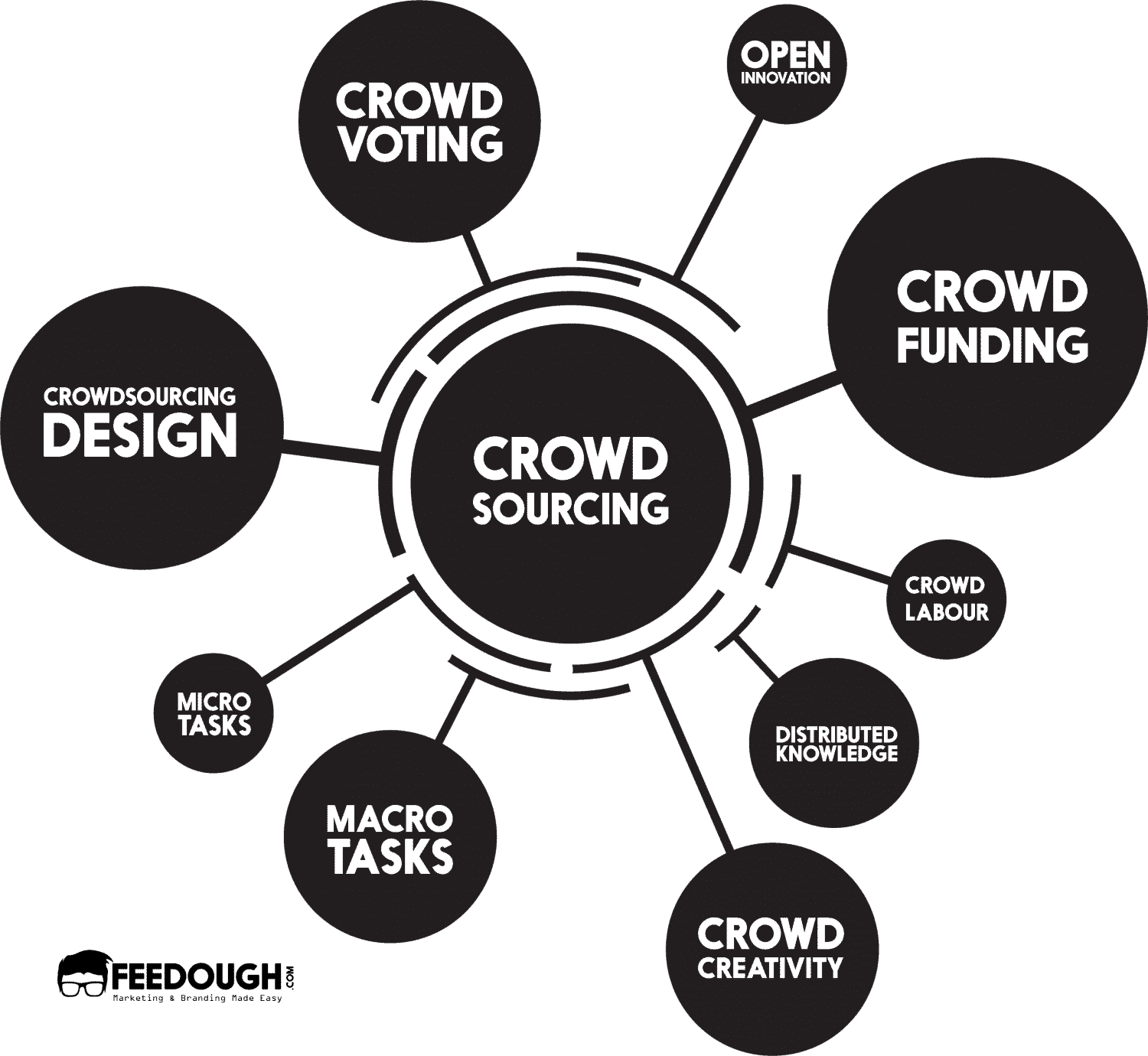
    types of CROWDSOURCING

    Crowd Labour

    Crowd Labour fills the gap between supply and demand of labour by getting a distributed labour pool to perform tasks virtually.

    Crowdfunding

    Crowdfunding helps in raising capital for new products and businesses through donations and sponsorships from online investors and the general public.

    Open Innovation

    Open innovation is companies asking people outside their organization for innovative ideas. Examples would be My Starbucks Idea or Cisco iPrize etc.

    Crowdsourcing Design

    Companies outsource the task of designing anything, from logos to product packaging, to freelancers. This reduces the company’s costs a lot. 99Designs is a great example of this type of crowdsourcing.

    Crowd Creativity

    When crowdsourcing is used for innovative media content, it is called crowd creativity. Crowdsourcing is often used to procure photographs, audio clips, short films etc.

    Distributed Knowledge

    Crowdsourcing is also used to obtain knowledge and information on a particular topic. Citizen journalism is an important example of this type of crowdsourcing.

    Crowd Voting

    When your favourite contestant wins on the latest reality show, it is crowd voting in effect. Votes can be gathered for various decisions, from designing a product to the flavour of chips.

    Micro Tasks

    Small tasks that are outsourced to the public and do not require any particular skills are micro-tasks.

    Macro Tasks

    Macro tasks, as the name suggests, are the exact opposite of micro tasks and need expertise in a particular area like coding or graphic designing.

    Crowdsourcing Examples

    There are many examples from all across the world that show how powerful crowdsourcing can be. It all depends on how you decide to use it.

    Airbnb

    If Airbnb as a platform wasn’t a truer example of crowdsourcing, even its marketing and advertising revolve around it. Their campaign #AirbnbShorts used all user-submitted videos to promote lesser-known destinations by giving viewers a peek into what people like them have themselves experienced.

    Lays – Do Us A Flavour

    Lays’ “Do Us A Flavour” campaign was a masterstroke for the brand. The consumers had to create their own flavour and all the flavours fought to be the people’s favourite. This campaign was followed by an 8% increase in sales and a whole lot of buzz for the brand.

    MIT Climate CoLab

    I would term it as one of the most important crowdsourcing efforts in recent memory. MIT’s Climate CoLab brought more than 10,000 users together on its platform to devise solutions to tackle climate change.

    Lego

    Lego is a crowdsourcing champion. Any user can submit a design that other users vote for. The idea with the highest number of votes is moved to production. While the designer gets a 1% royalty, the company enjoys increased customer engagement as well.

    Pebble

    Pebble’s very existence is due to crowdsourcing. From a simple idea to one of the most popular fund raising campaigns on Kickstarter, it became a product that could challenge the rival products of biggies like Samsung and Apple. It wasn’t just money that was pooled in this campaign but knowledge and ideas as well. No wonder it is hailed as one of the biggest, if not the biggest, crowdsourcing success stories till date.

    Some Crowdsourcing Platforms That Can Help Your Startup

    Your startup might benefit a lot from a few crowdsourcing platforms. The following list is not exhaustive by any means but it definitely tells you why you should seriously consider this option. The right platform for your exact needs is just a Google search away.

    Here are some of the most popular crowdsourcing platforms today:

    Kickstarter

    When we talk about crowdsourcing, we cannot NOT think about Kickstarter, the most popular crowdfunding website in the world. While the focus of Kickstarter remains on creative arts and it cannot be used to fund businesses, it has been used to fund many products, including the Pebble. I have to say though that the submission process on Kickstarter is rigorous and the approvals to post on the platform can be quite tough to get.

    99Designs

    99Designs connects graphic and web designers with businesses that need design work to be done. The focus of this crowdsourcing platform is on artistic work like logos, packaging, clothing, illustrations etc.

    Amazon Mechanical Turk

    A business might have certain important projects or tasks that are simple and repetitive. With Amazon Mechanical Turk, you can find people across the world to complete these tasks and that too for pennies. The price is set per HIT (Human Intelligence Task) and the entire project is executed very quickly and in a cost-effective manner.

    DesignCrowd

    DesignCrowd is another platform like 99Designs that is used by large corporations as well as small businesses for finding designers for their products.

    Freelancer

    Freelancer helps businesses find freelancers in various fields such as animation, writing, coding, photography etc. You propose the projects and the freelancers set their bids. This platform lets you communicate with the freelancers virtually and even set their payments as per their deliverables.

    Upwork

    One of the most comprehensive crowdsourcing websites, Upwork is another platform that helps companies find freelancers for both their short-term and long-term projects. Even giants like Amazon and Panasonic use this platform.

    uTest

    Usability testing is important for every business and uTest makes it easy for you. It lets you perform online testing by over 18,000 QA professionals from 150 countries. uTest is the best place to get your project tested in a professional manner.

    Chaordix

    Chaordix lets businesses get opinions from experts for their projects. You can invite the experts to present their opinions on any business problem you might be facing. This platform is perfect for any startup which wants ideas from contributors.

    Now that you know what crowdsourcing is and how companies all over the world have leveraged the power of the crowd for their benefit, you should seek how you can do the same for your startup. The right use of crowdsourcing in any business process can be incredibly effective. Do not get left behind while your competition surges ahead with this tactic. The potential is huge. You just need to know how and when to use it.

    Go On, Tell Us What You Think!

    Did we miss something?  Come on! Tell us what you think about our article on crowdsourcing in the comments section.
  • SAAS Business Model | How SAAS Works?

    SAAS Business Model | How SAAS Works?

    Software come in two forms:

    • Software As A Product (SAAP): where the software is usually sold with a usage license and is hosted on the user’s machine/system.
    • Software As A Service (SAAS): one of the recent advancements in the technology industry where the software is provided online and hosted on a server and users pay the rent to use the software for a specified time period.

    The cloud computing industry has been on a fast forward since its inception in the days of the dot-com bubble. According to Gartner, the worldwide public cloud services market is projected to grow 18 percent in 2017 to total $246.8 billion with the highest growth coming from infrastructural services (IAAS).

    But before moving ahead to discuss the SAAS business model and how SAAS works, it is important to know the basic terms of this industry.

    What is Cloud Computing?

    Cloud computing refers to delivering computing services like software, servers, storage, databases, networking, analytics, infrastructure, etc. over the internet (the cloud). Companies providing these services often charge you based on your usage within a certain time period.

    Cloud Computing can be categorized into SAAS, IAAS, and PAAS.

    What Is SAAS (Software As A Service)?

    SAAS is a part of cloud computing and only deals with the software which are provided on the cloud as a service.

    That is:

    Instead of purchasing the license and installing the software in your own system, you rent the usage of the software and access it over the internet.

    Examples of SAAS: 

    • Google Apps
    • Microsoft Office 365

    What is PAAS (Platform As A Service)?

    Paas provides a platform that includes the operating system, programming language execution environment, database, web server etc. on the cloud over which software or application can be developed and/or deployed.

    Examples of PAAS:

    • Heroku
    • Google App Engine
    • Red Hat’s OpenShift.

    What Is IAAS (Infrastructure As A Service)?

    In the IAAS model, the cloud host provides the infrastructure which includes servers, storage, networking hardware, virtualization, firewall, IP addresses, virtual local area networks etc. over the cloud which are accessed over a WAN.

    Examples of IAAS:

    • Windows Azure
    • Amazon EC2
    • Rackspace

    Now that you know what exactly is SAAS and cloud computing, let’s dive into the details of the SAAS business model.

    How SAAS Works?

    Software as a product has many limitations:

    • You have to invest in purchasing its license and also in upgrading their hardware to run the software
    • A lot of time and money is spent on the customisation of the SAAP as per your requirements.
    • The data is stored only on one device or server (if you’re using LAN)
    • In order to update the software, you either have to buy the updated version or download the update from the internet which resulted in a wastage of time and internet.

    Opting to the SAAS model has helped the developers in effectively removing/minimizing these limitations. SAAS requires only one prerequisite; the internet.

    It hosts the software and the data on the cloud and lets the developer update the software without you downloading anything.

    Another advantage of the SAAS business model is that it is easily scalable as everything is hosted on the cloud. The company can cater to users all around the world and not be limited to one region or country.

    SAAS Business Model

    Understanding SAAS Business Model isn’t easy. Many entrepreneurs underestimate its various performance indicators which becomes the reason why they fail. Before moving on to discuss the business model of SAAS, it’s important to know about specific key performance indicators:

    CAC

    CAC is the customer acquisition cost which is the aggregate cost (marketing costs + outsourcing cost + other costs) of acquiring one customer.

    LTV

    Lifetime Value(LTV) is the total revenue earned per customer. It’s calculated by dividing the total revenue earned by the number of customers in a specific time period.

    MRR

    Monthly recurring revenue is the amount of fixed revenue retained every month. It is a measure to calculate how well are the customers retained in the business. It is calculated by multiplying net users per month by the subscription fee.

    MRR Churn

    Churn refers to the revenue lost and customers who’ve left. It is calculated by multiplying the net users left per month by the subscription fee.

    The Economics Of SAAS Business Model

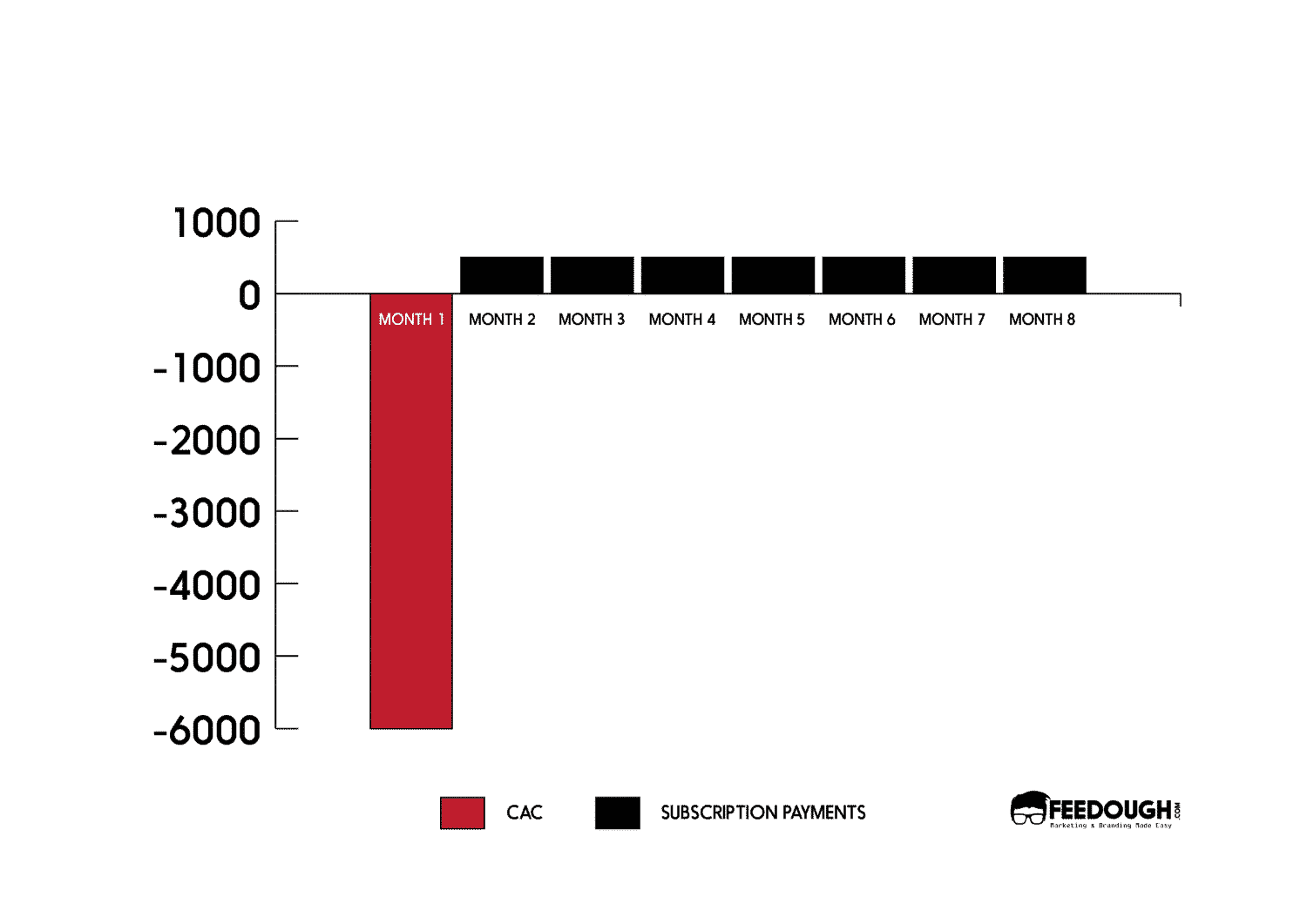
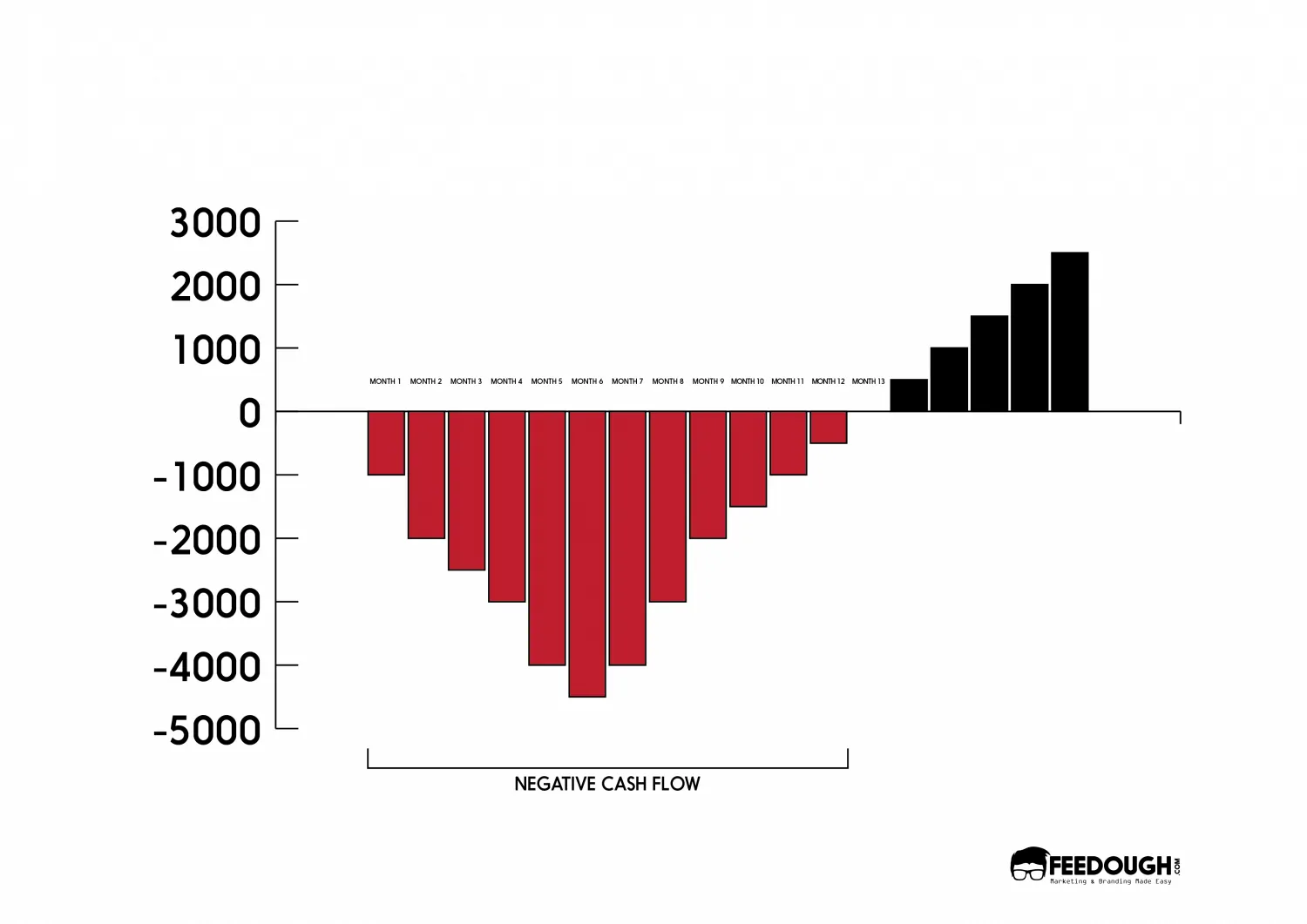
    SAAS is a subscription-based business model which involves the generation of profits after a considerable long period of time. That is, the expense is incurred a long time before you actually see the profit. It takes months to recover CAC which usually results in negative cash flow in the business.

    The expenses in these stages of SAAS business model include

    • COGS: which include outsourcing costs, server costs, etc.
    • Sales & Marketing Costs
    • Research & Development Costs
    • General & Administrative Costs

    Since the SAAS model is a subscription-based model, the revenue earned takes time to cover up the expenses and result in profit.

    saas business model

    This leads to the increasingly negative cash flow for the first few months as there is an increase in the customers acquired by the business.

    More customers = More CAC = Less Profits/Negative Cash Flow

    SAAS BUSINESS MODEL GRAPH

    The negative cash flow is usually minimized by charging the customers on a yearly basis rather than monthly.

    Customer Churn VS. LTV

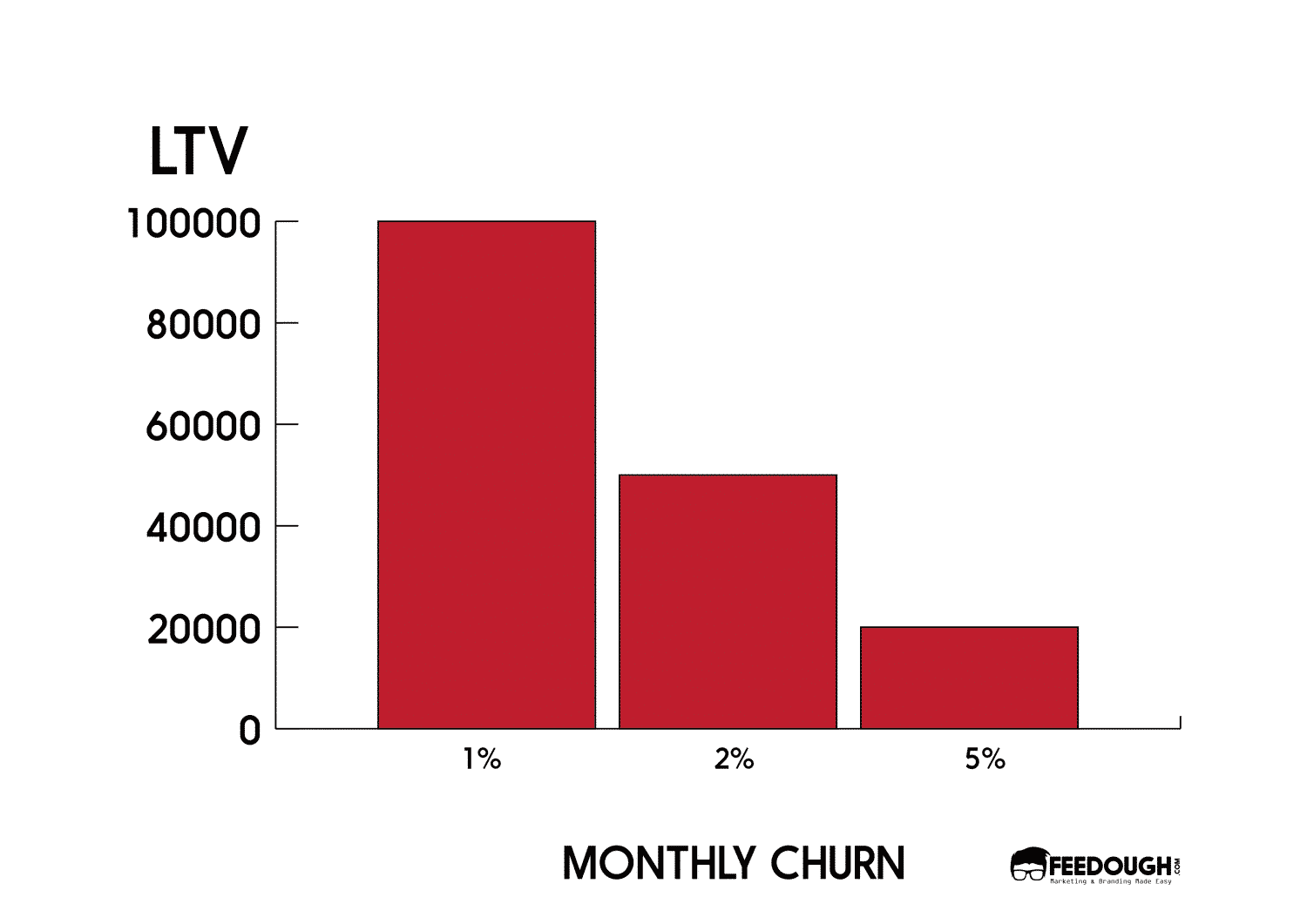
    Customer retention is one of the most difficult tasks of SAAS business. Nevertheless, every SAAS business sees some of its customers leaving each month which is named as customer churn. Customer churn affects the LTV of the business.

    SAAS BUSINESS MODEL GRAPH

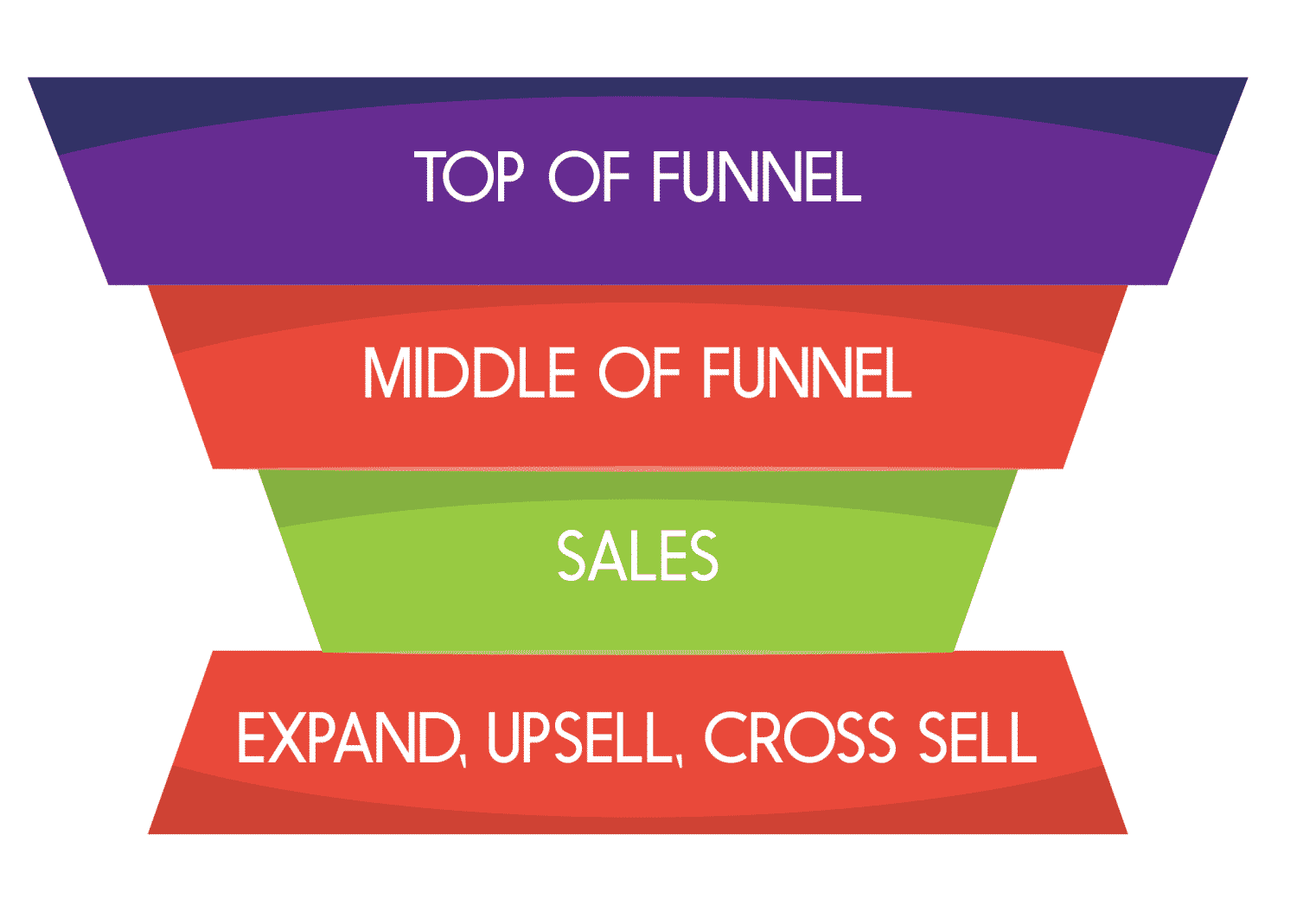
    To avoid this, SAAS entrepreneurs look for ways to attract more customers and expand the revenue from the existing ones. The marketing funnel of the SAAS model looks like this.

    SAAS BUSINESS MODEL GRAPH

    Ever wondered why the SAAS packages come in free, basic, pro, & enterprise editions?

    Here’s the answer:

    The economics of the SAAS Business Model is divided into three parts:

    • Acquisition
    • Retention
    • Monetization

    The company acquires the customers by providing freemium services, and once acquired other services are offered at a basic periodic price to him. This leads to retention and monetization.

    Software as a service (SAAS) example

     Google Apps

    Google apps is an online suite of communication and collaboration tools. It consists of the following:

    • Gmail, Hangouts, Calendar, and Google+ (Communication)
    • Drive (Storage)
    • Docs, Sheets, Slides, Forms & Sites (Collaboration)

    The suite is provided as a freemium model where most of the services are provided free of cost while upgraded services like extended storage space and custom email address are provided at a cost.

    Go On, Tell Us What You Think!

    Did we miss something?  Come on! Tell us what you think about our article on SAAS business model in the comments section.

  • What Is Intrapreneurship & Who Is An Intrapreneur?

    What Is Intrapreneurship & Who Is An Intrapreneur?

    The idea of entrepreneurship is enticing, everyone likes to be their own boss. But not everyone can afford and live the restless and risky life of an entrepreneur. An entrepreneur has to live two lives; with the life of his startup overpowering his own.

    One of the biggest risk entrepreneurs face is losing everything they’ve invested in the startup. This repels many brilliant minds from taking entrepreneurship as a career and has led to the creation of a new concept called intrapreneurship.

    Intrapreneurship is enabling the employees with the entrepreneurial skills to come up with original ideas for the betterment of the organisation and providing the resources for the same.

    What Is An Intrapreneur?

    An intrapreneur (also referred to as inside entrepreneur) is an employee with certain entrepreneurial skills within an organisation who is given the responsibility and authority to develop a new product without incurring the risks associated with it.

    Precisely:

    An intrapreneur is what we get when we deduct entrepreneurial risks from the life of an entrepreneur.

    That is, you get your salary even if your product fails.

    Entrepreneur vs Intrapreneur

    The ways in which entrepreneurs and intrapreneurs work are similar yet differentiable. An entrepreneur has full liberty over his decisions which he uses to envision and create the company and its products from scratch. While an intrapreneur experience less liberty but a broader vision in decision making as he is entitled to create a new product for a brand that already exists and can also capitalise on its existing brand equity and positioning.

    The following points may clear the difference between an entrepreneur and an intrapreneur:

    Independence

    An entrepreneur is independent to take any decision for his company. He may or may not consult anyone before taking any decision. However, an intrapreneur usually reports to the owner and other top official and is usually dependent on them.

    Risks

    An entrepreneur is always at a risk to lose everything he has invested in the company whereas the risks of new products developed by intrapreneurs are usually borne by the company.

    Funds

    An entrepreneur has to struggle with fund generation and there are cases when the startup fail because entrepreneur could not generate enough funds for its survival.

    Funding is not much of a problem in intrapreneurship. They get the fund if the company feels it’s necessary.

    Relationship With The Business

    In the early life of a startup, the entrepreneur and the business act as one. The entrepreneur and his startup cannot be separated. However, the intrapreneurs often lack this relationship with the company they work with.

    Who Is An Intrapreneur?

    Even though Intrapreneurs and entrepreneurs differ in what and how they do it, they do possess many similar characteristics. Just like an entrepreneur, an intrapreneur:

    Is the Leader

    An intrapreneur carries the burden of the new product on his shoulder while guiding and leading his team in the pursuit of success. He identifies and nurtures the talent in a way that the business and the team fulfills their objectives simultaneously.

    Is an Innovator

    Innovation is an integral part of the life of an intrapreneur. An intrapreneur always looks for innovation, not only at the time of new product development, but also in marketing, promoting, and other business strategies required to make the product succeed in the market.

    Has a Vision

    An intrapreneur has a clear vision of his objectives and goals. He knows what is to be done at what time and he doesn’t wander around thinking of and performing unnecessary tasks.

    Is an Optimist

    Optimism is required when you are leading a team and working with the development of a product, the success of which isn’t guaranteed. Intrapreneurs are optimists who not only motivate their team but also use this optimism to learn from their mistakes.

    Why Intrapreneurship Is Beneficial (and Essential)

    The big organisations today are not only challenged by the existing players but also by the new players in the market. Around 3 new startups launch every second and while many of them fail, many of the successful ones end up taking the market share of the existing players. This has made innovation and intrapreneurship a big necessity in the big organisations. Intrapreneurship has the following advantages:

    Recognition of Potential

    Many brilliant entrepreneurial minds choose 9-5 jobs because of the risk involved in entrepreneurship. Intrapreneurship programmes recognise and make the use of their skills to the fullest.

    Enforces Equity Theory

    Equity theory is based on an idea that the employees feel motivated if an organisation uses fair methods to recognise and reward their efforts. This not only makes them content but also motivates them to give their fullest to the organisation. Intrapreneurship not only recognises entrepreneurial candidates but also rewards them monetarily and non-monetarily.

    Organisational Benefits

    The organisation gets to make use of entrepreneurial spirit in the development of new products, programmes, strategies.

    Some Inspiring Examples Of Intrapreneurship

    Shutterstock

    Shutterstock in known to run an annual hack-a-thon where it gives its employees an opportunity to think like entrepreneurs for 24 hours and come up with ideas for the betterment of the company.

    Sony

    The PlayStation as we know it is the brainchild of an intrapreneur in Sony. Ken Kutaragi, an employee of Sony, wanted to make a better version of the Nintendo console and came up with the idea of the PlayStation which was recognised and rewarded by the CEO of the company.

    Google

    Gmail was developed by one of the intrapreneurs in Google, Paul Buchheit, who worked on this project for 4 years till its launch on April 1, 2004.

    Go On, Tell Us What You Think!

    Did we miss something?  Come on! Tell us what you think about our article on intrapreneurship in the comments section.
  • eBay Business Model | How Does eBay Make Money?

    eBay Business Model | How Does eBay Make Money?

    Founded in the living room of Pierre Omidyar in 1995, eBay is the pioneer of marketplaces for consumer-to-consumer and business-to-consumer vending. Even though it started off as a platform to auction collectables, eBay business model has drastically shifted its focus and is now a leading e-marketplace, a classified service as well as an online ticket vendor.

    eBay Business Model

    eBay’s approach is that it places a substantial prominence on the first-mover advantage and has been constantly reinventing itself since the beginning.  The business model of eBay can be reported as service differentiation with the pivot on the user experience of both buyers and sellers.

    How Does eBay Make Money?

    The revenue model of eBay includes revenue from eBay marketplace, subsidiaries, branding solutions, and advertising business.

    eBay Marketplace

    eBay is among the pioneers of online trading. It digitized the people-to-people trading which usually used to take place at flea markets, garage sales, etc. eBay, just like any other marketplace, is a platform to buy and sell things online. However, trading on this platform can happen either as an auction or a fixed-price sale. One being a buyer’s auction where buyers bid for a single product and the other being a seller auction where different sellers bid their fixed price for a single product and buyer chooses the best offer for him.

    The company has also introduced features such as SafeHarbor Program, eBay Top Rated Seller Program, Feedback Forum, Verified Rights Owner Program, eBay Money Back Guarantee etc as well as loyalty programs for both sellers and buyers to let the customers feel safe in trading with undisclosed partners.

    The simplest way to trade on eBay is Buy It Now. Buy It Now is the method used by most of the marketplaces over the internet. There are three different options in Buy It Now:

    • In the Auction-style listings with a Buy It Now option the customer can either bid in the auction or purchase it directly. The difference is that the Buy It Now price will be at least 30% higher than the starting price of the auctions.
    • In the Reserve price auctions with a Buy It Now option, the option is shown only after the reserve price is met.
    • The third option is Buy It Now without bidding. This is like every other e-commerce company where customers buy products for the given price.

    While most of the features provided to the buyers are free of cost or included in the final price sold, the sellers are charged the following charges:

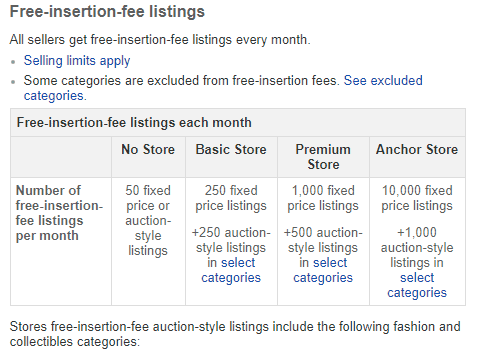
    Insertion Fee

    Every seller on eBay is charged an insertion (listing) fee for listing their article on the platform. The fee is charged per listing and vary as per the category of the item listed.

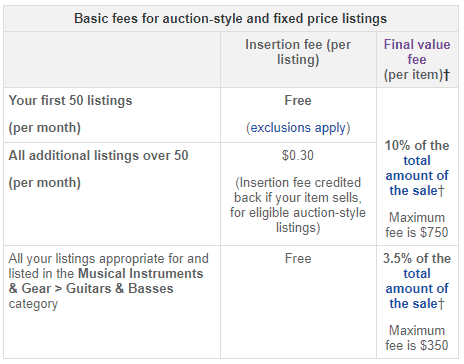
    Nevertheless, every seller is provided with few (50) free listings every month. After the first 50 free listings, eBay charges a fee for every extra listing from the sellers. It is 5 cents for fixed-price Books, Movies, DVDs, Music and Video Games. If it is any other category, it is 30 cents per every extra listing.

    ebay insertion fees

    Final Value Fee

    eBay also charges a commission on every sale made by the seller on the platform. This commission is charged by the name of Final Value Fee and ranges from 3.5% to 10% depending on the category of the product.

    ebay fees

    Advanced Listing Upgrade Fees

    eBay also provides options to promote, highlight, relist the item on the platform. The features are available for both the fixed price and auction-style trading and involve certain predetermined charges as well.

    Close5

    close5 business model

    eBay lent its original objective of local trading to its subsidiary Close5 when it shifted its business model to become a full-fledged marketplace. The business and revenue model of close5 is very similar to Letgo’s business model & Craigslist’s business model where the company earns revenue through promoted posts.

    StubHub

    StubHub was taken over by eBay on January 2007. It is an online ticket exchange enterprise which provides a platform for buying and selling theatre, sports, concerts and other live entertainment events tickets. From being the largest secondary-market ticket marketplace in the United States, it rose to become the world’s largest ticket marketplace.

    There are no fees for the sellers to list their tickets but they are charged 15% of the cost of the tickets if they get sold while the buyers are charged 10% of the fees. Depending on how much tickets are sold by a seller, the fees could get reduced up to 10% as well.

    Kijiji or eBay Classifieds

    kijiji business model

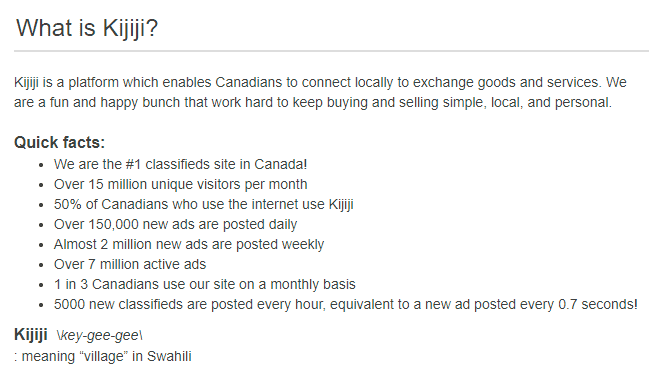
    Kijiji, launched in 2005 is an online classified advertising service for posting local ads. Kijiji is active in more than 300 cities in Canada, Italy, Hong Kong, and Taiwan. It was made accessible to chosen cities in the United States in 2007 but was renamed as eBay Classifieds in 2010.

    There are different options to choose from while uploading an advertisement in Kijiji. Highlight ad, as the name says will highlight the advertisement so that it stands out among the other advertisements.  The urgent ad comes with an urgent sign so that users know the seller wishes to sell the product as fast as possible. Ads applied with the Top ad option gets automatically positioned in the top of each category. Bump ups option gives the seller ability to “bump” the ad up the listings in every category. Homepage gallery option posts the ad in the gallery available in the top of the page. Other ways revenue is generated are by allowing website URLs to be posted with the ads which require extra payment as well as posting complimentary third-party advertisements on the website.

    The other main revenue generation subsidiaries of eBay include GittiGidiyor, a Turkish e-shopping mall. The URL of the company comes from the Turkish translation of “Going, going, gone”. Similar to the eBay marketplace, it offers different products on sale; eBay Enterprise , a multinational e-commerce corporation that specializes in building, developing and managing online shopping sites for brick and mortar labels and retailers; and Corrigon , a visual search engine.

    Two other companies which were under eBay but later split were PayPal and Skype. PayPal, which became a subsidiary of eBay on October 3, 2002, operates a worldwide online payments system that facilitates online money transfers and performs as an electronic alternative to traditional paper methods like checks or demand drafts. eBay on September 31, 2014, proclaimed the splitting of PayPal into an independent company. Skype, telecommunications software that excels in providing video and voice calls between mobile devices, computers tablets, smartwatches via the Internet, the Xbox One console and to regular telephones was acquired by eBay in October 2005. It was sold to Microsoft in May 2011 after eBay sold a majority stake in November 2009.

    eBay Business Model vs Amazon Business Model

    Both the business models of Amazon and eBay are different and unique from each other and provide the companies with the best and efficient way to generate revenue. While there are similarities between the business models, there are wide differences as well.

    The biggest difference between eBay and Amazon business models is that eBay is also an auction house and the business entity directly facilitates the sale of products between third-party buyers and sellers. The buyers search the site for products they want and then bid on them through discrete auctions. The buyer who bids the highest at the end of the given time frame wins the product. The other option is the Buy It Now option. Meanwhile, Amazon inventories and provides goods directly and they are sold through a large network of Amazon warehouses. The price is fixed and there is no need for auctions.

    Purchases on Amazon can be made using the ‘one-click buying option and unlike eBay, payment can be done without leaving the website. eBay has the option of customizing and personalizing the listings which makes it more appealing than the neutral listing of Amazon. This leads to more sales on eBay than Amazon.

    Go On, Tell Us What You Think!

    Did we miss something?  Come on! Tell us what you think about our article on eBay business model in the comments section.

  • What Is Brand Identity? – Importance & Examples

    What Is Brand Identity? – Importance & Examples

    A brand is viewed with two different perspective –

    • How the brand wants to be perceived.
    • How the customer actually perceives it.

    Brand identity is the company’s side of the story. It’s how the company feels that it should be perceived by the consumers. Efforts like developing a brand outlook, brand personality, and brand design are some of the various strategies that are used to make the brand identify itself uniquely in the crowd of competitors.

    What Is Brand Identity?

    Brand identity is how a brand portrays itself to the customers. It is the set of all the branding activities a company indulges in order to be perceived in a particular way to the target audience.

    Brand identity is how a brand identifies itself. It is the aggregate of brand name, tagline, brand voice, brand positioning, brand associations, and brand personality.

    Brand Image vs Brand Identity

    Even though brand identity is often confused to be the same as brand image, both are very different.

    Brand identity is how the brand wants its customer to perceive it.

    Brand image, on the other hand, is the customers’ perspective of the brand which results from their interactions with the brand. It often stems from the brand identity but is not necessarily same or similar to it as the brand has little or no control over the brand image.

    Importance of Brand Identity

    Besides the rationale that brand identity is what makes the brand unique and identifiable in the market, here are some other importance of brand identity –

    Helps Develop A Suitable Brand Image

    While brand identity is the outward expression of the brand, brand image is how the customers perceive it. Having an identity is really important for the business as it gives rise to brand image. However, it’s a task for the marketer to make customers form an image of the brand which is similar to its identity.

    Differentiates The Product From The Competition

    Brand identity helps the brand develop its own unique stance and differentiate itself from others in the market. This differentiation also helps in developing a positioning strategy and getting a loyal customer-base in the market.

    Creates Consistency

    Consistency is the most important aspect of branding and brand identity is what gives rise to consistency. Developing a consistent outward expression is important to be perceived in a way brand wants.

    Helps Develop A Personality

    A brand identity is the visual identity and representation tool to express the brand’s personality.

    The Elements Of Brand Identity

    Brand identity helps a brand differentiate itself from others. It includes distinguishable brand elements that are used to promote the business. Even though the brand name, logo, and tagline are an important part of it, a brand’s identity isn’t limited to them. It includes all the visual and non-visual elements which give rise to the brand experience.

    Visual Elements

    • Brand Name: A brand name is a name decided by the brand strategist to identify the offering and differentiate it from others.
    • Brand Logo & Tagline: A logo is a textual and/or pictorial symbol representing the offering or an organisation, and tagline is a short memorable description that succinctly and clearly communicates the brand message.
    • Brand Typography Style: Typography is the art and style of arranging letters and text which is unique to the brand.
    • Colour Palette: Colour palette is the set of colours used by the brand in its marketing materials.
    • Imagery: It is the set of differentiated images and visuals used by the brand to communicate its brand message.

    Non-Visual Elements

    • Brand Personality: Brand personality refers to the set of human traits/characteristics assigned to the brand. This personality is stems from the visual brand identity elements and customer interaction.
    • Brand Associations: These are elements other than the brand which the customer feels is associated with the brand. These include famous personalities, partner brands, etc.
    • Brand Voice: Brand voice is the uniformity in selection of words, the attitude and values of the brand while addressing the target audience or others.

    Brand Identity Examples

    Coca-Cola

    coca cola shotgun approach

    Right from the early 20th century, Coca-Cola has had its brand identity strategies in place where it associates red and white colours and the feeling of happiness with its brand. The company also uses a unique shape for its bottles which makes it unique from the competition.

     The brand message has also been the same – the high quality soft drink which relates to good experiences.

    Apple

    apple brand identity

    Apple has one of the most differentiating identities as compared to other brands. The use of the letter ‘i’ before every product, premium pricing, the look, the logo, and the voice makes it stand out.

    McDonald’s

    mcdonald's brand strategy

    McDonald’s is the world’s largest restaurant chain, with 34,480 restaurants in 119 countries. Yet the company has a really consistent brand identity where it associates the colour red and yellow to it, the tagline and jingle of I’m lovin’ it, and the mascot Ronald McDonald.

    Go On, Tell Us What You Think!

    Did we miss something?  Come on! Tell us what you think of this article in the comments section.
  • 10 Characteristics of a Great Entrepreneur

    10 Characteristics of a Great Entrepreneur

    Entrepreneurs are believed to be a courageous lot. It is not easy to give up the comfort of a steady income and take the plunge. But their passion and vision take them forward. Still, so many startups fail in spite of doing most of the things right. So many startups struggle for years on end before shutting shop. A lot of a startup’s success is dependent on the strategy thought out and executed by those at the helm of affairs. While the entire team performs the actual work, it is the entrepreneur himself who is responsible for the overall direction his company takes. You might know what an entrepreneur is but do you know what separates a great entrepreneur from an average entrepreneur?

    10 Characteristics of a Great Entrepreneur

    There are some defining characteristics of a great entrepreneur that ensure a startup survives all the ups and downs and comes up trumps. I am sure you would love to know if you have the inherent traits or characteristics of a successful entrepreneur. So without further ado, let’s dive in.

    Self-Belief/Motivation/Determination/Passion

    One may call it motivation or drive or self-belief or the often used or misused “Passion” but there is an inherent burning desire inside every great entrepreneur that does not let him quit even on the worst of days. They have tremendous faith in themselves and their idea. This faith keeps an entrepreneur going in spite of all obstacles. It is the same drive that keeps an entrepreneur improving his idea and working on it again and again. This motivation and determination stem from the fact that every entrepreneur truly loves what he is doing and wants to do it for the rest of his life.

    Decisiveness

    Entrepreneurs have to take very hard decisions and that too very quickly. There are tons of areas where there will be many alternatives and choosing the right alternative at the right time will be of paramount importance because one decision can make or break a company. This is why entrepreneurs need to be able to sort the wheat from the chaff. This is why decisiveness is one trait entrepreneurs cannot lack in. Not only does an entrepreneur need to make tough choices but also stick with them when things seem to go awry.

    Risk Tolerance

    No one succeeds by playing safe always. There shall be risks throughout one’s entrepreneurial journey and taking the road less travelled sometimes can do wonders for a business. That does not mean one has to be reckless and tread on dangerous ground. A successful entrepreneur knows when to take calculated risks. A successful entrepreneur shall also have Plan B and Plan C ready when Plan A does not work due to unexpected situations.

    Flexibility

    The biggest companies need to change with times. Work timings might change, teams might change and even the business model might change too. The customers should always be the first priority for a business and whatever has to be done to meet their demands, has to be done. This requires entrepreneurs to be flexible. Only those who are flexible and are willing to change with the need of the hour shall survive and thrive.

    Constant Learning

    The world is constantly changing and new trends keep emerging. Those who do not keep pace with these changes will not be able to succeed. If today, a marketing firm does not want to incorporate digital or AI in its marketing initiatives, it will be left far behind and may even fade into oblivion soon. Every entrepreneur has to be on his toes and keep learning how to make his business better to ensure his business is ahead of the competition. The learning can be about improving one’s leadership skills or the latest technology and incorporating it into the business for its growth or the customer’s pain points. As they say, once you stop learning, you start dying. This holds true for a business as well.

    Resourcefulness

    An entrepreneur has to be resourceful and street-smart. He will face hurdles every day that cannot be overcome with normal, routine methods. Entrepreneurs have to think out-of-the-box on a daily basis. A great entrepreneur will make the best use of the available resources to achieve his objectives. A great entrepreneur is not bogged down by lofty targets or lack of funding. He is a true problem-solver and always finds a way.

    Vision and Focus

    Entrepreneurs have a vision of what they want to do and how they want to do it and they are single-mindedly focussed on it. If an entrepreneur does not have focus, he will squander away his potential as he will never be able to decide what needs to be done. Every setback will be demoralizing and his vision of the company will continuously change, never really reaching its true potential. An entrepreneur needs to ask himself if he can see the bigger picture and do whatever it takes to make sure it is realized.

    Creativity and Innovation

    Entrepreneurs see business opportunity everywhere and constantly innovate to make the most out of that opportunity. It’s innovation that keeps a company going year after year. One has to be innovative with not only the product that is being offered but also with how the business is being run, especially if one does not have the first mover advantage in the market. Even late entrants can take on established players with innovative business models and creative marketing.

    Expert Networking Skills

    A successful entrepreneur banks on his network to help him out in tricky situations. One’s mentors and peers will always be there to give precious advice but the art of leveraging it to the fullest depends on the entrepreneur’s sharp-mindedness. Networking is also needed to effectively sell to customers because not everyone will be excited to be bombarded by new products and services. A great entrepreneur loves being with people.

    Optimism

    An entrepreneur’s life is tough and not every day is rosy. Uncertainty and lack of motivation creeps in on some days and a negative attitude towards life can spell doom in that scenario. A great entrepreneur is a dreamer and brims with optimism because he believes in his dreams wholeheartedly. He knows minor setbacks cannot derail him or his ambitions and if one hurdle stands in his way, he will either overcome it or find another way to reach the end-goal.


    If you do compare the best startups around you, you shall find these similarities in the people who run them. A lot goes into every business and if you do not possess these characteristics, chances are your startup will fail sooner or later in spite of all that. Someone with an entrepreneurial mindset will inspire the same in the people around him. Therefore, although the size and nature of your business might differ, this mindset remains the backbone of every successful business.

    Go On, Tell Us What You Think!

    Did we miss something?  Come on! Tell us what you think about our article on characteristics of a great entrepreneur in the comments section.
  • What Is Brand Equity? Why Is It Important?

    What Is Brand Equity? Why Is It Important?

    The increase in the competition has eventually changed the buying habits and purchasing decision making process of the consumers and have put more weight on the brand than on any other product feature. This has not only made the brand as one of the most important assets of the company but has also made marketers include strategies to build a strong positive brand equity.

    What is Brand Equity?

    Brand equity refers to the total value of the brand as a separate asset. It is the aggregate of assets and liabilities attached to the brand name and symbol which results in the relationship customers have with the brand.

    Brand equity is often reflected in the way customers see, feel, and act towards the brand. The effect of this intangible asset is also visible in the financial books as the market share, prices, demand, and profitability.

    Components of Brand Equity

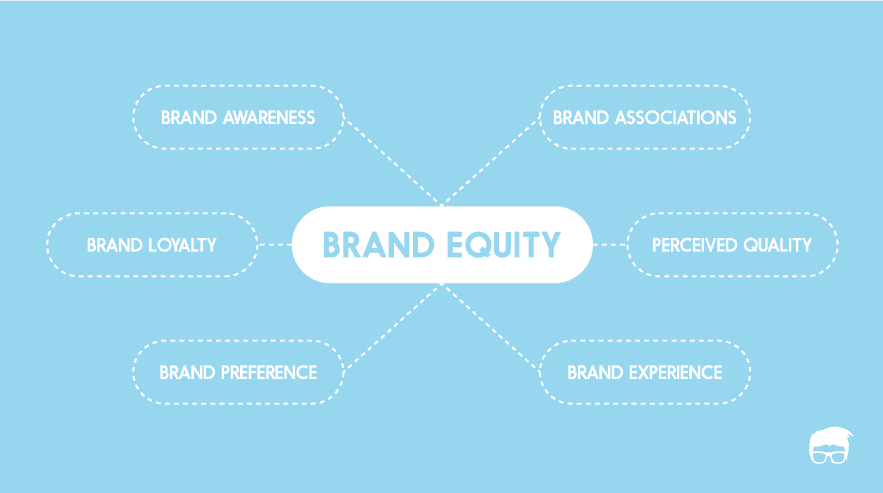
    BRAND EQUITY

    Brand equity usually is dependent on brand awareness, loyalty, perceived quality, strong brand associations and other assets such as patents, trademarks, and channel relationships. It involves fulfilling the promise the business has made to the customers and maintaining the relationship well.

    Brand Awareness

    The first step of the equity building process is building the awareness of the brand. Brand awareness means that the customers are aware of the brand and can associate it with the specific product/category. Awareness triggers the rest of the components of the brand equity building process.

    Brand Associations

    Just like with other people, we tend to associate things with brands too. Brand association is anything which the customers think of or relate to the brand. Interactions with the brand give rise to the associations. These could be employees, colour, advertisements, voice, language, experience, etc. For example, we tend to associate the colour red with McDonalds and happiness with coca-cola.

    Advertisements, online & offline presence, and pre-sale, sale, and post-sale interactions give rise to brand associations. Good brand associations are crucial to any business as it not only leads to repetitive sales, but it also helps the business through word of mouth marketing.

    Perceived Quality

    One of the major prerequisites of building strong brand equity is the fulfilment of the brand promise. Customers assess the brand by comparing its offering to the offerings of the competitors on the basis of certain qualitative and quantitative parameters. The product quality being a qualitative measure is a relative subject and depends totally on the customer’s perception. Nevertheless, it influences the pricing decision and positioning strategy of the brand which eventually affects its equity.

    Brand Experience

    Brand experience is the aggregate of experiences of the customer with the product offered and the brand overall. It includes pre-sale, sale, and post-sale experiences with the brand along with the experiences with the product offered. Customers with good brand experiences will certainly consider the brand superior over others and will prefer it over other brands.

    Brand Preference

    Brand preference is one of the major indicators of strong brand equity in the market. A preferred brand can charge more for the same product. However, giving rise to brand preference isn’t as easy as it seems. The company needs to make sure that the customers have good associations and experiences with their brand.

    Brand Loyalty

    A brand loyal person repeatedly chooses one brand over others offering the same product. Loyal customers not only result in repetitive sales, but they also are the best source for word of mouth marketing.

    Importance of Brand Equity

    Equity is important for the brand not only to increase its market share but also to increase its valuation in the market.

    Asset

    Brand equity is one of the most important intangible assets of the company and just like other assets, this too can be sold, licensed or leased to others.

    Price Premium

    A brand having positive brand equity can charge more for its product than the actual market price.

    Increases Market Share

    Positive brand equity often results in more loyal customers who prefer one specific brand over others and in-turn increases its share in the market.

    Easy Product Line Extensions

    It becomes easier to launch new product lines under the brand which has positive brand equity. For example, Apple, which started off with macs, was able to easily launch and lend its brand equity to iPhones.

    Examples of Brand Equity

    Brand equity is the value added to the same product by offering it under a specific brand. It is what makes one product preferable over other when the two have exactly the same features and utility. Precisely, brand equity is what makes a specific brand superior or inferior to others. Here are some examples of brand equity:

    Apple

    Apple is one of the best examples to explain brand equity. Even though the product offered by this brand have similar features to products of other brands, the demand, loyalty and the price premium to higher than any other mobile brand. The brand is counted among the top three most valuable brands since the past 7 years.

    Maggi

    Even after months of the ban on its flagship noodles in India, the product saw a great demand when it was relaunched in the market. Maggi is one of the best examples to show how a strong brand equity can help a company cope up with anything in the market.

    Facebook

    Other social networking websites may come and go but Facebook remains the only constant. Facebook has made its users so brand loyal that most of them don’t even look up to any other social media platforms.

    Positive and Negative Brand Equity

    A brand can have either positive or negative brand equity. While positive brand equity helps the company to maintain superiority over its competitors and expand its product lines, a negative brand equity as in the case of Volkswagen, which was held guilty for emission scandal, could even hurt the current product lines under the brand and have a long-lasting negative effect on the brand positioning.

    Go On, Tell Us What You Think!

    Did we miss something?  Come on! Tell us what you think of our article in the comments section.
  • The 10 Types Of Entrepreneurs [Infographic]

    The 10 Types Of Entrepreneurs [Infographic]

    Entrepreneurs are stealing the spotlight in the 21st century and if you’re reading this post you probably are one of them. You might be an upcoming entrepreneur with a new groundbreaking business model, an existing super-entrepreneur who has successfully launched his product and is working on the next part of the plan, or an infopreneur working on your next video, e-book, or a blog post. We’ve classified different types of entrepreneurs into 10 types in this infographic. See where do you fit in.

    The Innovator

    With a strong personal drive, these are the leaders. Innovation motivates them strongly, but a major incentive for this group is the idea of creating a legacy and doing things the other way.

    Characteristics of Innovators

    • They constantly look for patterns.
    • They’re brilliantly lazy.
    • They’re obsessive note-takers.
    • They Aim for perfection but practice progress
    • They embrace fear

    Example of Innovators

    • Bill Gates: co-founder of the Microsoft Corporation
    • Larry Page: co-founder and chief executive officer of Google’s parent company, Alphabet Inc.

    The Hustler

    The enthusiastic ones, these entrepreneurs don’t wait for opportunities to fall in their lap. They know the importance of small things and make use of them effectively and efficiently. They are focused dreamers and work hard to achieve it.

    Characteristics of Hustlers

    • They know the importance of networking.
    • They are laser-focused
    • They dream ridiculously big.
    • They aren’t afraid to take a risk.
    • Hustlers eliminate all distractions.
    • Hustlers create their own opportunities.

     Example of the Hustlers

    • Zig Ziglar:  American author, salesman, and motivational speaker.
    • Mary Kay Ash: American businesswoman and founder of Mary Kay Cosmetics, Inc.

    The Imitator

    These entrepreneurs try to play safe by copying a successful or going to be a successful business model. They iterate a certain feature or innovation in a particular product or the business model to make it more appealing and have a competitive edge over the current market. The greatest advantage of copycat entrepreneurs is that they know the opportunities and shortcomings of the business and have a proven business model to work on.

    Characteristics of Imitators

    • They are risk takers
    • They are adamant about what they do.
    • They have an ability to build upon an existing idea
    • They are great researchers
    • They don’t follow or do things on other people’s terms.

    Examples of Imitators

    • Mark Zuckerberg: co-founder, chairman and chief executive officer of Facebook.
    • Oliver Samwer: Serial startup cloner.

    The Researcher

    These entrepreneurs not only believe in original ideas but also ideas which are viable. They believe in starting a foolproof business and spend a lot of time in choosing the right one.

    Characteristics of Researchers

    • These are the perfectionists
    • They are the problem solvers
    • They are critical thinkers
    • They are the visionaries.

    Examples of Researchers

    • Jeff Bezos: founder, chairman, and chief executive officer of Amazon.com
    • Larry Ellison: co-founder, executive chairman and chief technology officer of Oracle Corporation.

    The Money Magnet

    It’s a lot easier to make money when you start with money. This is what these entrepreneurs do. They usually don’t have much know-how of the business world and most of the work is done by the professionals appointed by them.

    Characteristics of Money Magnets

    • Rich Family
    • Professional team
    • Personal Brand
    • Easy PR

    Examples of Money Magnets

    • Paris Hilton: American businesswoman, socialite, television and media personality, model, actress, singer, and DJ.
    • Kim Kardashian:  American reality television personality, socialite, actress, businesswoman, and model.

    The Prodigy

    While others thrive on innovating and challenging the status quo, prodigies rely on innate intelligence and instinct as well as a higher degree of emotional stability. These entrepreneurs are blessed with inborn business sense and instinct.

    Characteristics of Prodigies

    • They rely on their innate qualities
    • They are born innovators
    • They believe in doing the things their own way.
    • They have inborn business sense.

    Examples of Prodigies

    • Elon Musk: American business magnate, investor, engineer, and inventor
    • Steve Jobs:  American entrepreneur, businessman, inventor, and industrial designer.

    The Buyer

    These entrepreneurs have huge pockets and are ready to invest in any promising venture. They might already have an experience in running a successful business and look for more opportunities.

    Characteristics of Buyers

    • They act as a guide to new ventures
    • Huge Pockets
    • They look for original & different ideas
    • They have a thirst for knowledge
    • They have a great network

    Examples of Buyers

    • Warren Buffet: Chief Executive Officer and Chairman of Berkshire Hathaway
    • Carl Icahn:  founder and majority shareholder of Icahn Enterprises

    The Solopreneur

    These entrepreneurs choose to start a business on their own with no intention of ever adding staff. They are the chief cook and the sole person responsible for the fate of the business.

    Characteristics of Solopreneurs

    • They are passionate workaholics
    • They are versatile as they handle every aspect of their business.
    • They create their own schedule
    • Their personal and corporate brand is interlinked
    • They love adventure

    Examples of Solopreneurs

    • Neil Patel: A renowned SEO and digital marketing specialist.
    • Brian Dean: founder of Backlinko.

    The Short-termer

    The main motive of these entrepreneurs is to create a successful business and sell it for top dollar. They are the innovators who derive their business model from bigger companies and add up innovation to them.

    Characteristics of Short termers

    • Money minded
    • Innovative
    • Effective communication and networking skills
    • They aim for big exits

    Examples of Short-termers

    Jan Koum & Brian Acton: Founders of WhatsApp.

    The Rebels

    These are the unconventional and challenge the existing players with their innovation and different routes. The rebels challenge the way it has always been done and does the work that matters.

    Characteristics of Rebels

    • They know what’s essential
    • They are very tenacious and work hard and long to achieve objectives.
    • They are the risk takers
    • They are the challengers

    Examples of Rebels

    • Evan Spiegel: co-founder and CEO of the American multinational technology and social media company Snap Inc.
    • Michael Dubin: founder of Dollar Shave Club
    Types of entrepreneurs

    Go On, Tell Us What You Think!

    Did we miss something?  Come on! Tell us what you think about our article on types of entrepreneurs in the comments section.