
Feedough Logo

Blog

  • How To Make Money With ChatGPT: 16 Proven Ways

    How To Make Money With ChatGPT: 16 Proven Ways

    Just a few years back, if someone said we’d be chatting with bots to get answers, discuss ideas, or seek help, we simply wouldn’t have believed it. But as freaky as it sounds, that’s our reality now. And who do we have to thank for it? None other than the amazing ChatGPT! 

    This smart AI chatbot can do it all, from creative work like writing essays to crunching numbers and writing codes. Interestingly enough, people are now using ChatGPT’s AI capabilities to make money on the side. 

    If you, too, are keen on tapping into the money-making potential of ChatGPT, then keep reading to discover sixteen different ways to make money with ChatGPT’s innovative chatbot platform.

    Become A Content Writer

    Before, being a content writer meant being creative, conducting extensive research, and constantly coming up with new ideas until you find the perfect one. Not everyone could do it. But now, with ChatGPT, literally anyone can try their hands at content writing and see if it works for them. 

    You can offer various paid content-writing services, including:  

    • Writing content for profitable blog niches.
    • Writing sponsored content for brands.
    • Writing product descriptions for ecommerce stores
    • Writing content for social media posts.  
    • Writing content for landing pages, email campaigns, sales letters and social media ads.

    You can use prompts like:

    • “Help me write a compelling product description for my online boutique that offers high-quality, handmade home accessories for a touch of elegance.”
    • Write an engaging blog post for a health and wellness website featuring some of the best wellness retreats worldwide, ideal for relaxation and rejuvenation.
    • “Compose an ad for an Etsy gift shop specialising in customisable keepsakes, emphasising their uniqueness and sentimental value for recipients.”

    Become a Content Editor and Proofreader

    With ChatGPT, you can effortlessly proofread and refine any written content. Let’s say you need to proofread and edit a blog. You can ask ChatGPT to identify potential grammatical, punctuation, or spelling errors in the text. However, make sure to review the content alongside ChatGPT’s suggestions to correct any mistakes and ensure the final draft is error-free and polished.

    You can use prompts like: 

    • “Check this text for subject-verb agreement errors.”
    • “Find any instances of passive voice in this text and rewrite them in active voice.”
    • “Suggest alternative vocabulary choices to improve the readability of this text.”
    • “Find any overused words or phrases in this text and suggest alternatives.”
    • “Check this text for clarity and flow, and suggest any improvements.”

    You can create content editing packages utilising ChatGPT as part of the service. You can offer different tiers of editing, with the ChatGPT assisting in basic proofreading, grammar checks, and sentence structure improvements, while human editors handle more complex editing tasks.

    Become a Social Media Manager

    Social media is a huge part of marketing and brand promotions today. And guess what? With ChatGPT’s assistance, you can level up your skills and become a full-fledged social media manager. Think about this: you’ll get to curate content, write high-converting social media posts, and even plan content calendars. And the best part of it all? You can offer your services to businesses worldwide and make some serious money with ChatGPT.

    Here are some prompt ideas to help you get started:

    • Write a social media strategy for a small business that is trying to increase brand awareness.”
    • “Create a social media campaign for a product launch to generate excitement and buzz.”
    • “Plan a social media content calendar for a month”

    Try Email Affiliate Marketing

    Email affiliate marketing is a great way to make money using ChatGPT. ChatGPT can write emails that are persuasive and engaging, and it can also include affiliate links in the emails. You can promote various offerings to your email list and earn a commission on any sales you generate.

    To start with email affiliate marketing, you must choose an affiliate program. With so many affiliate programs available online, find the one that sells the products or services you are interested in. 

    Once you have chosen an affiliate program, you must build an email list. To do so, you can offer lead magnets, such as free ebooks or webinars, in exchange for email addresses.

    Once you finish your email list, you can craft compelling email campaigns. ChatGPT can help you write emails tailored to your audience and persuade them to click on your affiliate links.

    You can use a prompt like, “Write an email campaign promoting *mention the affiliate product* from Amazon.”

    Keep track of click-through and conversion rates to determine your campaigns’ performance and adjust as needed.

    Work As a Virtual Assistant

    With so many businesses switching to remote settings nowadays, the demand for virtual assistants has also risen significantly.  And you know what VA jobs entail, right? Lots of clerical stuff like sending emails, researching, writing invoices, preparing documents and whatnot. ChatGPT can help you to easily streamline these tasks, get things done faster, and be productive.

    Platforms like Wishup, Toptal, Fiverr, Upwork, etc., are a great place to start with your virtual assistant career.

    Translation Services

    ChatGPT can be really good with translations, but only a few know this fact. You can use this to your benefit and kick-start your AI translation services. ChatGPT works best for basic text translations, you know, all the simple ones like website content, product descriptions and various marketing materials. 

    For instance, you can use a prompt like “Translate this product description from English to French: [copy and paste your text here].”

    These types of translations are often in high demand, especially by entrepreneurs starting a new business overseas or entering a foreign market with their existing offerings. Hiring a human translator can be pretty costly, and that’s the pain point you can focus on. This is how you can sell yourself, “We’re an AI translation service that can provide you with human-like content at a fraction of the cost and 10 times faster than traditional methods!”

    For more complex tasks, like translating a manual or a legal document, you can offer premium services, which could include a detailed human review of the ChatGPT translation, ensuring the translation is free of errors and 100% culturally accurate. To take it a step further, you can also offer region-specific or industry-specific AI translation services that are tailor-made for businesses’ translation requirements. 

    Audio and Video Transcription Services

    In the past, transcribing stuff from audio and video has been a real pain – it took forever, and mistakes would slip in all too often. But with ChatGPT, that’s not the case. It pretty much automates the entire transcription process, making it much faster and more accurate.

    Moreover, ChatGPT can handle quite a few languages, which is a major advantage for companies and organisations that operate across different foreign countries. No matter how complex the language is or how low the quality of the recording is, ChatGPT can transcribe audio and video files in any language. 

    Here are some prompts you can try: 

    For audio:

    • “Transcribe this audio file into text, including the speaker’s name and any other relevant information.”
    • “Transcribe this audio file and identify the key points of the conversation.”

    For video:

    • “Transcribe this video and include the speaker’s name and any other relevant information.”
    • “Transcribe this video and create a summary of the main points.”

    Resume and Cover Letter Writing Services

    You can ask ChatGPT to write a customised resume or cover letter based on a job description, and the AI chatbot will produce a nearly complete document, just missing a few basic details, like your name and address.

    Here are a few prompts to help you out: 

    • “Write a resume for a [job title] position highlighting my skills and experience.”
    • “Generate a resume that is tailored to the [company name] job posting.”
    • “Come up with a list of keywords that I should include in my resume for the [job title] position.”
    • “Write a cover letter for the [job title] position at [company name] that highlights my qualifications and enthusiasm.”
    • “Come up with a list of reasons why I am the best candidate for the [job title] position.”

    Create and Sell Online Courses

    You can create a course using ChatGPT and sell it on platforms such as Skillshare, Udemy, Thinkific, etc. In addition to creating a course outline, you can also use ChatGPT to produce advertising copies to promote your course online.  

    Here’s an example of an outline for 4 weeks, a 1-hour-per-day course created by ChatGPT:
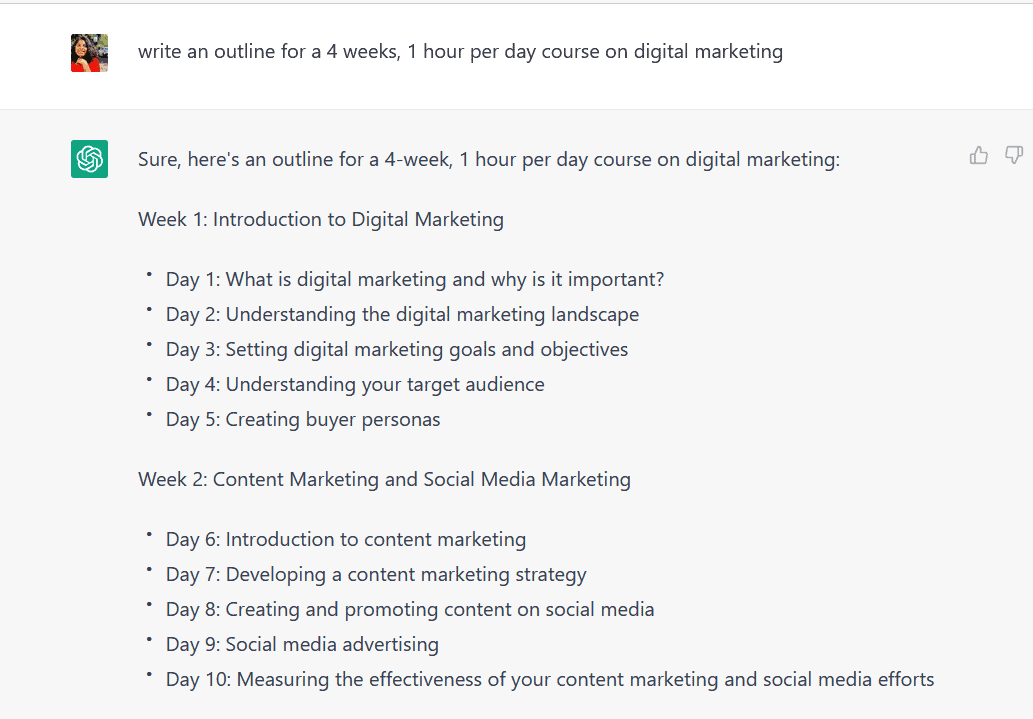
    Make Money With ChatGPT- Create and Sell Online Courses

    Here’s the advertising copy that ChatGPT created for the same course:
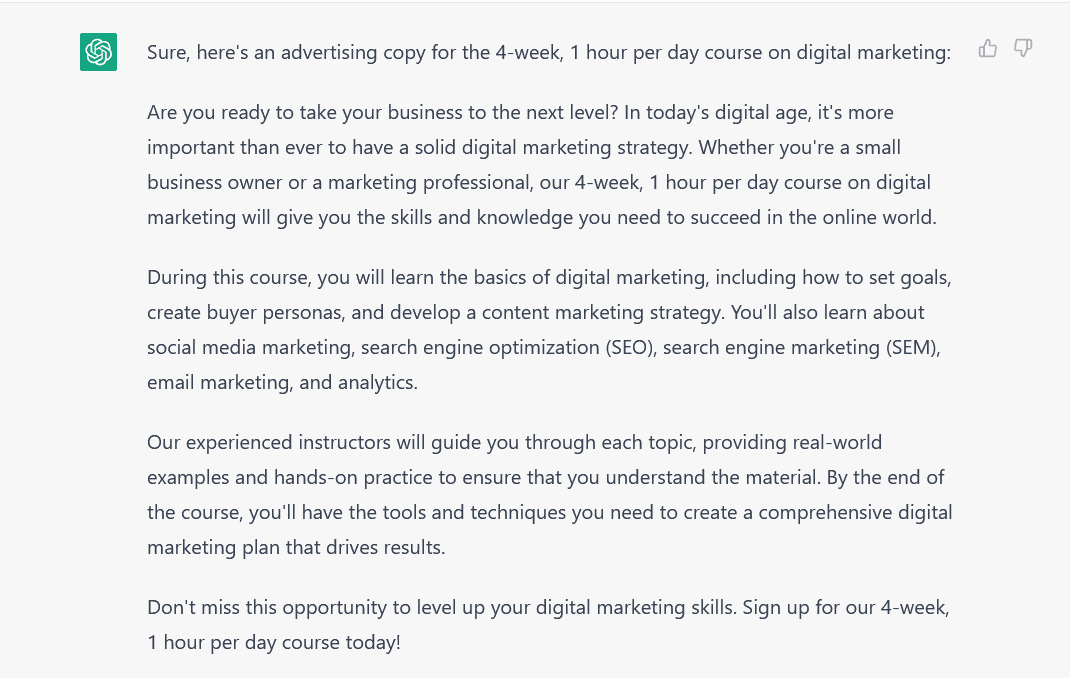
    Create and Sell Online Courses

    Create and Monetise a Faceless YouTube Channel

    You don’t always have to show your face to make good money on YouTube. But how? Well, that’s where faceless YouTube channels come in!  And they are pretty easy to make. 

    You can simply start by selecting a stock video depending on the niche you’re focusing on and use ChatGPT to generate a script for the same. Here’s one example: 
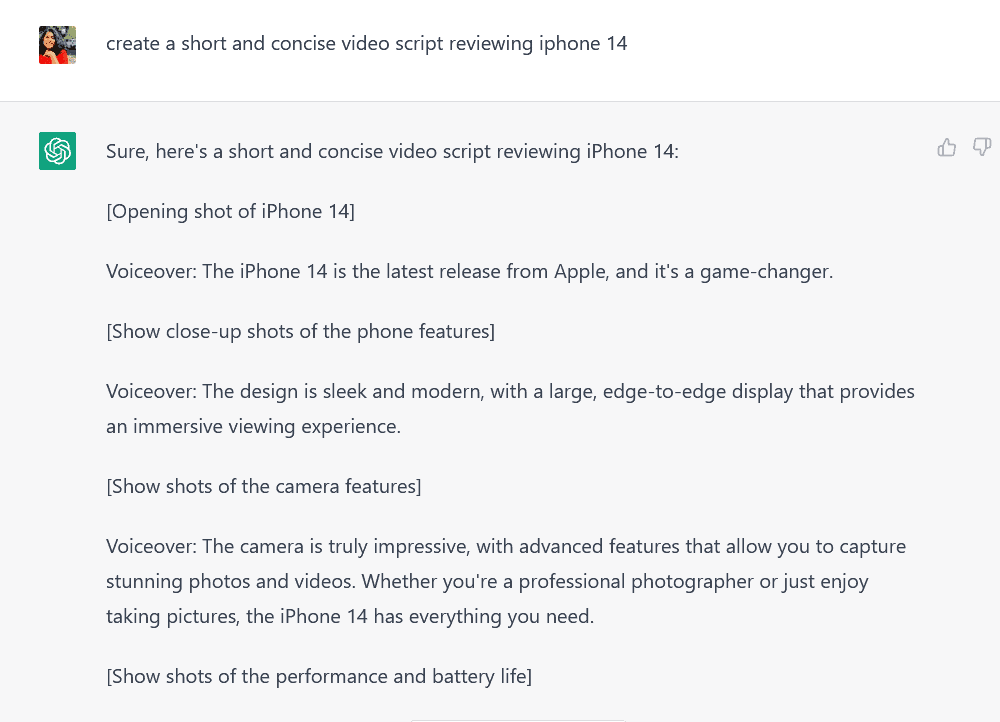
    Make Money With ChatGPT- Create and Monetise a Faceless YouTube Channel

    Once the script is ready, you can use Speechify’s voice-over generator to turn that script into a natural-sounding audio narration. Moreover, you can convert your script into a video using Synthesia AI. That way, you’ll have a complete video with a voice-over without ever showing your face. 

    ChatGPT can also help you optimise your videos’ titles, descriptions, and tags to ensure search engines properly index them and ensure people can find your content more easily.

    Become a Scriptwriter

    ChatGPT is surprisingly good at creating functional scripts for short films or TV shows. While the scripts it generates aren’t always perfect, you can use them as a good starting point for writing something more detailed or accurate.

    Here are some prompts to get started with ChatGPT for script writing:

    Brainstorming ideas:

    • “Write a logline for a short film about a group of friends who go on a road trip.”
    • “Generate a list of character archetypes for a TV show about a teenage love story.”

    Generating dialogue:

    • “Generate a monologue for a character who is trying to convince someone to do something they don’t want to do.”
    • “Write a scene for a comedy about two people who are trying to flirt with each other.”

    Structuring a script:

    • “Write an outline for a short film about a character trying to solve a mystery.”
    • “Come up with a plot for a horror movie about a group of people trapped in a cabin in the woods.”

    Write and Self-Publish E-books

    According to a report published by Reuters this year, writing and selling AI-written ebooks on Amazon has gained massive popularity. So much so that people are making a career out of it. And the good news is, you, too, can be a part of it. Simply select the niche that you wish to target, think of a rough idea of what you want the story to be about, type it as a prompt, and ChatGPT will instantly come up with a story for you. 

    Make Money With ChatGPT - Write and Self-Publish E-books

    Create an AI Chatbot 

    One of the best ways to make money with ChatGPT is to create chatbots that can provide customer service, handle support requests, and even close deals for businesses and organisations. Kind of like having an automated customer care and assistant.

    And here’s how you can do it, too: to create a chatbot, you’ll need to train ChatGPT on the business’s information. This includes details like hours of operation, the services or offerings, and frequently asked questions. You can also provide sample responses to some questions to train ChatGPT on how you’d like it to answer them. 

    Once trained, the chatbot can respond to customer enquiries based on your provided information. Just be sure to test the chatbot thoroughly to ensure it behaves as desired. Refine the prompts, adjust parameters, and improve based on user feedback.

    Develop and Sell Apps, Chrome Extensions and Plug-Ins

    With ChatGPT, coding has become simpler than ever, offering a golden opportunity to earn money using ChatGPT. If you’ve ever dreamt of creating your very own Chrome extension, plug-ins or apps, then ChatGPT can help you get there. 

    For ideas or general instructions, try entering a prompt like “Help me design a mobile phone app in the style of Gardenscapes.”

    Once you’ve narrowed down the idea and know exactly what you want your app or extension to do, you can give specific prompts to ChatGPT and create the code you need.

    Start with a general prompt, like “Code a simple text adventure game in Python,”. Then, build on the basic code that ChatGPT has generated for you to add your own custom characters, levels, locations, and other features.

    If you have a particular idea in mind, you can give ChatGPT more detailed prompts, such as “Create a Google Sheets add-on that lets users enter a list of tasks and their due dates and then generates a calendar view of the tasks.”

    Sell AI Prompts

    Here’s a secret not everyone knows about, i.e. you can make money with ChatGPT by creating and selling AI prompts. Prompts are the specific instructions you give based on what the AI gives you as an output. And If you are good at writing effective AI prompts, you can sell them to people who want to use ChatGPT for their own projects. 

    There are a few different ways to sell AI prompts:

    • You can create your own blog or a website to sell your prompts individually or in packs.
    • You can join a marketplace for AI prompts, such as PromptBase or FlowGPT.
    • You can offer your prompts as a service, where you will write custom prompts for people based on their specific needs.
    • You can promote your prompts on social media and other online channels. 

    Here are some additional tips for creating and selling AI prompts:

    • Make sure your prompts are clear and concise.
    • Focus on keywords that people likely search for.
    • Offer a free trial or sample of your prompts.
    • Provide excellent customer service.

    Become a ChatGPT Consultant

    By becoming a ChatGPT consultant, you can help businesses to improve their operations, increase productivity, and generate new insights. This can be considered a reliable way to make money with ChatGPT.

    You need to do a few things to become a ChatGPT consultant. First, you need to have a strong understanding of ChatGPT and how it works. You should also be familiar with how ChatGPT is utilised in business in the landscape.

    Once you understand ChatGPT well, you need to start building your network. Talk to businesses about their needs and how ChatGPT can help them. You can also offer free consultations to businesses to demonstrate your skills.

    As you build your network, you will attract more clients. Once you have a list of clients ready, you can start to charge for your services. You can also start to offer training and workshops on how to use ChatGPT in business.

    Bottom-Line?

    Although ChatGPT is far from perfect, what it generates often needs more editing and input than it’s worth. However, the possibilities for what can be accomplished with ChatGPT are endless, making it a valuable tool for anyone who wishes to make money with ChatGPT. So, why not take advantage of it? Discover how you can start raking in the dough using ChatGPT and find the approach that suits you best.

  • How To Start A Business Internationally [Detailed Guide]

    How To Start A Business Internationally [Detailed Guide]

    In the past, opening an international business literally meant crossing oceans to reach foreign markets. Fortunately, times have changed, and today venturing into the global market is much easier, safer and more popular than ever before.

    In fact, international business is currently experiencing a significant boom. According to a recent study by the World Bank, international trade is growing at a rate of 3.8% per year, surpassing global GDP growth. Now, that’s a whole lot of opportunities waiting to be seized.

    However, it’s crucial to acknowledge that starting a business internationally comes with its own set of hurdles. Cultural differences, language barriers, and legal requirements are just a few examples of the challenges businesses need to overcome. Yet, the rewards can be substantial.

    That’s why we’ve put together this guide to help you navigate the process of setting up a business internationally. We’ll walk you through the steps, provide valuable insights, and offer practical tips to make your international business venture a success.

    Step 1: Choose Your Market

    The first step to take when starting a business internationally is to conduct thorough market research. This will help you identify and narrow down potential markets for expansion. You’ll be required to gather and analyse lots of data based on the economic, political and cultural environment of the countries you’re considering and the demand for your offerings in their local markets.

    You can consult a variety of sources to gather information for your market research, which could include: 

    • Government websites: Many governments have websites that provide information about the economy, the regulatory environment, and their country’s culture.
    • Trade associations: Trade associations can provide information about your industry, as well as the regulations and standards that apply in different countries.
    • Business directories: Business directories can help you identify potential partners and customers in a new market.
    • Online forums, focus groups and online surveys: Joining online forums or focus groups can be a great way to connect with people who are already doing business in a new market. You can also conduct online surveys to gather direct feedback and insights from potential customers and industry experts.
    • Consulting firms: Consulting firms can provide specialised advice on market research and international expansion.
    • Academic resources: Universities and research institutes often publish studies, papers, and research findings on various markets that can help you provide a deeper understanding of the economic, social, and cultural aspects of the target country.

    Step 2: Develop Your Business Plan

    The next is to come up with a solid business plan. You’ll have to start by defining specific goals and objectives for your international expansion and outlining your strategies to make it happen.

    Here’s what your business plan should include:

    • Executive Summary: This is a brief overview of the business plan, and it should include the goals and objectives of the international expansion, as well as the strategies that will be used to achieve them.
    • Company Description: This section should provide an overview of the company, including its history, products or services, and target market.
    • Market Analysis: This section should analyse the target market, including the size and growth potential of the market, the level of competition, and the regulatory environment.
    • Marketing Plan: This section should outline the marketing strategies that will be used to reach the target market, including the messaging, distribution channels, and promotional activities.
    • Financial Plan: This section should provide an overview of the financial projections for the international expansion, including the costs and revenue.
    • Sales Plan: This section should outline the sales strategies that will be used to reach the target market, including pricing, product positioning, and sales channels.
    • Operations Plan: This section should outline the operational strategies that will be used to support international expansion, including the supply chain, manufacturing, and customer service.
    • Logistics Plan: This section should outline the logistics strategies that will be used to get products or services to the target market, including transportation, warehousing, and customs clearance.
    • Management Team: This section should introduce the management team and their experience.
    • Appendix: This section should include any supporting documents, such as market research reports or financial statements.

    A well-developed business plan will develop the success of your business in international markets. You’ll not stay focused and on track, but you’ll also have a roadmap for your future expansion efforts. Your business plan will serve as an official record proving the viability of your business, which would open numerous avenues to secure funding and attract potential investors.

    Step 3: Set Up Your Business Entity

    Even setting up your business’s legal entity could be a hassle when it comes to international business. There are two aspects to it:

    There are many different legal structures available. However, choosing which would be the best for you will depend on a number of factors, including the size and nature of your business, the level of liability you are comfortable with, and the tax implications in the country you are expanding into.

    Some of the most common legal structures for international businesses include:

    • Sole proprietorship: This is the simplest and most common legal structure for small businesses. In a sole proprietorship, the business owner is personally liable for all debts and liabilities of the business.
    • Partnership: A partnership is a business owned by two or more people. The partners are jointly liable for the debts and liabilities of the business.
    • Limited liability company (LLC): An LLC is a hybrid business structure that combines the benefits of a corporation and a partnership. The owners of an LLC are not personally liable for the debts and liabilities of the business, but the LLC itself is a separate legal entity. If you need assistance, Incfile can help you file for your own LLC online for free.
    • Corporation: A corporation is a legal entity that is separate from its owners. The owners of a corporation are shareholders, and they are not personally liable for the debts and liabilities of the corporation.

    Registering With The Appropriate Authorities

    Once you have chosen the right legal structure, you must register your business with the appropriate authorities in the country you are expanding into. The registration process will vary from country to country, but it typically involves providing information about your business, such as its name, address, and contact information.

    Step 4: Get the Necessary Permits And Licences

    The specific permits and licences you will need will vary depending on the country you are expanding into. However, some common permits and licences include

    • Business registration: You will need to register your business with the appropriate authorities in the country you are expanding into.
    • Employment permits: If you plan to hire employees in the country you are expanding into, you will need to obtain employment permits for them.
    • Tax registration: You will need to register your business for tax purposes in the country you are expanding into.
    • Intellectual property registration: If you have intellectual property, such as trademarks or patents, you must register them in the country you are expanding into.
    • Import and export licences: If you plan to import or export goods, you will need to obtain import and export licences.

    If you’re struggling to figure out which permits or licences your business needs, BetterLegal can research for you so you can focus on getting your business off the ground.

    Step 5: Open a Bank Account

    Opening a bank in your target market will greatly help you develop a local financial presence. Plus, you’ll easily facilitate transactions, all while complying with local regulations. Here are a few things to consider before you open your bank account:

    • Research local banking options: Start by researching the local banks in your target market. Look for reputable local banks that offer suitable business services, such as international transactions, account types, foreign exchange services and international banking facilities. If you are a non-resident, you will need to find a bank that is willing to open a LLC bank account for non residents for you.
    • Check the requirements: Different countries have different rules when it comes to opening a bank account. Make sure to check requirements for documentation, business licences, minimum deposit requirements, and identification. In case you need any help, consult the local authorities, business associations, or legal advisors for guidance. Gather the necessary documentation: Once you have chosen a bank, prepare the necessary documentation to open an account. This typically includes identification documents (such as passports or national ID cards) for the account signatories, proof of address (utility bills or lease agreements), business registration or incorporation documents, and tax identification numbers. Some countries may ask you for additional documents, so ensure you have a comprehensive list based on local regulations.
    • Open the account online or in person: Some banks allow you to open an account online, while others require you to open an account in person. If you are opening an account in person, be sure to schedule an appointment in advance.
    • Transfer your funds: Once your account is successfully opened, transfer funds to it by wire transfer, bank transfer or check. Make sure to familiarise thoroughly with the processes, fees, and any currency conversion requirements. You may also explore options such as foreign exchange services or international payment platforms to streamline your cross-border transactions.

    Step 6: Hire Employees

    Expanding on the sixth step of opening a business internationally, which is hiring employees, make sure to find qualified professionals in your target market and make them a part of your team. But before you hunt for potential candidates, familiarise yourself with the local labour laws and regulations. If you need any help, you can also consult local legal counsel or HR experts.

    Step 7: Market Your Business

    When marketing your business internationally, the first thing you need to do is to create a solid marketing plan. This plan should include your goals, target audience, marketing channels, and budget. Once you have created your marketing plan, you can start promoting your business. This can be done in two ways: online and offline.

    Online marketing can include:

    • Search engine optimisation (SEO): Create a user-friendly, visually-appealing website that showcases your offerings. Use SEO techniques to improve your website’s organic rankings on search engine results pages. This means optimising your website’s content, using relevant keywords, and obtaining high-quality backlinks.
    • Invest in online advertising: Consider running online advertisements through platforms like Google Ads, social media ads, and display advertising networks. Target your ads based on demographic and geographic factors to reach your desired audience effectively.
    • Social media marketing: Establish a popular presence on social media platforms within your target market. Engage with your audience, build a connection and use it to promote your business.
    • Email marketing: Build an email list and send targeted email campaigns to nurture relationships with potential customers. To keep them engaged, provide relevant information, exclusive offers, and updates about your business.

    Offline marketing can include:

    • Participate in trade shows and industry events: Attending relevant trade shows and industry events is a great way to showcase your products, network with potential customers, and gain industry exposure in your target market.
    • Localise your marketing materials: Translate and adapt your marketing materials, including brochures, flyers, and promotional videos, to the local language and culture of your target market. This shows that you value their customs and increases your credibility.
    • Collaborate with local influencers or partners: Be on the lookout for influential individuals or businesses in your target market who can help promote your brand. Partner with them for joint marketing campaigns or sponsorships to reach a wider audience.
    • Engage in public relations (PR): Build solid relationships with local media outlets, journalists, and bloggers to generate positive coverage for your business. Issue press releases, arrange interviews, or participate in relevant PR opportunities to increase your brand’s visibility.
    • Utilise traditional advertising: Consider placing advertisements in local newspapers, magazines, radio stations, or television networks to reach a wider audience. Adapt your messaging to align with the cultural preferences of the local market.

    Marketing your business internationally requires an in-depth understanding of the target market and the cultural differences. So, make sure to adapt your marketing strategies accordingly, monitor their effectiveness, and leave enough room to make changes or incorporate new ideas as you go.

    Step 8: Manage Your Finances

    Managing your finances is a crucial part of running an international business. A healthy financial record ensures stability, legal compliance, risk mitigation, and efficient operations. Here are some important steps that’ll help you keep your finances in order:

    1. Keep track of your money: Set up a system to track your income and expenses. This could be using accounting software or getting help from an accountant. It’s important to have a clear picture of your finances.
    2. Pay your taxes on time: Make sure you understand the tax requirements in the countries where you operate. Stay updated on tax laws and regulations. If need be, seek advice from a tax expert who can optimise your tax planning and avoid penalties.
    3. Watch out for currency exchange risks: Dealing with different currencies can be tricky. Make it a point to stay informed about exchange rates. Also, consider working with a foreign exchange provider who could manage currency conversions and minimise risks for you.
    4. Build good banking relationships: Choose a reliable international bank that suits your business needs. This will help you handle transactions across borders and access global financial services.
    5. Implement strong financial controls: Establish clear policies and procedures for financial transactions within your business. This includes authorisations, invoice approvals, and segregation of duties. Regularly review and update these controls to minimise the risk of fraud or errors.
    6. Stay compliant with regulations: Make sure you understand and comply with financial regulations, such as anti-money laundering and Know Your Customer requirements. Stay informed and keep your operations aligned with these regulations.

    Remember, good financial health creates a solid foundation for long-term success in the global marketplace.

    Tips to Keep in Mind While Starting a Business Internationally

    Stepping foot in the global marketplace can be exciting. However, growing your business overseas also comes with its own sets of challenges. To make sure you’re set up for success, here are a few important tips you need before you ahead and take the plunge:

    1. Establish physical presence: You can do so by partnering with a local company, forming a joint venture or setting up your own local offices in the target market.
    2. Adapt your pricing strategy: Make sure to adjust the price of your offerings as per the local market conditions, the competitive landscape and the purchasing power of the target customers. If need be, introduce discounts or promotions to attract more customers.
    3. Invest in cross-cultural training: This will help your employees to develop cultural intelligence. They’ll better understand the cultural norms and expectations of the target market, which would help them build solid relationships with international partners and customers.
    4. Develop a comprehensive risk management plan: While coming up with a risk management plan, make sure to address the political, economic, and legal risks associated with operating in different countries. Also, include contingency plans just to be prepared for unexpected events or scenarios.
    5. Use digital tools: Incorporate digital tools and platforms to facilitate remote collaboration, virtual meetings, and seamless communication with international stakeholders.
    6. Build a strong brand reputation: Prioritise your customers’ satisfaction above anything else, make sure your offerings are simply top-notch and maintain ethical business practices.
    7. Stay up-to-date on trade agreements. Tariff changes and geopolitical events can significantly impact your business operations or supply chain. It is important to stay up-to-date on these changes so that you can make informed decisions about your business.
    8. Seek feedback and testimonials: This will help you understand what your customers actually want and need, and it will also help you improve your offerings. Positive feedback from customers can also help you build credibility and generate word-of-mouth within the target market.

    FAQs

    What challenges should I anticipate when operating a business internationally?

    While there are many challenges one may encounter while operating a business internationally, here are some of the most common ones:
    Cultural differences: Each country has its own unique cultural nuances and practices that can vary significantly across countries, affecting communication styles, business etiquette and customer preferences. Adapting to and respecting these differences is crucial to ensure successful operations.
    Language barriers: Not being able to speak the local language can make conducting business a lot more difficult, especially when you need to constantly communicate with your customers, suppliers, partners, and employees. This can be a challenge, especially if you are operating in a country with a language that is very different from your own.
    Regulatory hurdles: Each country has its own set of regulations, and it is important to understand these regulations in order to comply with the law. This can be a challenge, especially if you are operating in a country with a complex regulatory environment.
    Financial risks: Operating a business in a new market can be risky, as you may not be familiar with the local market conditions. For example, you may be exposed to currency fluctuations or political instability.
    Logistics challenges: Shipping products or services to a new market can be challenging, especially if the country is located far away. You will need to factor in the cost of shipping, as well as the time it takes to get your products or services to your customers.
    Competition: The level of competition in a new market can vary greatly. There may be very little competition in some markets, while in others, the competition can be quite high. You will have to assess the level of competition in the market before you enter and develop a strategy accordingly to compete effectively.

    Which country in the world is the cheapest to start a business?

    There are a number of countries that are relatively inexpensive and easy to start a business in. Here are a few of them, as per the World Bank’s “Doing Business” report:
    New Zealand: New Zealand is ranked as the easiest country in the world to start a business. The cost of registering a business in New Zealand is just NZ$43, and the process can be completed in less than a day with minimum paperwork.
    Rwanda: Rwanda is another relatively inexpensive country to start a business in. The cost of registering a business in Rwanda is just RWF10,000 (around US$10). Similar to New Zealand, the process can be completed in less than a day.
    Slovenia: Slovenia is a country in Central Europe known for its business-friendly environment. The cost of registering a business in Slovenia is just EUR750, and the process takes about a week to complete.
    United Kingdom: We all know the United Kingdom is a developed country with a strong economy. The cost of registering a business in the UK is just GBP12, and the process can be completed in about a week.
    Denmark: Denmark is a Nordic country with a high standard of living. The cost of registering a business in Denmark is just DKK3,000, and the process takes about a week or so to complete.

    How can I effectively navigate language and communication barriers when expanding internationally?

    You can hire bilingual or multilingual staff, utilise professional translation services, and invest in cross-cultural communication training to overcome language and communication barriers.

  • The Top 5 Writesonic Alternatives (Comparison + Detailed Review)

    The Top 5 Writesonic Alternatives (Comparison + Detailed Review)

    Picture a magician performing tricks to captivate and delight children by transforming a cap into a pigeon, producing a flower bouquet out of thin air, and more. But just like a magician needs the right techniques and props to pull off these feats, a content writer needs the right tools to create compelling content.

    Enter AI writing tools, the modern-day magician’s bag of tricks. These tools help generate new ideas, eliminate writer’s block, and streamline the writing process. But not all AI writing tools are created equal, they differ based on their features, ease of use, use cases, and other aspects. 

    A similar thing is with Writesonic. It is a comprehensive and great tool for content writers, but since there are more similar tools in the market, you can always look for alternatives when required. If you’re currently using Writesonic or considering using it, you might be searching for a competitive alternative of writesonic offering better features, outputs, ease of use, price or more. As someone who’s been in that position, I’ve tested ten different tools over the past few weeks and discovered five that are worthy alternatives to Writesonic.

    Here is the list of the five best alternatives to Writesonic, comparing each one on different aspects and use cases. This will enable you to make a more informed decision about which tool is best suited to your specific requirements.

    Features 
    Writesonic 
    Anyword 
    Copy.ai
    Jasper 
    Hypotenuse AI
    Simplified 
    No of templates 
    100+
    90+
    90+
    50+
    28+ templates 
    90+ templates 
    Supported languages 
    25 languages 
    25+ languages 
    29 languages 
    29 languages 
    25+ languages 
    30+ languages 
    Supported Tones 
    Add custom tones 
    You can add the tone while giving the Prompt. 
    9 tones and allows to enter custom tones as well.
    Allows you to enter your preferred tone.
    5 added tones of tools or describe your own tone option.
    10 tones 
    Chrome Extension 
    Yes
    No extension 
    Yes 
    Yes
    No 
    Yes 
    Long-form content Generator 
    Generate 3k word content in one go, and use other 25+ templates to generate more
    Blog Wizard, General writing, Article/blog section and other frameworks
    25+ templates to support long-form content. 
    15+ templates that help in long-form content generation.
    Blog posts, workflow, and three other templates including the ask anything template helps to complete the long-form content.
    Blog Wizard, article writer, and 20+ templates help in long-form content writing
    Technology 
    Transformer 3 or GPT (3 an 3.50) technology
    (GPT-4 in all paid plans)
    GPT3, T5 and CTRL, technology. 
    GPT Technology 3 
    GPT technology 3.5 
    Free version uses GPT-3 which the prime version offers GPT-4
    GPT 3
    Social Media Content Generator 
    15 templates
    20+ templates
    Freestyle template and ready to use templates
    20+ templates. 
    6 templates
    100+ templates
    Text to image generator 
    Yes
    No 
    No 
    Yes
    Yes
    Yes
    Chatbot 
    Yes
    No 
    Yes
    Yes
    Yes
    No
    SEO tools
    Surfer SEO and Zapier integrations 
    No direct integration
    No integrations
    Surfer SEO Integrations. 
    No.
    No.
    Mobile Friendly 
    Yes
    Yes
    Yes 
    Yes
    No 
    Yes
    Free Trial 
    Free to use 
    7 days free trial plan. 
    7 days 
    5 days 
    7 days
    Free to use plan.

    Jasper

    Jasper is more than just an AI writing tool. It is a virtual writing assistant that can help you with any content creation task. Whether you need to write blog posts, social media captions, ads, emails, website copy, or anything else, Jasper has covered you all. Besides, it is also one of the best tools in the industry that caters to producing long-form content. You can work with Jasper in 29 languages and adapt to different tones and formats. You can also use Jasper Command, an intuitive feature that completes your sentences as you type. You can also generate images for your content using its AI image generator. With all this, it helps you create content faster, easier, and better than ever before.

    Writesonic VS Jasper

    Features 
    Writesonic 
    Jasper 
    Ease of use 

    The interface seems clean, but it is confusing to use and set up 

    Simplest UI amongst the other tools a low learning curve 
    No of templates 
    100+
    50+
    Supported languages 
    25 languages. 
    29 languages.
    Supported Tones 
    Add custom tones.
    Allows you to enter your preferred tone. 
    Chrome Extension 
    Yes
    Yes
    Long-form content Generator 
    Generate 3k word content in one go, and use other 25+ templates to generate more long-form content pieces.
    15+ templates that help in long-form content generation. 
    Technology 
    Transformer 3 or GPT (3 an 3.50) technology
    (Unlock GPT-4 and GPT-4+ in all paid plans)
    GPT technology 3.5 
    Social Media Content Generator 
    15 templates for popular social media platforms and Chatsonic to create custom captions or social media posts.
    Create content for all different social media platforms with 20+ templates. 
    Text to image generator 
    Yes
    Yes
    Chatbot 
    Yes
    Yes
    SEO tools
    Surfer SEO and Zapier integrations. 
    Surfer SEO Integrations. 
    Mobile Friendly 
    Yes
    Yes
    Free Trial 
    Free to use While access to advanced features and GPT 4 and 4+ technology requires you to upgrade plans. 
    5 days.
    Pricing 
    Free Trial: includes 10,000 words with a a lot of features.
    Long form:Unlock GPT 4 and 4+ technology to write 60K words with 1 user seat at $12.67/ month. 
    Custom Plan:Includes a custom number of words, seats with GPT 4 and 4+ technology. 
    Starters plan for hobbyist start at $24/mo with 20k Words.

    Boss ModeFor individuals and small teams starts at $49/mo with 50k words. 
    Custom Plan & Price for growing teams and businesses. 

    Is Writesonic Better Than Jasper?

    Writesonic and Jasper are both comprehensive AI writing tools powered by the same AI models, but they differ in features, pricing, and integrations. Some of the points of comparison are:

    • Writesonic lets you choose the AI model (GPT-3.5, GPT-4, or GPT-4+), while Jasper selects the best one automatically.
    • Writesonic is simpler and more rigid, while Jasper is more intuitive and flexible.
    • Writesonic is cheaper and has a free plan, while Jasper is more expensive and has no free plan.
    • Writesonic has more templates (over 100) and integrations (including Zapier), while Jasper has fewer templates (over 50) and integrations (including Surfer SEO).
    • Jasper has more features (such as Jasper Command, Jasper Compose, plagiarism checker, brand voice customization, and AI image generator), while Writesonic has fewer features.

    The best tool for you depends on your preferences, needs, and budget. You can try both tools and see which one suits you better.

    Anyword

    Anyword is not just another AI-powered copywriting platform. It is a smart content writing and SEO solution that helps you generate, improve, and score your copy based on your brand and marketing goals. With Anyword, you can write high-converting ad copy, email copy, blog posts, landing pages, social media posts, and more in minutes. Moreover, Anyword is the only AI copywriting platform that can predict how well your copy will perform before you publish it. It uses its powerful predictive analytics based on billions of marketing data sets to score your copy and tell you who is most likely to engage with it. Thus, you can also analyse and optimise your copy across different channels using copy intelligence analytics and custom copy scoring models and work more on the copies that perform well. All of these features make Anyword a worthy alternative to Writesonic.

    Writesonic VS Anyword

    Features 
    Writesonic
    Anyword
    Ease of use 
    The interface seems clean, but it is confusing to use and set up. 
    Simple, easy to navigate, and user-friendly UI.
    No of templates 
    100+
    90+
    Supported languages 
    25 languages. 
    25+ languages. 
    Supported Tones 
    Add custom tones. 
    You can add the tone while giving the Prompt.
    Chrome Extension 
    Yes
    No extension. 
    Long-form content Generator 
    Generate 3k word content in one go, and use other 25+ templates to generate more long-form content pieces.
    Blog Wizard, General writing, Article/blog section and other frameworks can help you generate long-form content.
    Technology 
    Transformer 3 or GPT (3 an 3.50) technology
    (Unlock GPT-4 and GPT-4+ in all paid plans)
    GPT3, T5 and CTRL, technology 
    Social Media Content Generator 
    15 templates for popular social media platforms and chatsonic to create custom captions or social media posts.
    20+ templates dedicated to social media. 
    Text to image generator 
    Yes
    No 
    Chatbot 
    Yes
    No 
    SEO tools
    Surfer SEO and Zapier integrations. 
    No direct integration with SEO tools, but you can use the API for integrations and use its SEO keyword panel to generate more keywords or use Predictive scores & analytics if you are a business plan user.
    Mobile Friendly 
    Yes
    Yes
    Free Trial 
    Free to use While access to advanced features and GPT 4 and 4+ technology requires you to upgrade plans. 
    7 days free trial plan. 
    Pricing 
    Free Trial:
    includes 10,000 words with a lot of features. 
    Long form:
    Unlock GPT 4 and 4+ technology to write 60K words with 1 user seat at $12.67/ month. 
    Custom Plan:
    Includes a custom number of words, seats with GPT 4 and 4+ technology.


    Free Trial:
    7 days. 
    Starter Plan:
    $29 if billed monthly and $24 if billed annually with 20k words per month.
    Data-Driven Plan:
    $99 if billed monthly and $88 if billed annually with 30k words per month.

    Is Anyword better than Writesonic?

    Writesonic and Anyword are both AI writing assistants with similar features, including grammar, tone, plagiarism checks, and multi-language support. However, there are differences between them. Writesonic has better customer service, but Anyword is easier to set up and use than Writesonic.

    Moreover, Writesonic offers a free version with 10,000 premium words, while Anyword provides a free trial period of 7 days. While both tools meet most users’ requirements, Writesonic is more likely to get recommendations, as it includes SEO and content writing tools, a text-to-image generator, and a chatbot, making it an all-in-one tool with advanced writing features. To choose the best tool for your needs, try both for free and compare.

    Copy.ai

    Copy.ai is an AI writing assistant that can help you create marketing copy and content for any purpose. It is an AI writing assistant that can generate high-quality copy for blogs, social media posts, emails, product descriptions, slogans, and more. You just need to tell Copy.ai what you want, and it will do the rest. You can also edit, tweak, and refine the copy as you like.

    With Copy.ai, you can also find inspiration and creativity for your content. It can help you generate content ideas, outlines, hooks, and more. You can also experiment with different tones, styles, and formats for your content. Copy.ai helps you overcome writer’s block and unleash your full potential. It uses a powerful AI model called GPT-3, which is trained on billions of words from the internet. GPT-3 can understand natural language and generate coherent and relevant text based on your input.

    Writesonic VS Copy.ai

    Features
    Writesonic
    Copy.ai
    Ease of use 
    The interface seems clean, but it is confusing to use and set up 
    Simple and clean UI with a low learning curve. 
    No of templates 
    100+
    90+
    Supported languages 
    25 languages 
    29 languages 
    Supported Tones 
    Add custom tones 
    9 tones and allows to enter custom tones as well
    Chrome Extension 
    Yes
    Yes 
    Long-form content Generator 
    Generate 3k word content in one go, and use other 25+ templates to generate more long-form content pieces
    25+ templates to support long-form content 
    Technology 
    Transformer 3 or GPT (3 an 3.50) technology
    (Unlock GPT-4 and GPT-4+ in all paid plans)
    GPT Technology 3 
    Social Media Content Generator 
    15 templates for popular social media platforms and chatsonic to create custom captions or social media posts
    Freestyle template and ready to use templates for popular social media platforms 
    Text to image generator 
    Yes
    No 
    Chatbot 
    Yes
    Yes
    SEO tools
    Surfer SEO and Zapier integrations 
    No integrations with SEO tools
    Mobile Friendly 
    Yes
    Yes 
    Free Trial 
    Free to use While access to advanced features and GPT 4 and 4+ technology requires you to upgrade plans 
    7 days 
    Pricing 
    Free Trial: includes 10,000 words with a a lot of features 
    Long form:Unlock GPT 4 and 4+ technology to write 60K words with 1 user seat at $12.67/ month. 
    Custom Plan:Includes a custom number of words, seats with GPT 4 and 4+ technology.
    Free plan: Offers many features for personal use.
    Pro plan: Includes all free features plus extras, costs $49/month and $36/mo when billed yearly with 5 user seats. 
    Enterprise Plan: Custom pricing for teams with over 20 seats.

    Is Copy.ai better than Writesonic?

    When it comes to AI-powered writing assistants, Copy.ai emerges as a viable alternative to Writesonic. Both tools excel at aiding in the creation of marketing copy and content. They have similar features, such as grammar check, tone check, plagiarism check, and multi-language support. However, Writesonic has some advantages over Copy.ai in terms of clean interface, customer service, pricing, and long-form content creation. Writesonic is easier to navigate and has better support than Copy.ai. Writesonic also has a free version, while Copy.ai only has a 7 days free trial. 

    Writesonic is better at writing long-form content, blog posts, and also short content like captions, and content for social media, while Copy.ai is known as a tool better for writing product descriptions and social media content only. Similarly, while Writesonic integrates with WordPress and Zapier, Copy.ai does not integrate with any third-party app. So, you can try both tools for free and see which one suits your needs better.

    Hypotenuse.ai

    Hypotenuse AI is another AI writing assistant that can help you create marketing copy and content. It has a unique feature called Content Detective, which helps you research up-to-date, factual content from the web. You can easily add citations to your content and save your research for future use. This is a great feature for writing the factual content like blog posts, articles, and reports.

    One notable aspect of Hypotenuse AI, setting it apart as an alternative to Writesonic, is its eCommerce bulk generator which helps you write high-converting, SEO-friendly product descriptions at scale. You can also generate images and artwork from text with Hypotenuse AI. This is a useful feature for creating visuals for your content, such as logos, banners, illustrations, and more. Hypotenuse AI can also help you write emails, website content, social media copy, and more. It uses a powerful AI model called GPT-3, in the free plan and GPT 4 in the prime version which can generate coherent and relevant text and images based on your input.

    Writesonic VS Hypotneus.ai

    Features 
    Writesonic 
    Hypotenuse AI
    Ease of use 
    The interface seems clean, but it is confusing to use and set up 
    Simple and straightforward UI with no learning curve
    No of templates 
    100+
    28+ templates 
    Supported languages 
    25 languages 
    25+ languages 
    Supported Tones 
    Add custom tones 
    5 added tones of tools or describe your own tone option 
    Chrome Extension 
    Yes
    No 
    Long-form content Generator 
    Generate 3k word content in one go, and use other 25+ templates to generate more long-form content pieces
    Blog posts, workflow, and 3 other templates including ask anything template helps to complete the long form content 
    Technology 
    Transformer 3 or GPT (3 an 3.50) technology
    (Unlock GPT-4 and GPT-4+ in all paid plans)
    Free version uses GPT-3 which the prime version offers GPT-4
    Social Media Content Generator 
    15 templates for popular social media platforms and chatsonic to create custom captions or social media posts
    6 templates are there for social media content generation and use the chatbot to create custom posts
    Text to image generator 
    Yes
    Yes (With various customisation options) 
    Chatbot 
    Yes
    Yes
    SEO tools
    Surfer SEO and Zapier integrations 
    No. You can give keywords to the AI to generate content around it, instead. 
    Mobile Friendly 
    Yes
    No 
    Free Trial 
    Free to use While access to advanced features and GPT 4 and 4+ technology requires you to upgrade plans 
    7 days
    Pricing 
    Free Trial: includes 10,000 words with a a lot of features 
    Long form:Unlock GPT 4 and 4+ technology to write 60K words with 1 user seat at $12.67/ month. 
    Custom Plan:Includes a custom number of words, seats with GPT 4 and 4+ technology.
    Starter Plan: includes Access to AI article wizard, all copy templates + standard image resolution at $24/mo (billed annually). 
    Growth Plan: Includes Everything in Starter + unlimited high-resolution images and advanced article writing features at $49/ mo (billed annually). 
    Enterprise Plan: Includes custom plans for organizations.  

    Is Hypotenues AI better than Writesonic?

    Hypotenuse AI and Writesonic are AI writing tools for marketing copy and content. They have similar features, but Hypotenuse AI has Content Detective and eCommerce bulk generator, while Writesonic has blog post wizard and WordPress integration. Hypotenuse AI is better for factual content and images, while Writesonic is better for long-form content and blog posts. Where Writesonic has 100 templates, Hypotenues has 28 templates. So, these tools are powerful in their own styles and servings. You can try both of them to see which one suits your needs better.

    Simplified

    Simplified is an excellent alternative to Writesonic, offering a comprehensive set of features for modern marketing teams that helps them create stunning graphics, videos, and copy with the power of AI. Simplified lets you access millions of free images, videos, and audio clips, thousands of designer templates, and dozens of AI copywriting tools to generate content for any platform and purpose. Whether you need to design a logo, write a blog post, edit a video, or schedule a social media campaign, Simplified has you covered. You can also publish your designs to multiple platforms with one click, and collaborate with your team or clients in real time. With Simplified, you can streamline your workflow, automate your to-do list, and save time compared to manually publishing and modifying media across multiple tools. Simplified is easy to use, fast, and affordable

    Writesonic Vs Simplified

    Features 
    Writesonic 
    Simplified 
    Ease of use 
    The interface seems clean, but it is confusing to use and set up 
    Simple and easy UI with a low learning curve. 
    No of templates 
    100+
    90+ templates 
    Supported languages 
    25 languages 
    30+ languages 
    Supported Tones 
    Add custom tones 
    10 tones 
    Chrome Extension 
    Yes
    Yes 
    Long-form content Generator 
    Generate 3k word content in one go, and use other 25+ templates to generate more long-form content pieces
    Blog Wizard, article writer, and 20+ templates help in long form content writinig 
    Technology 
    Transformer 3 or GPT (3 an 3.50) technology
    (Unlock GPT-4 and GPT-4+ in all paid plans)
    It uses GPT 3
    Social Media Content Generator 
    15 templates for popular social media platforms and chatsonic to create custom captions or social media posts
    Yes, it has templates to create social media content for popular platforms and scheduler to schedule posts and analyse content 
    Text to image generator 
    Yes
    Yes, with amazing custmizaton petitions and 25+ animation effects 
    Chatbot 
    Yes
    No
    SEO tools
    Surfer SEO and Zapier integrations 
    No. You can add Keyword in the promp section while using the Generate with AI section 
    Mobile Friendly 
    Yes
    Yes
    Free Trial 
    Free to use While access to advanced features and GPT 4 and 4+ technology requires you to upgrade plans 
    Free to use plan can let you experience the basic features
    Pricing 
    Free Trial: includes 10,000 words with a a lot of features 
    Long form:Unlock GPT 4 and 4+ technology to write 60K words with 1 user seat at $12.67/ month. 
    Custom Plan:Includes a custom number of words, seats with GPT 4 and 4+ technology.
    Fee Plan: Is suitable for personal use 
    Small Team Plan: for $24/month is best for small teams and freelancers starting with digital marketing
    BusinessBest: for $40/month is a plan for growing teams scaling creatives, social,  blogs.

    GrowthBest Plan: for $100/month is best for bigger teams and high growth businesses.

    Is Simplified better than Writesonic?

    Simplified and Writesonic are both AI content generators that use GPT-3 technology to help you create graphics, videos, and copy for your brand. They both have a range of templates, features, and integrations to help you create content for any platform and purpose. However, they also have some differences that might make one of them more suitable for your needs. 

    Simplified is more team-friendly and user-friendly than Writesonic, which Writesonic is more cost-effective that Simplified. Simplified allows you to collaborate with your team or clients in real time, comment and mention them directly on your designs, and share feedback faster and easier. It also has a simple and clean interface that is easy to use and navigate. You can also access all the features and templates for free forever, or upgrade to a premium plan when you need more words, storage, or brand kits, while Writesonic offers 10k words generation in its free version. Writesonic is more flexible and customizable than Simplified. It gives you more options to tweak and personalize your designs and copy. So, based on your needs and usage, you can hoose a tool.

  • 10 Proven Tips For Student Entrepreneurs

    10 Proven Tips For Student Entrepreneurs

    Entrepreneurship is a buzzword in the modern world. And its power to attract is particularly strong for the ambitious and innovative minds of students who wish to become entrepreneurs.

     As the academic landscape expands and embraces creativity and risk-taking, more and more students are getting lured into the world of startups while continuing their studies.

    However, for new minds, navigating the path of a student entrepreneur can be both thrilling and challenging. So, to contribute to your aspiring young vision and help you make your entrepreneurial journey easier, we are here with ten proven tips tailored explicitly for student entrepreneurs.

    These practical insights are not just general tips but actionable points drawn from the experiences of successful entrepreneurs who once stood in the same shoes. If you are a student with an entrepreneurial spark, take heed of the valuable guidance and strategies and turn your ideas into reality.

    Develop A Product That Solves A Real Problem

    If you want to develop a product that addresses a real problem, there are two approaches you should consider when figuring out your product or service. These are:

    • Relevance to the pain point, and
    • Having a unique approach.

    Relevance To Pain Points

    As you are just starting as a student entrepreneur, you need to identify and understand customers’ pain points or unmet needs in a specific market.

    Consider:

    • Conducting thorough market research. You can do this on your college campus, where students have different, creative minds to get diverse ideas.
    • Engaging in conversations with potential customers or students, professors, and business enthusiasts around you to get different approaches to an idea.
    • Gather insights about what challenges your peers face in their daily lives that are frustrating and require an immediate solution. This will give you new challenges to set up your business around.

    By converging with people, you can tailor your product to address their pain points directly.

     A relevant product is one that:

    • Seamlessly integrates into your customers’ lives
    • Provides a solution that resonates with their needs
    • Simplifies their daily tasks
    • Saves them time and effort
    • Offers a tangible benefit that enhances their overall experience.

    The more relevant your product is to their lives or businesses, the higher the chances of gaining loyal customers who value its impact.

    For instance:

    • AI chatbots solve the problem of writers, students, or researchers getting relevant and accurate answers to their complex or research-intensive queries within a few minutes.
    • Netflix solves the problem of limited entertainment options, like going to the cinema, inconvenient schedules of traditional media, and more.

    Unique Approach

    In a competitive market, where N number of products are shelved, you’ll be recognised differently and capture the attention of your target audience when you offer them a better solution to make their lives easier.

    To be unique, identify what can make your product different, unique, or superior. It could be:

    • A novel technology
    • A fresh and unique perspective on an existing problem’s solution
    • A user-centric design approach to a solution
    • An innovative business model

    You can emphasise these unique aspects in your marketing efforts and highlight your product’s distinctive value proposition in the market, even if it makes the smallest difference.

    For example, consider creating a note-sharing platform where students can buy and sell their personal notes, and teachers can upload their resources for all the students on one centralised platform. By eliminating the manual collection of notes, students and professors can provide each other with a comprehensive repository of study materials at the touch of a button and save time.

    This unique approach of making notes available online attracts students (your potential customers) and fosters a sense of exclusivity. This makes your customers feel they have access to something special that cannot be easily replicated.

    By combining relevance and uniqueness, create a product that addresses pain points and captures the market’s attention.

    Study Your Competitors & Industry Leaders

    As a student entrepreneur, one of the crucial steps to building a successful startup is studying your competitors and industry leaders. Before you get started, study the startups of others around you to get a better idea of what sets them apart from other startup endeavours. This practice will play an essential role in strategising your startup’s plan. By studying them, you can:

    Gain valuable insights and opportunities that you can leverage at the nascent stage of your venture.

    Identify how they covered gaps in the market to strategies to cover gaps and differentiate your product or service.

    • Understand their offerings and shortcomings to discover new avenues for innovation for your startups.
    • Learn from their successes and mistakes, adopt the best practices and avoid the pitfalls they faced as a new student entrepreneur.
    • Stay updated on the latest developments and trends in your field to boost your startup’s growth and relevance.
    • Access critical market intelligence and tested strategies that will fuel your strategic decisions.
    • Benchmark your startup’s performance against the competition, set realistic goals, and track your progress.
    • Gain valuable insights into consumer preferences, pain points, and expectations by analysing your competitors’ customer base. Using these insights, you can refine your product or service to meet customer needs better.
    • Study competitors’ pricing and positioning strategies to set a pricing strategy and market positioning for your newly launched products.

    For example,

    Studying competitors and industry leaders is not about copying their strategies but about learning from their entire journey. As analysing them will give you actionable valuable insights into dos and don’ts as a student entrepreneur, you can drive the growth and success of your startup.

    Keep It Simple

    As a student entrepreneur, embracing simplicity can be a powerful tool for success in the dynamic startup world. Where 1,37,000 startups emerge every day globally, and 90% of them fail, 34% of those fail due to the lack of the proper product-market fit, which can often be a result of product complexity.

    Thus, to achieve simplicity, you need to find the right balance between the known and the unknown solutions available in the market. This means you neither solely rely on existing methods (Tracers) nor continuously pursue creating novel methods (Re-inventors). As a new entrepreneur, you must integrate both new and old approaches to create a simple yet innovative and reliable solution to keep things straightforward.

    • Tracers are content with the existing solutions and tend to adopt and replicate the existing methods to resolve problems.
    • Re-inventors are the innovators of the industries who continually explore novel methods for every challenge and set new trends.

    So, as an entrepreneur who’s just starting out, be a balancer who takes inspiration from proven strategies while having a unique idea and approach to the solutions. Maintain an equilibrium to enhance and improve these concepts and make them uniquely yours.

    For example: Airbnb

    Airbnb was the idea of three student entrepreneurs who were roommates in San Francisco. They came up with the idea of renting out their living space to people who were attending a design conference in the city. They put together a website called Airbedandbreakfast.com, and the service quickly took off.

    Airbnb has since grown into a global company with over 4 million listings in over 220 countries. It has changed how people find a place to stay when they travel. Instead of only booking hotels (Tracers), Airbnb lets regular people rent out their homes to travellers. This idea is easy to understand and use, but it’s also very different from traditional hotels, which makes it new and exciting (Re-inventors).

    Airbnb got its success when it started to offer its services with a perfect balance between the old concept and introducing a new one. By providing unique travel experiences and making booking a place to stay easy, Airbnb won people’s trust and succeeded.

    Proper Time & Finance Management

    Proper time and finance management are crucial for student entrepreneurs, as both are in short supply. You must efficiently balance your academic commitments with your entrepreneurial pursuits and your business’s budget with your daily expenses. Here’s how you must do it:

    Student Entrepreneur Tips For Time Management

    • Make a schedule: Take a pen and paper, and write down your daily or weekly schedule. Write down the time you will dedicate to academic tasks, including classes, library time, the time you give to projects and more. Then, write your startup work timing where you’ll work solely to upscale your startup. In this schedule, prioritise essential tasks and allocate specific time slots for each activity.
    • Set realistic goals: Define clear and achievable goals for your studies and startup. Do not get too extensive or unrealistic with your goals. While it is possible to complete the syllabus one night before the exam, this kind of goal will not work for your startup. So, break down the larger tasks into smaller, manageable steps to make achieving everyday goals less overwhelming.
    • Block your time: To work on your startup, block specific dedicated hours for these tasks. In these hours, avoid multitasking as it will affect productivity and efficiency, and just focus on the startup.
    • Identify time-waster tasks: There are many tasks that, without reason, suck up time. You need to identify these time wasters and eliminate this time to redirect it to do something more valuable.
    • Take breaks: Taking short breaks is essential to avoid burnout. At first, you might enjoy working and studying without breaks, but eventually, it will take a toll on you and give you burnout. Make time for short gigs with friends in your schedules.

    Student Entrepreneur Tips For Finance Management

    • Track expenses: Keep a record of all your startup and personal costs. You can use tools or apps to keep scanned copies of bills to organise and track your spending. This will help you maintain a clear picture of finances and also help you claim the expenses as a startup.
    • Budget wisely: As a student entrepreneur, you need to create a budget to avoid overspending. You can outline your revenue sources and planned expenses. When you have a budget, stick to it strictly to prevent overspending and financial strain, as finances are already limited when you are a student.
    • Separate finances: Always open a separate bank account for your startup to maintain clear financial separation from personal funds. With this, you will be able to track business expenses more effectively.
    • Seek professional advice: As a newbie in the realm of startups, consider consulting with financial advisors, professors, researchers, or HODs of finance departments who can provide genuine guidance on financial matters specific to your startup.
    • Look for cost-effective solutions: There are always cost-effective ways to run your startup without compromising quality. For instance, consider using free or low-cost tools for marketing and communication tasks, and work with freelancers, friends, and juniors who are ready to work at lower costs instead of hiring people.

    Build A Network

    Building a strong network is a critical aspect of success for student entrepreneurs. A well-established network can provide valuable resources, support, and opportunities for your startup. When you are surrounded by so many people of different ages, professions, and experiences, networking becomes way easier.

    Here’s how to build and nurture a thriving network:

    • Engage with your college community: Connect with faculty members, students, and alumni interested in entrepreneurship. Attend workshops and events.
    • Join entrepreneurship clubs: Become a part of campus clubs focusing on entrepreneurship. In clubs, meeting like-minded people will help you in networking and collaboration.
    • Leverage social media: Use platforms like LinkedIn and Twitter to connect and engage with industry influencers and experts.
    • Collaborate with Startups: Partner with other student startups to get mutual benefits and innovative solutions.
    • Pitch in competitions and hackathons: Take part in relevant hackathons or competitions to showcase your startup to potential investors and stakeholders.
    • Join online entrepreneurship communities: With the rising trend of communities, there are many forums and groups you can choose to join to connect with entrepreneurs globally. You can also join such relevant groups in colleges and universities.
    • Stay active locally: To build a local presence, attend local startup events, and join co-working spaces and incubators to network in your area.
    • Follow up and nurture relationships: Building a network is not just about making connections. It will help if you nurture those relationships over time. To do so, follow up with people you meet, express genuine interest in their ventures, be a part of their daily events, and offer support when needed.

    Build A Team

    As the saying goes, “Together, we are stronger than the sum of our parts,” this perfectly underscores the importance of building a team as a student entrepreneur. This is because, no matter how many endless hours and efforts you pour in or as much as you may possess skills and drive, you cannot be a one-man army to tackle all aspects of your startup. A team always has better results.

    Here’s how to build an effective team:

    • Look for team members with diverse skills to complement yours. These people can be your friends, mutual connections, juniors, or peers in communities. A diverse team always helps you get a broader range of perspectives on the table.
    • Ensure your team members share the same vision and values for the startup. You can always find like-minded people in your relevant subject class, competitions, or seminars. People with a unified sense of purpose help the team work cohesively towards common goals.
    • Seek members who are passionate about your startup’s mission and are not just passing the time as a student to get some co-curricular activity. A passionate team is more likely to stay committed, even during challenging times. And challenges are a part of your way as a startup.
    • Always foster open and transparent communication within the team and clearly define what you can provide them with. Encourage feedback and idea-sharing to create a culture of collaboration. Transparency is the best policy to get a loyal team.
    • Look for team members who are flexible and adaptable to the dynamic nature of startups, as startup environments require individuals who can quickly pivot and adjust.

    Moreover,  always remember that building a team is not just about finding a suitable skill set. It is also about finding people who align with your startup’s vision and values. A supportive team can help you:

    • Accelerate your startup’s growth
    • Navigate challenges effectively
    • Achieve greater success

    Go For The Market Validation (Minimum Viable Product Testing)

    Market validation, also known as Minimum Viable Product (MVP) testing, is a crucial and a must-take step for student entrepreneurs. Because if your product has no relevance to the market’s needs, what use is there in creating the product in the first place?

    This process aims to test your startup idea or product in the market before you fully launch it. This testing will help you gauge people’s reactions and gather feedback and data from potential customers. This data allows you to validate whether your concept has actual demand in the market and potential for success.

    You can offer your product to the entire college student body, professors, and their mutuals. It will keep the product in a closed group, serve the purpose of conducting the MVP test and also help you gain rational feedback.

    Instead of spending a significant amount of time and hefty resources to build a full-fledged product, start with a basic version known as the Minimum Viable Product (MVP). The MVP product has the core features necessary to address your target audience’s primary problem or need. Release this version to see the customer response and identify areas for improvement.

    For example, Buffer

    A social media management tool, Buffer allows users to schedule posts, analyse performance, and manage multiple accounts. Joel Gascoigne, the founder of Buffer, started with a simple landing page explaining the product’s value proposition and asked visitors to sign up for a paid plan.

    He used this MVP to test whether people would pay for his idea before building the product.

    Be Ready To Adapt

    Adaptability is one of the most crucial parts of starting a new business. You can not stay in the same place, repeating the same strategies, plans and tasks you began with. Your startups run the risk of getting caught in a vicious cycle with no advancement and being susceptible to collapse. In contrast, your growth spirals upward when you adapt to different required changes over time.

    In the same way a student needs to adapt to different syllabi and semesters, you need to adapt different strategies at different stages to make your business successful.

    Here are the things you need to be adaptable with:

    • Rapid Market Shifts: Markets are dynamic, and consumers’ preferences rapidly evolve with their needs based on their lifecycle changes and other events. Being adaptable allows you to respond quickly to shifts in market demand and adjust your products or services accordingly. Like, grocery stores that adopted home deliveries during the time of covid saw a boom in that and the post-pandemic period.
    • Advancements In Technology: Technology is getting more accurate, efficient, precise, and powerful every day, and it also plays a significant role in today’s business environment. Embracing new technologies and trends can give your startup a competitive edge. Similar to how many of your fellows graduated online, thanks to technology.
    • Customer Feedback: Listening to customer feedback and being open to suggestions helps you improve your offerings and cater to their evolving needs. For example, if the university student Phil Knight, and his coach Bill Bowerman, the founders of Nike, wouldn’t focus on customer feedback, they wouldn’t have been able to make it a billion-dollar company.
    • Accept Competitive Challenges: Everyone offering solutions to users, including your competitors, might develop innovative solutions. Being adaptable allows you to stay ahead by learning from them or finding creative ways to differentiate your startup.
    • Regulatory Changes: With your startup evolving and having new customers on board, the existing regulations and policies can impact your business. Always stay prepared to adapt to new rules as required, as this will ensure compliance and minimise potential disruptions.
    • Economic Shifts: Economic conditions never stay the same. They fluctuate. Be adaptable to adjust your strategies to thrive in both booms and downturns.
    • Internal Growth: Your needs and challenges will evolve as your startup grows. You might need more professionals, student interns, strategy changes, or other changes. Being flexible allows you to scale your team and operations effectively.

    When you embrace adaptability:

    • You foster a culture of continuous learning
    • You encourage yourself and the team to explore new possibilities and acquire new skills.
    • It builds resilience that helps you overcome obstacles and bounce back stronger from setbacks.

    Take Part In Student  Entrepreneurship Competitions

    Student entrepreneur competitions do not just host a competition but also offer a host of benefits that can significantly impact your startup’s success.

    These competitions give you push and impact you because it offers:

    • Funding opportunities: Many competitors provide prize money to the winners, which you can use to fund the development or launch of a business.
    • Publicity and networking: When you compete, you already put your startup in the spotlight, which attracts the attention of investors, professors of your college, mentors, and potential customers. This also gives you an advantage in your college campus.
    • Feedback and validation: Competing in a gig helps you get valuable feedback from experts and judges. This feedback can help you refine your business model and validate your ideas at the very nascent stage.
    • Collaborating and learning from peers: Interacting with other student entrepreneurs gives you exposure to diverse perspectives and ideas, fostering a collaborative learning environment.
    • Networking Opportunities: Engaging with fellow competitors, judges, researchers from different colleges, and sponsors expands your network, which helps you create potential partnerships and future opportunities.

    Seek Mentorship and Guidance

    Every time someone starts on a journey, be it a startup, a hiking experience, cooking, learning a new skill, or beginning with any other journey, they always need the guidance of the experienced.

    The insights and expertise of mentors, professors, and seniors who have been in your place as a student entrepreneur will help you find the right direction at ground level through the complex world of student entrepreneurship.

    Here’s is more that you can get from the mentor’s guidance:

    • Gain experienced insights and expertise from experts who have been student entrepreneurs in their age, professors, or other experts who have been through the entrepreneurial journey.
    • Avoid the common pitfalls they have fallen in with the guidance and tested strategies they provide.
    • Expand your network and access potential investors, partners, and customers through your mentor’s connections.
    • Receive support, encouragement for personal growth and constructive feedback during challenging times to refine your ideas and decision-making process.
    • Draw inspiration from your alumni student entrepreneurs’ success and experience.
    • Accelerate your learning curve and propel your startup towards success through mentorship.

    Wrapping Up

    As you journey into the world of student entrepreneurship, all equipped with these ten proven tips, remember that greatness lies ahead. You possess the ambition, creativity, and determination to turn your dreams into reality.

    Stay calm, embrace the challenges, and enjoy this thrill-filled journey to create something meaningful from scratch. Never hesitate to seek guidance from experienced mentors, connect with like-minded individuals, and learn and adapt along the way.

    Your journey as a student entrepreneur has only just begun, and the possibilities are limitless. Let your vision soar high, and remember, greatness lies within you.

    FAQs

    What is a student entrepreneur?

    Student entrepreneurs are higher education registered students actively engaged in academic studies and running their own startup or business venture.

    Can a solo entrepreneur raise funding?

    Yes, solo founders do attract investors. A study shown by Forbes says that “45.9% of companies that raised more than $10 million were also solopreneur companies.”

    Can student entrepreneurs benefit from university support in their startup journey?

    Student entrepreneurs can access a wealth of support from universities to fuel their startup ventures. Universities like St. Cloud State University, Stanford University, Massachusetts Institute of Technology and many others offer workshops, mentorship programs, guidance from experienced faculty members, and opportunities to participate in entrepreneurship competitions. These resources empower students to transform their innovative ideas into successful businesses while pursuing their academic goals.

    Should I seek a co-founder or build my startup alone as a student entrepreneur?

    It depends on your strengths and weaknesses. If you are an individualist who prefers working alone, you must stay a solo founder. But if you are a collaborator, you can choose to have a co-founder. A co-founder can bring complementary skills and support, but solo entrepreneurship is also possible with discipline and focus.

    How to balance academics and entrepreneurship effectively as a student entrepreneur?

    You can possibly balance academics and entrepreneurship with proper time management, discipline, and support from mentors or advisors.

  • What Is Limited Liability & How It Works?

    What Is Limited Liability & How It Works?

    In legal terms, a company is also an artificial or fictitious person, separate from its founders, that has quantifiable money in its pocket. That is, it cannot pay more than the amount of money it has. Limited liability is a concept that safeguards this artificial person from being legally liable for more than the amount of money it has. But there’s more to this concept of limited liability and how it works.

    Here’s a guide explaining the definition of limited liability, its importance, and how it works in practice.

    What Is Limited Liability?

    Limited liability is a legal concept stating that the liabilities of a business’s shareholders (owners and investors) are limited to the capital invested by them in the corporation, company, or partnership. It doesn’t extend to their personal assets.

    In simple terms, limited liability separates the business organisation from its owners, investors, and shareholders in terms of legal liability. This, in turn, shields them from being personally liable for the debts or obligations of that business. So, if a business’s debts exceed its assets in the future, that company or corporation can go bankrupt without its owners risking their personal assets.

    Limited Liability Applications

    The concept of limited liability is usually used in the context of these three business organisations:

    • Limited Liability Company: A Limited Liability Company (LLC) is a business entity owned and managed by a group of individuals who invest money in the company. An LLC provides limited liability to its owners, which means owners’ liability is only limited to the investment they made in the company.
    • Corporation: A corporation is a business entity owned by one or more investors and managed by appointed officers. Just like an LLC, a corporation is a separate entity from its owners and provides limited liability to them.
    • Limited Liability Partnership: A limited liability partnership is a business entity formed by two or more individuals who share the profits, losses, liabilities, and assets of the business. But unlike normal partnerships where the partners are personally liable for the debts of their business, a limited liability partnership limits the personal liabilities of each partner to only their respective capital investments.

    Importance Of Limited Liability

    The concept of limited liability is an important part of any corporate structure as it ensures that the shareholders only risk the amount they’ve invested in the company and not any other assets if something goes wrong.

    It also encourages entrepreneurs to start businesses and attract investors as they know their investments will be safe in case of a financial loss. Limited liability also helps create a secure business environment free from the fear of personal risk and liabilities.

    It’s necessary to note that limited liability does not mean that the owners are absolved from all legal responsibility for their company. It just means that they will not be held liable to pay more than the amount of capital and investments they have in the company or corporation.

    How Limited Liability Works

    When a business organisation registers itself as a corporation, LLC, or LLP, it is treated as a separate legal entity from its founders and shareholders. That means the business will be liable for its debts and obligations and not for its owners.

    In addition to this separation of liabilities, limited liability also ensures that the company’s assets are separated from those owned by its owners and shareholders, ensuring that the owners do not risk their personal assets in case of a financial loss.

    But sometimes, this business concept can be tricky to understand how it works in practice.

    To start with, it’s important to realise that limited liability protects the owners from having to pay out of pocket for debts and liabilities incurred by the company, but it doesn’t protect them from other kinds of legal action.

    For example, if a company runs into legal trouble and is sued during its lifetime, its shareholders may still be held accountable for their actions; they won’t be protected under the concept of limited liability if they are found guilty and required to pay damages.

    However, limited liability can also provide some protection in this scenario. If the shareholders are found to be negligent or have acted without due care, they will not be held personally liable for any legal action against the company.

    Advantages And Disadvantages Of Limited Liability

    Limited liability comes with a set of advantages and disadvantages. Here’s a quick overview of both:

    Advantages Of Limited Liability

    The biggest advantage of limited liability is that it protects the personal assets of owners and shareholders from being used to pay for debts or liabilities incurred by the company. Besides this, limited liability also has the following advantages:

    • It attracts more investors as they are only liable to the extent of their investment.
    • It helps reduce legal risks as owners and shareholders are not personally liable for any legal action against the company.
    • It has tax benefits as profits are not subject to personal tax but are taxed at the company’s rate.
    • The company can exist even after any of its owners leave or die.

    Disadvantages Of Limited Liability

    The concept of limited liability also has its own set of drawbacks. These include:

    • It increases the company’s complexity, requiring more paperwork and legal filing.
    • It can also result in higher taxes for owners and shareholders, as non-business-related expenses and losses cannot be offset against business income.

    Limited Liability Example

    Suppose two people, A and B, start a business and register it as an LLC. Both A and B will be the owners of this business, and they each have to invest $10,000 in the company.

    Now, if the company takes a loan of $40,000 from a bank but defaults on it, the bank cannot ask the owners to pay back that loan. They will only be liable to pay $10,000 each and no more than that due to the concept of limited liability.

    That is, the bank will get only $20,000 back and have to put the rest $20,000 as bad debt.

    Limited Liability Vs Unlimited Liability

    The concept of limited liability can be contrasted with unlimited liability as it is seen with sole proprietorship and general partnerships.

    Limited Liability
    Unlimited Liability
    Definition
    The owners’ liability is restricted to the amount they have invested in the business. Their personal assets are protected.
    The owners are personally and fully responsible for all debts and liabilities of the business. There is no protection for personal assets.
    Risk
    Lower risk as the personal assets of the owners are not at stake.
    Higher risk as the personal assets of the owners can be used to pay off the business debts.
    Businesses
    Typically associated with corporations, limited liability companies (LLCs), and limited partnerships.
    Usually associated with sole proprietorships and general partnerships.
    Debt
    The company’s debt is not considered the debt of the owners.
    The debt of the business is considered to be the debt of the owners.
    Legal Status
    The business is a separate legal entity from its owners.
    There is no legal distinction between the business and its owners.
    Bankruptcy
    If the business goes bankrupt, the owners lose only the money they have invested into the business.
    If the business goes bankrupt, the owners could lose personal assets to cover the business debts.
    Management and Control
    Often, ownership and management can be separate. This can lead to more professional management.
    Generally, the owners have direct control over all aspects of the business.
    Formation
    More legal formalities and higher costs involved in the formation.
    Fewer legal formalities and lower costs involved in formation.
  • What Is A Remote Team? – Types & Examples

    What Is A Remote Team? – Types & Examples

    In the past five years, remote work has grown by 44% —and it’s pretty easy to see why.  But remote work isn’t a recent phenomenon that emerged only in the past few years. In fact, it has a rich history dating back to as early as the 1990s, as revealed by a report published by Mckinsey & Co. Remote teams have quietly existed and thrived long before they became a popular trend in the modern work landscape.

    In this comprehensive guide, we’ll dig deep into the concept of remote teams – what they are, the different types that exist, the challenges and, most importantly, the numerous advantages they offer. 

    What Is A Remote Team? 

    A remote team is a group of people working together from different locations but in collaboration to reach the same goal. They often communicate and collaborate using digital tools and are often managed by one or more remote managers.

    Remote teams can be geographically dispersed, meaning they work from different countries or cities. They can also be distributed, in which case the team works from various locations within one country.

    Unlike traditional office setups, remote teams heavily rely on technology for seamless communication and collaboration. For example, they use project management tools for task management, video conferencing to stay connected with each other and cloud storage solutions for sharing files.

    Today, several companies have embraced remote teams and are reaping the benefits. In fact, research shows that companies with remote teams reported 25% less employee turnover than their non-counterparts. 

    Types Of Remote Teams

    Even though the concept of remote teams remains the same, not every remote team is the same. Different organisations have different needs, and therefore, there are several types of remote teams that exist in today’s corporate landscape.

    • Fully remote teams: These refer to remote teams where all the members are geographically scattered and don’t come together at any point. This type of team often has members from multiple countries, cities, or even continents.
    • Hybrid teams: A hybrid team includes a mix of both remote and on-site employees. It may be a combination of employees working in different locations or the same location but from different offices.

    Importance Of Remote Teams 

    With digitisation, globalisation and constant technological advancements, remote teams have become an important part of the corporate landscape. Having a remote team can bring immense value in various ways, especially in certain scenarios such as:

    • Geographical Limitations: With a remote team, organisations can overcome geographical limitations and build a team with members from across the world.
    • Cost Savings: Remote teams enable organisations to save costs on infrastructure, office space, and other relocation expenses. Also, when it comes to recruiting talent, remote teams make it easier for businesses to find the right people without spending money on travel or relocation costs. Hiring Process
    • Business Continuity: Remote teams are especially beneficial during unprecedented situations when people can’t come to the office. Natural disasters, extreme weather conditions, or health emergencies can disrupt the normal operations of an office-based workforce. In such cases, having a remote team enables business continuity as employees can continue working from their homes or any other safe location.

    Advantages Of Remote Teams 

    No more long commutes, the freedom to work from anywhere, and a schedule that aligns with personal preferences — these are some of the top benefits of having a remote team.

    1. Greater Flexibility: Remote work offers the freedom to work from any location, allowing team members to create a customised work environment that suits their needs. Whether it’s working from home, a coffee shop, or a different country altogether, remote teams enjoy unparalleled flexibility.
    2. Better Productivity: According to a survey conducted by Stanford University professor Nicholas Bloom, it was found that 9% of remote workers reported being more efficient at home than in the office.
    3. Expanded Talent Pool: With remote teams, companies and businesses can hire top talent from virtually any corner of the world. Geographical location is no longer an issue, which also means recruiting candidates who bring in a diversity of skills and perspectives, further benefiting the organisation greatly. 
    4. Cost Savings: Remote teams can often lead to significant cost savings for both companies and employees. Companies can reduce office space, utilities, and equipment expenses, while employees save on commuting costs and potentially even relocation expenses.
    5. Better Health: As per numerous studies, it has been found that employees tend to take good care of their health when they’re operating remotely. According to a survey conducted by Costo Cloud, 42% of remote workers ate healthier meals working from home than they did in an office-based environment.

    Challenges of Remote Teams 

    While offering numerous advantages, remote work also comes with its fair share of roadblocks and challenges: 

    1. Communication and Collaboration: Remote teams rely heavily on virtual communication tools, which can sometimes result in miscommunication or difficulties in conveying information effectively. For example, a small fault in the internet connection or a few seconds of delay can cause huge misunderstandings.
    2. Building Trust: Without regular face-to-face interactions, building trust among team members can be quite challenging. Establishing a sense of camaraderie and fostering a strong team culture requires intentional effort and creative virtual team-building activities.
    3. Work-Life Balance Boundaries: Remote work offers flexibility but can also blur the boundaries between work and personal life. Remote team members may struggle to establish clear boundaries, leading to potential burnout or difficulty in switching off from work.
    4. Managing Different Time Zones: Working remotely could also mean collaborating with individuals located in various time zones. Coordinating meetings, ensuring timely communication, and accommodating different working hours could come up as a logistical challenge.
    5. Potential for Social Isolation: Working remotely can often cause feelings of social isolation and disconnection. Without regular face-to-face interactions, team members may miss out on casual office conversations and the spontaneous exchange of ideas.

    Case Examples of Successful Remote Teams 

    Creating a productive remote team doesn’t happen by accident. It requires planning and execution, along with the right mix of people, processes, and technology.

    And surprisingly, there are some remarkable companies out there that have managed to pull off the remote team magic. Let’s take a look at some inspiring examples: 

    Buffer – Striking The Perfect Balance Between Productivity And Burnout

    According to research conducted by Buffer, 18% of remote employees struggle with being able to “unplug” from work.

    To address this issue, Buffer came up with a clever solution using Slack, their communication tool of choice. They established what they call the “10 Slack Agreements,” a set of guidelines aimed at helping their employees set clear expectations and strike a healthy balance between productivity and avoiding burnout.

    The fact that Buffer recognised the need for such agreements highlights the importance of providing tools to employees and helping them understand how those tools should be used.

    It’s not just about having the technology; it’s about utilising it in a way that promotes a healthy work-life balance and prevents the feeling of being constantly tethered to work.

    HotJar – Team Building Done Right 

    With over 100 employees across a distributed team, Hotjar believes in being “very intentional and proactive about building personal connections.”

    So, how do they make it happen? 

    Well, the answer is pretty simple: virtual team-building activities. 

    Now, conducting team-building activities through video conferencing software might take a little getting used to, but Hotjar sure knows how to make the best of it. And here’s how they do it:

    • 10 things about you” sessions—where workers tell fun facts and weird stories about themselves to spark conversations during onboarding. 
    • Coffee sessions: 15-minute meetings where workers run quick presentations about how they recently learned something new that might benefit the team (“Stretches I do at my desk” or “How I organise my emails”).
    • Wednesday bonfires: Company-wide meetings where workers catch each other up on interesting topics or discuss ways to improve personal growth.

    Best Practices For Remote Teams

    To ensure the remote team is running smoothly and efficiently, it’s important to set up some solid operational processes. Here are a few best practices to consider: 

    Establish Clear Expectations

    34% of remote workers worldwide believe that transparency from leadership fosters a strong sense of connection at work. And a big part of transparency is establishing clear rules and regulations for the team members.

    When it comes to managing remote teams, setting boundaries and expectations is crucial. Team members must be aware of their roles and responsibilities, work hours, deadlines, communication protocols, etc.

    This would mean communicating: 

    • Company Culture: Clarifying the organisation’s mission and core values to ensure everyone is on the same page.
    • Evaluation Criteria: Setting measurable goals, objectives, and deadlines to keep team members accountable.
    • Tools & Technology: Providing necessary resources for remote workers to do their job efficiently. For example, video conferencing software, project management tools, etc.
    • Remote Work Procedures: Establishing the processes for how tasks should be completed, and communication should take place.
    • Project Guidelines: Clearly communicate the guidelines for projects. Share the objectives, milestones, and deadlines so that everyone is on the same page and working towards a common goal. 
    • Communication Style Guide: Establish expectations for how team members should communicate with each other and clients.
    • Workload and Availability Expectations: Define the expected working hours, availability for collaboration, and how the company measures productivity. This clarity helps team members plan their workday efficiently and enables effective coordination.

    Set Regular Check-Ins

    When the team is all in the same office, it’s easy to keep everyone updated and touch base regularly. But this can be done in a remote setup as well.

    For instance, managers can kick things off with a daily meeting that lasts around 15-20 minutes. Take turns going around the virtual circle, giving each team member a chance to share their plans for the day, any challenges they’re facing, and what kind of support they may need from their colleagues.

    Invest In The Right Remote Team Management Tools 

    When it comes to managing a remote team, having everything the manager and employees need in one place can truly work wonders for the team’s work culture. That’s where remote team management software comes in handy. These tools help managers organise tasks, track deadlines, and assign jobs quickly and easily. They also provide the means for workers to communicate with each other in real time, making it easier for them to collaborate on projects.

    Provide Opportunities To Socialise

    According to a survey conducted by Buffer, 20% of remote workers experience a heightened sense of loneliness, and another 20% find it tough to collaborate and communicate.

    struggles with working remotely.

    So, it’s extremely important to encourage social interaction in remote teams. This could mean planning and arranging virtual hangouts, morning coffee standups, joint brainstorming sessions, online lunch and learns, and team-building games. 

    Remote Team Management Tips

    Remote team management can come with its own unique set of challenges, but with the right approach, managers can maximise the productivity of their virtual team. Here are a few remote team management tips that can make a significant difference:

    • Set clear goals and expectations for each member of the team.
    • Establish regular check-ins to provide feedback and address any concerns.
    • Utilise project management tools to track progress and deadlines.
    • Use employee remote monitoring software as a tool for collaboration and improvement rather than solely for surveillance.
    • Make sure to encourage open and transparent communication among team members.
    • Foster a sense of community through virtual team-building activities.
    • Provide opportunities for professional development and growth.
    • Trust team members to deliver quality work and avoid micromanaging.
    • Promote work-life balance by encouraging breaks and respecting personal boundaries.
    • Create a supportive and inclusive team culture, even in a virtual environment.
    • Celebrate achievements and recognise individual and team contributions.
  • What Is Employee Engagement? – Importance, Strategies & Examples

    What Is Employee Engagement? – Importance, Strategies & Examples

    Employees form the backbone of any company. They can do wonders if they love what they do. But the company won’t reach its potential if they work just to earn their salary. It is, therefore, crucial to foster an environment where employees are highly engaged and motivated to perform their best. This is known as employee engagement, one of the most important concepts in organisational psychology.

    What Is Employee Engagement?

    Employee engagement is a human resource concept that describes the level of enthusiasm and commitment an employee feels towards their work and organisation.

    It is the degree to which employees feel motivated, passionate, and invested in their work. Though not a quantifiable metric, employee engagement reflects how employees feel about their job, the organisation they work for, and its leadership.

    An engaged employee is usually more productive, creative, and willing to go the extra mile for the benefit of their organisation. They feel a sense of ownership over their work and take pride in being part of something bigger than themselves. That is, they’re not in just for the paycheck but instead have an emotional connection to their work.

    Importance of Employee Engagement

    Employee engagement is critical for a company’s success. Engaged workers are more likely to stay with the company and can help foster a better overall work culture. They’re also more likely to be productive, creative, and energised — all of which contribute to an organisation’s bottom line.

    Besides the key importance of employee engagement, engaged employees are also important to:

    • Create a better workplace environment: Engaged employees are more likely to stay with the company and feel a greater sense of purpose. This can create a better overall workplace environment that is positive and inviting.
    • Increase productivity: Engaged workers are more productive than those who are disengaged. They take the initiative, think outside of the box, and work hard because they love what they do. This leads to increased productivity and efficiency.
    • Improve customer relationships: Engaged employees are better equipped to build customer relationships. They’re more enthusiastic about their work and more likely to go the extra mile for customers, leading to better customer retention rates.

    Despite their immense value, only 23% of employees worldwide are engaged. Companies must, therefore, take proactive steps to increase employee engagement and reap its associated rewards.

    Levels Of Employee Engagement

    Based on the employee’s perception of their work and the organisation, there are three levels of employees:

    • Actively engaged: An actively engaged employee is passionate about their job and is highly motivated to perform at a high level. They are often an organisation’s most creative, productive, and successful workers. Actively engaged employees:
      • Offer creative ideas for enhancing the work experience;
      • Strive to complete tasks and achieve goals on their own;
      • Feel a sense of ownership over the organisation’s success.
    • Not engaged: This level of employee engagement includes indifferent workers who do the bare minimum to get by. They are not passionate about their work and simply “go through the motions” without putting in any extra effort. Not engaged employees often:
      • Feel disconnected from their work and organisation;
      • Are not involved in team activities and meetings;
      • Do not take the initiative or offer new ideas.
    • Actively disengaged: This level of employee engagement describes employees who are actively undermining their organisation. They are usually negative and cynical and often try to bring down their co-workers. Actively disengaged employees:
      • Express negative opinions about the company;
      • Are non-collaborative and unproductive;
      • Show little to no interest in their work;
      • Their actions and words make it clear that they do not care about the organisation.

    Factors Influencing Employee Engagement

    Several factors can influence employee engagement. Some of the most common are:

    • Leadership: The organisation’s leadership style can greatly impact employee engagement. Employees are more likely to be engaged if their managers offer support, respect, and recognition for their efforts.
    • Organisational culture: A positive organisational culture helps foster a sense of connection and purpose among employees. Companies that foster inclusion, open communication, and collaboration usually have higher levels of employee engagement.
    • Workplace environment: A conducive workplace environment is necessary for employee engagement. Employees are likelier to engage in their work if the workspace is clean, organised, and comfortable.
    • Compensation: Employees who feel they are adequately compensated for their efforts will usually be more engaged than those who don’t. Moreover, it’s not just about money — paid time off, flexible schedules, and other perks can also help boost engagement.
    • Location: Employee location can also have an impact on engagement. People who work remotely may feel isolated and disconnected if they don’t have access to the right resources. Similarly, employees who travel long distances to work may become disengaged due to the inconvenience.

    How To Measure Employee Engagement?

    Just like any other employee-oriented metric, employee engagement can be measured in various ways. Companies often use surveys, interviews, and other data collection methods to gauge their employees’ engagement levels.

    Some companies even use engagement assessment tools that feature workplace simulations, such as games and quizzes, to measure engagement levels. These assessment tools help companies identify the areas of their organisation that may need improvement in order to engage employees better.

    How To Improve Employee Engagement

    Improving employee engagement requires a concerted effort from both the employer and employees. But the company should take the lead in developing an engaging workplace environment. Here are some tips for how to improve employee engagement:

    • Create a supportive culture: A supportive culture encourages employees to be engaged and productive. This can be done by providing resources, offering social recognition and rewards, and allowing employees to make decisions about their work.
    • Ensure effective communication: Effective communication between the employer and employees is essential for fostering a culture of engagement. Employers should be open and honest with their employees and vice versa.
    • Provide development opportunities: Providing learning and development opportunities helps keep employees motivated to stay engaged in their work. This can come in the form of company-sponsored training courses or mentorship programs.
    • Have a competitive compensation policy: A fair and competent compensation policy is important for employee engagement. Employees should feel they are being adequately compensated for their efforts.
    • Set clear goals: Having clearly defined goals helps employees stay focused and motivated to achieve them. Goals should be realistic and challenging so that employees can feel a sense of accomplishment when they meet them.
    • Measure progress: Measuring employee engagement levels periodically helps employers identify areas for improvement. Regular surveys, feedback sessions, and one-on-one conversations can help assess engagement levels.

    Bottom-Line?

    Employee engagement is an important factor in the success of any organisation. Engaged employees are more productive, creative, and motivated to achieve organisational goals. But in order to foster a culture of engagement, companies need to take the lead by creating a supportive environment and providing resources for employees. Employers should also measure employee engagement levels periodically so they can identify areas where improvement is needed. By doing this, employers can ensure their workforce is engaged and motivated to achieve success.

  • Top 10 Branding Ideas To Grow Your Business

    Top 10 Branding Ideas To Grow Your Business

    You’ve worked hard to build a successful business. You might have even disrupted the industry with a revolutionary product or service.

    However, there’s a problem. No one knows about your brand yet.

    And this could hurt your business.

    That’s why you need to focus on building a brand for your business that your customers recognise and relate to.

    Fortunately, there are many creative ways to do this. Here are ten innovative branding ideas that will help you grow your business:

    Story-Based Branding

    Story-based branding, often called brand storytelling, refers to creating a narrative around your brand that speaks to people’s emotions.

    This branding strategy uses narrative to create an emotional connection with the customer and deliver a message with a powerful impact. It capitalises on empathy and allows customers to relate to your brand on a personal level.

    But this doesn’t mean sharing only the brand story – how the brand started and evolved. It can be anything related to the brand that can engage customers emotionally.

    For example, Nike has managed to create an emotional connection with its customers by telling stories about how their products help athletes reach their goals. The stories usually involve athletes overcoming adversity, which resonates with their target audience.

    https://www.youtube.com/watch?v=PZIqV7wNyyU

    Story-based branding stands out in a world of sales-oriented advertising. By telling a compelling story, you don’t sell an offering but create an experience, evoke emotions, and motivate action. Stories are a valuable asset in any branding strategy.

    User-Generated Content (UGC) Oriented Branding

    An average human sees around 4,000 to 10,000 advertisements daily, so standing out is a real challenge.

    That’s why UGC-driven branding has gained popularity in recent years. UGC stands for user-generated content, and it refers to any content created by customers, such as reviews, videos, pictures, memes and more.

    In this social media networking era, experts have proved that people trust content their peers and opinion leaders created more than corporate-made marketing messages.

    This is why you would trust an Amazon review more than its product description.

    A perfect example of UGC catering to branding is the ‘Share A Coke’ campaign by Coca-Cola. The beverage giant printed names on their bottle labels to create a personalised experience for customers and encourage them to share their own stories with the hashtag ‘ShareACoke’. This created a huge buzz and drove people to interact with the brand.

    Sustainability Branding

    Sustainability branding is the practice of creating and promoting a brand based on its commitment to environmental, social, and economic sustainability.

    In this era where consumers are becoming more aware of the environmental consequences of their buying decisions, they’re increasingly looking for brands with similar beliefs and values.

    To cater to this demand, some brands have developed sustainability-driven branding strategies that focus on promoting their commitment to reducing emissions, energy and water consumption, waste reduction, and more.

    The North Face is a great example of a brand with a strong sustainability ethos. The company has done this using three strategies –

    • It expects that by 2025, 100% of its top materials (polyester, cotton and nylon) be recycled, responsibly sourced, or regeneratively grown. It also aims to eliminate single-use plastics from its supply chain.
    • It also has a dedicated section for its renewed products, where customers can buy recycled clothing items.
    • Finally, it has also invested heavily in creating sustainable clothing materials, such as recycled wool and down.

    This strong commitment to sustainability has helped the brand establish its position in the market and given it a competitive edge over other brands.

    Cultural Relevance Branding

    Cultural relevance branding connects your brand to a certain culture, trend or demographic.

    This strategy helps you connect emotionally with the target group and generate more interest in the brand.

    Let’s say you sell authentic Japanese products. To make your brand relevant to Japanese culture, you might create your entire brand strategy around the country’s culture and values.

    You can use traditional Japanese elements like symbols, colours, food, dance, music etc., in your branding collateral to create an association between your products and the Japanese culture.

    But cultural relevance branding isn’t limited to existing cultures. You can also create your own culture and use that to build your brand identity.

    Red Bull, for example, has created its own energy-drink culture by sponsoring extreme sports events and creating a unique lifestyle for their target audience.

    Experiential Branding

    Experiential branding refers to creating an immersive experience for customers that facilitate engagement and interaction with the brand.

    This branding strategy focuses on making the customer part of the brand rather than just a passive recipient of marketing messages.

    Experiential branding often involves events, such as pop-up shops, launches, live performances, art installations etc. These activities create opportunities to capture customers’ attention and leave a lasting impression.

    Coca-Cola’s ‘happiness machine’ campaign is a great example of experiential branding.

    The company created a vending machine that dispensed free Coke cans and gifts, such as flowers, toys, videos etc. The idea was to create a surprise for people and make them feel special.

    This campaign created a lot of buzz around the brand and encouraged customers to share their experiences with others.

    Similarly, you can create one-of-a-kind experiences to engage with customers and make your brand stand out from the competition. Even small guerilla marketing techniques like sticker marketing or street art can greatly impact your branding efforts.

    Transparent Branding

    Transparency is becoming increasingly important in any brand’s image as customers become more conscious of the values and practices of companies they buy from.

    Transparent branding is the practice of honesty and openness about your business operations, such as the production process, ingredients used, sourcing practices, environmental impact, etc.

    This branding idea helps customers understand the value they are getting from the product and gives them a sense of authenticity.

    Patagonia is a great example of transparent branding. The company has adopted an open-door policy where it openly shares information about its suppliers, production process and other business operations with its customers.

    This has helped the brand establish itself as a socially responsible and trustworthy company, which in turn has encouraged customers to buy from them.

    Brand Integration And Product Placement

    Brand integration refers to integrating a company’s product into a larger media platform, such as TV shows, movies, or video games.

    Product placement is an important element of brand integration that refers to just placing a company’s product in a media platform.

    For example, you might see a famous actor drinking from a can of Coke in a movie. The placement of the product is not random; it’s done to create an association between the brand and its target audience.

    Similarly, the movie Harold and Kumar Go to White Castle featured a lot of product placement for the restaurant chain White Castle. This helped create an association between the movie and the brand, increasing sales.

    Brand localisation

    Customers are far more likely to accept and trust a brand if it reflects the values and culture of the local population.

    This branding idea focuses on adapting aspects of your branding to suit specific markets, such as language, imagery, cultural symbolism etc.

    McDonald’s is a great example of localised branding. The fast-food chain has adapted its menu to accommodate different cultures worldwide. In India, for example, it had to go away with its top-selling ‘Big Mac’ burgers and instead offer vegetarian options such as Mc Aloo Tikki burgers to suit the local dietary preferences.

    This allowed McDonald’s to establish a strong foothold in the Indian market and create an association with its target audience.

    Brand Partnerships And Collaborations

    Brand partnerships involve associations between two or more brands to achieve common objectives. These can be short-term collaborations or long-term strategic partnerships.

    When a customer sees your brand partnering with another trusted and successful brand, it increases their trust in your own brand.

    For example, a lounge partnering with a famous liquor brand can help create an association between the two brands and promote both of them simultaneously.

    Similarly, when Uber partnered with Spotify, they enabled customers to play their favourite music during a ride. This helped create an association between the two brands and increased customer loyalty for both of them – increased satisfaction for Uber users and created brand awareness and endowment effect for Spotify.

    Uber partnership with Spotify

    The Expert’s Perspective

    Often seen in toothpaste and pharmaceuticals, this type of branding uses experts to endorse the product. The use of doctors, dentists, athletes or celebrities as experts help customers to trust the product more and increase its credibility.

    For example, Gatorade has used famous athletes like Michael Jordan to promote their sports drinks. This gave the brand a lot of credibility in the eyes of consumers and helped them become a leader in the sports drink industry.

    This branding idea is slowly taking the shape of influencer marketing, where influencers are used to promote the product. However, the motive remains the same – to increase trust in the product and make it more credible.

  • 8 Proven Strategies To Secure A Website

    8 Proven Strategies To Secure A Website

    As the internet evolves, so do security threats. What if the next time you open your website, you find it redirecting to a casino? It’s a frightening notion but one that can be prevented if you just take the necessary steps to ensure website security.

    Moreover, getting started doesn’t require you to be a developer or security expert.

    In this guide, we’ll walk you through 8 simple yet effective strategies to secure a website from hackers, malware, and other malicious attacks.

    How To Secure A Website?

    While there’s no guaranteed way to ensure 100% website security, there are steps you can take to minimise the risks. These are:

    1. Install an SSL certificate,
    2. Choose a reliable host,
    3. Create strong passwords and two-factor authentication,
    4. Keep your website up-to-date,
    5. Ensure you don’t click on suspicious emails,
    6. Use a firewall and antivirus software,
    7. Take periodic backups, and
    8. Install relevant HTTP security headers.

    Install An SSL Certificate

    The HTTP and HTTPS prefix you see before a website URL denotes that the site is secure and encrypted. For example, HTTP means the website is insecure and not encrypted, whereas HTTPS indicates that the website is secure and has an SSL certificate installed.

    This SSL certificate ensures that all the data transferred between the user and the website is encrypted and no hacker or malicious actor can intercept it.

    Moreover, it’s now necessary for you to install SSL certificates on your website to be able to rank higher on Google, as the search engine giant favours HTTPS websites.

    The best part? It isn’t even expensive to install an SSL certificate on your website. In fact, there are many free and reliable options, such as Let’s Encrypt, CloudFlare, etc.

    If you’re using WordPress, there are also plugins that can help with the process. For others, you can simply buy wildcard SSL certificate that will secure both the main domain as well as any subdomains you might have.

    Choose A Reliable Host

    According to a Sitelock, an average website experiences around 94 attacks each day and is visited by bots approximately 2,608 times a week, 60% of which are malicious bots.

    This threat involves a security layer over and above your efforts, which only your hosting provider can provide.

    Therefore, you must choose a hosting provider that offers robust security features and actively monitors all the websites hosted on their platform. Here are some features you should always look for in a host:

    • Restricts access to secure information
    • Offer data backups or stores server snapshots
    • Has a robust malware scanner and removal tool
    • Has an intrusion detection system in place
    • Provides firewalls and other security policies
    • Ensures DDoS protection

    Creating Strong Passwords And Two-Factor Authentication

    123456 isn’t a password; it’s an invitation to cyber criminals. To protect your website from such threats, you must create strong passwords and also use two-factor authentication.

    Ensure your password:

    • Contains at least eight characters
    • Includes a combination of alphabets, numbers, and symbols
    • Is not a dictionary word
    • Doesn’t use any personal information (like name, date of birth, or phone number)

    Moreover, you must also enable two-factor authentication for all the user accounts on your website. It refers to an extra layer of security where you are required to enter an additional code sent to your phone or email address before you can log in. This additional security measure ensures that even if someone guesses your password, they won’t be able to access your website.

    Keep Your Website Up-To-Date

    Outdated websites are more vulnerable to security threats, especially when it comes to their content management systems (CMS). Whether you’re using WordPress, Drupal or any other platform, make sure that your plugins, themes, PHP and other related software are up-to-date.

    This will help protect you from malicious actors who try to exploit outdated versions of these services.

    Moreover, it’s also a good idea to keep an eye on the latest security updates released by your hosting provider or CMS platform and ensure that all the relevant ones get installed as soon as possible.

    Ensure You Don’t Click On Suspicious Emails

    Email phishing is one of the most common ways hackers try to infiltrate a website. It involves sending an email from what looks like a legitimate source, asking for sensitive information such as login credentials or credit card details, or just asking you to click on a link.

    To avoid falling prey to such attacks, always:

    • Double-check the sender’s address. Ensure that it’s from the same domain as the website you’re trying to access.
    • Avoid clicking on any links or opening attachments sent with an email unless you’re sure about their authenticity.
    • Hover over any suspicious links before clicking on them. You’ll see the real URL they are redirecting you to.
    • If in doubt, contact the company or website directly and ask for verification before taking any action.

    You can even install an antivirus program or a spam filter to protect yourself from such emails.

    Use A Firewall And Antivirus Software

    Firewalls and antivirus software play an important role in keeping your website secure.

    A firewall helps monitor all the incoming and outgoing traffic on a network. For example, it can block malicious or unauthorised attempts to gain access to your website.

    Similarly, an antivirus program helps protect you from malware and other malicious software. It scans the files stored on a computer or network for any potential threats and blocks them if found.

    You should install both programs on your website to ensure no malicious actor can access your data.

    Take Periodic Backup

    Often, websites are subjected to cyberattacks that result in the loss of important data and information. To avoid such a scenario, you should always have a backup plan in place.

    For instance, you should create periodic backups of the files stored on your website and store them in a secure location. This way, if your website is ever hacked or attacked, you will have the most up-to-date version of your data stored away safely and can restore it with minimal disruption to your business operations.

    You can even look for cloud-based backup solutions provided by either your hosting provider or third-party vendors. These cloud solutions will help you store your data securely and access it from anywhere, anytime.

    Install Relevant HTTP Security Headers

    An HTTP security header is an additional layer of protection for your website. It helps protect it from common web vulnerabilities such as cross-site scripting, clickjacking, etc. and also provides a way to detect and block malicious requests.

    To ensure that your website is secure, you should install the following HTTP security headers:

    • X-Frame-Options: It helps prevent clickjacking attacks. For example, if you set it to “sameorigin”, only your website can render the page within a frame or iframe.
    • X-XSS-Protection: It helps protect your site from cross-site scripting attacks involving malicious JavaScript code running on your website. Hackers often use this type of attack to steal user data or gain access to sensitive information.
    • Strict-Transport-Security: It helps protect your website from man-in-the-middle (MITM) attacks by ensuring that all communications between the server and client take place over an encrypted connection.
    • Content-Security-Policy: The CSP header helps protect your website from cross-site scripting, code injection, and other malicious attacks by specifying which domains are allowed to load content. In simple terms, it tells browsers which domain can be trusted and which cannot.

    You can install several other security headers to further protect your website. Mozilla has an extensive list of security headers you can use to secure your website.

    Bottom-Line?

    Securing a website is not easy, but following these strategies will go a long way in ensuring that your website remains safe from malicious actors. From using strong passwords and two-factor authentication to installing the relevant security headers and ensuring periodic backups, there are several steps you can take to keep your data secure. So make sure to implement all these strategies and stay one step ahead of potential threats.

  • Startup Failure Rate – How Many Startups Fail?

    Startup Failure Rate – How Many Startups Fail?

    If you follow any startup-oriented news outlets, you know that startup failure rates are high. Even startups with millions in funding and strong founding teams do fail. Even startup projects by top companies like Google and Facebook have not been immune to failure. So, how many startups fail?

    Statistically, the answer varies depending on the source you look at. For example –

    • According to Bloomberg, eight out of 10 startups fail.
    • CB Insights reported that 90% of all startups fail, as only one in ten survives their fifth year or more.

    Moreover, the startup failure rate also differs regarding the following factors:

    • Country,
    • Industry,
    • Stage of the company, and
    • How does the government or a research organisation define startups.

    No matter the case, here’s Feedough’s take on the startup failure rate, answering how many startups fail each year:

    How Many Startups Fail?

    90% of startups completely fail. And only 15% of those who survive produce a successful exit of $50 million or more.

    When we talk about the number of years in existence, according to the Bureau of Labor:

    • Only 20% of startups fail in their first year.
    • 30% fail till their second year.
    • 45% of startups fail till their fifth year. (In India, the failure rate is 90% for the fifth year)
    • 65% fail during the first ten years.

    And only 1% of startups end up becoming unicorns (source: CB Insights).

    Even venture-backed startups (also called scaleups) fail at a rate of 75%. That is, only one out of four venture-backed startups survives.

    While these startup failure rate statistics can seem daunting, know that not all startups are doomed to fail. The nature of the startup ecosystem and your negligence as a founder & co-founder to take the right direction causes most of the failure.

    But to understand the reasons behind this high startup failure rate, you need to know how startups operate and what environment they thrive in.

    Why Are Startups Prone To Failure?

    The startup ecosystem is an unpredictable and volatile environment. It greatly differs from other established industries and established companies.

    For example, a startup spends money not just on innovating a solution to a repressed problem but also on creating a market and making people used to this solution so that they can buy it. Sometimes, this process of creating a market itself:

    • Can take years, demanding additional capital and resources from the founders,
    • Can fail due to low market readiness or saturation.

    In such cases, startups are more prone to failure than existing companies and industries. This is because existing companies already have an established customer base and a track record of success in their industry.

    Besides this, founders have a heavy responsibility to manage their startup’s internal and external operations. Even one wrong decision can make the entire market-building process fail.

    For example, Housing.com, once a highly-valued startup, failed to find the right leadership and investors at the right time.

    Reasons For Startup Failure

    While startup failure reasons are easy to define, it’s often too late for the founders to note and rectify them. Some even go on raising funds in the name of solving these problems, which further adds to their downfall.

    That’s why it’s important to identify and address them in the early stages of a startup.

    Common reasons for startup failure include:

    Premature Scaling

    Startup failures due to no market need: ~70% (Source: Forbes)

    Scalability is a crucial factor for success, but it can lead to failure if done too early. Premature scaling implies that your startup is investing way more than its income or investment, leading to a vicious cycle of cash burn and, finally – bankruptcy.

    For example, even though Fab.com had a vibrant platform, it failed to scale up its operations correctly; ultimately, it could not sustain its cash burn rate.

    No Market Need

    Startup failures due to no market need: 35% (Source: CB Insights)

    Sometimes, even the hypothesis that startups are built on fails to hold true, mainly because founders take the wrong route. Instead of identifying the problem before creating the solution, they often create a product first and then try to fit it into the market.

    For example, even though Google Glass was an innovative product that gave a glimpse of future technology, its high price and the lack of a problem-solution fit made it a failure.

    Insufficient Capital

    Startup failures due to insufficient capital: 38% (Source: CB Insights)

    Since starting up involves building an entire market from scratch, they often run out of capital faster than expected.

    That’s why special terms like cash runway, burn rate, and cash flow measure how much capital is available to a startup.

    Often, founders run out of cash because they:

    • Fail to secure the right investors,
    • Overspend on marketing or unnecessary resources,
    • Neglect to raise additional capital in time,
    • Don’t pay much attention to their cash runway, or
    • Plan their revenue model inefficiently

    Flawed Business Model

    Startup failures due to the flawed business model: 19% (Source: CB Insights)

    Even startups with the perfect problem-solution fit fail because they cannot make the most out of their business model.

    For example, even though Groupon’s business model was theoretically designed for a win-win situation, its implementation in the Indian market failed due to excessive discounting and high costs, making its product-market fit inefficient.

    How Can Startups Avoid Failure?

    While there isn’t a magic sauce to prevent startup failure, there are some practices that startups can adopt. These include:

    • Building a product that solves real problems: Startups need to identify the problem or need before creating a solution for it.
    • Test before launch: Startups should test their product’s viability in the market before launching it commercially. For example, a simple MVP validation can drastically reduce your risk of failure.
    • Focus on transactional profit: Instead of vanity metrics, startups should focus on transactional profit to stay afloat. For example, if a startup sells a service for $10 and pays $17 to acquire the customer, it essentially loses $7 on every transaction. While it’s important in the initial stages, it should be avoided in the later stages to stay afloat.
    • Focus on the runway: Cash runway refers to how long a startup can sustain itself with the current capital. For example, if your startup has $1000 and spends $500 monthly, its cash runway is two months. You should always check your spending and focus on increasing your cash runway.
    • Keep debt low: Debt eats up a startup’s profits and cash flow. Therefore, startups should keep their debt low unless it is essential for growth. Convertible options are available for startups to raise capital without having too much debt. These include convertible notes and SAFE convert to equity once the startup is ready to expand. Nevertheless, even if the founder prefers debt over equity dilution, they should look for opportunities to refinance a loan or pay it off with the proceeds of new rounds to keep the debt-to-equity ratio below 2:1.
    • Scale only when needed: Scaling isn’t just diving into new markets. Premature scaling also involves expanding beyond the existing offering too soon, hiring too many people, or spending too much on marketing or other unnecessary resources. Startups should scale up only when they are confident of the return on investment and when the product’s market fit is clear.
    • Build a value-oriented business model that can generate cash: Both value proposition and revenue model play an essential role in the success of a startup. You should focus on creating value the market recognises and is ready to pay for. For example, while a pet matrimonial app ‘Tindog’ sounds like a fun idea, people might not be willing to pay for it, making its revenue model inefficient.