Feedough Logo

Blog

  • How To Build A Sales Funnel For Your Business?

    How To Build A Sales Funnel For Your Business?

    Customer acquisition is much like dating. It happens in stages.

    It starts with the customer being unaware of your product or service. Then, as they become aware, they start to develop interest. From there, they move into a decision-making stage where they evaluate whether or not your offering is the right fit for them. Lastly, they take action and buy from you.

    But it isn’t easy to get a customer from being unaware of your product to becoming a paying customer. In order to do that, you need to build a sales funnel.

    What Is A Sales Funnel?

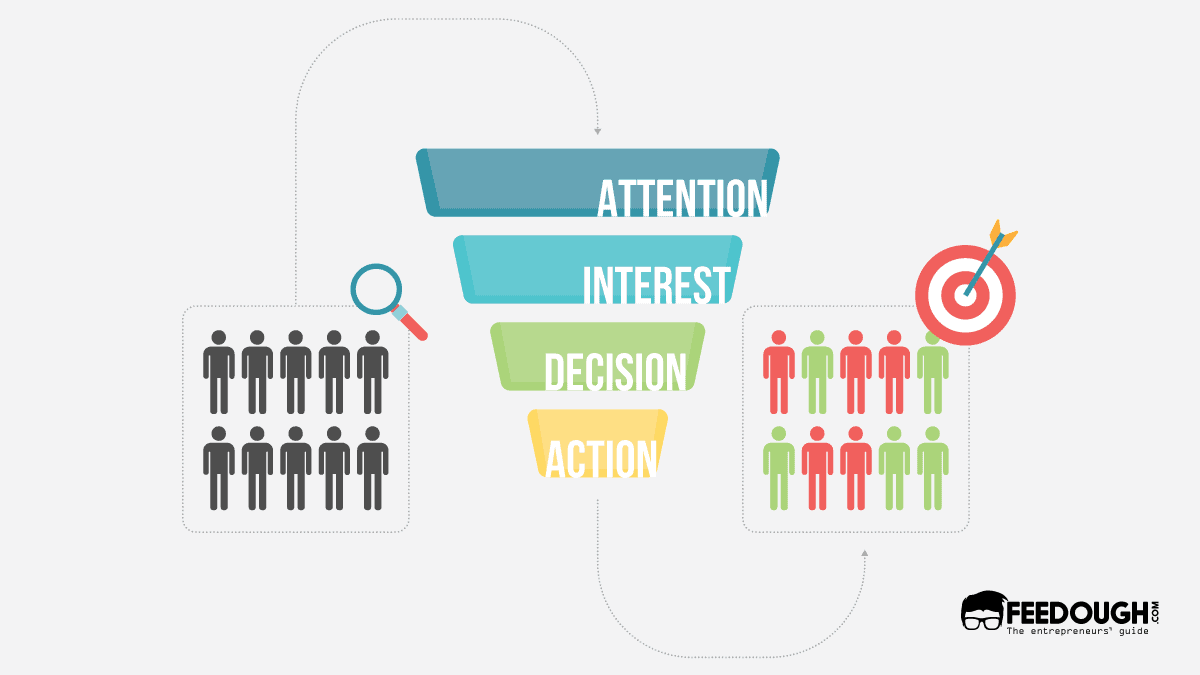
    A sales funnel is a visual representation mapping out a customer’s journey from their first contact with the brand to becoming a paying customer.

    Resembling an actual funnel, a sales funnel narrows down from the top (the widest part) to the bottom (the smallest opening). This is because, as a customer goes through the stages of the funnel, they are weeded out until only the most interested and qualified prospects remain.

    You can also think of a sales funnel as a process that moves potential customers through the stages of awareness, interest, decision, and action.

    The Stages Of A Sales Funnel

    Technically there are three stages in a sales funnel –

    • Top of the funnel (ToFu): Where the customer is made aware of your brand.
    • Middle of the funnel (MoFu): Where they start to develop interest.
    • Bottom of the funnel (BoFu): Where they make a decision and take action.

    These three stages are further divided into four stages –

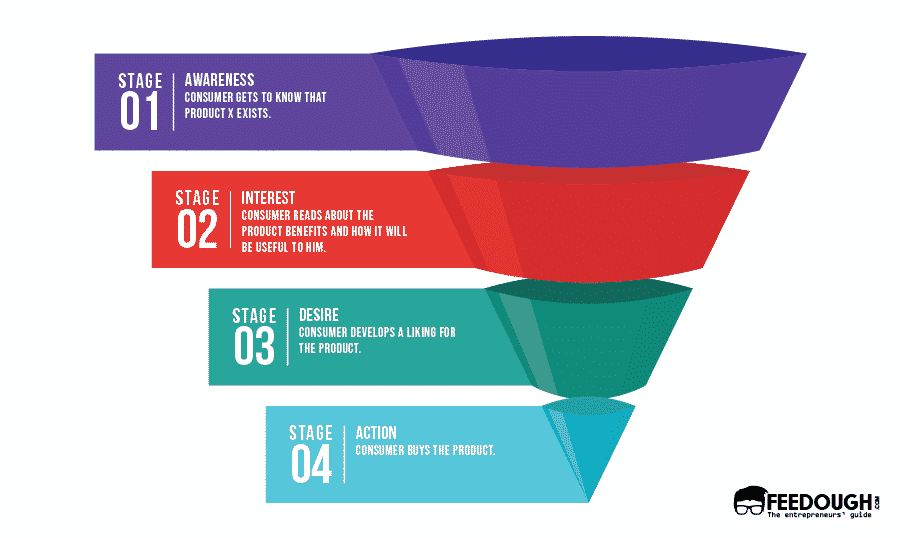
    • Awareness
    • Interest
    • Decision
    • Action
    The Stages Of A Sales Funnel

    Awareness

    The awareness stage is when the customer becomes aware of a problem they have. They might not know that your product or service exists, but they are undoubtedly aware that they need something to solve their problem.

    For example, someone might be aware that they need to lose weight, but they don’t know about your new diet book. Or, they could be aware that their car needs fixing, but they don’t know about your mechanic shop.

    This is where your job as a marketer or salesperson comes in. You need to make the customer aware of your product or service and how it can help them solve their problem.

    You can do this through content marketing, paid advertising, social media, email marketing, and more.

    Interest

    The interest stage is when the customer starts to develop an affinity for your brand. They are interested in what you have to say, and they want to learn more about your product or service.

    At this point, they are still not ready to buy, but they are getting closer. But at the same time, the number of prospects starts to dwindle as some customers lose interest.

    This is where you need to continue providing value. You can do this by providing more information about your product or service, case studies, testimonials, free trials, etc.

    You can also continue to nurture your prospects through email marketing and other channels.

    Decision

    The decision or the desire stage is when the customer is finally ready to buy. They have all the information they need, and they are convinced that your product or service is the right fit for them.

    At this point, it’s just a matter of making the purchase. But even then, some customers might still need a little push to take that final step. This is where you offer discounts, coupons, free shipping, etc.

    Action

    The action stage is when the customer takes the final step and buys from you. But even after they’ve made the purchase, you need to continue providing value. This is where post-purchase support, warranty, follow-ups, customer relationship management etc., come in.

    This is also where upselling and cross-selling come into play. By offering related products or services, you can increase the lifetime value of your customer.

    How To Build A Sales Funnel?

    There is no one-size-fits-all solution for developing a sales funnel. The best way to build a sales funnel is to start with the end in mind.

    Think about what you want your customers to do and work backwards from there. Once you have a clear goal, you can start putting together the pieces of the puzzle.

    Here’s a quick overview of how to build a sales funnel –

    1. Identify your target audience.
    2. Create a compelling value proposition.
    3. Develop a lead-generation campaign.
    4. Nurture leads to customers.
    5. Delight customers and turn them into promoters.
    6. Measure and optimise your funnel.
    How To Build A Sales Funnel?

    Identifying The Target Audience

    Identifying who will buy from you is the first and most important step in building a sales funnel. You need to know who your ideal customer is and what they are looking for.

    Only then can you create a compelling offer and develop an effective lead capture campaign.

    To identify your target market, you need to answer these questions –

    • What problem are they trying to solve?
    • What are their pain points?
    • What are their goals?
    • What are their values?
    • Who do they trust?

    Once you have answers to these questions, you can start creating your customer persona. This is a fictional character that represents your ideal customer.

    Creating A Compelling Value Proposition

    A value proposition is a statement that tells your prospects what value they will get by purchasing your offering.

    In simple terms, it is the promise of tangible benefits that your product or service provides.

    Your value proposition needs to be clear, compelling, and relevant to your target audience.

    It should also be unique. That is, it should be different from what your competitors are offering.

    This value is what will bring your customers through the sales funnel.

    Developing A Lead Generation Campaign

    Once you have a clear value proposition, you need to develop a lead generation campaign. This is an awareness-stage marketing campaign with the sole purpose of capturing leads.

    There are many ways to capture leads. Some common methods include –

    • Landing pages
    • Content marketing strategies
    • Social media marketing
    • Paid advertising
    • Lead magnets
    • Referral programs
    • Email marketing

    All of these strategies focus on getting potential customers to opt in to your list. Once they are on your list, you can then start nurturing them into customers.

    Nurturing Leads Into Customers

    Once the prospective customer has crossed the awareness stage, it’s time to start nurturing them into customers.

    This is where you provide more information about your product or service and its benefits. You can do this through a variety of content such as –

    • Ebooks
    • Whitepapers
    • Case studies
    • Tutorials
    • How-to guides
    • Product demos
    • Testimonials

    The aim of this sales funnel stage is to provide the target audience with sufficient information to help them make an informed decision favouring your product.

    This stage either results in the prospect customers paying for your product or moving away from it.

    Delighting Customers And Turn Them Into Promoters

    If the customer decides to buy your product, congratulations! You have made a sale.

    But your job is not done yet.

    The next step is to deliver on your promises and exceed their expectations. This will turn them into promoters of your brand.

    To do this, you need to provide an excellent customer experience at every stage of the customer journey.

    This includes –

    • Pre-sale
    • Onboarding
    • Usage
    • Support
    • Renewal

    When you deliver an excellent customer experience, your customers will be happy to sing your praises to their friends and family.

    This word-of-mouth marketing is the best kind of marketing as it is free and highly effective.

    Measuring And Optimising Your Funnel

    The final step in building a sales funnel is to measure and optimise it.

    You need to track the performance of your funnel at every stage and identify what is working and what is not.

    This will help you to make necessary changes and improve the efficiency of your sales plan strategy.

    A good sales plan strategy example is to track the following metrics –

    Once you have this data, you can start making changes to improve your funnel.

    For example, if you are not generating enough leads, you need to focus on your lead generation campaign.

    Or, if your lead conversion rate is low, you need to work on your value proposition.

    By constantly measuring and optimising your funnel, you can increase its efficiency and get more sales.

    Bottom-Line?

    By developing a sales funnel, you develop some control over the buyer’s journey. You make them aware of your product when they should be and provide them with the information they need to make a purchase decision.

    With the increasing competition in every industry, a sales funnel gives you an edge over your competitors.

    If you haven’t already, start building your sales funnel today.

    Go On, Tell Us What You Think!

    Did we miss something? Come on! Tell us what you think of this article on how to build a sales funnel for your business in the comment section.

  • 12 Important Lessons From Failed Startups

    12 Important Lessons From Failed Startups

    No business is inherently future-proof, no matter how big or small it may be. At some point, all companies will face difficulties that could potentially lead to their downfall.

    This is especially true for startups. Given the high-risk nature of starting a new business, it’s not surprising that many startups fail. In fact, according to Failory, about 90% of startups fail within their first two years.

    Of course, not all failures are created equal. Some businesses shut down because they could not find a sustainable market fit, while others made poor strategic decisions that ultimately led to their demise.

    In any case, there’s always something to be learned from failed businesses, no matter the reason for their failure. With that in mind, here are 12 things you can learn from failed startups.

    Validate Before Building

    According to CB Insights, no market need is the number one reason startups fail.

    It results from a faulty product development process in which entrepreneurs waste valuable time and money building products before even figuring out if there is a market for them.

    For example, Google Glass released its product too early without conducting enough market research first.

    As a result, it failed to gain traction with consumers and was eventually discontinued.

    To not fall into the same trap, you must validate your product before starting to build it.

    To do the same, follow this process –

    • Identify the job that needs to be done. It can be anything from baking bread or taking the user from place A to place B.
    • Focus on the problems that prevent the user from being able to do the job. This will help you develop your value proposition.
    • Recognise the benefits that the user will get from getting the job done. This will help you identify whether the user will pay to get the benefit or not.
    • Once done, build a product hypothesis that helps the user complete the job by solving their problems and helping them get all the benefits.

    You can do the same by filling the value proposition canvas. This will help you understand the user, what they want to achieve, and how you can help them.

    Build An Eligible Team

    Having skilled and experienced team members is not only important to secure funding but also to have a successful startup. Your team should be passionate, committed and have the relevant skills to achieve the company’s goals.

    Over 30% of startups fail just because their management team is not good enough to handle issues.

    You can avoid this by ensuring that your team has the right mix of complementary skill sets and continuously evolving them as your startup grows.

    Your founding team should constitute people who are:

    • Passionate – People who have a genuine interest in the problem you are solving and are committed to seeing it through.
    • Skilled – Individuals with the relevant skillsets needed to execute on your business idea.
    • Experienced – Team members who have been through the startup journey before and can provide valuable insights and guidance.

    Don’t Try To Do Everything Yourself

    One common mistake that first-time entrepreneurs make is trying to do everything themselves.

    This is often due to a combination of factors such as wanting to save on costs, not wanting to give up control, and simply not knowing any better.

    The problem with this approach is that it quickly leads to burnout and can significantly hinder your startup’s growth. In fact, solopreneurs are more likely to fail than those with cofounders.

    Instead of trying to do everything yourself, delegate tasks to others on your team or outsource them altogether. This will free up your time to focus on the most important aspects of your business.

    Build A Viable Business Model

    Your business model states how you operate and make money. It is the foundation of any successful startup. Without a solid business model, your startup will quickly crumble.

    There are many different types of business models, but all successful startups have one thing in common: they generate revenue.

    If your business model isn’t focused on generating revenue in the long run, you’re not a viable business.

    A perfect example of failure due to a great value proposition but a faulty business model is the case of Quibi. The mobile-oriented streaming service was shut down just six months after it launched because it developed its business model around a subscription service of short-length content, which people were already getting on YouTube, TikTok, etc.

    Don’t Be Afraid To Pivot

    Pivoting refers to making a strategic change in your business model to better adapt to the market.

    Nokia is a great example of a company that didn’t pivot soon enough. The Finnish company was the world’s leading mobile phone manufacturer in the 2000s. But it failed to see the rise of smartphones and lost its dominant market position.

    Blockbuster is another company that didn’t pivot soon enough. The American entertainment company went bankrupt in 2010 after failing to embrace the digital age of streaming services like Netflix.

    To avoid making the same mistake as these companies, you need to always be on the lookout for changes in your industry and be willing to make the necessary changes to your business model.

    Don’t Underestimate The Power Of Marketing

    Startups have an inherent problem – they have to create a market for their product. And that’s not an easy thing to do.

    You need to have a great product, but that’s not enough. You also need people to know about it and believe in it enough to buy it. That’s where marketing comes in.

    Many startups make the mistake of thinking that a good product will automatically attract customers. But the truth is, if no one knows about your product, it doesn’t matter how great it is.

    Remember that marketing is not just about selling your product – it’s also about building up your brand and making people aware of who you are and what you stand for.

    Don’t be like Tutorspree – the Airbnb for tutors that wanted to disrupt the tutoring space but ended up going out of business because they focused too much on the product and not enough on marketing. The company relied primarily on Google search engine optimisation (SEO) for the traffic, but it didn’t prove to be sustainable in the long run.

    When it comes to marketing, think about what channels you can use to reach your target audience. And don’t be afraid to experiment – it’s the only way you’ll find out what works and what doesn’t.

    Sign Better Contracts

    Carefully read and understand every contract you sign – be it with cofounders, vendors, contractors, or customers. Don’t be afraid to ask for help from a lawyer if you’re not sure about something. It’s better to be safe than sorry.

    This seems like common sense, but it’s something that many startups overlook – especially when they’re starting out.

    There are startups that failed due to flawed contracts with cofounders, vendors, and even employees.

    Your shareholder agreement, for example, should clearly state the roles and responsibilities of each founder and what will happen if one of you wants to leave the company.

    NDAs (non-disclosure agreements) are also important, especially if you’re working on something that could be considered a trade secret.

    Term sheets and other agreements signed with investors should also be watertight – you don’t want any surprises down the line. Specify the roles and expectations of both parties in clear, concise language to avoid any misunderstandings.

    And Employees should sign contracts that state that any intellectual property they create while working for your company belongs to the company – not them.

    Even though a successful startup, Facebook made this mistake with their original cofounder Eduardo Saverin, which cost them dearly.

    Keep An Eye On The Competition

    The last thing you want is to be caught off guard by a competitor.

    Keep track of what they’re doing, what new products or services they’re offering, and how their marketing messages compare to yours. If you see them starting to eat into your market share, take action immediately.

    Facebook did this when Google introduced Google Plus. They quickly responded with their own version, Facebook Groups, which helped them keep their dominant position.

    Work on your positioning strategy as it will be one of your most powerful marketing tools against your competition.

    Take Snapchat, for example.

    They didn’t just develop a new messaging app; they positioned themselves as the anti-Facebook.

    This resulted in them being extremely popular with young people looking for an alternative to Facebook.

    Digg, on the other hand, failed to adapt to the changing landscape of the internet and were eventually eclipsed by Reddit.

    Your positioning strategy should be fluid and always evolving to stay ahead of your competition.

    Manage Funds Properly

    Liquidity is key for any business, but it is especially important for startups.

    You need to make sure to allocate your funds properly and have a solid plan for how you are going to spend your money. Make sure to have someone who understands startup finances on your team to help make sure you are making the best decisions with your money.

    Zirtual, an online virtual assistant service, is a great example of a startup that ran out of money and had to shut down. The company raised over $5.5 million in funding but ended up channelling most of it to increasing the workforce rather than investing in other business areas. This ultimately led to a high burn rate and the company shutting its doors in 2015.

    Premature Scaling Is Always Bad

    Premature scaling refers to a company growing too fast, too soon. This growth can be in the form of hiring too many employees, expanding to new locations, or investing in too much inventory.

    This can happen when a startup raises too much money and then tries to grow the business at an unsustainable rate.

    One prime example is Color Labs, a photo-sharing app that raised $41 million in funding but quickly ran out of cash and had to shut down. The company tried to grow too quickly and spent lavishly on marketing and expansion without a solid plan for profitability.

    Understand The Legalities Beforehand

    Since startups operate in a market that is yet to mature, the legal landscape is also constantly shifting. This can create a lot of uncertainty and gray areas for startups, which others can exploit.

    Understand the risks and legalities involved in your industry before starting your business. This will help you avoid getting caught off guard by any sudden changes or challenges down the road.

    Not just legalities, focus on tariffs, regulations, environmental standards, and other compliance-related issues that could impact your business.

    Coolest Cooler is the perfect example of a successful startup getting bogged down by increased tariffs. The company raised over $13 million on Kickstarter to fund the development of a cooler with a built-in blender, music player, and other features.

    The project was widely publicised and highly anticipated. However, when the company tried to bring the product to market, they were hit with a 25% tariff on Chinese-made blenders, which increased the cost of each cooler substantially. This put a serious strain on the business, and they eventually had to declare bankruptcy.

    Focus On Timings

    An untimed product release is often a recipe for disaster. You need to keep two things in mind before getting the product to the market:

    • Is the product ready?
    • Is the market ready for the product?

    Both the scenarios have to be given equal importance while making a decision. Failure to do so can result in massive losses and bankruptcy, as was the case with Vreal.

    Vreal was a social platform that allowed users to create, explore, and share virtual reality content. It raised $11.6 million in seed funding and $2 million in a bridge round from big-name investors like Intel Capital and Acecap.

    However, the startup failed just a few years after it was founded. The main reason for its failure was that it jumped into the market too early without considering whether people were actually ready for virtual reality content.

    Go On, Tell Us What You Think!

    Did we miss something? Come on! Tell us what you think of this article on the lessons from failed startups in the comment section.

  • Business Process Outsourcing (BPO): Definition & Examples

    Business Process Outsourcing (BPO): Definition & Examples

    A business process refers to a set of activities or tasks that are carried out in order to complete a specific business goal. These processes can be core to the business or they can be support processes.

    Often businesses delegate or outsource specific processes to third-party organisations to focus on their core competency or to reduce costs. This process of outsourcing business processes is known as Business Process Outsourcing (BPO).

    What Is Business Process Outsourcing (BPO)?

    Business process outsourcing (BPO) is a business practice of contracting a specific business operation or process to a third-party provider.

    Usually, a company opts for business process outsourcing when it wants to focus on its core business competencies and reduce operational costs.

    Also known as subcontracting or externalisation, business process outsourcing was initially adopted by manufacturing firms that outsourced their non-core processes such as payroll and logistics.

    Nowadays, the BPO industry has expanded to include a wide range of services such as customer care, human resources management, finance and accounting, marketing, and technological support. The global Business Process Outsourcing (BPO) market is forecasted to reach $215.9 Billion by 2026.

    Services Offered By BPO Companies

    BPO companies excel in providing recurring services that can be easily defined and measured. They usually provide the following services:

    The Types Of BPO

    BPOs can be categorised into several types based on:

    • Geographical location,
    • Services offered,
    • Types of functions

    Based On Geographical Location

    With the advent of the internet and improved telecommunications, businesses can now outsource their processes to service providers located in any part of the world.

    This has given rise to three types of business process outsourcing — onshore, offshore, and nearshore BPO.

    • Onshore Business Process Outsourcing: When a company outsources its processes to service providers located in the same country, it is called onshore business process outsourcing.
    • Offshore Business Process Outsourcing: When a company outsources its processes to service providers located in a different country, it is called offshore business process outsourcing.
    • Nearshore Business Process Outsourcing: When a company outsources its processes to service providers located in a neighbouring country, it is called nearshore business process outsourcing.

    Based On Services Offered

    BPOs can also be classified based on the type of services they offer. The two most common types of services are:

    • Horizontal services: When a BPO provides a single service to multiple clients in different industries, it is known as a horizontal service. The most common type of horizontal service is customer support. For example, a customer support BPO can provide its services to ecommerce, banking, and telecommunications companies.
    • Vertical services: When a BPO provides different kinds of services to clients in the same industry, it is known as a vertical service. The most common type of vertical service is back-office support for banks. For example, a banking BPO can provide services such as loan processing, customer support, and fraud detection to different banks.

    Based On Types Of Functions

    BPOs can also be classified based on the type of functions they perform. They are:

    • Front Office BPOs: Front office services are client-facing services such as customer support, sales, and marketing.
    • Back Office BPOs: Back office services are non-client facing services such as accounting, data entry, IT, and payroll.

    Advantages Of BPO

    Outsourcing a business process can provide many benefits to a company. Some of the most important benefits are:

    • Cost savings: Outsourcing can help a company save money on labour, infrastructure, and technology costs.
    • Improved quality: When a process is outsourced to a specialist service provider, the quality of the process is usually improved.
    • Increased efficiency: BPOs can help a company become more efficient by streamlining its processes and eliminating waste.
    • Focus on core activities: Outsourcing non-core activities can help a company focus on its core activities and become more competitive.
    • Risk reduction: When a company outsources a process, it can transfer the associated risks to the service provider.
    • Increased competitive advantage: Outsourcing can help a company gain a competitive advantage by accessing the service provider’s expertise and technology.

    Disadvantages Of BPO

    While outsourcing can provide many benefits to a company, there are also some risks associated with it. Some of the most important risks are:

    • Loss of control: When a company outsources a process, it can lose some control over the process. This could lead to problems such as poor quality, delays, and cost overruns.
    • Dependency on the service provider: The company can also become dependent on the service provider. This dependency can lead to problems if the service provider goes out of business or is unable to meet the company’s expectations.
    • Hidden costs: There can be hidden costs associated with outsourcing, such as communication difficulties and cultural differences.
    • Security risks: When a company outsources its processes, it can also expose itself to security risks. For example, the service provider may not have adequate security measures in place to protect the company’s data.
    • Job losses: Outsourcing can lead to job losses within the company. This can be a problem if the company is unable to find new jobs for the affected employees.

    BPO Vs KPO

    Business process outsourcing (BPO) and knowledge process outsourcing (KPO) are often confused with each other. But there is a difference between the two.

    BPO is the outsourcing of business processes, while KPO is the outsourcing of knowledge-based processes.

    Business processes are repetitive and well-defined, while knowledge-based processes are complex and require expert knowledge. For example, data entry is a business process, while financial analysis is a knowledge-based process.

    BPO is usually less expensive than KPO because it does not require expert knowledge. Also, BPO can be outsourced to countries with lower labour costs, while KPO is usually outsourced to developed countries.

    Basis
    BPO
    KPO
    Definition
    A business process is outsourced to an external service provider.
    A knowledge-based process is outsourced to an external service provider.
    Complexity
    The task is recurring and well defined.
    The task is complex and requires expert knowledge
    Type
    Done in both front and back office services
    Mostly done in back office services.
    Driven By
    Driven by volume 
    Driven by knowledge

    BPO Vs Call Centres

    BPO is often confused with call centres. But there is a difference between the two.

    A call centre is a type of BPO that deals with customer service and support. Call centres can be either inbound or outbound. Inbound call centres handle calls from customers, while outbound call centres make calls to customers.

    BPO is not just limited to call centres. It can also include other business processes, such as accounting, data entry, and payroll.

    BPO Companies Examples

    There are many companies that provide BPO services. Some of the most famous ones are:

    • Accenture: It is one of the largest companies specialising in consulting technology services which is involved in providing BPO services like technology consulting, digital marketing and analytics, IT services, cloud services security as a service, Supply chain services, etc.
    • IBM: International Business Machines Corporation is another well-known American multinational technology corporation rendering BPO services like procurement services, HR services, finance transformation, automation, etc.
    • Wipro: An Indian multinational company that provides information technology, consulting, and business process services. BPO services provided by Wipro are Digital workspace solutions, data analytics, cloud, blockchain, DevOps, etc.
    • Cognizant: Another U.S.-based company also deals in providing IT and consulting services along with outsourcing. Outsourcing services like AI, digital strategy, IoT, digital engineering, enterprise services, etc.

    Role Of Business Process Outsourcing

    The role of business process outsourcing has evolved over the years. Initially, BPO was used to outsource simple and routine tasks. But now, BPO is used to outsourcing complex and strategic processes.

    Today, BPO is used to improve operational efficiency, reduce costs, and focus on core competencies. It is also used to gain access to world-class capabilities and tap into new markets.

    Go On, Tell Us What You Think!

    Did we miss something?  Come on! Tell us what you think about our article on business process outsourcing in the comments section.

  • How To Make Money As A Teenager? – A Guide

    How To Make Money As A Teenager? – A Guide

    It’s not easy being a teenager. You’re not quite an adult, but you’re not a child either. You’re in that awkward stage where you’re trying to find your place in the world and figure out who you are and what you want to do with your life. And on top of all that, you’ve got to make some money.

    If you’re looking for ways to make money as a teenager, plenty of options are available. You can find work offline in traditional employment roles, or you can explore the many online opportunities. There are also several ways to make money that don’t necessarily involve working for someone else.

    If you’re creative and entrepreneurial, you can find ways to make money on your own. In this article, we’ll explore some options for making money as a teenager.

    Make Money Online As A Teenager

    The internet has opened up a whole new world of opportunity for teenagers looking to make money. If you’re comfortable using a computer and have a good internet connection, there are plenty of ways to make money online.

    Freelancing

    Freelancing means offering your skills to any individual or company on a contractual basis.

    It can be any skill you have, from writing and editing to graphic design or web development. Several websites act as platforms for freelancers and businesses to connect, such as Upwork, Fiverr, and 99Designs.

    All you need to do is create a profile on one of these websites and start bidding for jobs. Once you’ve landed a few jobs and built a good reputation, you can start charging higher rates.

    How To Start As A Freelancer?

    • You can join the freelancing sites by registering with your name, email address, country name, and other required information. After your information is validated, your account will be created. 
    • Next, you will need to create a profile based on your education, experience, and skills. After the profile is approved within a time frame, you will be able to take on freelance work.
    • Make sure you have a previous body of work or a portfolio to showcase on your freelancing account.
    • You may choose the task or project by interacting directly with clients or browsing the website. Once the work is completed, you may then charge your fee accordingly.

    How Much Money Can You Make As A Freelancer?

    Freelancers are paid according to the task or project they complete. It differs from one client to another. If a freelancer is able to work on multiple tasks or projects at a time, they will be able to make more money.

    On average, a freelancer may charge $15-$50 per hour, depending on the type of work and their experience.

    Upwork states that an average US freelancer earns an hourly rate of $20.

    Content Creation

    If you’re a wordsmith or know how to create videos or design, you can make money by creating content.

    There are a number of ways to make money from content creation, such as:- blogging, vlogging, article writing, graphic design, and video editing.

    Blogging

    A blog is a website or online platform where you can share your thoughts and ideas with the world. You can write about anything you want, whether it’s your interests, hobbies, or observations on the world around you.

    To make money from blogging, you can sign up for Google Adsense which will place ads on your blog and pay you every time someone clicks on one of the ads. You can also collaborate with brands and companies by writing sponsored posts or reviews or by selling advertising space on your blog. If you have a large enough following, you can also make money by selling products or courses or hosting events.

    How To Become A Blogger?
    • First, you need to find a niche or topic that you’re passionate about writing about.
    • Then, select a platform for your blog like WordPress, Blogger, Tumblr, Medium, Ghost, Squarespace, etc. However, it is best to create a self-hosted site with WordPress using hosts like Namecheap, Inmotion, etc. because free blogs restrict customisation and functionality and have limited storage space. They do not allow advertisements or affiliate links, which are great ways to make money. The blog and domain name will cost money, but they will be worth the investment.
    • Once done, choose a domain and a hosting package. You will be treated more seriously and professionally with your domain name. Also, purchasing a web hosting service will allow you absolute control over your blog.
    • Next, choose a topic that interests you and begin writing and sharing information about it. If you want to build expertise and a dedicated following, you will need to put effort and time. You must also post frequently and with original content.
    • Promote your blogs on all your social media handles to direct more traffic and increase your earning potential.
    How Much Money Can You Make As A Blogger?

    A blogger can make anywhere from $500 to $5,000 per month, depending on their niche, content quality, blog traffic, and other factors.

    Vlogging

    Vlogging is similar to blogging, but instead of writing, you share your life and thoughts through videos.

    You can vlog about anything you want, whether it’s your daily routine, travel experiences, or product reviews.

    There are a few ways to make money from vlogging. The most popular one is YouTube’s Partner Program, which allows you to place ads on your videos and earn money every time someone clicks on the ad. You can also make money through sponsorships, product placements, or by selling products or courses.

    How To Become A Vlogger?
    • First zero on your niche or topic. You can’t just vlog about anything. You need to find a specific focus for your channel if you want people to stick around and watch your videos.
    • Then create a YouTube account and start filming yourself! You can use your phone, or invest in a camera if you want to get serious about it. Your videos don’t have to be perfect, but try to make them entertaining and informative.
    • Edit your videos using basic editing software, or hire someone to do it for you if you’re not confident in your own skills.
    • Finally, upload your videos and share them with the world!
    How Much Money Can You Make As A Vlogger Or YouTuber?

    Vloggers and Youtubers have the potential to make a lot of money, but it doesn’t happen overnight. You need to build up a following before you can start earning serious cash. Most successful YouTubers make anywhere from $3 to $5 per thousand views.

    Social Media Influencer

    If you know how to build a large and engaged social media following, then you can make money by working with brands as a social media influencer.

    A social media influencer is a person who has a large number of followers on their social media accounts. They persuade and influence others to act based on their recommendations. 

    Brands will pay you to post about their products or services on your social media channels or to simply mention them in your posts. You can also make money through sponsorships, affiliate marketing, or by selling products or courses.

    How To Become A Social Media Influencer?
    • You need to start by finding your niche or topic. You can’t just be an influencer for anything; you need to focus on one area if you want people to take you seriously.
    • Choose the platform you’re going to use to build your following. You can use Instagram, YouTube, Twitter, or any other social media site.
    • Start creating content and sharing it with the world. Use high-quality images or videos, and share interesting and informative content that will persuade people to follow you.
    • Then build up a large and engaged following on your chosen platform or platforms. This takes time, effort, and consistency.
    • Post interesting and engaging content that will persuade your followers to take action. You need to be at the top of your game if you want to be successful.
    • Finally, start working with brands as an influencer. You can reach out to them directly or work with an agency that connects influencers with brands.
    How Much Money Can You Make As A Social Media Influencer?

    Influencers are the new celebrities, and they have the potential to make a lot of money. How much you make will depend on your niche, your engagement rate, and the number of followers you have. You can easily make $100-$200 per post if you have a large, engaged following. But if you want to make serious money, you need to have millions of followers.

    According to Forbes, micro-influencers (followers of 1,000 to 10,000) earn $1,420 a month. Mega-influencers (followers of more than one million) earn $15,356 a month.

    Podcasting

    Podcasts are modern-day radio shows that you can listen to on your phone or computer.

    They can be anywhere between 5 minutes and 2 hours long and are usually on a specific topic or niche. Podcasts are becoming increasingly popular, which means there’s a lot of money to make in this industry.

    Monetising a podcast is similar to monetising a blog. You can sell advertising, become an affiliate, or sell products and courses. You can also get sponsorships from brands that want to be associated with your show.

    How To Start Podcasting?

    Podcasting is relatively easy to get into. All you need is a microphone and some recording software. You can record your podcast anywhere, but it’s best to find a quiet room where you won’t be interrupted. Once you have your equipment set up, it’s time to start recording!

    Record your episodes and edit them if necessary. Then upload them to a hosting platform like Anchor or Buzzsprout.

    These platforms not only host your files but also help you distribute your podcast to popular platforms like iTunes and Spotify.

    Moreover, they also act as middlemen for ads and sponsorships, so you can start making money without lifting a finger!

    How Much Money Can You Make With Podcasting?

    An average podcaster earns $200-$300 per episode. This earning can be divided into sponsorships ($18 to $50 CPM), direct support (premium content subscriptions), and affiliate sales (selling other people’s products). Of course, your earnings will depend on the number of listeners you have and how often you release new episodes. But if you can build up a large and engaged following, you can easily make a full-time income from podcasting.

    Virtual Assistant

    A virtual assistant is a person who assists clients with administrative tasks while working from a location other than the client’s office. 

    As a teenage virtual assistant, you will be responsible for organising meetings, editing, proofreading, accounting, data entry, and other tasks. Usually, your manager will teach you the duties they require. It is an opportunity for you to learn while being paid.

    How Can You Become A Virtual Assistant?

    • First, you will need a decent resume. You can include all the skills you have that could be useful as a virtual assistant.
    • Then, create a profile on freelance websites like Fiverr, Wishup, or Upwork. After the sites accept your profile, you may begin looking for a virtual assistant job.
    • Next, to ensure that you have several choices, apply to as many jobs as possible. You will be invited to an interview once your resume is accepted. It may be conducted through email or over Skype. After that, if you impress the interviewer, you will almost certainly be approved and able to start working.
    • Congratulations on being a teenage virtual assistant. As you get more experienced, you can increase your pay, and as time goes on, you will make more and more money.

    How Much Money Can You Make As A Virtual Assistant?

    As per Wishup, a teenage virtual assistant may earn an average of $5 – $20 per hour. However, this value changes considerably based on your level of experience.

    Sell Stock Photos & Videos

    If you have a camera and know how to capture an image, try taking stock photos and videos and selling them online. You can make a lot of money doing this, especially if you’re good at taking pictures of nature, animals, or people.There are a few websites where you can sell your photos, such as Adobe Stock, Shutterstock, and iStockPhoto. They all have different commission structures, so make sure to do your research before choosing one. Generally speaking, the more photos you upload, the more money you’ll make.

    How Much Money Can You Make By Selling Stock Photos?

    It depends on how many photos you sell and which website you use. Adobe Stock pays 33% of the sale price for each photo and 35% for videos, while Shutterstock pays between 20% and 30%, depending on your level of experience.

    Participate In Online Surveys

    Several companies offer online surveys that anyone can participate in. The surveys are short and painless, and you can do them from the convenience of your own home.

    You can find such surveys on websites like Survey Junkie, Swagbucks, and InboxDollars. These websites offer cash or gift cards in exchange for your participation.

    How Much Money Can You Make By Taking Online Surveys?

    It depends on the company and the type of survey. Some companies may pay $0.50 to $1 per survey, while others may pay up to $5.

    The average hourly pay for surveys is $7.00–$8.00. You may also take part in paid focus groups for marketing research. These focus groups interact directly and can tip you between $50.00 and $150.00 per hour.

    Use Mobile Apps That Pay You For Running Errands

    If you have a smartphone, various applications connect you with local companies or people who need people to complete small tasks like running errands for a fee. Although not all the jobs listed on the apps pay well, they are often simple and easy. 

    Apps like GigWalk, WeReward, and CheckPoints are a few examples. However, before signing up, you need to ensure there is no registration cost and that the program admits teenagers.

    Make Money Offline As A Teenager

    Offline methods are becoming increasingly popular, as they provide more opportunities to socialise and work in person. If you’re looking for a way to make money as a teenager offline, here are some ideas:

    Doing Odd Jobs

    You can do odd jobs. It includes doing small tasks like babysitting, running errands, tutoring, lawn mowing, etc

    Baby Sitting 

    If you are responsible and you like children, consider babysitting. It is one of the most common ways to earn money for teenagers without investing anything. 

    You might begin by becoming CPR certified. Doing basic first aid lessons can make your new employers feel more comfortable leaving their children with you. The classes are frequently offered for free or at a reduced cost by community centres, hospitals, and local Red Cross chapters.

    However, if you have no experience caring for children and your prospective customers are concerned about your lack of experience, you may ask them for a trial period. While you initially start babysitting, you can do so when a parent is at home and accessible to help.

    Pet Sitting

    If you love animals and are good with them, you can help people petsitting their pets. 

    For instance, most people enjoy walking their dogs, but their busy schedules make it hard to do so during the day. However, their dogs’ welfare is important to them, so they are willing to shell out some real cash for someone to take them for walks and exercise. 

    You can sign up for it on mobile apps like Wag! or Rover, which connect available dog walkers to needy clients.

    Running Errands

    Senior citizens usually have mobility or dexterity issues, so they find it hard to do some daily tasks. If you know any aged people in your area, you can offer to help them out. You can help them fetch groceries, move furniture, solve computer-related issues, or water plants for extra cash.

    Above all, first, you need to ensure that your arrangement is clear from both sides. The last thing you want is to do work expecting you to be paid while the other person regards your efforts as a favour out of love and kindness.

    Lawn Mowing

    Nowadays, people are too busy to keep up with their usual yard work. However, they don’t want their houses to appear untidy or abandoned. They frequently look to pay someone to mow their lawn, rake leaves, or trim the hedges.

    In these cases, you can start asking your friends and relatives if they need assistance for a fee. If that doesn’t work out, put up some posters around the area advertising your services.

    Tutor Neighborhood Kids

    Does math come easy to you? Have you always been good at English? Or are you good at a particular sport? If so, then you can earn money from it. If you know kids in your neighbourhood who are either your age or younger than you, you can teach them a subject or a sport you’re strong in for extra cash. The kids could benefit from having a tutor, and you can also earn from it. It is a win-win situation. 

    Working in Service Industry

    Working in the service industry can also help you earn money. It can include working in the local stores or shops, nearby restaurants, or maybe working as a lifeguard at recreational facilities and others. 

    Local Stores & Shops

    Usually, grocery stores and local stores hire teenagers as baggers or stockers. You will not get much more than the minimum wage. However, your earnings will be constant and predictable as long as you turn up for your shifts and prove to your employer that you are a trustworthy employee. You will have the opportunity to work and socialise with other like-minded teenagers. But, you need to make sure that you can stand for several hours, as bagging and stocking are physically exhausting tasks.

    Restaurant

    Restaurants frequently require waiters and bartenders over 18 or 21 years, but sometimes they engage teenagers as bussers and food runners. You may have less involvement with customers in these roles. However, you can earn significant restaurant experience and often receive a portion of the servers’ tips. It’s a physically demanding job, and you will have to be on your toes for the entirety of your shift.

    Working in a restaurant can also pose certain safety risks. So, you need to review the safety standards and obtain sufficient training from your employer before starting the work.

    Selling Products

    As a teenager, you can also sell products traditionally to help you earn a little more. You can do this by organising a yard sale, thrifting old clothes in a thrift store, selling craft items in your locality, etc. 

    Organise Yard Sale

     If you have old junk lying around your house or garage that is just taking up extra room, you can ask your parents if they are willing to clean up and let you collect the money if you put the stuff on sale. If they say yes, clean out your closet, attic, or basement and organise a yard sale in your neighbourhood. 

    You might also make additional money by selling inexpensive beverages or snacks in your sale. If the weather is pleasant, you can provide lemonade or soda; if it is chilly, you can se2rve hot tea or coffee. 

    Thrift Old Clothes

    If you have old clothes or accessories that you do not like to use now, you could always take them to a local recycled fashion store or a thrift store and get some cash in exchange for it.

    You will not earn any money in advance. But, when your item sells, you will get a portion of the profits.

    However, you should ensure to wash the clothes before bringing them to the store since their cleanliness and condition will affect the price of your item.

    Sell Handicraft Items

    If you are good at making your crafts, then you may attempt crafting your products to sell. You can design bracelets, beaded jewellery, origami, or T-shirts, depending on the tools you have and how much money you have to purchase the supplies. 

    Further, you can start advertising your new store and crafts on your social media accounts and through your friends and relatives.

    Bottom- Line?

    Being a teenager may be difficult, but it can also be fun. Learning how to handle your money by earning your own money is fun. However, it may not always appear to be enjoyable at the moment, but eventually, it pays off.

    Earning your own money teaches you how to manage your life, provides you with essential job experience, and boosts your self-esteem.

    You will someday thank yourself for learning how to manage and earn your own money early.

    Go On, Tell Us What You Think!

    Did we miss something?  Come on! Tell us what you think about our article on make money as a teenager in the comments section.

  • What Is A Corporation? – Types, Formation, & Dissolution

    What Is A Corporation? – Types, Formation, & Dissolution

    On any ordinary day, one may use their Microsoft computer to see their Google emails, take calls on their Apple or Android device, order products from Amazon, and use an Uber to get around. These are all things that are taken for granted.

    But what do these brands have in common? They are all examples of corporations that we interact with in our day-to-day lives.

    However, what is a corporation exactly? How does it work? How is it formed? And What is its purpose?

    Let’s dive in and find answers to these questions.

    What Is A Corporation?

    A corporation is a legal business entity whose identity is separate from its owners and is formed by shareholders who share a common goal and objective.

    The owners or shareholders of the business create it to carry out a specific purpose, such as making money or providing a service.

    It is also sometimes referred to as a “legal person” because a corporation can enter into contracts, lend and borrow money, sue and get sued, hire employees, own assets, and pay taxes independently. 

    How Does A Corporation Work?

    A corporation comprises three primary groups: shareholders, the board of directors, and corporate officers.

    Shareholders are the people who own the corporation by buying shares in it. They are the ones who elect the board of directors, who in turn, appoint the corporate officers.

    The board of directors is a group of people elected by shareholders to oversee the corporation’s management and make sure it is working towards its goals. Their primary responsibilities include setting the corporation’s strategic direction, deciding on major investments, and hiring and firing the CEO.

    The corporate officers are the people in charge of running the corporation day-to-day. Their role is to implement the board’s decisions and make sure the corporation runs smoothly. The board of directors appoints them and typically includes the CEO, CFO, and COO.

    The 5 Types of Corporations

    Corporations aren’t all the same – there are different types that are structured in different ways and offer different benefits. The most common types of corporations are:

    C Corporation

    A C Corporation is the standard type of corporation that most people are familiar with. It is a for-profit entity that is taxed separately from its owners.

    The profits of a C Corporation are subject to corporate income tax, and the shareholders are also taxed on the dividends they receive. This is often referred to as “double taxation.”

    C Corporations can have an unlimited number of shareholders and can be publicly traded on stock exchanges.

    Some examples of C Corporations include:

    • Walmart
    • Coca Cola
    • IBM

    S Corporation

    An S Corporation is very similar to a C Corporation, but it is taxed differently. The profits of an S Corporation are only taxed once, at the shareholder level.

    This means that the shareholders pay taxes on their personal income tax returns, rather than the corporation itself being taxed.

    S Corporations are smaller businesses with 100 or fewer shareholders. They must also be US citizens and can only have one class of stock. Here are other conditions that have to be fulfilled such as;

    • There should be no partnerships.
    • Non-resident aliens or foreigners cannot be a part of the corporation.
    • Cannot have other corporations as shareholders.
    • Cannot have more than 100 shareholders.

    Some examples of S Corporations include:

    • Kraft Heinz
    • Hershey

    B Corporation

    A B Corporation (or “Benefit Corporation”) is a for-profit corporation that is committed to making a positive impact on society, rather than just maximising profits for shareholders.

    B Corporations hold themselves to higher standards of social and environmental responsibility. They are also required to report their impact on society, so that shareholders and the public can hold them accountable.

    Not all states have laws that recognise B Corporations, but there are currently more than 2,000 B Corporations in over 60 industries across the US.

    There are some very rigorous criteria for forming a B corporation, like scoring an 80 or above score on the B Impact assessment, announcing your score to the general public and making a legal commitment to consider the company’s shareholders.

    However other aspects are similar to C-corps or S-corps.

    Some examples of B Corporations include:

    • Patagonia
    • Ben & Jerry’s
    • New Belgium Brewing Company

    Closed Corporations

    A Closed Corporation is a corporation that has a limited number of shareholders and isn’t publicly traded.

    Closed Corporations are often family businesses or businesses owned by a small group of people. They rarely have over 30 shareholders.

    The shareholders of a Closed Corporation have more control over the business than the shareholders of a public corporation. They can also make decisions without holding shareholder meetings.

    Some examples of Closed Corporations include:

    • Mars Inc.
    • Beam Suntory

    Non-Profit Corporation

    A Non-Profit Corporation is a corporation that doesn’t have shareholders and doesn’t distribute profits to them. In fact, a non-profit corporation can’t make a profit – any surplus income must be reinvested into the organisation.

    Non-profit corporations are formed to further a social cause or to provide a public service. They are exempt from paying taxes, but they must follow certain rules and regulations.

    Some examples of Non-Profit Corporations include:

    • American Red Cross
    • The Salvation Army
    • Goodwill Industries International

    How Is A Corporation Formed?

    A corporation is formed by a group of shareholders with the common objective of making profits and protecting themselves from any sort of liability. It is registered as a separate legal entity that can do business, enter into contracts, borrow or lend money, sue or be sued, remit state taxes etc.

    However, the process of forming a corporation is complex and lengthy and involves several steps and processes.

    The steps of forming a corporation are;

    STEP 1- Choose a Business Location

    The first step is to choose a location to form the corporation in. The location can play a vital role in the development and growth of the business.

    Corporations are usually formed in the place from which the business operates from or it can also be formed in pro-business states that offer special considerations to corporations.

    Location of a business can depend on factors like;

    • Presence of target market or customer base.
    • Various costs, benefits, and regulations stipulated by various government agencies.
    • Expenses like property values, rentals, government licenses, and fees, etc.
    • Local and state government incentives.

    STEP 2- Choose The Business Name

    The next step is to choose a name for the corporation. The chosen name should be indicative of the brand identity and match the business offerings. The name should be available and unique.

    After choosing the name, it has to be registered to protect and finalise it. Registration can be done in 4 different ways-

    • Entity Name: Entity names recognise and protect the business at the state level. This means that the company has to register under the state using a unique legal entity name depending on the business structure and the rules and regulations of the state.
    • Trademark: Trademark is a name that protects the business at the national level. Each state has its own trademark infringement laws which are required to be followed.
    • Doing business As (DBA) Name: DBA is also known as a trade name, assumed name, or a fictitious name under which a company operates. It has to be registered with the state, county, or city in which your business is located. However, it does not provide any legal protection to the business.
    • Domain Name: If a business is incorporated in an online platform then the name of the website has to be registered as the domain name. It helps to protect the online presence of the company.

    STEP 3- Appoint Directors

    The company’s shareholders appoint the board of directors in the annual general meeting.

    These shareholders elect their representatives based on a voting system and quorum, where each shareholder hold a vote equal to their share value.

    The number of directors to be appointed will depend on state regulations.

    STEP 4- File The Articles of Incorporation

    Articles of Incorporation is a formal document required to be filed in the state where the corporation is to be formed. It legally documents the entire process of the creation of a corporation.

    It is also referred to as the ‘corporate charter”, “Articles of Association”, or “Certificate of Incorporation”.

    It contains pertinent information like;

    • The name and physical address of the business.
    • A description of the business and its goods and services.
    • The name and address of the registered agent, or the person authorised to receive official notices.
    • Type of corporate structure
    • Names and addresses of the initial board of directors
    • Number and type of authorised shares
    • Duration of the corporation, if it wasn’t established to exist perpetually
    • Name, signature, and address of the incorporator, who is the person in charge of setting up a corporation

    STEP 5- Write Corporate Bylaws

    The By-laws of a corporation are the rules that govern the functions and management of the corporation. It sets down the rules and regulations of the company and supports any of the rules and laws set down by the government.

    Corporate by-laws can include;

    • How the corporation will be governed, including the role of directors and officers.
    • How meetings are held, voting procedures, electing officers or directors.
    • How records will be kept and managed.
    • How legal documents will be executed.
    • How disputes will be handled.
    • How bylaws will be added/amended in the future.
    • The date of the annual shareholders’ meeting.
    • How to negotiate contracts.
    • Who will file annual reports.
    • How the corporation will issue stock.
    • Fiduciary duties to the corporation (i.e. acting in the best interests of the corporation).
    • What constitutes a quorum for voting purposes.
    • How the day to day operations of the corporation will be conducted.

    By-laws can be amended as required once the corporation has been formed.

    STEP 6- Draft A Shareholders’ Agreement

    The next step is to draft a shareholders’ agreement. A shareholders’ agreement is a document used in the event of the death or retirement of an owner, or some other event that causes an owner to need to transfer ownership of his or her shares in the corporation.

    This helps protect the interest of the remaining shareholders and makes the transfer of ownership smoother.

    STEP 7- Issue Stock

    After the board of directors authorises the issuance of stocks, the next major step is to issue those stocks to the board members and the general public to raise funds for the corporation.

    STEP 8- Obtain Business Permits and Licenses

    One of the important steps is to obtain the necessary business permits, certificates and licenses from the state and local governments.

    These permits and licenses largely depend on the type of industry, the business structure, and the state’s laws in which the company operates.

    STEP 9- Register With the IRS and State and Local Tax Agencies

    The next step is to register with the Internal Revenue Service(IRS) and other tax agencies like the Securities and Exchange Commission (SEC) and obtain the Federal and State Tax ID number.

    STEP 10- Open A Corporate Bank Account

    The last step before commencing operations is to create a corporate bank account responsible for all the company’s financial management.

    Advantages Of Forming A Corporation

    There are several advantages of incorporating a business, such as;

    • Creation of a separate legal entity- The main advantage of forming a corporation is the separation of the owners and the business. That means the business or company has a separate legal identity from its owners and can enter into contracts and agreements, sue or be sued, hire employees, pay taxes, etc. independently.
    • Limited Personal liability- Shareholders form corporations to protect themselves from any sort of liability. The shareholders are only liable for the number of shares they hold. Any sort of loan borrowed by the company cannot be paid using the owners’ assets. 
    • Security and perpetuity of business- Corporations are flexible in terms of management and transfer of ownership. Although the particulars of transfer of ownership are given in the by-laws of the corporation, however, if an owner wants to end their ownership, they can directly sell their shares on the market. This helps to increase the stability and continuity of the corporation.
    • Access to more capital- Corporations can have multiple owners and publicly sell their ownership. This helps to raise large amounts of funds by selling their stocks and growing the company.
    • Competent management- The owners do not directly manage the company. They hire a board of directors to manage the day to day operations of the company and perform other functions of the company. This helps in the company’s more efficient and professional management and helps to make more profits.
    • Tax benefits- Some corporations depending on their structure have tax benefits. These tax benefits can be availed based on the distribution of their profits and losses.

    Disadvantages Of Forming A Corporation

    • Lengthy and complex application process- The application and formation process of corporations can be very complex and lengthy. There are extensive paperwork, documentation and assessments to incorporate a business. 
    • Rigid formalities, protocols and structure-  It is necessary to properly maintain a corporation and follow all the legal requirements and state laws, rules and regulations. Corporations have to adhere to many formalities, by-laws and heavy regulations to maintain corporate status.
    • Double Taxation- Double taxation means that the taxes are charged both from the profits of the corporation as well as the from the dividends of the shareholders.
    • Expensive- Corporations are expensive to form and operate. It might be easy for established corporations to raise capital by selling shares, but forming and maintaining a corporation can be costly. A lot of startup capital is needed to get a corporation running, in addition to paying the filing charges, ongoing fees and larger taxes.

    Dissolving A Corporation

    Dissolving a corporation means ending its legal existence. Although the lifespan of a corporate is considered perpetual, it can be ended if there is a change in its charter or if it has fulfilled its purpose.

    The process of ending or shutting down a corporation is called “liquidation”. A liquidator facilitates liquidation.

    Liquidation can either be a voluntary decision of the shareholders and the board of directors or it could be due to financial collapse or bankruptcy of the company.

    The process of liquidation involves various steps that have to be followed to dissolve a corporate. Such steps are;

    STEP 1- Seeking Approval Of The Shareholders And The Board Of Directors

    A board meeting has to be called where the board of directors may propose a plan of dissolution. This must be voted on and passed by the members of the board and the shareholders.

    Only a majority vote of approval can initiate the dissolution of the corporation. A majority comprises two-thirds of the shareholders in most states, but this varies from state to state.

    This sets out the agreements among directors and shareholders concerning the dissolution process and distribution of assets. The process of liquidation starts once the required permissions are obtained.

    STEP 2- Filing Articles Of Dissolution

    Also called the certificate of dissolution, the document is filed with the state secretary to inform them that the corporation is to be liquidated. It contains basic information like the name and address of the company, the date of the vote, the number of votes for and against, whether assets have been issued, and the date of execution.

    STEP 3- Finalising Taxes And Notify The Internal Revenue Service (IRS) And Other Taxing Authorities

    Before the liquidation of the business, all the taxes have to be audited and any unpaid taxes should be paid off to the government.

    The IRS has to be notified by filing Form 966, which covers corporate dissolution and liquidation. Then final tax return for the year the business closes has to be filed.

    The employer identification number (EIN) and the IRS business account has to be closed by sending a letter to the IRS that contains the business name, address, and EIN, along with the reason for closing the account, i.e., dissolution.

    STEP 4- Notifying Creditors And Issuing Notice To Any Claimants For Settling Any Outstanding Debts

    All creditors should be notified of the dissolution of the company and the time period they have in which to claim any outstanding debts. This is also a notification to stop any further debts from the creditors.

    All the creditors and relevant claimants should be sent a notice in the mail that includes the address to which creditors should send their claims and the information that must be included in the claim.

    STEP-5 Liquidate And Distribute Assets And Distribute Funds To Shareholders

    Any business assets that remain after claims with creditors are settled should be liquidated for distribution to shareholders. This means selling assets, such as business equipment, real estate, and vehicles for cash.

    This also includes intangible assets like contracts and intellectual property. All the assets may be liquidated by selling them to appropriate buyers or putting the assets up for auction or holding a discount sale, etc.

    STEP 6- Wrap Up Operations And Close Accounts And Credit Lines, Cancel Licenses, Etc.

    The last step is to wrap up any remaining business affairs that could include closing accounts, cancelling credit lines and licences, etc. At this point, no other business activities can be conducted other than winding down the business.

    This includes;

    • Fulfilling any remaining contractual obligations
    • Ending contracts with clients
    • Collecting any outstanding debts taking care of any commitments to employees
    • Notifying vendors and customers that the business will be closed,
    • Terminating any permits or licenses
    • Withdrawing from leases on business properties
    • Lastly ensuring that the financial records are properly maintained and balanced so that the corporate bank accounts and service accounts can be closed.

    This can be done by issuing a formal notice in a local newspaper, magazine, or journal.

    Go On, Tell Us What You Think!

    Did we miss something? Come on! Tell us what you think about our article on what is a corporation in the comments section.

  • Startup Due Diligence: Guide For Entrepreneurs

    Startup Due Diligence: Guide For Entrepreneurs

    Finding an investor is hard. Convincing him to invest in your startup is harder. But the hardest part is actually getting the deal done. Why? Because before an investor hands over his money, he will want to know everything there is to know about your business.

    This process, where the investor tries to gather as much information as possible about the business before investing, is due diligence, and it forms an essential part of every investment deal.

    What Is Due Diligence?

    Due diligence is an investigation or review of a potential investment or product to confirm all facts, such as reviewing financial records, contracts, and other legal documents.

    In startups, due diligence is usually performed by investors, usually venture capital firms, to verify the claims made by the startup and get a better understanding of the business, the team, the technology, the market opportunity, and the competitive landscape.

    The goal of due diligence is to minimise the investment risks for the investor by helping him make an informed decision.

    Why Is Due Diligence Done?

    Startup founders try to impress investors using various marketing tactics and making bold claims about their business. Investors perform due diligence to verify these claims to get a clear picture of the company before investing.

    It is a systematic way to gather all the information about the startup so that investors can identify any red flags or potential problems that might impact their decision to invest.

    These potential problems can be anything from financial irregularities to legal issues, and it is the job of the investor’s legal and financial team to uncover them during the due diligence process.

    In simple terms, due diligence is involving experts to vet the startup to get the following answers:

    • What potential problems or risks are associated with this investment?
    • Can these problems or risks be mitigated?
    • What are the potential rewards of this investment?
    • Is this the right time to invest in this startup?
    • Has the company been honest and transparent about its business?
    • Does the company comply with all legal and regulatory requirements?
    • Does the company own all the intellectual property (IP) associated with their products and services?
    • What is the competitive landscape?

    When Is Due Diligence Done?

    In an ideal startup fundraising process, due diligence is done twice – once before the term sheet is signed and once after.

    Pre-Term Sheet Due Diligence

    The pre-term sheet due diligence, commonly called business due diligence, identifies whether the startup “fits” the investor’s investment criteria.

    This usually happens after the investor has expressed interest in investing in the startup but before committing to anything.

    This process is relatively informal and is usually done by the junior and senior members of the venture capital firm or by the investor himself if it’s an angel investor or a small firm owner.

    The goal of the pre-term sheet due diligence is to help the investor decide whether he wants to take forward the talks to the term sheet stage or not. He finds the answer to this question by assessing the startup’s business model, market opportunity, competitive landscape, and team.

    During this process, the investor will also try to understand the startup’s financials better to predict its future cash needs.

    Pre-term sheet due diligence usually takes 1-2 weeks to complete.

    Post-Term Sheet Due Diligence

    The second round of due diligence is carried out once both parties have signed the term sheet and is known as post-term sheet due diligence or legal due diligence. This is done to verify all the claims made by the startup during the negotiation process and to prepare for the closing of the deal.

    Post-term sheet due diligence is a more formal process and is usually done by the investor’s legal and financial team. They will go through all the documents related to the business, such as financial statements, contracts, legal filings, etc.

    It may involve meetings with the startup’s management team, customers, suppliers, and other key stakeholders. This exercise aims to identify any potential problems that might impact the investment decision.

    Parties Involved In Due Diligence Process

    Due diligence is usually done by the investor’s team, which includes

    • Lawyers,
    • Accountants, and
    • Financial analysts.

    But in some cases, the investor might also hire external consultants to help with the process.

    The startup’s management team is also involved in the due diligence process as they are responsible for providing all the information required by the investor. They will also have to answer all the questions asked by the investor’s team and lawyers.

    Usually, startups also employ lawyers to help them during the DD process. These lawyers will go through all the documents related to the deal and will also negotiate with the investor’s team on behalf of the startup.

    How Is Due Diligence Performed?

    Due diligence is usually performed in two steps – information gathering and information analysis.

    Information Gathering

    This is the first step of the due diligence process, and it involves collecting all the relevant information about the startup. This information can be divided into financial, legal, and business categories.

    Financial Information

    This includes all the startup’s financial statements, such as balance sheet, income statement, cash flow statement, etc. The investor’s team will also look at the tax returns and other financial documents to better understand the startup’s financial health.

    This exercise aims to understand the historical performance of the startup and predict its future cash needs.

    Investors will also want to know about all the legal agreements of the startup, such as contracts, leases, licenses, etc. They will also want to know about any pending lawsuits or disputes.

    The investor’s team also scrutinises the founders’ personal legal history along with previous business ventures.

    Business Information

    This includes information about the startup’s business model, products, customers, market opportunity, competitive landscape, etc. The investor’s team will also want to know about the cofounders, management team and their experience in the industry.

    Methods Used To Gather Information

    Usually, the investor team collects this information using the following methods:

    • Customer calls: A few calls are made to the startup’s customers to get feedback about the products and services.
    • Supplier calls: Asking some questions to the suppliers to get an idea about the startup’s business operations.
    • Management interviews: One-on-one meetings with the startup’s management team to understand their vision and strategy.
    • Deep financial review: A thorough analysis of all the financial statements to identify any red flags. These statements include but are not limited to the balance sheet, income statement, cash flow statement, etc.
    • Industry research: Doing some research about the specific industry in which the startup operates. Finding out the trends, opportunities, and threats in that industry.
    • Competitor analysis: A study of the startup’s competitors to understand the market opportunity.
    • IP diligence: Checking for any intellectual property rights issues.
    • Contract reviews: Deep diving into all the startup contracts to identify any risky provisions.
    • Legal diligence: Looking for ex-founder issues, cap table issues, vesting schedules issues, ex-employees issues, etc. and also reviewing all the legal documentation of the startup. These documents can include employee agreements, supplier contracts, lease agreements, etc.
    • Product demos: Checking out the startup’s products to better understand the technology. The team may also involve specialists to get an expert opinion about the products.

    Information Analysis

    Once all the relevant information has been gathered, it is analysed by the investor’s team.

    Specialists in each field, such as lawyers, accountants, and financial analysts, go through the information collected during the previous phase.

    They go through all the documents and interview the stakeholders to look for red flags. Some examples of red flags include:

    • IP ownership issues: If the startup does not have clear ownership of its IP, it can be a big risk for the investor.
    • Pending lawsuits: If the startup is involved in any legal disputes, it can delay or even scuttle the deal.
    • Inadequate management team: The investor can also back out if they feel that the startup does not have a strong management team.
    • Inadequate financial management: Investors invest their money with an expectation of return. If the startup is not managed well financially, it can impact the investor’s returns.
    • Cap table issues: The cap table is a document that shows the ownership structure of the startup. If there are any issues with the cap table, it can be a problem for the investor.
    • Bad contracts: Previous contracts that can be disadvantageous to the startup can also be a concern for investors.
    • Tax Problems: Entrepreneurs often overlook tax issues, but they can be a big problem for investors. Problems like missing 83(b) elections or issuing options below 409A prices can create tax liabilities for the startup and the investors.
    • Legal problems: Loan and guarantee agreements, franchising agreements, and other legal documents often have clauses that can be disadvantageous to the startup. These clauses can be a problem for investors.

    After the information has been analysed, the investor’s team will prepare a report detailing their findings and recommendations. This report is then presented to the investors, who will use it to make their final decision.

    What Happens After Due Diligence?

    The whole due diligence process can take anywhere from a few weeks to several months.

    Once the due diligence is complete, the investor will decide whether or not to invest in the startup.

    If the investor decides to invest, they will negotiate and sign an investment agreement with the startup. This agreement will detail the terms of the investment, such as the amount of money to be invested, the equity stake to be taken, and the rights and obligations of each party.

    The investor may also ask to change some of the terms of the agreement based on what they have learned during due diligence. This scenario is called a re-trade. It doesn’t happen often, but it’s not unheard of.

    If the investor decides not to invest, they will usually inform the startup and return any confidential information that they have received. The startup can then try to raise money from other investors.

    What Entrepreneurs Should Take Care of During The Due Diligence Process?

    There are a few things that entrepreneurs should keep in mind before, during, and after due diligence:

    • Be prepared: Before meeting with investors, entrepreneurs should have all the relevant information and documents ready. They should also be prepared to answer any questions that the investor might have.
    • Be honest: It is essential to be honest with the investors during due diligence. If there are any problems with the startup, it is better to reveal them during due diligence than to try to hide them.
    • Be responsive: During due diligence, the investor’s team will ask for a lot of information. It is important to be responsive and provide the information in a timely manner.
    • Keep track of changes: Any changes to the business model, management team, or financial situation of the startup should be tracked and reported to the investor.
    • Get everything in writing: Any agreements between the startup and the investor should be put in writing and signed by both parties. This will help avoid any misunderstandings later on.

    Go On, Tell Us What You Think!

    Did we miss something? Come on! Tell us what you think about our article on due diligence in the comments section.

  • Product Positioning: Definition, Types, & Examples

    Product Positioning: Definition, Types, & Examples

    Customers weigh a variety of factors when considering a purchase. And all these factors affect how they perceive the product.

    When a company try to frame this perception according to its marketing objectives, it is called product positioning.

    Today, this product perception is much more important than the product itself, thanks to the increasing number of choices that customers have.

    So, what is product positioning, why is it important, and what strategies do businesses use to position their products?

    What Is Product Positioning?

    Product positioning is a marketing strategy businesses use to create a distinctive identity for their product in the minds of their target customers to highlight the product’s strengths and unique selling points (USPs).

    It aims to impact customers’ perceptions and create a favourable image of the product in their minds differentiating it from competing products.

    This process is based on the product’s qualities that either differentiate it from other similar products or rate itself higher on globally acceptable factors like the taste, speed, looks etc.

    For example, a company manufacturing electric cars might position its product as being more environmentally friendly than petrol or diesel cars.

    It’s not just advertising or promotion that can influence positioning. This strategy is supported by all the marketing mix elements such as product features, price, promotion, and distribution.

    The Importance Of Product Positioning

    A good positioning strategy makes customers aware of the business’s product and sets it apart from the competition, making it more likely to be purchased.

    Besides this, an effective and efficient product positioning strategy is important for businesses for the following reasons:

    • Helps customers understand what the product does and how it can benefit them,
    • Makes it easier for companies to target their marketing campaigns,
    • Increases sales and ROI by attracting more customers who are willing to pay a premium price for the product,
    • Reduces customer acquisition costs by making it easier for customers to find the product,
    • Builds brand equity and customer loyalty,
    • Helps the business get an edge over the competition,
    • Promotes a better launch profile and enhances market penetration.

    Types Of Product Positioning Strategies

    A business can either plan to position its product relative to the competition or try to occupy a unique space in the market.

    The two types of product positioning are:

    • Relative Positioning: When a business positions its product relative to the competition, it is said to have adopted a competitive positioning strategy. In this case, businesses study their competitors’ products and target customers to develop a unique selling proposition (USP) that makes their product better than the competition. For example, Apple’s iPhone was positioned as a premium smartphone with a better design and user interface than its competitors.
    • Absolute Positioning: Unique positioning is when a business tries to occupy a space in the market that is not yet occupied by any of its competitors. In this case, businesses focus on creating a USP for their product that is not present in any other product in the market. For example, SpaceX’s Falcon 9 rocket was positioned as the first reusable rocket which could be used multiple times.

    These two strategies are further materialised using attributes, emotions, and benefits. Following are the five types of product positioning strategies:

    Attributes-Based Positioning

    In this type of product positioning, businesses focus on their product’s physical or functional attributes to make it stand out from the competition. For example, a company manufacturing laptop computers might position its product as being thinner and lighter than its competitors.

    A real-life example of characteristics-based positioning is the way Volvo positions itself as the safest car manufacturer.

    Emotion-Based Positioning

    In emotion-based positioning, businesses try to evoke certain emotions in customers to make their products more appealing. For example, a company might position its product as luxurious and aspirational to attract customers looking for status symbols.

    An example of emotion-based positioning is how Mercedes-Benz positions itself as a luxurious and aspirational brand.

    Use-Based Positioning

    Use-based positioning is when businesses focus on their product’s specific use or application to make it more appealing to customers. For example, a company might position its product as ideal for gaming.

    A good example of use-based positioning is how Logitech positions its wireless mouse as the perfect choice for gaming.

    User-Based Positioning

    In user-based positioning, businesses focus on a specific type of user or customer to make their product more appealing. For example, a company might position its product as ideal for students.

    An example of such user-based positioning is how Microsoft positions its Surface Pro tablet as ideal for students.

    Value-Based Positioning

    In this type of product positioning, businesses focus on the value or benefit that their product provides to make it more appealing to customers. For example, a company might position its product as being more affordable or more durable than its competitors.

    Samsung’s Galaxy smartphones positioning is a good example of value-based positioning as the company positioned its product as more affordable yet reliable than its competitors.

    Price-Oriented Positioning

    Price-oriented positioning focuses on the price of their product to make it more appealing to customers. A company might position its product as the most affordable or the least expensive option in the market.

    Walmart is the perfect example of a company that uses price-oriented positioning.

    There are many other types of product positioning strategies that businesses can adopt, but these are some of the most common ones.

    Characteristics Of A Good Product Positioning

    Product positioning isn’t just about choosing the right strategy; it’s also about executing it in the right way. There are certain characteristics that make a good positioning strategy. They are as follows:

    • Relevancy: The positioning of a product should be relevant to the target audience. It should address their needs and wants.
    • Clarity: The positioning of a product should be clear and concise. It should be easy for customers to understand.
    • Differentiation: The positioning of a product should be different from that of its competitors. Otherwise, it will be difficult for customers to see its value.
    • Consistency: The positioning of a product should be consistent across all channels. This includes advertising, packaging, and even word-of-mouth.
    • Believability: The positioning of a product should be believable. Otherwise, customers will not trust the brand or the product.

    Product Positioning Examples

    There are several notable examples of product positioning. Let’s take a look at some of them.

    Nike’s Jordan

    Nike’s Jordan brand is an excellent example of emotion-based positioning. The brand was named after basketball legend Michael Jordan and positioned itself as a premium athleticwear brand. It capitalised on Jordan’s fame and popularity to create an aspirational brand that was associated with success and greatness.

    The Jordan brand has been hugely successful and is now one of the most valuable brands in the world.

    BMW’s M Series

    BMW’s M Series capitalists on the use-based positioning strategy. The M Series was positioned as a high-performance line of cars intended for racing and track use. This made it appealing to customers looking for a car that could offer them a thrilling driving experience.

    The M Series has been very successful and is now one of the most sought-after car lines globally.

    Red Bull’s Energy Drinks

    Red Bull markets its energy drinks by boasting about the benefits they provide.

    The drinks were positioned to give customers an extra boost of energy (wings), which made them appealing to people who needed an energy boost.

    The positioning of Red Bull’s energy drinks has been so successful that the company is now the world’s leading energy drink manufacturer.

    Product Positioning Vs Brand Positioning

    While many people use the terms “product positioning” and “brand positioning” interchangeably, they are actually two different concepts.

    Product positioning is all about how a product is positioned in the market, whereas brand positioning is about how the overall brand is positioned in the market.

    Brand positioning is more concerned with the overall image of a parent brand, while product positioning is more concerned with how a particular product is positioned.

    To put it simply, brand positioning is about creating an identity for the company, while product positioning is about creating an identity for a product.

    While both concepts are important, brand positioning is usually more important for long-term success. This is because it sets the foundation for how customers will perceive a brand. On the other hand, product positioning is more concerned with short-term success. This is because it is more focused on promoting a particular product.

    Go On, Tell Us What You Think!

    Did we miss something? Come on! Tell us what you think about our article in the comments section.

  • What Is A Virtual Store? How Does It Work?

    What Is A Virtual Store? How Does It Work?

    Ecommerce has disrupted the retail sphere as customers know it. However, it also took away the immersive experience from the traditional shopping experience. Even though online sales are predicted to cross $6 trillion by 2024, there’s a huge aspect that’s missing from it.

    Human beings crave that in-person interaction with humans and even materialistic things. It’s one of the many reasons why brick-and-mortar stores are still relevant. However, it looks like ecommerce is trying to make a comeback with virtual stores.

    What Is A Virtual Store?

    A virtual store is an ecommerce experience powered by extended reality tools bridging the gap between digital and real-life shopping.

    These tools can be anything from 3D modelling, virtual reality, holographic displays, or augmented reality. It’s a way to give shoppers the feeling that they’re actually in the store, which is immersive and allows them to see what their purchase looks like and interact with sales associates in real-time.

    How Does A Virtual Store Work?

    Different brands take different approaches to develop a virtual store. For example, IKEA has a Place app that allows customers to place virtual furniture in their homes to see how it looks before buying it.

    Other brands like Rebecca Minkoff are using augmented reality in fitting rooms so shoppers can see how an outfit looks on them without even trying it on.

    Some brands even create virtual reality experiences to give customers a taste of their products. For example, L’Oreal created a virtual reality hair salon so people could try out different hair colours and styles before they commit to it.

    The main objective of virtual shopping is to give shoppers a realistic experience of the product before purchasing. This is beneficial for both the customer and the retailer as it helps reduce returns and increases customer satisfaction.

    Types Of Virtual Stores

    The physical touch of retailing while being virtual is what virtual stores strive for. They try to fulfil this goal by providing an immersive and realistic experience to the customers.

    There are seven types of virtual stores in existence today. These are:

    Virtual Try-On

    This is one of the most popular types of virtual stores. It allows shoppers to try on products without even physically touching them. This type of store uses AR or VR technology to give shoppers a realistic experience of what the product would look like on them.

    One example of a company using this type of store is Lenskart. They have an AR try-on feature on their website and app that lets shoppers try on different types of glasses and sunglasses.

    Virtual Try-Out

    Virtual try-outs are similar to virtual try-ons, but they allow shoppers to place virtual items in their real-world environment to see how they look.

    This type of store is beneficial for shoppers who want to buy things like furniture or home décor. IKEA’s Place app is a good example of this.

    Visual search is a type of virtual store that allows shoppers to search for products using an image instead of words.

    This type of store is beneficial for shoppers who know what they want but don’t know its name. Myntra’s image search feature is an excellent example of this.

    Virtual Reality Store

    A virtual reality store is a type of virtual store that uses VR technology to create an immersive and realistic virtual experience for shoppers.

    Customers access the store through a VR headset and are transported to a virtual world where they can interact with products and make purchases.

    One example of a company using this type of store is Walmart, which started developing its shopping experience in the metaverse.

    https://www.youtube.com/watch?v=UNMHH0kIpPE

    360-degree Product View

    A 360-degree product view is a type of virtual store that allows shoppers to see a product from all angles.

    In simple terms, it’s the 3D version of an actual product. The customer can zoom in, rotate, and inspect the product from all angles.

    It offers a great experience for shoppers who want to see a product in detail before they make a purchase. Amazon’s 360-degree view feature is a good example of this.

    3D Webstores

    A 3D webstore is a 3-dimensional webstore experience on an e-commerce website instead of a simple catalogue.

    The main objective of this type of store is to provide an immersive and realistic experience to shoppers. It uses 3D product images, 360-degree view, and other visual elements to give shoppers a realistic experience of the product.

    One example of a company using this type of store is Wayfair. They have a 3D room planner on their website that lets shoppers see how furniture would look in their home before they make a purchase.

    Video Interactions

    Several brands have included video interactions and consultations on their online stores to replicate 1:1 in-store shopping experiences virtually.

    It’s perfect for shoppers who want to have a human interaction before they make a purchase. It also helps build trust and credibility with the shopper.

    An example of a company using this type of store is Credo Beauty. They offer one-on-one video consultations with their experts to help shoppers choose the right products for their skin type.

    The Benefits Of A Virtual Store

    Virtual stores bridge the gap between the online and offline world. They provide a realistic experience of the product to shoppers and help them make an informed decision.

    Some of the benefits of a virtual store are:

    • Added human touch: Several virtual stores offer video consultations and 1:1 interactions to replicate an in-store shopping experience. This added human touch helps build trust and credibility with shoppers.
    • Informed decisions: Virtual stores provide a realistic experience of the product to shoppers. They can see how the product looks, feels, and works before they make a purchase. This helps them make an informed decision.
    • Reduced costs: Virtual stores are cheaper to set up and maintain than physical stores. There is no need for rent, inventory, or staffing costs.
    • Improved customer experience: Virtual stores provide an immersive and realistic experience to customers that help them make informed decisions.
    • Increased sales: Virtual stores have been known to increase sales by up to 30%.
    • Flexibility: Virtual stores can be set up anywhere in the world and are not limited by geographical boundaries.
    • Increased word-of-mouth: Virtual stores are still a new concept and shoppers are likely to talk about their experiences. This can help generate word-of-mouth marketing for the brand.

    The Disadvantages Of A Virtual Store

    Despite the benefits, there are some disadvantages of a virtual store that should be considered:

    • Requires high-speed internet: A virtual store requires high-speed internet to work properly. If the shopper’s internet connection is slow, they may not be able to experience the store’s full potential.
    • Limited to certain products: Virtual stores are mostly used for products that can be experienced digitally. For example, clothes, furniture, and cosmetics. It’s not suitable for products that need to be felt or touched before purchase, such as food.
    • High initial investment: Virtual stores require a higher initial investment to set up than a physical store. This includes the cost of 3D models, 360-degree product photography, and development costs.
    • May not be able to replicate the in-store experience: Some shoppers still prefer the in-store experience of trying on clothes or testing cosmetics before they make a purchase. Virtual stores may not be able to replicate this completely.

    Virtual Stores Examples

    Several brands have already started using virtual stores to give shoppers a realistic experience of their products.

    Here are some of the examples of branded virtual stores:

    Ralph Lauren

    Ralph Lauren offers several faithful online walk-throughs of its stores. Customers can explore the entire store, see how products are displayed and experience the in-store ambience without leaving their homes.

    IKEA

    IKEA’s virtual store is a 3D replica of its real-life store. Shoppers can explore different room sets, see how furniture looks in different settings and find products they’re looking for.

    Besides this, IKEA also offers a virtual reality app that lets shoppers experience what it’s like to furnish their homes with IKEA furniture.

    Sephora

    Sephora has creatively leveraged AR and AI to let shoppers virtually try on makeup products. The app uses AI to scan the shopper’s face and then recommends products for their skin tone and type.

    The company even has an innovation lab dedicated to developing new technologies for improved customer experience.

    Go On, Tell Us What You Think!

    Did we miss something?  Come on! Tell us what you think about our article in the comments section.

  • Private Investors: Definition, Types, Where To Find Them

    Private Investors: Definition, Types, Where To Find Them

    It is always thrilling to start a business. However, most startups lack sufficient funding for their operations. As they attempt to address the difficulties that no one has recognised yet, it becomes more difficult for them to raise funds for their business.

    While some try to run their business with public funds or bank loans, some don’t have that option. Banks are really selective about whom to fund, and crowdfunding is a lengthy and uncertain process.

    To take some strain off their finances, the startup owners rely on private investors.

    So, who exactly are these private investors and how do they fund startups?

    What Is A Private Investor?

    A private investor is an individual or an organisation willing to invest their own money in a company or a startup to give it financial aid, contribute to its growth, and earn profits on their investments.

    Investment can be made through equity, i.e., exchanging money for ownership, or debt. The investors will be paid back according to their equity in the company or the company share that they hold based on their investment.

    Startups are disruptive businesses that are just getting started or are in their initial stages. They need money to expand their business. Private investors are the primary source of raising capital for such companies. They open a window of opportunities and exposure for businesses.

    Types Of Private Investors

    Private investors are people with abundant knowledge, experience, and expertise in their field and high net worth. They have a wide range of interests, preferences, strengths, and work routines.

    So, the founder of a startup company must understand the various types of private investors, their investing methodologies, and their willingness to contribute to their startups before approaching investment.

    There are four types of Private Investors, and they are as follows:

    1. Friends and Family: The easiest way to raise cash is through one’s closest social group. Friends and family are usually the first private investors for startups and small enterprises. They’re an excellent source of investment as friends and family already have the trust and the confidence that founders need to build with other private investors. Friends and family can either lend money or invest in the startup business.
    2. Angel Investors: Angel investors are high net worth individuals who are keen on investing in upcoming startups in return for profits. They also offer mentoring or advice alongside capital. But the Securities and Exchange Commission has defined angel investors as accredited investors who have a net worth of at least $1 million and earn $200,000 per year or $300,000 per year jointly with a spouse.
    3. Venture Capitalists: A venture capital firm is a private investment firm constituting a group of investors who act as one while investing in a startup. They bet on business the same way individuals do in the stock market, and they do all in their ability to ensure that their bets pay off. Venture capitalists carry out fewer investments but invest more than angel investors in business development in exchange for a stake in the company. They invest for the long term. So, the founders need to have a well-established business, a strong management team, and a good track record of success to get investment from venture capitalists.
    4. Peer- to- Peer Investors: Peer-to-peer (P2P) investing includes three parties, i.e., a borrower, a lender, and a middle-party company. The borrower is the business owner, and the lender here is the investor. The borrower seeks a loan from a middle-party company. The investment process begins here. Then, the middle party which is a well-established firm gathers funds from a group of investors and distributes them to borrowers as loans. The middle party is in charge of transferring interest and principles from borrowers to lenders. Both parties then pay a certain amount of money to the platform. The money is repaid with interest, and none of the investors owns any share of the companies. This way, the investors gain higher interest rates than regular bank loans. However, the risk in this type of investment is higher since such investments are not protected by the government.
    5. Private equity firms: A private equity firm is an investment company that allocates investment money from institutional investors and uses it to invest in companies with a proven growth record. These companies don’t usually invest in high-risk startups as there is a huge amount (>$5 million) involved.

    How Do Private Investors Invest In A Startup?

    The money needed to establish and run a business is called funding. The monetary investment in a business is for its expansion, product creation, sales and marketing, office space, inventory, etc.

    Startups need funding, especially when they try to grow and scale up their business. They rely on private investors to invest in their startups.

    Private investors may invest funds in startups in the following ways:

    Equity Financing

    Equity financing is a method of obtaining funds for a startup to meet its needs by selling the company shares in exchange for cash.  

    There is no payback component for the invested funds in equity financing. Although the companies do not feel pressured to meet the repayment deadlines, investors continuously strive and constantly push them to meet the growth objectives. Equity investors often like to be more involved in the decision-making process of the business. Their portion of the stake in the company depends on the ownership interest.

    Moreover, when a startup seeks equity funding to support its needs, it must submit a prospectus outlining the financial facts of the company to the investors. The firm must also explain what it intends to do with the acquired funds.

    Angel Investors, Family, Friends, Venture Capitalists, and Crowd Fund are examples of Equity Investors.

    Debt Financing

    Debt financing is a method of raising funds that entails borrowing money and repaying it with interest.

    The borrowed funds must be repaid with interest in a specified time range. The startups may be required to keep a company asset as collateral to get the debt, and they need to adhere to the repayment timelines.

    Debt financing requires more effort to produce cash flows to fulfil interest repayments. However, the debt financers have relatively less say in decision-making and have no control over the business operations.

    Debt financing includes loans from Banks, Non-Banking Financial Institutions, and Government Loan Schemes.

    Convertible Notes

    A convertible note is a type of short-term debt that converts into equity in the future.

    In simple terms, investors lend money to a business as an investment, and instead of getting their money back with interest, they receive shares of the startup on a future date according to the conditions of the note.

    A convertible note delays the valuation conversion and allows the company to access the capital sooner with less negotiation. It is like a loan, but instead of using an asset of the company as collateral, the company’s stock is the collateral.

    Pros of a Private Investor

    Private Investors have certain advantages. Some of the pros of private investors include:

    1. It is not a bank loan. Private investment is an easier fundraising option than obtaining bank loans. The bank loan needs to be supported with a mortgage. However, it is not the case in private investment usually. Private investors know that if the enterprise fails, their money is lost. The business owner is not liable to return the money.
    2. It does not need proven credit history. Private money financing is not the same as typical bank financing. It does not require any credit or demonstrated financial history like commercial lenders or banks. Private investors are more interested in their future earnings than what the company has done in the past.
    3. It gives access to investors’ expertise. Private investors are individuals who have extensive knowledge, experience, and skill in their chosen field. They also provide mentorship and guidance in addition to funding. There are a lot of books available regarding business strategies, startups, funding, and product success. However, first-hand access to the high-level expertise of investors is unmatchable.

    Cons of a Private Investor

    Despite the advantages of Private Investors, there are a few disadvantages that the business owners should be aware of. They are as follows:

    1. It dilutes the share earnings. Private investors expect ownership and a share of profit in return for their investment. As a result, the company shares are distributed to investors. The high ownership share will affect the company’s earnings, and would not be profitable in the long term.
    2. It affects the controlling power of the business owner. Private investments have an impact on the founders’ authority. An increase in stakeholders makes the founder more answerable to the investors, resulting in a significant delay in the decision-making process.
    3. The stakes are at higher risk. Investors demand higher efficacy from the businesses in which they invest. There is constant pressure on the management team to meet the investor’s expectations. So, one must ensure that the investor’s demands are as per the capabilities and potential of the team. If not, it is preferable to seek alternative suitable investors and company funding choices.

    What Do Private Investors Look For In A Startup?

    Searching for a private investor would be a difficult task. Before investing in any business, an investor would look for various factors. It includes having a well-prepared pitch, executive summary, pitch deck, a proven business plan, and financial predictions for at least three to four years.

    However, some investors bet on the skills of the founder. They assess the founder’s competence, potential, and resoluteness that would help the business succeed. So focusing and working on oneself is as vital as starting a business.

    So, the following are the essential factors that a private investor looks for before investing in any business:

    1. Idea or Product: The investors look if the business idea or the product is an original work. They look for it to have distinctive features that sell in the market.
    2. Business Plan: Investors examine the business plan, including its marketing analysis and product execution.
    3. Management Team: A capable team is an essential element for running a business successfully. Investors look if the management team has the necessary education and experience to meet the objective.
    4. Cash Flow: Investors do not invest in a company that barely generates a profit. While assessing the firm, they look for earnings before interest, taxes, depreciation, and amortisation, known as EBITDA. The upward trend of EBITDA implies more money as the company is meeting the market needs.
    5. Liquidity: The firm may not pay its debts if it doesn’t have any liquid assets. So, the investors need assurance before investing in a company. They ensure that the company stays within the liquidity agreement.
    6. Expenses: High expenses can ruin a firm. Investors look to see if a company has an expense control methodology to keep the unnecessary cost in check.
    7. Metrics: A business metric is a quantifiable criterion used to track, monitor, and assess a company’s success or failure. There is no one-size-fits-all scale. Different companies use different indicators to measure their success.

    Private investors would want to look at these indicators to see how the company is performing in the market. They would want to know how they could get their profit from the firm when the time arrives.

    Where To Find A Private Investor?

    Finding a private investor would be a difficult task. But, it would be beneficial if one figured out the type of investor they needed for their business.

    Searching for investors on the internet or social media is one of the ways to find an investor. Various databases are available online that have the details of the investors. One can look for the preferred investor in these databases. Some of the databases are Angel Capital Association, Angellist, Angel Investment Network, etc.

    Another approach is to promote oneself. It would help someone engaged in business networks and participates in startup events. It might attract the attention of investors.

    The next step is to fine-tune the business pitch. The pitch is the deciding factor for investments. It should include diagrams, pie charts, and graphs and needs to be informative and precise.

    Above all, one needs to have good communication and presentation skills with a great business idea to attract investors to invest in their company.

    What do Private Investors want in return for their investments?

    Private investors want a good return on a successful business initiative. They seek networking opportunities and business connections. Sometimes they take on a management role in their invested firm.

    Bottom- Line?

    Getting an investor on board is difficult for most small business owners. It may be appealing to seek financing wherever it is found, but it is essential to consider the pros and cons of each option before moving forward. Understanding the investors’ management style, objectives, and goals and following their past performance is crucial before accepting an investment for the business.

    Access to guidance might be what the organisation would require to thrive in the long run. However, mentorship by the investors should be allowed, but not the complete authority of the organisation.

    Go On, Tell Us What You Think!

    Did we miss something?  Come on! Tell us what you think about our article on private investors in the comments section.

  • Board Of Directors: Definition, Types, & Duties

    Board Of Directors: Definition, Types, & Duties

    Managing a company is an incredibly complex process that involves many moving parts and decisions. No single person or entity can manage everything at once.

    Hence every incorporated company has a body or panel of specially elected members to oversee its management and operations. This panel or body is the board of directors.

    Here’s a detailed guide elaborating what a board of directors is, its functions and responsibilities, importance, types, appointment and disqualification.

    What Is Board Of Directors?

    The board of directors is the governing panel of elected shareholders of a company responsible for setting the strategy and overseeing management.

    Commonly referred to as the board, it acts as the decision making authority of any corporation and establishes policies for the effective management of the company. However, the primary duty of the board of directors is to safeguard the interests of the shareholders and protect their assets to ensure that they get a good return on their investments in the organisation.

    The board is also responsible for the company’s overall functioning and represents all the activities of the company. This means the board considers all the internal and external factors that may affect the company’s overall performance and considers any issues raised by shareholders and members to ensure the smooth functioning of the company.

    Generally, the country laws of several nations require only the public companies to have a board but numerous private companies and not for profit companies also appoint a board for better management and functioning.

    Who are Shareholders?

    Shareholders are people who own the shares of the company stock. They have a vested interest in the company as they benefit from its growth and lose with every wrong decision. These shareholders have a say in how the company is run as they are entitled to vote on matters that affect the company. Hence they are a vital part of the company’s functioning.

    Importance Of Board Of Directors

    No modern corporation can function effectively without a board of directors. Directors are important because they represent the company’s shareholders and protect their interests and assets.

    As most organisations have many shareholders, it is impossible for them to make any decisions or policies. Hence, they elect directors to make company policies and strategies on their behalf for the company’s proper functioning and to ensure consistent growth and profits.

    Is the board of directors more powerful than the CEO?

    The board of directors has more powers and functions than the CEO and is usually responsible for the appointment of the CEO and other executive officers.

    Functions Of The Board of Directors

    Primarily, the board of directors have two core functions – oversee the company’s management and protect shareholders’ interests. These core functions are subdivided into several specific functions like –

    1. Determining the vision and mission of the company and establishing its purpose.
    2. Deciding the appointment, roles and compensation of senior executives like CEO, CTO, COO, etc.
    3. Creating and establishing dividend policies, payouts and stock option policies.
    4. Leading acquisitions and mergers with other companies and organisations.
    5. Responding to and managing any crises that arise within the company.
    6. Setting company goals and providing necessary resources for their fulfilment. 
    7. Managing and maintaining the funds and financial resources of the companies.
    8. Establishing company policies and strategic plans for efficient management.
    9. Determining, monitoring and strengthening the organisation’s products, services and programs.
    10. Being accountable for the organisation’s performance and actions and enhancing its public image.
    11. Ensuring legal compliance and ethical integrity of the company.

    Responsibilities Of The Board of Directors

    The board of directors is responsible for the company’s operations to not only shareholders but also to the employees, customers, suppliers, creditors, government, and other stakeholders.

    General Responsibilities

    1. Establishing the mission, vision and objectives of the company. The directors decide the organisation’s short term and long-term goals and lay strategies on how to achieve them.
    2. Deciding the organisational structure of the company. The board of directors designs the structure of management based on the size and scale of the organisation.
    3. Selecting top-level executives and managers. The board decides the selection of chief executives and upper management.
    4. Formulating and implementing policies and strategies to ensure efficient management and the smooth functioning of the organisation.
    5. Managing and allocating the finances and resources of the corporation for growth and profits.

    Responsibilities Towards Shareholders

    1. Protecting the assets and interests of the shareholders and ensuring they receive the Return on Investment (ROI).
    2. Monitoring and evaluating the performance of the company and its employees.
    3. Monitoring and improving the organisation’s products and services.
    4. Deciding the dividend policies, payouts and stock option policies.
    5. Taking accountability for the actions and performances of the organisation and ensuring legal compliance and integrity.
    1. Duty of care: The board members are expected to have a level of competence and must exercise reasonable care and caution when making a decision for the organisation.
    2. Duty of Loyalty: The board members should have a degree of allegiance to the organisation and are expected to act in the organisation’s best interests. They should not use the information and resources of the organisation for personal gain.
    3. Duty of obedience: The board members must show consistency in achieving the goals and objectives of the organisation and advocate on behalf of the organisation. They should also abide by the laws as well as the internal rules and regulations of the organisation.

    Types Of Board Members

    An effective board has several members to represent the shareholders and carry out the necessary tasks of management of the organisation. Some of the members are:

    Based on the type of directors:

    • Outside/External directors: These directors are independent members (not the organisation’s employees) who are not involved in the corporation’s day-to-day operations but are reimbursed for their services. They are often experts in business or corporate fields who provide their views and experience for decision and policymaking.
    • Inside/Internal directors: These members are the organisation’s employees who have extensive experience and knowledge about the functioning of the company. They are not compensated or reimbursed as they are already C-level officers, major shareholders, or a representative of the organisation.

    Based on the director’s post:

    • Chairman: Also referred to as the president of the organisation. They are the acting head of the board of directors who provide directions for the board. In many cases, the CEO acts as the chairman.
    • Vice-Chairman: Also called the vice-president. They serve as the head of the board in case of the chairman’s absence.
    • Treasurer: Member responsible for managing the organisation’s financial resources. They do not take part in the day to day operations of the organisation. They are responsible for annual budgeting, creating financial policies, investments and financial audits.
    • Secretary: The secretary is responsible for creating and maintaining corporate records and other critical corporate documents.
    • Executive director: Directors who hold executive positions within the company. In the USA, it’s the CEO or managing director of the company. In the UK, it can be an elected member on the board who is also an employee with a senior role in the organisation.
    • Shadow or de facto director: Directors who control or direct the board are not listed as board members. The shadow director is someone who makes directorial decisions behind the scenes. De facto director is someone who fills the role of the director without being formally appointed.
    • Nominee director: A director nominated or elected by interest groups, creditors or shareholders to protect their interests.
    • Celebrity director: Directors who are well-known or people of repute that bring credibility, goodwill, and influence to improve public image.

    Structure Of The Board of Directors

    board of directors structure

    The basic structure of the board of directors differs from company to company. The structure of the directors and their responsibilities are determined by the bylaws of the organisation and country laws.

    The organisation’s Articles of Association specify the organisation’s bylaws, the total number of board members that can be there, the process of election of board members and the frequency of board meetings. There are commonly 3-31 board members.

    The chairman heads the board.

    It also consists of internal directors elected by employees and shareholders. These internal directors oversee the company’s daily operations and manage the interests of shareholders, officers, and employees and external directors who represent those who function outside of the company.

    Appointment Of Board Of Directors

    The process for the appointment of the board of directors is generally specified in the Articles of Association of the organisation. It differs for every company and depends on the needs of the organisation, the industry in which the organisation operates and the interest of the shareholders.

    The board members are generally elected by the shareholders of the company at the annual shareholder’s meeting.

    A director can be elected for at least 5-10 years but this differs amongst different companies. The tenure can also sometimes be extended.

    Disqualification Of Board Of Directors

    The board of directors can also be disqualified or suspended from the panel either for a limited time or permanently for the following reasons:

    1. Involvement in case of fraud, misconduct or any other criminal charges.
    2. Utilising company assets and funds for personal gains.
    3. Inability to maintain proper corporate and accounting records.
    4. Failure to pay taxes and debts owed by the company.
    5. Abusing directorial powers and working against the interests of the shareholders and the company.
    6. Any conflict of interest arising between the director and the organisation.
    7. Colluding or making deals with outside individuals against the organisation.

    Go On, Tell Us What You Think!

    Did we miss something? Come on! Tell us what you think about our article on board of directors in the comments section.