Feedough Logo

Blog

  • How To Spot Bad Business Ideas (& The Good Ones)?

    How To Spot Bad Business Ideas (& The Good Ones)?

    Starting a new business is a daunting task, especially if you have a million ideas in mind and don’t know which one to pick. The biggest challenge at this stage is to recognise what will make your idea fail or not worthy of pursuing it further. It is crucial to filter the good from the bad so that you can get started with the right foot.

    But how will you identify what’s bad and what is worth pursuing?

    What Makes An Idea Good Or Bad?

    If you think about it, quite unusual ideas have come to life in the past years. Who thought we could buy ‘n’ number of products sitting in our homes just with a few clicks on your phone. Amazon made it possible and is now one of the biggest ecommerce websites across the world.

    But an idea doesn’t need to be entirely unique to work. What matters is that it fulfils the following criteria:

    A Good Idea Solves An Existing Worthy Problem

    A good idea solves a real problem. It is something that people are already looking for and would be happy to pay for it.

    Now, a problem is a difficulty your customer face in completing a job. There can be various issues that might be preventing them from doing the job. A good idea is one that can help remove that difficulty or obstacle easily.

    Some reasons why a business idea is not worthy are:

    • There’s no problem to solve: You can’t think of a good business idea if you don’t know what the problem is. If there’s no problem, certainly your solution would be redundant. You should not waste your time and money developing something that nobody wants. Innovating for the sake of innovation is useless. It will not lead to anything if people don’t see any value in what you are offering them.
    • The problem it solves has already been solved: There might be various reasons behind this. Your competitors might have taken the lead and implemented the solution before you made your move. Or they may have been very successful in offering the solution to their potential customers.
    • The problem is not that big: Not every problem is worth solving. Some problems are minor and do not affect people that much. For example, if you want to start an online store that sells different types of highlighters, the need for it among students may be limited.

    A Good Business Idea Provides Value To The Customer

    Value is what your customers get in return for their money. They should perceive your offering as the best expense or investment to solve a specific problem.

    A valuable solution is what:

    • Helps the customer in getting their job done
    • Solves the problem that poses difficulty in getting the job done
    • Provides the benefits the customer expects from the fulfilled job

    Some reasons why a business idea is not valuable are:

    • The solution does not provide utility to the customers: It doesn’t matter how innovative your idea is; if it fails to offer utility to them, they will have no reason to buy it. The customer wants you to make their life simpler and easier by helping them save time, money or effort spent on other options available in the market. If you are offering them something that does not offer value to them, they will look for other options.
    • The solution is not consistent with customer expectations: A good business idea offers a solution that is consistent with customer expectations. People want something that delivers what they expect from it. It shouldn’t make them disappointed or frustrated in the end. If you are not providing someone with what they expected, your idea will fail to win them over.

    A Good Business Idea Has A Competitive Advantage

    In a competitive market, your idea will have to face a lot of competition. Your product or service must offer something unique and different from what others are offering in the market.

    Differentiation is what helps you beat the competition. It gives you a competitive advantage.

    Some reasons why a business idea can be termed as a bad idea are:

    • The idea isn’t different from what’s already there in the market: If it doesn’t offer something unique to its customers, they will prefer other options. They will not be interested in buying what you are offering them if other similar options are already available in the market.
    • The idea has low barriers to entry: If the idea is easy to implement with low investment, it will remain vulnerable to competition. The initial demand for your product or service may be strong initially, but your business will not have a strong stance if someone decides to outsell you in this market. Low barriers also mean that making changes to your strategy would be easy for competitors.

    A Good Business Idea Is A Scalable One

    The potential of your business lies in scalability. Once you’ve got an idea that is working and has a competitive advantage, it should be easy to grow and scale your business.

    A scalable business means you can replicate the offering for a larger market. You do it by adding more branches, hiring more people, increasing production capacity, etc.

    A scalable business has a better chance of making it big in a cutthroat competitive scenario.

    There is no point in starting a business idea you can’t scale up. The idea must be able to bring the desired results if you make changes in the future.

    Reasons why a business idea is not worthy

    • The idea doesn’t provide scope for scalability: Some businesses lack the scope of scaling up their operations like expanding geographically, production management etc. If your idea doesn’t offer such opportunities, it will restrict the growth and expansion of your business.
    • It’s difficult to scale up operations: Sometimes, it is also difficult to scale up your operations because of the kind of product or service you are offering. If it needs more resources, time, and investment to scale up, it can put your business at risk.

    A Bad Business Idea Does Not Have a Clear Target Audience

    The target audience is who you are targeting with your product offering. It is wise to find real potential customers rather than make assumptions about who will be interested in buying your product or service.

    You must know the target audience for your business idea before making any investment or starting operations. It ensures that you don’t waste your efforts on people who will not be interested in buying it.

    A bad business idea:

    • Doesn’t define a clear target audience: If you’ve got an idea and don’t know who to focus on, your efforts will be scattered. You may not know where to reach out to them and how to communicate with them. This will only confuse the customer about what kind of product or service you are offering them.
    • Doesn’t build the offering based on the target audience: You may have a great idea to offer, but if you’ve not put yourself in your customer’s shoes and built it based on their needs, you are going to fail. This is because your offering will not be able to meet the requirements of these people, and they won’t value your offering.

    A Bad Idea Lacks A Market Need

    Bad ideas are always driven by just the passion of the owner. They want to start their own business out of sheer interest, not by properly analysing whether this idea will work or not.

    A good business idea comes from thorough market research and analysis. It’s all about studying your target customers and understanding their needs thoroughly before presenting them with a solution to fulfil their requirements.

    A bad idea, however:

    • Isn’t necessarily desired in the market: Sometimes, the idea owner may not have done enough research or work on an assumption, which might prove false once they work towards implementing it. You must test every business idea against the market scenario. You do this by performing market analysis, competitor analysis, trend analysis etc. The chances of success will depend upon how much you know about your customers and what exactly they want from you.
    • Is a solution looking for a problem: Instead of focusing on solving a specific problem, bad business ideas build products first, then seek problems that this offering can solve. This approach often backfires as your idea might not be able to fill the demands and needs of your target customers. The perception is: “I like this idea and I am confident it will work” whereas, there should be a more practical approach of “how will this idea work?”.

    Bad Ideas Are Not Viable

    Viability means that your idea is able to maintain itself, sustain and grow. It refers to the actuality of whether your idea will be profitable or not.

    A non-viable idea-

    • Isn’t unique: Authenticity of an idea is directly proportional to uniqueness. If you are replicating a business model already in existence, there’s no point in going through all the hassles. You must focus on a unique idea that gives your customers a reason to choose your product or service over the others available in the market.
    • Isn’t financially viable: A non-viable idea is not financially viable. It means you won’t be able to generate the desired revenue or break even with this product or service. While coming up with an idea, think about its financial viability. You should be able to sustain for a longer time period by using funds efficiently. You must also analyse the customer acquisition cost properly to generate revenues without spending too much on advertising and marketing. Consider all angles like human resources, finance, infrastructure etc., before taking the plunge.
    • Isn’t profit-oriented: Your business, ultimately, should bring profits so you can keep it running and make changes as per the market demands. Your idea may look good on paper, but if it isn’t profitable enough, you need to change it before taking it further into the implementation stage. You can assess an idea for profitability by considering the break-even point and profit margin. A break-even point is the amount of sales that will cover the cost of products or services. You can calculate it by considering your fixed and variable costs. Profit margin is the revenue minus all costs and expenses. Make sure you have decent profit margins from the start or have a scope in the future so that you can generate enough funds to expand your business.
    • Is not time-efficient: A non-viable idea is not time efficient. You might spend more time and resources than necessary before you can generate revenue with it. Sometimes, the idea may appear brilliant but might take too much time to launch. You need to consider your strengths and limitations while selecting an idea that fulfils the market demands. Don’t lose time on an idea that would take more time to bring into practice.
    • Isn’t scoped properly: The execution plan, however good it may sound, can fail due to a lack of proper scoping. All the resources you will need to run your business, the employees you need to hire, and the technologies you will be using are part of scoping. If you are not sure about all these aspects, you need to find out the answers before finalising your idea.
    • Is based on assumptions: It’s okay to have assumptions, but they must be the right ones. Assumptions which are often based on gut feeling, tradition, or subjective thinking can lead to failure. You must have detailed market research before finalising your idea that includes figuring out the need of target customers, their buying behaviour, and lifestyle choices and preferences.
    • Isn’t legally possible: Your idea must be legally feasible if you want to implement it successfully. Ask yourself this question- “Can I execute my business plan as per the government law?” You also need to think about your intellectual property rights and whether you will have any problems regarding labour laws.

    You can check the viability of an idea by answering a few questions like these-

    • How much money will you need to start and scale up your business? When do you require how much amount?
    • What is the rate at which your cost of goods or services will reduce with increased production or sales?
    • Is your target audience profitable enough to sustain the business in future, if not now?
    • Will you be able to retain your customers without making any changes in your product or service?
    • What are the legal requirements to run this business idea?
    • Does your idea align with the current market trend and customer expectations?
    • How much time will it take for customers to see positive results or return on investment (ROI)?

    A Bad Business Idea Does Not Fit Your Strengths

    Before finalising an idea, you should analyse your strengths and weaknesses. If you have the required skills to take a project forward, you should go for it. If you lack any of them or have weaknesses that can greatly impact the execution of your idea, then avoid it, as it will be a big problem for you.

    Start with SWOT analysis. It is a simple way to understand your capabilities and identify potential weaknesses. SWOT stands for strengths, weaknesses, opportunities and threats associated with it. It analyses performance from four perspectives: internal factors (strengths and weaknesses) and external factors (opportunities and threats). Make sure you consider all these angles while coming up with an idea.

    Bottom-Line?

    Ideas are a dime a dozen, but not every one of them is worth pursuing. Many factors make an idea non-viable, and you need to find out whether your business idea falls under the same category or not. The more time you invest in understanding this before launching your startup, the better it will be for you financially.

    But make sure you can differentiate a good idea from a bad one. Your idea should be customer-oriented, scalable, resource-efficient, and profitable when executed. If you are not sure about any of these aspects with your business idea, it would be better for you to wait until you find an idea that is worthy!

    Go On, Tell Us What You Think!

    Did we miss something?  Come on! Tell us what you think of this article on how to spot a bad business idea in the comments section.
  • What Is Evangelism Marketing? – Importance, Types, & Examples

    What Is Evangelism Marketing? – Importance, Types, & Examples

    Literally meaning ‘to convert’, evangelism in marketing means the conversion of people to campaigners. In the face of cut-throat competition, it is playing a key role in capturing the market. Through this strategy, businesses use the influential power of their audience, who act as their unpaid salesmen.

    Moreover, global trends suggest that 92% of the customers’ count on peer reviews and recommendations over promotional content, making evangelism marketing even more significant.

    To get a better understanding, let’s look into what evangelism marketing is and how it works.

    What Is Evangelism Marketing?

    Evangelism marketing is a marketing strategy where a business’s customers, prospective customers, and other people of utility promote the product or service of the business voluntarily.

    In simple words, evangelism marketing:

    • Is a marketing strategy: A marketing strategy is a business’s game plan to market its offerings. Evangelism marketing is one of the best marketing strategies where the business converts its customers into campaigners to promote its offerings.
    • Is based on the influential power of the business’s evangelists: Evangelism marketing utilises the powers of the existing employees, employees’ friends and family, customer base, etc., who are otherwise bound to be loyal to the business anyway.
    • Makes people promote the offering of the business voluntarily: Evangelism marketing makes people, who are already loyal to the business, promote its offerings voluntarily. They do this not to gain from it, but because they want to help the business and believe in its offerings.

    Characteristics Of Evangelism Marketing

    Evangelism marketing is based on the following six characteristics:

    • It is built around people: Evangelism marketing focuses on converting the existing customers of the business into an evangelist to promote its offering at their own will and volition. This means that Evangelism marketing takes care of interpersonal relationship elements of the business, before it takes care of the product/service quality
    • It is customer-driven: The entire approach to publicising the product lies with the prospective target audience with no intervention by the business. These evangelists may use any medium to convey their message among family, friends, workplace peers or other acquaintances. At times, this propagation of personal opinions may be subconscious as well.
    • It is based on a long-term orientation: Evangelism marketing is a part of the marketers’ long-term vision and strategy, not a short-term promotion tactic. In other words, evangelism marketing is an ongoing process in which your customers voluntarily promote your offerings in their own circle of influence. This means that Evangelism marketing endeavours to turn your loyal customers into a reliable source of energy as far as your promotion strategy is concerned.
    • It is cost effective: Evangelism marketing is an economical affair as the evangelists promote the brand without any monetary benefits. They are not associated or tied to the brand in any way. These people are attached to a brand and voluntarily encourage their family and friends to purchase it.
    • It capitalises on social validation: Evangelists believe in sharing their positive experiences with others to make them adopt the product as well. Evangelism spreads positive feedback and reviews about a product which influences around 77% of the demand. It is one of the advanced forms of word of mouth marketing that helps gain long-term customers, and it adds to the credibility of the product as well.
    • It has a certain degree of independence: Evangelism marketing allows businesses to utilise people’s influence without having an opportunity to influence them directly or overtly. Evangelism is not bought, but earned.

    Importance Of Evangelism Marketing

    Evangelism marketing is the most effective form of unpaid marketing. Evangelism marketing is not bought but earned, which means that it allows businesses to use their customers’ influence without any form of direct or overt control over these evangelists.

    This form of marketing helps in building a strong and loyal customer base which can be relied upon for getting new customers as well. It also builds trust in the minds of current customers which leads to greater customer satisfaction, leading in turn to increased sales.

    It can be used as a great PR tool that helps businesses get noticed by engaging with their potential consumers.

    Types of Evangelism Marketing

    This type of marketing isn’t one size fits all. It comes in three conventional forms which are as follows:

    • Chief evangelism marketing: Chief evangelism marketing is when a person talks good about a company in general and supports all of its policies, associated brands, and businesses. For example, a person fond of Moët Hennessy Louis Vuitton will spread positive information about its subsidiaries like Louis Vuitton, Christian Dior, Kenzo Parfums, etc.
    • Brand evangelism marketing: Brand evangelism marketing is when people spread positive information about a particular brand and its product line. For example, a person fascinated by the Armani fashion group vouches for its offerings like Giorgio Armani Prive, Giorgio Armani, Armani Jeans, Armani Collezioni etc. 
    • Product evangelism marketing: Product evangelism marketing is when a person preaches about a specific product—for example, a person popularising the Maggie noodles. They do not praise the entire Maggi product line but just spread the word about Maggi Noodles.

    Advantages Of Evangelism Marketing

    Evangelism marketing offers some distinct advantages which are as follows:

    • It is economical: Evangelism marketing is very economical as it doesn’t involve any monetary exchanges at any stage. Evangelists voluntarily promote the product, and the business doesn’t have to pay them for that either.
    • It builds trust: Evangelism means sharing positive experiences. Evangelists spread the word regarding their experience and help build customer trust in a product. This leads to increased sales and more loyal customers.
    • It fosters better customer relationships: Evangelism nurtures better customer relationships. Evangelists are more closely attached to a product and company relations are deeper, which results in greater customer satisfaction. With positive word-of-mouth, businesses get new customers as well.
    • It has the potential for viral growth: Evangelism marketing is potentially viral in nature. It can spread from one person to another quite easily, and soon this word of mouth can catch the attention of those who haven’t tried or used a product. This way evangelism marketing is able to gain rapid momentum and loyal customers as well.
    • It aids other marketing efforts: Evangelism marketing boosts other forms of marketing. Evangelism is the best form of PR, and it helps businesses get noticed more easily than any other expensive advertising campaign can achieve. It also strengthens traditional marketing efforts, bettering the chances of a product being sold effectively at a decent profit margin.

    Disadvantages Of Evangelism Marketing

    Even though evangelism marketing has many advantages, it still isn’t without its flaws. Here are a few disadvantages that evangelism marketing can have:

    • It is time-consuming: Evangelism marketing always demands an extra effort – both from the business and evangelists. It doesn’t garner results over one night. Evangelists mostly aren’t paid for their efforts, and they do it because of the passion they have for a product. Getting results requires time, effort, and patience.
    • It isn’t measurable: Evangelism marketing cannot be measured, and there is no way to ascertain how effective it has been and if the number of new customers gained was worth the time and effort put in. Evangelists may not always be correct or truthful about their claims, so brands cannot be sure of the quality of information being shared.
    • It is hard to control: If something goes wrong while evangelizing about a product – due to improper communication or other factors – it may have a negative impact on the brand image. Evangelism marketing is difficult to monitor or control, and if there are any wrong doings, they will be hard to control as well.
    • It is not always the right marketing technique: Evangelism isn’t effective marketing technique for every kind of business. Evangelism marketing is a process that needs a lot of time, and not every company has the time for it. Evangelism works well when a brand has got an established name or if word-of-mouth publicity is already going in its favour.

    Examples Of Evangelism Marketing In Business

    One can find examples of evangelism marketing in the corporate world everywhere. Lays, PepsiCo, McDonald’s are some of the best evangelist marketers who use evangelism to market their brands successfully.

    Here are some case studies :

    Apple

    Apple is known for its evangelism marketing. Without much need for advertising, Apple products sell themselves. The company has a strong base of evangelists and brand loyalists who do the marketing for free. All it needs to do is convey them positive messages about its product.

    • Why: The company uses neuromarketing to develop, market, and position its brands. It understands that products are extensions of consumer’s identities, and it needs to carefully craft its brand image in order to appeal to the right kind of audience.
    • How: Apple started the ‘Us vs They’ trend to widen the gap between users and non-users. The desire to belong to the elite group and gratification of this desire creates buzz about the brand. These fans can turn the non-prospective customers into evangelists as well.

    Netflix

    Netflix has a community of more than three million people who voluntarily share their Netflix experience with others. They form social media groups to discuss the latest TV shows, rate them, recommend good ones to each other- all for free. All because they are emotionally invested in Netflix.

    • Why: The platform provides a customer-friendly, innovative interface service tailored for every user, thus making the delivery customised and convenient. This, along with tons of content, adds to a positive user experience that is shared in the community.
    • How: Netflix closely analyses the customer feedback and keeps an up-to-date database for constantly fulfilling demand. The seven-day free trial, top-notch, original content suiting tastes of customers, quality streaming services and interactive social media engagement contribute to its success.

    Go On, Tell Us What You Think!

    Did we miss something? Come on! Tell us what you think about our article on what is evangelism marketing in the comments section.

  • How To Write Professional Business Emails: A Beginner’s Guide

    How To Write Professional Business Emails: A Beginner’s Guide

    Whether you are an employee, an entrepreneur or a blogger, a working professional, or one aspiring to be one, writing good professional emails is an essential element of your business communication skills. With the complexities of English grammar and the ever-increasing busy schedules that people have these days, garnering people’s attention and making them read what you have to say is no cakewalk.

    So here’s the ultimate guide teaching you how to write better business emails and some mistakes that you should avoid in the same.

    What Are Business Emails And Their Types?

    A business email is one that you compose when corresponding with colleagues, clients or other people connected to your line of business. In simple terms, a business email is simply an email that is sent to carry out a transaction or conduct business, such as attending a meeting, sending someone an invoice, networking with new people etc.

    Business emails come in several types, some of which are more formal than others. Depending on the context, recipient, and motive, a business email can be considered a cold or warm email.

    Cold Emails

    If your email is sent to someone you don’t know or haven’t done business with before (or ever met), it is termed as a cold email.

    This type of email requires the writer to include all relevant information for their message to be understood clearly and without confusion. Cold emails are often related to requests for a particular transaction or have a specific purpose. For example, an email sent to a prospective client (who probably doesn’t know you) asking for their business is considered a cold email.

    When such an email is sent as part of the marketing process (such as sending out mass newsletters), it’s also referred to as a ‘cold marketing email. They’re called ‘cold lead emails when they’re sent to try and secure new business opportunities.

    Warm Emails

    A warm email is sent out to someone who knows you or has contacted you before.

    This could be a current customer of yours, a co-worker or even your boss. Warm emails are usually briefer, less formal and only include the key information needed to know without any unnecessary details.

    For example, if you are attending an important meeting with your manager, after which you would be discussing your promotion within the company, the email can be kept brief and to the point by stating what you want (the promotion), the reason why you deserve it (because of your good work in the past) and when you would like to meet (after the meeting).

    The Components Of A Business Email

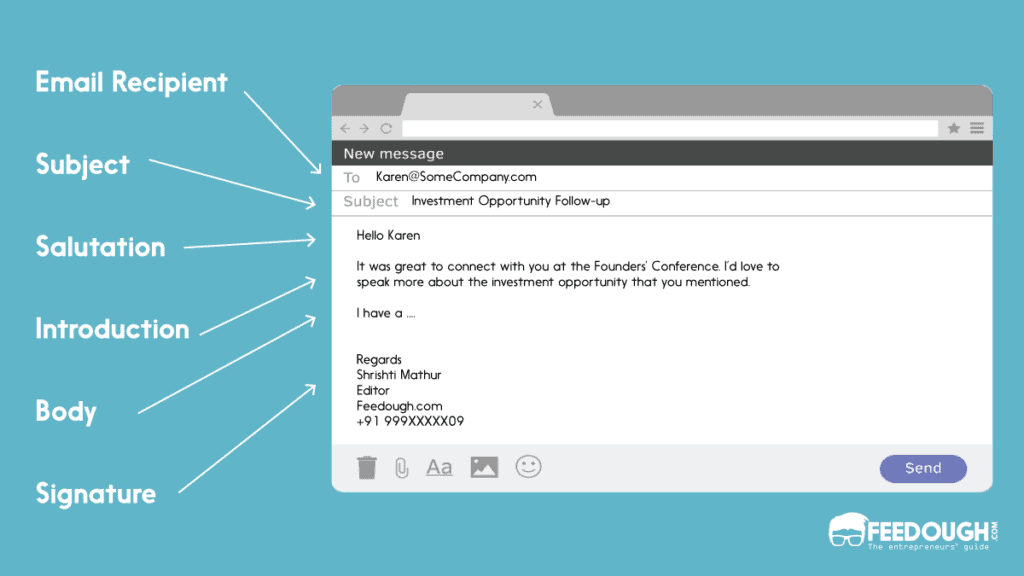
    Components Of A Business Email

    Most business emails tend to contain certain elements. If these are not included, the email may not achieve its goal, and that would be a waste of your time and effort. Some of these elements you must have in every business email are:

    Subject

    Every business email requires a subject. It is a kind of title or identifier that will make the reader open up the email. The subject should be simple, relevant and command attention. For example, if your boss sends an email to update everyone about the company meeting, the subject would be ‘Company Meeting’.

    It may also include a colon, after which you can add additional information that you feel is important to get across. For example, if you are working on a project with multiple people involved and want to inform them about some changes applied to the plan, then ‘Project Status: New Changes’ can be added as a subject.

    Salutation

    Salutation is the phrase used to address the recipient in the business email. The salutation should be formal and courteous, depending on who your email is addressed to. For example, if you send an email to your superior, your salutation should be ‘Dear Mr De Silva’ or ‘Dear Sir’. If it is to a client or someone not directly associated with the organisation, ‘Dear Valued Customer’ would suffice.

    Body And Structure

    Most business emails are formal in nature. As such, they require a formal structure that will enable the recipient to respond accordingly. The most common structure used is IBC (Introductory Message, Body and Closing)

    • Introduction: This section briefly mentions who you are and how you know the recipient. For example, if you are introducing yourself as a new staff member, ‘I am the new marketing executive’ can be used as your introduction. You can also indicate why they should read the email. For example, ‘I am sure you will be interested in this information or ‘This may interest you’.
    • Body: This section contains the main part of the business email. You have to write it concisely and precisely so that the recipient will be able to understand it quickly rather than reading through a rambling paragraph. Include everything you want to say without any unnecessary details. For example, if you want to request a business partner for a business proposal, start with ‘Request you to send the business proposal so..’.
    • Closing: In this section, you respectfully request what you want from the other person. You can also indicate that you expect a reply if they have any questions or concerns regarding your request. For example, ‘I hope that I’ll hear positive news at tomorrow’s meeting and look forward to working with you in the future.’

    Signature

    This section includes your name and contact information. If the email is formal, it should also include your job title and designation. For example, ‘Rasha Al-Najjar – Personal Assistant to Mr John Smith.’ You can also add your contact details such as email address, phone number and mailing address to the signature.

    Eight Steps For Writing A Great Business Email

    If you are new to writing business emails, it is advisable to follow the eight-step below:

    1. Identify your purpose: Before you start to write the business email, identify the purpose of it. Is it a request, an invitation? If possible, summarise your purpose in about two sentences. This will help you to stay focused and include only what is relevant.
    2. Study your recipient: You should target your email only to the person you are addressing it to, not to the masses. You do this by studying your recipient. Who are they? What are their interests and behaviours? This stage is crucial because it helps you to connect with your reader on a personal level. You can even try to identify any mutual connections or friends in common. This way, you can mention them briefly in the email to personalise it. Also, check the recipient’s profile on social media sites like LinkedIn. This will give you an indication of their age group and interests. It is not wise to include words they may not understand, especially if they are from a different generation.
    3. Write the subject line: In business, the subject of your email is very important as it sets the tone for what’s inside. A poorly written or vague subject will lead to confusion and possibly a misunderstanding on the part of the recipient. Keep your subject short and place the most important words in the beginning. Also, make sure that your subject line doesn’t sound spammy as the recipient may delete your email without even opening it.
    4. Address your reader: Like any other communication, you must address your recipient correctly. Make sure to use the proper salutation (i.e., Dear Sir, Hello Mr Smith) and avoid using phrases like “To Whom It May Concern” or “Dear Miss, Dear Mister”. If you want to be formal even without knowing your recipient, address their job title, for example, “Dear Founder of Feedough.com”. Or simply use phrases like “Hi there” or “Hello”.
    5. Write the body: In the business email, you need to clearly and precisely communicate your message. First comes first: address your topic and then move on to what you want from them and why they should give it to you. If possible, use bullet points as this makes the information easy for the recipient to read. Close your request with a question or a call to action. Try to keep your email short, use different paragraphs for different arguments, and try to sound conversational but be very specific.
    6. Develop and add your signature: Using your name and job title is not enough. A good signature will include a brief description of your role at the company, a contact number and an email address. You can also add your social media handles to make it easy for your recipient to reach out to you.
    7. Proofread for grammar, spelling errors and typos: Always read your email from a reader’s perspective. Ensure that it is free of any grammar, spelling and typing errors as these mistakes can be a deal-breaker on part of the recipient.
    8. Send the email and wait: Once you’re done writing your email, proofread it one more time and send the email to the intended recipient. Then wait for their response.

    Key Things To Remember While Writing A Business Email

    When it comes to business emails, second chances do not exist. It is important that you follow certain rules and policies to ensure your email is professional and has a good impact on the reader:

    Keep Your Email Short

    The shorter your email, the better. Long emails are usually ignored or not read completely. Be concise and get straight to the point.

    For example, instead of elongating a sentence such as “Our past clients are very popular and renowned in their respective fields, and we take pride in paving one step forward to their success”, you can use “We take pride in having served some very renowned clients in the past”.

    Keep Your Email Simple

    If possible, avoid long, industry-related words and use a simpler vocabulary while writing your email. Use easy-to-understand words that are quick to read.

    For example, instead of trying to sound smart by using the phrase “multi-faceted, cross-platform technology”, you can use “multifunctional website”.

    Keep Your Email Formal

    Keep your email formal and respectful. It may be easier to write a casual tone but try to keep it professional. But don’t keep it too professional as well. Try to strike the perfect balance between too formal and too casual, and keep in mind the kind of relationship you have or want to build with the recipient. Moreover, adding a touch of warmth and respect in the email helps connect better with the recipient. 

    Make Use Of An AI Copywriting Tool

    Today, you can write compelling business emails even if you are new to the process. There are a number of AI copywriting tools that can help you write emails in the simplest way possible. For example, ClosersCopy, Jasper, and Rytr are AI-based email writing tools that can help you draft emails in the shortest time- without you having to make the necessary tweaks.

    Avoid Passive Voice

    Passive voice sounds vague and may make it difficult for the reader to understand what you are trying to say. Try using active voice instead. For example, instead of writing “The opportunity will be discussed by us soon”, use “We will discuss this opportunity soon”.

    Use Bullet Points To Make It Easy To Read

    Lengthy paragraphs can be difficult to read and understand. They can confuse your reader and lose their attention completely. Use bullet points instead for an easy and quick understanding of the topic.

    For example, instead of writing “We are the leading e-commerce website in this industry because we provide superior quality services to our customers, which include the availability of an extensive range of products, providing 24×7 customer service and so on”, use

    “Our online retail store provides:

    • An extensive range of product
    • 24/7 customer service.”

    Try Not To Sound Robotic

    A too formal tone is not recommended. Using words like “in the capacity of”, “owing to the fact that” or “it would be my pleasure if” makes your email sound robotic. Use simple words instead for better clarity.

    For example, instead of saying “In compliance with your request”, use “As per your request”.

    Proofread Your Email Before Sending It

    Proofread your email and check for spelling and punctuation errors. These may not be a big deal when you’re writing to friends using casual language, but in business emails, any small mistake can harm the image of your organisation or brand.

    Grammarly and Hemingway are two of the most popular AI tools that you can use to double-check your emails before you send them out. These tools highlight grammatical errors, spelling mistakes, wordiness and overall readability and suggest changes so that you can make your email less complicated, easier to read and improve overall clarity.

    Avoid Hedging

    Hedging is when people use linguistic devices that express uncertainty and hesitancy to seem polite. Words and phrases like “maybe,” “I think”, “I feel like”, “It would be great if”, “Should be able to” and “Basically” may seem like a good idea at the time, but ultimately end up weakening an otherwise strong statement.

    For example, instead of writing “I think we might be able to do this” try “, We can do this”.

    Since the recipient could be someone who hasn’t heard of you before, they could be extra cautious about opening any attachment or link that you attach to your email. Try not to bombard your initial emails with excessive links or attachments.

    How To Format Your Business Email

    Formatting your email correctly makes it easier to read and understand. Like in the case of bullet points, words in bold or italics can help draw attention to specific information. Using caps and underline is not advisable as they make your email look unprofessional and difficult to read.

    Moreover, if your email will be forwarded to various departments or people, use BOLD and CAPITAL LETTERS for important information to clearly see the most important information in the email.

    As a general rule of thumb:

    • Use a font size of 10-12 for body text,
    • Serif fonts are easier to read on-screen,
    • Arial, Helvetica, Times New Roman, and Verdana are some of the best fonts you can use for your email,
    • Avoid using all uppercase letters in your subject line (it feels like you’re yelling),
    • Bold important information for better readability,
    • Use indentations and line breaks to make email structure easy to follow,
    • Avoid using multiple font colours,
    • Keep a standard font size throughout your email,
    • Don’t use more than two fonts styles.

    Bottom-Line?

    There’s no doubt that modern business communication has become a lot more casual. However, it is important to keep in mind that even though you’re sending out a less formal email, the recipient might see it as your official brand or company representative communicating with them.

    Using formal language and being concise increases the chances of getting a response from your reader because they can clearly understand what you want to say without any confusion. This tactic will go a long way in improving customer satisfaction.

    Finally… remember, don’t be afraid to use emoticons! The world wouldn’t be the same without 🙂

    And we hope these tips will help you write better emails and get more responses!

    Go On, Tell Us What You Think!

    Did we miss something?  Come on! Tell us what you think of this article on how to write business emails in the comments section.

  • What Is DeFi? – Decentralised Finance Explained

    What Is DeFi? – Decentralised Finance Explained

    Imagine living in a world with no banks! You don’t need to reveal your identity every time you make payment. You don’t need to maintain a credit score every time you want to borrow money. You don’t even need to worry about forex rates every time you visit another country. All your money is stored in a wallet that you can access from anywhere in the world. Moreover, you can see every transaction that has ever happened on the system while being completely anonymous and secure!

    That’s decentralised finance for you!

    The introduction of blockchain and cryptocurrencies has been revolutionising for various industries, including the financial industry. And, DeFi is one of the major applications of blockchain. Decentralisation and independence have proven to be very attractive for centralised finance (CeFi) users, resulting in a major boom in DeFi in a very short span of time. As of 2021, DeFi contracts have a total value of more than $195 billion!

    DeFi has huge growth potential in the coming years, and it is the future of the financial ecosystem. Therefore, it is important to understand the intricacies, applications as well as risks of decentralised finance.

    Thus, here is a guide for you explaining all the basics of DeFi in the simplest terms.

    So dive right in!

    What is DeFi?

    DeFi or decentralised finance is a global, peer-to-peer system that provides financial services using a public blockchain network.

    As is evident by its name, DeFi provides a permissionless and transparent financial ecosystem without depending on any centralised authority. Most DeFi applications are built on a blockchain-based platform Ethereum.

    Now, What Is Blockchain?

    Blockchain can be thought of as a decentralised digital ledger that everyone owns but at the same time, no one owns. This means that even though anyone can contribute to a public blockchain, no one actually owns the right to edit or change the data in a blockchain. In other words, blockchain is a digital ledger used to store information that is private as well as transparent. So, anyone can access and look at the public information on a blockchain, but no one can access the users’ private information or edit any sort of transaction.

    This is because each block in a blockchain contains the hash value of the data in its previous block as well as of the current block. So to edit any information in the current block, one will have to edit all the previous blocks, which will take a large amount of time and energy.  This is what makes blockchain tamper-resistant, secure, transparent as well as efficient.

    Since DeFi is itself based on blockchain, it inherits all these properties, which makes the system efficient. DeFi provides all the facilities allowed by the traditional banks but eliminates the need for an intermediary or central authority. Furthermore, the platform is faster, globalised and doesn’t require any paperwork. This allows anyone with an internet connection to have access to their funds and other assets at any time. 

    How Does DeFi Work?

    DeFi primarily works on three components: smart contracts, stablecoins and DeFi apps.

    Smart contracts

    Smart contracts are an essential part of any blockchain and thus a necessary part of DeFi. In simple words, a smart contract is just a piece of code that is automatically executed when certain prerequisite conditions are met. In Ethereum, every smart contract is decentralised and immutable, meaning that once it is coded and deployed, it cannot be changed or edited at all. That is why the DeFi system is said to follow the ‘code is law’ thesis as the law or the contract is represented through written code. Hence, smart contracts help in making the blockchain trustless and secure. 

    Think of a smart contract as a vending machine. Like smart contracts, a vending machine is also pre-programmed and allows only certain actions based on the input. For example, if you wish to buy a chocolate bar that costs $3 but you only have $2, you will not be able to get the bar or manipulate the machine’s working in any way.

    Stable Coins

    DeFi is basically based on blockchain, and the transactions are completed using cryptocurrencies. But, cryptocurrencies are highly volatile, and their values keep frequently fluctuating, which leads to extreme instability in the market. Therefore, to mitigate this problem, stablecoins were created whose values were pegged to many stable assets, particularly the US dollar. The coins have become a very important component of the DeFi system as they are a mixture of the best qualities of cryptocurrency and the centralised currency.

    DeFi Applications

    DeFi applications or DApps are applications based on DeFi which allow users to easily access various services offered by the system. These applications differ from the usual applications as they use blockchain as their database. These apps are used in several areas and industries, including the financial sector, the gaming industry, marketplaces, social media, etc. DApps provide various financial services, similar to a bank. The only difference here is that, unlike a bank, DApps do not have a centralised authority. Instead, they use DeFi protocols and smart contracts to manage finance and maintain security.

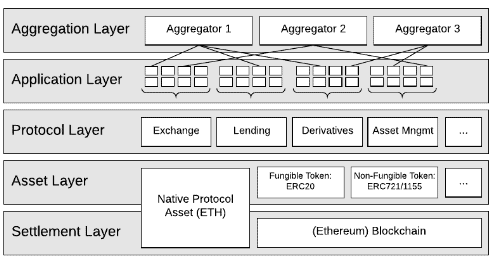
    The working of DeFi applications, or DeFi in general, can be understood by looking at the various layers that form the DeFi stack. Each layer is customised to perform a particular task in the building of the DeFi system. Furthermore, the DeFi stack is composable, meaning that each component and each layer can be grouped together to build a complete DeFi application.

    The four layers include: 

    DeFi Applications
    • Settlement layer: the settlement layer is the base layer or the foundation on which the DeFi ecosystem is built. This base makes DeFi work completely differently than the centralised finance ecosystem because it is built on blockchain technology. This layer is used to store ownership information securely and serve as a settlement and dispute resolution system.
    • Protocol layer: this layer consists of software protocols which are basically a set of rules that govern the functioning of DeFi applications. In the blockchain regime, these rules are composed of a series of smart contracts. The smart contracts manage the working and behaviour of assets in a DeFi environment. Also, the DeFi protocols are highly interoperable, which means multiple entities or applications can access them simultaneously. 
    • Application layer: this layer provides user-oriented applications to the DeFi system. It basically gives a face to the underlying DeFi protocols so that consumers can easily interact with the DeFi system without programming or in-depth knowledge about blockchain. In the application layer, the smart contract is abstracted by a web-based front end, making the protocols easy to use, just like usual applications. Most common applications, including decentralised cryptocurrency exchanges and lending services, reside on this layer.
    • Aggregation layer: this layer can be seen as an extension of the application layer. It is because the aggregators bundle up multiple applications and protocols togEther to ease up the process for the user further. This technology-based framework smoothens the process for users as they can use a single dashboard to execute various functions. The aggregator can be thought of as a phone’s home screen with different icons as DeFi applications. 

    DeFi Applications

    The DeFi ecosystem provides a decentralised alternative to almost all kinds of transactions that can be done in the traditional financial system. One can borrow with or without collateral, lend, save, invest, trade tokens, grow a portfolio, send money across the globe, buy insurance as well as manage a portfolio.

    In addition to these basic financial applications, DeFi also helps resolve some problems that are prevalent in the traditional financial system, including:

    • Remittance market solutions: one of the most important use cases of DeFi is the remittance market. The market usually entails workers from foreign countries who send millions of dollars as remittances. But they encounter many problems in the process, one of the major ones being the fee they are required to pay to complete the transaction. DeFi resolves the problem by cutting the cost by at least 50% or more.
    • Lending platforms: as with any financial system, lending and borrowing are the most basic and essential features and use cases. In the traditional financial system, the loan industry depends on having access to banking or a similar service. But DeFi allows users to borrow or lend in a completely decentralised manner while maintaining full custody over their coins. Furthermore, DeFi lending is accessible to everyone without providing any personal details or trusting someone. One such platform based on DeFi is Compound which allows users to borrow cryptos or offer loans.
    • Prediction markets: one of the oldest use cases of DeFi is prediction markets. These are markets where people bet on the outcomes of various events. Centralised prediction markets are generally frowned upon by the government, and they are usually shut down. Hence, DeFi could be helpful in such scenarios. 

    In addition to these common applications, some complex concepts have also been built around the DeFi system, including:

    Yield farming

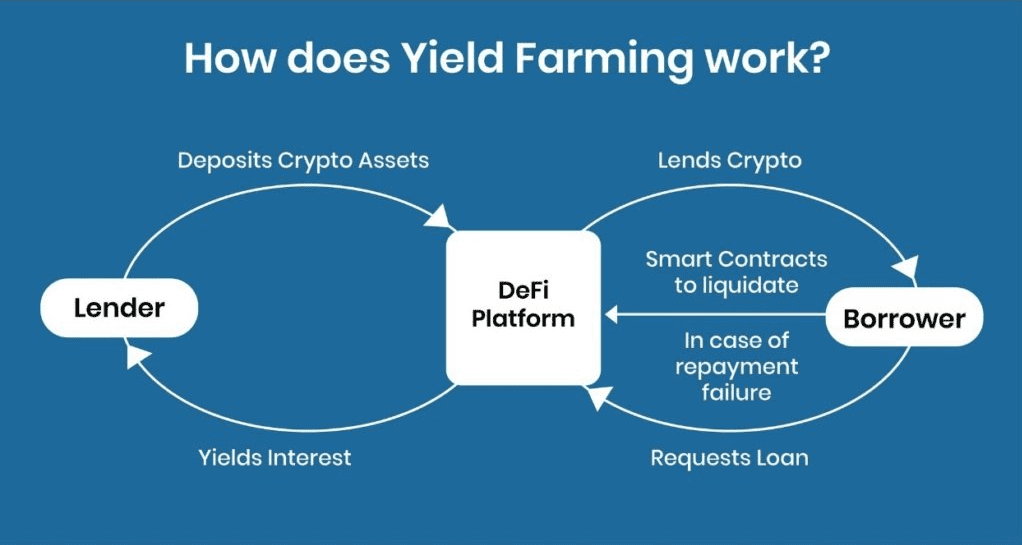
    Yield farming is the technique of making more crypto using your existing crypto. In other words, it is the technique of lending or staking crypto assets to generate high returns in the form of additional crypto assets. Yield farming works in the same way a bank lends money to generate interest. The only difference is that there are DeFi protocols instead of banks, and each protocol has its own interest rates and properties.

    That is why ‘farmers’ try to strategise and move their funds around to get the maximum possible yield or returns on their crypto assets. Sometimes, this procedure is also called crop rotation as the users may try different protocols or swap some coins to the one generating a higher yield.

    yield farming

    Yield farming has become one of the most popular applications of DeFi among modern traders. The system takes up idle cryptocurrency that would otherwise be wasted away in a wallet or an exchange and uses it to provide liquidity in DeFi protocols. Another reason for the increased popularity of yield farming is the high rates of return. For example, some of the yield farming strategies have been reported to generate 100% annual percentage yield.

    Liquidity Mining

    Yield farming works in tandem with liquidity mining which further facilitates the process. What happens is, the yield farming protocols incentivise liquidity providers to stake or invest their crypto assets in smart contracts-based liquidity pools. And in return of providing liquidity to the pools, the liquidity providers earn some rewards, usually in the form of tokens. These tokens are added on top of the yields farmers get from various DeFi protocols. This process of distributing tokens to the users of a protocol in return for liquidity is called liquidity mining.

    Important Defi Projects And Protocols

    After looking at various applications and use cases of DeFi, here is a summary of the major projects that have allowed the DeFi space to expand and increase its reach.

    No one can point out the exact date when the DeFi ecosystem was started. But, many would agree that the invention of Bitcoin was the first major milestone that marked the beginning of a decentralised world.

    Bitcoin

    Created in 2009 by a pseudonymous person called Satoshi Nakamoto, Bitcoin is one of the very first applications of DeFi. It is one of the first cryptocurrencies that introduced the concept of decentralisation to the world and enabled the creation of Ethereum. Bitcoin allows you to truly own and control value and send it anywhere in the world. It accomplishes this by eliminating the need for a trusted intermediary and allowing a large number of people to agree on a ledger of accounts without trusting each other. In other words, Bitcoin is simply a token that holds a certain value and represents balances kept on a public ledger that is transparent and open for each user.

    Although Bitcoin enables one to send and receive tokens globally, a financial system needs many other important services to operate. People should be able to lend, borrow, trade, fund, etc. But, Bitcoin was not suitable for such applications, and that is where Ethereum came in.

    Ethereum

    Founded in 2015, Ethereum is a blockchain database that stores information in a decentralised format. It forms the perfect foundation for the majority of DeFi applications. Unlike Bitcoin, Ethereum wasn’t built to support a cryptocurrency. Instead, it provides a platform to its users to develop and use various applications and store information securely. Ethereum also has its own cryptocurrency called Ether, which can be used to complete transactions on this blockchain.

    One of the major DeFi projects built on Ethereum is Maker, which is based on a DeFi protocol called MakerDAO

    Maker and MakerDAO

    MakerDAO is an Ethereum-based DeFi protocol that has played a crucial role in DeFi by providing a platform to the developers with liquidity and a stable unit for DeFi applications. This protocol is responsible for creating a stablecoin called DAI, which is soft-pegged to the value of the US dollar. Moreover, it also has its own governance token called Maker (MKR), used to vote on various protocol decisions. This project is one of the early pioneers of the DeFi ecosystem and has played a huge role in expanding the decentralised finance space.

    In 2017, another major use case of Ethereum- ICOs became prevalent. ICOs or initial coin offerings can be seen as DeFi’s equivalent to an initial public offering. A company or a new product looking to raise money can launch an ICO instead of resorting to traditional methods of raising money. Then the investors can participate in the offering in exchange for a new cryptocurrency token issued by the company. This token may have some utility, or it may simply represent a stake in the project.

    In the era of ICOs, many interesting projects came up that further contributed to the DeFi ecosystem. One such project is Aave.

    Aave

    This is another popular application on the Ethereum blockchain that allows users to lend and borrow cryptocurrencies. Aave is basically a decentralised crypto bank controlled by its users. As can be predicted, all the loans are controlled and operated through smart contracts. This lending protocol has its native token called AAVE which also runs on the Ethereum blockchain. AAVE is not a cryptocurrency but a token, meaning that the users will have to pay ETH gas fees while using it. The token is used for governance as only the token holders can vote on requested changes in the protocol.

    Besides Aave, many other projects based on the Ethereum blockchain have made massive contributions in fuelling the rise of decentralised finance. Some of these projects include Synthetix, Ren, Kyber Network, Bancor and the 0x protocol.

    DeFi vs CeFi

    Traditional finance or centralised finance (CeFi) differs from DeFi in many ways. Although both systems’ basic applications are almost the same, the way they carry out their operations is the main difference. While the CeFi system operates on trusting people and providing customer service, DeFi works on technology and blockchain and thus, makes the system intrusion free by eliminating the need for intermediary or censorship. 

    The main differences between the two include:

    Decentralised Finance
    Traditional Finance
    Based on a public blockchain
    Controlled by central authorities like banks or government
    Users have complete control over funds’ custody.
    Central authorities control the funds.
    Permissionless- anyone with an internet connection and crypto wallet can lend or borrow.
    Requires permission and certain prerequisites such as credit score or banking record to borrow or lend.
    Trustless- all the transactions are based on pre-programmed smart contracts that cannot be tampered with. 
    Need to trust the central authority and banks with funds.
    Privacy- all transactions are made pseudonymously.
    Every financial activity requires the user to reveal their identity.
    Transparent- anyone can go through a public blockchain’s records and see how the system is working.
    No one can ask to look at the authority’s histories or records.

    As is evident by the differences, the DeFi model is particularly aimed to resolve some major issues in the traditional financial system including limited availability, the need to trust people, no transparency, regulatory control and low transaction fees.

    Risks Associated With DeFi

    Although the DeFi system has revolutionised the financial sector, there are certain very serious risks associated with the system as it is very recent and still evolving. Therefore, anyone who is looking to invest in this sector should first lookout for these risks.

    • Technological risks: DeFi applications are primarily built on blockchain which runs on smart contracts. Since humans encode these smart contracts, they may contain some bugs or errors. These bugs can severely affect DeFi applications and protocols. For example, recently, a DAO hack resulted in millions of dollars being lost as a hacker extracted funds from the smart contract.
    • Asset risks and market gyrations: usually, the collateral provided in DeFi transactions is in cryptocurrency. Now, the crypto market is quite volatile, leading to frequent and sometimes extreme fluctuations in the market. This leads to uncertainty and instability in the financial market. Sometimes, the problem goes out of hand and can cause potential bank runs, leading to major crashes in the value of the tokens.
    • Compliance risks: the main selling proposition of the DeFi system is that it is based on software programs that automate transactions and replace centralised authorities. But this proposition in itself creates several risks as well as an uncertain regulatory environment. These risks are further amplified due to the anonymous transactions and global reach of DeFi. As there is no direct guidance from any responsible authority, the users are confronted with confusing compliance and legal obligations.
    • Flash loan attacks: Flash loans are unique DeFi loans that do not require any collateral. These are unsecured loans based on smart contracts to mitigate the risks in the lending process. Using a flash loan, the borrower can borrow an unlimited amount of money without any collateral, but they have to pay back the full amount within the same transaction. If the borrower doesn’t pay back, the lender can just roll back the transaction without any problem.

    Since flash loans do not require any collateral, credit source, or other verification, they pose certain risks to the DeFi system. This is because borrowers sometimes borrow a huge amount of money and use it to manipulate the market for their personal gains without any repercussions. For example, recently, some attackers attacked a yield farming aggregator called PancakeBunny. The attack was so severe that the aggregator’s token Bunny dropped by 95% of its value. The attackers achieved this by borrowing large amounts of BNB through the aggregator’s lending protocol, using that money to manipulate the price of BUNNY and then eventually dumping the protocol on the open market.

    Bottom-Line?

    DeFi has undoubtedly revolutionised the financial ecosystem by introducing a decentralised and transparent ecosystem with apparently no entry restrictions. This global system has the potential for unlimited growth in the recent future.

    However, it cannot be ignored that DeFi is still in its infancy and some certain risks and loopholes need to be resolved and looked out for before DeFi can become fully mainstream among the common public. For example, there are significant risks associated with smart contracts; there are DeFi rug pulls using which hackers drain a protocol of funds leaving the investors unable to trade. And the biggest drawback of the DeFi system is the lack of clear regulations and laws to protect the users from various cybercrimes.

    But one cannot deny that DeFi is the future of the financial system. If appropriately utilised, DeFi can be of significant help to both developed as well as developing countries. Once fully matured, DeFi will help bring the much-required paradigm shift by offering an open, affordable and profitable system to the users with mutual trust and transparency.

    Go On, Tell Us What You Think!

    Did we miss something? Come on! Tell us what you think about our article on what is Decentralised Finance in the comments section.

  • What Is Hyperlocal Business Model & How Does It Work?

    What Is Hyperlocal Business Model & How Does It Work?

    There was a time when you had to face the hassle of going to the grocery store every time you needed something, or rush to a pharmacy or stand in a line at a cafe or restaurant to buy some food for yourself. It wasn’t easy to even imagine a day when all these things would arrive at your doorstep with just a few taps on-demand.

    A perfect utopia a decade back is a reality now.

    This is what the hyperlocal business model is all about – making the consumers’ life easy by building a local ecosystem that fulfils needs on-demand. Poised to grow by a whopping $451.64 million in the coming years, it has an expected CAGR of 18% during the forecast period.

    Wondering what a hyperlocal business model is, how it works and makes money?

    Fret not!

    Here’s a guide that explains it all.

    What Does Hyperlocal Mean?

    Hyperlocal’ or extensively local literally means a well defined and specific community and geographical area. In its essence, it is localisation in its true spirit. It focuses on a highly specific location and community, with geography and time as the key factors. For instance, a neighbourhood or specific locality of some state of a country would be termed hyperlocal.

    Since it is based on personalised one to one services, hyperlocal works for specific areas. It also has the ability to cater to well-defined needs in an effective and efficient way using modern technology.

    What Is Hyperlocal Business Model?

    A hyperlocal business model, also known as a micro-marketplace, is a business that focuses on the needs of geographically local consumers. It aims to fill in the gap between demand and supply with an efficient network of suppliers/vendors who fulfil consumer demands by selling them what they need at their doorstep.

    Technically, a hyperlocal business model is an online business model that caters to customers’ on-demand needs, which are met through a local ecosystem.

    In other words, the customer uses a platform or service aggregator that acquires the requested product locally and delivers it to the customer’s doorstep in the respective geographical location. Grocery shopping, food delivery, health care, and many other services have taken a different dimension altogether with the ushering of hyperlocal e-commerce platforms. 

    The unique selling proposition of the hyperlocal business model is its ability to get good quality products and services delivered at peoples’ doorsteps at unbelievably fast speeds. Using digital platforms makes it more convenient for the customers to monitor the entire process and keep track of deliveries in real-time. 

    A hyperlocal business model usually has the following characteristic features:-

    1. It is a keen-eyed and personalised business that focuses on the needs of geographically local consumers.
    2. It targets a specific area with a high demand for goods and services.
    3. It caters to the well-defined needs of people in an effective and efficient way using modern technology
    4. The unique selling proposition of this business model is its ability to get good quality products and services delivered at people’s doorsteps at unbelievably fast speeds
    5. An effective mix of the marketplace and aggregator business model.

    Technologies such as GPS (Global Positioning System), mobile applications, and social media play a prominent role in the hyperlocal business model. This combination makes it more convenient for the organisers to monitor the entire process and keep track of deliveries.

    How Does A Hyperlocal Business Operate?

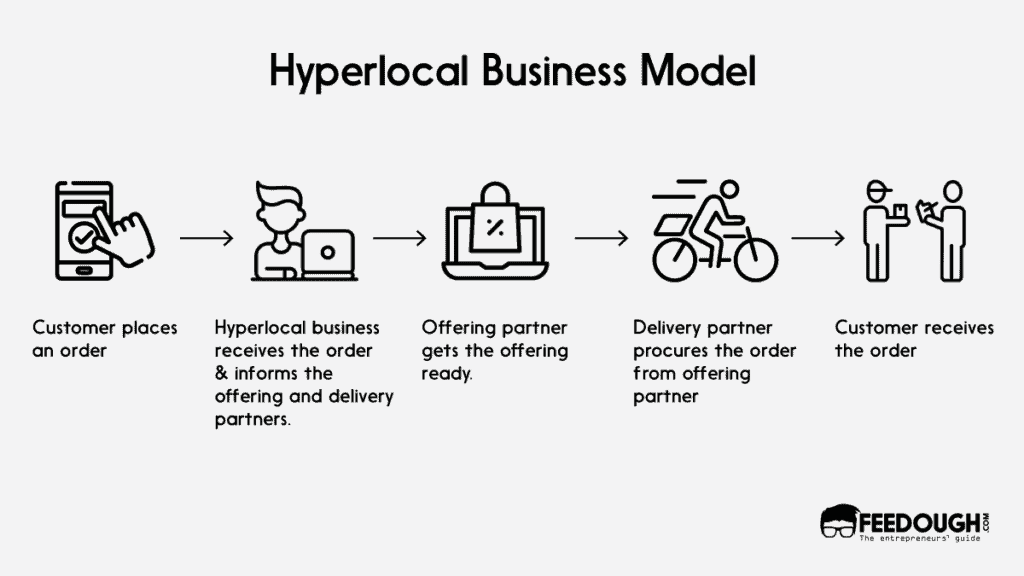
    Hyperlocal business model process

    The hyperlocal businesses work with the pre-existing infrastructure and elements of local markets but connect them all in an ecosystem where orders can be taken, processed, procured and eventually delivered, all in one place. It operates with the help of offering and delivery partners to bridge the gap between customer demands and retail supplies.

    Businesses operating under the hyperlocal business model provide online retail platforms to local consumers and businesses. They usually have an inventory database where all the information is stored about the products, services, customers and locations. They also have an ordering platform through which the customers can order products and services. 

    To understand it better, let us consider an example of a hyperlocal on-demand food platform. When a customer places an order for a required food item through the platform, the platform receives that order and passes on the details to the offering partner (local store) and the delivery partner (delivery person). The delivery partner then procures the required food item from the local business and delivers it to the customer’s specified location. The platform drives the entire process and earns a commission for the role it plays and the local stores get amplified visibility and delivery services in the process.

    The biggest reason for the success of hyperlocal businesses is their ability to generate revenue through a variety of business models. However, it depends on the nature and type of offering being offered by a particular hyperlocal platform.

    In general, hyperlocal brands operate on four business models:

    Inventory-Led Model

    Inventory led hyperlocal business

    In the inventory led model, the hyperlocal business either produces its own offerings or buys them directly from brands and sellers and creates an inventory. This rules out the need to approach local stores after the order is made but bring in the element of managing the inventory and tracking customer demands for the business.

    Aggregator Model

    Aggregator hyperlocal business model

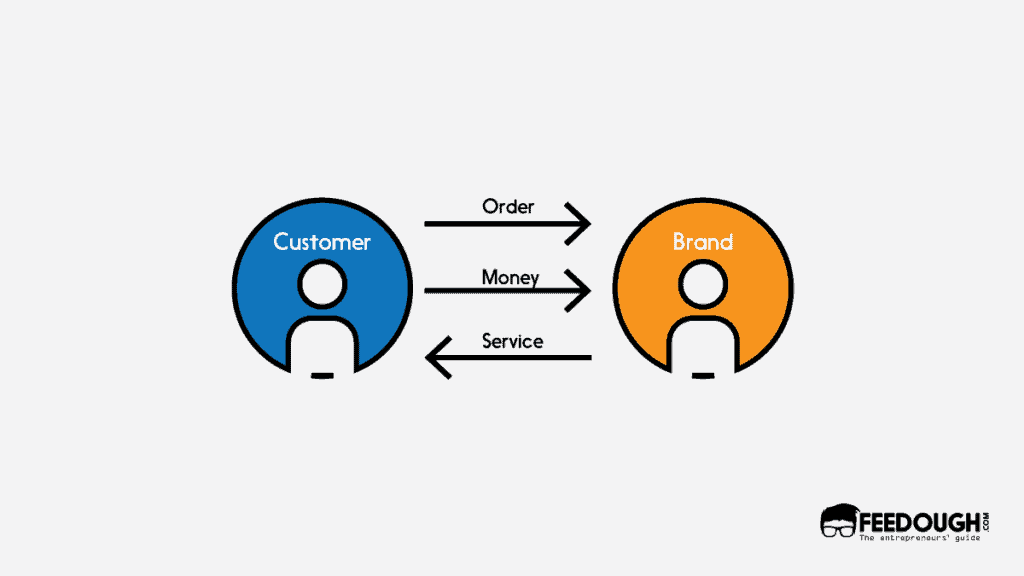
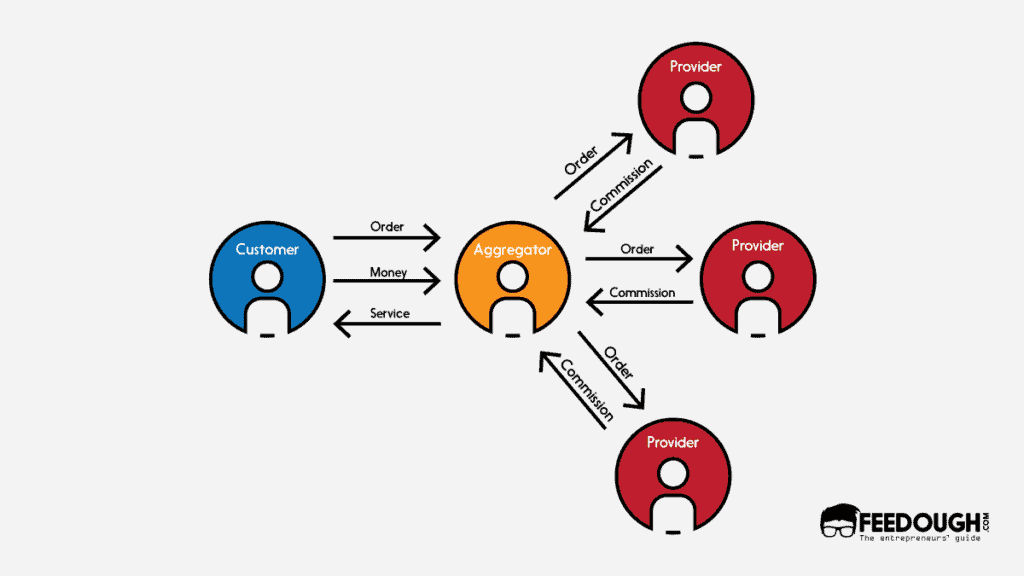
    In the Aggregator or Zero inventory model, hyperlocal businesses act as a connecting bridge by linking the customers and retailers and ensuring last-mile connectivity and delivery to them. However, it provides the offerings under its own brand, no matter who it procures it from. Moreover, such an aggregator brand also makes sure to keep standardised prices and quality.

    Consider the aggregator model as the Uber for hyperlocal offerings. The customer orders the offerings from the brand and the brand delivers it under its own name. However, the backend involves a partnership with an offering partner from where the brand procures the good and a delivery partner who delivers the offering.

    Marketplace Model

    Marketplace hyperlocal business model

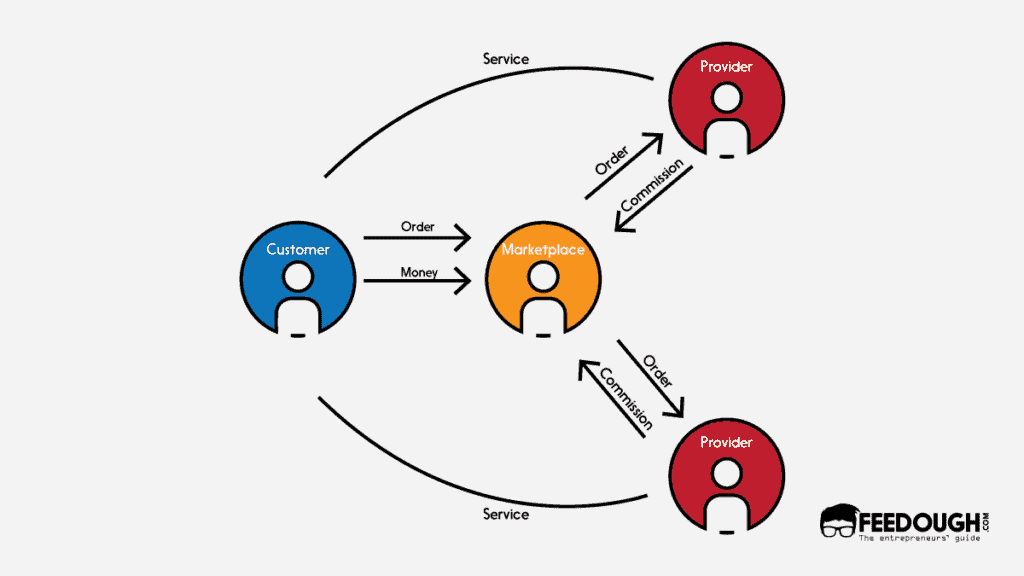
    A hyperlocal marketplace model is one where the brand acts as a facilitator, connecting the customer with the retailers or sellers. That is, it provides a platform for several local retailers to sell similar items at prices they deem fit.

    Unlike an aggregator, the marketplace model doesn’t demand standardised prices or quality. The brand only focuses on developing a discovery and ordering platform and sometimes help in delivery too.

    Hybrid Model

    It is a mix of the inventory, aggregate, or marketplace model and can be shaped depending on what suits the business the best. Businesses need to keep in mind the feasibility and viability of the system and the need and requirement of the customer segment they are targeting.

    Target Customers Of A Hyperlocal Business

    Hyperlocal platforms and applications usually target the tech-friendly prospects that belong to generation Z or millennials. Such customers value time over money and convenience over accessibility. They are known to be highly mobile-savvy and like using online apps for almost everything that is possible, ranging from ordering food and groceries or booking cabs to finding out about news and live events.

    What Value Does A Hyperlocal Business Provide To The Customers?

    Hyperlocal brands provide a level of convenience that is unmatched till now. Customers can order anything they want by just going online or downloading an app and placing an order. Customers prefer hyperlocal platforms because of the following reasons:

    • Customers can place their order for items that are available on-demand or store pickup with the click of a button.
    • It eliminates the need to visit a store to get the product. They can even order a number of items at once and split the bill at the end.
    • Customers get more options to choose from. For example, they can pick from multiple stores and retailers. 
    • The process is transparent with real-time visibility of the transaction. 

    Key Partners Of A Hyperlocal Business

    Since hyperlocal businesses operate mostly on marketplace and aggregator business models, their operating model revolves around two key partners –

    • Offering partners: It constitutes the local store owners, manufacturers, wholesalers, or retailers who fulfil the offering demand of the customers. The hyperlocal business procures its goods from such partners.
    • Delivery partners: It includes delivery personnel who work as partners for the hyperlocal platform and not employees. This saves money for the platform and give liberty to the partners to decide their own working hours.

    Besides these two key partners, a hyperlocal brand also partners with several other partners that help it make its platform complete. They include –

    • Map API Providers: Live order tracking is an essential feature of several hyperlocal platforms. To provide such a feature, hyperlocal businesses need to use map APIs provided by companies like Google. These map APIs help track the location of the delivery personnel and also show the progress of their order
    • Payment Processors: The hyperlocal business needs to be equipped with a payment gateway or processor. Payment gateways help in keeping track of all the customer payments and ensure smooth order processing. Various payment gateways like Paypal, Stripe, etc. offer such services to hyperlocal businesses.

    Key Resources Of A Hyperlocal Business

    Broadly, hyperlocal platforms build their businesses capitalising on three key resources –

    1. Brand: The brand is the biggest resource they have. A hyperlocal business builds its brand by creating awareness, trust, and loyalty among its customers. The trust factor it creates helps it gain more orders and retain loyal customers who keep returning for their offerings.
    2. Technology platform: Hyperlocal businesses need a technology platform that manages the demand and supply, facilitates order-making and delivery, and tracks the location of customers. It must be capable of handling high volumes of traffic with minute-to-minute changes in consumer preferences
    3. Network: Network is a vital element to build an on-demand ecosystem. To make a hyperlocal platform work, a business has to focus on building a strong network of customers, offering partners, and delivery personnel.

    What Channels Do Hyperlocal Businesses Use To Reach Customers?

    The digital medium is the best way to reach out to a hyperlocal business’s customers. For example, Uber Eats has a website and mobile app for its users.

    On all these platforms, customers can browse through information like menu cards, discounts, food festivals etc., reserve their order with the click of a button, pay online via net banking or cash on delivery, and track their order.

    How Does A Hyperlocal Business Make Money?

    Hyperlocal businesses make money in two ways –

    • They charge a commission fee from the offering partners for every order they make.
    • They charge a delivery fee from the customer for every order they deliver.

    Some hyperlocal businesses also earn revenue by selling ad space on their platform. That is, they charge fees from the offering partners to feature them on the platform.

    What Types Of Industries Can A Hyperlocal Platform Operate In?

    Hyperlocal platforms can operate in any industry where there is a high demand for immediate, on-demand delivery.

    They are good for various types of industries –

    • Food delivery: The food and restaurant industry witnessed the advent of hyperlocal business models with the launch of online food aggregator platforms like Uber Eats, Swiggy, Postmates, etc.
    • Grocery Delivery: Grocery delivery is a big market that several hyperlocal businesses have entered into. Instacart, Grofers, Bigbasket, and Amazon Now are some of the known names in the grocery business.
    • Medical products delivery: Players like 1mg, Healthkart etc. are good examples of businesses operating as hyperlocal platforms for the sale of medical products ranging from medicines to equipment.
    • Courier and Logistics: Players like Porter, Uber Connect offer hyperlocal courier and logistics services with the click of a button. They focus on delivering express or urgent couriers or parcels the same day via their delivery network.
    • Home services: Home services is another area where hyperlocal platforms are set to disrupt the market. For example, players like Urban Company offer their service via their own network of service providers for home maintenance related issues like carpenter work, plumber work etc.

    Bottom-Line?

    In today’s world where it is so difficult to capture customer attention with the skyrocketing competition, businesses have started to realise the value of providing quality customer experiences and solving their problems.

    Hyperlocal businesses are slowly but steadily growing in the global market. They provide a valuable solution to needs that could not be fulfilled by brick-and-mortar businesses earlier. It is an easy way for people to buy what they need at their doorstep without making any extra effort or travelling long distances.

    The future of hyperlocal businesses is filled with vast opportunities. With the rise of the Internet, people are always online and want everything at their fingertips. So it is just a matter of time before hyperlocal business models replace our traditional ways to buy things completely.

    Go On, Tell Us What You Think!

    Did we miss something? Come on! Tell us what you think about our article on hyperlocal business model in the comments section.
  • What Is Adtech? – Use Cases, Examples, & Future

    What Is Adtech? – Use Cases, Examples, & Future

    Advertising is an important part of any marketing campaign. But up until now, the advertising industry has been technologically slow-paced. Marketers use out-of-date tools to help them plan their ads (like spreadsheets). Then, they hire human creatives to make their ads more “personalised” and “targeted”. Finally, they pay for those ads to appear on screens (or in newspapers) worldwide.

    Manual processes lead to missed deadlines, wasted resources, and subpar results.

    That’s why adtech is taking over. Today’s ad tech enables marketers to create highly personalised, high performing ads in minutes. And get data-driven insights on ad performance in seconds.

    What is AdTech?

    Adtech or advertising technology refers to the use of technology and tools in the creation, optimisation, management, measurement, analysis, and delivery of advertising.

    It encompasses all the digital advertising technologies and solutions used to target, measure, and report on the performance of digital advertising campaigns. These technologies include –

    • Creation (Eg: Display, Automated, Interactive)
    • Targeting (Eg: Retargeting, Dynamic Segmentation, Behavior-based targeting)
    • Measurement (Eg: Analytics, Performance management, optimisation)
    • Management (Eg: Audience and campaign management, Creative, Demand-side Platforms)
    • Reporting (Eg: ROI reporting, Cost optimisation)
    • Delivery (Eg: Ad Serving Platforms, Real-time bidding)

    The advertising technology industry has been in existence for a while now. But recently, it has made a big leap in terms of efficiency and scale. This is mainly due to the adoption of Artificial Intelligence (AI), machine learning, and blockchain. These technologies allow computers to make decisions that are more complicated than humans. With the help of AI, ML, and blockchain, marketers can create highly targeted ads within minutes that provide more ROI and are less prone to frauds.

    Today, adtech is an effective disruptor helping marketers create, manage, measure and report on their ad campaigns on a global scale in real-time.

    Advertising Industry Challenges

    Today’s advertising industry faces an uphill struggle to make the product a must-have in the market. Here are some of the challenges faced by the industry:

    • Competition: This industry has been highly competitive ever since the start, but with competition rising day by day, it is becoming harder for a new company to carve a niche in the industry. 
    • Advertising Cost: While the prices have gone down over the years, they are still higher than in the past. This has made it difficult for advertisers to allocate enough money to digital advertising campaigns.
    • New Regulations: The industry is constantly evolving and adapting to changes in the rules and regulations. These changes are not always positive for the growth of the advertising industry. As such, the industry must adopt and adapt to the latest regulations pertaining to data privacy, data usage, restricted products, etc.
    • Data Privacy & Security: With the advent of technology and the internet, data privacy and security are issues for marketers and advertisers. The problem with the industry is that customers don’t want to share data without their consent. Even platforms like Apple and Google have started releasing user-privacy centred features that significantly impact ad campaigns. Moreover, data breaches are common now and can lead to massive losses for companies.
    • Fraud: Another major challenge that marketers are currently facing is fraud. Fraudsters have found ways to deceive advertisers and marketers using hidden ads, click jacking, etc. This has led to a huge loss in advertising revenues for companies.
    • Ad blindness: The other major challenge marketers face is ad blindness. It is a common phenomenon where ads are invisible to people. Ad blindness occurs when the ad is either blocked by ad blockers or the ad is not displayed on certain platforms, or the fact that people are losing interest in ads, which has led to a decrease in advertising revenue.

    Adtech Use Cases

    Adtech is an umbrella term for all the advertising technologies and services that are used in the advertising industry. Some of the main use cases of adtech include:

    • Mobile Advertising: Mobile advertising has been growing steadily over the past few years. It involves all the types of advertising appearing on mobile devices like smartphones and tablets. Mobile advertising isn’t limited to banner ads on apps and websites; it also includes innovative text ads sent via SMS. The rise of mobile apps has led to new advertising technology channels, including push notifications and even WhatsApp messages, which send relevant messages to people based on their behaviour.
    • Display Advertising: Display advertising refers to the ads placed on websites and apps. As display ads are on the site’s surface, they have high visibility and have a better click-through rate than traditional banners. Adtech has found its use case in making such display ads more engaging, delivering them to the right audience, reducing the costs, and optimising the conversion rate.
    • Email Advertising: In the past, email marketing was considered a very basic way of getting in touch with people. But the advent of adtech has made it one of the most effective mediums to reach out to the audience. With the help of adtech, marketers can get into the contact details of the email users, track the open rates and other relevant information. Email marketing is also beneficial for brands that want to retain their customers and make them loyal to their brand.
    • Broadcast Advertising: Broadcast advertising (TV and radio) has seen a huge rise in popularity over the years. It’s no surprise why companies still use broadcast ads. One of the main reasons being that it reaches out to a large number of people. However, it is still a costly way to reach out to the audience. Adtech has enabled TV and radio ads to be more targeted and also more engaging by analysing data and delivering the right message at the right time. It has made campaigns more cost-effective, more engaging and more targeted. 
    • Social Media Advertising: Social media ads have been rising in popularity and have become a huge source of income for companies. This includes the use of Facebook Ads, Twitter Ads, and Instagram Ads, amongst others. Adtech has enabled these ads to be more relevant, engaging and targeted. Adtech helps track the click-through rate and other relevant information, which enables the advertiser to find out how much money they are spending on their ads.
    • Video Advertising: Video ads have been getting popular over the years, especially in recent times. They are known to have higher click-through rates than other ad formats. Video ads have a larger engagement rate, since they allow users to watch the entire video instead of just a snippet. It’s also beneficial for businesses as it allows them to deliver the message more engagingly. Adtech helps brands advertise better on the most profitable platforms (OTT, social media, etc.) from one place, bid and buy inventory, track performance, and reach the right audience. Moreover, adtech has helped platforms find the perfect spot within the content to showcase ads. Ads can be placed either as pre-rolls or mid-rolls on video sites like YouTube and Hulu or even on OTT platforms, resulting in more customer attention. 
    • Ad bidding: Advertisers bid to get the perfect ad space for their ads. Ad tech has made this process more efficient, effective, transparent, and cost-effective. Ad bidding is now fast and doesn’t involve as many complications as it used to before.
    • Search Engine Marketing: Search Engine Marketing (SEM) is another advertising channel that allows companies to place ads on search engine websites such as Google and Bing. Adtech helps businesses target their audience by bidding on profitable keywords and creating a more cost-effective campaign, with less risk and better ROI.
    • Geo-targeting: Geofencing allows advertisers to advertise to a specific area, based on its location. With the help of GPS and geofencing, adtech helps target a particular location, allowing the advertiser to target a specific geographic area and reach a larger audience. This is especially useful for retailers, who want to target customers within a certain radius. This increases the ROI and saves money for the advertiser.
    • Targeted Advertising: Targeted advertising is an effective way for businesses to reach out to a specific type of audience. It enables advertisers to choose what kind of audience they want to reach. They can focus on demographics (age, gender, income, etc.) or geography. Targeted advertising gives businesses a chance to target users who are more likely to purchase their product or service than the general audience. 
    • Remarketing: Remarketing refers to the use of cookies to retarget ads to previous visitors. This is used to encourage repeat purchases from previous customers. A cookie is placed on the customers’ computer when they leave a website. Adtech has made remarketing almost automatic and hassle-free. 
    • Ad Fraud protection: With the help of ad fraud detection algorithms, adtech makes sure that ad inventory is safe and secure for all parties involved. Ad fraud can be defined as the fraudulent practice to defraud digital advertising networks for financial gain. It includes hidden ads, click hijacking, fake installations, botnets ad frauds. 
    • Revenue attribution: Revenue Attribution is the process of tracking and identifying which actions are responsible for increasing the sales of an advertisement. This helps advertisers to gain a better understanding of how well their ads are performing, as well as to identify the best type of ad to display to customers
    • Retail Advertising: Adtech has even disrupted the offline advertising industry by bringing in more effective and efficient advertising solutions through data-backed placements, better creatives, digital ad delivery, and the use of artificial intelligence and machine learning to deliver point of purchase ads.

    Adtech Startups & Companies

    Here’s a list of some of the best adtech startups disrupting the advertising industry by using technology.

    CitrusAd

    CitrusAd

    With an estimated annual revenue of $28.8M per year, CirtusAd help more than half of the top 20 retailers in the world to serve better digital ads. It uses its cutting edge technology to gain from sponsored products, banner ads, branded landing pages, email placements, and even POP ads.

    Jivox

    Jivox adtech

    Jivox boasts its disruptive personalised advertising technology services. The company uses big data, machine learning and digital creatives to provide personalised ads on any platform possible, including CTV. The company even uses data-driven purchase prediction technology for targeting prospective customers that are more likely to buy.

    Trufan

    trufan adtech

    Trufan lets advertisers grow their marketing efforts using first-party data. It helps them engage genuine followers and influencers with fully managed, high performing custom campaigns.

    The platform lets advertisers run giveaways and grow their following using incentivised data campaigns. The platform also let them segregate the data and analyse audience segments to run influencer marketing and referral marketing campaigns. 

    Future Of Adtech

    The advertising industry is prone to face a lot of challenges in the future. With data privacy the top priority, it’s only adtech that has helped the companies find get profitable solutions.

    Over the past couple of years, the advertising industry has seen the rise of adtech startups like Brave browser, Vidmob, etc., many of which are now profitable and expanding at a rapid pace. These adtech startups, powered by new technology like blockchain, AI, ML, etc. are leading the way in adtech by creating new business models, disrupting the industry and creating innovative solutions to some of the biggest problems within it. 

    In 2026, adTech is predicted to be a $29.85 Billion industry, with a growth of 7.9% per year. Undeniably, adtech will continue to make a massive impact on every aspect of our lives. 

    Go On, Tell Us What You Think!

    Did we miss something? Come on! Tell us what you think about our article on what is adtech in the comments section.
  • Starting A Business After College? Ask These 18 Questions

    Starting A Business After College? Ask These 18 Questions

    So, you are a graduate, a post-graduate, or a college student who wants to take the less-travelled path and carve out your distinct professional trajectory by starting your own business after college.

    But even though starting your own business does seem enticing, it can also have drawbacks for the unwary.

    So, here’s a set of questions that you need to ask yourself before starting a business after college that might not seem important at the moment but can have a huge impact in the near future.

    Is now the right time to start a business?

    The first thing that you need to ensure is that you’re not starting at an inopportune time because if you do so, your idea, however brilliant it may be, would never take off. Therefore, research, analyse, take your time and make sure that you address the present demand. For instance, take the COVID-19 pandemic. The types of businesses that are prospering although, in a pandemic, are like food delivery, online tutoring, sales over the internet, specialised services of accountants and communication technologists, show a clear pattern. They all illustrate the importance of being able to “read the room” and determine what potential customers require.

    See, since you’re a college graduate, you’ll be starting from scratch. But, this lack of expertise can be advantageous as

    • You’ll have more time to devote.
    • You’ll be less likely to carry any baggage with you from prior jobs. Thus, you’ll be more open to new ideas and methods of working.

    However, mind you, it can affect your studies, and you might have to sacrifice exploring other opportunities (social and professional). Sometimes, you might not be taken seriously by investors due to your lack of experience.

    Therefore, weigh the pros and cons and decide accordingly.

    Are you passionate about this business?

    Remember, before making any decision hastily, you must figure out whether you’re truly passionate about the business or is it just a hobby. Many times, people confuse a hobby with a passion. For instance, just because you enjoy reading novels does not imply that you should become a writer. What if you get ‘bored of’ your hobby? What if you become interested in something else?

    So, do this small exercise where you visualise yourself working in that immersive environment which you’ve chosen for yourself. Are you getting bored of it? Do any other alternatives tempt you?

    You’ll know you’re passionate about the particular field of employment if you can comfortably say no to other fascinating alternatives and are willing to put in a lot of effort and time.

    Why do you want to start a business?

    You could have easily applied for a job in your field and might have gotten placed somewhere. So, why did you take this big step? What’s the intention behind starting your own business? Do you want to follow your passion? Or, do you want to be financially independent? Or, do you want to have the freedom to live a more flexible lifestyle? Are you afraid of being fired or laid off if you work for someone else?  Is working for someone else’s benefit a trigger for you? What is it?

    I know, sometimes it might seem very hard to resist the temptation to get right into establishing your own business after you’ve had the initial spark of an idea, but long-term success takes extensive research and planning. So, give yourself plenty of time to comprehend the purpose that’s driving you to make this big decision as it could have repercussions later.

    Do you have an idea or concept for the business?

    Before you go in with both feet, you must have a comprehensive business idea.

    It doesn’t have to be something unimaginable. You just have to take into account how your idea meets the current demand and solves a problem. For this, you need to do extensive research.

    Because it’s much easier to get a foothold in an established market than it is to start from scratch, it’s okay if you take up an existing idea, evaluate it, uncover flaws in it, or just improve it. Take Uber, for example, Uber didn’t originate the concept of ride-sharing (taxis have existed since 1897), but it delivers the service in a new, unique way.

    Have you designed a business plan yet?

    After you’re finished researching your business idea, the next step is to create a business plan. It would be best if you created a business plan that encapsulates every aspect of your business, thus, serving as your business’s primary road map. So, write down briefly and explain all the costs, choices for advertising, everything you need to start, decide the prices of your goods and services, anticipated income, and perform a break-even analysis.

    In short, create such a business plan that brings all your operational plans, strategy, and tactics together under one roof and gives you valuable insight into your venture’s potential strengths and limitations.

    Here’s a guide that will help you to write your business plan.

    Do you have the skills required to get started?

    By now, you must have realised that you’ll have to wear several hats, especially in the early stages. For this, you must possess both hard skills as well as soft skills. You must have:

    • Effective Communication Skills: You must have the ability to communicate with others as well as demonstrate sympathy toward your customers. So, if you’re someone with not-so-great communication skills, then you need to up your game. For instance: you can plan responses to some of the most often asked questions about your business and then test your answers on friends, and family members with various levels of expertise about your business and sector. Also, here’s a list of courses that will help you enhance your communication skills. 
    • Financial Knowledge: While you don’t have to be a financial planner to start a business, it helps to have a basic understanding of finances and how to handle your money well. Here’s a list of courses that will help you hone your financial skills.
    • Tech-savviness: For today’s business, you should have a firm grasp of the latest technologies. So, invest extra time to learn about new technology. Also, learn to use internet marketing as much as possible and remain up to date with market changes on social media.
    • Marketing and sales strategy: It doesn’t matter if you run a corner store or Pinterest; if you want to start a business, you need to be good at selling, and you must know how to bring customers and then retain those customers.

    Overall, to succeed in today’s marketplace, you must be able to make sound decisions under pressure. Still, if you don’t even know where to begin, and other commitments are weighing you down then you need to construct a team with different skills.

    Do you require additional skills?

    If you lack business skills, then you can develop these skills by:

    • Researching: Firstly, determine your previously existing skills and talents that can be improved. Regular business research and study can help you to  maintain your abilities and keep you aware of current and emerging trends.
    • Taking the help of a mentor: An experienced mentor can give you the advice necessary for your professional development.
    • Reading business books: You can study a number of useful business books to enhance your knowledge. One wonderful strategy to uncover valuable business books worth your time is to find books that students in business schools currently read.
    • Taking a course or workshop for business skills: This is an excellent technique to strengthen your knowledge and skills. Many courses may be found online, and some are even free, so you can fit in your schedule conveniently and affordably.

    Have you analysed the market you want to cater?

    You must determine if people need your product or service by thoroughly evaluating the market before entering it. You can start by comparing costs, service quality, product range (if it’s a product company). Then, you must gauge the current demand and supply in the markets you’ve selected. Also, don’t forget to list the industry’s challenges and work on their solutions.

    The next step is to decide on the type of business. See, focusing on a certain industry will assist you in expanding in this sector, and you will be able to branch out to new sectors after your business is growing. So, decide whether you want to enter the service sector, merchandising industry, or a hybrid industry. Once you have analysed the market and selected the industry to which you will cater, you can begin conceptualising your product line or the services you will provide.

    What is your customer’s persona, and how can your product be relevant to their lives?

    Now, you must determine: Who are you going to offer your services or products to? Who needs them? What are your customers’ choices today? How can your product benefit them?

    In order to find answers to these questions, research extensively about the demographic information on age, likes and preferences, the economic trends as it will give you a clear picture of your target audience. Read about other entrepreneurs in similar sectors’ in blogs, community forums, and Reddit postings to see what they know.

    Have you validated your business idea?

    Go out and have a chat with your potential customers so that you can obtain several views. In fact, you can develop a prototype (a minimally feasible service or product) and try to sell through a tiny publicity campaign. It will help you examine the demand. Ensure to make notes of the comments of your customers. It will help you determine whether your product/service is actually solving their problem or not. Finally, after you’re done learning about your target audience, make changes to your pitch.

    However, reach out only to your target audience and not to your friends, families, and coworkers, as they might sugarcoat things for you.

    How are you different from your competitors?

    Take a moment to understand what is going to make someone purchase your product over your competitors? What is your “secret recipe”? See, it’s that “secret recipe” that will set your business apart from the competition. It might originate from various sources, including where the product is manufactured, its distinctive quality, how it’s made, competitive price, or a philanthropic component.

    However, don’t get into the rush of differentiating yourself that will make you lose the foresight of what you actually want to deliver. Remember the customer is the king. Hence, provide a good customer experience, address the customer pain points, and show that you care about the environment and social issues. 

    For instance, there are many soaps out there in the market. But, it’s Dove’s genuine beauty campaign that promotes self-esteem and body confidence in women and girls that sets the company apart.

    Have you decided on the location of your work or do you want to work from home?

    Even though your first location is less crucial than having a solid company plan and a well-thought-out strategy. Yet, do consider whether you want to work from your own home? Or, do you want to rent out a place for your business?

    It’s not like you can’t establish a successful business from your house. Apple, Google, and Ford all had their start in the basements of people’s houses. Why? Because it saves additional costs such as costs of transportation. But again, the location of your business has an impact on your revenue, expenditures, and even legality. Even though it can be pricey, businesses located in high-traffic locations tend to be more successful than those hidden away in industrial parks or quiet malls.

    As a result, before making any decisions, honestly analyse your needs.

    Is there a need to hire employees?

    On the one hand, your instinct might tell you to be a lone warrior as you might not have the resources to support another person. On the other hand, you might feel that you don’t possess all the skills or knowledge required; hence, you should just hire someone. See, it’s your choice whether you want to start your business alone or with a partner or hire an employee and expand as a team over the years.

    So, take your own time to decide if or not you require support and guidance. Like, if you’re turning down work, you have a new cash stream, or you’re lagging, then it’s time that you hire an employee. 

    Should you include your friends as your team members?

    Now, if you’ve decided to hire employees, should you hire your friends or family members? Many people are wary of using the services of a friend or family member because they are afraid of being taken advantage of. Because borders may blur quickly, many people are concerned about combining their personal and work life. The possible benefits of hiring them are:

    • When you’re starting and growing a business, your friends and family are the ones that will give support and encouragement.
    • They are the ones concerned about your well-being.

    However, it can be tough to fire them, and they can bring personal problems to work.

    Sometimes, they may believe that they have special privileges. Lastly, if things go south, personal or family relations could potentially be damaged

    Thus, it’s critical that you create clear limits and duties. You must be confident in your ability to assume an authoritative role, delegate duties, provide constructive criticism, and even listen to your employees’ recommendations and criticisms about your company and your leadership.

    What funds do you currently have, and what do you need to start?

    Even for the simplest home-based business, there are several initial costs, like establishing a company name, getting a business phone line, and printing business cards. Therefore, you have to figure out how much money you’d need in the initial stages of your business. At the very least, you should prepare a sales estimate, an expense budget, and a cash flow projection. These three predictions will assist you in determining what it will take to get your business off the ground and maintain it running after you start receiving customers.

    For instance, when you project how much money you will need, take the total and increase it by at least 20%.

    If you realise you need more funds to get started, you can secure funding through personal investment, angel investors, or a business line of credit. But, since you’re a recent grad, you may find it more difficult to secure funding from an investor or lender.

    How much of your time and energy will it consume?

    A successful business demands a lot of time and energy. So, make sure that you’re in a decent spot in your life where you don’t have too many obligations that will prevent you from giving the business 100%. Thus, set a workable and efficient timetable for your business if other commitments restrict your schedules. This will enable you to remain motivated and manage your business efficiently.

    Are You Prepared for the Possibility of Failure?

    See, planning for failure is more important than planning for success as you’ll face unforeseen difficulties and obstacles. So, ask yourself: Will you be able to pick yourself up if your business doesn’t work out? From the very beginning, you have to operate with a full understanding that the odds are against you. Even if your business begins out well, be ready with a plan B. However, don’t live in the crippling dread of failure all the time. Just focus on your goals without being distracted.

    Do you have a clear-cut vision for your business?

    In the short run, you can get through if you are resourceful and prepared, but you have to pivot at some point. A vision gives the business a great sense of where you might go. But, how do you define and share your vision with your customers? It is with a statement of vision. A vision statement outlines the desired mission of the organisation and expresses goals and hopes for the future. It should convey what your business plans to achieve in the future and how you intend to solve the problems you’re aiming to solve. Keep the vision statement short and simple.

    Business After College: Bottom-Line? 

    All in all, these 18 questions will help you decide whether or not you’re ready to take the next step or not. Thus, ensure that you’re giving enough time to each question so that you can understand your business idea inside and out. So, be passionate about your business, have tenacity and self-belief and be brave and take the risk that might lead to your greatest success.

    And, if you can’t, then you’re not ready for starting a business after college.

    Go On, Tell Us What You Think!

    Did we miss something? Come on! Tell us what you think of our article on the business after college in the comments section.
  • The 10 Biggest Competitors of Instagram

    The 10 Biggest Competitors of Instagram

    Instagram or Insta, as Gen Z calls it, was launched in 2010 and is the most powerful social media tool in the Internet world. With 81 percent of users saying they use the platform to explore products and services, this photo and video sharing network has a lot to offer both its consumers and brands. And it is only second to Facebook in terms of monthly active users, with over 1 billion monthly users. In 2020, users spent an average of 30 minutes per day on the platform, a 4-minute increase from the previous year.

    Facebook owns Instagram; therefore, there are some noticeable parallels between the two programs. Both Facebook and Instagram promote community formation in public spaces.

    But the parallels don’t stop there. Instagram fills the void left by younger generations’ abandonment of Facebook. Users were fed up with the clutter of Facebook’s news stream, and with older generations flocking to the platform, they desired a cleaner, more focused location to post developments. Instagram’s basic feed, which favours finely curated, stunning photographs, accomplishes just that. In some ways, it’s a more competitive environment for material than Facebook, where anything goes. However, it cannot be regarded as a competitor to Facebook or vice versa.

    It is hardly a niche app since its user growth figures continue to exceed one billion rapidly. Instagram is one of the fastest-growing mainstream user social platforms. By combining the finest of Facebook’s old-generation social network with new capabilities, Instagram has created the ideal social tool for millennials and generation Z.

    But this doesn’t mean Instagram has the monopoly. There are several competitors of Instagram that it has to tackle both to get consumers’ attention and the brands’ money.

    Competitors Of Instagram As A Social Media Platform

    Snapchat

    snapchat logo

    Snapchat and Instagram are two of the most popular social apps, emphasising image sharing and visual content. Snapchat was formed in 2010 and has its headquarters in Santa Monica, California. Snapchat is a tough competitor for Instagram with having something for everyone, from Stories to disappearing texts, face filters, and more. Snapchat has updated its efforts and added new features like Discover, which is similar to Instagram Feed, to stay relevant for the audience.

    Snapchat Vs Instagram

    Snapchat has 46 million monthly active users in the United States, whereas Instagram has 121 million. However, to keep users from leaving, Facebook duplicated several Snapchat features and added them to Instagram. It may come as no surprise that 59 percent of Instagram users are between the ages of 18 and 29. Snapchat’s demographics are somewhat unique. It has a sizable proportion of teenage users, with a whopping 77 percent of users aged 18 to 24.

    Snapchat encourages users to return every day with streaks, whereas Instagram’s Stories are refreshed daily. Both apps aspire to be a daily habit, at the very least. Snapchat offers a more personal vibe and a greater emphasis on direct messaging, whereas Instagram is considerably more focused on public sharing.

    TikTok

    tiktok logo

    TikTok is one of the newer rivals but a big threat to Instagram. It is available in over 150 countries, has over 1 billion users, and has been downloaded at least 200 million times in the United States alone.

    TikTok, unlike Instagram, has a penchant for connecting people through shared interests through discovery because it is based on the content rather than who users know or follow. It works by employing artificial intelligence to analyse individual interests and preferences and then reorganising the feed accordingly. The option to create reaction films and duets with other users has also aided the platform’s expansion.

    TikTok Vs Instagram

    TikTok’s new user growth appears to have been accelerated by the Coronavirus stay-at-home directive. With over 115.2 million installs, TikTok became the most downloaded non-game app in the world in March 2020. In comparison, Instagram only averaged 111.5 million downloads each quarter in 2019. While the age demographics of both applications are comparable, the gender distribution of the two apps differs. According to TikTok gender demographics, males outnumber females by 55.6 percent to 44.4 percent. TikTok’s minor male user preference contrasts with Instagram’s stronger female user presence, with 65 percent female users outnumbering 35 percent male.

    While the principles of TikTok and Instagram are identical, they have several features that set them apart. TikTok does not presently offer a long-form video function; its video capabilities are limited to 15 seconds with the potential to loop for 60 seconds. Instagram’s long-form video feature, IGTV, allows for videos of up to one hour in duration.

    Triller

    triller logo

    Triller has been in business since 2015. It works on a fairly simple principle: users choose a song from the platform’s or their library, select the song part they want to spotlight, take a video, and then adjust and edit it using dozens of inbuilt effects. The platform’s technology then edits and merges all of the content in the same way that a professional editor would. In addition to the United States, the app has now reached the top of the App Store in nearly 50 nations. According to some estimates, Triller has had 250 million downloads globally.

    Triller Vs Instagram

    Triller’s competitive edge as a short-form video app has long been its positioning as a “music video app,” complete with AI-powered sound editing features and exclusive music licensing. Unlike Instagram, which has a separate direct messaging tab, Triller offers a dedicated music discovery tab that allows users to identify top trending music artists and rising stars effortlessly. It is a strong alternative for particular Instagram segments, such as dance challenge fans and inexperienced musicians.

    Triller, unlike Instagram, does not feature adverts; thus, its money is derived through brand collaborations with companies. This reduces the incentive for influencers to choose Triller over Instagram Reels since they risk losing out on big ad money. Nonetheless, Triller’s expansion has been organic, and it has managed to attract a large number of Gen Z influencers to their platform.

    Twitter

    twitter logo

    Twitter is an out-of-the-ordinary yet great app. A real-time information-sharing social platform to share news and related content, an added advantage in comparison to Instagram. Twitter was established in 2006 and is based in San Francisco, California. When it comes to engagement, it’s a tale of two halves. It appears that either no one is listening or that everyone is listening to what one has to say. This is because Twitter’s algorithm encourages high engagement more than any other app. It takes effort to create an active Twitter following, but once one does, the brand’s audience will be offered the messages every time they open the app.

    Twitter Vs Instagram

    Twitter has 24 percent of US adults as users, with 40 percent of users between the ages of 18 and 29. Instagram has 77 percent of its users between the ages of 18 and 24. Because Twitter has a 140-character limit and had 330 million monthly active users in Q1 2019, one has no choice but to engage users with easily digestible material. Instagram allows brands to build an engaging community, and users are more likely to interact on this platform. When people go to Instagram, they expect to see influencers and brands they enjoy.

    Instagram has the highest number of active users of any social network. Instagram aims to keep users engaged with the app while browsing with little to no interruptions. On the other hand, there is Twitter. This social network is quite crowded. Brands feed is chock-full of links to blog posts, news stories, videos, and other stuff that takes users away from Twitter’s app/site. Twitter is primarily a content distribution platform. There isn’t a lot of original content on Twitter, and the network is mostly made up of users exchanging links or live updates. It’s about keeping up with what’s going on in real-time. Conversations on Instagram often concentrate on Instagram posts.

    Likee

    likee logo

    Likee touts itself as a global platform for creating short videos. An alternative to the famous Instagram Reels, Likee may be an unlikely successful alternative to this feature as the platform offers more editing capabilities, special effects, filters, and stickers than its competitors. Likee also does not force interested parties to register on the platform before giving it a try.

    Likee Vs Instagram

    The service recently topped 100 million monthly active users. Not only does the service deliver a constant stream of entertaining videos, dances, and lip-syncs, but it also features various series on beauty and fitness suggestions, life hacks, food, and joint travel vlog projects developed by influencers and platform celebrities. Branded stickers and augmented reality effects, push notifications, and banners with embedded links are all options for marketers. Users can also earn money on Likee by live streaming, participating in challenges and tournaments, and earning sponsorships.

    Pinterest

    pinterest logo

    Pinterest is regarded as one of Instagram’s main rivals. Pinterest is a publicly traded corporation that was formed in California in 2009. Pinterest is more about discovering and sharing other people’s content than it is about own content. Instagram, on the other hand, is used to share original photos and videos. Pinterest is a highly visual social networking platform, and it is perhaps the most visual. Beautiful, high-quality, and meaningful photographs are required to get followers on this social site.

    Pinterest Vs Instagram

    Pinterest’s core audience is female (77.1%), and it attracts users who are looking for visual inspiration, style suggestions, creative ideas, and recipes. Pinterest’s audience is predominantly female, with about 80% of users being female. On the other hand, Instagram has a more even gender split, with 51 percent female and 49 percent male users. Instagram’s Explore tab allows users to browse curated content based on their specific interests, and 83% of users discover new brands and services.

    Pins on Pinterest typically have a longer lifespan. This is one of Pinterest’s primary benefits. According to reports, pins can remain up to four months, making the content evergreen. Instagram postings, on the other hand, have a far shorter shelf life. This is owing to the platform’s “instant” nature. The posts are typically engaged within the first 24 hours. Instagram and Pinterest are becoming more similar, with Pinterest just announcing expanded video sharing options for creators and companies on the network. They added a video tab, lifetime metrics, and video Pin scheduling.

    Tumblr

    tumblr logo

    Not just a microblogging site, Tumblr is also a social network. Giving a tough competition to Instagram, having over 170 million monthly visits worldwide. According to Quantcast, the site now ranks 11th in terms of traffic. Tumblr, which was founded in 2007, is a feature-rich and free blog hosting platform that provides professional and fully customisable designs, bookmarklets, images, mobile apps, and a social network.

    Tumblr Vs Instagram

    Tumblr is a microblogging website, making it more adaptable than Instagram. Tumblr can be used as a social media networking channel to publish text, photographs, links, videos, and anything else that will pique the viewers’ interest. Instagram offers a user-friendly interface that even a novice can utilise. Tumblr functions similarly to a blogging service, including a dashboard where users may write posts and manage their profiles.

    Tumblr is predominantly used by millennials who see it as a more personalised approach to interact with their audience. Teenagers are the primary users of Instagram. Tumblr allows users more control over their content and look, but Instagram is a faster and easier way to upload photos. Finally, Instagram allows one to upload text, photographs, and videos easily, but Tumblr gives users a platform to express their stories with multimedia content in a more personal way.

    Competitors Of Instagram As A Marketing Platform

    Snapchat For Business

    Instagram and Snapchat have 687 million daily active users combined. Because of their vast audiences, they are both excellent platforms for marketing any brand. A rival to Instagram ads, Snapchat is considered a better platform if the brand’s target audience consists mostly of teenagers and young adults. Snapchat’s fleeting nature has some significant advantages. Businesses can take advantage of the 24-hour deadline by promoting last-minute contests, promotions, or freebies. If brands have trouble seeming approachable and “down-to-earth” to their target audience, generating authentic Snapchats is the way to go.

    Snapchat Vs Instagram

    Instagram offers far cheaper advertising than Snapchat, with an average cost-per-click of $0.70 and $1.00. There are additional free analytics tools accessible to measure Instagram success. One can also run Instagram advertisements and track their performance through Facebook’s Ad Manager, which is especially useful if the company also utilises Facebook as an advertising platform. Snapchat is more expensive than Instagram, but it may be a superior investment depending on the budget and target market. Snapchat advertisements also receive 1.5 times more visual attention than Instagram ads, making it the clear winner if one has the funds. Instagram is a better tool for discoverability because it allows brands to make their business’s profile public, allowing potential followers to check out the material whether or not they’ve chosen to follow. Snapchat profile, on the other hand, can only be viewed by those who have added the brand.

    Tik Tok

    TikTok, which debuted in 2016, has experienced a tremendous increase in the number of active users. Considered a tough competitor to Instagram ads. It’s an effective platform to advertise businesses and reach out to potential clients. TikTok is popular among creators because it is a fun, casual way to post content and interact with their audience. Users can post numerous times per day without fear of overexposure for their audience, as Instagram page scrollers may.

    TikTok Vs Instagram

    TikTok takes the cake when it comes to measuring analytics. Brands gain a better understanding of their content’s performance, who is watching it, and where they are. This might help them to decide what kind of material to create in the future and where to target potential clients. As TikTok content creators gain more traction and following, there will be more opportunities to collaborate with influencers to promote the company. However, Instagram has resulted in some of the most famous celebrities having the most followers. With a more familiar editing interface and near proximity to the official brand material, Instagram Reels can be a wonderful place to upload content that complements the brand’s existing feed, and it may reach new audiences through the Reels feed.

    Google Ads

    The advantage of Google Search Ads is that when people search for a specific service or product on Google, they are already interested in that thing. If brands choose the appropriate keyword, one that is specialised enough to target the right audience while being broad enough to reach many people, brands will most likely receive a few clicks that will result in a sale.

    Google Ads Vs Instagram

    Social media is for social networking; most people aren’t on Instagram looking for a plumber, but it is changing. Yet, the buying intent is not as strong as it is with Google Search Ads. Social media has billions of users, giving it the ideal medium for locating and communicating with a brand’s target market. Running Instagram Ads can be beneficial for increasing brand exposure, encouraging engagement, and retargeting consumers. If brands want to increase brand exposure or social following, Instagram ads will help. Google Search Ads are effective for attracting people at the bottom of the funnel.

    Quora for Business

    While marketing on Instagram may be more popular right now, marketing on Quora may be the way of the future. Because of the sheer volume of advertisements people see on social media, they may become desensitised to them. Add to that the overexposure on platforms like Instagram, and trust in these platforms is at an all-time low, with many users equating spam with much of the advertising. Quora provides an alternative to these social media sites and can assist in developing a better marketing strategy for businesses at a low cost.

    Quora Vs Instagram

    Quora is distinctive in that it allows businesses to communicate with consumers and prospects while they are the ones asking the questions. On the other hand, Instagram is a one-stop-shop for many consumers to learn about its products. Instagram’s algorithm favours sponsored and advertisement-oriented content, providing advertisers with a significant advantage.

    Quora has a strong community, with industry leaders from practically every industry represented. It’s a terrific method to repurpose existing content, receive fresh ideas to help brands generate more engaging content, and directly answering queries enhances their authoritative presence and credibility. However, Instagram has a larger audience and influencer base in addition to various formats of content, giving the brands a larger field to play on.

    LinkedIn Ads

    While LinkedIn only has 550+ million users, it is an excellent platform for increasing the brand’s visibility among other industry leaders or offering B2B products or services.

    LinkedIn Vs Instagram

    Instagram has a substantially lower cost per click than LinkedIn. Instagram has the lower median CPC compared to LinkedIn at $3.56, while LinkedIn Ads has it at a high rate of $5.26. LinkedIn Ads are not always pricey. The data just demonstrates how highly valued those clicks are because more expensive leads on LinkedIn often indicate higher-quality leads and a higher ROI for those leads. Both LinkedIn and Instagram include several ad kinds, but Instagram has a wider range of alternatives. Brands generally use Instagram ads if they have a limited advertising budget and need to attract non-professional buyers.

    Go On, Tell Us What You Think!

    Did we miss something? Come on! Tell us what you think of our article on the intsagram competitors in the comments section.

  • What Is Insurtech? – Use Cases, Examples, & Future

    What Is Insurtech? – Use Cases, Examples, & Future

    Insurance has traditionally been an industry built on trust. And it’s this very element that makes insurance such a complex product to sell. The right customer segment needs to be identified, a suitable plan needs to be pitched to that customer segment, and finally, the customer needs to trust the insurance company enough to buy a plan from them.

    All of these steps are painstakingly slow, with customers asking questions along the way. This means that the traditional insurance sales process can take weeks – or even months – to complete.

    Insurtech looked to disrupt this industry by automating many of the manual processes involved in underwriting and claims.

    Today, most insurers use insurtech products to automate at least some of the work involved in underwriting and claim processing.

    But what is insurtech and how does it work? 

    Let’s find out.

    What Is Insurtech?

    Insurance technology or insurtech refers to the use of technology to make the current insurance model more efficient, profitable, and effective.

    Insurance companies use insurtech to create and offer new types of insurance products, improve their existing products, reduce costs for customers and the companies, and enhance customer satisfaction through more efficient and effective business models.

    A subdivision of fintech, insurtech is a relatively new – but growing – sector of financial services. Companies within the insurtech sector use technology to improve or disrupt the insurance value chain by using data, AI, blockchain, machine learning and other emerging technologies.

    The application of insurtech spans across several insurance product categories, including personal lines, commercial lines, reinsurance, and life insurance. Although insurtech has its roots in self-service functionality using mobile apps, it has expanded to cover a wide range of insurance products. Today, it focuses on providing value to businesses and customers in three ways:

    1. By reducing costs for customers
    2. By improving customer experience
    3. By increasing revenue for insurance companies

    Insurtech applications can also be used for key operations like underwriting or claim processing. For example, a business may use an insurtech tool for customers to submit a claim. And the insurer uses that data to inform their underwriting decision. 

    Insurance Industry Challenges

    Insurance is a highly regulated industry, and any disruption in the industry creates major headaches for both customers and insurers. The insurtech sector has its fair share of challenges – most of which revolve around compliance with regulations. Here are some examples:

    • Data Collection, Management, and Analysis: Insurtech companies need to invest heavily in data collection, management, and analysis. This is especially true for risk assessment and pricing models.
    • Data Regulation: Marketing teams need to access customer data to build their models. However, customer’s data privacy laws restrict how much of this data can be used. 
    • Data Usage: The insurance industry is heavily data-driven. However, using this data for product innovation, upselling, cross-selling, and other key business operations is time and human resource extensive. 
    • Product Development: To develop a new insurance product, insurance companies need to understand the customer’s insurance needs and create a solution that satisfies them. However, the insurance industry is extremely complex with thousands of moving parts, making it difficult for marketers to quickly turn ideas into tangible products. 
    • Regulation: Insurers need to work within a set of guidelines provided by regulators. This includes things like how many competitors a company can have, how much commission can be charged, and more.
    • Customer Acquisition Costs: Insurtech companies spend a lot of money acquiring new customers. This is mainly due to the high commission fees that insurance providers charge for new customer acquisitions.
    • Relationship Management: Insurtech companies have to do a lot of one-to-one relationship building to drive sales. This is especially true for sales reps, who often travel long distances to visit customers.

    Insurtech Use Cases

    Insurance is an industry that’s seeing lots of disruption. Some of the insurtech use cases include:

    • Decentralised Insurance: Decentralised insurance (also known as “distributed ledger technology-based insurance”) uses blockchain and smart contracts to create a trustless environment for insurance companies and their customers. This means there’s no longer a need for a centralised third party to underwrite and process claims. Moreover, blockchain can help reduce fraud, errors and increases transparency in the insurance industry.
    • Tokenised Insurance: Tokenised insurance uses a digital token to represent the ownership of a policy or annuity. Customers can use the token to make payments on a policy, receive dividends, or redeem them for a future payment.
    • Claims Management: Today, insurance companies use technology to process and pay out claims more quickly and accurately. This improves customer satisfaction and also reduces the cost of claims to the company.
    • Product Innovation: Insurtech is enabling insurance companies to create entirely new types of insurance products. Examples include cover for rental properties (landlord insurance policies) and peer-to-peer insurance.
    • Data Analytics: Data analytics is the use of statistics and computing to extract information from data sets. This can help insurance companies create personalised policies and rates, among other things.
    • Predictive Modelling: Predictive modelling is the use of statistical analysis to create models that can predict the likelihood of something happening. This helps insurance companies set appropriate premiums and improve customer retention.
    • Claims Analytics: Claims analytics helps insurers identify fraudulent claims in order to reduce payouts and increase the odds of receiving future claims.
    • Usage-based Insurance: Usage-based insurance helps customers pay for insurance based on how the vehicle or device is used.
    • Claims processing: Technology now help insurers process claims faster and more accurately. They overcome the problems of inconsistency, data format problems, and regulation adherence that takes place with manual claim processing.
    • Appeal processing: The ability for policyholders to appeal decisions has become a key feature of many insurance products. Insurtech is improving the appeal process by reducing the number of tiers, making it more straightforward and user-friendly.
    • Customer Retention: Customer retention strategies include everything from simplifying the application process to rewarding loyal customers. Insurtech is enabling insurers to improve customer retention through cross-selling and upselling.
    • Insurance pricing: Insurers are using insurtech to create personalised rates and prices based on factors like location, age and gender of the customer.
    • Underwriting: Underwriting involves determining whether or an applicant meets the criteria of a specific insurance policy. Insurtech can reduce the time it takes to make this decision by analysing data points in real-time. 
    • Documentation: Documentation includes things like affidavit requirements and the number of documents that must be provided. Insurtech is automating and standardising documentation processes to make them faster and more efficient.
    • Fraud detection: Fraud detection helps identify fraudulent activity so it can be stopped before it affects the policyholder or the company. Insurtech improves fraud detection by using machine learning and data analytics to spot patterns and identify potential risks.
    • Reinsurance: Reinsurance is when an insurer transfers a portion of their risk to another insurer. The transfer of risk is generally based on a percentage of the insured value. Insurtech enables reinsurance companies to create more tailored products, including caplets, that are less expensive than traditional products. 

    Insurtech Startups & Companies

    Even though a newcomer to the tech industry, insurtech surely has several companies disrupting the industry. Some of them are:

    Spot

    Spot insurtech

    Spot has disrupted the insurance industry by bringing in a totally new insurance product – Injury Insurance. Unlike any other insurance company, Spot provides coverage for surgery and X-Rays to physical therapy whenever the insuree is injured. 

    It’s a subscription-based product starting at $25.

    Zesty

    Zesty insurtech

    Zesty uses artificial intelligence, computer vision, and deep learning (200 billion+ data points including aerial imagery, permits, transaction, weather, and sensor data) to assess risk in the property insurance industry. The platform helps several insurance carriers and reinsurers underwrite risks better and provide their customers with a smoother experience while saving costs.

    WeFox

    Wefox insurtech

    WeFox disrupts the insurance industry by providing its customers with all insurance-related services directly on their smartphones. Customers get to access every insurance-related document in one place, update their policies and personal details in real-time and file claims directly on the application.

    But the company also makes sure that the personalised feel of insurance products remain, and hence, every customer gets direct consultation by their broker or by the Wefox team.

    Ladder

    ladder insurtech

    With Ladder, a customer can opt for life insurance in five minutes. The company has streamlined the entire life insurance application in three steps. 

    Moreover, every aspect of life insurance, like renewal and laddering, is handled via the app, reducing the costs for both the insurer and the insuree.

    Future Of Insurtech

    Insurance is a multi-billion-dollar industry, yet insurtech has just begin disrupting the industry. It was due to covid pandemic that most insurance transactions started getting online. Today, the fast-changing world of technology is reshaping the insurance sector. New startups are entering the market, disrupting the traditional model and offering innovative solutions.

    There are new type of insurance today like injury insurance, new ways to underwrite, claim, and appeal. Even one can now complete the entire insurance process within five minutes with less than five taps – a process that used to take days a few years back.

    Insurtech is sure to boom and it will make fintech even more disruptive.

    Go On, Tell Us What You Think!

    Did we miss something? Come on! Tell us what you think about our article on what is insurtech in the comments section.
  • What Is A Non-Fungible Token (NFT)? – A Beginner’s Guide

    What Is A Non-Fungible Token (NFT)? – A Beginner’s Guide

    “NFT of side-eyeing toddler meme fetches over $74,000 in cryptocurrency.” (The Washington Post)

    “Somebody just paid $1.3 million for a picture of a rock” (CNBC)

    “Twelve-year-old boy makes £290,000 from whale NFTs” (BBC)

    These were some of the headlines on how NFTs are disrupting the market and surprising people every day. As it is, blockchain is a complex concept, and people have a hard time understanding the working and absurdities of it. Now NFTs, which are based on blockchain, have further confused tons of people while others are making huge profits by minting and selling them.

    Many are still trying to figure out whether NFTs are a genuinely revolutionary technology that will forever reform various industries, just like cryptocurrencies did or if it’s merely a hoax that will gradually fade away.

    But before jumping to these questions, it is important to understand the basics like what exactly is an NFT, how it works and most importantly, why are people ready to spend millions over assets that are available for free over the internet?

    Read on to find out!

    What Is An NFT?

    NFTs, also known as Non-Fungible Tokens, are secure tokens or certificates that prove the ownership of unique items as a blockchain-based asset. In other words, NFTs work as tokens or certificates used to prove ownership of unique assets. Currently, they are usually used as collectables or investments as one can resell an NFT and earn profits based on its current value.

    what is NFT

    The following keywords further elaborate the meaning of NFTs:

    Non-fungible

    Fungible means something that can be exchanged. For example, one dollar can be exchanged for another as each dollar amounts to the same value. Likewise, one can easily exchange a 1 gram bar of gold for another 1 gram bar of gold as these are fungible assets. Non-fungible, on the other hand, means that the assets are one-of-a-kind and non-transferable. In other words, one NFT cannot be exchanged for another because each NFT represents a unique asset and thus, its value can differ based on different assets.

    Blockchain-based

    Blockchain is a decentralised digital ledger that stores information in a sequence of blocks and facilitates the process of recording transactions. Each block in a blockchain is connected to all the previous blocks as each block contains hash values of its previous blocks as well as of current transactions. Thus, if someone tries to change the information in one block, they will have to update all the blocks after it as the hash values change as soon as the data is tampered with. Furthermore, the system is transparent as all the blockchain participants have access to all the transactions. Also, the users need to reach a consensus in order to approve transactions in a blockchain. Thus it is nearly impossible to tamper with the data in a blockchain.

    Therefore, a blockchain facilitates trust, security, efficiency as well as transparency among the participants.

    NFTs are based on blockchain, making them extremely transparent and secure to transfer values over the internet. To be more precise, most NFTs are based on Ethereum, an open-source blockchainbased platform with its own cryptocurrency, Ether.

    Ownership

    Since NFTs are based on blockchain, they are secure, transparent and extremely easy to track, which is why they are used to prove ownership and verify the authenticity of unique assets. The ownership of an NFT is represented through a unique ID and metadata that no other NFT can duplicate.

    How Do NFTs Work?

    An NFT is minted from digital assets that can represent both digital and non-digital assets. For example, NFTs could represent:

    • Digital art like GIFs, music, memes, videos, collectibles, in-game purchases, tweets, domain names etc.
    • Non-digital items like deeds to a car, event tickets, legal documents, etc.

    However, that is not it. Recently NFTs have been used to represent some of the most unexpected items. For example, not very long ago, Jack Dorsey, the CEO of Twitter, minted his first tweet as an NFT which was sold for just under $3 million!

    One of the first use cases of NFTs was a game called CryptoKitties which allowed users to trade in virtual kittens. Recently, someone bought one of such kitties for $170,000 as an NFT.

    How Is An NFT Created Or Minted?

    The creation of an NFT is known as minting. There are various steps involved when an NFT is minted from scratch, including :

    • Digitisation: The owner verifies the data and digitises it into an acceptable format
    • Storage: The owner stores the raw data outside the blockchain. The owner is also allowed to store the data into the blockchain itself, but the operation consumes energy.
    • Signing: The owner signs a transaction that includes the hash of the NFT. After that, the transaction is sent to a smart contract.
    • Minting: After the smart contract is executed, the minting process begins, and a unique token for the NFT is generated. 
    • Confirmation: After the owner confirms the transaction, the minting process is completed and the NFT is linked to a blockchain that preserves and stores the data and its address.
    How Is An NFT Created Or Minted?

    Smart Contracts

    NFTs are secure and unique because they are minted using smart contracts, an essential part of any blockchain system. Think of a smart contract as the usual contract that proves the ownership of an asset or binds a person legally. Smart contracts simply constitute a bunch of code that is executed when some prerequisite conditions are met.

    Whenever someone creates an NFT, the code (the smart contract) is executed, and the consequential information is stored in the block where the NFT is being managed. This is why NFTs are easily traceable as well as secure.

    Proving Ownership Of An NFT

    Although the digital assets which an NFT represents can be often duplicated or utilised by others, the NFT itself can only have a single owner. For example, recently, clips from a Logan Paul video were sold for up to $20,000. Now, this doesn’t mean that no one can watch, download or post that video, and it will be accessible to everyone on the internet like before. But the NFT for that video belongs to only one person who can further sell it or utilise it.

    Since NFTs are based on the Ethereum blockchain, some of its unique properties are used to prove the ownership of an NFT and determine its value. One such property is cryptography. It is the process of developing a piece of information in a form so that it can only be understood by its intended recipient and no one else. The information transformed can only be enabled with a pair of keys called the public key and the private key. In other words, whenever an NFT is minted into a blockchain, each block is locked by a cryptographic hash that connects it to the previous hash. This hash can be decoded only with the help of the keys.

    Moreover, NFTs are stored as tokens on the blockchain, usually the Ethereum blockchain and whenever one buys an NFT, they earn a right to transfer this token to their digital wallet. This token is what proves one’s ownership as well as the originality of the NFT.

    Furthermore, a user’s private crypto key is the proof of ownership of the original digital copy, whereas the content creator’s public crypto key proves the originality of the asset. 

    Thus, if someone owns an NFT, they can easily prove their ownership with the combination of their private key as well as the creator’s public key.

    What Are Nfts Used For?

    NFTs have recently become really popular among artists and content creators as they allow them to successfully and securely monetise their art. NFTs allow artists to directly sell their art to consumers without relying on online platforms, galleries or auctions. Moreover, they can even program royalties into an NFT to get a certain percentage whenever their art is resold.

    For example, recently, a video by Beeple was sold as an NFT for $6.6 million!

     a video by Beeple

    However, there are many other industries where NFTs are becoming increasingly popular including:

    Gaming Industry

    NFTs have seen a great boom in the gaming industry. They provide ownership records of items and promote economic marking in the ecosystem, thus benefiting developers and players.

    • Players: while in a lot of existing games, players can purchase in-game items so as to make their experience more enriching, if the items are an NFT, players can resell these items after they are done with the game and may even earn some profit if the value of their NFT rises.
    • Developers: publishers of NFT can earn royalties each time an item is resold in the marketplace.

    Furthermore, NFTs can help in-game items outlive the game itself. For example, even if the game is no longer being developed, the items can still exist as an NFT, and thus they can have a value independent of the game.

    There are a lot of games that are already utilising NFTs for various in-game purchases, thus increasing the scope of the game. For example, in a game called Decentraland, the players can buy digital land, which can later be resold and even be used as advertising space.

    Decentraland

    Virtual Events

    With the help of their distinctive properties like uniqueness, ownership and liquidity, NFTs can be used to manage and control virtual events. Even though blockchain can be used for activities like funding, its applications are somewhat limited compared to NFTs.

    One of the most common examples of the use of NFTs in managing virtual events is trading in the tickets market. In a traditional event, there is a centralised third party that the consumers are required to trust. Thus, there is a risk of numerous fraudulent activities such as selling counterfeit or invalid tickets. But an NFT-based ticket is unique and scarce, and thus, it cannot be resold or forfeited. Furthermore, the smart contract can be easily used to track the tickets sold and make the process transparent and trustworthy. 

    DeFi Or Decentralised Finance

    Another popular and booming investment trend based on Ethereum blockchain is decentralised finance.

    As evident by its name, DeFi is yet another disruptive technology that has made the financial world decentralised and transparent. It means that there is no central authority like central banks or the government controlling the printing or value of money.

    One of the first and main applications of the DeFi system is bitcoin. Bitcoin allows one to easily hold money, control value and transfer it anywhere around the world. Furthermore, it is open to everyone, but no one can change the encoded rules, and thus the system is completely trustworthy.

    Recently NFTs are being used in collaboration with decentralised finance so as to revolutionise the industry further. For example, NFTs have been used to :

    • Solve the issue of collateralisation: Certain DeFi applications allow users to borrow money through collateral. Recently, NFTs tokens are being used as collateral to borrow money. This could eventually work with several things, thus expanding and tokenising the market.
    • Execute fractional ownership: NFT developers are also allowed to create shares of their NFTs so as to allow traders to own a part of an asset without paying an enormous price for the whole NFT. Buyers can also sell these shares on DEXs (decentralised exchanges) in addition to NFT marketplaces.

    How To Mint And Trade NFTs?

    There is no such restriction as to who can create or ‘mint’ an NFT. Therefore, anyone with an internet connection and a digital wallet can create work, create an NFT (called minting) and sell it on the marketplace. Moreover, one can even attach royalties with an NFT to earn a commission every time the NFT is resold. The only thing to keep in mind while creating an NFT is that one must be the original creator of the content.

    However, as easy as it seems, minting an NFT is quite expensive. With every NFT sale, there comes numerous fees including a listing fee, a gas fee that is the price of energy for each transaction, a commission fee, and a commission as a transaction fee. 

    Several NFT marketplaces like Nifty Gateway, SuperRare, Foundation, OpenSea, Rarible, and Mintable allow one to buy and sell NFTs. These marketplaces are also known as NFT providers, and one can easily go to these marketplaces and buy or sell NFTs with cryptocurrencies in their digital wallets.

    However, it is advised to have some knowledge about blockchain and cryptocurrencies before dealing in NFTs as these concepts can be a little complex and require at least some technical knowledge.

    The Way Ahead

    As is evident by several examples, NFTs have become very popular in a very short amount of time. They have successfully disrupted many industries, especially the creatives and the gaming industry. Artists, musicians, content creators, and others most benefited as they can now easily create and sell their work without any middlemen or auctions. They have even accelerated the applications of decentralised finance and disrupted the digital economic industry.

    However, these are just initial applications as NFTs are a relatively new concept. NFTs still have a lot of potential to grow and further enter different industries. But, before that, there are certain hurdles, including certain copyright issues, accessibility, affordability, and the climate factor. The speed with which developers resolve these issues will determine whether NFTs can keep their momentum going or if it is merely a “hype”.

    NFTs FAQs

    The ownership of an NFT does not by default grant the copyright to the underlying asset. This means that the owner of the NFT has no right to commercially exploit or use the asset as such.

    However, this position can be varied through a smart contract which can be customised to specify the ownership rights to the assets. Alternatively, the NFT can also be accompanied by a sale contract or a copyright license specifying the proprietary rights including copyright.

    How do NFTs impact the climate?

    With the emergence of NFTs and their increasing popularity, there has also been an emerging concern that NFTs are not eco-friendly and negatively impact the climate. This is because NFTs are built on the blockchain technology which consumes an enormous amount of energy. It is estimated that each NFT transaction consumes the energy utilised by two American households in a day.

    However, the Ethereum blockchain is continuously evolving and moving towards a less power hungry design. This speed of transformation of the Ethereum blockchain will play a huge role in the future of NFTs.

    Can NFTs represent physical assets?

    At present, NFTs are mostly used to represent digital assets as opposed to their physical counterparts. However, there is no restriction on the type of assets NFTs can represent and there are a lot of projects experimenting on the tokenisation of real-estate or unique fashion items. 

    What is the most expensive NFT ever sold?

    The most expensive NFT ever sold is an artwork created by Mike Beeple Winkelmann called “Everdays: The First 5000 Days”. The artwork representing a collage of Beeple’s first 5000 artworks was sold for $69.3 million.

    Everdays: The First 5000 Days

    Go On, Tell Us What You Think!

    Did we miss something? Come on! Tell us what you think of our article on the Non-fungible tokens (NFT) in the comments section.