Feedough Logo

Blog

  • 20 Best Free Job Posting Sites

    20 Best Free Job Posting Sites

    Chatrooms and forums were among the first things to pop up on the internet when it first gained popularity. These were truly the first social media networks since it allowed people to share their views as well as meet new people online.

    Many soon started leveraging this for posting and finding employment opportunities. Posting jobs online provides a lot of benefits – it is cost-effective, provides vast exposure, and the list goes on.

    But, if you were to search for “free job posting site”, you are likely to be bombarded with hundreds, if not thousands, of sites that all offer the same thing. But which among them should you choose for finding and recruiting the best hire quickly?

    We have compiled together a list of 20 truly free job posting sites that will help you find your next hire with ease.

    Best Free Job Posting Sites

    We have split the list into 3 categories –

    General Job Posting Sites
    Freelance/Remote Work Job Posting Sites
    Social Media Job Posting Sites
    MightyRecruiter
    Upwork
    LinkedIn
    Indeed
    Freelancer.com
    Reddit
    Ladders
    Guru
    Facebook
    Glassdoor
    Fiver
    JobInventory.com
    FlexJobs
    Jora
    Outsourcely
    Internships
    StartUpers
    AngelList
    Zippia
    Learn4Good

    General Job Posting Sites

    MightyRecruiter

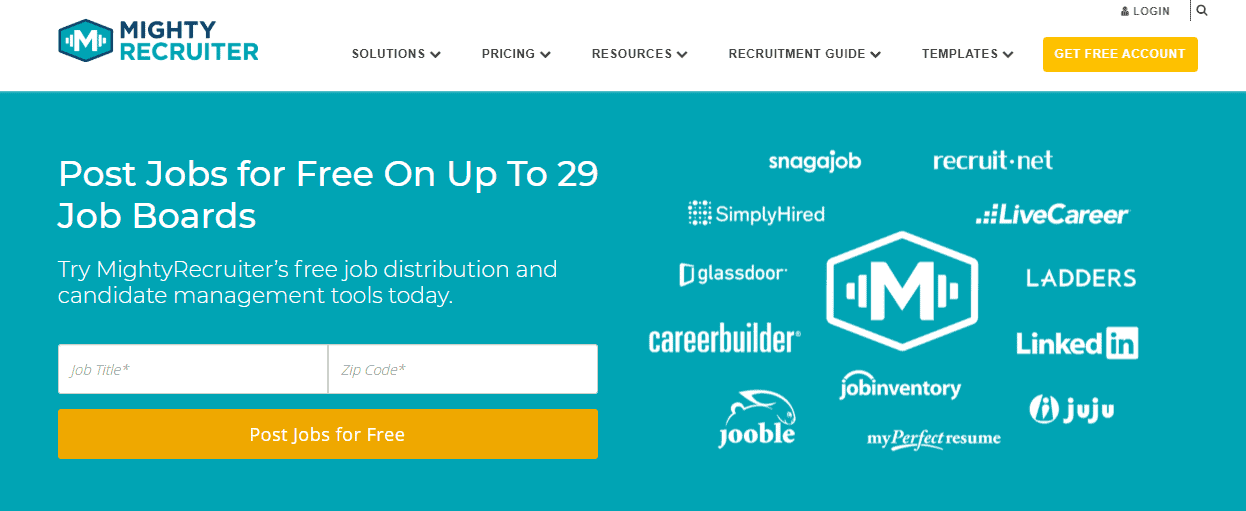
    MightyRecruiter is a job posting aggregator site – it allows you to post on various job posting platforms such as LinkedIn, Ladders and Glassdoor using its service. It offers a 30-day free plan which allows you to post job openings to over 20 such job posting platforms. There is also a paid plan starting at $189/month which provides you with the ability to post on an increased number of platforms.
    mightyrecruiter job posting
    Source: MightyRecruiter

    Indeed

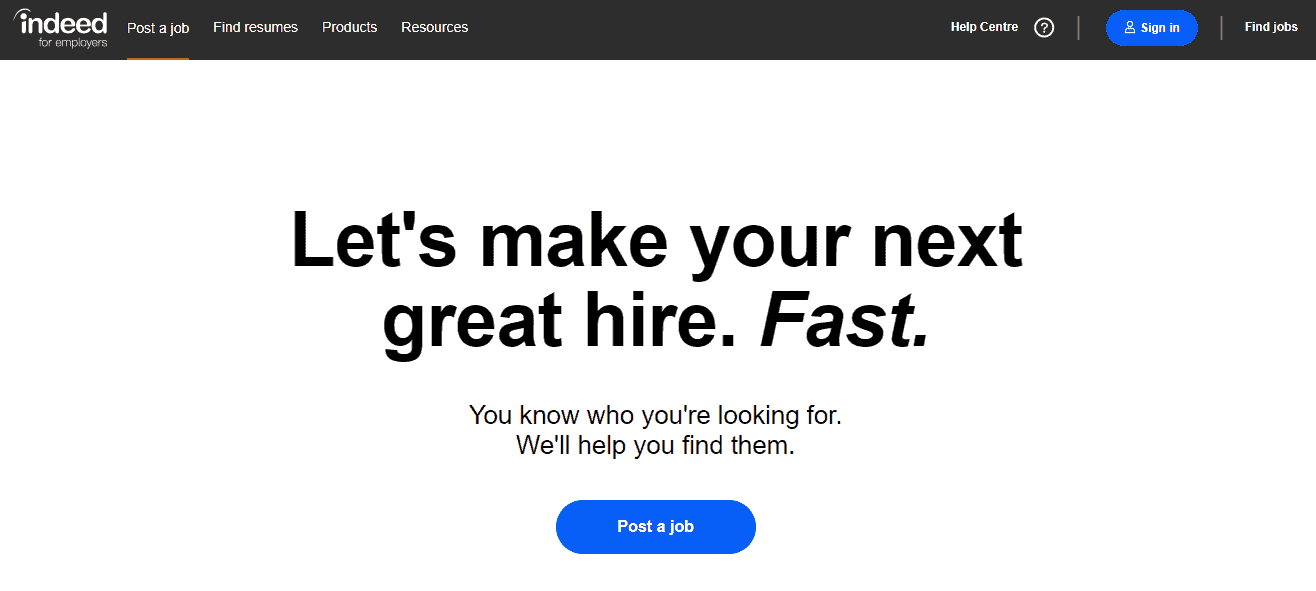
    Indeed is among the top 50 most visited sites at the time of writing, making it immensely lucrative for posting your jobs. Indeed offers a free job posting service wherein you can – post an unlimited number of job openings, free resume screening, accept mobile applications and manage applications right from your Indeed account. It also has paid plans that unlock certain features such as the ability to create hiring campaigns and the option of paying only when your posting is clicked upon. Indeed also has a clean and minimalist interface that is easy to get around.
    indeed job posting
    Source: Indeed

    Ladders

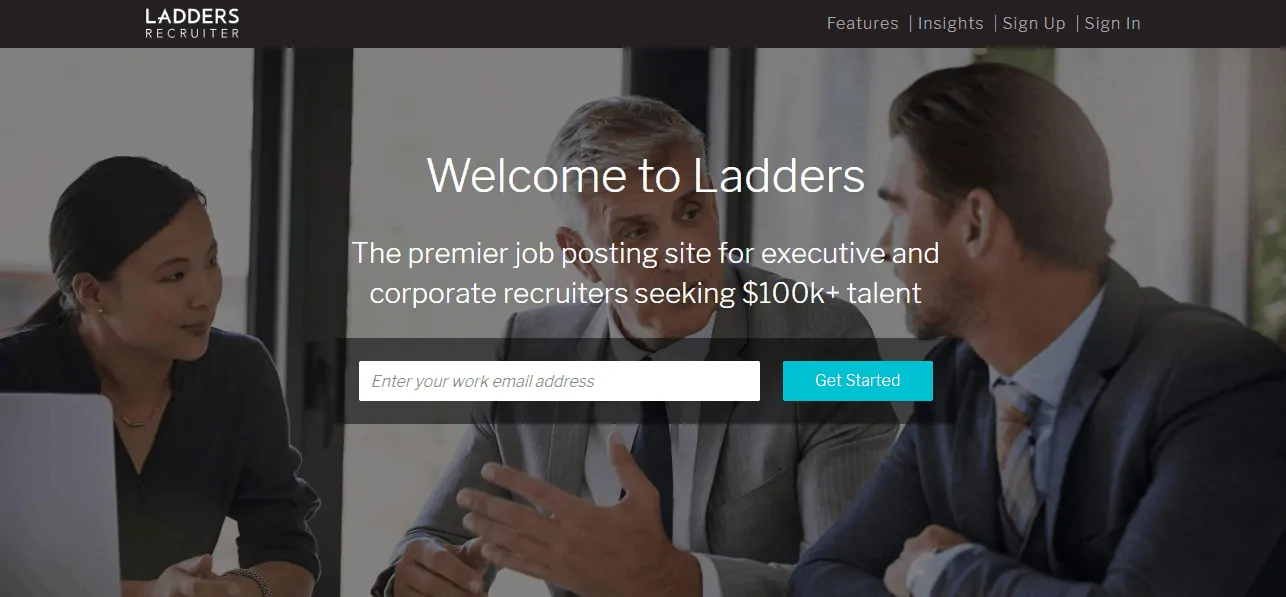
    Ladders is a more “focused” job posting site – it allows you to connect with already established and experienced candidates of the industry, making it that much easier on your part of finding talented individuals easily. It is more suited in case you are looking for hires who have proven to bring favourable results and have previous experience at particular designations. Ladders also allows you to post 20 job openings for free.
    ladders job posting
    Source: Ladders

    Glassdoor

    Glassdoor is considered as THE website for employees and employers. Such a website is also the perfect place for posting your vacancy or job advertisement. Glassdoor offers a 7-day free trial where it allows you to post your job opportunities and offers. The site is quite popular among job seekers and is a great place to start looking for new hires for your venture.
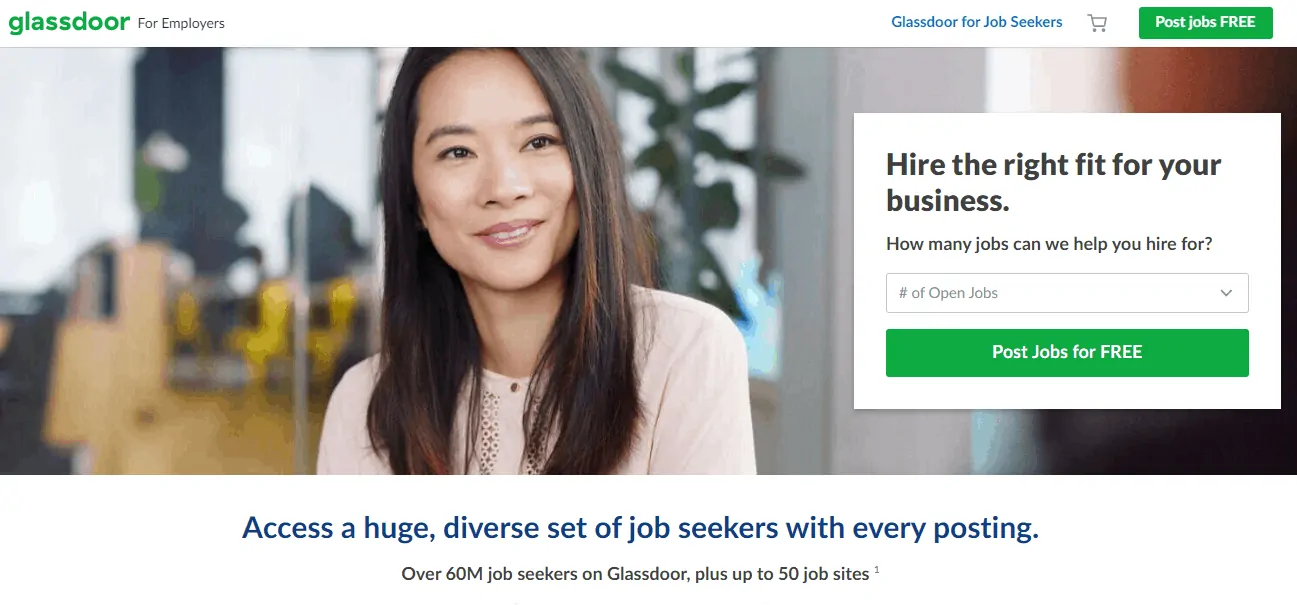
    glassdoor job posting
    Source: Glassdoor

    JobInventory.com

    JobInventory.com is a job aggregator site and is quite similar to MightyRecruiter in terms of functioning. It allows you to post your job openings to its site and for free. But it currently is only available for the US as of writing.
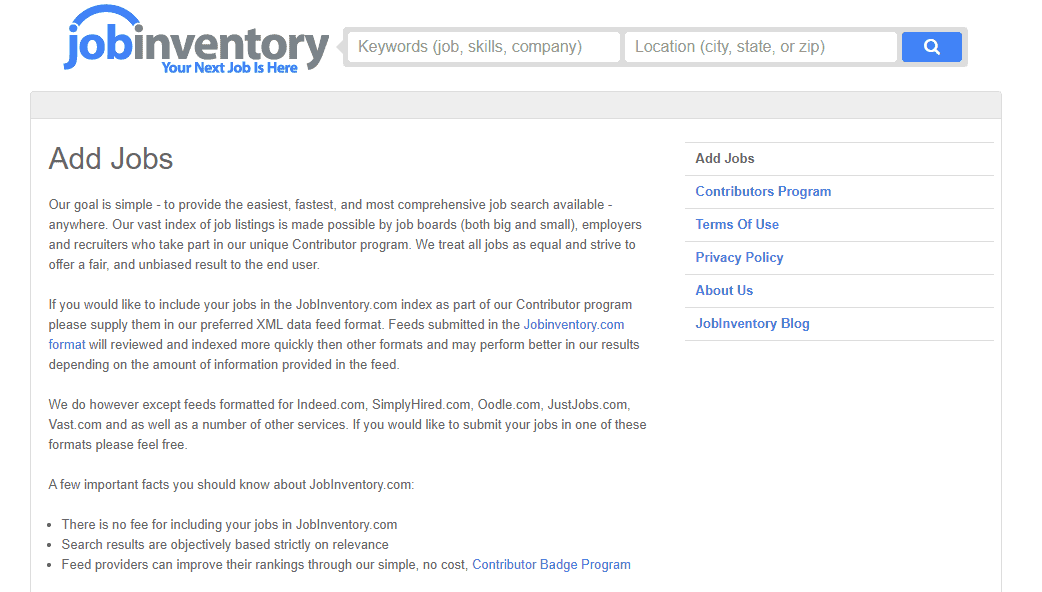
    jobinventory job posting
    Source: JobInventory

    Jora

    Unlike JobInventory.com, Jora is available internationally and it is truly free in the fact that there is no fee or charges for posting your job opportunities and vacancies. The site is also quite straight-forward and takes the least amount of time to get your job entries on its growing list. Jora is more of a job posting aggregator site – it collects and brings together job opportunities from various other job boards and forums.
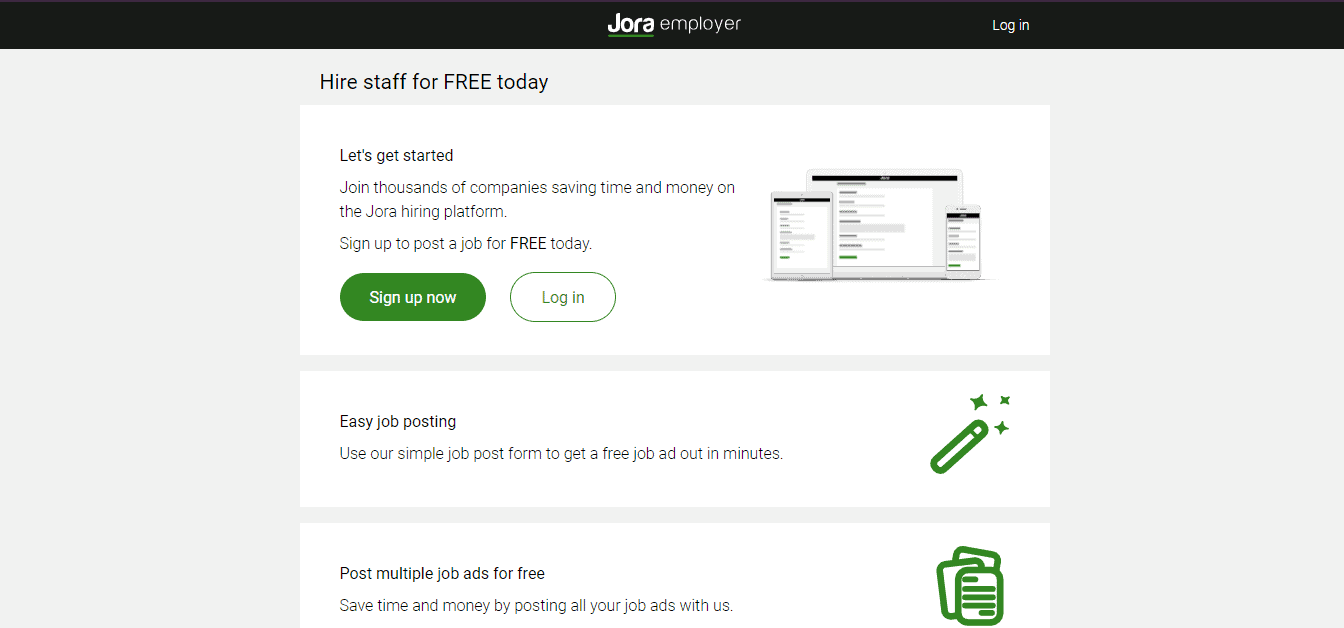
    jora job posting
    Source: Jora

    Internships.com

    Looking for an intern? Internships.com is your go-to site in case you want interns who are looking to hone in on their skills. Hiring interns also provide you with the opportunity to mould them exactly to your needs and they can also be made into full-time employees later down the line. Internships.com allows you to post an unlimited number of internships and also provides you with resources to step up your hiring game – all for free. But it is limited to the US alone.
    internships job posting
    Source: Internships

    StartUpers

    As the name suggests, StartUpers is the place for you if you are looking for hires for your startup. StartUpers markets itself as the “Secret Job Posting Board for Startups” and it lives up to its name – from Shopify to Slack to Medium, there are job postings from various startups from all over the world. StartUpers is free to use and posting your job opportunity is as simple as filling up a Google Docs form.
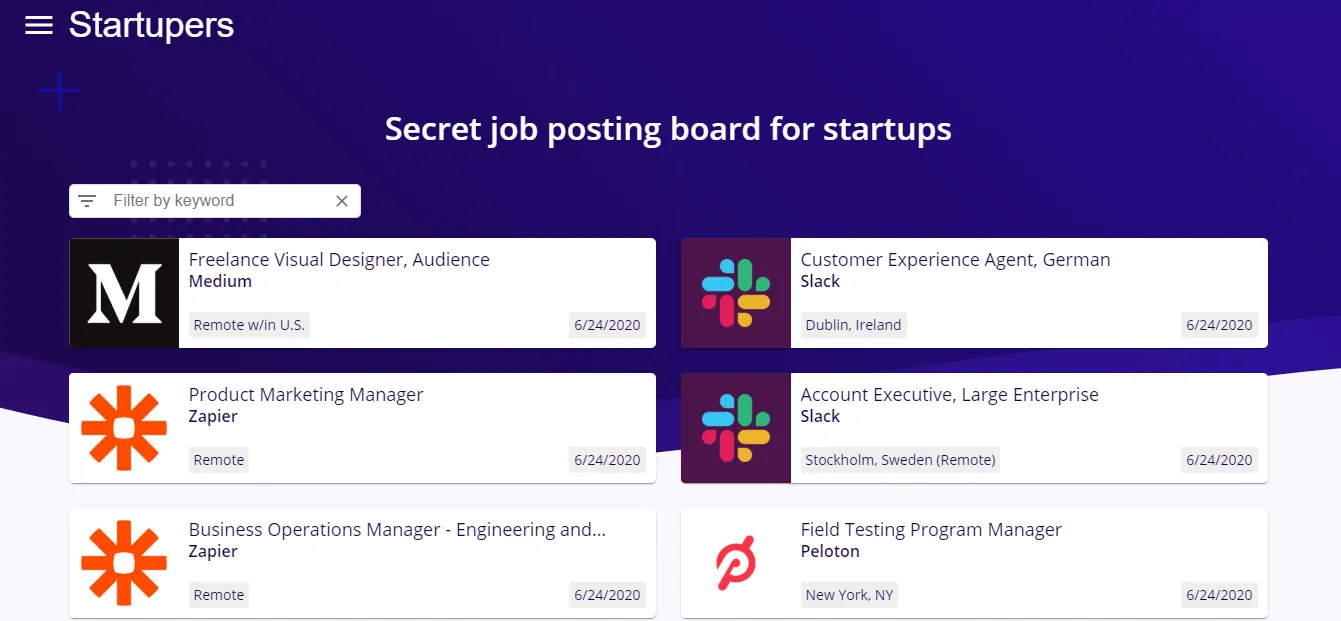
    startupers job posting
    Source: StartUpers

    AngelList

    AngelList is a tech-focussed job posting site that is similar to StartUpers. It is used by startups from all over the world for hiring top talents in their respective fields. This is the best place to list your job opening if you are an up and coming startup. AngelList allows you to post job opportunities and vacancies on its platform for free.
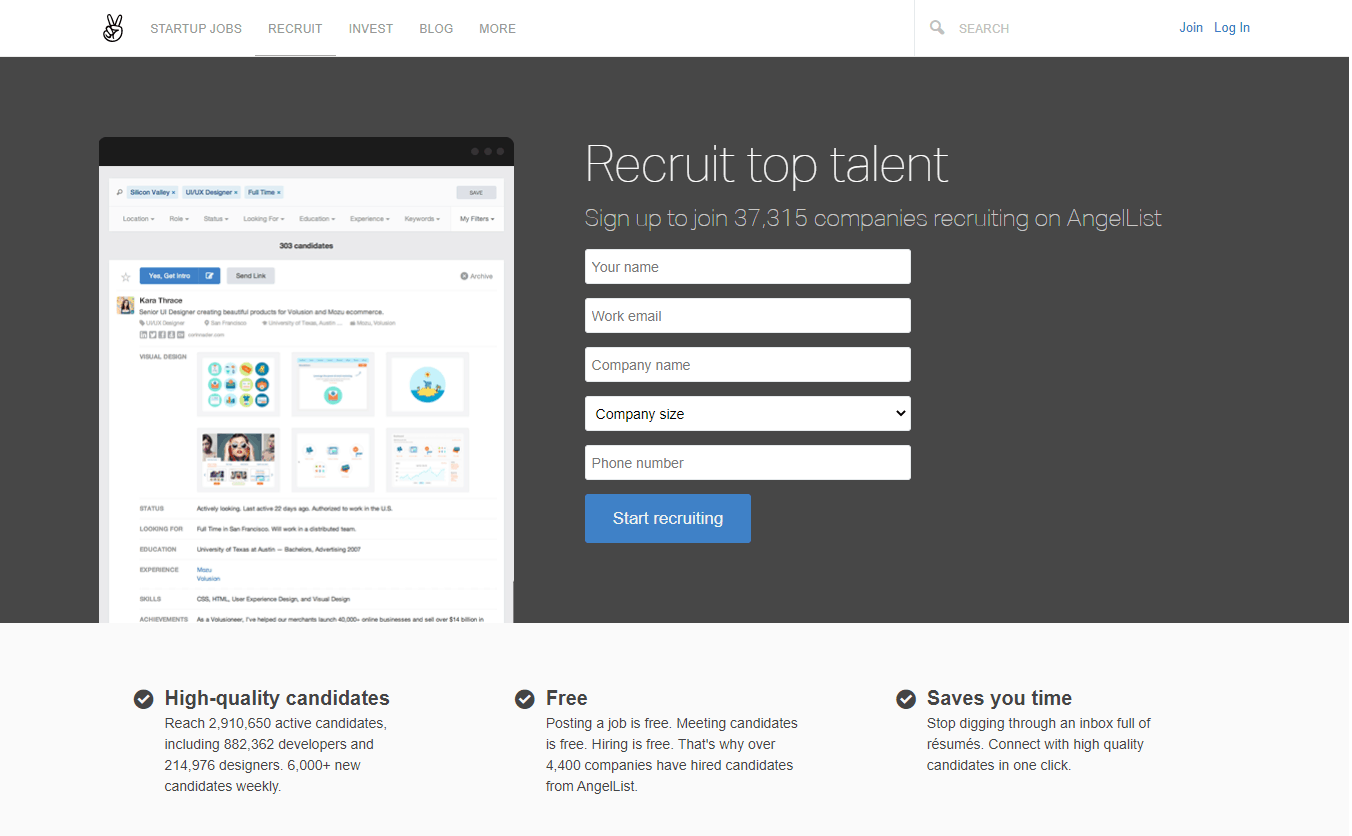
    angellist jobposting
    Source: AngelList

    Zippia

    Zippia is quite different from the rest in the fact that it widely uses artificial intelligence to find the best matches from millions of applicants to your job postings quickly and effortlessly. This helps drastically reduce the burden of going through hundreds of applications and letting you focus on the things at hand. Also, Zippia allows you to post jobs on its site and receive the most qualified applications sorted by the Zippia algorithm for free.
    zippia job posting
    Source: Zippia

    Learn4Good

    Learn4Good is a site focussed on providing educational and employment resources for students and job seekers alike. But it also is a great site for employers to look for new hires. Learn4Good allows you to post 20 jobs for free every 6 months and offers paid plans that allow you to post more jobs. The interface is more of function over form but do not let that discourage you – the site could net you your next hire quite quickly.
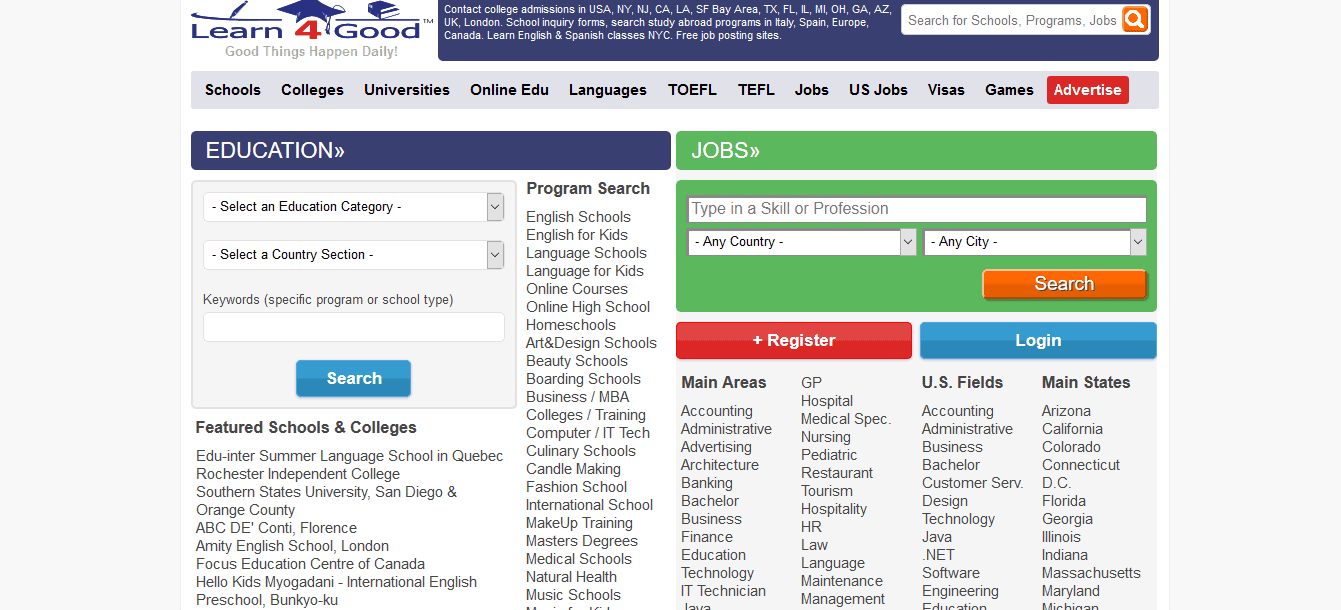
    Learn4Good
    Source: Learn4Good

    Freelance/Remote-Work job Posting Sites

    Upwork

    Upwork is an international marketplace for finding and posting freelance and remote-work jobs in particular. Upwork allows you to freely post job vacancies and opportunities that require remote-employees or freelancers.
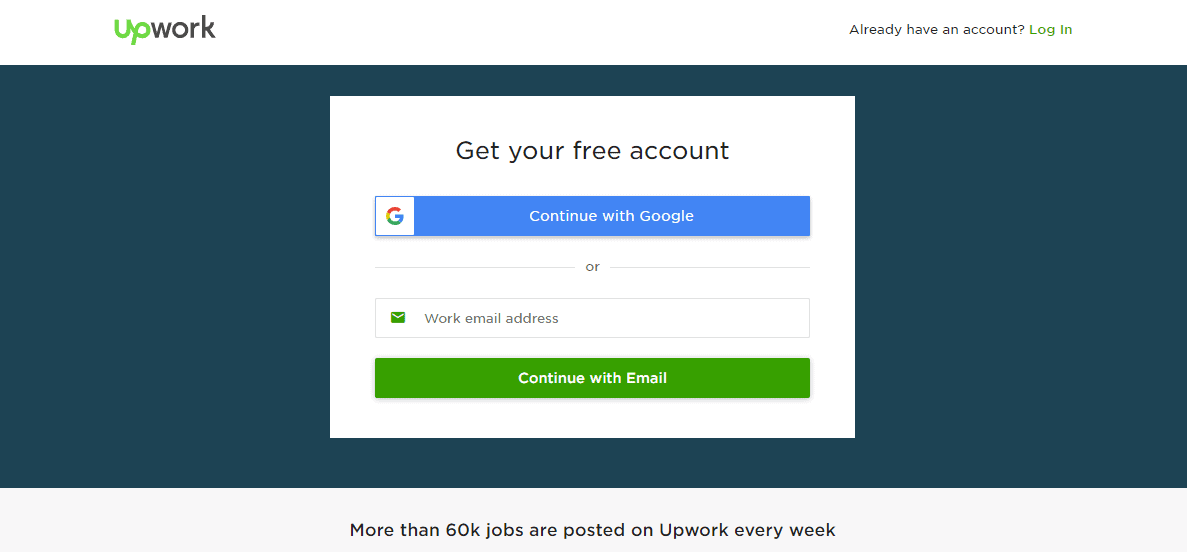
    upwork job posting
    Source: Upwork

    Freelancer.com

    Freelancer.com is similar to Upwork wherein it allows you to find freelancers and remote-workers for your job vacancy or project. It is free to use and post your job listing on Freelancer.com and it is as simple as filling up a form on its site.
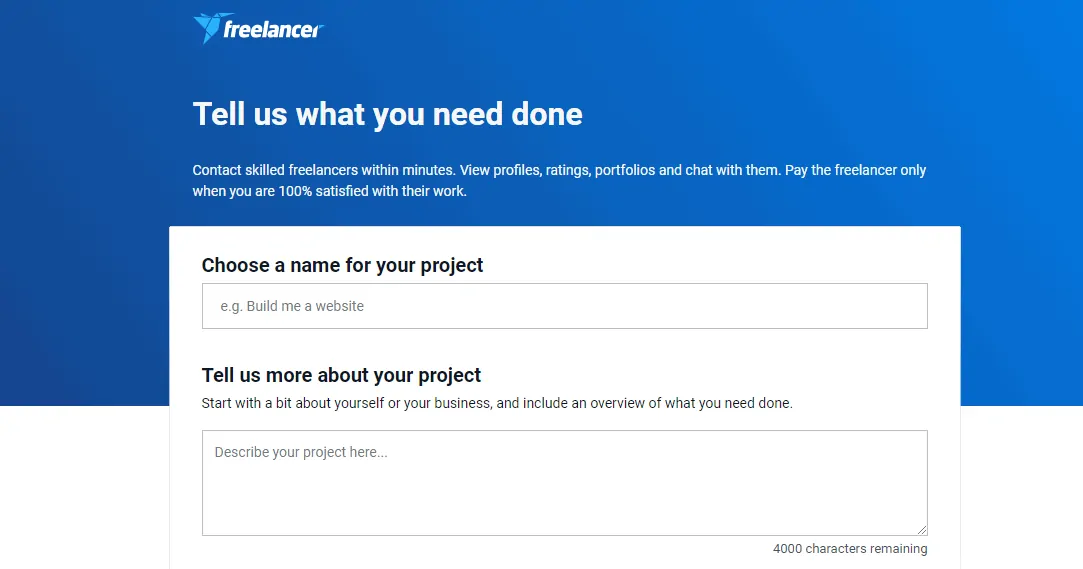
    freelancer job posting
    Source: Freelancer

    Guru

    Guru is another platform that primarily focuses on providing employers with the ability to post and find freelancers and related jobs. Guru is easy and entirely free to use. Listing your job on Guru is as simple as filling up a form and it also has a bespoke Enterprise plan (paid) in case you are working with or looking to work with a large number of freelancers with pricing based upon your needs.
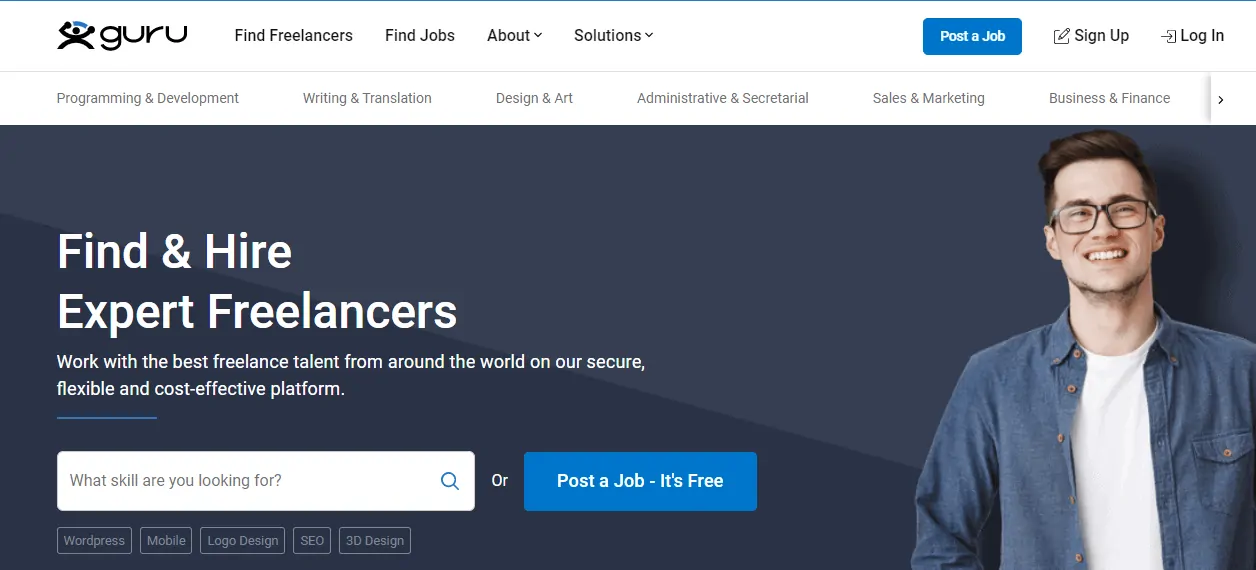
    guru job posting
    Source: Guru

    Fiverr

    Fiverr is a popular freelancing and remote work marketplace platform where the minimum rate is set to $5, hence the name. You could get to complete your project using a freelancer for as less as $5. Fiverr works differently from the others in the fact that it does not allow you to post your job opportunity. Instead, you can find from a list of freelancers who might be a good fit for your job opportunity or project, for free. Though it is to be noted that Fiverr takes a small cut from the payment made to the freelancer as fees.
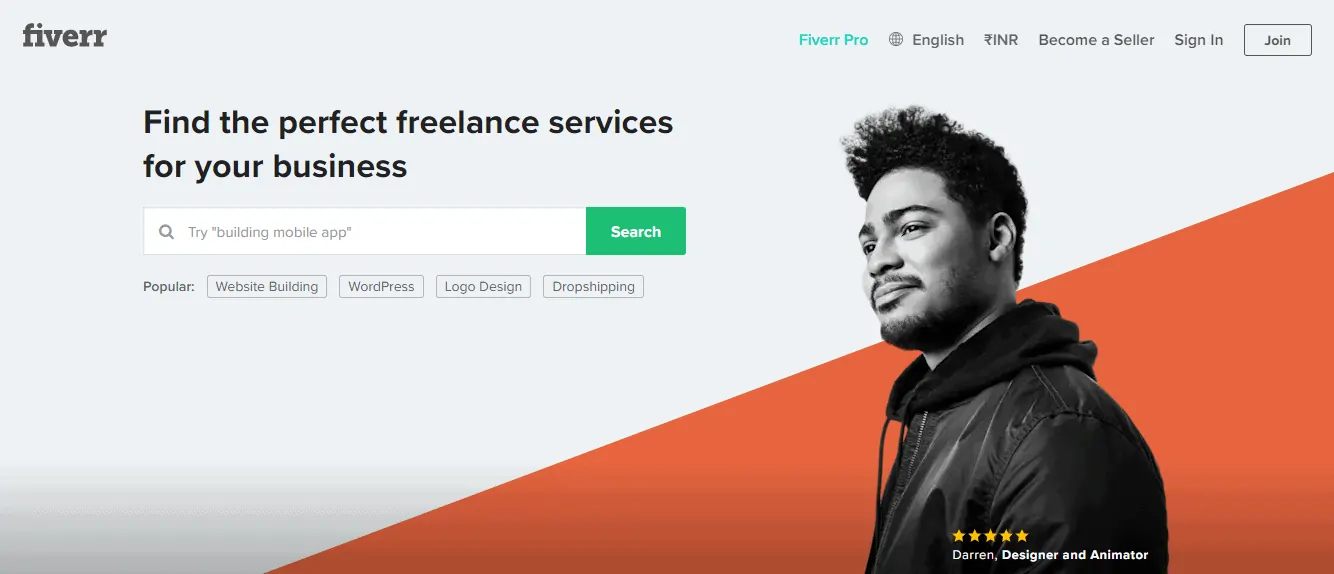
    fiverr gigs
    Source: Fiverr

    FlexJobs

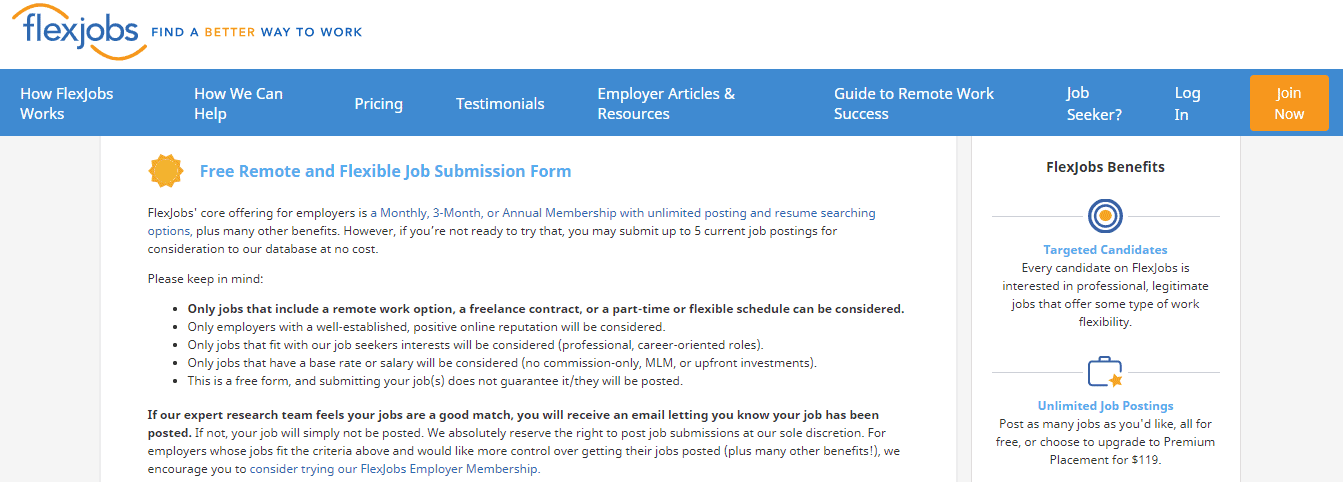
    FlexJobs is a more private and freelance job posting site wherein you are required to be invited into the platform after which you can post up to to 5 freelance job opportunities for free. It also offers paid membership plans that help you avoid all this and get directly to listing your job opportunity.
    flexjobs job posting
    Source: FlexJobs

    Outsourcely

    Many would not have heard about Outsourcely since it is kind of the new kid on the block. But it works really well as a platform that helps connect employers to a large range of remote workers from all over the world for cheap. Outsourcely does not charge any fees from the remote workers and instead charges employees for using the platform via subscription plans. But it allows you to post one free job opportunity on its site and connect with the incredibly talented remote workers present on the platform. Outsourcely works really well if you are on the lookout for remote workers or freelancers, especially for web development, content writing and digital designing.
    Outsourcely
    Source: Outsourcely

    Social Media Job Posting Sites

    LinkedIn

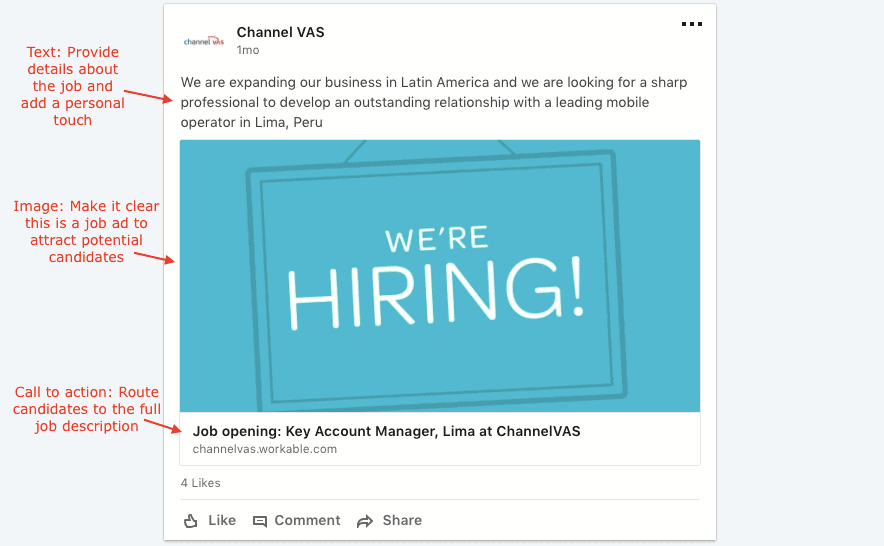
    LinkedIn is THE site for professionals to hang out and meet up. LinkedIn is a great site for posting your job vacancies and opportunities as posts or to other pages within LinkedIn. With it being a social media platform, it is that much easier to share your job posting as a status for free which can be then easily shared and viewed by others. LinkedIn also offers dedicated hiring tools for a fee but the built-in messaging is more than enough for responding to the received applications.
    linkedin job posting
    LinkedIn job posting Template | Source: Workable

    Facebook

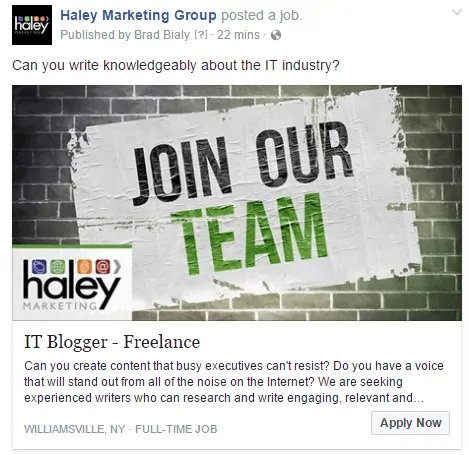
    Facebook has its very own job posting feature. Yes, posting jobs on Facebook does not mean just putting up status but more like creating a job listing as you would on any other employment-related site. In order to create aa job posting on Facebook, all you have to do is to –

    • Create or go to your Facebook Page
    • Click on “Create” -> “Job”
    • Fill in the details and publish it

    The published job gets posted on your page as well as under the “Jobs on Facebook site where thousands of users search and view for employment opportunities. Posting on Facebook has its inherent benefits – it allows you to reach large audiences easily and it easier to promote and share your job posting with others. You also have the option of advertising your job vacancies and listing on Facebook and other Facebook-owned services such as Instagram using Facebook Ads. For a very small fee, you can advertise on various platforms, which have massive user numbers and drastically increase the chances of your job posting being viewed by an interested party.
    facebook job posting
    An job status example on Facebook | Source: Haley Marketing Group

    Reddit

    Reddit, simply put, is a massive collection of forums and chat boards where users can post and vote on things they like. The more the number of votes, the higher it is pushed on the site and eventually shown on the homepage. It is among the top 20 most visited site as of wiring and the sheer number of visitors can be leveraged as a way to get your job posting more publicity. Reddit is a great place to look for your next recruit and there are dedicated sub-forums (knows as subreddits) to recruiting, hiring, job applications and such. Here are few for you to get started with: r/Jobs and r/Recruitment.
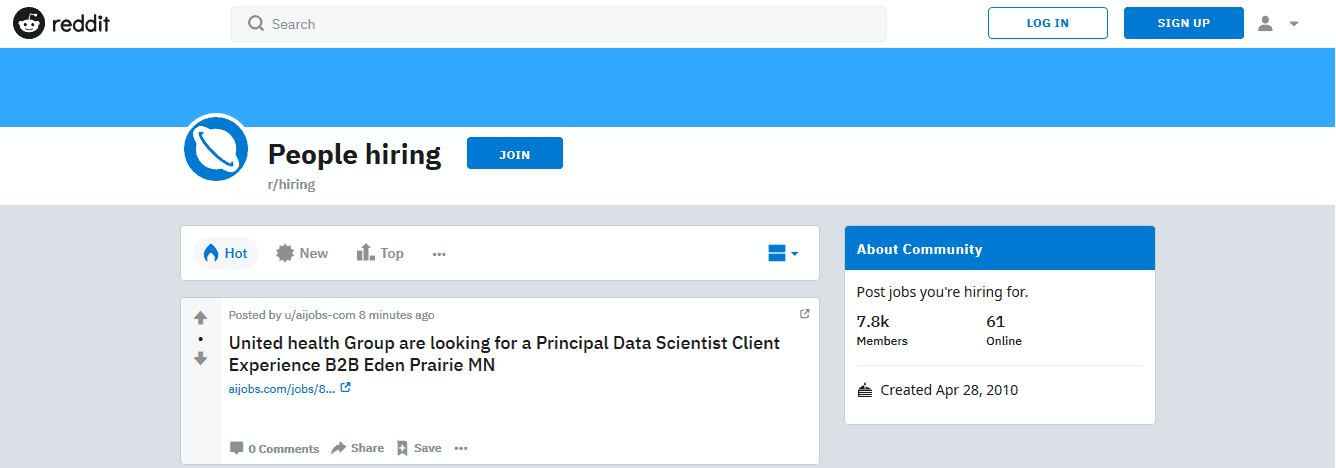
    reddit job posting subreddit
    One of the many job posting subreddits – r/hiring | Source: Reddit

    Go On, Tell Us What You Think!

    Did we miss something?  Come on! Tell us what you think about our article on 20 Best Job Posting Sites in the comments section.
  • The History Of Microsoft

    The History Of Microsoft

    Did you know Microsoft’s first operating system was not Windows? It’s first OS was based on Unix.

    But Microsoft helped bring the operating system for the masses. It is one of the most popular and valuable companies in the world and among the very few to have even reached a trillion-dollar valuation

    But, how did Microsoft get to where it is today?

    Let’s have a look at Microsoft’s history – right from its humble beginnings to becoming the tech giant that it is today.

    Beginning of “Micro-Soft”

    Microsoft was founded on April 4, 1975, by two friends Paul Allen and Bill Gates. It all began when Paul Allen got fascinated when the first microcomputer, Altair 8800 was realised the previous year.

    Upon hearing about the new microcomputer system, Paul approached his childhood friend Bill Gates, who was a sophomore at Harvard, to share and hear his take on the new system. Paul and Bill were geeks at the truest sense – they both were totally into computers and never missed the chance to experience anything related to technology.

    It was said that the two usually used to skipped classes in their high school to tinker with the computers there and once even got caught for hacking into their school systems. But instead of being punished, the two were asked to help pentest and help the school strengthen their computer systems.

    With such a background, the two were eager to share about anything related to technology and both soon realised the potential of the microsystem. They decided on developing an implementation of BASIC – a general-purpose high-level programming language – for the Altair 8800 microsystem.

    altair 8800
    The Altair 8800 Microsystem | Source: MediaTek

    So both, Paul and Bill founded Microsoft in an Albuquerque garage in 1975 and soon moved to a motel nearby, where they wrote the BASIC port for Altair 8800. Their BASIC implementation for the Altair 8800 was a success and the new system was sold by Altair’s manufacturer as Altair BASIC and both Paul and Bill knew that they had something unique in their hands.

    This became the first product to be developed by them under the newly formed Microsoft.

    Exploding Onto The Scene – DOS, Microsoft Word & PCs

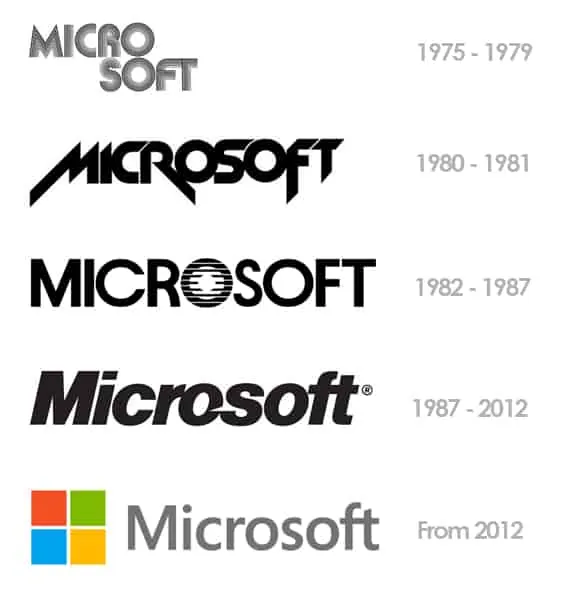
    Initially, Microsoft was known by the name that Paul came up with – “Micro-soft”, a hyphenated version of microcomputer and software. This name stuck for a while and they even registered the company under the same name in Albuquerque, New Mexico on November 26, 1976.

    microsoft logos
    Microsoft Logos over the years | Source: Dowitcher Designs

    Microsoft grew quickly in size and scale – it made its first $1 million in 1978, just three years after starting. They soon felt the need to shift their headquarters to Washington since it was hard to find good programming talent around New Mexico. On January 1, 1979, Microsoft moved to Bellevue, Washington which remained as its headquarters for around 7 years.

    The company was incorporated in Washington, D.C. under the name “Microsoft Corporation, Inc.” on June 25, 1981. The name stuck chords with everyone at the company after Bill Gates started calling it that. With having incorporated the company, it was announced that Bill Gates and Paul Allen would be the president and executive vice-president respectively, with both of them being a part of the Microsoft board.

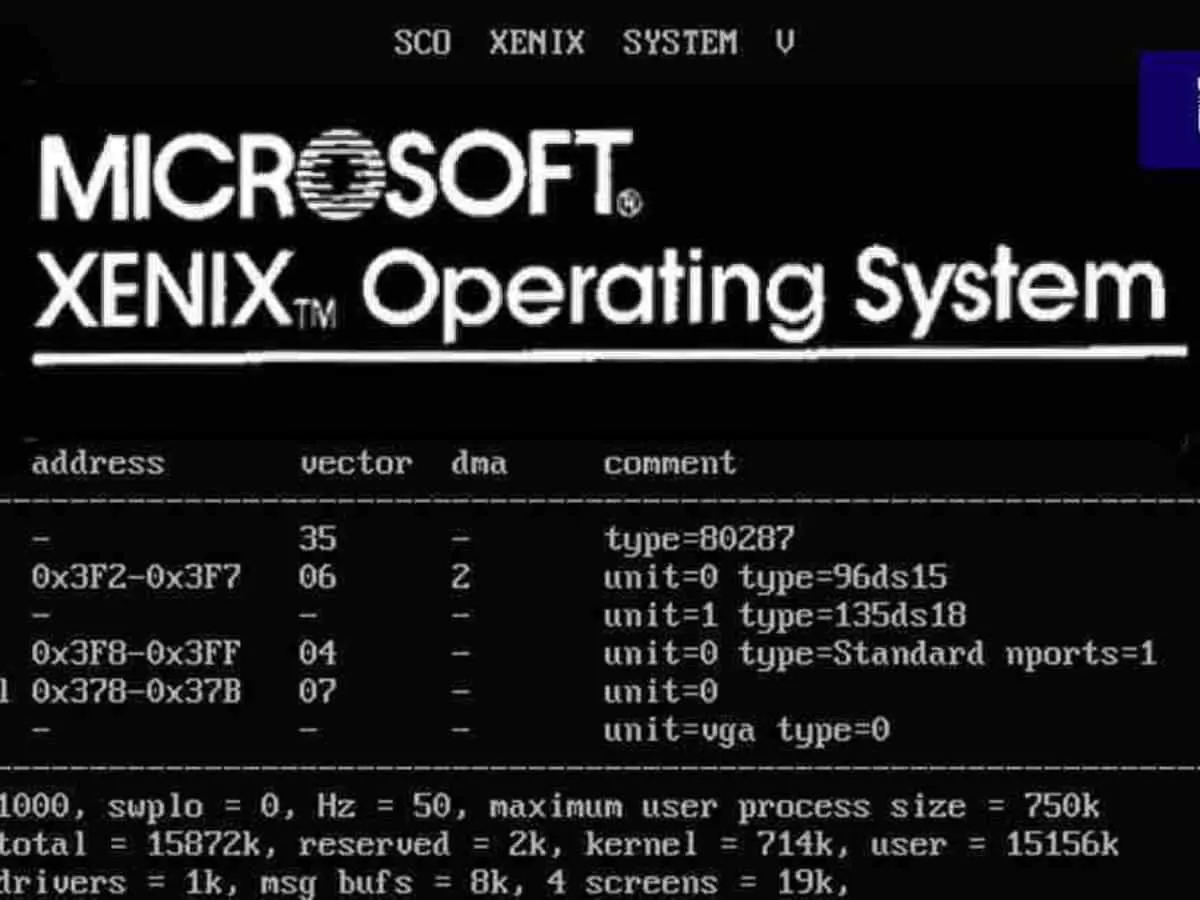
    After the shift, the company started focussing on producing software for various systems and companies. Apart from its take on the BASIC programming language for different systems, Microsoft also launched its very first operating system – Xenix in 1980. Xenix was a port of the Unix operating system that it licensed over from AT&T Corporation.

    microsoft xenix
    Microsoft’s Xenix Operating System | Source: Fossbytes

    It was also during the same year that Microsoft launched its very first hardware product, the Z-80 SoftCard – a piece of tech that allowed Apple computers to CP/M (an operating system) – and this turned out to be a huge success. The Z-80 SoftCard even became the main source of revenue for that year, helping Microsoft stay afloat.

    Entering The PC Market

    Microsoft’s breakthrough into the PC market came in 1980 when IBM approached Microsoft to develop the operating system for its upcoming IBM PCs. Microsoft was among the few companies that were approached by IBM and eventually IBM gave the contract to Microsoft to develop a CP/M operating system for the IBM PC.

    bill gates paul allen
    Paul Allen (left) & Bill Gates (right) in 1981 after signing the IBM deal | Source: Verge

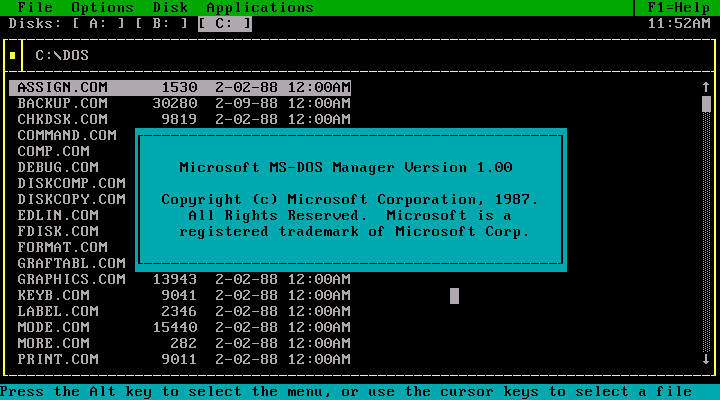
    Instead of developing from the scratch, Microsoft bought a CP/M clone named 86-DOS and made changes to it as MS-DOS or Microsoft Disk Operating System. IBM released its IBM PC in August 1981 and marketed CP/M and MS-DOS versions for around $240 and $40.

    ms dos
    MS-DOS | Source: WinWorld

    This lower price led to MS-DOS becoming the standard for the IBM PC. The IBM PC sold in large numbers and helped put Microsoft in the minds of the consumers and enthusiasts alike.

    ibm pc
    IBM PCs that were running MS-DOS | Source: IBM Archives

    In 1983, Microsoft released its word processing software Multi-Tool Word which was later renamed to Microsoft Word. People took notice of Microsoft Word since it was much easier and intuitive to use than what was currently available in the market. During the same year, it launched the Microsoft Mouse, which was also given away for free with every purchase of Microsoft Word.

    Windows

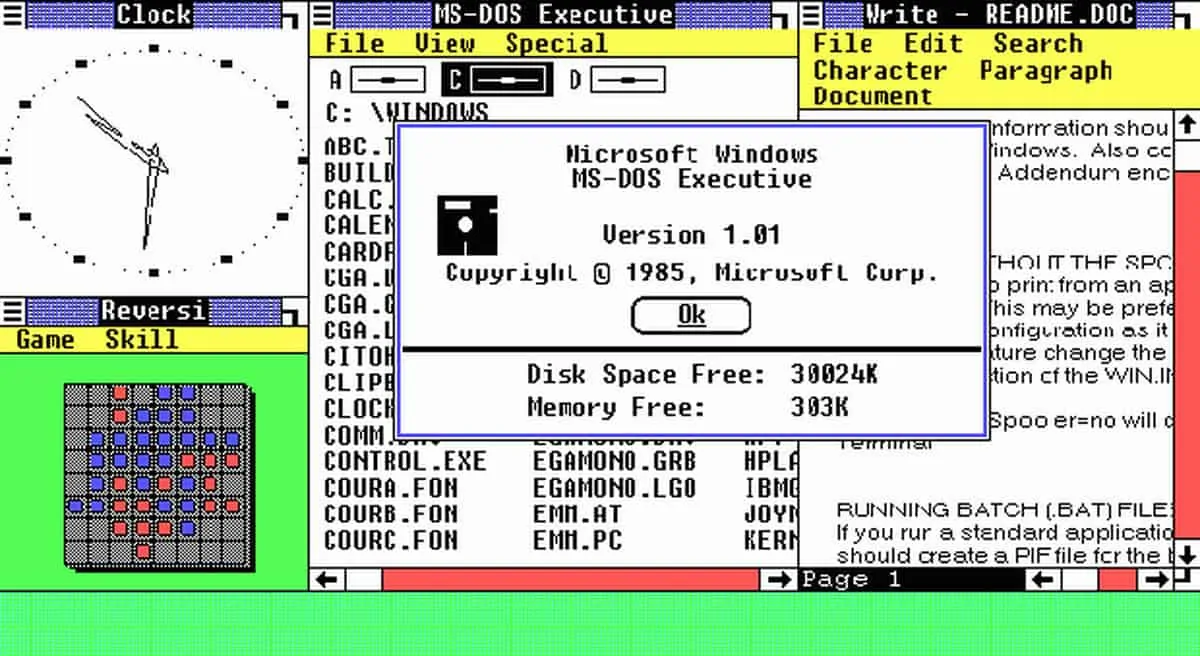
    Microsoft launched the first version of its renowned Windows operating system software in November 1985 named Microsoft Windows. It was initially launched as a GUI for its existing MS-DOS operating system but soon went onto becoming a standalone software.

    microsoft windows
    Microsoft Windows 1.01 | Source: ZDNet

    New Digs & IPO

    On February 16, 1986, Microsoft moved its headquarters from Bellevue to Redmond, Washington, where it remains as Microsoft’s main headquarters. On March 13, 1986, Microsoft held its IPO and managed to raise $61 million at $21 per share.

    Apart from the Windows operating system, Microsoft was also working on Microsoft Works – a software that provided features founds in word processors, spreadsheets and database. In 1987, Microsoft made its first acquisition by purchasing Forethought, Inc. for around $14million. Forethought were the developers of what is now known as Microsoft PowerPoint – the slide presentation software. This soon paved the way for its well-known and highly successful office suite – Microsoft Office.

    Microsoft Office

    On August 8, 1989, Microsoft launched the Microsoft Office, and it was a bundle of separate programs such as Microsoft Word, Microsoft Excel and Microsoft PowerPoint and so on.

    microsoft word
    Source: The Windows Club

    On May 22, 1990, Microsoft launched its Windows 3.0 which featured a much-streamlined user interface and Windows OS along with the Microsoft Office helped Windows gain a lot of popularity and traction among the general consumers and by 1993, Windows became the most popular and widely used GUI-based operating system. Moreover, the ease of use and functionality of Microsoft Office led to it becoming the most popular office productivity software.

    Here’s a list of major versions of Windows that Microsoft has launched over the years and the features that it bought to the table –

    OS
    Release Date
    Features & Changes
    Windows 95
    August 1995
    DirectX, Start button, 32-bit support, new UI, plug-n-play support
    Windows 98
    June 1998
    New filesystem support, integrated web browser (Internet Explorer)
    Windows 2000
    February 2000
    Different versions: Professional, Server, Advanced Server & Datacenter server
    Windows XP
    October 2001
    Redesigned UI, improved stability
    Windows Vista
    November 2006
    New UI, improved security, performance and stability
    Windows 7
    October 2009
    Improved Vista UI, internet performance and security
    Windows 8
    August 2012
    Metro UI, focus on touch-based inputs
    Windows 10
    July 2015
    Emphasis on a unified operating system, simplified UI, performance, stability and security improvements.

    The Modern Microsoft – Taking on The Internet

    Microsoft, though a little late to the party due to its successes in PC software, soon realised the importance of the role of internet in the future of the industry. Though it had developed the Windows NT (NT stands for New Technologies) which offered more focus towards networking and interconnectivity among different PCs in 1993 itself, Microsoft did not enter the internet sector till years later.

    It was only after the launch and following success of the Netscape Navigator web browser that Microsoft stood up and took notice. But to its credit, Microsoft soon focussed most of its attention to embracing the internet and bring in more networking features to all its products.

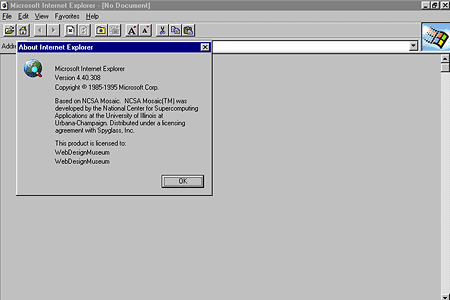
    On 16 August 1995, Microsoft launched its very own web browser, the Internet Explorer.

    internet explorer 1.0
    Internet Explorer | Source: Web Design Museum

    Microsoft marketed Internet Explorer for free. This was at a time when Netscape Navigator and most other competitors charged for their web browser software.

    Along with that, the bundling of the Internet Explorer into its Windows operating system helped it to become the most widely used internet browser in no time. Many legacy users and businesses still use internet explorer to this date. Microsoft, in general, became more focussed on internet and cloud infrastructure since then.

    Entering The Gaming Market

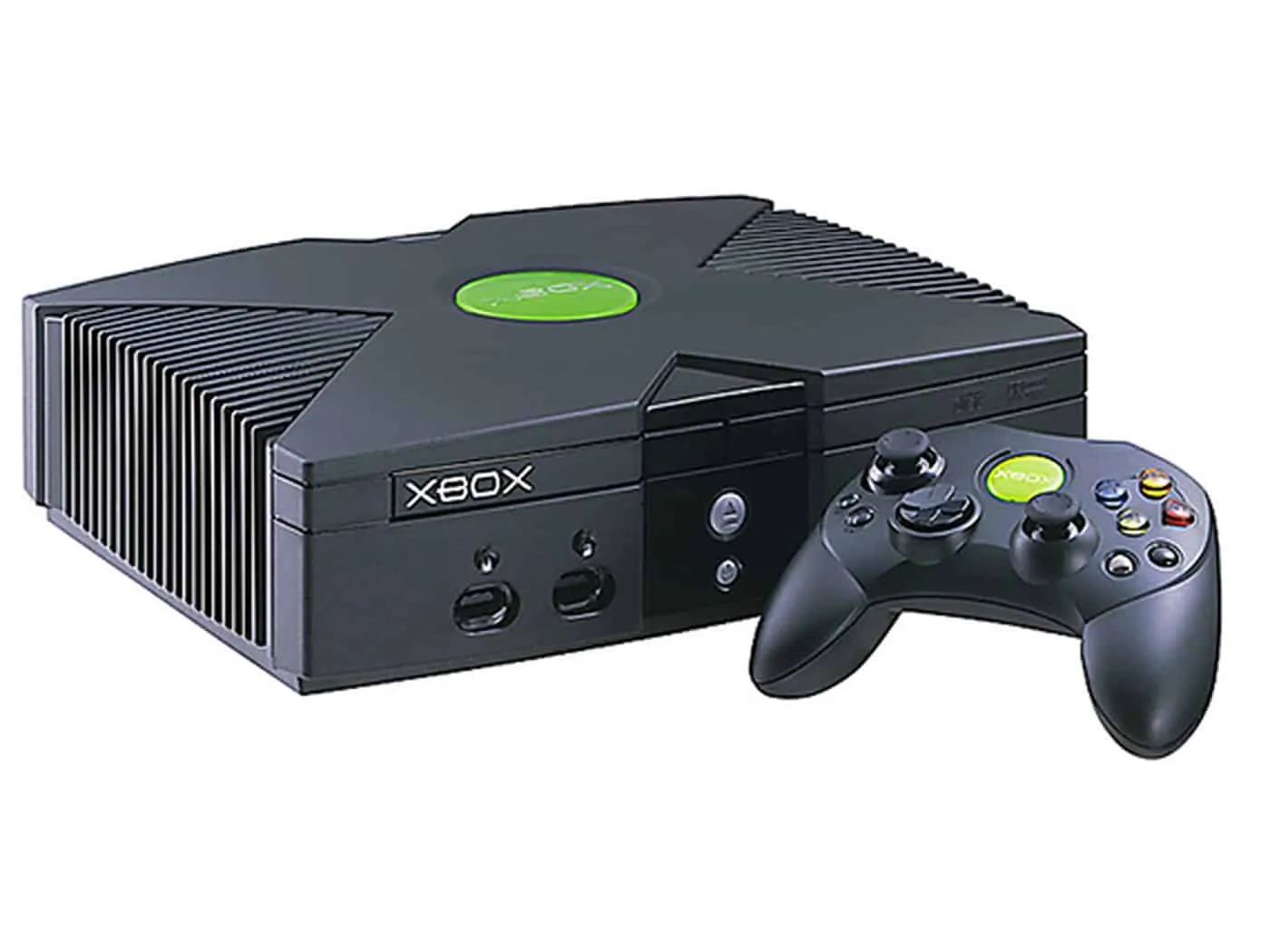
    In 2001, Microsoft released the Xbox, its first gaming console and it proved to be successful after a while.

    original xbox
    Original Xbox | Source: Verge

    But this was not Microsoft’s first entry into the gaming market. It previously had released DirectX, an application program interface (API) for the Windows platform (starting with Windows 95) in 1995 which made it easier for developers to handle game programming and multimedia in the new Windows OS.

    The Xbox console became one of the most well-known gaming consoles and Microsoft released newer versions along the way –

    • Xbox 360 (2005)
    • Xbox 360 S (2010)
    • Xbox 360 E (2013)
    • Xbox One (2013)
    • Xbox One S (2016)
    • Xbox One X (2017)

    Apart from the consoles, Microsoft also launched the Xbox Live service – an online gaming network service which allowed users to be able to play online multiplayer, connect with friends, download or buy new content online, as well as receive updates and subscription-based content using the internet.

    Focusing On The Cloud

    Microsoft was already catering to the enterprise market with their server focussed operating systems, office & productivity software suites, it was also trying to enter the cloud market. In 2008, Microsoft launched its very own cloud platform called the Microsoft Azure and it soon became the leaders in the cloud computing industry.

    microsoft azure
    Source: Microsoft

    Microsoft Hardware

    Initially, Microsoft was more focussed on developing software rather than hardware since the software was where it truly made its mark. But that is not to say that Microsoft ignored hardware.

    Microsoft has always been producing its hardware in-house under the Hardware Division. It was created in 1982 and currently handles much more than just the Xbox and Microsoft peripherals.

    Microsoft has launched a lot of hardware products since then and here are a few notable ones among them –

    • Microsoft Hololens (2016)
    microsoft hololens
    Hololens 2 | Source: 4Experience
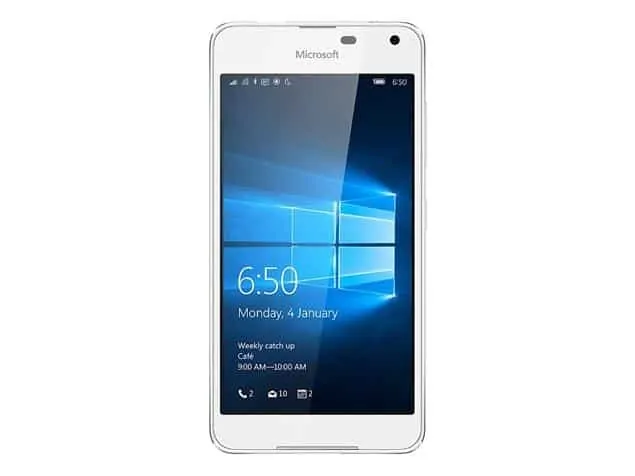
    • Microsoft Lumia smartphones (2011)
    lumia 650
    The Microsoft Lumia 650 | Source: NDTV
    • Microsoft Surface – Laptop & Tablet PCs (2012)
    microsoft surface
    Microsoft Surface Devices | Source: Microsoft
    • Zune portable media player (2006)
    microsoft zune
    Microsoft Zune Portable Media Player | Source: Wired

    These hardware products usually served as halo products or as benchmark products for OEM’s to take inspiration from. While some failed to take off, others even became a sizeable part of the revenue source for the company.

    Venturing Away From PCs

    Microsoft was quite diversified, but just not in the normal sense. Since its founding days, Microsoft has acquired over 190 companies to date. Most of these are software-based companies that Microsoft absorbed into its upcoming products or rebranded & reused it as is under the Microsoft banner. Usually, these companies were the ones developing office, productivity, gaming and entertainment-based software.

    However, there are a few notable acquisitions that helped Microsoft diversify itself and into developing other products and services.

    • Skype ($8.5 billion in 2011) – Skype is a video chat and conferencing service
    • Nokia ($7.2 billion in 2013) – Nokia is a Finnish telecommunications and consumer electronics company famous for their mobile phones during the early half of the 2000s. It initially helped sell Nokia branded Lumia phones that ran Windows Phone OS and soon was rebranded as Microsoft Lumia and was eventually sold back to HMD Global.
    • Mojang ($2.5 billion in 2014) – Mojang is the developer of the popular video-game Minecraft.
    • LinkedIn ($28.1 billion in 2016) – LinkedIn is a business and employment social network platform and remains to be Microsoft’s largest acquisition to date.

    Microsoft In 2020s

    Microsoft is currently among the most valuable and popular companies in the world. Its operating systems, software, hardware products are used everywhere – within homes to large enterprises and institutions. Microsoft has started to focus more on the things that work while trying to reduce spending and development on things that don’t and seem to be slowing down on their experimentation phase.

    That is not to say that they have completely stopped experimenting with new technologies and services. Products such as the Hololens – a holographic AR wearable headset – help say otherwise.

    • In June 2019, Microsoft reached the trillion-dollar valuation for the first time, becoming the third tech company in the world to ever do so, after Apple and Amazon.
    • Microsoft has over 190 companies under its belt
    • It is the second-largest cloud service provider in the world
    • Microsoft Windows is run on over 80% of the laptops and desktop computers in the world as of writing. Compared to that, only 10% of computers run Apple’s macOS.

    Go On, Tell Us What You Think!

    Did we miss something?  Come on! Tell us what you think about our article on History Of Microsoft in the comments section.

  • How To Find Investors For Your Startup?

    How To Find Investors For Your Startup?

    If we consider starting up to be a video game, the investment phase is the boss level.

    While getting to this boss level itself is the task, only a very few startups get past this stage. In fact, only 0.05% of startups succeed in raising venture capital.

    But that’s another story. For now, let’s be optimistic and look at the positive aspects– over 10,400 companies received $133 billion in funding in 2019 in the USA alone.

    So, if you’re a new entrepreneur unaware of the funding intricacies, here’s a comprehensive guide to help you find investors for your startup.

    But before we start, answer this –

    Which stage is your startup in?

    Why, you ask?

    Because each stage requires you to approach a different type of investor.

    Pre-Seed Stage

    • Startup’s operations are getting off the ground
    • No real customer traction
    • Test products (prototypes, proof of concepts, and MVP) are built to validate assumptions
    • The average ticket size is low due to the nascent stage of the startup.
    • The average investment by a single investor is less than $150,000

    If we consider the startup business to be a plant, the pre-seed stage is actually what it sounds like – the stage when the business isn’t even started.

    In this stage, you have a concept which is still under development. You need to convert this concept further into a feasible business. The process requires various assumptions, numerous tests, and in some cases, a bit of investment too.

    But, since there is no business during the pre-seed stage, many investors try to stay away and wait till the founders turn the idea into a validated business.

    But if we divide the sources of investment for startups according to the sub-phase of pre-seed, there’s a way for you to find an investor for your startup even when all you have is an idea. Moreover, there are a lot of benefits in for them, like lower investment/higher equity and getting the first-mover advantage by getting more equity than they would have in subsequent rounds.

    Finding Pre-Seed Investment When All You Have Is An Idea Or Concept

    Believe it or not, you require an MVP to prove your concept to anyone that you have a viable business concept. But in cases where you need funds to develop an MVP to generate funds further, here are the sources of investments you can look for –

    FFF (Family, Friends, & Fools)

    These are the people who want to support your project because they believe in you or your team. These are the people who are more willing to invest in the people behind the idea than the actual idea.

    Such investments are more likely to be in the form of debts as there’s no equity in an idea. But such debt can be in the form of convertible debt, where debt converts to equity at some later date.

    Debt Funding

    Banks don’t invest in ideas, but they do invest in you based on your credit score. An early-stage investment for your business could be in the form of a personal loan from the bank.

    Pitch Competitions

    A pitch competition is a competition where you have a limited time to present your business idea in front of an audience and a jury.

    While preferred for the post-MVP stage, there are many pitch competitions that are open for pitching just ideas as well. These startup pitch competitions are perfect for getting that little push you wanted to pursue your idea in both monetary and non-monetary terms.

    Monetarily, these competitions can offer you benefits ranging from $5,000 to a few hundred thousand dollars.

    There are numerous pitch competitions for every niche and every country.

    All you need to do is Google “pitch competition” + “your country”

    pitch competitions

    The best part about pitch competitions is that you can apply for as many as you want. But to ace these competitions, make sure your pitch deck has the following elements –

    • Problem
    • Opportunity
    • Solution
    • Product
    • Competitor Analysis
    • Business Model
    • Unique Proposition/Key Highlight
    • Team

    P2P Lending

    Peer-to-peer lending, also called social lending, is a new practice of obtaining loans from many individual lenders, eliminating the financial institution as the middleman.

    Usually, these are unsecured personal ranging from $2K to $35K that can be obtained by verifying your personal and financial information on platforms like –

    • Funding Circle
    • Prosper
    • Lending Club
    • Peerform
    • Upstart

    Even though it is easier to get a loan from a P2P lending platform, the rate of interest could be as high as 35.99% APR depending upon your profile and trustworthiness.

    Finding Pre-Seed Investment When Your Concept Is Validated

    Developing an MVP and validating your problem-solution fit and product-market fit assumption opens the gates to a lot of investment sources. These include –

    Incubators

    Incubators are collaborative programs designed to help your startup develop during its initial stages until it is able to sustain itself in the market.

    In simple terms, an incubator is a collaborative program consisting of investors and mentors to help your early-stage startup develop into a self-sustaining business. It can be a not-for-profit or a for-profit organisation backed by a university, government, or corporate that provides you with expertise and constant guidance and support from startup experts in all forms.

    Most incubators, especially the academic ones, don’t provide you with funding but may provide you with a network of investors ready to invest in your early-stage startup. On the other hand, government incubators often provide you with investment as debt, while corporate and for-profit incubators invest (~ $10,000 to $150,000) in your startup in return for some equity.

    Here’s where you’ll find startup incubators in –

    If you reside in some other country, finding an incubator isn’t hard. Start with scouting for government incubators in your country online. Many of them are niche-focused and provide a great kickstart to your startup.

    Besides this, Crunchbase is a great directory for incubators worldwide, but you may have to register for its premium account.

    If you’re a student entrepreneur, you can also look for universities and institutions with good startup incubation centres that can help you with your startup.

    But remember, even though incubators bring in good capital to your very early-stage startup, there’s a lot more to them. Always go for an incubator that has experience in incubating startups of your niche and can guide you better.  Go for incubators that –

    • Provides mentors and specialists that suit your niche and are beneficial for your startup.
    • Is situated at a location that’s easily accessible for you as you’ll have to visit it often, if not daily.
    • Has an educational curriculum with positive reviews from previous participants.

    But never fix your eye on just one incubator. Startup incubators receive thousands of applications for a very few spots. The application screening is followed by interviews and other rounds as well. Hence, there are always chances of you getting rejected for one reason or the other.

    Pre-Seed Angel Investors

    Angel investors are high net-worth investors who provide initial capital for your startup, usually in exchange for convertible debt or ownership equity. Also called business angels, these investors trust you when others don’t and also provide you guidance on how to move ahead in the right direction.

    But even such investors for startups seldom invest in pre-seed stages. Hence, you need to dig deeper into the special lists of angel investors who invest in the pre-seed stages.

    Some places where you’ll find such investors are –

    • AngelList’s List Of Pre Seed Angel Investors
    • Investor Hunt’s List Of Pre-Seed Angel Investors

    You can even perform the same drill as searching for the pitch competition. Just search “pre-seed investors” on Google, and you might get a good list of potential investors you can pitch to. Besides this, keep an eye on startup news and note which investors are investing in pre-seed stages so you can approach them as well.

    Once you have a list, all you need to do is to send personalised emails to all. And if you can’t find their email address online, look for them on LinkedIn and send your pitch in the form of a message. An interested investor always replies and asks for a meeting. Do your research on the companies the investor has invested in before and get an idea of what he looks for in the pitch and mould your pitch differently for each investor.

    Usually, pre-seed angel investors invest up to $500,000 in a concept. However, you might have to dilute a lot of your equity (10-30%) and might have a new member joining you in your board meetings if you go for such an investment.

    Pre-Seed Venture Capitalists

    A venture capitalist is a professional investor that funds startups and business ventures showing high growth potential in exchange for an equity stake.

    Consider VCs to be a pool of money from different investors. And since it is a pool, it always invests big and is more cautious of its investments. This makes it very unlikely for VCs to invest in a pre-seed stage.

    However, the trend is changing, and many VCs are emerging that do invest in the pre-seed stage. These are called micro VCs. Some of the VCs that do fund at pre-seed stage are –

    • Notation Capital
    • SV Angel
    • Lerer Ventures
    • Thrive Capital
    • Brooklyn Bridge Ventures
    • BoxGroup
    • High Line Venture Partners
    • Bee Partners
    • Bold Start
    • Initialized Capital
    • Jumpstart Ventures
    • K9 Ventures
    • Landscape Capital
    • Ludlow Ventures
    • Right Side Capital Management

    Other than this list, here’s an extensive list by Acceleprise. You can get a lot more recommendations by asking on forums like Quora or Reddit.

    The best way to reach out to a venture capital firm is through mutual contact. But, if there isn’t one, every such firm has a website where they do mention the process of reaching out and pitching to them.

    Seed Stage

    • The concept is converted into a business, and the startup has started acquiring customers
    • Average ticket size ranges from $100,000 to $2 million

    The seed stage starts when your initial preparations end, and you have a proven offering that’s required in the market. The seed stage is when you have a business built around your offering and have started acquiring a few customers.

    It is when your startup has started disrupting the market.

    The challenges that you might face during the seed stage are –

    • Final product development
    • Manufacturing products at scale
    • Penetrating into an existing market or creating a new market for your product (marketing)
    • Building brand
    • Building and growing the team

    Unlike the pre-seed stage, raising funding during the seed stage is easier. In fact, most startups go for funding during this stage. The sources of investment for startups during the seed stage include –

    Angel Investors & Venture Capitalists

    Angel Investors are startups’ go-to investment source (< $1 million) during their seed stage. The process of finding and applying for investment is the same as it was for the pre-seed stage. But this stage gives you a better hand in researching and finding out exactly who could be interested in your startup idea. Do competitor research and find out angel investors who’ve recently invested in startups that belong to your niche. You can use information sources like –

    On the other hand, venture capital is for those who require a lot of money (> $1 million) in their seed stage.

    There are numerous articles and lists online like this, this, and this that will lead you to the venture capitalists that invest in seed-stage startups.

    Accelerators

    Startup accelerators or business accelerators help your developing startup grow by providing structured guidance, mentorship, access to investors and other support.

    These are just like incubators but for grown-up startups.

    These collaborative programs provide you with structured guidance and mentorship from the top leaders in your niche. Besides this, they also help you with –

    • Resources focused on achieving increased growth within a short span. This includes infrastructure, mentorship, seminar, and workshops
    • Funding in exchange for equity in the company ($100,000 to $500,000)
    • Legal guidance
    • Networking opportunity

    However, just like every other investment source, you need to apply for the accelerators, which then screen your application and select you based on their predefined norms and standards. According to Forbes, only 1% to 3% of startups are usually selected by accelerators, and the process is done in batches (1-3 batches per year).

    Accelerators and their selection criteria can easily be found online. Here’s the list of 100 startup accelerators by Crunchbase according to the continents served.

    If you plan to apply to an accelerator, make sure you network and connect with their mentors and founders first, as most of them give some preference to the startups referred by these key members.

    Crowdfunding

    Crowdfunding refers to raising a small amount of money from a large number of people to finance your startup.

    In the seed stage, when your product is ready, is presentable, and is feasible enough to earn money in future, you can go for these three options –

    • Debt Crowdfunding
    • Equity Crowdfunding
    • Reward Crowdfunding.

    Debt Crowdfunding

    This is the business aspect of P2P lending. Now, since your idea is validated and you have a business in place, more individuals become interested in it. In fact, you may even get business loans ranging from $20K to $5 million with the help of debt crowdfunding. Here are some platforms that you can look for if you go for this type of investment for your startup –

    • Funding Circle
    • Lending Club
    • Circleup
    • GrowthStreet
    • Localstake
    • NextSeed

    Reward-Based Crowdfunding

    Reward crowdfunding is a practice where people contribute to a new project in return for a product or a service or rewards such as concert tickets, t-shirts, mugs, pens and coupons etc.

    It works like this –

    1. You describe your startup idea or showcase your project on a crowdfunding platform
    2. You set specific rewards in return for every amount donated/invested. Usually, tiers are set for donations and each tier gets different rewards.

    Some of the famous reward-based crowdfunding platforms are –

    • Kickstarter
    • Indiegogo
    • Rockethub

    Equity-Based Crowdfunding

    Equity-based crowdfunding is just like an actual investment round. You raise funds and offer stock, future shares, or another security in return. However, instead of one big player, this equity is diluted among a lot of small players.

    This type of crowdfunding isn’t legal in a lot of countries so you have to check before ticking this as an option to raise money for your startup. Moreover, if you operate in the USA, you need to study the two types of equity-crowdfunding that are provided by platforms in your country –

    • Title II equity crowdfunding: means that your crowdfunding campaign can solicit investment only from accredited investors. The platforms which deal in this type of crowdfunding platforms are –
      • Crowdfunder
      • EquityNet
      • AngelList
    • Title III equity crowdfunding, or Regulation Crowdfunding: means that your crowdfunding campaign can solicit money from anyone.
      • Start Engine
      • Fundable
      • WeFunder

    No matter how enticing it may sound, equity crowdfunding, just like other forms of funding involves you to fulfil a lot of legal requirements. So make sure you consult a lawyer first before going forward to this source of investment for startup.

    Growth Stage

    The seed stage is followed by series A, B, C, and D funding which usually involve two parties –

    • Venture Capitalists
    • Big Corporates

    While the process of finding and reaching out to venture capitalists remain the same, the new player – big corporates, require some more effort.

    Big corporates like Facebook, Google, Amazon, etc. work on buy and expand philosophy. You need to plan an exit strategy right from the start if you look for big corporates to buy your startup or invest in it. And you need to build an offering that they see value in.

    Reaching out to such companies is usually through relationships and connections so make sure you find some mutual connections who can set your meetings with the key people in these big companies.

    Go On, Tell Us What You Think!

    Did we miss something? Come on! Tell us what you think about our article on how to find investors for startups in the comments section.
  • What Is Competitor Analysis & How To Do It?

    What Is Competitor Analysis & How To Do It?

    Unless you’re selling Jupiter sand, chances are that you’re going to face some competition in the market. But contrary to what many people think, competition is actually good for business. Having business competition usually means there’s demand in the market, and the offering is worth selling.

    Moreover, it motivates you to innovate, differentiate and develop your best offering to stand out in the market and increase your market share.

    So, no matter if you’re new to the market or an existing player, competitive analysis is something that should be in your to-do list as your competitors are out there practising it finding opportunities to take the lead. 

    What Is Competitor Analysis?

    Competitor analysis is a process of identifying the competitors and analysing their business strategies to determine their strengths and weaknesses relative to your business or offering.

    In simple words, competitor analysis (also called competitive analysis) is a process to –

    • Identify who the competitors are: These include both current and potential competitors.
    • Analyse their business strategies: Business strategies include both long term and short term corporate and competitive strategies.
    • Identify opportunities and threats: The motive of competitor analysis is to analyse the competitors’ strength and weaknesses, compare it with your own strategies, and identify the opportunities and threats.

    Importance Of Competitive Analysis

    Besides the rationale that the competitive analysis process helps you determine the strengths and weaknesses of the competitors to discover short term and long-term opportunities and threats, conducting a competitive analysis is essential because it helps you:

    • Build an understanding of how the existing market operates and how potential customers rate the competition.
    • Get a good idea of what exactly does the customers require and how you can sell it to them.
    • Develop strategies for how to grow in the current market and expand into new markets.
    • Develop differentiated offerings which stand out of the crowd with their competitive advantages.

    Purpose Of Competitive Analysis

    Usually, there isn’t just one reason to conduct a competitive analysis. Competitive analysis in marketing is done to –

    Understand Market Conditions Better

    It’s rare when a company competes against just one competitor. Competitor analysis helps you identify all the current and potential direct and indirect competitors, which could hinder your entry or growth within the market.

    Find Untapped Opportunities And Upcoming Threats

    Competitive analysis is the analysis and evaluation of the strengths and weaknesses of the market players. This analysis often results in finding untapped opportunities that can be capitalised on for a short term or long term gain. These opportunities could be the weakness within the –

    • Product development cycle of the competitor(s)
    • Marketing and sales process of the competitor(s)

    This analysis also results in identifying an upcoming threat in the form of a new competitor or changing market trends.

    Come Up With Better Strategies

    When you know how the market currently works and what’s in the box, it’s easier to think out of the box and come up with more effective and efficient (corporate and competitive) strategies that will provide the business with a distinct advantage.

    Help Develop Competitive Barriers

    A careful analysis of competitors is instrumental in developing barriers which are hard to break. Timely competitor analysis also helps in developing barriers to prevent the entry of new competitors in the market.

    How To Do A Competitive Analysis?

    Although conducting a competitive analysis is no rocket science, it requires a lot of efforts and can often be tedious.

    But fret not.

    Here’s a simple, easy-to-use competitive analysis process that you can use to identify the competitors and perform a competitor analysis to help you keep a check on other players in your market space.

    Determine Your Goal

    Competitive analysis is an exercise backed by a goal in mind. You need a reason to analyse your competitors and evaluate their efforts. The reasons include but are not limited to –

    • Identifying and analysing the current market players (and their marketing efforts) to develop better new product development and marketing strategies.
    • Keeping a check on existing competitors’ marketing efforts to develop better strategies to attract more customers.
    • Analysing competitors before entering into new markets.
    • Finding indirect competitors which can become direct competitors in future.
    • Identifying the strengths and weaknesses of the competitors in relation to your business.

    This reason forms the spine of the competitive analysis process on which the next steps depend.

    Identify The Competitors

    Once the ‘Why’ of the competitor analysis is answered, the process moves on to determining ‘who’ your competitors are. It is critical to figure out the right competitors and segregate them to compare the data correctly. Otherwise, a lot of time will be wasted with no proper insight.

    Remember, almost every category niche includes over a dozen players. You can easily find them by tracking your buyer’s journey or by doing some research online.

    But, competitor analysis isn’t about analysing them all. It’s about finding the ideal competitors which represent the biggest threat to your business. The best way to identify this is by following the WWH approach.

    Who is the customer?

    What is the problem?

    How is the problem solved?

    All you need to do is to answer these questions for all the players you think and categorise them into three types according to the answers.

    • Direct Competitors: Competitors which cater to the same customers, address the same problem, and provide the same solution as you. For example, Uber and Lyft are complementary when we talk about on-demand cab aggregators.
    • Secondary Competitors: Competitors which cater to different customer segments but address the same problem and provide the same solution as you. For example, Gucci and Gap, even though address the same problem of clothing, cater to different customer segments.
    • Indirect Competitors: Competitors which cater to the same customer segment and address the same problem but provide a different solution. For example, Domino’s and McDonald’s, even though address to the same problem of the same target audience, offer different solutions.

    Once done, select the competitor type to be analysed according to the set goals.

    Identify The Parameters & Develop A Competitive Analysis Framework

    The next step involves you to decide the ‘What’ and ‘How’ of the competitive analysis – what needs to be analysed, and what framework would you use to analyse it?

    Based on your goal, you can either use an existing competitive analysis framework or develop your own framework based on certain parameters. Some of the existing competitive analysis frameworks are –

    • SWOT analysis: To help identify potential competitive advantage by analysing strengths, weaknesses, opportunities, and threats of the competitors.
    • Porter’s five forces: To help analyse the competitive structure of the industry by analysing five factors – new entrants, buyers, suppliers, substitutes, and competitive rivalry.
    • Strategic Group Analysis: To assess players’ positions in the competitive environment based on two variables.
    • Growth-Share Matrix: To classify products in your company’s portfolio against the competitive landscape of the industry to determine the products worthy of investment and the ones not worthy.
    • Perceptual Mapping: To visually represent the perception of your products relative to competitive alternatives.

    There are way more than just these five frameworks. Most of such frameworks use predefined parameters and many let you choose your parameters. These parameters can be both qualitative or quantitative that stems from the actual goal of the competitor analysis.

    Qualitative parameters include but are not limited to –

    • Advertisement and marketing strategies used,
    • Sales Strategies,
    • USP,
    • Value proposition,
    • Store design,
    • Website design,
    • Customer reviews,
    • Product quality,
    • Customer location,
    • Social media presence
    • Type of ads on social media,
    • Customer response on social media posts, etc.

    Quantitative parameters include but are not limited to –

    • Pricing,
    • Cost structure,
    • Number of reviews,
    • Funding received,
    • Profit margin,
    • Store distance from a specific place,
    • Company size,
    • Discount offered on products,
    • Channels of distribution used,
    • Keywords targeted on search engines,
    • The number of ads running on social media,
    • Customer income, etc.

    In general, when an apt competitive analysis framework isn’t found, these data parameters are grouped together and a standard competitive analysis framework is developed to collect, sort, present, and analyse data.

    Collect Data And Analyse

    Once the framework is decided, the next step involves collecting data. If you happen to conduct research online, you can make use of some of these competitor analysis tools –

    • Ahrefs: To get their search engine related data.
    • Sprout Social: To analyse competitors’ performance on social media.
    • SimilarWeb: To get an overview of the website traffic, referrals, search traffic and keywords, social media, display advertising, audience, and similar sites and apps.
    • Prisync: To track competitor prices and available stock in its ecommerce store.
    • Crunchbase: To get company insights like the number of employees, funding, etc.

    Here’s a list of survey tools if your research happens to involve surveys.

    Once the data is collected, it is then sorted and entered into the competitive analysis framework to be analysed.

    Competitor Analysis Example

    To make the competitive analysis process even more clear, take this hypothetical example –

    Mr Adam owns a specialised toy shop (selling wooden puzzle) in a famous market. He notices that while his customers are reducing, his competitors aren’t making losses because they also have an online presence and sell their products online.

    Now, before making any spontaneous decision, Mr Adam decides to conduct a competitive analysis to strategise the best plan to come at par with his competitors.

    Goal

    To find the companies selling wooden puzzles online and analysing what all channels do they use.

    Identifying Competitors

    Even though Mr Adam already has an idea of his competitors, he conducts more research online to find other competitors over the web. He makes use of Google queries like “Wooden Puzzle Buy Online” to find the sellers selling the same and similar products to him.

    Once identified, he categorises them under direct, secondary, and indirect competitors.

    Now, since he has to only find out the channels they use, he chooses both direct and secondary competitors to be a part of his research.

    Developing A Competitor Analysis Framework

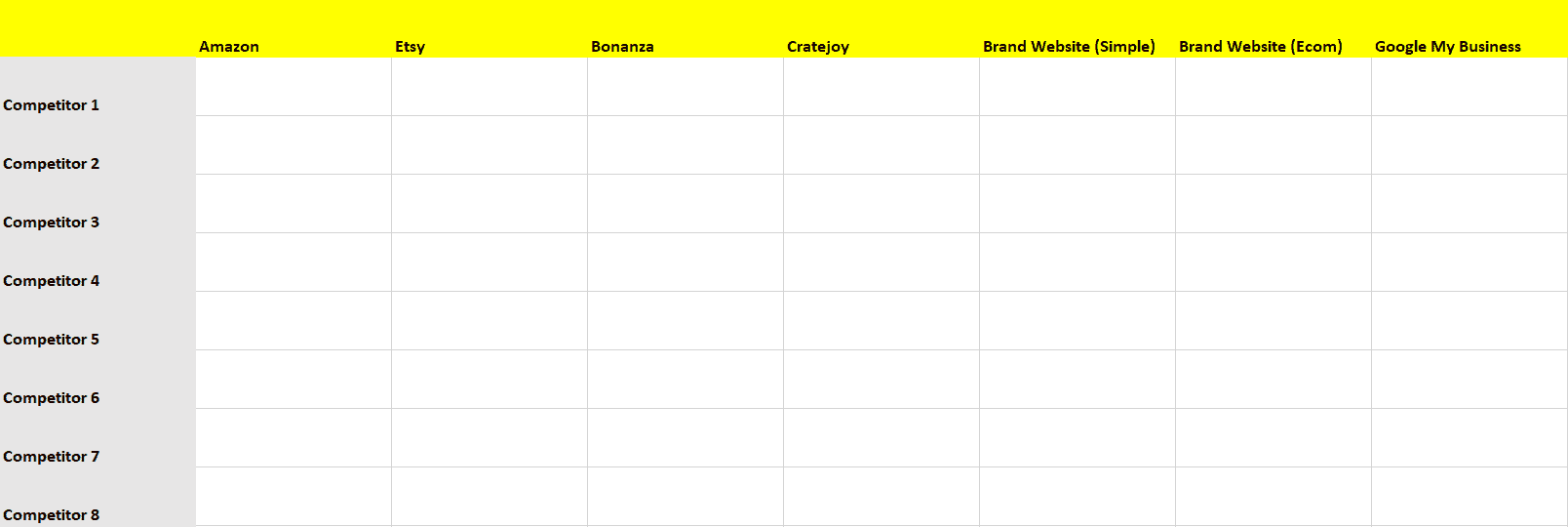
    He develops a simple excel sheet mentioning the competitors’ name and the channels they use.

    Competitor Analysis Framework

    Data Collection & Analysis

    He individually checks every competitor’s presence online and fills his competitor analysis template. Once done, he determines the most sought after channels and develops new strategies for the same.

    Bottom-Line?

    Competitor analysis is an essential practice for new and existing players alike. A periodic competitor analysis helps the company keep a tab on its competitors, identify opportunities, and become ready for upcoming threats.

    Go On, Tell Us What You Think!

    Did we miss something? Come on! Tell us what you think about our article on competitive analysis in the comments section.

  • 24 Questions To Ask Before Joining A Startup

    24 Questions To Ask Before Joining A Startup

    There are 2 kinds of people –

    First, who dream of getting into an established multinational company with an established role and a salary digit which leaves people awestruck.

    The other one includes people who want to work with emerging companies, better known as startups. These might offer less pay but the opportunity could be exhilarating. 

    This swift comparison between “the established vs the emerging” attracts a lot of debate. However, one cannot disagree with the fact that every established brand or company was once an emerging startup. This is often the reason why a staggering number of people are inclined towards them.

    If you’re among those who are inclined towards working with a startup, this article is for you.

    Your next steps include you to discover your requirements and expectations from the job. Based on a totalitarian approach, these are the three most common types of requirements an employee has from a job.

    1. Remuneration or monetary benefits 
    2. Growth and recognition  
    3. Cultural diversity and socialising

    You need to prioritise what amongst the following holds key importance and ask some questions before committing your time and effort to the job. 

    Here are some common questions to ask before joining a startup for your reference:

    Remuneration Or Monetary Benefits 

    The popular notion regarding startups is that they pay excessively less to their employees. While many researches support this statement, yet there is no universal declaration as of yet.

    The salary structure of any startup depends on a variety of factors, like the stage at which it is currently operating or the niche under which you are employed.

    Most of the comparisons made between a startup and a globally established company are made in terms of market rate, for comparing the average salary. However, if you look closely you will understand how biased this method of considering the market rate is. 

    A startup in its initial stage is not in a position to flex according to the market equilibrium in terms of salary. However, if you look at the long term picture, it will strike you that it is the startup that amplifies your earning potential to unimaginable rates, which again won’t match the market rate. 

    Questions To Estimate The Earning Potential 

    If you are offering your skills in exchange, you need to know how much pure cash you can make via this startup. To make this estimation, 3 questions will help you get sorted.

    1) What’s The Scope Of Salary For This Position?

    How much is the salary? Is it worth your effort, dedication, mind?

    Will putting more effort help you earn more?

    2) How Is My Remuneration Going To Be Measured? 

    Understand the process and salary policies adopted by the company while paying its employees

    3) What Is The Criteria For A Bonus? 

    Understanding if bonuses are timely or work-based or event-based. This will help you assess when and how you can improve your chances of earning more. 

    Now, what if the salary estimation is a surprising (positive) amount, but the chances of this startup to crash by the next year is high. If you have such notions, you need to add some additional questions to your list. 

    Questions To Assess The Long Term Feasibility

    If you have a mixed opinion about the survival chances of this startup, here are the questions you need to ask.

    4) Is The Company Market-Ready With Its Offering? 

    Does the offering has a proven product-market fit or is the company still in the testing phase?

    A startup that is still developing a product has more chances of failing in the coming future.

    5) What Is Its Current Stage Of Revenue Generation? 

    Usually, startups go through these three stages of revenue generation –

    • No revenue: In this stage, the business doesn’t generate any money from its business activities and the expenditure is covered by a limited investment.
    • Break-Even: The business generates enough revenue to cover the expenses.
    • Profitability: The revenue generated is more than the expenses and is expected to grow.

    Here, it is also important to understand that revenue and profit are two entirely different concepts. While profit is accounted for after deducting expenses and operating costs involved, revenue is concerned with the amount earned from the primary business or ‘sales.’ It does not take into account any expense or debts for its calculation. 

    6) What Is The Burn Rate? What Is The Runway? 

    Burn rate is the rate at which the startup uses its liquid cash. It is a periodic measure calculated by accounting existing and new cash inflows and cash outflows of the company.

    Runway is the amount of time the startup has before it runs out of cash.

    Suppose the startup has an investment of $100,000 and generates $1,000 per month. It, however, spends $5,000 per month. The burn rate of this startup would be $4,000 per month and its runway be 25 months.

    An additional question would be to look at the kind of people involved in the top management and their long term vision for the startup. How flexible can they be with the needs of the changing times? 

    Questions To Assess Prospects Of Gains Through Equity 

    Equity in a startup requires quite a lot of research and one needs to be properly equipped with the required knowledge. If you are skeptical about this option, ask these 3 questions to determine your equity windfalls in this startup. 

    7) How Much Percentage Do These Shares Represent? 

    There is no point in deliberating over the number of shares you hold. Rather focus on the percentage that they represent. 

    8) What Does It Mean For My Total Preference Stack?

    In case there is a huge sum owed in liquidation preference, your equity is likely to be of much more loss than a profit. 

    Liquidation preference is a guarantee for some preferred shareholders (investors) that they’ll get paid first and at least a certain amount when the company sells.

    This makes the employees’ share even lesser valuable.

    Here’s an example –

    Suppose an investor invested $2 million in a startup you work in. In return, the investor got 20%, the two cofounders got 35% each and the rest 10% is split evenly among 5 employees.

    Now, after a few months, the company sells for $8 million.

    Here –

    • The investor gets $1.6 million,
    • Cofounders get $2.8 million each, and
    • Each employee (including you) gets $160,000.

    In this scenario, while the cofounders became millionaires and the employees got a good share, the investor lost $40,000.

    Now, to protect his right and his investment, the investor is usually guaranteed a liquidation preference – let’s say $5 million in this scenario, which results in a drastic reduction in the share of employees.

    9) What Will Be The Minimum Price For Me To Exit?

    Setting a minimum price will help you compare the final amount you are likely to earn from the established base. 

    You know equity is safe and profitable when they represent a decent percentage, is not indebted with a preference stack and your final payout can be a massive IPO turnout too. 

    But, if you are one of those people who are much more inclined to achieve a career oriented  growth rather than pay related growth, then the questions are a bit different. Let us look at the next section to understand the needs of this section of wannabes. 

    Growth And Recognition 

    Before getting deep, let us try to understand why growth in this section is different from monetary growth. The common assumption is that the end goal should be to earn in millions and further, expand this income size. 

    Let me give an example to explain this better. The Silicon Valley is home to five of the world’s eight most valuable companies, capturing almost $4 trillion, yet they employ merely 1.2 billion. These companies are increasingly supported by AI and hence, they provide limited opportunities for a person to grow. 

    They might pay you a lot but at the end of the day, the work involves doing the same stuff every single day. As a result, several employees start looking for jobs that provide them with more job flexibility and diverse roles and responsibilities. 

    Now let us try and decode what we need to ask ourselves before getting into a startup with such requirements. 

    10) What Are The Available Growth Opportunities?

    Sometimes, people get hired for a position they have always been dreaming of. But the functions seem to get boring after some time as they get repetitive.

    You need to identify if there is enough room for you to flex all your skills and upgrade accordingly. 

    11) Will I Be Given Responsibilities Or Will I Be Just Merely Accountable? 

    Identifying a role that provides enough growth means identifying how much responsibility you will be subjected to. This responsibility will further lead to accountability.

    As an employee, you will be asked to get something done. Not getting it done might lead to serious repercussions. However, you are not included while deciding the time frame required to get the job done or provided with the required resources. This is merely accountability. 

    You need to get yourself into a position that provides scope for responsibility under which there is decent scope of independent decision making as well. 

    12) How Do I See The Best Person In This Skill Growing In This Position? 

    If someone with the best skills of playing any musical instrument cannot get themself a chair at Carnegie hall, then there is something wrong with the place. 

    Simply put, you need to understand if there is enough room for you to grow, given your skillset.

    13) Will I Be Learning Something New? 

    You can understand this by looking at how diverse employee culture is at the organisation and how many perspectives are being discussed while solving a problem. 

    For instance, if employees are merely informed or their opinion considered while discussing the product strategy. This will help you understand how much of your say will be actually heard and how much of it will go overheard. 

    14) How Big Is This Startup? 

    This is important to understand how much their mention will affect your CV for future roles. Additionally, it will be better if you can dig through the founder’s life and be clear if they don’t have any dirt in the past which can potentially damage your future opportunities.

    15) What Kind Of People I’ll Be Networking With? 

    Networking can take you to places and this has been successfully established in the present world. From the kind of people you interact with daily to the ones you get to see on a few occasions, assessment is crucial. Your network not only impacts your daily life but it also shapes up your outlook about the future and your wants. 

    Ask yourself, what kind of people will you be networking with? Will it help you in future?

    16) Will This Get Me To My Destination? 

    Do you simply want a higher position in the same company or want the same position in a different company? Evaluating the present offer in terms of where you want to be in the future is essential.

    Now, for the culturally enthusiastic and provoked people, the next section belongs to you. 

    Cultural Diversity And Socialising

    The present generation pays much more importance to their environment than the previous generation. What sets them even more apart is a noncompromising attitude when it comes to jobs that do not cater to their interest and aspirations. If you are someone who can not fit in a standard work environment but want more flexibility, then the next section will help you make a clear choice. 

    Questions To Assess The Company’s Values

    The workplace culture manifested by any company lies in its mainstream policies that guide the work environment.

    17) What Are Their Core Values? 

    These values go beyond the website’s homepage and can be noticed in the day to day meetings and conversations.

    Assess if they value their employees as much as they value work.

    18) How Are These Values Reflected In The Company’s Policies? 

    If they consider their values while framing policies for the organisation, you know you are in the right place. 

    19) Who Can’t Fit Here?

    Even the most influential people will sometimes have to give up in front of a company that stands firm on its core values, and that in turn says a lot about their preferences. 

    Now, you are required to understand the communication style that flows through this organisation. 

    Questions To Assess The Communication Style

    How informal and formal communication takes place into the organisation and how much leverage they are ready to provide. 

    20) What Is The Scale Of Socialising 

    How employees socialise with each other and how much they tend to converse in between, will help you understand if you can fit in.

    21) How Communication Takes Place In The Hierarchy? 

    If there is space for one on one conversations without following a fixed chain or this chain can never be broken. Such a network is crucial to understand how your concerns will be addressed by whom.

    You can even look out for how the organisational feuds are handled. If a certain employee has a problem with his immediate superior, then how can he/she reach out for redressal. 

    22) How Does The Company Influence Socialising In Its Space? 

    The kind of social events a company organises and how they encourage employees to participate. 

    You need to further assess how you can fit yourself in such a circle. For instance, being an introvert, handling weekly social gatherings can be a major trauma for you. 

    Level of flexibility

    This is crucial to understand if your lifestyle will be able to mold according to the company’s policy and how flexible are they willing to go with their employees. 

    23) Does The Company Promotes ‘Work From Anywhere’?

    Work from home and work from anywhere are some of the new important factors to consider while joining a company. Do clear out your doubts about such norms with the company.

    24) What Is The Vacation Policy?

    If you have a wanderlust, this might be the deal maker or breaker for you. 

    Once you are sorted with this list of questions, you simply have to take your final call. 

    Final Word

    There will be times when you won’t be able to ask the employer all the questions you have in mind. In such cases, it is a good practice to connect with existing employees and clear your doubts before committing anything to the company.

    Go On, Tell Us What You Think!

    Did we miss something? Come on! Tell us what you think about our article on questions to ask before joining a startup in the comments section.

  • Kickstarter vs Indiegogo: Which Platform To Choose?

    Kickstarter vs Indiegogo: Which Platform To Choose?

    Do you have an idea or a product or a startup?

    But, are you low on funds to even get started?

    Crowdfunding is here to help.

    Crowdfunding is the method of raising funds for bringing your ideas or projects to life from interested individuals on the internet. But there’s a catch – there are a lot of crowdfunding platforms out there – with Kickstarter and Indiegogo being the most popular.

    Choosing between these two platforms might get confusing – especially for a newcomer – since they both seem to offer similar methods of raising funds.

    Let’s find out whether you should choose Kickstarter or Indiegogo for raising funds for your next big project.

    What Is Kickstarter?

    Kickstarter is a crowdfunding platform that was started in 2009 to provide people with the ability to support and fund creative projects via the internet.

    Kickstarter has been highly successful in helping bring newer ideas and products to life which otherwise would not have seen the light of day. As of writing, Kickstarter has helped fund over 183,072 projects and raise over $5 billion in pledges for all projects listed on its site.

    What Is Indiegogo?

    Indiegogo is a crowdfunding platform, similar to Kickstarter, in the fact that it helps users post their ideas or projects to receive funding from interested users.

    Indiegogo was founded in 2007 and is quite popular as a direct rival to Kickstarter. The site gets over 10 million monthly unique visits, helped raise over $1 billion in pledges, and lists over 19,000 new campaigns on its platform every month as of writing.

    Kickstarter vs Indiegogo

    Kickstarter
    Indiegogo
    Raising Funds
    One-time: Fixed
    Fixed & Flexible options
    Funding Payout
    Once the Funding goal is Reached (Or) Upon completion of the campaign
    Once the Funding goal is Reached (Or) Upon campaign meeting its deadline
    Platform Fees
    5% of the total funds raised + transaction fee (3-5%)
    5% of the total funds raised + transaction fee (3-5%)
    Availability
    Campaign creation available in 22 countries (at the time of writing)
    Campaign creation available in 20 countries (at the time of writing)
    Suitable For
    New, one-time, one-off projects
    Developing emerging ideas or products

    Raising Funds

    Kickstarter

    Kickstarter provides a more “fixed” approach towards raising funds:

    • You create a campaign on Kickstarter and set a certain amount and duration as the goal of your campaign
    • Other users get to fund your campaign

    You are provided with the option for setting the duration of your Kickstarter campaign and the maximum numbers of days that you can run your campaign are limited to 60 days.

    Kickstarter, in effect, help create a one-time, large fund that will help you in your endeavours.

    Indiegogo

    Indiegogo provides users with the ability to choose between two different methods of raising funds –

    • Fixed: You receive the amount only after it meets your goals within the set deadline. Recommended if your campaign objective requires a minimum amount to be produced and delivered.
    • Flexible: You get to keep the amount you raised even if it does not meet your goals or the deadline. Recommended if your main intention is to raise money and if you’ll be able to provide on your promises even if the target goal is not met.

    Indiegogo also allows users with the option of setting the duration of their campaigns (max. duration – 60 days).

    Funding Payout

    Kickstarter

    Kickstarter funds are paid out only upon completion of the campaign. A campaign is considered to be “successful” if it reaches or exceeds the funding goals set before the deadline. The raised amount is held for about 14-15 days after the completion of the campaign before it is credited to your account.

    This is because of the way Kickstarter handles funding from users –

    Once a user pledges an amount for a project, it does not get debited from the user’s card immediately. Instead, the amount is debited from the user only when the campaign is “successful”. This time is also used by Kickstarter to check campaign for inconsistencies and allows payment processors to verify payment details.

    In case your campaign does not reach its goals or runs out of time, backers are not charged and you do not receive any funding amount.

    Indiegogo

    On the other hand, Indiegogo credits the total amount raised to your bank account within 14-15 days after the project ends.

    • Fixed Indiegogo campaigns get their amount credited to their bank accounts after the project reaches its goals.
    • Flexible Indiegogo campaigns get their amount credited to their bank accounts once the project reaches its deadline.

    This is due because of the way Indiegogo handles its pledges.

    Unlike Kickstarter, when a backer pledges an amount to an Indiegogo campaign, the amount gets instantly debited from the backer’s account.

    Platform Fees

    Kickstarter

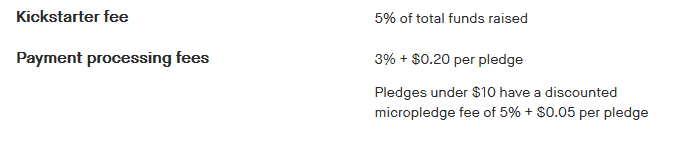
    Kickstarter takes 5% from the total amount you managed to raise during your campaign as the platform fee and also charges another 3-5% in the form of payment processing fee.

    kickstarter fees
    Kickstarter Fees | Source: Kickstarter

    Indiegogo

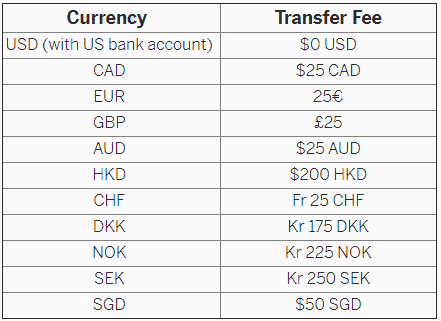
    Similar to Kickstarter, Indiegogo takes 5% from the total amount that you were able to raise during your campaign as a platform fee and also charges another 3-5% in the form of payment processing fee for handling the individual transactions made by backers. Apart from that, it also charges certain fixed rates every time Indiegogo sends funds to your bank account –

    Kickstarter vs Indiegogo
    Indiegogo Transfer Fees Breakdown | Source: Indiegogo

    Availability

    Kickstarter

    Kickstarter allows backers from anywhere in the world to pledge for a Kickstarter project. But Kickstarter project creation is available only for users from the following countries (as of writing) –

    The United States
    United Kingdom
    Canada
    Australia
    New Zealand
    The Netherlands
    Denmark
    Ireland
    Norway
    Sweden
    Germany
    France
    Spain
    Italy
    Austria
    Belgium
    Switzerland
    Luxembourg
    Hong Kong
    Singapore
    Mexico
    Japan


    Indiegogo

    Indiegogo also allows backers from anywhere in the world but the ability to create an Indiegogo campaign is limited to users from the following countries (as of writing) –

    The United States
    United Kingdom
    Canada
    Australia
     Hong Kong (China campaigns may be eligible)
    Austria
    Belgium
    Denmark
    Germany
    Finland
    France
    Republic of Ireland
    Italy
    Luxembourg
    Netherlands
    Norway
    Portugal
    Singapore
    Spain
    Sweden
    Switzerland


    Suitable For

    Kickstarter

    Kickstarter is more suitable for funding new, one-off projects or products that require a fixed amount of funding for production. Kickstarter’s fixed, one-time funding also means that it is more suitable for those requiring large amounts of funding.

    Here are a few products and companies to come out of Kickstarter campaigns –

    • Pebble Smartwatches
    • OUYA Video Game Console
    • The Everyday Backpack

    These types of one-off products would greatly benefit from a Kickstarter campaign than from Indiegogo.

    Indiegogo

    Indiegogo is more suited to emerging projects and ideas. While Indiegogo allows for funding to be raised in a “fixed” manner similar to Kickstarter’s approach, it also allows a “flexible” campaign.

    This is useful if your primary aim is to raise money – how much ever it may be. This works if you are looking to raise money for a cause, for non-profit, or if you’re sure that you will be able to deliver your product as well as perk even without reaching your goal.

    This flexibility is not available in Kickstarter and Indiegogo also benefits from the faster transfer times of the raised funds.

    Here are a few products, companies and causes that were successfully funded with the help of Indiegogo campaigns –

    • AIT Smart One: The GameChanger Smart Desk
    • Restoring King Chapel
    • Opal Nugget Ice Maker
    • Jibo

    Takeaway

    Both, Kickstarter and Indiegogo are highly popular. Both are similar to one another in more ways than one. But even then, Kickstarter can be seen as a more traditional and stricter take on the crowdfunding model while Indiegogo has a more laid-back approach with its flexible funding supporting even the smallest of ideas and projects.

    Needless to say, it is up to you to find out which platform fits your goals and your unique idea or project.

    Generally speaking, you will find more artists, musicians, filmmakers, geeks and gadget makers on Kickstarter while you get to see more small businesses and unique ideas on Indiegogo.

    Go On, Tell Us What You Think!

    Did we miss something?  Come on! Tell us what you think of our guide on Kickstarter vs Indiegogo in the comments section.
  • Entrepreneurs are At Greater Risk Of Mental Disorders: Science Confirms

    Entrepreneurs are At Greater Risk Of Mental Disorders: Science Confirms

    No successful entrepreneur ever said that building a company was easy. So let’s be honest about how brutal it actually is?

    Why did Kate Spade, the founder of the $46.5 million company Kate Spade bags; Mao Kankan, a successful entrepreneur who founded Beijing Times Majoy Technology Co. (valued at $75 billion); and $70 billion company Café Coffee Day’s founder, V.G.Siddhartha, ended up taking their own lives?

    If you are an entrepreneur, you probably are living with stress, anxiety, and burnout constantly. A recent study by Michael Freeman stated that 49% of all entrepreneurs at-risk of at least one mental illness. The same study also proved that entrepreneurs are:

    • 2 times more likely to have suicidal thoughts
    • 2 times more likely to be hospitalised for psychiatric ailments

    Why Entrepreneurship Affects Mental Health?

    In the words of Michael Freeman –

    Who in their right mind would choose to be an entrepreneur? The barriers to success are virtually unlimited and most startups fail as a result.

    Entrepreneurs have lower initial earnings, lower earnings growth, lower long-term earnings, greater work stress, and more psychosomatic health problems than employees. Why would anyone voluntarily accept the longer work hours, fewer weekends and holidays, more responsibility, chronic uncertainty, greater personal risk and struggle, and greater investment of emotional and physical resources required to be an entrepreneur instead of the security and long-term rewards of having a career? By conventional standards choosing to be an entrepreneur is an exercise in bad judgment.

    Entrepreneurs have to multi-task amongst numerous roles and are repeatedly disappointed because of several factors like –

    Lost customers, disputes with partners, increased competition, staffing problems, etc.

    …all while stressed to make money.

    So it shouldn’t come as a surprise that entrepreneurship involves great levels of anxiety compared to other works. But the picture does not end there. Here are some scientifically researched reasons behind the increasing mental disorders in entrepreneurs:

    Innate Character Traits

    People who choose entrepreneurship as a career possess certain traits like high energy and enthusiasm and they experience all emotions very strongly.

    But the flip side to such inner character traits is that entrepreneurs experience positive and negative emotions to the extreme. They are more likely to have strong thoughts of depression, despair, hopelessness, and worthlessness powerfully.

    Obsession

    A psychologist at John Hopkins published a book on how most entrepreneurs are so intensely obsessed with their work-life that they turn into hypo-maniacs.

    Hypo-mania is a psychological state with increased activity, less need for sleep, racing thoughts, and obsession with a single activity. When an entrepreneur marries his work-life and gets obsessed with the business, s/he is a potential hypo-maniac. Such an intense focus and obsession with is a leading cause of poor mental health amongst entrepreneurs.

    Alienation From Social Life

    Poor social relationships have become a characteristic of a 21st-century entrepreneur. Even the World Health Organisation and National Institute of Health has identified social relationships as the most important social determinant of life. But the rigorous nature of a startup causes founders to spend lesser time with family, friends, and significant others. They are required to re-locate away from their support networks for strategic reasons. They may stretch a 24-hour day to fit in 30 hours of work just to rise to the top.

    As a result, the focus on work grows stronger and other supportive relationships get weaker.

    “I Am My Company” Syndrome

    Entrepreneurs may treat their business so near and dear that it becomes a synonym for their self-image. The line between themselves and their companies starts to get blurry. But why does this lead to mental health issues? An entrepreneur would say –

    “I am just being passionate about my work. I created it and it creates me. We define each other.”

    Unfortunately, this is a very common but unhealthy way of building a business. In such cases, people begin to feel company failures as personal failures. The tiniest instances like losing a customer contract or something huge as receiving a “no” from an investor feels like an extremely personal rejection.

    Financial Risk

    One of the biggest contributors to mental disorders amongst entrepreneurs is the financial risk of starting one’s own business from scratch. Entrepreneurs may have to go months pouring personal capital into their businesses without receiving returns. A certain amount of “skin in the game” can be encouraging, but founders often give in too much turning it discouraging.

    Barriers To Mental Health Experts

    Mental health resources, even in the 21st century, are not available for everyone. But access to mental health resources is even more limited for entrepreneurs because traditional employees may have a counsellor at their office but entrepreneurs have nowhere to go; mostly because entrepreneurs:

    • Don’t factor in therapy in their budget
    • Feel that stress and worrying is the way of an entrepreneurial life
    • Are unaware of the importance of mental health for a successful business
    • Are scared of the stigma attached to therapy, counselling, and psychiatric treatment

    Entrepreneur Mental Health Statistics

    Image Source – Shopify

    Entrepreneurs are:

    • Twice more likely to have lifelong depression
    • 6 times more likely to have Attention-Deficit-Hyperactivity-Disorder
    • 3 times more likely to be addicted to toxic substances
    • 11 times more likely to be bipolar (extreme happiness – extreme anxiety)

    Despite these intense statistics, a small 15% of entrepreneurs actually report their mental illness. It is high time that the entrepreneur culture addresses mental health and the growing mental disorders amongst their community.

    How Entrepreneurship Affects Mental Health?

    About one-third of entrepreneurs experience at least one mental illness. Is it just a coincidence that the most brilliant minds struggle the most?

    Research says otherwise.

    Here’s how entrepreneurs are more prone to mental illnesses:

    Entrepreneurship Depression

    Entrepreneurs are known to be twice more likely to suffer from depression than traditional employees.

    Depression and sadness are different among entrepreneurs. Sadness comes in waves and is more general. For instance, if an entrepreneur has to sell off belongings to raise money, s/he might get sad for a while. That shouldn’t put him/her into depression.

    Depression is more prolonged and intense. Risk-taking fails, unachieved goals, and stagnated progress, become fertile ground for entrepreneurial depression. Entrepreneur depression, similar to other depressive conditions, reduces concentration and affects good decision-making. As a result, things can go from sadness to depression if not treated.

    Entrepreneurial Stress

    Entrepreneurial stress is an intense feeling of emotional or physical tension. It usually occurs at the beginning of starting one’s own business. Since start-up businesses can change drastically and suddenly, stress and anxiety begin to creep in. Stress can be of two types:

    • Acute stress: Acute stress is when you feel tension for short bursts of time. For instance, if you fought with a friend, family member, or an employee, or if your employee did not turn in work on time, etc.
    • Chronic stress: Chronic stress is when you feel tensed and anxious for prolonged periods. This happens very often to entrepreneurs as they are pre-occupied with financial risks, competition, uncertainty, and loneliness.

    Acute stress is seen as positive for the mental well being of entrepreneurs. But if an entrepreneur starts to give in more than s/he can handle, acute stress turns chronic. Chronic stress is not known to be a mental disorder but it is a sign of poor mental health because it brings feelings for hopelessness, aimlessness, and un-importance for an entrepreneur.

    Entrepreneurial Burnout

    Burnout is a very common and unaddressed mental ailment amongst entrepreneurs. A study by the Harvard Business Review showed that more than half the respondent entrepreneurs experienced levels of burnout that were even higher than burnout by athletes and college students. The merciless and tasking work schedule of an entrepreneur often leads to chronic stress, which soon turns into burnout. Symptoms of burnout for entrepreneurs include:

    • Feeling tired regardless of how much sleep you get
    • Your inbox is always full but you never feel motivated enough to address all aspects
    • Less excitement about your day from the moment you wake up
    • Reduced inspiration to create proposals and reach out to investors
    • Hiring more employees than your capacity and dumping your work on them
    • Physical symptoms – Headaches, dizziness, nausea, stomach aches, increased perspiration, etc.

    Many entrepreneurs often dismiss burnout symptoms as just a part of a hectic schedule, but in reality, it is not a schedule issue it is a mental health issue.

    Entrepreneurial Substance Abuse

    Entrepreneurs are at a higher risk of substance abuse than the general population. They face continual and significant levels of stress, loneliness, and risk of failure. As the head of an organization, an entrepreneur ought to monitor the behavior of others to ensure that it doesn’t harm the business, but there’s no one to do the same for them. These feasible elements come together to create a perfect environment for substance abuse.

    How To Avoid Mental Disorders As An Entrepreneur?

    Entrepreneurship can be a wild ride, with ups and downs. But here are common practices entrepreneurs can do to help prevent their lives from spiraling out of control.

    Nurture relationships

    Relationships with friends and family members can be very powerful weapons to fight mental disorders.  Entrepreneurs could join a peer group, engage with old friends, go out on date nights with their significant other, and make new friends. Not only are these fun but also a great reminder to entrepreneurs that they have a separate existence from their work.

    Turn To Mental Health Resources

    Entrepreneurs must always avail of the option of regular mental health check-ups through short counselling sessions and psychometric tests. Entrepreneurs must factor in the costs of such options in their budget and actively engage in asking for help. This is not only important for one’s well-being, but research has proven that stronger mental health increases business turnover and productivity. This is simply because stronger mental health prepares you to critically, calmly, and analytically deal with new challenges thrown at you.

    Work On Physical Health

    One of the best ways to fight burnout is by being physically active. According to the Anxiety and Depression Association of America, “Scientists have found that regular participation in aerobic exercise has been shown to decrease overall levels of tension, elevate and stabilize mood, improve sleep, and improve self-esteem.”

    Exercising doesn’t refer to vigorous training and running marathons. But entrepreneurs must factor in at least 30 minutes a day for fitness. This can include simple yoga, stretching, running, walking around the neighborhood, etc. Another great way to develop an exercise regime is by engaging in your favourite sport. Get to learning a new sport or honing your skills for a sport you like.

    Work On The Business, Not In It

    One of the most common issues leading to burnout is attaching oneself to one’s business. Entrepreneurs may find their own identity wrapped up in their business. The best way to avoid this is to set boundaries between the business and the self. Begin by trying to maintain a journal or a schedule where you write about some personal time for yourself. Take this personal time to think about your personality, your qualities, your hobbies, your childhood, etc. Make sure that you have a definition of your own and your business has a different definition of its own. Such boundaries will help you realise that you work on your business, not within it.

    Limit Your Finances

    Entrepreneurs might pour too much of their monetary holdings into their business. It’s natural to aim for financial independence. But the financial health of your business can turn too overwhelming. If you do not plan and distribute your finances well, it may dictate where you live, how you live, and how your family lives too.

    Therefore, you must stick to rigid financial planning. Plan out the investment sources you would rely on, plan out how much you can pitch in, how much your family can pitch in, but remember to set an upper limit Create a back-up financing plan too, but don’t cross the upper limit.

    Divide And Delegate

    Entrepreneurship is all about building a business by yourself from scratch. Right?

    Wrong! The startup stage is actually a ripe time to distribute responsibility and delegate. Imagine this, if you were a sole proprietor, then delegating work means passing off book-keeping to an accountant or employing a virtual assistant for the task. Studies have shown that business quality and productivity rise as work is planned and delegated. If you micromanage you might end up over-burdening yourself with work, blaming yourself for all business issues, and such events may trigger stress, anxiety, and depression.

    There is no perfect way to live the entrepreneur’s life, but the way to survive it well-enough is acknowledging and looking after one’s mental and physical well-being. Renew yourself and your perspective and start over. Starting over is a portion of the process of starting up. The entrepreneurial community must understand better than anyone else.

    Go On, Tell Us What You Think!

    Did we miss something?  Come on! Tell us what you think of our article on entrepreneurs and mental health in the comment section.

  • Deming Cycle: Plan-Do-Check-Act (PDCA) Cycle Explained

    Deming Cycle: Plan-Do-Check-Act (PDCA) Cycle Explained

    Have you ever bought a product that was well-made and felt good to use?

    That was mostly achieved by following certain steps and rules to hone in on the quality of the products and service. These rules are a part of an approach called Total Quality Management (TQM).

    Take the Japanese car manufacturer Toyota for example – it was among the first to start using principles of TQM to boost their productivity back in the 1950s. Soon enough, Toyota was beating other car manufacturers in sales by offering well-made, reliable cars at the same or less cost than the competition.

    This was all possible thanks to the TQM principles that are an amalgamation of rules and principles from quality and management gurus such as W. Edwards Deming, Philip B Crosby, Kaonru Ishikawa and Joshep M. Juran.

    Mr Deming, in particular, had laid out a particular set of rules and checklist called the Deming Cycle, to be followed to continually improve quality standards of the company.

    Deming Cycle Definition

    Deming Cycle can be defined as a set of four, logically connected, repetitive steps – Plan, Do, Check (Study), Act – that help in continuous quality improvement and learning.

    PDCA Cycle

    The Deming Cycle is also known as the PDCA Cycle or PDSA (Plan, Do, Study, Act) Cycle and is an altered version of the Shewart Cycle – Plan, Do See – that had been around since it was introduced by statistics expert Mr Walter A. Shewart in the 1920s.

    What is PDCA Cycle?

    The four steps of the PDCA Cycle (or Deming Cycle) are –

    1. Plan: Find and note down opportunities; Analyze problems that are present; Plan changes and steps to be made to your findings and problems
    2. Do: Implement the solution (ideally, on a smaller scale or a controlled testbed) & note down observations and findings
    3. Check (Study): Study your findings and observations from your “testing” phase & make changes to the steps as necessary
    4. Act: Implement or improve the process

    Plan

    This stage involves planning the end goal and the process to be followed to reach it. In case you are looking to improve or solve a problem in an existing process, this is where you gather all the necessary information and steps that might help resolve the issue.

    This stage involves a lot of analysis to find out the causes and fixes for the issues you are currently facing.

    Example: You are a car manufacturer and find out that customers complaining about the constant failure of just one plastic button on the dashboard. Your goal is to fix the problem and the planning stage involves in you gathering necessary information such as the source of plastic. You plan on trying out plastic sourced from a different provider.

    Do

    This stage involves implementing the fixes and solutions that materialized during the planning stage. As a precautionary measure, it is recommended to implement the changes on a smaller scale, as a test, to find out whether the solution proves to be useful or not.

    This is where you can benefit from setting up and implementing your changes in a small, controlled test environment. This not only helps give provide insight into the effectiveness of changes but also better understand “why” the outcome improved.

    Note: However small your business or operation may be, it is advisable to test-run your plans on a small scale and in a way such that it does not affect your existing operations and processes. Also, do not stop with this step.

    Example: You run a set of trial runs of manufacturing the plastic button with plastic sourced from different vendors. You do this on a small scale and do not include it in the main assembly line to not disturb the existing process and manufacturing.

    Check (Study)

    This stage involves checking the results obtained from your trial runs for changes and improvements. If there are still issues or problems arising, then find out the causes and come up with a better solution.

    It is advisable to ask the following questions –

    “Will the proposed changes work on a larger scale?”

    “Did the changes work?”

    “Why did the changes work?”

    “Is there more opportunities?”

    “Can the plan be further refined?”

    This might seem trivial at first but checking helps avoid further mistakes down the line and when the changes are implemented on a larger scale.

    Example: You find out buttons manufactured from the current supplier of plastic to have high chances of deformations and failures from the test run. You find out the buttons produced from a different vendor to fit your requirements and so you decide to use a different plastic vendor for all assembly lines.

    Act

    This is the final phase were the recommended changes and tested processes are finally implemented in their entirety.

    But, though this is the final process the cycle does not end here. In case there are further changes to be made, observations from this step are to be taken and the cycle is to be restarted once again.

    This PDCA Cycle is to be followed until all the necessary expectations are met and there is no necessity of further changes down the line.

    Example: You start using plastic sourced from a different vendor for manufacturing your buttons on the main assembly lines and find the number of complaints on faulty buttons to decrease drastically.

    Benefits of PDCA Cycle

    • The PDCA Cycle (or Deming Cycle) helps reduce problems into smaller chunks, making it easier to tackle
    • It helps in the development of new products, services, process and solutions
    • It can be applied for most businesses and industries – however small or big it might be
    • It is a flexible model – you are free to use the methods and process for coming up with results in all of the four steps
    • It helps promote the continuous development of the established systems and processes

    Drawbacks of PDCA Cycle

    • The PDCA Cycle is a slow process – it takes time for the results to show up since you would have to complete many cycles for things to be as refined as you want it to be
    • Not viable for urgent problems or emergencies

    Key Takeaway

    PDCA Cycle is a simple yet straightforward group of steps that can drastically help in improving your quality standards by either providing newer solutions or solving existing problems in your business or company.

    Not only that, but the PDCA Cycle (or Deming Cycle) can also be applied to life as well – it can be used by one to improve on a personal basis too.

    Go On, Tell Us What You Think!

    Did we miss something? Come on! Tell us what you think about our article on Deming Cycle in the comments section.

  • What Is Infratech? – Use Cases, Examples, & Future

    What Is Infratech? – Use Cases, Examples, & Future

    Our existing infrastructure was designed and built in a different age, with different levels of technical know-how. Things such as environmental impact and ecological effect of structures on nature were not among the primary concern back then.

    This is no longer the case. Times have changed and so has the world and its people. The existing infrastructure, which was designed and built for a time simpler than the current, is mostly inappropriate for today’s world.

    We now have much-expanded knowledge and technology to be able to create better structures that lean more towards sustainability and offset its impacts.

    Enter Infratech.

    What Is Infratech?

    Infratech is defined as improving or supplementing physical infrastructure with the usage of technology to deliver efficient, connected, resilient, and agile assets.

    The word Infratech is an amalgamation of the words “infrastructure” and “technology”. It is a vast field, covering all of the domains related to infrastructure, including –

    • Energy generation and distribution infrastructure (Eg: Nuclear plant)
    • Transportation infrastructure (Eg: Roadways)
    • Water and waste infrastructure (Eg: Recycling plants)
    • Food production & storage infrastructure (Eg: Greenhouses & Cold storages)
    • Resource extraction, processing and use infrastructure (Eg: Off-shore oil rigs)
    • Communications infrastructure (Eg: Cell towers)
    • Health and well-being infrastructure (Eg: Hospitals)  
    • Smart materials (Eg: Advanced construction materials)

    These domains and examples are among the few of the many sectors that stand to benefit from utilizing “Infratech” solutions. The benefits range from – the creation of smarter, greener, robust and efficient infrastructure to improving the safety of workers.

    The importance and use of Infratech can be further understood by looking at the current challenges that the construction and infrastructure sector faces.

    Infrastructure Sector Challenges

    Here are a few of the major challenges that the infrastructure and construction sector faces –

    Structural Damage

    Man-made structures are subjected to the elements of nature as well as man-made forces. This means that they are at the risk of constant degradation of structural integrity. It also means that they are susceptible to risks such as erosion or rusting of materials due to moisture or damage to materials due to fires.

    Structural & Material Faults

    Building structures needs utmost precision and the use of strong and appropriate materials at respective places accordingly. Failing to do so or even slight mistakes or misjudgments could prove to be fatal or destructive on nature.

    The structures and buildings not only have to support their weight but also have to oppose the forces of nature as well as human utilization.

    Maintenance Follow-ups

    Since the buildings are subjected to constant degradation that is caused due to various natural and man-made factors, it requires constant maintenance. Failing to properly maintain the structure can also prove to be fatal in the long run.

    Project Delays

    Construction of any structure is a large undertaking and it takes quite a while for a project to be fully completed. While delays are to be expected, constant delays stop progress drastically and introduce newer problems such as – reduced structural integrity or incorrect construction.

    Excess Resource Usage

    Infrastructure projects are large in scale – even the simplest of construction projects such as building a sewage network involve the use of a large number of resources such as energy, electricity, water and required construction materials. Most often, these resources are either over-utilized leading to wastage of resources while adding little to its structural integrity.

    Security

    Even with today’s technology and equipment, security proves to be a big problem too and the implementation of separate security personnel brings in problems of its own such as being dependent on an individual’s performance to provide security and safety to your structures.

    Which brings us to –

    What are the use cases of Infratech? How does it help tackle the challenges and improve the situation? What and where does technology help benefit infrastructure?

    Infratech Use Case

    Sensors & Remote Monitoring Systems

    Sensors and Remote Monitoring Systems help solve most of the challenges. A sensor or a monitoring system could help in –

    • Reducing structural damage caused by natural and man-made elements by recording useful data over time
    • Reducing the various causes of faults while constructing the buildings
    • Increase security by automating protection and regulating the entry and exit from buildings
    • Provide timely updates on the structure’s integrity to follow up on maintenance as necessary

    Artificial Intelligence

    The use of Artificial intelligence brings lots of benefits to the table. Not only does it help reduce errors during construction, but it can also be used to predict them even before they have the chance of occurring.

    Project Management Systems

    Project Management Systems help in reducing the delays encountered on a construction project. They help keep tabs on one another and improve productivity in general since things tend to flow in a natural sequence as necessary steps are finished one by one.

    Computer Vision

    Computer Vision refers to the programming of computers to be able to understand the situation from digital images and videos. When paired with a remote monitoring system such as surveillance cameras, computer vision can help improve things such as construction workers safety, usage of appropriate construction materials and the security of the structure.

    These are a few important uses cases where Infratech is being used to make a difference. Moving on, let’s look at a few companies and startups that operate and are striving to innovate in the field of Infratech.

    Infratech Startups & Companies

    CIPO Cloud

    cipo cloud
    Source: CIPO Cloud

    CIPO Cloud is an American company that provides resource and user management software for construction projects. This helps overcome problems encountered by construction companies by allowing them to track, manage and visualize their projects and its resources in real-time.

    Brooklyn SolarWorks

    brooklyn solarworks
    Source: Brooklyn SolarWorks

    Brooklyn SolarWorks is a New-York based residential solar systems provider. It has a  hyper-local approach on providing and installing solar panels in residential properties which have helped reduce the load on the main grid all while helping reduce carbon footprint.

    ICON

    icon build
    Source: ICON

    ICON is an American company that has developed 3D-printing techniques for printing and fabricating housing structures. This helps reduce the time taken to construct as well as reduce the resources used while increase the structural integrity due to the use of 3D printing.

    Keller Williams

    keller williams
    Source: Keller Williams

    Keller Williams is a technology company that launched an AI-powered assistant that helps provide real-estate agents and customers with real-time information on interested properties.

    Future of Infratech

    The future of Infratech is now. Various technologies are being used to make the construction of structures safer, efficient, and easier. Infratech and its solutions help make buildings future-proof and much more flexible to changes in usage and maintenance than traditionally-built structures. The advancements made in computing, in general, has made most design firms, contractors, and construction companies to adopt Infratech and its solutions for building improved structures that benefit today’s world.

    Go On, Tell Us What You Think!

    Did we miss something? Come on! Tell us what you think about our article on Infratech in the comments section.

  • A Marketplace For Event Volunteers – Boorg Startup Review

    A Marketplace For Event Volunteers – Boorg Startup Review

    The event industry is the sunrise industry in the service sector. Be it a public event or a private event, everything is now done on a big scale.

    And since the word ‘event’ is redefined, so is the manner of how it is hosted. This new way of hosting an event on a big scale opened up the opportunity for event-based-volunteering and event-based-jobs. These volunteers, though very helpful, are not easy to find.

    This is where Boorg comes in – an event directory to help the organisers find authentic and professional volunteers for their events.

    Boorg – Startup Review By Feedough

    An event-listing-cum-volunteer scouting platform which helps event organisers in Armenia find efficient volunteers with professional backgrounds. In simple terms, Boorg works as the platform where volunteers can find events to participate in and organisers can find volunteers they can work with.

    Besides this, the application also makes it easy for the organisers to effectively communicate and manage the volunteers.

    The Concept

    The founders of Boorg found an opportunity in the repressed demands of the volunteers and event organisers who wished to connect but were unable to do so because of a missing discovery platform. The existing middlemen, on the other hand, were either mismanaging or weren’t able to provide promising volunteers to the organisers.

    In the words of a representative –

    “Currently, in the Republic of Armenia, many volunteers want to join events, but due to mismanagement many don’t join or many quit in the middle of the event. By using this application, volunteers will be able to use its magnificent services such as getting quotes on foods or transportation. This application will remove the middle management and will be the form of communication with the event organiser and the volunteer itself.”

    The Offering

    To cater to the core problem of a missing discovery platform and other related event organisation problems, Boorg was developed as a mobile application which lets –

    1. Organisers to list their platform in very few and simple steps
    2. Volunteers to discover events they can take part in and apply for the same
    3. Organisers to receive applications from professional volunteers who have some experience
    4. Organisers to benefit from a volunteer relationship management system within the application.

    The revenue model of the application is a simple commission model where Boorg takes a commission from the event organiser for every volunteer that joins the event.

    The Value Proposition

    The current positioning of the brand as a discovery platform is the unique selling proposition as well as the value proposition of Boorg.

    The fact that it is easy for the volunteers to just find any event they want to work in makes this platform a hub for such volunteers. And because there are many volunteers on the platform, event organisers are automatically attracted.

    The Interview

    How is your product/service disrupting the industry?

    Our main products and services will be all based on an application. If the organiser wants to set up the event, they will click on the app and create the event. Volunteers will be granted access to the app in signing up for the event as a volunteer. They would need to provide documents and information’s regarding their background. The application will send the documentation directly to the host and they will be able to choose the volunteers they want.
    The application will provide benefits to the volunteers that are participating. It will also include service benefit packages as discussed previously.

    What about the competition? How are you better than others?

    In this case, we don’t have competitors, because Boorg will be the new platform in Armenia, which will remove the middle management and will be the form of communication with the event organiser and the volunteer itself. Our competitors can be some volunteering services in Armenia. For example, volunteer bank NGO- they have a base of volunteers but don’t have task management and platform as well.

    The history of your startup (how it all started)?

    Our team has had extensive experience in volunteering at various events And during those events and volunteer work, we’ve had different issues and that’s why we decided to set up Boorg, which will be a system where more productive systematization of events can be organised, why not allow volunteers to improve their experience and skills.

    Why did you choose this niche?

    This niche is a CRM system (platform) and task management tool except it revolves around volunteers and event organisers. We create a CRM system (volunteer base), or volunteer relationship management system (volunteers task tools), which allows event managers to track, monitor and communicate with volunteers using an automated platform. You can customise messages to focus on items, issues, information of interest to specific customers, which helps build retention into communications mix.

    Tell us about the team.

    Our young and dynamic company is successfully evolving through gaining more expertise in the industry and helping other businesses to grow. And we are focused on helping our industry to improve. Our team holds the view that software and technology can bring a positive social change. Estero team is passionate and dedicated to work, we are a team of bright-minded and disciplined people, which help us make awesome projects. The team has worked together for many projects, and we are already a great team, we know each of our strengths and we use it to get better results in any work we do together. In order to understand the importance of creating Boorg platform, we conducted market research to uncover the demand.

    What’s the progress till now and what are you expecting in the future?

    The priority for our team is to bring this project to fruition, although we already have mobile-first. In the future, we look forward to new partnerships and a global market.

    Feedough’s Take on Boorg

    Boorg successfully found a market which needed what it had to provide. The business model is crafted efficiently enough to help both the event organisers and the volunteers without charging much from the pockets of the organisers.

    We also loved how this startup planned its milestones – starting with a specific Geographic and releasing only a mobile application to test the hypothesis.

    Interested?

    Liked how this startup found its way out in the market by serving to the repressed demands?

    Are you an event organiser who was waiting for such an app to exist?

    Or are you just a random person who loved the idea? Head on to Boorg and see how they are disrupting the industry

    Get Your Startup Reviewed By Feedough!

    Get discovered by over 500,000 monthly visitors. Explain your offering to over thousands of potential investors, customers, and top blogs.

    Startup reviews are custom written posts by our experienced team who’ll work closely with your team to create the best pitch possible. The review article will be posted and shared with thousands of our subscribers over emails, social media posts, and push notifications.

    Use this form to get in touch.