Feedough Logo

Blog

  • How Does DuckDuckGo Make Money? | DDG Business Model

    How Does DuckDuckGo Make Money? | DDG Business Model

    Ever spoke to a friend about a product you saw somewhere and immediately saw an advertisement while browsing through the internet? Don’t even answer it, we all know how intrusive search engines are these days. Especially one particular search giant is notorious in poking nose all over in your data. We all know who I am talking about.

    From knowing your flight itinerary to your daily commute to your favourite sports team, Google has become your new (and boundary crossing) best friend. The reason why we don’t make a fuss about it because we believe that it has to track your information to generate revenue. “If you are not paying for something, you are the product”.

    But is it necessarily true? Do search engines really require your data to generate revenue?

    DuckDuckGo denies.

    What Is DuckDuckGo?

    DuckDuckGo was established in the year 2008 as an internet privacy company which aims at being a secure search engine and not a pseudo-tracking engine. Basically, DuckDuckGo is an alternative to Google which doesn’t follow and track your behaviour.

    So how does DDG make money? We will get to the answer after a short brief of their history.

    History of DuckDuckGo

    Founded in 2008 by Gabriel Weinberg, DuckDuckGo was a self-funded project after Weinberg sold his previous venture NamesDatabase to classmates.com in 2006 for $10 million.

    The core idea behind starting DuckDuckGo was to provide search results in a secure internet space. During October 2011, DDG was funded by Union Square Ventures because they believed that competitiveness in search engine is through privacy now. By 2014, DDG was a profitable company although earning a tiny fraction of what Google earns. In August 2018, DDG raised another $10 million from Omers Ventures as Google was accused of biased internet search by US President Donald Trump. Although DDG was doing well off without the funding, the money could be used to spread awareness about the big bout between data privacy provided by DDG vs the giant Google.

    DDG With Numbers

    With 22 Billion searches under their belt, DDG has 55 employees currently and are keen on taking up the game with dedicated APIs to protect you from being followed by Google everywhere you go. DDG meanwhile is also keen on studying how Google tracks and stores data, therefore, having a head-on collision with Google in terms of data security.
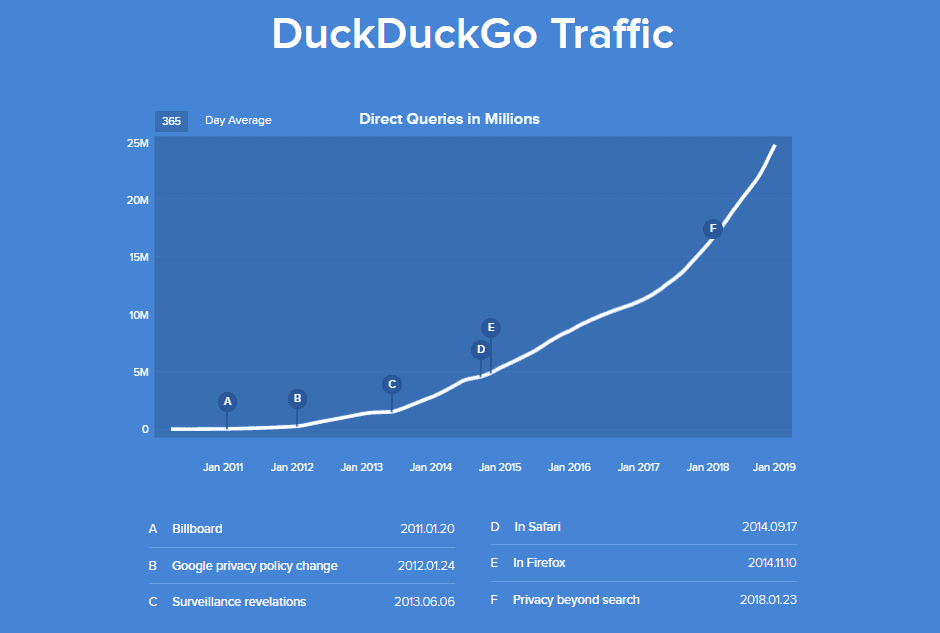
    DuckDuckGo traffic

    DuckDuckGo Business Model

    The Primary means of business for DuckDuckGo is always going to be its search engine. But even they know it is not enough to sustain themselves in the market where the competitor is Google.

    With time DDG has moved on to its own app in Google Play store and Apple iTunes, and also launched it as a Chrome extension giving a much convenient option than using DDG through the browser.

    DDG has its own instant answers API that is free of cost. Although, you might use it commercially only after getting email approval from DuckDuckGo. Pretty easy and convenient to use and aimed at getting more people to use DDG.

    DDG is now developing APIs targeted on preventing your data from being processed while browsing other websites and will continue to keep up the fight with more data and more solutions to prevent internet users’ privacy being violated.

    Not to forget the extensive study and fight DDG has put up against Google to protect user privacy. It now extensively conducts studies and shares results with masses to emphasize the need for more secure search engines.

    How Does DuckDuckGo Make Money?

    Most search engines make money by showing you advertisements related to the keywords you type in the search box. It is an acceptable approach except most search engines save the data about what you search.

    DDG is different here: DDG makes sure it doesn’t save your IP, look at your cookie data or even remember who you are when you make consecutive searches. Basically, every time you use DDG, it is as if you are using the search engine for the first time.

    So how do they give you targeted ads?

    They don’t. They use keywords typed in to show advertisements (which are syndicated through Yahoo!). For example: If you search for ‘buy headphones online’, you will be shown headphones advertisements without peeping into your private data.
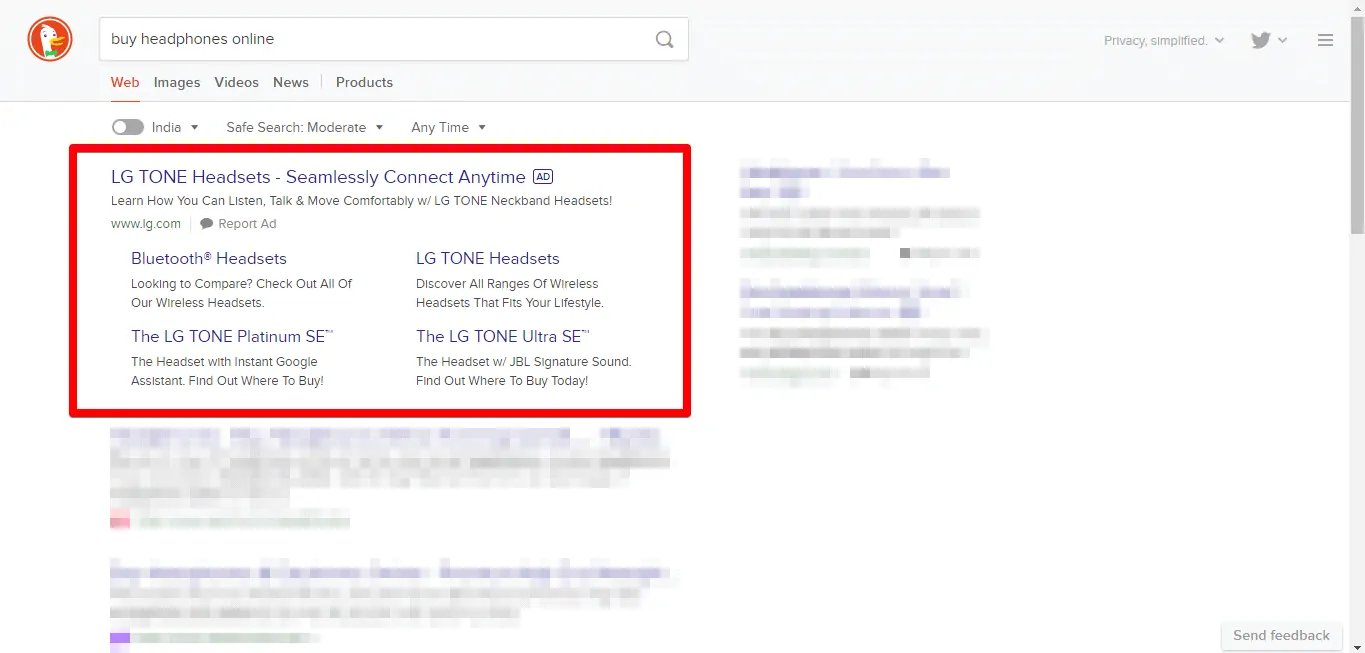
    buy headphones online at DuckDuckGo

    Thus, DuckDuckGo only shows you ads related to the keywords typed in the search box. (which by the way, you can disable in settings) This is their primary source of income.

    The other method of generating revenue is non-tracking affiliate partnership with eBay and Amazon. When you purchase something from these websites through DDG, DuckDuckGo receives a small commission out of it.

    So basically the other way DDG earns revenue is by getting a cut out of each product you buy through the DDG redirection link.
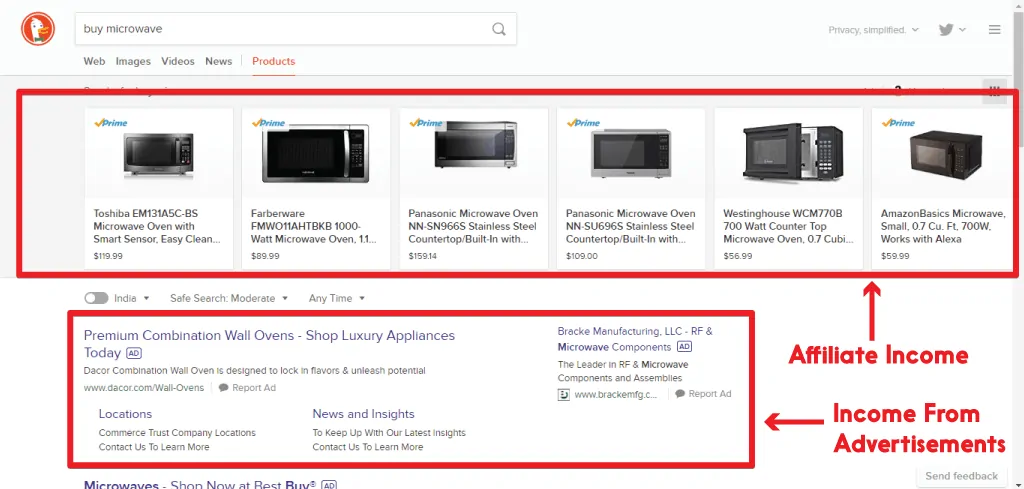
    How Does DuckDuckGo Make Money

    Naturally, these are not very profitable means and DDG is constantly on a lookout for more revenue generating models without putting user data at risk.

    DuckDuckGo Vs Google

    Most people are curious how DuckDuckGo makes a difference as compared to their usual Google search. Here is an infographic that will help you understand it better.

    duckduckgo-vs-google

    How Google Handles A Search Query

    When you put in a search keyword on the search bar, Google takes in the keywords and shows you related Advertisements (also stores in what keyword you had typed, from what device, at what time and location). After picking a suitable header when you click on a link, Google sends your IP address and user agent(basically your complete digital identity)  to that website thus recording not just what you searched but from what device you searched and who searched it. It further keeps this information to itself to show you the advertisements of products that you may have left in your cart, etc. To have a thorough follow up, it creeps up on your internet activity through trackers that are on multiple websites that carry Advertisements driven by Google AdWords.

    How DDG Handles A Search Query

    When you put in a search keyword on the search bar, DDG takes in the keywords and shows advertisements based on the keyword (without saving your search history).Further when you click a link, DDG to make sure your identity is safe, changes link from a majority of websites so as to make the user data almost encrypted where the website won’t know the user information

    DuckDuckGo Current Stance

    Is DuckDuckGo all about a safe browser that doesn’t follow you or is there more to it?

    10 years into a successful launch, DuckDuckGo has picked up the axe, has its warcry ready and is heading straight to tackle the biggest shark in the sea: Google.

    DDG has made it open that it is against Google’s ­creepy tracking of the internet. Now that DDG has newly acquired funds, it has been on Google’s tail and has made an extensive study of how Google collects and uses User data and started making masses aware of how we can get rid of this creepy stalking. With the latest study by DDG claiming that Google still personalises your search results even when you are in incognito mode i.e. incognito isn’t as private as you thought it was. This isn’t as big a shock as the fact that was discovered that over 75% of the websites you visit have secret trackers in them which are installed in them by Google as part of Adwords or other support systems.

    Now, leaving aside the mass study and awareness DDG is spreading to put its name out there, DDG is also developing methods to keep you safe when you browse the internet. DDG makes sure there is no search leakage when you browse through DDG. So now, they are making internet search more private, but they are also making some noise about it. The business model has changed drastically.

    Go On, Tell Us What You Think!

    Come on! Tell us what you think of our article on How Does DuckDuckGo Make Money? in the comments section.

  • Swiggy Business Model | How Swiggy Works & Makes Money

    Swiggy Business Model | How Swiggy Works & Makes Money

    You want to eat your favourite food from your favourite restaurant, but there is the usual tedious task in front of you – from getting ready to arriving at the restaurant through modern-day traffic to waiting for your table.

    You suddenly decide to postpone your dine-out plan and eat home-cooked food instead. Available are food ordering options but you still have to pick it up from the restaurant. Hence, eating at home often seems to be a better option after a tiring day at work.

    Worry no more because Swiggy has come to the rescue.

    Prior to Swiggy, all options available were food ordering services, but Swiggy introduced ordering & delivering food services at your doorsteps – much needed by the customers.

    Let us now understand how Swiggy works and makes money by diving deep into Swiggy’s business model.

    Swiggy Business Model

    Just like Grubhub in the USA, Swiggy operates on a hyperlocal on-demand food delivery business model. It not only aggregates restaurants but also organises a fleet of delivery partners which deliver the food (in less than 30 minutes) on-demand.

    Owned and operated by Bundl Technologies Private Limited, this unicorn startup followed the path paved by Uber and crafted a business model which relied on a dual partnership model. The partners can be divided into two categories:

    Restaurant Partners: The restaurant partners are restaurants which opt to deliver to customers that come from the Swiggy application and website.

    partner restaurant swiggy

    Delivery Partners: They form the delivery fleet which is given the responsibility to pick up the order from the partner restaurant and deliver it to the end consumer.

    How Swiggy Works?

    Swiggy provides an online platform for ordering from a wide range of listed neighbourhood partner restaurants and has its own fleet of delivery personnel who pick up the orders from the partner restaurants and deliver them to the customers at their doorsteps.

    Swiggy works by providing a complete food ordering and delivery solution that connects the existing neighbourhood restaurants with the urban foodies proving to be beneficial for both.

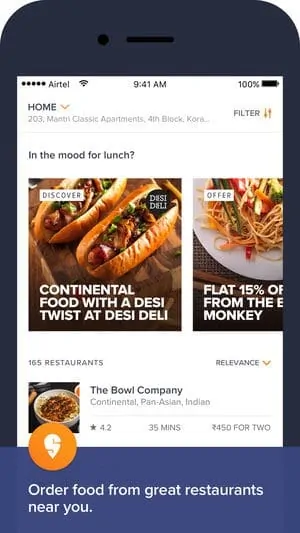
    You can open the Swiggy application on your mobile phone or visit the Swiggy website, and you will find a whole list of restaurants to order from.

    Once the restaurant is selected and the order placed, the restaurant which has its own Swiggy application receives the order details and starts preparing the order.

    A broadcast signal is then sent to all the drivers in the vicinity who have their own driver applications. Those willing to accept the order can choose to accept and deliver it.

    Like other on-demand delivery startups, Swiggy also has integrated the Google Maps API, which lets the customers know where their order is and the amount of time it will take for their order to get delivered in real-time.

    How Swiggy Makes Money?

    Swiggy’s business model has made Swiggy an early mover in the food service space in India and has had a set base model on which its business is based, but it has started earning revenues from other related avenues ever since it established itself.

    The following are the different sources that Swiggy makes money from:-

    Commissions

    Swiggy typically charges a 15% – 25% commission on the order bill amount received by the restaurant. This commission is charged on the full bill amount, including the Goods and Service Tax charged over and above the menu price.

    Swiggy continuously tries to get restaurants on board to be available on Swiggy exclusively. On this account, certain benefits are given to restaurants, like greater visibility and sometimes a drop in the commission of about 2% – 3%. But since the resulting benefit is far more than the drop in revenue, Swiggy does this aggressively.

    The percentage of the commission depends on various factors like the frequency of orders received, location of the restaurant, dependency of the restaurant on Swiggy, the percentage charged by competitors, penetration to a new city etc.

    Delivery charges

    Swiggy does not have a minimum order requirement for delivery, so Swiggy often receives orders amounting to less than Rs 100. This increases the logistics cost per order.

    So, after Swiggy got a stronghold of the market, it started charging delivery charges to low order amounts (depending on and varying from city to city). Delivery charges are typically around Rs 20 for orders less than Rs 250. Swiggy sometimes also charges a surge in delivery prices in times of high demand, rains, special occasions and midnight delivery in select markets.

    This additionally helps in pushing customers to order above the threshold to avoid paying delivery charges.

    swiggy business model

    Advertising

    Swiggy started earning advertising revenue via two models – Banner promotions and priority listing of restaurants.

    Swiggy recently started with Banner promotions to take a leaf out of Zomato and Foodpanda’s books. Restaurants are promoted and displayed in their app and website pertaining to regions. Different regions on the displayed page vary in their rates based on the visibility that the restaurant is to receive via the banner promotion.

    The only limitation is that Swiggy does not share customer data, so the restaurants rely on generating raw revenue through higher visibility only.

    Swiggy typically displays a list of available restaurants to the customers. It has tapped this very potential into a revenue stream by charging a premium from restaurants in return for giving priority listing to the restaurants. The higher up the list the restaurant is displayed, the higher the cost the restaurant has to pay.

    swiggy business model

    Restaurants

    Swiggy has started its own restaurants, which are prominently displayed on the application and website with the highest amount of visibility you can imagine. This started in Bangalore and is said to be replicated soon in markets like Mumbai and Hyderabad.

    Swiggy Access

    Swiggy has recently launched Swiggy Access, a central kitchen base-like facility which houses kitchens of different restaurants, including Swiggy’s private labels. This cloud kitchen business model will help restaurants to set up kitchens in locations even where they are not present.

    Launched in Bangalore last year, it has expanded to include 30 restaurants with 36 kitchens in new cities, including Kolkata, Delhi, Mumbai and Hyderabad.

    This inter-city model is expected to be a game-changer for penetration into tier 2 and tier 3 cities.

    Currently, in markets where it is launched, about 8% – 25% of order volumes come via Access kitchens. Restaurants on Access have to pay higher commissions than the existing average commissions that the platform charges for delivery only.

    Swiggy Super

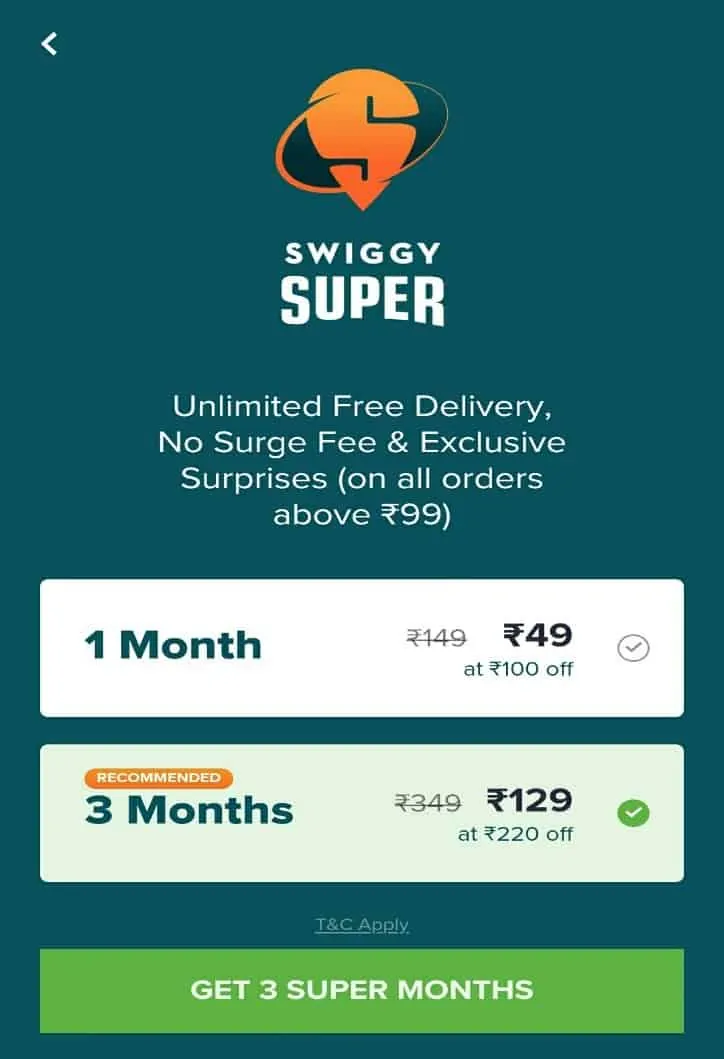
    Swiggy has recently launched Swiggy Super which is a membership program for customers. It offers unlimited free delivery on orders above Rs 99 and no surge pricing for which the customer has to pay a fixed amount.

    Available options include a one-month membership for Rs 149 and a 3-month membership for Rs 349, which are being offered at introductory prices of Rs 49 and Rs 129, respectively. This amount, in addition to the repeat orders Swiggy expects through this membership program, is expected to increase revenue.

    swiggy super

    Affiliate Income

    Besides the core business practices, Swiggy also makes money in the form of affiliate income by referring credit cards to its customers. The company has partnered with financial institutions and banks like American Express, Citibank, ICICI bank, HSBC, etc. to sell their credit cards to customers.

    Customers see the credit card offers on the order tracking screen.

    Swiggy affiliate income

    Sources Of Expenses For Swiggy

    Apart from the revenue streams, Swiggy also has to incur expenses for its day-to-day functioning. These expenses, coupled with Swiggy’s motive to gain market share aggressively, led Swiggy to lose Rs. 1.5 for every Re. 1 it earned in 2017. But, Swiggy owing to its expansion strategies across the country and having gained considerable market share, has managed to earn Rs. 1.1 for every rupee it lost in 2018.

    • Payments and incentives to delivery partners (the amount varies according to the experience, place of operation, and the number and time of delivery)
    • Application and website development charges
    • Application and website maintenance charges
    • Salaries and provisions for full-time employees
    • Administrative costs
    • Advertising and marketing costs
    • Benefits given to customers in the form of offers
    • Returns and refunds
    • Miscellaneous expenses

    Future Of Swiggy

    Swiggy recently became the first aggregator to offer the 30 minutes or free delivery feature to customers. It is available at select restaurants in select cities but it solves a huge pain point of customers having to wait for 40-60 minutes for their food to get delivered. Once it is fully launched – Swiggy will bear 70% – 80% of the cost in case it fails to deliver on time, while the restaurants will bear the rest.

    Swiggy also launched the Swiggy POP, which focuses on providing single-serve meals that save time. It is aimed at time-pressed professionals who are on the move and want a foolproof mix for their daily needs.

    Swiggy now also allows customers to pre-order their meals through Swiggy scheduled. They can now place their orders in slots of 30 minutes, a minimum of two hours and a maximum of 48 hours in advance. This enhances the experience of those who order from Swiggy regularly.

    Bottom Line?

    Due to such different features and a host of different options provided by Swiggy, it might soon gain a competitive advantage and increase its customer base, as we already see happening. Additionally, due to its innovation, the resultant growth would be purely organic in nature – something that every company dreams of.

    Go On, Tell Us What You Think!

    Did we miss something? Come on! Tell us what you think about our article on swiggy business model in the comments section.
  • Startups & Game Theory: What You Need To Know!

    Startups & Game Theory: What You Need To Know!

    Business whether small or large depends on how it interacts with people. Marketing Strategies, Financial Strategies, Survival in the market etc. essentially depends how effective is it in dealing with people; be it potential customer or competitor.

    Now behavioural aspects are not constant and could not be quantified, but there exists a field of study which tries to help people understand the choice that a rationally intelligent person would make.

    This field is now known as Game Theory.

    What is Game Theory?

    Game theory is the study of the decision-making process and rationale behind it. It is a way of studying a model of conflict and cooperation between intelligent, rational decision taker.

    You might remember the motion picture A Beautiful Mind in which Russel Crowe played a mathematician John Nash; well he is one of the pioneers of Game Theory.

    Types of Games in Game Theory

    Game Theory in design is essentially a theoretical approach to strategies in life and as it happens in life, you could either be cooperative or noncooperative.

    Therefore Game Theory has two main running ideas:

    1. Cooperative Games

    Cooperative Games as the name suggests deals with a cooperative group. It is a game between a group of players rather than between individuals, and it deals with the structure of groups like group forming tactics, resource allocation etc.

    2. Non-Cooperative Games

    Non-cooperative game theory is essentially a scenario where individual agents deal with economic assets for their good.

    In this situation, only the available strategies and the outcomes that result from a combination of choices are known.

    An example of a noncooperative game would be the classic Rock-Paper-Scissors.

    Real Life Application Of The Game Theory

    Game Theory has gathered steam due to its application in various fields. We usually see Game Theory in our daily life without knowing it. Read on to find out more about some of the Game Theory strategies.

    1. Tit for Tat Game

    Let’s consider the case of Harry Potter in Goblet of Fire.

    When Harry was crowned as the fourth champion, he was required to complete the three tasks to be crowned as the Triwizard Tournament Champion.

    Before even the first task of the tournament, we see cooperation between players regarding the exchange of information. Hagrid reveals to Harry that the challenge of the first task will involve dragons. Harry deduces that the Durmstrang and Beauxbatons champions must also possess this knowledge, given Hagrid’s relationship with the Beauxbatons headmistress and the fact that he ran into Durmstrang’s headmaster near the place where the dragons were being kept. He then assumes that Cedric is the only oblivious champion and was faced with the decision of either passing on the information to Cedric or withhold and gain the upper hand.

    But Harry did pass on the information and received the same help from Cedric in the second task and deduced the message in the dragon egg.

    This form of cooperation based on prior experience forms the Tit for Tat game that is solely based on trust. One defection and it might just ruin the balance forever.

    2. Cournot Competition

    In the real world, oligopolistic markets have emerged. Such markets could be explained in the sense of a duopoly by Cournot Competition.

    Cournot competition describes an industry structure in which competing ventures make the same product but choose a quantity to produce independently and simultaneously.

    This is a well-coordinated strategy to maximise their profit in the long run and get an almost dictatorial hold on the market.

    In real life, this could be seen in the diamond industry.

    The big four of the diamond industry controls and coordinate so well that they have tricked the people in believing that diamonds are a necessary luxury.

    3. Peace War Games

    Peace War Game is an iterated version of Tit for Tat, here the more aggressive approach leads to huge profit in the initial run but continuous aggression is not shown since the cost are too high, and therefore peace is made after some time.

    In the recent telecom war Reliance Jio reduced the cost of data packs and started a revolution and quickly managed to reach a massive population in just a matter of few months. It blew out the competition where bigwigs like Bharti Airtel, Vodafone and Idea Cellular were already well established.

    This is an example of a Peace War Game where Reliance Jio waged a price war and did not relent which ultimately led to an aggressive price cut from every telecom company. This led to a considerable loss especially in the case of Bharti Airtel and an effective merger between Vodafone and Idea.

    Now plans are being rolled out with similar benefits by every telecom companies, and there is a peace situation unless provoked.

    4. Non-Zero Sum Strategy

    Mergers and acquisitions are usually complex, and one has to employ a non-zero-sum strategy.

    A zero-sum strategy is a scenario where one entity gains in the same amount as the other entity loses(equal amount of positive and negative lead to zero and hence the name) whereas Non-zero-sum strategy is where both parties have something to gain.

    The classic example being Google here.

    Google did attract attention from both Yahoo! and Excite. Yahoo passed on the opportunity, but Excite did decide to pursue the deal. Google founders, however, did not want to have a company take over. They wanted the company to overhaul their entire search algorithms and replace them with Google’s.

    Now, this was an outrageous idea and eventually Excite backed out of the deal.

    5. Volunteer’s Dilemma

    Even the company’s financial and accounting practices are covered by one aspect of game theory.

    The Enron Scandal is one of the biggest corporate bankruptcy scandals that led to the loss of many jobs and also the dissolution of one of the big five accounting firm Arthur Anderson.

    The Enron way of business was based on a false pretext and non-ethical accounting practices in which mark to market strategy always showed the company going to profit.

    This scandal was known by the employees, but there was no one to come out as they were enjoying the prosperity that Enron brought with it. However such practices eventually led to the downfall of Enron.

    Such situations where volunteer action becomes too hard to decide is aptly described by the Volunteer’s Dilemma, where the cost of being a whistleblower is not worth it and therefore nobody volunteers, and eventually the whole scam is exposed, and everyone is out of the job.

    Startups and Game Theory

    Now one of the most buzzing ecosystem in the 21st century has been the startup ecosystem. Within any ecosystem that displays competition, we’ll see a set of different strategies for long-term survival and prosperity.

    Depending on the underlying stakes, this behaviour will result in a new generation of actors emerging after a round of the game.

    Let’s put this into the startup context.

    Imagine a scenario where founders and investors are negotiating a deal. This could happen in a cooperative manner where they do a fair deal, benefiting both parties equally (a non-zero-sum game) or become noncooperative and try to exploit and get a better deal for themselves at the expense of the other (a zero-sum game).

    After initial negotiations, the next set of decisions would be taken on prior experience, and therefore strategies would be adjusted accordingly (tit for tat).

    Forming such a system usually results in homogeneity. Fair players tend to increase in number as a trust has multiplier effect while defect doesn’t. Therefore in a system even if there is a small number of players that play in a trustworthy manner could outdo the competition eventually.

    Not only survival but game theory also is important in an expansion.

    Take salary issues for example. When hiring for a startup, there will be a final negotiation on the salary to be given to an employee. Now the employee would seek out to maximise his salary, and you as an entrepreneur would try to play it down, since agreeing to egregious terms would leave your venture in a financial mess.

    Therefore there would be a middle ground where both the venture as well as the employee has to compromise.

    Another important aspect of a successful venture is the government policies.

    In a turbulent political, social and economic environment, entrepreneurs face many of questions:

    • Should I start a new business?
    • Should I invest in new machinery or technologies?
    • Should I spend more money on research and development?

    To answer these questions, an entrepreneur should identify and establish an optimal or sub-optimal strategic business and technology choices.

    Go On, Tell Us What You Think!

    Did we miss something? Come on! Tell us what you think about our article on startups & game theory in the comments section.
  • 5 Genius Examples Of Memes In Marketing

    5 Genius Examples Of Memes In Marketing

    When we say that ‘Memes are taking over the world,’ we mean it. Quite literally. They are also rapidly taking over the fields of marketing and advertising.

    Memes are a great way to keep up with all the current trends in pop-culture, which is very important if you plan to keep your brand and content relevant and interesting to your customers.

    meme marketing

    Ergo, internet meme-marketing can be very beneficial for your business. Several brands use memes in the forms of text-posts, photos, videos and gifs to connect with their customers on social media. This also serves a dual purpose —meme marketing helps to spread the word about your business through your customers on social media, thereby also helping you gain social validation via the viral content.

    Why Is Meme Marketing Important?

    Did you know that an average person spends nearly 2 hours on social media every day? Memes are so effective that people share them and laugh at them, while also giving you plenty of opportunities to engage with your audience.

    marketing with memes

    The Daily Mail compared memes to the bubonic plague, saying that memes also originate from a specific place and transfer from ‘person-to-person’ and form a wave-like pattern. But unlike the plague, memes can actually help your consumers engage with your business.

    The only downside to brand marketing on social media is that it has very low engagement. Gen-Z can be very averse to branded content and sponsored advertisements, and therefore, steer clear of all sponsored ads and show very little interest. Memes are also quite refreshing from all the regular informational and promotional content on social media.

    social media strategy

    This is where meme-marketing comes in. Memes work for brands because they have been created for value through entertainment. About 85% of the content shared on social media today comprises of memes. Meme-marketing isn’t overly promotional; it makes people laugh, but with a casual reference to your brand, which makes meme-marketing a very important method to connect with your existing and potential consumers.

    How Brands Implement Meme Marketing

    Fenty Beauty

    Rihanna’s very own beauty line Fenty took over the world of cosmetics immediately with their very diverse collection of make-up. Fenty is a brand that is widely rooted in the Instagram-culture, which appeals visually to the consumers; much like memes, which are perfectly aligned with the visual nature of Instagram.

    https://www.instagram.com/p/Bqp0zqygmNI/

    Occasionally promoting products and offers through memes makes catches the consumers’ attention in a better manner, instead of scrolling away from the post. Fenty uses meme-marketing to promote their upcoming products and sales, and to excite their consumers into doing business with them.

    https://www.instagram.com/p/BqgDfPTgHld/

    Denny’s Diner

    Denny’s has always been known for their active interactions over social media with their consumers. Their posts on social media are widely liked and shared by consumers. So it isn’t really a stretch that Denny’s also uses meme-marketing to increase their engagement with customers.

    https://www.instagram.com/p/BfMod-xHjYC/

    Since Denny’s have always been so interactive and updated with pop-culture on social media platforms, their customers have come to expect meme-marketing from them, instead of coming across as trying too hard or inauthentic. This helps the brand connect to the consumers via meme-marketing.

    https://www.instagram.com/p/BZFXvvGHBsX/

    Netflix

    Netflix, like Denny’s, has also always been interactive with their followers on social media platforms. Apart from meme-marketing, Netflix also uses internet lingo and informal language with its audience. That being said, it is important to be mindful of your audience and know how to present yourselves on various platforms.

    https://www.instagram.com/p/BqXxjW2Fiay/

    Netflix has its own sub-account named ‘Netflix is a Joke’ on their social platforms that is used specifically for meme-marketing. Here’s the catch, though—Netflix makes memes out of their own shows instead of using the already viral templates, thereby promoting their shows and increasing their viewership. They use their own content as the basis for the joke, and the audience loves that!

    https://www.instagram.com/p/BqdIJgvlBwg/

    Disney

    Disney has focused on children and adults alike. But considering the population of Gen-Z on social media, the entertainment giant has also taken to sharing memes on their various social media accounts from around the world, with memes that their audience from the specific region targeted can relate to.

    This step by Disney has garnered mass-engagement on their social media platforms because they cater to their audience according to geo-location.

    https://www.instagram.com/p/Bqs6unWAorn/

    Disney also makes memes out of their own shows, like Netflix, but also mixes them up with the most trending memes in pop-culture, thus also keeping up with the times. This keeps the content relatable and encourages the audience to interact (like, comment, or share/retweet) with the memes as well.

    https://www.instagram.com/p/Bp5EkdLlAcQ/

    BarkBox

    BarkBox is an online shopping site for pets and is widely popular for is subscription boxes. It’s highly advantageous that they are a pet-store as they can widely make use of the viral animal memes, and dominantly, the well-known ‘Doggo’ memes to stay relevant and strike a chord with their consumers.

    https://www.instagram.com/p/BoulNaBlCsh/

    A majority of the memes that BarkBox uploads on their page is animal-related, which speaks volumes about the kind of brand they are. It is important to create an identity for yourself among your consumers and to remain active on social media, while also making sure that your memes subtly show off your products and services.

    https://www.instagram.com/p/BokD7Oalo8t/

    Tips For Meme-Marketing

    • Stay up-to-date with the current trends in pop-culture. Several brands use trending viral memes to increase engagement rates among their customers.
    internet culture meme
    • It is important to stray away from being professional at times. A little use of internet lingo every once in a while can entertain your customers and potential customers.
    • Use your own brand’s content or imagery as the basis for the meme to make your products and services more memorable to the audience.

    • You can jump on the viral meme bandwagon every once in a while, but ensure that your memes remain original and unique to your business.
    • Adapt some humour into your memes frequently instead of uploading mechanical promotional content all the time. This will help you create better connect with your audience.

    Bottom line?

    Memes can be an integral part of your marketing strategy, as long as a few rules are kept in mind. When done correctly, meme-marketing can be very useful. Instead of just leaving promotion for branded content, memes are a great way to interact with your audience.

    Most users on social media prefer sharing entertainment over a 500-words long blog post about your brand’s latest product to their own social media pages. This makes meme-marketing an extremely useful strategy to make your consumers share your content and engage in your business further.

    Memes today have a specific connotation in the digital world. They can be used to express emotions and spread humour. Due to their wide popularity and reach among the audience, meme-marketing is a great way to promote your business through humour over social media.

    Go On, Tell Us What You Think!

    Did we miss something? Come on! Tell us what you think about our article on Meme Marketing in the comments section.

  • What Is Marketing Plan? How To Write One?

    What Is Marketing Plan? How To Write One?

    A product without a marketing plan is like a traveller without a map.

    When you’re preparing for a trip, you consider lots of things like the route, mode of transport, place of stay, weather, how much would you need to spend, places to visit, et al. And all of these need to be carefully planned so you don’t end up with say, lesser clothes than you needed or run out of money!

    Similarly, when you launch a product, you need to consider several aspects like:

    • identifying the target customers
    • establishing its Unique Selling Point (USP), the strong and weak areas of the product and comparing those with that of the competitors
    • framing a pricing strategy
    • constructing a distribution channel
    • planning promotions and offers, etc.

    And just like your travel itinerary, these processes need to be structurally analysed for the company to plan a feasible course of action.

    Let us understand what a marketing plan is, what is the purpose of a marketing plan and how to write a marketing plan.

    What Is A Marketing Plan?

    A marketing plan is a business roadmap describing the business’s marketing goals and the marketing strategies and tactics it uses to fulfil those goals.

    It is a blueprint or a document that contains details of the product’s primary research, strengths and shortfalls, competitive environment, promotion plans, financials and further prospects.

    Such processes need to be in a logical flow.

    You obviously can’t determine your points of sale without understanding the target group’s buying behaviour. Or, you cannot frame your pricing strategy before you consider the competitive environment and gaps in customers’ needs.

    Hence, you need a ‘plan’ to give a logical sequence and flow to the entire process.

    Importance Of A Marketing Plan

    A marketing plan consists of a very comprehensive roadmap and analyses, upon which future course of actions is decided. Hence it is very important to ensure the accuracy and feasibility of all the components in the plan.

    The purpose of a marketing plan is to:

    • Facilitate internal discussions on the product
    • Pitch the product idea to investors
    • Set the vision and specific goals for an upcoming time period

    How To Write A Marketing Plan?

    A marketing plan can be in the form of a document or report. But the popular method of presenting a Marketing Plan, usually, is through Powerpoint presentations (PPTs). Since you can use graphics, pictures and videos, it is easier for both the presenter and the listener to understand.

    An ideal Marketing Plan consists of these ten components:

    1. Executive Summary
    2. Marketing Mix
    3. Consumer Research
    4. Target Customers
    5. SWOT Analysis
    6. Competitor Analysis
    7. Pricing
    8. Distribution
    9. Promotions
    10. Financials

    We will look at each of the components in detail with examples.

    Executive Summary

    As the name suggests, this section contains a brief summary of all the other sections, which helps to give a quick overview of the entire plan.

    Planning the Marketing Mix

    For every product, you need to keep four basic things in mind-

    • Its features
    • Its price
    • Where and how will it be sold
    • How to promote it

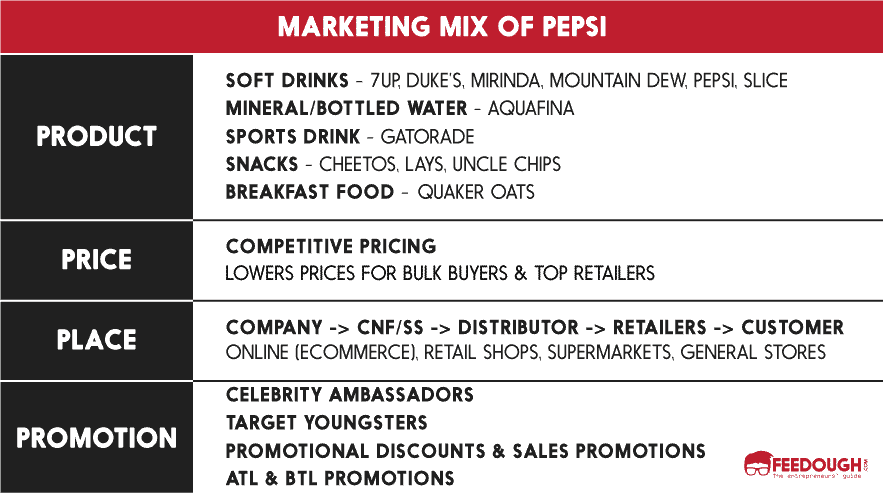
    These are popularly referred to as the Marketing Mix or the 4 Ps (Product, Price, Place and Promotion).

    Let’s take, for example, the Marketing Mix of Pepsi

    marketing-mix-of-pepsi

    Consumer Research

    Before you bring your product out, you need to understand what consumers need, demand and expect of the product category. This helps you in identifying and addressing the gaps consumers face.

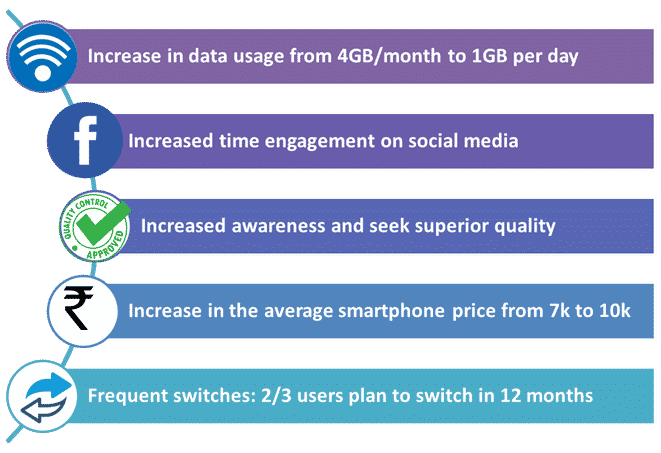
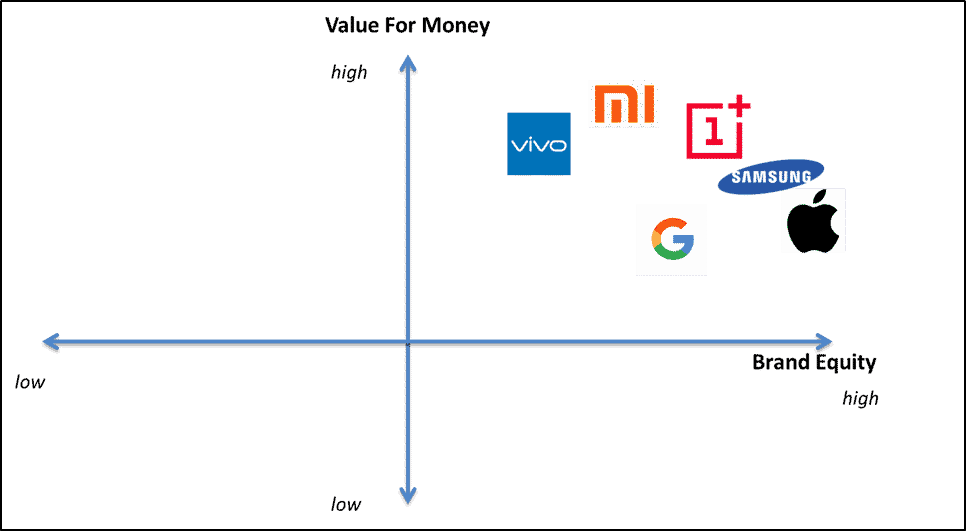
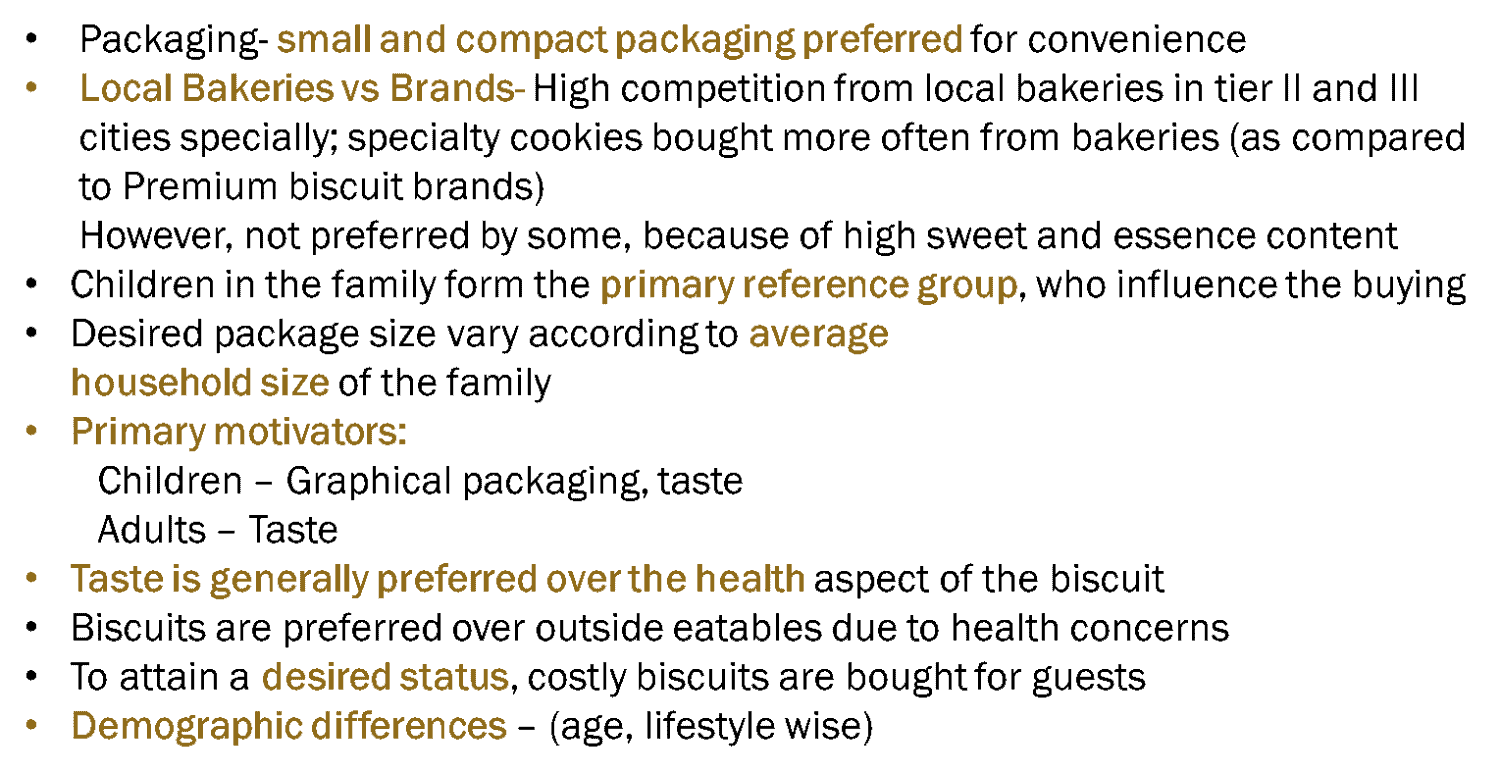
    Consumer Research can be carried out through online and offline surveys and interviews, analysing online search patterns and feedback. Here is an example of the trends in smartphone usage by customers.

    Here is an example of a consumer research for biscuits:

    consumer research for biscuits

    Target Customers

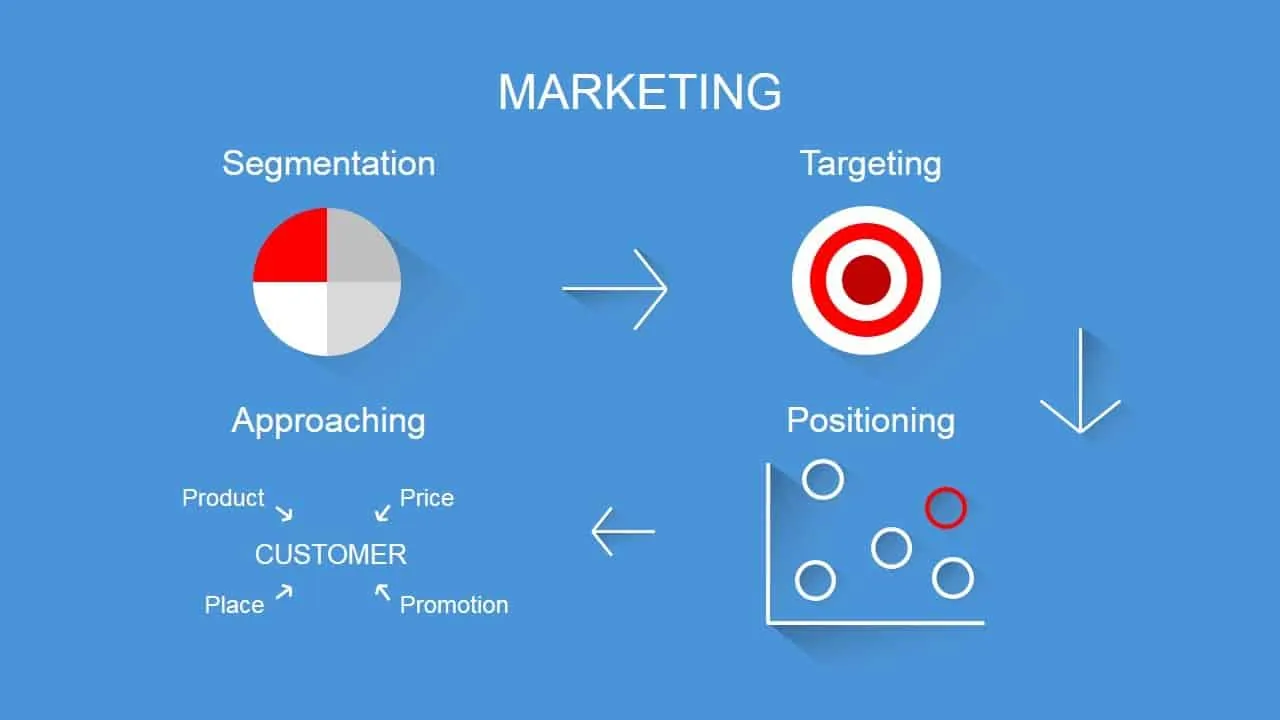
    To specifically target who your likely consumers will be, we follow a process called STP Analysis (Segmenting, Targeting and Positioning).

    target customers

    Segmentation

    Of the broad population, you make segments based on, say age or gender or income levels, etc. that constitute your potential consumers. Of these segments, you pinpoint on a particular segment which becomes your focus.

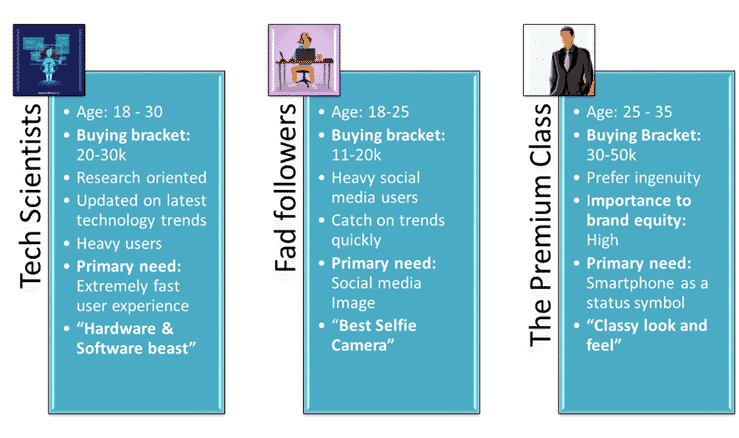
    Here are segments of mobile phone users in India, on the basis of age, phone-usage patterns, etc.
    For each segment, you highlight their particular expectation or requirement.

    segmentation

    Targeting

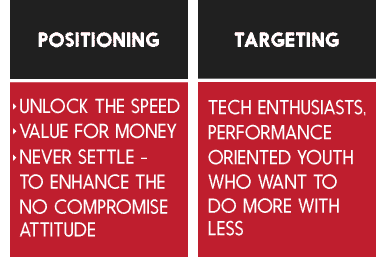
    After analysing the segments, you pick one Target segment, which is the most convenient and suitable to cater to, given the segment’s characteristics and your product offerings. In this case, the target segment would be:

    targeting

    Positioning

    Now it’s time to highlight the USP (Unique Selling Point) of your product.

    A key difference in how various brands differentiate their product is through their ‘brand positioning’.

    It refers to the image your product has in the minds of the consumers. For example, L’Oreal positions and promotes itself as a premium luxury brand. So when one thinks of Luxury skin care, the chances of L’Oreal popping up first in the mind are higher.

    positioning

    SWOT Analysis

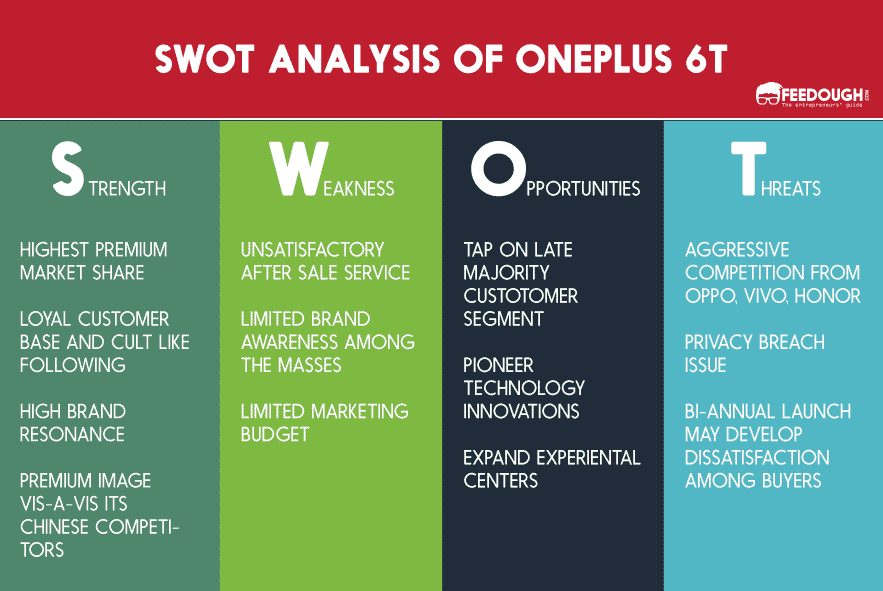
    Once you understand the market scenario and the requirements of the consumers viz. a viz. your product, you need to identify the Strengths, Weaknesses, Opportunities and Threats the product might face.

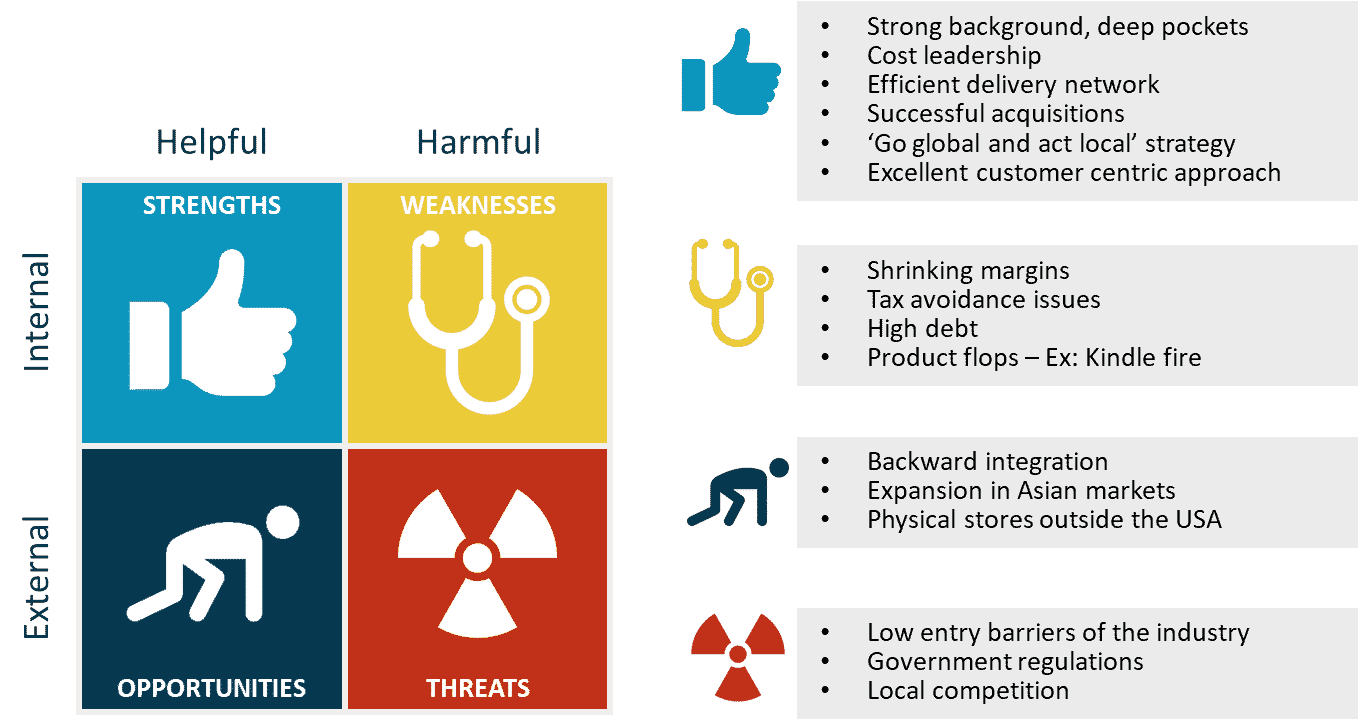
    Let us consider a SWOT Analysis for Amazon as an example –

    amazon swot

    Competition Analysis

    Once you have identified the gaps and the strengths, you need to map your offerings with those of the competitors and see where you stand. Parallels could be drawn in the form of pricing, market share, etc.

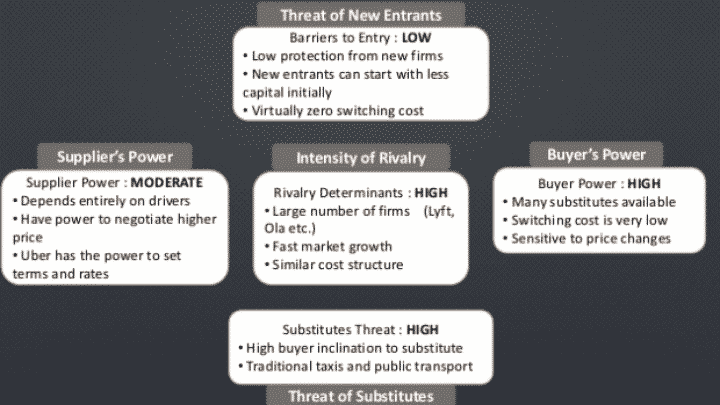
    You should also analyse the overall competition in the industry, using a tool called ‘Porter’s five force analysis’ which measures:

    • Intensity of Rivalry
    • Threat of New Entrants
    • Threat of Substitutes
    • Power of Suppliers
    • Power of Buyers

    For example, let us see the competitive analysis for Uber-

    uber competitive analysis

    Pricing

    Having targeted our customers, identified the SWOT, analyzed the competitors, we now need to determine our pricing strategy.

    There are several kinds of pricing strategies, for example:

    • If your brand is entering into a competitive market where there is a market leader, you might want to go for competitive pricing (challenging the market leader by offering a similar product at a lower price). For example- Walmart
    • If you are a market leader, have significant market share and now seek to broaden the existing share, you could go for penetrative pricing (very low price). Example: Stax v/s Pringles. Stax offered steep discounts which enabled it to get more display and ultimately more market penetration.
    • If you want to both expand and penetrate the market and have sufficient resources, you could go for disruptive pricing like Tesla, Nike or Netflix- all of which offer high-quality alternatives at significantly low prices.

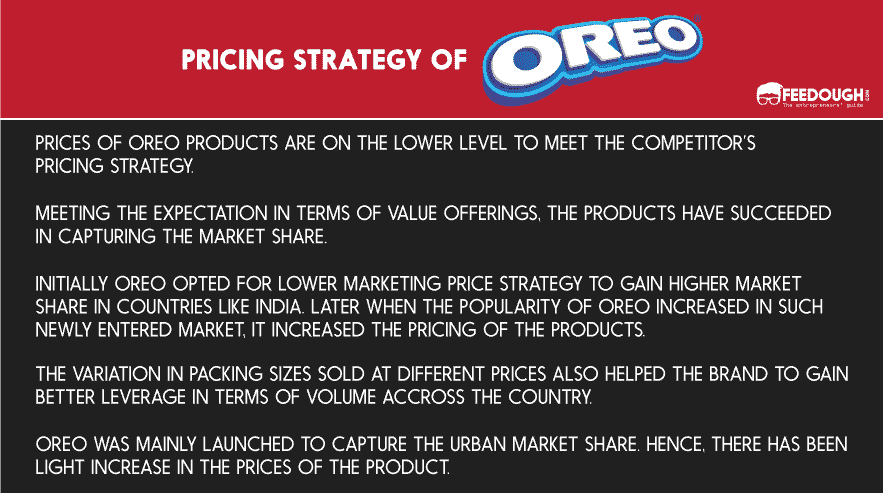
    For example, let us see the pricing strategy of Oreo Biscuits:

    pricing strategy of oreo

    Distribution

    A very essential component of the Marketing Plan is determining the distribution channels for the product. These are the channels through which the product will be transported to different points of sale. These can be both online and offline.

    For perishable products, it is very necessary to have a consistent flow and an accurate forecast of demand so as to avoid wastage or damage.

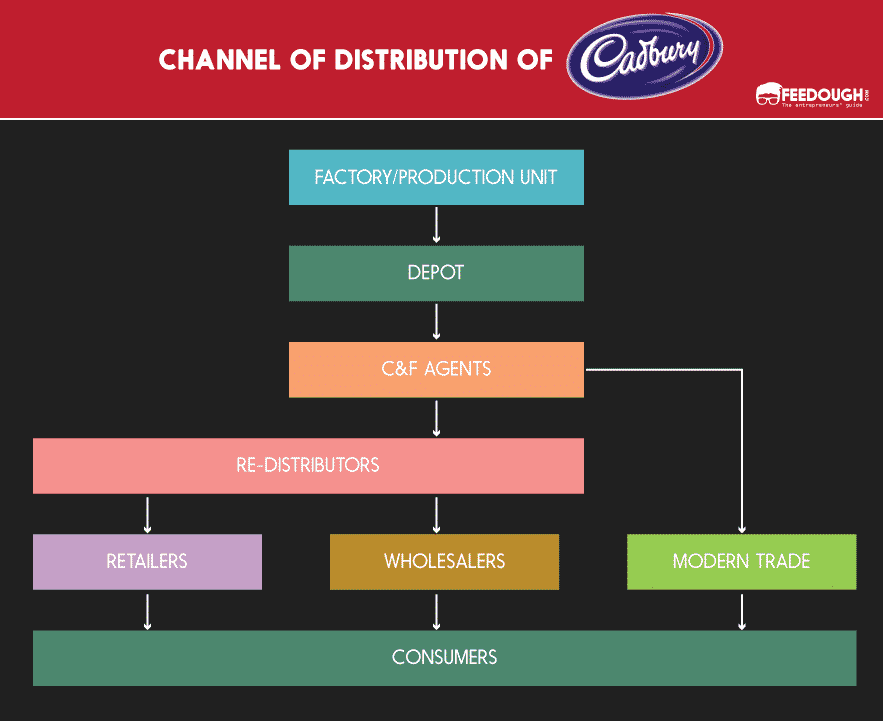
    Here is the distribution channel of Cadbury for example –

    channel of distribution of cadbury

    Promotions Strategy

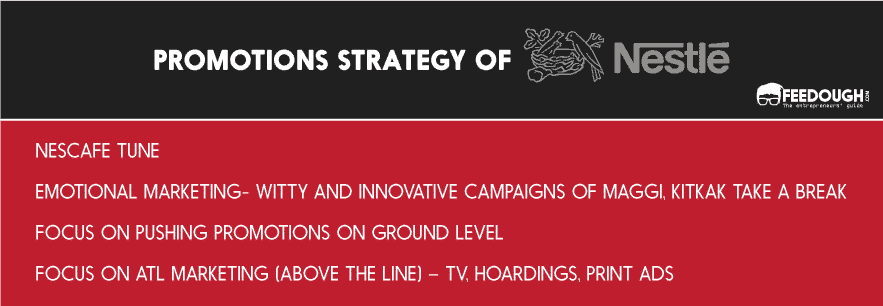
    This is one of the most important sections of the Marketing Plan. People associate the brand with its value proposition, and brands drive their promotions focusing on the proposition. The promotions strategy should also be driven keeping in mind the target audience and their exposure to various media platforms.

    For example, here is a brief of promotion techniques used by Nestle –

    PROMOTIONS STRATEGY OF NESTLE

    Financial Projections

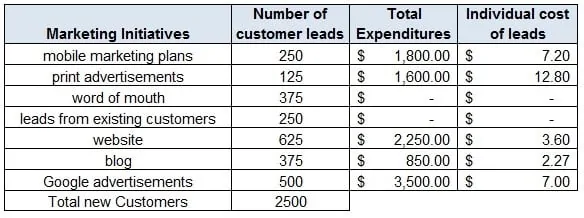
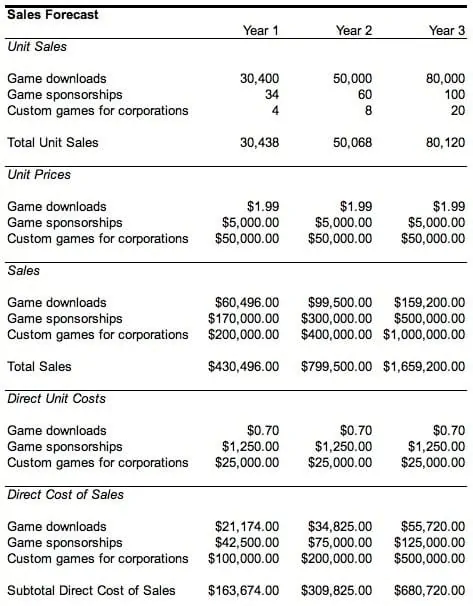
    Here comes the dreaded section- planning the budget for your marketing activities. The financials are usually shown in the form of a cost sheet, which includes detailed lists of costs attached to each activity. The financial projections are also used to depict sales forecasts and estimated profits over a few quarters or years.

    Companies don’t usually share their costing structure on the public forum. So we take a very general example here of how a cost sheet may look like-

    Example 1 –

    financial projection
    Source: driveyoursuccess.com

    Example 2 –

    financial projection
    Source: morebusiness.com

    Example of a Marketing Plan

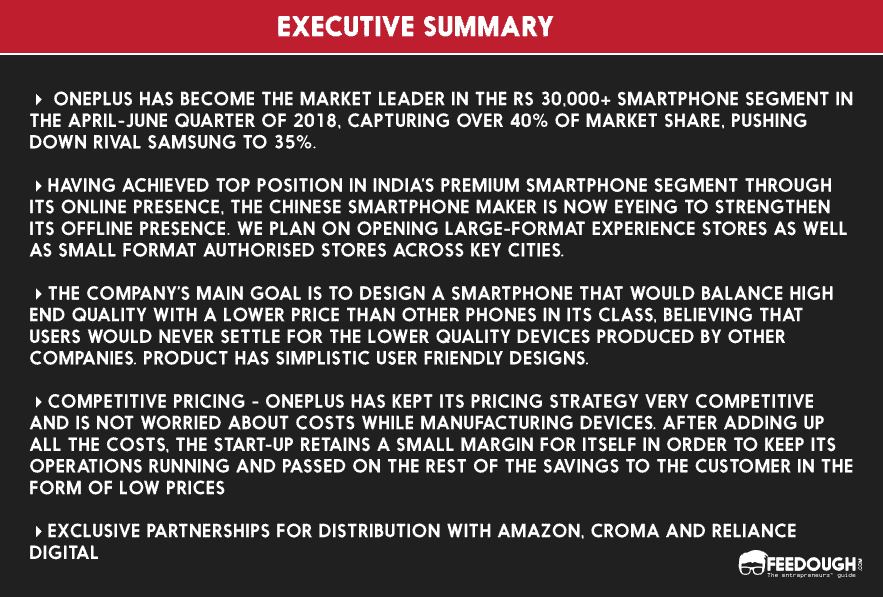
    To understand the entire process more easily, let us focus on writing a marketing plan for OnePlus 6T, as an example.

    Executive Summary

    executive summary oneplus 6t

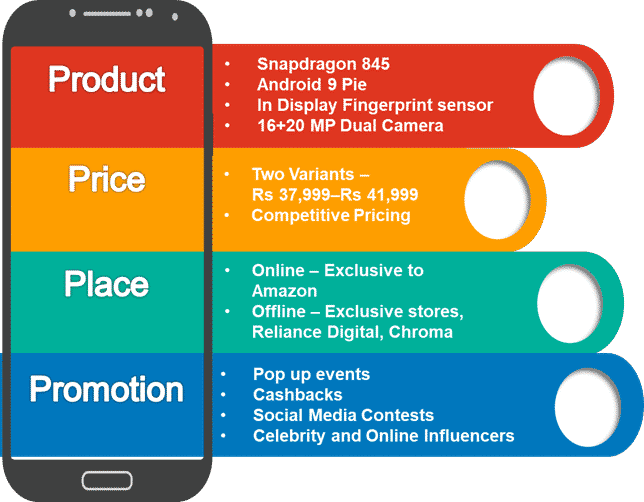
    Marketing Mix

    marketing mix of oneplus 6t

    Consumer Research

    Target Customers

    target audience oneplus 6t
    target audience oneplus 6t

    SWOT Analysis

    SWOT ANALYSIS OF ONEPLUS 6T

    Competitor Analysis

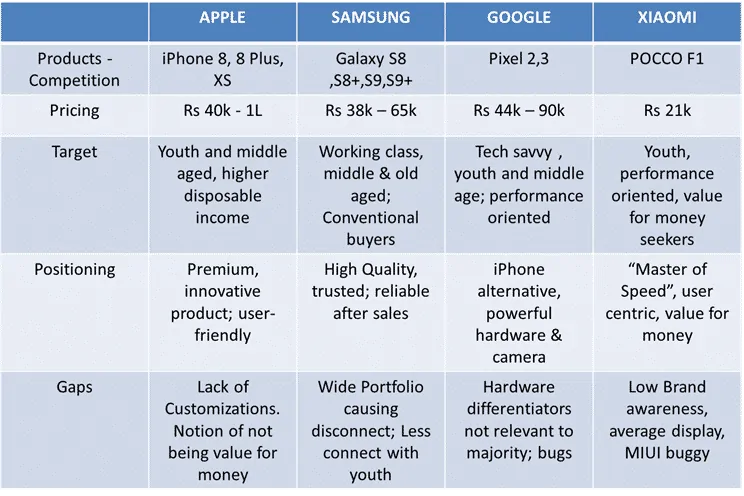
    oneplus 6t competitor analysis

    competitor analysis oneplus 6t

    Pricing

    OnePlus Competitive Pricing

    Distribution

    Initially, OnePlus had an invite-only system, which helped in demand control and forecasting and also in helping the company grow sustainably but now it has very specific and exclusive channels.

    Online: an exclusive partnership with Amazon

    Offline: Exclusive stores- Reliance Digital and Croma

    Promotions

    ONEPLUS PROMOTION

    Go On, Tell Us What You Think!

    Did we miss something? Come on! Tell us what you think about our article on Marketing Plan in the comments section.

  • What Is Entrepreneurship? – Types & Importance

    What Is Entrepreneurship? – Types & Importance

    There are 582 million entrepreneurs in the world today. This means 1 in every 13 people owns a business! Well, the talks about entrepreneurship are everywhere but not everyone knows what exactly does entrepreneurship mean?

    Here’s a detailed article explaining the same.

    What Is Entrepreneurship?

    The practice of ideating, developing, launching, and running a business venture along with its financial risks is called entrepreneurship.

    It is very important for the economic development of the expanding global marketplace. A person who undertakes entrepreneurship is called an entrepreneur.

    Generally, starting your own business is a tough proposition as 90% of startups fail each year. However, it comes as no surprise that more and more people choose to be independent in their professional careers. In fact, 2 out of 3 people worldwide think entrepreneurship is a good choice.

    Majority of the people think that entrepreneurship has just one meaning. But there are different types of entrepreneurship as described below:

    Types Of Entrepreneurship

    Small business entrepreneurship

    In today’s world, the majority of businesses are still small businesses. In the U.S, 99.7% of all companies are small businesses and they employ 50% of all non-governmental workers.

    They are mostly barely profitable, but they make profits only to make a living and support their families. Such businesses lack the scale to attract venture capital and they are funded via friends/family or small business loans.

    Examples of small business entrepreneurship include hairdressers, grocery stores, electricians, carpenters, plumbers, consultants, etc.

    Scalable Startup Entrepreneurship

    In this type of entrepreneurship, entrepreneurs start their company believing that their vision can change the world. Their funding comes from venture capitalists and they hire the best employees. Finding a scalable and repeatable business model is their goal. Once they find it, further funding from venture capitalists is required for growing their business.

    Scalable startups only make up a small proportion of all businesses due to the risk capital and outsize returns.

    Examples of scalable startup entrepreneurship include Facebook, Instagram, Online shopping for electronics, etc.

    Large Company Entrepreneurship

    Large companies through sustaining innovation, offering new products that are variants around their core products. New products are developed in order to meet with changing customer needs and advanced technology. Often, companies do this by partnering with or buying innovative companies.

    Examples of large company entrepreneurship include Google, Microsoft, Samsung, etc.

    Social Entrepreneurship

    Social entrepreneurship is where an entrepreneur creates products and services to solve social needs and problems. Their only goal is to make the world a better place and not to make profits or acquire wealth. They can be non-profit, profit or hybrid.

    One example of social entrepreneurship is an organization named Safepoint Trust by Marc Koska, which works to redesign medical tools and introduce inexpensive non-reusable syringes for underfunded clinics around the world. This organization was able to deliver 4 billion safe injections across 40 countries with their breakthrough Auto-Disable syringes.

    Importance of Entrepreneurship

    Haven’t we all wondered at least once in our lives why entrepreneurship is so appealing to the majority? Why is it so important?

    • Entrepreneurs create jobs: Entrepreneurs, in addition to employing themselves, also create a number of job opportunities with their business venture. And as their businesses grow, more job opportunities are created, thereby reducing unemployment.
    • Entrepreneurs create change: When an entrepreneur makes a product in the hopes of solving a problem or when they explore a new idea, it brings a change into the world. Their ambitions and ideas thus improve the world.
    • Entrepreneurs give to society: It is a common notion that the rich are greedy, but it is mostly wrong. The more money they make, the more in taxes they pay which in turn funds social services. Some entrepreneurs as we know, like Bill Gates, the founder of Microsoft, are the biggest donors to charities and non-profits.

    Factors Affecting Entrepreneurship

    As much appealing the idea of entrepreneurship may seem, there are a few factors to be kept in mind before choosing when and where to start your business. Some of the factors that affect entrepreneurship are:

    • Political Factors: The market in a place can be capitalistic, communistic or a mixture of both. Capitalism requires innovation while communism requires entrepreneurs and the political class to be well connected with each other. Ideally, a country should be capitalistic for entrepreneurship to flourish in the region.
    • Legal Factors: The strength and fairness of the judicial system in a country has a big role to play in the quality of entrepreneurship. This is because entrepreneurs in many cases might require the courts to enforce the contracts agreed between two parties. But in many countries, such contracts are not enforced properly, and this risk prevents the development of entrepreneurship in those countries.
    • Taxation: Governments sometimes resort to excessive taxation as they adopt the policy of taking from the rich and giving it to the poor. However, the basic principle of entrepreneurship believes in the survival of the fittest and the excessive taxation rule contradicts it. Hence, entrepreneurs want to set up businesses in places where there is very little interference from the government on taxation.
    • Capital Availability: Capital is the first requirement to start risky ventures and they might also require instant capital to scale up the business once an idea becomes successful. Therefore, entrepreneurship helps the economies to grow in those countries where there is a well-developed system of providing capital at every stage i.e. seed capital, venture capital, private equity as well as stock and bond markets.
    • Labour and raw materials: Availability of skilled labour and required raw materials at reasonable prices are an important factor for the launching of a business venture in a region. Countries like India, Bangladesh and China have witnessed a huge rise in entrepreneurial activities because of the labour markets being favourable for them.

    Make sure to plan your business startup keeping all these factors in mind to improve the chances of your success.

    Any independent individual with leadership qualities would opt for entrepreneurship in today’s world even though there comes a lot of risks and responsibilities along with it. “Entrepreneurship is about being able to face failure, manage failure and succeed after failing” – Kiran Mazumdar Shaw

    If you believe you have the skills and talent to be an entrepreneur, do read our article “How to Become an Entrepreneur” to guide you in your journey towards success.

    Go On, Tell Us What You Think!

    Did we miss something? Come on! Tell us what you think about our article on what is entrepreneurship in the comments section.

  • What Is Personalised Marketing? How Does It Work?

    What Is Personalised Marketing? How Does It Work?

    What is the first thing that comes to mind upon reading the word ‘personalisation’?

    Maybe a gift item with your name engraved on it, or something that has been uniquely customized for your specific needs.

    personalized marketing coke

    When it comes to digital marketing techniques, personalisation has a similar, but at the same time, a different approach. If you have ever purchased, say a book, from Amazon, the site specifically curates recommendations based on your last purchase. Another great example is Google, which curates articles for you based on your activity online.

    Remember that a person’s name is, to that person, the sweetest and most important sound in any language.


    – Dale Carnegie, in ‘How to Win Friends and Influence People’.

    The goal is to make your customers feel connected to your site, by making the content relevant to them, while also not infringing their privacy. It’s about marketing the right product at the right time, but also to the right customer.

    What Is Personalisation?

    Personalisation is a process that allows the tailoring of marketing strategies to specifically target each customer individually, depending on their choices and preferences. It is also sometimes known as one-to-one marketing, because it focuses on every single customer, based on what they like.

    Personalised marketing uses customer information such as their behaviour, preferences, demographics etc.that helps to understand your customers better and to create a personal connect with them.

    Personalisation is a great way to meet your customers’ needs more effectively and efficiently. This makes interactions easier and faster, and also increases customer satisfaction and loyalty, thus the possibility that your customers will do repeat business with you.

    Personalisation As We Know It Today

    The growth of the internet has led to unthinkable possibilities. Customers are connected now more than ever, what with devices like the Fitbit, Apple Watch, Samsung Gear etc, Amazon Echo, Google Home, car navigation, gaming consoles, entertainment systems like smart TVs, and even home appliances—all of which continuously receive information about the preferences of the users to personalise content to provide better customer experience.

    The point is, your customers want the content they receive to be highly relevant to them, for which they also willingly share certain information with the sites they visit.

    A study by Frost & Sullivan showed that by 2020, customer experience will be the key brand differentiator over other factors like pricing and product. So, the biggest challenge that marketing technology companies and digital marketers now face is how to improve the way the business is able to constantly communicate with, engage and delight customers.

    That is where personalisation comes in.

    What Does Personalisation Mean To Customers?

    Customers are always sceptical about the degree to which they welcome the concept of personalisation or about the amount of information that they are willing to share to enable a certain level of personalisation.

    A study by Epsilon, based over a survey conducted for 1000 people who are not related in any way to the marketing industry provided some interesting insights to how customers see personalisation:

    • Customers would most likely view personalisation as a form of customization (32%), as much as they would see it as a form of service (32%).
    • An example of personalization as customization is having something tailored specifically to suit you, and as far as personalization as a service is concerned, it is the belief that the business has all the necessary data that is needed to know the customers’ likes and dislikes.
    • 16% of the people interpreted ‘personalisation’ in terms of discounts, offers; 8% interpreted it as a specific product or service.
    •  7% agreed that personalisation was a form of convenience to the customers as well as the company, as the business could monitor how they surfed the internet or what they purchased to customize ads and shopping options based on their preferences.
    • 75% of the respondents agreed that personalisation was a very good strategy to understand consumer behaviour and cater to their needs.
    • Two-thirds of the respondents agreed that providing businesses with their information so that they could receive personalised offers and recommendations was worth it, while the rest of the one-thirds believed that it was not.
    • The survey also suggested that the attitude of customers towards personalisation does not impact the amount of shopping they’ll do, but also that those who favour personalisation tend to shop more frequently.

    Why Is Personalisation Important?

    1. Increase in sales: Personalisation helps a great deal in instilling faith in your customers that you monitor their likes and preferences—for new and repeat customers alike. This appeal in personalisation is a great factor for increasing sales in your business.
    2. Building relationships: Irrespective of whether you are B2B (business-to-business) or B2C (business-to-consumer), building a strong relationship with your customers is necessary. Personalisation is a great way to let your customers know that you care and have their best interests at heart.
    3. Enhancing customer experience: Catering specifically to each one of your customers improves the entire customer experience and also accounts for positive social validation about your business.
    4. Engagement rates: Tailoring content based on the preferences of your customers, showing them products that they would actually be interested in, delivering messages that they would mean something to them can help your customers engage more in your business.
    5. Return customers: Personalisation is always a pleasant experience for the customers. A positive opinion of your customers about your business inspires them to come back to do business with you, to keep availing the personalised experience.
    6. Gaining customer data: The more a customer returns to your business for a better experience, the easier it gets to gain information about them that can help your business make better and informed choices that can get you more customers as well.

    Ways To Implement Personalisation

    Customers are highly aware and tuned to expect anything less than a highly targeted and personalised customer experience from brands. This can pose a challenge for marketers as content cannot be personalised for millions of people without wearing out the marketing team.

    Here are 5 ways that you can implement a personalised marketing strategy:

    1. Right technology: It is always important to have the right tools for any kind of job, and personalised marketing is no different. It is important to ensure that your current marketing technology is able to handle the data, segmentation and automation that an effective personalised campaign requires to free up a lot of time and resources by automating tedious processes or analyzing huge data sets. Some examples of personalisation technology include content personalisation, recommendations, marketing automation and data collection.
    2. Gathering customer data: With the right technology in place, the next focus should be on collecting information. It is easier to target your customers with specific and relevant content and recommendations to attract both new and repeat customers. To do this, customer behaviour such as email opens, clicking on links, shopping cart data, searches and purchases should be monitored to refine personalisation.
    3. Using technology effectively: Once the information has been segmented into dynamic customer profiles, personalisation can be executed across multiple channels, platforms and websites. Common channels include social media, web, and third-party ads. Ads on social media platforms such as Facebook and Instagram use incentive and recommendation tools to deliver targeted messages to possible customers.
    4. Impacting customer experience: Just as offline customers engage in the products and services by learning more about them, so do the customers online. Therefore, it is important to impact every step of the customer’s experience. Incentives can be given initially to pique interest among the customers, and then provide them recommendations based similar purchases, schedule reminders in the event of cart abandonment, sending out advertisements that will catch the customers’ attention etc. to personalise their experience.
    5. Update and customer experience: Personalisation is a dynamic process and needs to constantly be updated and refined with your customers’ most recent activity so that the content stays relevant to them on a higher level. Integrating customer feedback into strategy and staying updated with the latest technology also helps.

    Examples Of Personalisation

    The most accurate example for hyper personalisation has to be President Donald Trump’s election campaign.

    While Pres. Trump may be known for his tweets, Facebook is the platform that gave him the upper hand during the elections. On an interview with 60 Minutes, Trump’s Digital Director Brad Parscale mentioned that Trump had fine-tuned political ads on Facebook with the help of Republican employees at the company to reach certain rural voters who would have otherwise been ‘out-of-reach’.

    The campaign ran around 50-60,000 different versions of the same ad to reach out to people and gain their votes. The budget spent on Facebook ads was nearly $70 million. The reason was that “Facebook could reach the fifteen people in the Florida handle that [Trump]would never buy a TV commercial for.”

    According to Parscale, “Twitter was how Trump talked to people, Facebook was going to be how he won.”

    Bottomline?

    Success in this new era of personalisation requires marketing technology organizations to plan and align the structure around the customers. Personalised marketing revolves around providing your customers with highly relevant content so as to pique an interest in them to engage in your business.

    Making your customers feel that their customer experience is unique over everyone else’s is the key to maintain their loyalty to your brand, and inspiring loyalty in new customers. Better customer experience projects help to enhance the personalisation of content over time, and that is the perfect win-win for your customers and you, if executed correctly.

    Go On, Tell Us What You Think!

    Did we miss something? Come on! Tell us what you think about our article on Personalised Marketing in the comments section.
  • How Google Maps Works & Makes Money?

    How Google Maps Works & Makes Money?

    If you’re reading this article on your smartphone, there’s a probability that imagining a world without Google Maps now could be a bit difficult for you.

    Started as C++ program in 2004, Google Maps has literally brought the world at your fingertips. It has become so important part of our lives and businesses that if we were to experience a crash in Google Maps services, big unicorns like Uber, Didi, and Airbnb will go down along with it.

    But how does this giant work? How does Google Maps make money given that it is free to use? Here’s an article to answer all your questions regarding this pioneer of web mapping.

    How Google Maps Works?

    google map stats

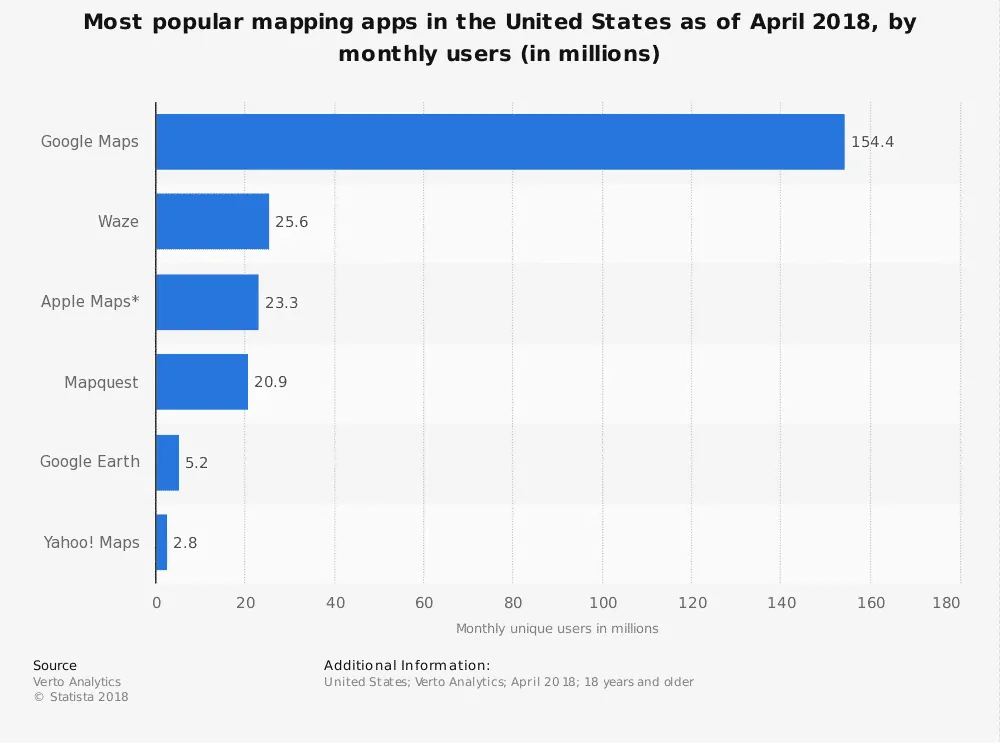
    With over 154 million monthly users, Google Maps, no doubt, has established its brand name as a synonym to the word maps. It provides us with everything from traffic highlights to road maps, from street signs to businesses. But how does it all works? Where does Google Maps gets all its data from?

    The answer to this is crowdsourcing.

    Google Maps depends on its Map Content Partners for most of its data. The Map Content Partners can be divided into five categories –

    • Base Map Partners For Geological Maps: The Base Map Partner Program collects information in the form of vector data from a range of credible organizations like USDA Forest Service, the U.S. National Park Service, Rails-to-Trails Conservancy, and U.S. Geological Survey.
    • Imagery Partners For Aerial Views: Partners, both private and government organisations, provide high-resolution aerial imagery to be used in Google Maps, and Google Earth. These images are either taken by a satellite or from an aircraft flying at a considerable height from the ground.
    • Transit Partners: Transit is the public transportation planning tool that combines the Google Maps data with the latest agency data like transit stop, route, schedule, and fare information to make trip planning effortless. These transit partners include government departments running trains, busses, etc. and even ride-hailing companies like Uber too.
    • Individual Partners: Google collects the location data from your smartphone and analyses it to provide features like real-time traffic updates, new routes, alternate routes, etc. Besides this, every Google Maps user can also become a local guide and contribute to making the application better by contributing their local knowledge to the platform.
    • Google My Business: Google lets the businesses list themselves on Google Maps by registering on Google MyBusiness. This adds to the utility as more and more addresses are added every day automatically.

    Besides this, Google also sources minutely detailed digital images from its company-owned vehicles which patrol almost all the streets, neighbourhoods and residential complexes round the clock.

    How Google Maps Makes Money?

    Google Maps not only gives you directions between places but also features nearby stores, pharmacies, service centres, etc. including your business for free. While the Maps don’t charge you for your usage, it still earns a considerable amount of revenue (expected to rise to $5 billion by 2020) from advertisements and strategic partnerships.

    1. Advertising

    Just like the parent company, Google Maps make most of its revenue from advertisements. These ads can be divided into two categories

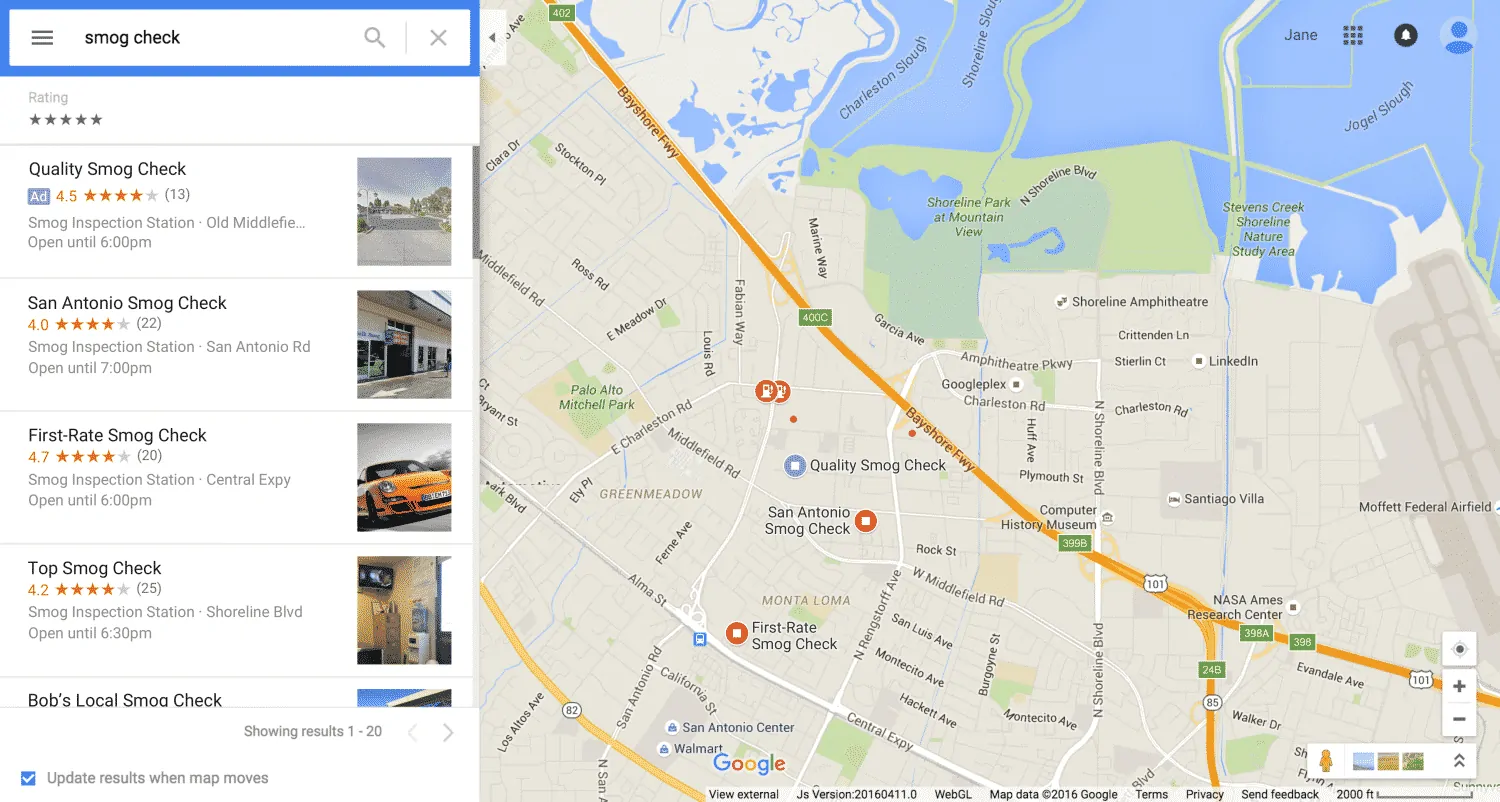
    Local Search Ads: Local search ads are featured businesses which appear as top results whenever people search for nearby businesses on Google or Google Maps or explore the businesses in the neighbourhood on Google Maps.

    google maps local ads
    Source: Google

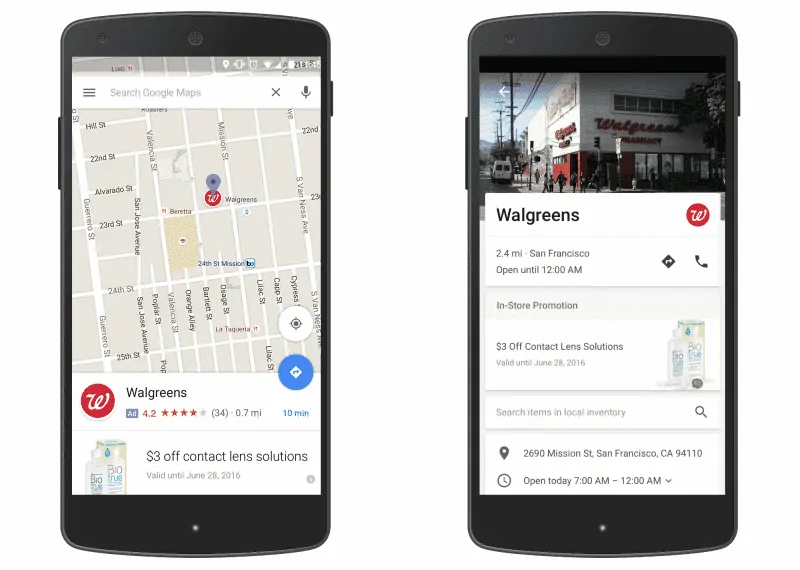
    Promoted Pins: Google Maps uses a ‘pin’ like symbol to indicate the location of a place. But in very large cities with thousands of businesses, it is difficult to locate a specific place among so many pins. Here google steps in by offering to display the company’s logo instead of the standard pin. For example, McDonald’s pays a fee to Google to have its signature ‘M’ logo to be embedded in each map. The logos (the promoted pins), differently coloured, definitely stand out and are easy to spot.

    Not only does this increase the businesses’ visibility, but also streamlines the user experience, and of course, helps generates more revenue. Most importantly, this form of advertising is small-scale and subtle and doesn’t scream pop-ups so it drives clicks purely through brand recognition.

    promoted pins
    Source: Neil Patel

    2. Google Maps API

    Google Maps isn’t limited to the Google Maps or Google Maps Go application. Companies Like Uber, Airbnb, and even The Pokemon Company pay to include Google Maps API in their services. But what exactly is API and how can other companies use an application within their own application?

    In simple terms, an API is a software intermediary that allows two applications to talk to each other. Google maps sells its API to businesses like Uber and Pokemon Go which tailor it according to their needs and use it to make money.

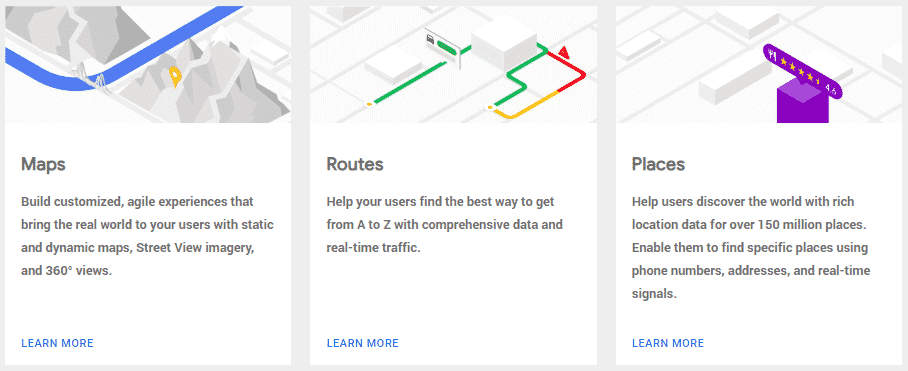
    Google API can be categorized into three products:

    • Custom Maps
    • Routes
    • Places

    google maps api products

    Custom Maps are customizable maps and street view imagery which can be embedded in the application or website to enhance the user experience by helping them get the context they need. Such Maps are used by hotel marketplaces or aggregators, real estate website and applications, etc.

    custom maps google maps api

    Routes has comprehensive, up-to-date transit, biking, driving, and walking directions covering 40 million miles of roads in over 200 countries and territories. It’s used by companies like Vallie, Swiggy, Appy Parking etc. which often need to be on the road, deliver the products, or show routes and their current location to the users.

    routes google maps api

    Places is used to help the users discover points of interest on-demand. It is apt for applications and websites dealing in events, trip booking, trip planning, etc.

    places google maps api

    How much does it cost to use the Google Maps API?

    The pricing strategies adopted by Google for its Google Maps products are a pay as you go and you only pay for what you use. The amount is calculated based on the number of calls for each SKU.

    The user also gets a recurring $200 credit on his billing account each month to offset the usage costs.

    You can find more about the pricing on this webpage and learn about the costing structure on this webpage.

    3. Partnerships

    Google Maps has partnered with several cab-hailing companies across the world like Uber, Lyft, Ola, etc. and added the option of discovering available cabs and their pricing within the Google Maps App. A user gets to explore different offers from the cab-hailing companies within the Google Maps app and is directed to their applications if he plans to book one.

    Google Maps Uber Partnership

    The cab-hailing section of the Google Maps includes a sticker of Ads which means these companies pay the platform per impression or per click.

    Go On, Tell Us What You Think!

    Did we miss something? Come on! Tell us what you think about our article on How does Google Maps make money in the comments section.
  • Time Management In The Workplace: A How-To Guide

    Time Management In The Workplace: A How-To Guide

    Do you ever feel like there isn’t enough time to do everything you’re supposed to do?

    Why do some people achieve more than others in the same 24 hours?

    Well, the answers lies in effective time management as time is one resource working professionals can never have enough of.

    We’ve all been told to learn to manage our time effectively a million times as we grew up. But it isn’t easy as it seems theoretically. Perhaps, time management could be the most difficult task a person could face when he’s burdened with loads of work. But fret not, here’s an article with small yet effective time management hacks which you can implement one by one to increase your productivity over time.

    What is Time Management?

    Time management is the process of organizing and dividing your time between specific activities. It is one of the most important soft skills which makes you work smarter – not harder – to increase your overall productivity.

    However, time management in the workplace can be a real challenge. Distractions like e-mails, meetings, demands, deadlines, requests etc. can be quite overwhelming for any worker, which often leads to pressure, stress, and anxiety.

    But here’s the good news:

    Effective time management isn’t impossible and can be mastered if you are determined and look at the huge gains it can provide.

    Benefits Of Time Management

    Effective time management results in holistic benefits which not only improves your productivity at work but also your life in general.

    Greater productivity and efficiency: Productivity and efficiency increases as managing time helps you to achieve more in a day without compromising on the quality of your work.

    Less stress and anxiety: Managing time effectively can reduce unnecessary stress and tension in your life. For instance, when you have too much on your plate and have no idea where to start, all that you will do is stress about it. On the other hand, when you prioritize your time between different activities, you will feel less stressed and will be able to do the work effectively and efficiently.

    Improved reputation and more opportunities: Time management ensures your punctuality and thereby earn a good reputation at work. This, in turn, can bring you more promotional opportunities at work.

    Fewer problems: Often in the workplace, you create your own problems when you miss a deadline or forget an appointment. Avoid such problems by planning and managing your time effectively.

    More free time: It is a common misconception that time management requires extra effort. To the contrary, proper time management will make your life easier. You will have more leisure time in your hands when you no longer waste time by wondering what to do next, but already be a step ahead of your work.

    Now, what if you could get all these benefits with the help of a few steps? Let us hence move on to the steps that will make you an expert in time management.

    How To Manage Your Time Effectively?

    1. Plan

    Planning precedes time management. Time management without planning is just a dream. Author Brian Tracy once said,

    Every minute you spend in planning saves 10 minutes in execution; this gives you a 1,000 per cent Return on Energy.

    The first thing you should do in the morning is to note down the tasks you need to accomplish that day. This can provide a sense of direction at work.

    2. Prioritize

    Prioritizing your daily activities will help you to focus on what is important. Decide what tasks need urgent completion and what can be done later. Here’s a perfect guide to help you prioritize your work.

    3. Organize

    Organize your files, documents, cards, keys, etc. so that you don’t waste your time searching for them.

    4. Cut off distractions

    Distractions cost us almost 3 hours every day in our life. This includes mobile phones, social media, chatting unnecessarily in the workplace, etc. Take a minute to learn about these distractions and allot fixed time in a day for social media or if possible cut off these distractions.

    5. Devote your entire focus to the task at hand

    Working with a mind preoccupied with the other tasks decreases the overall productivity. Try meditating and focusing entirely on the task in hand.

    6. Know When You’re Done

    Most professionals aren’t aware that they waste time by continuing to work on something even when they’ve reached the target for the day. Stopping when you’re done and moving on to the next task is important.

    7. Know Your Goals

    Sometimes, when your to-do list is extra-long, you end up procrastinating things. Make a time bound and practical to-do list every day to avoid the need of procrastination.

    8. Learn To Say ‘No’

    Most people fail to keep up with their schedules is because they can’t say no to any distraction or a new task even when they know it’ll hamper the overall productivity.

    You should learn to decline opportunities and say yes to only those that you know you have time for and those which really matter.

    9. Keep Buffer Time Between Tasks

    You don’t always complete the tasks in the time assigned for them. Keeping buffer time between the tasks safeguards you from hampering your entire schedule just because of delay in one task.

    10. Use Time-Management Tools

    You can also take the help of time management tools such as Focus Booster or Instant Boss. Set the timer for specified tasks such as 30 minutes and it will serve as a visual reminder as it counts down and sounds an alarm when the time is up. You can also block websites if you have a tendency to visit them often in the midst of your work.

    “You may delay, but time will not” – Benjamin Franklin

    Completing a job on time is expected of every employee and without effective management of time, this cannot be accomplished. Moreover, proper time management can have a positive impact on your work and life in general.

    Go On, Tell Us What You Think!

    Did we miss something?  Come on! Tell us what you think of this article on workplace time management in the comments section.
  • Coworking Space: How Does It Work & Make Money?

    Coworking Space: How Does It Work & Make Money?

    In this ever-changing world of workplace set ups, you might have heard of or witnessed your entrepreneur friends choosing CoWorking Spaces as their office.

    There must be many questions in your mind like “What is a co-working space?”, “How does a Coworking Space Operate and make money”?, “Why should I care about it?”

    Well, on the contrary to popular beliefs, coworking space is a startup in itself which has disrupted the current workplace scenario. The way it operates and makes money is also a lot different from the usual. Read on to know more.

    What Is Coworking Space?

    Coworking space is a business service provision model which lets individuals and teams work independently or collaboratively in a shared office space. Even though it’s a shared office space, a coworking space provides an environment that simulates the environment found in an established venture.

    Besides being a shared office space, coworking spaces also serve as a place to hold relevant workshops, conferences, and much more.

    coworking space
    source: 91springboard

    How Coworking Space Makes Money?

    Unlike other office spaces, the co-working space business model is a bit different. A coworking space is a startup in itself which has disrupted the existing market scenario. It not only makes money in the form of rents but also has widened its branches to other revenue sources like partnerships and memberships.

    Renting

    coworking spaces
    source: 91springboard

    1. Renting Out The Office Infrastructure

    Just like a normal workplace, a coworking space has set number of workstations which it rents to individual and teams. This renting out the workstations acts as the primary source of revenue for most coworking spaces.

    Besides the dedicated workstations, many coworking spaces offer dedicated cabins for rents too. Many of them also offer a flexible rent option where they provide an à la carte solutions to the users.

    2. Renting Out Space

    Many coworking spaces with available halls and meeting rooms also rent out these spaces for events like conferences, seminars, training workshops etc.

    They charge a fee that is nominal when compared to other resource-intensive alternatives and also provide adequate facilities to host such events.

    Virtual Offices

    Some coworking spaces even add virtual offices offering to their business model. A virtual office is a premium work address which the business uses for listings and mails and packages, while the team works from home.

    A virtual office is a boon for entrepreneurs who like to work from home but need a dedicated premium looking address for their startup.

    Marketing

    Since there is a lot of diversity in terms of types of companies, work structure, and employees in coworking spaces, some B2B companies usually use these spaces for promotional activities.

    Even workshops or training that are conducted in coworking space serve as a means of promoting a product and become a source of revenue.

    Premium Membership

    Every product venture at some point of time does introduce features and facilities that could be availed by paying some amount. Premium membership is a one time fee usually charged annually and gives access to marquee facilities. This form of revenue generation also ensures loyalty.

    Partnerships

    Since there are a plethora of tasks that are being done under one roof, it becomes easier for both the investors and members to reach one another.

    Strategic tie-ups with angel investors or venture capitalists lead to an increase in revenue and also popularity among the masses. Coworking spaces act as an easy medium to connect investors to the startup founders and charge a small commission or fee for the same.

    Why Have Coworking Spaces Become So Popular?

    Coworking spaces provide a cheap alternative for budding enterprises. You could book a room for a team of even two people or an entire floor for a medium scale enterprise and still pay nominal fees.

    Even after being a cheaper alternative, coworking space still has the best resources for the community.

    Benefits Of Coworking Spaces

    Zero Capital Investment

    The biggest benefit of coworking spaces is that entrepreneurs don’t have to shed their pockets or look for investors to invest in offices before the actual product is released or the actual business is set up.

    Productivity

    Working from home has an abundance of distractions like TV, pets, bed, and family, and such constant distractions reduce productivity.

    Maintaining a clear distinction between work and home allows an individual to keep the structure in their life, and provides all the more reason to get out of the comforts of their home and work in an office like environment.

    Networking

    Since coworking space brings people from diverse background, it provides you with an opportunity to work with people vastly different skillsets and gain a new perspective about solutions to a problem and if you are in a coworking space that has more professionals aligned with interest you could actually come with a novel solution.
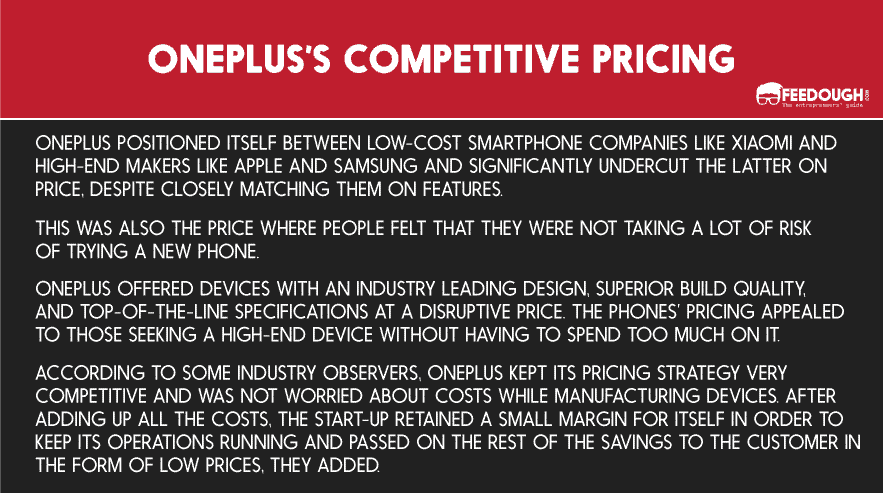
    Flexibility

    As a budding entrepreneur, it is impossible to set up a fully functional office as you might be investing even the seed funding in hiring the best talent to help your venture grow.

    Apart from this owning an office space is no easy task in itself.

    Lease agreements, utility bills and the infrastructure for ensuring smooth functioning require a significant amount of money as well as time.

    On the other hand coworking spaces already have these arrangements in place.

    Emotional Stability

    There will be times when you as an entrepreneur would feel like nothing is working and would tend to give up. When in self-doubt, the best way to overcome it is the being in the company of people. Their stories and struggles might motivate you and reduce the negative vibes in your life.

    Also working alone in your home would make you feel lonely and you would want someone to address your concerns be it technical or spiritual.

    Working in a coworking space brings you an opportunity to connect with people and learn from them.

    The Best Coworking Spaces In The World

    While defining the best coworking space, it is essential to have some basic criteria for judgements.

    The best coworking space could be judged on three parameters – Location, Innovativeness and Community.

    Location: It is crucial for a location to be situated in a metropolis. This is because a metropolis has better access to facilities and it is easy to find fast solutions if a problem may occur.

    Innovativeness: It is essential for the coworking space to have some innovation. It should not be just four walls with basic amenities. It should provide some facilities that stand out.
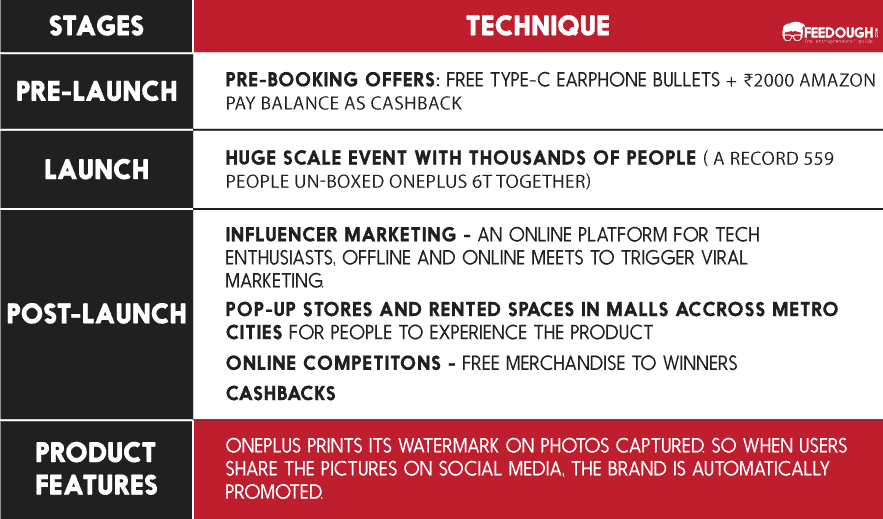
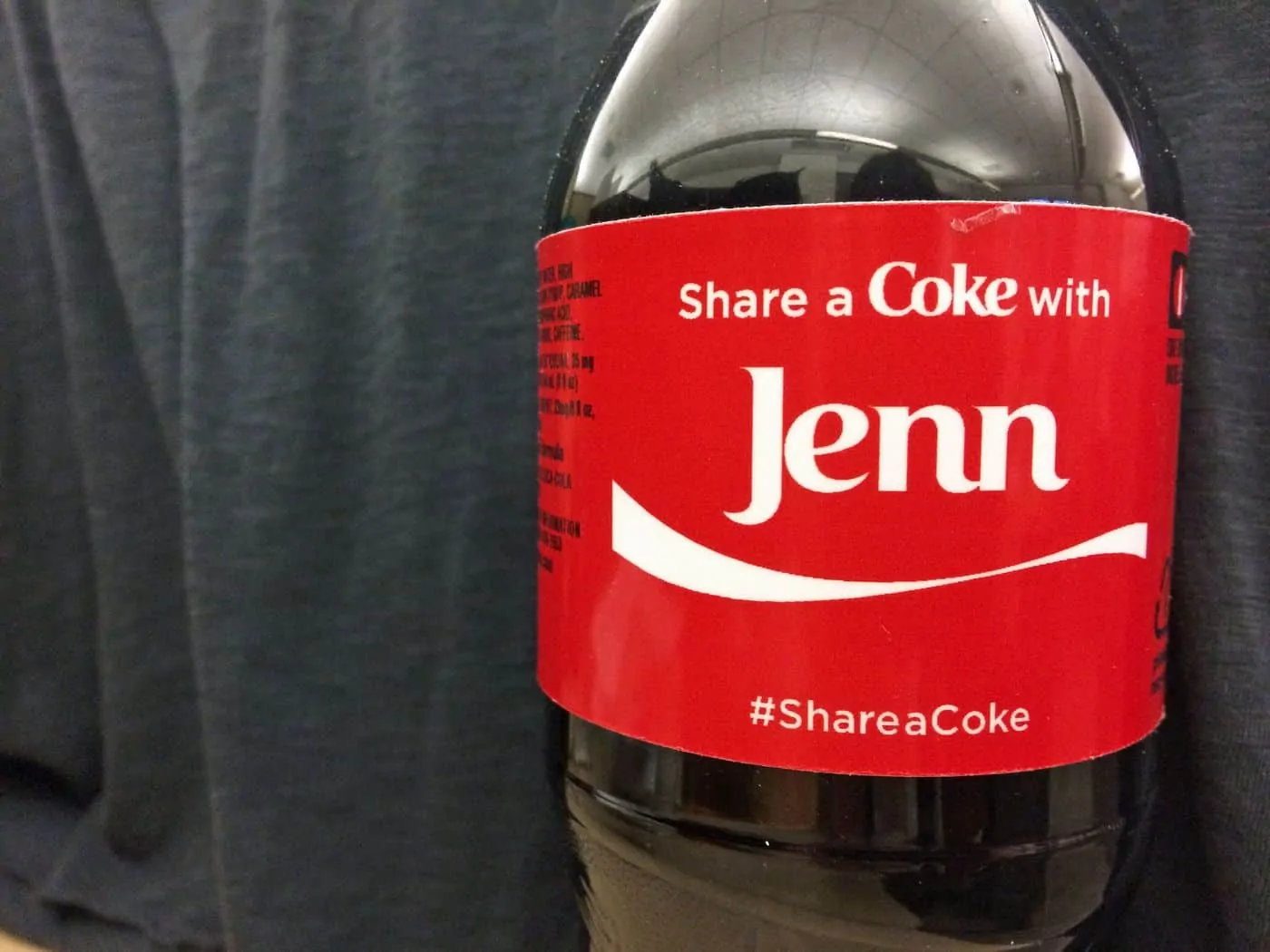
    Community: Coworking space is all about community. There is no point of a coworking space if it doesn’t have the right people working there. A large part is about the spirit of the people you work with.

    Let’s look at some of the best coworking space around the globe.

    1. TNW’s TQ, Amsterdam, Holland

    Located in Amsterdam TQ has created a niche for itself. Providing members with access to world-class seminars, conferences, community and events; it is a dream come true for many entrepreneurs.

    2. Village Underground Lisboa, Lisbon, Portugal

    Apart from the community and facilities, it has to offer, the best part about it is the structure. Its unique architectural structure is made from shipping containers and double-decker buses, recycled into office spaces, a restaurant and conference room.

    Apart from this Village Underground has established itself as a global powerhouse when it comes to CoWorking Spaces establishing a branch in London as well.

    3. The Pool, Mexico

    It’s the atmosphere of departure that makes “The Pool” so special. You can experience creativity and productivity in every corner of the building.

    Go On, Tell Us What You Think!

    Did we miss something?  Come on! Tell us what you think of this article on coworking spaces in the comments section.