Feedough Logo

Blog

  • What Is A Niche Market? – Meaning & Examples

    What Is A Niche Market? – Meaning & Examples

    In a usual business scenario ruled by well-funded corporations and marketers, mass appeal products are offered to an un-segmented market through mass retailers and independent stores. But this mass marketing technique often ignores the specific needs of specific segments.

    This is where companies with niche market focus capitalise on.

    Niche Market Definition

    A niche market is a small but well-defined market segment which can be addressed by a business providing solutions that are not being provided by the mainstream providers.

    In simple terms, a niche market is a particular market segment in the existing big market, which has a specific requirement that is being overlooked by mainstream providers. For example, computers for blind people is a niche which isn’t catered to properly by the existing companies dealing with computers.

    What Makes A Market Niche?

    While many people refer to a niche market as any other market segment, the truth is, unlike a usual market segment, a niche is created and not automatically developed.

    Even though the demand is there in the market, the business brings the audience together to create a market of its own. Here are some factors to define a niche –

    • Price: (premium pricing, discounted pricing, competitive pricing)
    • Demographic Base: (gender-based, age-based, income level based, etc.)
    • Quality: (premium quality, high quality, medium quality, low quality)
    • Psychographics: (beliefs, values, morals, attitudes, etc.)
    • Geographic: (buyer location, seller location, etc.)
    • Channels (online, offline, etc.)

    Niche Market Examples

    While the mass market is the whole pie, niche marketing focuses on just a small slice of that pie. For example, instead of targeting the full loan industry, a company can target recent school graduates in New York who are looking for education loans to get to their preferred colleges. This will not only narrow the market for better targeting strategies but also will help the company to build a brand across a niche requirement and build more trust among that segment.

    Here’s a list of some niche markets to make the topic clearer –

    • Fitness: Yoga for expecting mothers in urban cities
    • Sports: Disability Sports
    • Business: House flippers
    • Security: Identity theft protection
    • Hobbies: Waltz for senior citizens
    • Automotive: Disabled motorcycle rider aid products
    • Taxi: Late night taxis for working women in the suburbs

    Besides the above list, here are some real-life examples of businesses catering to the specific niches –

    Niche Market Advantages & Disadvantages

    Catering to a highly specialised market has its own perks and cons. Here are the reasons why many companies choose niche marketing over mass marketing and vice versa.

    Advantages

    • Less Competition: Niche market usually witnesses less competition as there’s limited demand.
    • Brand Loyalty: Since the company offers products considering all the requirements of the target market, it experiences more brand loyalty compared to the company dealing with the mass market.
    • Cost Effective: It’s comparatively economical to market to a niche as there are few customers who can be targeted using common marketing means.
    • Premium Pricing: Niche focused companies usually opt of premium pricing as they offer unique features which are actually required by the target market.

    Disadvantages

    • Limited Demand: There’s a limited demand which is very less compared to the mass market. Hence, sometimes resulting in less profits as compared to dealing in mass markets.
    • It Takes Time To Divert Demand: Since niche-focused companies are small compared to big multinationals who serve mass markets, it is sometimes hard to divert the demand in their favour.

    Go On, Tell Us What You Think!

    Did we miss something?  Come on! Tell us what you think of our guide in the comments section.

  • What Is Retail? Retailing Types, Functions, & Characteristics

    What Is Retail? Retailing Types, Functions, & Characteristics

    Retailing goes as back as time goes and the best part of it is that the concept of retailing hasn’t changed for centuries. But before we move on to elaborating retail definition or its concept, you should be clear of these two terminologies –

    Good: Product offered in the market in exchange for money.

    Distribution Channel: Is the path or route decided by the company to deliver its goods to the customers.

    What Is Retail?

    Retail is the final channel of distribution where small quantities of goods (or services) are sold directly to the consumer for their own use.

    Two key phrases in this definition that separate retail from wholesale are –

    What Is Retailing?

    Retailing is the distribution process of a retailer getting the goods (either from the manufacturer, wholesaler, or agents) and selling them to the customers for actual use.

    In simple terms, retailing is the transaction of small quantities of goods between a retailer and the customer where the good is not bought for resale purpose.

    What is A Retailer?

    A retailer is a person or a business that sells small quantities of goods to customers for actual use.

    Remember –

    Importance Of Retailing

    Retailing is important for the creators, customers, as well as the economy.

    Retail stores are the places where most of the actual sales to the customers take place. They act as both a marketing tool for the brands and a support tool for the customers to exchange and communicate important information.

    Besides this, retailing is a great asset to the economy. It provides jobs, adds to the GDP, and acts as a preferred shopping channel during the holiday season.

    How Retail Works?

    Retail works on a simple revenue model of markup. The retailers buy the goods at a cost price, add up the cost of labour, equipment, and distribution to it along with the desired profit margin, and sell it at a higher price.

    Retailing Types

    Retailing can be divided into five types. Here are the types of retailing that exists today –

    • Store retailing: This includes different types of retail stores like department stores, speciality stores, supermarkets, convenience stores, catalogue showrooms, drug stores, superstores, discount stores, extreme value stores etc.
    • Non-store retailing: Non-store retailing is a type of retailing where the transaction happens outside conventional shops or stores. It is further divided into two types – direct selling (where the company uses direct methods like door-to-door selling) and automated vending (installing automated vending machines which sell offer a variety of products without the need of a human retailer).
    • Corporate retailing: It involves retailing through corporate channels like chain stores, franchises, and merchandising conglomerates. Corporate retailing focuses on retailing goods of only the parent or partner brand.
    • Internet retailing: Internet retailing or online retailing works on a similar concept of selling small quantities of goods to the final consumer, but they serve a larger market and don’t have a physical retail outlet where the customer can go and touch or try the product.
    • Service retailing: Retailers not always sell tangible goods; retail offerings also consist of services. When a retailer deals with services, the process is called service retailing. Restaurants, hotels, bars, etc. are examples of service retailing.

    Characteristics Of Retailing

    Retailing can be differentiated from wholesaling or manufacturing because of its certain distinct characteristics, which include –

    • Direct contact with the customer – Retailing involves direct contact with the end customer and retailers act as a mediator between the wholesaler and the customer or the manufacturer and the customer depending upon the distribution channels used.
    • Relationship with the customers – Retailers form a bond with the customers and help them decide which products and services they should choose for themselves.
    • Stock small quantities of goods – Retailers usually stock small quantities of goods compared to manufacturers and wholesalers.
    • Stock goods of different brands – Retailers usually stock different goods of different brands according to the demand in the market.
    • Customers’ contact with the company – Retailers act as the company’s representatives to the end customers who give them their feedback and suggestions.
    • Have a limited shelf space – Retail stores usually have very limited shelf space and only stock goods which have good demand.
    • Sells the goods at maximum prices – Since retailing involves selling the products directly to the customers, it also witnesses the maximum price of the product.

    Functions Of Retailing

    Retailers have many important functions to perform to facilitate the sale of products. These functions include –

    Sorting

    Manufacturers produce large quantities of similar goods and like to sell their inventories to a few buyers who buy in lots. While customers desire many varieties of goods from different manufacturers to choose from. Retailers balance the demands of both sides by collecting and assorting the goods from different sources and placing them according to the customers’ needs.

    Breaking Bulk

    Retailers buy goods from manufacturers and wholesalers in sufficiently large quantities but sell to the customers in small quantities.

    Channel Of Communication

    Since retail involves direct contact with the end consumers, it forms a very important communication channel for companies and manufacturers. The manufacturer tries to communicate the advantages of their products as well as the offers and discounts through retailers.

    Retail also acts as a mediator between the company and the customer and communicates the feedback given by the customers back to the manufacturer or wholesaler.

    Marketing

    Retail stores are the final channels where the actual decisions are made. Hence, they act as important marketing channels for the brands. The manufacturers execute smart placements, banners, advertisements, offers, and other strategies to increase their sales in retail stores.

    Retailing Examples

    The most common examples of retailing are the traditional brick-and-mortar stores like Walmart, Best Buy, Aldi, etc. But retailing isn’t limited to them. It also includes small kiosks at the malls, online marketplaces like Amazon and eBay, and even restaurants which sell food and service.

    Go On, Tell Us What You Think!

    Did we miss something?  Come on! Tell us what you think about our article on what is retail in the comments section.

  • 3 Proven Lean Startup Strategies To Launch New Products

    3 Proven Lean Startup Strategies To Launch New Products

    Launching new products can be expensive and extremely risky. Whether digital or physical, new product launches require significant design, testing, and development. Entrepreneurs get their hopes high that they are releasing the products that customers will buy, and when customers don’t buy, it can be catastrophic.

    Fortunately, there is a way for entrepreneurs to assess customer interest even before building their product – and this method is called the Lean Startup. In this post, we will explore exactly what lean startup is and provide you with several strategies for using the lean startup to soft launch and hard launch new innovations and products.

    What Is Lean Startup, Anyway?

    In the most general terms, a lean startup is a unique approach to building new businesses and products. This method proposes that entrepreneurs must launch experiments to validate their assumptions as they develop new products. In other words, instead of building products to 100% completion, entrepreneurs should develop several tests along the way to ensure that they are building exactly what consumers want to buy.

    Take Zappos, for instance. Today, we know it as one of the world’s most successful e-commerce platforms, but this wasn’t always the case. Before renting a warehouse and filling it up with inventory, founder Nick Swinmurn wanted to confirm, “Is selling shoes online viable?” This was 1999, and the e-commerce era was just in its infant stages.

    Nick visited several local shoe stores, taking photos of their products and loading them onto his website. When an order was placed, he would return to the store, purchase the shoes, and send them to the customer. Sure, this business model wouldn’t be stable in the long-term, but his question was answered – people were definitely looking for a reputable online source where they could purchase shoes. With this data, he now knew that moving forward with his idea would yield positive results.

    Risk isn’t so risky when you have the right data.

    Choosing A Lean Startup Strategy

    While Zappos’ lean strategy worked perfectly, it’s not the only strategy that you can adopt when launching a new product. The strategy that you choose should be based upon your intended goal, as each strategy will reveal different insights.

    What can you learn by launching a lean startup experiment? With the right strategy in place, you can learn intimate details about your customers, their desires, and their intentions. Some of the questions that can be answered with a lean experiment include:

    • Have you chosen the right target market?
    • Is your marketing strategy effective?
    • Is there a demand for your offering?
    • Are you providing the right solution to meet that demand?
    • Does your product/service offer the right features?
    • Will your customers buy it? At what price?

    The key to lean startup is to gather these insights as early as possible so that you are clear on what to build, why you’re building it, and who you’re building it for; before exhausting the valuable resources necessary to develop it. Not only does lean startup allow you to validate your assumptions, but it also allows you to create an effective business plan based upon real primary research of your exact customer base.

    Now that you’re familiar with lean startup and can understand it’s benefits, let’s talk about how to implement some of the most effective lean startup strategies.

    4 Highly Effective Lean Startup Strategies

    Although ‘lean startup’ may be a new term to you, you actually see it in action constantly. Some of the world’s most well-known brands use lean startup right in front of your eyes, every single day.

    Have you ever noticed a new feature on Facebook that suddenly disappeared the next day? In some cases, it may have appeared on your account, but not on your friends’ accounts. This is Facebook testing new features to a limited audience to gather insights before launching the feature to its millions of users.

    From major tech companies to small product-based companies and beyond, lean startup is everywhere. Why? Because if you implement it correctly, it can save you an enormous amount of waste in both monetary and time efforts.

    Here are three amazing lean startup strategies that you can implement today to prove your concept and validate all assumptions regarding your product or service.

    Showcase Products Before They Are Built

    Technology has given us the power to intricately display products that have not yet been built. There is extreme power in visuals, and today, we have the power to use visualization to bring non-existent products to life. For example:

    • Product-based businesses can use digital 3D models or have prototypes built with a 3D printer to showcase what the product looks like and how it works.
    • Software-based businesses can use design screens, prototypes and demos to display how the software will look and how it will function.

    Some say a picture speaks a thousand words. If this is the case, then there is no quantity of words that can equal the effect of a great video. Whether an explainer video or promotional video, live or animated video can be used to capture the attention of an audience, describe the benefits of the product, and introduce them to a solution to their problem – even if that solution has not yet been built.

    Does this strategy work? Well, it certainly did for Drew Houston, founder of Dropbox.

    Dropbox was founded by a team of engineers. To build the software seamlessly across all platforms (Windows, Mac, iOS, Android, etc.), a significant level of development and testing would be necessary. Before taking the risk, founder Drew Houston wanted to first test whether people even had a challenge with managing and synching their files, and if they did, whether Dropbox solved that challenge. So, he launched a video.

    The video was only three minutes long and simply showed a screencast of Drew using and explaining the software. According to Drew Houston, “It drove hundreds of thousands of people to the website. Our beta waiting list went from 5,000 people to 75,000 people literally overnight. It totally blew us away.” For Drew there was no doubt, the risk of building the software was definitely worth taking. Today, Dropbox is estimated to be worth as much as $8 billion.

    Test For Customer Intent

    Just because someone likes your product, it doesn’t mean that they want to use it. Luckily, you can also run lean experiments to not only gauge customer interest but also their intent to learn more or purchase the product.

    A landing page MVP is often used for this purpose. In this model, a startup will launch a landing page online that showcases the product (using the methods in the previous strategy) and details its features and benefits. A form on the page allows users to pre-register, sign-up for beta, or to sign up and be informed of the product’s release. Not only does this method allow entrepreneurs to gauge interest in the product, but it also allows them to build up a list of customers who may want to purchase the product once it is released.

    A shadow button MVP is similar with one small difference. Instead of having a form, the page will have a button with a call-to-action such as “Click Here to Purchase” or “Download Now!” Since the product doesn’t yet exist, the page will lead to either an error or a message stating that the product is not yet available. On this screen, a form can be added to capture the details of individuals who may be interested in buying the product. Shadow button MVPs allow entrepreneurs to perfectly gauge how many visitors intended to purchase or download the product.

    Landing page and shadow button MVPs are rather simple, but they are extremely effective. Take Buffer, for instance. Before building out the platform, owner Joel Gascoigne wanted to determine whether people would even be interested in using the Buffer platform.

    With a simple webpage, he explained what Buffer did and what problem it solved. There was a button for “Plans and Pricing” that interested parties could click to purchase. However, this was only a shadow button. Instead of taking them to pricing, it took them to a page that said, “Hello! You’ve caught us before we’re ready!”

    Joel noticed that people were clicking the pricing button, and many were even providing their email addresses for further information. He ran a second experiment – this time updating the Plans and Pricing page with actual prices for each package ($0, $5, and $10). Now, people were coming to the landing page and many were even clicking to purchase the higher-priced subscriptions. There was a market, people wanted the product, now he just needed to build it.

    Many startups take this concept a step further and choose to pre-sell their product; another fantastic lean startup strategy. Using crowdfunding platforms like Kickstarter and IndieGoGo, startups are able to introduce their concepts to real customers, sell the product and earn revenue before the product has been built.

    Run A/B Comparison Tests

    You might have a great product, but does it offer the features that consumers are seeking? There’s only one way to know – test it.

    By using A/B comparison tests, startups can gather insights on what features consumers will buy into and which they won’t. Furthermore, this technique can work in conjunction with the previously mentioned strategies.

    Here are the steps to completing a successful A/B comparison for lean startup testing:

    1. Launch a landing page that describes a specific set of product features.
    2. Launch a second landing page that has one (and only one) feature change.
    3. Measure the results of these two pages against each other. Which one performed better? Which feature-set garnered the most interest by customers? Which got the most signups?
    4. Keep the feature set with the best customer metrics.
    5. Change another feature and repeat the process until the optimal product has been developed.

    From Lean to Green

    By implementing the right lean startup strategies, you can quickly move from the ideation stage to the revenue generation stage; reducing waste and maximizing the potential of success.

    Testing never ends. Once your product has been optimized for a perfect market fit, the rest of your strategy should be tested as well. Run experiments on your marketing strategies before investing your entire budget. Test new markets effectively before scaling into them.

    Your lean startup strategy doesn’t have to be pretty, it just needs to be effective. In the words of LinkedIn’s founder, Reid Hoffman –

    If you are not embarrassed by the first version of your product, you’ve launched too late.

    Go On, Tell Us What You Think!

    Did we miss something?  Come on! Tell us what you think of our guide on the Lean Startup Strategies in the comments section.

  • What Is Long Tail In Marketing? | Long Tail Theory Explained

    What Is Long Tail In Marketing? | Long Tail Theory Explained

    It’s a long-known fact that there has always been a limited shelf space. Retailers, wholesalers, and distributors only stock goods that have considerable demand in the market.

    Because stocking goods with low demand volume isn’t profitable, right?

    Well, it was true until the evolution of the internet, cloud storage, globalisation, and unlimited virtual shelf space.

    Welcome the long tail effect theory which states that you can earn as much or even more than the usual profits if you appeal and cater to the niche markets instead of the broad market.

    What Is Long Tail in marketing?

    Long tail in marketing refers to those offerings which are in less demand compared to the actual popular product of a specific category.

    Some examples of long tail markets are (different types of) laptop chargers in the laptop niche, (different types of) mobile covers in the smartphone accessories market, and (different types of) customized gifts in the gifting niche.

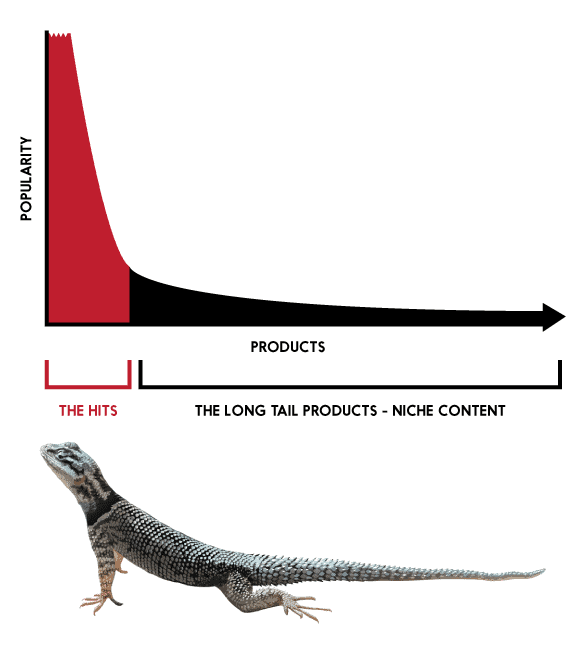
    long tail theory

    The usual retail scenario runs like the above graph where there is one dominant head in the front (the popular product which referred to as ‘hit’) followed by a long tail of not that popular products.

    What Is Long Tail Marketing?

    In the usual retail environment, a small group of popular products dominate sales. These popular items could be a newly released gadget, movie, book, game or any recently acclaimed product. The stores focus on stocking up and promoting these popular products to earn most of the profits while other products in the inventory continue to sell in a usual pattern with no single item making a big impact.

    Long tail marketing is a business strategy of equalling or exceeding the market demand of a hit product by stocking, offering, and marketing many less demand volume niche products. Unlike the usual strategy of product promotion, the long tail strategy focuses more on inventory management and selling multiple less popular products to generate as much profit from the long tail as the hit head.

    The concept of long tails was introduced by Chris Anderson in his book named ‘The Long Tail: How Endless Choice is Creating Unlimited Demand’. He used the book to explain the market that is being created and catered to with the advent of the internet and availability of endless information.

    His argument in the book revolves around how consumers in the modern economy are shifting towards individualized niche products than being attracted to a small number of ‘hit’ products. He states that globalization and the internet revolution has made it really easy and economical to produce and stock a large amount of less-demand products. This eventually creates more choices for the consumers to choose from and helps the seller stand out by catering to a niche or micro-niche.

    The Economics Of Long Tail

    The economics of the long tail theory works in the following way –

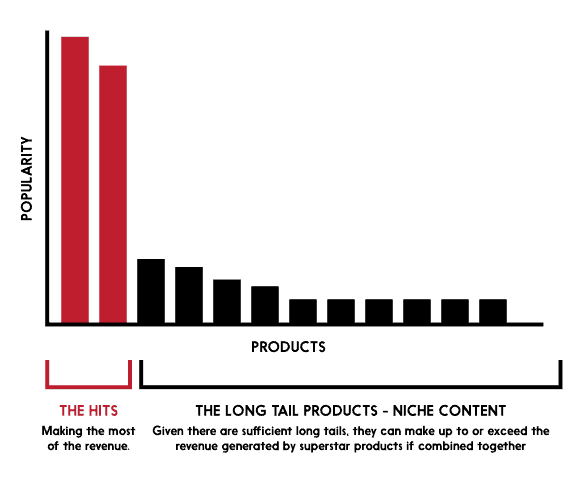
    long tail theory

    While the superstar product makes most of the revenue, given there are considerable niche products, the long tail can equal or exceed it if combined together to serve the evolving market.

    Let’s look back a bit to explain it further –

    Before the advent of the internet, most of our demand was created by the limited supply itself. The lack of available information and the limited shelf space made most of our assumptions about popular taste the artefacts of inefficient supply and distribution.

    Then came the internet which gave rise to unique preferences of the individuals who started moving away from the popular trends. Since the globalization and the internet also made it possible to stock and distribute all the niche products which these individuals preferred, it gave rise to the long tail strategy.

    While the long tail looks like a strategy opposing the usual belief of high demand leads to more profits, it actually works on the same line. The long tail strategy believes in bundling up the demand for niche products and increasing the profits by capitalizing on it.

    Why Long Tail?

    According to research by MIT, three kinds of demand drivers exist in the market. These are –

    Technological drivers – 57% of online shopping starts with the search engines. Besides search engines, personalization and recommendation techniques and online communities and social networks also drive the demand for the product.

    Supply-side drivers – Technology has made it easy to add the inventory of stock of digital as well as physical products. Moreover, new supply side demand driving models like dropshipping and affiliates have also come into existence which influence the decision-making process and promote niche products. The technology has also made the supply side strong by making it serve the global market at once.

    Non Technological drivers – The non-technological drivers include the psychological drivers of being part of the group or standing out of the group which influence the decision-making process of the customers.

    While there are arguments on both the sides that these drivers either favour the demand for the superstar products or the niche products, the truth is that it totally depends on the industry and how you’re capitalizing on the demand.

    On one side, Netflix saw a rise of 45 million accounts who watched Birdbox, Amazon, on the other side, has been using the long tail marketing strategy for years to generate additional revenue for itself.

    The long tail strategy has two applications –

    • To increase the customer lifetime value by using long tail strategies like cross-selling and recommendations etc.
    • To stand out in the market and increase sales by building a brand out of long tail products or just capitalizing on the untapped market.

    In simple terms, either you can focus on long tail offerings as add-ons to your superstar product, which will increase the customer lifetime value and attract more customers, or you can bundle up and just focus on the long tail offerings to compete with existing players and create a different positioning for yourself in the market.

    Long Tail Examples & Applications

    From e-commerce to entertainment platforms, the application of the long tail strategy isn’t limited to any single niche.

    eCommerce

    The long tail strategy works perfectly for eCommerce marketplaces like Amazon which makes 57% of its books sales from long-tail searches.

    Other than this, there is a rise of niche-oriented e-commerce stores like Etsy (for handmade and unique products), Redbubble (unique products from the artists), and many niche oriented Shopify stores which serve to long tail demands.

    Entertainment Platforms

    While Netflix uses the popular superhits to get many people to subscribe to it, it’s AI-powered personal recommendation system monitors the activities of the users to suggest them the long tail content according to their own needs. This makes them stay with Netflix for long and increases their lifetime value.

    Other than this, Youtube and other free streaming platforms are filled with niche-based content to cater to highly demanding customers.

    Websites & Blogs

    Websites make use of the long tail strategy to optimize themselves for the search engines. They create a large number of pages to cater to every long tail keyword search related to their niche. For example, a website operating on an affiliate marketing business model in the smartphone niche may focus on all the possible keywords related to smartphones. These can be –

    • Best smartphones under $500,
    • Best smartphones under $600,
    • Best smartphones under $700,
    • Best smartphones under $1000,

    These will lead to more traffic than compared to just writing a post on Best smartphones under $1000. The website can also take an approach of reviewing individual smartphones to increase its traffic even more.

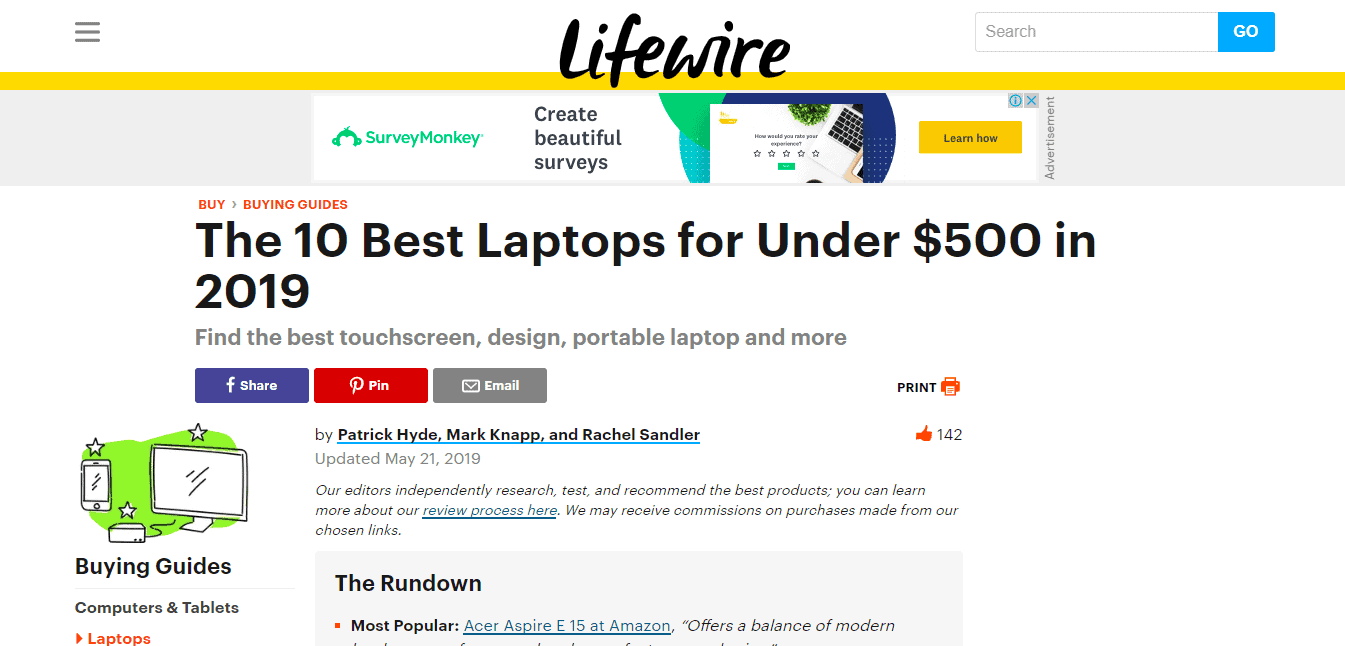
    A perfect example of a website using such long-tail marketing strategy is Lifewire.

    lifewire affiliate

    Customized & Personalized Goods

    New customized goods stores have become a reality just to capitalize on the unique and personalized needs of the target market. These customized goods companies make use of technology to develop or print products on-demand based on the need of even a single customer.

    3D printing companies and customized gifts companies make use of this highly targeted niche segment.

    Go On, Tell Us What You Think!

    Did we miss something?  Come on! Tell us what you think of our guide on the long-tail theory in the comments section.
  • How Does Kickstarter Work & Make Money?

    How Does Kickstarter Work & Make Money?

    The name of the game is “Many hands make light work”.

    There are a lot of examples which support this old maxim.

    Take Reddit for example. When we get together on a single case, we tend to surprise everyone in what we can achieve. A quick Google search on “Cases solved by Reddit” will present you with many interesting reads. The humankind as a “collective” is a really powerful force to reckon with.

    Wondering what I said above has to do with Kickstarter?

    Well, Kickstarter works in a similar fashion too. It helps turn average Internet users into backers of new and innovative things.

    Let’s find out how.

    What is Kickstarter?

    Kickstarter is a crowdfunding marketplace focused on providing resources, support, and funding to creative ideas and products.

    The company was started in 2009 with a mission to bring creative projects to life by using crowdfunding and crowdsourcing.

    Back in 2001, Perry Chan, founder of Kickstarter, wanted to bring two DJs to New Orleans to play at the local jazz fest, but the gig never happened because it cost too much.

    This led him to come with the idea of the customers being able to buy tickets for a show. Once a set target was reached the gig would happen, or the customers will never be charged. This was a great vision to support new ideas.

    The mission, even today, is to help people with ideas to put present them and obtain funding from the internet as easily as possible.

    The company’s business and operating model revolves around the concept of crowdsourcing and crowdfunding where support and funding to creative ideas are offered by the global community of millions of people.

    But, Kickstarter didn’t invent crowdfunding. The concept of crowdfunding has been around for a long time, since the 1990’s to be precise, with us not realising that they were all cases of crowdfunding.

    Kickstarter just bought the concept to the next step, onto the internet, but with few tweaks of their own to prevent misuse of the platform.

    Well, those changes that they made sure seem to be working.

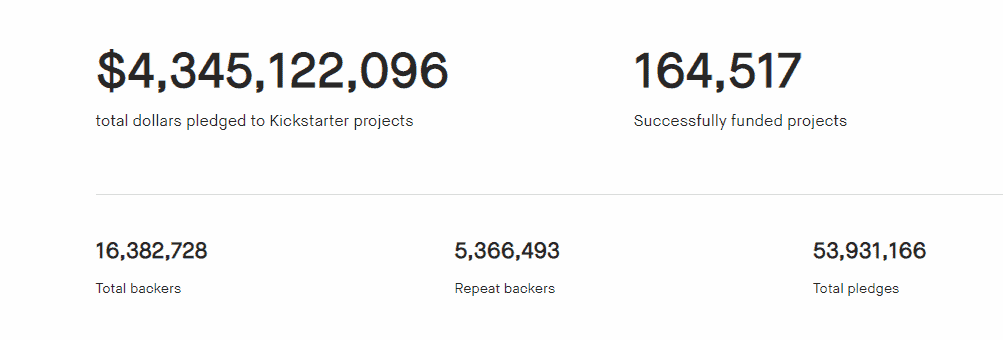
    Ever since they began, they have successfully funded over 164,725 projects and raised over $4.4 billion as funds for projects

    kickstarter stats
    Source: Kickstarter Stats

    We’ve established that Kickstarter revolutionised the crowdfunding market, let’s now look at how Kickstarter works.

    Kickstarter’s Operating Model

    To understand Kickstarter’s operating model or how Kickstarter works, you need to understand the meaning of the following terms –

    • Creators: People or teams with ideas or products who post on the site and create a Kickstarter Campaign, requesting funding for their projects. Kickstarter allows them to pitch an idea for a project without risk. If they don’t get full funding, they move on to the next idea. If they do get full funding, they have all the money they need to complete the project.
    • Backers: The people who pledge their money when they see a project worth investing in. They are the ones that the creators need to appeal to. They either support the product voluntarily or look for returns out of them. Returns can be in the form of free products, offers, discounts, event invites etc.
    • Project: It’s the innovative idea brought to life by the creators. According to the company, it’s a work with a clear goal around which Kickstarter’s business model revolves.
    • Funding Goal: It’s the amount of money the creators need to complete their project. All the projects on Kickstarter come with a predetermined funding goal. The creator gets the money only after the project reaches or exceeds their funding goals. Similarly, backers’ cards are charged only when the project is fully funded.
    • Rewards: This is the benefit the creators provide to the backers in return for their monetary support. It could be one-of-a-kind experiences, limited editions, or copies of the creative work being produced.

    How Does Kickstarter Work?

    Now that you know the basic terms of Kickstarter’s business model, it’s time to put them to places and answer your question of how does Kickstarter work.

    Kickstarted is a marketplace where people with creative ideas meet people who want to support creative ideas and buy innovative products. The creators launch their projects on the platform with a set funding goal. They mention everything about their idea through text, images and videos, and even mention the rewards the backers will get if they support their idea. The rewards can be categorized into tiers with the backer supporting more getting more rewards. The backers are people who support creative ideas voluntarily or because they like the rewards associated with it. The support is financial and the backers get to choose the rewards according to the money they pledge in.

    Once the funding goal is achieved. The backers’ cards are charged with the amount they’ve pledged and the amount is transferred to the creators. And the backers get their rewards as promised.

    Example

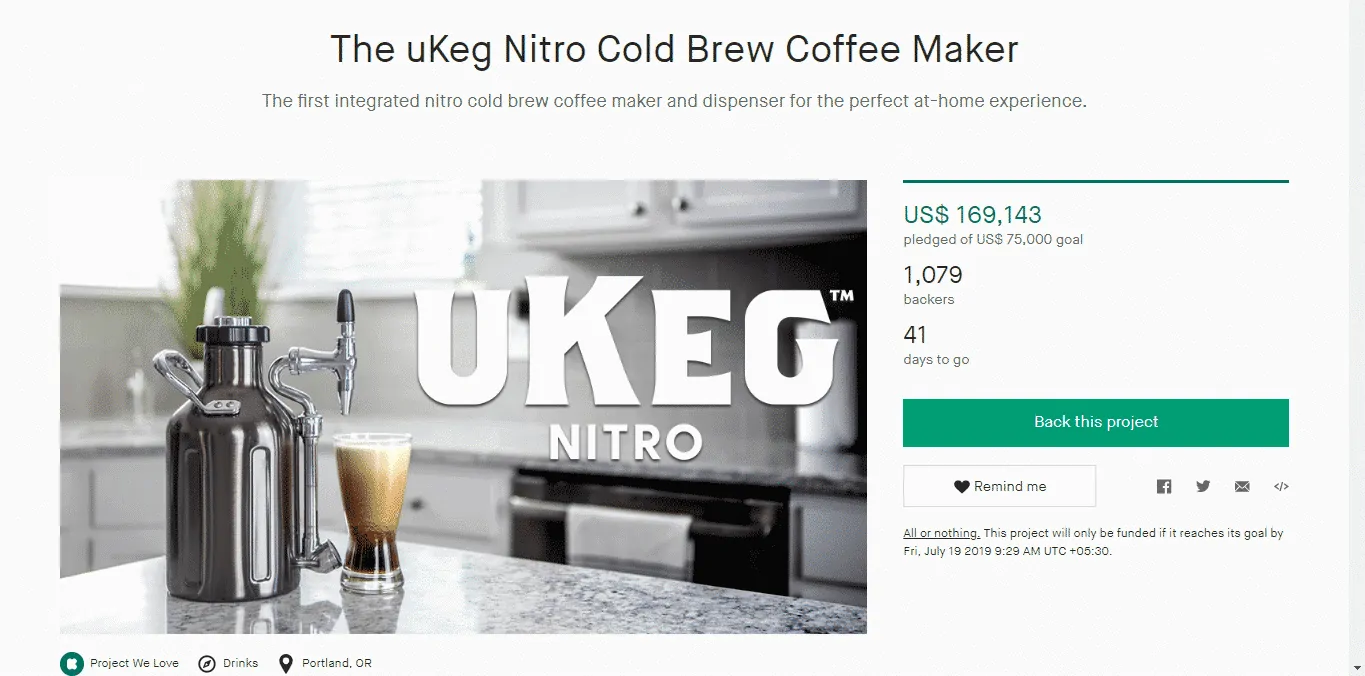
    Here’s a Kickstarter Campaign for Cold Brew Coffee Maker:

    kickstarter campaign

    Say that you’ve always fancied having a cold brew coffee maker at your home. This could save you time from visiting your local Starbucks to get your fix.

    You go through the very descriptive “About” section:

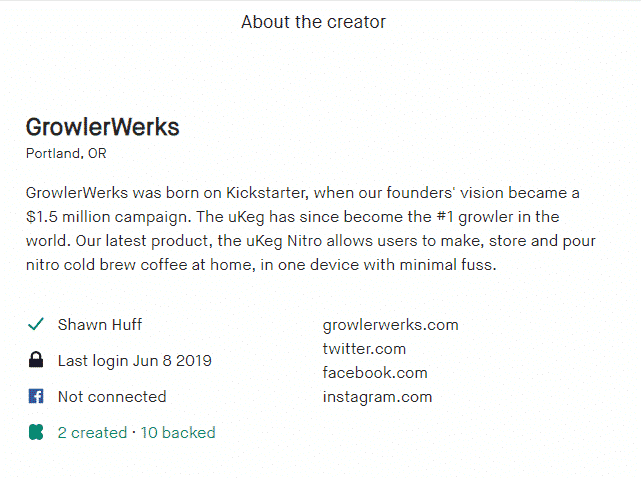
    And check out the people behind it:

    about creator kickstarter

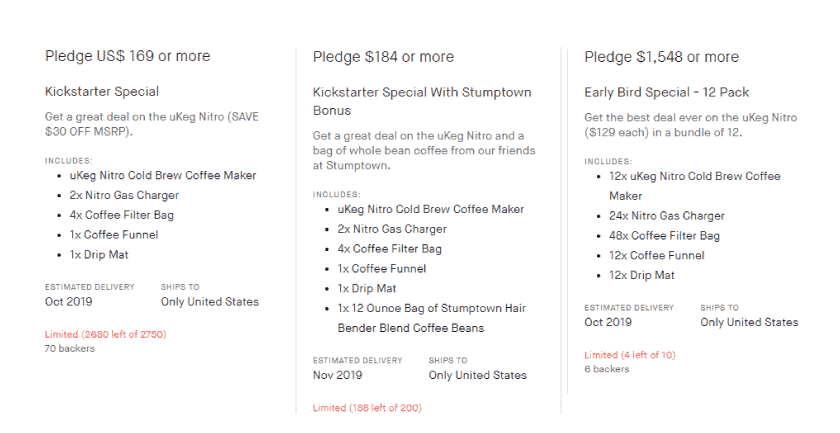
    If satisfied with what you find, you choose a pledge that fits your budget or rewards you as you like:

    kickstarter pledges

    Kickstarter’s Crowdfunding Business Model

    Kickstarter operates on a marketplace business model. It is basically a marketplace helping the creators connect with the pledgers; just as a similar marketplace, say Amazon, helps connect the buyers with the sellers.

    Kickstarter doesn’t own any of the projects or ideas nor do they set the prices. It just has successfully interlinked the two business models of crowdfunding and online marketplace together to disrupt the crowdfunding industry. The business model is complemented with the following business strategies –

    • All-or-Nothing Strategy: Kickstarter employs an all-or-nothing strategy. The creator gets the money only after the project reaches or exceeds their funding goals. Similarly, backers’ cards are charged only when the project is fully funded.
    • Time limitation on campaigns: There is a time limit imposed for each campaign. No money is collected if the campaign fails to reach the funding goal within that limit.
    • Rewards: Creators are also required to offer rewards to backers. There are different rewards for differing funding levels as seen in the coffee brewer example before.
    • Pledge Anonymously: Kickstarter allows backers to fund the project anonymously, without any rewards.

    With an estimated annual revenue of about $34.6 Million, this strategy sure seems to be working in their favour. But wait, how exactly does Kickstarter make money?

    How Does Kickstarter Make Money

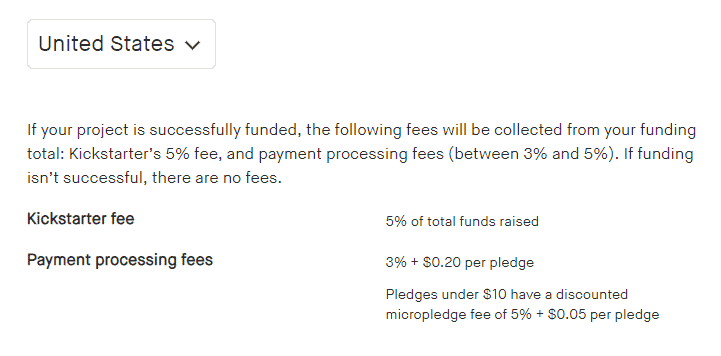
    Even though Kickstarter is a Benefit Corporation, it is still a for-profit business. The company earns its revenue by charging a 5% commission fee on the total funds raised. It is also to be noted that they charge a separate fee for payment processing (payment gateway charges).

    kickstarter fees

    Thus, if a project had raised $10,000 from 100 pledges, then the creators of the project get $9,000, Kickstarter will get $500 and the payment processing fee (3% + $0.20 per pledge) will amount to $500.

    Even this $500 for a $10,000 project amounts to good profit for the company as there are not many costs involved. The company consists of just 159 people who have worked hard to create this platform back 164,725 projects and raise $4.4 billion. The major cost centres include storage spaces, general and administrative expenses, salaries, data centres, rent payments and servers, etc.

    Now, as a bonus, let’s look at how Kickstarter fares against its competitors, specifically Indiegogo, since many assume both platforms to be the same.

    Kickstarter vs Indiegogo

    Indiegogo, also a crowdfunding site, is considered to be the major competitor to Kickstarter.

    Let’s clear things up a bit.

    Kickstarter does not allow for the posting of personal projects, charity and non-tangible products. There must be a working prototype. Kickstarter’s team will manually review the project to make sure it complies with their rules.

    On the other hand, Indiegogo allows the posting of personal projects, charity and non-tangible products and more.

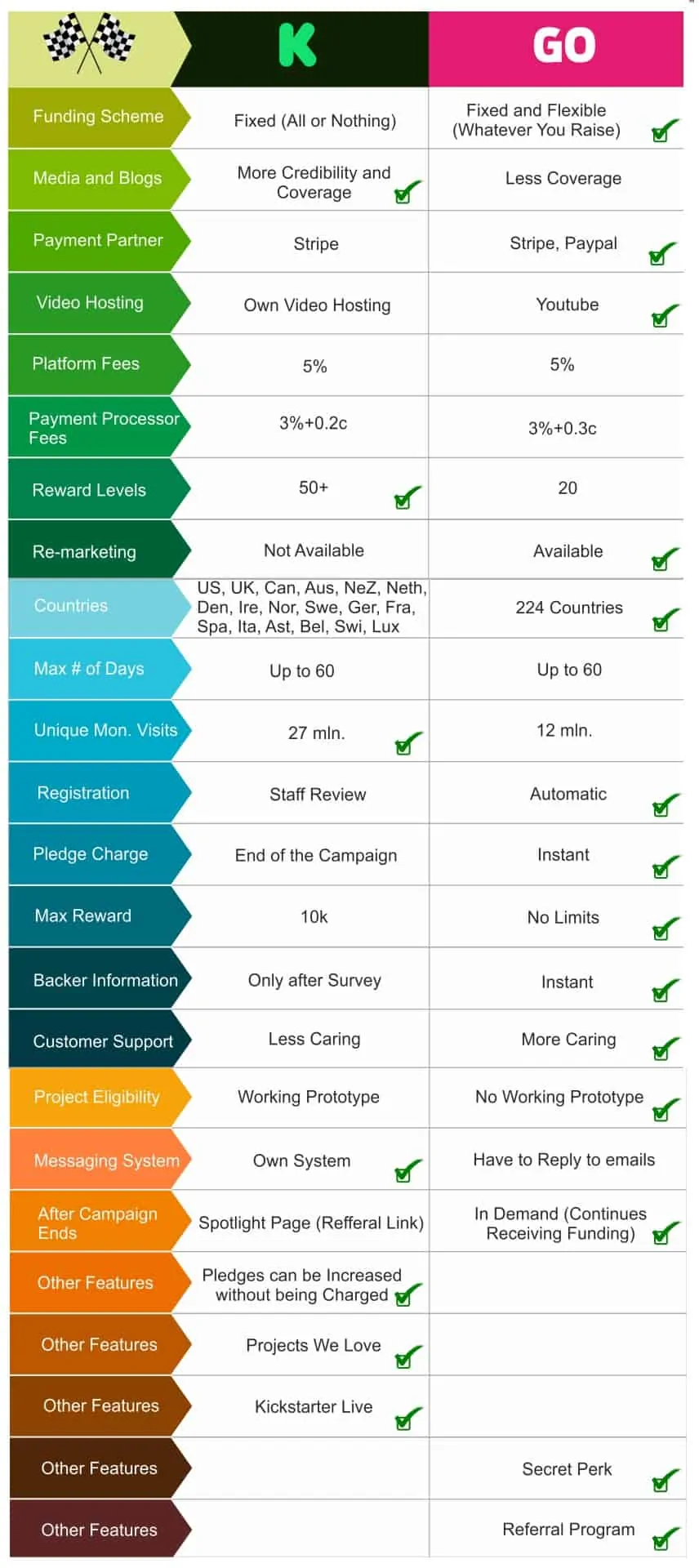
    Here’s an Infographic comparing them.

    kickstarter vs indiegogoa
    Source: The Crowdfunding Formula

    Needless to say, they are similar to one another only by the concept.

    Generally speaking, you’ll tend to find more artists, musicians, filmmakers, geeks and techy gadget makers on Kickstarter and you’ll see more small businesses and controversial ideas at Indiegogo. Also, Indiegogo has a more female-friendly audience and gets more traffic from Facebook than Kickstarter.

    Go On, Tell Us What You Think!

    Did we miss something?  Come on! Tell us what you think of our guide on How does Kickstarter Work & Make Money in the comments section.
  • Box Office Fantasy Game – The Next Big Film Startup Review

    Box Office Fantasy Game – The Next Big Film Startup Review

    What if there were a fantasy game for films where you could predict a film’s success, bid on it, and win revenue rights if you had the biggest bid?

    If you’re a movie buff, you’re going to love what we have here (because we loved the concept too).

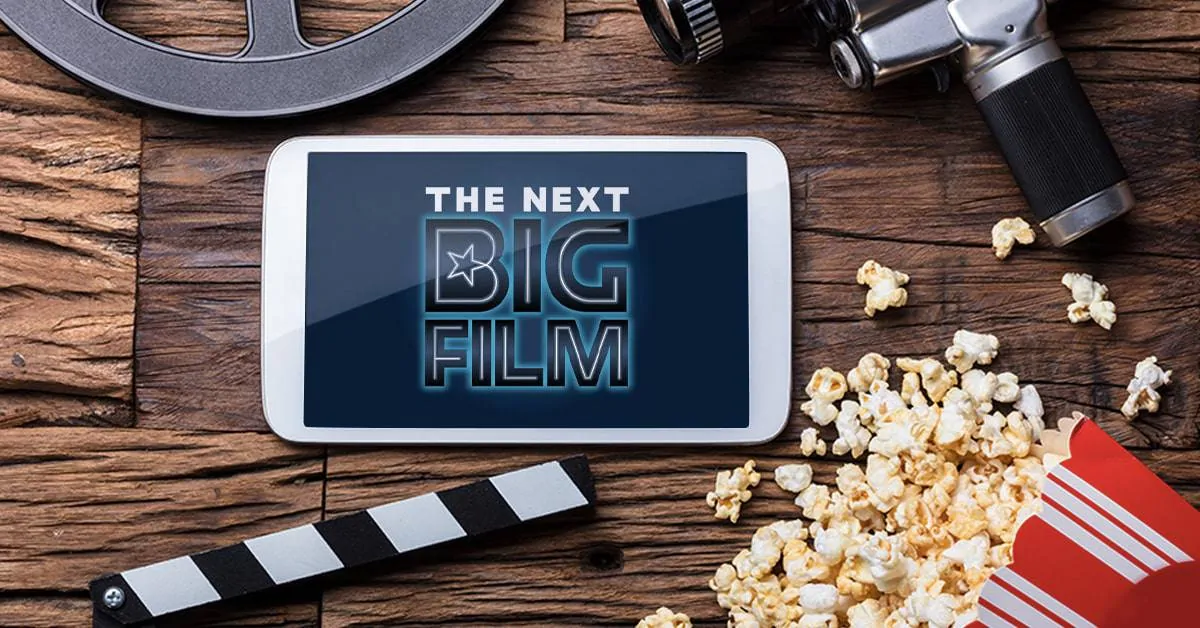
    The Next Big Film is an immersive film experience that combines elements of films, game and fantasy sport. It is a box office prediction game that offers you an entirely new way to connect with both your friends and favourite films.

    The Next Big Film – Startup Review By Feedough

    the next big film

    A box office fantasy game.

    Yes, you read it right. A game where you act as the chief executive of a big-name film distributor like Warner Bros or Disney and are responsible for our company’s film portfolio and the revenue it generates.

    Started in 2016 by Byron Thomas over a banter with his friend about whether the Dark Knight or Avengers would dominate the box office, the startup tapped the untapped opportunity to make the film industry more engaging.

    The Concept

    The problem with the film industry is that it fails to create real engagement with the audience. Unlike sports, the audience doesn’t feel much related to the movies, and the film interest levels quickly decline after the release.

    The Next Big Film capitalizes on the psychology of ownership and offers an interactive game which connects the upcoming movies to the audience in a more engaging way.

    The Offering

    The game – currently available on App Store, makes you a senior executive of one of the world’s largest film studios, who is responsible for the company’s film portfolio.

    On registering, you receive 1 million virtual pounds each day which you can use to bid in the fantasy film auction game. A new film is opened for bidding every day and the bid starts at an opening value of £10,000 virtual pounds. If you bid the highest, you become the owner of that film and secure the rights to 60% of the film’s revenue.

    This profit can be used to bid on other movies.

    The Value Proposition

    The sense of ownership and interest in the film’s progress results in more engagement even after the movie has released. This benefits the filmmakers. And the added touch of network effect where the users get to compete with their friends and others all over the world in bidding for their most anticipated films makes it enticing for the users as well.

    The Interview

    We discussed the concept, vision, and the future prospects of the startup with Byron Thomas, the CEO of The Next Big Film. Here are his thoughts on his startup –

    How Is Your Offering Disrupting The Industry?

    Byron: We think we are doing something that’s beyond ‘Disruption’, The Next Big Film is ‘Disregarding’ our affiliate industries. For the past year, we have been pushing this concept out to those in the Film, Gaming and Entertainment sectors. Our argument was that we’re doing something that is fun and exciting and will change how we interact, discuss and even promote the film. We weren’t satisfied with the pace that things were moving in relation to discussions and so we decided to bootstrap this ourselves and to build our audience in an organic and personable way. This is a hybrid concept where elements from Film, Gaming and Fantasy Sport all are creatively merged into a cinematic-gaming, mobile experience. We take pleasure in offering a completely free box-office experience and that we are creating an entirely new industry called ‘Competitive Entertainment’, where we take traditional forms of amusement and inject a competitive twist into it, this consist of both television and film as examples.

    For years the only means to interact with Film was done passively. You passively: read the re-hashed film articles, viewed the 2-minute trailers and watched the film. The Next Big Film offers active movie entertainment. Players take on the roll as Studio Executives and they must use their knowledge of film, gaming strategy and other tactics to secure the up and coming blockbuster hits. This enables the fan to share in the box-office success of their favourite films. Furthermore, it extends their interest levels in a film beyond its theatrical release for players now have an invested interest in a movies box-office performance. Moreover, our cinematic game kick starts weeks before the film release date thus this fills that period of inactivity where the fan has to eagerly await for the film and re-watch those short-lived film trailers (I personally watched the Suicide Squad trailer over 12 times within a two day period).

    We are offering the equivalent of what has been generated for both the Sport and Gambling enthusiasts think Fantasy Football and Online Poker. Both type of fans no longer have to leave their premise to partake in their favourite pastime, a Fantasy Sports League or an Online Poker championship can be formed from the comforts of their own home. The Film enthusiasts have no equivalent… until now.

    How It All Started?

    Byron: This concept started over banter about the film (the Dark Knight vs Avengers: which will dominate in the box-office). Film fans, like Sports Enthusiasts, are passionate about their pastime. Instead of leaving our film debate discussion open for further talks we decided to put our virtual money where our mouth was. We met up at a pub to host the first Fantasy Film Auction. We were simply auctioning off films that were due to be released using virtual money, each film league member or player was allocated 100 virtual pounds. We would then try to outbid other players for films that we thought would box-office hits and then track their performance over their theatrical window. Post film auction we found that everything changed, our discussions became more about film stats and we were more engaged with each movie. We added an objective element into the film experience where box-office figures, statistics and historical patterns were considered. This was the first fantasy film league filled with nothing but avid film fans, techies, students and working professional who shared a general interest in film and entertainment.

    The Next Big Film is simply translating those years in the pub where we hosted live film auctions over several pints into a mobile app experience for ALL to play.

    Why Did You Choose This Niche?

    Byron: The niche chose us. That eureka moment happened only after the fantasy film auctions held at our local pub. We began to fine tune the live game and tinker with the rules and parameters though only for the original Film League members. However, as we entertained further ideas to evolve this we realized that our mobile app platform can enable 10’s, 100’s 1000’s or 1000000’s of avid film fans to play worldwide, creating their own fantasy film leagues and organizing their rules from the comfort of their very own home.

    The Team

    Byron: Our core team consist of four passionate and creative individuals. Each of our talents come from various backgrounds and generally have their own unique taste in film. Our tech lead Andrii is from Ukraine and in addition to app development and film he also enjoys extreme water sports. Our Digital Content Editor Kate is a recent graduate who loves Rugby and is primarily responsible for the content that you see and for establishing our tone-of-voice. Our Brand and Operations talent is Amanda, she is a Product Manage by day, and a fierce, business savvy person at night. In addition, she is my backup and must deal with all of my crazy ideas and put them into context. I occupy the lead role and my top five films include: The Matrix (1999), House Party (1990), IT (2017), Old School (2003), The Doors (1991). I’m the visionary of all this madness and my team are the ones who keep this in order.

    What’s The Progress Till Now And What Are You Expecting In Future?

    Byron: We started out hosting only live, physical film auctions. We then tested the waters and developed a web-based beta version. We collected some input from players and went into Phase 2 development by adopting this web version of the game into a mobile app experience.

    In the future, we are wanting to continue to refine this daily interactive film experience by making our minimal viable product an even more robust platform. We’ll then look at adding some really draw dropping features such as the ability to chat with other players in your film league, the ability rate/rank films, user profiles and so on. We have a catalogue of ideas we’re going to introduce, we now need further input from the audience to steer us into a direction. Lastly, we are wanting to inject more diverse films from all geographic regions for there is a Hollywood in each of these (China, India, Nigeria, Russia, Australia, South America and the list goes on).

    We’re also wanting to reconnect with studios by offering them a creative, cost-effective channel to promote their film product. We hope to secure key partnerships to help accelerate the growth of The Next Big Film.

    Feedough’s Take On The Next Big Film

    the next big film

    The Next Big Film has tapped the opportunity which was waiting to be tapped. The films industry does require some add-ons when it comes to engagement.

    Having film evangelists which stick to the film even after its release will certainly add to the marketing efforts of the production houses.

    Even though the concept of this startup is spot-on, we believe there are a lot of elements that can be added to it. The first being data collection. Collecting and providing the data to the production houses could be a great addon to the revenue model.

    That being said, The Next Big Film seems like the next big thing. Let’s see how it progresses over time.

    Interested?

    If you’re a big movie buff (like us), you would want to download The Next Big Film application from the App Store.

    Get Your Startup Reviewed By Feedough!

    Get discovered by over 500,000 monthly visitors. Explain your offering to over thousands of potential investors, customers, and top blogs.

    Startup reviews are custom written posts by our experienced team who’ll work closely with your team to create the best pitch possible. The review article will be posted and shared with thousands of our subscribers over emails, social media posts, and push notifications.

    Use this form to get in touch.

  • The Importance Of Branding In Today’s World

    The Importance Of Branding In Today’s World

    Today, the market is full of countless companies selling similar generic products. This has led to the increased importance of branding in business.

    The customer today buys the brand. He chooses the product with the brand he is most familiar with or which has been successful in getting his attention through its communication. And if he likes the product, he knows which brand to choose the next time he goes shopping.

    The role of branding has changed over time. Earlier, it was used to differentiate the product from others in the market. But today, branding not only differentiates the product from others, but it also adds a set of personality traits to the product and automatically positions it in the market according to what position its brand occupies in the minds of the target audience.

    Why Is Branding Important?

    One cannot ignore the advantages of branding as it has an overall positive impact on a company. It changes how the target market perceives the product, gives it a recognisable identity, helps in driving new business, and compliments the marketing strategies.

    Here are a few of the reasons why branding is important for a business –

    Gives An Identity To The Product

    The main purpose of branding is to name the product, assign it attributes (logo, colours, voice, etc.), and develop a personality that has a distinct identity. Branding transforms a generic product into something that is recognisable and easily memorable.

    Differentiates The Product From The Competition

    Different brands have different identities. Branding helps in differentiating the product from the rest and positioning it in a way the company wants. This is done by developing a distinct outlook by working on brand identity, brand message, and brand tonality.

    Increases Recall

    Since branding assigns recognisable attributes to the product, it increases its recall. It adds the ability to assign an experience or characteristic to the brand before and after the sale has taken place.

    Creates Trust

    Since a brand assigns a recognisable identity to the product, it increases the customer’s trust in it as they can now identify whom to blame or promote according to their experience with it.

    Branding increases trust as the customers get an identity to sue if the promises are not fulfilled.

    Increases The Overall Market Value

    The brand has its own value as a separate asset (called brand equity). Brand equity is the increase in the value of a product just because a brand name is associated with it.

    Moreover, a brand can be sold as a separate asset too.

    Attracts New Customers

    A strong brand attracts more customers like a magnet. Strong branding means there is a positive impression of the company in the minds of the customers. This triggers voluntary referrals through word of mouth and viral marketing.

    Boosts Employees’ Trust And Satisfaction

    When employees work with a renowned brand, their satisfaction increases, and they are more motivated to work hard.

    Working for a reputable brand gives them surety of a good salary, recognition, and better opportunities in future.

    Support The Marketing Strategies

    Referral marketing, influencer marketing, affiliate marketing, and even advertising strategies only succeed if an identifiable brand complements them.

    Marketing strategies require an identity to promote, and the brand is what gives an identity to the product.

    Helps The Business To Expand

    A reputable brand can be expanded easily, and new products can be added to the product mix of the same brand. This gives a kickstart to the marketing and sales of new products as they receive the goodwill of the existing brand.

    Go On, Tell Us What You Think!

    Did we miss something?  Come on! Tell us what you think of our article on the importance of branding in the comments section.
  • Cost Leadership – Definition, Examples, & Strategies

    Cost Leadership – Definition, Examples, & Strategies

    Unless you have a money-bearing tree in your backyard, I’m sure you’ve always searched an extra place or went an extra mile, just to purchase an item that’s available at a lower price. After all, most of us are used to reading tags from right to left; because the price is what matters more than anything else.

    But have you ever wondered how companies manage to sell products at comparatively lower rates? And why do they even do so?

    This is accomplished with the help of a marketing strategy called cost leadership. Cost leadership helps you gain a competitive advantage over your competitors in a price sensitive market.

    What Is Cost Leadership?

    Cost Leadership is the mechanism of establishing a competitive advantage by having the lowest cost of operation in the industry. This strategy is especially beneficial in a market where the price is an important factor.

    The primary objective of a firm aiming to attain cost leadership is to become the lowest cost producer in comparison to the competitors. This is usually achieved by large scale production which enables the firm to attain economies of scale or by innovating the production process.

    Acquiring quality raw materials at the lowest price is the basic goal of a cost leadership strategy. Further, there is an additional requirement of quality labour who’ll convert these raw materials into valuable goods for the consumer.

    But,

    It needs to be noted that the way the cost of products differs from their price, similarly, cost leadership isn’t the same as price leadership.

    The expenses incurred by a business in the process of bringing a product or service into the market is known as the cost; while the money which the customers pay for that product or service is known as its price. The value of the price is usually higher than the value of the cost.

    Thus, the cost is the money which a company GIVES to the production and introduction of a product in the market (like labour, capital, materials, wages, bills, and other transaction costs). Whereas the price is the money which the company GETS from that product ( a total of the production costs and seller’s profit).

    Cost Leadership ≠ Price Leadership

    Although the two often go together, cost leadership is not necessarily price leadership. A company could be the lowest cost producer yet not offer the lowest-priced products or services, thus possessing higher profitability. A cost leader will be more profitable than a competitor at the same price point.

    The profitability of cost leaders gives them room to innovate, manoeuvre, and survive as compared to their lower-margin competitors, especially in price centred industries.

    The goal of a cost leading company is to reduce costs, and not just prices. Also, a company with the lowest prices isn’t necessarily the one with the lowest costs.

    Now that we have possessed a good knowledge of cost leadership, let’s move on to achieving it in real life.

    How To Achieve Cost Leadership

    Although a little bit tricky, achieving cost leadership isn’t a tough deal.

    A unique and effective cost leadership strategy which is better than the competitors is the key!

    A cost leadership strategy works on the basic principle that more the number of units produced, lower will be the unitary cost. It exploits the scale of production, by producing highly standardized products using advanced technology. In short, a successful cost leadership strategy enables companies to sell more units sold at a lower margin per unit.

    However, there are no shortcuts or escapes for a company aiming to achieve cost leadership in the long run. Either they have to commit to cost reduction or they lose the race.

    Here are a few cost leadership strategies through which one can establish and maintain an upper hand:

    • Economies of scale: Efficient production decreases the costs of production. Size of the company matters a lot when we talk about economies of scale. In short, larger the business, lower the costs.
    • Advantages of size: Increased purchasing power is a major outcome of the advantages of size. In short, more the money given to the suppliers, more the likeliness of extracting unique deals that become advantages.
    • Technology: Better and innovative technologies and methods of production are a major deal in cutting costs. In short, better the technology used by a business, more are its chances of staying a cost leader in the long run.
    • Focus: A company needs not to be huge to be a cost leader in the market. Even if a company manages to produce just one product, but with full focus and efficiency, it can manage to become the cost leader in that field of the market. In short, more the focus that a company renders to its good, more are its chances of becoming a cost leader in that domain.
    • Raw materials: Costs can be greatly reduced depending upon the amount of access a company has over the basic raw materials required for production. A company might pay huge sums for a particular resource, while another may not have to do so. In short, more the access of a company to potential raw materials, more are its chances of cutting costs as compared to competitors.
    • Operating efficiency: Getting more tasks done in comparatively lesser time and costs emerge as a golden way of increasing efficiency and also, cutting costs. In short, the lesser the amount of money and time that a company spends on getting a task done, more are its chances of coming out as an effective and cost-advantaged company.

    These were a few ways through which companies can cut on costs and improve their chances of becoming cost leaders in the market.

    Now, let’s take a look at some of the successful cost leaders in today’s market.

    Cost Leadership Examples

    Aldi

    Aldi has successfully cut down on excesses at every point of production and uses a no-frills marketing strategy too. As a result, is able to provide the consumers with quality products at low prices.

    Amazon

    Amazon offers maximum value for its customers at the lowest price and wraps its business around the customers wherein they find it to be a reliable portal for their online shopping needs.

    McDonald’s

    McDonald’s practices a division of labour by employing and training inexperienced staff instead of skilled cooks and thus manages to cut huge amounts of costs from the salaries of its employees.

    Go On, Tell Us What You Think!

    Did we miss something?  Come on! Tell us what you think of our article on cost leadership in the comments section

  • Why Is IKEA So Cheap? | IKEA Business Model

    Why Is IKEA So Cheap? | IKEA Business Model

    IKEA is known as that Furniture store where you get economical furniture for all your needs. And it reaches your home in a flat pack DIY system to suit the current apartment size needs. How convenient?

    For those who still don’t know what I am talking about, here’s a brief idea on what exactly is IKEA:

    What Is IKEA?

    IKEA is the world’s largest furniture retailer. The company got its name from the initials of Ingvar Kamprad (Founder) Elmtaryd (his family farm) Agunnaryd (his hometown) and was founded in 1943. IKEA began with sales of pens, wallets, jewellery with the primary concept of meeting customer demands at affordable prices. Five years into the business IKEA brought in furniture. Since then IKEA furniture has seen a meteoric rise to become a household name. With 424 IKEA stores and operations in 52 different countries, IKEA furniture is now a well-established multinational brand.

    If IKEA was a mainstream furniture manufacturer it probably wouldn’t be where it is right now. The company is known for its flat-pack furniture system. An idea that was developed when a carpenter removed the legs of a table for easier transport. Since then IKEA has been keen on developing furniture that anyone could assemble in their own household.

    How Does IKEA Fare In Numbers?

    IKEA had a global revenue of 38.8 billion Euros in 2018, an up from 36.3 billion in the previous year.

    With 12,000 products in its product range, there are literally thousands of options to choose from. IKEA has around 1350 suppliers from around 50 countries that fit the requirements of this massive chain.

    Even though the operating profit of IKEA in 2018 saw a 26% drop, IKEA is looking at new avenues and markets to explore.

    The IKEA Smart Secret

    IKEA is owned by the INGKA (Ingvar Kamprad) foundation. INGKA is actually one of the world’s largest charitable organizations. But why would IKEA be owned by a charitable non-profit organization?

    This began when IKEA management figured out that transferring the ownership to a charitable organization in the Netherlands would help it achieve three goals: Reduced taxes, impossible to make a hostile takeover and a privilege to perform as a non-profit organization. Moreover, the intellectual property is held by another company. This is all done to have minimal taxes. (and it works).

    How IKEA Works | IKEA Business Model

    Volume Of Sale

    IKEA primarily believes that the higher the volume of business, the higher the profit, the lower the cost. Thus, to reap benefits of this cyclic process, IKEA begins with low cost on furniture and strategically places itself in cities with a population over 500,000. They simply play with the economics of scale. Thus IKEA is able to provide cheaper furniture over your standard furniture manufacturer.

    Shipping Cost Elimination

    Just like Aldi, IKEA also believes in saving non-essential costs using genius strategies. The company uses the flat pack system to its advantage. Since the furniture packs up in a box that looks identical to your flat screen TV system they can ship more furniture in a single shipment as the compact arrangement makes fitting more furniture in less space viable. And the end assembly is done by the consumer so it is a win-win scenario.

    Hybrid Material

    IKEA uses hybrid materials like medium density fiberboards and laminates to have a strong structure at a cost and weight less than that of wood. This helps reduce their pricing for the final product.

    Lesser Skilled Carpenters

    IKEA believes in a strong R&D team which cuts costs and finalizes the design as per requirement. They are constantly involved in making the set cheaper and easier to put together. Thus the design they pick out usually is replicable and is done in a CNC machine and not by the custom carpenter. This is another cornerstone in putting down the cost of the set.

    Specific Market Research

    IKEA came up with the legacy products in the foreign market, but soon they realized that the sales never met the expectations. IKEA definitely had cheap products but didn’t fit up to the consumer’s needs. That is when IKEA shifted its focus to the needs of their consumers. IKEA began having a proper feedback loop where they realized the needs of the local markets they are targeting in.

    For example, the consumers in the US wanted larger beds and furniture since they had ample space and consumers in Japan wanted modular furniture to fit in their compact houses.

    IKEA figures out what furniture is it going to sell before entering any market.

    Private Franchising

    IKEA takes an annual franchise fee of 3% of all sales made from the stores that franchise the brand. Unsurprisingly, this franchising business model results in a lot of money for IKEA.

    Distribution Channel

    IKEA has more than 1400 suppliers in 52 countries and more than 40 distribution centres in 16 countries. IKEA has a strong foot in supply chain management as it manages the supply from far off countries. 60% of IKEA’s suppliers are from European countries and the rest from China and other local markets.

    The whole idea of having a wide supplier channel lies with the ideology that IKEA believes in an upfront price limit to the required furniture. It believes in a socially responsible and environmentally friendly way to develop furniture. This being said, it boasts a furniture range consisting of 60% of the products made of recyclable materials and 10% of furniture made totally from recycled materials.

    Suppliers and distributors contact each other to have a ready stock at all the IKEA stores. IKEA believes in take and go and thus always has inventory ready.

    In A Nutshell

    IKEA has a massive network of suppliers who they deal with to create their desired products in exceptionally low costs which in turn works for them as their profit is covered in volumes of the business. Further, their innovate flat packing of the furniture saves their packaging and shipping costs helping them minimize the expenses.

    IKEA business model revolves around the basic rule of marketing: Meeting needs profitably and thus is able to dish out significant profit by their basic yet widespread model.

    Go On, Tell Us What You Think!

    Did we miss something?  Come on! Tell us what you think of our article on IKEA Business Model in the comments section

  • 13 Actionable Branding Tips For Startups

    13 Actionable Branding Tips For Startups

    What comes to your mind when you hear the term brand?

    If it is just name, logo, colour, font, ambassador, and any other attribute, you need to read this article till the end.

    Because a brand isn’t what you think it is all about.

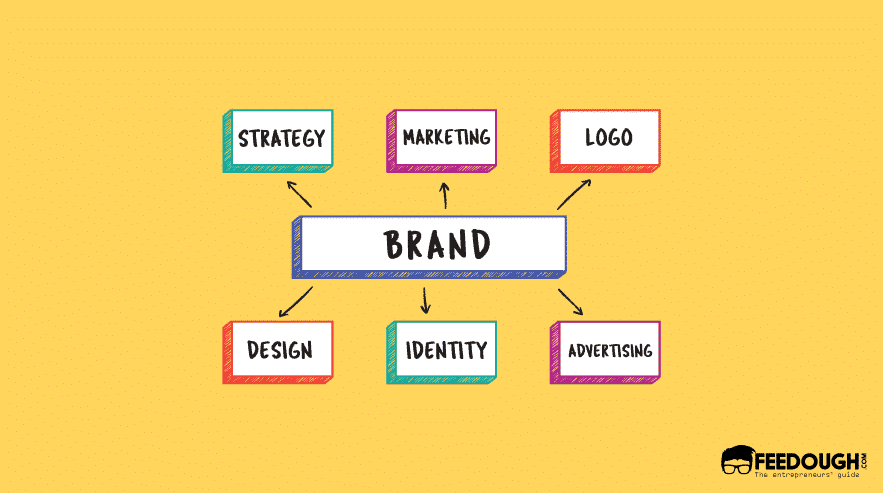
    It is the combination of all the properties within and outside the product which gives it an identity and a personality. Yes, it consists of a name, logo, some symbols, and other attributes. But it also includes the associations, message, tonality, voice and the overall outlook of the company.

    It is not developed when you find an available domain name on the internet. It requires extensive research on consumer behaviour, the product features, the right positioning for the product, and the personality you want your offering to have.

    Know the basics

    Before we move on to discuss the actionable branding tips for your startup, it’s important for you to understand the basics as we’ll be using them a lot.

    • Brand Personality: Brand personality is the set of human traits like unique, caring, funny, trustworthy, creative, straightforward, dishonest, rebel, etc. assigned to your brand. All the brand communication strategies revolve around building its personality as the company desires it to be.
    • Brand Associations: These are the tangible and intangible product features like logo, colour scheme, ambassadors, owners, etc which increases your brand recall.
    • Brand Positioning: Positioning is the unique position your brand occupies in the minds of your customers. It makes your customers view your offering in a unique way and makes it stand out from the competition. Positioning is different from personality. It is how your customers recognise your offering’s USP and not how they recognise your personality.
    • Brand Identity: It is how your brand portrays itself to the customers. It is how you want to be perceived by your customers.
    • Brand Image: It is how your customers perceive your brand. It is what your brand stands for as a whole to the customers. Brand image builds over time and is the aggregate of beliefs, ideas, and impressions that a customer holds regarding the brand.

    Your brand should work on building its personality by forming brand associations and executing brand identity building strategies. This personality will eventually position the brand in a unique way and gives rise to the brand image.

    Remember, you cannot directly alter your brand image. But you can work on building a good brand personality which forms your brand image.

    Never Ignore The Buyer Persona

    Your brand should be built around what your customers desire. Position your offering according to what they want and you’ll have a magnetic brand.

    If your customer likes buying premium looking brands but is short of money, why not use these two characteristics to create a unique identity in the market?

    Build a buyer persona before drafting your branding strategies (even before you select the name for your brand).

    Build Your Brand As If It Is A Person

    A brand is the personification of the company or the offering. Build it like you’re creating a new person. Don’t just focus on the appearance, define how it’ll talk to the audience, how it’ll age, and what all it’ll be associated to.

    If you’re creating a sports brand, instead of just focusing on the logo and tagline, specify the products you’ll be focusing on (premium products, accessories, or low-cost products), the perfect colour palette (for the sporty look), the tonality of the communications (to build the personality) on posters, blog posts, social media posts, and the replies. Strategize brand placement in every communication message. It isn’t necessary to be just the logo; it could be the brand message, the tagline or just the brand colours.

    Consider What’s Driving Your Business

    Building your brand around your value proposition is always a good idea as it makes it easy to understand your communication and also helps in positioning the brand as you want it to be.

    If being organic drives your business, instead of building a generic niche brand, focus more on being organic while developing and deciding the brand attributes, identity, and associations.

    Test Drive Everything (Split Testing)

    A brand built on just the assumptions rarely succeeds. Validate your assumptions using split testing. Create a different landing page for every alternative and collect data on how the user interacts with it.

    Test drive everything and be 100% sure before releasing it in the market. Leadpages, Click Funnels, and Product Hunt Ship are great tools to help you split test to validate your assumptions.

    Ask Questions & Take Feedback

    Another (and more preferred) way of validating your branding assumptions is to go out and talk to the users. Draft your questions to understand the desirable but untapped positioning opportunity in the market.

    Product Hunt Ship lets you do that too. Or you can select the survey tool according to your needs from our list of best survey tools on the internet.

    Prioritize Your Brand From Day One

    Never think of building the product first and the brand later. Start working on your brand from the day one and make it inseparable from the offering.

    Even your early adopters should know everything about the brand they bought it from.

    Be Consistent

    Consistency is the key to successful branding. Your focus should be to communicate a consistent brand message to set the desired positioning in the minds of the customers.

    Setting brand guidelines and developing distinct products which are unique to your brand will help you in maintaining such consistency.

    Take Apple for example. The company has built up its brand consistency over time with a series of products and communications that reinforce the company’s central identity.

    One can easily identify an iPhone advertisement even before the logo actually shows up.

    https://www.youtube.com/watch?v=cFOAefphdGI

    Never Mimic

    You wouldn’t want to be called ‘a brand like XYZ’. Always focus on building an identity which is unique, identifiable, and differentiable.

    While mimicking may help you make use of the existing brand’s followership in the short run, it would result in your brand getting lost forgotten in the long run as you will never be alone in this.

    Think Long-Term

    Every year we are told about how our attention spans are shrinking. There is a lot of information, a lot of products, and a lot of other things vying for our attention. Our attention has become a commodity now.

    Continuous investment in the brand with consistent communication of the brand message helps in finding a distinct place in the minds of the customers which eventually reaps more profits in the long run as compared to any new brand.

    According to research by Mckinsey, firms with long-term strategies had 47% more top-line growth than other companies, 36% higher earnings, and added an average market capitalization of $8.67 billion.

    So, how do you think long term?

    Well, you need to focus on building up and imbibing your brand promise in the minds of your target audience over time. Build products that are consistent, have consistency in all your communication strategies, and build a balance between short term and long term goals (40:60).

    Never ignore your existing customers. Keep them happy, take their feedback, and fulfil their after-sale requirements to make them stay for long (and even refer the people in their network).

    Create An Experience

    It’s easier to forget about the product but it takes time to forget about an experience. A brand experience is the sum of all the interactions your target audience have with your brand.

    Focus on enhancing the brand experience. Try to woo your customers at every stage of their buyer journey (and even after he has made the purchase). Be approachable, answer their questions, know their expectations, talk to them on social media, and keep them happy even after the sale has taken place.

    Connect Your Brand Strategy With Marketing

    Don’t just market your product. Market how your brand has added a special touch to a generic product. Market your brand promise and you’ll definitely build a long-term brand.

    Go On, Tell Us What You Think!

    Did we miss something?  Come on! Tell us what you think of our article on branding tips in the comments section