
Feedough Logo

Blog

  • What Is Entrepreneur In Residence?

    What Is Entrepreneur In Residence?

    Venture capital firms and other investors operate on just one principle – invest in people and projects with the highest potential for growth and profitability. This is why they are always on the lookout for talented individuals who can bring their innovative ideas to life.

    One way that these firms identify promising entrepreneurs is through the entrepreneur-in-residence (EIR) program.

    Today, it’s not just the venture capital firms that are running EIR programs. Many large corporations and even government entities have also started to invest in this model to foster innovation and bring new products to market quickly.

    So what is an entrepreneur in residence? Why is it gaining importance, and how does it work?

    What Is Entrepreneur In Residence?

    An entrepreneur in residence (EIR), also referred to as executive in residence, is a position offered by venture capital firms and other business organisations involving experienced entrepreneurs who are temporarily employed to work within the organisation with the mandate to identify and develop new business opportunities.

    An EIR typically has a lot of experience in launching and running successful businesses. They are usually well-connected individuals who can help an organisation tap into new markets and opportunities.

    The role of these EIRs is to generate new business ideas and help to turn them into viable ventures. This may involve working with existing staff to develop new offerings, improve existing offerings, or start a new company from scratch with a fresh team.

    EIRs are usually brought in on a short-term basis, typically for one to two years. During this time, they are given the resources and support they need to work on developing new business opportunities.

    What Is Entrepreneur In Residence Program?

    An EIR program is an initiative by a company to bring in experienced entrepreneurs to help generate new business ideas and opportunities. These programs are typically run by venture capital firms, but they are also becoming increasingly popular with large corporations and even government entities.

    The EIR program provides a structured environment for experienced entrepreneurs to work on developing new business opportunities. A structured environment means:

    • Access to resources: EIRs are given access to the organisation’s resources, which may include office space, funding, and mentorship.
    • Support: The organisation provides support to the EIR in the form of advice and guidance.
    • Network: The EIR has access to the organisation’s network of contacts, which can help them to find customers, partners, and investors.

    These programs usually last for a few months to two years.

    Types Of Entrepreneur In Residence Programs

    There are three main types of EIR programs:

    • Corporate EIR programs: These are run by large corporations as a way to foster innovation and bring new products and services to market quickly.
    • Venture-backed EIR programs: These are run by venture capital firms with an aim to invest in talented entrepreneurs with high-growth potential. Some startup studios also include venture-backed EIR programs.
    • University-based EIR programs: These are programs offered by universities to support entrepreneurship and help commercialise new technologies developed by academic researchers.

    The Roles And Responsibilities Of Entrepreneurs In Residence

    The roles and responsibilities of an EIR vary depending on the organisation they are working for. However, there are some common tasks that they are typically responsible for, such as:

    • Identifying new business opportunities: The primary role of an EIR is to identify new business opportunities that the organisation can pursue. This involves keeping up to date with industry trends and developments and looking for gaps in the market that the organisation can fill.
    • Develop and manage new firms: Once a new business opportunity has been identified, the EIR will work on developing it into a viable startup. This may involve putting together a team of employees, working on a business plan, and raising capital.
    • Provide mentorship and guidance: An EIR is also responsible for providing mentorship and guidance to not just the team they are working with but also to other firms within the organisation. This includes sharing their knowledge and experience, as well as helping to connect the organisation with other professionals and resources.
    • Improving the existing business: In some cases, an EIR may be brought in to help improve an existing business. This may involve working on new product development, streamlining processes, or expanding into new markets.
    • Help in due diligence: An EIR may also be involved in the due diligence process when the organisation is considering investing in a new venture. This includes evaluating the business opportunity, the team, and the market potential.

    Benefits Of Entrepreneur In Residence Programs

    EIR programs are aimed to benefit both the organisation and the entrepreneur. Some of the benefits of these programs include-

    For the organisation:

    • Generate new ideas: One of the key benefits of EIR programs is that they can help to generate new ideas and bring fresh perspectives to an organisation.
    • Reduce pressure: EIR programs can also help to reduce pressure on the venture capitalists to get the most out of its investment.
    • Bring in entrepreneurial expertise: EIR programs also provide organisations with access to experienced entrepreneurs who can share their knowledge and expertise.

    For the entrepreneur:

    • Structured environment: The EIR program provides a structured environment for experienced entrepreneurs to work on developing new business opportunities.
    • Resources and support: It also provides access to resources and support, which can help to accelerate the development of new businesses.
    • Mentorship and guidance: The EIR program can also provide mentorship and guidance, which can benefit entrepreneurs looking to take their business to the next level.
    • Exposure: A good entrepreneur in residence program can also provide exposure to a large organisation, which can be beneficial for networking and raising capital.

    Entrepreneur In Residence FAQs

    There are a few questions that people often have about EIR programs. Here are some of the most frequently asked questions:

    How long does an EIR program last?

    The duration of an EIR program varies depending on the organisation. However, most programs typically last for a few months to two years.

    Does an entrepreneur in residence get paid?

    EIR programs are typically paid positions. The amount of money an EIR earns depends on a number of factors, such as the organisation they are working for, the duration of the program, and their level of experience.

    What is the difference between an entrepreneur in residence and a consultant?

    The main difference between an EIR and a consultant is that an EIR is typically brought in to work on developing new business opportunities, whereas a consultant is usually brought in to provide advice and guidance on existing businesses.

    Go On, Tell Us What You Think!

    Did we miss something? Come on! Tell us what you think about our article on entrepreneur in residence in the comments section.
  • Where & How To Find A Cofounder For Your Startup?

    Where & How To Find A Cofounder For Your Startup?

    A startup isn’t a single-player game. It’s a team sport. In fact, 23% of startups fail just because they don’t have the right team.

    And one of the most important members of your startup team is your cofounder.

    Your cofounder is your business partner. They are the one you’ll be spending long hours with in the trenches, building your business from the ground up.

    So, it’s critical that you choose your cofounder wisely.

    But we understand that you must have your own doubts. Doubts regarding why you need a cofounder in the first place, where to find one and how to pick the right person for your startup.

    We will answer all these questions to make your startup process a lot smoother.

    Why Do You Need A Cofounder?

    Starting up is hard. You will face a lot of challenges along the way, and there will be times when you feel like giving up. This is where a cofounder comes in. A good cofounder is that perfect puzzle piece that fits in and helps you build a strong foundation for your startup.

    They will be your sounding board when you’re feeling lost, will help you make tough decisions, and will push you to do better.

    In short, there are more chances of you succeeding with a cofounder than going solo.

    Moreover, here are some more reasons why you need a cofounder:

    • To balance your skills and knowledge: A cofounder will have different skills and knowledge than you, which will help balance out your weaknesses. For example, if you’re great at marketing but not so good with numbers, then you can find a cofounder who’s good with finances. This way, you can complement each other and build a well-rounded business.
    • To Share The Load: Starting up is a lot of work. There will be long days and sleepless nights. It’s not possible for one person to handle everything on their own. A cofounder will help share the load and make your journey a little less daunting.
    • To Get A Different Perspective: It’s easy to get tunnel vision when you’re working on your own. A cofounder will be able to provide a different perspective and help you see things that you might have missed. This is especially helpful when making key decisions for your business.
    • To Grow Your Network: A cofounder comes with their own set of connections which can help you take your business to the next level. This is especially helpful in the early stages when you’re trying to get your foot in the door.

    Now that we’ve answered the question of why you need a cofounder, let’s move on to where you can find one.

    Where To Find A Cofounder?

    The best cofounder is a person who you already know and trust. This could be a friend, family member or someone you’ve worked with in the past.

    If you don’t know anyone who fits the bill, don’t worry. There are plenty of other places where you can find a cofounder. Here are a few options:

    YCombinator’s Startup School

    YCombinator's Startup School

    YCombinator is one of the most popular startup accelerators in the world. They have a Startup School program, a free 10-week online course to help you start your own company.

    One of the best parts about this program is that it has a cofounder matching feature. This means that you can find other entrepreneurs who are looking for a cofounder with a similar skillset and vision.

    CoFoundersLab

    CoFoundersLab

    Boasting itself as the world’s largest network of entrepreneurs, CoFoundersLab is a great platform to find a cofounder for your startup. They have a database of over 100,000 entrepreneurs from all around the world.

    You can use their advanced search feature to find someone who meets your specific criteria. You can also attend their events which are held in various cities across the globe.

    Besides networking, CoFoundersLab also offers helpful resources on their website, from foundational startup knowledge to mentoring programs.

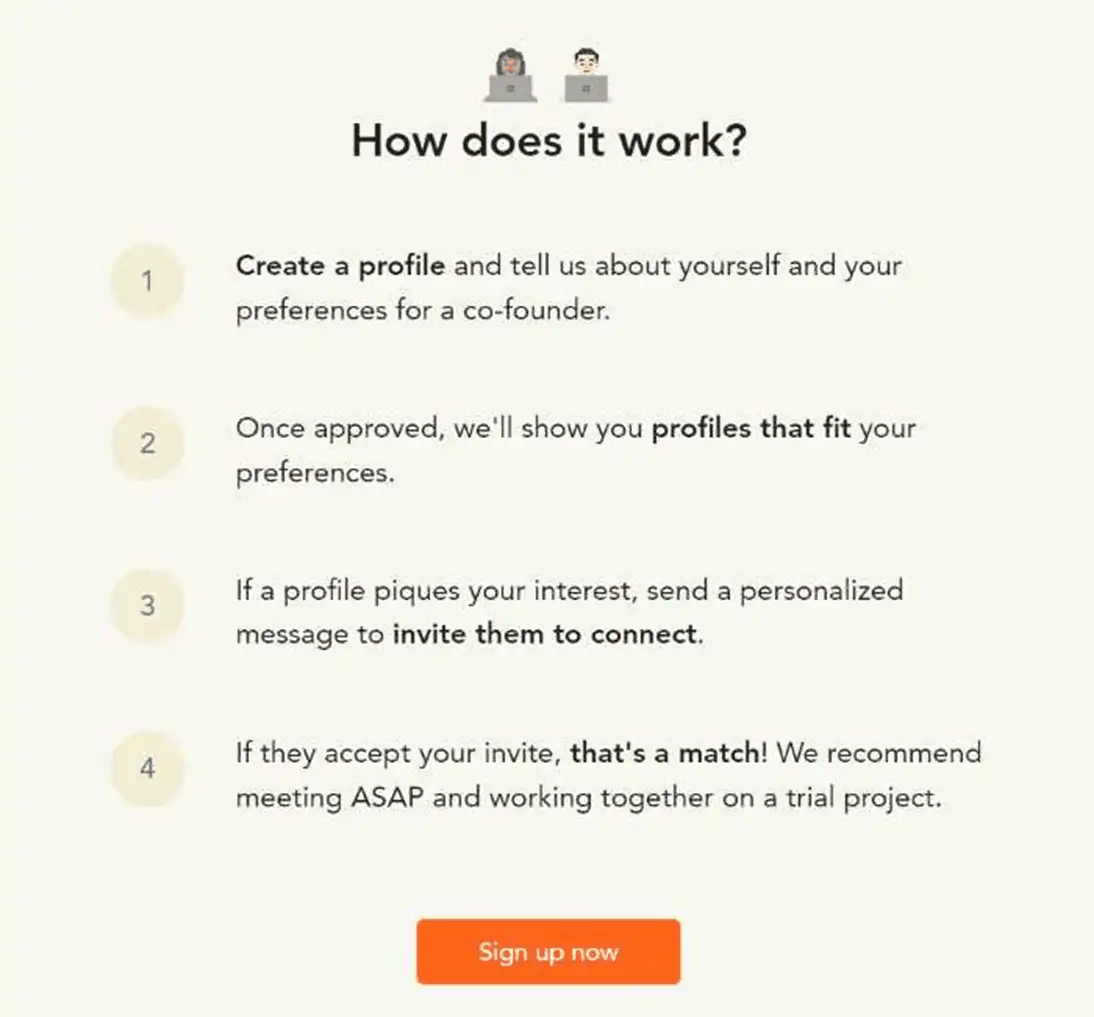
    Intch

    Intch is an AI-powered networking platform that helps entrepreneurs connect with the right people. All you have to do is sign up and answer a few questions about yourself.

    After that, their algorithm will match you daily with five people who have complementary skills and knowledge or who are looking for your expertise. You can also use their platform to find investors, mentors, and advisors for your startup.

    StartHawk

    StartHawk

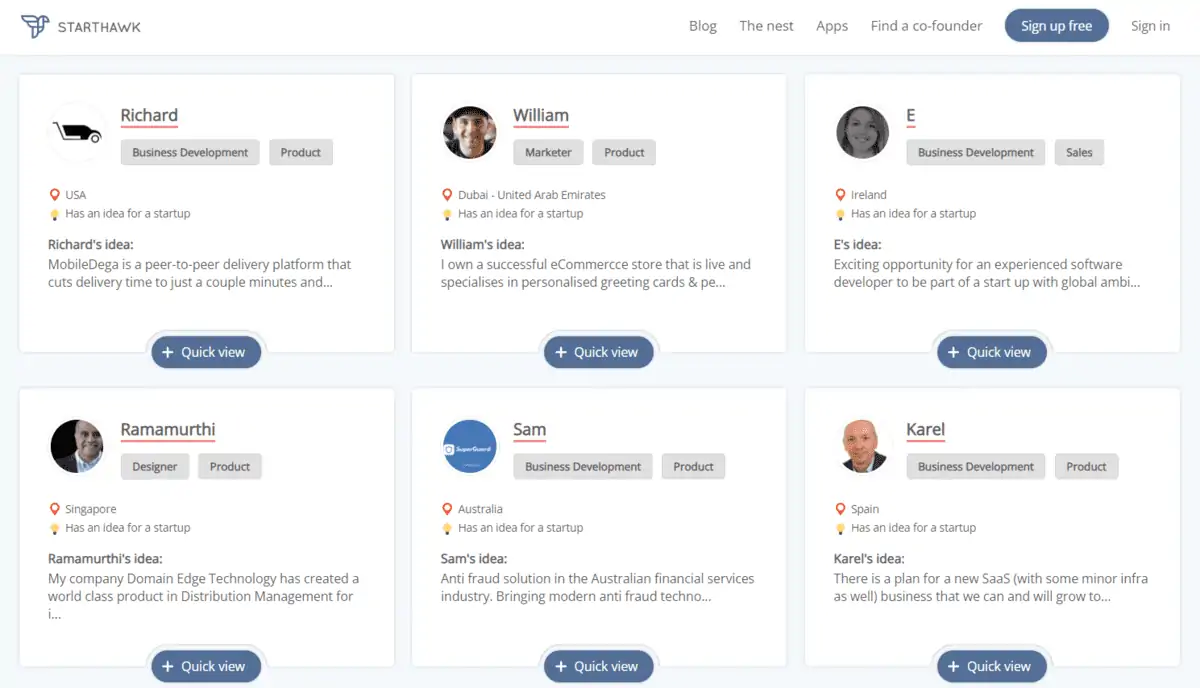
    StartHawk is a “founder listing” platform that helps entrepreneurs find the perfect cofounder for their startup by browsing and filtering the list of available entrepreneurs who are willing to collab on their idea or are open to working on another.

    All you have to do is sign up and fill in your personal and company or idea details. After that, their algorithm will add you to the list of potential cofounders who match your criteria.

    You can also use their platform to look for suitable cofounders based on their skills, experience, and location.

    Lunchclub

    Lunchclub

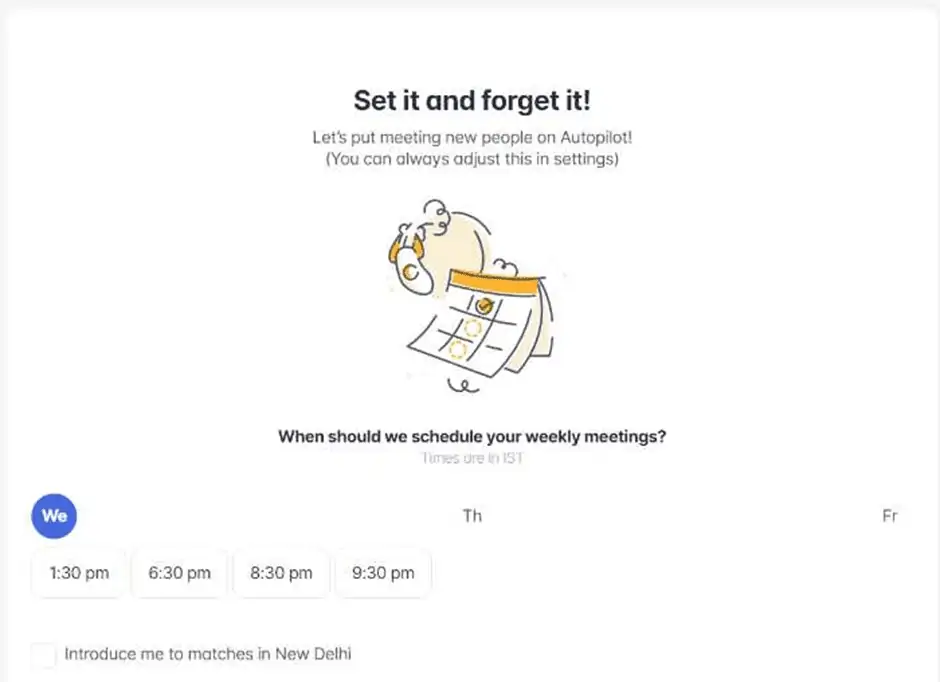
    Lunchclub is an AI and ML fueled social networking platform focused highly on connecting users with common interests and objectives.

    To begin, sign up and answer a few questions about yourself and what you’re looking for and select the date and time you’re comfortable with for an online meeting. Lunchclub’s algorithm will then match you with someone who it thinks would be a good fit.

    The platform is backed by Lightspeed, Coatue, and a16z and boasts its 1:1 meeting success rate.

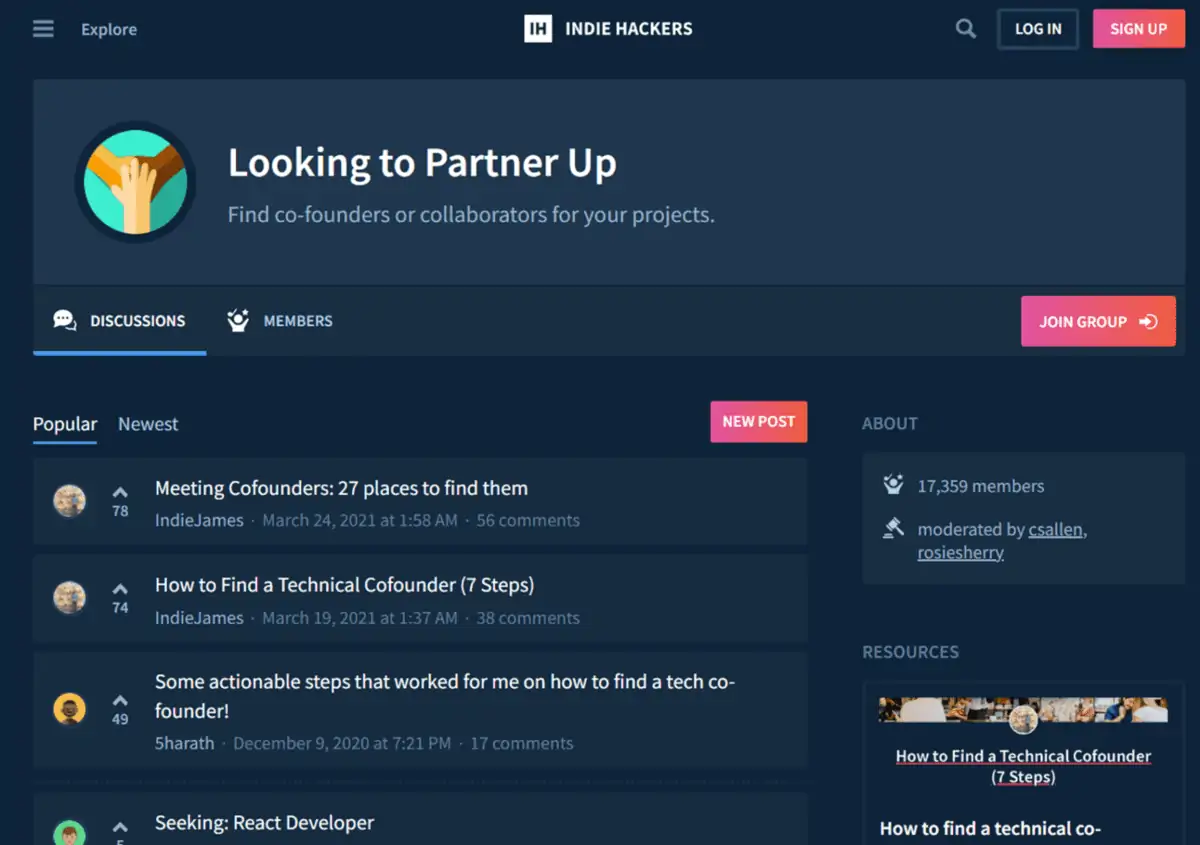
    Indie Hackers

    Indie Hackers

    Indie Hackers is a podcast and community for entrepreneurs who are bootstrapping their businesses.

    The platform also has a section dedicated to helping you find your cofounder by posting your requirements and expectations in a cofounder forum. Besides this, the community is really supportive in whatever you are planning and makes sure you succeed in every venture – be it finding a cofounder, building your MVP, or planning your go-to-market strategy.

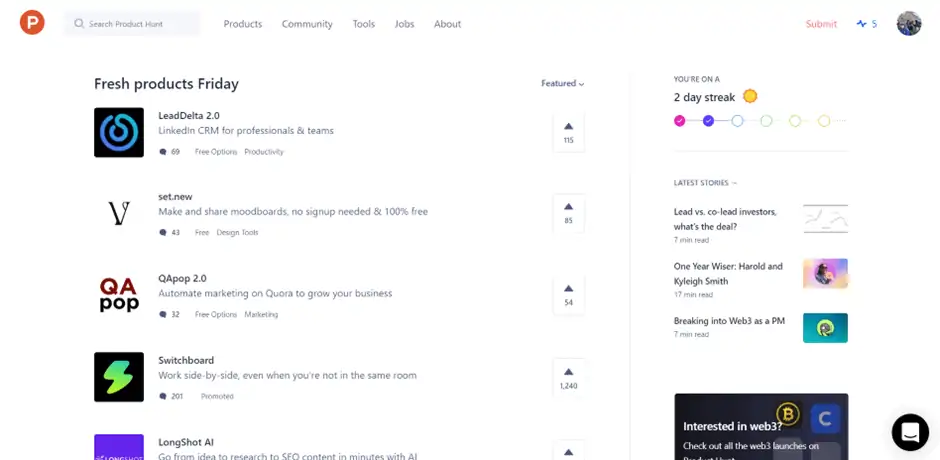
    Product Hunt

    Product Hunt

    Product Hunt is a product discovery platform focused majorly on technology offerings and SAAS. You’ll find several tech-oriented people willing to partner with you on your next venture as your tech cofounders.

    You can use their community section to connect with people, find answers, and find networking events to widen your existing network and find the perfect cofounder you were looking for.

    Startup Weekend

    Techstar’s Startup Weekend is a 54-hour event where developers, designers, marketers, product managers, and startup enthusiasts come together to share ideas, form teams, and launch startups.

    You can use their platform to find upcoming events in your city or even organise one yourself. These events are a great way to meet like-minded people, find a cofounder for your startup, and get feedback on your ideas.

    Founder Institute

    Founder Institute

    Founder Institute is a global startup accelerator that helps entrepreneurs launch their businesses with the help of experienced mentors, resources, and a structured curriculum.

    You can apply to their program to get access to their resources, network, and mentorship. The accelerator also hosts virtual cofounder networking events where you can find cofounders for your startup along with free mentorship sessions.

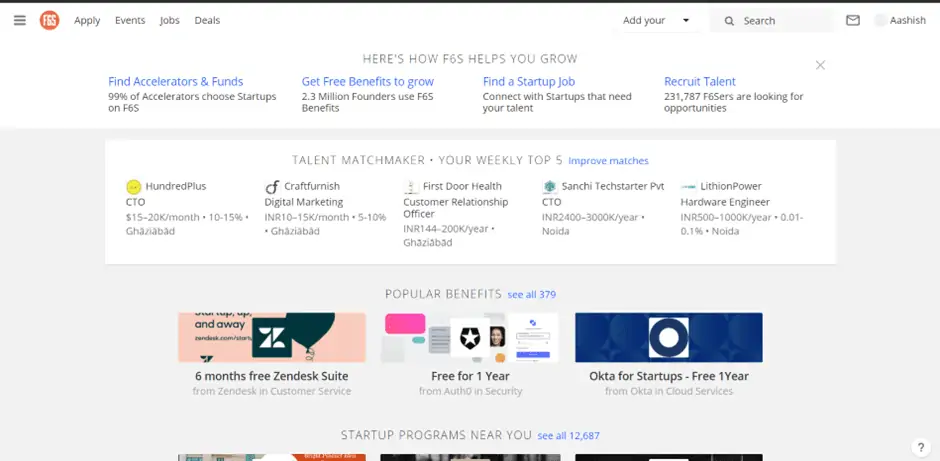
    F6S

    F6S

    F6S is a community of startup founders with over 1 million members. They offer resources such as free access to startup programs, deals, discounts, and networking events.

    You can use their platform to find cofounders for your startup by browsing through their member directory or attending one of their events.

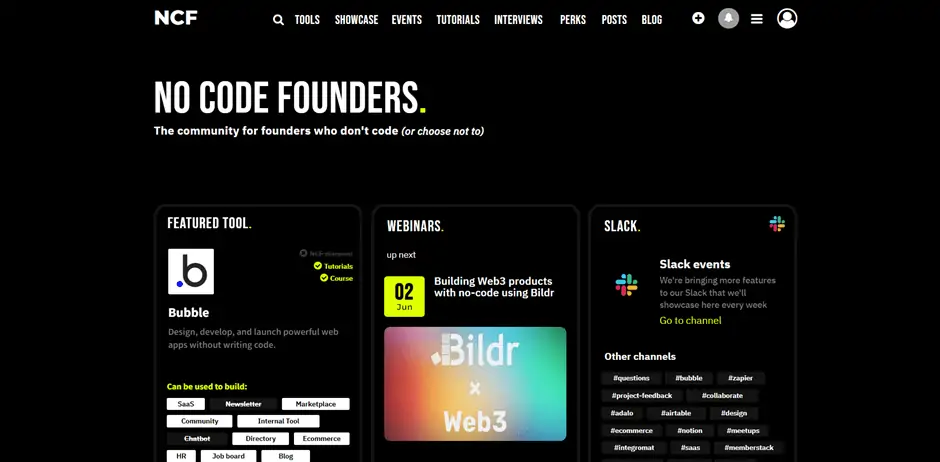
    No Code Founders

    No Code Founders

    No code founders is a premium Slack community of over 12,000+ founders who are building and launching successful companies without a single line of code.

    You can use their platform to connect with like-minded individuals, find collaborators, and get feedback on your ideas. They also have a directory of no-code tools with special offers that you can use to build your business.

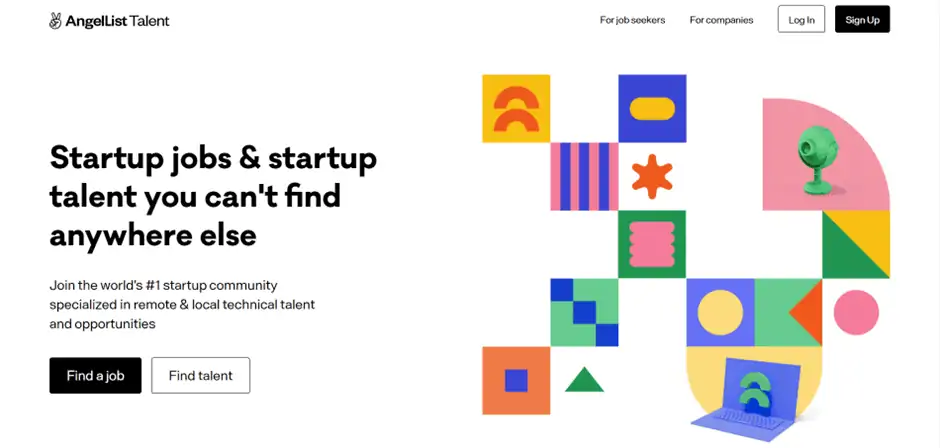
    Angel List

    Angel List

    Angel List boasts itself as the #1 startup community specialising in connecting startups with talent.

    You can use their platform to browse through startup jobs, find a cofounder for your startup, and get access to resources such as funding, advice, and mentorship.

    What sets this platform apart is:

    • The database of 8 million registered active users
    • Great UI that will help you find the apt cofounder in less than 10 minutes
    • A free applicant tracking system

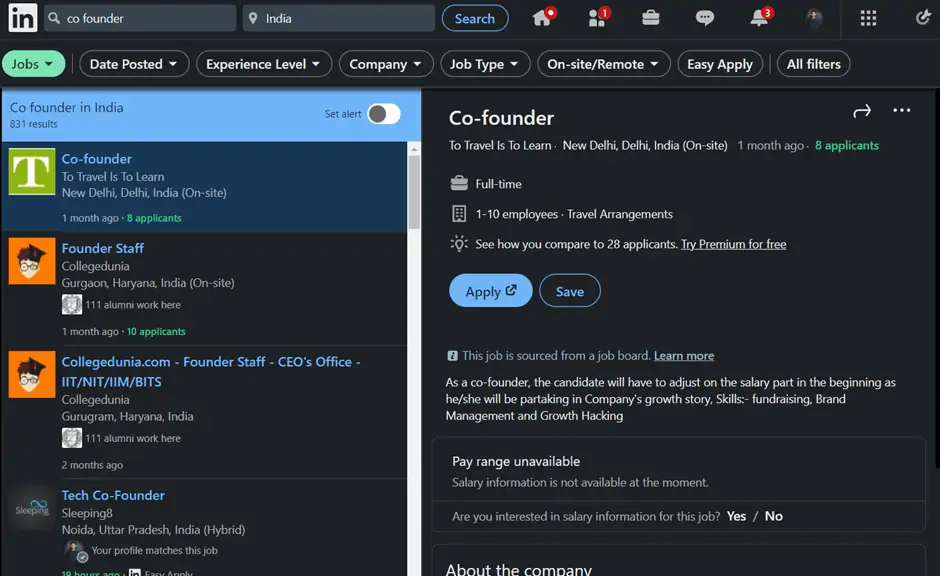
    Linkedin

    Linkedin

    Linkedin is the best platform for connecting with professionals from all walks of life. You can easily find people with the same interests and objectives as you and connect with them to discuss potential business opportunities.

    There are a number of ways you can use Linkedin to find a cofounder for your startup:

    • Browse through LinkedIn Groups: There are many groups on LinkedIn dedicated to startups and entrepreneurship. You can browse through these groups to find potential cofounders for your startup.
    • Connect with 2nd or 3rd degree connections: LinkedIn allows you to connect with people who are not in your immediate network. This is a great way to expand your network and find a cofounder for your startup.
    • Post a cofounder job: You can use LinkedIn’s job board to post a job listing for your startup. This is a great way to find qualified candidates for your cofounder position.
    • Use Linkedin premium: You can use Linkedin’s advanced search features to find potential cofounders with the specific skills and experience you are looking for.

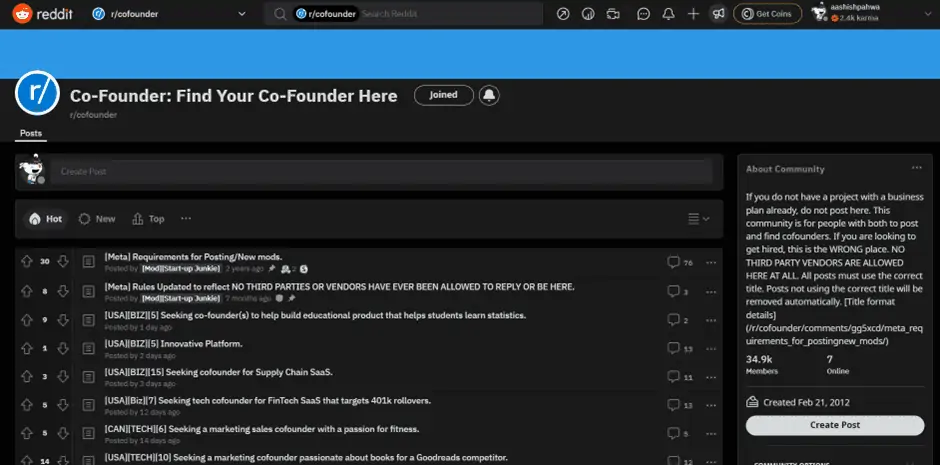
    Reddit

    Reddit

    Reddit is a community of several niche communities where you can find the perfect person to complement your skills. You can use this platform to:

    Moreover, several subreddits like r/cofounder and r/startups are great places to find potential cofounders for your startup. You can also use Reddit’s search feature to find other relevant subreddits where you can connect with potential cofounders.

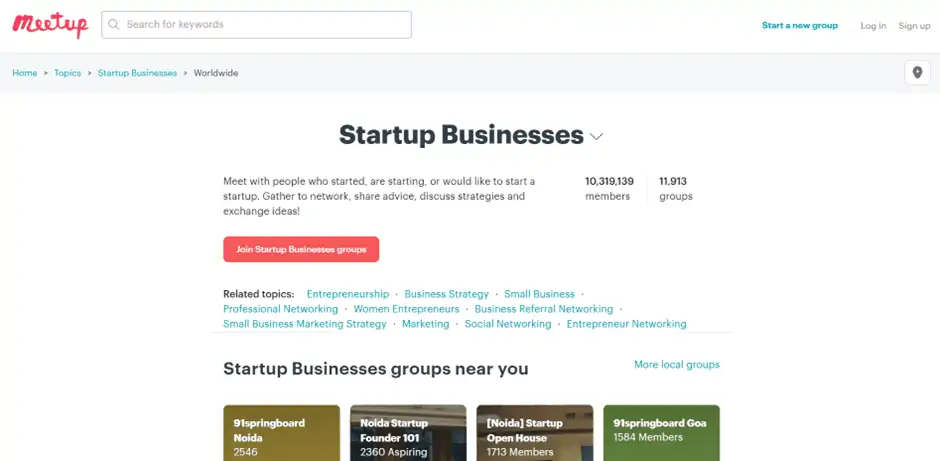
    Meetup

    Meetup

    Meetup.com is an event-listing platform that helps people with similar interests connect and meet in person.

    You can use their platform to find relevant startup or networking meetups in your area. This is a great way to meet potential cofounders for your startup and get feedback on your business idea.

    How To Evaluate A Prospective Cofounder?

    Finding some people who have skills that complement you in your startup journey is just the first step. And speaking out of the experience, it’s the easiest part.

    The difficult part is evaluating them to make sure they will actually be a good fit for your startup journey. Because, let’s face it, not everyone is cut out to be a cofounder.

    There are a number of factors you should consider when evaluating a prospective cofounder. But before you start looking for such factors, make sure you already know who you’re looking for – what skills do you lack and what core tasks would you want a helping hand in?

    Your first task should be to develop a job description of the cofounder you’re looking for. This isn’t a usual job description that you’d post on a job hunting site, but a list of skills you’d want to see in your prospective cofounder. Once done, evaluate the person.

    Look for:

    • Complementary skills: A good cofounder should have complementary skills to yours. This will help you build a well-rounded team with the necessary skills to succeed.
    • Complementary temperament: Your cofounder should also have a complementary temperament to yours. That is, if you tend to be more impulsive, your cofounder should be more level-headed. If you tend to be more risk-averse, your cofounder should be more willing to take risks.
    • A shared vision: Look for a cofounder who shares your vision for the company. This will help ensure that you are both working towards the same goal and help avoid disagreements down the road.
    • A compatible work style: Compatibility is key when it comes to working together. You should look for a cofounder whose work style is compatible with yours. For example, if you like to work during certain hours of the day, your cofounder should be someone who is also available to work during those hours.
    • Self-sufficient: Your cofounder should be someone who is self-sufficient and doesn’t need to be micromanaged. This will help you avoid any potential power struggles down the road.

    To evaluate your compatibility with a prospective cofounder, you can:

    • Have candid conversations: Have candid conversations with your prospective cofounder about your business idea, your vision for the company, and your expectations for the role of a cofounder. This will help you get to know them better and see if you are compatible.
    • Do a trial run: You can also do a trial run with your prospective cofounder to see how well you work together. This could involve working on a small project together or attending a few meetups together. If you find that you are compatible, then you can move forward with the relationship.

    The Way Forward

    If you’re serious about starting a company, ask yourself if you’re capable enough to do it all alone.

    If not, then you need to find a cofounder. And finding the right cofounder can be the difference between success and failure.

    The best cofounders are those who have complementary skills, temperaments, and visions to yours. They are also self-sufficient and have a compatible work style.

    Make sure to evaluate them carefully before moving forward. The last thing you want is to end up with a cofounder who isn’t a good fit for your company.

    Go On, Tell Us What You Think!

    Did we miss something? Come on! Tell us what you think of this article on where and how to find a cofounder in the comments section.
  • What Is Customer Development? Importance & Process

    What Is Customer Development? Importance & Process

    Unlike traditional businesses, startups don’t have the benefit of an existing customer base or market to rely on. They need to create their own market and customers from scratch, which can be a daunting and risky proposition.

    All this is because startups are typically trying to solve a problem that nobody has realised exists yet, or they’re offering a new solution to an existing problem that is much better than what’s currently available. In either case, there’s no guarantee that people will actually want or need what the startup is offering.

    This is where customer development comes in.

    What is Customer Development?

    Customer development is a formal methodology proposed by Steve Blank focused on helping startups comprehend the customer’s needs and build ideal products to meet their expectations. 

    This includes identifying and testing the assumption that there is a market for the product or service, validating the problem that the product or service is solving, and developing and refining the solution to meet the needs of the target customer base.

    The goal of customer development is to reduce the risk of failure by helping startups gain a deep understanding of their customers and the market they’re operating in.

    Importance Of Customer Development

    Customer development is part of the three-part Lean Startup methodology (business model design, customer development, agile engineering).

    It is a vital methodology to safeguard startups as they do not follow the same rules as traditional businesses. They have to validate their business model by testing it with customers and gathering feedback to improve their product or service.

    Customer development allows startups to:

    • Execute their ideas systematically by validating their assumptions about the problem and the solution early on.
    • Develop a deep understanding of who their customers are and what they need.
    • Get feedback from customers to inform product development.
    • Iterate quickly based on customer feedback to build a product that meets customer needs.
    • Reduce risks by making sure they’re solving a problem that people actually care about.
    • Avoid stagnation by continually testing and learning.

    History Of Customer Development

    Steve Blank came up with the concept of customer development when he was writing about his experiences as an entrepreneur in Silicon Valley in the 1990s. 

    He realised that startups are not just the smaller versions of big companies, but they actually have to follow different rules.

    This startup model lacked crucial data. The way to get this data was to speak to customers, something that Blank realised startups were not doing enough of.

    In his book The Four Steps to the Epiphany, he proposed the customer development model as a solution to this problem. The model, however, received much greater attention when Eric Ries popularised it in his book The Lean Startup.

    Startups have since adopted the Lean Startup methodology all over the world as a way to reduce the risk of failure.

    The Customer Development Process

    Customer development is a four-step-long process that startups use to understand their customers and the market better. These four steps are classified into two phases – search and execution

    Search: It is about understanding the problem that the startup is trying to solve and testing assumptions about the solution. After the problem-solution fit, the startup searches for the product-market fit. This phase comprises customer discovery and customer validation steps of the customer development process.

    Execution: This phase is about taking the product to market and scaling the business. In this phase, startups focus on building the product, launching it, and acquiring customers. This phase comprises customer creation and company-building steps of the customer development process.

    Let’s take a deep dive into each step of the customer development process:

    Step 1: Customer Discovery

    Customer discovery is where the startup founders map out all the assumptions about their product and convert them into falsifiable hypotheses. These hypotheses include assumptions about the problem, target market, and solution.

    This step also involves coming up with plans to test these hypotheses by talking to customers.

    The goal of customer discovery is to validate the problem that the startup is trying to solve and to find a fit between the solution and the problem. This is done by talking to potential customers, understanding their needs, and testing assumptions about the product.

    This step helps startups answer important questions such as:

    • Who are our target customers?
    • What is the problem that we’re trying to solve?
    • What are the existing solutions?
    • What do customers like or dislike about existing solutions?
    • What are our potential solutions?
    • What value proposition do our potential solutions offer? Does it align with the market needs?

    Step 2: Customer Validation

    Customer validation is where startups validate their hypotheses about the product-market fit. It involves finding the answer to the question:

    Whether the startup and its business model repeatable and scalable?

    This is done by launching an MVP and testing the business idea in the real market. If the MVP is successful, there is a product-market fit.

    The goal of customer validation is to validate the business model and to find a repeatable and scalable way to acquire customers. This step helps startups build a repeatable sales roadmap and a growth plan.

    Once validated, the startup can move on to the next step, customer creation.

    Step 3: Customer Creation

    Customer creation is where startups focus on acquiring long-term customers and scaling the business. In this phase, startups build the product, launch it, and acquire customers.

    The customer creation phase focuses on creating an end-user demand for the product.

    This is where different startups start using different marketing and sales strategies to acquire customers. It depends on the type of startup and the market.

    Step 4: Company Building

    The company building stage is where startups transition from their informal, learning, and search phase into a more formal, structured, and execution-focused phase. In this stage, startups focus on building the team, processes, and systems to scale the business.

    The goal of company building is to build a strong foundation for growth. This is done by putting the right people in the right roles, building business processes and systems, and raising money from the right investors.

    This is the final stage of the customer development process, and it sets the startup up for long-term success.

    Examples Of Customer Development

    Every successful startup goes through the customer development process. Let’s take a look at some examples:

    Airbnb

    Airbnb is a platform that allows people to find and book rooms from local hosts. The company was founded in 2008, and it has raised over $6 billion in funding.

    In the early days, the founders of Airbnb focused just on customer discovery. They started by renting out air mattresses in their apartment and quickly learned that people were willing to pay for a place to stay (problem-solution fit).

    They then moved on to customer validation and built an MVP (Airbedandbreakfast.com) of their platform. They launched it in San Francisco and acquired its first customers during the Industrial Design Conference.

    Once they validated their business model, they raised money from investors and focused on customer creation. They launched their platform in different cities and used various marketing and PR strategies to acquire customers.

    Today, Airbnb is a billion-dollar company with over 150 million users.

    Slack

    Slack is a messaging platform for teams. Founded in 2009, it has raised over $1.4 billion in funding.

    Slack was initially started as an internal tool for the founders’ previous company, Tiny Speck. This was the premise of their customer discovery. They quickly realised that the tool could be valuable for other companies as well.

    They then decided to focus on customer validation and built an MVP of Slack which they launched in 2013. The company acquired its first paying customers within a few months. In fact, by May 2013, the company already had 45 customer companies using Slack.

    Slack’s business model was such that the customers couldn’t leave the platform once they were using it (because all their data was stored on Slack), which meant customer validation was also customer creation.

    Once they validated their business model, the company raised money from investors and started to focus on customer creation. They launched their platform to the public in 2014 and became the fastest-growing startup ever.

    Today, Slack is a billion-dollar company with over 12 million daily active users.

    Benefits Of Customer Development

    Startups that go through the customer development process have a much higher chance of success than those that don’t.

    Some of the benefits of customer development include:

    • It helps startups mitigate risks: Customer development helps startups identify and reduce the risks associated with their business models.
    • It saves time and money: Startups can avoid wasting time and money on building something that no one wants by validating their business models early on.
    • It improves the chances of success: Startups that go through customer development are more likely to succeed than those that don’t.
    • It helps startups understand their customers better: Customer development helps startups understand their customers’ needs and pain points by interacting with them directly.

    Pitfalls Of Customer Development

    Despite the many benefits of customer development, there are also some potential pitfalls that startups should be aware of:

    • It can take a long time: The customer development process can take several months (or even years) to complete. This can be a problem for startups trying to get to the market quickly.
    • It can be expensive: Startups that want to do customer development properly need to be prepared to spend money on things like market research and customer surveys.
    • There can be a difference of opinion: The startup founders might not all agree on the best course of action to take during customer development. This can lead to disagreements and even conflict within the team.
    • The process is not always linear: The customer development process is often non-linear, so startups might have to go back and forth between different stages. This can be frustrating for founders who are used to working in a more linear way.

    Bottom-Line?

    The customer development approach has evolved businesses into a two-way street. It is not just about making a profit but also building and gaining the customer’s trust.

    If the relationship with the customer is strong, the company will see natural growth and success from its efforts.

    The actions and words of their current customers would act as advertisements and promotions for the company.

    So, does not it seem foolish to waste time and other resources creating products and then introducing them into the market to test whether they would sell?

    It is wiser to test the ideas with the people who would use them first and then build the product.

    Go On, Tell Us What You Think!

    Did we miss something? Come on! Tell us what you think of this article on customer development in the comments section.
  • What Is Content Writing? – Types, Importance, & Examples

    What Is Content Writing? – Types, Importance, & Examples

    Today, content is found in almost every aspect of modern life. People consume content through books, magazines, newspapers, blogs, websites, and even social media. In fact, an average person spends around 7 hours consuming online content, thanks to the internet.

    With so much content being consumed daily, it’s no wonder that businesses are increasingly looking for talented writers to create content for their products, services, and websites.

    This skill is in high demand, but what exactly is content writing? What all does it constitute? What does a content writer do?

    Here’s a guide with a comprehensive overview of content writing, including its types, importance, and examples.

    What is Content Writing?

    Content writing is the creative process of generating content through careful planning and research, writing, and editing that is then published on online platforms with an aim to attract, engage, and retain readers.

    This content writing definition can be simplified by breaking it into three key phrases:

    • The creative process of generating content: Content writing involves creative thinking and a flair for writing. It’s not just about regurgitating information but about presenting it in an engaging and interesting manner.
    • Careful planning, research, writing and editing: Any good piece of writing, be it an article, blog post, or even a social media update, requires careful planning, research, and editing. Without these elements, the content will likely be uninformative or poorly written.
      So, brainstorming content ideas before writing any piece of content is essential. Using a content idea generator is one of the best ways to explore unique content ideas.
    • Aiming to attract, engage, and retain readers: The ultimate goal of content writing is to reach and resonate with the target audience.

    No matter what the form, all content must aim to serve a purpose, be it providing information, educating the reader, or entertaining them.

    That’s where a content writer comes in – to create content that is not only compelling but also relevant and targeted to the right audience.

    Who Is A Content Writer?

    A content writer is a professional writer who specialises in creating content for various online platforms.

    This content can take the form of articles, blog posts, social media updates, web page content, product descriptions, or even marketing collateral.

    The content writer can wear the hat of a copywriter, ghostwriter, SEO specialist, or even a social media manager – all depending on the type of content they’re creating.

    However, their ultimate goal remains the same – to create compelling, relevant, and engaging content.

    Types Of Content Writing

    While most people think of content writing as one homogenous entity, the reality is that there are different types of content writing, each with its own distinct style, purpose, and audience.

    Some of the most popular types of content writing include:

    • Article Writing: Articles are usually informative pieces that are longer in length and provide detailed information on a particular topic. They are often published on digital publications or niche-oriented websites like Forbes, Huffington Post, and other such sites. Writing an article requires the content writer to have good SEO knowledge so as to ensure that the article ranks high on SERP.
    • Copywriting: Copywriting is a type of content writing that aims to sell an offering or fulfil a marketing goal. It’s usually short, persuasive, and to-the-point. Copywriters use various techniques like powerful headlines, call-to-actions, and even emotional triggers to get the reader to take the desired action. Content pieces that fit into this type include landing pages, social media marketing content, and even ads.
    • Press Releases: Press releases are official statements that are sent out to the media with an aim to generate press coverage for a particular product, service, event, or even an individual. Press releases are well-written and newsworthy with an aim to increase the chances of them being picked up by reporters and journalists.
    • Technical Writing: Technical writing is a type of content writing that focuses on providing information about technical subjects and products. This type of content is usually lengthy, detailed, and full of industry-specific jargon. It’s aimed at those who already have some knowledge about the subject and are looking for more in-depth information. Technical writing can be in the form of user manuals, installation guides, FAQs, and more.
    • Long-Form Content: Ebooks, case studies, whitepapers, and even research reports fall under the category of long-form content. These pieces are usually in-depth and provide detailed information on a particular subject. They are meant to be informative and as such, use formal language. These are usually used by businesses as lead magnets or even gated content to capture leads.
    • Content scriptwriting: This type of content writing is used for creating content for videos, podcasts, or even infographics. Such content is usually short, sweet, and to-the-point with an aim to communicate the message as little time as possible.
    • Professional writing: Professional writing is a type of content writing that involves interactions through professional communication channels such as business emails, memos, letters, and more. The style of writing is usually formal and covers a wide range of topics such as business proposals, marketing plans, employee communications, and more.

    Importance Of Content Writing

    With the boom of the internet and other internet-related industries, content has taken tremendous importance. Producing new and relevant content has become necessary to survive and stand out in the competitive market today.

    Content writing is considered a necessary skill, as it is vital for a business to build and acquire customers. The following points elaborate on the importance of content writing in today’s business scenario:

    • Essential For SEO: In order to rank high on SERP, businesses need to ensure that their website contains quality and relevant content. This is because Google and other such search engines use algorithms that consider various factors like keyword density, content length, and more to determine the ranking of a website.
    • Key Lead Generation Tool: Quality content is an essential lead generation tool. By producing helpful and informative content, businesses can attract their target audience to their website and convert them into leads.
    • Builds Credibility: In order for customers to trust a business, they need to see that the business is an expert in its field. This can be achieved by producing quality content that is relevant to the business and its products or services.
    • Customer Retention: Customer retention is as important as acquiring new customers. Once a customer has been acquired, it is important to keep them engaged with the business. Good content writing skill is essential to produce various forms of content like email newsletters, blogs, etc., which can keep the customers coming back for more.

    Content Writing Skills

    Content writing is a skill that can be learned and perfected with practice.

    However, there are certain inherent qualities that all content writers must possess:

    • Writing and communication skills: The ability to communicate clearly and concisely is crucial for a content writer. They must be able to understand the requirements of the project and express their thoughts in a well-written and structured manner that is free from grammatical and spelling errors.
    • Creativity: Creative thinking is essential for content writing as it helps to come up with new and interesting ideas that will engage the reader.
    • Attention to detail: Good attention to detail ensures that all information is accurately represented in the final piece of content.
    • Research skills: Researching and gaining information on the topic is vital to present in an understandable manner to the readers. The writers must also be aware of the latest trends in their area of expertise to produce relevant content.
    • Time management: Writers need to be consistent and work within deadlines to publish content on a regular basis. They need to be fluent in prioritisation and time management to complete the project on time.
    • Technical skills: Some forms of content writing may require the writer to have basic SEO and algorithm knowledge. They must also possess computer-operating proficiency to use different content management systems and content writing tools.

    Content Writing Examples

    Content writing can take many different forms. The following are some examples of content writing:

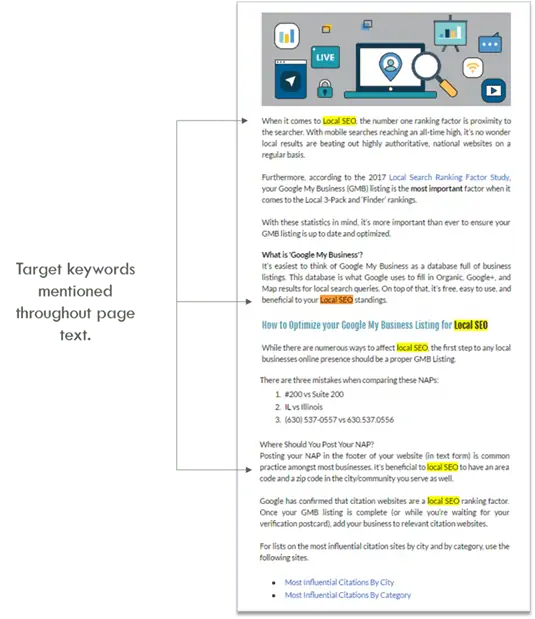
    SEO Writing

    SEO content writing article example

    SEO writing is a type of content writing that focuses on creating content that is optimised for search engines. This involves the use of relevant keywords and phrases that help to improve the visibility of the website on SERP.

    The above example is a very basic explanation of how an SEO writer uses targeted keywords to improve the ranking of a website. However, SEO writing is not just about using the right keywords. It also involves creating quality content that is relevant to the business and its products or services.

    Copywriting

    copywriting example

    Copywriting is all about using the right words to persuade the reader to take a particular action. The aim is to create content that is so compelling that it convinces the reader to head in the desired direction that fulfils the brand’s marketing objectives.

    The above copywriting example is a marketing campaign launched by the popular dating site OkCupid with an aim to make the readers try the application.

    Press Release

    Press releases focus on developing newsworthy content that can be used by media outlets to generate publicity. The content must be well-written and structured in a way that is easy for the media to pick up and use.

    The following is an example of a press release written to answer all the relevant questions about the new head of the CITI solutions centre.

    press release example

    Product Description

    product description example

    Product descriptions aim to provide the reader with all the necessary information about the product so that they can make an informed purchase decision.

    It includes features, benefits, specs, and anything else that would be useful for the customer. The language is used tactically to persuade the reader to buy the product.

    The image above is an example of a product description of a toy robot. It provides all the necessary features and information about the robot in a short and concise format and relies on pictures to convey the information.

    Go On, Tell Us What You Think!

    Did we miss something? Come on! Tell us what you think of this article on what is content writing in the comments section.
  • What Is CPC? Cost Per Click Explained

    What Is CPC? Cost Per Click Explained

    Digital marketing is a broad term that refers to the various ways businesses can promote themselves online. One of the most common and effective digital marketing strategies is pay-per-click (PPC) advertising.

    PPC is a type of advertising where businesses pay a fee every time their ad is clicked. This cost is calculated by a metric called cost-per-click (CPC). In other words, CPC is the price businesses pay for each click on their ad.

    So, what is CPC in marketing, how does it work, and how is it different from CPM and CPA?

    What Is CPC?

    Cost per click (CPC) is a digital advertising pricing model in which businesses pay a fee for each click on their ad.

    The CPC model is commonly used in search engine advertising, display advertising, and social media advertising, where businesses only pay when their ad is clicked.

    For example, let’s say a business runs a website that sells shoes. It decides to use Google Ads to promote its website and bid on the keyword “canvas shoes.

    When someone searches for “canvas shoes” on Google, its ad may appear on the results page. The ad may get thousands of impressions, but only when the searcher clicks on the ad, the business will have to pay the CPC for that keyword.

    CPC Formula

    Calculating cost per click is simple. One just needs to divide the total cost of their campaign by the number of clicks it received.

    For example, if a business spent $100 on its Google Ads campaign and received 1,000 clicks, its CPC would be $0.10.

    CPC = Total Cost of Campaign / Number of Clicks

    How Does CPC Work?

    In a usual scenario, several advertisers bid on the same keyword. The CPC for a particular keyword is determined by the advertiser who is willing to pay the highest amount per click.

    The CPC also depends on the quality score of an ad. Different ad platforms have different quality score criteria, but the higher the quality score, the lower the CPC will be.

    From a campaign perspective, the advertiser is charged every time someone clicks on their ad. This advertiser either fixes the cost per click rate or allows the platform to automatically adjust it in order to get more clicks (within its budget).

    The number of impressions an ad gets doesn’t affect the cost per click as it does in a CPM campaign. An ad can get a large number of impressions but the advertiser will only be charged when someone clicks on it.

    There are some related terms that a user may come across while launching a PPC campaign. These are:

    • Maximum cost per click: The highest amount an advertiser is willing to pay for a particular keyword. This doesn’t mean that the advertiser will be charged this amount every time their ad is clicked. It just serves as a limit for the CPC.
    • Manual cost per click bidding: In this type of bidding, the advertiser sets a maximum CPC for each keyword. This means that they will never be charged more than their maximum CPC.
    • Automatic cost per click bidding: Also called enhanced cost per click bidding, here the ad platform uses advanced algorithms to optimise the advertiser’s campaign for better results automatically.
    • Click-through rate (CTR): The number of times an ad is clicked divided by the number of times it’s shown (impressions). CTR helps advertisers track the effectiveness of their ad campaigns.

    CPC vs CPM vs CPA

    Often, CPC is confused with two other digital advertising pricing models – cost per thousand impressions (CPM) and cost per action (CPA).

    In a CPM campaign, businesses are charged a fee for every 1,000 times their ad is shown, regardless of whether it’s clicked or not.

    A CPA campaign, on the other hand, charges businesses only when the desired action is taken by the user, such as making a purchase or signing up for a newsletter. It’s a subset of performance marketing.

    CPC is different from both CPM and CPA in that businesses are only charged when their ad is clicked.

    For example, if a business runs a CPC campaign on Google Ads and its ad is shown 1,000 times but only receives 10 clicks and one sale, the business will only be charged for those 10 clicks.

    Advantages Of CPC

    There are several advantages of using a CPC pricing model for digital advertising, including:

    • Fairness: businesses are only charged when their ad is clicked, so they don’t have to worry about paying for impressions or other actions that may not lead to conversions.
    • Transparency: businesses know exactly how much they will be charged for each click on their ad, so there are no hidden fees.
    • Flexibility: businesses can set their own CPC rate or allow the platform to automatically adjust it based on their budget and other factors.
    • Manageability: businesses can easily control their spending by setting a daily or total budget for their CPC campaign.

    Disadvantages Of CPC

    There are also some disadvantages of using a CPC pricing model, including:

    • High competition: businesses may have to pay a high CPC rate for popular keywords that are being bid on by many other advertisers.
    • Low-quality score: businesses may have to pay a high CPC rate if their ad has a low-quality score.
    • Click fraud: businesses may be charged for fake clicks on their ads, which can be difficult to detect and prevent.

    Factors Affecting CPC

    CPC can be affected by a number of factors, including:

    • Popularity of the keyword: more popular keywords tends to have higher CPCs.
    • Quality score of the ad: ads with a higher quality score tend to have lower CPCs.
    • Type of device: ads on mobile devices tend to have lower CPCs than ads on desktop devices.
    • Type of ad: text ads tend to have lower CPCs than image or video ads.
    • Location of the user: users in developed countries tend to have higher CPCs than users in developing countries.

    Besides these factors, the CPC for a particular keyword can also be affected by the overall budget of the campaign and the maximum CPC bids set by the businesses.

    Bottom-Line?

    CPC is among the most popular online advertising pricing models as it allows businesses to control their spending and only pay when their ad is clicked.

    Brands use PPC campaigns mostly for the middle of the funnel and bottom of the funnel marketing goals like lead generation and product sales. However, these campaigns don’t suit top of the funnel marketing goals like brand awareness.

    Digital advertisers should keep in mind the various factors that can affect CPC when planning their campaigns. By understanding how CPC works, businesses can better control their ad spending and achieve their desired results.

    Go On, Tell Us What You Think!

    Did we miss something? Come on! Tell us what you think about our article on cost per click (CPC) in the comments section.

  • What Is CPM? Cost Per Thousand Impressions Explained

    What Is CPM? Cost Per Thousand Impressions Explained

    Advertising on the internet can be confusing. There are so many acronyms and abbreviations that it’s difficult to keep track of all of them. One of those is CPM, which stands for cost per mille or cost per thousand impressions.

    As an advertiser, one must be aware of all the types of online advertising in order to make an informed decision on which will work best for the company.

    So, what is CPM in marketing, how does it work, and how is it different from CPC and CPA?

    What Is CPM?

    Cost per mille (CPM), also referred to as cost per thousand impressions, is a digital advertisement pricing model where advertisers pay a certain amount for every 1,000 times their ad is displayed.

    So, if an advertiser pays $2 CPM, that means they pay $2 for every 1,000 impressions.

    In digital marketing, an impression is the single instance of an ad being displayed. It does not matter whether or not the user takes any action, such as clicking on the ad.

    Different internet companies use different methods to calculate impressions. For example, Facebook measures an ad impression when an ad enters the screen. For Google, an impression is counted every time an ad is loaded on the page, irrespective of whether the user scrolls to see it or not.

    CPM Formula

    Calculating cost per thousand impressions is pretty straightforward. All one has to do is take the total cost of the ad campaign and divide it by the number of impressions in thousands.

    CPM = Total Cost of Ad Campaign / Number of Impressions (in Thousands)

    For example, if an advertiser spends $500 on their ad campaign and their ad is displayed 100,000 times, their CPM would be $5.

    $500 (total cost) / 100 (100,000 impressions in thousands) = $5 CPM

    How Does CPM Work?

    CPM works by charging the advertiser for every 1,000 impressions their ad receives. The price of each CPM will differ based on a variety of factors, including the size of the ad, the placement of the ad, the type of website the ad is placed on, and the demographics of the website’s visitors.

    For example, a large banner ad placed on a popular website with a lot of traffic will cost more per 1,000 impressions than a small sidebar ad on a less popular website. This is because the former has a higher chance of being seen by users than the latter.

    One thing to note here is that impressions are different from page views. A page view is a single instance of a web page being loaded on a user’s browser. An impression, on the other hand, is a single instance of an ad being loaded on a web page.

    This means that one page view can generate multiple impressions for a campaign if there are multiple ads on the page. Likewise, one ad can generate multiple impressions if it’s displayed on multiple pages.

    But this system isn’t perfect. Advertisers can never be 100% sure that a human actually saw their ad. To solve this issue, several ad networks came up with the concept of VCPM or viewable CPM.

    In viewable CPM, advertisers are only charged when a user actually sees their ad. A viewed ad means that at least 50% of the ad is loaded on the page and is visible to the user for at least 1 second.

    CPM Bidding

    Ad networks work like auction houses, where advertisers bid against each other for ad space. The advertiser willing to pay the highest price for an ad spot gets their ad displayed on the website.

    CPM bidding is the process of setting a price for 1,000 impressions on an ad spot. Advertisers can either set a fixed CPM or they can let the ad network decide the CPM based on their budget.

    CPM vs CPC vs CPA

    CPM is often confused with CPC and CPA. However, these are three different pricing models.

    CPC stands for cost per click. This is a digital pricing model in which the advertiser pays each time a user clicks on their ad.

    CPA is short for cost per acquisition or cost per action. This is a pricing model in which the advertiser pays only when a user takes a desired action, such as making a purchase or signing up for a newsletter.

    For example, if an advertiser sets a $2 CPM, $5 CPC, and $20 CPA rates, they will pay $2 for every 1,000 impressions, $5 for every time a user clicks on their ad, and $20 only when a user makes a purchase.

    CPM is a popular pricing model for brand awareness campaigns as this pricing model helps them maximise their reach among the display advertising network. CPC is more conversion-rate-oriented and helps advertisers get more leads and conversions in their mid-funnel campaigns. CPA is a performance marketing metric and is mostly used by ecommerce companies to drive sales or launch bottom-of-the-funnel campaigns.

    Advantages Of CPM Advertising

    CPM advertising has a number of advantages, which is why it’s so popular among advertisers.

    • High reach: CPM campaigns have the potential to reach a large number of people as clicks or conversions do not limit them. This makes CPM ideal for brand awareness and top-of-the-funnel campaigns.
    • Predictable costs: With CPM advertising, advertisers know exactly how much they will be spending on their campaigns. This makes it easier to budget for and manage ad spending.
    • Flexible pricing: CPM rates can be negotiated depending on the placement of the ad, the type of website, and the demographics of the website’s visitors. This makes CPM a more flexible pricing model.

    Disadvantages Of CPM Advertising

    CPM advertising also has a few disadvantages.

    • Low engagement: Since CPM campaigns are not limited by clicks or conversions, they often have lower engagement rates than CPC or CPA campaigns. This can make it difficult to measure the success of CPM campaigns.
    • Inefficient spend: CPM campaigns can be inefficient as advertisers may end up paying for impressions that never get seen by users. This is because ads can be placed on websites with low traffic or below the fold where they are less likely to be seen.

    Factors Affecting CPM

    Several factors can affect the cost of CPM advertising. These include-

    • Advertisement size: The size of the ad can affect the CPM rate. Larger ads, such as full-page or half-page ads, usually have higher CPM rates.
    • Advertisement format: The format of the ad also affects the CPM rate. For example, video ads usually have higher CPM rates than static image ads.
    • Ad placement: The placement of the ad on the website can also affect the CPM rate. Ads that are placed above the fold or in high-traffic areas usually have higher CPM rates.
    • Website traffic: The amount of traffic a website receives can also affect the CPM rate. Websites with more traffic usually have higher CPM rates.
    • Website demographics: The demographics of the website’s visitors can also affect the CPM rate. For example, websites with a high percentage of female visitors usually have higher CPM rates for ads targeting women.

    Bottom-Line?

    CPM is a popular pricing model for online advertising. It’s a cost-effective way to reach a large audience and can be used for both brand awareness and top-of-the-funnel campaigns. However, CPM campaigns can be inefficient as they may generate many impressions that users never get seen.

    So an advertiser needs to carefully consider whether CPM is the right pricing model for their campaigns. If they’re looking for more engagement and conversions, CPC or CPA may be better options.

    Go On, Tell Us What You Think!

    Did we miss something?  Come on! Tell us what you think about our article on CPM advertising in the comments section.

  • How to Avoid Time Theft in Remote Teams: Complete Guide

    How to Avoid Time Theft in Remote Teams: Complete Guide

    Remote work is not new, but for many organisations, the pandemic was their first time implementing this style of work. It seemed challenging at first, but for those who got it right, it brought tremendous benefits.

    Of course, working from home has its drawbacks. Distractions and interruptions are everywhere, and this affects productivity. But one of the biggest challenges to optimising employee time continues to be time theft.

    Consider this: The average employee steals approximately 4.5 hours per week from their employer, according to a Forbes article. This accumulates to around six full workweeks every year. In terms of cost, a whopping $400 billion annually is lost in productivity.

    What Is Time Theft?

    Employee time theft is when an employee is paid for the time they didn’t spend working. The employee could be engaging in personal activities but intentionally misleads their employer about how they spend their time. In other cases, the employee could be doing nothing at all, but still receives payment for their time.

    For office workers, it’s easier for the employer to notice, and even monitor, time theft. If a worker takes a longer lunch break or is making rounds of socialising rather than working at their desks, it is highly visible.

    When managing a remote team, it’s far more difficult to monitor time theft since employees are invisible. You can’t really tell if the employee is watching their favourite show or scrolling through social media on their phones.

    Most employers pay their workers based on the number of hours they spend working. When employees steal time, it means the company spends money it wasn’t supposed to. This could have serious consequences on productivity and the company’s overall performance.

    Examples of Employee Time Theft

    Employee time theft can happen in so many ways, and sometimes it’s not that obvious. Below, we list some of the common ways employees claim wages without earning them:

    • Taking longer than necessary breaks. The U.S. Department of Labor lists the laws pertaining to lunch and break for each state. It’s healthy and even productive for workers to take breaks throughout the workday. But when an employee spends more time than the stipulated break period, it becomes time theft.
    • Buddy punching. This is common among office workers, where an employee asks their buddies to fill in timesheets on their behalf.
    • Socialising during work. Light socialising between breaks or after meetings isn’t a bad thing, and might actually help your teams build relationships. It stops being productive the moment the light conversation goes on for the next 30 minutes. Unless, of course,  the business requires socialising with clients to help build trust and rapport to help win their loyalty.
    • Timesheet fraud. This happens when an employee alters or forges timesheets to get paid for extra hours. While this might happen unintentionally, especially with manual timesheets, which are prone to errors, it can be quite costly for employers. Take an example of a team member who clocks into work late and clocks out too early. Starting work at 8.05 am instead of 8.00 am or clocking out at 5.50 pm instead of 6 pm might not seem like much. But these round-ups and down can add up to a huge chunk of hours over time.
    • Clocking unauthorised overtime. The Fair Labor Standards Act requires that you pay overtime for hours worked over 40 per workweek. What if an employee works more than 40 hours per week, despite clearly asking them to stop at 40 hours? Unfortunately, you may still be required to pay anyway. For a repeat offender who refuses to comply, termination might be your best course of action.

    How To Stop Time Theft

    Time theft is a common remote work challenge that a lot of business owners or managers are trying to curb. If you’re one of them, this guide shares the best strategies to stop time theft.

    Develop Clear Time and Attendance Policies

    A company with clear timekeeping policies has a better chance of eliminating employee time theft. If you don’t have a policy in place, it’s not too late to establish one now. Your time and attendance policies should be clear on:

    • Procedures for clocking in and out
    • Break times
    • Overtime rules
    • Personal use of the internet and technology
    • Acceptable socialising during company time
    • What counts and doesn’t count as time theft

    Your policy should also outline:

    • How time theft can hurt the business and coworkers
    • The consequences of time theft
    • Attendance and time tracking methods you plan to use
    • How employees can protect themselves from falling into bad habits

    Defining clearly what you expect from employees eliminates any gaps that may result in legal action in case of wrongful termination. It also helps your virtual team understand what’s right and wrong.

    Be sure to give employees a chance to ask questions and provide feedback to address any issues. Get these rules in writing and make them accessible to all employees. Cloud services like Google Drive and OneDrive make it easy to share the policies with employees no matter their location.

    Implement Time Tracking Software

    An effective way to eliminate employee time theft is through technology. Modern time tracking solutions offer features that make it easy to tell if someone is at their computer or in a meeting. You can even see their exact location if they work out in the field.

    Most of them are automated, meaning you don’t have to spend time manually entering data or correcting errors. These tools accurately log hours spent on each project or task, and even indicate how the time was spent.

    For example, you can see all the apps and websites the employee accessed during work hours. If you discover an excessive amount of time spent on social media and other non-work-related staff, you can address the issue before it blows over.

    Using clock in clock out apps also solves the mystery of employee attendance since they capture computer activity, which employees can’t cheat. Most importantly, these tools provide you with crucial data that can help you learn a lot about your employees and the business.

    An effective time tracking solution offers payroll features, so you can access accurate, automated timesheets and create invoices directly from the platform.

    Look Out for Signs of Disengagement

    For the most part, when employees are committing time fraud or are struggling with work, there are always telltale signs. For example, if the employee delays responding to a work email or fail to answer calls, it might seem suspicious.

    But this isn’t proof enough of time theft. If the worker constantly sends in assignments late or is notably unavailable compared to coworkers, it could be a sign of disengagement.

    Mistakes happen, but when they are repeated, you can start investigating the matter.

    Additionally, working in isolation can lead to disengagement, which can result in employees committing time fraud. Managers should remind their remote workers of the overall company goals and mission, as well as their personal goals.

    They should also support them through the challenges and help them focus on work. Don’t forget to reward excellent work. A simple shout-out via the team’s official communication channel can do wonders for an employee’s morale.

    Check-In Regularly

    Knowing what’s going on with your employees can help you understand how they are feeling. Your remote workers may be juggling several responsibilities at home with work. They could be stressed about finances, or they could be burned out.

    By checking on them, you get the chance to listen to their concerns and learn about their wellbeing. Asking about their days also reminds them that they are not alone, given that remote workers struggle with feeling lonely and isolated.

    Be Flexible and Understanding

    The typical 9-5 schedule may not be ideal when employees are working remotely. Offering them flexible hours can help reduce cases of time theft since they’ll have time to go to appointments, take care of their children and pets, and run errands.

    A recent survey published by PR Newswire shows that 80 percent of workers would prefer a job that offers a flexible work schedule over one that didn’t, for good reason. Scientific research proves that flexible working hours contribute to the health and wellbeing of employees.

    Allowing employees to customise their schedules to some extent can reduce wasted work time and improve productivity.

    Follow Through with Disciplinary Actions

    You must show that you take the time theft offence seriously by disciplining offenders as per the disciplinary measures outlined in the time and attendance policy. Generally, this could include verbal warning, written warning, suspension, and termination.

    For example, if one of the rules for manipulating timesheets is pay cut, be sure to cut one day’s salary from the offender’s salary. This way, not only will other workers take the time theft policy more seriously, it will lower cases of time fraud in the company.

    The Bottom Line

    Knowing the facts about time theft will help you take the right steps toward eliminating it from your organisation. In everything you do, make sure you maintain an open line of communication. This way, employees will know you’re approachable and willing to listen to their concerns.

    Most importantly, develop remote work policies that clearly outline employees’ expectations, including timekeeping and warnings about time theft and its repercussions.

    Go On, Tell Us What You Think!

    Did we miss something?  Come on! Tell us what you think about our article on managing time theft in the comments section.

  • What Is Problem-Solution Fit? How To Achieve It?

    What Is Problem-Solution Fit? How To Achieve It?

    So you have a great idea for a new business. You’re excited to get started and make your mark on the world. But before you do anything, it’s important to make sure that there is a demand for your offering in the market.

    The least glamorous but most important part of starting a successful business is determining whether your idea actually solves a real problem for people. This process is known as finding a problem-solution fit.

    Here’s a guide explaining what problem-solution fit means, why it’s so important to the success of your new business, and how to achieve it.

    What Is Problem-Solution Fit?

    Problem-solution fit is a term used to describe the point validating that the base problem resulting in a business idea really exists and the proposed solution actually solves that problem.

    The problem-solution fit is when you-

    • Validate that the problem exists: When you validate your problem hypothesis using real-world data and feedback. That is, you gather information from real users to determine whether or not they care about the pain point you’re trying to solve.
    • Validate that your solution solves the problem: When you validate that the target audience appreciates the value your solution delivers to them.

    The problem-solution fit precedes the product development and forms the foundation upon which a company is built. It helps you answer the basics startup-related questions before you even start your startup.

    • Do people actually have the problem that you think they have?
    • How do they solve the problem now?
    • Does your proposed solution make a meaningful difference?

    Once you’re satisfied with the answers, you use this solution to develop a saleable product and start acquiring customers.

    Why Achieving A Problem Solution Fit Important?

    Achieving problem-solution fit is essential to the success of any new business.

    Why?

    Because without it, you’re essentially just guessing that your idea is going to work. And if you want to be successful, you need more than just a guess.

    The problem solution fits help you-

    • Get a better understanding of your target market: It helps you identify your target customers, who they are and what matters to them the most.
    • Get a better understanding of the customer tasks and pain points: Only after getting into the shoes of the customers do you realise their real tasks and the problems that hinder their progress in completing the tasks.
    • Get a better understanding of existing solutions and what they lack: It helps you understand what gaps exist in the market and how your business can fill those gaps.
    • Build a solution based on real data: It gives you the information you need to build a solution that users actually want, rather than guessing their needs.

    When Should You Look For A Problem-Solution Fit?

    Ideally, you want to achieve a problem-solution fit before you start working on your product. This way, you can be confident that you’re solving a real problem that people actually care about. Otherwise, you risk building something that no one wants or needs.

    This problem-solution fit forms the basis for your entire business. From your product development to your marketing and sales efforts, everything should be focused on solving the problem that you’ve identified.

    How To Achieve Problem-Solution Fit?

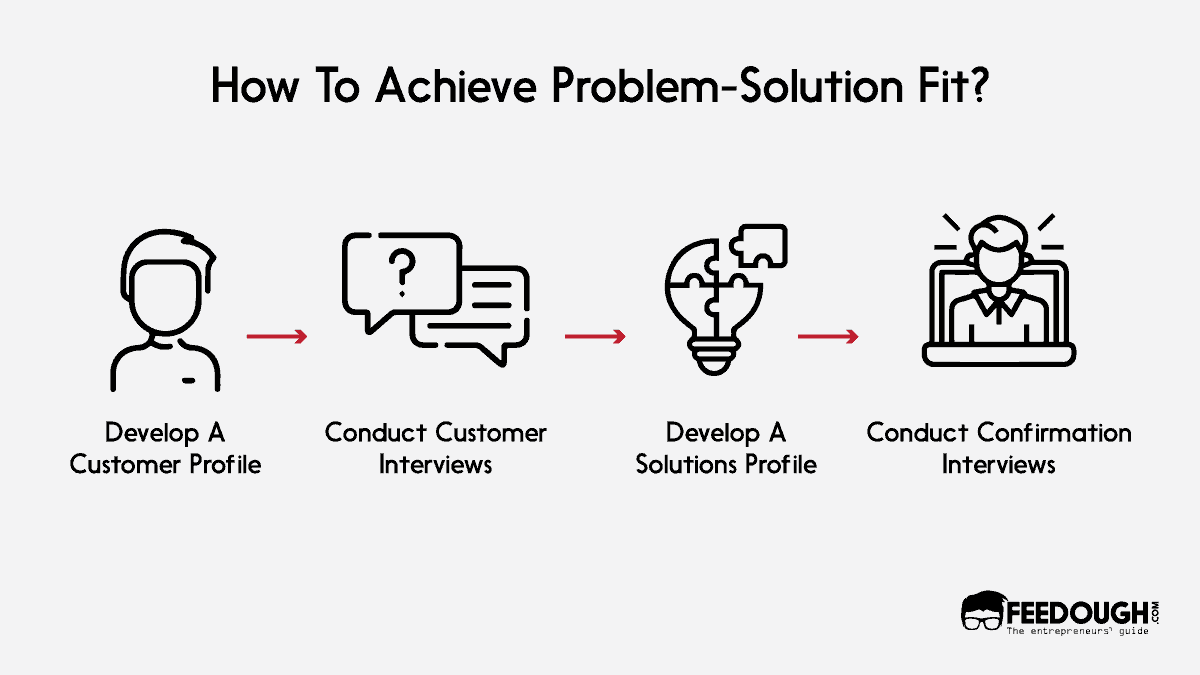
    problem-solution fit process

    The key to achieving a problem-solution fit lies in identifying the right people to talk to, gathering data from them, and then analysing the results.

    This is easier said than done, of course. But this can be done by following two simple steps –

    Develop A Customer Profile

    The customer profile section helps you to understand your target audience in greater detail. This process will give you answers to the most important customer-related questions that will take you closer to your offering –

    • Who are they? (Persona)
    • What jobs do they need to get done? (Jobs-to-be-done)
    • What problems do they face while doing the job? (Pain points)
    • What do they gain by completing the job? (Desired Outcomes)

    The Customer Persona

    The customer persona is a semi-fictional representation of your ideal customer based on market research and real data about your existing customers.

    Creating a customer persona helps you understand your target audience better. It includes information like –

    • Demographics: Age, gender, location, education, job title
    • Psychographics: Lifestyle, values, interests, attitudes
    • Behavioural patterns: Buying habits, online behaviour, communication preferences

    The Job-To-Be-Done

    Consider your customer’s job-to-be-done as the reason why they need your solution.

    For example, imagine that your target customer is a busy professional who wants to increase their productivity. This “job” might include managing their email, calendars and social media accounts all in one place.

    Painpoints

    What are the challenges and frustrations your target customers experience while completing the job?

    For example, busy professionals might find it difficult to keep track of their different accounts and feel constantly bombarded with notifications.

    Desired outcomes

    What are the desired results or outcomes your customer hopes to achieve by completing the job?

    For example, they want to be able to quickly find the information they need and minimise interruptions.

    Conduct Customer Interviews

    The customer profile results in a hypothesis about the problem your target customers face.

    You need to talk to actual people who match your persona to validate this hypothesis. This is done by conducting customer interviews, and its goal is to collect qualitative and quantitative data that will help you better understand your users’ needs.

    Problem interviews are typically exploratory in nature. These are unstructured interviews in which you ask open-ended questions to better understand the problem.

    Take this scenario, for example –

    You’re building a productivity app for busy professionals.

    Your previous hypotheses suggested that the primary challenge your customers face is managing their email, calendars and social media accounts all in one place.

    To verify this hypothesis, you conduct exploratory interviews with a small group of users where you ask questions like – “Tell me about the biggest challenges you face at work”, and “How do you currently manage your email, calendar and social media accounts?”.

    From the responses, you narrow down on the pain points and start to form a clearer picture of the problem.

    This feedback helps you validate (or invalidate) your previous assumptions and makes it easier to develop a solution that meets the needs of your target customers.

    Develop A Solutions Profile

    The solutions profile describes the solution you plan to offer that addresses your customers’ desired outcomes. It results from your customer interviews and should be based on actual feedback, not assumptions.

    You develop a solutions profile by answering:

    • How do you help the customer get their job done?
    • How do you address and solve their pain points?
    • What are the desired outcomes for the customer?

    A solutions profile might look something like this:

    Our productivity app helps busy professionals manage their email, calendar and social media accounts all in one place. It offers a unified inbox that shows all your messages from different accounts in one place and allows you to switch between them with just a few taps quickly. Additionally, it includes a centralised calendar that lets you schedule meetings and appointments without having to switch between multiple apps. And finally, we provide tools for managing your social media accounts so you never miss an important update again!

    Conduct Confirmation Interviews

    Your solution profile is based on your customer interviews, but it’s important to validate your problem-solution fit with actual users before you start building anything. This is done using confirmation interviews.

    Confirmation interviews are structured with a focus on testing the proposed solution. In these interviews, you focus on verifying the findings of your exploratory interviews along with the proposed solution.

    This is done by asking more specific but open-ended questions like – “How would you feel if you had a unified inbox for all your email accounts?”, “What would be the biggest benefit of having a centralised calendar?”.

    The goal of confirmation interviews is not to get detailed feedback on the proposed solution, but to validate that the solution solves the problem in a way that is valuable to the customer.

    Problem-Solution Fit Examples

    Every successful company today started with a problem-solution fit. Here are a few examples:

    • Airbnb solved the problem of finding affordable accommodation by connecting people who need a place to stay with those who have an extra room.
    • Uber solved the problem of getting a cab by creating an on-demand ridesharing platform that connects drivers with riders.
    • Spotify solved the music artist’s problem of getting their music heard (without piracy) by creating a streaming platform that makes it easy for people to discover and listen to new music. At the same time, it solved the music listener’s problem of having to buy entire albums when they only wanted to listen to one or two songs.
    • Google solved the problem of finding relevant information on the internet by creating a search engine that uses algorithms to rank websites based on their relevance to the user’s query.
    • Facebook made it possible for people to connect with each other on a social platform, regardless of distance or location. It solved the problem of keeping in touch with family and friends through an easy-to-use online interface.

    Problem-Solution Fit vs Product Market Fit

    People often confuse the terms “problem-solution fit” and “product-market fit“, but these are actually two very different things.

    While problem-solution fit refers to validating that your solution solves a problem for your target market, product-market fit is about validating that there is actual demand for your product or service.

    There are times when a company solves a real problem and develops a good solution, but is not able to get traction because their customers are not willing to pay for it.

    Problem-Solution Fit
    Product-Market Fit
    Definition
    It’s the point validating that the conceptualised solution solves a real problem.
    It’s the point validating that the conceptualised product has a demand in the market.
    Startup Stage
    Ideation & conceptualisation
    MVP

    Bottom-Line?

    Achieving problem-solution fit is an essential part of the startup process. By taking the time to understand the problem and developing a solution that meets the needs of your target customers, you increase your chances of success.

    Moreover, this approach helps you avoid building a solution that is not needed, and that will never be used.

    As a startup founder, it’s important to understand that problem-solution fit is a continuous process. You’ll always be learning and improving as you grow, and it’s always important to validate your findings with actual users.

    Go On, Tell Us What You Think!

    Did we miss something?  Come on! Tell us what you think about our article on problem-solution fit in the comments section.
  • The Startup Fundraising Process – Know The Chronology

    The Startup Fundraising Process – Know The Chronology

    It takes a lot of time, dedication, and hard work to start a successful startup. It can be even harder to raise funds, especially when you’re new to the arena.

    But you can’t afford to make mistakes. Because one mistake can mean the difference between success and failure.

    So learn everything before you step into the game.

    Here’s the startup fundraising process to help you understand the chronology.

    1. You build a prototype and MVP and validate your assumptions
    2. Create a winning pitch deck.
    3. Research investors on websites like Angel List, Crunchbase, Gust, etc.
    4. Find the best-fit investor(s) for your startup.
    5. Look for mutuals or people who can align you with them (direct pitches rarely work)
    6. Pitch your startup over emails to these investors to set a meeting
    7. Attend investor meetings and pitch
    8. Work on term sheets and other contracts
    9. Survive due diligence
    10. Close the round with wire transfers and execute the paperwork

    Assumptions Validation

    Before you even start thinking of startup fundraising and even developing your pitch deck, you make sure that your product actually solves a problem that people have.

    You do this by testing your hypotheses with real data and feedback from your target market. This is important because no one would want to invest their hard-earned money in a business or product that no one wants.

    You build an MVP (Minimum Viable Product) to validate your assumptions and get real users to try it.

    Then you use their usage data and several KPIs like churn rate, customer lifetime value, and acquisition costs to see if your product has potential.

    Once you’re confident that your product has a problem-solution fit and product-market fit, only then do you start thinking about raising funds for your startup.

    Pitch Deck Development

    Your pitch deck is the first impression potential investors will have of your startup. It’s the document you use to present your business to potential investors during your startup fundraising process.

    This pitch deck includes slides that give an overview of your business, team, target market, product, and go-to-market strategy.

    It also includes slides on your business model, how you plan to generate revenue, and a slide on your financial projections.

    The goal of this pitch deck is to get potential investors interested in your business so that you can further discuss the opportunity with them.

    So you focus on creating a winning pitch deck.

    By winning, we mean a convincing, clear, and focused pitch on your startup’s potential.

    You develop this as an investment opportunity to the investor, not as a product sales pitch.

    It highlights the problem you’re solving, how you plan to solve it, and why you can succeed where others have failed. All this is backed by how investing in this problem would be profitable for the investor.

    Investor Research & Selection

    Not every person with a tag angel investor or venture capitalist is interested in your business.

    This step involves you researching to find the best-fit investors for your startup.

    You do this by using websites like Angel List, Crunchbase, and Gust. These are great resources for finding and researching investors.

    You can also use LinkedIn to find and connect with potential investors.

    The term potential investor means an individual or an institution with both the willingness and the ability to invest in your startup.

    The best-fit investor for your startup is someone –

    • With experience in your domain,
    • Who has invested in companies of a similar size as yours,
    • Preferably, in the same geography as you,
    • And finally, who is passionate about the problem you’re solving.

    Getting Introduced To The Investor

    An average investor receives around 500 pitches in a year, while an established one like Sequoia Capital receives about 10,000 pitches.

    A cold pitch in this scenario rarely works as there is a high chance of your email getting lost in the flood of emails.

    This is where having a mutual connection comes in handy.

    Your goal here is to get introduced to the potential investor by someone they know and trust.

    Find someone connected to the investor you want to reach out to, and ask them if they can introduce you.

    Make sure you do your research well before asking someone for an introduction. If it’s a friend, you can ask them directly. But if it’s an acquaintance or someone more important or senior, you must be armed with relevant information about your company and a short elevator pitch.

    Conversation Initiation

    Once connected to the investor through a mutual connection, you must try to get into their emails by creating a warm introduction.

    This is where your email deck comes into play. An email deck is a pared-down version of your pitch deck, including the crucial elements but not exceeding ten slides. It usually includes more text than the actual pitch deck.

    Your goal here is to get your startup in front of the investor so that they can review it and decide if they want to invest further in your opportunity.

    The email deck is usually crisp, well-structured, straightforward, and has a call to action that asks the investor to evaluate and discuss your pitch deck with you in person.

    You may also include a video pitch along with your email deck to make it more engaging.

    Investor’s Meeting & ThePitch

    This is the D-day when you finally meet the investor and pitch your startup.

    The meeting is preceded by you doing a good research on the investors you’re meeting, their portfolio companies, the domain they’re interested in, and any other information that would be useful.

    The meeting is usually short, with around 20-30 minutes provided for the pitch and another 15-20 minutes for questions.

    It involves introducing yourself, explaining your business idea and potential to the investor, and answering any questions they have about your startup, followed by your investment proposal.

    This meeting aims to raise the investor’s interest and get a commitment from them to invest in your startup. The pitch is usually followed by negotiations on the investment type, amount, valuation, and equity.

    Investment Negotiation & Due Diligence

    Unless it’s a Demo Day organised by an accelerator or an incubator, where startups get to pitch in front of multiple investors, the negotiations don’t end in the first meeting.

    It usually takes a few more meetings to reach an agreement on the investment amount and other important details. Both the parties engage in a give-and-take process to come to an acceptable conclusion where both of them benefit.

    The investor team carries out due diligence of your startup involving a close examination of all aspects relating to your business, such as financials, revenue model, competition, team strength, and even the founders’ previous work experience.

    After coming out successfully from this stage, the final negotiations take place.

    The pre-term sheet stage requires you to clearly understand the investment type (equity, debt, convertible note, or SAFE), amount, valuation, and equity allocation between the founders.

    This is where having a good investment lawyer comes in handy, as they help you understand the legal implications of the investment term sheet and protect your interests.

    The Term Sheet

    The term sheet is an agreement that details the investment structure and its terms.

    In general, it includes three types of terms that both the parties agree to:

    • Economic terms: That talks about valuation, price per share, and the amount of investment along with intricacies like vesting, excise period, and anti-dilution.
    • Control terms: That define the rights and responsibilities of the shareholders, board seats, protective provisions, and the drag-along agreement.
    • Other terms: They include dividends, redemption rights, and rights to assets, among others.

    Note that the term sheet is a non-binding agreement and is usually followed by a more detailed due diligence, which gets converted into a legally binding agreement, i.e., the shareholders’ agreement.

    Post-Term Sheet Diligence

    Due diligence doesn’t end with the term sheet. The investor team now carries out a more detailed and in-depth analysis of your startup.

    This stage is more critical as it involves a lot of legalities such as reviews of employment contracts, intellectual property, corporate organisational documents, and other agreements.

    This is also the time when the investor’s lawyer gets involved to ensure that the legal terms in the term sheet are adhered to.

    During this phase, the investor team deep dives into:

    • Bank statements and financial statements: They closely examine the startup’s financial health and its market valuation.
    • Background checks: The investor team checks the background of each founder and their reputation in the market.
    • IP diligence: They make sure that the business’s intellectual property is protected.
    • Legal due diligence: Founder and team related previous legal issues that may include ex-founder issues, personal guarantees, and lawsuits.

    Due diligence can last for a few days to months, depending on how complex your startup is and what information are you willing to share with them.

    Round Closure And Fund Transfer

    Once the due diligence is completed, it’s time to close the deal and get the funds transferred to your account.

    The final step in the journey is signing the legal documents that formalise the investment and transferring the funds.

    This usually includes:

    • The shareholders’ agreement: It’s a binding contract between the company and its shareholders that outlines the terms and conditions of the investment.
    • The debt agreement: This legal document specifies the amount to be paid back with interest at a particular time period.

    Once these documents are signed, you are welcome to begin your startup journey leading it to success!

    Go On, Tell Us What You Think!

    Did we miss something?  Come on! Tell us what you think about our article on startup fundraising process in the comments section.
  • What Is A Marketing Channel? -Types, Functions, Examples

    What Is A Marketing Channel? -Types, Functions, Examples

    A business is most profitable when it develops its marketing mix to meet its needs and that of its target market. One of the most important elements of this marketing mix is the marketing channel. It is the path that goods or services take from the point of production to the end-user.

    But what exactly is a marketing channel, what are its functions, and why is it important?

    What Is A Marketing Channel?

    A marketing channel is the path or the route a company’s products and services take from the point of production to the end-user.

    It is created through a series of relationships between middlemen, or intermediaries, who sell the product or service on behalf of the company.

    The marketing channel includes a mix of people, organisations, and activities that enable the company to bring its product or service to market. Often, this mix includes retailers, agents, wholesalers, brokers, transportation companies, and others.

    Types Of Marketing Channels

    Marketing channels can be categorised into direct and indirect channels depending on the structure of the channel. The indirect channels are further divided into three types: one-level, two-level, and three-level channels based on the number of intermediaries present.

    Direct Channel or Zero Level Channel

    Producer → Customer

    A direct or zero-level channel is one in which the manufacturer sells directly to the end-user with no intermediaries involved. This type of channel is often used by businesses that produce perishable goods, expensive goods, or whose target market is small and concentrated.

    An all-new D2C model in which the manufacturer sells directly to the customer through its online branded channels is being followed by a lot of companies these days.

    Indirect Channel

    Producer → Intermediaries → Customer

    When the manufacturer takes the help of one or more intermediaries to reach the end-user, it is known as an indirect channel.

    One-Level Channel

    Producer → Retailer → Consumer

    A one-level channel has only one intermediary – the retailer – between the manufacturer and the end-user. In this type of channel, the manufacturer sells directly to a retailer, who then sells the product to the consumer. This type of channel is often used for shopping goods like clothes, food, and home furnishings.

    Two-Level Channel

    Producer → Wholesaler → Retailer → Customer

    A two-level channel has two intermediaries – the wholesaler and the retailer – between the manufacturer and the end-user. In this type of channel, the manufacturer sells to a wholesaler who, in turn, sells to the retailer who then sells to the consumer.

    The wholesaler’s role is to break the bulk and deliver the product to the retailer. The retailer’s role is to reach the end consumer.

    Goods that are sold in two-level channels are usually durable, have a long shelf life, and target an audience that isn’t limited to a confined area. These include goods like home appliances, FMCG products, and automobile parts.

    Three-Level Channel

    Producer → Agent/Broker → Wholesaler or Retailer → Customer

    A three-level channel has three intermediaries – the agent, the wholesaler, and the retailer – between the manufacturer and the end-user. In this type of channel, the manufacturer sells to an agent whose role is to break bulk for a wholesaler or retailer. The agent then sells to the wholesaler throughout the country or region.

    The wholesaler’s role is to distribute the product to the retailer who sells it to the consumer. The agent in this channel often provides services like credit, financing, and market information.

    The main advantages of this type of channel are that it allows manufacturers to reach more markets faster and build relationships with multiple retailers at a time.

    Products that are sold in three-level channels include agricultural produce, raw materials, and commodities.

    Importance Of Marketing Channels

    Marketing channels are the tangible links between a company and its customers. They are the enablers of business that allow companies to deliver their products or services to the final customer.

    They are important for the business as they:

    • Bring the offering to market
    • Help business reach its intended target audience
    • Help the brand build relationships with customers
    • Promote and sell the product or service on behalf of the manufacturer

    Moreover, marketing channels are not only important for businesses wanting to reach customers and generate revenue, but also for consumers as they enable them to have access to different products or services in a convenient manner at competitive prices.

    Functions Of Marketing Channels

    Marketing channels play a very important role in the success of a business. Some of the key functions of marketing channels are:

    • Logistics and distribution: Marketing channels play an important role in transporting the product or service from the manufacturer to the end consumer. They are responsible for ensuring that the chosen products reach customers through their distribution network at an affordable price and in a timely manner.
    • Promotion: Marketing channels also further promote a product by providing marketing messages and other advertisements to targeted audiences, which helps them build a strong brand image and reputation.
    • Transactional functions: These channels are vital to enabling the transfer of product ownership from manufacturers to consumers. They help businesses in billing, invoicing, and collecting payments from customers.
    • Facilitating functions: Marketing channels also offer other important services like storage, packaging, credit facilities, and after-sales service that add value to the product or service being offered.
    • Risk sharing: Marketing channels help businesses to share the risk by joining hands with them, as they can reduce their own risks and losses by reducing exposure to all kinds of uncertainties. This reduces the overall costs of selling a product or service since manufacturers are not bearing the entire loss themselves.
    • Efficiency and effectiveness in distribution: By working with marketing channels, businesses can ensure that their products or services reach the right customers at the right time and place. This helps to improve customer satisfaction levels as well as the efficiency and effectiveness of businesses.

    Factors Affecting The Choice Of Marketing Channels

    Every business has to carefully consider the factors that affect their marketing channels in order to ensure that they make the best decisions. Some of these essential factors include:

    Product Characteristics

    The type of product or service being offered by a business plays an essential role in determining which channel would be most suitable for it. For instance, a brand goes for a short channel for its product if the product is:

    • Perishable
    • Complex
    • Expensive

    That is, perishable products like food items or flowers that need to reach the customer as soon as possible use shorter channels. Similarly, complex products like industrial goods that require more explanation and demonstration before purchase, and expensive products like jewellery where customers need time to think and decide before making a purchase also rely on shorter channels to work better.

    Market Characteristics

    The market in which a business is operating also has a big impact on the choice of marketing channels. For example, a brand chooses shorter marketing channels if:

    • The offering is targeted at business users
    • Customers are geographically concentrated
    • Customers require extensive technical knowledge
    • Regular servicing is required for the product
    • The order quantity is large

    Similarly, a brand uses a longer marketing channel when it sells shopping goods to individuals in a geographically dispersed market.

    Competition Characteristics

    The choice of marketing channels is also influenced by the nature of competition in that market.

    The channels that the competitors use play a vital role in this decision. If a brand sees that its competitors are using shorter marketing channels, it would be wise of them to follow the same path so as not to lose out on potential customers.

    In a market with low competition, a brand might choose to use a longer marketing channel so as to create a more differentiated offering for its customers.

    Company Characteristics

    The company’s financial resources and objectives are also major factors that come into play while deciding on marketing channels.

    For example, if a company has limited financial resources, it might not be able to afford to set up its own distribution network and would instead have to depend on other intermediaries to reach its target market.

    Similarly, if a company’s objective is to build a strong relationship with its customers, it might choose a shorter marketing channel so that more personal touch can be added to the product/service.

    Marketing Channels Examples

    Every company in existence use one or more marketing channels to reach their target customers. Some of the most common examples include:

    Nike

    Nike is a famous shoe manufacturer that sells its products to customers through both online and offline channels.

    The company uses a mix of both direct and indirect channels where it sells its products directly using its websites and franchise model, and indirectly on online marketplaces and offline retailers using intermediaries.

    Apple

    As one of the most popular technology companies in the world, Apple sells its products through both online and offline, direct and indirect channels.

    The company sells its products directly using its own website and physical stores, and indirectly through intermediaries such as online marketplaces and offline retailers.

    As of 2018, 29% of Apple’s net sales come from direct channels, and 71% come from indirect channels.

    Go On, Tell Us What You Think!

    Did we miss something?  Come on! Tell us what you think about our article on marketing channels in the comments section.