
Feedough Logo

Blog

  • How does Mozilla Make Money | Mozilla Business Model

    How does Mozilla Make Money | Mozilla Business Model

    Organisation established to harness the power of the software development community. Creating an open-source community-powered browser good enough to steal a huge share of users from the fierce Microsoft’s browser. And becoming one of the biggest bannerman for promoting and contributing to a “healthy internet”.

    That’s the fascinating story of Mozilla.

    What Is Mozilla?

    Mozilla (often depicted as moz://a) is a community-powered organisation that strives to actively promote open, healthy and secure internet that is driven by the users. I say ‘actively’ because Mozilla not only promotes but also contributes to this by creating solid products and services like Firefox, Thunderbird, MDN docs etc. Mozilla’s manifesto illuminates not only what Mozilla is about but also why is it so important.
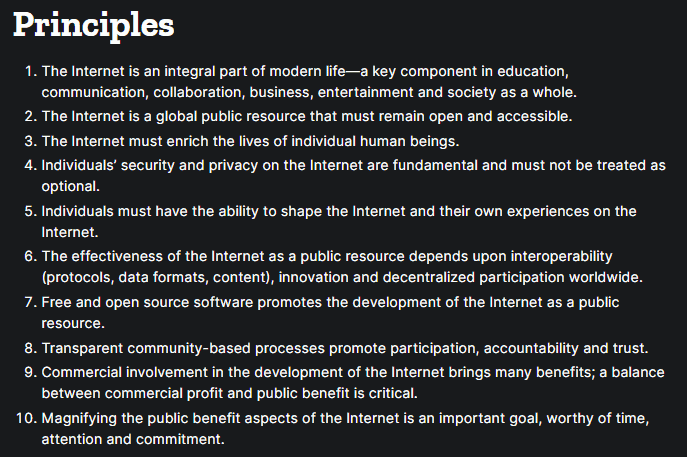
    mozilla principles

    Mozilla Business Model

    Mozilla’s business model can be divided into three primary entities: Mozilla community, Mozilla Foundation and Mozilla Corporation.

    Difference between Mozilla, Mozilla Foundation and Mozilla Corporation

    • Mozilla (community): Mozilla software community was started in 1998. It is a community of thousands of volunteers working to create an open and accessible internet. It stands to create excellent open-source software as well as standards for it. Mozilla describes itself as, “maker of browsers, apps, code and tools that put people before profit.”
    • Mozilla Foundation: Founded in 2003, Mozilla Foundation is a non-profit organisation that leads and manages the Mozilla (community) project. It controls trademarks, copyrights and other assets and sets development guidelines. It is the driver of Mozilla’s goal of a healthy and open internet.
    • Mozilla Corporation: Established as a 100% owned subsidiary of Mozilla Foundation in 2005, it is a for-profit organisation that invests all of its revenues into Mozilla projects. It continues to be governed by Mozilla Foundation with no other shareholders or owners. Firefox Browser shines as the flagship product of Mozilla Corporation with Thunderbird E-mail client being another one until January 2020, when it moved under MZLA Technologies Corporation.

    How Does Mozilla Work?

    Members of the Mozilla Foundation and its subsidiary Mozilla Corporation along with numerous volunteers are responsible for all of Mozilla’s operations.

    While Mozilla Foundation continues to work on building and backing infrastructures for an open and healthy internet, Mozilla Corporation focuses on creating and improving products and policies and on experimenting to improve the quality of internet usage for people. Both organisations work under the banner of Mozilla. Mozilla is a “social enterprise”. And one of the very few ones in its field with such a large number of users and contributors.

    So, there are 2 different fields Mozilla concentrates on:

    • Improving internet health as a whole for the users.
    • Continue developing products like Firefox Browser, Thunderbird E-mail client, Pocket app etc. while exploring new technologies.

    Firefox Browser

    Firefox is a free and open-source web browser developed by Mozilla.
    firefox browser

    It is the most significant of Mozilla’s product offerings. Not only because it is a great product but also because it was a key player in the company’s initial growth. Just like all other offerings, Mozilla was developed keeping in mind the ‘good of the users’.
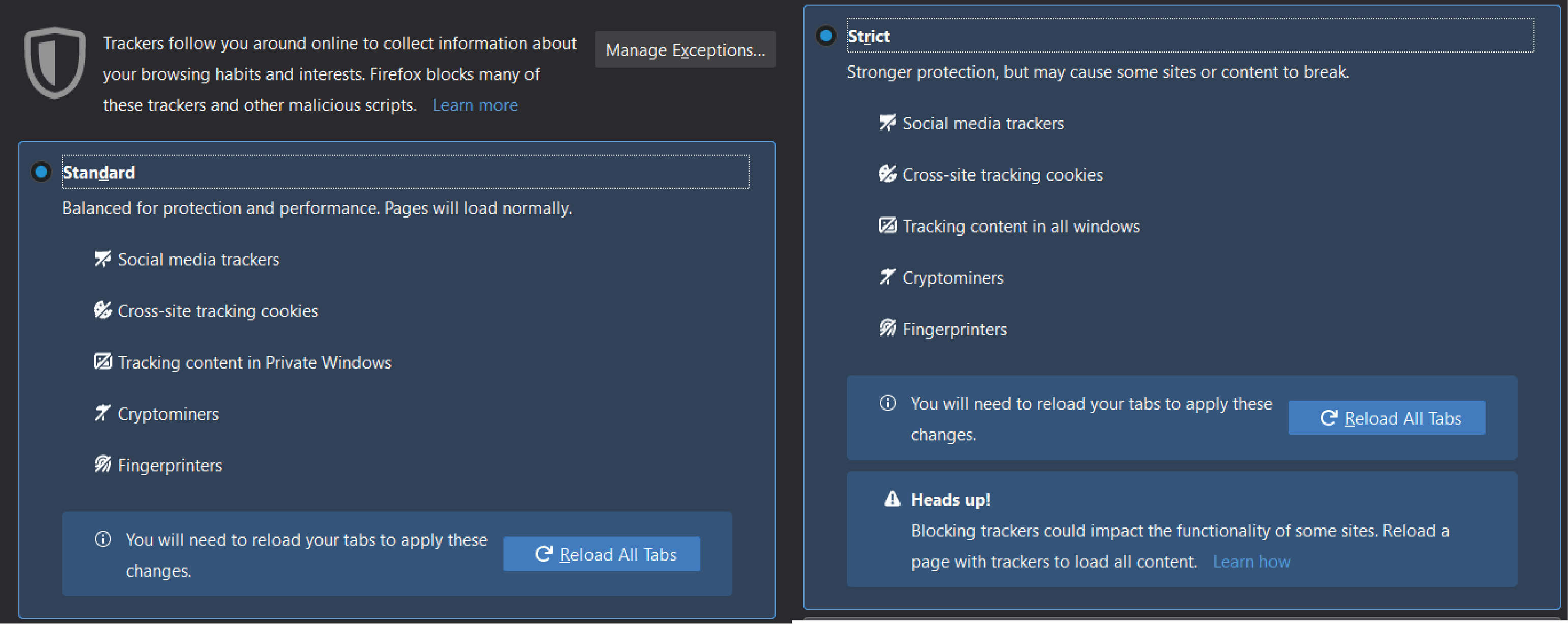
    Firefox browser
    Source: Mozilla Desktop Browser

    Firefox alongside remaining a superb open-source software concentrates on privacy and data protection. It blocks lots of trackers by default and promises to never sell any user data. Not just sell, Mozilla is very proud and clear about their privacy standards.
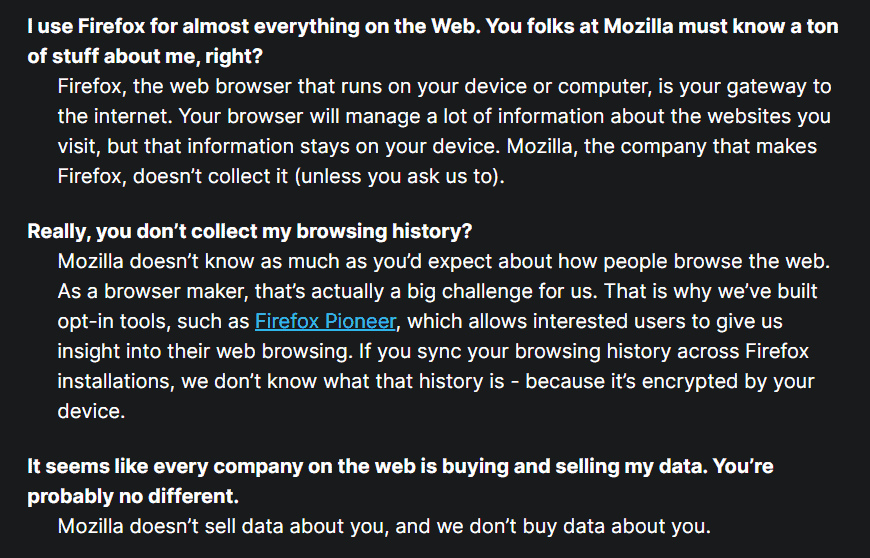
    Mozilla privacy
    Source: Mozilla Privacy F.A.Q.

    Firefox is available for all major platforms like Windows, Linux, macOS, Android and iOS.

    Mozilla Thunderbird

    Thunderbird is a free E-mail client which comes with built-in productivity features like newsfeed, chats and calendaring. It is open-source and shows the power of Mozilla community. Despite being one of the best software of its type, it runs off monetary donations of the community members. Not just that, code contributions by the community also play a huge part in Thunderbird’s development.
    Mozilla Thunderbird
    Source: Thunderbird’s website

    Thunderbird extends its functionalities with the tons of add-ons available on their website. These add-ons allow you to make the already great software much more powerful.
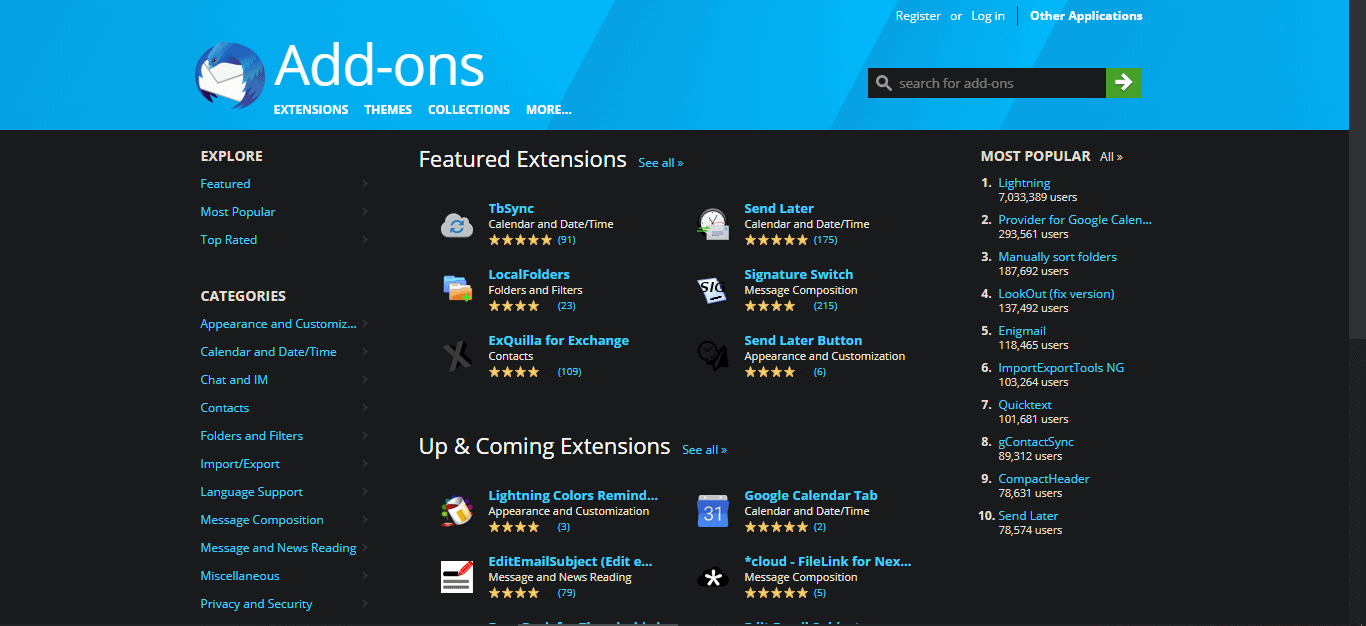
    thunderbird addons
    Source: Thunderbird’s website

    Thunderbird also stays committed to user privacy. It is very strict about sharing user data and uses it only and only where it is necessary. It is available for Windows, Linux and macOS.
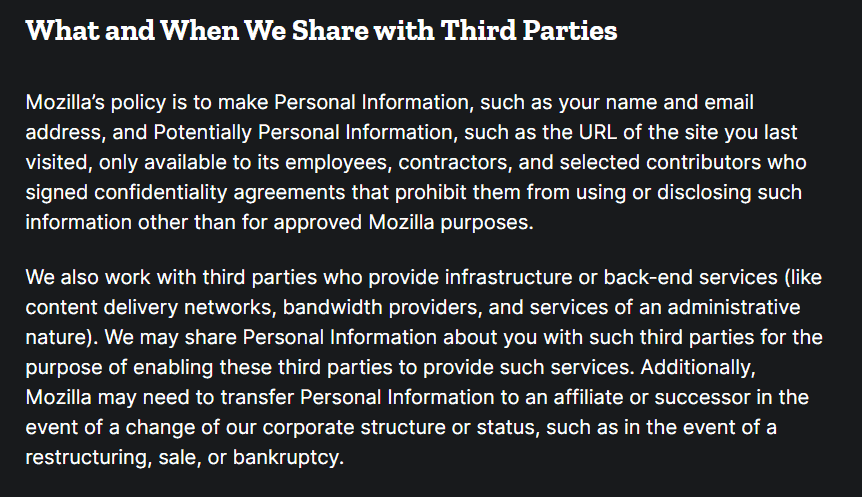
    Thunderbird Privacy Policy
    Source: Thunderbird Privacy Policy

    Pocket App

    This is a different product. Pocket isn’t something Mozilla built from the ground-up. It became Mozilla’s part when Read It Later, Inc. was acquired by Mozilla Corporation in 2017. Pocket lets its users save online content like articles and videos from any app or page and then consume and share at their own ease. It provides seamless integration between mobile apps and its web interface all of which provide a superb experience.
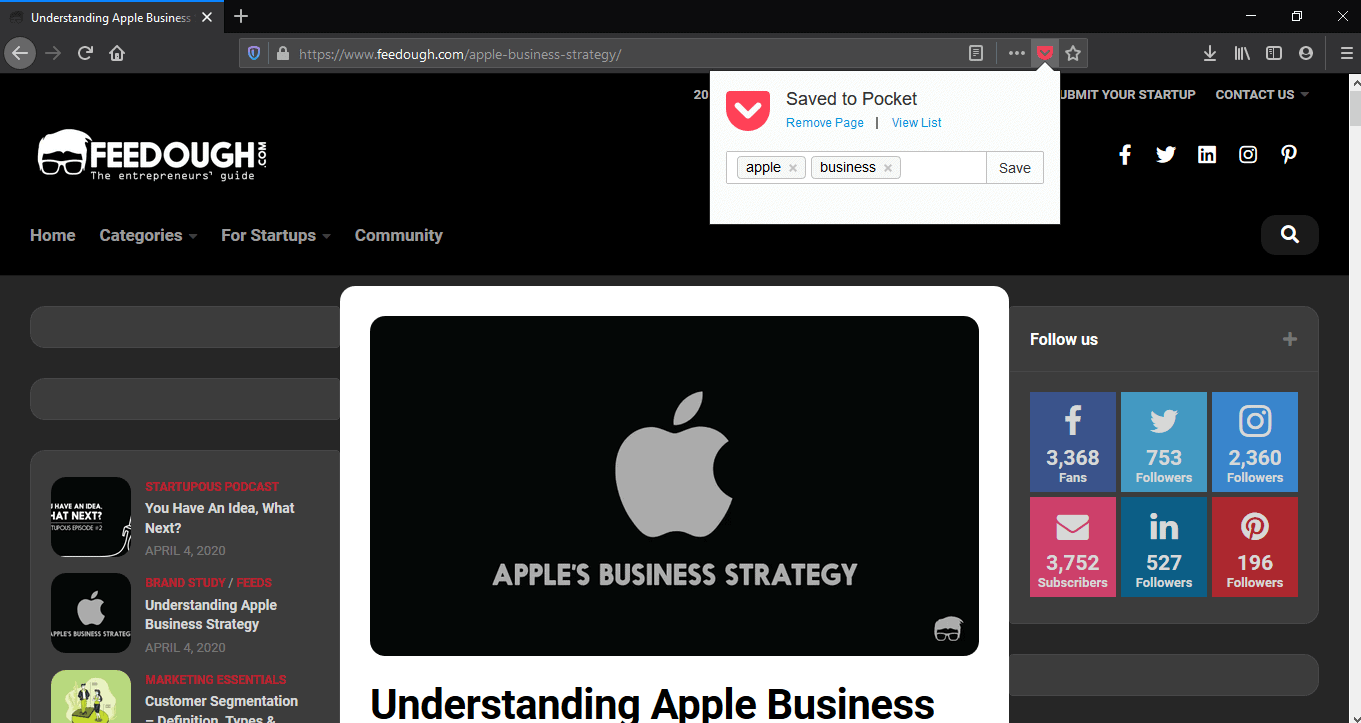
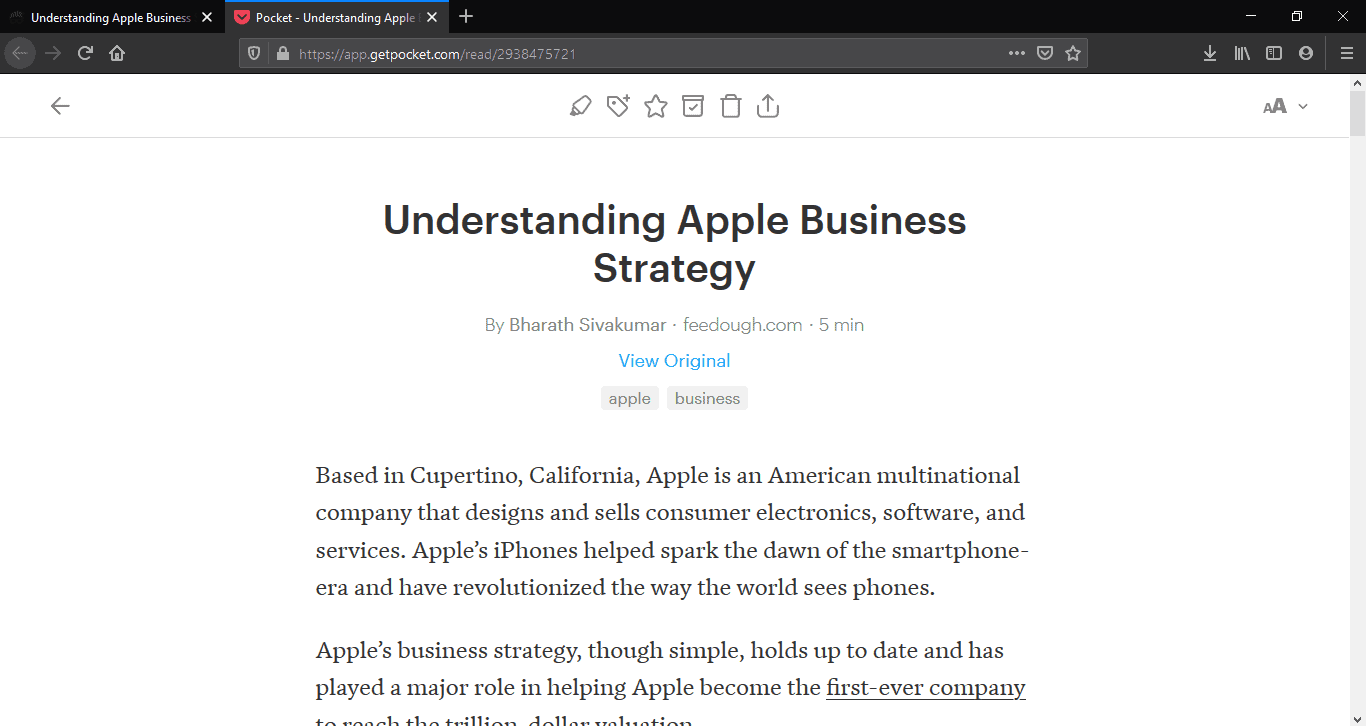
    Saving an article on Pocket
    Saving an article on Pocket
    Pocket reader with features like sharing, tags etc.
    Pocket reader with features like sharing, tags etc.
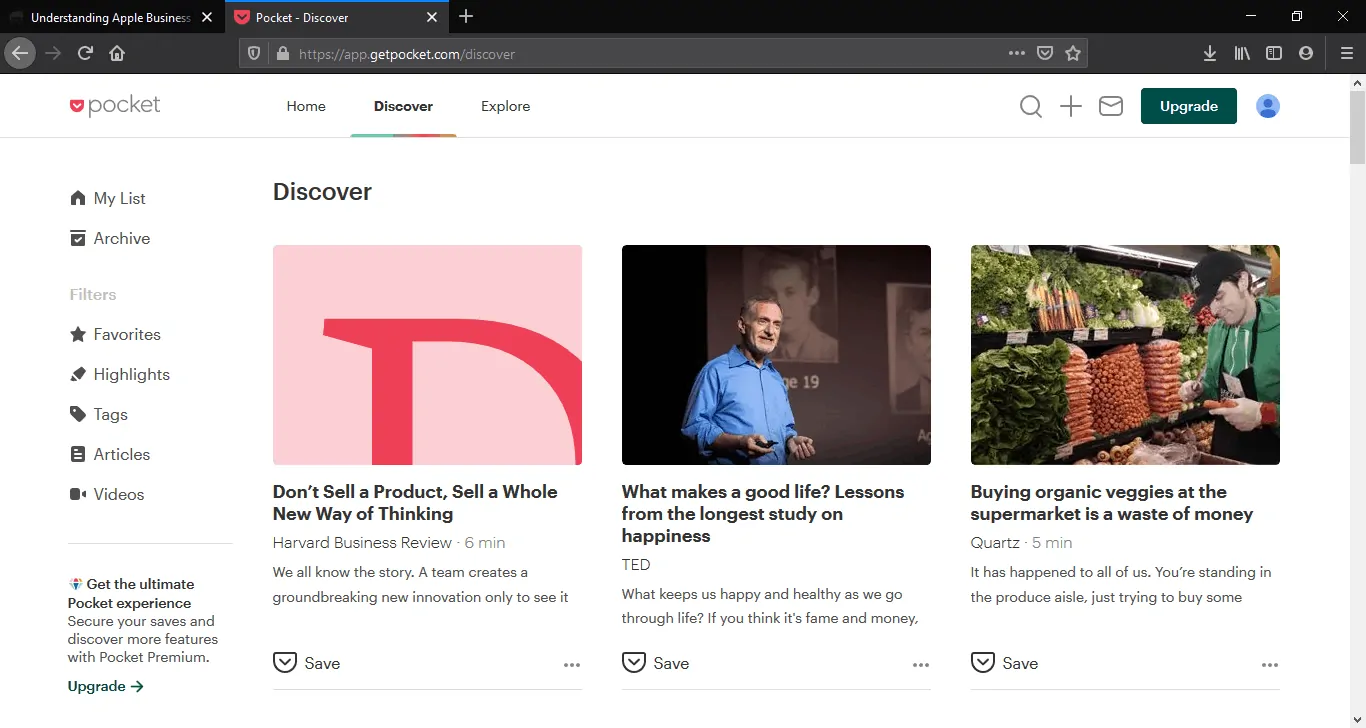
    Discovery section in Pocket
    Discovery section in Pocket

    As Mozilla’s first strategic acquisition, it was done to promote “discovery and accessibility of high-quality web content”. They looked at pocket as a medium for users to consume and share content on their own terms for an independent and decentralised experience. Pocket is available on Android, iOS and the web.

    Mozilla is a crucial contributor to the online open-source community. They actively develop and work on lots of projects to improve the quality of the internet for users. Rust, Servo, MDN web docs are all Mozilla’s work to name a few. They also provide grants and donations to individuals and groups working in the same direction as Mozilla.

    Mozilla also keeps on experimenting into new areas. Since progressing internet into the right direction for users (or humans) is a major part of Mozilla’s mission, stepping into new zones to progress their ideology has been a key part of their operations. Firefox Reality is a very recent example of this.

    How Does Mozilla Make Money? Mozilla’s Revenue Model.

    Mozilla is a bit different than most software companies. It doesn’t have any big paid software suites. They don’t consider selling your data to earn revenue. Mozilla, being a social enterprise that it is, only employs earning methods which are not bad for the user or the internet. For Mozilla, privacy is like a right.

    How then does it pay the salaries of Mozilla Corporation’s employees? And how does it bear legal, marketing, consultation and all other expenses? Here are the key revenue sources of Mozilla:
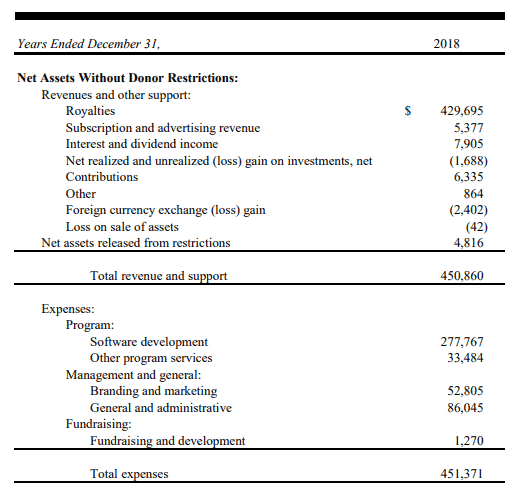
    Mozilla’s revenue and expenses in the year 2018.
    Mozilla’s revenue and expenses in the year 2018.

    Search Partnerships (Royalties) For Firefox Browser

    A browser acts as a broker between a search engine and its users. Mozilla’s biggest income source is the deals between Mozilla’s Firefox browser and search engine(s) to make them Mozilla’s default.  After the one with Yahoo expired, the new deal with Google in 2017 resulted in highest-ever revenue ($542 million) for the organisation. According to their global search strategy, Google, Baidu, Yandex and Yahoo are set as their default search engines for different regions.

    Donations

    Backing from the fans and followers are always an important part of an open-source project. Although it is a relatively lower contribution than the search deals, it shouldn’t be understated in any case. These contributions also represent the faith of the people in the project. The non-monetary contributions to the project (and its codebase) can also be seen as indirect income or savings, which otherwise would force Mozilla into paying more developers. These code contributions save them a lot of resources and time. Mozilla Foundation’s income comes from these donations and partly from Mozilla Corporation’s earnings.

    Subscriptions And The Future of Mozilla

    The ‘paid software’ and ‘user data’ revenue models for software companies are common because they work. A revenue model for a software company outside of these two is difficult to implement. And that’s the case especially for Mozilla who also is strongly committed to its good internet beliefs.

    In 2018, around 95% of their revenue was from search deals. A big chunk of this comes from Google, a company whose browser is the biggest competitor for Mozilla’s flagship product. Moreover, even with massive improvements and feature additions, Firefox’s share of users has been falling. For the same reasons, Mozilla is gradually trying to diversify its revenue sources.

    From 2019 onwards, Mozilla teased its users towards the subscription services it is looking to sell. The two that garnered the most attention were:

    Firefox Private Network (FPN) VPN

    Mozilla tested this in partnership with ProtonVPN and in 2019 launched their own VPN service in partnership with Mullvad. It is still limited to the USA and to a few platforms but is planned to expand soon. It costs $4.99 at the moment but there be a free and probably a subscription that will cost higher when it launches globally. It is going to be of two types, FPN browser protection and FPN full-device protection. The privacy policy is very clear about how the data is handled and unsurprisingly promises to not monitor/log your network history.
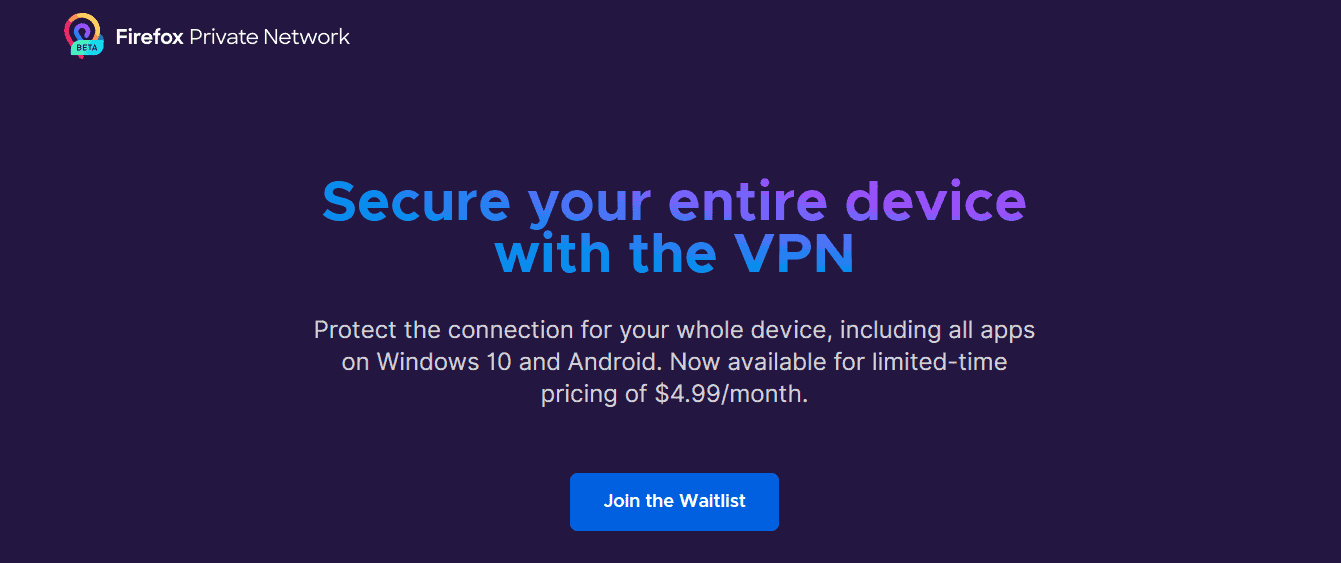
    Firefox private network
    Source: FPN Website

    Firefox Better Web

    Launched in partnership with Scroll, Firefox Better Web is a paid service that gives users an ad-free browsing experience on Scroll’s partners like Vox, Business Insider, The Verge, The Atlantic, Salon and more. It is shaped with the mission to, “disrupt the current ad-revenue model by directly funding partner sites”.
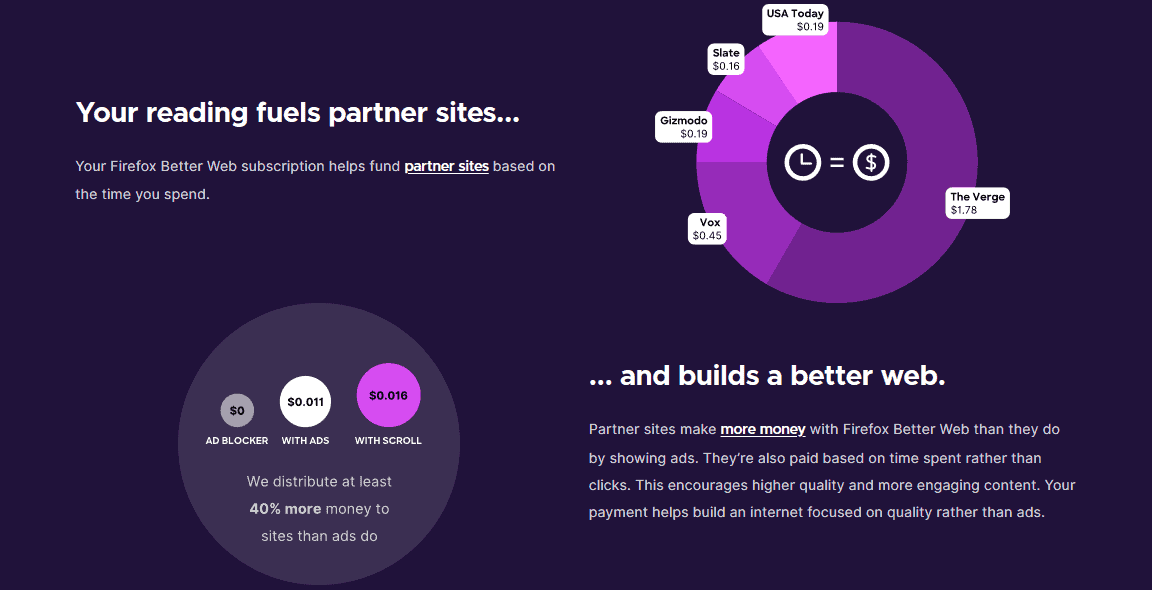
    Current Partners for Firefox Better Web
    Current Partners for Firefox Better Web
    The Idea for A ‘Better Web’
    Source: Firefox Better Web’s Website

    It is enriched with features like offline reading, dictated articles, tracker protection in Firefox and syncing. At the moment it is available only to desktop users in the United States and costs $4.99/month. Mozilla is also offering a 6-month 50% discount for early birds.

    Final Word?

    It is an interesting time for Mozilla. Although their cash reservoir is not emptying anytime soon, they are taking a more conservative approach now. As mentioned above, Mozilla isn’t one of the giant tech-corporations but more of a social pursuit for a better online environment. Which makes it all the more difficult for them to grow. Creating new strong and stable income sources are a big focus for Mozilla now. The subscription models, moving Thunderbird to from Mozilla Foundation to MZLA Technologies Corporation, new support deal with the third most used mobile operating system KaiOS etc. all aim to spread their income sources and get Mozilla to more and more people.

    Go On, Tell Us What You Think!

    Did we miss something? Come on! Tell us what you think about our article on Mozilla Business Model in the comments section.

  • What Is Brand Experience? [A Detailed Guide With Examples]

    What Is Brand Experience? [A Detailed Guide With Examples]

    Mark is a young adult who likes to ride bikes. He goes into an XYZ store to look at their bike range. The tagline of the store is – ‘Screw it, let’s ride.’ Mark feels very enthusiastic and energised reading it. He observes that the store is also rustic and wooden. The colour of the bikes, the bold font, the badges and pins on the biker jackets on display, everything gives mark a feeling of empowerment, passion, and enthusiasm. A sales employee also tells Mark about their customers’ family group, through which all customers across the United States go for bike rides to varied terrains, sponsored by XYZ. They receive a whole lot of certificates, awards, medals, and badges upon completion of certain segments of the travel. The idea of the family group gives Mark a feeling of compassion and risk, community and individuality, warmth, and passion. Mark is motivated to lock XYZ to make the final purchase.

    Any guesses on which brand is XYZ?

    XYZ is Harley Davidson, one of the top companies with a great brand experience. Harley Davidson is known for not selling bikes, but an entire holistic brand experience signifies with passion, power, unity, and boldness.

    What Is Brand Experience?

    Brand experience is awakening a holistic sensory experience to build an all-rounding relationship between customers and a brand.

    The business uses every customer touchpoint to develop a holistic brand experience. The journey may differ from customer to customer, but the experience doesn’t, as this experience is what results in the development of the brand image.

    And brand image needs to align with the brand identity, always.

    Take Starbucks, for example.

    Let’s say customer A got to know about Starbucks by coming across a Starbucks outlet. This is the first touchpoint. Without even buying from the store, the constant green-brown colour, basic logo, variety in menu, relaxed seating arrangement, free-wifi, sleek machinery, etc. portrayed strong feelings of adaptive style, innovation but basic. Starbucks, in the first instance, attempted to create an experience of one-stop for a quick coffee and one-stop for a long hangout with friends.

    Then came the customer interaction and subsequent touchpoints.

    The experience included selecting a coffee, personalising it with a name, fast-paced counter, waiting on a comfy sofa, having the name called out for the exceptional coffee and enjoying it with free wifi, and an edgy vibe.

    Now, the brand makes sure this experience remains the same for customers B, C, and D as well, which will result in building a standardised experience significant of – trend, comfort, edginess, and personalisation. Overall it has a ‘feel-good’ factor to its brand experience. A customer doesn’t buy a coffee anymore; he buys a ‘Starbucks’.

    The expression “brand experience” has become famous the same way number of different terms in the marketing businesses did, which is with the development of the media used to impart a brand’s message or story.

    Brand experience is associated with specific products or organisation names. Through the brand experience, organisations try to curate a set of emotions that lead to a predefined brand personality.

    And this personality results in a relationship between the brand and a particular need or feeling.

    Brand experience is about the ‘emotive inclination’ from experience, regardless of whether physical or computerised. Media might be a component planned for driving impressions and engagement around the experience. Yet, brand experiences are not media-driven, per se, rather enhanced by media, whether employing social influencers, computerised means, social means, print ads, etc.

    Why Is Brand Experience Important?

    In this era of consistently high competition, brand experience is what summon affectionate feelings and sentiments, regardless of whether it is a most loved children’s clothing brand or a top magazine membership you happily renew each year.

    But why at all is brand experience vital in today’s time and age?

    Provide A Deeper Meaning To The Offering

    Brand experience provides a deeper meaning to an offering and the brand behind it.

    Take the energy drink brand, Red Bull, for example.

    At the end of the day, Red Bull is selling glucose and caffeine in different flavours. That’s pretty uni-dimensional. But then why does it rank as the top energy drink in the US? It is the brand experience that lifted the mere energy drink brand to one associated with ‘wings’ – ideas, enduring, inspiring, and sporting. Hence, brand experience is vital to building a multi-dimensional brand, one that awakens feelings, thoughts, and actions in the consumer.

    Build Brand Perception

    Brand perception is how a customer sees the brand. Brand experience is what makes the customer think of the brand whenever he witnesses –

    • Offering related keywords: Customers often think of Johnson and Johnson whenever they witness baby products.
    • Brand related emotions: Coca-Cola is the go-to brand wherever there’s happiness.

    Enhance Brand Loyalty

    Brand experience is immensely important because it results in brand loyalty. Retaining consumers is perhaps much more important than drawing new ones. As research has proven, consumer acquisition is 5 – 25 times more costly than retaining existing customers.

    Apple is an excellent example of brand loyalty through brand experience. Apple has well-established features like camera quality. None of its present marketing strategies focus on technicalities of Apple products, but rather on –

    • What Apple stands for?
    • What are the values associated with an iPhone – urban high class, chic, different from the clutter, etc.?

    To Stand Out Of The Clutter

    Brand experience is essential for a brand to be able to stand out and attract positive attention. Numerous businesses enter the industry with a lack of a crisp strategy.

    Having a brand experience in today’s times expands to having a value associated with a brand. Through a strong brand experience, customers and clients can pick on positive and strong cues such as – image and vibe.

    Awful experiences with a brand are what turn into a lost opportunity and obliterate the brand. Therefore, to create a strong brand experience, organisations should win the hearts of their customers.

    How To Create A Brand Experience

    Though the creation of a brand experience may vary from industry to industry, a few commonly used effective steps to create a winning brand experience are:

    Set A Purpose – Mission statement

    A brand experience should center around what the brand stands for. The best way to do this by creating a mission statement. A mission statement would define the objective, goals, and aims of the brand. This is what will guide your brand’s marketing, target audience, vision statement, but above all –

    ‘its brand experience’.

    For instance, Amazon’s mission statement is – “We strive to offer our customers the lowest possible prices, the best available selection, and the utmost convenience.” The mission statement shouts for low prices, top-notch product base, and convenience. And today, this is essentially the brand experience that Amazon brings with it.

    Know Your Audience

    Put yourself in the brain, shoes, and heart of your client. One of the advantages of the web, and particularly of artificial intelligence now accessible for client support communications, is –

    “the open doors it creates for assembling more and better information about a target audience”.

    To ascertain the target audience, a few helpful questions could be:

    • What are consumers’ extensive interests?
    • By what method can a brand authentically partner tie itself to those interests?
    • What are their demographics?
    • What experiences work for them?
    • Are they living your brand?

    For instance, Nike manufactured a realm by being merely a shoe brand as well as one that speaks to a whole accomplishment situated way of life. Likewise, Starbucks is situated not just as a spot to get some espresso but also as a representative of a specific point of view toward society, of a young, edgy vibe that can serve you well for fun and work.

    Create And Inspire Emotion

    Consumers need to see that the organisations and items they support have an actual existence. Your brand should build a character, and an enthusiasm to which consumers can relate.

    Organisations can no longer stand to set up billboards and TV ads among themselves and the client. Instead, you have to focus in and get included.

    Brand experience is all about building relationships with the consumer. Relations are characterised by emotions. Whether a brand experience offers a sharing and caring emotion like Coca-Cola, or a fearful and cautious sentiment like PETA (People for Ethical Treatment of Animals), it is essential to ponder upon what’ feeling will be associated with your brand’.

    Engage With Your Customers

    Engagement is the core of building a brand-consumer relationship. Luckily, resources today help build this engagement easier than you can imagine. The digital perform is the one where, with just little effort, a rich client relationship can be built.

    Social campaigns – The Dove Real Beauty campaign across the United States, helped Dove add a sense of authenticity, trust, and a non-judgemental factor to its brand experience. It still is a bar of soap at the end of the day. But its also so much more than that!

    https://www.youtube.com/watch?v=XpaOjMXyJGk&feature=emb_title

    Social Engagement –Cadbury India launched discussions and open-thoughts on suggestions for a new flavour for its next chocolate bar. For this launched a dedicated platform where any customer could select ingredients, create a unique bar recipe and Cadbury would try all suggested recipes, and select the top one.

    Direct Discussions – A great example of this can the ‘let’s do lunch’ initiative by Dominos in the UK in 2012. Dominos asked people to add the hashtag #letsdolunch on all of their tweets and promised huge lunch discounts for that day to all participants. The number of tweets and re-tweets during this initiative rose to a good 82,500 approx., thereby boosting an edgy brand experience for Dominos.

    Influencers

    Today, influencers play a significant role in triggering brand perception.

    Consumers depend vigorously on the suggestions of real people’s experiences via web-based networking media more than experts. By partnering with an influencer who has confidence in the company and whose interest, reverberation, and commitment meet the company’s prerequisites, the company profits from his/her followers.

    Though not a mandatory step, the use of influencers for marketing for a brand aids in the development of trust, authenticity, and credibility to a brand’s character. And having such associations with a brand’s character is the strongest step toward building a brand experience.

    Research Competitors

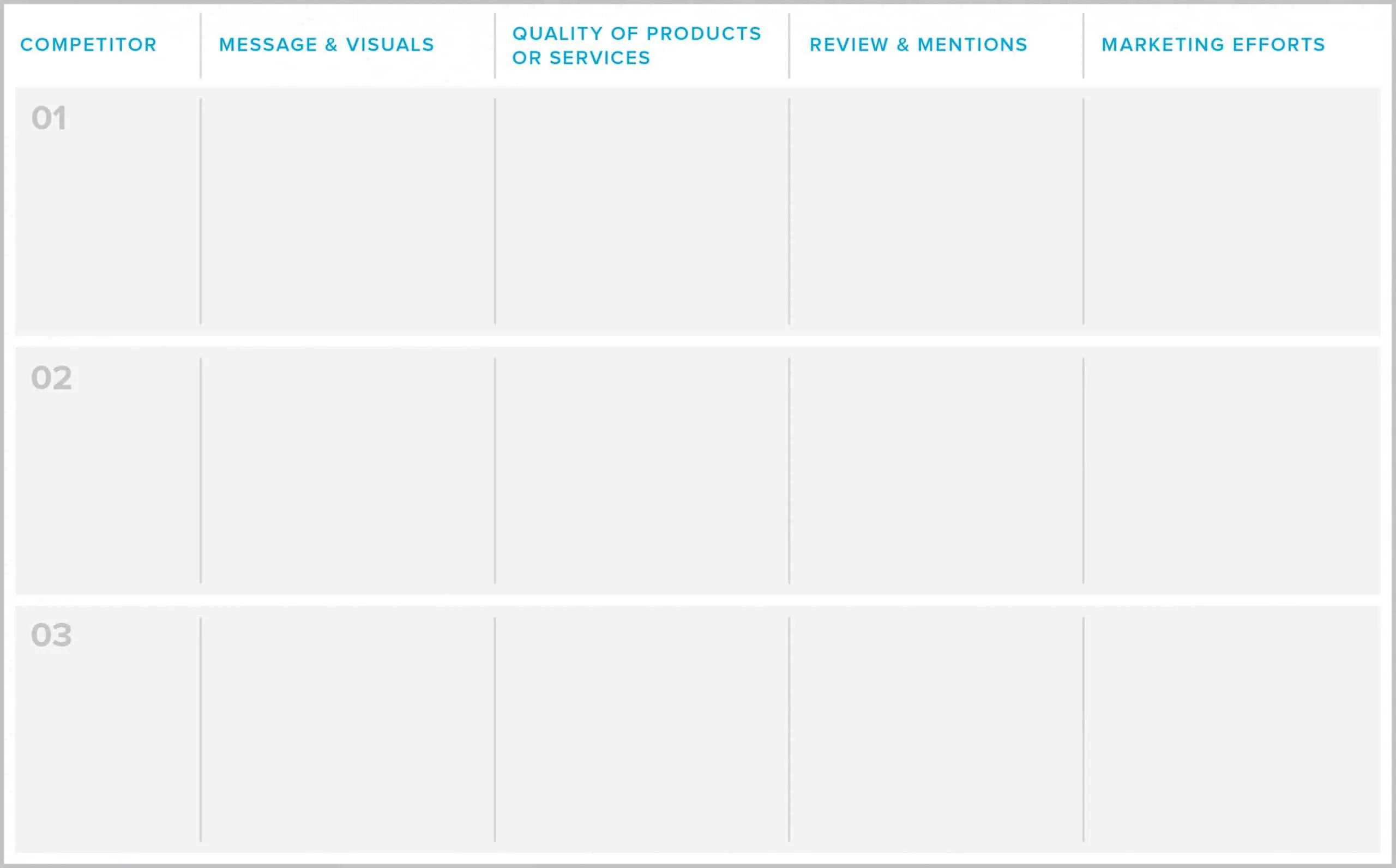
    A company’s objective should be to separate from the opposition, to persuade a client to buy from them over others! They should research their primary rivals or benchmark brands. For example, concentrate on how well they have approached assembling a brand name. Competitor research is a key component of brand success. This can be done by making a brand contender spreadsheet for comparison, as given below.

    brand competitor research

    Brand Experience Strategy

    Now that the meaning, importance, and steps for the creation of brand experience has been established. This section deals with what strategies to chose as the focus of the creation of a killer brand experience. Every brand must strive to adopt a strategy that imbibes the essence of the brand itself. What are the available strategies to do so?

    Live Experience

    According to a study, being part of a live experience hosted by a brand increases the chances of brand recommendation by 65% and purchasing chances by 59%. Live experiences are a supreme way to interact and involve your consumers. A live experience refers to a live event engaging existing and potential consumers with the brand experience at its core. The advantages of building a brand experience through a live experience are:

    • It absorbs the audience through all senses. It’s an audio-visual feel to the brand.
    • It builds social connectivity, with the brand as the ‘hot topic’ of talks.
    • It includes a ‘stickiness factor’. The stickiness factor refers to an event being memorable and etched inside the minds of the participants.

    Design Thinking

    Design thinking is a brand experience strategy designed to promote innovation. It is a consumer-centric way involving:

    • Collaboration with other brands or with consumers themselves
    • Surveying and mapping the consumer journey to develop a better brand experience
    • Prototyping and beta testing. Through prototyping and beta testing, brands can test the response and functionality of a product by releasing the product temporarily in-house and to a limited set of real consumers.

    Top brands with a great brand experience such as Apple, Nike, etc. have set the standard for design thinking in today’s times. Among the 24 principles of design thinking, the most relevant to brand experience is –

    “breaking through the noise”.

    Design thinking involves being empathetic and thinking from the user’s perspective.  The design thinking framework makes use of user data, including – interviews, surveys, contextual inquiries, and user groups. The ultimate goal is to truly understand your customer’s needs and desires. The process focuses on eliminating whatever is irrelevant to the brand story. From unnecessary colors to sarcasm to fictitious references, etc. whatever does not seem eye-catching and relevant must be scrapped off.

    Personalisation

    Customisation has become a huge trend in driving brand experience and consumer experience. Why is personalisation a great strategy for building brand experience?

    Personalisation helps in conveying a more empathetic and relevant feeling of the brand. This is because, toward the end, a consumer will not remember what they were told or what they saw as well as they would remember how they felt.

    Creating a customised brand experience requires extensive research to identify the target audience and buyer persona. After there is adequate information on what the buyers’ interests, needs, and requirements are, a brand can adapt its mission statement accordingly.

    Storytelling

    Stories are, by far the most effective way to build a brand experience. As the next section of examples will indicate, companies with a powerful brand experience attach a strong story to themselves.

    To inculcate storytelling to build a brand experience, one must follow the steps from the earlier section –

    1. Create a mission statement,
    2. inculcate storytelling to build a brand experience,
    3. Infuse emotion,
    4. Ascertain the target audience,
    5. Engage with the target audience, and
    6. Research competitors.

    Once all these steps are successfully completed, a company must attempt to link the mission statement and related emotions and values with the target audience.

    For instance, if XYZ is a pet product company

    • The mission statement is ‘speaking for the ones who cannot speak for themselves.’
    • Common beliefs of the target audience are that all pet products are usually for general breeds and sizes and not specific to their pets
    • The brand can link these two to stand for the fact that they customise products, provide more varieties catering to the specific needs of different breeds and sizes of pet animals. The brand cares for the animals and believes that if human beings can have things according to individual differences, pets should too. They deserve love and all the customisation that XYZ strives to provide.

    Brand experience examples

    Coca-Cola – Share Happiness

    Coca-cola has built a widespread and strong ‘share the happiness, share a coke’ story. The brand experience includes – Happiness, sharing, and caring, fun, and love. The share a coke campaign that started in 2011, demonstrated personalisation, and empathy toward its consumers. It also grew to sell 150 million bottles only in the year 2014!

    Amongst other cola drink brands, coca-cola managed to build a unique brand experience characterised by sharing and happiness with, of course, its product at the center. Coca-cola made extensive use of two strategies:

    • Building a multi-dimensional image
    • Linking emotions to their product

    To understand the use of these two strategies better, think about what does coca-cola sells? Does it really sell happiness?

    No.

    It sells a cola drink, with different variants. But by using a multi-dimensional image, they expanded to create an experience of not just fizzy cola, but friendship and happiness. Today, across all age groups, one cannot imagine a party without coca-cola. The multi-dimensional image is created by going beyond the basic utility of the product and giving it a character and personality of its own. The second strategy is the linking of emotions. Coca-cola, through its advertisements, its taglines, and campaigns, built an experience centered around the emotions of – happiness, love, caring, and sharing.

    X-box – Survival Billboard

    The X-box survival billboard, though a promotional advertising strategy, added to the story of the brand experience of X-box. The brand created a challenge where eight members randomly chosen from the sign-up participants received, had to perform a stunt on their ‘Survival Billboard’. What X-box did is create a brand experience with:

    • Design thinking strategy – By transforming a regular billboard into a survival billboard, they thought ‘out-of-the box’ and empathised with their target audience. What go users of X box like? Games, adventure, and risk. The survival billboard placed all of the emotions of the users into their brand experience.
    • Storytelling – The survival billboard was not just any billboard with fun and adventure. It had a story. A story of participants who endured numerous tests to reach the finale. A story of their survival. A story of X-box hosting the survival billboard challenge, accepting votes and polls from across the nation, and declaring a winner.
    • Personalisation- X-box brilliantly personalised their entire consumer experience for the user. Users were allowed to be participants and voters. The participants and voters were given a chance to feel like they could change the game. They had a say in how this goes forward. The experience was customised to their wish.

    They combined their mission statement – “We believe in uniting gaming communities where you can play, compete and connect with friends, wherever they are” with their target audience (gamers) requirements – “Innovation, competition, adventure and fun” and came up with the innovative idea. After the survival billboard, X-box is seen as a brand that delivers the experience of fun, innovation, and adventure.

    Netflix – Entertain The World

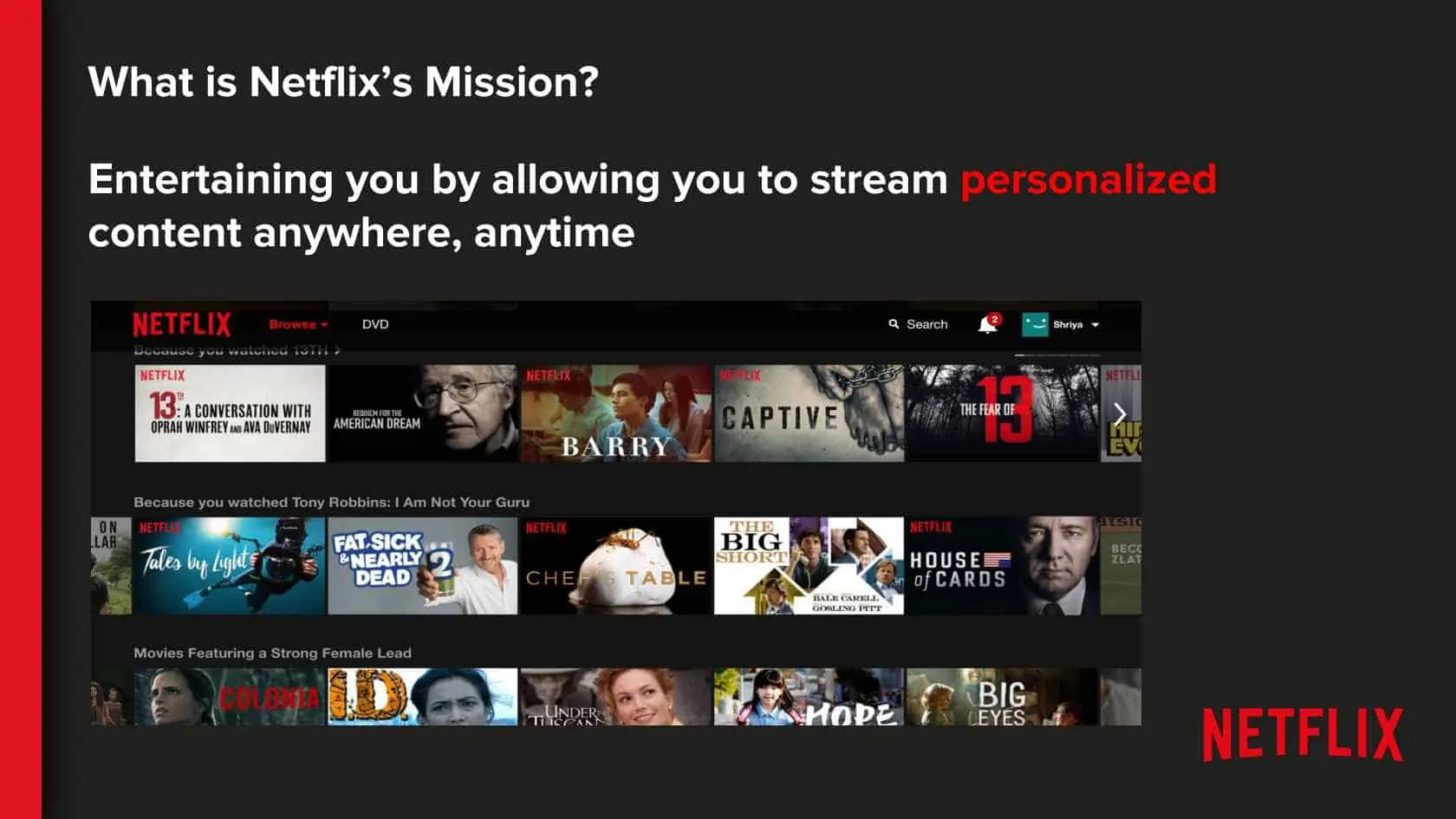
    Brand experience example - Netflix
    Source: infoq

    Netflix, alone, occupied 35% of the internet traffic in North America in 2016. Netflix’s mission statement – “to entertain the world” conveys a global, dedicated, and entertaining idea. Netflix adopts the brand experience strategy of ‘personalisation’. Netflix never stops personalising. It employs the following approaches:

    • Design thinking – By means of design thinking, Netflix placed itself in the shoes of the consumer. What do people like to watch? How do people decide what to watch? After extensive user research, surveys, and response analysis Netflix provides content suggestions similar to content a user is watching or has watched in the past.
    • Personalisation – As a business, it tries to keep the user tied to itself by constantly curating an account according to the preferences of the consumer. To boost the brand experience, Netflix shows that it deeply cares and values the customer’s choices and preferences. It is almost like -“we will curate your account, especially to help your likes and interests. All just to make your entertainment viewing with us worthwhile”.

    Netflix’s customer-centric approach has only strengthened over time. Because of which today, it is known to deliver an experience curated just for an individual customer – personal, easy, custom, and fun, all according to one’s views, likes, and dislikes.

    Go On, Tell Us What You Think!

    Did we miss something?  Come on! Tell us what you think about our article on brand experience in the comments section.

  • Measuring Influencer Marketing ROI

    Measuring Influencer Marketing ROI

    Studies have proven that influencer marketing ROI is found to be 11 times more than that of banner ads and conventional advertising channels. That explains the “buzz” about influencer marketing ROI in the digital marketing sphere!

    But there still exists a notion that it is impossible to measure the return on investment (ROI) for influencer marketing!

    The good news is that we understand trends and are here to guide you through calculating influencer marketing ROI.

    But for the absolute beginners –

    What Does Influencer Marketing ROI Mean?

    Influencer marketing ROI refers to the metrics of an influencer marketing campaign to quantitatively determine its efficiency with respect to the investment.

    In order to calculate the return on investment for influencer marketing efficiently, the objective and goal of the campaign must be clear. While for an established brand, this may mean boosting sales, for an upcoming brand it may mean building brand awareness. In both cases, the influencer launches a market campaign and calculating the ROI helps tangibly ascertain the success and efficiency of the campaign.

    Why Is ROI Important?

    Why at all should a brand calculate the ROI of influencer marketing? Why not merely let the influencer do “their thing”? The simple answer to that is –

    Influencer marketing has grown to become a $5-10 billion industry. Therefore, it is very important to capture the market at this growth stage. And the only way to ascertain whether or not investments in this industry are fruitful is through calculating its ROI. The practical use and impact of calculating ROI are:

    1. Measuring Profitability

    By way of calculating the influencer marketing ROI, a brand can clearly understand the returns generated per dollar invested in the influencer’s campaigns. Once a brand has estimated the returns generated per unit invested, the allocation of resources becomes more practical, such as – budget, time, number of members for the team, etc.

    1. It Helps Estimate Cost-Per-Engagement

    Cost-per-engagement (CPE), though quite similar to profitability, refers to the revenue generated from the ‘clicks’. Depending on the social media platform used, these ‘clicks’ refer to – likes, comments, views on videos, etc. CPE has been found to be as low as $0.01 (one cent), for influencers. Therefore, its vital to continually calculate the ROI and make us of its results to improve CPE.

    1. Establishing Key Performance Indicators (KPIs)

    Key performance indicators are used to quantitatively determine the success of a brand. Calculating the ROI of influencer marketing not only helps with estimating returns but helps in estimating KPIs too. This includes conversion rates, referral traffic, and influencer consumer loyalty.

    1. Finding The Best Performing Channel

    Another huge impact of calculating influencer marketing ROI is that it can be done platform-wise. A brand making use of influencer marketing can estimate the ROI based on every channel. This briefly means that you can estimate what are your returns from influencer marketing on Instagram versus on Facebook versus on Medium, etc.

    Measuring Influencer Marketing ROI

    While the statistics from the previous section establish the growth of influencer marketing ROI, they do not explain how to do about calculating the same. This step-by-step section will act as a guide on measuring influencer marketing:

    Influencer Marketing Objectives

    The first and most important step toward calculating the ROI is setting clear goals and objectives. This is an important step not only for measuring ROI but for influencer marketing too. Setting objectives entails two aspects:

    1. What are the goals of your influencers?
    2. What is the brand’s goal through the marketing process?

    While it is more likely that a brand working with influencers at the moment might have already defined its goals, it’s never too late to start. Defining goals helps narrow down the focus aspects of the ROI. For instance, if the goal is visibility and awareness, the focus ROI aspect would be ‘are people noticing the brand?’, but if it is engagement, the focus ROI aspect would include cost-per-click revenues and cost-per-engagement revenues.

    Influencer Marketing Campaign Metrics

    The next step to determine and note the metrics to be targeted. Is the focus metric ‘growth’ or is it the ‘duration’ users engage with?

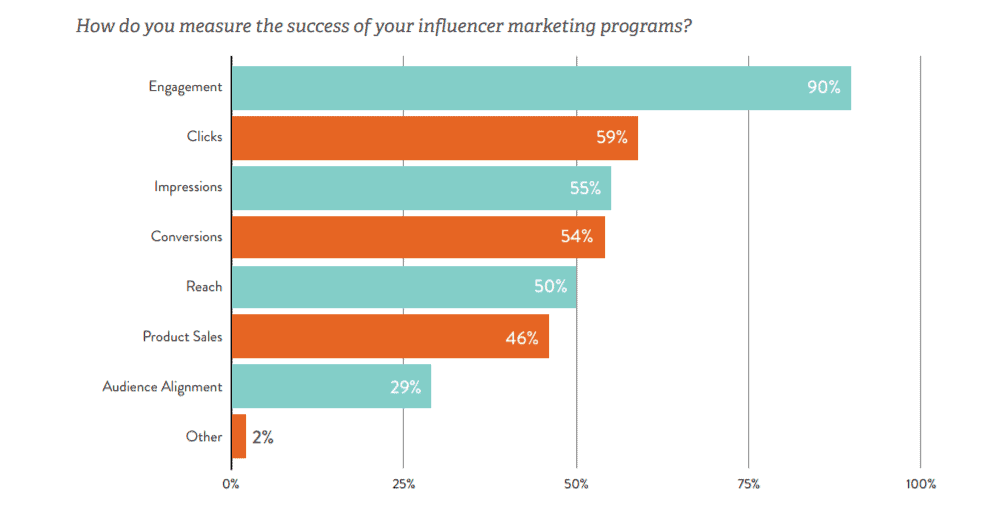
    measuring influencer marketing programs

    According to a Linqia study, the most widely used metric has been ‘engagement’ (cited by 90%). While it is not necessary to narrow down a campaign to a singular metric, one must note that majority of the marketers make use of clicks (59%), impressions (55%), and conversions (54%) too. Along with these, metrics including ‘reach’ and ‘product sales’ have gained popularity too.

    Roi Calculation

    The point of determining ROI is to ascertain whether the returns from the campaign are positive for the brand or negative for the brand?

    The simple formula for the calculation is:

    ROI = (Profit – Investment)/Investment x 100

    A simple example to help understand better would be, assume that Feedough has started influencer marketing and wants to calculate its ROI. After laying down a clear blueprint of goals and focus metrics, we decide:

    Case 1

    • Campaign Investment – $5000/-
    • Number of influencers – 3
    • Social media channel – Instagram
    • The value generated after 1 month – $8000/-

    Now applying the formula would look like:

    ROI = {(8000-5000)/5000} x 100

    ROI = (3000/5000) x 100

    ROI = 0.6 x 100

    ROI = 60%

    Case 2

    • Campaign Investment – $5000/-
    • Number of influencers – 3
    • Social media channel – Quora
    • The value generated after 1 month – $2500/-

    Now applying the formula would look like:

    ROI = {(2500-5000)/5000} x 100

    ROI = (-2500/5000) x 100

    ROI = -0.2 x 100

    ROI = 20%

    This means that in case 1 for every dollar invested, the company has made a return of positive $0.6, a profit. On the other hand, in case 2, for every dollar invested, the company has made a return of negative $0.2, a loss. Therefore, this would help Feedough understand that hypothetically, investing in Instagram influencers is better than investing in Quora influencers.

    Return On Investment Analysis

    An ROI analysis helps in moving beyond the superficial ROI numbers. What does ROI analysis mean?

    “ROI analysis refers to the detailed assessment of the profitability of an investment.”

    From an influencer marketing point of view, an ROI analysis can be as simple as dividing the ROI calculations based on relevant factors. Such factors include:

    • Social media platforms (How is the ROI through a Twitter influencer? How is it through a Facebook influencer?
    • Age (How is the ROI if the influencer is a late teen? How is it when the influencer is a young adult?)
    • Gender (How is the ROI when the influencer identifies as a male versus female? How is it when the influencer identifies as non-binary?)

    What Is A Good ROI?

    What does ‘good ROI’ mean?

    Good ROI refers to the most efficient ratio between return and investment.

    In the context of influencer marketing, it basically means, when you spend $1 worth investment into influencer marketing, what should you ‘ideally’ expect in return?

    A good ROI is considered to be 5:1.

    5:1 essentially forms the centre of the bell curve. A return to investment ratio lower than 5:1 is considered to be poor ROI, while above 5:1 is considered to be great.

    Influencer Management Platforms

    Using the aforementioned formula, any brand can easily and quickly calculate the ROI. For increased efficiency, the formula can be expanded to include various other engagement related metric data. In case you wish to go about the complex way too, this guide has got you covered. This section elaborates on the top easiest and free ROI calculation platforms:

    Google Analytics

    Google Analytics is a great tool, especially for tracking and managing influencer marketing, but for other channels of marketing too.  The reason why Google Analytics is considered great is its provision of free tools that permit close analysis of business data – all in one place.

    Apart from it being easy, estimating social media ROI through Google Analytics has become easier than ever. Google Analytics helps calculate the ROI but, more broadly, the ROAS, that is, the Return On Advertising Spend.

    But, nevertheless, ROAS analysis aids the estimation of the ROI.

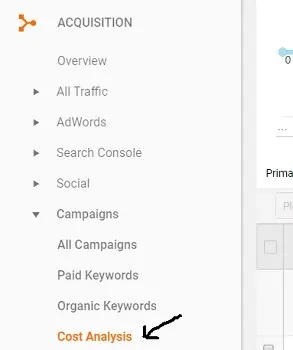
    Firstly, the ‘cost analysis’ report function can be used through Google Analytics. This can be done by following these steps:

    • Go to the ‘acquisition’ button
    • Next click on the ‘campaigns’ button
    • Lastly, click on the ‘cost analysis’ button
      influencer marketing google analytics
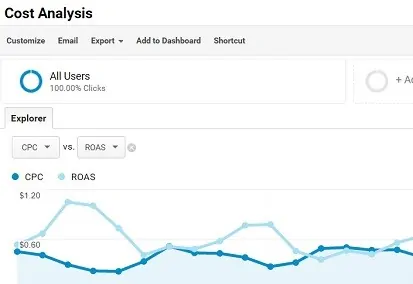
    • If your cost data is imported into your Google Analytics account, the report would look like this.
      cost analysis

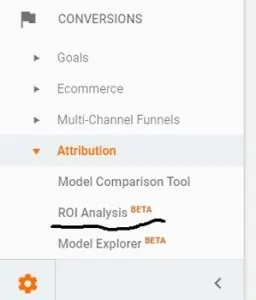
    Secondly, in order to make use of the ROI analysis feature the following steps can be followed on any Google Analytics premium account:

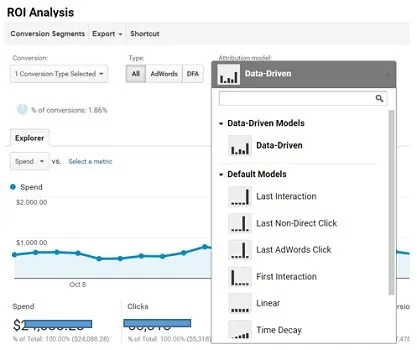
    • Begin by navigating to the ‘Conversions’ section
    • Next click on the ‘Attribution’ button
    • Now the option ‘ROI Analysis’ would be in the dropdown menu
      roi analysis
    • This ROI analysis report would like this:
      roi analysis report
    • Interpretation of the ROI analysis report: Though confusing this report is very detailed. For a general report, the ‘data-driven’ report would be sufficient. And for any specific report related to the interaction of users, time-based engagement, non-direct clicks, etc. the appropriate option from the dropdown menu may be selected.

    Pixlee

    Pixlee offers a great platform to help brands track influencer activities and results. It helps in organizing, tracking, and managing the influencer networks to, in turn, strategize and build market value. One of the marketing tools on Pixlee includes ROI tracking.

    Using Pixlee’s influencer management tools, companies could easily connect their influencer programs to their efforts with a hard ROI. Thereby tracking the impact and efficiency of influencer marketing campaigns.

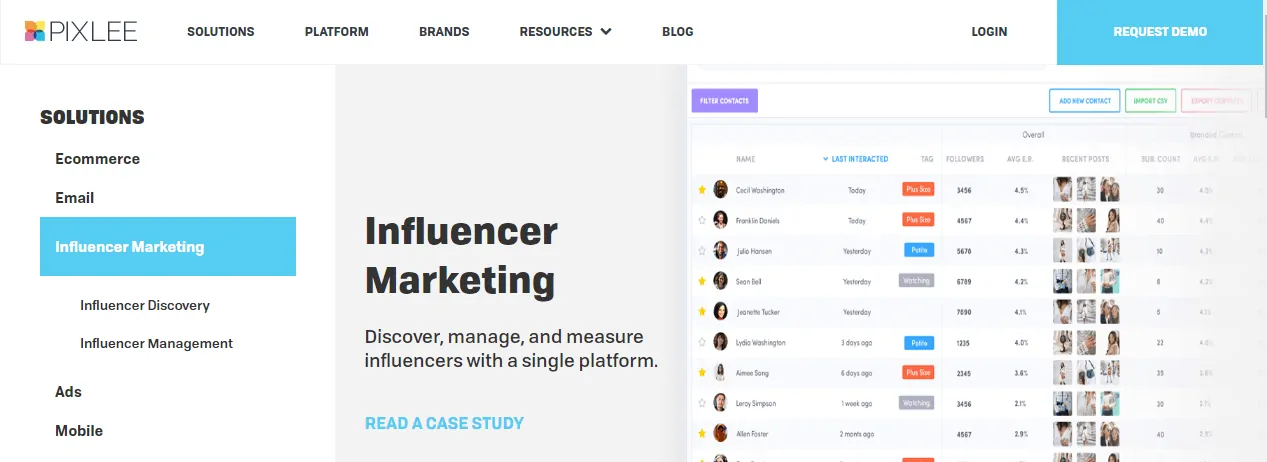
    1. Using Pixlee one has the option of choosing between ‘influencer discovery’ and ‘influencer management’.
      pixlee influencer management
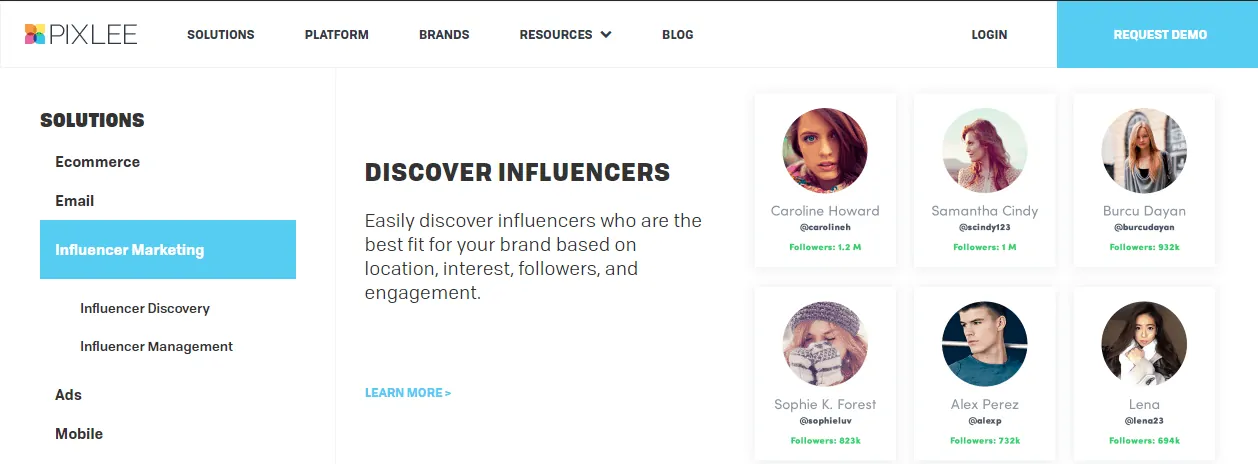
    2. Through the ‘influencer discovery’ option one can look for hiring influencers and their portfolios
      pixlee influencer management
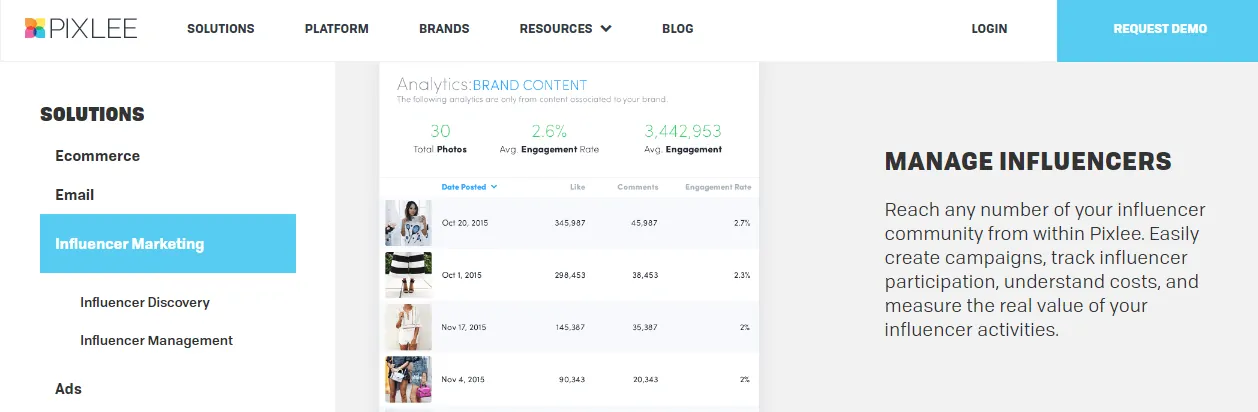
    3. Using the ‘influencer management’ option you can track the ROI, engagement and various important KPIs through column-wise data of – last interaction; followers; ROI; engagement; number of posts, etc.
      pixlee influencer ROI

    Hubspot

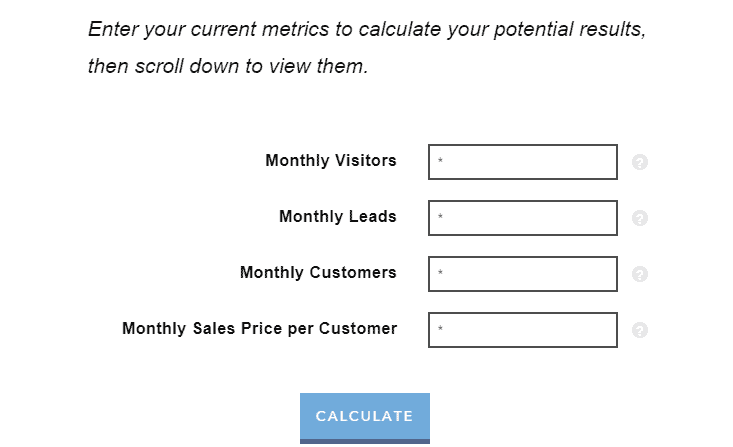
    Last, but probably the easiest platform for ROI calculation is Hubspot. Hubspot provides the user with 4 basic entry fields somewhat like this:

    • Enter the estimated number of campaign visitors per month in the first entry box
    • Next, monthly leads refer to the estimated number of leads generated per month.
    • Next enter the number of customers who made purchases in the month.
    • Lastly, enter the estimated sales revenue per month in the ‘monthly sales price per customer’ entry box
    • Then click on the ‘calculate’ button
      Hubspot influencer ROI

    Any user can easily enter the respective fields, and click on the ‘calculate’ button to get the ROI value. The only disadvantage is that Hubspot is not as wholistic as the previous two websites in terms of tracking other marketing metrics.

    Go On, Tell Us What You Think!

    Did we miss something? Come on! Tell us what you think about our article on Measuring Influencer Marketing ROI in the comments section.

  • Zoom Business Model | How Does Zoom Make Money

    Zoom Business Model | How Does Zoom Make Money

    Zoom has seen a spectacular rise in terms of user numbers, especially during the trying times of quarantine and social distancing as a result of the global pandemic. Zoom was only known within enterprises and businesses but that has changed. The popularity is all thanks to Zoom’s simple yet effective business model.

    Before looking at Zoom’s business model, let’s answer the big question –

    What Is Zoom?

    Zoom is a remote video conferencing service that was founded in 2011. The company was founded by former Cisco WebEx (Cisco’s video conferencing offering) engineer Eric Yuan and started offering its video conferencing service under Zoom Cloud Video in early 2013.
    This SAAS platform allows users to virtually interact with their contacts and other people using video, helping them maintain their workflow even when they are not available physically.

    zoom meeting
    Source: Zoom

    Zoom allows people to share whatever is displayed on their screen – quite useful, especially for presentations and teachers to show notes – to those within the Zoom meeting room. Speaking of Zoom Meetings, you will be hearing this term quite a lot, which simply refers to a video conference or webinars hosted using Zoom.

    https://www.youtube.com/watch?v=VnyitUU4DUY

    Zoom is available for Windows, macOS, Android, iOS, and as integrations for browsers and other video conferencing apps such as Skype for Business.

    Right from the get-go, Zoom’s growth has been immense – it reached one million participants within 5 months and 40 million registered users with over 1 billion meeting minutes served in just two years.

    Which brings us to –

    Zoom’s business model and pricing strategy.

    Zoom Business Model

    Zoom follows the freemium business model. Zoom offers 4 different subscription plans, one among them being the free plan.

    Zoom’s Free plan offers an unlimited 1 to 1 meeting and up to 40 mins of a group meeting with 100 participants. The Free plan is more than enough for the regular users and those looking for a temporary service until things get back to normal with the pandemic. Zoom’s Free plan offers the same features as offered in the paid plans of its competitors.

    That is not to say that Zoom is free. You need to pay a fee to obtain additional features such as – increased meeting hours, the ability to add more than 100 participants, support staff, and integration with other services.

    Zoom’s model focuses on getting its free users to become paying customers. The freemium model has helped increase the adoption rates as well as boost word of mouth publicity.

    Zoom’s Key Partners

    Individual Users

    Individual users form the core of Zoom’s business and sales. Zoom’s growth has been quite steady and has risen exponentially since it was first launched in 2013.

    zoom users
    Source: Drift

    Individual users have also become the backbone of Zoom’s business. Zoom has added more users as of March 2020 than all of 2019 combined. Zoom added 2.22 million monthly active users to its platform, bringing the total users of Zoom to over 12 million. Zoom, as of writing, has enabled more than 200 million to participate in video calls daily.

    Business & Enterprises

    Business, enterprises, and companies have always been Zoom’s primary target audience. The Zoom platform was initially built mainly for enterprise customers – ranging from large financial service corporations, universities, government agencies, healthcare, and IT companies.

    Investors

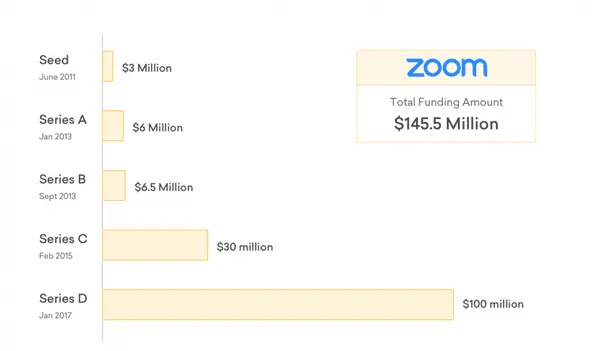
    Zoom is adored by its investors, making them one of the most important partners towards Zoom’s operation and success. Zoom has raised over $145.5 million via its series of funding rounds that stretch from 2011-2017.

    zoom funding
    Source: Freshworks

    Zoom was even termed as a unicorn company in early-2017, allowing it to attract $100 million in Series D funding from Sequoia Capital. Zoom filed for IPO in March 2019 and went public on 18 April 2019. By the end of the IPO, Zoom was valued at just under $16 billion (at $36 per share).

    Zoom’s Operating Model

    Zoom allows its users to –

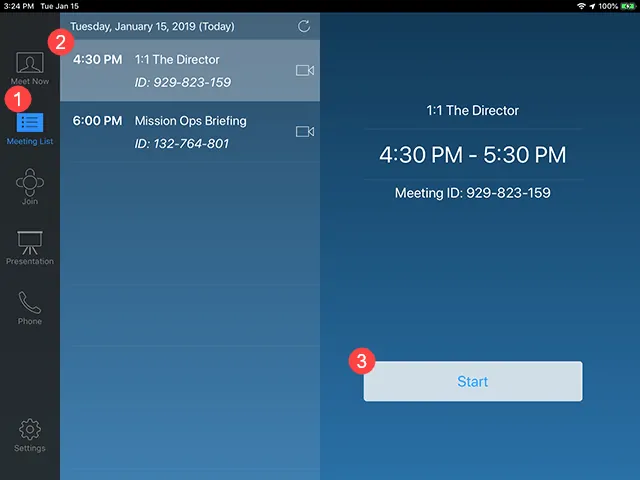
    1. Host & schedule Zoom video conferences with their contacts
    start zoom meeting
    Source: Zoom
  • Join a Zoom meeting
  • join zoom meeting
    Source: Zoom
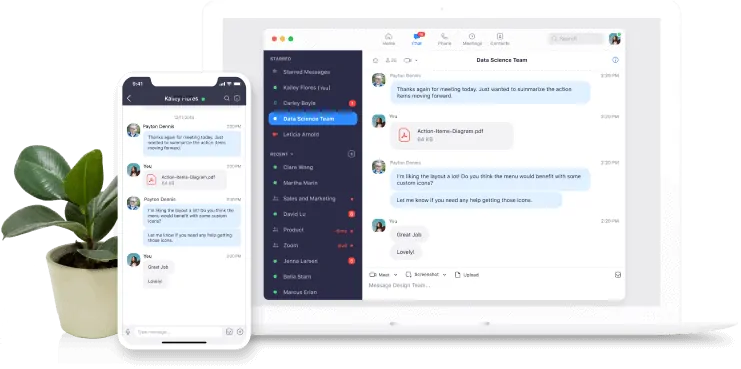
  • Chat with contacts from within Zoom
  • zoom chat
    Source: Zoom

    This raises the question –

    How does Zoom make money if it provides most of its services and features for free?

    How Does Zoom Make Money?

    Subscription Plans

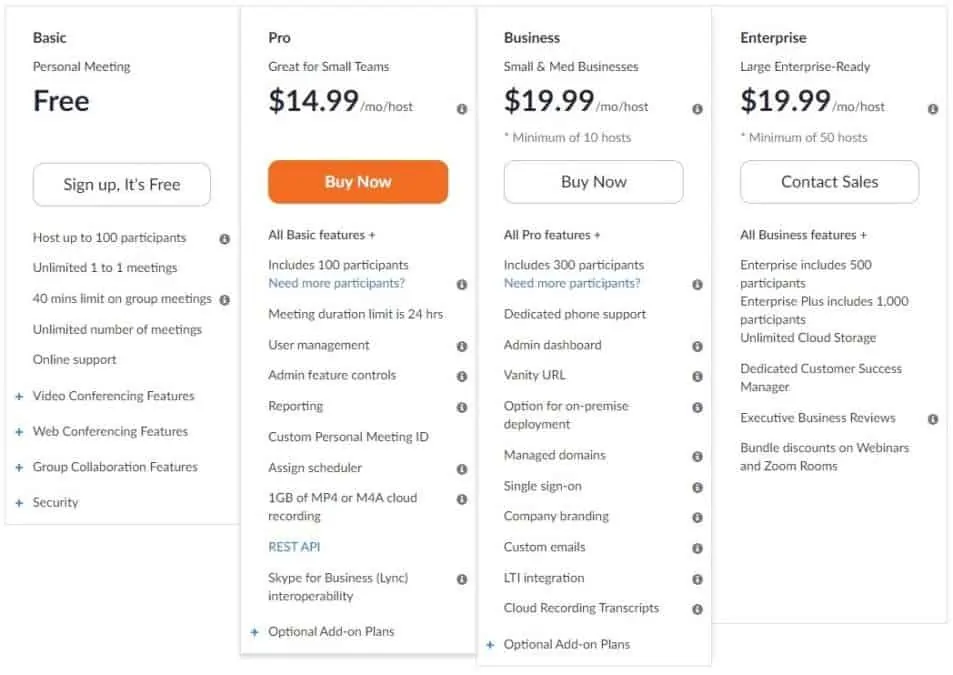
    Zoom earns most of its revenue from offering subscription plans with varying features. As of writing, Zoom offers 4 different subscription plans for its users –

    • Basic
    • Pro
    • Business
    • Enterprise
    zoom pricing
    Source: Zoom

    Zoom Basic

    The Basic plan is free to use and it allows its users to host up to 100 participants in a single meeting (video conference), unlimited 1 to 1 meeting, online support and additional features on video calls, web and group collaborations. The only limitation is that the duration of group video call is limited to 40 mins. Another group call with the same participants can be made only after a cooldown period of 10 minutes. Zoom’s Basic plan is more suited to personal use-cases.

    Zoom Pro

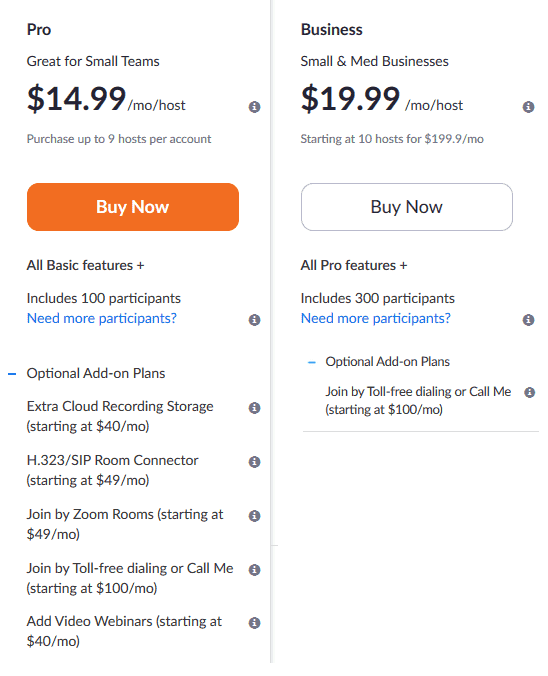
    The Pro plan is currently priced at $14 per month and carries over all the features provided by the Basic plan along with added benefits such as – group video call duration increased to 24 hours rather than 40 minutes, the ability to add more than 100 participants for a set fee, integration with Skype for Business and much more.

    zoom pro plan
    Source: Zoom

    The Pro plan is more suited towards professionals and small teams aiming to collaborate from their desired locations.

    Zoom Business

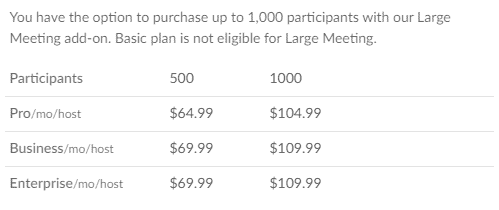
    The Business plan is currently priced at $19.99 per month and requires at least 10 members to be present in your team. As the name suggests, this plan is more suited for small to medium businesses. The Business plan carries over the features offered by the Pro plan along with lots of added benefits. The Business plan provides the ability to host video meetings with up to 300 participants by default (with the ability to add more by paying for it), dedicated phone support, custom emails, logins, URLs, domains and admin console.

    Zoom Enterprise

    The Enterprise plan starts $19.99 per month and requires there to be at least 50 members present in your team. As the name suggests, the Enterprise plan is most suited towards large businesses and enterprises. The Enterprise plan carries over all the features provided by the Business plan while offering newer ones better suited for large teams, businesses and corporations such as – the ability to have up to 500 participants by default, unlimited cloud storage, discounts, and bonuses on other Zoom offerings, analytics, tracking tools, and dedicated support staff.

    Add-Ons

    While Zoom offers most features that an average user might want out of a remote conferencing service for free, it charges for its set of add-ons which help add features such as video webinars, extra cloud recording storage and so on.

    zoom add ons
    Zoom’s various add-ons that are available only in paid tiers for a monthly subscription fees

    Free users will have to upgrade to Pro plan or higher to be able to access the add-ons. The add-ons are not bundled with the paid tiers and users will have to pay the monthly subscription fee based on the add-on they would like to use. As of writing, Zoom offers various solutions as add-ons under their paid plans and these usually are needed by enterprises and startups to collaborate and be productive such as –

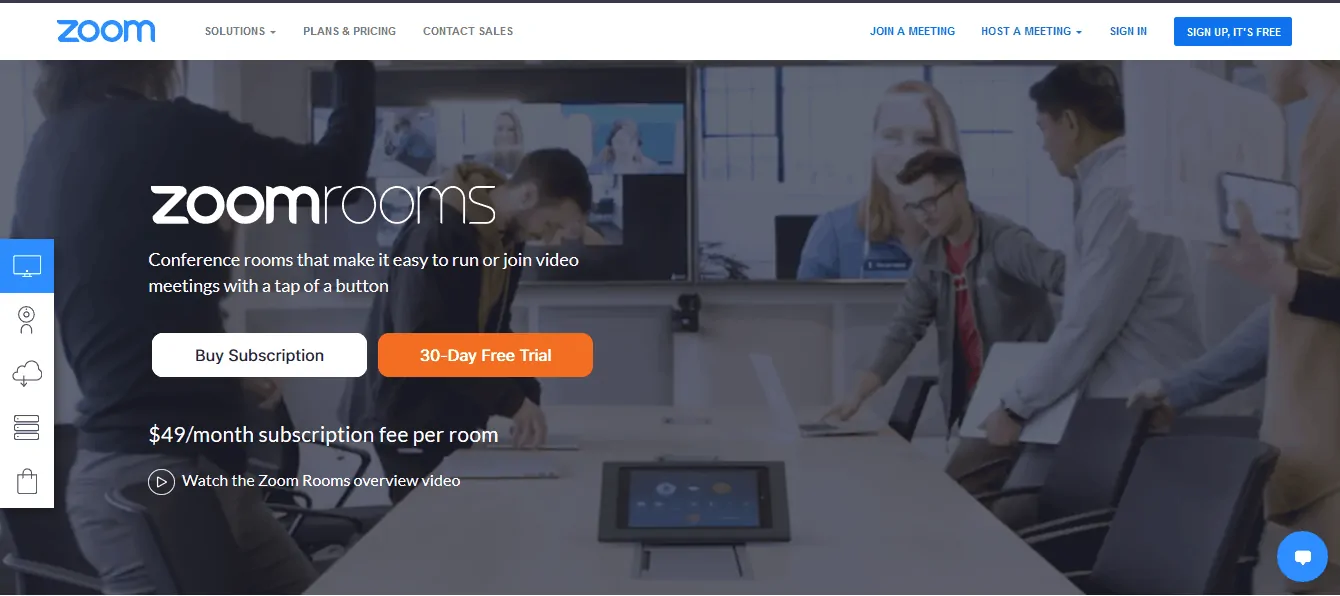
    Zoom Rooms

    zoom rooms

    Zoom charges $49/month/room to allow its users to be able to create dedicated Rooms for holding its conferences.

    Zoom Webinars

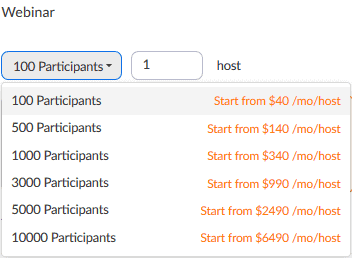
    Zoom users are not able to hold webinars by default and are required to be on Pro (or higher tiers) to be able to hold webinars. Zoom charges a monthly fee that starts at $40/month/host for hosting a webinar with up to 100 participants and goes up to $6,490/month/host for having 10,000 participants.

    zoom webinar

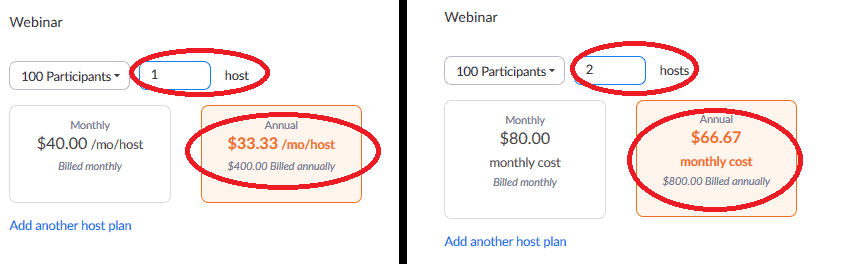
    Note: The rates mentioned above are for 1 host alone. If you need more than 1 host for the webinar, each new host will cost you around $33.33 on top of the existing rates mentioned above.

    zoom webinar pricing

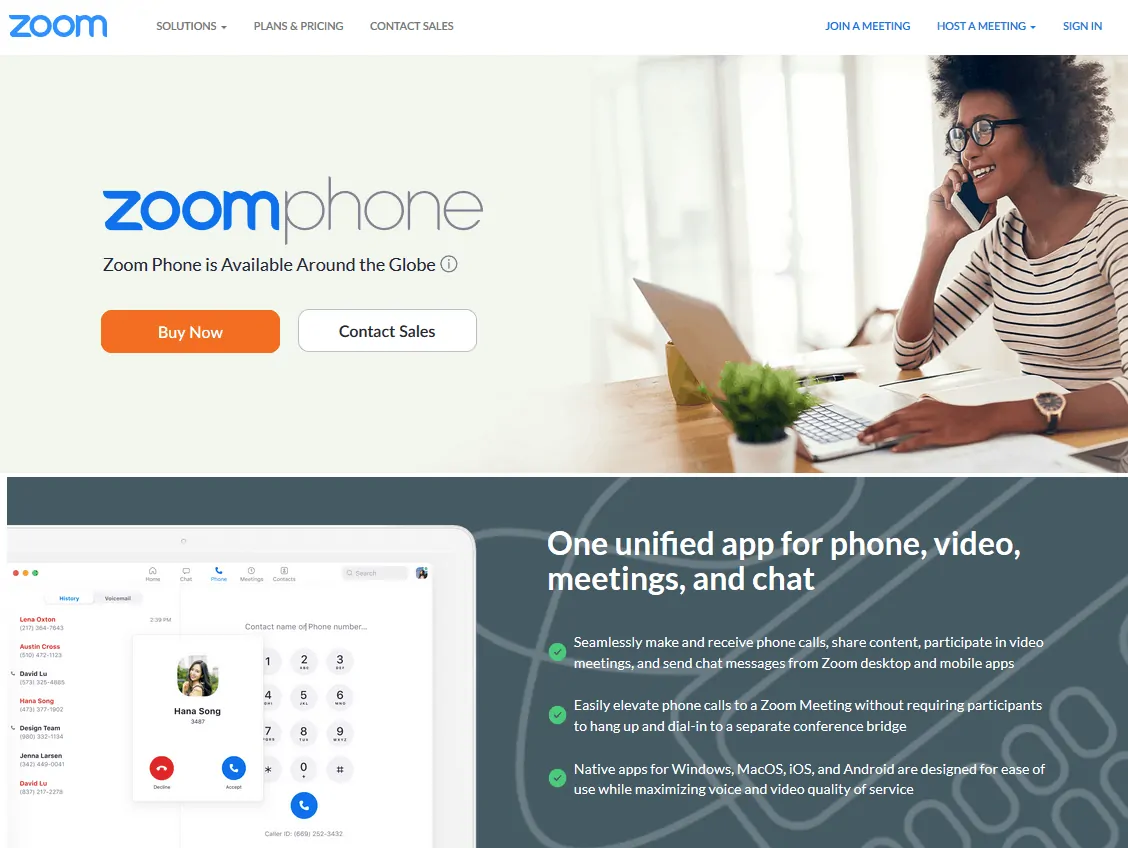
    Zoom Phone

    Zoom allows users to be able to make phone calls right within the Zoom app.

    zoom phone

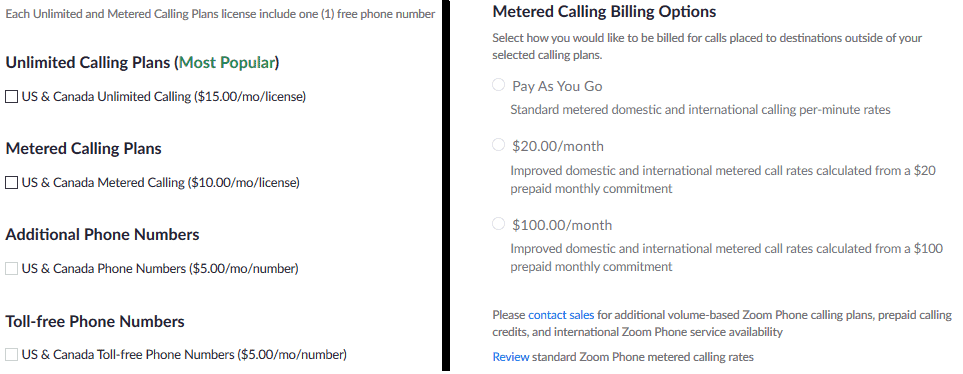
    Zoom charges $10/month for availing the Zoom Phone add-on.

    zoom phone pricing

    Apart from that, Zoom provides its US & Canada based users (exclusively as of writing) with the ability to opt for options such as unlimited calling plans, metered calling plans and additional numbers for an added fee.
    zoom phone us canada

    Bespoke Plans For Certain Industrial Sectors

    Zoom also offers a customized suite of its tools and services that is made to order for the following industries:

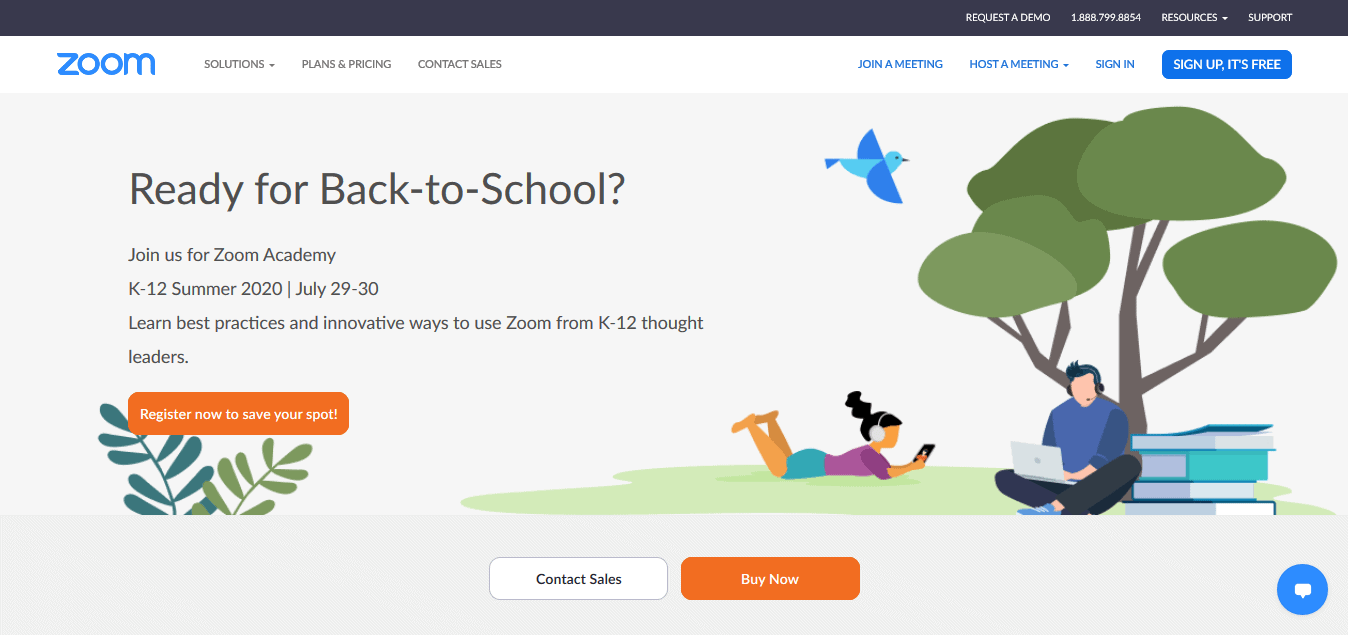
    Educationzoom solutions education

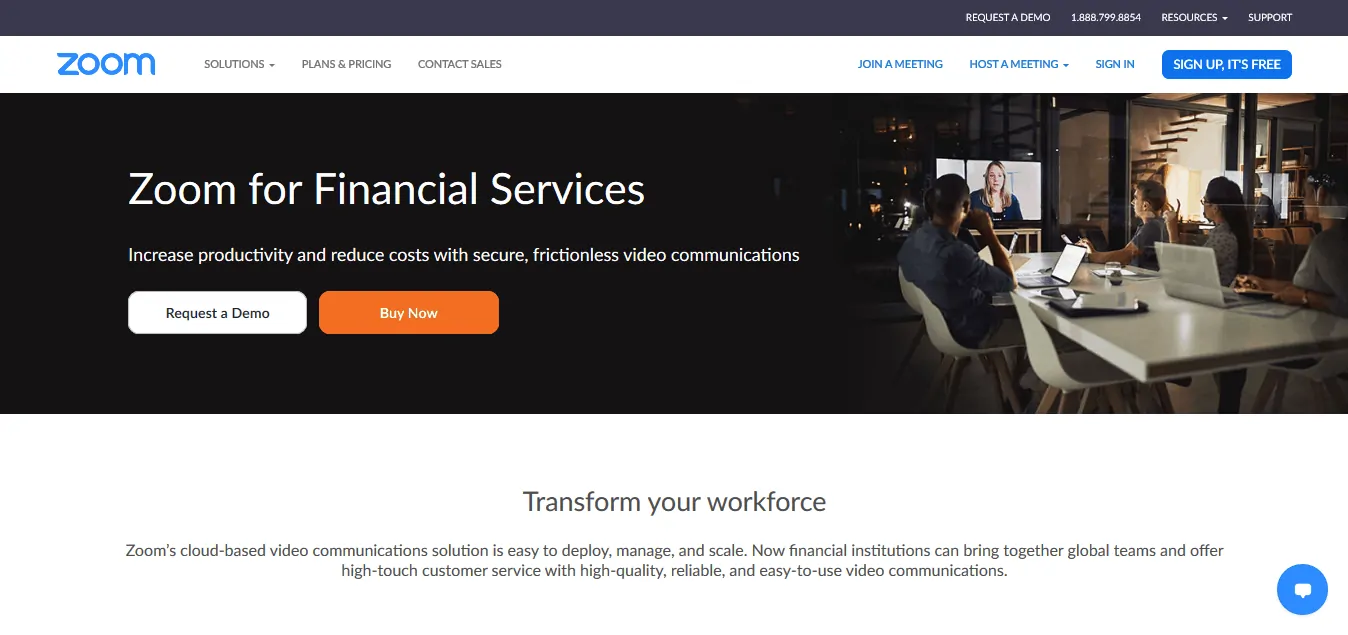
    Financezoom solution finance

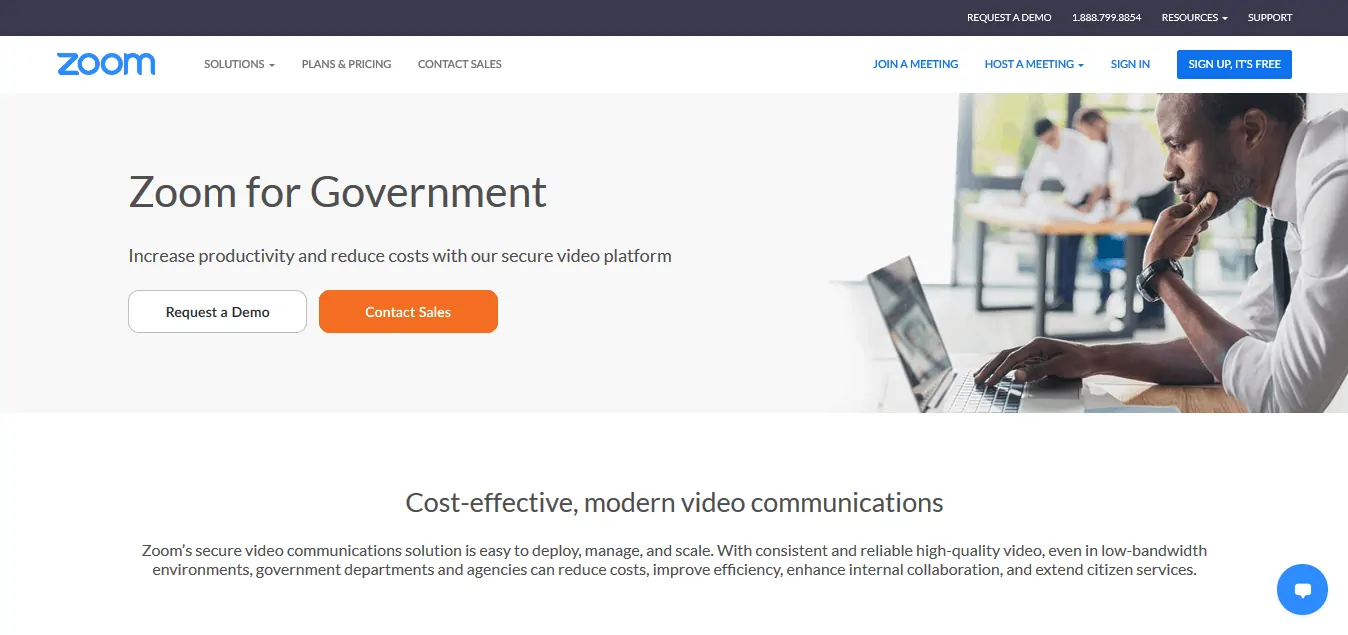
    Governmentzoom government solutions

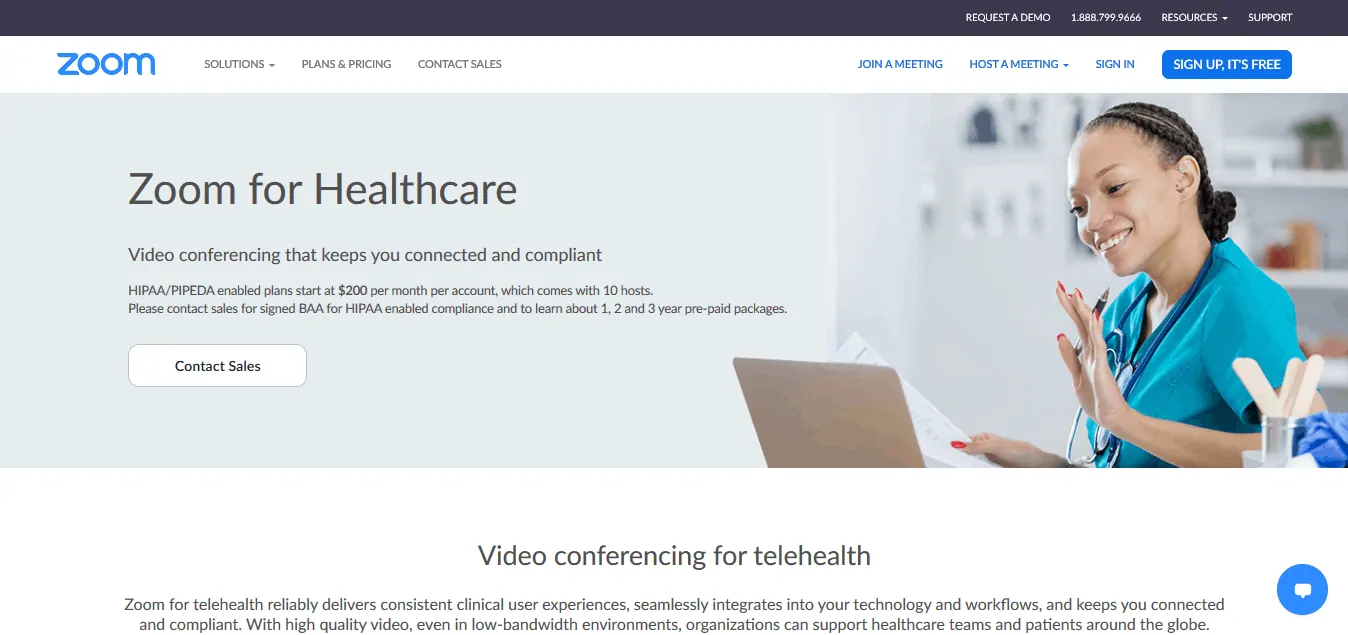
    Healthcarezoom healthcare solutions

    Zoom’s Rise to Popularity

    Zoom took off among the masses when people found Zoom and its free plan satisfied their remote working needs when the coronavirus pandemic which caused the shutting down of all businesses.

    But, even before work from home went viral, Zoom had been popular among the enterprise crowd. Zoom was being actively adopted by schools – since Zoom is free of charge till K-12 in lots of countries. This helped increase its word of mouth reach.

    Currently, Zoom has also become a social platform of sorts for people during the pandemic. People have started using Zoom to keep in contact with their loved ones, hold parties, and even weddings and ceremonies.

    But this raises the question –

    Why Zoom?

    The answer to that is quite simple –

    • Zoom’s Free plan – The free plan is almost fully-fledged, offering the same features as its competitors, but for no cost.
    • Reliability – People have come to like the simplistic and intuitive user interface. But most of all, they all have stuck with Zoom for one reason – “because it just works!”
    https://twitter.com/sriramk/status/1237524067629977600
    • Low Latency – Zoom’s videos try to stay under 150 milliseconds – since it is after 150 milliseconds that a conversation starts to feel unnatural – by optimizing the connection on per-device basis instead of focusing on the worst ones in the loop.

    Why Zoom Works!

    Over time, Zoom has managed to capture a large audience for itself by offering solid features and much-needed features for free for the general users while those looking for additional integrations and added features (usually enterprise or business use-cases) have to pay for them.

    The user base is so large that even a fraction of them opting to pay for Zoom’s paid plans and add-ons helps it covers its operating cost as well as earn revenue.

    Apart from the add-ons, Zoom also has its own App Marketplace (maintained by Zoom) from which users can install thrid-party applications to integrate with their Zoom services and workflow without much hassle. As of writing, there are no paid apps on the store, but Zoom could very well introduce paid versions of the apps which unlocks additional features to add it to their growing revenue stream.

    Go On, Tell Us What You Think!

    Did we miss something? Come on! Tell us what you think about our article on Zoom Business Model in the comments section.

  • Managing Gen Z Employees: A Detailed Guide

    Managing Gen Z Employees: A Detailed Guide

    If Gen Z employees are the latest hype at the workplace, then people who handle them are probably going to be the most successful employers ever.

    But what if they don’t want to be handled?

    Then, you start managing them.

    Well, easier said than done. Even though Generation Z is marking its presence across various platforms, hiring and managing them is still considered a gruesome business. Their need to constantly be socially connected and post everything on the web, get paid accordingly,  limited authority intervention and never to jeopardize social and cultural integrity has been frequently questioned by those in power.

    But, is there more to their emotionally hyperactive brain and how are they making significant contributions, after all, let’s find out.

    Advantages Of Recruiting Gen Z Employees

    Gen Z employees might have certain characteristics that seem to be very unprofitable at first, but when used properly, these features can help you grow your organization.

    Extremely Competitive

    Gen Z, unlike millennials, keeps a keen eye on their competitor and how they can combat extreme competition. They are constantly looking for better practices to enhance efficiency in the organization. This can help the organization to grow at an unprecedented rate.

    Entrepreneurial Mindset

    Gen Z experienced their loved ones getting affected by the great depression of 2008. This made them rely more on themselves and develop entrepreneurial skills. This skill set allows them to look for income sources in the most scarce conditions.

    In fact, according to research, More than 60% of school students prefer entrepreneurship over being employed by someone else. The primary reason for this sort of inclination is the high rate of dependency on jobs experienced by the millennials in the past. Getting a job straight after college did not only increased the competition but also increased the chances of landing with no job at all.

    They Are Influencers

    Gen Zs are not like any other generation of employees when it comes to impacting their environment. They are far more concerned about their workplace and they make sure that their voice is being heard. They are not looking for credits, all they wish to experience is a change in a positive direction. They would prefer thrift stores over high street brands, and won’t take a second call before calling out a brand for adopting unclean practices.

    Like it or not, millennial’s might be socially connected but they cannot still act as influencers on social media platforms. With a large following, Gen Z brings with itself an army of dedicated followers for your brand and make sure to display their influencer skills.

    Negligible Reservations

    Gen Z acts on emotions and is constantly discovering ways to find peace in what they do and once, they have found their drive, there is no looking back. They commit to their work, irrespective of the time it demands.

    One of the prime accusations levelled against Gen Z employees is the high pace of hopping from one job to another. This is because of a lack of satisfaction they derive from their work. Once they enjoy the tasks they are assigned, they can arch over their boundaries easily.

    They Are Waiting For Constructive Criticism

    Due to their competitive spirit, they value every constructive criticism that they can get hold of. They are not just dedicated, but make sure that they are headed in the right direction.

    Feedback once in a week enhances employee retention. Gen Z wishes to be heard and seen through their work, and feedback gives the same impression from the organization’s side.

    All these traits can be well embedded in a profitable organization if recognized and harnessed in the right way. Given below are some of the ideas which can be adopted by managers while handling this hyperactive generation of bellwethers.

    Effective Ways To Handle Gen Z

    Gen Zers had a tough time dealing with parents who had to face acute economic slowdowns. Further, the boost of the startup ecosystem provides hope for a better future.

    So, expecting them to do a job in the same manner as it has been done since the past 50 years is a blot on their superb capabilities. Here are a few quick ways to manage them effectively.

    1) Let Them Decide The Manner To Complete A Task

    As much as big brands want to hold onto their great grandfather practices, now is the time to start deviating from this strategy. Allow the Gen Zs to find their methodology or own process to do their thing. You can, however, pull the strings back while negotiating the time frame to assess their methodology.

    Head To Teamwork If Necessary

    If you are not sure about a particular employee, you can form groups that are headed by a senior employee. This will have a lot of advantages

    1. Communicating within a team working on the same task is much easier than turning to an entire organizational hierarchy.
    2. Employees will be able to recognize the importance of teamwork.
    3. It will save a lot of time as unnecessary doubts can be resolved within the group under a supervisor.

    Allot A Time Frame

    If your tried and tested method takes a month to yield results, then provide Gen Z employees with a time frame of 3 weeks to design the entire strategy. This will not only challenge them but also help them to work on their skills.

    However, managers need to put this idea on hold, in case they are dealing with a newcomer. Proper time should be given for them to understand the organization and how it operates.

    Ask Them To Stick To The Core Principle

    Organizational principles should be appropriately communicated while allowing Gen Z’s to devise their strategy.

    For eg, if they wish to increase the price of an essential commodity produced by the company’s during a food crisis, then the company’s price policy should abstain from doing so. Communicating this policy, hence becomes important.

    2) Go Flexible With The 8-Hour Schedule

    Millennials have always been wanting to get rid of this conventional on desk face time practice, which keeps an eye on the number of hours dedicated. Gen Zers are looking forward to putting their focus on productivity rather than the time dedicated to the job.

    Managers need to understand this trait and get a bit flexible with the timing.

    Sync In The Availability

    First and foremost, managers need to make sure that there is a proper communication channel between employees, task leaders and employers sometimes. Even if it’s not all the time, a common time of availability can help to clear major doubts and send all the necessary instructions.

    Work In Shifts

    Don’t allow all the employees to do work from home. Some shall stay put in the office, while others get the comfort of their house. The pattern and the employee can change each time.

    Schedule Days For Work From Home (Or Remote Work)

    For organizations working from office for years, shifting to ‘work from home’ criteria can impact the psyche of the employees. Hence, going for a few days of work from home can result in positive results rather than going full overboard.

    3) Diversity – Not A Goal But A Need

    Gen Z employees have been treading the borderlines since school. They intend to make friends beyond a certain group, region or nationality. Hence, to crave their need to identify with a diverse group, companies need to focus on engaging employees from all walks of life.

    Create Groups With Sufficient Diversity

    Forming groups that consist of members from different backgrounds can help the gen Z feel much more comfortable in their new space. This will also allow the entry of different perspectives for each project, which will be an insight for someone fresh.

    Honour Various Cultural And Religious Practices

    Floating holidays should be the new norm and employees need to be given the chance to celebrate and share various cultural and religious practices. This will promote a diverse culture in the workspace.

    Gender Pay Inequality Is A Strict No

    Gender pay difference is one of the chief reasons for women to either resign from their positions or give up completely. Equal pay will foster a strong work spirit among all the genders and will ensure proper coordination.

    4) Get Personal With Perks

    A universal pattern of offering greater time controls might have worked 5 years back. But, Gen Zers are not identical twins and their needs and wants to differ from each other, with so much on their plate.

    Hence, now is the time to start identifying what everyone wants from their job and start honouring those as perks.

    Steps to put this in practice include

    1. Start identifying the motivation behind every employee’s work
    2. Make it a part of the product strategy to gain more productivity from employees
    3. Ensure that the perks are communicated in advance to get positive results at the end of the day

    For instance, if an employee has a wedding to attend and needs extra pay, then you should allow him to work in advance or indulge in overtime and then pay him in advance for the purpose.

    However, a different employee might require a holiday for the same wedding purpose. You should then allow him/her to complete the assigned task in advance to attend the wedding.

    5) Explore New Areas Of Social Interaction

    If brands are ecstatic about how Gen Zers conduct their social gatherings online, now is the time to address this issue. A weekly informal dinner or a monthly social gathering for the employees and a few dignitaries might give them a chance to address their quench more effectively.

    Karaoke Night

    Even though this sounds purely informal, it will give all the employees a chance to look at the creative side of one another. Although, it is advisable to keep it at a bare minimum, organizing it can prove to be a major step in team building.

    Professional Workshop

    A workshop intended for a special purpose can help Gen Z’s feel much more included in the organization. This will also help them to expand their interaction across people of much expertise.

    Volunteer For A Cause Together

    Companies are already aware of their social responsibility. Even though these are for various causes, it’s time that firms start looking at it from an organizational perspective. Using the fund and volunteering for a common cause will help Gen Z employees to get some values from their millennial supervisors.

    They will also be able to understand how their day to day work is having a positive impact on their surroundings, leaving them with utmost satisfaction.

    Final Word?

    Gen Z employees are a huge asset to any company. They don’t just look out for new opportunities, but they can invent even more for others.

    Companies today’s, in such a globally competitive world, are much more sensitized about the requirement of such employees. Hence, it’s better to help them explore their avenue under your umbrella rather than letting them decide themselves, and then further increase competition in the market.

    Go On, Tell Us What You Think!

    Did we miss something? Come on! Tell us what you think about our article on Managing remote teams better in the comments section.

  • Manage Remote Teams Better: A Detailed Guide

    Manage Remote Teams Better: A Detailed Guide

    So you work with a virtual team with members spread across the globe.

    The problem?

    Oftentimes, it becomes difficult for you to coordinate with all your employees, and you’re not able to keep track of their productivity levels.

    The bigger problem?

    These problems seem to pile up.

    Here’s the deal:

    It is quite possible to find yourself overwhelmed by the challenges posed by working with remote employees. There may be issues in communicating exactly what you want, you might be unsatisfied with the quality of work, and, at times, you might be confused if you’re even allotting the right tasks or not.

    It can be difficult to maintain high morale amongst the employees and ensure productivity doesn’t dip.

    But fret not, here’s your guide on how to efficiently manage a remote team and overcome all challenges that come your way.

    Lack of Communication

    A lack of communication is evident when your employees seem unsure of the task they’ve been assigned. It might seem like some of your employees are uninterested in the task you give them, or someone might be withdrawing from work altogether. You may get unsatisfactory reports or start to lose confidence in the quality of their work.

    So, how can you overcome this?

    #1 Use Project Management Apps

    Project Management Apps make planning and execution easier. It leads to more clarity in the work assigned and ensures projects are delivered timely. This way, your employees stay in the loop and also stick to their deadlines.

    Some easy to use Project Management Apps are Hubstaff and Trello.

    These tools allow you to create a board and sort all the tasks you wish to complete by a stipulated deadline. You can create individual boards with your employees and, this way, keep track of how far along they are with the assigned task.

    You can create a board with all your team members where everyone can see each other’s work. This will also lead you to equally distribute the work.

    Using such applications instils a sense of discipline and seriousness regarding the allotted task as your employees are aware that you keep track of the work they’re doing.

    #2 Create a Communicative Environment

    As a leader, you should lead by example. You need to create a virtual workplace wherein everyone is comfortable putting forth their views. Be an approachable leader and make yourself available. Use online chat tools like Workplace and Slack.

    These are casual, less formal platforms that allow you to build a rapport with your employees and cut down the need for back-and-forth emails and frequent meetings for approval of small tasks.

    #3 Notice The Levels of Participation

    It is easy for employees to disconnect from work when there are no daily in-person interactions. You must always look for signs of withdrawal to make sure your employees don’t feel lonely or secluded.

    The following are certain indicators that your employee is withdrawing:

    • Someone who is usually vocal in meetings has suddenly stopped participating as much
    • An employee might be working extra hours a day to prove himself. Overwork can be very stressful and is a leading cause of burnout. It can cause people to pull all-nighters to complete the work and develop an improper sleep schedule and other health illnesses.

    Wait until after one task is completed to give another task. This way, you lower the pressure on your employees. Moreover, trust your instincts and reach out to employees who you think might be withdrawing. Humanize the work environment and be more empathetic towards your employees.

    #4 Enthusiastic Response

    Mutual trust develops when your employees are appreciated and feel valued. This is rather easy to put into action. Following are simple ways by which your employees develop an emotional connection with the company:

    • Celebrate occasions like birthdays, anniversaries, etc.
    • Commemorate years of service.
    • Offered paid leaves during times of emergency.

    Inefficient Scheduling

    If your employees are spread across different time zones it can get difficult to decide on one time that is convenient for everyone. If such is the case, then –

    1. Divide your employees into groups based on their time zones
    2. Schedule a meeting with one group, record it and share the same with the other group, asking for their input.
    3. If you think you can manage two meetings with both groups, incorporate that instead. Otherwise, you should alternate between the groups for meetings.

    If it is favourable for your employees to work together then schedule meetings at a common time. You obviously can’t expect your employees to work from 9 to 5, instead, create a routine with shorter work hours. For example, you can schedule a meeting for your employees three days a week from 9 am to 1 pm EST and 8 am to 12 pm CST.

    Low Productivity

    Low productivity is a very common issue that many managers like you face when they work with remote teams. Make sure you ask these questions often –

    • Are you certain you know how efficiently your employees are working?
    • Are you giving them enough work or overburdening them?
    • Are you sure you’re not underutilizing them?

    #1 Use Productivity Tracker Apps

    You need to be able to trust your employees when you assign them to work, but at the same time, you need to keep track of the work they’re doing. Using Productivity Tracker Apps allows you to easily check their progress and holds them accountable for the output at the end of each day.

    TimeDoctor is one such application which you can use. It allows you to calculate –

    • Attendance
    • Task the employee is currently working on
    • Task allocation based on their productivity level
    • Sites they visit
    • Number of times they log in and out

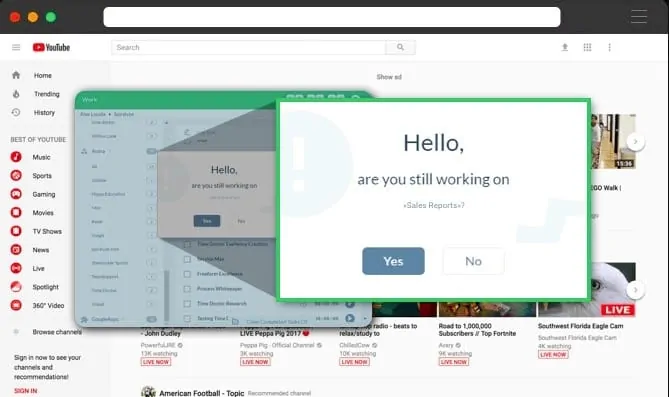
    Used by companies like Apple and Verizon, TimeDoctor ensures employees stay focused and don’t waste their time on social media and other websites. In case they do, a notification like the following pops up on their screen.

    timedoctor

    TimeDoctor Chrome Extension also works with Trello Cards, and you can keep track of how much time each card takes to complete.

    #2 Monthly Performance Appraisal

    A regular monthly performance appraisal has the following benefits –

    • Makes employees feel included and valued
    • Identifies areas for improvement
    • Motivates employees

    You should evaluate your remote employees on the basis of the quality of their work and output. Give them honest feedback, and also remember that it is a good opportunity for employees to talk about any issues they might be facing in their professional life or personal life.

    Often, especially with remote teams, work can take priority above all else and discussions on career opportunities can be easily forgotten. Discuss the future of your employees and take the time to understand what their expectations and goals are.

    Performance appraisals are very important but often neglected, especially in bigger firms. They boost morale and give the employees time to sit back and reflect upon their role in the company.

    Go On, Tell Us What You Think!

    Did we miss something? Come on! Tell us what you think about our article on Managing remote teams better in the comments section.

  • You Have An Idea, What Next?

    You Have An Idea, What Next?

    You have an idea, a wonderful one, one that can disrupt an entire industry. But now you don’t know how to move ahead and convert it into reality.

    Well, don’t worry.

    You’re not alone in this.

    The path just ahead of ideation is often blurry to many, mostly because you lack experience, you lack guidance, and because it often involves stepping out of your comfort zone.

    But before moving on to discussing how you can convert this business idea into reality, let’s discuss what completes an idea first.

    What Completes an Idea?

    Your business idea is said to be complete when you have an answer to these four questions –

    What Is the Problem?

    A problem is the spine of an idea. Your business idea should be a result of a problem, not that you thought of a solution and now looking for a perfect problem where it fits into.

    Remember the latter often fails.

    Now, pinpoint the exact pain-points that you want to heal.

    It’s as simple as – “waiting too long for the groceries to get delivered”, “Waiting in long queues to get into the restaurant”, etc.

    Who Is Facing The Problem?

    This is your target market. Narrow it down as much as you can. The answer to this question shouldn’t be limited to phrases like “working men”, “housewives”, “daily wagers” etc. But this answer should define the persona of the group that you wish to target.

    Make sure you have an answer like – “A 20-30 years old unmarried men working in an MNC who drives to work every day”

    Now, suppose I have an idea to open a book compilation and publishing company for bloggers and hobby writers.

    Of course, my target market would include bloggers and hobby writers. But I have to be specific in whom I want to target.

    I would have to find a perfect niche first – say sci-fi.

    Then I’d have to narrow down to the preferred language – let’s keep it English.

    And then, to make my work easier for the start and get more conversions, I would only choose bloggers and hobby writers with a blog or a social media page with a followership of at least 5000.

    So that makes – Sci-fi oriented hobby writers who have an English blog with at least 5000 followers.

    What Solution Are You Selling?

    Now that you have a problem and you know the person who faces the problem, defining your solution becomes very easy.

    All you need to do is to solve the problem.

    Mind it,

    This solution forms the base your startup stands on.

    Don’t layer it much. I’m not talking about how you’ll offer your solution but just how are you going to solve the problem.

    A solution for Coca-Cola would be – “a tasty way to quench thirst”

    That’s it.

    Keep it this simple.

    Why Would Your Customer Buy Your Solution?

    Now, this can be as simple as “because water is tasteless and my target audience often looks for a tasty solution to quench their thirst”

    Or just

    “My app gives them an option to break the queue and get into the restaurant before anyone else for just $5.”

    Answering these four questions completes your idea – an idea you think people will pay for.

    The next includes testing it for its credibility.

    Converting The Idea Into A Concept

    Before we start, let me break this to you.

    A concept is very different from an idea. While an idea is just a thought in your mind, a concept is a well-defined idea that has been tested for its credibility.

    So, to convert your idea into a concept, you have to validate your assumptions you mentioned above.

    This is an interesting process. It involves you to go out and ask just three questions from your target audience.

    1. What is the job the customer wants to get done? (Let’s say you get the answer of – managing remote employees better)
    2. What benefit does he/she seek from getting the job done? (Making information exchange, managing, and controlling easier and at one place)
    3. What’s preventing him from getting the job done? (no one-stop platform to fulfil all the managing needs)

    Next, it is your turn to answer some questions –

    1. What’s do you offer and how does it help the customers to get the job done? Keep in mind the customers’ answers while answering these questions. (For the problem of handling remote workers, let’s say your product is a one-stop SAAS platform focused on remote work)
    2. How does it help the customers to achieve their gains which they just mentioned? (This platform has project management features, time worked analysis, auto reminders, video conferencing features, and is available for both desktop and mobile)
    3. And how does it relieve their pains? (it’s a one-stop solution for every remote-work need and the user doesn’t have to switch among four to five platforms just to manage a single employee)

    And half of your work is done. You now have a concept that fits perfectly to your target market’s needs.

    But will they pay for it?

    If yes, how much?

    And how would they like it to be served?

    To know this, you’ll have to make many more assumptions. And then you’ll have to validate them.

    Validate Your Assumptions

    The activity we did above is called filling up a value proposition canvas which focuses on customer profile and value map. It helps you develop what is actually required in the market, develop an offering which actually gets the job done, relieves the pains, and helps gain whatever the customer wants to achieve.

    But oftentimes, even value proposition canvas results in false assumptions and even this proof of concept often fails.

    Let’s say I really want to start the same remote work managing platform we talked about before.

    Now, even though I have validated that there’s a need for such an online platform, there’s no surety that the customer will use it or pay for it.

    Why, you ask?

    Maybe because the customer is too habitual of using Zoom as a video conferencing software or maybe all of his team members are on Trello and are not willing to move on to try another tool.

    Now, this is a competitive barrier because of the network effect.

    A network effect is the increased value of an offering when more people use it. For example, even though WhatsApp lacks several internet messaging features, it is very valuable for its users because their contacts are already using it.

    Even if I launch an IM with better encryption and features than WhatsApp, it’ll be very difficult for me to get those customers to leave WhatsApp and try my app. Many won’t even try it just because their friends are not on it.

    So, if you get me here, validating the actual market need for the product is very important before you go on to convert your idea into a full-fledged product.

    And you do it by launching an MVP.

    An MVP or the minimum viable product is the first saleable version of your product designed with minimum yet sufficient features to satisfy early adopters and to validate the assumptions of usability and demand basis on which the final product is developed.

    In simple terms, you launch a very basic version of your product which just helps the customer to get his job done without any frills attached.

    For the remote work platform, I might just use an available video conferencing API and combine it with very basic project management features (like Trello’s free version) without investing much on servers. It’ll be an offering just big enough so as to get around 50-100 users on board and try it, understand what I’m offering, and give me feedback.

    Remember this phrase when you start building your MVP – Minimum Effort, Maximum Learning.

    You don’t have to launch the final product as an MVP, just launch a viable product which gets the job done, and which is saleable enough to understand whether the customer will pay for it or not.

    Now, there are three types of MVPs that you can choose from –

    Concierge MVP

    In concierge MVP, instead of coding or building an automated offering, you do the operations manually.

    It prevents you from wasting time building something no one would actually pay for.

    Suppose you want to launch a dating application which matches people according to their answers to weird questions like –

    “Donald Trump’s nose looks like a carrot, beetroot ginger, or a turnip”

    Now, you know the bases you’ll use to match the profiles. But instead of coding the algorithm, you launch an MVP where you manually use those bases to match profiles and see the response.

    The hypothesis is that people would like matches with equal weirdness.

    If things don’t work out, you change your hypothesis and try again.

    In the concierge type, you often tell the customers that you do things manually and even take feedback to understand their behaviour and requirements better.

    Doing things manually helps you validate your most important hypothesis of –

    • Whether the target audience will use it, whether they like it, are you doing it right, etc. and
    • Whether they’ll pay for it

    Wizards Of Oz

    Wizards of Oz works just like the concierge MVP where the automated part is replaced by a human. However, you never tell your audience that the tasks are done manually. You make them believe that it’s an algorithm and test how they respond to you your solution.

    In simple terms, the user thinks that he is interacting with an automated product, but in reality, a human is doing all the tasks and pulling all the levers manually.

    The only difference between concierge MVP and wizards of oz is that, instead of validating their behaviour and choices, you validate your solution in using the Wizards of Oz MVP.

    Suppose you want to launch an AI-powered gift recommendation platform. In such a platform, what matters the most is the recommended gift. People don’t care if the work is done by human or artificial intelligence.

    That’s when you use wizards of Oz MVP.

    Piecemeal MVP

    Sometimes, there are cases, when the tasks can’t be performed manually, where you need something coded or automated to work for you.

    That’s when piecemeal MVP comes into play.

    It is a way to test a product in the market by investing a minimum amount of money (or even nothing). Usually, existing tools and solutions are used to deliver the offering in a piecemeal MVP.

    For example, using a Wordpress website to test an eCommerce store rather than investing in it before the actual market is validated.

    Groupon did this.

    The platform was launched on WordPress, a free CMS, and used emails and existing tools like Filemaker to generate PDF versions of coupons.

    The founders validated whether the user would pay for coupons or not, succeeded in it, and invested in their platform after that. You know what followed and how successful the company is today.

    Similarly, to validate your concept hypotheses, you can develop your own MVP. But just keep in mind to –

    • Invest as less as possible, and
    • Learn as much as possible about your target market because this is your offering’s first encounter with it.

    Once you’re confident that the product is needed in the market, it’s time to build a business model that will last long.

    Go On, Tell Us What You Think!

    Did we miss something? Come on! Tell us what you think about our article on startup idea in the comments section.

  • Understanding Apple Business Strategy

    Understanding Apple Business Strategy

    Based in Cupertino, California, Apple is an American multinational company that designs and sells consumer electronics, software, and services. Apple’s iPhones helped spark the dawn of the smartphone-era and have revolutionized the way the world sees phones.

    Apple’s business strategy, though simple, holds up to date and has played a major role in helping Apple become the first-ever company to reach the trillion-dollar valuation.

    apple trillion
    Source: Statista

    Apple’s business strategy can be easily understood by knowing the type of products and services they provide.

    Let’s find out.

    The Business of Apple

    Apple was founded on 1 April 1976 by Steve Jobs, Steve Wozniak, and Ronald Wayne, and bought innovation to the table in form of their rendition of what a personal computer should look like with the Apple I.

    Apple continued producing quality and perfectly engineered products, with an emphasis on design and aesthetics. Apple primarily made desktop systems and hardware accessories related to it for a while and soon diversified into making other consumer electronics such as laptops, PDAs, music players and such.

    Their first major success of the new millennium was the iPod – which wholly embraced all of Apple’s design philosophy and set stage for its future products. The revolutionary iPhone was launched in 2007. With resounding success, Apple once again redefined the public’s perception of the smartphone.

    To put it in short, Apple has brought about –

    • The revolution of the PC industry
    • Introduced mouse and graphical user interface to consumer products
    • Innovated the music player
    • Launched the smartphone revolution
    • Bringing innovating technologies that set trends for the rest of the industry

    Here are all the products and online services that Apple currently provides –

    apple products
    Source: Macrumours
    Products
    Services
    • iPhone
    • iPad
    • Macintosh
    • Apple TV
    • Apple Watch
    • AirPods
    • HomePod
    • iPod
    • Beats products
    • Apple-branded and third-party accessories
    • Digital Content
    • iTunes Store
    • App Store
    • Apple Arcade
    • Mac App Store
    • Book Store
    • Apple Music
    • iCloud
    • AppleCare
    • Apple Pay

    Apple is among the leading electronics manufacturers in the world with profit margins and revenues that put most major businesses to shame. Apple became the first “tech” company to reach a trillion-dollar market capitalization value in August 2017.

    There are only five other companies to have made it to the trillion-dollar list, which brings us to –

    What is Apple’s business strategy that has led them to become such a successful company?

    Let’s find out the operational tactics of Apple which have helped them list as one of the market leaders in the technology and electronics industry.

    Apple Business Strategy

    Apple Ecosystem

    Apple has always designed, developed and manufactured its hardware and software in-house. This innate advantage helps them create a deeper level of integration between its hardware and software – between for all of its devices.

    Here’s an example –

    Say, you buy an iPhone. You soon start using a few of its online services such as iCloud for storage. Herein lies its brilliance – the hardware, software, and services on the iPhone are so well designed and intuitive to use that you soon fully embrace it. Once you do, it leads you to create a good image and also only the rest of Apple devices can use the services.

    This makes you buy their laptops and other hardware that plays well with one another. This extends to their accessories as well – the recent line of iPhones have removed the headphone jack which makes people buy more of Apple’s wireless AirPods earphones.

    apple ecosystem
    Source: TechRestore Blog

    This strategy has helped Apple create an environment or “ecosystem” that offers a consistent and great experience to its users.

    Customer Relation

    Apple has always made a major point in providing stellar customer service and has been able to facilitate this with its AppleCare service and by employing knowledgeable sales and service personnel to cater to the customers in need.

    applecare plans
    Source: Apple

    This has helped Apple set itself apart from the rest of the competition in terms of customer relations and support, increasing its brand loyalty. Apple has made it a point to focus on providing the best quality of service to its consumers and this has been reflected in the increased chance of customers sticking with Apple.

    Apple also builds upon this with their purpose-built Apple Stores, which are mostly situated at prime locations, allowing customers to experience Apple products before making the purchase.

    apple store fifth avenue
    Source: Apple

    The Apple Stores also help have much finer control over the customer experience and apart from showcasing Apple products and devices, Apple Stores double up as service centres.

    Form Over Function

    One of Apple’s main strategies when it comes to product development lies in its ability to provide well-designed products and services – with emphasis on minimalism, clean lines, and solid tones.

    apple design
    Source: Medium

    But it can also be said that Apple has made it a point to focus on design and aesthetics over performance when possible.

    The recent Macbook (laptop) lineup is a great example of this. Apple has sacrificed heat dissipation capabilities and has included a thinner keyboard – which is riddled with issues such as not working in case the slightest of dust getting in between the keys – all in the pursuit of maintaining a thin and sleek design.

    But this strategy has still worked out fine and in favour of Apple. The average consumer mostly prefers thinner and quieter laptops.

    Brand Differentiation

    Apple’s brand strategy and marketing strategy have always made it a point to promote itself as a luxury brand while focusing on differentiating itself from its competitors. Apple makes sure that it puts forth the following brand image – Apple competes against itself and not against others. This helps Apple in achieving its desired brand image and recognition.

    apple brand
    Source: Apple, SHOUTS

    Consumers anyway tend to presume this is because Apple has built its reputation as a manufacturer of well-built premium products.

    Customer Privacy

    Apple has always made it clear that it values customer privacy and has shown to handle its customer’s data much better than the rest of its competitors.

    apple privacy
    Source: Apple

    During CES 2020, Apple’s senior director for global privacy mentioned Apple’s take on privacy as –

    • Minimize the amount of personal data collected from its users.
    • Providing highly secured cloud storage (iCloud)
    • Providing tools for users to be able to maintain their privacy

    Final Thoughts

    Apple’s main strategies are as follows –

    Apple uses product development and market penetration as its main intensive strategy for growth.

    Apple’s product development revolves around creating clean and premium products that are quite timeless and appeal to a wider audience while their market penetration strategy can be summed up as distinguishing themselves from the rest of the competition, providing an air of distinction and recognition for their products.

    Their exceptional customer support and the seamless integration between their products are icing on the cake which helps Apple firmly hold its place as one of the market leaders in the technology and consumer electronics industry.

    Go On, Tell Us What You Think!

    Did we miss something? Come on! Tell us what you think about our article on Apple Business Strategy in the comments section.

  • Customer Segmentation – Definition, Types & Examples

    Customer Segmentation – Definition, Types & Examples

    Ever wondered why websites give away time-bound offers specifically to first-time customers or specifically to long-term ones? Why do companies choose to have loyalty programs at all? Why do students get different offers on Windows and office users to get different offers?

    The answer lies in the technique of –

    “customer segmentation”

    Unless a company has a really low number of customers, it is neither possible nor feasible to cater to each and every customer individually. And even if it wishes to remain a small business with a focused customer base, making each of its customers feel connected and personal with the brand is a goal that’s hard to reach.

    Customer segmentation is a marketing strategy which helps in that.

    What Is Customer Segmentation?

    Customer segmentation refers to dividing the target market into manageable and feasible groups according to shared characteristics to develop effective and appropriate business strategies.

    In simple terms, customer segmentation is the process of dividing the existing customer base into manageable and feasible groups based on common characteristics such as age, gender, loyalty, frequency of purchase, etc. to target and develop marketing strategies for each group according to its characteristics.

    The objectives of customer segmentation include dividing the target customers into smaller groups that reflect similarity among customers in each group to –

    • Develop better relationships by understanding the needs of every customer segment
    • Identify valuable customers
    • Identify cross-selling and up-selling opportunities
    • Improve profitability by developing more effective marketing strategies for each segment

    Types Of Customer Segments

    Developing appropriate customer segments based on consumer preferences can aid tailoring marketing communication effectively. There are three main approaches to customer segmentation. These are –

    • Priori Segmentation: This segmentation type uses publically available characteristics information like industry and company size to create distinct segments of the customer base. Usually, demographic segmentation comes under this approach of customer segmentation.
    • Needs-Based Segmentation: This type of customer segmentation relies on differentiated and validated drivers (needs) expressed by the customers for the offering. Lifestyle segmentation and value/benefit segmentation come under this approach of customer segmentation.
    • Value-Based Segmentation: This segmentation approach segments the customers based on their economic value to the company. New customers and existing customers segments fall under this type of customer segmentation.

    Demographic Segmentation

    Under demographic segmentation, customers are divided into specific categories of age, gender, income, location, ethnicity, education, occupation, etc.

    This type of customer segmentation works on a notion that what interests a single, 18-years-old college student will be different from what a 50-years-old lawyer, married with two children, would find interesting.

    Lifestyle Segmentation

    Lifestyle segmentation includes segments based on the customers’ activities, opinions, and interests. Here’s an example –

    Customer
    Activities
    Opinions
    Interests
    A
    Practising law
    Feminism
    Cooking
    B
    Social gathering events
    Public welfare
    Drawing/Painting

    C

    Marine diving
    Environmentalist
    Adventure sports
    D
    Sleeping
    Self-centred
    Fashion

    The above table gives a crisp picture of what kind of communication strategies would work to help get hold of each of the respective customer. For instance –

    The following customer loyalty rewards should work better for the corresponding customers:

    Free recycled backpacks – Customer C

    Free fashion magazines – Customer D

    Another great example of lifestyle marketing is Mountain Dew’s “Dewnited States” campaign. Mountain Dew communication is oriented towards a consumer segment that prefers adventure, risk, and thrill, of between 18-30 years probably.

    https://www.facebook.com/mountaindew/videos/492509258211691/

    Value/Benefit Segmentation

    Value or benefit segmentation refers to creating segments of customers based on their value perception from the product/service sold by a company. In simple terms, in this strategy, the company divides the segments based on the value, benefit, or advantage consumers believe to perceive when they consume the offering.

    A few important things to note here:

    • This kind of segment only works for existing customers/recent customers, but not new ones.
    • Value segmentation requires substantial analytical insights about consumer behaviour from the point of contact with a brand until the consumer makes a purchase/leaves.

    Examples of value/benefit segmentation could include customers who:

    • Try to maximize value
    • Try to seek benefit
    • Are reluctant aspirers
    • Are heavy spenders

    New Customer Segment

    A company/brand may choose to segment its consumers on a ‘new versus existing’ basis too. In such a case, the new customer segment would include:

    1. A new customer who hasn’t made a purchase
    2. A new customer who made a few purchases (1-2) recently

    Within the ‘new customer segment,’ often the focus is on what means did the customer use to come across the product in the first place.

    new customer segment

    Next, it would include a sub-segment of the ‘level of engagement’ that the user had with the website, salesperson, application, etc.

    Existing Customers

    A new customer, when appropriately nurtured, usually converts to an existing customer. Existing customers are loyal to your brand. They are further divided into sub-segments of the frequency of visiting or buying, and the reason for buying.

    The Importance Of Customer Segmentation

    Customer segmentation has a significant impact on customer management. Dividing customers into different groups that are based on common characteristics and needs helps to market to every segment distinctively and effectively. It also helps to focus on the needs of each kind of customer at any given moment. Whether large or small, niche customer segments can be targeted based on the resources or needs of the company.

    The following section details the benefits of customer segmentation, and in turn, how any company can grow using customer segmentation:

    Increased Competitiveness

    Customer segmentation strategies permit a company to emerge as an active, assertive, and even aggressive business. It is quite the opposite of the “spray and pray” method wherein brands create adverts and marketing campaigns but merely sit back and “hope” for customers to be attracted.

    The idea here is that once a company is well-versed with its customers’ profiles, it’s more likely to rightly ascertain what they need.

    A resultant rise in sales numbers and revenue, in turn, will transform the company into owning a larger chunk of the market share. With that, the company would naturally become more popular and therefore cause a rise in its brand equity.

    Ability To Expand

    Next, customer segmentation allows growth not merely in a spatial sense but strategically too. A spatial/physical sense because one will be able to cater to the right customer and turn to areas populated by those who suit one’s present customer base.

    Think of Apple – the world’s first $trillion company. At first, it started as a California business partnership. When the company became financially prepared to expand, it began as its services in other metropolitan areas across the country.

    How?

    Well, Apple segmented and targeted a specific market, gained its trust and loyalty. That trust and loyalty converted into revenue and enabled Apple to expand its customer base.

    Increased Customer Retention

    With the trust of customers, comes loyalty.

    The most obvious reason for this link is the brand experience – because a respective brand has been helpful in the past by catering to exactly what the customer needed and is expected to do so in the future too.

    But there are reasons, less obvious and much deeper than that.

    Successful customer segmentation will permit the maintenance of a connection with the customers post-sale.

    Through segmenting customers into precise subsets, formulation of what else can be offered (additionally) to indicate the company’s enthusiasm about serving their wants and needs, becomes easier.

    By doing so, there is an increase in the likeliness of them returning when they need something in the future.

    Price Optimization

    Through customer segments of financial and societal status, it becomes much easier for a brand to offer a product or service at a price that will be considered reasonable.

    Therefore, the optimization of the price of the product will help ensure that customers get the greatest value for their money, as well as ensure that the company produces the maximum sum of revenue possible.

    Customer Segmentation Examples

    Customer segmentation is a fact of many industries. Companies segment their customers to sell better, serve better, and maintain better relationships. Here are some examples of customer segmentation experienced in known industries –

    Banking

    Banks segment their customers based on their economic status and their relationship with the bank. Such segmentation helps the bank to send personalized communication to upsell and cross-sell.

    The segmentation also helps it to develop a more effective marketing strategy which focuses on the exact needs of every segment.

    E-Commmerce

    Ecommerce websites segment their customers according to which stage of the sales funnel they are on. This helps these websites send more effective communication messages (SMS, emails, push notifications, etc.) to make them move ahead in the funnel.

    Online Games

    Online games, often freemium ones, segment their customers according to their activities in the game. This helps them find customers which are more likely to convert and conduct micro-transactions.

    Go On, Tell Us What You Think!

    Did we miss something? Come on! Tell us what you think of our article on customer segmentation in the comments section.

  • Brand Recognition: Definition, Importance, Levels, & Strategies

    Brand Recognition: Definition, Importance, Levels, & Strategies

    A brand is the company’s most valuable asset. It is what the customer recognises, remembers, and often buys when he thinks of the product category.

    One of the key aspects of measuring a brand’s success is its recognition by the target audience. Companies spend millions to achieve it and yet it can often take years to build.

    This article takes a closer look at brand recognition, its importance and how companies work to build it.

    What Is Brand Recognition?

    Brand recognition is when the customer can recognise the brand and differentiate it from other brands when he comes into contact with it.

    In simple terms, brand recognition is the ability of a customer to recognise a brand from its distinctive logo, tagline or an audio cue.  It is a type of brand awareness which doesn’t require the customer to recall the name. It just focuses on whether the customer can recognise it when it is presented at the point-of-sale or when he witnesses the visual packaging.

    It is often called aided recognition through visual recognition when viewing an ad, seeing its logo or auditory recognition when listening to a jingle associated with that company.

    Importance Of Brand Recognition

    Once the audience understands what the company offers and the company has gained enough traction and popularity, people begin to recognise it. People can recognise the company regardless of being customers or not. For example, most of the people can recognise an Audi on the road just by the car’s design or the company’s logo. Even if they don’t recognise the brand name, they recognise that it’s a premium automobile brand.

    Gives Competitive Edge To The Company

    Customers today are relatively more knowledgeable than before and therefore, any brand needs to truly stand out in order to gain their trust. This is where brand recognition comes into play. For instance, when posed with two identical products offered by different companies the consumer will choose the company he/she already recognises.

    Thus, it ensures that customers lean towards that brand while making a decision, giving the company a competitive edge over others.

    Improves Marketability Of The Product

    An increase in marketability means a known and recognised brand is more appealing to buyers. Customers are often willing to pay a premium price for a product sold by a recognised company and choose it over its generic equivalents.

    Enhances Brand Equity

    The more people recognise a brand, the more valuable it becomes. Brand equity is the value of the brand as a separate asset.

    High brand recognition helps in building the perceived value of the brand.

    How To Build Brand Recognition?

    Building brand recognition is an ongoing process. The goal of this process is to make the brand memorable and more appealing to the audience. And this is done by understanding the buyer’s journey and the stages of recognition of a brand.

    The Five Levels Of Brand Recognition

    stages of brand recognition
    1. Brand Rejection: If a customer associates the brand to something negative, they tend to avoid that brand.
    2. Brand Non-Recognition: This occurs when the consumer is unable to distinguish the company’s product from its competitors due to an unrecognised logo or name and poor marketing strategies.
    3. Brand Recognition: Consumer recognises the brand upon viewing its logo, tagline or with an audio cue.
    4. Brand Loyalty: Customer chooses the same brand repeatedly owing to the trust developed over time.
    5. Brand Preference: Preference means the customer will lean towards the recognised brand when offered other choices.

    Strategies To Build Brand Recognition

    Understand Target Audience Better

    It is important to understand the target audience’s demographics and psychographics profile to gain insight into what is most relevant for them. There are various online tools that can be used for this purpose like Google Analytics and Facebook Insights. They provide a variety of information ranging from age and location to their behaviours and interests.

    Build Memorable Brand Associations

    The visual aspects of any brand such as the logo and tagline form the image of the brand. It should be designed in a way that is strong, distinctive yet balanced. It should be easy to grasp and communicate the business. Logos should be on the face of everything. Companies should keep reinforcing its name and its logo everywhere possible so it’s easier to grasp and persists in the customer’s mind.

    Following are some examples of the most famous brand logos, most of which can be recognised without the brand’s name.

    Some of the most recognizable taglines –

    • “Just Do It” – Nike
    • “Open Happiness” – Coca Cola
    • “I’m lovin’ it” – McDonald’s
    • “Melts in Your Mouth, Not in Your Hands” – M&M
    • “Think Different” – Apple
    • “Inspire the Next” – Hitachi
    • “Das Auto” – Volkswagen

    Make Use Of Influencer Marketing

    Social media is undoubtedly one of the best platforms to reach out to customers. Social media influencers are instrumental in further increasing this reach. It becomes easier to target the right audience using short videos and relevant hashtags shared by the influencers. It is one of the subtle methods of online marketing which is almost certain to generate a decent amount of clicks and conversions. Influencers tend to have a well-established audience that trusts them. Thus, if the influencer shares the products with the audience, they would naturally gravitate towards it.

    influencer marketing brand recognition

    For example, ‘mostlysane’, an Indian YouTuber with more than 1.9 million Instagram followers, is now the face of H&M India’s store. She also tied up with Yatra.com and appears in commercials for Whatsapp.

    Develop A Unique Product Packaging

    Unboxing is a part of the product journey. Allowing consumers to customise their packaging can make the purchase a lot more exciting. Moreover, including the logo, name, and tagline of the brand in the packaging improves retention. Even the smallest of initiatives like including a bookmark when a customer purchases a book can have a huge positive impact. Personalised packaging seems like a gift for the customers.

    A unique product packaging increases brand recognition.

    Ask For Customer Feedback

    Any customer’s opinion about a product they’ve used is important to better serve their needs and helps in identifying areas of improvement. Customers always appreciate when asked for product reviews as it makes them feel like their opinions are valued.

    Brands that recognise the value of human interactions succeed in enhancing their recognition in the market.

    Make Commercials Worth Remembering

    A company’s commercial should be a reflection of the company’s values and identity. An ad should make people go, “This is what I was looking for”, or “This ad is for me”. This is achieved when the right audience is targeted such that they relate with the product or services offered. Even advertisements that can inspire a dialogue leaves an impact on the minds of the customers.

    Marketing experts estimate that an American sees 4,000 to 10,000 ads every day. Any advertisers’ job is to cut through that noise and make the ad stand out.

    For example, Apple’s 1984 commercial for Macintosh computers revolved around the concept of a futuristic society, drawing inspiration from George Orwell’s book, 1984. This ad was a huge success and purchases worth $155 million were made after its debut.

    Brand Recognition and Brand Recall

    Brand recognition and brand recall both fall under the umbrella of brand awareness.

    Brand recall is sometimes referred to as unaided or spontaneous recall while brand recognition is referred to as aided recall. Moreover, brand recognition is not about the customer remembering the brand name rather about the customer recognising the brand when presented at the point of sale. Whereas, brand recall refers to how well a customer can recall the brand from their memory when prompted by a product category.

    Go On, Tell Us What You Think!

    Did we miss something? Come on! Tell us what you think of our article on brand recognition in the comments section.