
Feedough Logo

Blog

  • Creating An Effective Brand Identity: The Ultimate Guide

    Creating An Effective Brand Identity: The Ultimate Guide

    What would be the first thing you’d want people to think of when they talk about your brand? Is it something simple like the logo or the tagline, or something more elaborate like the story of your brand’s success?

    Whatever your answer may be, the underlying fact remains that every brand needs to have its own unique yet powerful identity that speaks for itself. Every successful brand needs a brand identity that creates a positive impact for your business as a whole.

    In a sense, your brand’s identity is at the heart of your business.

    Importance of Brand Identity

    A strong and effective brand can help your business be more successful, and at times can also determine where your business currently stands among its competitors. This is one of the several reasons why creating a strong brand identity is extremely important for your business.

    • Personality- An effective brand identity is the visual representation of the values and goals of your business and can be designed to communicate the ultimate goal of your business to your consumers.
    • Consistency- Having an effective brand identity helps in sending a cohesive message across all marketing materials and products.
    • Differentiating- Having a unique brand identity helps to differentiate your brand from your competition. It shows where you stand in the market, and also helps your business stand out to potential customers.
    • Awareness- The more that word spreads about your brand, the better social validation it can receive. Having an effective brand identity can help create awareness about your business and attract potential consumers.
    • Loyalty- An effective brand identity can help to build a strong sense of customer loyalty and trust because it allows your consumers to establish a connection with your business.

    Tips For An Effective Brand Identity

    It is important to create an effective brand identity for your business to succeed and become a household name. Taking a few measures and implementing the following steps into your business strategy can help you to create an effective brand identity for your business, or enhance your existing brand identity.

    Do Your Research

    Much like any other aspect of business, creating a brand identity requires you to do a thorough research in order to understand your audience as well as the competition you’ll face in the market.

    Different people require and expect different things from your business. So it doesn’t make any sense in marketing your product to teens and adults in the same manner. Learning what your audience wants from a business in your industry is very important to ensure that you meet their needs in the right manner. Targeted ads and surveys are a great way to gather information about your audience.

    Also, knowing the difference between your business and your competition is important when it comes to creating a brand identity. What can you offer your consumers that your competitors cannot? How is your brand any different from the several others in the market? Researching these areas can help you gauge the competition and allow you to create a unique brand identity.

    Logo And Design

    Consider brands such as PepsiCo, Coca Cola or Apple—what is the first thing that comes to mind when these brands are mentioned? Most of the times, it is the logo. Although the logo isn’t your whole brand, it happens to be the most easily recognizable feature about your brand.

    “Design is the silent ambassador of your brand.” —Paul Rand.

    It is what’s going to represent your brand on everything from your website and social media handles, to your products and their packaging, so it makes sense that a lot of thought needs to go into the creative process of designing a logo for your brand. Everything including the colour palette, the typography, and the flexibility of the logo are important factors when it comes to creating an effective visual identity for your business.

    Stay Connected

    Establishing your brand within your company is one thing. It is much more important to integrate your brand into the community, and the easiest, most effective way to do so is by staying connected to your audience on your social media handles.

    In every way, your content is your brand online. It’s your story, and every piece of content you publish reflects on, and defines, your brand. So, great content, great brand. Boring content, boring brand. –Patrick Shea, ‘Branding in the Inbound Age’.

    Use language that matches the personality of your brand. Coca Cola keeps up its brand theme of happiness in all their social media handles. Others like Netflix and Denny’s choose a tongue-in-cheek approach to humour while addressing their audience. Choose what suits your brand best and connect with your audience.

    Know What To Avoid

    Two things you should stay away from when you’re in the process of creating a brand identity? Do not copy your competition or lose consistency in the messages you send across to your audience.

    Even if your competition has exemplary branding tactics for the same products and services you offer, it is a bad idea. Stay true to your brand and its personality so that your audience gets what they see. Taking what your competition does into account is always smart, but make sure you give it your own twist before you present it to your audience.

    Also, while your print ads may look a lot more different than the advertisements you post online, ensure that they send the same message to your audience and maintain the consistency of your brand.

    Follow Up

    Let’s say your brand has been around for a while. Have you been keeping track of how your business has been performing? Maybe it is time to make a few changes so that your brand keeps up with the latest demands of people and the market. Similar to other aspects of marketing, it is important to find out what you’re doing right (along with what you’re not), and it is difficult to do so without tracking key performance metrics.

    Using Google Analytics, social media comments and discussions, social validation, Twitter trends etc to get an idea about how your consumers talk about your brand and how they interact with you. This can help you make changes to your brand identity to keep up with your audience’s expectations.

    SWOT Analysis To Create A Brand Identity

    A SWOT analysis is great for understanding your brand and building your brand identity better. Considering the current characteristics and personality of your brand can help you to understand where to improve your focus while creating an effective brand identity.

    • Strengths- Assess your strengths from an internal standpoint as well as from the perspective of your customers. What are the positive characteristics of your brand that will provide you an advantage over your competition? What do you know that your competition doesn’t? Asking yourself these questions can help you focus on strengthening both the strong and weak parts of your business further.
    • Weaknesses- Be brutally honest about what your business is currently lacking so that you can take a more objective approach to improving those aspects. How does your competition have an edge over your business? Assessing the characteristics that can prove a disadvantage to your business will help you fix those areas to improve your brand identity.
    • Opportunities- Assessing the current state of the market you are in as well as your target customer can give you an idea of how your business can make its mark. Keeping up with the changes and trends in your industry helps you understand the long-term opportunities that you’ll get in the market.
    • Threats- Assess both internal and external factors that can pose as a threat to the growth of your business. External factors include a shift in government regulations, saturation of market, economy, environment etc. Internal factors include the budget, availability of resources and connections, outdated technology etc. identifying and eliminating these risks can help you create an effective brand identity.

    Bottom-Line?

    Ultimately, your brand identity should be a representation of what your company is all about, and what you hope to achieve through your business. Branding and creating a brand identity are things that take a considerable amount of time, but are extremely crucial first steps in launching your business. When your customers recognize your business for what you are and the core values you represent, it shows that your brand has become more than just a name and a symbol.

    Go On, Tell Us What You Think!

    Did we miss something?  Come on! Tell us what you think about our article on Creating An Effective Brand Identity in the comments section.
  • What Is Disruptive Business Model?

    What Is Disruptive Business Model?

    You have an idea, an innovation which you know is fully formed, sure to be a hit and welcomed by the market. But how disruptive is your business model?

    Intrigued why I asked this question?

    Uber and Netflix two apps which are on every phone right now.

    Nights are not complete without Netflix displaying “Are you still watching ” and you won’t see people waving hands at taxis like a character from some 90s rom-com anymore. Uber made it possible with just a few taps on the phone screens.

    They both came with their respective disruptive business models and became part of the lifestyle of a big section of society. We don’t book a cab anymore — we book an Uber. Netflix has already won over the traditional cable TV and now is strategizing to compete with your sleep.

    Why knowing this is important, you ask?

    3 new startups launch every second and 90% of them fail. The startup ecosystem is so full of competition that the word startup is now defined as a business structure powered by disruptive innovation, developed to solve a problem by delivering a new product or service under conditions of extreme uncertainty. Hence, if you want to call yourself a startup, you need to be disruptive.

    Here’s a guide to explain everything you should know about disruptive business models.

    What Is Disruptive Business Model?

    Disruptive business model disrupts the market by addressing to the repressed demands, those demands which have been ignored by the leading providers and manufacturers of the industry, and providing solutions which the current industry has failed to deliver or is incompetent to do so.

    These business models are powered by disruptive innovation which helps them create a new niche within an existing market or create a new market altogether by creating, disintermediating, refining, reengineering or optimizing a product/service.

    If you look at the history of every successful company right now, you’ll notice that almost all of them have their roots in disruptive innovation. This separates them from the other players who work within a homogeneous market with a mediocre offering.

    For instance, WordPress, which powers 29% of the web, made it possible for non-coders to get on the web and share information. It created a platform that actually made it possible to consider blogging as a hobby or even a profession. This was a disruptive innovation which reinvented the wheel.

    How To Develop A Disruptive Business Model?

    Disruption requires a lot of research from your end. Most of the times customers don’t even know what they desire. You need to learn about the opportunities which the current market players have been ignoring and work on whether the customer would accept your solution or not.

    Once this is done, you need a strategy — a foolproof plan to outperform your competitors. You may have gone into every stage of developing an excellent product/service, but there are still things that you need to work on.

    Take Advantage From The Repressed Market Demands

    The best disruptive business model ideas come from the knowledge of repressed market demands.

    Repressed market demands refer to the need of the consumers who are already using a product but are not fully satisfied with it or the product lacks the features to make the consumer’s life easier.

    For example, Airbnb came up with the idea to create a community based two-sided online marketplace to help connect travellers with local hosts.

    The company knew that there was no one to cater to the unused properties of the users, so it capitalized on this opportunity by using the aggregator business model and created a competition to the existing hospitality industry where it made money by helping people with unused property to rent/lease them, and also the commuters to get a more economical option as compared to hotels.

    Innovation Is The Key

    A disruptive business model only exists if there is an innovative idea behind it which support its cause.

    Only an innovation which has the ability to make peoples lives easier at a justified cost can form the base of the disruptive business model. When Sony came up with the idea of a walkman, the company was already a big brand. But with the innovation of walkman, Sony created a new market.

    Sony kept innovating and kept embracing new ideas which made it relevant in the industry even today. Companies like Nokia, who came up with a disruptive business model once but couldn’t keep it up with incorporated disruptive thinking eventually had to leave the arena in the long run.

    Create A New Market

    Reinventing the wheel and creating a new market by providing an offering with a totally new utility isn’t easy. However, once the pain point is found, developing a business model and becoming a pioneer brings in a lot of public attention and plays a vital role in marketing.

    One such example of a brand which reinvented the wheel is Instagram. The company brought a totally new trend of social sharing by providing a social network which let people share their lives with others visually.

    Find Opportunities In The Existing Structure

    • Does your idea make certain use of the product easier?
    • Does it make the cost of the product cheaper or more affordable for the consumer?
    • Does it throw the intermediatory out of the picture and decrease the efforts of the consumer?
    • Does your business model embrace new consumer behaviour?

    A business model can be considered as disruptive when it makes the consumer’s work easy by adopting new technology, by decreasing customer’s efforts and by lowering the cost and making it more affordable for the most of the class of people.

    Examples Of Disruptive Business Models

    Here are few notable examples of companies which disrupted the entire industry to not only make a name for themselves but to pave their way to the top.

    Netflix

    Netflix disrupted the existing structure by developing an offering which catered to the on-demand and binge-watching needs of its audience. The company provided on-demand legal access to movies, TV shows, and documentaries and built its business strategies around the premise of making the users getting hooked to the offering.

    Uber

    Just like Netflix, Uber as well saw the disarrangement of the taxi industry and money one had to pay to commute on a daily life basis. Before Uber, booking a cab was no less than a task where users had to use a different contact number in every state to book a taxi. Moreover, the prices weren’t standardised in most of countries.

    Uber solved this problem by aggregating the taxi drivers under one brand and providing standardised services at predetermined prices. The company made it easy to book and track the booked taxi — with just a few taps on the smartphone and has managed to have 100 million users worldwide and connected 2 million drivers around the globe.

    Grammarly

    Checking the articles, emails, dissertations, etc. for grammatical errors was almost impossible before Grammarly was launched in 2008. The company was successful in finding out about the repressed demand of the users and providing a solution which solved this demand. Grammarly checks your writeups for contextual grammatical errors, spellings, and other write-up related errors.

    Go On, Tell Us What You Think!

    Did we miss something?  Come on! Tell us what you think about our article on the disruptive business model in the comments section.

  • How To Fire An Employee [An Actionable Guide]

    How To Fire An Employee [An Actionable Guide]

    Firing an employee – looking him straight in the eye and telling him that he is not fit for your organisation anymore – is, no doubt, stressful both for the employee and you, who are going to break this news to him. Yet, this is something that can’t be avoided. Every startup, small business, and even big company witness this situation at least once in its lifetime.

    But employee termination needs to be properly planned and backed by appropriate reasons, facts, and stats as failing to do that can lead to your company being sued by the employee fired. While there’s no specific script for terminating an employee, there surely are certain tips which can help you plan the termination in the nicest and most professional way possible. Read on to find out about these tips on how to prepare for and carry out a termination meeting

    When Should You Fire An Employee?

    While there are innumerable reasons why an employee must be fired. Some being – unethical conduct, damaging company property, poor performance, falsifying company records, insubordination, theft, misconduct, violating company policies, etc. The questions raised by many HRs, entrepreneurs, and managers are ‘when should you fire an employee?’ and ‘How much time should you give an employee to work on your feedback and improve?’.

    While the timeline differs for different companies and types of employees (and their deeds), here are few suggestions –

    • Give time and training to bad performers before terminating them. Try paying extra attention to them for 2-3 months. If they still lack motivation or required skill set. You got the answer.
    • Set a complaints limit for office bullies; let’s say 3. Give them appropriate warnings but never reveal the complaint limit to them.
    • Major violators like those bringing a weapon to the office, leaking the information to competitors, etc. should be fired immediately without any second thought. Not firing them affects the office atmosphere and performance more than firing them.
    • Employees who thrive on drama and take nourishment from hurt feelings should be given some chances before taking the decision of firing them. Changing their teams and taking feedbacks could help in solving this problem. Nevertheless, If you find them to be a tumour in the company, treat them like one and get rid of them as soon as possible.

    Tips To Fire An Employee Gracefully

    Here are 10 tips to help you fire an employee in the most professional way possible.

    Have A Transition Plan In Place

    Plan the work, authorities, and responsibilities of everyone before firing the employee. Having a succession and transition plan makes your decision more firm by adding a layer of confidence that you know how things will work after this employee is gone.

    Recheck All The Feedback Provided

    You have to be sure that there isn’t a fault on the company’s side in providing feedback, training, warnings, and motivation to the employee and terminating him is the only option left for you to do.

    Don’t Surprise

    Termination should never be a surprise. Give him clues during regular employee reviews about the expectations and present status of performance. He should get regular feedback and know if anyone complains about him.

    Do It Face To Face

    Never hold a termination meeting over a call or an email thread. It is a sign of courtesy to let an employee go who dedicated his time to benefit the company, no matter how small his contribution was. It’s even better to make a familiar face like the immediate manager or a familiar HR manager break the bad news to him.

    Keep It Concise

    Inform the employee of their termination clearly and concisely. Back your arguments with facts and stats and never get personal and start explaining things. However, you can use compliments or other pleasant language to help the employee deal with the termination.

    Be Firm But Don’t Overexplain

    Stay firm on your decision but never overexplain. Remember that termination is always perceived to be negative and most of what you say will also be perceived negatively, regardless of your intent.

    Be Aware Of The Legalities

    Every country and state have its own law when it comes to termination of employees. Make sure you discuss the same with your HR and legal team before taking the step.

    Give Them The Deserved Lead Time

    For employees who are not being terminated on an immediate basis, help them make the transition seamless by providing them with good lead time to find a new job.

    Try Not To End The Meeting On A Low Note

    Once you’ve communicated the decision about termination. Try not sounding like you’re demeaning him or hurting his self-esteem. Give him compliments, make him remember good experiences, and talk about job searching. Always try to end the meeting by using encouraging words like “we are confident that you will find a job that is a better fit for you.”

    Discuss Logistics In The End

    Keep the logistical matters for the end. These include the property you want them to return, their final paycheck, the severance package, and the separation agreement, etc.

    The Do’s & Don’ts Of Firing An Employee

    Now that you’ve got a gist of how to fire an employee, here’s a list of do’s and don’ts which you should not forget before, during, and after the process is complete.

    Do’s

    • Keep a checklist with you: It is always advisable to keep a checklist of all the tasks to be done before the termination meeting, things that need to be conveyed during the termination meeting, formalities that need to be completed during the process, and logistics that need to be exchanged after the meeting.
    • Record the conversation or include a witness: There have been cases where the terminated employee fabricated the facts and used it against the company in a lawsuit. Hence it is always advisable to record the termination meeting or include a witness during the same.
    • Remove employee’s access from the company’s database: Cut their connection from the company database (email, system login, etc.) during the meeting or as soon as the meeting concludes.
    • Be prepared for the worse: Be prepared to be yelled at or even the worse. Always be ready with a backup plan if something goes wrong.
    • Offer To Help: In most cases, the employee terminated is not a terrible person; he’s just not suited for the job. If the employee terminated worked in good faith and was only fired because she lacked the specific skill set for the job, acknowledge him regarding whatever he was good at. You can also give them suggestions and recommendations of how they can go out looking for new jobs.

    Don’ts

    • Avoid empathising: Avoid empathising during a termination meeting. Saying words like “I know how you’re feeling right now” do more bad than good.
    • Don’t make it sound like the decision is not final: Never make it sound like the decision isn’t final as it’ll give a false ray of hope to the terminated employee if you said it just for the sake of making him feel better. This is worse for the employee fired.
    • Don’t hold the meeting in public: Termination is a very sensitive topic and the meeting should always be held in a private meeting room as holding this meeting in public would be a lot more embarrassing for the employee.
    • Don’t take it personally yourself: What’s worse is when the managers take it personally when the terminated employee tries to resist. Make sure you keep this meeting as professional as possible.  

    Bottom Line?

    Terminating an employee is never an easy task. You get to live with the guilt of ending someone’s career as well. But think of the bigger picture — at the end of the day, it’s all about the company. If you won’t let go of someone now who’s hindering the progress of your company, it’ll come back to you someday directly or indirectly.

    Go On, Tell Us What You Think!

    Did we miss something?  Come on! Tell us what you think about our article on how to fire an employee in the comments section.

  • What Is An Action Plan & How To Write It? [Ultimate Guide]

    What Is An Action Plan & How To Write It? [Ultimate Guide]

    You have a goal. Let’s say you need to print a document. Now, for a goal this small, you probably won’t require a plan which will outline all your actions from clicking the print command to collecting the printed documents. But if this goal were to start a printing company from scratch, there would have been a big necessity of putting down what all needs to be done, who all are responsible for the same, what all resources are needed to complete it, and how long will it take.

    We call this activity as creating an action plan.

    What Is An Action Plan?

    An action plan or a plan of action is a detailed plan which outlines all the actions required, all the people involved, and all the resources required to complete a certain task or to accomplish a certain goal.

    It breaks down the task into actionable steps according to the given resources and timeline and makes it easier to measure the progress as all the actions are planned in chronological order or in a connected way.

    Importance Of An Action Plan

    An action plan plays a vital role when it comes to working with a team on a long-term project. It not only simplifies planning by stating what needs to be done but also identifies the measures of success for better control.

    • Clarifies The Objective: An action plan clarifies the objective and clears the doubts regarding what needs to be achieved by whom, thus resulting in more efficiency.
    • Prioritizes For Better Workflow: The action plan focuses on prioritizing the activities and interim goals to give a better understanding of what requires more attention than others.
    • Set Milestones: Different milestones are set which act as interim goals. This results in more efficiency as the resources and manpower are spent on completing one goal at a time while moving towards the final goal.
    • Efficient Resource Distribution: The action plan efficiently distributes the resources according to the need of the moment which results in reducing wastage.
    • Creates A Sense Of Ownership And Accountability: A sense of ownership and accountability is built among the team members as work is efficiently distributed according to their capabilities and everyone is given a goal to achieve.
    • Identifies Measures Of Success: Since the action plan includes interim goals, it becomes easy to measure the growth or success at any point of time.

    How To Write An Action Plan?

    Writing an action plan isn’t an uphill struggle all you need to do is divide the goal into small interim goals, assign them to the team members according to their capabilities, and set milestones and timelines for better control.

    Specify Your Goal

    The first step of developing an action plan is to define a goal and have a clear view of what needs to be achieved. Different factors need to be considered in this step like the importance of the goal and the available timeframe and resources you have to work with. This eventually leads to developing a deadline before which you’ll try to achieve this goal.

    Create Interim Goals & Action Steps

    The next step of creating an action plan includes dividing the goal into several interim goals or milestones which are further divided into action steps.

    Assign Action Steps & Set The Priority

    Once the action steps are planned, they are assigned to different team members or different groups within the team. Once assigned, each action step is prioritized according to the need of the situation.

    Develop Milestones And Timelines

    A start and an end date is also assigned to every action step. This simplifies most of the process as everyone now knows what is desired from him/her and before when it needs to be done.

    Update

    The action plan is updated as soon as one of the interim goals is achieved. This involves setting up new priorities and assigning new duties to the team members to get the work done fast.

    Action Plan Example

    Now that you know about the components of an action plan, here’s an action plan example to further explain the topic and clear doubts on how to write an action plan.

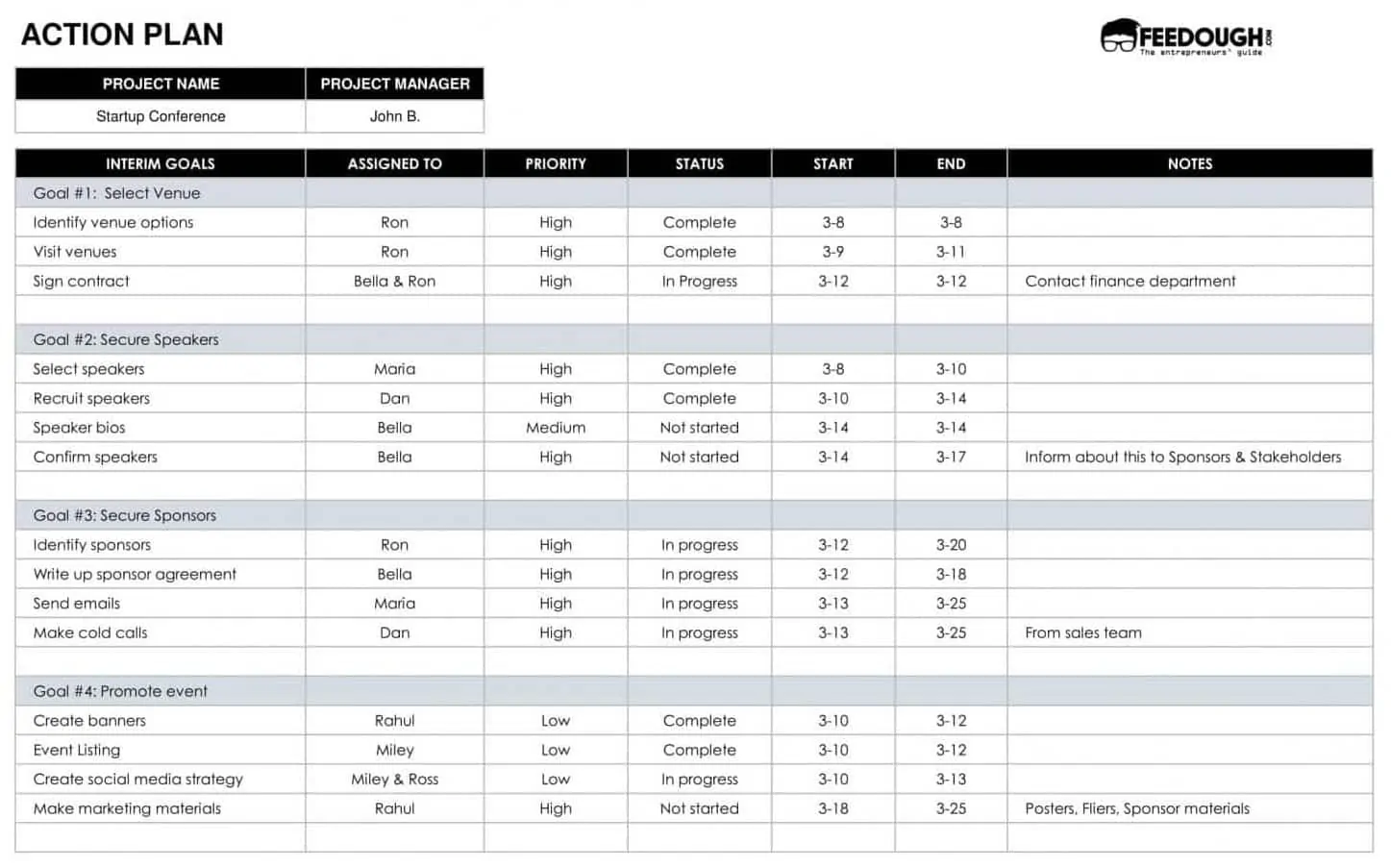
    Action Plan Example

    In this action plan sample, the goal is to organise a startup conference. This goal is divided into four interim goals which are further divided into different action steps. These action steps are assigned to the team members according to their capabilities. Priority, start date, and end date are assigned to each of the action steps to make things more smooth and clear to everyone.

    Action Plan Template

    Here’s an action plan template which you can use to create detailed action plans irrespective of the time period to achieve the goal.

    Go On, Tell Us What You Think!

    Did we miss something?  Come on! Tell us what you think about our article in the comments section.

  • 7 Proven Ways To Improve The Quality Of Your Startup’s Blog

    7 Proven Ways To Improve The Quality Of Your Startup’s Blog

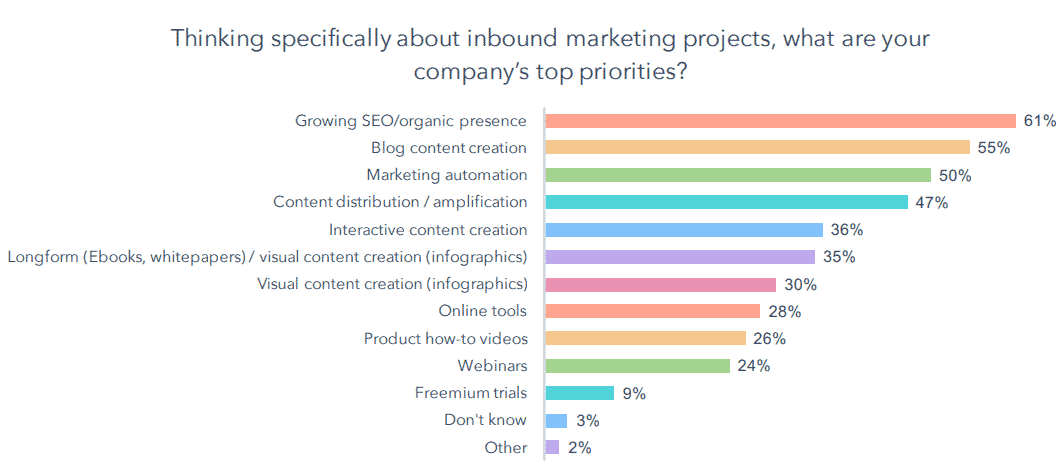
    There are lots of things to take into account when you’re thinking about how to create a website for your startup — web design, UX, layout, navigation, and so on — but your company’s blog must be one of the most important considerations. Why? Blogs are essential. In fact, they’re a top priority for businesses.

    Top marketing priorities
    Source: stateofinbound.com

    Blog content creation is second only to boosting organic presence when it comes to marketing priorities. That’s because a business blog can be hugely valuable – boosting traffic, increasing conversions, and perhaps even more importantly, differentiating your startup from your competitors. At a time when audiences want more than just the right price, showing off your brand’s personality is essential.

    Creating Blog Content

    Creating blog content can often be quite a time-consuming task for marketers, especially when you consider that readers value ‘freshness’. Quite simply, visitors like to see businesses publish content regularly, keeping them up-to-date with new ideas and providing new, fresh reading material.

    impact of blog posts on monthly traffic
    Source: Hubspot.com

    But publishing content regularly is a bit of a double-edged sword. On the one hand, regular content shows a dedication to engaging with your audience. On the other hand, the more content you publish, the more opportunities your audience has to identify flaws in your work…. to identify poor quality posts.

    Although we may think it’s a quantity that matters, and although graphs like the one above demonstrate the importance of quantity, there is one aspect that is even more important…. Quality.

    So what simple measures can you take to improve the quality of your startup’s blog?

    1. Publish Great Content

    Let’s start with the most obvious point: Content. While you may be producing enough content for your readers, are you actually producing enough great content?  What is great content?

    Every business is sure to have its own definition of what great content is, but on the whole, we can usually describe great content as that which appeals to readers. If you think your blog content could use some work, it’s worth taking a little time to get to know your audience more. Send surveys to collect audience data, engage and interact with audiences through social media channels, and see what your competitors are doing.

    2. Bring in Different Perspectives

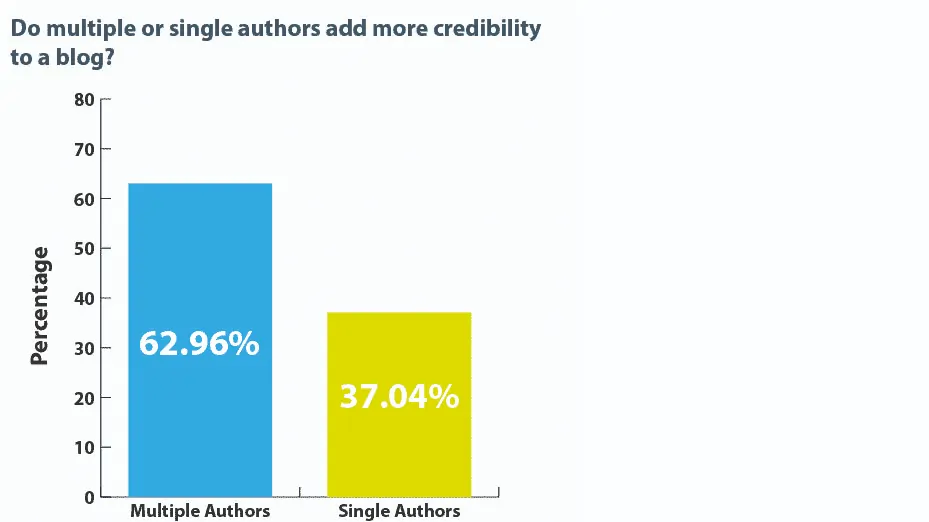
    User-generated content and peer-generated content are becoming increasingly important. Think about when you book a vacation; do you place more trust in what the hotel’s website says, or in the review of a past guest?

    Exactly.

    If you want to increase the quality of your startup’s blog, you should be working to increase trust levels.

    Readers will view your blog as being of higher quality if you’re able to bring in some alternative perspectives that complement — or even challenge — your own. Think about publishing guest posts written by subject matter experts, or sparking discussion amongst readers in your blog’s comments.

    multi-author blog
    Source: jeffbullas.com

    3. Leverage the Quality of Others

    Some say that outbound links are a lost opportunity; An opportunity that could have been spent on inbound links. However, outbound links can be particularly useful in terms of boosting blog quality, especially when linking to high authority websites.

    By linking to authoritative sources (think Government pages or major publications, for example) you can easily leverage the quality of these sites for yourself. Always be sure to link any statistics, facts, and figures to authoritative sources, as this shows that you’re basing your information on accurate, quality data rather than on the views of Bob from Quora.

    4. Get Rid of the Spam

    This really is just a case of using your own common sense. Think about what typically looks ‘off’ to you when you visit a company’s blog. What makes it seem like it’s low quality? Tons of links? It could be some sort of ‘black hat’ link building scheme.

    Be sure to check your keywords, too. Keyword stuffing can make even the most relevant and interesting blog content look like it’s poorly written, and unnatural keyword placements can significantly affect readability, lowering the reader’s perceptions. Spammy aspects can really have an impact on overall blog quality, so try to keep everything looking professional.

    5. Boost User Experience

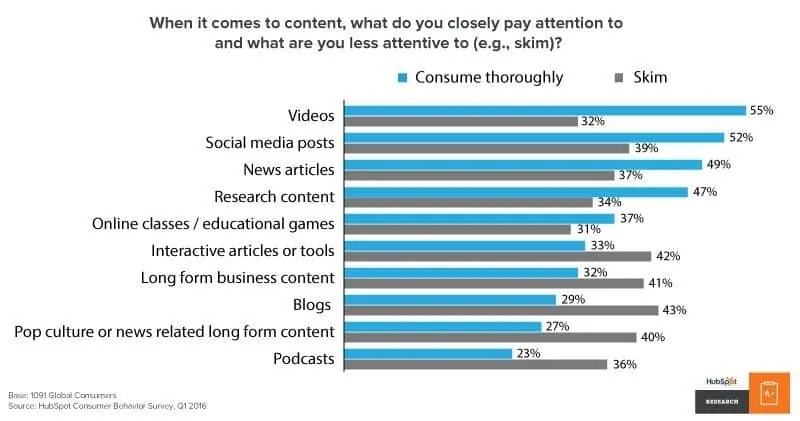
    Your blog marketing strategy shouldn’t just be about content… It should be about offering a great user experience, too. Let’s use visuals as an example. Audiences don’t just want to see walls of text; They want variety. Nearly half of us will skim through a blog post, yet we’re more attentive to videos.

    content which gains more attention
    Source: Hubspot

    This means that your startup should be incorporating visuals and interactive, engaging elements into articles on your blog… but don’t forget to think about the user experience as well.

    More media = longer load times, which can affect the overall quality of your blog. Try to find the right balance between UX and engaging content.

    6. Consider Word Count

    We’ve already touched briefly on trust, but let’s delve a little deeper now. Readers are more likely to view a blog as high quality if they can trust it, and one of the best ways to instil trust is by providing readers with a comprehensive overview of a given topic.

    Long-form posts (2000 words+) provide the most value to readers as they thoroughly cover a certain subject. Shorter posts can make a blog seem to be of lower quality because they only provide selected information. And as an extra bonus, if you’re trying to grow your startup, long-form posts earn the most links, get the most shares, and generate the most traffic!

    Naturally, it won’t always be possible to write 2000+ words on a certain topic. In that case, go with lower word count rather than stuffing the text with unrelated and unnecessary paragraphs just to get to that 2000 words mark.

    7. Make Use of Helpful Tools

    Is improving the quality of your startup’s blog simple? Sure. Is it quick? Not always. But who said you need to make all of these changes yourself? Automation is working its way into practically every area of business, including marketing, so if the tools are there you may as well be using them.

    There are a number of great tools that can help you to increase the overall quality of your blog. We’ll list some, divided into key categories.

    Topic generators – these tools can help you to carve out your own niche

    topic generator

    Readability tests are here to ensure your blog posts are suitable for your target audience.

    readability check

    Headline analyzers will help you draw more visitors to your website with fantastic headlines

    headline analyzer

    Bottom-Line?

    We all know that business blogs are important, but they are perhaps of even more value to new startups. That’s because a blog forms the cornerstone of on-site audience engagement, and creates the basis for future B2B partnerships.

    Don’t waste this amazing opportunity by creating a low-quality blog. Instead, take a little time to improve the quality of your startup’s blog with the 7 simple methods above.

    Go On, Tell Us What You Think!

    Did we miss something?  Come on! Tell us what you think about our article on Ways to Improve the Quality of Your Startup’s Blog in the comments section.

  • Effective Communication In Business: Importance & Tips

    Effective Communication In Business: Importance & Tips

    Running a business isn’t exactly a cake-walk. Let’s face it—if it wasn’t for the constant communication between your employees in various departments, the entire work process would be completely out of sync. In short, the lack of proper communication can result in issues related to the organization’s efficiency.

    Today, communication can take place through several methods. But no matter what the medium of communication is, there are numerous reasons why communication needs to be emphasized in your business.

    According to a study, companies that practice effective communication in their business perform nearly thrice better than companies that don’t. This applies the same way, whether you own a startup, or run a big organization.

    The Importance Of Business Communication

    Communication plays a very fundamental role in all aspects of a business. Processing and developing a certain flair for communication can help your business in several ways.

    Improves Customer Relationships

    Every business exists to serve its consumers and without establishing a strong relationship with them, the business fails to fulfil its purpose. Communicating with your consumers is just as important as communicating within the workplace. Keeping a constant flow of communication with your customers ensures that the customers who spend a lot of money and stay loyal to your business remain happy.

    Communication in business is even more important when it comes to providing excellent customer service to help clarify any queries that they might have regarding your products and services. This is very important because if your customers feel like they are listened to and that their suggestions are acted upon, your business can generate additional revenue through returning customers.

    Enhanced Innovation

    No matter how skilled and talented your employees may be, there are never enough good ideas to go around that will affect your business positively. When you encourage your employees to come forth with their new ideas and suggestions without the fear of being shut down, you’ll notice that your employees have the most to add to the discussion. A business can become innovative overnight by sharing their ideas with each other regularly. Your best employees could also have ideas that could possibly help your business grow.

    Ensures Feedback

    When communication is stressed upon in an organization, not only does it prove to be effective but also creates an open environment where your employees are comfortable enough to talk to each other and give feedback about how their teams are performing. This can be extremely beneficial to your business. When the communication between various departments in your organization takes place seamlessly and feedbacks are constantly exchanged, errors are quickly resolved.

    Communication in business goes both ways. The management gives feedback to the employees on how they are faring and how they can perform better, while the employees give their feedback to how the ideals of the organization are being upheld and how it can be done better.

    Contributes To The Growth Of The Business

    Effective communication can often serve as a backbone or sorts to your business. While that is a bold statement to make, imagine how it would be possible to carry out various procedures across departments without proper communication within the company, or with your clients.

    That being said, without effective internal and external communication, most businesses struggle to survive and grow. On the other hand, with effective communication in your business, procedures can be carried out systematically and productively. Communication also ensures that your company’s policies are implemented properly, without any unnecessary delays. With increased levels of productivity, the business is bound to grow and succeed.

    Ensures Transparency

    When you practice effective communication in your business, both internally and externally, you ensure that your organization remains more transparent. Transparency becomes extremely important when you want to build trust in your brand and its policies, products and services. This way, when there are tough decisions to be made to improve your business, you’ll have a much easier time explaining your clients and employees as to why the said decision must be made.

    Tips For Effective Communication In Business

    It’s not what you say, but how you say it.

    Communication in business has progressed dynamically with the recent advance in technology. This has led to new standards of contacting those you work with and those you do business with. So there are quite a few ways to develop effective communication in your business.

    1. Quality Content- The most basic point of effective communication is the content of the messages that you are trying to get across to your employees, clients and consumers. Whether it is socializing at work, or sending out a mass promotional email to your clients, it is important to understand what kind of information you need to communicate in order to succeed at the task assigned. Be mindful of how you converse with your co-workers and consumers.
    2. Ask Questions- Asking questions assures the person you are communicating with that you are interested and that you actually listened to the point they are trying to put across. Questions can also help you communicate in your business effectively by giving you additional information about your consumers. Keep in mind that your questions are related to the topic being discussed.
    3. Offer Positive Feedback- Motivating your employees is a great way to build effective communication within the business. Motivates employees put in more efforts when they are encouraged and praised for their achievements. Apart from effective communication, positive feedback also improves levels of productivity which as a result can benefit your business.
    4. Create a Receptive Atmosphere- When the culture at your workplace is receptive one where constructive criticism can be taken in a positive manner; it becomes easier to communicate effectively with your employees as well as clients and consumers. Avoiding a tense atmosphere prevents discouragement and unnecessary loss of productivity.
    5. Understand Your Audience- Knowing what to say to your employees or clients in order to gain compliance is extremely trivial for your business. Understanding your audience is one of the very first steps to effective communication. The more you know about them, the better you can persuade them.

    Bottom-Line?

    Although effective communication may seem like a very unimportant factor for a successful business, it happens to be one of the most important factors for success. Lacking effective communication is an easily fixable issue. If you feel as if your business doesn’t have the quality of communication that it should, address this issue swiftly. An effective communication system requires a certain level of proficiency in receiving and delivering messages both internally and externally. It is, in a sense, the building block of every successful organization.

    Go On, Tell Us What You Think!

    Did we miss something?  Come on! Tell us what you think about our article on business communication in the comments section.

  • Product-Market Fit: What It Is & Why Is It Important?

    Product-Market Fit: What It Is & Why Is It Important?

    You had an idea. You developed a product based on that idea. You succeeded in getting investment based on your pitch and now you own a company with some talented employees.

    The problem – the startup isn’t taking off well. Your hypothesis isn’t turning into reality and investors have started to doubt your competence.

    The actual problem – probably your product isn’t a good market fit or you’ve selected the wrong market for your product.

    Fret not, even Java couldn’t find the right product-market fit the first time. The language was originally designed for interactive television but was too advanced for the digital cable television industry at that time.

    Here’s a comprehensive guide to help you understand what exactly product-market fit means, why is it so important, and how can you find one.

    What Is Product-Market Fit?

    Product-market fit refers to having a product which is desired by the market and has the capability to satisfy its need.

    This definition of product-market fit can be divided into two parts –

    • A product that is desired by the market (Desirability): There’s a market demand for the product and people are actually looking for it. Market demand means that people are willing to pay to get a task done or solve their problem.
    • A product that has the capability to satisfy the market (Feasibility): The product is able to solve the problem or help people get their task done. The product has to have the right features and be usable enough to be actually used by consumers.

    Unlike the problem-solution fit, which is about whether your product can solve the problem, the product-market fit is about whether there’s a market for your product.

    It’s worth noting that a product can have a problem-solution fit but not have a product-market fit. For example, you might have developed a product which is the most efficient way to solve a problem but there might not be enough people who actually care about that problem.

    Why Is Product-Market Fit Important?

    The product-market fit is important because it’s the make-or-break factor for a startup. A startup can have the best product but if there’s no market demand for it, the startup will fail.

    Conversely, a startup can have an average product but if there’s enough market demand for it, the startup will succeed.

    It’s also important to note that a product-market fit is not a one-time event. As the market changes, your product needs to change as well to maintain the product-market fit. For example, Snapchat was originally built as a way to send disappearing photos but it has since evolved into a messaging platform.

    When Should You Look For A Product-Market Fit?

    Ideally, you should validate your market demand during your MVP phase. An MVP is a minimum viable product which is the simplest version of your product that you can put out in the market to get feedback.

    The MVP helps you collect feedback from actual users and not just your family and friends. And this feedback from MVP testing should help you validate whether there’s enough market demand for your product. If there is, you can start working on building the rest of the product. If not, you might need to pivot to a different product or market.

    How To Find A Product-Market Fit?

    The best way to find a product-market fit is through constant experimentation and testing. The Lean Startup methodology preaches the Build-Measure-Learn feedback loop which encourages startups to constantly build, measure, and learn from their experiments.

    The idea is that you should constantly be testing different hypotheses about your product and market. These tests can be in the form of A/B tests, user surveys, interviews, etc. And based on the results of these tests, you either validate or invalidate your hypotheses.

    This build-measure-learn feedback loop helps you realise when things have gotten wrong before it is too late. It also helps you validate your product-market fit early on so that you can focus on building the rest of the product.

    The model revolves around the following four steps that you can use as well:

    Plan

    This is the initial stage where you plan the market hypothesis that you believe fits perfectly into the puzzle.

    The hypothesis revolves around:

    • The problem and what you think matters the most relating to that problem.
    • The solution that you believe the target market is seeking and is ready to pay for.
    • The product features that you think will resonate with the target market.
    • The product pricing that you think will be acceptable to the target market.
    • The business model that you think will work to monetise this solution for the target market

    Build

    Now, you move on to developing the MVP in order to validate the hypothesis that you have planned in stage one.

    The MVP is the smallest yet essential version of your product that you can put in front of the target market to receive feedback about it.

    It is the simplest product that solves the problem for the customer and allows you to start measuring key metrics.

    Moreover, this version is essential-features-rich as it focuses on validating whether the customer is ready to pay for the solution that you have developed to solve their problem.

    Measure

    The MVP includes several data points and metrics that you can use to validate whether the product solves the problem for the customer in an efficient manner.

    This also allows you to know whether customers are actually using your product and how much time they are spending on it.

    In addition, it also allows startups to understand what features of their product are being used by customers the most and which ones are being ignored.

    This stage is vital as it allows them to know whether they are on the right track or not and make changes accordingly.

    Learn

    The final stage is to learn from all the feedback that you have received in the MVP stage and know how well your product fits in the market.

    It also allows startups to understand whether they need to make minor changes, pivot their business model, or change their product altogether.

    The learnings from this stage are important to make decisions about the future of the startup.

    How Do You Know If Your Product Is Fit For The Market?

    There are a few key indicators that show whether your product is fit for the market or not. Here are a few:

    The 40% Rule

    The 40% rule is among the topmost factors in determining whether your offering is fit for the market. It involves taking feedback from the existing customers on how would they feel if they no longer have access to the offering. If at least 40% of them indicate that they will be “very disappointed”, your product is a good fit for the market.

    Repeat Purchases

    If your product is fit for the market, customers will show that they understand its value by repeating the purchases. If you experience an increasing percentage of repeat purchases every month, your product might be a good market fit. However, if the repeat purchase graph of your offering remains stagnant or falls every month, you need to reconsider your product and positioning strategy.

    Word Of Mouth

    A good product-market fit leads to word of mouth which brings in more customers. If you witness organic word of mouth marketing, good reviews, and coverage on publications and social media; probably your product is a good fit in the market.

    Growth

    A company with the perfect product-market fit scales up faster than other companies with not so good product-market fit. If your company is having an average annualised growth of at least 20% in the past 3 years, you’re good to go.

    Sales Cycle

    A sales cycle encompasses all activities associated with closing a sale. If your product is a good market fit, you don’t have to put much effort into selling it which results in deals closing quickly and a smaller sales cycle.

    Product-Market Fit Examples

    Every business is unique and so is its market fit. There are businesses that have a great product but still fail to find their market and vice versa.

    Here are a few examples of products that achieved or failed to achieve a great product-market fit:

    Google Glasses

    Google Glasses is one of the best examples of a product that failed to achieve a great product-market fit. Despite having a great product, it never picked up in the market and was discontinued in 2015.

    Slated as the next big thing, the product was too ahead of its time. It included features like a camera, voice control, and augmented reality which were not yet common among people.

    Another reason for its failure was the high price point. For a product with no existing market, the $1,500 price tag was too much for people to justify.

    Facebook

    Facebook created a product by validating a hypothesis inspired by the “what ifs” of its target audience. What if there were a platform that allowed people to connect with anyone in the world? What if there were a platform that allowed businesses to connect with their customers?

    Facebook validated its offering by first launching it in college campuses and then expanding to other demographics.

    The product was a hit with people as it solved a problem that they didn’t even know they had. Facebook quickly became the go-to platform for social networking and has since then acquired Instagram, WhatsApp, and Oculus.

    Go On, Tell Us What You Think!

    Did we miss something? Come on! Tell us what you think about our article on product/market fit in the comments section.

  • What Is Scaleup Company?

    What Is Scaleup Company?

    So you’re an entrepreneur with a clear startup concept in mind. You’ve been working on this idea for the last 1.5 years and you now own an office, a team of 4 or maybe 10, a .com, .io, or .ly domain and are almost close to establishing your revenue model. Still, it is highly likely that an investor will say no to your startup even after all this hard work.

    Why?

    Because you haven’t validated your concept yet, haven’t proved that your unit economics as sustainable, and all you have are predictions about how well your startup can perform in another 5 or 10 years.

    This is where you wished you were a scaleup and not just a startup.

    What Is A Scaleup?

    A scaleup (also called high-growth startup/enterprise/company) is a company that has validated its product and proven that its unit economics are sustainable by having an average annualised growth of at least 20% in the past 3 years. According to OECD, the annualised growth can be measured in terms of the number of employees or turnover.

    3 new startups launch­­­ every second and 90% of them fail. With such astonishing facts, investors are now more inclined towards startups and businesses with more credibility and sustainable unit economics. Scaleups are these new credible startups.

    Scaleup vs Startup

    A Startup spends most of its time and resources in finding its place in the market. It experiments using the funds provided to it by the investors and run tests to find the most profitable positioning. Once it succeeds in finding the best product-market fit. It sticks to it for a while before it scales up.

    Once a startup scales up, it is no more a startup. It has an operational system in place, a recognisable management hierarchy, set roles for every team member, and most importantly an idea validated by the end consumers themselves.

    Here’s what separates a scaleup from a startup –

    Product-Market Fit

    The most important difference between a scale-up and a startup is that the scaleup has found and perfected its product-market fit. It has already validated its assumption about the customer segments, competitive advantage, customer acquisition costs, product features, and pricing strategies. It has enough data to prove that if an investor invests $X, he can expect a return of $Y in a defined time period.

    On the other hand, startups might still be experimenting with its strategies and not sure about the product-market fit, competitive advantage, customer acquisition costs, etc. The funds invested in them might be used more for such experimentations than usual business.

    Pivot

    Since scaleups have found their place in the market, it is highly likely that they’ll stick to their business concept and do what they’ve communicated to the investors. Whereas, startups that have not figured out their product-market fit may pivot if someone in the team comes up with a better idea.

    Employees

    A startup usually has 10 or less than 10 employees. However, a scaleup has a minimum of 10 employees and witnesses an employee growth rate of at least 20% every year.

    Member/Employee Roles

    It is not new in a startup for team members to take more than one role. Usually, there are no fixed duties and almost everyone does more than what he was hired for.

    Scaleups, on the other hands, have a narrow and more defined team and employee roles. They have different employees assigned to different jobs.

    Systemised Operations

    Experimentation is an inherent characteristic of a startup that results in unsystematised operations. However, once the startup becomes a scaleup, it knows what works and what doesn’t. This put the systems in place which the team members follow so as to maintain quality control, effectiveness, and efficiency.

    Risk Aversion

    As the startup upgrades to a scaleup, its responsibility increases and it becomes accountable to investors for better results and customers for promised performance. It no longer has the flexibility to pivot in response to incoming feedback, data, and ideas. Hence it becomes more risk-averse compared to when it was just a startup.

    Scaleup Examples

    Uber

    Uber took less than 5 years to earn the status of a unicorn. The company capitalised on the unorganised cab sector by utilising the aggregator business model. Even though the work started unorganised and the business model and even the name saw drastic changes, the company became a scaleup in 2011 when it launched its service in Paris and started increasing its employees at a constant rate.

    Hubspot

    Founded in 2006, Hubspot created a market for inbound marketing by introducing the alternative to traditional marketing. The company started scaling in 2007, hired a lot of employees to increase sales and became a unicorn in less than 10 years. The company is now a perfect example of a scaleup that has witnessed an average revenue growth of 35.18% year on year, to $ 144.02 million in 2018.

    Go On, Tell Us What You Think!

    Did we miss something?  Come on! Tell us what you think about our article on scaleup company in the comments section.

  • What Is Buyer Persona? [Ultimate Guide]

    What Is Buyer Persona? [Ultimate Guide]

    Thrifty Tylor, Trendy Sally, and Discount Dolly are not just fancy names. They all represent different categories of buyers with similar habits, backgrounds, likes, and decision-making processes.

    Thrifty Tylor spends her money only on the things she thinks are of utmost importance and hardly buys any brand which she hasn’t heard of or tried yet.

    Stylish Sally loves receiving notifications about the new fashion styles and always listens to the recommendations of the influencer she follows. She doesn’t care about the price as much as she cares about not being left out.

    Discount Dolly only buys when there’s a sale going on and there are times when she may end up buying discounted products that she never heard of or tried before.

    Thrifty Tylor, Trendy Sally, and Discount Dolly are buyer personas.

    Many times, we see companies are all about themselves and rarely listen to what the customer actually wants (like the case with Snapchat). Creating buyer personas help you to not be such a company.

    If you’ve come to this article by searching “What Is Buyer Persona?”, you must have already gotten a clue of what it actually is. Nevertheless, here’s a comprehensive guide to explain everything you should know.

    What Is Buyer Persona?

    A buyer persona is a fictionalised character representing a brand’s ideal customer created based on market research of prospective customers and existing customers and real data on the existing customers.

    In simple terms, buyer persona refers to the description of a consumer’s personality traits and behaviour as well as their demographics which would help the marketer to assess their right target audience.

    Importance Of Creating Buyer Personas

    You need to create a buyer persona for your brand as it helps to –

    • Understand your target audience better
    • Develop better products which the audience really wants
    • Create better offers to bring in more customers
    • Develop strategies to create a long-term relationship with the customers
    • Align brand personality with consumer personality and vice versa
    • Get better insights to help to create a better USP

    Buyer Persona Elements

    A buyer persona answers the who, what, why, and how about the ideal customer. This requires you to conduct extensive market research of who is already buying your offerings and who is willing to buy it. A perfect persona is made up of the following elements –

    Demographics

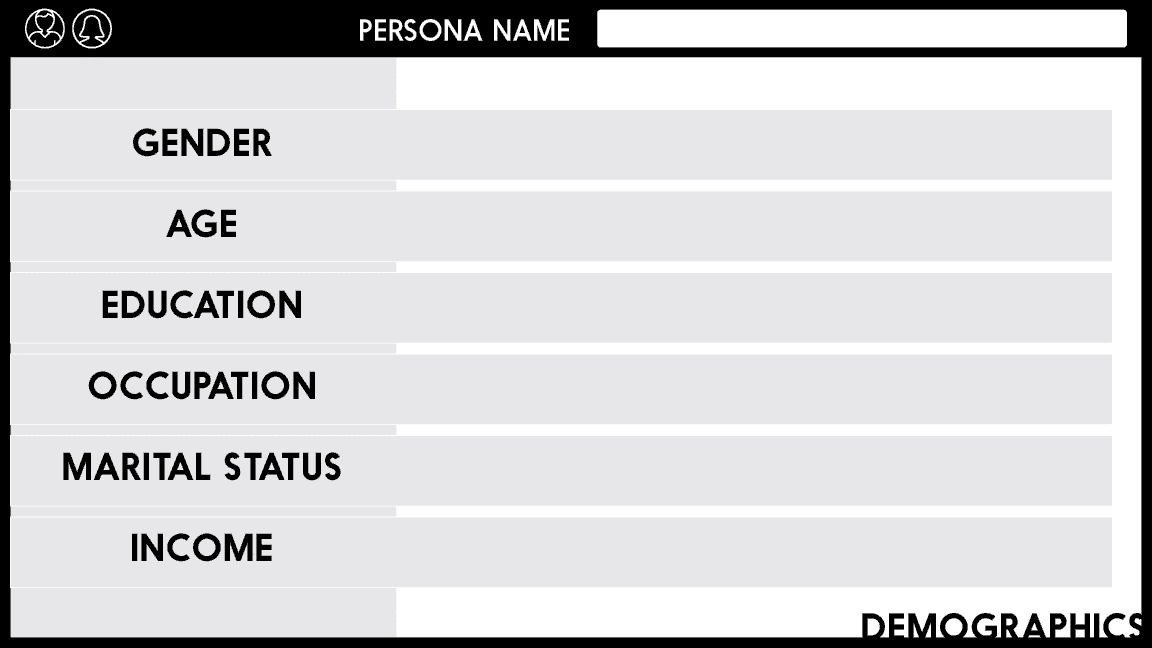
    Demographics are the statistical data relating to the ideal customer’s age, gender, marital status, family size, income, religion, race, occupation, nationality, etc. It gives a statistical description of the customer segment the company is planning to target.

    Some important demographic categories that you should look for while creating a buyer persona are –

    • Age
    • Gender
    • Marital status
    • Number of children (if applicable)
    • Occupation
    • Annual income
    • Education level
    • Living status (homeowner or renter)

    Psychographics & Behaviour

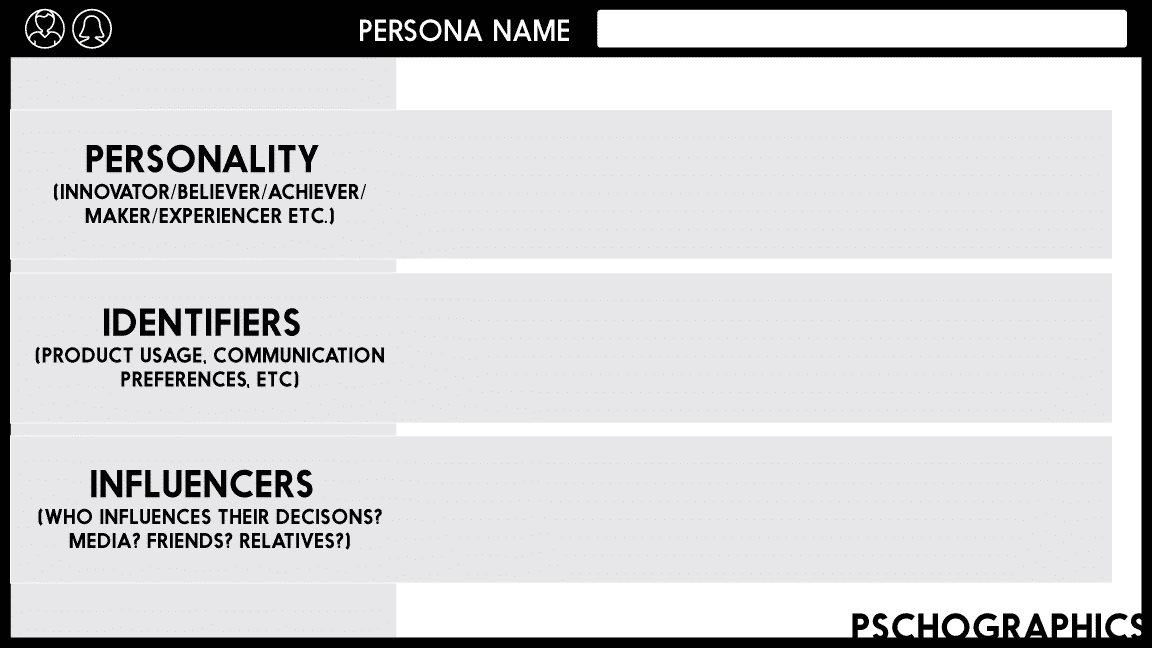
    After knowing your buyer’s demographics, you also need to know your buyer’s behaviour, personality, values, spending habits or patterns etc. Psychographic and behavioural market segmentation is done to know more about the customer’s personality, lifestyle, and attitude.

    VALS (Value, Attitudes & LifeStyles) Framework is a proprietary research methodology used for psychographic and behavioural segmentation of consumers into eight types which are as follows :

    • Innovators: These consumers are on the leading edge to change. They have high incomes, self-esteem and abundant resources. They have their individual tastes in things and prefer purchasing prestige goods and services.
    • Thinkers: This group of consumers is known to have high resources and are motivated by ideals. They are mature, responsible, well-educated professionals. Their leisure activities revolve around their homes, but they are well informed with what goes on in the world. They are open to new ideas and social change. Even though they have high incomes but are practical consumers and rational decision makers
    • Believers: This group of consumers has low resources, modest income and is motivated by ideals. They are conservative and predictable consumers who favour established brands. Their lives revolve around family, church, community and the nation.
    • Achievers: This group of consumers has high resources and are motivated by achievements. They are successful work-oriented people and get their satisfaction from jobs and families. They are politically conservative and respect authority as well as status.
    • Strivers: They have low resources and are also motivated by achievements. They have few values similar to achievers which are economic, social and psychological resources. They give due importance to Style as they strive to emulate the people they admire.
    • Experiencers: They are known to have high resources and are motivated by self-expression. They are the youngest of all consumers. They have a lot of energy which they pour in physical exercises and social activities. They are avid consumers spending heavily on clothing, fast food, music and other youthful favourite things with an emphasis on new products and services, hence lacking brand loyalty.
    • Makers: This group of consumers has resources and are alike experiencers for being motivated by self-expression. They are practical and value self-sufficiency. They are focused on the family work and physical recreation. They have little interest in the broader world. They favour practical and functional products.
    • Survivors: They have the lowest incomes. They have very few resources to be included in any consumer self-orientation and are the oldest of all the consumers. Because of their limited means, they tend to be brand loyal consumers.

    Influencers

    Influencers refer to the forces that influence the buyer’s decision-making process. These influencers are of two types: External and Internal Influencers.

    The external influencers are-

    • Culture,
    • SubCulture,
    • Demographics,
    • Social Status,
    • Reference Groups,
    • Family, and
    • Marketing Activities.

    The internal influencers are-

    • Motives,
    • Emotions,
    • Personality,
    • Perception, and
    • Learning

    These influencers impact a buyer’s decision-making process. It is important for the marketer to know why, when and where these influencers impact the buyer’s decision-making process.

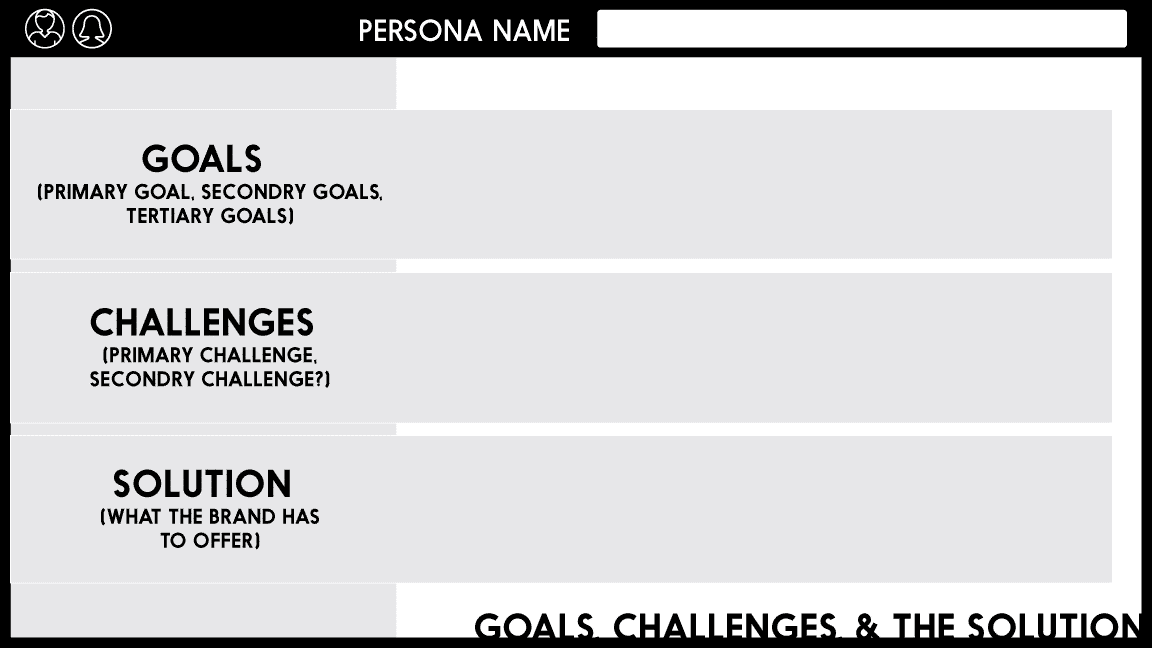
    Goals, Challenges, & Problems

    A goal refers to what the customer wants to achieve. It can be classified into primary, secondary, and tertiary goals where the primary is of the utmost importance and tertiary has less importance in his life.

    Challenges include circumstances and limitations which keep the customer away from achieving the goals. These challenges lead to problems whose solutions the customer looks for in an offering.

    How To Create A Buyer Persona?

    Once the market research is complete, creating a buyer persona is not an uphill struggle. All you need to do is put the persona elements in the right place. Here’s a template of buyer persona to help you create a detailed buyer persona.

    Buyer Persona Template

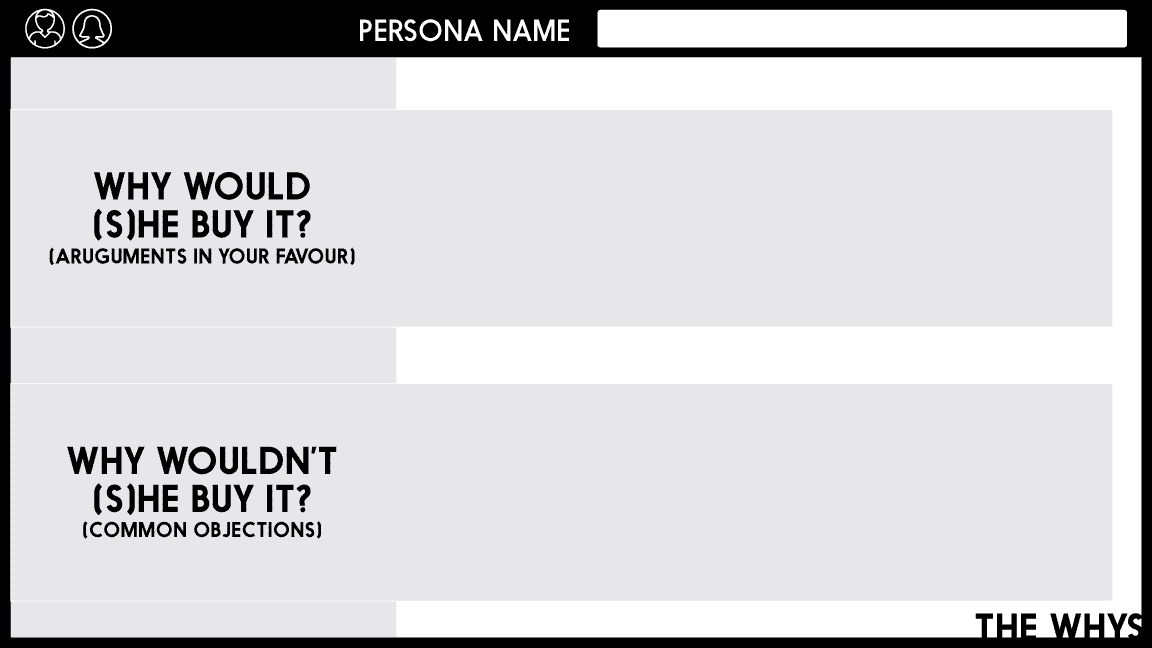
    Our buyer persona template is made up of four sections. The first section talks about the demographics of the customer, second talks about the psychographics, third about goals, challenges, and solutions, and fourth gives the arguments about why he will and will not choose the brand’s offering.

    Click here to download the buyer persona template.

    Buyer Persona Examples

    iPhone

    There are two corporates/working professionals named Tyler Dickinson and Mikaela Pascal (Age: 26, 28) and are from Houston and earn an income of $6,444 per month. They are not much tech savvy and are in search of a phone which can be useful for their daily routine, work and recreational time but they also want the phone to be of the premium quality which ensures that they stand out of the crowd when they possess a phone which can not only be trusted for its efficiency but also give them a status symbol. iPhone would be the right phone for them to purchase as it’s an affordable phone for them and it can fulfil all of their needs and demands.

    Reese’s

    There are two College going students named Ethan James and Brittany Cuadra (Age: 19, 21) and are from Utah and do an Internship for their additional and recreational expenses. They earn a sum of $480 – $600 per week. They have a sweet tooth for chocolates, especially the ones which are filled with Milk Chocolate, Peanut and Cocoa Butter. Their specifications of a Chocolate would be fulfilled by Reese’s with its variety in shapes and form of Peanut Butter Cups and Bars, the chocolates are also of an affordable price for them.

    The above Buyer Personas can be framed out well when the Marketing and Brand Building official of that brand refers to the elements of Buyer Persona to make a fictional representation of their ideal customer with perfection.

    Go On, Tell Us What You Think!

    Did we miss something?  Come on! Tell us what you think about our article on buyer persona in the comments section.

  • Top 10 Proven Ways to Motivate Employees

    Top 10 Proven Ways to Motivate Employees

    As an employer, it falls to you to put together the perfect team with individuals who are the perfect fit for your workplace culture. On paper, your employees are highly qualified with really impressive levels of experience. This is the team you have put together keeping in mind their abilities to take your business to a higher level.

    But often, the pressure of work can get to your team sometimes. Employees who came up with fresh, innovative ideas aren’t able to do so at the moment, and the overall levels of productivity at your workplace have decreased.

    How can you tackle this? How can you boost the morale of your employees?

    The answer is to motivate them.

    Importance Of Employee Motivation

    Your employees are no doubt extremely valuable to your organization. In a study conducted on Employee Engagement & Job Satisfaction by SHRM in the year 2017, 44 aspects of job satisfaction and 38 aspects of employee engagement were examined. While 89% of the people who took the survey felt satisfied with their jobs, there still remained in a gaping difference between how certain aspects at the workplace are considered important, and the number of people who were actually satisfied with them.

    Only 38% of the people felt like their contribution at work were meaningful. This leads to your employees feeling distant and disengaged from their work. An employee is not motivated at work is a waste of the organization’s time, energy and resources. To prevent low levels of motivation, it is important to constantly encourage your employees.

    A motivated employee is more committed to his work and puts in their best efforts into the tasks they have been assigned. As a result, their productivity levels and efficiency is increased as well. Motivating your employees can also positively affect their overall development at work.

    How To Motivate Employees?

    There are various ways to motivate your employees. Here, we have listed some of the best ways to motivate your employees to ensure that they do their best.

    Create A Healthy Workplace Culture

    Healthy workplace culture is one where there is mutual respect between all employees. When the relationship between your employees and you is a cordial, appreciative, and supportive, the environment at your workplace becomes one that in itself becomes a factor of motivation to your employees. When the atmosphere at your workplace is energetic and welcoming, employees feel more motivated to put in their best.

    Acknowledge A Job Well Done

    Recognition is hugely important. It establishes a connection between the employer and the employee. Acknowledging your employees’ achievements is a critical piece of employee engagement. Having a weekly or monthly awards program at your workplace, such as ‘Employee of the Week/Month’ can be very beneficial in motivating your employees can reinforce your organizations’ core values. Rewarding your employees with a gift card or coupon for their exemplary performance ensures that they keep up their performance at work.

    Give Your Team Autonomy

    Everybody needs to feel like they’re in control of their own time and energy. Granting autonomy to your team demonstrates that you trust them and is highly crucial for the employee engagement rates at your organization. In the long run, this motivates your employees to become more self-sufficient. They create their own processes at work and it is a mutual exchange of knowledge for both the employer and the employee.

    Play To Your Employees’ Strengths

    It is very important to understand that all of your employees are different. Some are introverts, some are extroverts. Some might require guidance and others can work independently. The point is, all of your employees have different strengths. So, enforcing a one-size-fits-all solution to your diverse workforce might not be the best for everybody. Interacting with your employees and socializing at work not only helps you to play up their strengths but also greatly motivates your employees.

    Give Employees Room To Grow

    If your business is rapidly growing; giving your employees room to grow within the company can be a huge motivating factor. The psychological aspect of feeling trusted and respected for their work can encourage them to perform even better in the near future. For instance, if an employee is doing exceptional work with the inventory, training and allowing them to handle vendor relations completely can highly motivate them.

    Share Positive Feedback

    Positivity is always motivating, especially when it comes to motivating your employees. It gives them a deeper connection to your business. In fact, letting your employees know that they’re doing a great job is one of the key elements of job satisfaction. Having weekly meetings where you can share the positive reviews left by your consumers with your employees can highly motivate them.

    Be Transparent

    Having an insight as to how your business is performing makes your employees highly invested in the organization. Sending out weekly or monthly reports to your employees and letting them know about where the company stands currently reinforces trust between the employer and the employees. Having access to the data not only makes employees feel important but also helps in pointing out the areas that can be improved.

    Encourage Creativity

    Always welcome fresh ideas, and make your employees feel like they can approach you with their fresh and innovative ideas that can benefit your company. Encourage them to express their opinions with you. Encouraging creativity and making yourself approachable not only motivates your employees but also gives them assurance that their opinions are valued.

    Encourage Friendly Competition

    A healthy and friendly competition among your employees can motivate them to perform better in the tasks that they have been assigned. Friendly competitions among teams help with employee engagement and participation. A competitive environment at work ensures better levels of productivity among your employees and motivates them to step up their skills as well.

    Express Gratitude

    Gratitude is not the same as recognizing your employees’ achievements. Let your employees know that you are thankful to have them as a part of your team, as a part of the organization. Making your employees feel like they matter on a bigger scale in the organizations motivates them greatly.

    Bottom Line?

    Employees who are highly motivated are an asset to your organization. They reward you with dedication and a positive perspective for your company’s future. There is no hard-and-fast rule when it comes to motivating your employees at work. Don’t hesitate from making small adjustments at your workplace that can positively affect the work environment. Every employee is unique and has their own strengths and weaknesses. Similarly, every organization works differently. Understanding what makes your employees tick, and how it can work for your organization is the key to motivating them.

    Go On, Tell Us What You Think!

    Did we miss something?  Come on! Tell us what you think about our article on how to motivate employees in the comments section.