Feedough Logo

Blog

  • What Is Growth Hacking: An Actionable Guide

    What Is Growth Hacking: An Actionable Guide

    If you’re an entrepreneur, there must be a lot of days when you thought of how you can make your startup to grow and spread like wildfire. How to build product, distribution, and marketing strategies which put the growth on automation?

    While there is no rule of thumb to help you in this venture, there surely is a clever technique – Growth Hacking.

    While many of you might have heard the term, not many would know what growth hacking exactly is. Here’s a comprehensive guide to help you understand everything you should know about the same.

    What Is Growth Hacking?

    Growth hacking is a marketing strategy in which rapid experimentation is carried out across various business areas, such as marketing, product development, and sales segments, to identify the most effective and efficient ways to do business.

    The term “Growth Hacking” was coined in 2010 by Sean Ellis, founder and CEO of GrowthHackers who has helped numerous internet companies achieve incredible growth using strategies which were not as broadly focused as traditional marketing.

    The goal of growth hacking strategies is simple: massive growth in a short time.

    This technique is more common among startups where entrepreneurs strive for rapid growth without spending huge amounts of cash post the launch of their product/service. It can also be used to grow and maintain an already established active user base. The target of growth hacking can either be long term sustainability or low cost per customer acquisition.

    Now, it is likely one might confuse between growth hacking and traditional marketing. But there are some important factors that make them different from each other.

    Growth Hacking vs. Traditional Marketing

    Even though the fundamental principles (increased engagement, conversion and retention) are the same for both growth hacking and traditional marketing, they differ when it comes to their goals.

    Growth hacking is mostly associated with startups and scaleups; it is mostly comprised of strategies that do not require a huge amount of money like how established businesses might. In addition, marketing requires extensive market research to be done before deciding on the platform or channel to market a product/service. Growth hacking, on the other hand, uses analytical and website data to understand the requirements of the market and implement strategies.

    A marketer can be a growth hacker if he focuses his attention on the growth of the business alone but not vice versa.

    Who is a Growth Hacker?

    A growth hacker is someone whose profession is growth hacking. From the words of Sean Ellis –

    A growth hacker is a person whose true north is growth. Everything they do is scrutinized by its potential impact on scalable growth…

    An effective growth hacker also needs to be disciplined to follow a growth hacking process of prioritizing ideas (their own and others in the company), testing the ideas, and being analytical enough to know which tested growth drivers to keep and which ones to cut. The faster this process can be repeated, the more likely they’ll find scalable, repeatable ways to grow the business.

    It can be inferred from these words that growth hacking is closely linked to A/B Testing and optimization. The strategy, however, is executed in four phases to get the perfect solution.

    Phases Of Growth Hacking
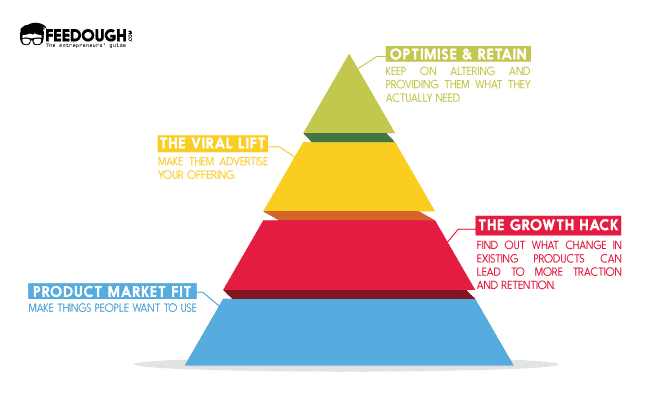
    growth hacking pyramid
    Growth Hacking Pyramid

    What made Whatsapp the top IM app for smartphones? What made Facebook get to the top and retain its position? We surely talk about it a lot. But here’s how growth hacking actually works.

    Product-Market Fit

    Make things people want.

    Growth hacking focuses on understanding the users and building products that they actually need and would love to use. It is not always limited to disruption. Sometimes, a simple change to the existing products can make the product more fit than the ones available in the market.

    According to Sean Ellis, your product has a good product-market fit if at least 40% of your users say that they would be very disappointed without your product.

    I’ve tried to make the concept less abstract by offering a specific metric for determining product/market fit. I ask existing users of a product how they would feel if they could no longer use the product. In my experience, achieving product/market fit requires at least 40% of users saying they would be “very disappointed” without your product. Admittedly this threshold is a bit arbitrary, but I defined it after comparing results across nearly 100 startups. Those that struggle for traction are always under 40%, while most that gain strong traction exceed 40%.

    The strategy focuses on building products and services that are easy to market (where viral marketing and word of mouth marketing works). These products are results of extensive research of what the customer actually needs, wants, and desires, and are continuously upgraded and altered to remain a good market fit. Some examples of such products are – Whatsapp, Google Drive, Buffer, etc.

    The Growth Hack

    Find out what change in existing products can lead to more traction and retention.

    Growth hacking involves hacking the existing system to look for potential vulnerabilities and opportunities. It involves researching what’s missing in the existing products that could actually result in more traction and retention. For Candy Crush, it was Facebook integration, limited lives, and Facebook invites to get those lives back. For Hubspot, it was content marketing and free products.

    The Viral Lift

    Make them advertise your offering.

    The essence of growth hacking is making your existing customers attract more customers for your business. Hotmail was able to get over 1 million new users within 6 months just because the company added “PS I Love You. Get Free Email” at the footer of every email. Candy Crush’s growth hacking strategy involved sending Facebook invites to get more lives. Similarly, Dropbox provided extra storage by inviting friends to use the service.

    The viral lift originates from sowing a sharing strategy to the core of the business model. This strategy is drafted in a way that customers benefit every time they share the offering with others.

    Optimise & Retain

    Keep on altering and providing them what they actually need.

    This is one of the most crucial and difficult tasks of growth hacking. Once you have customers using your product, it’s time to get serious about the metrics. Check the metrics to analyze whether your customers are actually returning or not returning to use your product, interview them to understand why they don’t come back, and use the data to improve your product.

    Compared to traditional marketing strategies, growth hacking does not just focus on pitching the idea. It focuses on altering the idea occasionally to suit the customers’ needs. It involves using many factors to identify the most efficient way to conduct business. These are –

    Key Performance Indicators (KPI)

    Just like Facebook uses the number of monthly active users as a KPI, WhatsApp uses the number of messages sent per day, and Uber uses the number of rides as the KPI, your business should have a KPI, too. Identifying this is very important to begin the growth hacking process.

    Channels

    A growth hacker has a number of channels to choose from: SEO, SEM, Social Media, PR, Sales, Viral Marketing, Business development strategies, etc. acquire a good overview of all the channels and how they can be used for your business.

    Every business industry is different, their targets may differ and so identifying a channel that can carry your message to the world is the key here. This is not an easy task but with research about the company, ongoing competition and testing, you can find out and prioritize the channels.

    A/B Testing

    A/B Testing is a method that simultaneously experiments two or more pages to see which one yields the best results. The channels you feel are necessary should undergo A/B testing so that the best one can ultimately be used for growth hacking purposes.

    For instance, if a social media platform is taken up for testing, then you will have to post different posts with different hashtags, post at different times, etc, to find out what works the best.

    Data Analytics

    Data analysis is very important for the successful implementation of growth hacking. Without it, growth hacking is next to impossible. Track all the actions that you are doing for the company. Only by tracking can you understand where and what needs improvisation.

    There are many ways to track your tests or actions. When PR is concerned, the number of reviews on your post and the number of answers posted by journalists/bloggers should tell you about it.

    User Feedback

    Every business spends a lot of money on consultants but nobody other than the customers are sure to know everything about the product. They use it every day, so they have the answers to where you should improve and what.

    Thus, negative reviews or comments are very important to understand where your product needs to be improved. Testing products with customers can provide more information than a consultant ever will.

    Prioritization

    After analysing your data and channels, A/B Testing should be done again. Always remember that continuous testing is crucial for your success. Prioritize the best channel and then start testing again.

    Automation

    When you have improved your product and prioritized your channels, it is time to automate the growth hacking process and your strategies and tactics. For this, you can use various growth hacking tools.

    IFTTT is an example of a classic growth hacking tool. When you post a picture in Facebook, it can be posted to Instagram and Twitter in a few seconds with IFTTT. It can also help track the progressions of a link email across various platforms.

    Growth Hacking Strategies

    One you have paved the way to growth hacking, it is time to implement growth hacking strategies. Here are a few growth hacks your company might benefit from:

    1. Product Listing PlatformsProduct Hunt is a platform where you can expose your startup to a global audience. This platform can also help you receive feedback and ideas from innovators, journalists, etc.
    2. Referral Hack – introduce referral hacks to your business where a customer who refers your product/service to a friend gets a fair benefit. This strategy can improve your user base dramatically.
    3. Customer Loyalty Programs – The cost of retaining a customer is six to seven times lower than acquiring new customers. Find ways to reward loyal customers as a bird in hand is always better.
    4. Host and attend community Events – attending community events can help you make bigger and better connections. Exposing your startup will help you gain success when you can learn more about your industry, get inspired and make important connections.
    5. Social Media – Social media can be used to promote yourself, receive feedback, interact with customers and influencers.
    6. Content Marketing – Create a content marketing strategy, preferably a video with a modest budget. Videos can convey a lot of information in a small package and without getting people bored. An interesting video can get viral, thus, improving your user base.
    7. Get help from Influencers Well known influencers (people with more than 50,000 followers) can help your product/service reach a wider audience. If done the right way, influencer marketing can help you achieve a massive reach.
    8. Scarcity Principle – customers are more likely to buy a product or take a deal when there is a sense of urgency. Limited edition deals or countdown timers can drive your customers to purchase more than regular products.

    Benefits of Growth Hacking

    According to Sean Ellis –

    A growth hacker is a person whose true north is growth. Everything they do is scrutinized by its potential impact on scalable growth.

    Having a person solely focussed on the growth of your company is in itself a benefit in addition to:

    • Low cost – growth hacking is designed to use only the resources you already have in the most economical way. Even though the testing processes take a long time before you find the right hack, you are still using way less money than if you were to use advertising or traditional marketing strategies.
    • Assured Return on Investment (ROI) – With the data telling you about every action’s consequences, you can discard the methods that do not help you much and keep the hacks that promise your business success.
    • Low resources – unlike traditional marketing, growth hacking doesn’t require hefty resources to give big results. All it needs is someone who knows how to analyze data for the best results.

    Examples Of Growth Hacking

    There are a few well-known examples where growth hacking was implemented successfully.

    Dropbox

    Dropbox saw a 60% increase in the number of signups when it offered its users 500MB additional storage for free whenever they referred someone to Dropbox. The person being referred also gets additional space giving them a reason to prefer using that link rather than signing up on their own.

    They also offered extra storage space when the user shared Dropbox via social media. Here, each new user cost Dropbox only 500 MB of disk storage space and no advertising costs. Moreover, as each user’s storage space increased, it became less likely that they would give it up and go to some other platform.

    Hotmail

    Hotmail found traditional advertising methods to be too expensive and came up with an ingenious hack. One of their investors suggested putting “PS I love you. Get your free E-mail at Hotmail” at the bottom of every e-mail sent with Hotmail.

    Soon after the company incorporated this strategy, it acquired 3,000 signups per day and went on to a staggering 1 million users in 6 months. They used every single mail of every single user as an advertisement.

    This was actually one of the growth hacks that was implemented long before the term was coined. Today though, this is a common practice and you can find it when you send an email from iPhone (Sent from my iPhone).

    Instagram

    The founders of Instagram made their move when the digital camera on smartphones was still a new trend, and there was no good social photo-sharing application. The company created a new experience for the users by adding filters and social networking elements to a photo-sharing platform.

    The users loved the way they could showcase their lives and experiences to a larger audience and, hence, were eager to spread the word themselves. The company also used influencer marketing and asked journalists and tech influencers to write reviews about the same. These reviews also resulted in a huge boost to the

    Airbnb

    Airbnb hosted roughly 400 guests during its initial year and now roughly 400 guests check in every 2 minutes into an Airbnb! Growth hacking played a huge role in helping them reach this level.

    Out of the several hacks they implemented, their craigslist hack was the most famous. They managed to reverse engineer an API (Application Programming Interface) that allowed Airbnb users to cross-post their listings on Craigslist. Airbnb’s growth rate increased dramatically as Craigslist already had a huge user base.

    Even though Craigslist shut them out, it had already worked its magic. Following the hack, they grew exponentially.

    LinkedIn

    LinkedIn grew from 2 million users to 200 million users only in a few years because of a great growth hacking technique.

    LinkedIn enabled users to create public profiles which came up in Google’s search results. Being a working-class individual, you could get yourself listed on the first page of Google through LinkedIn without paying for it.

    This is one of the major reasons people sign up for LinkedIn.

    The above examples are for drawing inspiration from them. What worked for one company might not work for another. Each startup or business will have a different way to grow and, thus, an unlimited number of hacks. Therefore, identifying, prioritizing and testing hacks until you find the right fit will help you reach your business to great heights.
  • What Is Business Strategy? – Components, Levels, & Examples

    What Is Business Strategy? – Components, Levels, & Examples

    Different businesses have different goals and take different routes to fulfil those goals. These routes constitute the business strategies of these businesses.

    While it is easy to understand the definition of business strategy, sometimes it’s an uphill task to form and execute a successful one.

    Here is an article to help you understand business strategy better.

    What Is Business Strategy?

    A business strategy is the combination of all the decisions taken and actions performed by the business to accomplish business goals and to secure a competitive position in the market.

    It is the backbone of the business as it is the roadmap which leads to the desired goals. Any fault in this roadmap can result in the business getting lost in the crowd of overwhelming competitors.

    Importance Of Business Strategy

    A business objective without a strategy is just a dream. It is no less than a gamble if you enter into the market without a well-planned strategy.

    With the increase in the competition, the importance of business strategy is becoming apparent and there’s a huge increase in the types of business strategies used by the businesses. Here are five reasons why a strategy is necessary for your business.

    • Planning: Business strategy is a part of a business plan. While the business plan sets the goals and objectives, the strategy gives you a way to fulfil those goals. It is a plan to reach where you intend to.
    • Strengths and Weaknesses: Most of the times, you get to know about your real strengths and weaknesses while formulating a strategy. Moreover, it also helps you capitalise on what you’re good at and use that to overshadow your weaknesses (or eliminate them).
    • Efficiency and Effectiveness: When every step is planned, every resource is allocated, and everyone knows what is to be done, business activities become more efficient and effective automatically.
    • Competitive Advantage: A business strategy focuses on capitalising on the strengths of the business and using it as a competitive advantage to position the brand in a unique way. This gives an identity to business and makes it unique in the eyes of the customer.
    • Control: It also decides the path to be followed and interim goals to be achieved. This makes it easy to control the activities and see if they are going as planned.

    Business Strategy vs Business Plan vs Business Model

    The business strategy is a part of the business plan which is a part of the big conceptual structure called the business model.

    The business model is a conceptual structure that explains how the company operates, makes money, and how it intends to achieve its goals. The business plan defines those goals, and business strategies outline the roadmap of how to achieve them.

    Levels of Business Strategy

    The business goal is achieved by the effective execution of different business strategies. While every employee, partner, and stakeholder of the company focus on fulfilling a single business objective, their activities are defined by various business strategies according to their level in the organisation.

    Business strategies can be classified into three levels –

    Level 1: The Corporate Level

    The corporate level is the highest and most broad level of the business strategy. It is the business plan which sets the guidelines of what is to be achieved and how the business is expected to achieve it. It sets the mission, vision, and corporate objectives for everyone.

    Level 2: The Business Unit Level

    The business unit level is a unit specific strategy which differs for different units of the business. A unit can be different products or channels which have totally different operations. These units form strategies to differentiate themselves from the competitors using competitive strategies and to align their objectives with the overall business objective defined in the corporate level strategy.

    Level 3: The Functional Level

    The functional level strategies are set by different departments of the units. The departments include but are not limited to marketing, sales, operations, finance, CRM etc. These functional level strategies are limited to day to day actions and decisions needed to deliver unit level and corporate level strategies, maintaining relationships between different departments, and fulfilling functional goals.

    Key Components Of A Business Strategy

    While an objective is defined clearly in the business plan, the strategy answers all the whats, whys, whos, wheres, whens, & hows of the fulfilling that objective. Here are the key components of a business strategy.

    Mission, Vision, & Business Objectives

    The main focus of a business strategy is to fulfil the business objective. It gives the vision and direction to the business with clear instructions of what needs to be done, how it needs to be done, and who all are responsible for it.

    Core Values

    It also states the ‘musts’ and ‘must nots’ of the business which clarify most of the doubts and give a clear direction to the top level, units, as well as the departments.

    SWOT

    A SWOT (strengths, weaknesses, opportunities, and threats) analysis is a rundown of the company’s current situation. It is a necessary component of a business strategy as it represents the current strengths and opportunities which the company can make use of and the weaknesses and threats which the company should be wary of.

    Operational Tactics

    Unit and functional business strategies get deep into the operational details of how the work needs to be done in order to be most effective and efficient. This saves a lot of time and effort as everyone knows what needs to be done.

    Resource Procurement & Allocation Plan

    The strategy also answers where and how will you procure the required resources, how will it be allocated, and who will be responsible for handling it.

    Measurement

    Unless there are no control measures, the viability of a business strategy can’t be assessed properly. A good business strategy always includes ways to track the company’s output and performance against the set targets.

    Business Strategy Examples

    Creating A New Market

    Hubspot developed an executed a perfect strategy where it created a market that didn’t even existed – inbound marketing.

    It created an online resource guide explaining the limitations of the interruption marketing and informing about the benefits of the inbound marketing. The company even provided free courses to help the target audience understand its offering better.

    Buying The Competition

    Facebook’s buy the competition strategy has been successful ever since the company was launched. It focuses on buying the pioneer or the competition instead of creating the technology of its own to compete with it. So far there have been many notable acquisitions by Facebook like Instagram, Whatsapp, Oculus, etc. to increase its reach and user base.

    Product Differentiation

    Apple differentiated its smartphone operating system iOS by making it really simple as compared to Android. This differentiated it and built its own followership. The company has been following a similar strategy for its other products as well.

    Cost Leadership

    OnePlus launched its flagship product OnePlus 6T with similar features to iPhone X but at a price which is less than half a price of iPhone X. This strategy worked for OnePlus making it the top premium phone brand in India and other countries.

    Go On, Tell Us What You Think!

    Did we miss something? Come on! Tell us what you think about our article in the comments section.

  • Workplace Culture – Meaning, Importance, & Types

    Workplace Culture – Meaning, Importance, & Types

    When employers interview prospective employees for a job, they often consider if they would be a good ‘cultural fit’ for their organization. The ‘culture’ they refer to here is the workplace culture.

    Every business or organization is built on a foundation of its core values. It’s what makes your business unique—a sum total of traditions, beliefs, interactions, attitudes, how your organization is managed, hierarchy, and behaviours among your employees.

    It is the work culture that eventually determines how employees interact with each other, and how they affect the ambience of the workplace.

    What Is Workplace Culture?

    Workplace culture is a concept that, as a whole, deals with the elements that make up an organization. It is a study of how the interactions among employees at your workplace affect the way the organization functions.

    Workplace culture refers to the environment you create for your employees and how it determines their performance at work, work satisfaction, relationships and progression; it is the environment that surrounds you at work all the time.

    In short, it is the character and personality that set the overall vibe for your organization.

    Importance of Workplace Culture

    The importance of a healthy workplace culture should not be underestimated. Workplace culture is something that is extremely important to all organizations, irrespective of what type of industry they fall under. It determines how toxic or pleasant the environment at your workplace is, or rather, can be under pressure. This means that if you want to attract the best staff for your team, you need to invest in creating a good and healthy workplace culture.

    Workplace culture has a direct influence on how your employee fits into your organization, as well as the organization’s ability to attract and retain employees because it shapes the environment they work in. A good workplace culture offers everyone an opportunity to initiate change and grow on a more professional and personal aspect. It also leads to better productivity levels among employees.

    Types of Workplace Cultures

    Strong Leadership

    A strong culture of leadership at your workplace revolves around both the existing and rising leaderships. To enforce this, mentorship programs and training sessions are implemented at work. Existing leaders put their subordinates in positions to succeed, and best performing employees are put on fast track for leadership positions of their own.

    The culture of leadership is not just enforced by corporate giants. Baristas at a coffee shop who are trained to be competent shift leaders are also capable of displaying high levels of leadership.

    Innovation

    A culture of innovation at work is a culture in which conventional ideas are kept aside to avoid falling behind in the competition. Strict communication and hierarchy are often subverted to make way for brainstorming new and creative ideas to stay on the cutting edge of trends and developments in the industry.

    Empowerment

    In a culture of empowerment, no employee in the organization feels undervalued. Regardless of their position or role at the workplace, every employee is made to feel that their role in the workplace is vital to keep the gears turning. Subordinates are comfortable with approaching their superiors and wages are generous as well.

    Organizations like Ben and Jerry’s and Disney continuously empower their employees through well-paying jobs with benefits.

    Collaboration

    Interpersonal and communication skills that impact your employees’ interactions can be highly beneficial to your organization. In the culture of collaboration, it is important to know how much employees individually contribute to the team’s collective goals.

    Often, in workplaces, team-work is extremely crucial for certain projects to be executed properly. The culture of collaboration is a great way to assess an employee’s ability to work seamlessly with their team.

    Adaptability

    It is important to keep up with the changing trends and developments in the industry to stay ahead of the competition. In the midst of a culture shift at the workplace, it is important to understand the levels of flexibility and problem-solving skills of your employees.

    The culture of adaptability gauges the capability of your employees to learn new things and grow in order to meet unfamiliar changes that might come across your organization. The ability of an employee to rise up to an occasion can come in handy in times of need.

    Defining Your Workplace Culture

    Sometimes, workplace cultures are allowed to form normally and naturally, which can lead to a number of problems like hiring employees who do not fit into the workplace culture itself, tolerating management styles that threaten employee engagement and retention or not communicating and creating a clear vision to your employees.

    For these reasons, it is important to take a step back to evaluate and define your workplace culture—not only as it is in the present, but also as you want it to be in the future. Although workplace culture is something hard to define, assessment tools and surveys at work can help in gauging where the current culture stands.

    For instance, if your employees are overworked and stressed, it indicates that the environment workplace culture at your organization is unhealthy and needs to be improved, not only for the sake of the employees, but also to ensure that productivity levels do not decrease.

    Also, examining and monitoring workplace behaviour, meetings, interactions and interviews can help in understanding the environment at work better. The most important part is to take a step towards shaping and defining the workplace culture at your organization.

    Bottom-Line?

    Workplace culture is dynamic and there is always scope for improvement. It is far too significant to be ignored or overlooked. It is important to understand that workplace culture is just as important as a business strategy—if not, it is a part of the strategy itself.

    When deciding on a workplace culture for your organization, there doesn’t have to be a single culture picked out in particular. An organization’s workplace culture can be a potpourri of multiple kinds of workplace cultures implemented to make the right fit for you.

    An organization doesn’t have a strong workplace culture if all employees strictly adhere to their rules and guidelines. Rather, there are better chances of having a good workplace culture at an organization that respects and responds to their employees’ inputs and suggestions.

    Go On, Tell Us What You Think!

    Did we miss something?  Come on! Tell us what you think about our article on workplace culture in the comments section.

  • How Does MoviePass Work & Make Money? | MoviePass Business Model

    How Does MoviePass Work & Make Money? | MoviePass Business Model

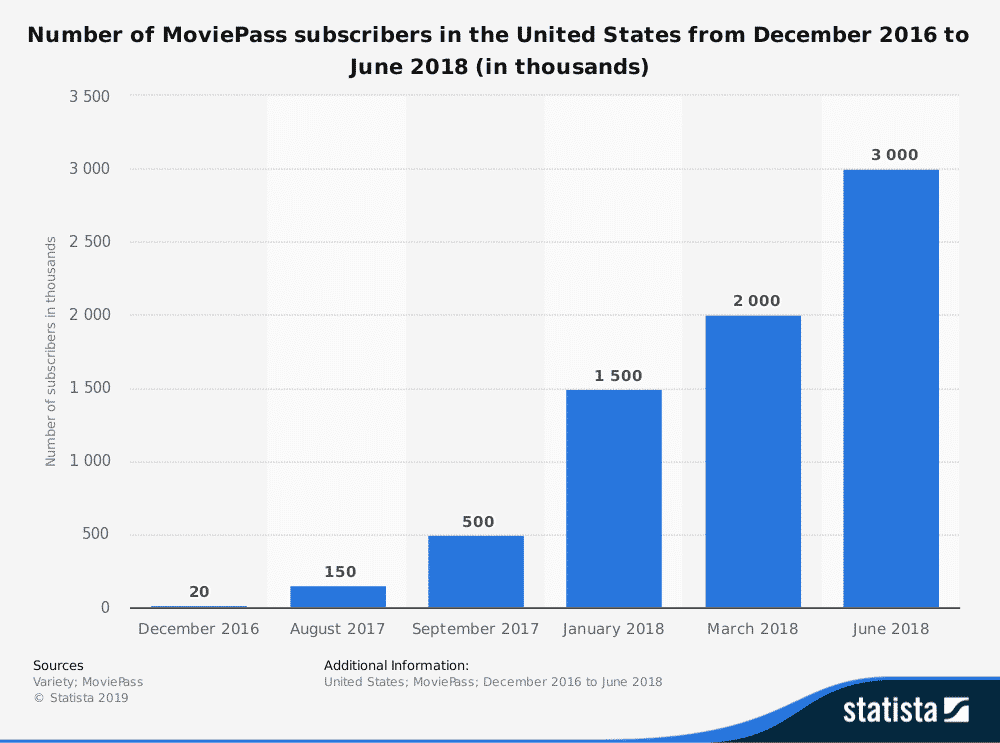
    After Netflix, the biggest disruption the entertainment industry has witnessed is a theatrical subscription service brought to the users by MoviePass. The company took the US movie market by storm and was able to get more than 3 million subscribers in the last 2 years. However, according to many critics, the business model of MoviePass is still very volatile and it is still not clear to many (including AMC) how Moviepass works and makes money.

    Here’s an article to explain this volatile business model of MoviePass, what all services does it provide, who it has partnered with to provide such services, how it actually makes money, and how it has been able to succeed till now.

    What Is MoviePass?

    MoviePass is a film subscription service that lets you watch 3 movies a month in over 30,000 movie theatres in the USA at a monthly subscription price starting at $9.95.

    This subscription-based movie ticketing service was founded in 2011 by Stacey Spikes and Hamet Watt and is backed by renowned investors like True Ventures, AOL Ventures, Lambert Media, Moxie Pictures, and Helios and Matheson which owns a majority of the stake of the company.

    How Does MoviePass Work?

    Moviepass’s operating model is similar to a gym-subscription model where you pay a monthly fee and get access to watch 3 movies at any partner theatre. But if you don’t watch all 3 movies in that month, the credit won’t be carried forward to the next month.

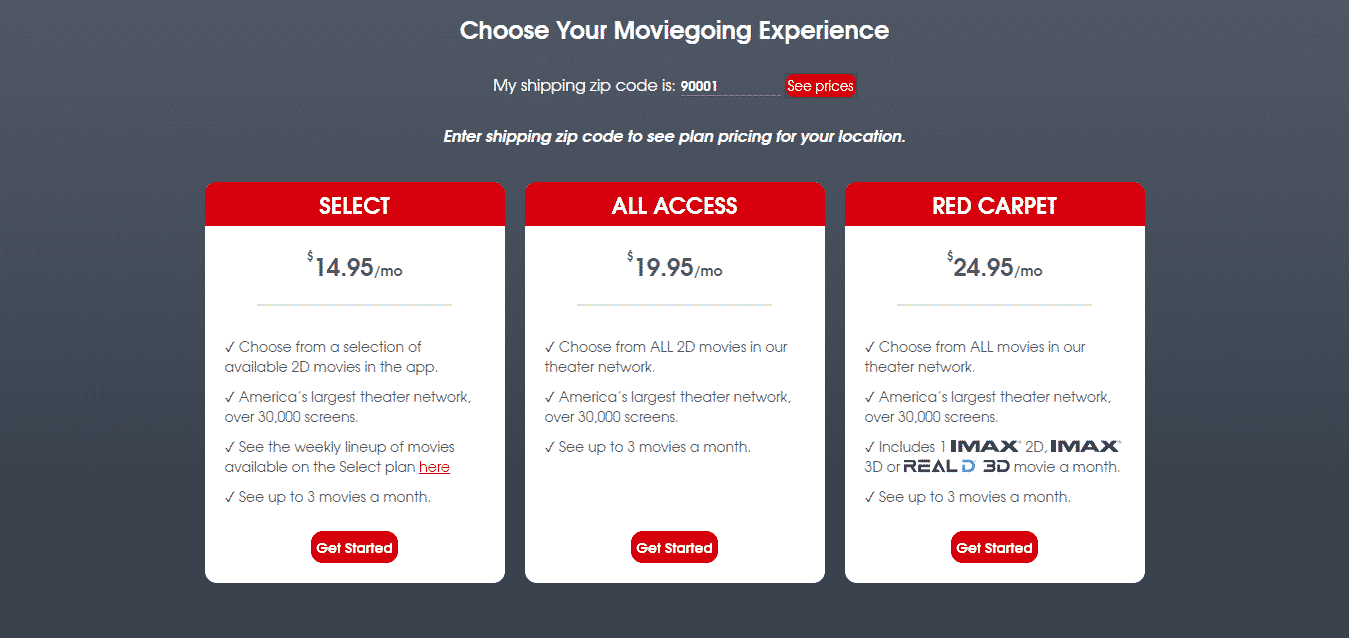
    Moviepass has been around for a while at experimental price points ranging from $6.95 to $50 before it came up with the current business model. As of February 2019, Moviepass provides 3 subscription packages (Select, All Access, & Red Carpet) starting from $9.95 and varying according to the area of operation and the package chosen.

    moviepass prices

    While Select subscribers get to watch 3 movies a month just from a selected list of movies, All Access and Red Carpet subscribers are entitled to watch 3 movies from all the movies airing in the theatres near them, with Red Carpet members being able to watch movies in IMAX 2D, IMAX 3D, and Real 3D as well.

    To make such partnerships with movie theatres possible, Moviepass partnered with Mastercard. This resulted in every theatre accepting Mastercard becoming a member of the Moviepass’s theatre network.

    These are the steps involved to get and use Moviepass to watch movies –

    • Register for MoviePass
    • Receive a Mastercard debit card (MoviePass Card) within 5-7 days
    • Download the MoviePass application and activate your card
    • Visit the theatre where the movie you intend to watch is playing
    • When you’re within 100 yards of the theatre, open the app, check in, and tell the app that you intend to buy the tickets
    • Your MoviPass card will be credited with the amount required to buy the ticket
    • Use that card to purchase a ticket at the kiosk

    An average movie ticket costs $8.95 and the same may easily cost twice this amount in major metropolitan cities. Since MoviePass offers 3 such tickets for $10, you must be curious about who pays for it, how MoviePass actually makes money, what exactly is its business model, and is it even sustainable?

    Read ahead for all the answers –

    MoviePass Business Model

    Moviepass was launched in 2011 with a motive of earning money just like any other gym with a subscription option. The company built its business model around the concept of ‘breakage’ and tried to capitalise on the fact that 88 per cent of its subscribers (would) use the service only one or fewer times per month.

    However, this didn’t work in favour of the company and the company had to alter its business model 11 times before ending up with the data monetization model as it is today (which is a bit similar to Twitter Business Model).

    2011 – The beta was launched in the San Francisco area, promising unlimited movie vouchers for $50 a month. This was a voucher-based model where the members used to print vouchers and redeemed them for movie tickets at participating movie theatres. The strategy failed because the company didn’t pitch to many partners before launching the beta.  (AMC, the biggest American movie theatre chain, didn’t accept MoviePass vouchers). To tackle this problem of less partners, the company partnered with Hollywood Movie Monkey which already had an established partnership with 36,000 cinemas including AMC. This made it easy for movie buffs to get their MoviePass vouchers exchanged for tickets.

    2012- MoviePass shifted to a card-based system and location-based pricing. It retired the voucher-based ticketing system and introduced MoviePass cards (in partnership with MasterCard) which automatically got filled with the exact amount needed to buy the ticket. The prices were also revised and set in the range of $24.99 to $39.99 according to the place the member lived.

    2016 – 2016 saw a major change in the executive committee of the company as former Redbox executive and Netflix co-founder Mitch Lowe joined in as the CEO. This also resulted in a lot of front-end testing of plans by the company which ended up in the creation of two different plans – unlimited movies for $40, $45 or $50 (depending on location) and two films a month for $15, $18 or $21 (depending on location)

    2017 – This year was a turning point for the startup. A majority of the company’ stake was sold to Helios and Matheson (a renowned big data solutions company). It retired all its location-based pricing strategies and launched the simplest pricing strategy of one-movie-a-day for $10. This resulted in a substantial increase in the subscribers despite the criticism and difficulties caused by AMC.

    moviepass subscribers
    source: statista

    2018 – The $10 strategy continued till mid-2018 but was soon replaced by a four-movies-a-month for $9.95 subscription plan which also came with a three-month trial of iHeartRadio. This strategy was again replaced by the unlimited plan which was further altered by adding a condition that the subscriber can’t see the same movie twice. The company also introduced surge pricing for popular movies which attracted an extra charge of $2 – $6 depending on the movie and time. It was followed by blocking weekend showtimes for certain movies. These two strategies resulted in a lot of criticism and were soon retired as in some cases, booking on MoviePass resulted to be costlier than buying tickets from the box office.

    MoviePass Business Model [2019]

    Ever since the majority of MoviePass’s stake was sold to Helios and Matheson, the company focused on getting more subscribers on board. The breakage model was retired and the new data monetization model was brought into existence. Now the company sustains itself by selling behavioural data of its users to third parties.

    How Does Moviepass Make Money?

    MoviePass’ Business Model
    byu/ElectricGremlin inMoviePassClub

    Unlike as most of the users and critics think, MoviePass now has a well-defined business plan. The company has plans to make money out of the user data.

    Which user data, you ask?

    how does moviepass make money

    The startup collects the behavioural data of the movies its users watch and when they watch them, and shares it with partners (movie studios and marketing firms) to help them in targeted marketing for their films.

    “If you get a trailer right now for Spiderman on Facebook, Facebook can’t tell if you ever actually go to the movie. We can,” he told Wired. “We can tell if you look at ‘Spider-Man’ and look at ‘Wonder Woman’ and ‘Mission: Impossible,’ we can tell you exactly what movie you went to out of all three trailers.” – Ted Farnsworth, Helios and Matheson CEO

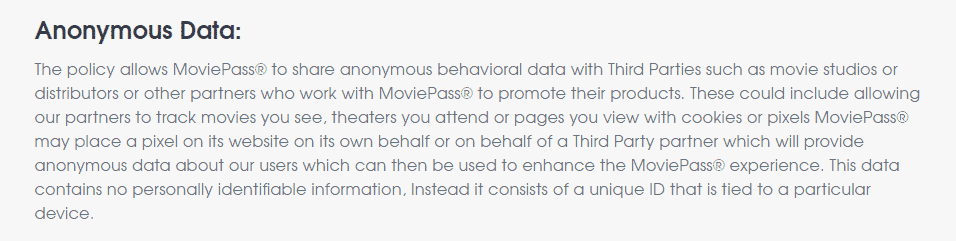
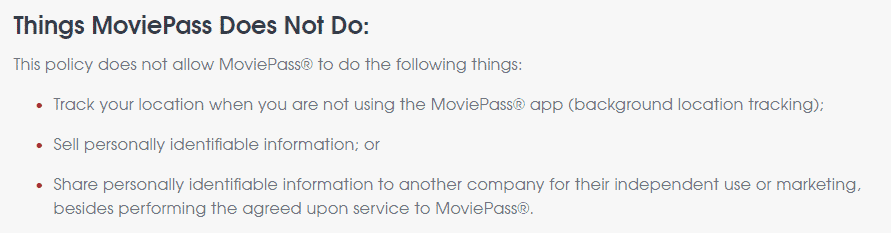
    According to the company’s privacy policy, the data shared with the third parties is behavioural data and does not contain any personally identifiable information.

    how does moviepass make money

    Is MoviePass Sustainable?

    Well, the company chose an industry no one chose to collect data from. It is transparent about its data monetization strategies, and it provides its users with a service one-third of its actual cost.

    Is it disruptive? Yes. Is it sustainable? Probably.

    According to The Atlantic, Hollywood has started using more and more of big data to understand what the user wants, when he wants it and how he wants it to be marketed to him. So if MoviePass continues to get more users on board, its business model can actually result to be the biggest disruptor of the entertainment industry and can set a benchmark for all other business models which will be built around this premise.

    Helios and Matheson has also recently acquired Moviefone (an American-based movie listing and information service) to strengthen MoviePass’s user base and building out its content-marketing strategy and advertising revenue platform.

    Nevertheless, the current model of MoviePass has some limitations on the front end. There is still no family or couples plan and everything is targeted to an individual user. In order to sustain, the company must launch such plans as movies are a group experience.

    Go On, Tell Us What You Think!

    Did we miss something?  Come on! Tell us what you think about our article on How Does MoviePass Work & Make Money? MoviePass Business Model in the comments section.

  • How To Recover From A Startup Failure?

    How To Recover From A Startup Failure?

    Your startup has fallen. Maybe you lost your biggest customer, maybe you haven’t attracted anyone for a long time, or maybe the brand loyalty wasn’t there. Whatever the reason for such a failed experience, it can have a huge impact on you and your career path, depending on your experience and age, and your own perception of the blame for the failure.

    Fortunately, startup failure is a constant in today’s business world and is considered to be a significant and essential part of new business ventures. Successful business leaders aren’t born successful but fail consistently until they achieve success.

    Steve Jobs and Apple are a lasting example of this. The company went through years of struggles, various bad decisions, and failures, and Steve Jobs was even forced to leave the company at a certain point. In the end, they persevered and created the iconic $1 trillion company it is today.

    Failing and rising again is, before everything else, a learning process. One that requires you to change your mindset, how you handle things and perceive them but most importantly, how you perceive yourself.

    Know That You Will Fail

    The best way to deal with a potential failure is to be prepared for it in advance. Even though counterintuitive, it is still the best strategy to handle a startup failure. Most people don’t like to think about failing and for this reason, the majority of them ends up doing it.

    Nowadays, it’s easy to find many budding entrepreneurs all excited about their new bulletproof business plan. But most of them aren’t aware that business is a game of probability – there’s always a 50-50 chance of either succeeding or failing.

    And with every business failure, self-doubt and emotional problems quickly follow. You will need to steel yourself and be full of courage to overcome this. Nobody wishes for failure but if it comes, just face it. Sometimes bad things happen, but it much better to think about them before than to live in an illusion that nothing will ever go wrong.

    Prepare for failure by giving your business everything you got, while simultaneously expecting that the worst will happen. Prepare a contingency plan, just in case. The reason why successful entrepreneurs start a new business venture despite the previous failing is that they have a contingency plan.

    Think about developing an alternative income while your business is still successful. For example, you may wish to go into the stock market and find a suitable small cap stock – then you could have a backup option that can bring you a passive income while you think about what to do next. Or plan another business venture and develop a sustainable model. You might be back to square one the next day, but there will be something to start with.

    Find The Time To Analyze Your Failure

    “Those who cannot remember the past are condemned to repeat it” – George Santayana

    Analyze completely the circumstances and situation surrounding business failure. Physically schedule time on your calendar to do this, either alone or with someone whose business advice you appreciate and review everything that led to the failure. Where were the mistakes made?

    Maybe the cash flow was inconsistent and inefficient and lead you to a cash crunch or the brand message didn’t convey the meaning properly. Maybe your product had poor quality or there was no market for it. Perhaps your business model was unviable or you just lost focus and passion you had in the beginning. Where is your fault in all of this?

    Try to answer these questions sincerely as possible and without expecting the meeting to end with definitive and clear solutions. Take your responsibility in all of this so you can learn what went wrong instead of just blaming everyone and feeling pity for yourself.

    Start all over again

    Find a way to deal with self-doubt and emotional baggage that came with failure and determine whether you have the guts to start everything over again. Is there a passion in you to go after it again, or is it better to search for a safer route? Sift through different options and career paths available to you. It can be helpful to write down your skills and income you can get from them on a piece of paper. Add time and circumstances into the equation. Perhaps your new startup should wait for different circumstances or you may wish to learn new skills before starting over again. Learn from your previous mistakes and find what you can do differently when you start again.

    Look Ahead

    Before you develop another business plan, start by creating a vision. Write it down. Then use it as a roadmap for your business plan since it will give it clarity. A vision is what your company is aspiring to be. Think about the future.

    What outcomes do you wish your business to achieve? Where do you want your company to be in the following months? The vision will serve as a guide for this. And you must do this in a clear and comprehensible way since it is one of the better tools to motivate your employees.

    Your vision should include services or products you are going to offer, the niche your company is in, the problem you are going to solve, your mission statement, ways to search for prospects, marketing strategy and ways to position your business against its competitors.

    Salvage what is left

    Evaluate what is left of your business assets after the failure. Vehicles, office space, equipment, good employees, intellectual property, everything comes into question. Then sell those or lease them so to have an investment for the new business venture. You can either sell them individually or collectively as a company. If you have trouble selling or leasing them, consider contacting:

    • Your competition
    • Your business partners
    • Ads, forums, blogs, newspapers

    You can use the client base or business relationships your company has developed while it was successful for a new startup. Even though those clients that have stayed with your business till the end may not seem useful in the aftermath of the failure, there can be a big asset in your future investments. Also, remember to ask them for their feedback about your failed startup as they may have noticed some mistakes that you have missed.

    Don’t let the failure of your previous startup keep you from starting again. It is going to be hard but remember that evolution created the entirety of all sentient life on earth by using only one tool: the mistake.

    Go On, Tell Us What You Think!

    Did we miss something?  Come on! Tell us what you think about our article on How To Recover From A Startup Failure? in the comments section.

  • What Is Business? – Definition, Concept & Types

    What Is Business? – Definition, Concept & Types

    Business is either an occupation, profession, or trade, or is a commercial activity which involves providing goods or services in exchange for profits.

    Profits in business are not necessarily money. It can be a benefit in any form which is acknowledged by a business entity involved in a business activity.

    To make things clearer, let us divide the business definition into business entity definition and business activity definition.

    Business Definition

    A business [entity] is an organisation or any other entity engaged in commercial, professional, charitable or industrial activities. It can be a for-profit entity or a not-for-profit entity and may or may not have a separate existence from the people/person controlling it.

    A business [activity] is a commercial activity which involves providing goods or services with a primary motive of earning profits.

    Concept Of Business

    The business concept is the fundamental idea behind the business. The business model, plan, vision, and mission are developed based on this concept. Uber, for example, was started on the concept of aggregating taxi drivers and providing their services on demand under one brand. Every other business strategy was developed based on this concept.

    Objective Of The Business

    The business objective is what makes the business go on and conduct its activities in a long run. It is the reason why the business exists. While most of the people argue that profit making is the core objective of every business. Few have come up with the new underlying objective.

    According to the traditional concept, business exists only to earn profits by providing the goods and services to the customers.

    According to the modern concept, the underlying objective of every business is customer satisfaction as this is what results in most profits. If the customer is satisfied, business excels.

    Types Of Business

    Businesses can be classified into but are not limited to 4 types. These are –

    Manufacturing

    Manufacturing businesses are the producers who develop the product and sell it either directly to the customer or the middlemen to conduct sales. Examples of manufacturing businesses are steel factories, plastic factories, etc.

    Service

    This type of business deals in selling intangible goods to the consumers. Unlike tangible goods, services cannot be stored or separated from the provider.

    Service firms offer professional services, expertise, commission-based promotions, etc. Examples include salons, schools, consultancy etc.

    Merchandising

    Merchandising is a middlemen business strategy where the business buys products from a manufacturer, wholesaler, or other partners, and sells the same at the retail price. It is usually known as a ‘buy and sell’ business as they make profits by selling the products at a price higher than their cost price.

    Examples of a merchandising business are grocery stores, supermarkets, distributors etc.

    Hybrid

    Hybrid businesses have the characteristics of two or more types of businesses explained above. For example, a restaurant develops its own dishes (manufacturing), sells the products like cold drinks which are manufactured by other businesses (merchandising), and provide service to the customers (service).

    Forms of Business Ownership

    Business ownership comes in many forms based on the number of owners, the liability of the owners, representation, and motives. These are –

    Sole Proprietorship

    Sole proprietorship is a business owned and operated by a single individual. It is easy to set-up, operate, and register. All the profits of the business belong to the owner and he’s also liable for all the liabilities incurred.

    The biggest drawback of this business that the owner faces unlimited liability. This means that the creditors of the business can go after the personal assets of the owner if the business is unable to pay them.

    Partnership

    When two or more persons join hands to run a business, they usually come into partnership. Partnerships come in two forms – general and limited. A general partnership is like sole proprietorship but with more than one owner where all the owners face unlimited liability. In limited partnerships, some or all of the partners have limited liability.

    Corporation

    A corporation is a business which has a separate legal identity from the people who own or run it. Ownership is usually represented in the form of shares of the stock.

    Owners enjoy limited liability but are not necessarily involved in running the business. The business is operated by a group (board of directors) elected by the shareholders.

    Limited Liability Company

    A limited liability company is a hybrid form of business which has characteristics of both a corporation and a partnership. A partnership because it is not incorporated and a corporation because all of the partners/owners enjoy limited liability.

    Cooperative

    Cooperative is a private business organisation owned and controlled by people for their mutual benefits. These people are called members and are benefitted by the goods and services offered by the cooperative. All members are expected to help run the business as the main motive of the cooperative is to provide service to all the members rather than a return on investment.

    Go On, Tell Us What You Think!

    Did we miss something?  Come on! Tell us what you think about our article on what is business in the comments section.

  • Emotional Marketing Explained: The Definitive Guide

    Emotional Marketing Explained: The Definitive Guide

    Think of the last time you went to Starbucks. You likely ordered something off the menu and had it customised to suit your taste.

    Perhaps you added customisations just because you can, and not necessarily because you need them – it’s Starbucks, after all, which means coffee your way. Even if you laughed at Meg Ryan’s sardonic take on the brand in the movie You’ve Got Mail.

    Maybe you stepped into Starbucks because you watched the movie clip and you wanted to see for yourself.

    Several reasons, one common thread – emotion.

    A feeling of wanting to enter, to customise, to buy.

    And emotion, in fact, is what guides most of our purchase decisions every day.

    What Is Emotional Marketing?

    Emotional marketing, simply put, is marketing that targets a consumer’s emotions and thus evokes an emotional response towards the marketer that cannot be entirely rationalised.

    Brands that actively engage in emotional marketing tend to play on sentiments like nostalgia, love and youthfulness to create an emotional attachment towards the brand in the mind of the consumer – and over time, this attachment deepens to a bond strong enough that consumers rarely, if ever, opt for other brands.

    All of this might sound like eyewash to the strictly rational, but the evidence says otherwise. Extensive research over the decades consistently validates the fact that emotions are the dominant factor in decision-making. People tend to respond to brands based on how they feel about the brand, more than whatever factual knowledge they have of the brand – they are unlikely to purchase from a brand with which they have had a bad experience in the past, even if statistics say that the brand delivers an overall good experience. In fact, the world, according to Forbes, has entered the ‘emotion economy’, where emotions are the reason someone buys (or doesn’t buy). Merely collecting and studying consumer data is no longer enough to understand what makes someone buy. The focus is now on understanding how consumers feel, and the effective computing market – which is developing technology that analyses and simulates human emotion – is poised to grow to $54 billion by 2021.

    Why Should You Care About Emotional Marketing?

    Goldfish generation.

    WhatsApp generation.

    These darn millennials.

    There are several ways of referring to the largest demographic of today, but the underlying sentiment is the same – bombarded as they are with thousands of ads every day, these folks just don’t have the time to figure out hidden meanings or listen to sales pitches.

    Your product may be the best in the market, but you’ll never convert any customers just by reeling off all the reasons you’re the best. If your audience feels nothing, they will move on – to a competitor whose product may not be the best but who has managed to capture the attention of the customer through marketing that touches the heart and convinces to buy. Your meticulously crafted sales pitches and fact-based ads, therefore, won’t take you far with the impatient holders of today’s purse-strings – with only around 8 seconds to convince someone to buy, there’s a clear reason for you to hit them where they’re most sensitive and hit them skillfully enough for their response to be a purchase.

    Which Emotions Matter Most For Marketers?

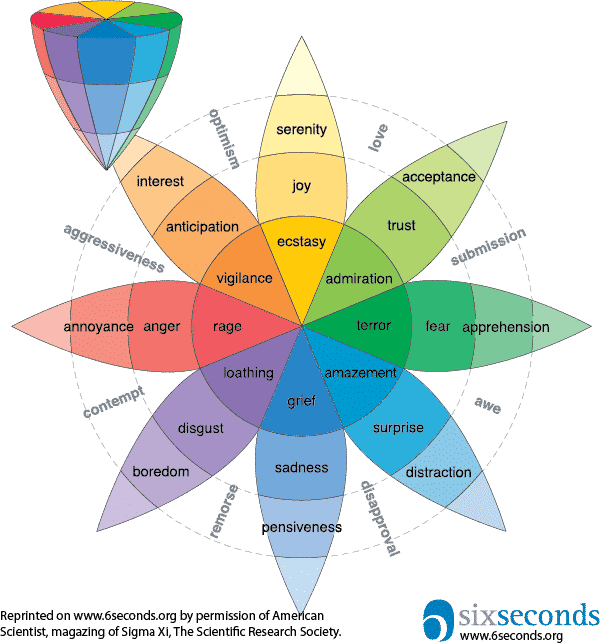
    wheel of emotions
    Source: 6seconds.org

    Emotions have as many subtleties as colours – indeed, Robert Plutchik’s famous ‘wheel of emotion’ model categorises emotions on the basis of colours, complete with primary, secondary and tertiary elements. Of course, trying to play to each and every one of these emotions is impossible no matter how big your marketing budget is – and it isn’t necessary either. Research indicates that human emotion is of four basic kinds – and successful emotional marketing plays on one or the other of these four.

    Happiness

    Who doesn’t love a puppy? And when it’s a video of a puppy pushing a cat in a stroller, it’s instant virality! Android’s 2015 ‘Friends Furever’ ad showcased interspecies friendships in a delightfully touching way, and was ranked by Unruly as the most shared ad of the year. Closely related to happiness is triumph – empowerment – which is what Nike’s ads are all about. Whether we’re an amputee or a hijabi, Nike says that we should ‘just do it’. Those simple words hit straight to the core and have been inspiring a whole generation of athletes to overcome societal barriers and rise to new heights.

    Sadness

    Sadness is a tricky emotion to get right in an ad – just enough pathos to arouse viewers to action, without going overboard. And perhaps nowhere has sadness been captured so brilliantly as in the iconic MetLife Hong Kong ad for its EduCare savings plan.

    In this three-and-a-half-minute clip, what appears to be a happy depiction of a little girl talking about her love for her father dissolves into a heart-wrenching account of the struggle the father faces every day to provide for his child. It’s impossible to watch this and not feel a pang. And for the parents who watched this with eyes brimming over? The final tagline ‘A child’s future is worth every sacrifice’ is enough to make them pick up the phone and dial their insurance agent.

    Fear

    Fear is what propels us into action to safeguard ourselves. It creates a sense of urgency that prompts us into sharing – or buying – whatever could keep us safe. Take this ad by Worldwide Fund for Nature, for instance.

    manfish wwf ad

    No creepy music, no chilling voiceovers – just a shocking image. And when you read the tagline “Stop Climate Change Before It Changes You”, you realise that you could look like the picture someday unless you’re careful. And so you share and spread the word.

    Anger/Disgust

    https://www.youtube.com/watch?v=XjJQBjWYDTs

    Arousing disgust doesn’t mean sharing pictures of month-old leftovers to arouse a “Bleurgh”. It means evoking a sense of being slighted, of being hit in the face with the injustice of something. Anger, here, is righteous anger – against inequality, against racism, against hate. Misogyny is one of the commonest themes that anger-provoking ads lash out against. One of the most iconic ads was P&G’s #LikeAGirl campaign, that won an Emmy for its forthright challenging of a deeply rooted stereotype – that to run, play or catch ‘like a girl’ is to be weak and silly.

    Another is Ariel’s #ShareTheLoad campaign, which questions the assumption that laundry is a woman’s job. Neither are dark ads, but both evoke a deep resentment against the misogyny that is ingrained in most of the world.

    How Does Emotional Marketing Retain Customers?

    Using basic emotions to jolt customers into engagement is the first step. The question arises, though, as to how emotional marketing can ‘make it stick’. How do you retain a customer’s interest long enough to convert it into trust, and hence get the customer to keep buying?

    Personality

    We’re attracted to certain kinds of people more than others, and it’s no different with brands. Research indicates that the personality traits a brand embodies, through its packaging, colour scheme or logo, attract people at an emotional level – and rationality has very little to do with it.

    Think about a black cocktail dress from your local department store versus a similar dress from Gucci. Chances are there’s very little difference in the fabric and the fit, and both would be equally suitable for your next party. Why, then, would you opt for the Gucci dress which would cost at least twenty times as much as the other one? Because Gucci – the word alone – has come to denote class. Sophistication. Exclusivity. When you wear the Gucci label, you feel like a celebrity – and that’s worth the extra dollars any day.

    Narrative

    ‘What’s your story?’ A common enough question in interviews and discussions, and for good reason. Knowing where someone is coming from and why they are doing what they are doing makes them more relatable to us, and hence more likeable. The same applies to brands – people want to be a part of something bigger and grander, and a compelling brand narrative can attract a vast audience who wish to embrace and endorse that narrative.

    Shoe brand Tom’s is doing an excellent job with this, including the use of VR to transport buyers to the faraway country where underprivileged kids are wearing the shoes that Tom’s donates for every purchase.

    https://www.youtube.com/watch?v=CSFdmazPPZ4

    Airbnb, the hospitality behemoth, makes use of a simple yet powerful animation to bring its message home to viewers – that we all want friends, family and a place to call home. Brands like these are loved by their buyers because of the stories they’ve weaved – stories that bring everyone together for a shared purpose.

    https://www.facebook.com/psyop/videos/10153215613209727/?permPage=1

    Sense of belonging

    Individuality is all very well, but at the end of the day we humans like to belong. We like to know that what we do has social approval, makes us cool. When we walk into a Starbucks and order a coffee with any kind of customisation we like, we’re affirming our membership in a club of cool people – the Starbucks club, where everyone can have their favourite kind of coffee. Users of Apple products are in a society of their own, where the badge is the iconic half-eaten apple logo. Harley Davidson is a lifestyle, as is Jack Daniels. They have transcended the state of being merely motorcycles or beverages and become identities in their own right. And embracing those identities makes us cooler people – which is why we don’t mind paying for them.

    Bottom Line?

    Like any concept, emotional marketing has its detractors, and a good many of them. They decry emotional marketing as manipulative, as capitalising on social issues to add to the already-swollen purses of the brands. Moreover, the very nature of emotion makes it easy to go overboard and thus risk coming across as insincere. Given the overwhelming evidence in favour of emotion-based marketing, however, it’s safe to say that the positives outweigh the negatives by an order of magnitude – campaigns such as #LikeAGirl serve to educate the public about social issues, regardless of the profits they generate, and an educated public leads to a better world. And we’re still cheering as wildly at every Apple launch as we do whenever our football team scores a goal, so the concept of emotional marketing clearly has significant relevance even in a world that claims to have immunised itself to ads.

    After all, if it ain’t broke, we shouldn’t fix it.

    Go On, Tell Us What You Think!

    Did we miss something?  Come on! Tell us what you think about our article on emotional marketing in the comments section.

  • How UPI Works? Unified Payments Interface Explained

    How UPI Works? Unified Payments Interface Explained

    With the pace of technology breaching new avenues, it was time for our transaction routine to get a jolt. With payment app and gateway making way into our lives, a new technology UPI has started making waves. Some apps are even including UPI support as one of their distinguishing features. So what is UPI?

    Before moving on to find out more about UPI, let’s first understand how did the traditional transaction routine work.

    Brief History of UPI

    Let’s capture the history of transactions through the eyes of longest living people in the world – Mr Pay and Mr Receiver.

    With the advent of banking, transactions depended on the wet signature.

    Mr Pay, therefore, has to sign an authorised transaction paper so that Mr Receiver could receive the amount.

    With the advent of computers, the functioning of a bank came at the ease of fingertips, and a new form of banking called net banking came into effect. Mr Pay can now use his personal computer at home and send money to Mr Receiver.

    However, moving from a traditional method to this online method many steps were introduced by the banks.

    Banks had to secure the transaction route otherwise a major compromise was waiting to happen just around the corner.

    It could happen that Mr Pay did not want to send his money to Mr Receiver, but the amount was still being deducted, or Mr Pay’s account balance was decreasing, and it was someone else who was receiving the money.

    Fast forward to the e-shopping era, Mr Pay and Mr Receiver were both shopping online. Now there was another problem that arose due to this. Banks did not trust the online merchants and Mr Pay and Mr Receiver would jump through pages of the online merchant to that of their respective banks.

    Now banks have to keep track of the various merchants and their respective choice for banks, and it was overloading the system with all the checks put in place.

    The Idea Of Unified Payments Interface

    Banking officials of India decided to implement a system which was to provide a backbone for the inter-bank transactions and make transactions more comfortable and faster.

    With this in mind, NPCI (National Payment Corporations of India) was established and inter-bank transactions were now to be taken by an NFS(National Financial Switch).

    IMPS (Immediate Payments Service) is also an initiative of NCPI. If a customer uses the IMPS services, the transaction would be done in a matter of few seconds, but this also required the customer to enter banking details again and again which was a cumbersome task.

    Enter UPI, which on a basic premise is the advanced version of IMPS.

    What Is UPI?

    Unified Payment Interface on a basic level is an advanced version of IMPS. It can be considered as a unique email ID for the payments, that is used by the banks to conduct the transaction using IMPS.

    UPI is a two-pronged solution to the problem that the financial sector was facing at that time. One was the unnecessary overhead of authenticating third-party apps to be genuine, and the other one was the transaction itself.

    The next question you might be asking yourself is how does UPI Work.

    Read on to find out.

    How UPI Works?

    There are several hoops that Mr Pay and Mr Receiver had to jump earlier. With UPI, NPCI streamlined the process and made some changes to the approach of a transaction.

    There are two major stages of the transaction now, and Mr Pay and Mr Receiver only need to focus on just one of them.

    PSP (Payment Service Provider)

    A PSP (Payment System Player) in the UPI ecosystem is a certified and trusted entity that acts on behalf of a bank. Mr Pay and Mr Receiver may be using different banks or different e-wallets, but for NPCI a PSP is just an endpoint for a transaction.

    Since anyone can be a payment service provider, NPCI made a standard API for everyone to use and integrate into their system accordingly.

    Now the since the API is openly accessible many ventures have started using this protocol. These ventures have integrated this protocol in their respective apps.

    VPA(Virtual Payment Address)

    Do you remember the time when Mr Pay and Mr Receiever had to enter long details (account number, bank name, and bank IFSC) of each other to send and receive money?

    Now when Mr Pay and Mr Receiver register with a PSP, they each get a VPA (Virtual Payment Address). This is as easy something of the form of someuniqueidentity@PSP.

    It is just like an email address.

    Mr Pay and Mr Receiver can link their bank accounts with a mobile number and multiple accounts with a single id or multiple ids for each account is as easy as the snap of fingers.

    It is natural to think of UPI as the next big game changer. The introduction of UPI has threatened the existence of major payment wallets like PayTM, PayPal etc. and also posed a major challenge to payment gateways like CCAvenue, EBS, Instamojo. However, there are still many challenges that UPI has to address.

    Challenges to UPI

    • Upper cap on transaction size: Every UPI app has an upper cap on transaction value, which limits the amount that can be transferred across bank accounts.
    • Fraud Transactions: Simplicity of app comes with fraudulent transactions threat. Hence, the user needs to keep his PIN secret.
    • Low Awareness: Though UPI is popular in urban areas, it still has to get traction in rural geographies. The rural section is generally tech-averse in case of money matters. Hence, UPI will face initial teething problems.
    • User Experience: Mobile wallets like PayTM have a good customer base and with WhatsApp Pay coming into play, quick recharges and cashback offers can keep them hooked to the platform little longer.

    Future of UPI

    Recently, UPI 2.0 was launched.

    Prior to UPI 2.0 most transactions were P2P (peer to peer). UPI 2.0 aims at facilitating peer to merchant transactions. Its features include – to allow customers to link their overdraft account to UPI, a creation of one-time mandates and pre-authorisation of transactions for payment at a later date, and checking the invoice sent by merchant before making payment.

    Go On, Tell Us What You Think!

    Did we miss something?  Come on! Tell us what you think about our article on how UPI works in the comments section.

  • Reputation Manager Job Description

    Reputation Manager Job Description

    91% of consumers within the age of 18-34 trust online reviews as much as personal recommendations. Therefore, shaping public perception of an organization is highly influenced by the information posted online. And that is what reputation management (rep management, online reputation management, ORM) is concerned with.

    Without a good reputation, success is limited, and a company’s long-term future is not guaranteed. Reputation management focuses on managing the organization’s information and reviews within the digital world due to the growing influence of the internet and social media today.

    Who Is A Reputation Manager?

    Reputation managers are PR specialists who monitor and control online activities of an organization’s brands and sub-brands. They make sure that favourable reviews stand above unfavourable ones. In simple terms, reputation managers safeguard a brand’s reputation on the internet by controlling online information, both good and bad.

    In addition to building a consistent reputation across all web-based channels and platforms, a reputation manager’s job includes traditional public relations strategies as well. Search engine management is also a key responsibility of ORM so as to counter negative search results.

    Read on to find out what employers expect from a reputation manager.

    Online Reputation Manager (ORM) Job Description

    The utmost role and responsibility of a reputation manager is to create and maintain a favourable brand image of the company and its products. He is in charge of every social media account of the company’s brands and monitors how the brands are engaging with the audience. Not just this, ORM also handles what should go out in media about the company and how to handle negative publicity even on the review websites like Glassdoor, Yelp, Google Play, iTunes etc.

    Put Forth Company’s Best Image

    A company’s reputation depends on the way its customers, employees and investors view it. One tweet, one Facebook post, and even one review can influence these factors for better or worse. ORM should put forth an image which conveys the message that the company values customer responses.

    This is achieved by always making sure you reply to the reviews, queries or complaints that the customer may have.

    Build Trust And Brand Loyalty

    Customers are sure to research about a company before making a purchasing decision and your lack of response to negative comments or reviews can make them hesitant. A reputation manager has to deal with such problems and help neutralize any bad review or comments.

    Showing your customers that you will improve or act upon the problems is a great way to boost your reputation. When your business understands and adopts the needs of a customer, they feel that they are an important component of your business. This can help build brand loyalty and ultimately raise revenues.

    Manage During A Scrutiny

    A reputation manager has to help cope with scrutiny by business communities, regulators and corporate governance teams. This can be done by implementing good reputation management practices.

    The internet is a difficult place to survive the competition. Any person wanting to damage a company’s reputation will find very few obstacles in their way. A management team dedicated to minimizing damage in case of any future crisis is thus vital to every company in the long run. That is why a reputation manager is essential for any company.

    If you think you have the skills to handle the responsibilities mentioned in the job description above, you can now read on to find out what educational qualifications you might require.

    Expectations From A Reputation Manager

    A reputation manager is expected to:

    1. Have an understanding of search engine behaviour, social media, forums, blogs, ratings and reviews, etc. These are considered to be the most important and basic skills of a reputation manager.
    2. Work towards enhancing and building the organization’s reputation by constantly measuring the effectiveness of your strategies.
    3. Establish policies and procedures, systems and standards that will avoid any negative impacts on the organization. Reaching out to dissatisfied customers is an important procedure to control negative reviews. Moreover, focussing on forums, tweets, images, and writing effective blog posts, or publishing positive reviews is also the responsibility of a reputation manager.
    4. Be well prepared for taking immediate action when the company’s reputation has been tarnished.
    5. Research online to find out all the negative keywords associated with a brand or individual and publish positive content that can then neutralize the effect of the former.
    6. Lead the management team in maintaining and improving the company’s reputation.
    7. Handle difficult situations such as internet blackmail and ethical manipulation of search engine results or reviews.

    Educational Requirements And Skills For A Reputation Manager

    As the job of a reputation manager largely surrounds the digital world, having a degree in digital marketing, social media marketing/branding or industrial relations is recommended. Qualifications like a Bachelors or Masters in Business Management or Mass Communication can ensure a bright future in the field.

    Additional tools like SEO and knowledge in programming will be an added advantage.

    Reputation Manager Salary

    In the United States, the average salary of a reputation manager is considered to be $62,846 per year. The salary can range from $37k to $101k depending on your experience, skills and expertise levels.

    Complete and effective management of a company’s reputation requires the presence of a skilled reputation manager. Building a reputation, sustaining a reputation, and protecting a reputation are each different objectives and each of these require different strategies and skills. This is all the more of a reason to have an individual or group of individuals to work exclusively for reputation management.

    Go On, Tell Us What You Think!

    Did we miss something?  Come on! Tell us what you think about our article on online reputation manager job description in the comments section.

  • Hard Skills – Definition, Importance & Examples

    Hard Skills – Definition, Importance & Examples

    In any job application or interview, employers look for applicants with two very important sets of skills—namely soft skills and hard skills. A successful candidate would ensure that he puts both sets of skills on display.

    While soft skills (interpersonal skills) play a crucial role for success in a job, they are harder to quantify than hard skills—skills that are acquired through formal education in schools, apprenticeships, online courses, vocational or training programs. These are the skills that include the expertise required by an individual for the job.

    What Are Hard Skills?

    Hard skills are job-specific and teachable abilities that are required in a candidate. These skills are those that are acquired through formal education, training programs, certification programs and coaching. They include the necessary expertise that is expected of employees, and are typically mentioned in job postings and descriptions to give an idea about what the job in question requires.

    Hard skills are those that can somehow be quantified, defined, evaluated or measured. For instance, a degree from the university, proficiency in a foreign language, writing skills, mathematical skills etc can be classified as hard skills. They are most commonly evaluated during interviews to ensure that the candidates actually do what they claim to in their resumes.

    Difference Between Soft Skills & Hard Skills

    Both soft skills and hard skills are equally important when it comes to job applications. It is also important to understand their differences in various aspects.

    The most basic difference between soft skills and hard skills is that the latter require the use of the left brain, or the logic centre, whereas the former require the right brain, or emotional centre to be used. Ergo, IQ is the key to hard skills, and EQ is the key to soft skills.

    Hard skills are those that are gained through formal education, training and experience. Soft skills, on the other hand, are subjective skills that are acquired through the way you relate, interact and work with others on projects.

    Hard skills are the ones that you need be able to perform a particular job. This may differ across various fields and industries, according to their requirements; for instance, a data analyst should have a fair amount of expertise in computer programming. Soft skills, however, are not very specific to a job. They are valued by all employers, no matter what field they operate in.

    Hard skills can be defined and quantified whereas soft skills are hard to quantify. Providing an evidence of your hard skills is fairly easier when compared to evidence of your soft skills. For instance, if your employer is looking for someone skilled in computer programming, a certificate or program can be pointed to.

    Importance Of Hard Skills

    Since hard skills refer to the expertise you have acquired in any particular field, they also happen to be one of the most important skills listed in your resume. Although soft skills eventually determine whether you’ll get the job, a certain level of proficiency is always required to give you an edge over the other candidates. That proficiency is determined by hard skills. For instance, you wouldn’t be hired as a graphic designer if you didn’t know how to use editing software.

    That being said, every job requires a different kind of balance between hard skills and soft skills.

    Hard Skills Over Soft Skills

    People who work in fields that are more hard skills-centric are extremely well-qualified and trained at their jobs. Their work is often more technical and soft skills take a back seat in their jobs. Physicians, engineers, scientists etc. often depend on their own ability and training to do their jobs, instead of focusing too much on team-work or management.

    Equal Focus On Hard Skills & Soft Skills

    Sometimes, a profession requires both sets of skills for success in the job. In fact, in these professions, soft skills enhance the person’s hard skills in a way that they’re co-dependent. For instance, doctors, psychiatrists, lawyers etc. are required implementing both sets of skills. Aside from expertise in their fields (hard skills), doctors also need to have a high EQ to handle emotional situations with their patients.

    Soft Skills Over Hard Skills

    Careers that require a high amount of creativity, team-work, communication and networking skills depend on soft skills over hard skills. For example, the employees in the marketing and sales department do not necessarily need to understand the technical features of the product they need to advertise; they can succeed at their work as long as they can gain compliance from their customers.

    Hard Skills Examples

    Hard skills are innumerable. Every profession comes with a list of its own hard skills requirements. Here are 10 examples of hard skills that employers look for while hiring an employee.

    1. Computer Technology- In today’s world, it is very important to have a basic grasp of computer technology at the very least, since many companies require candidates to apply for jobs using a computer-based platform.
    2. Hard Communication Skills- effective communication is a very important soft skill. But factors such as being fluent in more than two languages, or a foreign language, serve as effective hard skills.
    3. Data Analysis- Data analysis is a highly valued hard skill across various industries, and not just finance. The ability to analyse data to use the information for the benefit of your company is extremely useful.
    4. Certificates & Licenses- While these may not be hard skills themselves, they give your potential employer a proof of your expertise in the required hard skills.
    5. Design- being artistically inclined may be a soft skill, but being adept at using digital tools for designing has become a very important hard skill. This proves to be essential as the consumers’ standards for design aesthetics have increased today.
    6. Cloud Computing- Due to the advance in internet and technology, companies are turning to cloud computing as a more convenient method to secure their data. This means that people who can build and manage cloud systems are in demand.
    7. Mobile & Web Development- Multiple websites are created every second and several apps are released every day. This would not be possible without people who are skilled at creating and managing apps and websites.
    8. Network Security- Companies are very confidential when it comes to their data. IT professionals who are skilled in encryption algorithms are higher in demand than ever.
    9. Marketing- convincing and persuading a customer purchase a company’s products or services requires a certain amount of expertise in communication. This ability is always valuable to potential employers.
    10. Project Management- This is a set of hard skills that is required across multiple of industries ranging from IT to construction. Due to this, hard skills related to management have become extremely important to employers.

    Bottom Line?

    Hard skills are important for completing a task at hand in a much better manner, but soft skills are equally important for advancement in your career. Both hard skills and soft skills are equally important. While the former makes sure you know what you’re doing or talking about, the latter ensures that you do it with flair.

    Although soft skills aren’t given too much importance during the formative years or formal education, hard skills shouldn’t be neglected. Hard skills are mentioned in the cover letter of your resume when you apply for a job. While your soft skills enhance your hard skills further, no job can be done successfully without having a certain amount of expertise in that field. Thus, hard skills are those that serve as a foundation to the field you choose to work in.

    Go On, Tell Us What You Think!

    Did we miss something?  Come on! Tell us what you think about our article in the comments section.