Feedough Logo

Blog

  • What Is Point of Purchase? – POP Marketing Definition & Examples

    What Is Point of Purchase? – POP Marketing Definition & Examples

    An average supermarket shopper can be exposed to around 20,000 products in a single supermarket visit that may not last for 30 minutes. With this race against time and the ever-increasing number of products at a store, each trip for the shopper is like looking for a needle in a haystack.

    With all this competition, brands need to make sure their product stand out from the crowd and attract customers. They need something to explore all the touchpoints and interact with the customers inside the store.

    This is where the point of purchase marketing comes into play.

    POP marketing gives the brands access to a customer’s mind while they are inside a store and looking to fulfil his shopping needs. It provides a brand with the power to highlight its product and compel the customer to go ahead and make a purchase decision favouring the said brand.

    However, point of purchase is often confused with POP displays and POP marketing. Although they sound similar, each of these terms has a different meaning and plays a different role in the marketing regime.

    So, dive right in to know more about the point of purchase and the terms related to it. 

    What is Point of Purchase?

    A point of purchase (POP) is the location of in-store brand-customer interaction where a potential customer makes a purchasing decision.

    The definition of POP can be broken down into the following keywords:

    • In-store interaction:  As opposed to common opinion, POP is not limited to the billing counter. It includes each touchpoint inside the store where a customer can interact with the offering or the brand.
    • Potential customer: At this point, the customer only desires to buy some product, but they haven’t taken any action yet. Thus this is the point that precedes the customer’s actual decision.
    • Purchasing decision: It’s a location where a brand can persuade or induce customers to buy its product. POP is the last marketing and promotional channel a brand uses before the customer makes their final decision.

    In other words, POP denotes the touchpoint or the location where a customer interacts with the products inside a store.

    For example, upon entering a store, a customer can access everything from a dangler to an aisle to a shelf to the billing counter, etc. These touchpoints are seen as the buyer’s interaction with the brand or offering, and can be categorised as the points of purchase.

    What is POP Marketing?

    Point of purchase marketing, also referred to as POP marketing or POP advertising, is a form of retail marketing used by various brands to induce customers to buy their products once they are in the store and ready to make a purchasing decision.

    Brands use POP marketing techniques to make their products stand out from the clutter and catch the customer’s eye to induce impulsive purchase decisions favouring the displayed brand.

    What Is A POP Display?

    The elements which marketers use to market the product and attract buyers at the point of purchase are called POP displays.

    POP displays are a great marketing tool to

    • Promote the product and showcase special deals, offers, and other sales promotion strategies, and
    • Educate the customer about the offering and brand details.

    Along with POP displays, marketers also use packaging strategies, sales promotion, and personalised marketing to try and influence customer buying decisions in a retail store.

    Types Of POP Displays

    POP displays can be divided into various types based on their life span and their positions inside a store. Different types of POP displays have different usage and can be utilised by brands according to their needs.

    Types Of POP Displays Based On Lifespan

    According to the life span, POP displays can be categorised into the following three subcategories:

    • Temporary: Temporary POP displays are designed to last for a short period of time. They usually feature seasonal promotions or discounts and can be easily replaced after a certain amount of time. They are mostly made up of inexpensive material and are comparatively cheaper. As such displays are more affordable, brands can easily swap them for fresh displays and maintain creativity without much investment. Shelf talkers or simple signage are two examples of temporary displays.
    • Semi-permanent: Also known as secondary displays or off-shelf displays, semi-permanent displays are designed to last longer than temporary displays. They usually last from 6 months to a year. They are made up of materials like glass or heavy-duty cardboard and thus have a higher up-front cost.  Examples of such displays could be end caps or freestanding displays.
    • Permanent: Permanent displays are built to last at least 1 to 3 years. These are usually designed to resemble a store within the store. They are made up of durable materials and require a higher investment.

    Types Of POP Displays Based On Positions

    According to their positions, POP displays can be categorised into the following subcategories:

    1. Danglers: Danglers are one of the most common POP displays used by brands to attract customers. They are hanging signages dangled from the ceiling of a store, often used to educate customers about the qualities of the brand and any discounts, sales, or other promotions.
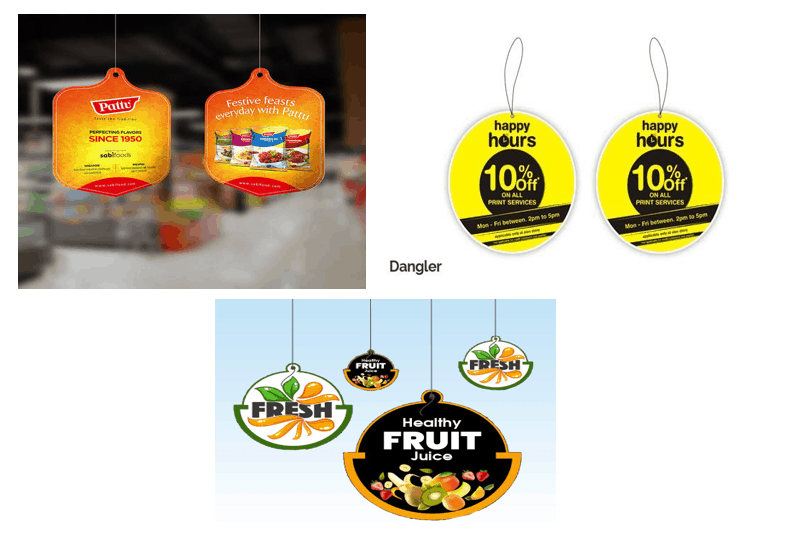
      Danglers
    2. End caps: End caps are POP displays placed at the end of an aisle. They provide extra visibility and a prime location to the product as the customers can see them without even going down the aisle. Creative end caps help in attracting customers and further building up a brand’s image.
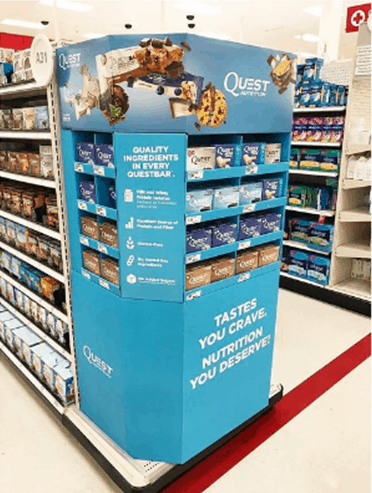
      End caps
    3. Freestanding displays: Freestanding displays are attractive displays that allow companies to place their product anywhere in the store. Brands can get creative and try their hand at designing innovative freestanding displays like a giant version of their product. For example, it will be almost impossible for the customers to miss this giant bowl of Maggi noodles in the middle of the store. This 360-degree display can be seen from all directions and will effectively attract customers while accurately projecting the brand’s organic image.
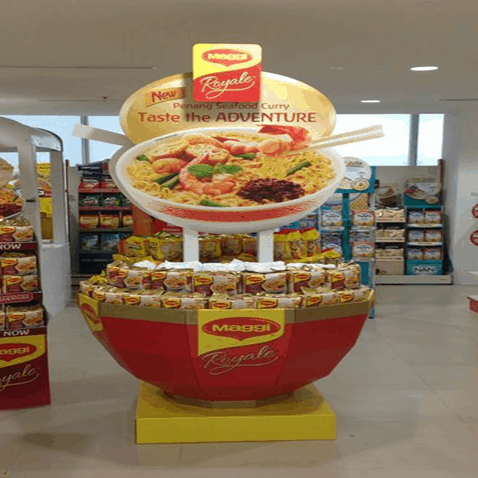
      Freestanding displays
    4. Shelf talkers: Shelf talkers are hanging tags or signs placed near a product on an aisle shelf. These tags make the product stand out within the aisle and educate the customer about the qualities of the product and the value it provides. Shelf talkers should be colourful, eye-catching, and highlight the product’s qualities in a line or two. Some shelf talkers also include promotions, discounts, and coupons which further induce the customers to buy the product.
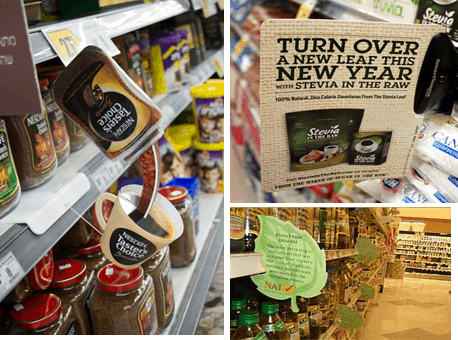
      shelf talkers
    5. Interactive displays: Brands can use technology to further enhance the in-store shopping experience for the customer and induce them to buy their product. Such displays work better than the usual POP displays. They encourage the customer to engage and interact with the brand rather than just inform them about certain product qualities. One such example is Campaign Outdoors’ jacket kiosk. The brand placed a 6-feet tall jacket kiosk in the middle of its store, allowing the customer to design a jacket themselves. The kiosk first allowed the customer to try on a jacket and then head on to the monitor where they could make various changes to the colour, size, and design of the product.
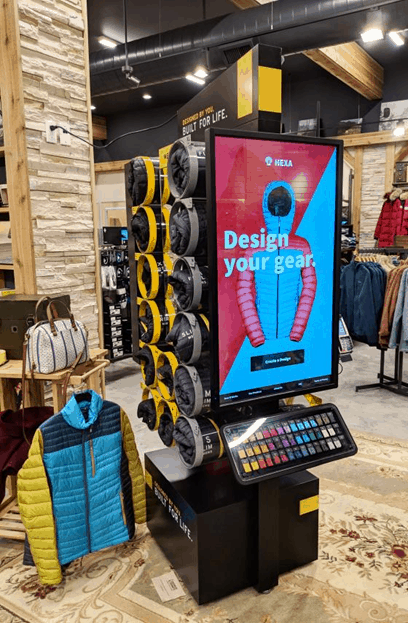
      Interactive displays
    6. Dump bins: Dump bins are standalone POP displays used for small-packaging products like candy bars or chocolates. As dump bins are freestanding, they come in handy in attracting the customer while shopping through the store. They can also be strategically placed so that they can be seen or interacted with from all angles.
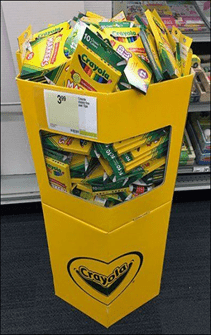
      dump bins
    7. Floor graphics: Using floor graphics is yet another way brands try to draw attention to their products. A unique and creative floor graphic placed in front of the product could help brands distinguish their product from other similar items on the aisle. For example, these displays from Nesquik, Mortin, and Fox’s are great examples of floor displays as they are creative and strategically placed right in front of the brands’ products to entice and induce the customer to make a purchase.

      floor graphics

    Why Is POP Marketing Important?

    POP marketing is a crucial tool for marketers and brands especially with an upsurge in impulse buying behaviour. It is a proven way to effectively optimise the product’s location inside the store and increase sales. Furthermore, POP marketing is important because it allows the brands to:

    • Target a specific audience: As POP displays are a part of location-based advertising, they make it easier for the brand to reach targeted customers. Marketers often use in-store POP advertising strategies to target customers based on their demographics, location, and buying behaviour.
    • Influence buying behaviour: Brands can effectively use POP marketing to influence the customer’s purchasing decision in their favour. With the help of attractive and creative POP displays, it becomes easy to highlight a certain product and persuade the customer to buy it.
    • Promote brand’s offerings: POP displays act as a surrogate salesperson for brands. They highlight the brand’s various offerings, educate customers on the qualities of various products, and advertise any discounts or schemes on the said product.

    What is the Objective of POP Marketing?

    POP marketing aims to attract customers and influence their buying decisions while simultaneously enhancing the brand’s image. While ad campaigns, brand activation events, influencer marketing, social media marketing, and other marketing techniques can help get the customer to a store or building up a brand’s image, POP marketing helps the brand in engaging with the customer once they are inside the store and ready to make a purchase decision.

    The main objectives which brands keep in mind while designing a POP marketing campaign are:

    • Enhancing customer’s shopping experience: Customers often prefer to keep their shopping trips quick and efficient. According to a European study, 39% of 23 billion shopping trips lasted for just about 15 minutes. But, this works against the brands because the longer a customer is inside a store, the more likely it is for him to make purchasing decisions favouring the brand. Thus, brands use POP marketing to provide useful information efficiently and quickly, make shopping entertaining for the buyer, and induce them to buy their product.
    • Increasing brand awareness: POP marketing is also used to increase brand awareness and further build up a brand’s image. When a customer looks at a huge POP display, they are reminded of previous marketing campaigns from the said brand. Even if the interaction doesn’t lead to purchase immediately, the customer will remember seeing the display from the said brand, which ultimately enhances the brand’s image.  
    • Incrementing sales: As the competition among different brands has been growing exponentially in almost every industry, POP marketing comes in handy when a particular brand wants to highlight its product in a cluster of similar products. Creative freestanding displays, end caps, or dump bins can effectively attract and influence potential buyers and increase sales.

    POP Marketing Examples

    Many brands have successfully unleashed the power of POP marketing and, in the process, increased their sales while effectively influencing customer’s in-store buying decisions. Some examples of such brands include:

    Kitkat

    Kitkat, a chocolate brand from the UK, has been known to use different POP marketing strategies to enhance the display of its product. The brand uses various POP displays such as end caps, freestanding displays, and dump bins to entice and attract customers.
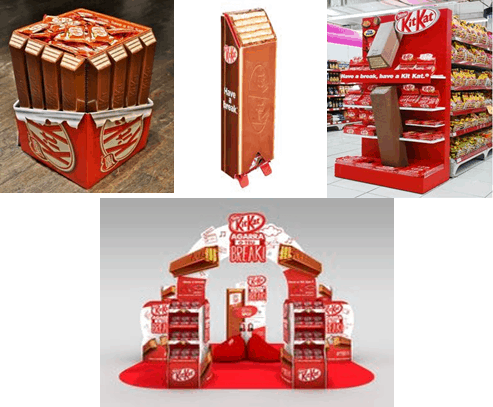
    KitKat POP

    Jameson 

    Jameson, the famous whiskey brand, is also known for its hard-to-miss POP displays. The brand specialises in designing bigger versions of the unique Jameson bottle, thus attracting customers from far away.
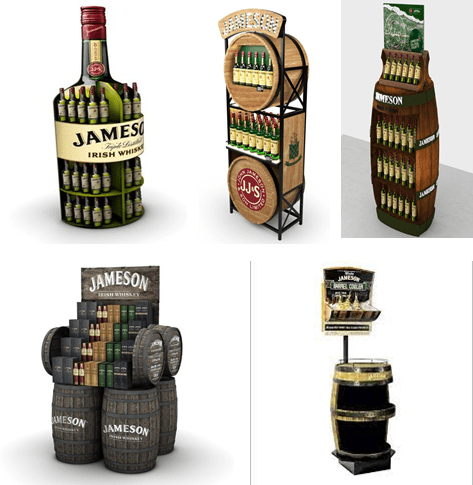
    Jameson point of purchase

    POP vs POS

    While POP and POS are terms often used interchangeably, they differ from each other. The main difference between point of purchase and point of sale is their location. While the point of purchase refers to the entire area where a buyer makes a purchasing decision, the point of sale refers to the specific area where the final transaction occurs.

    For example, the point of purchase for a chocolate bar is the entire store, including shelves, the aisle, and even the floor of the store because the customers can interact with this product through POP displays placed anywhere inside the store but the point of sale includes only the billing counter or the checkout aisle because that is the place where the actual transaction takes place.

    Brands usually use POS displays to provoke impulse buys by the shopper. The location of POS displays ensures that the potential buyer will at least once encounter the product because every customer will end up at the checkout counter for sure. This is why the products displayed at the point of sale are such that they would trigger impulse buying decisions at the customer’s end.

    For example, stores usually display chocolate bars, soft drinks, or cosmetic products at the billing counter. The potential buyer usually does not plan to buy such products, but they may likely pick them up if they encounter them while waiting at the billing counter. That is why the point of sale acts as a great touchpoint for brands who want to attract customers and prompt impulse buys.

    Go On, Tell Us What You Think!

    Did we miss something?  Come on! Tell us what you think of this article on point of purchase (POP) in the comments section.

  • How To Harness The Power Of Network Effects [Actionable Guide]

    How To Harness The Power Of Network Effects [Actionable Guide]

    Ever wondered why no competitor could come close to Facebook even when Google spent billions to make users try its Google+?

    Or why the majority of the users didn’t (or couldn’t) leave Whatsapp even after the big controversy relating to its privacy policy?

    The answer lies in a phenomenon called network effect.

    Network effects are why you will not (or can not) wake up one day and decide to leave behind all your contacts on Whatsapp and switch to Signal. These platforms are designed in such a way that it becomes tough for any competitor to overpower them even after spending millions.

    Curious?

    Dive in to find out more about network effects and how you can build one yourself! 

    What is The Network Effect?

    In the words of Harvard Business School professor Bharat Anand, “the term network effect refers to any situation in which the value of a product, service, or platform depends on the number of buyers, sellers, or users who leverage it. Typically, the greater the number of buyers, sellers, or users, the greater the network effect—and the greater the value created by the offering.”

    In simpler terms, an offering that capitalises on network effect becomes more valuable when more people use it.

    It is a phenomenon that dictates that the increase in the usage of a product, service, or experience increases its value for every other user. The term first emerged when researchers began to study the development of telephone networks.

    What is The Network Effect?

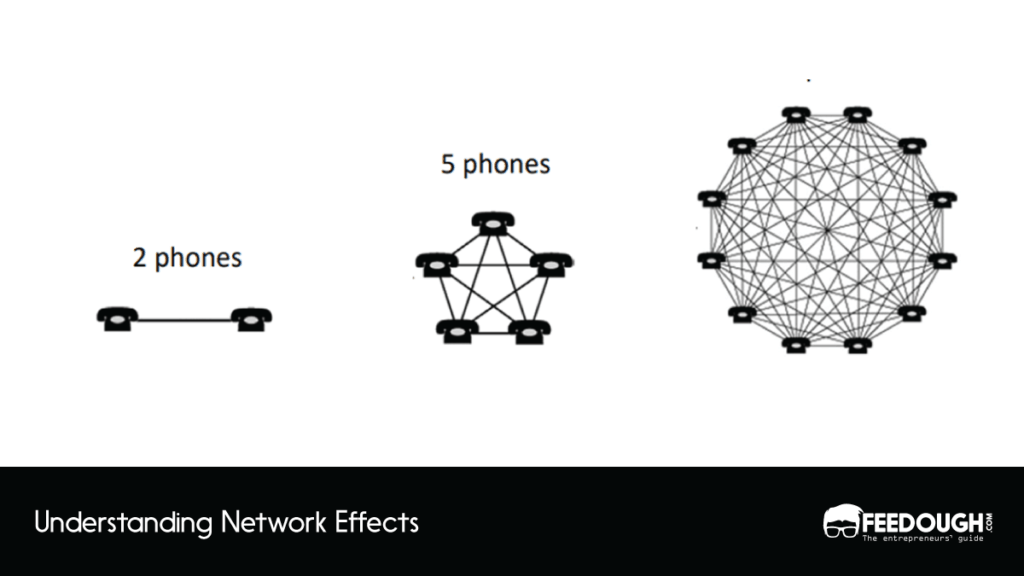
    Let’s explain the power of the network effect using a simple example. Suppose you are the only one who owns a telephone in the world. Now, this device would be utterly useless to you if you’re the only one. But, if your friend also owns a telephone, there’s some utility to it as you can now communicate with your friend. Now, what if four of your friends own a telephone? There can be 10 interactions in all! Notice the drastic increase in your perceived value of the application as more and more of your friends join the network. This increase in value further induces more people to own it and grow the network.

    This is the power of the network effect!

    Network effects are the primary source of competitive advantage and play a crucial role in the retention of consumers and the platform’s growth. For example, you wouldn’t leave Facebook and switch to another platform that your friends or family don’t use yet. Similarly, it’s hard for you to switch from Whatsapp to Telegram and Signal because not all of your contacts will switch to the same. Hence, even though many users downloaded Signal and Telegram after the WhatsApp controversy, not many could delete WhatsApp completely.

    But, network effects are not always positive. They don’t always increase the value of a product or service. Network effects can be negative too.

    For example, assume you have an account on Facebook. You chat with your friends or colleagues, comment on their posts and post your pictures. But then, due to network effects, all of your relatives and family members join in too. This increase in unwanted users would presumably reduce the value of the platform for some people. And this is one of the main reasons why most teens switched over to Instagram.  

    How Network Effects Result In Market Dominance?

    In the last two decades, network effects have accounted for 70% of the value creation in digital startups. It isn’t surprising as the power of network effects is massive. Once a network is harnessed into a platform or a startup, unlimited growth potential can be unleashed. The following points reiterate the importance of network effects for a platform and answer why you should consider integrating network effects into your platform or marketplace.

    Network Effects Increase The Value A Platform Provides

    When network effects are strong, the value of your platform increases sharply with each additional user.

    Take Instagram, for example. As the number of users of Instagram increases, it becomes more attractive and valuable for existing and new users. This, in turn, increases the amount and variety of new content on Instagram, attracting even more users.

    A Platform With Network Effect Requires Comparatively Less Marketing

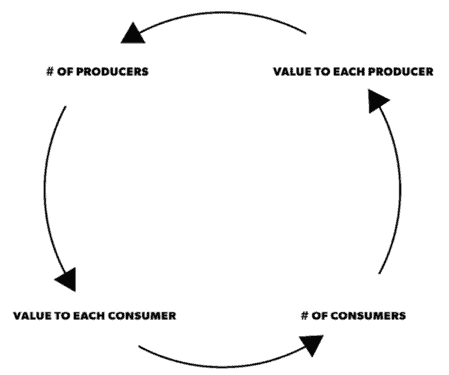
    Once you establish a network effect, it capitalises on network automation. It eventually grows and markets itself as more and more users join in. For example, if numerous developers develop apps on Playstore, more consumers will be attracted to the platform and will eventually prefer Android over other smartphones. It, in turn, will induce even more developers to learn and develop such apps. And the loop will go on.

    This positive feedback loop forms the core of network effects.

    positive feedback loop forms the core of network effects.

    If your platform or company already has a network effect in place, it can grow with comparatively much less marketing or without trying to attract more customers.

    But the marketing executives can’t sit back and relax, thinking that the network effect will do their job. They need to make sure that the network’s needs and wants are fulfilled as and when they arise.

    Network Effect Maintainance Cost Is Lesser Than The Value It Adds

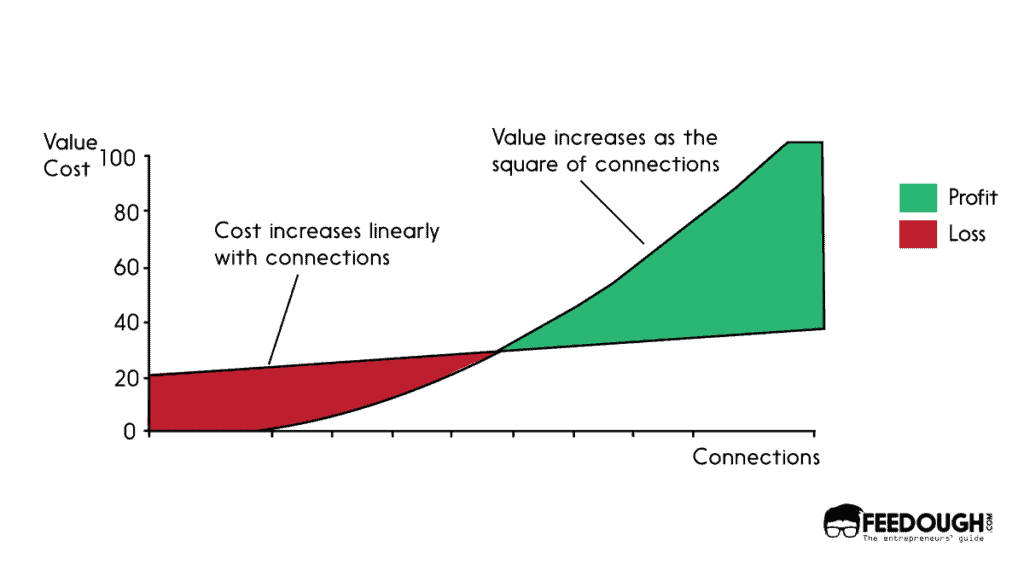
    Yet another advantage of having a network effect in place is that the value generated through the effect is much more than what it costs you to maintain it. While the value of the platform increases exponentially, the cost of each additional user will increase linearly. This is because you do not buy more assets to grow the platform. Instead, you acquire more customers, and that automatically helps your platform to thrive.

    Network Effect Maintainance Cost

    Network Effects Often Result In Market Monopoly

    All these features of network effects tend to strengthen the platform and make it invincible. Now any competing platform will have to probably spend millions or even billions on building such a network. This is why it is often said that network effects monopolise a market where usually the winner takes all.

    Types of Network effects

    A network effect can be built in numerous ways, and its dynamics change depending on its type. It is essential to understand these different types of network effects to realise their potential correctly.

    Same-Side Network Effects

    Also referred to as the direct network effect, this is the simplest of all network effects. It dictates that an increase in the number of users increases the value of the product.

    For example, if you were to create an instant messaging platform like Whatsapp, you would be integrating direct network effects. 

    Cross-Side Network Effects

    Also known as the indirect network effect, it dictates that the value of a product or service increases due to the complementary products or services that add value to the original platform.

    An example of indirect network effects is Microsoft Windows. Imagine you are a user of Microsoft Windows. As you increase the usage of Windows, you also increase the value of applications on this Operating System. Now, more developers would be willing to build and develop such applications. And this, in turn, would increase the value of Microsoft Windows for you.

    Two-Sided Network Effects

    These network effects can be seen as a two-directional version of indirect network effects. It dictates that the value of a service or a product increases for one user group when a user from a different user group joins the network.

    For example, eBay has two user groups: the sellers and the buyers. Now suppose you are a buyer on eBay. Then an additional buyer will not provide any value to you. But an additional seller will enhance your experience on eBay as now you will have more options to choose from.

    Local network effects 

    A local network effect is a phenomenon where each user is influenced by only a small subset of other users.

    Uber is an example of local network effects. Suppose you are an Uber driver working in New York, then you would be influenced only by the New York network and not by the network existing in any other state.

    Companies That Capitalised On The Power Of Network Effects

    With the advent of the internet, network effects have become even more powerful and engaging. Almost all the top-ranking tech companies with their market capitalisation touching billions of dollars use network effects to grow their platforms further and increase their reach. Some examples of such companies include:

    Facebook

    Facebook started as a simple social networking service to connect Harvard university students. But today, you would hardly come across someone who doesn’t have a Facebook account. Facebook has become an indispensable part of people’s lives, and probably yours too. Having a Facebook account has become as common as having your email. And it sounds absurd when someone says that they don’t use the platform.  

    But what makes Facebook so special is that the platform provides you with the ability to connect with your friends, family, and acquaintances. Facebook operates on a personal direct network effect. It taps into your fear of missing out and induces you to become a part of a network that becomes more valuable as more and more people join.

    Also, while scrolling Facebook, you must have seen some sponsored advertisements, which are very spookily based on your preferences and online behaviour. These advertisements are a part of Facebook’s self-serve ad platform, giving the company access to two-sided network effects. The users and advertisers are a part of a cross-side network whose value increases with each additional user.

    The company overpowered all its competitors and is still at the top because of its intricate network effects. 

    Uber

    Uber has become synonymous with a cab ride today.

    Notice how we say calling an ‘Uber’ and not a ‘cab’. That is the impact Uber has on our lives.  All thanks to the network effect.

    Uber has seen tremendous growth in past years and currently has a market capitalisation of $97.11 billion. The company’s greatest asset is its massive network and integrated network effects.

    The company operates on a cross-side network effect, with users on one side and the drivers on the other side.

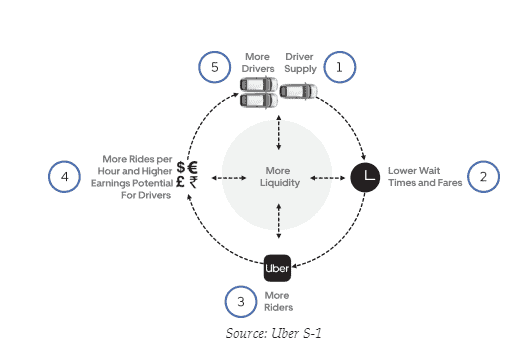
    The said network effect works in 5 stages. As the number of drivers increases, the potential wait time and fares decrease for users. This induces more customers to join Uber’s network, which increases earning potential for drivers and completes the loop.

     Uber’s network

    Amazon

    Amazon has become the one-stop destination for everyone’s shopping needs. Whether you are a consumer or a producer, Amazon is the place to go whenever you need to buy or sell anything.

    The company has a present market capitalisation of $117 trillion. It has been possible because the platform has successfully unleashed the true power of network effects. This eCommerce giant operates on a two-sided marketplace business model, capitalising on a cross-side network effect.

    The two sides of the network include the sellers and the buyers. Now, as the number of sellers increases, the marketplace offers more choices to the customers, and thus the number of buyers increases. This, in turn, induces even more sellers to sell on Amazon.

    The two sides feed each other, which automatically grows Amazon’s user base and its value to every user.

    These strategies, along with a social validation system and a recommendation system, have helped Amazon scale and impact its millions of consumers.

    How To Build and Develop Network Effects?

    It is challenging to overpower a platform with existing network effects but developing one is also not a child’s play. It requires effort, research, and experimentation to create and nurture a network effect. With that said, there are many strategies with which companies can try to create a network effect. Some of these strategies are listed below:

    Product First Model

    Creating a network effect and establishing a user base can be a daunting task. How would you attract the first user with a network effect unless there is a network?

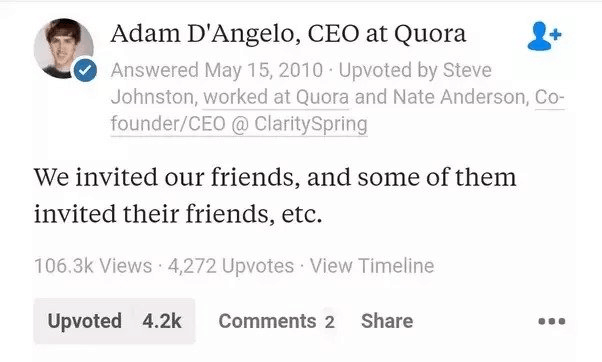
    The answer here is to attract users by providing them value and then getting them to participate in a network. Although this isn’t the only way to build a network, the strategy can be beneficial for companies trying to build a platform with network effects. For example, Quora’s founders started off the network by posting questions themselves and even answering them. This questions-answers loop was continued till the product was ready to be marketed to the right audience. Then the founders capitalised on the right marketing channels to promote the product.

     Quora’s network

    Subsidisation

    Two-sided platforms like Amazon and Uber often face the chicken and egg problem while developing a network. The problem entails deciding which of the two sides the platform should attract first.

    How would you attract sellers if there are no buyers on your platform, and how would you attract buyers when there is no product to sell?

    A strategy that can be used here is to subsidise one of the two sides. For example, Adobe tried to launch readers and writers together. But no one was willing to buy a reader when there was no content. Similarly, no one wanted to buy a writer and generate content when there were no readers.

    So, Adobe broke the impasse by subsidising one side and giving away readers for free.

    Content First Model

    In this strategy, instead of connecting users with each other, the platform tries to provide them with tools to generate content and then subsequently connect with each other.

    This model gives the user an immediate value and attracts them to participate in a network.

    For example, Instagram allows you to make reels, and Youtube allows you to generate videos. Many such platforms like Pinterest, Quora and Dribble have tried to create content before engaging users in a social network.

    Network Bridging

    Another growth strategy for a platform could be network bridging. This strategy entails connecting different networks.  A platform can leverage its multiple users and their corresponding data to diversify into different networks and improve its economics.

    An interesting example here could be Alibaba.

    The e-commerce giant bridged its Taobao and Tmall with its payment service Alipay. This way, Alibaba provided the buyers and sellers with a much-needed service and simultaneously built trust between them. Both these networks reinforced each other’s market positions and provided added value to the consumers.

    That is why even when the rival platform Tencent offered the wallet service called WeChat pay, Alipay didn’t lose its consumers as the service was more attractive due to its bridging with Alibaba. 

    Go On, Tell Us What You Think!

    Did we miss something?  Come on! Tell us what you think of this article on power of network effects in the comments section.

  • What Is A Virtual Office & How Does It Work?

    What Is A Virtual Office & How Does It Work?

    The way we go to the office today isn’t how it used to be before. Over the years, companies started encouraging their employees’ comfort and creativity – say, a four-day workweek. Many other things about going to the office have changed over time. In fact, the very idea of going to the office has changed. The concept of virtual offices makes it possible to sit anywhere in the world and work remotely while having an office address in some other part of the world!

    People usually scratch their heads thinking about what precisely a virtual office is. An actual place?  A service? A technology? A coworking office space? Or something in between?

    The answer to all these questions is a partial yes.

    A virtual office can serve different purposes, and in this article, we delve into what they are, how they work, and why one should use them.

    What Is A Virtual Office?

    A virtual office is a service that enables businesses to work remotely by providing them with a business address, internet-accessible business services, work and meetings space, and required technology without the business bearing the expenses of a physical office.

    In simple terms, it provides businesses with the perks of a traditional office – office and mailing address, telephone number, administration and communication services, optional access to workspaces and meeting rooms – without the business renting, leasing, or buying a physical office space.

    Virtual offices are best suited for teams not confined to a geographical area and businesses working remotely. But they are not just limited to providing just an official business address. They have their own business model that caters to the special needs of remote businesses.

    How Does A Virtual Office Work?

    Virtual offices work as usual office spaces in terms of the contract. Businesses rent a virtual office space like they do with a physical office space. However, unlike the latter, these offices don’t provide dedicated physical spaces.

    Generally, virtual offices are physical office spaces or coworking spaces that expand their business model by lending their address to businesses. They provide businesses with an address they can use for official paperwork and receive mails. Moreover, some office spaces can also include occasional use of meeting rooms and other value-added services like receptionist services, lockers, etc., in their packages.

    What Does A Virtual Office Provide?

    Virtual offices’ packages and offerings differ for different brands. These offices provide a combination of both physical and virtual services.

    Physical services include:

    • Business address: It is the recognised address at a physical office building that a business leases to be its official or mailing address. Businesses can use this address for official purposes like business licensing, LLC setup, marketing, and mailing, amongst other things.
    • Mail management: The office provides a facility to manage, store, or forward physical mails directed to the business or its employees.
    • Onsite receptionist: Receptionists take care of the mail processing (receiving and forwarding them to alternate addresses) and help set things up in case of an arrangement of meetings in the office.
    • Meeting rooms and office space: The users also have optional access to a physical workspace with meeting rooms, day desks, and private offices. The access is arranged based on the number of hours or days. Some virtual office plans have a set number of hours included in their monthly fee, while others charge for meeting room rentals on an hourly basis.
    • Copy and print facilities: Akin to other traditional offices, a virtual office centre has onsite copy and printing facilities. These services are usually available for a small additional fee.

    Virtual or remote services provided by virtual offices include:

    • Business phone system: It is a cloud-based phone system with various features such as an auto attendant, extensions, custom greetings, caller menus, etc. Companies can also select a business number with a local or toll-free area code.
    • Remote receptionist services: It offers remote basic customer services, and calls are answered in the company name, screened, and forwarded to the respective voicemails.
    • Digital mail service: Some virtual office centres also provide digital scanning services to view a scanned copy of their mail before getting it forwarded or trashed.
    • Virtual assistant: Virtual assistants support businesses by managing various responsibilities, from scheduling meetings to handling their social media accounts.

    How Much Does A Virtual Office Cost?

    Typical costs for using a virtual office include an initial setup fee of around $100-$150 and a standard fee of $50 to $100 per month for essential services. Additional services cost more. The exact costs vary depending on multiple factors like the provider and the business location; that is, costs for getting a virtual address in India’s New Delhi will be lesser than a virtual address in California.

    Who Needs A Virtual Office?

    With new business models rapidly replacing traditional models, business needs are also changing. Today, businesses work remotely with global teams. While some have traditional offices, the advancement in internet technologies has made it possible to work without a physical office. This is where the virtual office concept comes in place. The concept has a great use-case among the new generation of businesses that include:

    • Geographically scattered teams: Teams that are not confined to a geographical location often use virtual addresses to register their business and get official work done.
    • Virtual entrepreneurs: This concept best suits freelancers, business consultants, bloggers, digital marketers, and digital nomads who work from anywhere but need an address for official and mailing purposes.
    • Startups and garage businesses: Often, startups and small businesses start their operations from home. But having a home address on Google search or website isn’t professional. Hence they go for virtual office addresses.
    • Registered businesses with remote teams: Registered businesses with remote teams often use virtual office services to avail the benefits of virtual addresses and add-on services.

    Advantages Of A Virtual Office

    Virtual offices come with benefits that lure many people to move away from usual physical office scenarios. These are:

    • Economical: Virtual offices do away with owning or leasing a traditional office. Their low prices make it easier for startups to keep their overheads low. It also reduces the financial risks of testing a new product or service or dipping one’s toes into a new marketplace.
    • Requires minimum commitment: The commitment is minimal since contract terms start every month, in three months or more. This provides the flexibility of backing out with minimal loss.
    • Adds to professionalism and increases brand image: Customers want to know whom they are dealing with, and a professional address helps instil more confidence in them. It gives them something beyond a smart logo and a good website. Moreover, the ability to meet people in person in professional meeting rooms reinforces the legitimacy of the business in the eyes of the clients and customers.
    • Convenient: A virtual office allows running a business remotely from anywhere in the world with great speed and simplicity. When a face-to-face meeting is required, a virtual office provides the convenience of a more professional environment and a meeting room at the business address. It also gives the employees more flexibility to work, reduces travel expenses, and thus leads to greater productivity and job satisfaction.
    • Reduces legal liability: Using a virtual office helps reduce legal risks since it enables legal entities to differentiate between personal and business assets.
    • Boosts SEO(Search engine optimisation): Since virtual offices allow a business to have an office address anywhere globally, it is an affordable way to optimise for web searches when a prospect searches for businesses near their location. For example, a digital marketing agency operating from New Delhi can optimise well to rank on the search keyword “digital marketing agency in Sydney” if the agency has a virtual office in Sydney.

    Disadvantages of using a virtual office

    It is essential to be aware of the drawbacks that might come with adopting virtual offices. These are:

    • Some businesses might need a full-time or more permanent workspace since some tasks are better performed in a physical presence.
    • Access to the office space after regular working hours might not be facilitated by virtual service providers.
    • There might be short delays in receiving mails sometimes due to the need for their processing by the onsite team.

    Is A Virtual Office Worth It?

    Cost savings with easy setup and building a market presence can sound enticing to a lot of brands. However, on weighing these benefits with cons like an unmanageable remote team, late delivery of mails, messy teamwork, one can easily get into a dilemma of whether or not they should go for a virtual office.

    To get the answer, one must weigh the pros and cons and consider the type of business they have before choosing a virtual office.

    Virtual offices don’t suit brands that require the physical presence of teams to get the work done and those that need physical presence like courier companies.

    But it can be a boon for a business that can fully operate digitally with the help of remote teams.

    Like traditional physical offices and coworking spaces, virtual offices are legal in almost all countries worldwide. This is because they are registered entities that lend their address only after fulfilling the legal requirements of every country.   

    Bottom-Line?

    While virtual offices were more a concept than reality a few decades ago, today’s businesses have evolved to embrace them. Looking into the not very distant future, it seems highly likely that there will be a paradigm shift from the full-time permanent brick-and-mortar job requirements.

    With the advancement in technology by the day, workplaces are evolving more rapidly, and virtual offices would become more of a rule than an exception.

    Go On, Tell Us What You Think!

    Did we miss something? Come on! Tell us what you think of this article in the comments section.

  • What is Billboard Advertising? [Complete Guide]

    What is Billboard Advertising? [Complete Guide]

    What comes immediately to your mind when you picture Times Square?

    All the big neon lights, signposts, and advertisements, right?

    Tens of thousands of individuals must probably see those ads every day. Even if it’s only for a second, all of those people think of those advertised brands when they see those ads. These impressions lead to brand awareness and even sales of those companies’ offerings.

    This exposure is known as billboard advertising: the traditional marketing strategy that’s as important as it’s ever been. When used appropriately, it can act as a  powerful tool for reaching a diverse range of audiences, increasing revenue and brand exposure.

    In fact, billboards have the highest reach of all OOH advertising forms in the United States, as around 80% of Americans remembered seeing a billboard ad.

    So, now that billboard advertising has your attention, you may be wondering: What are its pros and cons? Are billboards effective? What is the cost of billboard advertising?

    Let’s find out.

    What Is A Billboard?

    A billboard (also known as hoarding in the UK) is a big outdoor advertising structure, similar to an oversized poster used to promote a brand, offering, or a campaign by displaying advertisements.

    It is generally located in high-traffic areas such as along highways or near shopping malls to pique the attention of the highest number of drivers and pedestrians.

    What Is Billboard Advertising?

    Billboard advertising is a process of using large scale print and digital advertising boards called billboards or hoardings to promote a brand, offering, or a campaign.

    It’s an efficient marketing strategy for getting the most number of views and long-term brand impressions. Furthermore, it establishes strong branding through huge text sizes, images of celebrities with clearly stated features and benefits of the products, and other pertinent information such as price.

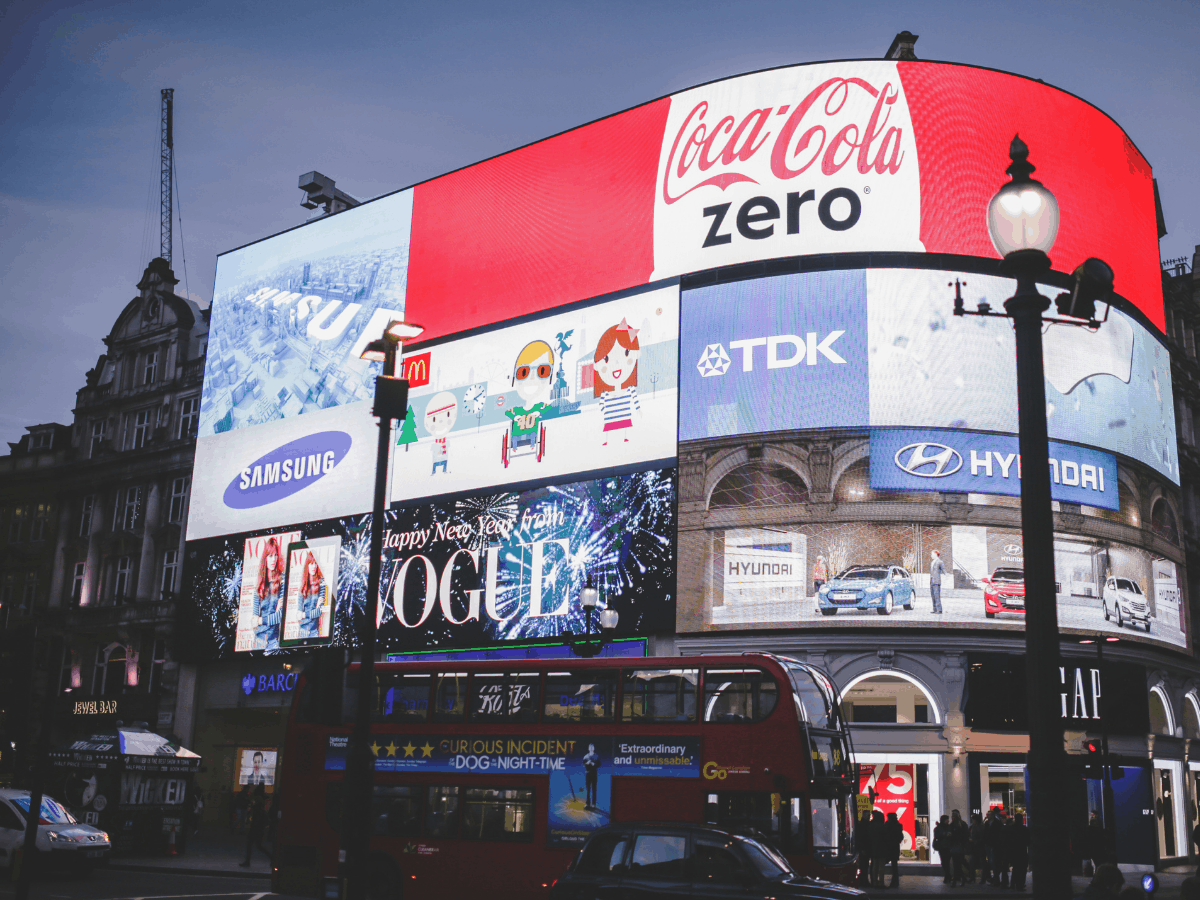
    For instance, Times Square in NYC is a billboard advertising mecca since it is one of the world’s busiest tourist attractions.

    Source: Britannica

    Types Of Billboards

    Billboards come in many different shapes and sizes. Some of the various types of billboards are:

    • Digital billboards: A digital billboard displays varying images and text generated by computer systems and software. It can be set up to show running text, or you can change it up depending on the time of day. The ever-changing texts offer maximum impact and reach for specific audiences. For instance, a restaurant might promote lunch specials throughout the morning and early afternoon and dinner specials beginning at 3 p.m.
      digital billboard
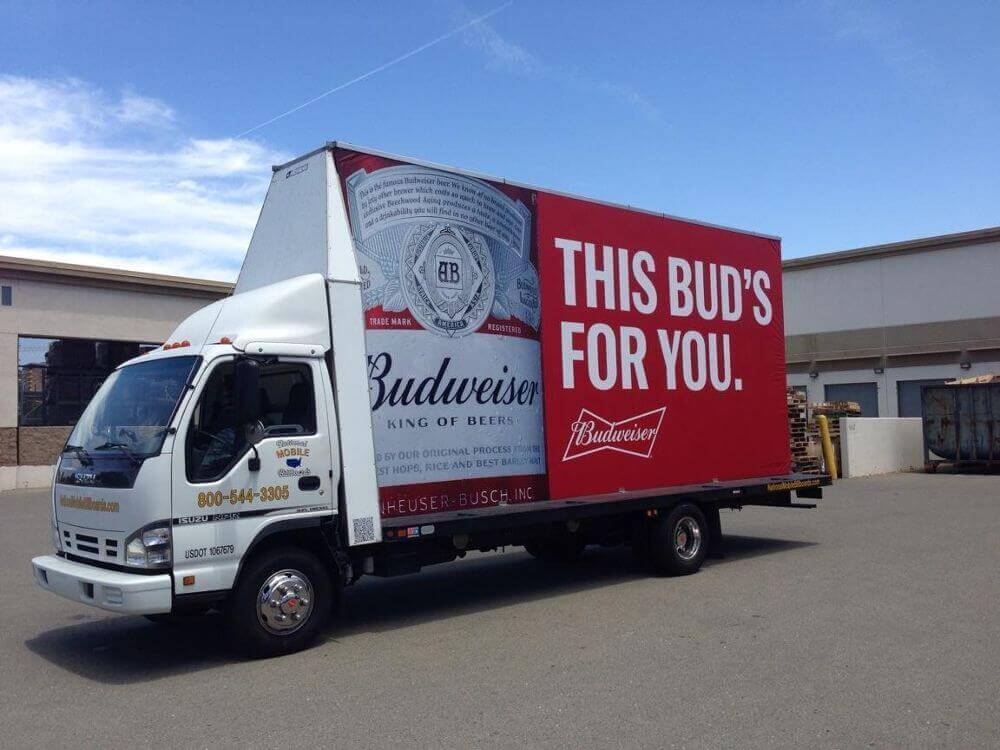
    • Mobile billboards: A mobile billboard is one that appears on buses, cars, and other moving vehicles. The advantage of a mobile billboard is that it is more likely to be noticed by your target audience. This is because the vehicle moves around the area you’ve chosen as a key location for promoting your company.
      mobile billboard
    • Painted billboards: These billboards are not graphically created. Rather they are painted either on the site or in studios and then placed on the site. In recent years, these billboards have been replaced by graphically created billboards. However, they are still used in some regions where only a single board is necessary. Like in Los Angeles, hand-painted billboards can still be found on the Sunset Strip, which mainly advertises new films or records.
      painted billboard advertising
    • Static Billboards: Static billboards are made of large printed vinyl and stretched across the billboard’s face. Here, a particular element in the billboard cannot be changed in a matter of seconds or minutes but must be re-erected and fastened to the structure.
      static billboard
    • Three-dimensional billboards: These are modern style billboards that capture viewers’ attention and curiosity by providing three-dimensional dramatic visuals and pop-up book style graphics. They can even transform a static image into a moving object that can display various messages at different times.
      3d billboard advertising

    What Are The Advantages Of Billboard Advertising?

    Often,  you might have turned on the radio just to turn it off as soon as an advertisement comes on. The same may be true for television commercials. But, unlike other forms of mass advertising, billboards can never be ignored, hidden, turned off, or thrown away.

    In fact, 70% of billboards are glanced at by passers-by, and 63% of these billboards are read in their entirety. Hence, there is no other medium of advertising that can match this level of viewership and retention.

    Other compelling reasons why billboards are a great advertising strategy are:

    • Billboards are huge and eye-catching: Billboards occupy a significant space and can be catchy if designed by skilled marketers. A good billboard may make a prospect stop and view it intentionally or unintentionally.
    • It helps reach the target audience: Billboard advertisements make it simple to target a specific local audience. With today’s technology, you can develop a demographic breakdown to demonstrate where the bulk of your target audience visits and then place your billboards where this specific group will see them.
    • It provides an incentive for impulse purchases: One of the reasons why billboards are still in use is that they have the ability to influence and inspire customers to make immediate purchases. Your key viewers are your decision-makers. So, if you can connect into their minds through your billboard, they will swarm to your shop and make a purchase. For instance, when you’re on a road trip with your friends and if you see a billboard with enticing pizza, it will make you want to stop and eat. It wasn’t intentional, yet you can’t help but stop and eat because of a billboard cleverly placed near a cafeteria.
    • It ensures brand exposure and brand recall: Billboards are extremely effective at generating and increasing brand awareness. It is because the ad is always visible – no other medium allows your message to be seen 24 hours a day, seven days a week. Take a look at some of the billboard advertisements you see on your everyday commute. You’ve probably memorised some of them because you’re exposed to them daily. So, if your company uses visuals or slogans that are catchy, clever, or memorable, potential customers might learn a lot about your company by looking at it. They’ll remember your billboard ad later when they need your product or service.
    • Billboards appeal to all ages: Unlike other forms of advertising, billboards can be used to target all ages alike – be it children or adults.
    • It has a high ROI: According to statistics, for every dollar spent on billboard advertising, marketers earn six dollars. This is a great ROI when compared to other advertising mediums like radio and print.

    What Are the Disadvantages of Billboard Advertising?

    Billboards advertising comes with its own set of disadvantages that you might have to weigh along with its pros before including it into your promotion mix. These are:

    • It can be expensive: One of the major drawbacks of billboard advertising is the amount of money required from the time the billboard is placed to the time it is dismantled. Plus, there are additional costs of maintenance and repairs. And it will not be cheap if natural calamities such as hurricanes demolish the structure. Also, in the case of property damage or injury resulting from a damaged billboard, the owner may face legal concerns and additional expenses. Thus, there is no certainty that advertising costs will yield the desired revenue.
    • It provides limited information: Billboard provides people with a limited amount of information. Such a short message may not be enough to entice information-hungry customers to buy your products. On the other hand, like certain automobile billboards that highlight a single adjective, it could be enough to plant a seed or make an impact.
    • It has a short exposure period: Billboards allow for a very brief, if not fleeting, exposure period to absorb the information. So, even though your ad is memorable, the viewer cannot note your contact details.
    • It’s a stationary mode of advertising: No matter how big it be, billboards are a stationary mode of advertising that only works when the place has visitors.
    • The focus is on mass marketing: Unlike digital ads, billboards ads can’t be personalised and can only show mass-marketing messages that have a lesser impact than personalised messages.

    Clearly, billboard advertising isn’t a remedy for all marketing problems, but it can achieve results that no other medium can achieve when done correctly.

    How To Use Billboard Advertising Correctly?

    You see around 4,000-10,000 advertisements per day and can’t remember a majority of them. So, if you don’t want your ad to be among those not-remembered ads, then your billboard must tell a story about your brand using thought-provoking graphics and very little text. It should be created in a way that has an immediate impact on your target audience.

    Thus, if you’re going to spend money on an advertisement that could be seen by millions of people, you should do it right. Here are a few billboard design tips to help you make your billboard more effective and appealing.

    Keep It Simple, Silly

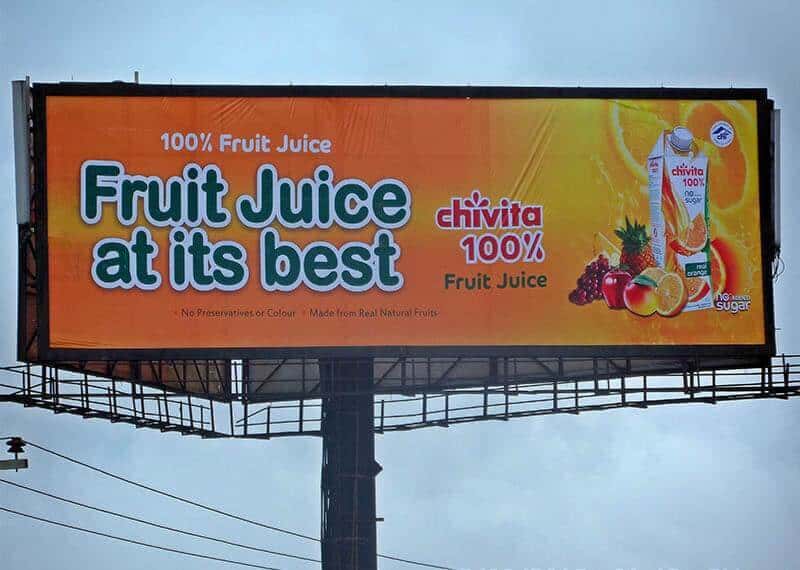
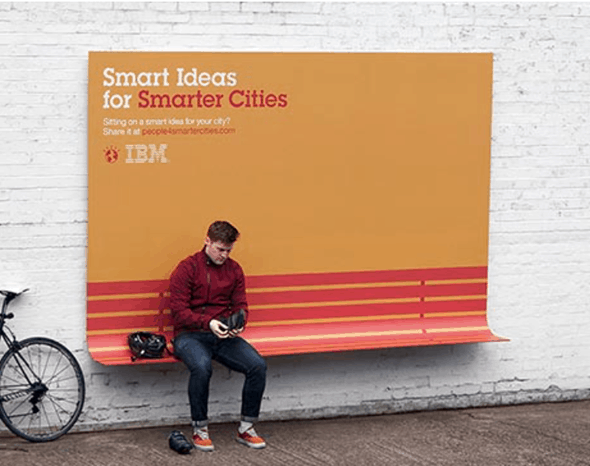
    Drivers, cyclists, and pedestrians read billboards rapidly and don’t have time to read a long, drawn-out message about your company. The general rule of thumb suggests a billboard should have not more than six words in order to communicate effectively with the target demographic. Use bold contrasting colours and large, legible fonts that are easy to read from a distance.

    Take a look at this billboard by IBM that is both short and imaginative.

    Make Use Of The Surrounding Area

    Billboards that are well-designed take into account their physical location. Local context, comedy, and neighbourhood pride are all great methods to incorporate brand identification into the surrounding community and demonstrate awareness. Try to use the trees, skyscrapers, and cars in your surroundings as part of your story-plot. This can make the billboard (and brand) much more impressionable to those who see it and can make your business go viral.

    For instance, in this Coca-Cola billboard, the company didn’t just put an image of their bottle. Instead, they positioned their advertisement in an old building and gave the impression that numerous straws were coming from different windows. Everyone appeared to be drinking from the same bottle. Thus, making the perfect use of the surroundings.

    Be More Visual

    Images attract attention and are easier to concentrate on while driving. Use an attractive and captivating photo relevant to your brand with a few words to accommodate them while making the most of your ad space. Always remember to include your logo along with your company’s phone number as well as a link to your website in the space. Lastly, use an image with a minimum resolution of 300 pixels per inch.

    For instance, this billboard ad by Berger paints has the illusion of a live painter painting the same blue colour of the sky onto the billboard. This exaggeration without words is both interesting and entertaining.

    Make It Memorable (But Design Responsively)

    Find a unique way to make your billboard ad memorable with a strong message and a clever call-to-action that leaves people thinking. To make your billboard design memorable, employ emotional marketing techniques, that is, allow your message to spark customers’ interest. Billboards with a unique design are the winners. But, keep in mind that there’s a thin line between getting your billboard noticed and causing major traffic distractions. Thus, depending on your business, keep your image choices G-rated and your content clean.

    For example, this restaurant uses the centre of its billboard to remind potential hungry drivers of this business’s services.

    Use The Location Wisely

    The success of a billboard advertising strategy depends on two factors – billboard design and location. Make sure to research well about your audience’s demographics and buying behaviour before choosing the location for your billboard.

    How Much Does it Cost to Advertise on a Billboard?

    Just like the cost of other forms of advertising, the cost of a billboard advertisement also varies. It is determined after considering aspects like the format and placement of your billboard, the total traffic in the region, and the expected number of people who will see your ad, and more.

    The cost of using billboards as a means of advertisement can range from $750 on a rural roadway to $14,000 and up in larger markets. Most billboard agencies charge in cost per thousand impressions, commonly known as cost per mille (CPM), which is dependent on four important factors: demographics, impressions, and circulation.

    • Demographics: Demographics are developed by observing the people who pass by the billboard regularly. It takes into account their age, gender, and even income level. For example, if you’re advertising on a billboard in a posh area, then you’ll probably be paying more.
    • Impressions: Impressions refer to the estimated number of people who see the ad. It is based on the size and location of the billboard, its visibility, and the speed limit in the region.
    • Circulation: Circulation refers to the total volume of people that passes by the area where your billboard is located. It is usually based on information derived by transportation authorities. However, it does not account for whether or not passers-by see your advertisement.
    • Positioning: The likelihood that the ad will be seen is considered before deciding the billboard advertising costs. The more likely the audience is likely to see the ad, the higher is the cost of the billboard.

    However, the cost of renting a billboard isn’t the only expense associated with billboard advertising. Design costs, installation costs as well as material costs are also important to consider. The cost of designing an ad varies from business to business and can be as much as $1,000. Depending on the size of the advertisement and whether it’s static or digital, some billboards cost around $800 to $3,600. Meanwhile, depending on their location, digital billboards can cost $10,000 or more per month.

    How to Measure Effectiveness of Billboard Advertising?

    Billboard advertising effectiveness has never been in question. That is one of the main reasons why, after all these years, we still see billboards.

    One of the metrics used to assess the effectiveness of billboards is Daily Effective Circulation, or DEC, which refers to the daily number of vehicles and pedestrians who pass by your billboard.

    Some of the other metrics are:

    • Sales: Sales are the true measure of advertising success. Have you noticed an increase in sales after your billboard was installed? If yes, then you’re using billboard advertisement correctly. Hence, it’s vital to record sales or profit benchmarks in reports to assess whether a new billboard ad is bringing in more customers or not.
    • Return on Investment (ROI): How much did the billboard cost, including design, printing, and assembly? How much money does it generate? Well, according to studies, the return on investment for every dollar spent on billboard advertising is nearly six dollars. Thus, when it comes to return on investment, billboards have a track record of being worth your time and investment. But do your homework and make sure it meets your company’s needs.
    • Location: The evaluation of possible billboard placement is always the first step in determining billboard effectiveness. Based on data analytics, you can establish the ideal demographics and optimum placement for your brand’s billboard using government statistics, census content, and an analysis of the area’s traffic levels. You can even estimate which demographic is most likely to react to your billboard.
    • Impressions: The average number of times a person sees an advertisement is measured in impressions. This includes data on traffic, which can be used to estimate the number of vehicles driven past an ad. Travel surveys, data modelling, and census data may all be included in Impressions.
    • Hashtags and Handles: Thanks to the explosion of social media platforms, hashtags are a simple way to advertise and connect your firm to a digital area with unique phrases or sayings that may be used to analyse statistics. In addition, brands may quickly establish an Instagram handle to increase their following. Your company can gain new followers as a result of the ad space.

    Hence, consider billboard marketing in your arsenal and budget if you can answer these questions in the affirmative:

    Will it be possible to read and comprehend your advertising message in less than 8 seconds? Do you want to raise your company’s profile or attract customers to come straight to your store after seeing a billboard?

    If someone needs more than a few seconds to comprehend your company’s message, then billboards are probably not worth your time.

    Go On, Tell Us What You Think!

    Did we miss something?  Come on! Tell us what you think of this article on billboard advertising in the comments section.

  • What Is HR Tech? – Use Cases, Examples, & Future

    What Is HR Tech? – Use Cases, Examples, & Future

    The role of the human resource department in a company isn’t limited to hiring new employees. Its responsibilities range from employee recruitment and training to handling performance and relations, promotions, and administering employee benefits.

    As the HR department continues to evolve to match the pace of the dynamic environment, organisations look to integrate technology in their HR operations to organise tasks and ensure smooth functioning.

    This is where HR tech comes in.

    What is HR Tech?

    Human resource technology (HR Tech) refers to the use of software and hardware technology to complement, automate, and simplify HR operations and provide a better employee experience.

    Since HR professionals are expected to cater to various demands, they face a lot of barriers. The HR tech eases the process of accomplishing tasks and boosts efficiency.

    So what are the challenges that most of the professionals in the HR department face?

    Human Resource Management Challenges

    From finding the right person to the right job to making sure they are paid right, trained right, and are satisfied with the work environment, human resource managers have various HR challenges:

    1. Hiring: The biggest challenge for the human resource department is to find the right person for the right job within the given time frame. It involves sending attractive offers to prospects, interviewing and analysing them, and working together with the concerned team to find the best fit.
    2. Onboarding: Employee onboarding poses a challenge for the HR team as they have to ensure smooth onboarding of the new hire. Usually, onboarding takes weeks, if not months. It requires a lot of personal touch from the side of the HR manager to provide the employee with all the relevant information, job clarity, applications, and legal fulfilment.
    3. Employer Branding: Even the job market is crowded, and HR managers are tasked with developing an employer brand to attract better employees.
    4. Employee Training: Employee training and development is a never-ending process. But it becomes a challenge to manage hectic employee schedules, high costs, and different learning habits of the employees.
    5. Employee Turnover: Retaining employees and reducing employee turnover is a big challenge faced by the HR department. As new employee acquisition usually costs more than employee retention.
    6. Compensation management: Companies struggle with their policy of payroll and compensation. They have to factor in all the aspects of compensation – benefits, training, taxes and other miscellaneous expenses. The HR manager has to maintain a complete record of salary, benefits, bonuses, and attachments of earnings. As they have to cooperate with the accounts department, there are often problems arising regarding accurate and timely payments, posing a challenge.
    7. Performance management: Keeping a check on whether the employees are doing the assigned tasks well is a big challenge for the HR department. Moreover, designing strategies to increase employees efforts towards company goals and strategies to measure employee performance often requires a lot of effort from the human resource manager.
    8. Administration of employee benefits: Providing the right benefits to the employees according to their posts, legal requirements, and motivational requirements involves effort from HR managers’ side.
    9. Expense management: It is the HR manager’s administrative task to reimburse the expenses incurred by office workers and employees. These expenses include but are not limited to flights, car rental, lodging, meals, laundry and other types of employee-initiated expenses that the company agreed to pay for.
    10. HR Data Management: Managing and storing human-resource-related data is a big challenge for the human resource department that takes a lot of time and can be messy. Moreover, it can add to the challenge if it is done manually.
    11. Remote Workforce Management: The shift to virtual workplaces has added another task for human resource managers as they have to handle and manage the workforce without even meeting them physically.

    All these tasks and challenges prove to be time-consuming, messy, and sometimes make the human resource manager put more effort into non-core tasks.

    This is where HR tech comes to the rescue.

    HR Tech Use Cases

    The introduction of technology in HR management significantly contributes towards the fulfilment of personnel policies. It improves the data management and organisation, liberates managers from their administrative burden and provides tools to help in decision making.

    Often considered as an HR copilot, HR tech uses digitisation, automation, and machine learning to assist the HR department in achieving ordinarily time-consuming tasks with eases.

    Easy Data Management And Analysis

    Technology has made it easier for HR managers to automate, store, sort, and find data relating to every aspect of human resource management. Today, specialised software has made it easier to organise and analyse data using cloud computing. Moreover, most of the monotonous work is no longer manual and is available for control on fingertips.

    The HR modules and tools make it easier to analyse performance data online by grouping and filtering using different attributes assigned. This makes the process hassle-free and easily accessible.

    Improved Employee Engagement And Performance Management

    There are software programs that solicit and track employee feedback which gives employees direct contact with HR professionals. These programs list the data and group them to suggest actions to the management with respect to the feedback received. The management undertakes appropriate changes on this basis.

    The HR tech also enables supervisors to check in on employees to be more aware of their performance and be more specific in their expectations.

    Cost Reduction And Improved Efficiency

    A significant amount of performance reports can be generated using HR tools. Very little time is spent on data entry and routine administration. This saves time and reduces costs by automating HR, benefits, attendance and payroll management.

    Errors are reduced, and employee costs are cut down. This simplifies organisational tasks and avoids confusion by giving a central platform for all functions.

    Not only managerial but employee time is also saved as they can submit requests and review performance easily.

    Digital Learning, Training And Development

    Organisations have started to provide online training programs for employees, which is less time consuming and is easy to keep track.

    Businesses also require platforms where managers can keep a record of workflows, assign tasks, share files and resources and support the employees.

    With the onset of the pandemic, everyone had to switch to online mode to keep their business going. They also provided training modules to help employees adjust to the work-from-home environment.

    AI In Recruitment And Hiring Process

    While recruitment is massively complex, HR tools use algorithms for more targeted and refined searches for potential candidates online by scanning resumes and user data.

    Artificial-intelligence-based algorithms help to provide deeper insights into employee applications using social media activity. It can also analyse sentences and facial expressions apart from legible data.

    This reduces hiring discrimination and also maintains diversity in the workforce.

    Automated Processes

    The implementation of technology frees the managers from routine work, eliminates paperwork and speeds up execution. Companies use machine learning to screen resumes and augmented reality to familiarise new employees.

    Augmented analytics platforms combine AI capabilities to organise large sets of data and identify trends and track significant metrics. The tools then process and deliver the findings in a legible form.

    Expense And Payroll Management

    The payroll management portals save internal staff from manually filling spreadsheets. All the information is gathered and is used to generate a master report that calculates employees’ salaries and social security obligations.

    Technology also assists in expense management by generating reports of funds transfer, payslips, cost reports and expenses incurred by each employee.

    Companies using HR tech

    With the increased popularity, several HR tech startups are coming up which build products using AI, machine learning and data analytics to help companies enhance their business outcomes and project analysis based on user data.

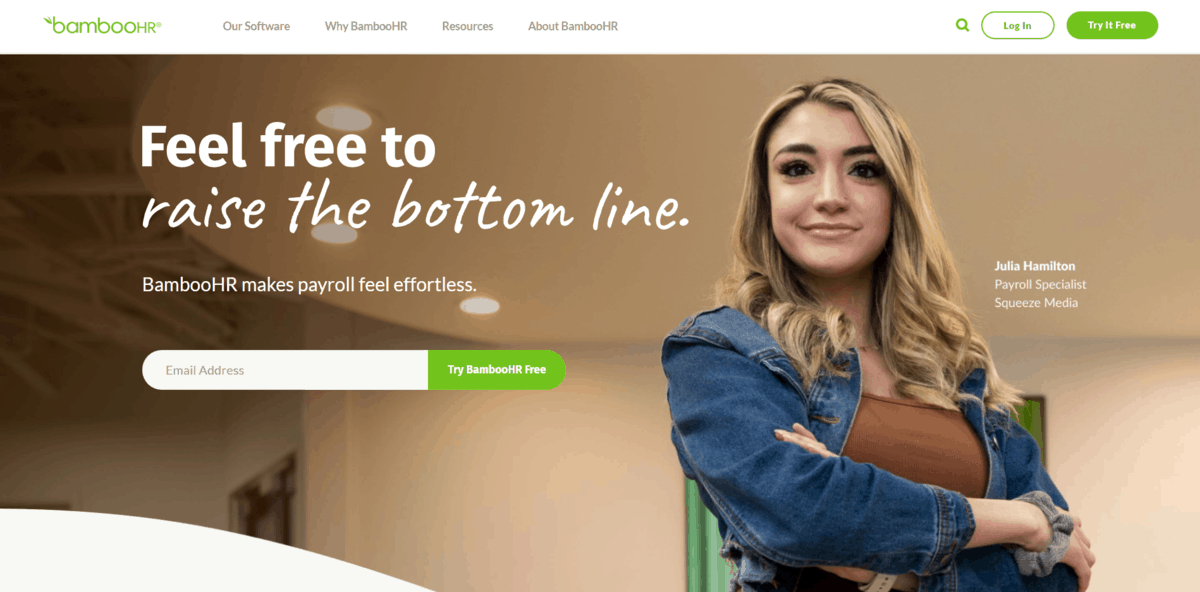
    • BambooHR: It is an all in one HR software made for small and medium businesses. They have a cloud system that allows applicant tracking (ATS), onboarding tools and performance management tools. Reporting and analysis of performance are made easier along with a mobile app for employees.
      bamboo HR Tech
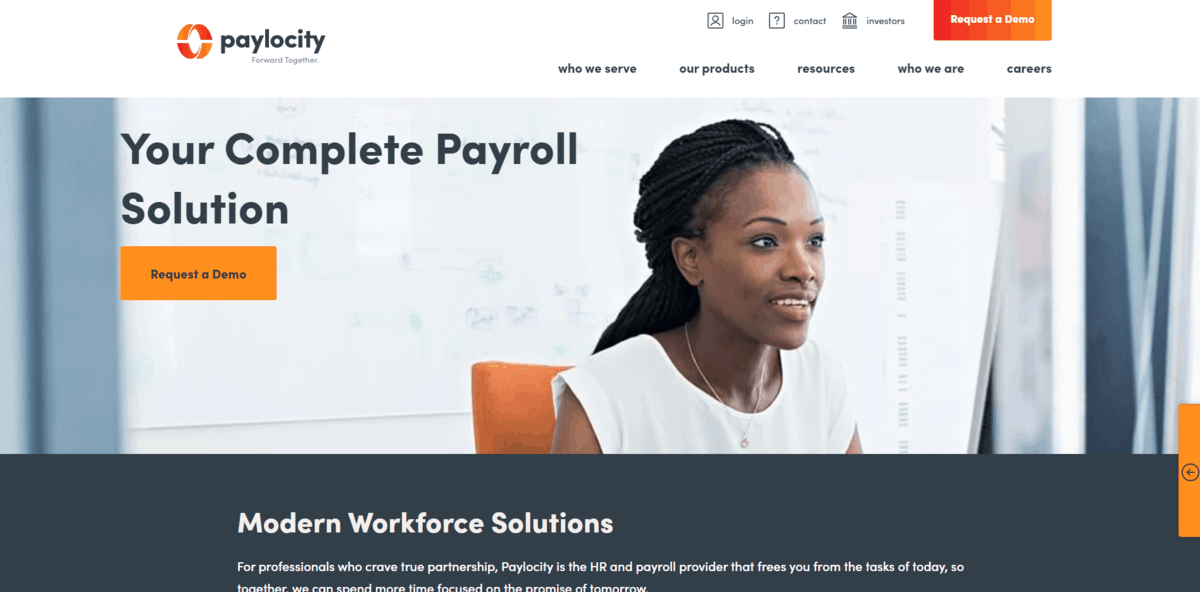
    • Paylocity: It is a cloud-based human capital management platform for businesses of any size to manage internal and core HR functions. These include payroll processing, benefits administration, time management, talent management, employee engagement and ATS.
      Paylocity
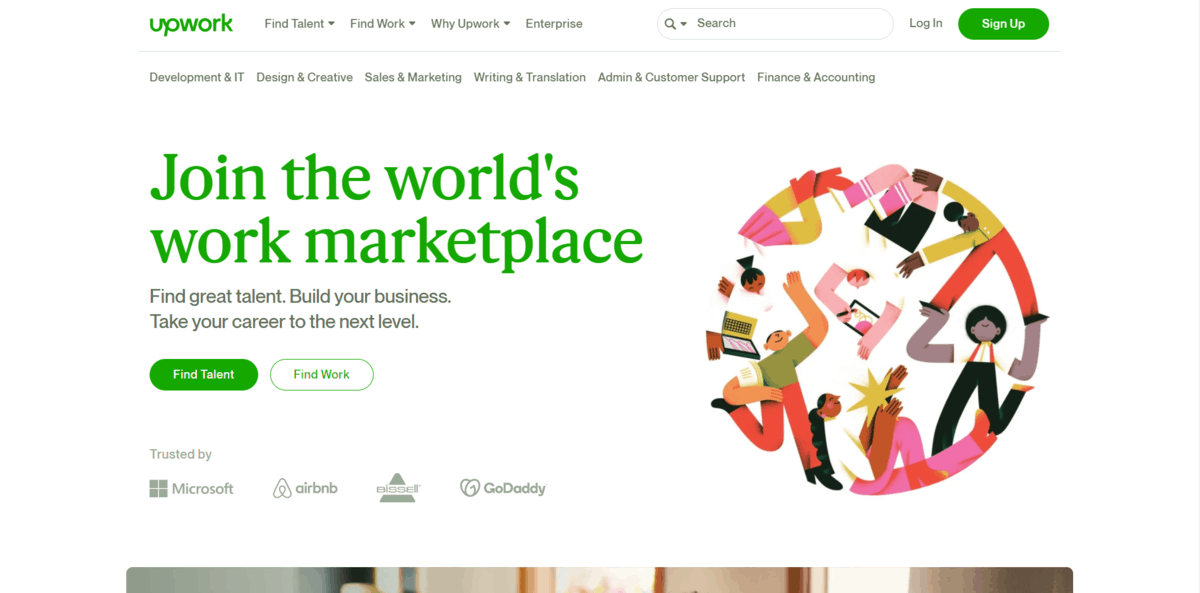
    • Upwork: It is a platform for organisations and professionals to find projects, communicate with clients and hire qualified candidates. It allows the user to post the job profile and wait for proposals. Their advanced algorithms help shortlist candidates who are the best fit.
      Upwork
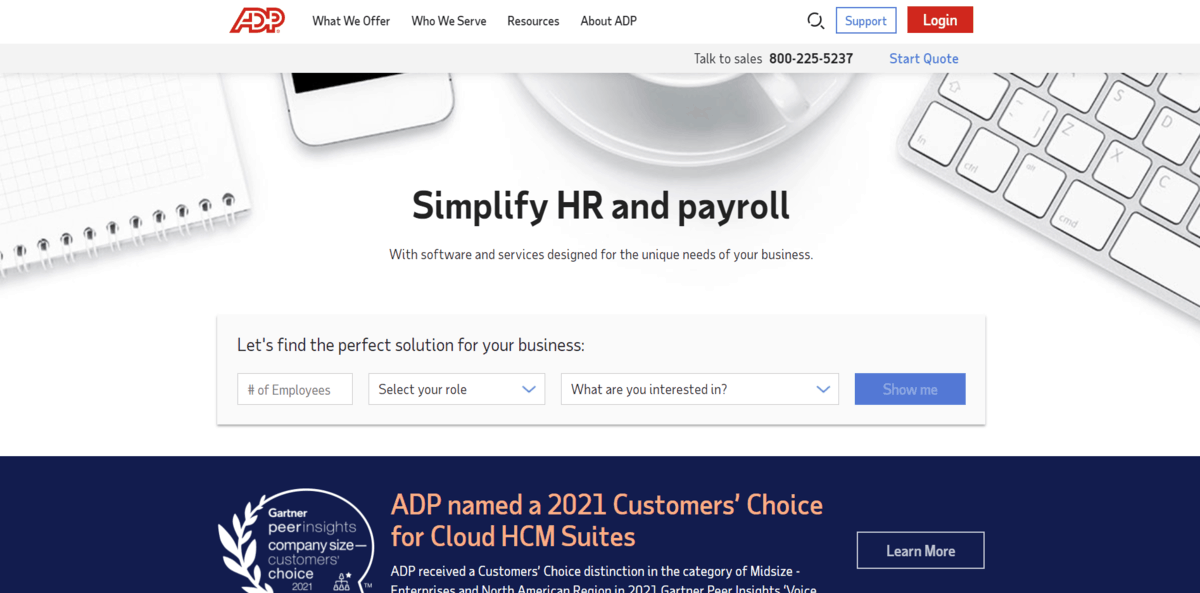
    • ADP: It offers small business tools which cater to HR needs like payroll, taxes, recruitment and training. For mid-sized businesses, it helps with administration, compliance and recruiting. For large businesses, it helps in handling talent management needs and strategic objectives.
      ATS HR tech

    Future Of HR Tech

    The future of human resource management requires the managers to handle a mixture of both virtual and traditional teams. This will eventually increase the demand for technology aiding human resource management.

    Moreover, while the workforce getting more global and the work culture getting more flexible helps the organisation overall, it increases the human resource department’s work. This has increased the global demand for HR tech startups.

    Go On, Tell Us What You Think!

    Did we miss something? Come on! Tell us what you think about our article on Human Resource Technology in the comments section.

  • Startup Compensation: A Guide For Employers

    Startup Compensation: A Guide For Employers

    Working in a startup is not easy. It requires immense investment in terms of time, money, and effort. You must have thought of product development, fundraising, and marketing to be tough jobs, but that’s the thing about managing businesses: even the simplest-seeming tasks are challenging to accomplish.

    One of these is deciding employee compensation in startups. Even though this seems like an odd job, it’s tough to fix an appealing compensation package for employees in a way that it doesn’t burden your scarce resources.

    But don’t you worry; we are here to guide you.

    How To Design A Pay Structure For Startup Workers Better?

    Founders tend to try doing most of the company’s jobs themselves to reduce operating expenses. However, this is not a conducive strategy as it may hamper their productivity and distract them from the most important tasks. Therefore, it is better to create a good hiring and startup compensation strategy to ensure the right quality and quantity of the workforce. For this, you need to understand the type of workers you can work with because an ideal balance of employees and contingent workers helps you save costs.

    Employees

    Employees are the workers on a company’s payroll. They generally work with only one organisation at a time, and their employers have considerable authority over them and their work.

    An employee’s payslip comprises a salary, perks, incentives, allowances, a contribution to their retirement fund, and sometimes even equity. Also, their employers are supposed to file their taxes.

    Full-time Employees

    Full-time employees typically work only with one company and require a full salary to support themselves and their dependents. They also need you to file taxes, contribute to their retirement funds, and bear overhead charges like paid leaves and relocation costs.

    So, as a startup, you cannot afford many full-time employees. It is recommended to keep them reserved for key positions and hire only skilled professionals. You can go for less-skilled individuals who demand lower salaries, but they would probably not provide good returns in a fast-paced startup environment. Your business requires expertise to grow; give it that.

    Also, full-time employee compensation has various components. An attractive salary package is a healthy combination of all this.

    • Basic Salary: Basic salary is the fixed taxable amount exclusive of incentives and deductions. It comprises around 35-50% of the total salary and serves as a base for calculating retirement funds, allowances, and sometimes even incentives.
    • Contribution to Retirement Funds: As an employer, you will be required to undertake this employee benefits scheme wherein you contribute an amount regularly to their retirement fund. This is usually a fixed portion of the basic salary.
    • Allowances: Allowances are additional benefits given to employees during their regular course of work. Some of these, like house rent, conveyance, and books and periodicals allowances, are needed to meet working expenses, while others like medical expenses help with your employees’ well-being.Allowances are usually calculated on the basic salary. You cannot cut back on them because they have become industry standards necessary to attract top talents.
    • Gratuity: This is the gratitude amount paid to an employee when they leave the company or retire. It is again calculated on the basic salary and is usually awarded after the employee has worked with the company for five years or more.However, many companies also award gratuity on a pro-rata basis; that is, they award a figure proportionate to the number of years an employee has served the company (regardless of whether five years are over or not).
    • Equity: Although not very desirable to owners, equity is the go-to method of compensation in startups. It lets you get away with paying less salary and adds an employee’s stake in the business. This further incentivises them to work harder and stay longer. You can award equity to your employees in two ways:
      • Sweat Equity: These are the stocks issued to an employee for their work that may have led to a valuable addition to the company. Generally, the first key employees of a company, especially those who help create an IP, receive sweat equity.
      • ESOPs: ESOP or Employee Stock Ownership Plan is a benefit scheme under which employees get entitled to a company’s stock appreciation value or get an option to purchase its shares at a lower price. They are commonly undertaken by new businesses and are subject to employees’ loyalty to the company.
        • Employee Stock Option Scheme: This gives an employee the right to purchase your company’s stocks at a specified price with their pre-tax money. These stock options are generally bought back when the employee leaves.
        • Employee Stock Purchase Plan: Here, the employee gets an option to purchase your company’s stocks at a discount from the market value with their after-tax money.
        • Restricted Stock Units: Restricted stock units are the rights to receive shares on a pre-determined date if an event occurs or certain conditions are fulfilled.
        • Stock Appreciation Rights: These are the rights of your employee on a monetary value equal to the appreciation of your company’s stocks over a specified period.
        • Phantom Stocks: Here, employees don’t receive actual stocks but mock stocks that follow the same price movement as real ones and give out resulting profits.
    • Additional Benefits: This includes leave travel allowance, gym membership, and other additional benefits your employees might get in their previous companies. However, you cannot afford this as a startup, and you need to be upfront about this.
    • Deferred Payment: Deferring payment keeps aside a part of your employee’s salary that they can withdraw in the future. This is common in pre-seed stage startups that promise to pay their employees once they get funded. However, it is not legal in many countries to defer one’s full salary; you need to pay a minimum wage at least.

    Part-time Employees

    Part-time employees like stay-at-home parents and students usually have other commitments because of which cannot take up full-time employment. So, they do not expect much money. Also, there is no hassle regarding their bonuses and allowances. You can choose to give incentives on a pro-rata basis or not give them at all; it’s up to you (although they deserve it).

    However, since they are paid less, you cannot expect them to prioritise your work over other commitments.

    Temporary Employees

    They are short-term employees hired temporarily for part-time and full-time projects. They might or might not be looking for permanent roles.

    Although they stick with you only briefly, they are your employees at the time. Hence, they are entitled to a proper compensation package like permanent employees. They deserve the same incentives and allowances; you also need to file their taxes.

    However, contributing to a temporary employee’s retirement funds may or may not be mandatory. Go through your country’s laws before recruiting temporary employees.

    Seasonal Employees

    Seasonal employees are the temporary employees whose skills come in handy only during certain months of the year. For instance, agriculture-based startups employ more people during the harvest season. Similarly, the tourism industry boosts with employment opportunities during holidays.

    While seasonal employees are compensated like the temporary ones, you may have to provide insurance if they work with you for six months or more. This again depends on your country’s laws.

    Leased Employees

    Leased employees are temporary employees hired through recruitment agencies. They are technically the employees of the agency that is leasing them to you. So, you need to pay the agency for its services. It then takes a cut and pays the employees as per its policies.

    Although partnering with a hiring agency tends to be costly, it provides you with the right people on short notice; also, your work gets reduced since you don’t have to decide the compensation package now.

    Job-Share Employees

    Job-share employees share one full-time task among themselves. In other words, job share employment requires you to divide one full-time job between two or more people, who may work together as a team or on a shifting basis.

    These employees are technically part-time employees finishing a full-time job together. Therefore, the ideal scenario requires you to divide their salaries, allowances, incentives, and benefits proportionately. Here, you need to be more fair and transparent about work division and compensation; else, the arrangement might not work.

    Job share employment generally appeals to startups because of the increased productivity of two satisfied employees rather than one overburdened worker. The novelty of the concept is another attractive factor. However, it isn’t easy.

    You need to plan the specifics very seriously. You have to see that the division of work, resources, and compensation is done well and fairly. You also need to make sure that the team is getting along with each other. Also, since its legal aspect isn’t clear in most industries, you have to consult a lawyer before hiring job-share employees.

    Contingent Workers

    Unlike employees, contract workers are not a part of your organisation; they partner with you on a project or term-based contract. Also, you don’t have as much authority over contingent workers as on your employees; you don’t even have to file their taxes or contribute to their retirement funds. Just pay them the amount you agreed on, and you are done.

    Generally, there are three types of contingent workers: freelancers, consultants, and interns.

    Freelancers

    Freelancers are self-employed skilled professionals who work hands-on with you, usually on a project basis. They are hired for the tasks that need to be outsourced or performed only a few times; for example, digital marketing, writing, designing, blockchain development, and web development. Some jobs like virtual assistance require freelancers to work on a time-based contract.

    Freelancers usually charge a fixed amount for their work. So, you don’t need to make any decision here; they decide the compensation. Just pay as per the agreement.

    Consultants

    Consultants, on the other hand, are self-employed professionals who guide you in their respective domains. These domains usually include law, accounts, marketing, business management, and product development. Consultants don’t work on a project but rather help you and your team of cofounders, executives, and other employees do it better.

    They are paid a fixed amount per project, per hour, or even per week or month, just like freelancers. However, top-notch consultants or those who assist you with too much work or help build an IP may be given equity.

    Interns

    They are generally students or graduates who need experience and work certificates more than money. So, if you treat them well and teach them enough, they will not mind working for lower stipends.

    However, interns are not skilled at their job; you need to guide them at every step. They may also not produce quality work and prioritise other commitments over your company. So, make sure that you hire interns in junior positions; only capable ones should be promoted.

    How to Decide on a Pay Structure for Startup Organisation?

    There is no one way to decide how much to pay your employees. A good workforce comprises an adequate number of full-time employees, part-time workers, interns, and contract workers; their salaries are a healthy mix of all the payslip components. However, framing startup compensation packages depends completely on your situation.

    • Consider the stage you are in: Startups generally require highly skilled employees in their initial days. However, they do not have enough cash to pay them, so early-stage startups hire full-time employees only for key positions and give them equity or defer their payment. Other jobs can be done by interns, contract workers, and the owners themselves.
    • Assess your Cash flow: Your expenses should be determined by the amount of cash flowing into your business. This is why bootstrapped startups tend to pay less in cash and more in equity. You may also have to defer your employees’ compensations or take on an investing cofounder. However, monetary payment can be increased once you raise capital.
    • See what role you are hiring for: Key positions need to be filled by skilled full-time/ part-time/contract professionals who demand more payment. Unlike interns, you cannot expect them to work for little or no compensation. So, here you need to design an appealing pay package comprising a healthy balance of salary, equity, and incentives. This is the trickiest part of deciding on a pay structure for your startup organisation.
    • Strike a balance: While contract workers, interns, and even part-time employees can be paid a fixed sum for their services, the compensation packages for full-time employees must be balanced in terms of salary, equity, allowances, and deferred compensation. Equity is your go-to payment method, but make sure that you do not part with a huge chunk of it. Instead, try paying salaries or deferring a portion of it. Just make sure to hire a lawyer drafting a deferral clause. You must also fix a less basic salary to save money in gratuity, taxes, and contribution to retirement funds. Give more allowances to make up for it.
    • Compute ROI: As a startup, you are supposed to get high returns on low investment. So, experiment with different startup compensation structures to reach the one that provides the highest ROI.
    • Build an appealing work culture: People like working with startups because of their inclusive growth culture; unlike huge corporates, everyone’s presence and judgments matter here. So, make sure to provide your employees with this environment. Ask them about their expectations from the company and try to give them that. Convey your plans and vision, and keep them in the loop about new developments. Remember that these people (especially your key employees) might be earning a huge opportunity cost to stick with you so make sure that it’s worth it.

    While designing a compensation framework, make sure to keep everything transparent. If you pay someone more because of their personal conditions, be honest about it; you don’t want people talking behind your back. Also, don’t categorise your full-time employees as consultants to save money on gratuity and retirement plans. This may land you in trouble.

    Lastly, remember that good startup compensation strategy will keep your employees motivated, but an outrageous one will discourage your investor. So, try being balanced here.

    Go On, Tell Us What You Think!

    Did we miss something?  Come on! Tell us what you think of this article on startup compensation in the comments section.

  • What Is Packaging? – Definition, Types, & Functions

    What Is Packaging? – Definition, Types, & Functions

    One cannot transport eggs from a poultry farm to the retailer without packing them in an egg tray as they might crack even before reaching the final consumer. Similarly, a white shirt might get stains if transported and sold without packaging, and a retailer might not be able to sell perishable milk products after a day if there were no Tetra Pak.

    The paper, corrugated boxes, plastic films, polybags, and rollbags, etc., that enclose a product have a lot more value than a customer can imagine.

    But what is packaging, why is it important, what are its types and functions?  

    What Is Packaging?

    Packaging is the act of enclosing or protecting the product using a container to aid its distribution, identification, storage, promotion, and usage.

    According to Kotler –

    Packing constitutes all the activities of designing and producing the container for a product.

    In simple terms, packaging refers to designing and developing the wrapping material or container around a product that helps to

    • Identify and differentiate the product in the market,
    • Transport and distribute the product,
    • Store the product,
    • Promote the product,
    • Use the product properly.

    Importance Of Packaging

    Often considered as an essential marketing subset, packaging forms the core distribution, storage, and sales tool that can be a part of the product itself or an external container made of varied materials.

    Packaging is an essential element both for the seller and the customer. While the seller use it as a tool to distribute, store, and promote; the customer uses it as an important identification and usage tool.

    Importance Of Packaging For The Seller

    • Distribution: Good packaging makes it possible for the seller to transport the product from the manufacturing unit to the final selling point and then to the customer. The seller uses different packaging for the same – transport packaging to transport the products and consumer packaging to aid the consumer in consuming the product.
    • Storage: Warehousing comes with its own risks of product spoilage, spillage, and mishandling. Proper packaging helps the seller store and assort the products better.
    • Promotion: Packaging forms a vital marketing element that the brand uses to differentiate the product using attractive, colourful, and visually appealing packages and inform the buyer about the product’s performance, features, and benefits.
    • Safety: Good packaging aids in product safety before it reaches the final consumer. For example, a Tetra Pak prevents the milk from getting spoilt before its expiry date.

    Importance Of Packaging For The Buyer

    • Identification: Packaging and labelling help the customers identify the product and differentiate it from other products in the market.
    • Usage: Often, packaging, like that of a toothpaste, that forms a part of the product aids in its usage and consumption.
    • Safety: It also protects the consumer from the dangers that the product comes with. For example, an acid bottle protects the user from getting acid burns.

    Functions Of Packaging

    Packaging plays a crucial role from the time a product is developed to the time a product is fully consumed. These functions of packaging include:

    1. Contains the product: Most products need to be contained either during transportation, storage, or consumption. Packaging makes sure the product is contained as and when required.
    2. Protects the product: Packaging protects the product and its quality, features, utility, etc. from being damaged or contaminated during transportation, storage, and consumption.
    3. Aids product handling and usage: Proper packaging aids product handling and makes it easy to transport, ship, and even use the product.
    4. Differentiates the product and makes it stand out: Packaging makes it easier for the customer to identify and differentiate it from other products. Moreover, attractive packages have a property to stand out and attract customers towards it.
    5. Forms a part of product marketing strategy: An attractive and/or informative package makes the product stand out and have a promotional appeal. Packaging also acts as the final touchpoint that helps in product promotion and sale.
    6. Provides customer convenience: Packaging is also a convenience tool that makes it convenient for the customer to carry, transport, and use the product.
    7. Acts as a communication medium: Packaging along with labelling helps communicate the brand identity, brand message, and product and company information to the customer.
    8. Adds to the aesthetic value: Packaging can make a simple product look attractive or a unique product look ordinary. It’s an important aesthetic touchpoint that can make or break a sale.

    Types Of Packaging

    Usually, packaging can be categorised into three types depending upon its usage and purpose. These types are:

    Primary Packaging

    cereal primary packaging

    Primary packaging, also referred to as consumer packaging, is in direct contact with the product and is intended for the customer to identify, gain product knowledge, and to aid product consumption.

    It’s the base packaging that emphasises both utility and appearance.

    It is the primary layer like the plastic pouch, cardboard box, etc. containing the finished product, that protects and preserves the finished product from contamination and tampering, while including aesthetic elements that make the product stand out.

    Besides aiding identification, differentiation, and consumption, primary packaging also acts as a promotional tool to attract more customers at the point of sale by making the product look more appealing.

    Some examples of primary packaging are:

    • Laminated pouches for dry fruits
    • Plastic containers for fruits
    • Tin cans for soft drinks
    • Laminated tubes for beauty products
    • Composite cans for chips

    Often, removing the primary packaging of a product affects the product’s quality or attribute.

    Secondary Packaging

    soda secondary packaging

    Secondary packaging forms the second packaging layer that the customers don’t usually see. Its main use is to group and hold together individual units of the product to deliver large quantities of that product to the point of sale.

    It collates smaller product units into a single pack and aids in inventory management (grouping and identification) before the product is showcased to the customer.

    Some examples of secondary packaging are:

    • Plastic ring that holds soda cans together, and
    • Cardboard box containing multiple individual boxes of cereal, etc.

    Removing secondary packaging doesn’t affect the product’s quality or attributes.

    Tertiary Packaging

    shipping container tertiary packaging

    Tertiary packaging, also referred to as bulk or transit packaging, is used to group a large quantity of a particular product to transport it from point A to B.

    The main objective of this packaging is to make it easier to transport heavy loads or large quantities of a product easily and securely, while facilitating easy storage and handling.

     Some examples of tertiary packaging are:

    • Wooden pallets used in freight shipping
    • A stretch-wrapped pallet containing a large quantity of secondary packaged goods.

    Difference Between Packing And Packaging

    While considered as same, packing and packaging are not something that one can use interchangeably. Packing is a subset of packaging that refers to wrapping up the product and containing it in a case or wrapper to protect it and aid in handling.

    On the other hand, packaging is the process of designing and developing the container of the offering that protects it and helps customers identify and differentiate in the market.

    In simple terms, packing just involves wrapping the product, while packaging also consists of the branding aspect.

    Basis
    Packing
    Packaging
    Meaning
    Packing is a subset of packaging where a product is contained within a wrapper or a container to aid its transport, handling, and delivery.
    Packaging is a subset of marketing where a brand designs and develops the wrapper or container to aid its transport, handling, delivery, and communicate the brand and product information by making it look attractive.
    Objective
    To facilitate safety and aid product storage and transportation.
    To facilitate safety, increase product appeal, and communicate brand and product information.

    Packaging Advantages

    Packaging comes with its own set of advantages. These are:

    • It protects the product from any physical harm and damage.
    • It helps increasing sales as it adds to the aesthetic value of the product.
    • It keeps the product hygiene by preventing adulteration and hampering.
    • Some specialised packaging also prevents the products from going bad.

    Packaging Disadvantages

    While packaging forms an important element of a product, it comes with its own disadvantages. These are:

    • Packaging can be deceptive and may trick the customer into getting a wrong perception of the product.
    • It adds to the cost. Packaging can add to the cost of the product, which the customer eventually bears.
    • It adds to the waste that can turn hazardous, especially if it is plastic.

    Go On, Tell Us What You Think!

    Did we miss something?  Come on! Tell us what you think about our article on packaging definition in the comments section.

  • What Is Comparative Advertising? –  Examples, Pros & Cons

    What Is Comparative Advertising? – Examples, Pros & Cons

    An average human is exposed to around 5000 ads every day. When every brand boasts about how perfect it is, it becomes hard for customers to compare them and choose the best. It is the reason why marketers use comparative advertising to make the customers’ jobs easier.

    The brand compares their offering with competitors’ and tries to convince why they are better than others.

    While this marketing strategy helps the brand get a better position in the market, this strategy proves to be a great help to the customers as well.

    What Is Comparative Advertising?

    Comparative advertising is an advertising strategy brands use to advertise their offerings, comparing them with the competitors’, and making theirs look better.

    It may involve a direct or indirect comparison of products of two or more parties which can be both negative and positive. That is, this advertising strategy can either make the brand’s offering look superior, or the competitor’s offering look inferior. For example, a restaurant chain can advertise its offering by comparing it with its competitor using either these messages –

    • “Now eat without guilt. Our burger has 80% less calories than McDonald’s.” This message showcases the brand’s offering to be superior.
    • “Still eating junk? McDonald’s burger has 80% more calories than our burger. Try us, have a guilt-free diet.” This message highlights the brand’s offering by making McDonald’s offering inferior.

    In simple terms, a comparative ad:

    • Advertises: The ad presents the company’s product or service to the market.
    • Compares: It compares the offerings based on features and attributes. At least one feature is mentioned which claims the offering to be superior to others.
    • Justifies: Test results and statistics are used to justify the competitive advantage and back up claims

    Other than increasing sales, the goal of a comparative ad is to communicate the value of the offering to the customers.

    Moreover, for a comparative advertising strategy to work, the other party should be a strong competitor or the market leader in the industry.

    DHL, one of the most popular courier and package delivery services, has two main competitors – FedEx and UPS. FedEx almost entirely depends on their iconic white trucks and uses them for experiments with their ads. To which DHL responded by transforming its banner into an attempt to mock its competitors. They want everyone to know that they are the best in the market.

    Comparative ads can be digital, print, videos, images, or in any other form. With the increased popularity of social media platforms, businesses see it as an opportunity to reach huge masses and gain exposure. They circulate ads online using Facebook Ads, Google Ads, posts on Twitter, Instagram and capitalise on likes, follows, shares, comments, and tweets.

    Purpose Of Comparative Advertising

    Comparative advertising serves three core purposes. These are:

    • It significantly increases perceived brand leader-challenger similarity. That is, it makes the customer think that the challenger brand is a close substitute of the leading brand, which is usually compared with.
    • It provides the customers with a point of reference to compare the value of the compared brands.
    • It establishes the unique selling proposition of the brand using perception-related dependent variables.

    Now, comparative advertising is often confused with competitive advertising. They are similar but not the same.

    Comparative Vs Competitive Advertising

    In comparative advertising, a specific product is presented to be superior to others. The brand may or may not explicitly mention the rival party. Either way, the customer can easily identify the other brand based on the product features mentioned. It compares brands using attributes like quality, finesse, price, or target audience.

    On the other hand, competitive advertising focuses on brand building. Instead of comparing the offering with others, it emphasises how the brand, as a whole, is better than all other players in the market. Comparative advertisement, when used as a tool along with reminders and reinforcement, becomes competitive advertising.

    Chick-fil-A and Popeyes are among the largest fast-food restaurant chains in the USA that specialise in fast food.

    While Chick-fil-A uses competitive advertising to boast about its chicken sandwiches, Popeyes choose the comparative advertising strategy to get the spotlight.

    Chick-fil-A chooses to keep the outlets closed on a Sunday while Popeyes takes advantage of the situation and keeps the outlet open throughout the week. The brand advertises this to remind the public that they are open on Sundays by directly comparing themselves with Chick-fil-A.

    https://www.youtube.com/watch?v=KJxLX9suK6I

    Examples Of Comparative Advertising

    A customer has several options to choose from before buying a product. But they choose the one which appears to be the best and appeals to them the most. Some brands light-heartedly mock others through ads and create a lasting impression, while others start a big brand war. Here are some examples of both types of comparative advertising.

    Samsung vs Apple

    It is one of the leading smartphone brands globally, with Apple being its major rival in the market. Samsung often mocks Apple through its ads and posts intending to sway the buyers into buying their products.

    When Galaxy II was launched, Samsung released an ad where people anxiously await a new iPhone to be launched. But they are stopped in their tracks as they witness the Samsung device with 4G network and marvelous screen size. The other brand was not explicitly stated to be Apple, but it was easily inferred.

    The other time, when Apple removed the charging adapter with the iPhone12, Samsung went on to emphasise the fact that it included a charger with the Galaxy phones.

    Pepsi vs Coca Cola

    The two brands constantly compete for market dominance in the soft drinks industry and have managed to launch powerful campaigns.

    In 2013, during the Halloween season, Pepsi released an ad to mock Coca-cola and attract attention towards it. It had a Pepsi can draped in a red cape of Coca-cola. The ad implied that buyers might buy a Coke but what they really want is a Pepsi. This ad went viral on social media in only a week.

    Pepsi explicitly mentions the rivals in its ads which sometimes leads to banning the ads completely from telecasting. One ad showed a kid trying to reach a Pepsi can by standing on two Coca-cola cans. As this undermines the image of Coca-Cola, the ad was ordered to be taken down from all platforms.

    pepsi vs coca cola

    Wendy’s vs McDonald’s

    These two are some of the biggest fast-food chains across the USA. Wendy’s has a reputation for calling out its competitors on Twitter.

    Wendy’s is known to use fresh beef for making burgers, unlike McDonald’s, which uses frozen beef. It led to Wendy’s leaving no chance to make fun of its rival. It took out a meme to mock the Big Mac openly with reference to the movie – Avengers: Infinity war.

    Pros Of Comparative Advertising

    Comparative advertising is more effective in the case of new entrants in the market. They might have a strong competitor who owns a significant market share. Using comparative ads will help generate awareness of the presence of a new brand in the market.

    • Increases awareness: If a new entrant in the market compares its offerings with that of a bigger brand, it attracts the attention of a larger audience. It helps in gaining exposure by standing up to a rival.
    • Educates customers: Most customers don’t bother to research before buying and stick to the usual brand, and many products get overlooked. Comparative ads demonstrate specific features of products that outperform others, so customers consider all factors before buying a product.
    • Focuses on specific products: Brands emphasise their particular products by throwing light on their features, making them better than competitors. Customers assess products through a direct point of comparison and make their decision rationally.
    • Attracts new customers: When a large audience sees a brand standing up to its competitor, it is bound to attract people. Brands generally issue ads during the time of the Super Bowl which has a large viewership number.

    Cons Of Comparative Advertising

    Since comparative advertising involves a direct or indirect comparison between brands, they need to make sure that they can back up their claims and prove their superiority. These ads should not focus merely on criticizing other players.

    • Legal action: Usually, there are laws present to regulate comparative ads like those laid down by the Federal Trade Commission (FTC). If a brand fails to abide by them, it might be served with lawsuits and legal requirements which can significantly damage its image.
    • Loss of reputation: If one brand compares itself with a smaller one, it will be regarded as a bully. Often, pitting brands against each other just to disparage the others is frowned upon by the audience. Mocking should be light-hearted, but if it goes too far, it may negatively affect the target audience.
    • Lose customers: As mentioned above, if the brand becomes untrustworthy or engages in undermining the competitors, they hurt their brand image and lose customers.
    • Confusion on brand name: If the ad names several brands for comparison, the customers might get confused as to which one offers their preferred features and is the best alternative for their needs.

    Best Practices for Comparative Advertising

    The ads can’t be forced to go viral and sway customers in choosing the mentioned product. But companies adopt certain practices which help in designing the ad and avoiding any negative impacts.

    • Should not undermine other brands: As this strategy involves a direct comparison between products of different brands, one should not mislead the buyers by undermining the rivals. The Federal Trade Commission (FTC) keeps a check and allows the companies to advertise within limits. It does not permit companies to gain an edge over their competitors by disparaging them or using any deceptive means to influence customers to choose their product.
    • Light-hearted: Comparative ads are often shown in a negative light by mocking the other brands. But, the company needs to ensure that they are light-hearted and fun. Humor appeals more to the audience and leaves a long-lasting impression. Samsung has been known to mock Apple through its ads for years. They highlight that their devices, if not superior, are just as good as iPhones.
    • Back-up the claims: Ads are more effective if they provide evidence to back their claims. This may include blind taste or touch results, scientific studies, and results or lists of components. Dove ads show customers to use their product along with one other blindfolded and assess the results on their own.
    • Avoid smaller brands: Small brands can compare themselves with the larger ones, but it is not advisable vice versa. The bigger company will be regarded as a bully, and the smaller one has an easy way into the market. However, if a small company pokes a large one, it will be presented as standing up to its rivals. A fast-food joint may challenge the biggest competitors like McDonald’s, but it won’t happen the other way.

    Go On, Tell Us What You Think!

    Did we miss something?  Come on! Tell us what you think about our article on comparative advertising in the comments section.

  • Types Of Employees & Contingent Workers In A Workplace

    Types Of Employees & Contingent Workers In A Workplace

    New businesses, especially startups, aim to generate maximum returns using limited investment. So, they need to wisely allot every kind of capital, be it financial, physical, or human.

    While founders generally focus enough on fundraising and securing necessary infrastructure, human capital tends to go neglected.

    Trust us, making the right hire isn’t easy. It is not just about recruiting dependable employees and partnering with skilled freelancers; hiring the right types of workers is as necessary.

    Typically, workers can be grouped into two broad categories: employees and contingent workers. A healthy balance of both is needed for a successful organisation.

    Read on to learn more about the types of employees and contingent workers you can hire.

    Types Of Employees

    On hearing the word ‘employee’, one’s mind automatically goes to a professional who comes in every weekday at nine and leaves at five. However, that’s not all there is to an employee.

    A company’s employees are the workers on its payroll who are hired for a specific part-time, full-time, or even temporary job at a pre-determined compensation rate and structure. Typically, their payslip comprises salary, perks, and benefits (like contribution to a retirement fund and health insurance). They are also entitled to paid leaves.

    Employees usually work for only one organisation at a time and are even bound by agreements to do so. Their employers have considerable authority over them and their work. For instance, an employer decides when and how to do specific tasks and assigns it to their employees. They also determine the time of work and file their employees’ taxes.

    However, we have agreements and laws in place to protect the employees from exploitation.

    Now, let’s discuss the different types of employees you can hire.

    Full-time Employees

    Full-time employees are the ones who work around 30-40 hours a week. They generally stay with your business for a longer duration and won’t have enough time to associate with another organisation. So, they prioritise your work and expect you to prioritise them in return.

    Full-time employees expect various perks and benefits besides salary. Many new businesses also pay them in equity. Also, they receive extra for working overtime. Because of this much cost, new businesses do not prefer hiring full-time employees except for some key roles. 

    Part-time Employees

    Part-time employment is undertaken by students and stay-at-home parents who have commitments that do not allow them to work full time. In fact, many stay-at-home parents with amazing credentials look for part-time employment opportunities where they charge less and deliver more.

    Although they work less than 20-30 hours a week and cannot be expected to prioritise work over everything else, part-time employees are the legitimate employees of an organisation. They are entitled to the same respect and pro-rata benefits as full-time employees (although not mandated by the law).

    Fixed Term/Contract/Temporary Employee

    They are short-term employees usually hired for temporary projects within an organisation. They may work part or full-time depending on your requirements and their commitments. While a few contract employees may be looking for full-time opportunities, others are just exploring their niches and/or getting a taste of different work cultures.

    Since temporary employees have worked with several businesses across different industries, they have immense knowledge and expertise. So, make use of that while they are with you.

    Remember that, although they might leave in some time, they are your workers. They deserve the same respect, perks, and incentives as your permanent employees. You are even required to file taxes on their behalf.

    One more thing to know here is that you may directly recruit temporary employees or approach hiring agencies for the same.

    Leased/Labour-Hire Employee

    When you hire a temporary employee (for part or full-time work) through an agency, they are called leased employees. Technically, they are the employees of the agency that has ‘leased’ them to you in exchange for money; the agency takes its cut from the amount and then transfers it to the employees.

    Although leasing employees cost you more, agencies provide you with skilled workers at short notice.

    Seasonal Employees

    Seasonal employees are the ones who are hired for full-time or part-time roles during a specific season, usually when the workload is heavy. They are similar to temporary employees, but their demand goes up in certain months of the year.

    Although seasonal employment has been common in traditional sectors (like agriculture, fishing, etc.) for centuries, startups dealing in these domains have boosted it. Also, there are other profiles and industries where demand shoots up during certain months; for instance, hotels employ more staff during holiday months.

    Keep in mind that, although seasonal employees are temporary, you must build good relations with them. Give them the same perks and benefits you will give to a permanent worker and retain them for next year.

    Moreover, some countries require employers in certain industries to provide insurance for the seasonal employees who work with them for six months or more. So, consider your finances and laws well before hiring a seasonal employee.

    Job Share Employees

    When you divide one full-time job between two or more people, they are called job-share employees. These roles are desirable among skilled professionals who want more flexibility and work-life balance, especially because of their personal commitments. You, as an employer, benefit from the increased productivity of two content employees rather than one frustrated one. Job-sharing also ensures that your work is done at least halfway even when one of the employees is on leave.

    However, a job-sharing arrangement isn’t easy to design. You have to see whether the employees will work together as a team or on a rotating basis. You will also have to manage workspaces and divide salary, perks, and incentives in a way that suffices them without being a burden on your finances. You also need to see that all the employees can work in unison and are satisfied with each other and you.

    Types Of Contingent Workers

    Contingent workers are generally those who work on a project or fixed-term contract basis with you. They may be working with more than one business at a time. Unlike employees, they aren’t a part of your organisation; they partner with you for some time in exchange for a pre-decided amount.

    You can pay contingent workers per project, per hour, per week, or even per month. However, they are not entitled to any perk or benefit. You don’t file their taxes or exercise any control over the time, method, or manner of their work. All the specifics of your association with them are determined by agreements.

    Freelancers

    Freelancers are self-employed experts in the fields of marketing, designing, website building, accounting, etc. They usually work on a project basis, except for a few jobs like virtual assistance where they enter into term-based contract.

    Since they have partnered with various businesses across different industries, they are experts at their work. Also, they aim at building long-term relations and getting more gigs through you. So, they usually produce satisfactory work. Not only this, freelancers have helped many early-stage businesses with their suggestions and guidance. They deliver more than regular employees at less cost and turn out to be good investments.

    The toughest part of dealing with a freelancer is finding the right one. Do that well, value them, and you got a good worker.

    Consultants

    Organisations usually onboard consultants in the field of marketing, law, accounts, etc. They are also self-employed and experts in their respective fields; however, instead of working hands-on on a project, they guide you in those domains.

    Early-stage businesses generally look up to consultants. While many of them demand a fixed sum for their services; a few worthy ones deserve equity and a board position. However, you must keep in mind that a consultant can steer the course of your business and hence, find the right one.

    Interns

    Interns are the students or graduates who work with a company for experience, knowledge, and college credits. They generally settle for little or no remuneration.

    Although most of them are unskilled and can only be hired for junior positions, interns are usually eager to work. Build a suitable work culture, give them opportunities to learn, and they will be amazingly productive. After a couple of months, you can decide to offer permanent part-time or full-time roles to zealous and driven interns.

    How to Decide on the Type of Employees and Contingent Workers to Hire?

    The right type of worker is the one that suits your needs. So, it is necessary to decide who you need to hire and for what profile.

    For instance, you cannot employ a full-time web developer to build your ecommerce website, can you? No, that’s the job you outsource to a freelancer. Similarly, you cannot expect a freelance designer to work 6 hours a day for three months.

    So, how do you understand which type of employee is best suited for what role?

    • Outline the tasks: List down all the jobs that need to be done. Make sure that the list includes everything that sustains your business, even the work done by you and your cofounders. Now, separate the tasks your current team should necessarily do; the rest are the roles you need to hire for.
    • Determine their frequencies: Determine the number of times these tasks need to be done in a day, week, month, or the complete lifetime of your business. Ask yourself questions. Do we need to do this every day? Wont it be sufficient of we do this once? Can’t we completely skip this task? For instance, while website building is a one-time job for eCommerce, it may be an ongoing task for a fintech startup.
    • Allot them: Now, you need to discuss with other team members and determine which type of worker to hire for which roles. You may recruit an employee for an ongoing job and a contingent worker for a one-time task. While some profiles require skilled workers, the others may be done by interns and less-skilled part-time employees; they will deliver as much at a lower charge. Also, if you have enough time, don’t approach a hiring agency; rather, find employees yourself through job portals and professional networks.

    Consider your requirements thoroughly, discuss with your team and only then make your decision. 

    Go On, Tell Us What You Think!

    Did we miss something?  Come on! Tell us what you think about our article on types of employees in the comments section.

  • How To Make Money On Snapchat: A Guide

    How To Make Money On Snapchat: A Guide

    Increased usage of smartphones, inclination towards visual content consumption, and a growing need for privacy made Snapchat find its unique positioning in the social media networking arena.

    Before Instagram influencers became a known phrase, Snapchat influencers had already taken over the stage, with the cream earning over $100,000 a week during the peak time. Snapchat was the pioneer that gave rise to personal brand development over a social media network. This personal brand led to good followership that brought many money-making strategies into play.

    Even today, you can make good money on Snapchat if you have good followership.

    But if you’re new to this social media platform, here’s a brief introduction of Snapchat for you.

    What is Snapchat?

    Snapchat is a privacy-focused visual IM application that lets you exchange self-disappearing pictures and videos with friends and followers.

    The platform targets Generation Z and other privacy-focused younger generations that:

    • Are more likely to give importance to social connectedness and social interaction,
    • Have a desire for instantaneous interaction and reward,
    • Tend to use graphics more than text during communication,
    • Are more tech-savvy.

    Snapchat capitalises on network effect and personal branding. People add you either using your contact number or your Snap ID, and you increase your followers depending upon how famous or social you are in your friend circle or among your followers.

    But unlike Instagram, you don’t have a profile on Instagram where you can show your pictures, videos, reels, etc., to your followers. It is more of an instant messaging application that helps you interact with your followers using visual messages.

    So, this leads to the question –

    Can you make money on Snapchat?

    Well, if you have good followership and a good brand, there are several ways you can make money on Snapchat.

    Moreover, the platform has even moved towards hosting and even paying for short videos like TikTok and Instagram Reels.

    How To Make Money On Snapchat?

    Just like Instagram, Snapchat has three use cases –

    • Interact with people you already know,
    • Build followership and strengthen your influence,
    • Develop content that the app users would like to consume.

    You can’t make money from Snapchat as long as you’re stuck with the only first use case. You need to build your followership to sell or promote something, or you need to develop content that the platform pays for.

    Intrigued?

    Here’s a simple guide to help you make money on Snapchat.

    Build & Monetise Your Following

    Snapchat promotes personal branding and network building. You start with increasing your followership to a level where it becomes enticing for other parties to promote their brands using your channel.

    But how do you increase followers on Snapchat?

    Start with your network. Add friends who already know you. Then try to add the profiles Snapchat suggests you add.

    But there’s a limit to that. You can’t become an influencer just by adding randoms who don’t even know you. You need to make people search for you and follow you on Snapchat.

    To do that, start promoting your Snapchat ID on other channels like Instagram, your website, Snapchat database sites like Ghostcodes, AddMeSnaps, etc.

    Once you get a few thousand followers who engage with your snaps and view your stories, you can start calling yourself a Snapchat influencer.

    Snapchat influencers use their network to make money on Snapchat using six ways. These are:

    Brand Promotions

    If you have good followership, you can register yourself on influencer marketing platforms like influence.co, Kolsquare, Upfluence, etc.

    Once registered, you’ll see brand campaigns that you can take part in, and brands can reach out to you individually to promote their offerings and be a part of their campaigns.

    Brands may ask you to use their filters, promote their offerings, talk about them, or post something that falls in line with their brand campaigns.

    Every brand partnership agreement is unique, and you can earn from $100 to $100,000 depending upon your network and influence power.

    Shoutouts

    Brands and individuals often pay people with good followership to give them a shoutout in their snaps and stories. This shoutout increases their brand awareness and helps them get more followers.

    Either such opportunities come to you directly, or you can advertise the offer on your stories for people to know that you do shoutouts.

    Brand Take Over

    If you’re a big niche influencer, brands belonging to your niche may approach you to take over their Snapchat profile for a certain time. That is, you post your snaps and stories on their channels while promoting their offerings. This makes them more follower-friendly, increases their brand awareness among your followers, and even helps them gain your followers’ trust.

    But you need a good number of niche followers (>100k) to get such offers from brands and make money on Snapchat.

    Product Sale

    make money on snapchat using product and affiliate links
    Source: Techjaja.com

    If you have good followership, you can use this network to sell even your products. These could include tangible products like fashion accessories and intangible products like courses.

    The best part about Snapchat is that you can add links to your Snaps and Stories. So, unlike Instagram where you require 10,000 followers to add links to your stories, you can use Snapchat to sell your products by linking to them in your stories even if you have fewer followers but loyal.

    Affiliate Marketing

    If you don’t have a product to sell, you can still make money on Snapchat by referring a product belonging to your niche and get a commission whenever someone buys using your link. This process is affiliate marketing.

    All you need to do is to make sure to register as an affiliate for the offering you plan to sell and get your unique affiliate link.

    You can use different platforms like Shareasale, Impact, Rakuten, etc., to find the offering that suits your niche best. Or you can even refer products from Amazon and Etsy and get a commission whenever someone buys such a product using your referral link.

    Become A Spotlight Creator

    Snapchat Spotlight is a TikTok-inspired add-on to the main application that lets you create and share short videos with the users of the world – irrespective of whether they follow you or not. But unlike TikTok, Snapchat has a $1 million fund to distribute to eligible Spotlight creators every day.

    So if you think you can develop good content, go for Spotlight, and you might get a share of the $1 million funds daily and make good money on Snapchat.

    Charge People To Access Your Premium Snapchat Accounts

    While not an official money-making strategy, some people charge money from people to send them exclusive snaps. These could be models sharing NSFW snaps or niche experts sharing exclusive tips and tricks with their followers. So, if you are one such influencer who could monetise on your audience’s willingness to pay, charge them to add them to your list.

    Sell Snapchat Filters Online

    Selling Snapchat filters is another unofficial way to make money from Snapchat where you, as a graphic designer, can create and sell personalised Snapchat filters that people can use for their special occasions like weddings, birthdays, events, etc.

    Snapchat filters sale

    Go On, Tell Us What You Think!

    Did we miss something?  Come on! Tell us what you think of this article on how to make money on Snapchat in the comments section.