Let us look at what we mean by that and see why you need a prototype before deciding on a business model for your product.
Why Do You Need a Prototype?
You need a prototype for:
Presenting to Investors or Licensees
You will have investors wanting to see how your product works and if it is worth investing in it. You might be interested in licensing as a business model and an interested licensee might want to test your product. They might want you to develop a proof of concept. They might want something for getting opinions from their senior management. You would want to have a working prototype ready for these stakeholders so that when the time arrives, you have something to present to them while you keep fine-tuning the product for the actual release. People take you much more seriously when you approach them with a working prototype instead of vague ideas.
Intellectual Property Protection
It is very difficult in today’s world to protect your idea without the Intellectual Property(IP) laws. With so much riding on your idea, you would not want your competitors to get a hint of your product idea and then using it for themselves to gain first-mover advantage. A prototype helps your patent lawyer understand what your product actually does or will do and grasp what it is actually about. Building a prototype also helps you test out different variations of your product, making the patent you file much stronger.
Remove Kinks in Manufacturing
There are many problems that you would face when you actually start mass-production of your item. Since a prototype is almost similar to your final product, it has to be built in the same fashion too. Building the prototype helps you understand the manufacturing process and how to make it leaner and smoother.
Testing and Refining the Product
A prototype is not just a visual guide to your final, finished product. It helps you and your development team to understand how to refine the design and functionality further. On paper, everything might seem straightforward and easy. It’s only when you start building the product, do you realize the latent intricacies of the process. You can even test out various materials for your product to minimize your costs or to improve quality.
Every design and development team begins with a prototype, even if it is just on paper. Prototyping is required for both internal and external validation of your product. A prototype does not need to be as perfect as you intend the final product to be but it should be built keeping in mind for whom you are building it for. You might want to show different aspects of your product to different stakeholders. But there are no reasons why you should not prototype. It integrates very smoothly with the rest of the stages and helps you to refine your product as much as possible before it is live or it goes for mass-production. So now that you understand why prototyping is important, let us find out how to develop one.
The Startup Process
We know how important your dream business is to you. Therefore, we’ve come up with an all in one guide: The Startup Process to help you turn your vision into reality.
Ever wondered why children are so unwilling to exchange their toys for new ones but are willing to grab a new one without exchange?
Why you prefer that one brand even though it’s costlier or provides fewer features than others?
Why car salesmen offer you free test drives before moving on to the purchase process?
Why iPhone users hate android and vice versa?
There’s something profound about human nature and that’s our sense of ownership and possession. Even though it starts at an incredibly early age, it intensifies and grows as we grow older. The answer to all the whys and whats about this sense of ownership can be explained by explaining a well-established phenomenon called the endowment effect.
What is the Endowment Effect?
First identified by economist Richard Thaler in the 1970s, the endowment effect explains the human tendency to overvalue things they own. According to Thaler:
Goods [that] are included in the individual’s endowment will be more highly valued than those not held in the endowment, ceteris paribus.
To demonstrate the same, Thaler teamed up with Daniel Kahneman and Jack L. Knetsch and conducted an experiment with some undergraduates and coffee cups. Thaler distributed coffee cups to just half of the students and asked them to estimate the selling price of the same. The other half who were not given the cups were asked to estimate the buying price. The researchers found the estimated buying price to be a half of the estimated selling price. The undergrads with the cup were unwilling to sell it for less than $5.25 whereas the ones with no cup were unwilling to pay more than $2.75 for the same.
What Results in Endowment Effect?
What results in the endowment effect? Is it the human tendency of loss aversion or is it just the sense of ownership, a mere feeling that object is mine? In the last few years, some psychologists have proved that the endowment effect results not from loss aversion but from the mere sense of possession.
A similar experiment to the one stated above was conducted by Carey K. Morewedge and a team of researchers where they found that the buyers who already owned an identical mug were willing to pay as much for the mug as sellers demanded.
Psychology of Ownership in Marketing
Ever wondered about the money back guarantee of certain products? How do marketers guarantee money back with no questions asked policy even if the product will be of no use to them once returned? Marketers know that the goods once bought will realign the preferences of the customer and there is a very less priority that they will return it to get the money back.
The endowment effect has an important role to play in many other marketing strategies. Here is how marketers use the sense of ownership in their marketing strategies.
The Brand
A brand is just like a person to the customer. The behaviour of the customer is directed to the brand just like it is directed towards other humans, and human interactions definitely result in attachments and sense of possession among the parties. It’s the same with the customer and a brand. Brand’s personality and its positioning have a great effect on the customer-brand relationship.
Once the sense of ownership kicks in, brand equity increases. In this era of high competition, it’s the brand which sells more than the product. The endowment effect is also a reason why many brands choose product line extensions over creating a different sub-brand altogether.
The sense of ownership can be seen in the following case studies:
Maggi Ban
There was a huge show of the sense of ownership at the time when India’s leading instant noodles brand – Maggi was forced to recall all its products from the market on 5 June 2015 because of the allegations which stated the presence of MSG and lead in its existing samples. Around 38,000 tonnes of Maggi noodles were called back and destroyed by the team and the incident created a lot of controversies.
Nevertheless, even though customers were aware of the health hazard, they were unwilling to let go of it and the product was even sold in black. All this because of the sense of ownership for the brand in the minds of the customers.
This even proved true when the 2 Minutes Instant noodles were rolled back. After losing almost 80% of the market share, Maggi didn’t take long to earn profits again.
How often have you seen an iPhone owner criticizing android phones and vice versa? There also is a huge probability that an iPhone user will consider an apple product while purchasing products in future. Endowment effect has a great role to play in electronic devices. iPhone owners tend to connect the product with themselves so much that they are often offended if someone criticizes their phone or its features.
Product Essence
Association value of products can be further proved by looking into the market of celebrity-owned products. People believe products which were owned by celebrities previously to have their essence in it. This results in an increased demand for these products which increases their cost.
The essence isn’t limited to celebrity-owned products, sometimes celebrity endorsement is used by the brands for the same reason.
Celebrity endorsement
Celebrity endorsement is a great technique to borrow the essence of the celebrity. The celebrity followers often consider his features and pros to be the features of the product endorsed by him. For example, a product endorsed by a trustworthy sportsperson is often considered a trustworthy product by the customers.
Patanjali Case Study
Patanjali is one of a kind brand which broke all the marketing norms and was able to borrow the essence of an entire activity – Yoga. The yoga saint turned brand ambassador, Baba Ramdev, skyrocketed the brand sales just by associating his name with the products.
Go On, Tell Us What You Think!
Did we miss something? Come on! Tell us what you think of our article on Psychology of Ownership in Marketing in the comments section.
Out all of the alcohol beverages available today, which is the world’s most widely consumed alcoholic beverage? Which is one of the world’s oldest prepared beverages? Which has actually been proven to prevent kidney stones and it even strengthens your bones? Amsterdam even pays its workers with this beverage. If you truly are a fan, you surely would have gotten a clue of what this special beverage is.
Beer.
Over the years, there have been many changes in beer and its variants. Craft beer is one of them. Craft Brewers have established high levels of quality as well as sustainable innovation, widening the Outlook of beer consumers and creating the most diverse brewing culture in the world.
The Story of Bira
Craft beer entered India through Bira91. A simple, yet brilliant business model that would leave you nothing short of inspired. Let us get to know more about this amazing success story!
An Introduction to Bira91
Ankur Jain completed his bachelor’s degree in Computer Engineering from Illinois Institute of Technology, Chicago and began his entrepreneurial journey through a healthcare information startup. Subsequently, he started a company called Cerana Beverages in 2009 that imported and distributed premium craft beer brands from Belgium, Germany, and the United States. The beer was sold in Delhi, Mumbai, and Bengaluru, in 330ml bottles.
Cerana Beverages (today known as B9 Beverages) is an import and distribution company. It owns India’s first and largest draft beer dispense network in restaurants and bars. It imports and distributes a portfolio covering major beer styles and more than 20 brands.
Ankur saw a potential for a beer business in India’s growing market he made a decision to pivot into that line. The first three years after returning to India, Jain spent his time understanding the beer market, taking trips to Europe to understand the different exotic beers available and choose a one for the Indian audience. It’s wise what he did: learning about the intricate details of the beers before getting into the business of it. And so he decided to specialize into craft beer.
What is Craft Beer?
Craft beer is made in a traditional or non-mechanized way by a small brewery.
The Choice
His choice to this selection was clever and based on certain facts and stats. In 2014/2015, India consumed about 270 million cases of beer. Among those, craft beers (including microbreweries) made up only one percent of the market. The overall market was dominated by UBL (United Breweries Ltd.). He saw an opportunity in this.
In 2014 he raised seed funding from unnamed investors (he reached out to his friends from college and collected $1 million from 6 of them) to expand the business and launch his own bottled craft beer. In 2015 he launched it under the name of Bira91. It was formally launched in February 2015 by the Belgian Ambassador to India: Jan Luykx, in an event that was attended by over 500 guests.
The Branding and the Design
Initially, it was to be called “Biru”. Biru is the generic name for beer in Japan. But after a registration problem in Japan, he decided to call it Bira. His team spent almost nine months in the branding exercise, including picking a name, mascot, colors, and other aspects of the packaging. Bira means brother in the north of India. Also, he said:
“Bira is a name that could come from anywhere, and yet has that Indian appeal.”
“We did not want to be a [narrow] ethnic brand. The idea was to present India in a modern and contemporary fashion.”
91 is the country code of India and it made it sound more distinctive. The reverse B is, according to them, a spirit of rebellion against the conventional beers available in the market. The mascot is a monkey because most of us have a monkey inside us. Thus the name “Bira91” with a monkey on its label was selected. According to Jain, much of the early success of Bira could be credited to the design of the product.
He manufactured and packed the beer in Belgium and then imported it to India. He even signed up a Belgian brewmaster to help design the recipes.
The Marketing
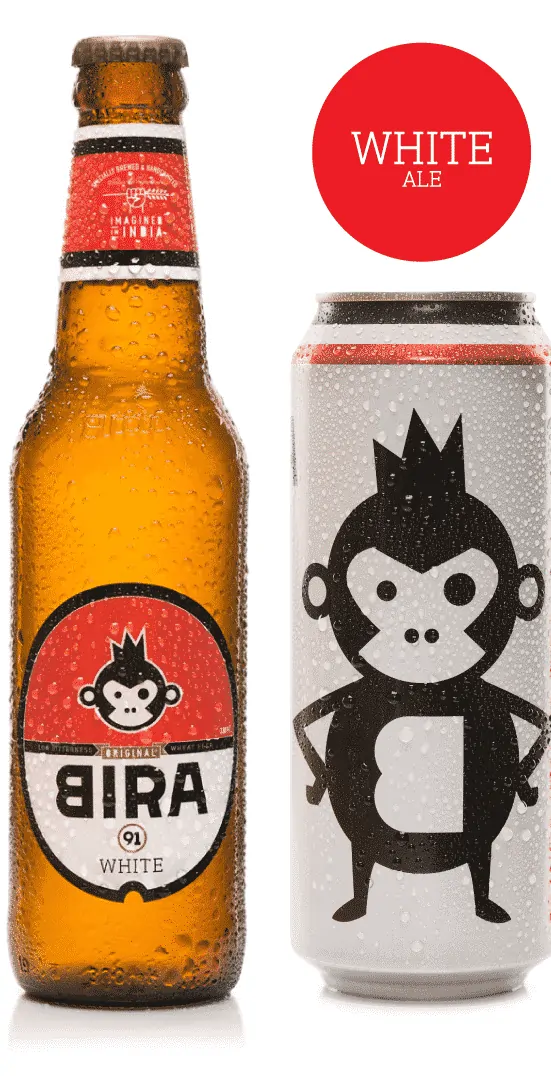
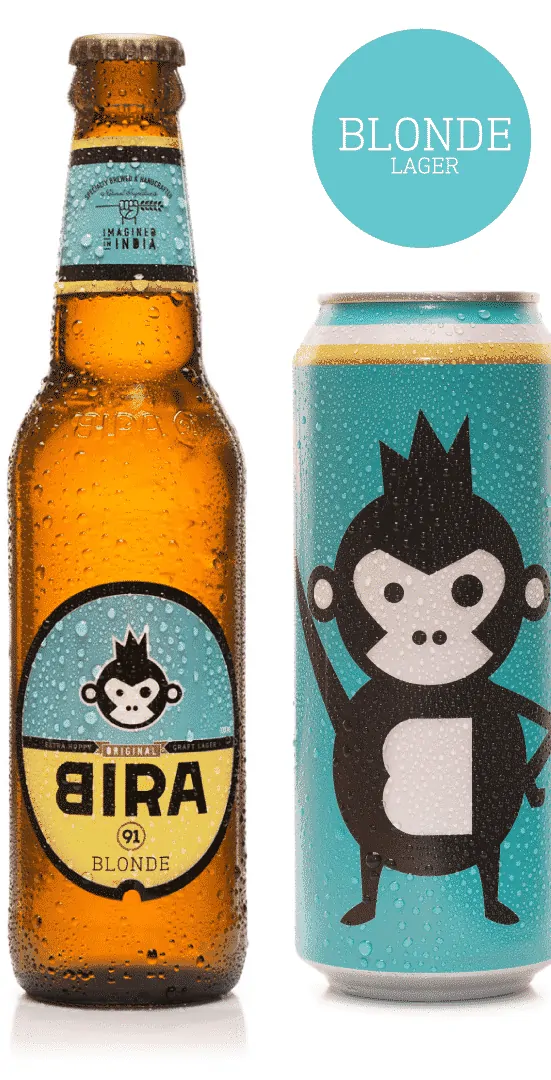
Bira91 was available in two flavors: Bira White Ale & Bira Blonde Lager.
Bira91 White Ale: It is a different wheat beer with the lack of bitterness and a soft finish. It has a taste that is sweeter and citrusy than normal beer.
Bira91 Blonde Lager: It is more conventional than its other variant. However, it is different in taste and color. It is extra malty with a delicate aroma and little bitterness.
Bira91 was selling beers that were never seen before in the market: neither in color nor in taste. Their aim was to fill the gap in the market for an unorthodox, unconventional, fun brand of beer. Bira91’s target audience was the youth of the nation and hence, they wanted to reach out to the young, urban, Indian consumer. Their design played a major role in this, as it was designed for this purpose alone. To successfully get to this audience, their strategies were pretty direct and simple. Since direct alcohol ads are banned in India, they focused only on distribution. Bira’s creative director, Delhi-based designer Dev Kabir Malik, said:
“we did not want to do those surrogate ads for CDs and cassettes and what not.”
They didn’t use any kind of marketing campaign or any sort of surrogate tricks. What they simply did was make the product available in a few pubs. The rest was left to the people who gave a really good response to the product. After that, it was a stark word of mouth publicity. Furthermore, they gained a 30% share in the premium segment without spending anything on traditional marketing.
The Outcome of Bira’s Marketing Strategies
“Bira has evoked a phenomenal response. The feedback has been excellent from people,” said The Beer Café founder and chief executive Rahul Singh.
All their hard work, their hypotheses, and estimations resulted in success. In just a few months they managed to start with one manufacturing unit each in Maharashtra and Rajasthan (another one was set up at Indore, and plans were made to set up one in Nagpur); and also managed to sell 10,000 cases in Delhi alone.
In 2016, Bira91 sold 35,000 cases (2500 barrels) a month, and also expanded its base to Mumbai, Bangalore, Kolkata, Goa, Pune, and Chandigarh as well. They had a penetration of 70% in all their markets, and are today growing at the rate of 30% month on month. Bira91 has also raised their first round of funding of US$6 million from Sequoia Capital, Kunal Bahl, Rohit Bansal, Deepinder Goyal, Ashish Dhawan and Mayank Singhal.
The Success Story Continues
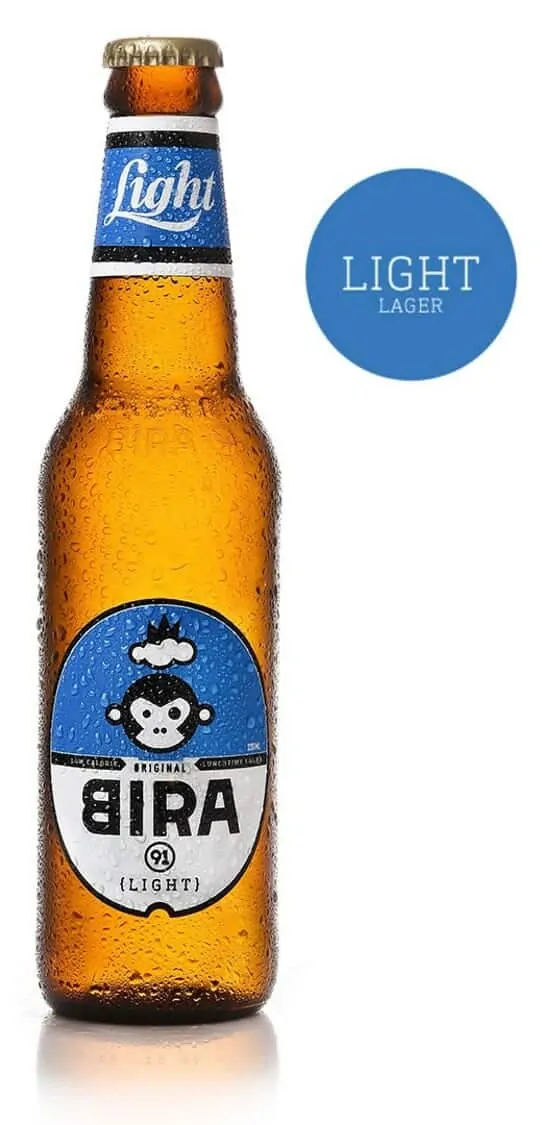
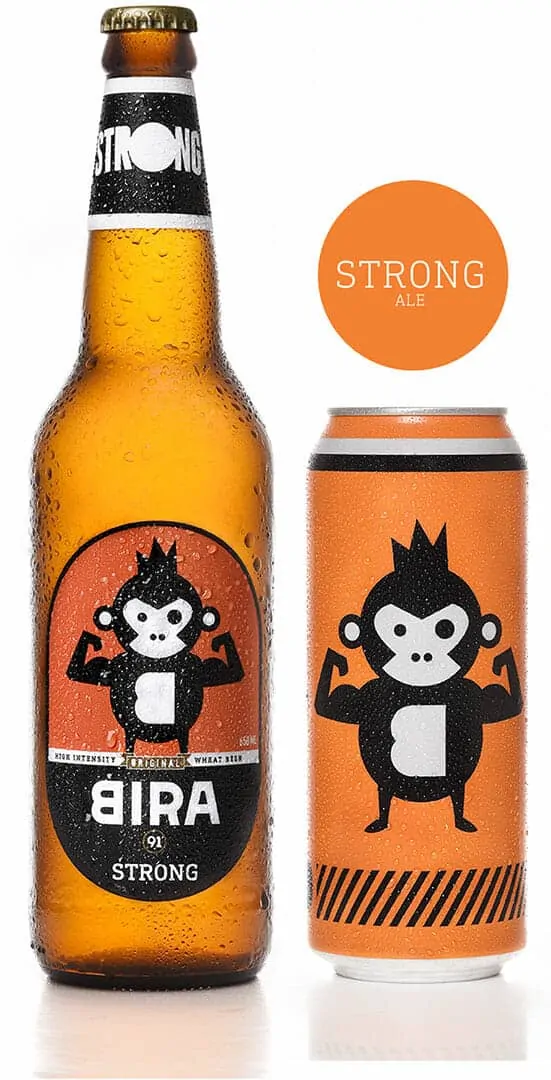
Bira has now added two more new variants of beer: Bira91 Light and Bira91 Strong.
Bira91 Light: As the name suggests, it is a mild beer, low in alcohol (4 percent as compared to the regular 7 percent) and low in calories (90 calories). It is a clean, crisp drink anyone can have at any time of the day.
Bira91 Strong: This beer is to give competition to the other leading beer brands in the market. It has 7 percent alcohol content and is described as the first strong wheat based beer, less bitter and high on caramel notes.
Jain believes craft beer (including microbreweries) would capture 15 to 18 percent of the market by value in around 10 years. An overall expansion in the beer market is also suggested.
“Indian consumer brands have followed more or less the same growth story. Going international means going to Singapore, or at most Africa, which are diaspora-led markets,” says chief marketing officer Mukherjee.
But Bira has some international dreams as well –
“We want to be India’s first consumer brand with a truly global footprint,” says Jain. His aim is to create a beer brand that was “imagined in India” but can proudly be sold as a leading brand globally, starting in New York.
Go On, Tell Us What You Think!
Did we miss something? Come on! Tell us what you think of our article on Bira’s Business Strategy and Success Story in the comments section.
Founded in 2006 by Fabrice Grinda and Alec Oxenford, the online marketplace OLX has its roots in Argentina. The company today functions in over 40 countries, of which it has emerged out as a stronghold in countries like India, Pakistan, Brazil, Portugal, Poland, Ukraine, Nigeria, Philippines, and Kenya. The online classifieds website was funded by several firms such as Nexus Venture Partners, General Catalyst Partners, and Bessemer Venture Partners, to name a few. This was until a major part of the company was taken over by Naspers, a South African media group, who succeeded in procuring the then investors. OLX had a standing of $30 million before being purchased by Naspers.
Before moving on to answer your question about how does OLX make money, let us have a look at some of the important statistics of OLX:
It stands as the largest online classifieds website in countries like India, Portugal, Poland, and Brazil
OLX has achieved major success in India where it stands as the largest marketplace
The success of OLX forced Google to shut down Google Trader, its classifieds website
Argentina-based OLX is at par with social media sites like Snapchat, Instagram, and Facebook in obtaining more than 200 million monthly visits
The web page views of OLX are more than 8.5 billion and has procured more than 25 million listings
The number of OLX transactions are more than 8.5 million
OLX Business Model
Just like Craigslist, OLX runs on a simple classified listing model. However, the revenue model of OLX is much different from that of Craigslist. But, in order to understand how does OLX make money,let us first discuss how OLX works.
How OLX works?
OLX works like just another classifieds portal – it has a parallel system for customers running side by side. People who wish to sell any goods can upload their advertisements just like one is expected to do in a classifieds portal. People who wish to buy goods may browse through the listing.
Sellers need to upload pictures of their goods, along with a title and description of the same and the expected sales price of the commodity. The buyers are allowed to browse through the several alternatives, contact the seller, negotiate with them one-to-one and then purchase the item.
The surprising fact is that OLX doesn’t act as a liaison between the buyer and the seller. It acts as a mere catalyst for connecting the two online through a classifieds portal. The conversation, bargaining, advances, and transactions remain between the buyer and seller only
Business Model of OLX
If we break up the OLX business model into parts, here’s how it functions:
The website acts as a classifieds portal where customers can buy and sell goods
OLX spends large amounts of money in order to garner more and more user traffic and greater frequency and number of listings
The high traffic is put to use to earn revenue by monetizing the number of clicks and searches
How does OLX make money?
Unlike other online marketplaces where website acts as an affiliate to sellers’ products, OLX has a different ball-game altogether. The prime source of revenue for OLX is through advertisements, Google Custom Search Engine, Sponsored Links and Sponsored Listings.
Google Ads
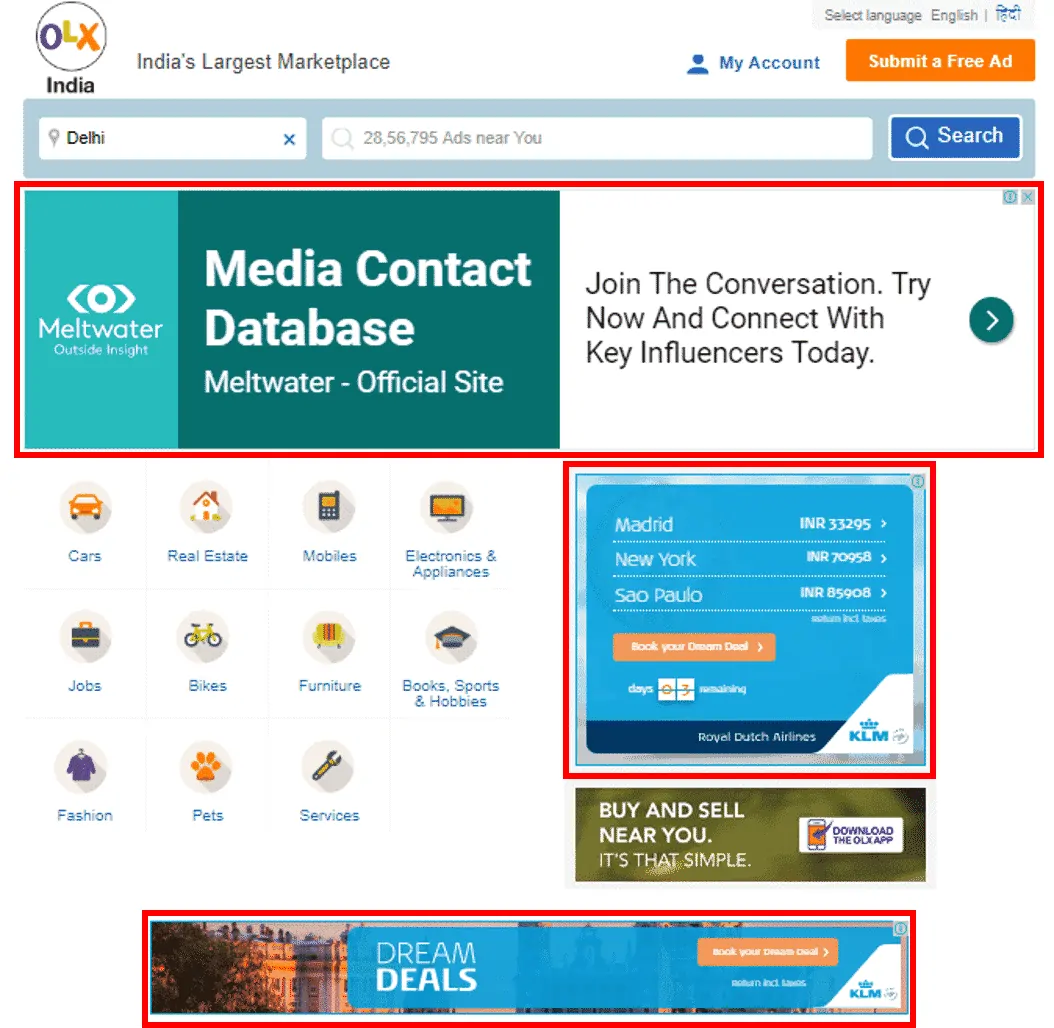
A major part of OLX’s revenue comes from Google Ads Monetization. The company works with partners who in-turn works with Google and other ad partners to act as ad supplier and ad mediator for the website.
These Ads works in juxtaposition with the OLX website, and its contents are displayed on the webpage itself. The number of Ad units varies on different pages of the website.
OLX garners high user traffic through online and TV brand advertisements. OLX monetizes this high customer inflow. It does this on the basis of Cost per Click (CPC), Cost per 1000 Impressions (CPM) and Cost per View for video ads on its home page as well as that on individual product pages till the seller is finally contacted and transacted with.
Google Custom Search Engine
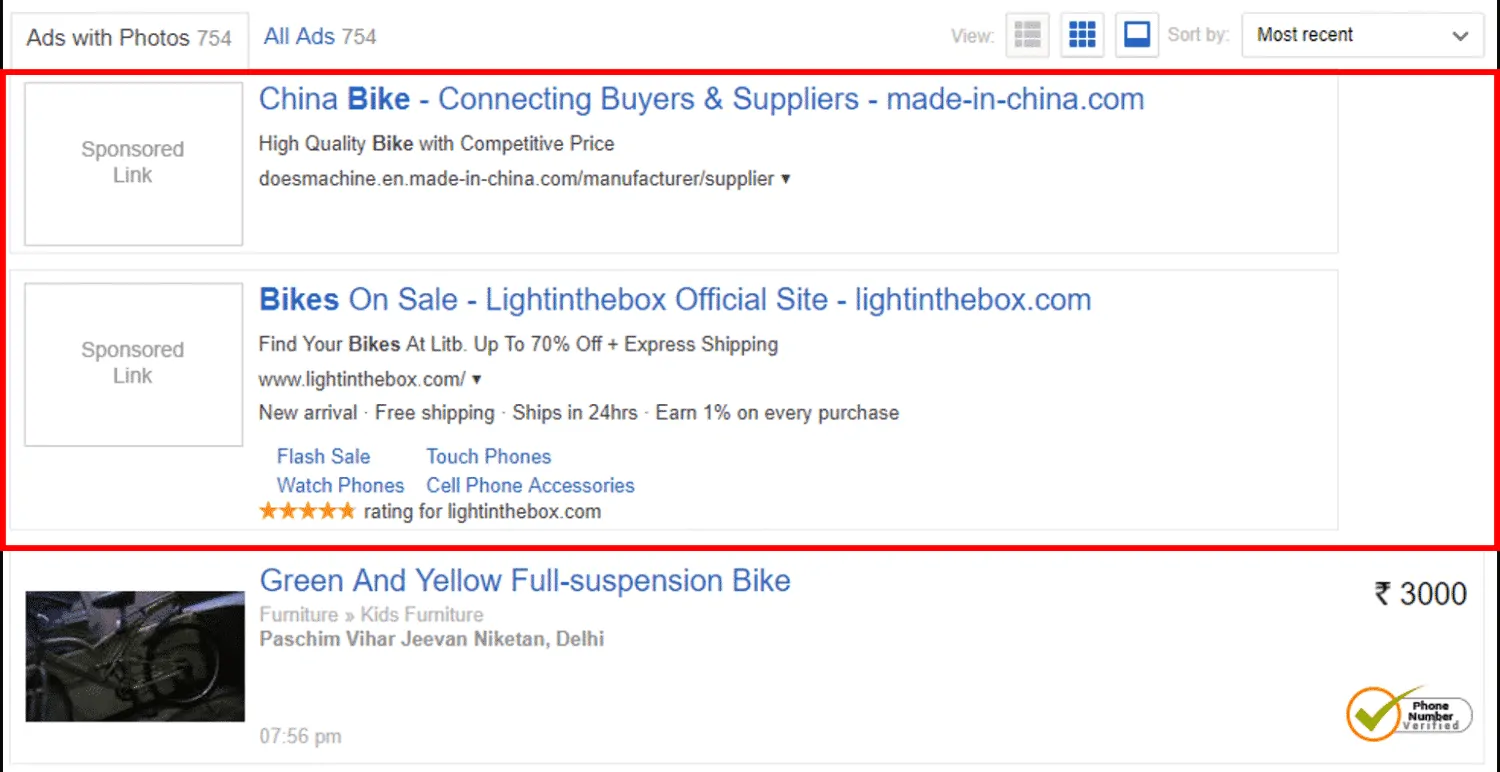
The OLX page has a search bar for customers to look up products. When they perform any search, the results obtained are optimized with the Google custom search engine monetization of advertisements (Adsense-like PPC advertisements), wherein the first two-three results are from Google.
Featured Listings
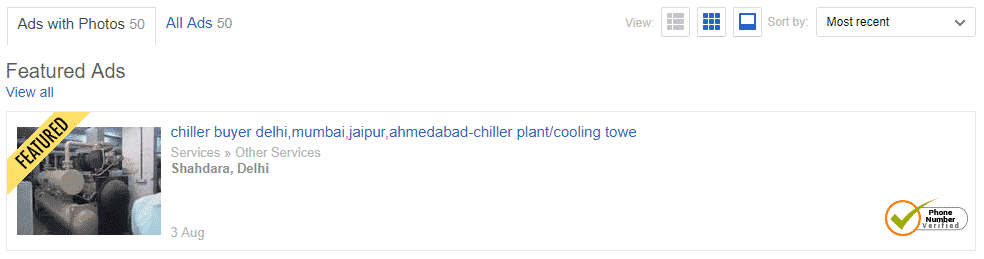
As explained above, if a seller, for example, has posted a classifieds listing of a refrigerator he wishes to sell. After some time, the product is bound to go further below more recent listings, and would now appear on the second or third page and so on. To make it still appear on the top, the seller can pay to OLX to ‘feature’ his listing on the top of the site. This featured listing is a source of profit to both the seller as well as OLX. He might earn more impressions too, which are also dual sources of income for OLX.
The Future Opportunities
The biggest power spread of OLX lies in India, Brazil, and Poland, though these three combined make up for just half its profits. The main strategy employed by Oxenford behind OLX is working on this online mega-mart in the less developed or developing countries, considering the vast ocean of opportunities here. He doesn’t wish to contend with the stalwarts of the US or UK and earn any competitors on the way.
Go On, Tell Us What You Think!
Did we miss something? Come on! Tell us what you think about our article onOLX Business Model | How does OLX make money? in the comments section.
Business is just like life – it is good to have a companion by your side who understands you and shares your vision and passion. Going alone might mean a greater stake in the company and greater decision-making power but having a cofounder has its own advantages.
After all, the founding team of a startup must have expertise in all the areas of a business and that is only truly possible with a team.
Still not convinced? Let us persuade you some more.
Why do you need a Cofounder for Your Startup?
Moral and Emotional Support
Starting a business is really hard. Running it is even harder and more stressful. Startups require far more time and effort than a 9-to-5 job. With so much money on the line and continuous threats from the competition and the risks involved, it is nice to have a partner in your journey who shares your vision and on whom you can lean on, especially in tougher times.
Support of Investors
Investors, generally, tend to support companies which are run by a team than those that run solo. They trust companies with multiple founders and are likely to fund them more easily. So it is best to get a cofounder or cofounders by your side if you want to make the funding process smoother.
Better Decision-making
You don’t want your company to run like a dictatorship, where every decision you take is the final call. Of course, you would have advisors, but a cofounder is your partner. Not only would a cofounder act as a sounding board for all your thoughts, but also actively aid in making the final decisions. You will come up with more ideas through brainstorming and also will be better equipped to seal the loopholes in those ideas by questioning each others’ ideas. That’s how startups end up developing a solid backbone. At the end of the day, a difference of opinion can be healthy and can help in seeing the larger picture if the end goal in sight remains the same.
Division of Responsibility
There are just too many responsibilities in a startup. Running a company is not a cakewalk. There is too much running around to get even the smallest tasks done, especially when the company is in the initial phases and you have to double up as both manager and employee. A cofounder divides the stress and responsibility associated with running a startup. As a result, you end up having a better work-life balance.
Complementary Skills
Everyone comes from a particular background and thus it is impossible for someone to be good or great at everything. You might come from a Marketing background and thus be well-versed with the Marketing problems or concepts but you might have little or no idea about the other areas that make a startup like finance, tech, logistics etc. Having a cofounder team with complementary skill sets is a boon for a startup. Different backgrounds also translate to different viewpoints, leading to different ideas. The work also flows quicker and more smoothly as every cofounder will handle departments according to his skills.
Risk Mitigation
With the huge risks involved, you would want someone to shoulder them with you. People forget that a cofounder does not share only the profits, but the losses too. The investors too would like to decrease their risks by funding a company with multiple founders. A founder is the heart of the company but what if he leaves? The startup might die with the exit of the founder. Having multiple founders means greater stability in the minds of the investors. A case in point would be the exit of Housing.com’s founder and CEO from the company.
Having a cofounder keeps you in good spirits and on your toes even on your bad days when you do not feel like going the extra mile or stepping out of your comfort zone. No matter how great a master of all trades you might think you are, chances are that the reality is you are just a jack of some trades and perhaps the master of none. This should never deter anyone from taking the entrepreneurial plunge. So get like-minded people as your partners who complement your skills and take your business to heights that would not have been possible with only you handling all the affairs of the company.
The Startup Process
We know how important your dream business is to you. Therefore, we’ve come up with an all in one guide: The Startup Process to help you turn your vision into reality.
Right from newspapers in 1685 to modern online dating apps today, people have been using media to propel their love life and relationships. It is interesting how dating through media has evolved through the ages. Today dating websites are frequented often by many men and women who want to get involved with their potential significant other.
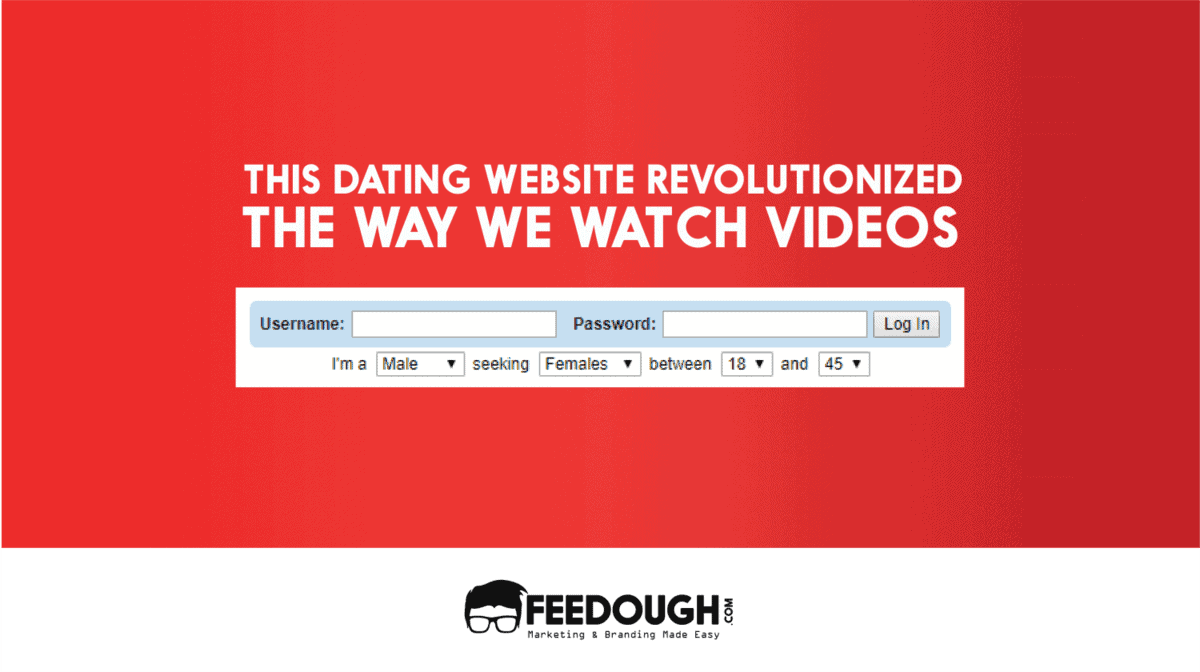
One project too, started by a group of young individuals who were alone, set out with its goal to help people find love. Today this website is not what it was intended to be, but something even greater. When you want to look up a video, learn a skill, get more acquainted with any topic, or simply just want to laugh when you’re alone and keep yourself interested, which is the first thing that comes to your mind? Yes, we’re thinking about the same thing. Although most people know about this humongous website and its many features, how much do you really know about its inception and the way it grew to be such a feat in innovation and strategizing.
YouTube – The Dating Website That Pivoted To video
A really odd beginning and with an inspiring story, YouTube’s growth from start to end is truly brilliant and something we all can learn from.
Getting deeper
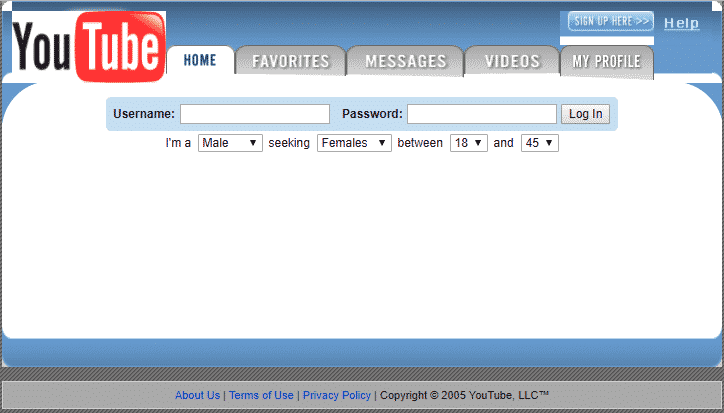
YouTube, the majestic empire of a video-sharing website that it is today, was founded by Chad Hurley, Steve Chen, and Jawed Karim. These three founded the site while they were still employees at PayPal. The domain name “www.youtube.com” got activated on 14th February, 2005 at 9:13pm (there is a special significance to this date which you will get to know more about in just a moment).
The Beginning
Before Tinder ever existed, there was a dating site for people looking out for potential partners: YouTube. Yes. YouTube, being the dominating video-sharing site today, initially started off as a dating website for lonely lovers.
At the South by Southwest tech, film and music conference in Austin, Texas, Chen said:
“We always thought there was something with video there, but what would be the actual practical application? We thought dating would be the obvious choice”.
Karim said, at his University of Illinois commencement speech back in 2007, said,
“We didn’t even know how to describe our new product. To generate interest, we just said it was a new kind of dating site. We even had a slogan for it: Tune in, Hook up.”
The site’s purpose was to allow its users to upload a video profile of themselves for others to view. They would give an introduction about themselves and state what they were interested in. This is was the whole initial idea of YouTube; this is why it was created in the first place.
“Just three guys on Valentine’s Day that had nothing to do,” said Chen.
The dating site had very few users. The server used to host the videos at $100 a month and no one was using it. Karim, Steve Chen, and Chad Hurley took out ads on Craigslist in which they offered to pay $20 to women to upload videos of themselves to the site. But it was all for naught.
The Pivot
And so, in the first 5 days since it commenced, not a single video had been uploaded. At that moment, Chen, and his colleagues decided to scrap the matchmaking objective of the website and switch to a general website for video sharing.
“OK, forget the dating aspect, let’s just open it up to any video” said Chen.
This is what Karim said, at the University of Illinois:
“We didn’t have any videos. Realizing videos of anything would be better than no videos, I populated our new dating site with videos of 747s taking off and landing. The whole thing didn’t make any sense. We were so desperate for some actual dating videos, whatever that even means, that we turned to the website any desperate person would turn to, Craigslist.”
As we read earlier, the co-founders tried many things to get the site more traffic and inflow and get people to upload videos, but it was all a waste. Karim stated that their users were ahead of them; that they began using YouTube to share all kinds of videos: their dogs, vacations, anything. The co-founders then decided to let the users define YouTube for the world. Karim uploaded his, and the, first video on YouTube on 23rd April, 2005: Meet me at the Zoo. It was under the username “jawed” and was recorded by his high school friend Yakov Lapitsky.
By June they had completely revamped the website, making it general and open. And their efforts had finally paid off. This pivot, this turning point, could be stated as the greatest thing that ever happened to the site.
The Growth
Since June 2005, YouTube started blooming magnificently. It was hosting more than 65,000 video uploads and getting an average of 100 million video views per day in July. On Alexa, it was ranked as the fifth-most-popular website (outpacing MySpace’s rate of growth) with an average of nearly 20 million visitors per month.
YouTube entered into a marketing and advertising partnership with NBC in June 2006. Moving on a year ahead, on October 2006, it was announced that Google purchased Youtube for US$1.65 billion in stock.
However, YouTube decided to continue its operations independently but with its co-founders and 67 employees working within Google. In 2007, YouTube started the YouTube awards. Its purpose was to give recognition to the best of the YouTube videos, voted by the community.
In 2007, YouTube started the YouTube awards. Its purpose was to give recognition to the best of the YouTube videos, voted by the community.
In 2011 the Google+ social networking site was integrated with YouTube and Google Chrome, allowing YouTube videos to be viewed from the Google+ interface.
In that year, in December, it changed its interface and at the same time, they changed their logo (their first design change since 2006).
Similar to this, YouTube has made many changes since its inception, which is one of the main reasons why it has been such a success throughout. Today YouTube is a behemoth in video-sharing. More than a billion hours are spent, each day, watching YouTube videos, and there are more than 400 hours of content uploaded every minute (as of February 2017).
Why did their strategy work? The secret of a pivot.
Initially, when YouTube’s website’s idea of a dating platform failed, they immediately decided to change it to a general platform for all kinds of videos. Now, there is more to this than most might observe. It was a successful complete pivot. A complete change in its motive and vision.
Most entrepreneurs are not ready to give up their initial vision and because of this they are even ready to jeopardize their entire business. This is a mistake so often made and the issue at hand is actually a simple one. In fact, if you go to see in reality, most of the world’s leading businesses had a successful pivot after which their success skyrocketed.
Just like YouTube and many more successful businesses, never be afraid to question the motive and vision of your business and whether or not it is actually a viable one. The key is to respond well to your customer’s reactions and be ready to face the challenge that might be to change your plan and pivot.
It might just be the best thing that would happen to your business.
Go On, Tell Us What You Think!
Did we miss something? Come on! Tell us what you think about our article on History of Youtube in the comments section.
They say the first step is always the toughest. Once you know what product you want to make and what industry you want to be in, you start getting a direction of where and how to proceed. But how do you know which niche to target or which gap to address? It can be intimidating but let’s add some order to the chaos and ease off your anxiety. Startups are considered inherently chaotic but there is always a method to the madness. The good news is you can always validate your idea before you decide to jump the gun and pour all your money on a sure-to-be-doomed idea.
Ideating can be tough when almost every idea you can think of already seems to be present. But new products still seem to get launched every day. So how do you ideate?
Ideation
Identify a Gap or Pain Point
The first step in ideation is to identify where the gaps lie in the market. Understanding and solving a customer pain point is a great way to make sure your product reaches as many people as possible because everyone likes a smooth and pleasing experience.
Getting a cab at any place at affordable rates, especially at odd hours had always been a hassle for people. Accountability and customer service were always poor for cabs till Uber identified these problems and solved them. Uber not only took care of the rider’s pain points but the driver’s pain points too.
Look for Unserved Niches
Choose niches carefully which are still unserved. Unserved niches have the highest market potential. While others might be oblivious to certain problems and be happy with the status quo, you can change the consumer behaviour by making people realize that your product is something that they have always wanted but never knew they wanted.
Most people did not even know they wanted Netflix till they got a taste of it and now Netflix is so popular that it has become a verb (a measure of success in the tech world) when it comes to watching content online.
Utilize your Own Experience
If you have worked in an industry and know everything about it, then you should use that experience and knowledge to identify problems and solve them. Converting your expertise into your business will not only add immense value to the customers, it will also make the business model and the service provided, difficult for others to replicate.
Use Latest Trends to Your Advantage
Nobody wants to get into a dead or stagnant market. When you see the latest trend in the market, capitalize on it and incorporate it into your product. It will make your marketing easier, get your product more eyeballs and rake in lots of moolah.
Criteria of Evaluation
How is your Idea Different?
You and your competitors are in the same industry and are trying to solve similar problems. The points of differentiation in either service or pricing or some other parameter must be strong enough for your target audience to flock to your product and not to your competition.
Analysis of Market
Use market research to determine the initial interest in your product idea and identify the right target audience. Again this is just to evaluate your idea and does not truly validate it. Customers might think they like something but might not use it when it is launched in the market. Product and customer validation is covered in the coming sections.
Competitor Analysis and Market Share
They say knowing your competition is half the battle won. Your competition might be doing some great work and benchmarking yourself against them will only help you improve your product and service. Identify their best practices and use them to improve your external and internal processes. Getting a sense of the market share is also very important to understand where you stand vis-à-vis your competitors and how to devise your entry strategy.
Cost/Budget Analysis
An analysis of implementation costs and other expenses involved including marketing costs is necessary to understand if it is feasible to move ahead with the idea.
Scalability
Your idea should be scalable i.e. it should be able to meet continuous standards while it is being replicated without the need for it to be constantly reproduced or reinvented.
Stickiness
Does your product have the necessary characteristics to not just solve a user problem but become a user habit? Stickiness directly translates to the emotional appeal of the product and not just its functional benefits. To determine how sticky or habit-inducing your product is, use the Hooked model. This is the most popular model for developing habit-forming products and it will help you drive your customer engagement.
Profitability
When starting out, lots of investments are required to alter user behavior. So many e-commerce companies have run themselves all dry with huge discounts to get people used to online shopping. But your idea and the associated revenue model needs to generate profits in the long run to be sustainable. Profitability depends on a lot on operational costs but having the correct revenue model is of utmost importance.
Methods of Evaluation
As we are trying to add more order to the initial ideation phase, the idea evaluation stage can be handled with certain methods.
Pass-Fail Evaluation
When there is a large number of ideas to be reviewed, a pass-fail evaluation becomes necessary. This is a simple method which lets you select the best ideas. We have already listed the evaluation criteria for your ideas. There have to be some criteria which the idea MUST pass to move on to the next stage. If an idea satisfies all or most criteria, it passes else it fails. Having just one idea or a few ideas do not require this method.
Evaluation Matrix
This method is more sophisticated than simple Pass-Fail Evaluation. The Evaluation Matrix is an array of an idea against a set of criteria. How well an idea meets a criterion has to be recorded on a scale of 0-5 or 0-10 and then an overall score is generated. Suggestions for improvement for an idea should also be mentioned to improve its score. The ideas with the highest scores can be selected for further review.
SWOT Analysis
The good-old SWOT Analysis has been in the tool-kit of every marketer since time immemorial. When evaluating ideas, it can prove to be very handy as it offers a very rounded view of every idea since it takes into account the strengths, weaknesses, threats, and opportunities related to every idea. The best ideas will rank highly in terms of strengths and opportunities and will have very few weaknesses and threats associated with them.
[the_ad id=”660″]
Idea Validation
Tons of people build businesses around ideas that never appeal to the customers and thus those ideas never sell. All the time and money go down the drain. You might think that you already know what the customer wants. Initial market research might make you believe that customers would love your product. But when the product actually arrives on the shelves, nobody cares about it. A market survey can sometimes be pretty useless since it’s still a hypothetical product. That is when idea validation or to be precise, product validation becomes so important. Validation of ideas can be done very quickly if you follow the right approach.
The right approach, more often than not, when it comes to idea validation is the proof of concept [POC]. A proof of concept is a well researched documented evidence that the proposed product and service is feasible and can be successful.
POC reinforces the Research-Learn-Repeat approach which lets you validate your concept based on the data collected in the research and evaluation phase and come up with the assumptions regarding the needs, wants and usage of the consumers you’re targeting to. The idea is to validate the concept and not getting into the usability and interface of the product.
The proof of concept structure can be divided into four parts:
Proof of Market
You need to prove the presence of the demand for the product you’re planning to offer to validate your idea. The data generated at the time of the market research can be used for this process. Presence of players providing similar product or service serve as a great proof of market for your product.
Proof of Utility
Consumer psychology is of vital importance while validating your idea. The proof of utility can be generated through qualitative and quantitative research methods like focus groups, market Interviews, surveys, etc.
Proof of Product
Proof of market and utility has to be supported by the proof that a feasible product can be built around the idea. This involves specifying and validating the technical aspects and other aspects relating to logistics, human resource, etc.
Interpretations & Assumptions
The proof of concept not only results in a clear yes or no answer to whether the idea is viable but also results in many interpretations and assumptions about the utility and positioning of the product which are further validated in the future phases of the startup process.
The Startup Process
We know how important your dream business is to you. Therefore, we’ve come up with an all in one guide: The Startup Process to help you turn your vision into reality.
Now that you know How to Research, Evaluate and Validate Your Startup Idea, let us move on to the Co-Founder Phase.
Tired of your 9-to-5 job? Fed up with your constant nagging boss? Irritated with the negligible annual increments? Worried at the prospect of never amassing sufficient wealth? If you have ever felt these, the thought of starting up your own business or venture must have definitely crossed your mind. You might have a great idea of a product in your mind but might feel unsure of all the nitty-gritties of starting your own business or even about the prospect of whether leaving the comfort of your secure and stable job makes sense in today’s uncertain world.
Being one’s own boss can be exhilarating and rewarding but it isn’t for everyone. Statistically speaking, most new ventures fail and only a tiny percentage succeeds. But fret not, irrespective of what you might feel, this is the greatest time to be alive for an entrepreneur. Not only are the investors ready to hear people out and be more accepting of the crazy ideas that are proposed, they are also ready to cough up huge sums of money to see them (at least some) succeed.
But before you set out on your entrepreneurial journey, you must ask yourself these 20 questions:
Why do I want to start a business?
If you are doing it because you hate your job or because everyone else near you is doing it and it is the latest fad, your venture won’t last long. You have to love and be passionate about what you are doing.
What problem do I look to solve/what niches have not been served/what gaps exist in the market?
Your idea is worth zilch if you are shooting in the dark. Try to understand what problem in the market you are trying to address or if there are gaps or niches that are not being served by anyone else. If those areas intersect with what you like, then you have hit the sweet spot.
What is the target market for my business?
Neither is every product meant for everyone nor do companies have the time and resources to reach everyone. Zeroing in on the target market not only helps you set your marketing and development strategies in place, it also can lead to higher returns on investment in the long run.
What funds are needed to start my company? How to get those funds?
Every company needs funds but there are certain funds without which you absolutely cannot do in a company. Every company needs to figure out which funds are most essential, so as to cut costs, especially in its initial days. Funding by venture capitalists makes all the news headlines for a startup but there are other ways to raise funds too like getting a bank loan, crowdfunding, factoring etc. Of course, bootstrapping (funding from one’s savings) remains the most obvious option. In the long run, the company has to turn profitable and cannot depend on raised funds to sustain itself. The revenue model of the company will determine how the company manages its expenses and generates profits.
Do I have the personal and financial support of friends and family?
There are good days and then there are bad days. In entrepreneurship, bad days can be extremely bad. In those challenging times, the support of friends and family can help you stay upbeat and sane.
Is the business idea scalable? If not, how do I make it scalable?
For a business to be scalable means you being ready to handle the increasing number of customers and vendors. Businesses need to grow to become successful. If you can’t see growth for your business in the future, then you must ask yourself what changes to its business model shall make it scalable and help it grow.
Who are the competitors/who else is already doing what I want to do?
First mover advantage is always wonderful to have. But sometimes being the second mover also has its advantages. When it is a completely new field, consumer habits need to adapt and for that, lots of investments in the form of discounts and promotions are required. Just imagine someone doing all the hard work of setting up the ground for you and you swooping right in and taking the pie. Irrespective of whether you are the first or second or Nth mover, it is always one of the first tasks to assess the competition and determine who is doing what and how so that you can formulate your strategies accordingly.
What makes my product or solution special or different from the competition?
If someone is already doing the same thing that you plan to do and doing it better than you ever could, there is no point going forward. Your solution or product might operate in the same space as its competitors but it needs to provide a unique value to consumers that others cannot for it to sustain itself in the long run.
How will I test and validate the product idea?
Just imagine the amount of effort and time and resources you would need to turn your great idea into reality and then launching it in the market just to realize that idea wasn’t really “great” after all. Nobody wants it and it ends being a dud. That’s where idea testing and market research come into the picture. Relatively newer product development approaches like Lean and Sprint allow you to test your ideas in just a week. If it works with the target audience, you can go ahead else it’s still not too late to go back to the drawing board.
Am I ready to give the required time, resources and capital to succeed? What sacrifices and risks am I ready to take for the business?
Starting up requires lots of time, sacrifices and risks. If you thought that being your own boss meant chilling to your heart’s content, you are in for a surprise. If your job demanded 8 hours of your day, your own company might need twice that amount plus working even on weekends. The initial phase of your company might need dipping into your savings and forgoing a stable salary. This is just the tip of the iceberg. So you should be prepared for all of this before you decide to startup.
Do I have the necessary skills and abilities to start and manage the day-to-day operations of a company?
You need to ask yourself if you see yourself capable to run the company operations. At the end of the day, 80% of running a company is operations. Do you have the required entrepreneurial skills and if not, how can you acquire them? There are tons of courses, seminars etc. to get you up to speed on these aspects.
What are the short and long-term goals, personally and financially, for both myself and my business? Can I see myself doing this 5 or 10 years down the line?
Your financial and operational strategy for yourself and your company will depend on your goals. How you raise funds, what the product roadmap is going to be like, how many teams you need to have, how many employees you will need, what costs to cut etc. will depend on these goals. Ask yourself where your company shall be in 5-10 years and if you are passionate enough to continue doing this even then.
Do I have sufficient knowledge and understanding of the industry I am looking to enter? How can my past experience and education help me?
It is absolutely essential to have a thorough understanding of the industry that your company would operate in. If you want to start an apparel company, knowledge of the apparel industry is a must. The same applies to automobiles, chemicals, pharmaceuticals or any other industry for that matter. If you do not understand that industry, it is best not to enter that industry. You should always look as to how your own education and experience can help you understand the industry better.
Do I need a co-founder(s) for the business? If yes, what complementary skills would the co-founder(s) need to have for the smooth and successful functioning of the business?
Not everyone is good at everything. You might be an excellent Product and Engineering person but you might still lack marketing skills or finance knowledge. A startup founding team should have all the necessary skills and that is why finding the right co-founder is most crucial. The co-founder(s) should not only complement your skills with his/hers but should also share your vision with utmost zeal and passion. Selecting the right co-founders is one of the most difficult and crucial steps in starting a company.
What organization structure would I need for my company in the short term and long term?
In a typical Organization Design class in a B-school, you will be taught a plethora of organizational structures. While it might look useless, all of them have a purpose. A small company can work with a flat structure better and as it grows bigger, the structure keeps on getting more hierarchical. There are various types of structures like functional, divisional, matrix etc. and you need to understand and figure out which structure suits your company best at which stage for its optimum functioning.
How many employees will I need?
Think about the costs and how much you can afford. Keep in mind the value that you expect from each employee. While starting up, the quality matters more than the quantity. One great employee can be equal to tens of average employees. Recruitment takes utmost priority. The initial team of a company is the hardest to form.
How is the legal structure to be set up for my company?
It is one of the most important decisions while setting up a new company. Your choice depends on the tax consequences and how much risk you are willing to take. Depending on that you can choose a legal structure as per your requirements, be it a sole proprietorship, partnership, LLC or corporation.
What kind of taxes would I have to pay for the business? What other expenses, including insurance, do I need to take into account?
You should know how to navigate tax landscape as a startup founder. Taxes and liabilities vary a lot depending on the legal structure of the company. For example in India, startups are exempt from capital gains tax and they also have to pay no income tax on their profits for the first three years. With risks running high, startups should definitely insure themselves in case things go awry due to unforeseen circumstances. Investors also like it when risk is eliminated as much as possible from the equation.
Am I ready to relentlessly meet and network with lots of people for investments, promotions, advertisements etc.?
Starting a new company means going to lots of conventions, seminars, workshops etc. and networking with as many people as possible. Sometimes to recruit people, sometimes to pitch ideas to potential investors, sometimes to just listen to ideas from fellow entrepreneurs. You must be comfortable networking with hundreds of people on some days. If you think you are too shy and the thought of all these makes you uncomfortable, maybe it’s not the right path for you.
How will I exit my business few years down the line if I want to and how will the responsibilities be transferred in such a case?
You might want to sell the startup to a bigger company few years down the line or make an exit from the company yourself. Evaluate all terms and conditions carefully and make a note of all the available options in your head. Even an IPO can be an exit strategy. The focus should be to leave the company after adding significant value holding your head held high and pockets heavy with profits. The transfer of responsibilities should be carefully handled with a proper business succession plan so that the company keeps doing well even in your absence. A lot of thought should go into choosing your successor.
The Startup Process
We know how important your dream business is to you. Therefore, we’ve come up with an all in one guide: The Startup Process to help you turn your vision into reality.
A goal without planning is just a dream. You need a ‘start to finish’ plan in order to ensure effective use of resources and better results. For marketers, imagining a buyer’s journey is an integral part of planning an effective marketing strategy, and there’s a perfect tool for the same: the marketing funnel.
Like an actual funnel, marketing funnels represent a buyer’s journey from being aware of an offering to becoming its loyal customer. It’s a step-by-step process that narrows down your target audience as they move further down the funnel, culminating in conversions and sales.
But before we move towards the functioning of a marketing funnel, let’s first understand what it is.
What Is A Marketing Funnel?
A marketing funnel is the visualisation of the buyer’s journey from the point when they first learn about the product or service to when they eventually become a customer.
It’s a step-by-step process that businesses use to nurture prospects and turn them into paying customers.
In simple words, a marketing funnel is a process that takes a customer from awareness to purchase.
Sounds puzzling? Let’s ease it further.
Imagine an actual funnel.
You pour water in the wide opening at the top, and it eventually comes out of a small hole at the bottom, right?
Now, think of your marketing funnel as that actual funnel.
The top of your funnel is where your target customers get to know you.
The middle is where they learn more about your product or service.
And the bottom is where they finally make a purchase.
The main purpose of a marketing funnel is to move your target customers from the top of the funnel (TOFU) all the way down to the bottom so they eventually become paying customers.
Marketing Funnel Stages
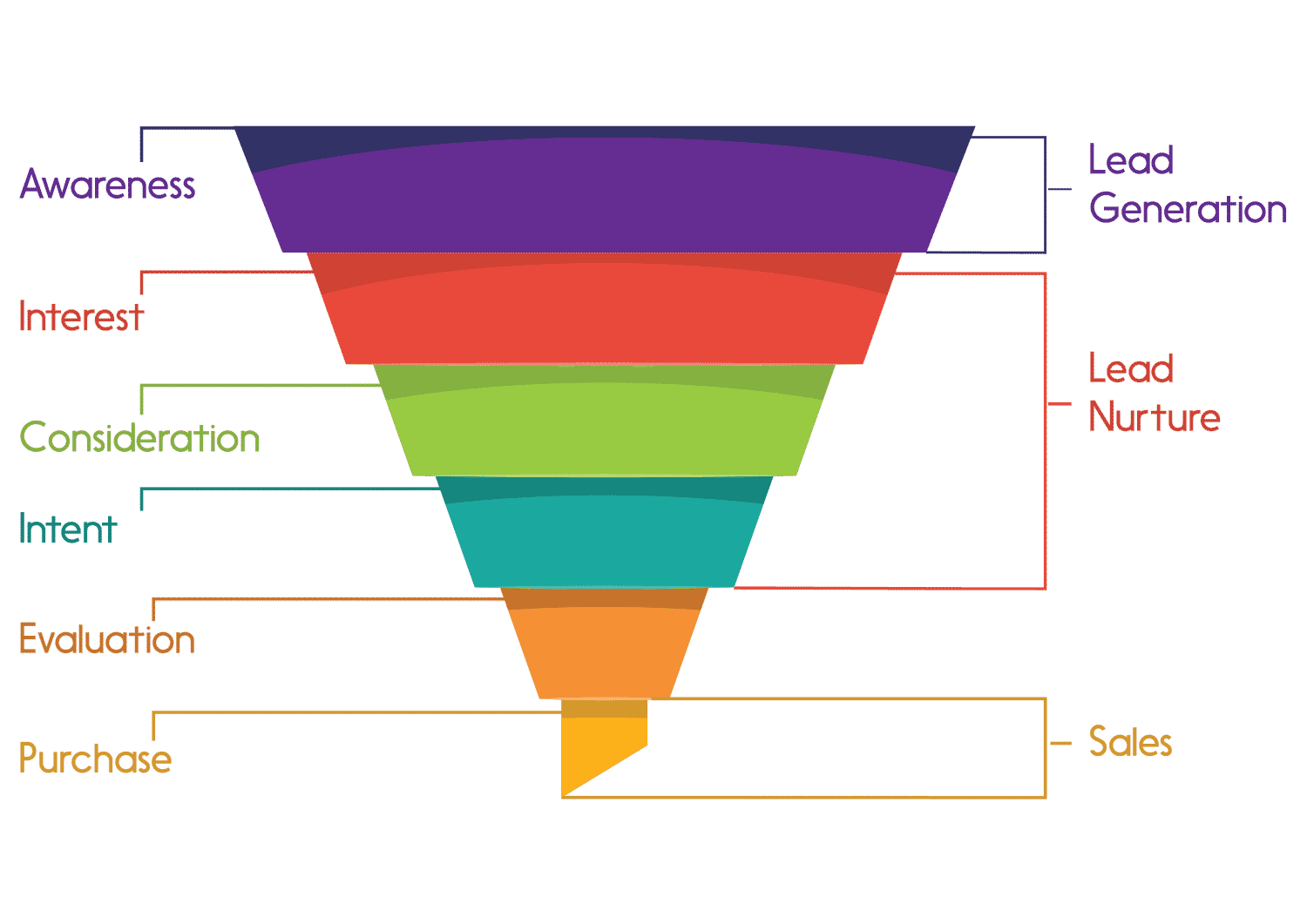
Most marketers categorise the marketing funnel into four main stages (AIDA model).
Awareness: Where the target audience becomes aware of the product or service.
Interest: When they start showing interest in what the brand has to offer.
Desire: When they start wanting the product or service.
Action: When they finally take action and make a purchase.
However, with the advent of the internet, the marketing funnel has become more complex with the addition of new stages. The modern marketing funnel today has six levels:
Awareness
Interest
Consideration
Intent
Evaluation
Purchase
Awareness
From a customer perspective, the awareness stage is all about getting to know your brand for the first time.
They might’ve seen a Facebook ad, read an article that mentioned your product, or heard someone talking about your company.
At this stage, customers are still trying to figure out what they need and whether your product is the right fit for them.
From a marketing standpoint, the awareness stage is all about getting your name out there and generating interest in your product. People at this stage of the funnel are named prospects and marketers try to convert them into leads by sharing relevant content.
Marketers focus on the following objectives during the awareness stage:
They achieve the same using the following techniques:
Content marketing: This involves creating and distributing valuable, relevant, and consistent content in the form of blog posts, infographics, ebooks, etc., to attract and get the attention of your target audience.
Search engine optimisation: This is the process of optimising your website to rank higher in search engine results pages (SERPs) for certain keywords, which, in turn, will generate more traffic to your site. SEO is complemented by content marketing.
Social media marketing: This involves using social media platforms such as Facebook, Twitter, LinkedIn, and Pinterest to build relationships with potential and current customers. Marketers post relevant content that has the potential to go viral and get shared by a large number of people.
Paid advertising: These are advertisements that appear on search engines, social media platforms, and third-party websites in the form of images, videos, or text. Marketers can use paid advertising to target relevant audiences with laser precision.
Public relations: Public relations is the process of managing the spread of information between an individual or an organisation and the public. Public relations activities can include organising press conferences, conducting interviews, and writing press releases to generate positive publicity and spread awareness about a brand.
Referral marketing: Referral marketing is a form of marketing that relies on word-of-mouth from satisfied customers to generate new leads. Referral marketing can be done through online platforms such as social media and review websites, or offline through personal recommendations. Referrers help the brand reach new customers in return for a reward, such as a discount or free product.
CPA marketing: CPA marketing, or cost-per-action marketing, is a form of affiliate marketing where you pay a commission for each action taken by a customer. This could be a sale, sign-up, or any other desired action. CPA marketing is a popular model for lead generation as the task to inform the customer about the product or service is already completed by the referrer, so what you get is already a lead deep down in your funnel.
For example, a person with yellow teeth may have just realised that they’re not happy with their smile. They start to do some research using keywords like “best teeth whitening products” or “how to get whiter teeth.” He may also talk to friends or family members about their experiences with different teeth whitening products.
This is the touchpoint where your brand needs to be visible.
Interest
At this stage, the prospects know that the brand exists and want to learn more about what it offers. The marketing funnel begins to narrow here as the prospect starts to compare different options and make a decision.
In marketing terms, these prospects have already converted into leads, and the goal now is to turn them into customers. But there’s a long way to go before that can happen.
This stage involves nurturing this early-stage lead by answering its comparison questions and addressing any objections it has about the brand.
For example, once aware of the available options for teeth whitening products, a customer may be interested in three to four, depending on their needs. If the offering lies among these, the marketing team’s job is to ensure that their product is the one that stands out. It does the same by understanding what the customer searches for next. Some examples include “XYZ brand pricing” or “XYZ brand features”.
During the interest phase, the customer just needs more information regarding whether the product has all the features they’re looking for and whether it’ll –
Help them get the job done
Solve the problems preventing them from getting the job done
Provide them gains related to the job getting done
You need to generate content that is both informative and persuasive, addressing the customer’s objections while also furthering their interest in the product.
Consideration
Getting favourable answers during the interest phase paves the way for customers to consider your product as something they can buy.
In simple terms, now the customer has a soft corner for your product, but they may need more information and persuasion to make the purchase decision.
The consideration stage is where people start to compare your product with other similar offerings in the market. They weigh the pros and cons and look for what others are saying about your product through reviews and testimonials, trying to figure out if it’s worth their money.
You’d need strong social proof and some more content in the form of third-party blog posts and videos to push them further down your funnel.
Affiliate marketing works best during the consideration phase. Review posts by known bloggers and vloggers, or even better, personal recommendations from people they trust can do wonders for your product.
A dedicated feature information page on your website or brochure for every feature your product or service offers can also be very helpful in this phase.
Intent
An intent stage is when the prospective customer does some specified activity after the consideration stage, this includes purchase-related queries, putting the product in the shopping cart, etc.
This is the phase you get confident that the prospect has the potential to become a customer.
But there are cases when the transaction is postponed or cancelled even after going through all the stages of the marketing funnel.
Having a follow-up plan for such situations is essential and not giving up easily. Here are some strategies that can help you with it:
Develop a sense Of urgency: Fear of missing out is a powerful emotion. You can use it to your advantage by creating a sense of urgency. For example, you can offer discounts that are only valid for a limited time or show that the stock is running low. This will prompt the customers to take action before it’s too late. Besides FOMO, other techniques like the scarcity principle can also be used to create a sense of urgency.
Remarketing: Remarketing is a form of marketing that helps you reach out to people who have already shown an interest in your product or service. For example, if someone visited your website but didn’t make a purchase, or added your product to the cart and left, you can show them targeted ads the next time they’re online. This will remind them of your brand and what you offer, and it might just be enough to persuade them to purchase.
Use Testimonials And Social Proof: Customer testimonials on checkout pages can help increase sales as it helps build trust and credibility. You can also use social validation by displaying the number of people who have already bought the product. This will show potential customers that others are using the product and are happy with it, which will encourage them to buy it as well.
Maintain A Human Touch: If selling on an eCommerce store, you can ensure human touch by adding a live chat option.
Make It Easy For Them: A difficult or lengthy checkout process will only discourage customers from buying your product. Make sure the process is as smooth and easy as possible, so they don’t have any trouble completing it.
The intent phase is also the best time to upsell or cross-sell related products to your potential customer. By offering them something else they might need, you can increase the order value and make more sales.
Evaluation
This is the last phase before the purchase is made. The customer has already decided they need the product, but they’re just making sure it’s the right one for them.
Very few customers churn at this stage, but it’s still important to make sure they have all the information they need to make an informed decision.
They cross-check the order to make sure they’re getting what they want, and they might look at reviews to see what other people think of the product.
What makes them churn at this stage are things like:
Shipping costs: if they’re unexpectedly high, the customer might back out
The return policy: if it’s too complicated or nonexistent, the customer might not want to risk it
Competitor’s offers: if there’s a better deal elsewhere or a coupon code the customer didn’t know about, they might go for that instead
The goal at this stage is to give the customer everything they need to make a purchase with confidence. Marketers play smart by:
Including shipping cost in the product price and making visible shipping cost free
Offering a simple return policy
Running their own coupons and promo codes
Purchase
The final stage is when the purchase is actually made. But that’s not the end of it – even after a purchase is complete, you can still nurture your customers and turn them into brand advocates. You can do this by:
Sending a thank you email
Asking for feedback
Inviting customers to join your loyalty program
Providing benefits for referrals
How Does Marketing Funnel Work?
From the marketer’s perspective, the entire funnel can be divided into three distinct objectives:
Lead Generation
Lead Nurture
Lead Conversion
Lead Generation
Everyone belonging to the target audience is a prospect, but not every prospect is a lead. A lead is someone who has shown an interest in your product or service by providing their contact information, such as their name and email address.
The top of the funnel aims to identify those who are interested and convert them into qualified leads. Marketers use a number of methods to generate leads, which can be broadly classified into two categories:
Inbound marketing: In inbound marketing, businesses create valuable content and make it easy for their target audience to find it. They then use this content to generate leads.
Outbound marketing: In this type of marketing, businesses directly contact their target audience through channels such as emails, calls, or advertisements.
Lead Nurture
A lead is not ready to buy your product or service immediately after showing interest. They need to be nurtured before they are ready to make a purchase.
The middle of the funnel is where you nurture your leads and build a relationship with them. You do this by providing them with valuable content that is relevant to their needs. This can be done using a free trial of your product, an email course, or a valuable ebook.
While there is a considerable churn rate at this stage, it is still less than at the top of the funnel. This is because you have already engaged with your leads and built a relationship with them.
The goal of lead nurturing is to build trust with the leads and keep them moving through the funnel until they are ready to make a purchase.
Lead Conversion
The bottom of the funnel is where your leads become sales. This is the stage where you close the deal and make a sale.
The lead conversion rate is the percentage of leads that become sales. The average lead conversion rate depends on the industry, but it is usually between 2% and 5%. Last-minute offers, discounts, and personal guidance can help increase the lead conversion rate.
Marketing Funnel Examples
Even though the marketing funnel stages are universal, the way they are executed will be different for every business.
Here are a few examples of how businesses can execute each stage of the marketing funnel:
Marketing Funnel Of Shoes Brand
A shoes brand focusing mostly on offline retail sales can use the following marketing funnel:
Awareness Stage: Advertising on billboards, TV commercials, and radio ads; using print media such as magazines to promote new products; sponsoring local events.
Interest Stage: Sending comparison charts of the brand’s products in direct mailers; making the retail stores more attractive and inviting; providing more detailed product information on the brand’s website.
Consideration Stage: Training sales staff in active listening so they can understand customer needs and then recommend the right product; using special technology within the store so customers can get more information about products before making a purchase.
Intent: Providing coupons and discounts to increase the likelihood of a purchase; developing a special program that benefit customers who frequently purchase the brand’s products; developing special upselling and cross-selling bundles.
Evaluation: Making sure that the sales staff is providing high-quality customer service; surveying customers to get feedback about the quality of products and services; offering after-sale services promise.
Purchase: Creating a streamlined purchase process that is easy for customers to follow; making it easy for customers to return or exchange products if necessary.
Marketing Funnel Of SAAS Brand
The marketing funnel for a SAAS brand is a little different than for other types of businesses because the product is purchased differently. The steps are still the same, but the process happens over a longer period of time.
Awareness: Creating blog content, infographics, and other informative resources that potential customers can use to learn about the product.
Interest: Creating a landing page with a strong offer that will capture leads and turn them into subscribers.
Consideration: Nurturing subscribers with helpful content that educates them about the product and its features.
Intent: Creating a free trial or demo of the product so that potential customers can experience its value firsthand.
Evaluation: Creating case studies and other customer success stories that potential customers can use to see how the product has helped others.
Purchase: Creating a special offer or discount for subscribers who are ready to buy the product.
Bottom-Line?
A business cannot sustain itself without customers. The marketing funnel is the path that a potential customer takes from being aware of the business to becoming a paying customer. Without a marketing funnel, a business will have a difficult time growing.
But different businesses will have different marketing funnels based on their products, target market, and business model. There is no one-size-fits-all marketing funnel.
The best way to create a marketing funnel is to start with the end goal in mind and work backwards. What does the customer need to do in order to make a purchase? Once you know the answer to that, you can create a marketing funnel that will lead them there.
Go On, Tell Us What You Think!
Did we miss something? Come on! Tell us what you think about our article on How Marketing Funnels Work? in the comments section.
Started as a dating website by Steve Chen, Chad Hurley, and Jawed Karim in February 2005, YouTube is now the world’s largest video sharing website and the second largest search engine in the www.
More than a billion hours are spent each day watching YouTube videos, there are more than 400 hours of content uploaded every minute.
The platform is available in 76 different languages and is used not only by individuals but also by big brands, celebrities, and many other Youtube exclusive influencers to promote themselves and to earn money through Youtube. But how does Youtube make money and what’s Youtube business model? Well, we have all your answers here.
How does Youtube work?
This Google-owned website allows its users to upload videos, share and comment on other videos, subscribe to other users’ channels and make money by monetizing their videos. The videos uploaded on the platform are free to watch.
Apart from providing video sharing platform, Youtube also provides a specialized platform for games and music.
But how does YouTube make money? Intuitively, it might sound confusing how can such a platform earn revenue when its content is free to access? But in reality, it’s pretty simple.
Understanding YouTube’s Business Model
Well, as we’ve discussed earlier, most of YouTube’s content is free to access. You can watch millions of free videos for as many hours you want (even some movies are provided for free).
The actual product that YouTube sells is its users. This is an advertisement based business model.
However, Youtube also makes money through a subscription-based model as well – Youtube Premium. Youtube Premium offers certain exclusive benefits to the subscribers by charging a nominal amount for the membership.
How Does Youtube Make Money?
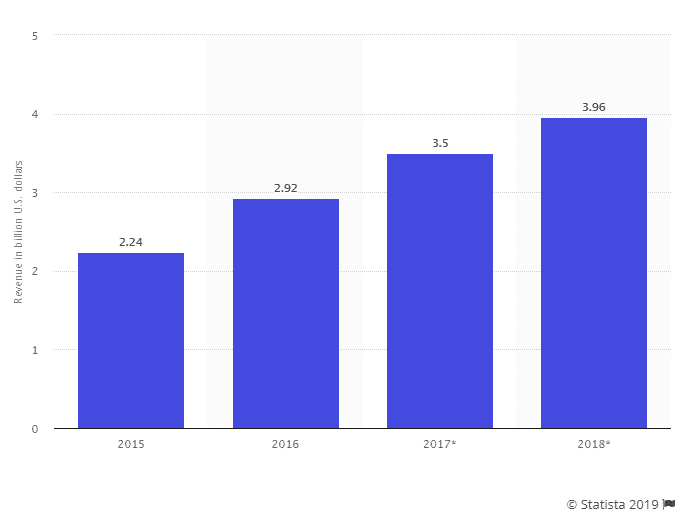
Youtube earns most of its revenue from advertisements and represents 11% of Google’s net US ad revenues. Even though the company is steadily moving towards the subscription-based business model, it still remains a secondary revenue source.
Youtube Advertising revenue in the USA from 2015-2018. Source: Statista
Sponsored Videos
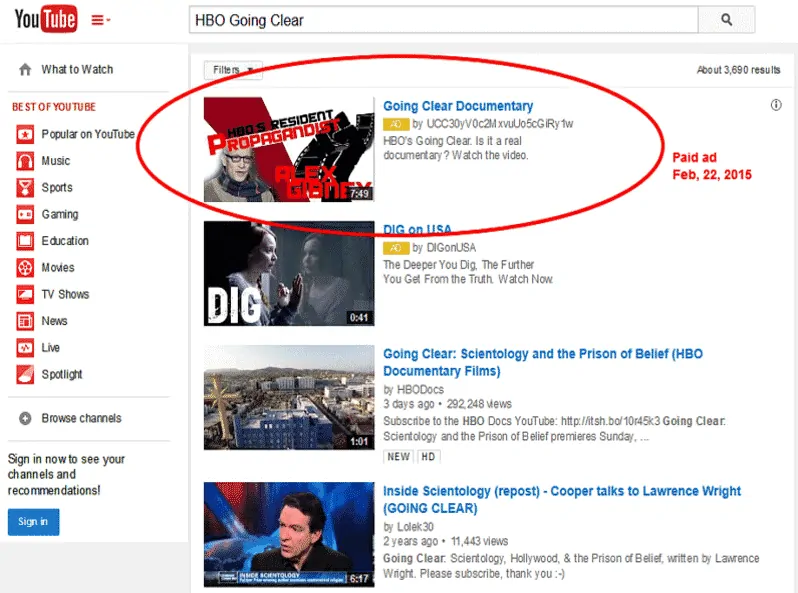
One of the ways Youtube make money is through sponsored advertisements. In the above picture, the result that is circled is a paid ad. It is a sponsored video and the advertiser pays YouTube based on the number of views it gets after such an ad has been clicked on. It is called SERP advertising.
Embedded Advertisements
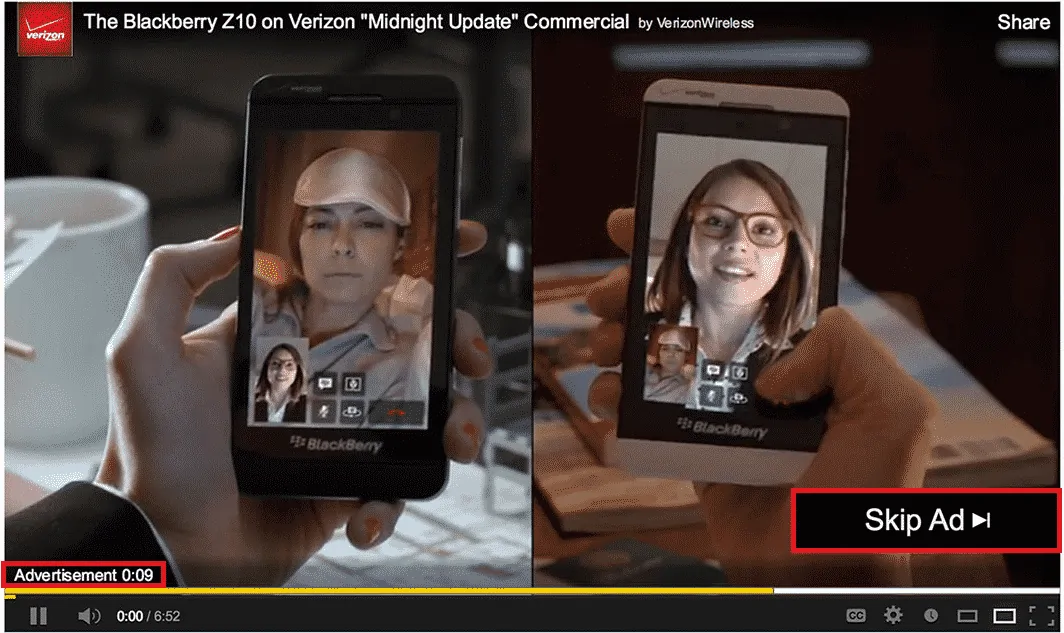
Another advertisement revenue stream of Youtube is an embedded advertisement. The above picture shows how an advertisement is embedded in a YouTube video. This advertisement is played before the actual video begins. Also, short ads are placed in between videos, that also generate income.
Here the company earns money from the advertisers based on the number of views the ad gets. A proportion of that fee is paid to the creator of the video.
Landing Page Advertisements
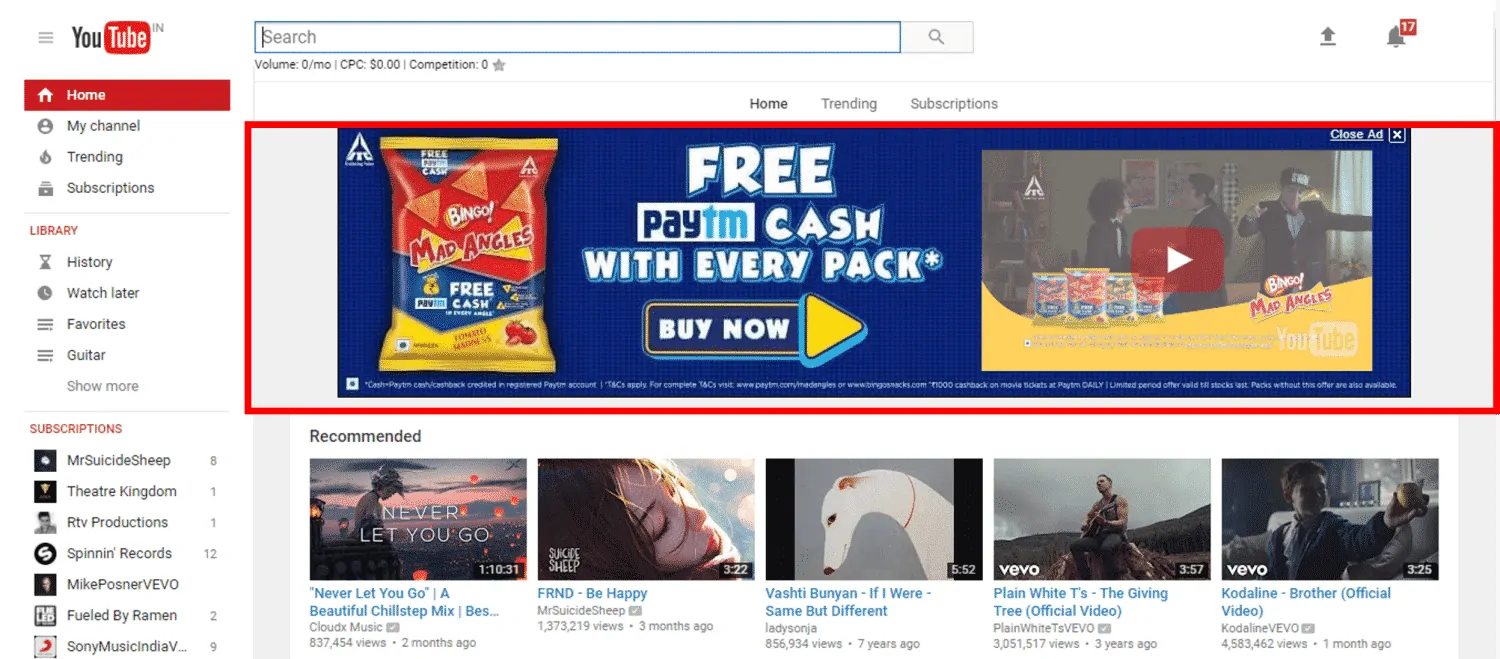
A Landing page is YouTube’s homepage — which opens first — without logging in. This landing page advertisement on Youtube is a banner style advertisement which can contain both pictures and videos and can be used by advertisers in numerous ways to shout out loud the story.
YouTube Premium
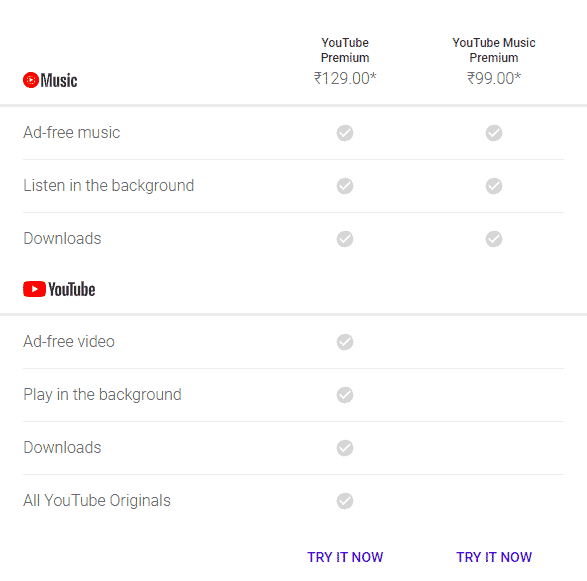
Just like Netflix’s business model, Youtube has also launched its subscription-based freemium revenue model, Youtube Premium, which gives you an enhanced, uninterrupted experience across YouTube, YouTube Music, and YouTube Gaming.
YouTube Premium membership has the following perks
Background play when using other apps or when your screen’s off
The subscription cost to join Youtube Red is $11.99 per month in the USA but it differs for different countries.
Channel Membership
Youtube revenue sources don’t stop at advertisements.
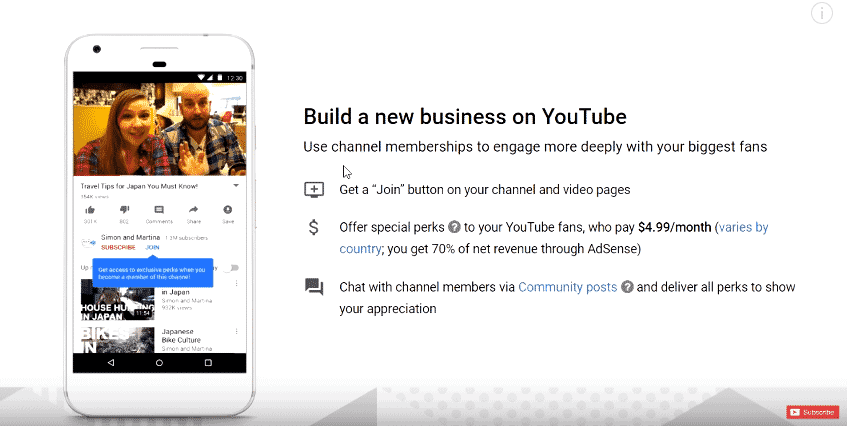
Started off as sponsorships, channel memberships feature allows the Youtube partners (publishers) to engage more deeply with their fans and earn more from Youtube than just putting ads.
This feature lets the partners add a “Join” button on their channel and video pages. This membership feature is inspired by Patreon’s business model and allows the creator to offer special perks like merchandises, offers and discounts on official products, etc. to the subscribers who pay $4.99/month (different for different countries).
Youtube keeps 30% of the membership fee paid by the subscriber.
Youtube TV
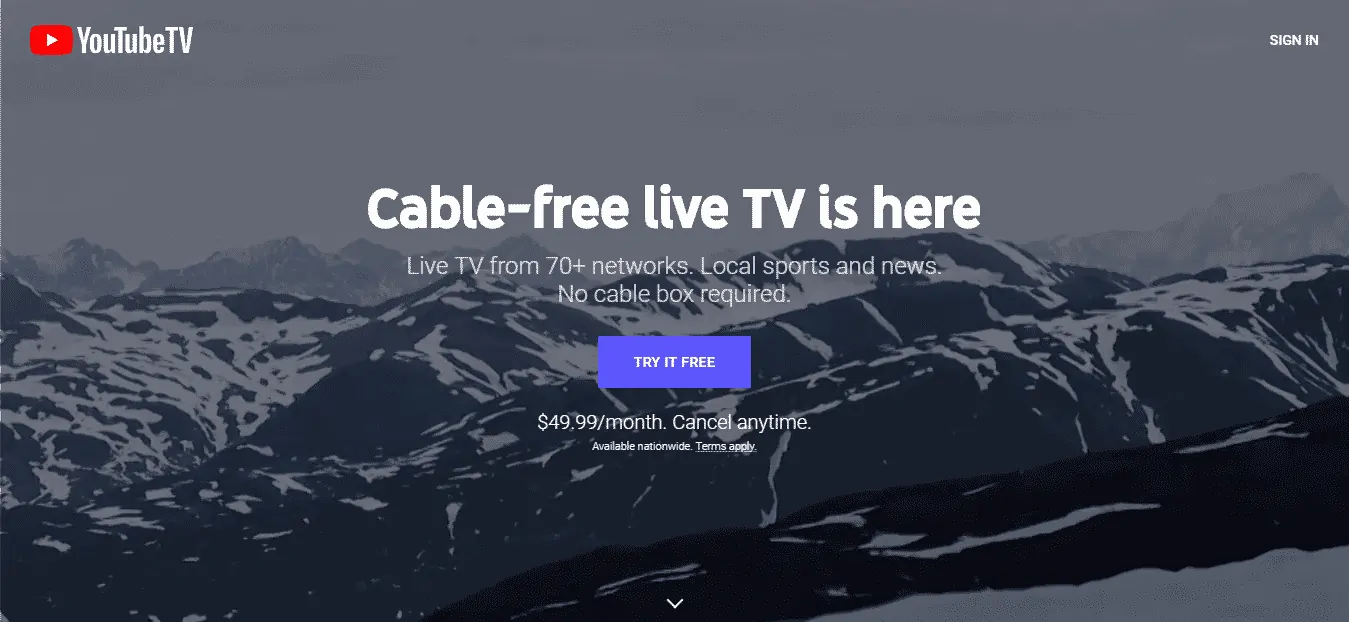
YouTube TV is a US-exclusive live TV streaming service which lets the subscribers watch cable channels like ABC, NBC, FOX, ESPN, Disney, and many more on Youtube. This is a subscription-based service and is expanding at a fast rate.
With more than a billion users, Youtube TV is a great addition to Youtube’s revenue model and is a strong competitor to Hulu. The service is provided at a cost of $49.99/month, comes with 6 different accounts, and let you stream from over 70 networks.
However, there are some premium channels which can be subscribed to after paying certain additional subscription amount. Youtube TV can be streamed on any device and comes with a complimentary Chromecast with every subscription.
Affiliate Earning
You must have noticed related products under some videos on Youtube. These products link to the affiliate partners which pays commission to Youtube if you buy their products.
Go On, Tell Us What You Think!
Did we miss something? Come on! Tell us what you think of this article on Youtube business model | How does Youtube make money? in the comments section.
Hey, I'm Aashish
Each week I share research backed AI oriented content in my newsletter.
There are AI ideas, AI trends, tutorials, and guides.
24k entrepreneurs read it. I'd love you to join.