Why do companies like Facebook, Whatsapp, Instagram, Snapchat, etc rule their respective niches without any fear of their competitors? Or rather, why you don’t want to switch to a different platform than these?
It’s all because of a phenomenon called the Network Effect.
What Is Network Effect?
The network effect, also known as the network externality or demand-side economies of scale, states that a good or service becomes more valuable when more people use it.
Precisely, more the usage of the product or the service, more is its value. The phenomenon might seem simple intuitively, but there’s more to it than you might think. The network effect works in a particular manner and is a powerful tool for certain growing businesses.
How Does The Network Effect Work?
The network effect derives its economic value from two sources –
Inherent Value: The value derived by the user from using the product.
Network value: The value derived by the user from the network using the product.
To achieve network effect, the business has to focus on both – inherent value to get the initial users, and network value to increase its value.
The inherent value is important as the network effect becomes significant after only when the service has a certain percentage of subscribers on board. This certain percentage is called the critical mass.
Once this critical point has been achieved, the network value kicks in — the value obtained from the offering by the user is greater than or equal to the price he paid for it.
This works in a positive loop.
Every user which joins the network increases its value, which in turn, attracts more users, increasing the value of the network even more.
It can scale very rapidly.
The key to making this system work is not to focus on what happens after the loop has begun but before it. After the network effect starts working its magic, there’s not much needed to get more users. The challenge lies in getting users to join in before the critical mass is hit.
Some companies rely on extrinsic motivation, like a payment to join or refer, a fee waiver (like WhatsApp), or a request for friends to sign up (like Snapchat).
For some, even the sustainable method works well wherein their offering is valuable and disruptive enough, if not for all, at least for early adopters to start using. This is more efficient and effective as the product works for itself and it provides good fruit later on in the business. Then, as the number of users increases, it will get a wider user base.
However, caution must be taken to issues like congestion or saturation. As the network effect scales, the network itself can get overloaded. This will stop the uptake. Congestion is caused by overuse.
Before the congestion point, every added user adds value to the network. But after the congestion point, every other user decreases the value of the network. Take the telephone network for example. As the user base is below the congestion point, every user adds value to another user. But, if too many people join the system, the system can get overloaded and the network will reach saturation. Practically, this would lead to busy signals, poor customer service, etc. From here on, the positive effect of the network effect stops working and a negative one begins. The next critical point is where the value obtained again equals the price paid. The system needs to be enlarged or it will crash.
Types Of Network Effect
A network effect business model can be formed in many ways. Not all of them work the same way and they even create different results. These are the types of network effect business models that exist:
Direct Network Effect
Also called the same-side network effect, the direct network effect is a phenomenon where an increase in usage leads to a direct increase in the value of the offering.
The telephone network is a good example – the more people have phones, the more valuable it becomes. Another example is online games which become more valuable with more participation of gamers.
Indirect Network Effect
Also called the cross-side network effect, the indirect network effect is a phenomenon where an increased usage of one product leads to an increased value of a complementary product or the network, which in turn, adds value to the original product.
Examples of the indirect network effect are operating systems like Windows and Android. The increased usage of these OS increases the value of the applications made to run on these platforms, which in turn, increases the value of these operating systems.
Two-Sided Network Effect
The two-sided network effect is a phenomenon that occurs in a two-sided market and exhibits the properties of both the same-side and cross-side network effects.
A two-sided market has two distinct user groups. Take Amazon for example. The company is a middleman that connects sellers to buyers and vice-versa. Such companies experience a two-sided network effect.
With an increase number of buyers, the sellers increase resulting in a positive cross-side network effect. But with an increased number of sellers, the competition becomes severe, thus resulting in a negative same-side network effect.
It’s the same with Uber and Airbnb as well. With the increased number of buyers, the business partners increase but with the increased number of business partners, the competition increases, and some partners drop out.
Network Effect Examples
Facebook
The reason Facebook rose to the top and is still at the top is because it understood the importance of network effect for the business.
The platform provided a high intrinsic value to the users who wanted something smoother than Myspace, Orkut, and other other complicated and heavy social media platforms.
Once on board, the users did the rest. They referred their network to try the platform because of the Facebook’s intrinsic business model which promoted better experience with more users on board.
As the years passed, many competitions came to the market but Facebook’s position was untouched because no other company today has as big a network as Facebook. Users are hesitant to try a new network as they think their network won’t get to a new network as it is already comfortable with Facebook.
The company also makes sure that it adds any new feature that’s in the market to its platform so as to not even let its users try the new platform.
I think that network effects shouldn’t be underestimated with what we do as well.
– Mark Zuckerberg
WhatsApp
WhatsApp, even though started as a status application, soon became the number one internet messaging application surpassing Facebook Messenger. The company invited the critical mass by acting as a great alternative to the then famous SMS messaging, and waiving off its joining fee.
This free alternative saved a lot of costs of the users which made them refer others on it automatically. Once on board, the network effect kicked in which proved to be a shield of WhatsApp against any competitor that tried to copy its business model.
Bottom-Line?
The network effect is a really powerful technique for a successful business. All the great entrepreneurs that used this in their business strategies scaled to unimaginable heights. In this generation, where almost everything is dependent on technology and media, using the network effect is rather simple and genius. All you require is to have the next big idea, and with this effect in your favour, you too can become the next big success story.
Go On, Tell Us What You Think!
Did we miss something? Come on! Tell us what you think about our article on Network Effect in the comments section.
Getting a business idea is easy. But converting that idea into a full-fledged business that makes money is the hard part.
Most businesses fail because they cannot make their business model profitable or sustainable in the long run.
This is where the business model canvas comes in.
It is powerful business ideation, modelling, and strategic planning tool that helps you identify how your business will operate and make money. It can be used to manage your existing business. Startup founders can also use it to validate their business idea and minimise the risk of failure before they start their business.
What Is Business Model Canvas?
A business model canvas (BMC) is a strategic management template used to organise and visualise the key elements that go into making a business model work.
In simple terms, it’s a template you fill to visualise –
Who is your customer?
What value do you provide to your customer?
How does your business provide value?
How does your business operate?
How does your business make money?
Technically –
The business model canvas is a conceptual structure that supports the viability of the business and explains who the business serves to, what it offers, how it offers it, and how it achieves its goals.
It is an important business development and strategy tool that helps you validate your business idea before spending too much time and effort on it.
Osterwalder’s Business Model Canvas Template
Conceptualised by Professor Alex Osterwalder, the business model canvas is a template used to represent different components of running a business.
Originally published in a business model design book, entrepreneurs and startups have used the business model canvas to help them visualise a broad overview of their businesses.
The business model canvas template has nine major components (or sections), and each section helps answer questions on what, how, and who of your business operations:
Customer Segments
Value Proposition
Channels
Customer Relationships
Revenue Streams
Key Resources
Key Activities
Key Partners
Cost Structure
To download this business model canvas template right click on the above image and select ‘save image as’ or you can click here to get a printable PDF version of the same.
The Components Of Business Model Canvas
The right side of the business model canvas focuses on the customer, while the left side on the business. Both sides come together with a value proposition in the centre to signify the exchange of value between your business and the customers.
Consider the components of a business model canvas as a shared language that helps you describe your business in a structured way. This shared language makes it easier for anyone to understand how your business works, what are its assumptions and dependencies, etc.
Here are the nine components of a business model canvas:
Customer Segments
For whom do you create value?
Who are your most important customer or consumer groups?
Customer segments are groups of target prospects with similar needs and characteristics. They are identified based on factors such as demographics, psychographic, behavioural patterns, etc.
For example –
All the people who live in a particular area.
All the people with a common characteristic like having a certain age, income, interest in a certain subject, etc.
Your entire business model revolves around your customer. It is therefore very important to understand your customer’s needs and how you are going to provide value for them. This will also help you identify your key segments –
What groups of customers are most critical to the success of your business?
What are their needs, wants, and the value they place on the benefits you are offering.
For example –
People living in a particular geographical location (customer segment) will have different needs and wants than people living in another part of the country.
If your target market is women with a high income, your value proposition, marketing and positioning strategy, etc. will be very different from that of a middle-class customer.
Value Proposition
What solution are you providing to the customer problems you have identified in your customer segments?
How does your offering make your customer’s life easier?
What is the value that your customers receive from your offering?
The value proposition is the essence of the customer benefits you offer through your product or service.
It is the main reason customers will buy your product over the competitors’.
Consider it to be the promise of tangible benefits that your customers will receive from consuming or experiencing the offering.
For example –
Starbucks offers an experience in the form of a coffee-shop ambience that allows customers to enjoy premium coffee. Customers buy Starbucks because it helps them relax, socialise, and have quality time in their hectic life.
The value proposition is significant in mapping out your business model canvas because it helps you understand your company’s competitive advantage – what makes your company stand out from the competitors in the eyes of the customers.
Channels
What marketing, distribution, and sales channels do you use to reach your customer segments?
Do you serve customers directly, sell through distributors or retailers, etc.?
Channels refer to the path a business takes to communicate with and provide its offering to the end consumer.
They include marketing, distribution, and sales channels.
If you run a small coffee shop near a college campus, the best way to reach out to students and prospective customers would be through word of mouth and social media. Your distribution and sales channels may include dine-in, takeaway, UberEats, etc.
However, if you open a coffee cart at a busy place in the city, your distribution channels would be different. You will have to focus on outlets that are frequented by office goers or working professionals – perhaps even vending machines or company canteens.
Customer Relationships
What relationships do your customer segments expect you to have with them?
How do you establish such relationships?
What’s your strategy to get, keep, and grow your customer base?
Customer relationships define the degree of intimacy or intensity of engagement between the brand and the customer, including purchase frequency, loyalty, etc.
For example –
Starbucks forms strong customer relationships by directly communicating with its customers through e-mails. They also offer rewards for frequent customers in the form of free coffee, discounts, etc.
Customer relationships are critical to the success of your business because you will be providing value for your customers through these relationships. When done right, customer relationships can lead to customer referrals and word-of-mouth marketing that is free for you.
Revenue Streams
What are the sources of revenue in your business model?
How much do customers pay for your offering?
What revenue streams contribute to what percentage of total revenue?
Revenue streams refer to how a company generates revenues from its business model.
In other words, it is the way a company makes money through its offering. It includes both primary and secondary incomes.
Primary income is derived from customers who buy your offering. Secondary income comes from other non-core sources.
For example – Starbucks brings in its primary income through regular customers who specifically choose Starbucks over the competition because of their value proposition and customer experience. Their secondary revenue source includes selling coffee beans or merchandise on their online store, etc.
Key Activities
What activities does your business need to perform to operate successfully?
What activities does your value proposition require you to perform?
Key activities refer to those activities that help you deliver your value proposition. Planning, organising, staffing, controlling, etc., these activities will keep your business running efficiently.
They are the most important activities that enable your business to run smoothly and provide its value proposition.
For example – Coffee-shop’s key activities would include roasting coffee beans, brewing coffee, managing servers, taking orders, delivering the order to the customer.
For a PC manufacturer, key activities would be designing PCs, sourcing PC components, manufacturing products, offering after-sales services, etc.
Key Resources
What do you need to have to produce your offering?
How will you create, deliver, and distribute the offering to your customers?
Key resources are the most important inputs required to create and deliver the promised value proposition, leverage different channels, maintain relationships with the customers, and earn revenue.
It includes elements like
Human resources
Property and equipment
Raw material
Intellectual property, etc.
For example, to run a coffee shop, you will require human resources in the form of Baristas who can prepare delicious coffee, skilled management to manage the operations, etc. You will need property and equipment such as coffee machines, tables and chairs in the shop for people to sit and enjoy their coffee, etc.
Key Partners
Which external organisations and individuals enable your business to offer and deliver the value proposition?
If you don’t perform these activities yourself, who does?
Key partners refer to those organisations and people who play an important part in supporting you in creating and delivering the promised value proposition.
These are alliances with third parties who bring their unique resources, skills or assets to complement yours, which in turn, helps you –
Optimise your business model
Acquire better resources
Reduce costs
Reduce risks
Gain access to new markets
For example – Lenovo doesn’t create its own processors. Instead, it partners with Intel to use its microprocessor.
Similarly, a coffee shop may partner with a bakery that can supply them with baked goods on demand.
Cost Structure
What are the costs required for your business to operate?
How much has each cost contributed to bringing in revenue?
A company’s cost structure highlights its operating expenses and how they evolved over time. It shows what percentage of revenues goes to different expenditure items like paying employees, buying raw materials, etc.
The cost structure basically summarises a company’s expenses in a particular time period. You calculate it after defining all the other business model canvas elements.
For example – In a given year, a coffee shop may have operating costs, including rent, salary for employees, cost of equipment, etc., amounting to $1,000,000. Their revenue in the same year is $3,000,000. This means that their net income after operating expenses is $2,000,000.
The Importance Of Business Model Canvas
The business model canvas (BMC) is considered an effective strategic tool to develop or modify existing businesses. It helps you to clearly see all the elements of your business model and analyse them for big areas of opportunity.
A clear understanding of what, how and for whom your business will create value is invaluable in making key decisions related to operations, revenue generation, distribution channels, etc.
Here’s why you should always develop a business model canvas for your business –
Allows you to visualise the different parts of the business model, which is difficult otherwise.
Enables detailed analysis of all elements that give rise to value creation – the key resources, key activities, key partnerships, etc.
Helps you identify and segregate value-adding and non-value-adding activities, which in turn helps you cut down on unnecessary costs.
Provides a clear picture of your business’s revenue model, which helps you identify key revenue drivers and areas that require more focus.
Provides an understanding of the channels you can use to distribute your products or services.
Helps you identify gaps in operations, areas where there is scope for improvement etc.
Helps you identify all possible risks associated with the business model – both external and internal.
Gives a clear answer to what matters most when it comes to your business – what your business is, how it operates and makes money, who are the key partners to collaborate with, what are the costs involved, etc.
Business Model Canvas Examples
We shall present some examples of Osterwalder’s Business Model Canvas in the following section.
Google
Linkedin
Facebook
Banks
Bottom-Line?
A Business Model Canvas Is More Than Just An Infographic
Many individuals think of a business model canvas as just another marketing tool or infographic to help present their idea in a more attractive way.
But it’s not just that. It actually helps you gain a comprehensive view of your business.
The objective of creating a business model is to have complete clarity on how your business will create, deliver and capture value. The more clearly you are able to identify, describe and visualise all the elements involved, the better it is for your overall business.
It becomes easier for you to understand the different elements of your business and identify areas where you can improve, innovate or add more value.
The Startup Process
We know how important your dream business is to you. Therefore, we’ve come up with an all in one guide: The Startup Process to help you turn your vision into reality.
But before we move on to the guide on how to register a company/business, let us first discuss the different types of companies a new business can be registered as.
Different Types of Companies
Companies can be classified into different types based on their mode of incorporation, liability of the members, and number of the members. The most common types of companies are:
Royal Chartered Companies
Statutory Companies
Registered or Incorporated Companies
Companies Limited By Shares
Companies Limited By Guarantee
Unlimited Companies
Public Company (or Public Limited Company)
Private Company (or Private Limited Company)
One Person Company
Types Of Companies Based On The Mode of Incorporation
Companies can be classified into three types based on whether they are created by a special act, special order, or are registered just like any normal company.
Royal Chartered Companies
Royal Chartered Companies are companies created by the Royal Charter. This means they are granted power or a right by the monarch or by special order of a king or a queen. Examples of Royal Chartered Companies are East India Company, BBC, Bank Of England, etc.
Statutory Companies
Statutory Companies are companies incorporated by means of a special act passed by the central or state legislature. They are mostly invested with compulsory powers and are responsible to carry out some special business of national importance. Some examples of statutory companies are The Reserve Bank of India (formed under RBI act, 1934), Life Insurance Corporation of India (formed under LIC Act, 1956).
Registered Or Incorporated Companies
All the other companies which are incorporated under the companies act passed by the government comes under this head. These companies come under existence only after they register themselves under the act and the certificate of incorporation is passed by the Registrar of companies. Google India Pvt Ltd is an example of incorporated companies.
Types Of Companies Based On The Number Of Members
Public Limited Company
The legal existence of a public limited company is separate from its members (shareholders) and the liability of its members is also limited. Its existence is thus not affected by the retirement or death of its shareholders. A minimum of 7 members is needed to form a Public Limited Company but there is no maximum limit on this. The company collects its capital by the sale of its shares to the shareholders. The shareholders of a company do not have the right to participate in the day-to-day management of the company, thus separating ownership from management. All the major decisions of the company are taken by the Board of Directors.
Private Limited Company
Private Limited (Pvt Ltd) companies have more than 2 and less than 200 members. Unlike Public Limited Companies, the transfer of shares of a Private Limited Company is limited to its members and the general public cannot subscribe to its shares and debentures.
Pvt Ltd companies are exempted from many rules and regulations which are applicable to Public Limited companies, for example, the need to file a prospectus with the Registrar, the need to hold the statutory general meeting or maintain annual reports etc. Also, it can start operations after receiving just the certificate of incorporation, whereas a Public Limited company needs a certificate of commencement as well. It is a great option if you want the advantages of limited liability and yet want greater control over your business and maintain its privacy. This is the most popular type of company for start-ups to be registered as.
One Person Company
One Person Company (OPC) as a company type was introduced in the Companies Act of 2013 in India. It is similar to a sole proprietorship but the owner shall have limited liability and thus his personal assets would not be at risk if losses need to be recovered or if the company is liquidated.
Types Of Companies Based On The Liability Of The Members
In case of liquidation, the members of a company can either be liable to pay even from their personal assets or to the extent of the face value of shares held by them. It all depends on how the company is registered as. Companies can be classified into three types based on the liability of the members. These are –
Companies Limited By Shares
The liability of the shareholders is limited to the extent of the face value of shares held by them. Most Pvt Ltd companies are of this type.
Companies Limited By Guarantee
In these companies, in case of liquidation, the shareholders promise to pay a certain fixed amount to cover the liabilities of the company.
Unlimited Companies
There is no limit on the liability of the shareholders. In case of liquidation, they might have to pay even from their personal assets to cover the liabilities of the company. This type of company is quite uncommon today due to obvious reasons.
There are a lot of options to choose from when you plan to register your startup. Make sure you research the pros and cons of each and register your firm accordingly. Now that you know about different types of companies, let’s move on to the guide on how to register your company.
The Startup Process
We know how important your dream business is to you. Therefore, we’ve come up with an all in one guide: The Startup Process to help you turn your vision into reality.
Now that you have got a thorough understanding of the types of companies, it’s time to give a legal structure and identity to your business model. In this section, we’ll be focusing on how to register a company in various countries.
Registering a company might seem a tricky affair but we are here to address all your concerns and answer all the frequently asked questions you might have about registering a company in this comprehensive guide.
How to Register a Company in India?
Steps of Setting Up a Business in India
Get Director Identification Number (DIN) for proposed Directors of the company [It is also advisable for all the directors to have an aadhar card]
Get the Digital Signature Certificate (DSC) for proposed Directors of the company
File the desired name of the company to the Registrar of Companies (ROC) for approval
Get the Memorandum of Association and Articles of Association printed
Fill all incorporation forms/documents and make payment of stamp duties online
Get the certificate of incorporation and also the certificate of commencement, if needed
Acquire a company seal, Permanent Account Number (PAN) and Tax Account Number (TAN)
Register under Shops and Establishment Act
Register for GST and also with EPFO and ESIC
Documents Required for Registration of a Company
For registering a company in India, an application for registration should be submitted to the Registrar of Companies (ROC) with the following documents:
Memorandum of Association
Articles of Association
A declaration signed by a person named in the articles of the proposed company as a director, manager, or secretary of the company, or by an advocate of the Supreme Court or High Court, or by an attorney entitled to appear before the High Court, or by a chartered accountant practicing in India stating that all the requirements of the Companies Act 1956 and the applicable rules with respect to the registration and other matters have been complied with
A list of persons who have consented to act as Directors of the company.
A prescribed form with information about directors, managing directors and managers and secretary
A prescribed form with registered office information
Power of attorney in favour of one of the promoters or any other person, authorizing him/her to make corrections in the documents submitted to the ROC, if it becomes necessary
Applicable registration fee payable to the ROC
How to Register a Company in the United States (USA)?
You do not have to be a US citizen or a green-card holder to start a business in the US. We shall be listing the steps for registering a Limited Liability Company (LLC) in the USA.
Select a location according to your business requirements. For non-US citizens looking to do business from their home country, Delaware, Wyoming and Nevada are good locations. Your legal company address shall act as your registered agent address if it is in the same state that the company was started and you are present during normal business hours (9 am – 5pm), else there are registered agent services to help you take care of this.
Decide on a name for the company
File the Articles of Organization with the state in which intend to set up your company
Draft an Operating Agreement
Obtain an EIN (Employee Identification Number) so that you can open a bank account, accept payments and pay taxes. You do not need to have a physical address in the US to open a bank account. A non-US resident is taxed on US source income only while a US resident is taxed on income from all over the world.
Obtain the business licenses and permits
Hire employees for the company as per your requirements
Get necessary insurance cover for the company
How to Register a Company in the United Kingdom (UK)?
You would need a physical address in the UK for your office. This address hall appear on the company records.
Choose a Standard Industrial Classification of Economic Activities (SIC) code that will state what your business does
Decide on the details of the share capital to be created and also on the details of the company director and secretary
Prepare Memorandum and Articles of Association
File the incorporation of the company with the Companies House and wait for it to be approved. This can be done online. The Companies House charges 12 pounds to register a company online.
Hold the company’s first board meeting, set up and maintain company registers and produce share certificates for the first shareholders
Set up a bank account, register for VAT with HMRC and also register and set up PAYE for employees
How to Register a Company in China?
China has more rules and regulations than most countries. So the first step should be to research as much as possible on the government policies, the industry you are looking to enter and the companies already operating in that space.
Select a major business or industrial centre, like Shanghai or Beijing as your company location and set up an office there. You need proof of a lease to register your business. Location also depends on your budget, transportation and logistics needs and the applicable government rules.
Decide on the name of the company and what type of business entity you would want to register as. There are joint ventures, representative offices, wholly foreign owned enterprises (WFOE) etc. for foreign companies. WFOE is the most popular option and in most cases is an LLC, though it requires investment in a Chinese bank and also is subject to more government regulations.
Ground reality in China is different from what is written in the law book. The application process and documents vary from city to city and depends on who you are dealing with. You can find the exhaustive list of documents needed to register a company in China here.
You would need an approval certificate and business license. Approvals are needed from the Ministry of Commerce (MOFCOM) and State Administration of Industry and Commerce (SAIC) and sometimes from the National Development and Reform Commission (NDRC) too. It takes around 90 days to get these approvals.
Once you get the approval certificate, you need to apply for the business license with the AIC within 30 days.
IP violations are a big issue in China. Getting your trademarks in China are equally important as getting them in your home country.
Open an account in a bank in China like HSBC or Bank of China, especially if your company is a WFOE and deposit the registered capital.
Get approval from the Public Security Bureau (PSB)
Register with the Tax Bureau, Customs Office and State Administration of Foreign Exchange (SAFE)
Hire an accountant, as maintaining the account books is mandatory in China
As you can see the registration procedure remains more or less similar in all the countries. These steps vary with the country and whether you are a citizen or a foreigner. Once you have registered, you are ready to do business and execute everything you had in your mind or on paper. Recruiting the right people is the biggest and most important while setting up a company. Now that you have registered your company name, it is time to manage expectations and build relationships.
The Startup Process
We know how important your dream business is to you. Therefore, we’ve come up with an all in one guide: The Startup Process to help you turn your vision into reality.
To imagine a way to connect with friends and other people without social networking is almost impossible. Social networking has helped us get closer to our friends and other people throughout the world, even if they are miles away from us. Social networking is a billion dollar industry and I doubt most of us even remember when it did start.
The First Social Networking Site, Geocities, was created in 1994, allowing users to create and customize their own websites. Since then this industry has only grown.
In today’s generation of a fast-growing user base for various social networking platforms, the competition for such websites has become really intense. Among these is Tumblr, a combination of a microblogging and social networking website that is working its way through this tough industry. In early 2017, there were a reported 341 million Tumblr blogs and billion of blog posts. With such huge numbers, you must have got an idea about how good the business model of Tumblr can be. But before moving on to Tumblr Business Modeland how does Tumblr make money? it’s important to discuss and understand what is Tumblr and How does Tumblr work?.
What is Tumblr?
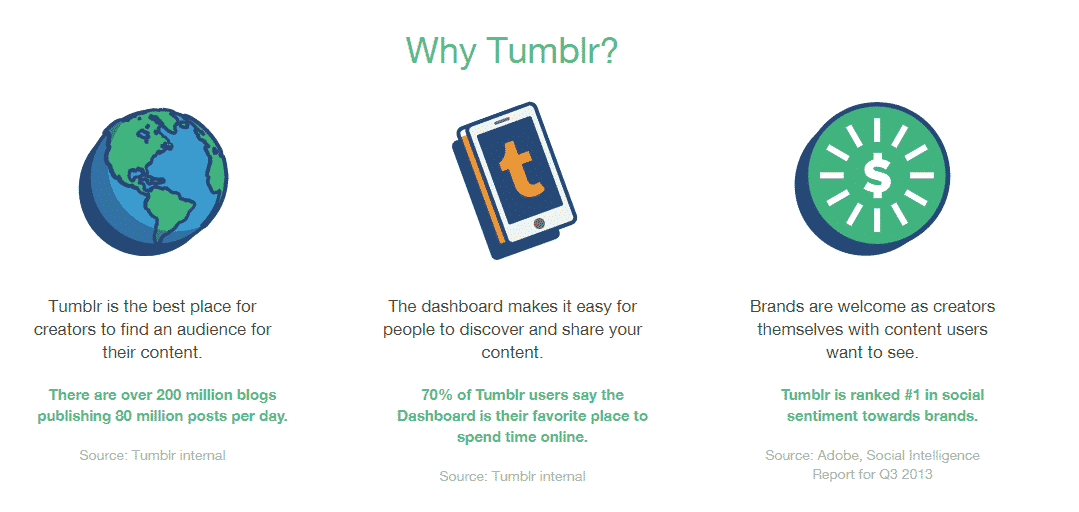
Founded on February 19, 2007, by David Karp, Tumblr is one of the leading blogging, microblogging, and social networking platforms. The inception of Tumblr began in 2006. David was interested in tumblelogs (short-form blogs) and had been eagerly waiting for one of the existing blogging websites to start one of their own. So after waiting for a year, when his expectations failed to pan out, he and developer Marco Arment decided to start their own tumblelogging platform. And so Tumblr was born and within two weeks the service had gained 75,000 users. Tumblr featured its first major brand advertising campaign in conjunction with Adidas in June 2012. On June 20, 2013, Tumblr was acquired by Yahoo! Inc. for USD$1.1 billion in cash; David Karp remained CEO. It is now under the parent company Verizon, which acquired Yahoo in 2016. Tumblr, as of August 1, 2017, hosts over 359 million blogs and more than 151.4 billion posts and over 35.3 million posts were created on the site each day.
How does Tumblr work?
Tumblr is one of the best places for creators to find an audience for their content. Tumblr operating model is similar to other social networking websites where users can create their own blogs and can follow, reblog, like and comment on other users’ blog and posts.
However, Tumblr business model offers its users a number of various other features which distinguish it from other social networking websites and gives them a chance to be as creative as they can to enhance their blogs. It uses a “dashboard” type interface for its bloggers which falls really convenient. The dashboard is the main page for a Tumblr user. It works as a live feed of all the blogs they follow. From this dashboard itself, users can like, comment, reblog other posts and share them on their Twitter and Facebook accounts.
Bloggers have an option to make their blogs private. They schedule their posts by delaying them over many hours or even days. There are Tags, which users can use, to find a topic of specific interest. Another interesting feature that most other popular social networking platforms don’t allow its users is to use HTML coding to change the look and appearance of their blogs. Users can also use a custom domain name for their blog. Moreover, the blogs optionally provide its users to submit questions to it, anonymously or as themselves, so that they can get a response.
A “fan mail” function, allowing users to send messages to blogs that they follow was introduced. On November 10, 2015, Tumblr announced an instant messaging function through which users can send messages to other users. Tumblr provides an app for its mobile users across IOS, Android, Blackberry and Windows platforms. An app for Google Glass was released in 2013 as well.
How Does Tumblr Make Money?
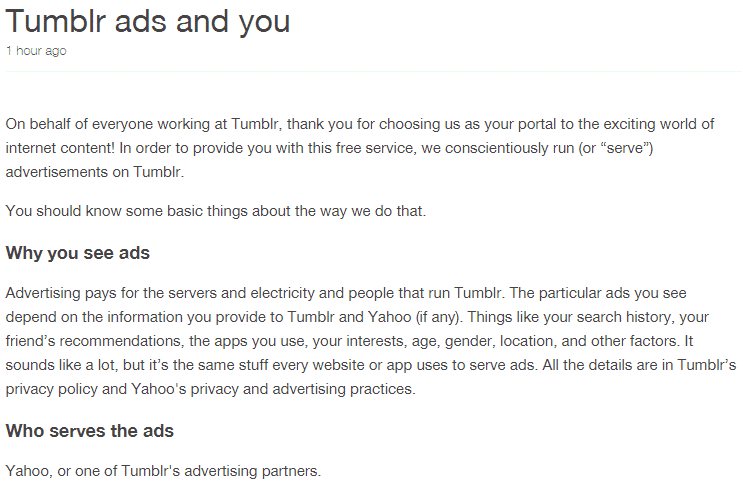
The platform has a vast user base; it is growing more and more every year. But the revenue model of Tumblr has been the same since the start. Tumblr makes money through advertisements.
Targeted advertisements
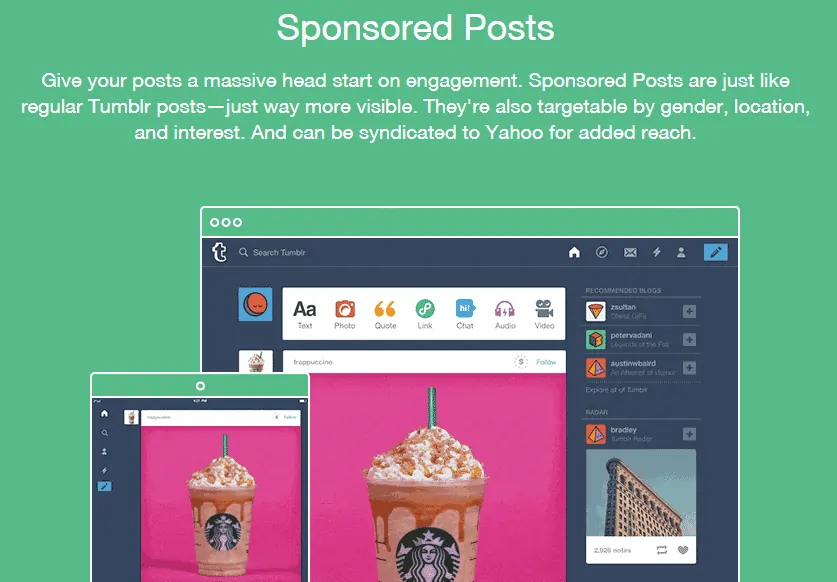
Just like other social media platforms with huge user base, Tumblr makes money through targeted advertisements. Since Tumblr place advertisements in the user dashboard, the company likes to call it sponsored post.
Tumblr’s sponsored posts are similar to their normal ones, other than the fact that they are highly targeted. For example, a sports company might place an ad that is mainly targeted to young adults who follow sports blogs and related ones. This ensures that the ad would be seen by maximum relevant audiences and thus it won’t be ignored easily. These type of advertisements are called in-stream ads. It is almost indistinguishable from a regular post and people are more likely to click on it as compared to a sidebar ad. Sponsored posts also have them located at the side—like traditional ads, and chances are the post might appear on Yahoo’s front page.
Sponsored Apps
Tumblr started displaying another form of ads called Tumblr Sponsored Apps. Just like sponsored posts, these too will be highly targeted according to people’s choices and the blogs they follow. However, the Sponsored App ads are available for a wider range of posts. The ads are for games and other mobile apps. This works like this: when a user clicks on such an ad, he is taken to the Apple app store or Google Play store or any other relevant platform, through which the user can download the app. Tumblr’s Spotlight is for bringing sponsored content to the front of the website. Tumblr says, “Spotlight drives tens of millions of followers each week.” It is another way by which Tumblr is promoting ads in a new way of displaying them to its users. David Karp still told AdAge that he would rather sell the company’s desks than put regular ads in the site.
Sponsored Day
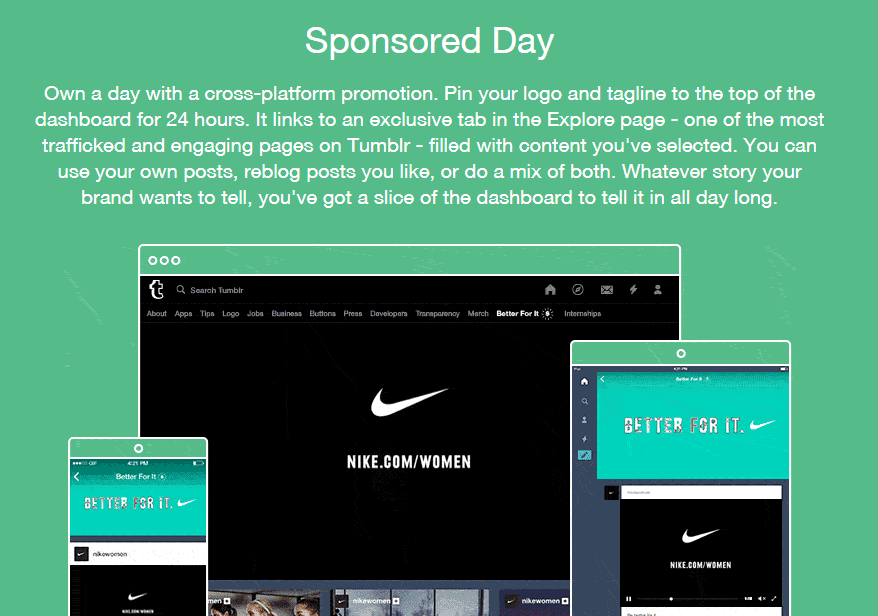
The biggest form of advertising on Tumblr is the Sponsored Day advertising where brands can own the day at Tumblr by buying a cross-platform exclusive promotion on Tumblr. The brand gets featured on the homepage, the dashboard, as well as get an exclusive tab on the explore page filled with the selected content.
This type of advertising can be compared to that of Snapchat’s and suits best for any brand looking for building its brand equity.
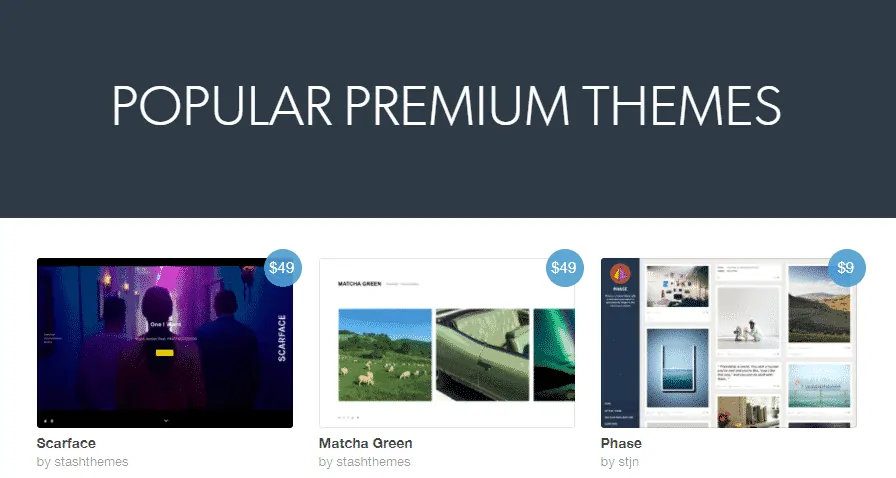
Another way by which Tumblr earns a revenue is by hosting a market place through which users can buy and sell premium themes for their blogs. Today, this has become widely demanded as people understand the growing importance of a good looking blog and the attraction it can create.
Promoted Posts
Tumblr also gives their users an option to promote their post. A user has to pay $1 and their post would be highlighted on the dashboard of their followers. “Every now and then, a post comes along that’s meant for big things,” explained David Karp. This feature was created precisely for this purpose, apart from generating another source of income. Tumblr also has preferred data partners that have direct access to the firehose to give brands and agencies an in-depth understanding of what’s happening across the network. This helps brands to track what is actually the impact of their posts on their users. This encourages them to put out more ads and increase their sponsorship.
Is Tumblr Profitable?
According to John Matthews, managing director of investment bank DeSilva+Phillips :
“Yahoo was making a speculative bet on future revenues that could, in theory, be achieved by tapping into the ‘millennial’ audience early. Yet Tumblr wasn’t designed by its founder David Karp to really be an ad-monetization platform.”
According to a Tumblr executive who left the company lately:
“Nobody at Yahoo ever understood what they bought and what Tumblr was. That fundamental issue is the core of lots of problems. If you don’t understand something, how can you sell it?”
Yahoo set some unrealistic revenue goals for Tumblr which the company failed to meet. There was a difference between the opinions of the two heads; Mayer and Karp. Some analysts consider Tumblr to an inconsequential part of Yahoo’s business. As we seen Tumblr’s main source of income is ads—just like Facebook and Twitter. But it cannot ask for a price that these social networking giants ask for. Its user base is also much less as compared to these websites (Tumblr’s users are counted in a far less specific way than Facebook and Twitter users). This makes it harder to Target ads. Also, users who log in with an email address do not have to provide information that is useful for targeting ads—information that Facebook asks for.
The revenue of Tumblr is too small when compared to its purchasing price. This is also a growing concern for investors and is not a good sign for the future of the company. Although Tumblr is an excellent platform for bloggers to put out their creativity, it must find a way by which it can increase its revenue and user base if it wants to compete with the existing social networking behemoths.
Go On, Tell Us What You Think!
Did we miss something? Come on! Tell us what you think about our article on How does Tumblr make money? | Tumblr Business Model in the comments section.
When it comes to online marketplace, the first name that comes to your mind is Amazon. Amazon surely is a big e-commerce company, but there is another upcoming e-commerce company that is about to (and has already started to) take over the internet marketplace. It is a China-based company whose founder was rejected by KFC. He is now the richest man in China. This e-commerce giant is none other than Alibaba.
With one of the most successful business models in the world, this company is on to take on the online marketplace globally. But how does Alibaba make money? What is Alibaba’s business model? Let us understand more about the company before we move onto discuss Alibaba Business Model.
What is Alibaba?
Alibaba Group was founded by Jack Ma along with 17 other co-founders in 1999 with the website Alibaba.com, a business-to-business portal with an aim to connect Chinese manufacturers with international buyers.
Today, Alibaba Group Holding Limited is one of the biggest companies in China that provides consumer-to-consumer, business-to-consumer and business-to-business sales and various other services via e-commerce web as well as offline portals. The major revenue earning services include electronic payment services, marketplace, and data-centric cloud computing.
The name Alibaba came from the character Ali Baba from the Persian literature One Thousand and One Nights because of its universal appeal. According to Jack:
People from India, people from Germany, people from Tokyo and China, they all knew about Alibaba. Alibaba – open sesame. Alibaba is a kind, smart business person, and he helped the village. So … easy to spell, and globally known. Alibaba opens sesame for small- to medium-sized companies.
Alibaba Business Model
Alibaba has come a long way since its beginning in 1999. As of April 2016, It is the world’s largest retailer surpassing Walmart, with operations in over 200 countries. But what exactly is Alibaba Business Model? How did it manage to gain such success? For that let us first understand how does Alibaba work and what all businesses does it own.
How Does Alibaba Work?
The business model of Alibaba is different from other players like eBay and Amazon. It focused more on trade between businesses. Unlike the usual business-to-consumer approach, Alibaba focuses on being a platform for suppliers to sell products in bulk at wholesale prices to small or medium-sized businesses worldwide, who then resell them for a profit in their domestic markets.
Although Alibaba focuses on business to business trade it also supports other trade through e-commerce web portals. Taobao is for consumers to trade, where as Tmall is for the upcoming middle class of China to purchase branded products. There are many other subsidiaries through which Alibaba makes money.
How Does Alibaba Make Money?
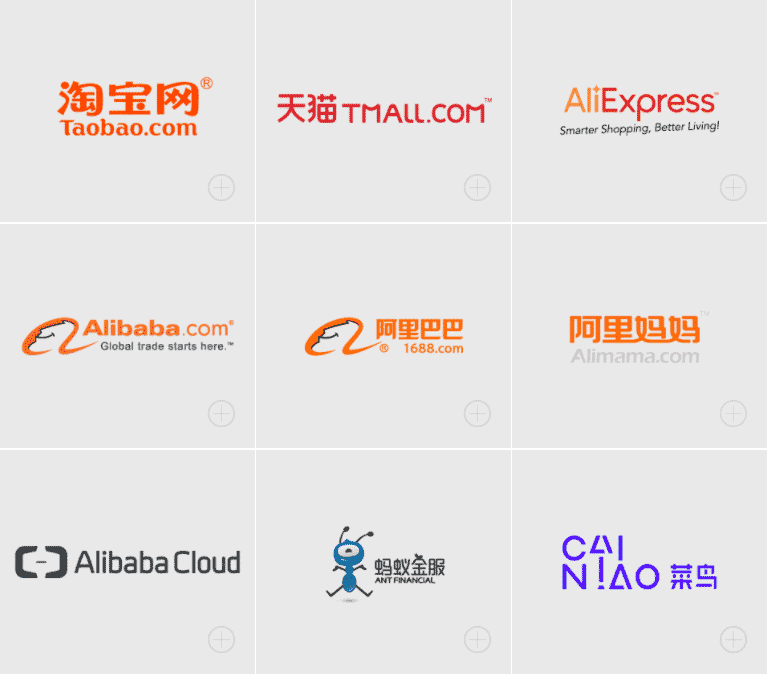
Alibaba’s Busines model is made up of three major web portals: Alibaba.com, Taobao, and Tmall. All of them serve to connect various types of buyers and sellers. However, there are 6 more subsidiaries of Alibaba which include Aliexpress, 1688, Alimama, Alibaba Cloud, Ant Financial, and Cainiao Network. All these subsidiaries are so well integrated that they make the Alibaba group a big ecosystem.
Alibaba Businesses & How Do They Make Money
Alibaba.com
Alibaba.com is the world’s largest online wholesale marketplace for global trade. The website allows exporters in China as well as in other countries to connect with the buyers in over 200 countries. The buyers usually constitute trade agents, wholesalers, retailers, manufacturers, and SMEs engaged in the import and export business.
The company also offers other import /export supply chain services which include
custom clearance,
VAT refund,
trade financing, and
logistic services.
Sellers can list their products on the website for free. They also have the privilege to pay for certain extra features such as greater exposure on the site and unlimited product listings.
How does Alibaba make money?
Alibaba.com is a marketplace where sellers and buyers meet. The website acts as an intermediary which charges commissions from the sellers of mainland China, Hongkong & Taiwan. However, the revenue isn’t earned just as commissions.
Alibaba offers two types of supplier membership:
Free Supplier Membership
Suppliers on Alibaba do not need to pay anything to list their goods on the online marketplace. They are free to display up to 50 Products online and to get business inquiries. Alibaba only makes money from them in the form of commissions if the money is paid through Ali Pay and the seller is from mainland China, Hongkong & Taiwan
Premium Gold Supplier Membership
There are limitations to being a free supplier member of Alibaba as these suppliers are not verified (reduces buyer’s trust) and are only able to display up to 50 products on the website. The suppliers from China can’t even list themselves as free suppliers and have to buy the premium gold supplier membership plan to start a business on Alibaba.com.
Alibaba Gold Supplier Membership is a premium membership where suppliers pay certain fees (few thousand dollars) to become a verified Gold Supplier.
All Gold Supplier members are required to fulfill necessary requirements for this highest level of membership. They are also required to undergo rigorous authentication and verificationprocedure by third-party credit reporting agencies.
Gold members are also charged commissions as a percentage of the transaction value of goods sold.
Taobao
Taobao means “search for treasure” in Chinese. It was launched on 10th May 2003 under the Alibaba group. This part of Alibaba’s business model facilitates (small) business to consumer and consumer to consumer trade by allowing small businesses and individual entrepreneurs to list their products on their website for sale.
Taobao, the biggest website of Alibaba, is so big and popular that it forced the market leader of the online marketplaces – eBay to shut its business in China in 2006. The website, today, is China’s largest shopping website. It is ranked the ninth most popular website in the world by Alexa.com. Taobao lists hundreds of millions of products and services from millions of sellers (400 million active users).
How does Taobao make money?
There is no transaction fee to conduct trade on Taobao and the merchants can join the site for free. The website functions just like Google which lists the result of the specific keywords and where merchants pay to stand out of all the other players through advertising and other marketing strategies. This was one of the reasons of Taobao’s high user base in China.
The site has a special rating system that reflects how many transactions each seller has successfully completed. Buyers can ask the merchants direct questions through Alibaba Group’s instant messenger software.
Tmall
Taobao, in April 2008, introduced a new B2C platform called Taobao Mall to complement its C2C marketplace. The idea got a whole new identity when Tmall.com was launched in November 2010 and became an independent business in June 2011.
Tmall (Taobao Mall) offers the Chinese consumers a wide range of branded products, mainly for the upcoming middle class of the country. Taobao was more focused on small sellers and individual entrepreneurs, whereas Tmall takes on the responsibility of larger companies (Nike, Apple, etc).
Tmall hosts over 3700 product categories selling to over 500 million active users. The company’s operating model is similar to other well-known e-commerce websites such as Amazon and eBay.
Tmall grants its sellers access to analytic tools that show the number of visitors, page views, and customer ratings. This proves to be helpful to the companies to guide their business decisions.
How does Tmall make money?
Tmall, just like other e-commerce players, makes money through
Commissions as a percentage of the price of good sold (it varies for different categories)
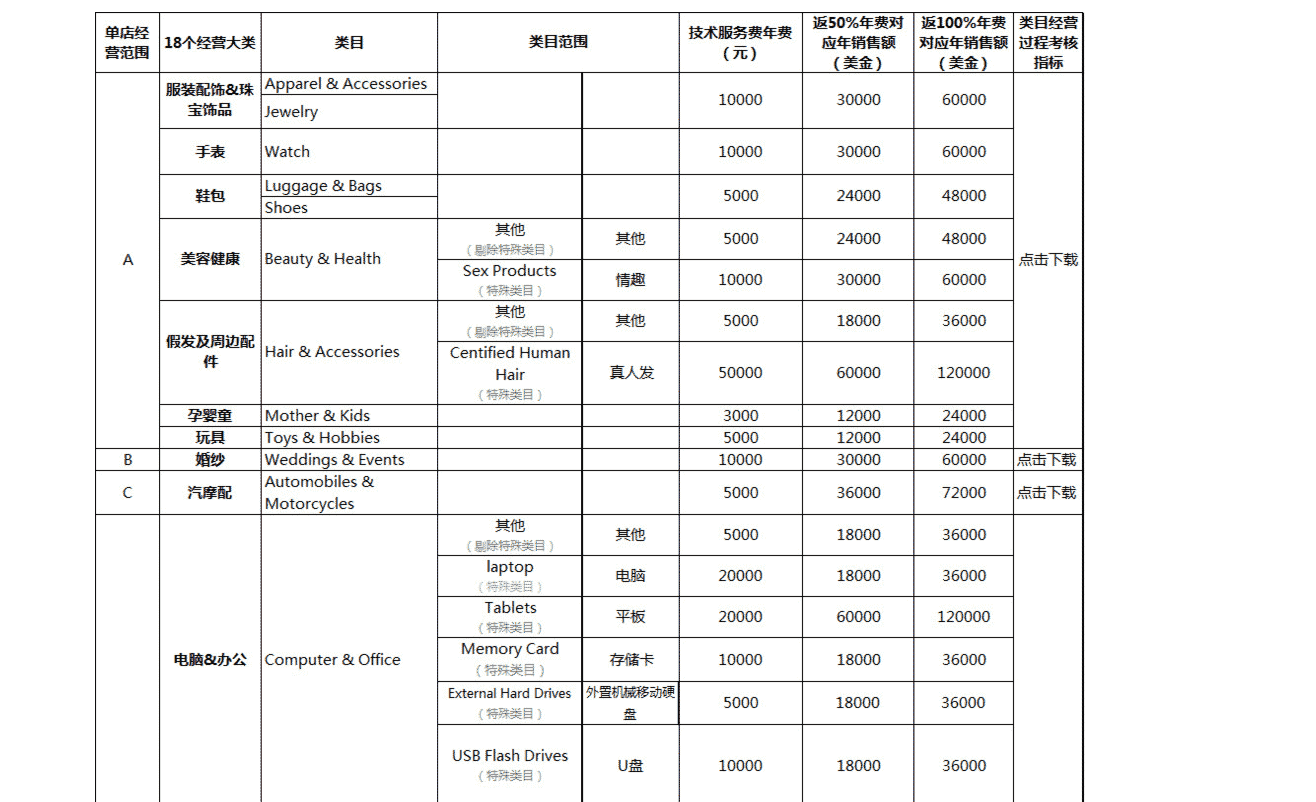
Service fees (one time fixed security deposit and annual technology and service fee)
Marketing services provided to the suppliers
Alimama
Alimama is the biggest open marketing platform in China. It acts like the Adsense in China. This online advertise trade platform for both publisher and advertiser lets advertisers from purchase content-based PPC advertising plan or banner or text link based on cost per impression or cost per time. Simultaneously it helps publishers make money by placing advertisements in their content.
How does Alimama make money?
Just like other marketing platforms, Alimama makes money through advertisers and split the same with affiliate partners.
AliExpress
AliExpress is a global retail marketplace that enables consumers from around the world to buy directly from manufacturers and distributors in China. The difference between Taobao and AliExpress is that Taobao focuses on selling to the Chinese consumers, whereas AliExpress allows consumers from countries like Russia, USA, Spain, Brazil, France, UK, etc, to shop directly from Chinese businesses.
How does Aliexpress make money?
Just like other e-commerce platforms of Alibaba, Aliexpress makes money by charging commissions as a percentage of the transaction value of goods sold. The commission range from 5% to 8% of the transaction value. However, Aliexpress also charges a fixed $1500 + store fee to start or change the store on the platform. This is done to help fight scammers and bad suppliers running away from their 1-star reviews.
Alipay
Alipay is a third-party online payment platform to assist buyers with their transactions. It is an eWallet platform just like Paytm in India which helps shoppers store funds and use the stored funds securely with an ease to transact online and offline.
There are two ways for a shopper to make a payment using AliPay:
The default option is for the shopper to use their mobile device (phone, tablet, and so on) to scan the QR code that appears on the Alipay payment page. This is the most popular payment method, used by the majority of shoppers.
An alternative is for the shopper to log in to the Alipay payment page using their Alipay credentials.
How does AliPay make money?
It doesn’t charge any fee and works through an escrow service. That is, it invests the stored money in a partner bank at a predetermined rate and receives interest on the stored amount.
[the_ad id=”2775″]
1688
1688.com was launched by Alibaba in 2010 primarily for targeting the wholesale business segment within China. The company reportedly hosts more than 500,000 quality suppliers offering over 150 million different types of products. 1688.com caters to individuals and businesses from all around the world and is today the number one website when looking for wholesalers and suppliers in China. Even many Taobao stores get their supplies from 1688.
Since 1688.com was established as a wholesale marketplace to cater users from China, the prices on the website are very low which attract a lot of customers all over the world.
How does 1688 make money?
Listing items on 1688.com is free. However, 1688 makes money from:
(i) TrustPass membership plan fees. This lets sellers host premium storefronts with access to data-analytics applications and upgraded storefront management tools
(ii) Premium services, such as premium data analytics and online marketing services.
Alibaba Cloud
Alibaba Cloud began as a private cloud to serve the internal demands of Alibaba’s e-commerce businesses. It is a global cloud computing company that provides various cloud computing services: elastic computing, object storage, relational database, big data analysis, and artificial intelligence. It operates in eight geographical regions around the globe.
Ant Financial
Ant Financial is the most valuable fin-tech company in the world that brings inclusive financial services to the world. The company operates Alipay, the world’s largest mobile and online payments platform, Yu’e Bao, the world’s largest money-market fund, Ant Fortune, Zhima Credit and MYbank.
Cainiao Network
Cainiao Network is a Logistics data platform operator dedicated to meeting the current and future logistics demands of China’s online and mobile commerce sector. The company has taken a collaborative approach to logistics and aims to realize delivery anywhere in China within 24 hours, and across the globe within 72 hours.
Other businesses
Alibaba is also involved/have stakes in other businesses. Some of them are:
Sina Weibo: China’s version of Twitter,
Youku Tudou: similar to YouTube,
Aliwangwang: an instant messaging service,
Juhuasuan: sales and marketing platform for flash sales for Taobao and Tmall.
Laiwang: a messaging application competing with WeChat.
To conclude
Alibaba is famous for its B2B website, Alibaba.com, that facilitates international trade in China and a few other Asian countries. However, it is not the sole reason for Alibaba’s success. It is really in the game because of its e-commerce within China: Taobao and Tmall. Sales on the Taobao marketplaces make up more than 80% of all online purchases in China. That’s huge.
Alibaba business model is really profitable and scalable and their momentum is ever increasing. They have the advantage for any upfront challenges in new markets.
Go On, Tell Us What You Think!
Did we miss something? Come on! Tell us what you think about our article on Alibaba Business Model | How Does Alibaba Make Money? in the comments section.
Your strategy for making your startup work for you will decide its competitiveness in the market. You would want to gain a sustainable advantage over your competitors and that starts with the right business model.
Now that you know what a business model is and the various types of business models, it’s time to learn what key elements constitute a business model and how to develop a perfectly sustainable business model for your company.
A great business model focuses on creating and delivering great value to the customers while simultaneously delivering great margins. A great business model should also look to avoid customer dissatisfaction or dissonance and funding problems. It should also incorporate plans and methods to achieve and maintain market leadership.
Developing the right business model requires similar efforts as developing the right product. Here’s how you can have an ideal business model:
Size your product’s value in the market
You should match your prices with those of the competitor products. If your product is priced too high, the sales will dip and if too low, the margins will not be high enough for long-term sustainability.
Acquire high-value customers
High-value customers are those customers from whom you gain maximum value while keeping your costs as low as possible. They help you achieve your business targets. You can reach these customers with minimal marketing expenses.
Ensure sufficiently high margins
Keeping manufacturing costs low by either outsourcing the manufacturing or having an improved process helps in keeping higher margins. Your product can have features that provide enhanced value to the customer and thus allow you to charge a premium for it. You can even opt for a low-touch model to reduce manpower costs. There are various ways to make sure that the margins are high enough to sustain the business in the long run.
See if your product is the best solution available
The prototype phase already takes care of how most of the stakeholders feel about your product. You have to see that the pain point you are trying to address is solved by your solution and it is the best at what it does. A lacklustre product cannot be saved even by the best business model.
Ensure customer satisfaction
Acquiring a new customer is far more expensive than keeping an existing customer satisfied. A satisfied customer is also a promoter of the brand. Quality after-sales customer service is one of the ways to ensure customer satisfaction but the associated costs are high and do not bring in any revenue for the company. These costs cannot be avoided but should ideally be either restricted or transferred to a third party.
Decide on the channel and distribution strategy
A great product will not be great if the distribution or marketing is poor. Test all the elements of your channel strategy in detail. An efficient distribution channel keeps margins high.
Maintain market position
A good business model will include plans to make the business sustainable and improve its market position. So it will have to take into account all the growth opportunities and external threats, and incorporate a long-term product roadmap. You do not want to rely on just a few customers for most of your product. You also would not want almost the entire distribution to be controlled by your competition or your competitors to be better funded than you. Technology is rapidly evolving making new product development risky but you would not want to be left behind too. You have to consider all such factors and decide how you plan to maintain and then continuously improve your
Formulate funding strategy
Your long-term sustainability depends on funding your business. By funding, we are not referring to only funding by investors. Your company can be bootstrapped yet it will require a constant flow of funds to sustain itself. Personnel costs, operating capital and various other overheads are required to be borne by any business, not just a start-up. Start-ups require even more funding as most of them have to spend significantly more on customer acquisition and retention than established businesses. You would want your revenues to take care of all of these. Ideally, your initial funding rounds should allow you to multiply your sales manifold so that external funding is no longer required.
Execute a pilot rollout
A pilot limited rollout is a great opportunity for you to test everything associated with your product, from costs to quality to pricing. It is a low-risk, high-speed way for fine-tuning pricing and channel strategy before the final launch.
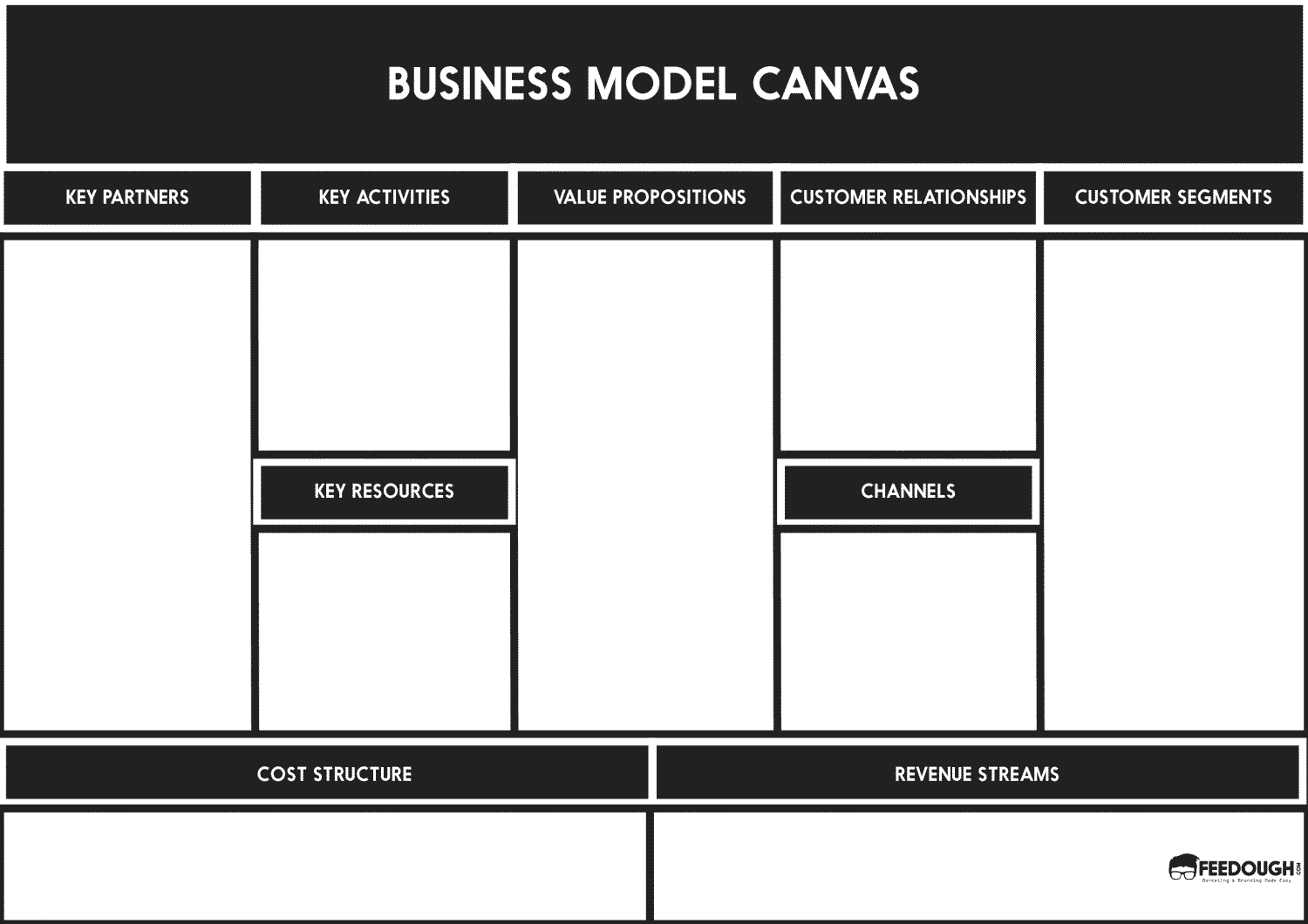
Alexander Osterwalder, the founder of Strategyzer, has developed perhaps the most comprehensive template for business models, called the Business Model Canvas. After you are done with the above steps, you would be in a position to fill the Business Model Canvas and decide on the entry or growth strategy. Let us dive into its details.
Business Model Canvas
Giants like P&G, GE, Nestlé etc. use the Business Model Canvas to discuss their existing and new businesses in a structured and tangible manner. While new companies use it to search for the right business model, established businesses use it to manage their strategy and create new growth avenues.
For whom are you creating value? What products and services are you offering to each customer segment?
Value Propositions
What value are you going to deliver to the customer? Which customer pain-points are you addressing?
Channels
Which channels are to be focused on to reach the desired customer segments? How are those channels integrated? Which ones are the most cost-effective?
Customer Relationships
What type of relationship do you maintain with each customer segment? What are the expectations of your customers? How to establish them? What would be the associated costs?
Revenue Streams
What are the customers willing to pay and for what value? How would they prefer to pay? How are they currently paying? How does each stream add up to the total revenue?
Key Resources
What key resources do your value propositions require? Your distribution channels? Customer relationships? Revenue streams?
Key Activities
What key activities do your value propositions require? Your distribution channels? Customer relationships? Revenue streams?
Key Partners
Who are your key partners? Your key suppliers? Which key resources are you acquiring from them? Which key activities do your partners perform?
Cost Structure
What are the most important cost drivers in your business model? Which key resources and activities are most expensive?
This is how the Business Model Canvas looks. It is your entire business model on a single sheet of paper.
Now, you have all the tools necessary for developing a winning business model. Your business model is as important as your product, if not more. While you might think that your product is the best there is and is sure to be a grand success, the ground reality might be different. Developing and visually mapping your business model lets you compare yourself with the market competition and identify underlying trends. A business model is an encapsulation of everything your business stands for and hence it needs utmost care and attention from your side to devise one.
The Startup Process
We know how important your dream business is to you. Therefore, we’ve come up with an all in one guide: The Startup Process to help you turn your vision into reality.
Your prototype might be ready for presentation to investors or licensees, but it is worth nothing if you do not have a business model in place. How will you explain to anyone what your product does or intends to do and how it will create value for customers and the company?
You need a business model for that.
It is a term people frequently use, but most of them don’t truly understand what it means. Michael Lewis, the author of The New, New Thing: A Silicon Valley Story, says that a business model is a “term of art”. Most people know it when they see it but cannot accurately describe it.
So, what exactly is a business model, and what are its components?
Let’s find out.
What Is A Business Model?
A business model is a conceptual structure that supports the viability of the business and explains who the business serves, what it offers, how it offers it, and how it achieves its goals.
All the business processes and policies that a company adopts and follows are part of the business model.
According to management coach Peter Drucker:
A business model is supposed to answer who your customer is, what value you can create/add for the customer and how you can do that at reasonable costs.
Thus, a business model is a description of how a company creates, delivers, and captures value for the customer as well as itself.
What Are The Components of A Business Model?
An ideal business model usually conveys four key aspects of the business, which are presented using a specialised tool called business model canvas. These key components are customers, value proposition, operating model, and revenue model.
Precisely, a business model answers the following key questions –
Who is the customer?
What value does the business deliver to the customers?
How does the business operate?
How does the business make money?
Who Is The Customer?
The customer forms the heart of a business model. It answers who the company plans to sell its offerings to. A business usually groups customers into different segments with certain homogeneous needs, characteristics, or behaviour. It then defines one or more customer segments that it serves or wants to serve, followed by an answer to why it plans to serve this segment.
What Value Does The Business Deliver To The Customers?
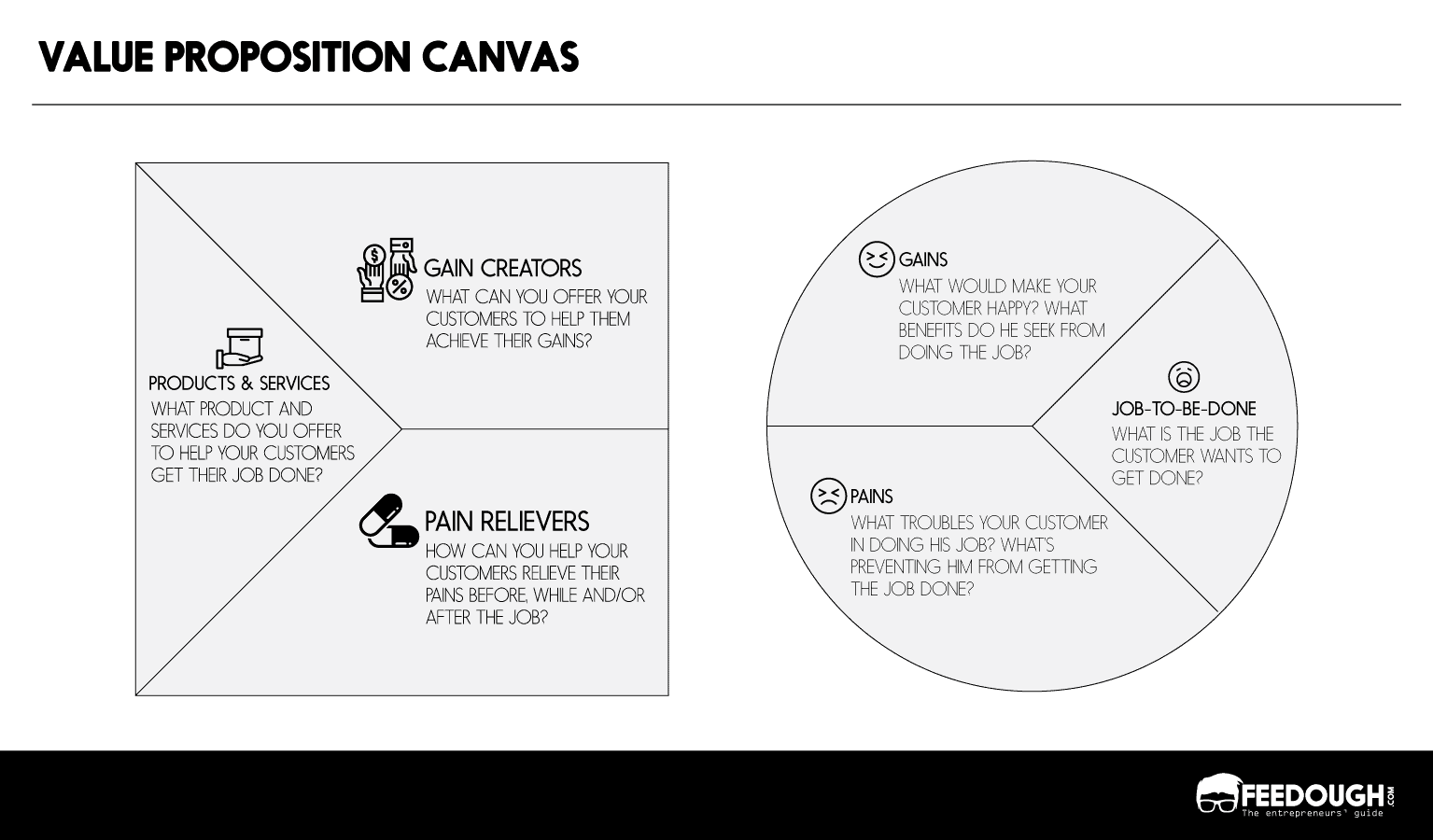
This is the most important component of a business model that answers several key customer and business value-related questions. It is often usually presented using a value proposition canvas.
What are the jobs the customer wants to be done?
What are their pains in doing the job?
What do they gain by doing the job?
Once these questions are answered, the business answers another set of questions that relates business to the customers:
How does the business get the job done?
How does the business relieve the customer’s pain?
How can the business help the customer get the gains?
Key Activities: What all offerings does the business sell to the customers?
Key Partners: Who helps the business in delivering value to the customers?
Key Resources: What all resources do the business uses to develop and deliver its offerings?
Key Channels: What channels does the business use to deliver its offerings to the customers?
Customer Relationships: What type of relationships does the business maintain with its customers?
How Does The Business Make Money?
Making money is important for the business to sustain itself. This component of the business model focuses on elaborating on the financials and how the business makes money.
It’s called the revenue model of the business and has two components:
The cost structure includes all the expenses that the business incurs in creating and delivering value to the customers.
The revenue streams include all the primary and non-primary revenue streams that the business utilises.
Why Is It Important To Develop A Business Model?
The business model acts as the blueprint of the business and a roadmap for its success (or failure). This tool helps the founders decide how their business will work and make money.
It is the only documentation that makes clear –
The business concept – the market opportunity the business capitalises on.
The solution the business offers and how it creates customer value.
How the business gets its customers.
The operating model the business follows.
How the business makes money, and what are the costs incurred to get the same.
Moreover, the business model gives a reason for the customers to choose the offering over others in the market. People chose Facebook because it helped them connect and chat with other people around the world (operating model), and it didn’t even charge for it (revenue model). Netflix’s business model was preferred over others as it provided value in the form of consistent on-demand content instead of the usual TV streaming business model.
The 30 Types Of Business Models
There are different types of business models meant for different businesses. Some of the basic types of business models are:
Manufacturer
A manufacturer makes finished products from raw materials. It may sell directly to the customers or sell it to a middleman i.e another business that sells it finally to the customer. Examples – Ford, 3M, General Electric.
Distributor
A distributor buys products from manufacturers and resells them to retailers or the public. Examples – Auto Dealerships.
Retailer
A retailer sells directly to the public after purchasing the products from a distributor or wholesaler. Examples – Amazon and Tesco.
Franchise
A franchise can be a manufacturer, distributor or retailer. Instead of creating a new product, the franchisee uses the parent business’s model and brand while paying royalties to it. Examples are McDonald’s and Pizza Hut.
Brick-and-Mortar
Brick-and-mortar is a traditional business model where retailers, wholesalers, and manufacturers deal with customers face-to-face in an office, a shop, or a store that the business owns or rents.
Ecommerce
The ecommerce business model is an upgradation of the traditional brick-and-mortar business model. It focuses on selling products by creating a web store on the internet.
Bricks-and-Clicks
A company that has both an online and offline presence allows customers to pick up products from the physical stores while they can place the order online. This model gives flexibility to the business since it is present online for customers who live in areas where they do not have brick-and-mortar stores. Examples – Almost all apparel companies nowadays.
Nickel-and-Dime
In this model, the basic product provided to the customers is very cost-sensitive and hence priced as low as possible. For every other service that comes with it, a certain amount is charged. Examples – All low-cost air carriers.
Freemium
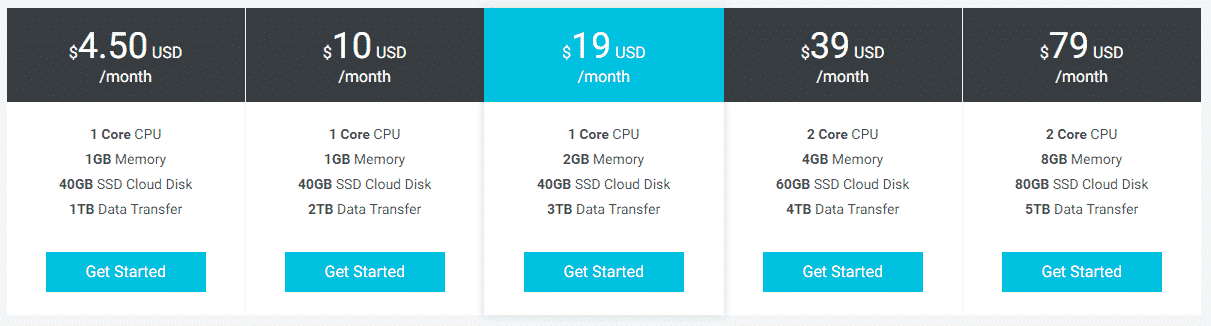
Freemium is one of the most common business models on the Internet. Companies offer basic services to customers for free while charging a certain premium for extra add-ons. So there will be multiple plans with various benefits for different customers. Generally, the basic service comes with certain restrictions or limitations, such as in-app advertisements, storage restrictions etc., which the premium plans shall not have. For example, the basic version of Dropbox comes with 2 GB of storage. If you want to increase that limit, you can move to the Pro plan and pay a monthly premium of $9.99 a month. Some online image editors allow you to edit only a certain number of images in the free basic plan while an unlimited number of images is in the paid plan.
Youtube’s free plan comes with ads, while the premium plan has no ad interruption and other benefits. This model is one of the most adopted models for online companies because it is not only a great marketing tool but also a cost-effective way to scale up and attract new users.
The aggregator business model is a recently developed model where the company has various service providers of a niche and sells its services under its own brand. The money is earned as commissions. Examples – Uber, Airbnb, Oyo.
Online Marketplace
Online marketplaces aggregate different sellers into one platform who compete to provide the same product/service at competitive prices. The marketplace builds its brand over different factors like trust, free and/or on-time home delivery, quality sellers, etc. and earns a commission on every sale carried on its platform. Examples are Amazon and Alibaba.
Advertisement
Advertisement business models are evolving even more with the rise of the demand for free products and services on the internet. Just like the earlier times, these business models are popular with media publishers like Youtube, Forbes, etc., where the information is provided for free but is accompanied by advertisements that are paid for by identified sponsors.
Data Licencing / Data Selling
With the advent of the internet, there has been an increase in the amount of data generated from users’ activities over the internet. This has led to the advent of a new business model – the data licencing business model. Many companies like Twitter and Onesignal sell or licence the data of their users to third parties who then use the same for analysis, advertising, and other purposes.
Agency-Based
An agency can be considered a partner company that specialises in handling non-core business activities like advertising, digital marketing, PR, ORM, etc. This company partners with several other companies that outsource their non-core tasks to them and is responsible for maintaining privacy and efficiency in their work. Examples of such agencies are Ogilvy & Mathers, Dentsu Aegis Network, etc.
Affiliate Marketing
The affiliate marketing business model is a commission-based model where the affiliate builds its business around promoting a partner’s product and directs all its efforts to convince its followers and users to buy the same. In return, the affiliate gets a commission for every sale referred. An example of a business operating on an affiliate marketing business model is lifewire.com.
Dropshipping
Dropshipping is a type of e-commerce business model where the business owns no product or inventory but just a store. The actual product is sold by partner sellers who receive the order as soon as the store receives an order from the ultimate customer. These partner sellers then deliver the products directly to the customer.
Network Marketing
Network marketing or multi-level marketing involves a pyramid-structured network of people who sell a company’s products. The model runs on a commission basis where the participants are remunerated when –
They make a sale of the company’s product.
Their recruits make a sale of the product.
The network marketing business model works on direct marketing and direct selling philosophy where there are no retail shops, but the offerings are marketed to the target market directly by the participants. The market is tapped by making more and more people part of the pyramid structure, where they make money by selling more goods and getting more people on board.
Crowdsourcing
The crowdsourcing business model involves the users contributing to the value provided. This business model is often combined with other business and revenue models to create an ultimate solution for the user and to earn money. Examples of businesses using the crowdsourcing business model are Wikipedia, reCAPTCHA, Duolingo, etc.
Peer 2 Peer Catalyst/Platform
A P2P economy is a decentralized internet-based economy where two parties interact directly with each other to buy or sell goods or to conduct a transaction without the intervention of any third party. A P2P catalyst is a platform where these users meet. Examples of P2P platforms are Craigslist, OLX, Airbnb etc.
Blockchain
The Blockchain is an immutable, decentralised digital ledger. It is a digital database that no one owns, but anyone can contribute to. Many businesses are taking this decentralised route to develop their business models. Models based on blockchain are not owned or monitored by a single entity. Rather, they work on peer-to-peer interactions and record everything on a digital decentralized ledger.
SAAS, IAAS, PAAS
Many companies have started offering their software, platform, and infrastructure as a service. The ‘as a service’ business model works on the principle of pay-as-you-go, where the customer pays for his usage of such software, platform, and infrastructure; he pays for what and how many features he has used and not for what he hasn’t.
High Touch
The high-touch model is one that requires lots of human interaction. The relationship between the salesperson and the customer has a huge impact on the overall revenues of the company. Companies with this business model operate on trust and credibility. Examples are hair salons and consulting firms.
Low Touch
The opposite of the high-touch model, the low-touch model requires minimal human assistance or intervention in selling a product or service. Since, as a company, you do not have to maintain a huge sales force, your costs decrease, though such companies also focus on improving technology to reduce human intervention further while making the customer experience better at the same time. Examples – Ikea, SurveyMonkey.
Auction-Based
Mostly used for unique items that are not frequently traded and that don’t have a well-established market value, like collectables, antiques, real estate, and even businesses.
This business model involves the listing of an offering by the seller and the buyers making repeated bids to buy that offering while fully aware of other bids by other buyers. The offering is sold to the highest buyer, with the auction broker charging a listing fee and/or commission based on the transaction value.
A reverse auction is an auction where the roles of a buyer and seller are exchanged, i.e. sellers bid prices instead of buyers.
The reverse-auction-based business model is often used when there are several sellers selling a similar offering to a single buyer. These sellers lower their prices with every bid; generally, the lowest bidder wins the auction. However, there are cases when the bidder with a price higher than the lowest bid wins the auction as the buyer likes his offer (offering with add-ons)
A platform that lets sellers bid for government contracts is an example of a reverse auction-based business model.
Razor And Blades
Razor and blade model is used by companies that deal in complementary or companion products like razors and blades.
It involves selling the high-margin root product at a low price to increase the volume of sales of the complementary or related low-margin product.
By using this model, businesses create a stream of recurring income over the life of the root product.
Companies dealing in razors, mosquito vaporizers, and other refillable products employ this business model. The game industry also makes use of this model by providing the gaming console at a very economical price and making good profits with the sale of games.
Reverse Razor And Blades
A business employing a reverse razor and blades model offers the low-margin item at a very less price or below the cost to encourage the sale of the high-margin product.
Amazon employs this business model to sell its Kindle e-reader. It provides Kindle ebooks at a price lower than their actual cost to make people consider Kindle as a one-time investment to enjoy low-cost books throughout its life.
On-Demand
An on-demand model is where a customer’s demand is fulfilled by delivering goods and services on demand (usually immediately).
The use of the Internet and mobile phones drives this business model. It works like this –
The customer order for products on services through a web app.
The company’s employee or a demand-fulfilling partner receives the request.
The employee or a partner fulfils the demand by delivering the ordered product or service either immediately or in the time promised.
Uber, Instacart, and Postmates are some examples of an on-demand business models.
User Community
Driven by the network effect, this business model involves granting access to a community or a network in return for a membership fee.
Glassdoor is a good example of such a user community.
Final Thoughts
Of course, most companies do not operate on any one of these business models but rather on a combination of some. You can be a Bricks-and-clicks Low Touch Retailer or a High Touch Subscription-Based Manufacturer. What business model you choose depends on your business needs and what value you want to create for your stakeholders. Next, we will see how to develop the perfect business model for your startup so that the chances of your success are amplified.
The Startup Process
We know how important your dream business is to you. Therefore, we’ve come up with an all-in-one guide: The Startup Process to help you turn your vision into reality.
With a monthly 28 million average unique mobile application visitors, 74 million unique mobile web visitors, and 83 million unique desktop visitors, Yelp’s Business Model is something you should definitely be aware of. This online business directory, which lists and make local businesses visible to users, differentiates itself with the crowdsourced reviews of those businesses on its platform. Furthermore, the company has expanded its business model by adding reservation services and food delivery/take out services.
Yelp Business Model
To answer your question about how Yelp makes moneywe have to look deep into its business and operating model first:
What Is Yelp And How Does It Operate?
Yelp was started in 2004 by two former PayPal employees, Jeremy Stoppelman and Russel Simmons, with a $1 million funding. The idea was to create an ’email circle’ that allowed friends to swap business reviews.
Yelp, today, has become the biggest platform that connects people with local businesses. It allows them to search, locate, book, and review the local businesses.
Founded in July 2004, Yelp has taken root in countries across the globe, making it the leading local guide for real word-of-mouth on everything from boutiques and mechanics to restaurants and dentists.
The platform is available in 32 countries in the form of both the mobile application and the website.
Yelp Operating Model
Yelp is a social network which lets its users search for and review businesses around them. Unlike other directories, Yelp focuses more on engaging with its users and make them engage with other users and businesses as well. Users can create a profile, add friends, chat in forums, and visit offline Yelp events too. They can also become a part of the Elite Squad by posting well-written reviews, high-quality photos and by fulfilling other prerequisites.
However, the operating model functions around local businesses which can list themselves on the platform for free. They get to build their own profile, get access to business analytics, and get to see and respond to reviews. These businesses can also attract more customers through targeted advertisements.
Yelp Reviews
Reviews have always been a catalyst to the growth of Yelp’s Business Model. As many say:
There are only two types of people in the world: those who write Yelp reviews and those who don’t.
Yelp reviewers not only share their review of a particular local business, but they also share experiences; they share the reviews more creatively than they do it on other websites. This review feature of the platform helped it make use of the network effect. The reviews help the new users finding what it really want; who in turn convert into a reviewer after using the service.
The company understood the importance of reviewers in its operating model and hence introduced a new squad of Elite members – the top reviewers on the website in 2006.
Yelp Elite
Yelp recognize active members of the community based on well-written reviews, high-quality tips, a detailed profile and other prerequisites. These recognized users are elite members of the platform. In exchange for their participation and constructive reviews on the website, they receive
free gifts (T-shirts, Lip Balm, etc)
a sparkly badge on their profile page
an invite to exclusive elite events
an invite to try out new businesses
Launched in 2006, this strategy of recognizing members as elite has resulted in many constructive reviews on the website.
How Does Yelp make money?
This directory of local businesses earned around $713 Million in 2016. Just like other social networks, Yelp earns a maximum of its revenue from advertisements. However, there are many other revenue sources which we will discuss in our this section of ‘How Does Yelp Make Money?‘
Targeted Advertisements & Profile Enhancements
Just like Facebook, Twitter, Pinterest or any other social media network, Yelp makes a maximum of its revenue through targeted advertisements. The company is a data mine for any local business wishing to target the local audience. The advertisements are targeted according to the user demographics and industry of the business.
According to a study by Nielsen, 98% of Yelp users have made a purchase from the business they found on Yelp, with around 90% doing so in a week. This is the biggest reason why many businesses look for advertising on Yelp. Yelp offers two premium model options for advertisements: The Self Service advertisements and the Full-Service advertisements.
Self Service Program
Yelp’s Self Service program provides Yelp’s free tools plus some advertising solutions and profile enhancements to the businesses. With the Self Service Advertisement program, businesses can:
Run Targeted Advertisements
This is the topmost revenue-earning feature of the platform. Businesses can target certain keywords and locations and place their advertisements at the top of the search results. These advertisements are also placed on the competitor’s profiles.
Make use of other Yelp premium tools
There are many other premium tools which can be used by the business to perform better than the competition on Yelp. These are
Deals and gift certificates
By choosing the self service program, a business can use deals and other gift certificates to attract more customers. Yelp charges 30% of the paid amount in case of deals and 10% in case of certificates.
Yelp Reservations
Another premium service offered by Yelp which lets restaurants to offer reservation option on Yelp platform itself. They are provided with all the hardware and software requirements by Yelp in return of small monthly fees.
Online Ordering
Even though this feature is available for free users as well, this is one of the premium feature provided by Yelp as the company charges 12.5% commission on subtotal + credit card processing for each order they get for the business.
Profile Enhancements
Other than deals and gift certifications and reservation services, businesses running self service program can enhance their profile by adding slideshows and call to action buttons and by removing competitor advertisements from their page.
Full Service Program
Yelp’s Full Service programs provide all Yelp’s free tools and Self Service program tools plus targeted Yelp ads, upgraded business page features, and dedicated support. The business who buy Full Service Program gets:
All the Free Tools
All the tools of the free suite to showcase the business and connect with the Yelp community.
All the Self Service Program Tools
Including online ordering, reservations, profile enhancements and deals and gift certificates.
Video production and hosting
Yelp sends a videographer to produce a professional video for the Yelp Business Page of businesses which buy full service program.
Dedicated Support
Businesses which buy full service program are entitled to dedicated support by Yelp staff.
Go On, Tell Us What You Think!
Did we miss something? Come on! Tell us what you think of our article on Yelp Business Model | How Does Yelp Make Money? in the comments section.
Now that you understand the importance of a product prototype for your company, it is time to build one. Here we shall be addressing how to go about developing a prototype that fulfils all your needs at this stage of your start-up. Remember at this stage, it is not meant to validate your idea but to convince the external stakeholders of the feasibility and viability of your idea. Of course, the business model is as important in this respect but we shall discuss it in-depth in the next phase.
How to Develop a Perfect Prototype of Your Startup?
Since at this stage, it is the external stakeholders that you are presenting to, a bare-bones validation structure like POC will not work. You would want something more refined, more polished for it to be convincing. You would not want just a visual prototype at this stage, but a presentation prototype or proof of concept, which will not only look like the final product but also provide a demonstration of the core product functionality and design.
Know Your Software/Hardware Options
Your product might be an application or a physical object. So you would want to know which software suite you would need to rapidly develop the prototype. There is software available today that can be used to develop high-fidelity prototypes that mimic animations, touch interactions etc. For physical objects, 3D printing is widely used to quickly get working prototypes. But the first step should be to know all the options available to you before you decide to start the prototyping process.
Reverse-Engineer Competing Products
If the product that you intend to build is already in the market, it would be wise to disassemble and take the competitors’ products apart to understand how they have been built and how they work. Reverse-engineering helps you to not only understand the gaps but also come up with more efficient methods of production.
Decide on the Material/Tools
It is an extension of the first step but here you have to decide the tools and material that you would be using to build the prototype and those which you would use to build the final product. For example, to build quick mechanical prototypes, you might use 3D printing. Now, 3D printing uses photopolymer resin hardened by UV light. But in most cases, you would not want the final product to be made of that. Decide on the highest-quality yet most cost-effective option for your material.
Build a Miniature Prototype Yourself
If it is a physical object, before making an elaborate prototype, model it using Computer-Aided Design (CAD) and then 3D-print it. It helps you understand even the smallest parts of your product and prepares you before you approach any prototyping professional.
Use Professional Services
Once you have a rough prototype, you may want to take it to the pros to get a more refined version and see how it would be manufactured once it moves to the mass-production stage. Vendors should be carefully chosen. They should not only be honest but also flexible enough to work within your budget. Check their credentials and past customer reviews. Make sure to get a non-disclosure agreement (NDA) from the vendor. This will serve as your legal protection if your prototype design gets stolen. At the end of the day, you should aim to have the most professional-looking working prototype so that it becomes easier to get more people on board.
Develop an In-House Team
For non-physical products like software, it is better to develop the necessary competency in-house instead of outsourcing the design and development work to third parties. Protection of design idea and product testing are more convenient with in-house teams.
Run Customer Tests
Just like in the case of idea validation, it might be useful to get customer feedback for your presentation prototype too, though the judgment lies completely with you if you want to run these tests. After all, you might not want to reveal your prototype to the customers at this stage. But it is better to get customer feedback as it helps you find defects and refine it further.
Prototypes are meant to be functional, not perfect and sometimes they can be expensive and time-consuming to build. But prototyping is the best way to get your idea in tangible form. It is an amazing experience to see an idea come to life. The focus should be to not have any preconceived notions and explore all possibilities and options available at this stage. The next phase for your start-up should be to go out in the market with your MVP to validate all your assumptions by using actual consumer data. Till then, happy prototyping!
The Startup Process
We know how important your dream business is to you. Therefore, we’ve come up with an all in one guide: The Startup Process to help you turn your vision into reality.
Hey, I'm Aashish
Each week I share research backed AI oriented content in my newsletter.
There are AI ideas, AI trends, tutorials, and guides.
24k entrepreneurs read it. I'd love you to join.


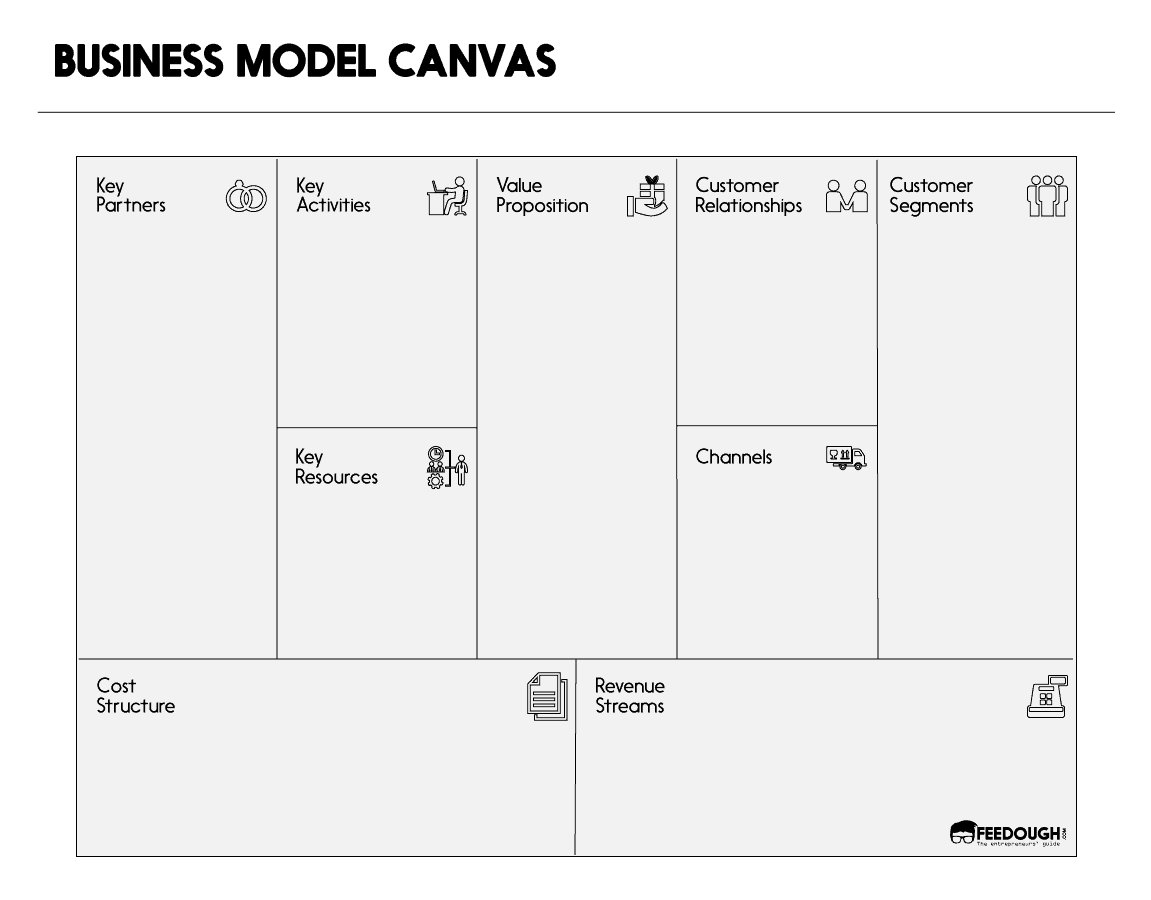
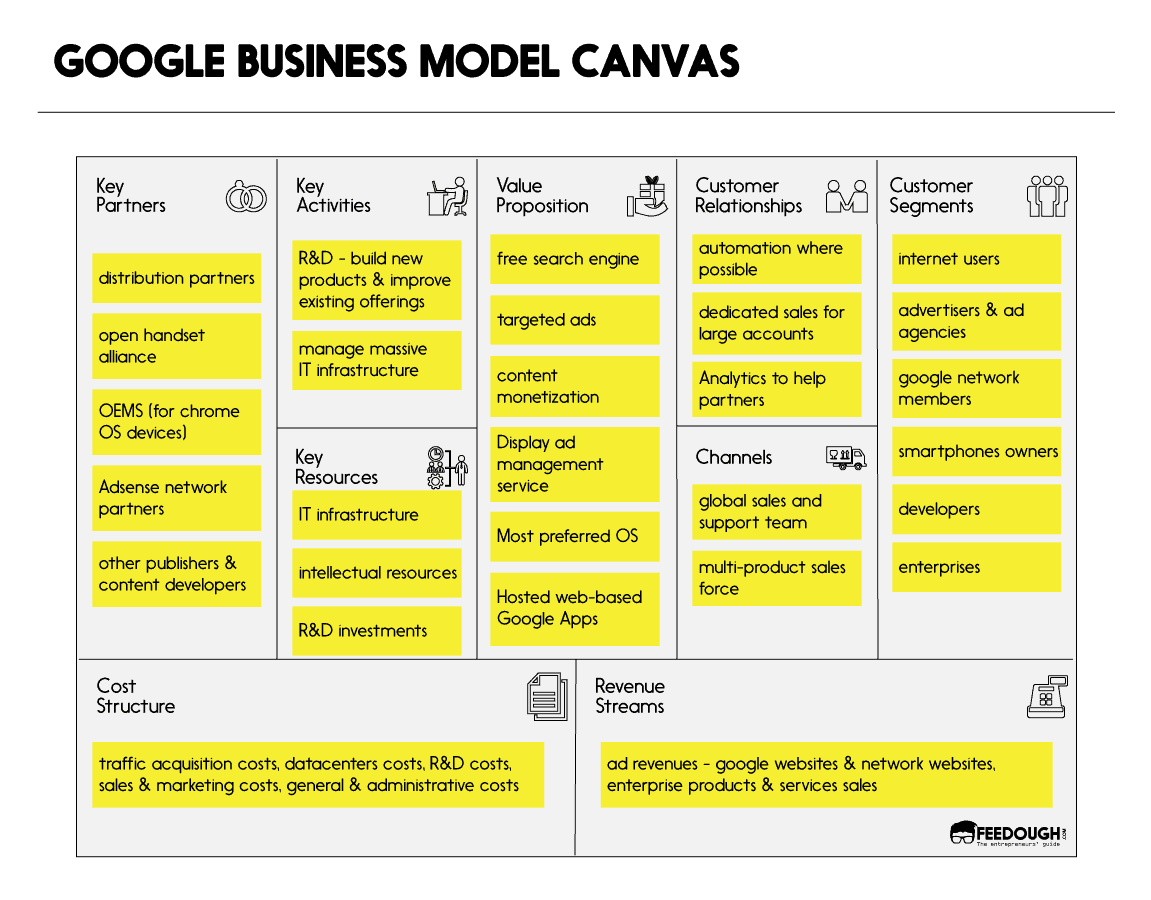
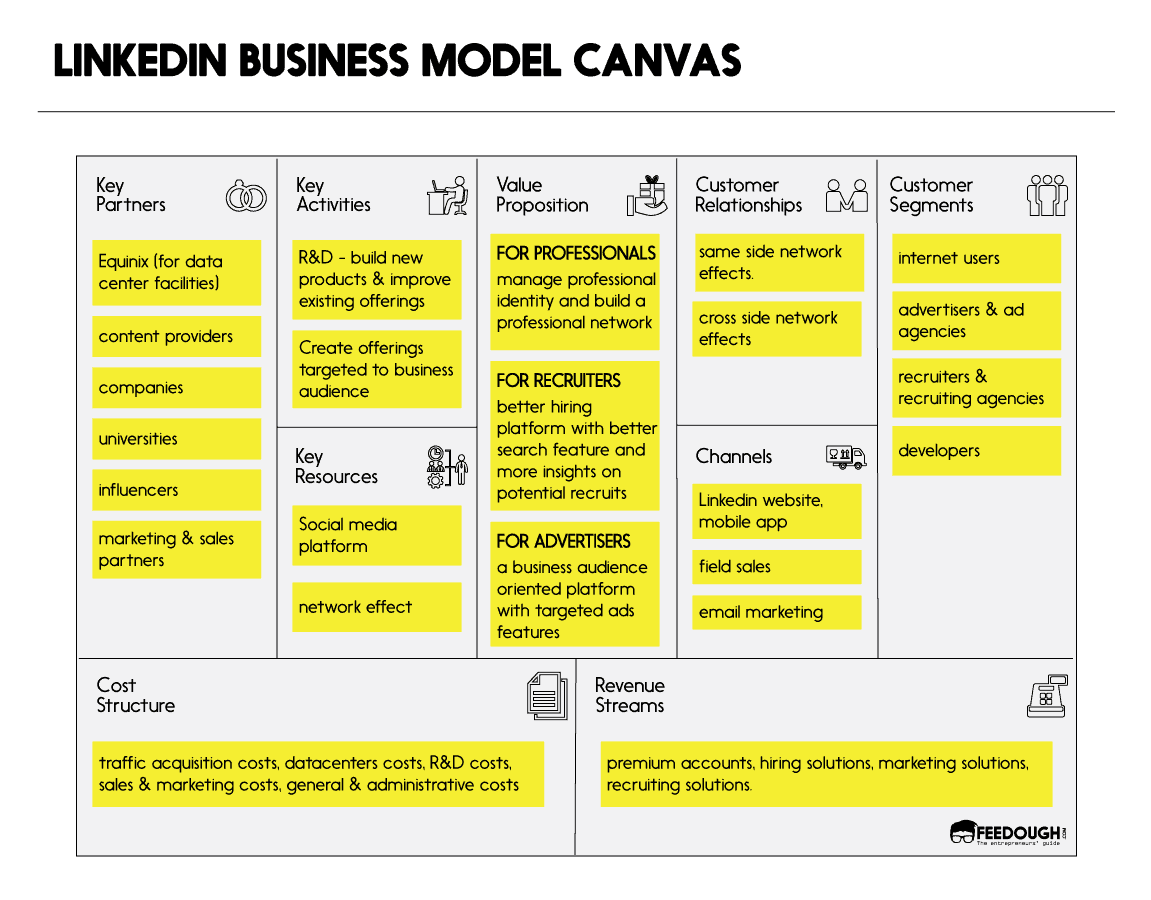
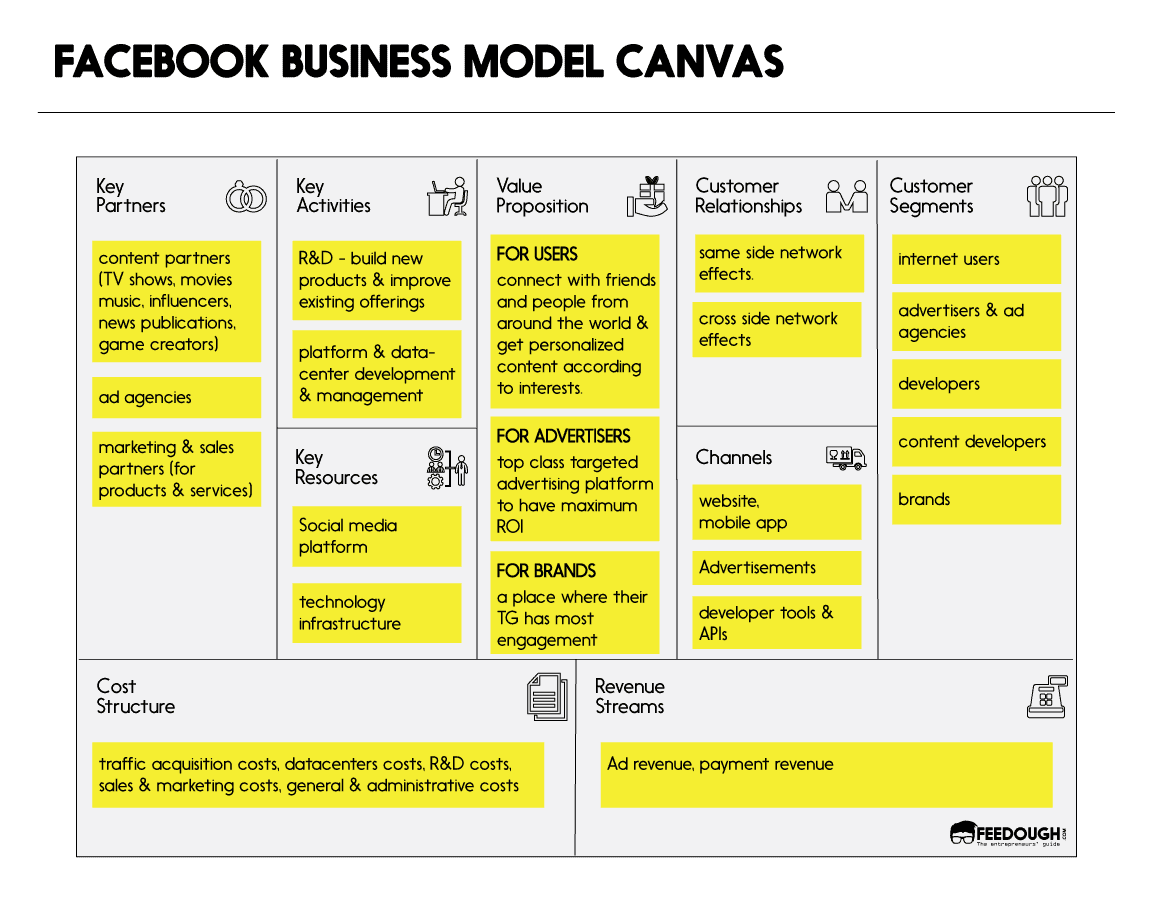

![How to Register a Company? [Detailed Guide]](https://www.feedough.com/wp-content/uploads/2017/08/company-phase-registering-company-10.png)