There are over 2.2 billion active gamers in the world which generated a whopping 108.9 billion in game revenues in 2017. What’s a better game based business model than a one which connects these gamers, let them have a voice chat while playing, and help them make communities and interact with their gaming friends while not playing?
Discord is a freeware software dedicated to all this.
What Is Discord?
Discord is an all in one text, voice, and video chat application dedicated to the gamers around the world. This free application focuses on a hassle-free voice and text chat experience during the games and building of communities outside the game.
When using Discord, you participate in themed servers which can be created by anyone logged in on the application. The same servers can be joined by others who have the invite or participation link. The server admins can host text and voice channels which are used by the members to discuss different topics. Even though Discord’s target market is gamers, the platform is used by many other interest groups ranging from music, art, entrepreneurship, to spirituality, etc.
Discord vs. Skype vs. TeamSpeak
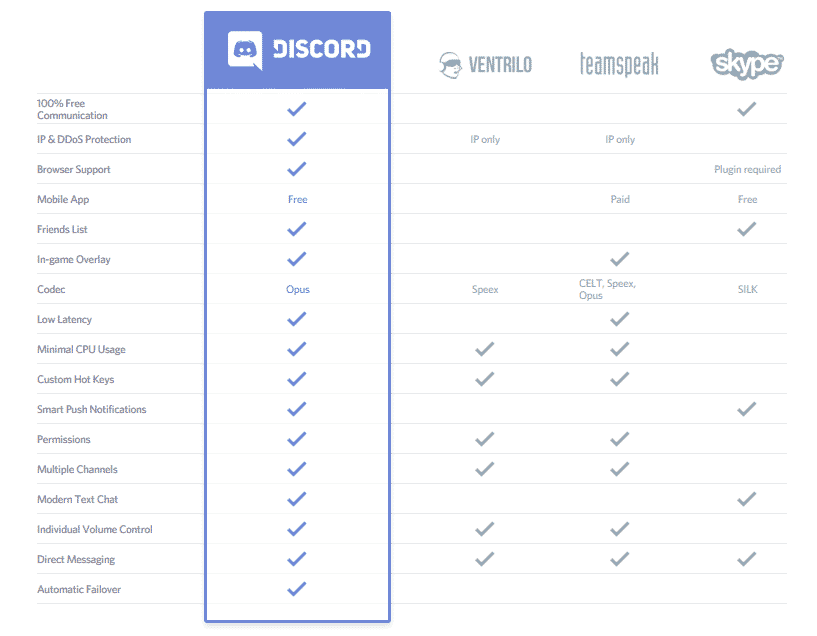
Discord became a huge threat to Skype and TeamSpeak ever since it was launched in the market. These traditional chat applications aren’t free (freemium business model), are heavy, involve risk of DDOS attacks, and aren’t dedicated to the gamers. Discord, on the other hand, is free, can be used on a browser, isn’t heavy, is safer, and involves every feature a gamer requires to hold a voice chat while playing.
Discord Business Model
Discord has more than 87 million users, and is planning to rule over the $1.7 billion worth of voice chat market. The application is entirely free to use and has no plans to charge money in future for its core features.
The main focus of the application is to provide hassle-free communication platform to everyone. Besides, the company also focuses on integrating its voice chat service in the gaming industry. It provides a free tool (gamebridge) which helps developers to integrate the app in their games. Other features like Rich Presence and Streamkit are also provided free of cost which let the game developers list their game on the application (which can be chosen by the users as the game they’re playing at the moment), and integrate other applications like Twitch, GameWisp, etc. with the app.
Operating among the gamers give the application a huge advantage of capitalizing on the network effect where its value increases as more and more users join it. The company is currently valued at around $700 million with the recent investment of $20 million.
How Does Discord Make Money?
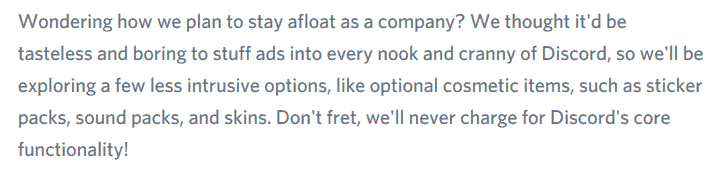
Discord’s revenue model is still a work in progress. The company is against advertisements and selling of user data and has been relying on the funding money till recently. They have no intentions to make users pay to use the application in future. Rather, the company is shifting to a semi-freemium business model where it provides more and better features to those who pay for them. Discord also makes money by selling company merchandise.
The developers feel advertisements are intrusive and selling user data equals breaching the relationship between the two parties, hence they’ve have strictly restricted themselves from using any such revenue earning strategy.
Nitro
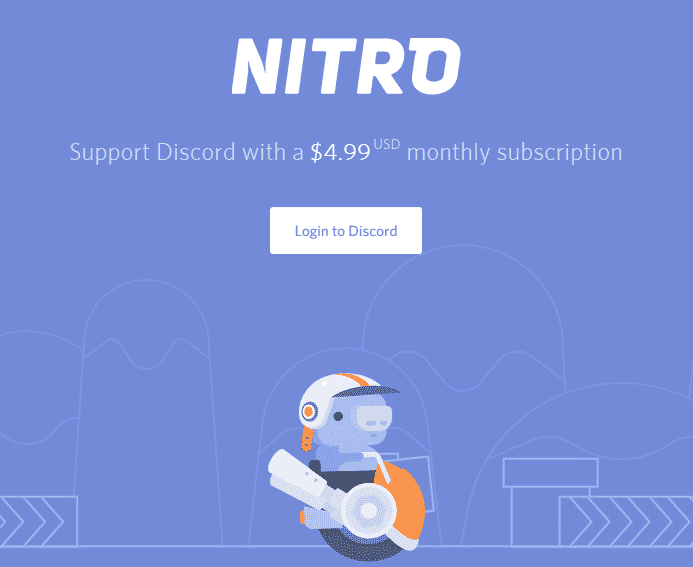
Discord has recently launched its $4.99 monthly subscription plan, Nitro, which enables subscribed users to get add-ons like animated avatars, higher quality screen share, custom and animated emojis, and boosted upload limit.
What separates Discord’s freemium business model from others is the marketing strategy used to promote it. The company doesn’t charge anything for its core functions and only asks its users to ‘support the application’ by buying the monthly subscription plan.
Merchandises
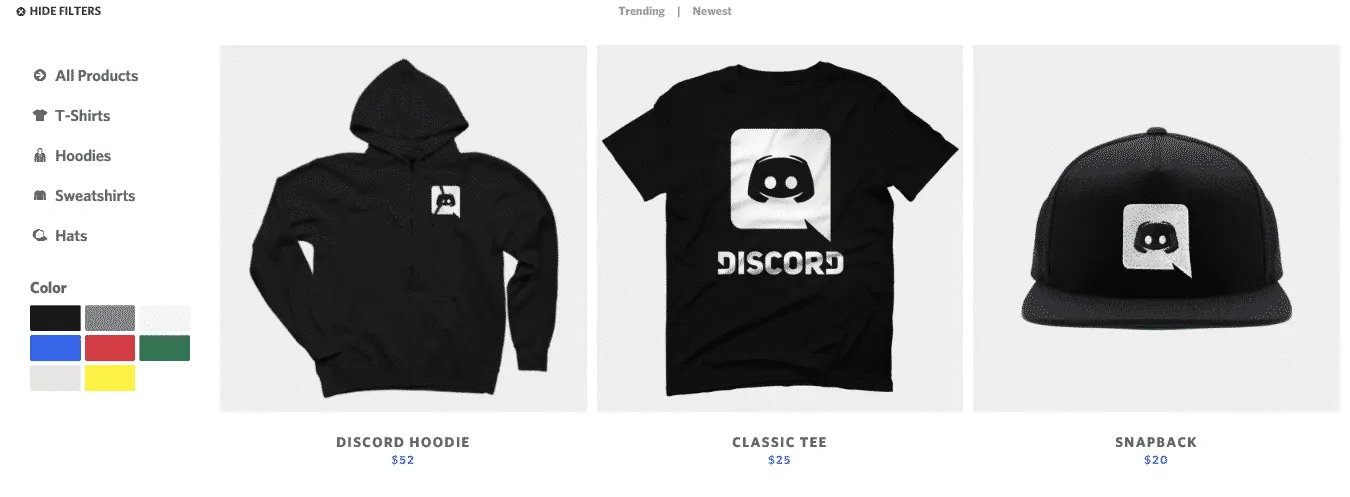
A small portion of Discord’s revenue comes from its merchandise store where it sells company branded t-shirts, hoodies, sweatshirts and hats.
What Can Be Discord’s Future Revenue Strategies?
No matter how much you try to appeal to your users by providing them a free and ad-free experience, you’ve got to earn money to stay alive in the market. Nitro is a good strategy to earn revenue in the initial stages, but this startup surely has many other potential revenue streams which it can use in future. These include:
Gamebridge
Gamebridge allows game developers to integrate the app in their game and lessen their burden of coding a in-game chat feature. It has the following features:
Automatch players in voice channels
Integrated Sharing of Screenshots, GIFs and Videos
Auto-Create permanent or temporary Servers for Ingame-Worlds/Guilds
Building up a community (Partner-like benefits)
Controlling Audio Settings
Positional Audio (Voices placed in a virtual space to augment distribution of players)
The feature was released for free in the initial months but was soon rolled back. The company is currently testing the feature with selected game developers and might release it as a paid product in the future.
Game Revenue Sharing
Just like Twitch, Discord can partner with some games in future and earn through every referred user which end up buying the game or any of its feature.
Go On, Tell Us What You Think!
Did we miss something? Come on! Tell us what you think about our article on how does Discord make money? | Discord business model in the comments section.
A single misstep can cost years of carefully built trust. That’s the reality brands face in 2025, where reputation moves at the speed of a tweet and crisis management isn’t optional anymore. The PR market reached $106.63 billion in 2025, growing at 7.51% annually, and there’s a clear reason why companies are investing heavily in strategic communication.
The stakes have never been higher.
Consider this: 69% of brand executives have already faced a PR crisis in the last five years. That’s no longer a hypothetical risk. It’s an operational certainty.
What separates thriving brands from those fighting for survival often comes down to how they communicate, how they position themselves, and how they respond when things go sideways.
Public relations isn’t just about press releases and media coverage. It’s the engine that shapes perception, builds credibility, and protects value when everything else is on the line.
What Is Public Relations?
Public relations is a strategic communication process companies, individuals, and organisations use to build mutually beneficial relationships with the public.
A public relations specialist drafts a specialised communication plan and uses media and other direct and indirect mediums to create and maintain a positive brand image and a strong relationship with the target audience.
In simple terms, public relations is a strategised process of managing the release and spread of organisation-related information to the public to maintain a favourable reputation of the organisation and its brands. This process focuses on –
What information should be released,
How it should be drafted,
How it should be released, and
What media should be used to release the information (usually earned or free media is used for the same).
The Objectives Of Public Relations
The main objective of public relations is to maintain a positive reputation for the brand and maintain a strategic relationship with the public, prospective customers, partners, investors, employees, and other stakeholders. This leads to a positive image of the brand and makes it seem honest, successful, important, and relevant.
Besides this, other objectives of public relations include –
Crisis Management
Public relations play a crucial role in spreading information to shape public perception and maintain an organisation’s reputation, especially during a crisis. For example, in 2018, KFC had a chicken shortage that led to the closure of more than half of its UK outlets (because it shifted its food distribution company to DHL). The customers were furious and bombarded the social media. To manage this, the company’s PR team responded with humour, acknowledging the irony of a chicken restaurant running out of chicken. The company issued a public apology through a clever ad campaign that rearranged the letters of its name to spell out “FCK” on a chicken bucket, alongside a message that humorously acknowledged the situation and apologised to customers.
Building Brand Awareness
One of the biggest responsibilities of a PR team in any company is to express the company’s expertise, build relationships with customers and stakeholders, achieve global recognition, and combine all these to build a favourable brand awareness. It does the same using strategies like –
Shaping Public Perceptions: PR works in synergy with the overall marketing objective in creating narratives highlighting a brand’s principles, goals, and uniqueness. For example, Dove’s ‘Real Beauty’ campaign challenged conventional beauty standards and promoted body positivity, significantly strengthening Dove’s brand image as socially responsible and inclusive.
Building Credibility: PR aims to boost a brand’s credibility by gaining media coverage in reputable publications and endorsements from influential figures. Always’s ‘#LikeAGirl’ campaign aimed to challenge stereotypes and successfully build awareness of the brand by gaining media coverage and influencers’ attention.
Building Media Relations
Media relations refer to strategic efforts to build and maintain strategic relationships with media outlets, journalists, influencers, and other media professionals to secure favorable media coverage, increase brand visibility, and manage public perception.
The PR team ensures that the organisation’s marketing message is amplified using media relations and earned media. This works in both at the times of positive and negative publicity.
For example, Johnson & Johnson faced a major crisis with reports of asbestos in their baby powder. The company’s PR team responded by launching a website providing detailed information, documents, and updates on the issue. This transparency helped them maintain relationships with media outlets and control the narrative in their favour.
Importance Of Public Relations
The PR industry grew 1.7% in the US in 2025, and that’s not just a random stat. Brands are dealing with faster news cycles, more vocal audiences, and crises that can blow up overnight. That’s exactly why companies are pouring resources into PR—because reputation isn’t a nice-to-have anymore. It’s the foundation that holds everything else together.
Builds brand image through third-party validation. When a journalist covers your story or an influencer mentions your brand, it carries more weight than any ad you could run. PR creates credibility that paid campaigns can’t buy. Think about how Tesla rarely advertises but dominates headlines—that’s strategic PR at work. Third-party voices turn your brand into something people trust rather than something they scroll past.
Capitalizes on timely opportunities. The best PR teams don’t just respond—they anticipate. When Google engineers worked on Ebola treatment tech, they didn’t wait for someone to notice. They pushed the story forward. Same goes for brands that jump on cultural moments or industry shifts before competitors catch on. Timing transforms a decent story into front-page coverage.
Promotes brand values authentically. Consumers in 2025 can smell fake activism from a mile away. PR helps brands show what they stand for without sounding preachy. When Facebook celebrated LGBTQ equality, it wasn’t just a rainbow logo—it was consistent messaging backed by policy changes. Values need proof, and PR provides the narrative that connects both.
Strengthens community connections. Local relationships still matter, even in a digital world. Coca-Cola’s community initiatives work because they’re visible and consistent. PR turns corporate actions into stories that resonate with the people who actually interact with your brand. Those connections create loyalty that survives bad quarters and market shifts.
Functions Of Public Relations
Public relations is different from advertising. Public relations agencies don’t buy ads, write stories for reporters, or focus on attractive paid promotions. The primary role of public relations is to promote the brand through editorial content in magazines, newspapers, news channels, websites, blogs, and TV programs.
Using earned or free media for promotion has its own benefits as information on these media isn’t bought. It has a third-party validation and hence isn’t viewed with scepticism by the public.
The functions of public relations managers and public relations agencies include:
Anticipating, analysing, and interpreting the public opinion and attitudes towards the brand and drafting strategies using free or earned media to influence them.
Drafting strategies to support the brand’s every campaign and new move through editorial content.
Planning and executing special public outreach and media relations events.
Writing content for the web (internal and external websites).
Developing a crisis public relations strategy.
Handling the brand’s social media presence and responding to public reviews on social media websites.
Counselling the organisation’s employees regarding policies, courses of action, the organisation’s responsibility, and their responsibilities.
Dealing with government and legislative agencies on behalf of the organisation.
Dealing with public groups and other organisations about social and other policies of the organisation and legislation of the government.
Handling investor relations.
Types Of Public Relations
According to the functions of the public relations department/agencies, public relations can be divided into 7 types. These are:
Media Relations: Establishing a good relationship with the media organisations and acting as their content source.
Investor Relations: Handling investors’ events, releasing financial reports and regulatory filings, and handling investors, analysts and media queries and complaints.
Government Relations: Representing the brand to the government regarding fulfilling policies like corporate social responsibility, fair competition, consumer protection, employee protection, etc.
Community Relations: Handling the social aspect of the brand and establishing a positive reputation in the social niche, such as environmental protection, education, etc.
Internal Relations: Counselling the organisation’s employees regarding policies, courses of action, the organisation’s responsibility, and their responsibilities. Cooperating with them during special product launches and events.
Customer Relations: Manage relationships with the target market and lead consumers. Conduct market research to learn more about customers’ interests, attitudes, and priorities and craft strategies to influence them using earned media.
Marketing Communications: Supporting marketing efforts relating to product launches, special campaigns, brand awareness, image, and positioning.
Public Relations Examples
PR stunts or strategies range from donating to an affected community to running a brand activation stunt in a mall. Some of the examples of successful public relations campaigns are:
Google’s Fight Ebola Campaign
The outbreak of the Ebola virus in 2014 was critical as it spread among many countries and took many lives. Google, to help people in need and to build up a positive brand image, started a donation campaign where it pledged to give $2 for every $1 donated to the cause through its website.
The public relations strategy attracted media attention and resulted in a huge success as Google raised $7.5 million.
Paramount Pictures The Ring Publicity Stunt
Paramount Pictures, to promote its new horror franchise, The Ring, and to get more user attention, took a step forward and planned a publicity stunt where the protagonist haunted the people in a real-life scenario.
The film’s most iconic scene of Samara crawling out of the TV set was recreated in a TV showroom where the protagonist came crawling out of the hidden compartment behind a TV screen and scared people.
The stunt went viral, and the video received over 10 million views on Facebook.
Just Eat & A Sick Customer
Just Eat is an online food ordering application that lets users add comments to their orders to inform the delivery person about the right address or to leave the order to the neighbour etc.
One unwell customer tried her luck to see if she could get the delivery person to stop en route and get her some medicines. She wrote:
Will you please stop in the Spar on the way and get me some Benylin cold and flu tablets and I’ll give you the money. Only ordering food so I can get the tablets. I’m sick xx.
The delivery person delivered both and this public relations stunt went viral over the media.
Facebook Paris Support Profile Pictures
In response to the tragic shooting in Paris in 2015, where at least 129 people died, Facebook added a France flag filter that users could apply to their profile pictures to support France. Millions of people applied this filter and appreciated this effort by Facebook.
Advantages Of Public Relations
Just like the other mediums of promotion, public relations comes with its set of advantages. These are –
Credibility: The public trusts the message coming from a trusted third party more than the advertised content. For example, they trust when a news outlets tell them that a brand has come up with no-sugar drink over an advertisement for the same.
Reach: A good public relations strategy can attract many news outlets, exposing the content to a large audience. Moreover, this medium can help the company utilise certain organic touchpoints that are hard to capitalise on otherwise.
Cost-effectiveness: Public relations is a cost-effective technique to reach a large audience as compared to paid promotion. News spread like wildfire sometimes.
Better Communication: Unlike advertisements, public relations help the company to communicate more information to the public than other forms of communication media. This is because people are more interested in hearing out their opinion leaders over watching advertisements.
Disadvantages Of Public Relations
PR also has its own set of disadvantages which can be costly for the business. These are:
No Direct Control: Unlike paid media, there isn’t direct control over the content distributed through the earned media. This is the biggest risk of investing in public relations. What if an information which was not to be disclosed get disclosed to the public in the form of news?
Hard To Measure Success: It is really hard to measure and evaluate the effectiveness of a PR campaign.
No Guaranteed Results: Publishing of a press release isn’t guaranteed as the brand doesn’t pay for it. The media outlet publishes it only if it feels that it’ll attract its target audience.
Public Relations vs Marketing vs Advertising
Public relations involves communicating expertly drafted messages using non-paid/earned media to build mutually beneficial relationships with the public.
Advertising, on the other hand, is a paid communication message intended to inform people about something or to influence them to buy or try something.
Marketing is the umbrella under which all the divisions dealing with creating, communicating, delivering, and exchanging dwell. That is, PR is the subset of marketing. Everything a PR department does is determined by the marketing goals set by the organisation.
Basis
Public Relations
Advertising
Marketing
Definition
Public relations is a marketing tool for communicating expertly drafted messages using non-paid/earned media to build mutually beneficial relationships with the public.
Advertising is a paid communication message intended to inform people about something or to influence them to buy or try something.
Marketing refers to activities a company undertakes to create, communicate promote, deliver, and exchange the offerings that have value for the customers.
Driven by
Relationship driven
Communication driven
Company/Brand growth driven
Communication
Two-way
One-way
Two-way
Importance
To build a favourable relationship with the target audience.
To communicate to the target audience about a certain offering, action, work, or other brand-related information
Identify and cater to the customers’ needs to survive and thrive.
How AI Is Transforming PR in 2025
According to recent industry data, 75-80% of PR professionals are expected to use AI tools by the end of 2025. That’s not some distant prediction. It’s happening right now.
The most common use? Content creation and press release drafting. Teams are using AI to handle first drafts of press releases, blog posts, and social media content. It speeds up the writing process, though most PR pros still edit what AI generates. Think of it as a writing assistant, not a replacement writer.
AI also changed how teams track what people are saying. Media monitoring and sentiment analysis tools scan thousands of mentions across news sites, social platforms, and blogs in real time. Instead of manually checking every mention, PR professionals get alerts when sentiment shifts or a potential issue pops up. This means they can respond faster when something needs attention.
Then there’s campaign analytics and performance tracking. AI tools analyze which messages resonate, which channels perform best, and what timing works. This data helps teams adjust strategies mid-campaign instead of waiting until the end to see what worked.
Some teams are integrating AI into their relationship management systems, too. These tools help track journalist interactions, pitch success rates, and media preferences. It’s basically a smarter CRM that learns which reporters care about which topics.
But here’s the thing. AI handles the repetitive stuff and data crunching. It doesn’t build relationships with journalists. It doesn’t understand the nuance of a crisis situation. It doesn’t create a strategy based on years of experience. That’s still on the humans. What AI does is free up time so PR professionals can focus on the parts of their job that actually require human judgment.
You might be among those who think it’s unreliable or among those who exploit it for their assignments, research projects, dissertations, and presentations. But you can’t be among those who deny the popularity of the world’s largest encyclopaedia, Wikipedia.
Wikipedia has more than 5.5 million articles, 33 million registered users, 32.5 million active editors, and an average 600 new articles a day just on the English version.
Ever since its launch on 15th January 2001 by Jimmy Wales and Larry Sanger, Wikipedia has disrupted the internet as we knew it. The website has a total of 298 language versions and articles relating to every topic.
But how does this giant operates and makes money? Let’s find out.
Wikipedia Business Model
Wikipedia is a crowdsourced encyclopaedia written collaboratively by the people who use it. It is a special type of online encyclopaedia designed to make collaboration and data creation easy where volunteers from across the world contribute and edit the content using trustable sources.
This makes the Wikipedia business model fairly easy to understand where the organisation only focuses on the handling the website, servers, and administration, and the main content is contributed by the volunteers for free.
But who owns Wikipedia?
The Wikimedia Foundation
The Wikimedia Foundation is a not-for-profit organization which supports Wikipedia and many other free knowledge websites to fulfil its vision to create a knowledge database which is available to all for free.
How Does Wikipedia Make Money?
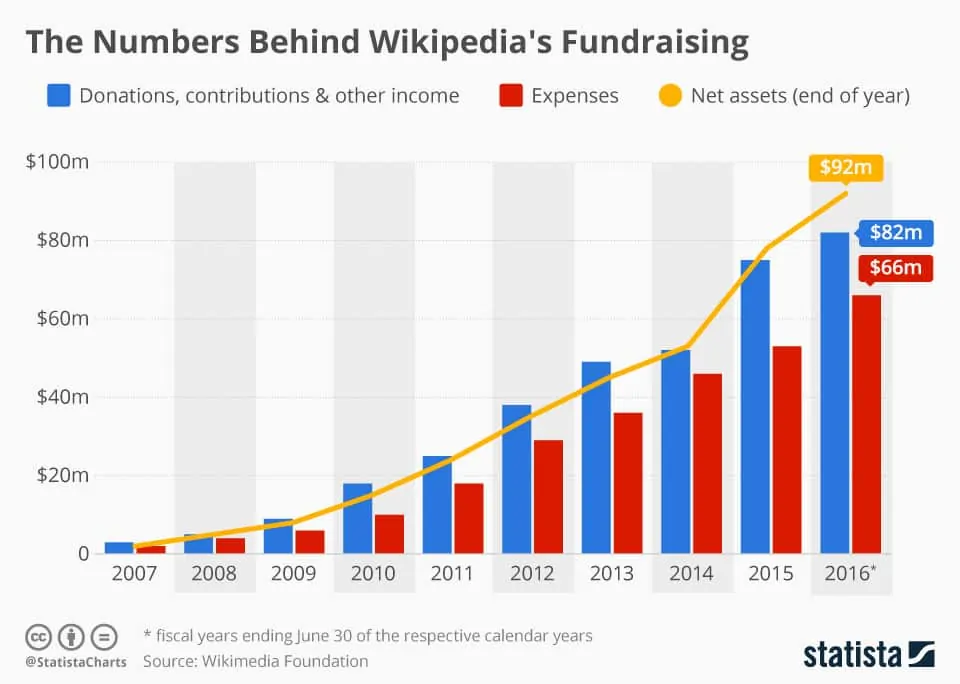
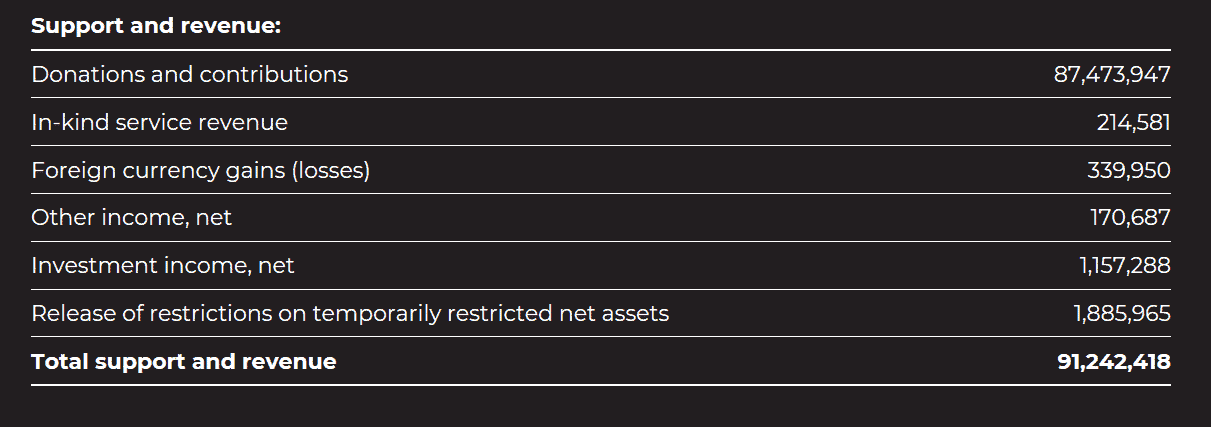
According to its annual report, Wikipedia earned a total revenue of $91 million in 2017 but none of it came from advertisements, affiliates, or any paid service. Then what resulted in the whopping $91 million revenue?
Donations.
Wikipedia Revenue Model
Wikipedia operates on a donation-based revenue model where the organisation gets most of its funds in the form of donations from millions of individuals and corporations around the world.
Besides monetary donations, the other sources of revenue for the organisation includes:
In Kind Services: These are in-kind donations in the form of supplies, equipment, and services.
Wikipedia Store: The organisation sells Wikipedia brand merchandises like tshirts, mugs, notebooks, etc. on Wikipedia’s official store.
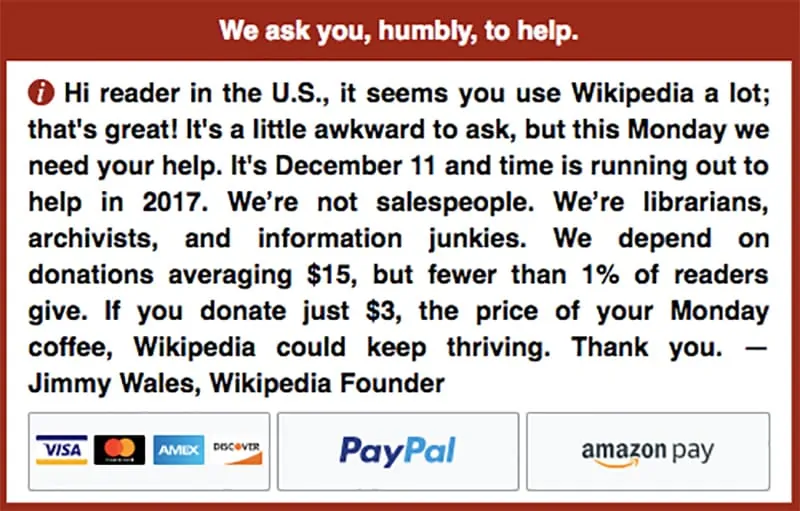
According to the company, the average donation is $15 and is tax deductible in many countries which motivates the users to donate.
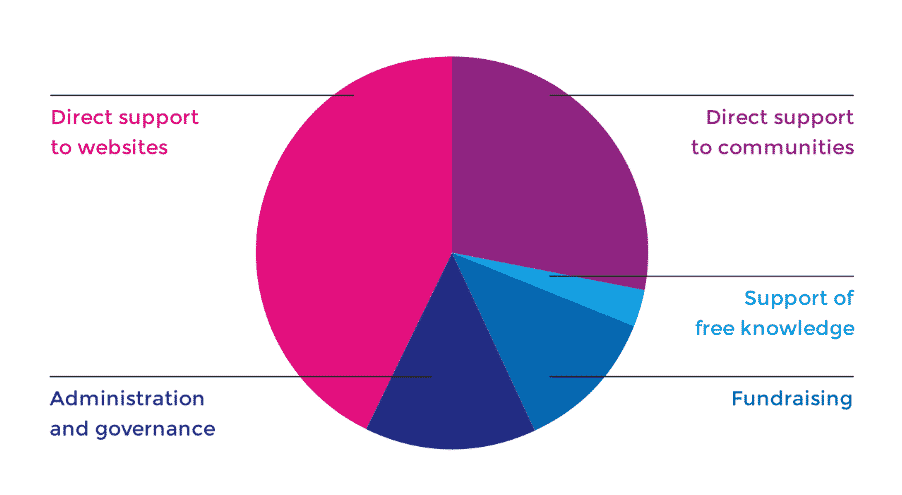
100% of the profits go straight to support Wikipedia and its sister projects. The sources of expense include:
Support to website: These include server costs, ongoing engineering improvements costs, product development costs, design and research costs, and legal support costs.
Awards & Grants: These include costs relating to ongoing engineering improvements, product development, design and research, and legal support.
Administrative & Governance: These include administrative expenses relating to salaries, recruitment costs and other governance expenses.
Fundraising: A part of the revenue is spent to acquire more funds for the organization.
Future Of Wikipedia
The Wikipedia community has grown to a level that ignoring its success is nearly impossible. But is this business model sustainable? Will Wikipedia still exist after 20 years?
The biggest hurdle which the company currently faces is the rise of smartphones. With the rise of smartphones visitors, the number of editors and content creators has decreased. Nevertheless, the company had recently launched a global discussion called Wikimedia 2030 to define the future of Wikipedia and the Wikimedia movement by the year 2030. It has plans to adapt to the shifting trends in the technology, to ensure they meet the needs of their users and continue to provide reliable, transparent, and neutral information.
We will adapt to the shifting trends in technology, to ensure we meet the needs of our users and continue to provide reliable, transparent, and neutral information. We will invite new voices to join us and ensure that anyone who wants to share knowledge on Wikipedia and the Wikimedia sites can do so. And we will advocate for the policies and values that have allowed Wikipedia and its sister sites to thrive. This direction asks us to be bold and experiment in the future, as we did in the past, and it remains rooted in our mission of free knowledge for all.
Go On, Tell Us What You Think!
Did we miss something? Come on! Tell us what you think about our article on how does Wikipedia make money? | Wikipedia business model in the comments section.
Did you check your phone before you started reading this article? Did you browse through your social media feed? Did you enquire about the score? Did you visit the new café everyone was talking about? Did you try the new camera app which makes your face look like a dog’s?
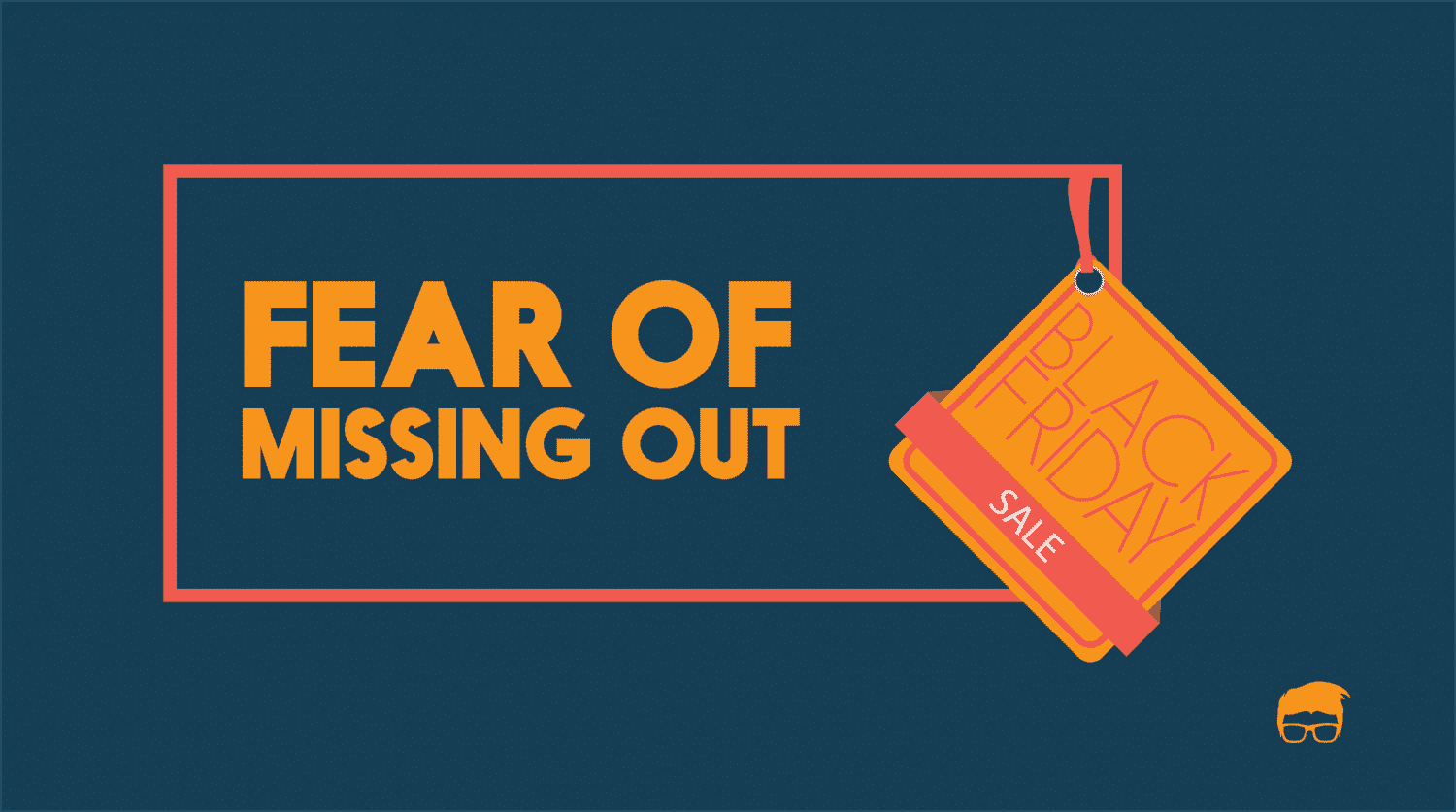
Do you know about the fear of missing out?
Because even if you don’t, there is a possibility that you might suffer from it in one form or another.
Spoiler alert: even your target audience suffers from it. You just need to use the right trigger to capitalize on it.
What is Fear Of Missing Out (FoMO)?
Fear of missing out is a fear or anxiety that something interesting or exciting may be happening somewhere which leads to a compulsive desire to experience it or be there, motivated not by what you’ll gain but by what you’ll probably lose.
FoMO is a social anxiety characterized by a want to know and stay connected with what others are doing and what’s happening around you.
The term was coined in 2004 by Patrick J. McGinnis in an article in an Harvard Business School’s magazine, The Harbus. However, the phenomenon is as old as the word of mouth marketing. Just like today, the fear of missing out was earlier triggered by word of mouth, newspapers and other media outlets. Social media is just a catalyst today.
What Causes Fear Of Missing Out?
People who suffer from the fear of missing out doesn’t always know what exactly they might be missing, but it’s the apprehension that they might miss out something important, interesting, or exciting and will be left out or out of touch with experiences and interactions.
It isn’t what you’ll gain, it’s the fear of loss, sadness, anxiety, inferiority, etc. which you’ll have to suffer in future that causes the fear of missing out.
Haven’t you tried the new app yet? Now you can’t be a part of your friends’ conversations.
Were you late to buy the phone during a flash sale? Your friends who bought it got a chance to flaunt.
Your target market is as prone to the fear of missing out as you are. They check their phones when they get a notification, check their social media feed regularly, read newspaper, watch movies, and try new applications not to get left behind.
This fear of missing out can turn out to be a game changer for your business.
Not many years ago, there was an application which used artificial intelligence to turn your photos into works of art.
Prisma.
The application indeed used a innovating technology, but its success hugely depended on the fear of missing out capitalization strategies used by the company.
It had an inbuilt social sharing feature, used social sharing hashtags to get the followership, influencer marketing to borrow influencers’ followership, and got a lot of (paid and free) press coverage. The application was also initially released only for IOS users which resulted in a capitalization on the scarcity principle and helped in the word of mouth marketing.
Fear Of Missing Out (FoMO) Marketing Strategies
Around 69% of the millennials experience the fear of missing out. 60% of them make reactive purchases because of the FoMO. More than half of the people using social media experience FoMO. This makes FoMO an important topic among the marketers.
But how can you draft an effective marketing strategy which capitalizes on the fear of missing out?
Simple, by using the following strategies.
Scarcity Principle
From flash sales to limited stock to limited period offers and deals, scarcity principle always triggers the fear of missing out and attract more viewers/customers/consumers.
According to this principle, humans consider a scarce object more valuable than the one which is in abundance. Scarcity creates a sense of urgency, triggers FoMO, and evoke people to act immediately.
Network Effecat
Network effect states that the value of a good or service increases when more people use it. That is, a good or service will attract more customers if its value depend on the number of customers. Social media networks like Facebook, YouTube, Twitter, WhatsApp are few examples.
How does the network effect trigger the fear of missing out?
The more people use that good or service, the more likely you’re to try it or you’ll get a feeling of being left behind.
Triggers
You’re more likely to get hit by the fear of missing out when you hear the notification pop on your phone than compared to when there isn’t any trigger. Triggers come in many forms like emails, pop-up notifications, phone calls, word of mouth, etc.
A strong focus on trigger based marketing strategies is beneficial if you’re planning to capitalize on FoMO.
Exclusivity increases the pride of the exclusive users and make non-exclusive users long for the same benefit. This increases the word of mouth marketing. Many restaurants run special discounts and other offers exclusively for their regular members which attract other customers to become regular and experience and see what they’ve been missing out.
Be Explicit
Being explicit about the loss that the user will have to suffer attracts more users than notifying them about the gains.
Go On, Tell Us What You Think!
Did we miss something? Come on! Tell us what you think about our article on fear of missing out in the comments section.
Building a productive mobile application which stands out in the sea of similar applications is a big task. But promoting your application is an another uphill struggle which probably might never end as long as the application exists.
How can you market your mobile application better than the competition? How to build a brand for your mobile application? How to make the target market realise that you’re better than the other players?
…because if you don’t, you might get lost in the sea just like many others.
How To Promote Your Mobile App?
Here is a list of 8 Ways To Market Your Mobile App effectively and efficiently:
Build A Presentable Website And Invest In SEM
Suppose you created an application on face-recognition technology. Wouldn’t it be great if your website appears on the top of the search results when people search for the term ‘face-recognition’?
And what’s better than having a strategic website and a blog which explains the use of the technology and your mobile application and directs the visitors to places where they can download it?
Search engine marketing, content marketing, and other inbound marketing strategies help you gain many new users by building a brand for your application.
List Your Application Product Listing Websites
There are hundreds of websites with millions of users waiting to discover and try your new application. All you need to do is to list your application on such platforms. If your product has the ability to stand out, it’ll surely stand out on these platforms.
Here are few product listing websites where you can list your final or beta version of your application:
App store optimization is as important for applications as search engine optimization is for websites. What’s better to promote your mobile application than making it rank at the first position for the desired keyword?
App store optimization involves:
Naming your application in a strategic way
Using appropriate keywords
A description which triggers the target consumers to buy
Getting good rating and reviews.
There are many other factors local preference, number of downloads, the reputation of company, language etc. which decide your position for the keyword but the ones mentioned above are of utmost importance.
You can also target more than one app-store for your application.
Focus On Getting Reviews From Trusted Websites & Influencers
Websites like Android Central, Android Police, App Brain etc. offer free and paid review and promotion of your application. You can opt to get reviewed on these platforms as these websites influence the behaviour of millions of users and offer an in-depth review of your mobile app.
Don’t Ignore The Power Of Social Media Marketing
Another great marketing strategy is to engage with your target audience on social media. The best way to promote your application on social media is to address their problems in an medium which is most engaging. Go live on Facebook. Start real-time hashtag conversations on Twitter. Make infographics and pin it on Pinterest. Make industry relevant videos and post it on YouTube. Join hand with influencers and borrow their followership.
But most importantly, make sure all your social media profiles link to your mobile app.
Press Release
This is a costly mobile application promotion strategy. Nevertheless, a press release has a very wide reach. It’ll reach your target audience, bloggers, news channels, and other influencers at the same time.
Advertisements
Targeted advertisements work best when you have a target market oriented marketing strategy. Use Google Adwords to target keywords on play store and Google.com. Use Search Ads to run similar ads on App Store. Run a targeted advertisement on Facebook and Twitter to target the users of your competitor application, those who are interested in your niche, and other prospective users.
Plan An Affiliate Strategy
An affiliate program is a strategy where you offer your users, bloggers, or any third party a monetary or non monetary benefit for every person they refer to your application.
Many games including Candy Crush Saga use this strategy to increase its user-base.
Go On, Tell Us What You Think!
Did we miss something? Come on! Tell us what you think of this article on How to promote your mobile app in the comment section.
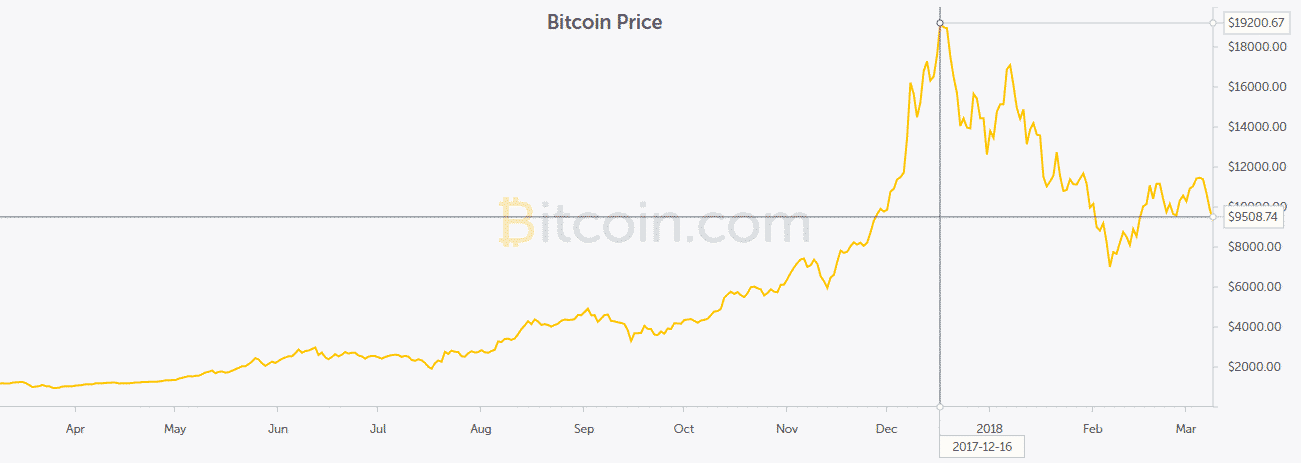
“Did you hear about Bitcoin? It’s an insane investment! I invested $100 and earned more than $1000. Can you believe that?”
Welcome to the era where every marketer aims at creating a buzz around his product.
Why?
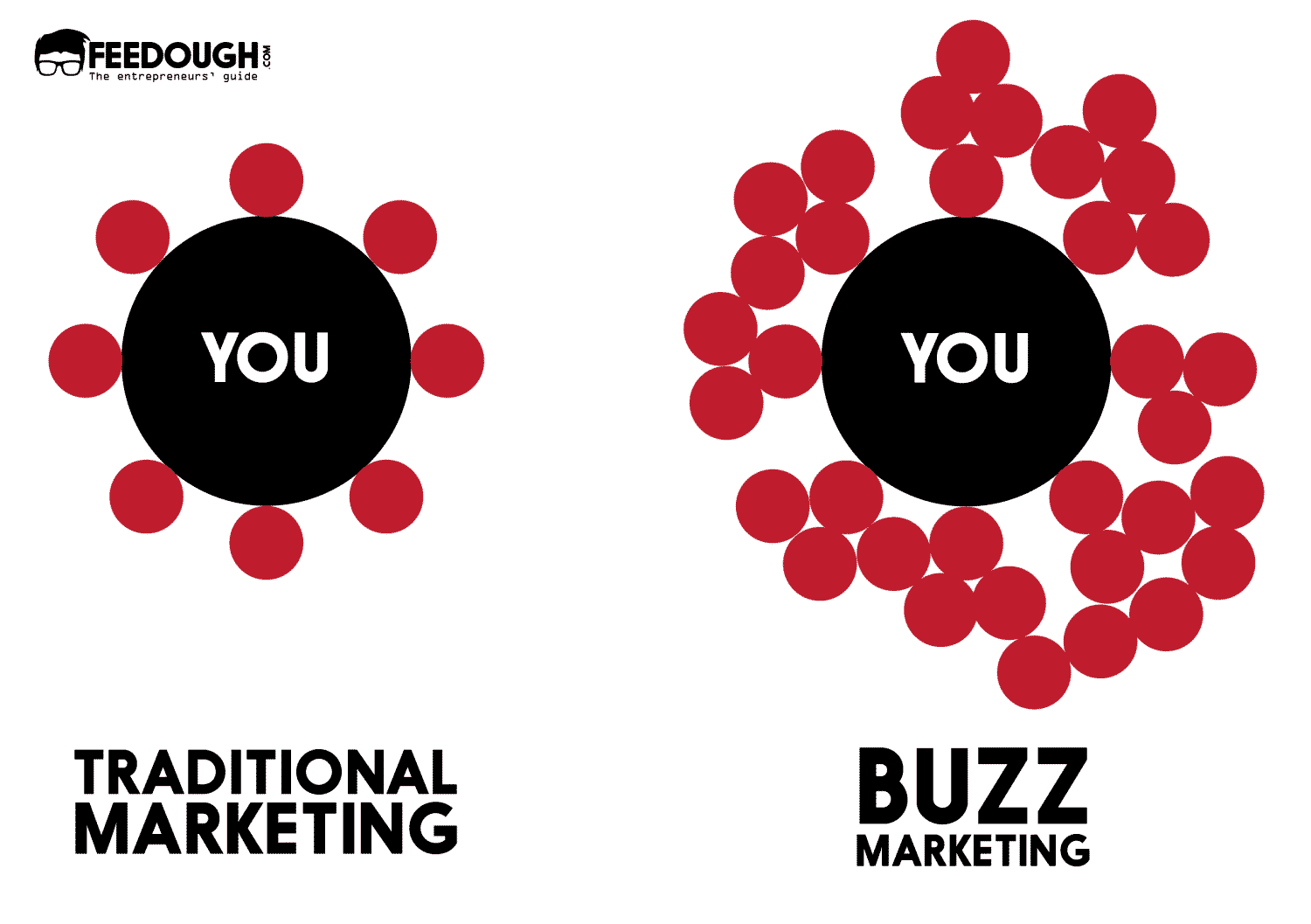
Average human witnesses around 5000 marketing messages daily, out of which very few marketers get to monetise their attention. Buzz marketing helps you to bombard the user with 100x (or 1000x) more marketing messages than you usually would have. All thanks to his friends, family members, friends of friends, social media, blogs, news channels, and influencers.
When did you hear about Bitcoin first? Was it in the second half of 2017?
What Is Buzz Marketing?
Buzz marketing refers to marketing strategies used to capture the customers’ attention and other influencers to amplify the marketing message to an extent where talking about the brand, product, or service becomes entertaining, fascinating, and newsworthy.
It is a subset of viral marketing and word-of-mouth marketing. But to understand it to the fullest, it is essential to understand the meaning of the word buzz. A buzz is a trigger that results in the word of mouth marketing. It can be an idea, a phrase, a tagline, a logo, a mascot, an advertisement, or any other trigger which makes people talk about the brand or its product.
Buzz starts conversations. It is a great/different/weird idea or a story that others are willing to share.
Buzz marketing is different from traditional marketing communication. It involves creating a trigger which spread out to the masses as it leads to:
Word Of Mouth Marketing
Word of mouth marketing starts with buzz marketing. It involves planning a buzz so well that motivated, satisfied, or impressed people in your target market start spreading your message voluntarily.
Fear Of Missing Out
No one wants to feel left out in this digital era triggered by social media. Not having a piece of vital information or having a feeling that one is not a part of the ‘in’ group releases enough psychological stress that acts as a threat to them. This makes the buzz easier to convert into word-of-mouth marketing as it has more conversational value. Plus, social media acts as a catalyst.
Baader-Meinhof Phenomenon
Baader-Meinhof Phenomenon is a situation where one stumbles upon an unfamiliar word, name, or buzz and soon afterwards reencounters the same subject, often repeatedly.
It’s the phenomenon which makes you say, “I recently heard about it, and now it’s everywhere.”
Buzz marketing sends you the same message through different channels, which makes you experience this phenomenon quite often, and the message sticks to your mind.
Is buzz marketing important? Well, when 83% of consumers trust recommendations from their peers over advertising, how unimportant could it be?
Focus More On People And Less On Product
Even though your brand or the product is in the spotlight, people have a more significant role in creating a buzz around it. The only way you can succeed in creating a buzz is to focus all of your marketing communication strategies on your target market’s needs, wants, interests, hobbies, etc.
Use Influencer Marketing
It’s a proven fact that people trust influencers more than any advertisement. Using influencers to your benefit can help you get the attention of their followers in a positive way.
Use The Scarcity Principle
The scarcity principle is brand-induced scarcity to create a mismatch between the demand and supply of the product. The phenomenon is on the rise with the increased popularity of flash sales on ecommerce websites as it increases the demand and creates a buzz around the product.
Scarcity techniques like flash sales, limited period offers, use it or lose it offers, limited users offers, etc. can help you create a buzz around your product and increase its demand.
Capitalise On The Network Effect
The network effect refers to a situation where a product or service becomes more valuable when more people use it. Creating a buzz around a product that capitalises on the network effect is easier as the network effect itself is a type of buzz.
For example – the more people use WhatsApp messenger, the more valuable it becomes to the users and the easier it is for the company to attract more customers.
Other Buzz Marketing Strategies
A brand can use many different buzz strategies or buzz buttons to create a buzz around itself or its products and services. These buzz buttons are:
Guerrilla marketing (using creative, imaginative yet unconventional marketing tactics to get maximum reach and better results without involving high costs and resources)
Suspense (creating suspense around its product)
Taboo (Breaking taboos)
Humour (Using humour which can be used by customers in their conversations)
Secrets (spreading out rumours or secrets)
Unexpected (A soft-drink brand making an advertisement on obesity due to soft drinks)
Extraordinary customer engagement, etc.
Buzz Marketing Examples
The 2017 Oscars created a lot of buzz when ‘La La Land’ was accidentally announced as the best movie instead of ‘Moonlight’. Why? Because it was unexpected in such a reputable award function. There are many other examples where the brand created a buzz.
The Honest Coca-Cola Obesity Commercial
Coca-cola was in the news, on social media, and in the title of many blog posts when it released the honest coca-cola obesity commercial where it accepted the fact that coca-cola causes obesity.
Tiger Woods Jesus Shot
EA games launched the Tiger Woods PGA Tour 08 game with an intriguing yet entertaining shot called the Jesus shot, where Tiger Woods would go into the water to play the shot. Later it was revealed that this feature was intentionally added to create a buzz around this game.
Mini Cooper Boxes In Amsterdam
Mini Cooper, to promote its 99€ a month finance deal during Christmas, executed a guerrilla campaign where it featured packing boxes in prominent locations around Amsterdam. This created a lot of buzz around the car in 2009.
Go On, Tell Us What You Think!
Did we miss something? Come on! Tell us what you think about our article on Buzz Marketing in the comments section.
Not so long ago, there was an idea to digitize and decentralize every monetary transaction. Today’s idea is to remove every middleman and use cryptography and peer to peer networking to conduct financial transactions, file sharing, cloud computing, banking transactions, transactions among the internet of things, and creating a platform for such transactions etc.
Cryptocurrency. Bitcoin. Decentralisation. Ripple. Ethereum. Mining. Smart Contracts. HODL. Our vocabulary has substantially increased within a really short span of time.
Ever since the introduction of bitcoin in 2009, a new era of cryptoassets has started. But what exactly is a cryptoasset? Is it any different from cryptocurrency? What is a cryptocurrency anyway? How do cryptoassets and cryptocurrencies work? Why is every company and country launching its cryptoasset? Will it replace the current monetary and non-monetary system?
Let’s answer all of your FAQs in this ultimate guide to cryptoassets.
What Are Cryptoassets?
Cryptoassets are digital assets that utilize cryptography, peer to peer networking, and a public ledger to regulate the generation of new units, verify the transactions, and secure the transactions without the intervention of any middleman.
Wait.
Wasn’t it a cryptocurrency and not a cryptoasset?
Yes. It all started as a cryptocurrency when bitcoin was launched in 2009. But things have moved a bit forward since then.
Cryptocurrency vs Cryptoasset
Bitcoin was launched with an objective of becoming a new type of open and publicly accessible currency that used blockchain, cryptography, and peer to peer networking and derived its value from its status as a new type of money that can be sent, received, and earned through the participation in the blockchain. Its value depended on its demand and supply just like that of any currency in the global economy.
A crypto asset is a blanket term that isn’t limited to cryptocurrencies. It is a tokenized asset that is issued in a public ledger, that doesn’t necessarily derive its value from the chain and whose application isn’t necessarily payments. It includes cryptocurrencies, utility tokens, platform tokens, and tokenised securities.
Why The Name Cryptoassets?
An asset is anything that functions as a store of value. Cryptoassets got their name for the simple reason that they can store value and can be converted into cash as and when needed. Plus, benefits can be derived from cryptoassets by holding them or using them over a period of time.
How Cryptoassets work?
Cryptoassets are encrypted assets that use peer to peer networking and a public ledger to execute and secure the transactions.
One of the most important aspects of cryptoassets is their supply. The supply of a cryptoasset is often the determinant of its utility and value. While some have a finite total supply, many are launched with infinite total supply. But this doesn’t mean that the coin with an infinite supply will be of less value. A cryptoasset’s supply can be divided into three types:
Circulating Supply: It’s the amount of coin available at present time and circulating in the market.
Total Supply: The total supply is the amount of coins that are already in existence (whether in circulation or not)
Maximum Supply: It is the maximum amount of coin that will ever exist for a particular cryptoasset.
Different cryptoassets are developed with different algorithms based on their use case. Some are launched with the maximum supply and reduce with increased usage (ripple), some are launched with a less circulating supply and are mined with every transaction to reach the maximum supply (bitcoin), while some are launched with a total finite supply and are earned by processing every transaction (ether).
No matter what the algorithm is. The differentiating factor of every cryptoasset is the distributed ledger which stores every confirmed transaction. This public ledger is usually called a blockchain.
Types Of Cryptoassets
Currently, there are thousands of companies offering thousands of cryptoassets having varied utility. Monero is a digital decentralized currency that focuses on the privacy of the parties involved. Ethereum is a decentralized blockchain-based application platform that runs on smart contracts. Kodak has recently launched its cryptoasset which can be used by photographers to register their photos through blockchain. Spotify has purchased a similar technology for music licencing. Siacoin is developed with the objective of creating a network of data centres where people can offer their unused hard drive space to become a part and earn money. Steem is a blockchain-based rewards platform that uses smart media tokens (SMT) to monetize publishers’ content and grow the community.
All these cryptoassets can’t be labelled as cryptocurrencies for the simple reason that they aren’t created with a motive of replacing money. Therefore, it is important to divide them based on the characteristics they possess.
As of March 2018, there are around 1500 cryptoassets which can be divided into 4 categories according to the technical layer, use-case, value dependency, utility, and legal status. These four types of cryptoassets are:
Cryptocurrencies
These are the most well-known native blockchain assets with only the basic characteristics as those of a fiat currency, but are decentralized. The only purpose of these cryptoassets is to act as money or digital currency which offer a more secure and decentralized experience to the users. Most modern-day cryptocurrencies are focused on providing even a faster experience than fiat transactions.
The value of cryptocurrencies depends on:
The total and the circulating supply
Demand of these coins
Rate of new coin generation
Blockchain they’re based on
The utility of every cryptocurrency isn’t the same. Some coins like Monero with unlimited supply and more focus on privacy tend to become an alternative to fiat currency, while other native cryptocurrencies like Bitcoin with limited supply has been and will be acting as a good investment option like Gold.
Even though many cryptocurrencies aren’t backed by the government, these are backed by the peer to peer network mining powered by millions of computers, the processing power of which is six to eight times greater than top 500 supercomputers combined.
Many countries like Venezuela and Russia have even launched their own government-backed cryptocurrencies to capitalize on the power of blockchain.
Examples Of Cryptocurrencies
Cryptocurrencies brought the concept of cryptoassets to the world. Some renowned cryptocurrencies are:
Bitcoin
Monero
Dash
ZCash
Bitcoin Cash
Platform Tokens
The second to the list of types of cryptoassets are the tokens that make thousands of other cryptoassets possible. As the name suggests, these cryptoassets are designed to act as a platform for other decentralized projects.
Unlike the current scenario where the information is stored on servers operated from one place and controlled by a single company, these cryptoassets use blockchain technology to build a database that is distributed among all the computers present on that blockchain. This overcomes the limitations of traditional servers as the database cannot be shut down or damaged as long as the computers are contributing to it as every transaction requires different computers to verify it to remove any inconsistency.
Cryptoassets like Ethereum add a layer of technology called smart contracts which is a computer code that must be fulfilled to complete the transaction. This lets other cryptoassets built on such platforms specify their own self-enforcing and self-executing smart contracts on the blockchain.
The value of these tokens increases with the increase of their usage by other cryptoassets as these are used to pay ‘gas’ to access the platform. There are a total of 46310 Erc20 Token Contracts (Ethereum smart contracts) as of writing this article. No wonder, Ethereum is the second most valuable cryptocurrency after Bitcoin.
Examples Of Platform Tokens
Platform tokens are the most reliable set of cryptoassets. Some of the examples of platform cryptoassets are:
Ethereum
Ethereum Classic
Neo
EOS
New Economy Movement
Utility Tokens
Utility tokens (also called protocol tokens) denotes decentralized services or units of decentralized services that can be bought, sold, and earned. Just like any real-life service token, these tokens can be exchanged for specific services like distributed storage, video game currency, etc. That is, these tokens are developed with a specific use case in mind and act as an API key that is used to access a specific service.
Suppose you plan to launch a video game that will involve the use of an in-game currency. This in-game currency can be launched as a utility token to the world at the time of an ICO to raise money for the project. Investors (future users, speculators, etc.) usually tend to invest in these assets at the time of the ICO because their price is much less than it’ll be in future.
These cryptoassets are usually released before the actual project is even started or when the project is in its MVP or beta stage. Hence, their initial value is influenced by their demand in the market which is influenced by the team’s ability, PR, and progress.
Unlike cryptocurrencies, the utility of these tokens doesn’t depend directly on the blockchain (most of them are based on platforms like ERC20) and is directly derived from their use case.
Examples Of Utility Tokens
From decentralized storage to decentralized assets to decentralized payment platforms, cryptoassets have started to disrupt every industry. Some of the examples of utility cryptoassets include:
Golem
Sonm
Siacoin
OmiseGo
Augur
Transactional Tokens/Payments Tokens
Financial institutions and banks are still very slow when it comes to cross-border payments. They depend on years old technology facilitated by SWIFT which involves six different parties and KYC and AML requirements.
Transactional tokens are cryptoassets launched to solve this inter-border transactional problem. One of the great examples of transactional cryptoassets is Ripple. Ripple is a global real-time settlement network that connects different banks and financial institutions around the world without requiring beneficiaries or other intermediaries. It enables cross border payments within banks within seconds while providing them with an end to end visibility throughout the whole process. Take it as a platform used by banks and other financial institutions to power new payment services.
Similar transactional and payment tokens are released with more focus on individuals and corporates as their target audience. Stellar uses lumens as the facilitator of transactions, IOTA uses the internet of things to handle micropayments, Metalpay uses blockchain to transfer money across the world with just a phone number.
The payment cryptoassets can be further subdivided into two categories:
Blockchain Based Transactional Tokens
Blockchain-based transactional tokens are the 1st and 2nd generation blockchain tokens that depend 100% on blockchain to conduct, execute, and secure the transactions.
Examples Of Blockchain Based Transactional Tokens
Unlike cryptocurrencies, many of these cryptoassets don’t violate most of the Government policies and are even looked upon as a stable investment.
Ripple
Stellar
Internet Of Things Based Transactional Tokens
There has to be a different category for tokens operating on the internet of things as these have opened an all-new spectrum of the decentralized economy by focusing on the machine to machine transactions and microtransactions.
How this cryptoasset is different from the ones mentioned above?
Instead of using blockchain to handle transactions, this technology uses a directed acyclic graph (tangle) to handle every transaction. According to a study, there will be over 75 billion internet of things connected devices in 2025. This technology uses this internet of things to process all the transactions which have the following advantages:
Zero transaction fee
Possibility of microtransactions
Examples Of IOT Based Platform Tokens
IOTA
VeChain
The Potential Of Cryptoassets
Facebook is planning to launch its cryptoasset. Starbucks is trying to integrate cryptocurrencies for cashless transactions. Venezuela has launched its own national cryptocurrency. Kodak is coming back to the photo industry with the launch of KodakCoin. Spotify bought a cryptoasset startup, Mediachain, to simplify music licencing (and avoid future penalties).
Do you see what’s going on in the world?
Bitcoin may not be the next gold but cryptoassets are definitely the future. Most of the cryptoassets we know today are still in their introductory stage. Most of them are still ideas that have a lot of potential to grow. Golem is developing a supercomputer using the unused processing power of the computers of the members. IOTA plans to delve into things ranging from shoes to big machines making communication, data collection and microtransactions possible. Stellar and Ripple have revolutionized how banks conduct inter border transactions.
Will cryptoassets replace the current monetary and non-monetary system?
We don’t know. But what we know for sure is that it’ll surely become a substantial part of it. With such disruptive technology in our hands, ideas that just dreamed could become true.
Go On, Tell Us What You Think!
Did we miss something? Come on! Tell us what you think about our article on Cryptoassets [The Ultimate Guide] in the comments section.
A good user experience is a must for the success of a product. That is why UX has become so important nowadays. But do Product Managers need to be masters of UX design?
Product Managers have to interact a lot with designers in their day-to-day job. Designers tend to think about the user experience and flow much more than Product Managers but what they miss out on is the product strategy for the long term, business needs, allocation of the limited resources available etc. That is why it is necessary that Product Managers and UX designers work in tandem to deliver a great product to the consumer.
Making good decisions as a Product Manager requires one to have, out of many other things, a keen sense of interaction design. The focus of a Product Manager should be to deliver a product that keeps on simplifying the user experience with every iteration, yet keep on innovating as well.
So as someone who drives the entire process, what UX design skills should a Product Manager possess? Let’s find out.
User Modelling
As a Product Manager, you should be able to create personas with their name, picture, characteristics and objectives or goals. These personas should be as realistic as possible. Personas help you understand your end-consumer and what they want from your product, in more depth.
Visual Design Elements
Knowing and understanding basic visual design elements can help you communicate with the designer more effectively. You will start understanding the trade-offs in visual design and how the UX team makes its decisions. If you want to provide better feedback about visual design or just want to be taken seriously as a Product Manager, it is always better to discuss design in terms of the typography, hierarchy, legibility, alignment etc. instead of just saying that the text is too small or the shape of the logo does not look right.
Source: www.talonx.com
Interaction Design
A Product Manager has to know the overall architecture of a site or app and how information flows through the different pages or activities of the product. As a Product Manager, you should know these so that you can provide constructive and meaningful feedback to the UX team. You should be comfortable with wireframing, storyboarding and user journeys.
User Research/Product Validation
A great Product Manager is also a great customer advocate, who understands his customers and what they truly want, very well. He empathises with them and brings their pain points forward to solve them. Thus as a Product Manager, you would need great user research skills to generate insights for your product. You need to be good with A/B testing, usability testing, product demonstrations etc.
Functionality
It matters a lot for your customers to find your app functional, almost as much as the interaction design. When I talk about functionality, I mean operability here. How quickly does your app open, how much does it lag during peak performance, how smooth is the transition between screens etc. are questions you should be able to ask and then answer too for the sake of your customer.
Design Sense/Taste
The best Product Managers have impeccable design sense/taste. One does not need to be a great designer for that but the ability to recognise great design should be present.
How do you do that? Simple. Go through all sorts of design and try to understand what makes them good or bad. Thinking critically about design will eventually help you hone your skills and make the right design decisions.
The whole idea behind Product Managers understanding and being good with elementary design principles is that they can give meaningful feedback to the UX designer when it is needed. The feedback should be related to the end-user or the product. A Product Manager shall earn the respect of the UX designer only if and when his feedback helps better the product. A great Product Manager also would not micro-manage the UX team for the simple reason being that they know their job better than he does. He makes the work of the UX team easier by facilitating the process and understanding the customer’s needs thoroughly instead of being a bottleneck. A little respect from one side can earn the respect from the other side as well.
Go On, Tell Us What You Think!
Did we miss something? Come on! Tell us what you think about our article on 6 Basic UX Design Skills Every Product Manager Should Havein the comments section.
Effortlessly put, business valuation entails a process and a set of steps to determine what business values up to. While this may seem simple, getting your enterprise valued the right way turns out to be difficult than expected.
Business valuation results depend on your assumptions.
For what’s worth, there isn’t a particular prescribed manner how to value your firm. Since valuation of a business means something different to different people, you cannot expect to do justice to your firm if you value it yourself.
Additionally, economic conditions have a significant impact on the financial worth. For example, when the economy struggles with unemployment, more buyers invade the market and tough competition leads to higher selling prices.
Business value fluctuates as per scenario of sale too. There lies a big difference between a business which is a gimmick under a systematic marketing effort and a quick winding up of assets at an auction.
Hence, worth of a business is essentially an anticipated price the firm would account for during the sale and/or wind up. The actual price may differ owing to peripheral factors like who ascertains the business value. The selling price shall also depend on how the sale gets executed. An auction and planned deal aren’t the same, are they?
Business Valuation Methods
Analysts basically adopt 3 common methods to value business firms:
Asset Approach
Market Approach
Income Approach
Asset Approach
This views the firm as a combination of assets and liabilities that comprise the total business value. This approach derives its foundation from the economic principle of substitution which caters to the question:
What will be the cost of creating another business like this, that will produce the same economic gains for you?
We do not know of a business that operates without a demarcation of assets and liabilities in the firm. This kind of unanimous way of operation facilitates us to derive the business value as the difference between the market value of assets and liabilities. This sounds simple, but the details pose the challenges: labelling assets and liabilities in the process of valuation, standardized value measurement, and final ascertainment of asset/liability’s worth.
Market Approach
The name of the approach implies that this approach relies majorly on the innate forces of the market to determine firm value. The economic principle of competition applies:
What is the worth of businesses similar to yours?
No business can operate in a vacuum. If you are doing something lucrative as an economic model, there is an extreme likelihood that there are other players in the market doing a similar thing. So if you are planning to buy a player or sell your enterprise, you decide the type of business you are inclined towards and look around to see what is the expected worth for such an enterprise.
It is intuitive to assume that the market shall settle at some price equilibrium – something that shall be acceptable to both buyers and sellers, which boils down to the following assumption:
The price that a willing buyer shall pay for a firm, and a willing seller will accept for the business. Both parties are assumed to act in full knowledge of all relevant facts and are not under compulsion to execute the sale.
Income Approach
This approach takes into account the core reason for running a business – money. The economic principle of expectation rules the approach with the following doctrine:
If you invest time, money and effort into your business, what economic benefits do you expect and when will they materialize?
Ascertain the future expectation of economic benefits from your business. Since the return is yet not in your bank, some measure of risk stays positive in the scenario. Also, in addition to figuring out what kind of gains the business is likely to fetch, the income valuation also factors in the risk.
Since the firm value must be established in the present, the expected income and risk must be discounted up to today. The income approach uses two ways to do this:
Capitalization
Discounting
Business Valuation By Direct Capitalization
In its simplest form, capitalization basically divides the business’s expected returns by the rate of capitalization. The idea is that the firm value is essentially the earnings of the business and the capitalization rate relates the two.
Valuation Of A Business By Discounting Its Cash Flows
Discounting works a little differently: step 1, you project the firm’s income stream over some future period, usually years. Next, you determine the rate at which the streams shall be discounted, reflecting the risk of getting this income on time and taking into account the time value of money at the same time.
Last, you chalk out what the business will be worth at the end of the projection period. This is called terminal value for the firm.
The discounting calculation gives you the present value of the business.
Business Valuation And Risk
Since both the methods for income valuation follow a similar algorithm, you can expect similar results. As a matter of fact, the capitalization and discount rates are numerically related:
CR = DR – K
Here: CR is the rate of capitalization and DR is the discounting rate. K is the expected growth rate in the projected income stream.
Hitherto, what starkly differentiates capitalization from discounting is the income input used. Capitalization uses a single gain measure such as the average of earnings over a period of time. The discounting, on the other hand, is done on a set of income values, one for each year in the projection period using discounting factors depending upon annuity conditions or otherwise.
If your business tracks steady profits every year, the capitalization method is a suitable alternative. For a growing business with rapidly fluctuating and less predictable returns, discounting gives accurate results.
Can business valuation fetch varied results?
Yes indeed! Consider two prospective buyers doing income projections and assessing the risk of acquiring a business.
Each buyer is likely to have a different perception of the risk present, therefore their capitalization and discount rates shall also differ. The two buyers may have different anticipations for the business, which shall affect how they project the income stream over the future period they consider, which shall vary as per their business ambitions.
Hence, even if they use the same valuation technique to value the firm in question, the result may be quite contrasting. This flexibility of measuring the business worth to match one’s objectives is one of the greatest strengths of the business valuation as a branch of finance, making it a service that should always be executed by a third party and not the owner itself.
Go On, Tell Us What You Think!
Did we miss something? Come on! Tell us what you think about our article on Business Valuation Methodsin the comments section.
What comes to your mind when you read the word ‘Subscription’?
Is it Newspaper? Gym? Internet? Reader’s Digest? Or is it Netflix? Spotify? Dollar Shave Club? Amazon Prime? Ipsy? Blue Apron? Weight Watchers?
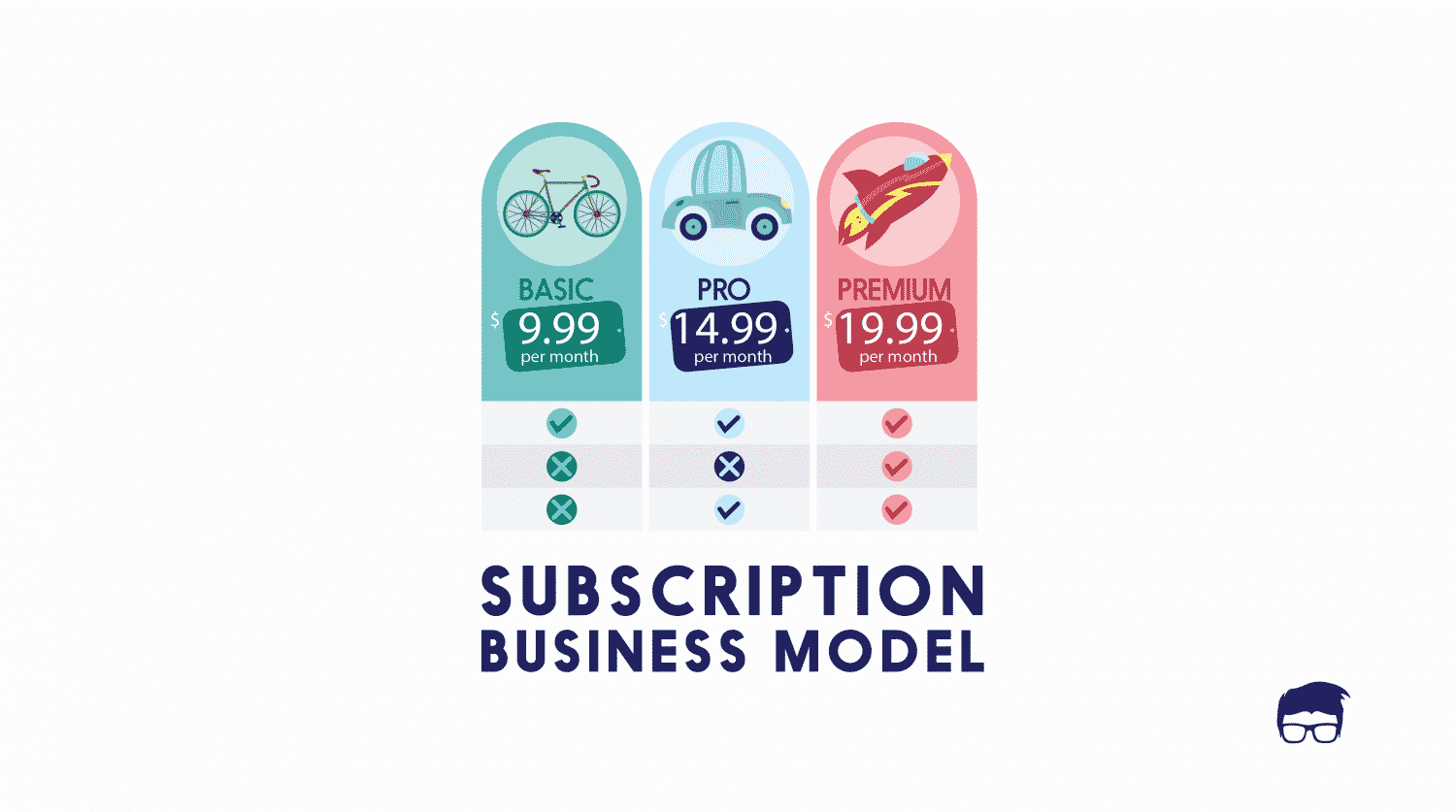
The subscription business model is booming. More businesses are trying to sell their products and services to customers through subscription plans than ever before. According to Digiday, there was a 2963% growth in the total monthly visitors to subscription box sites between January 2013 and January 2016. The overall subscription industry is growing at an annual rate of whopping 200%.
Let’s dive more into this membership economy to know more about what made it attract millions of users within just a few years.
What Is Subscription Commerce?
Subscription commerce refers to trading activities where the customer receives the product periodically or have periodic access to the services by paying a subscription fee.
Instead of conducting a repeated purchase of the same product, the customer pays for a subscription plan where he gets the product delivered to him automatically after a certain time period. The customer either pay for the future use in advance or allow the seller to deduct the subscription amount from his account and maintain an uninterrupted supply of product or service.
The Subscription Business Model
The subscription economy is not the same as it was 20 years ago. The business model has moved forward from newspapers, magazine, DVDs, and has disrupted the ecommerce sphere. From shaving razors to socks, from movie streaming to harry potter collectables, there are over 2000 consumer focused subscription businesses operating in the USA alone.
The easiest way to understand how subscription business model works is by examining the magazine business model where the companies instead of selling the product as a one-time purchase, offer the customers to purchase a periodic subscription of the magazine which ranges from few months to few years. The offer is crafted in such a way that it is a win-win situation for both the parties as the customer gets a discount on purchasing a longer-term subscription and the company gets a loyal customer who’ll not go anywhere till his subscription lasts.
Today, this business strategy has become a backbone of many industry giants like Netflix, Spotify, and thousands of subscription box startups too.
How Subscription Business Model Works?
One of the biggest advantages of having a niche subscription model is the presence of loyal customers. This makes the working model of a subscription business different from the traditional trading model as there are many new costs and revenue streams added to the system.
SAC: SACis the subscriber acquisition cost which is the aggregate cost (marketing costs + outsourcing cost + other costs like sales commissions, installation, etc.) of acquiring one subscriber.
MRR: Monthly recurring revenue is the amount of fixed revenue retained every month. It is a measure to calculate how well are the subscribers retained in the business. It is calculated by multiplying net users per month by the subscription fee.
Churn: Churn refers to the revenue lost and subscribers who’ve left. It is calculated by multiplying net users left per month by the subscription fee.
MRC: Monthly recurring costs are the cost incurred to earn the monthly revenue. These include expenses like customer care operational costs, customer complaints handling costs, etc.
LTV: Lifetime Value(LTV) is the total revenue earned per subscriber.
The economics of subscription business model is not much different from other business models. But the revenues are somehow more predictable. Suppose you provide a service for $100 per month for which your costs are $50. This result in monthly cash flow of $50 per user. But there are MRR churns which should be kept in mind while calculating the LTV. Let’s assume your monthly churn to be 2%. Take 1 and divide it by 2%, which gives you average customer months to be 50. This 50 months when multiplied by $50 monthly cash flow, results in an LTV of $2500 per customer. But we haven’t subtracted the subscriber acquisition costs till yet.
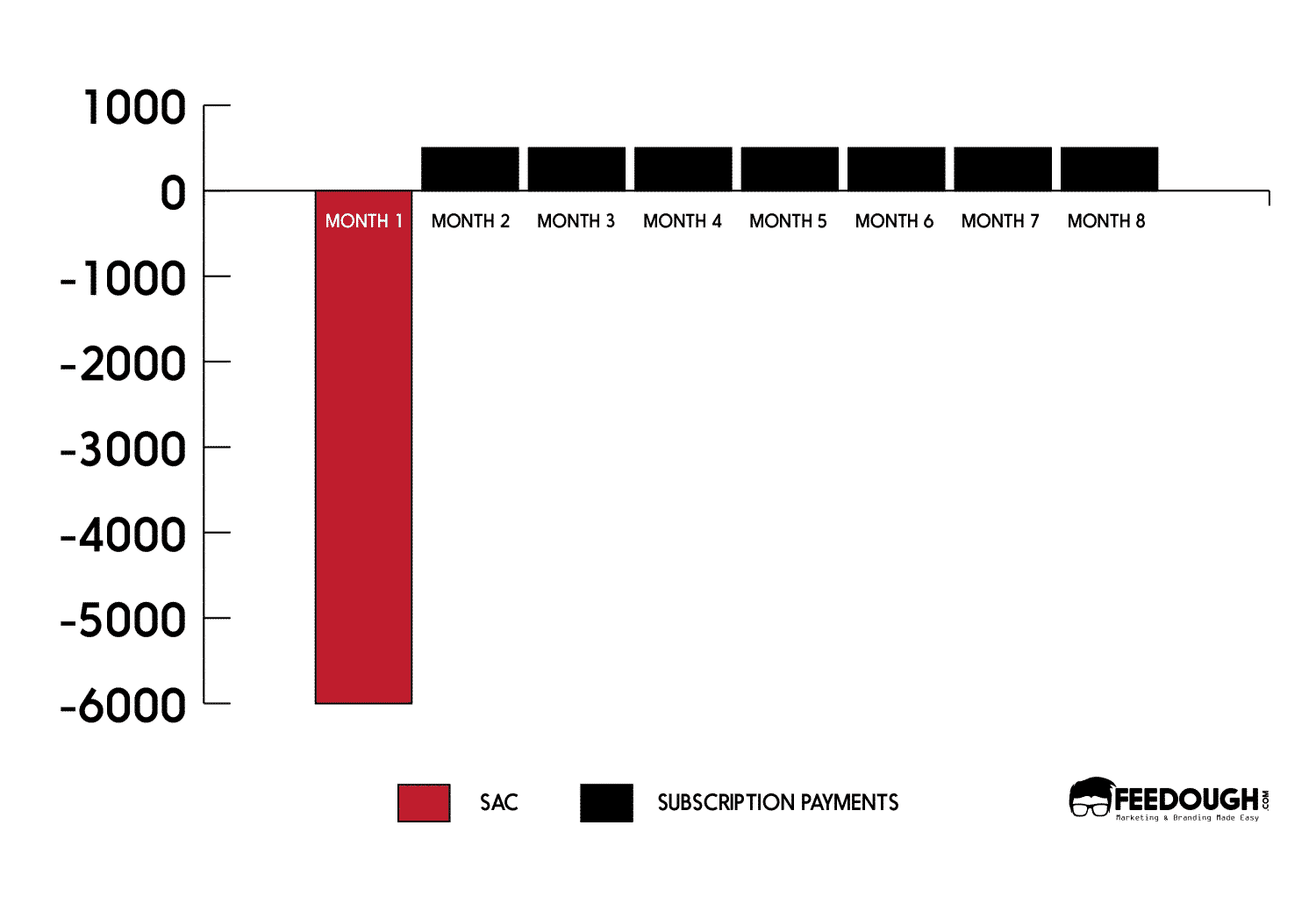
The SAC per user can be calculated by adding up all the costs related to marketing, sales, outsourcing, pieces of equipment, and third-party services by the number of users in this particular time period. Suppose SAC comes to be $1000 per user. This results in a profit of $1500 ($2500 – $1000) per user, which is great.
But there’s one setback to this model. You don’t recover most of your costs in the initial months of the service, which requires you to invest a lot in the initial months of your business.
The Rationale
The evolution of membership economy along with the evolution of e-commerce has brought a revolution in the retail industry. As customers are becoming busier day by day, this new model looks to be the most convenient way of conducting trade to them.
The vendors find it more appealing as there is no easier way to find a loyal customer than to offer him a subscription package. Plus, subscriptions are the new trend in the market.
Benefits Of The Subscription Model
The subscription-based business model has many lucrative advantages for both the parties.
To The Customers:
It is a convenient trade as they don’t have to order again and again.
Consistent monthly pricing helps them plan their budget accordingly.
They even get discounts on purchasing the subscription of some products or services.
To The Vendors:
The fact that a customer has to act to disconnect his subscription is an advantage as most of the times, inertia is in the vendor’s favour.
The consistency of revenue is also a plus point for the vendor as he doesn’t see the massive swings in revenue and can plan and implement his strategies very well.
Go On, Tell Us What You Think!
Did we miss something? Come on! Tell us what you think about our article on subscription business modelin the comments section.
Hey, I'm Aashish
Each week I share research backed AI oriented content in my newsletter.
There are AI ideas, AI trends, tutorials, and guides.
24k entrepreneurs read it. I'd love you to join.
















![What Is A Cryptoasset? Types Of Cryptoassets [Ultimate Guide]](https://www.feedough.com/wp-content/uploads/2018/03/cryptoassets-02.png)