
Feedough Logo

Blog

  • What Is Brand Recall? – Importance, Measurement, & Strategy

    What Is Brand Recall? – Importance, Measurement, & Strategy

    Every brand today wants to connect with the target audience like a pop song. But given the fierce competition and clutter in almost every industry, gaining such brand loyalty has become more than a simple task. The customer today is relatively more knowledgeable and aware and requires much more effort from the brand’s side to win his loyalty.

    While different marketers have different solutions to overcome this obstacle, many believe developing strategies to enhance brand recall to be the best option.

    Here is a complete guide explaining what is brand recall, its importance, its strategies, and how to measure it.

    What Is Brand Recall?

    Brand Recall is the likelihood of instant recollection of the name of a brand by a consumer when prompted with a product or service or any other association with it.

    In simple terms, brand recall is a qualitative measure of the consumer’s ability to remember the name of a brand. It is a component of brand awareness which measures the spontaneous recall of the brand from memory when the customer is prompted by the product category.

    Importance Of Brand Recall

    Being at the top of the mind whenever the consumer thinks of a product category is the ultimate aim of every brand as it not only leads to increased sales, but it also helps the brand carry out its word of mouth marketing strategies, referral marketing strategies, etc. Here’s a more detailed explanation of why having a strong brand recall is important for a brand –

    Boosts Sales And Market Share

    The brand recall for a company is directly proportional to the likelihood of actual purchase of a product or service offered by the brand. It plays a significant role in facilitating repeat purchases.

    A positive brand recall ensures behavioural, cognitive and emotional loyalty of consumers towards its existing and potential products and services.

    Creates A Competitive Edge

    Brand recall is one of the factors that lie at the top of the marketing funnel and reflects the first stage of a buyer’s journey. Brand recall signifies comfort and familiarity with a certain brand. It provides an edge over the competitor’s brand while making an actual purchase decision.

    Builds Brand Equity

    Brand recall builds brand equity for a brand’s products by ensuring that its superior quality and reliability is etched in the memory of consumers.

    How To Measure Brand Recall?

    Brand managers can ascertain the effectiveness of the branding strategies deployed for a company by measuring brand recall with this formula –

    Percentage Brand recall (%) = (Survey Respondents who correctly identified or recalled your brand/ Total number of respondents) X 100.

    The aforesaid technique must be aided with other KPIs (Key Performance Indicators) and suitable industry benchmark. For example – the recall percentage of a start-up should be compared to its peer group and not with an established giant like Coca Cola.

    Moreover, the above technique is also used to measure the two types of brand recall which helps the brand managers ascertain their future branding strategies. These two types of brand recall are –

    • Aided brand recall
    • Unaided brand recall

    Aided Brand Recall

    In terms of aided brand recall, the respondents are given an external hint which acts as an aid for them to recall the brand in the discussion.

    For example, A researcher might prompt a respondent with a question like “Are you familiar with Heineken (or any other beer brand or a list of beer brands)?” If the respondent professes familiarity with the brand, it is a result of aided brand recall. The name of the brand or any cue linked to the same is given to the respondent for enhancing or aiding the consumer’s memory.

    Unaided Brand Recall

    Unaided Brand recall implies when a consumer or respondent recalls the name of the brand without any aid or hint.

    For example, the researcher may ask a respondent “What beer brands are you familiar with?” A prompt answer from the consumer could be “Budweiser, Miller Light, Coors Light, Heineken” Such kind of prompt recall without any hint, under a product category is called unaided brand recall.

    Strategies To Enhance Brand Recall

    While there are innumerable strategies to enhance brand recall, which differs for different industries, here are some common and effective ones –

    Develop A Brand Profile

    A brand profile is a brand’s identity which encompasses all the decisions made by the company’s marketing agency in terms of communication, web presence, brand values and preferences, packaging, graphic design, etiquettes of the office staff, brand’s take on relevant socio-economic issues etc.

    Developing a solid Brand Profile reinforces brand identity and allows consumers to readily remember the brand’s concrete and abstract appearance.

    There are three main components of Brand profile based on which all communication on behalf of the brand is undertaken:

    Define The Brand Purpose

    Brand Purpose is the reason for the existence of a brand beyond generating revenues. It answers the question “How does a company improve the lives of its consumers” or “What is the idea that drives a particular brand”?

    A classic example of a powerful brand purpose is Dove. The Dove brand purpose is to improve the self-confidence and esteem of women around the world.

    https://www.youtube.com/watch?v=XpaOjMXyJGk

    Define The Brand Proposition

    Brand Proposition is simply the problem which a company’s product is solving for the consumers. It is the promise that the brand delivers to its consumers through its product or service.

    For example, Apple promotes itself by promising innovation and simplified user experience which forms Apple’s Brand proposition.

    Build A Brand Personality

    Building a brand personality implies providing human characteristics to a certain brand like competence, toughness, sincerity, sophistication etc. For example, the brand Nike has built its personality as Athletic. Therefore, it appeals to all athletes no matter which sport they play.

    Create A Brand Story

    Creating a brand story involves making an emotional connect with the audience which becomes a part of their memory.

    The narrative of the story could highlight conflict and resolution.

    For example, Nike’s equality campaign highlights the conflict in the form of inequality and the resolution by projecting Nike as a force for positive social change, i.e. equality, which is beyond just offering the athletes its workout gear.

    A brand’s story of struggle and success may invite consumers to be a part of an inspiring movement.

    Develop Catchy Brand Logo Design

    A brand logo lays the foundation of Brand Identity. It grabs attention, differentiates the company from its competitors and makes a strong first impression in the minds of consumers.

    An aesthetically pleasing logo triggers a positive recall about a company’s brand. It serves as a great hedge, in case the name of the brand is forgotten, by crystallizing the brand’s profile.

    Companies can choose from an array of brand logo types to enhance brand recall, like monogram logos, emblems, pictorial marks, mascots etc.

    Focus On The Upkeep Of Brand Reputation

    It is important to identify and eliminate all the potential reputation risks that may undermine the hard-earned reputation of a brand. While a brand recall is a boon, it may act as a bane if negative recollection takes place in the minds of consumers.

    Humanize The Brand

    It is a commonly known fact that people respond to people as opposed to a faceless organisation. Humanizing a brand involves connecting the ideas of the company with the people involved with the brand.

    The employees, the customers and strategic partners should be used as brand ambassadors of the company and their story of growth with the company must reach out to the audience. This realistic connect will ensure a greater Brand recall for customers.

    For example – A recent Apple advertisement that shows the design team at Apple’s office has just a few days to come up with a round pizza box prototype before a deadline. The ad with a pinch of humour focuses on how different products of Apple help the team of ‘underdogs’ collaborate towards a shared purpose.

    https://www.youtube.com/watch?v=G9TdA8d5aaU

    Develop An Unforgettable Brand Tagline

    One of the most effective ways to draw attention and enhance brand recall is developing an unforgettable tagline. A tagline should be such which points towards the benefits of a product while parallelly conveying the Brand Purpose.

    Some of the memorable brand taglines are :

    • Airbnb– Belong anywhere,
    • American Express – Don’t leave home without it,
    • L’Oreal –  Because you are worth it,
    • M&Ms – Melts in your mouth, not in your hands.

    Communicate Well With The Target Audience

    Consistent communication with the target audience enhances Brand recall.

    Social media can be leveraged through modes like Facebook, Twitter, Pinterest and Instagram. The Brand’s followers constantly lookout for updates from them on these platforms.

    For newer brands, which are trying to make a mark or capture market share, techniques like giving away free promotional products or experiential campaigns may be used to make space in the minds of the consumers.

    Brand Partnerships

    Brand Partnership is a mutual agreement between two or more brands to help one another in increasing brand recall, exposure, breaking into new markets and providing value-added services to the consumers.

    This excites the consumers and refreshes their memory about the brands involved.

    Brand Recall Examples

    McDonald’s

    The yellow M triggers a Brand recall in the target group’s minds for Mc Donald’s. McDonald’s, currently the sixth most important brand in the world, smartly crafted its logo using the colour yellow which is associated with happiness and catches the eye even on a crowded space.

    The company uses the same branding strategy in all the countries it operates in and has the same mascot, same brand voice, and the same branding guidelines for each of its marketing message which boosts its brand recall.

    Nike

    Nike’s swoosh tick mark is enough for consumers to recollect the Brand’s name. The logo indicates movement and speed, which supports the brand’s positioning goals.

    Besides this, the company has also succeeded in developing an unforgettable tagline – ‘Just do it.’ which resonates with each of its target customers. Nike also uses social media and other communication channels very well to communicate with their target customers and build a community around the brand.

    Brand Recall vs Brand Recognition

    Brand recall and Brand Recognition are both components of brand awareness.

    Brand recall is the top-of-mind recollection of a certain brand when a consumer is asked about a product category. It is a relatively stronger link which leads to final purchase.

    Brand Recognition is the ability of consumers to identify or recognize the name of a particular brand among other brands. It is a weaker link to final purchase as compared to Brand recall.

    Go On, Tell Us What You Think!

    Did we miss something?  Come on! Tell us what you think of our article on brand recall in the comments section
  • Organisational Culture: Definition, Importance, Types & Examples

    Organisational Culture: Definition, Importance, Types & Examples

    The employees in an organisation make up its most valuable asset and there exists a set of beliefs, assumptions and habits that these employees establish and adapt over time with experience. This shared system of ideas and behaviours helps create a culture within the organisation and is often referred to as organisational culture.

    What Is Organisational Culture?

    Organisational culture is a powerful system of shared norms and attitudes that works as a homogenising factor for an organisation’s employees and gets appropriated by them.

    In simple terms, organisational culture is a system of shared assumptions, values, beliefs, and norms that govern how an organisation’s employees behave in the organisation.

    This culture says a lot about an organisation’s practices and the activities it entertains. It has its basis in the unwritten and written rules of a company.  Over time, employees connect with each other and start to identify themselves with this system while also driving the culture forward and making necessary changes as and when required. And thus, existing culture can determine if an organisation is worth working for and therefore, the right culture attracts new employees.

    Why Is Organisational Culture Important?

    Over recent times, competitive organisations have given a good deal of importance to the maintenance of a healthy culture, for it enables:

    1. The unification of employees. A healthy culture helps the employees, very often from different backgrounds, interact better among themselves and build a mutual understanding when undertaking several tasks. A culture also improves an employee’s loyalty towards the company on an individual level, and the person may want to work harder. The importance of organisational culture can be felt when its ability to guide and motivate the employees helps the organisation scale new heights.
    2. The creation of momentum within the organisation. A culture often sets out to serve as the driving force behind a business’ strategy and may lead to its competitive advantage. The determinants for the sustainable building of this momentum are –
      • The nature of the culture.
      • Seriousness within employees.
      • Recognition of leaders and their effectiveness.
        It gives a sense of direction to the employees and leads to business success.
    3. The building of an identity of the organisation. Organisational culture has a key role in creating and maintaining the brand identity of the organisation for the employees and also for the outsiders.

    Characteristics Of Organisational Culture

    There are a few inherent elements of organisational culture.

    1. It is an undefined and ingrained aspect of an organisation. There exists no universal definition that can be followed in order to develop such a culture. It is more understood and less directed. It lies entangled with the complete hierarchal and functional structure of the organisation and can only be evolved but never be fundamentally changed.
    2. It is ever-changing. While a certain environment may seem pleasant to some employees, others might not find it suitable. Also, it may not cater to all the needs of the organisation at all times and hence, it keeps on changing and renewing itself.
    3. It depends on the company’s principles and goals. It can vary for different organisations depending upon their core values and beliefs and the ways they undertake to achieve certain goals. The degree of urgency given to tasks shapes organisational culture. A lot depends on what the organisation wishes to place first, its employees or its tasks.
    4. It tends to have a variety of ways to manifest itself. Culture can demonstrate itself in various ways, from communication techniques to research methods, from corporate merrymaking to leadership behaviours. Also, while some organisations develop their culture keeping in mind the traditional levels of authority, others may wish to alter it by their cultures and subcultures.
      But, keeping aside the wide range of things that can be good or bad, an organisation emphasises a certain set of values, called the values of organisational culture. These values include dependability, reliability, consistency, commitment, efficiency, and honesty, which will result in having team-oriented, goal-oriented employees working in healthy competition.
    5. It can sustain subcultures within itself. Organisational subculture is developed when a subgroup of employees, divided on the basis of tenure, identity, departmental designations etc. shares a set of values within themselves which may or may not align with the dominant culture’s values. Subcultures provide flexibility by bringing forth several responses to any single measure, without disturbing the overall working of an organisation. This makes way for a proper and timely evaluation of any order from the seat of authority and makes the organisation ready to adopt measures according to changing environments, while not being limited to just a single set of values.

    Types Of Organisational Culture

    Culture in an organisation depends on the working model that a company opts to have. According to the Quinn and Cameron framework model, designed and developed at the University of Michigan, there exist four parameters which break organisational culture into four distinct types.

    • Clan culture – When an organisation wishes to have internal integration and coordination by sharing a less competitive and a more family-like environment, the culture developed is called Clan Culture.
    • Adhocracy culture – When an organisation works flexibly and lays emphasis on individual innovation and thereby empowers its employees, while also committing to external demands, the culture thus developed is called adhocracy culture.
    • Market culture – Market Culture is the most capitalistic of all cultures, it exists when the employees in an organisation work in stability but with a competitive spirit to achieve better results in the market and make more profit.
    • Hierarchy culture – When management is done by a hierarchal structure to maintain stability and control within an organisation and leads to better coordination among employees, the culture is called Hierarchy Culture.

    An organisation, at a given time, may demonstrate traits from any of the four types of culture, depending on its strategy and challenges. It is never fixed and varies with time as well as department types, in the organisation.

    Examples Of Organisational Culture

    If an organisation is to succeed, it’s important to have a culture that brings out the best in the employees by constantly motivating them. It’s not always the perks and benefits that form a culture but how the employees in an organisation are managed and made to work. Following are a few examples of unique organisational cultures.

    1. CB Insights helps companies make decisions by providing them with factual analysis. For this purpose, CB Insights ensures that its employees are well updated with the evolved technology. And thus, it offers its employees with additional education stipend for the same. Managers at CB Insights care about the personal and professional growth of the employees under them and provide them with a challenging environment. This helps a company achieve its goals while also ensuring the well-being of the employees.
    2. FloQast, an accounting software vendor company, maintains a very transparent culture where it allows its employees to ask for any sort of information regarding the company. All levels of management work transparently and openly and it encourages open conversations and the development of trust and loyalty towards the company.
    3. At Evive, a company which provides predictive analytics, the employees, in order to minimise their ecological footprint, have taken an initiative to go green, within the company and also outside, by volunteering at several local NGOs. This practice of making an impact, at a larger level, and striving to create a better world has shaped the company’s culture.

    Final Thoughts

    Organisational cultures are never developed overnight. It requires efforts from the employees as individuals and as a team to help create a culture.  Also, cultures keep evolving as the company meets new challenges but have their basis in the written and the unwritten rules of the company, often set by the founder. What becomes important is to keep a check on the culture the company has adopted by continually analysing its good and bad effects. A weak or bad organisational culture tends to make an organisation seem disingenuous.

    Go On, Tell Us What You Think!

    Did we miss something? Come on! Tell us what you think about our article on organisational culture in the comments section.

  • How To Design A Logo Yourself [Detailed Guide]

    How To Design A Logo Yourself [Detailed Guide]

    Repeat after me: Logo development is more of strategising than actual designing. I don’t really need a designer to develop a logo for my business. All I need to do is to get my basics right.

    In the past couple of years, the demand for logos has increased tremendously and designers have started charging thousands (and some even millions) of dollars to design a logo that is mostly strategised by you.

    But honestly, logo designing is simple. Most of the famous logos we know are actually normal typefaces. Take Google, for example. Designers say the green (non-primary) colour in L is to show how Google defies the rules. More of strategising, isn’t it?

    google logo

    Or Amazon’s logo. It’s a simple typeface with an arrow linking a to z to show amazon has everything from a to z.

    amazon logo

    All it takes is strategising –

    • How it will look on brand collaterals?
    • What will it depict?
    • Will it represent the company’s brand identity and personality?
    • How will people perceive it?

    After reading this logo development guide, you should be able to develop your own logo for your business without hiring a designer for it.

    What Is A Logo And Why Do You Need One?

    A logo is a textual and/or pictorial symbol representing an organisation. It forms a part of the brand identity and helps the target audience identify and recognise the company easily.

    So, is the logo really important?

    Well, a simple answer – yes.

    Logo is considered to be one of the most important branding investments of a company as –

    • It is the face of the company which grabs attention and is usually the one making the first impression,
    • It forms a vital part of brand identity,
    • It helps in making brand memorable,
    • It separates a brand from the competition, and
    • Your audience expects you to have a logo.

    Can You Design A Good Business Logo Yourself?

    Developing a good business logo without hiring a professional graphics designer is highly possible, given you draft your brand identity well, learn the basics and principles of logo design, find good inspiration, and strategise well. Here’s every step explained in detail –

    Step 1: Discovery

    The first step to designing your business logo yourself is to discover what your brand is all about and how you want your target market to perceive it and differentiate it from others.

    Define The Brand Identity And Brand Personality

    Personify your brand and assign human traits and characteristics to it. Strategise how you want your customers to perceive it.

    Assigning human traits gives rise to a brand personality and strategising the perception gives rise to the brand identity. Almost every branding decision revolves around these two strategies.

    Take Woodland for example. The marketers and brand strategists assigned traits like outdoorsy, rugged, and adventurous to the brand and wanted the target group to remember it every time they thought of adventure and nature.

    This premise made them choose green as the brand colour and include a tree in their logo.

    woodland logo

    Do A Competitor Analysis

    Just defining your brand identity and personality is not enough. You have to make sure that you stand out from the crowd. For that, you need an extensive competitor analysis. Research and analyse –

    • What type of logo do your competitors use for their brands?
    • What makes their brand stand out. What images and texts have they used in their logos?
    • How do they make the target audience recognise them and differentiate them from others?
    • How do they use their logos on their brand collaterals?

    Competitor analysis helps you not only find inspiration from your competitors’ logos but it also helps you develop a strategy to stand out and develop your own logo and branding strategies.

    Suppose that I want to develop a logo for my new in-game VOIP application. My first step will be to build my own brand identity based on my product, its USP, and its value proposition.

    I might use a rebel personality as that’s what most gamers love, and I might use a darker shade colour as it will support my identity.

    Now, after doing a competitor analysis, I found out that most of my competitors like Discord, TeamSpeak, and Mumble, use a direct value proposition as their logo – a face-like structure wearing headphones or any structure which resembles games or gaming accessories.

    discord bot

    Discord’s logo resembles a bot which resembles a game controller. They even have a name for this logo.

    Mumble’s logo is an M shaped gaming headset. And TeamSpeak logo is a depiction of the actual gamer.

    teamspeak mumble logo

    Now, this analysis is important for me to learn how these in-game VOIPs differentiate themselves from other VOIPs like Skype and Viber.

    Step 2: Learn & Strategise

    Know More About The Types Of Logos Available

    A logo can be categorised into ten available types. These are –

    • Wordmark: Simple font-based logo, like that of Coca-Cola.
    • Logotype: A simple font-based logo but with symbolism within text design, like an arrow within the FedEx logo.
    • Lettermark: A logo made up of only initials of the brands having big brand names, like HBO for example.
    • Pictorial Mark: Graphic-based logos like that of Snapchat or WWF.
    • Abstract Mark: Graphic-based logos which are made up of abstract or unrecognisable images, like that of Pepsi, Adidas, etc.
    • Mascots: Pictorial logos having an illustrated character, like Colonel Sanders of KFC.
    • Combination mark: Logos that are a fusion of a pictorial mark and a wordmark. For example, Doritos, MasterCard, etc.
    • Emblem: Logos with a traditional outlook of brand name inside a symbol or icon, like that of Harvard.
    • Contoured Words: Logos with brand names within geometric shapes. For example, Samsung, BBC, etc.
    • Dynamic Logo: Adaptable logos that can be changed according to the context they are placed in, like that of MIT Media Lab.

    I’d suggest reading this guide explaining which companies use which type of logos and when should you choose which type of logo for your brand.

    Assign Adjectives To The Brand And Mention Its Traits

    The best way forward to designing your own logo is to assign adjectives to it. These adjectives can either complement your value proposition or even your long term brand objectives.

    • Is your brand innovative?
    • Do you want customers to perceive your brand as a complete solution in the niche you operate in?
    • Do you want to be perceived as a coach/guide?
    • Is your brand a rebel?
    • Do you consider your brand as a frontrunner in every industry trend?

    Assign as many adjectives as you can. Then sort the adjectives according to relevance. These adjectives give ideas about the shapes, typefaces, and colours you can use in your logo.

    Take Oral B for example. Here are some adjectives describing its traits –

    • Caring
    • Reliable
    • Gentle
    • Safe
    • Innovative

    All these traits give a hint to use the colour blue and a circle in the logo. Being caring also suggests that the letters should be close to each other. And being gentle and safe suggests using a font which is more rounded than one having more corners.

    And hence the logo –

    oral b logo

    Intrigued how I came to this inference? It’s simple. All you need to do is to study more about –

    (It won’t take more than an hour to study all three)

    Get To Know About The Basic Principles Of Logo Designing

    Before you go on developing your own business logo, you should get some of the logo principles right.

    • The Design Should Be Simple: Logo is targeted towards the masses and not just art enthusiasts. It should be as simple and rememberable as possible.
    • It Should Be Scalable And Versatile: The design should be created keeping in mind the future of the brand. If you’re currently operating a gym and want to get into the healthcare industry in the near future, don’t just focus on the gym while designing your logo.
    • The Design Should Not Rely On Colour: Logos are printed on varied structures and are often printed using just black ink. A logo which solely depends on colour variations might lose its essence in such situations.
    • The Design Should Be Timeless: The logo design is created once for the lifetime of the company. Never follow the trends and focus on building a valuable long-term brand identity using your logo.
    • Size Shouldn’t Matter: A highly complex logo might lose its essence when printed on small paper or surfaces. Develop a logo that can be easily recognised irrespective of the print size.

    Step 3: Get Inspiration

    Believe me when I say – no logo is original. Every logo is either copied or inspired by some other logo or design created by someone else.

    Airbnb’s logo is inspired by a design in the book Logo Modernism.

    logo modernism

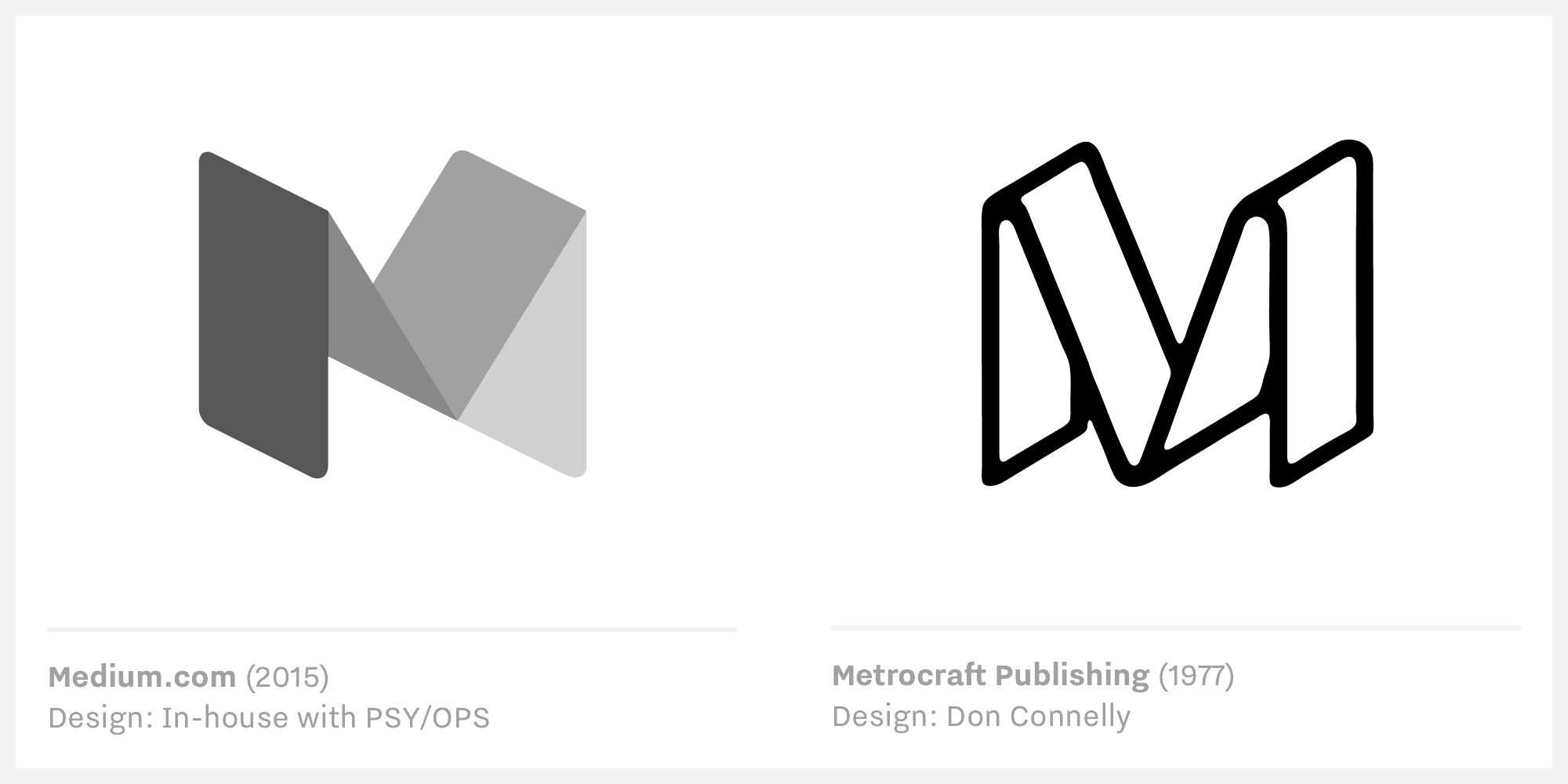
    Medium’s logo is almost an inverted copy of Metrocraft Publishing’s logo.

    medium logo copied

    Now, if you get the right inspiration, designing a good logo becomes a lot easier as all you have to do now is to morph the inspiration to fit your identity.

    Here are a few websites and resources which you can use to find inspiration for your logo –

    • Logobook: Showcase of finest logos, symbols and trademarks.
    • Dribbble: Community of designers where they showcase and share their work.
    • Designspiration: Website for designers to find inspiration.
    • Behance: Platform where designers showcase their portfolio.
    • Brand New: A blog that covers designs and redesigns of notable brands.
    • Logo Design Love: A website to find new designs and also the stories and logic behind those designs.

    Step 3: Logo Creation

    Inspiration always leads to creation. Once you’ve found the right inspiration, find the right tool to put your thoughts down into graphics that actually represent your brand. A little bit of editing to that graphic and you’ll be ready with your logo.

    But choose the logo software carefully. Choose the professional tools only if you’re willing to spend at least a week to learn how to use it. But if you don’t have much time, there are some logo-centric designing tools which can make your task a lot easier.

    Here are some of the recommended logo creation software –

    • Adobe Illustrator: It’s a part of the Adobe Creative Suite and is considered to be the kingpin of graphic design software. With the given features, vector design, and easy integrations with graphics tablets, you can create almost any type of logo with Illustrator. However, it requires some time to learn and master. But there are loads of videos online to help you in mastering illustrator.
    • Corel Draw: Corel Draw is similar to Illustrator, just with some fewer features as compared to the latter. This logo creation software is a perfect choice if you want to create or edit vectors, use graphics tablets, and create original logos backed by your imagination and inspiration.
    • Canva: Canva is the perfect example of technological advancement when it comes to graphics and logo design. It’s a freemium online tool which comes with thousands of editable templates which you can choose and edit to meet your needs. Creating a logo on Canva mostly involves you to drag and drop elements that you want in the logo and editing them. It is a great choice for anyone who’s not much into design, yet wants a professional looking logo.
    • Logomaker: Logomaker is an automated logo maker for those who want a logo but don’t want to spend a lot of time and money in developing it. The tool makes you type your brand name, select some graphic and typography styles you like, and comes up with some logo designs according to your taste, which you can edit before buying and downloading.
    https://youtu.be/FP4qoQSjnXI
    • PlaceIt: Placeit is another online graphic designing tool, just that it is not just for logos and can be used to develop your entire brand identity with few clicks. The tool works in a similar way as Logomaker but has many more features to help you create your own logo and even other brand collaterals.

    Don’t Make These 5 Logo Development Mistakes

    No matter which logo development software you choose, just don’t make these five logo development mistakes –

    • Using stock art: While this may seem the easiest way to develop your own logo, stock art, even though paid, isn’t exclusive to you and is usually used by hundreds of other designers. Using stock art automatically makes your logo unoriginal.
    • Sticking to the clichés of your industry: It isn’t necessary for a hotel booking portal to have a hotel in its logo. it’s the same with packers and movers or any other industry-specific business. Keeping away from clichés makes you seem more original and stand out.
    • Complicating it: Keep this in mind while developing the logo for your business – the target audience should be able to identify and remember it easily. Simple logos fits best to this requirement. Moreover, a logo is printed on collaterals of varied sizes. Overly complicated logos lose detail when printed in small places or different structures.
    • Following the trend instead of looking long term: While trends bring in more eyeballs for the short term, brand building is a very long-term process. Focus more on long-term growth while developing your logo.
    • Relying on Colour for effect: A big mistake logo designers do is that they focus more on colour as effects. But the logos are often printed with black and white ink which makes them less recognisable and make them lose their effect. Make sure you focus more on structure than colour to add effect.

    Final Thoughts

    Developing your own logo isn’t a walk in the park. But it’s not an uphill struggle as well. All you need to do is study the basics, learn some tools, and strategise well.

    After all, logo development is more of strategising than designing.

    Go On, Tell Us What You Think!

    Did we miss something? Come on! Tell us what you think about our article on how to design a business logo in the comments section.

  • The History of Facebook

    The History of Facebook

    On 4th February 2020, Facebook turned 15 years old with over 2.3 billion monthly active users. That accounts for 30% of the world’s population.

    Facebook has become an integral part of our lives and we have been using Facebook’s services or products in some way or the other – at least once in the past. Facebook helped usher in a new wave of internet – Web 2.0 and Facebook was one of the front-runners.

    Let’s find out how a dorm room site went on to become one of the most influential tech firms in history and have over a quarter of the world’s population among its user base.

    The Harvard Beginnings

    facebook founders

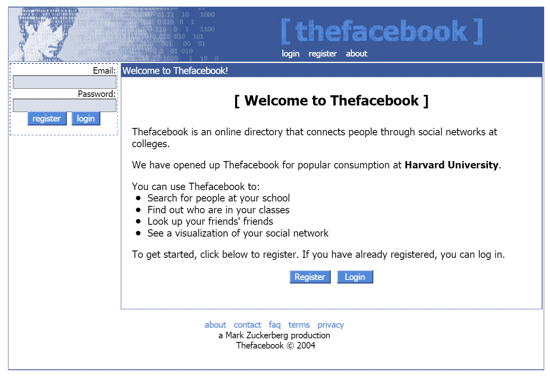
    Facebook was founded on February 4th by Mark Zuckerberg, Eduardo Saverin, Dustin Moskovitz and Chris Hughes in their Harvard dorm room and was initially called “Thefacebook”.

    But Facebook was not Mark Zuckerberg’s first site – he had created a few other sites similar to Facebook which eventually led to the idea of creating a centralized online site for people to post their information.

    And one of those sites was FaceMash.

    FaceMash

    FaceMash was a “Hot or Not” type of website that Mark had created during his sophomore year. On FaceMash, Mark had put up pictures of different Harvard students’ faces side by side – obtained illegally from online facebooks of Harvard’s nine Houses – for users to vote on who was the better looking of the two.

    A “facebook” is a web directory maintained by a few American universities that contained its student’s contact details and photographs.

    FaceMash drew over 450 visitors and over 22,000 image-views within four hours after launch. But FaceMash was shut down within a few days and Zuckerberg was charged by Harvard administration for violating individual privacy rights – he had used photos of the individuals without their consent that had been hacked from the institution-maintained website.

    Eventually, the charges were dropped and Mark got away scot-free after giving a public apology. After tasting success and the potential for an interactive online site, he set his sights on creating a centralized website for use within the college.

    Creation of Thefacebook

    During the same semester, Mark created another site for the final art exams where he posted images of art that also featured a section for users to be able to post comments. Mark shared this site with his classmates and they started sharing notes using the comments section. This later was implemented on Facebook as user posts.

    This further reinforced his previous idea of centralized facebook for the university students to post, share and discover one another. Mark set out to create just that and joined a fellow Harvard student Eduardo Saverin, with both agreeing to invest $1000 dollars on the site.

    On February 4th, 2004, Mark Zuckerberg released “Thefacebook” in the presence of his roommates and partners – Eduardo Saverin, Andrew McCollum, and Chris Huges.

    thefacebook
    The face of the person in the top-left is Al-Pacino | Source: First Versions

    Thefacebook was supposed to be the first iteration of the social networking site under the domain name thefacebook.com and got a great reception. But it was not going to be without its fair share of litigations.

    ConnectU sues Facebook

    Within six days of launching Thefacebook, Zuckerberg was accused by three senior Harvard students – Tyler Winklevoss, Cameron Winklevoss, and Divya Narendra – stating that Mark had stolen their idea of a creating a social network called ConnectU (originally HarvardConnection) that would allow for users to add other users as friends, message, and post pictures of themselves and used it to create Facebook.

    connectu
    Tyler Winklevoss (left), Divya Narendra and Cameron Winklevoss (right) | Source: Business Insider

    The ConnectU team had initially hired Zuckerberg to help create their ConnectU site and found about “Thefacebook” via a press release days after its launch. It was finally settled with each of the ConnectU trio receiving 1.2 million shares of Facebook and Facebook acquiring ConnectU.

    Massive Growth

    Apart from the ConnectU lawsuit, thefacebook was a massive hit and grew rapidly –

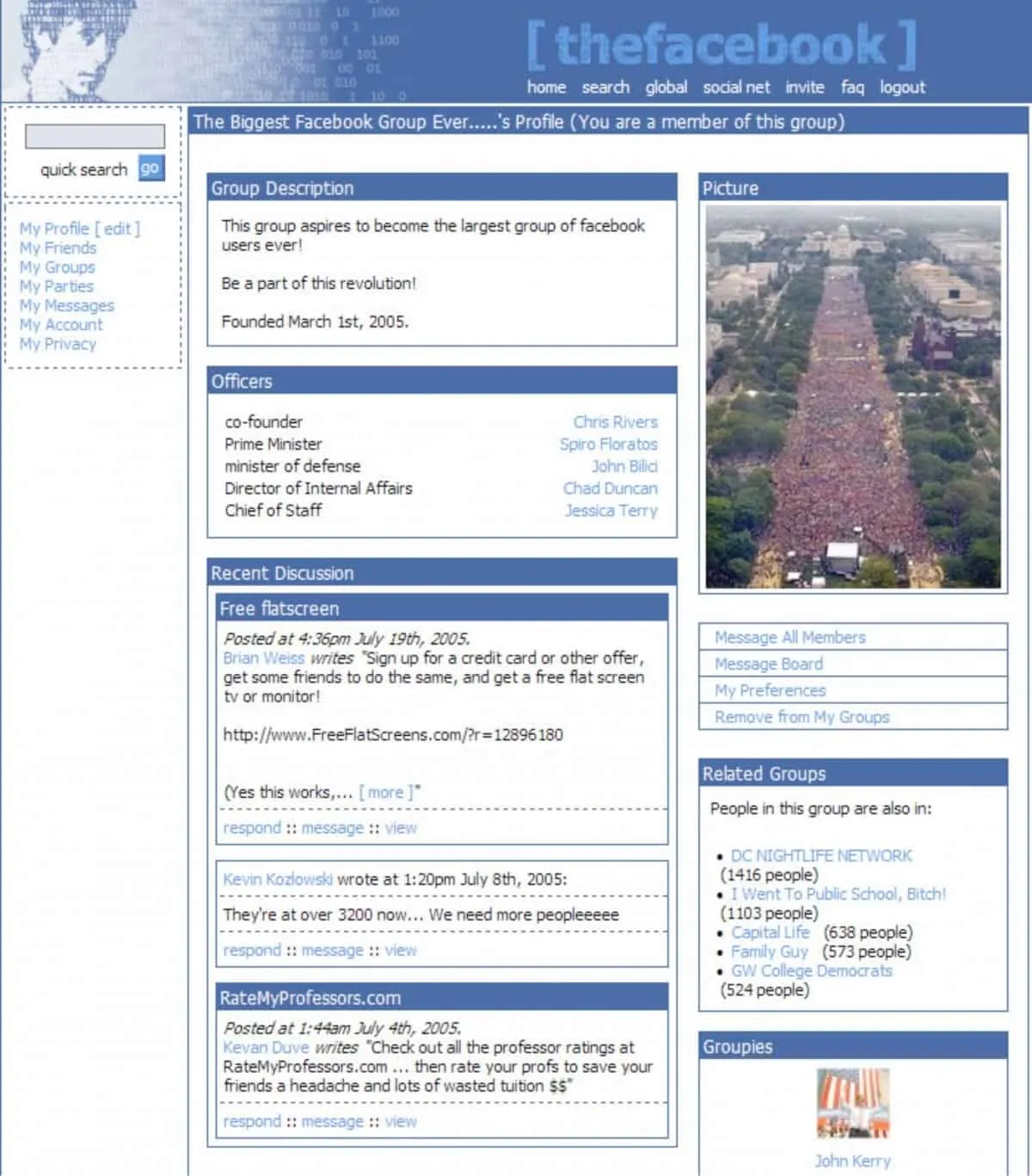
    • Upon a suggestion, Mark posted the site on the Kirkland mailing list which contained about 300 people. Within 24 hours of posting to the mailing list, the number of registered users grew over 1,300.
    • Initially, Facebook was restricted to Harvard students alone and by the end of the first month, half of Harvard’s undergraduates had already signed up.
    • It was then opened up to other Ivy-League universities and soon was opened to most other colleges and universities in the US and Canada.
    • In June 2004, Facebook moved to a new rental house in Palo Alto, California and kept innovating on the sites’ features and functions.
    • In July 2004, Facebook was incorporated and Sean Parker – from the Napster fame and previously acted as an “informal” advisor to Mark when creating Facebook – became the first president of the company.
    • In September 2004, Thefacebook launched its “wall”. The Facebook wall allowed its users to post messages and receive messages from friends.
    facebook wall
    Facebook wall | Source: IBTimes

    Facebook kept growing at a breakneck pace and by the end of 2004, it hit 1 million users – and all this from just the registrations of US and Canada university students alone. With numbers like these, it was easier for Facebook to find investors and obtain funding.

    Initial Funding

    In the beginning, the costs incurred on running Facebook were taken care of by Mark Zuckerberg and Eduardo Saverin themselves – both held equity stakes in the company. Facebook also ran advertisements on their website to get additional revenue to cover their costs.

    Sean Parker approached Reid Hoffman, the co-founder of LinkedIn, to help fund the company. Though Reid was interested in the concept of Facebook, investing in it would be against his LinkedIn duties. Instead, Reid recommended approaching Peter Thiel – one of the co-founders of PayPal.

    peter thiel
    Source: Benzinga

    This proved to be a good call since Peter Thiel quickly made an angel investment of $500,000 to Facebook and joined as one of the board members with 10.2% ownership in the company. This made Peter Thiel Facebook’s first outside investor.

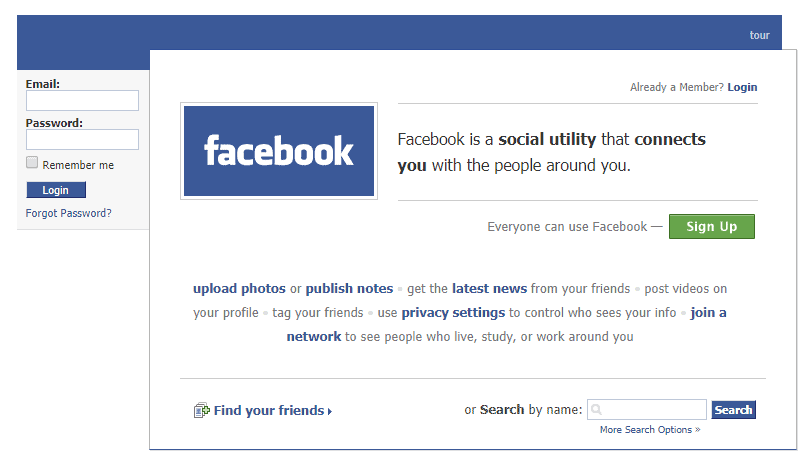
    Thefacebook becomes Facebook

    facebook 2006

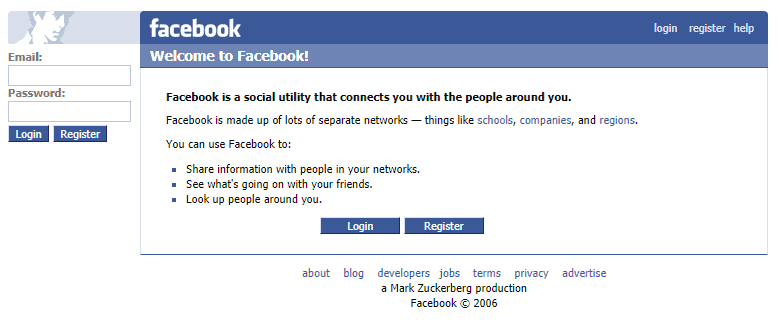
    With the funding at hand, Facebook expanded to over 800 college campuses and in September 2005, dropped “The” from “Thefacebook” to become Facebook (facebook.com domain was purchased for $200,000). Facebook also finally opened up for high school students to be able to join the platform, along with Microsoft and Apple employees.

    The remaining months of 2005 was a period of rapid expansion for Facebook. In October 2005, Facebook added photos to its site and expanded to countries other than the US and Canada. In December 2005, Facebook introduced the ability for its users to tag photos and also reached over 6 million users.

    facebook mobile

    In April 2006, Facebook launched its mobile-optimized site located at m.facebook.com. The bigger change came about in September 2006 – the site was opened allowing anyone above 13 years of age with a valid email to join Facebook. With that, Facebook was no longer just restricted to high schools, colleges, universities or businesses.

    facebook opens to all

    This led to the doubling of the user base from 6 million at the start of 2006 to 12 million by the end of the year.

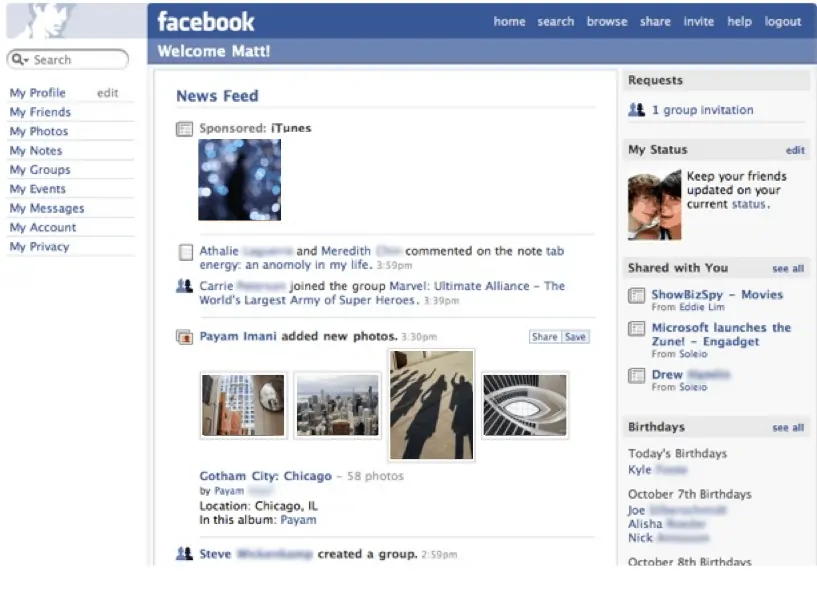
    In September 2006, Facebook launched one of its most defining features – News Feed.

    facebook news feed
    Source: World Economic Forum

    Before this users had to hop from one user profile to another to look at their latest posts. But, News Feed created a centralized stream right on the homepage from which one can view all their friends’ posts and updates.

    Dodging the Bullet

    In July 2006, Yahoo! approached Facebook in order to buy it for $1 billion. At the time, Facebook had around 8-9 million users and was making $30 million in revenue.

    When approached with the acquisition offer, Facebook’s three board members at the time – Mark Zuckerberg, Peter Thiel and Jim Beyer (VC) – met to and here’s how the meeting went:

    Mark Zuckerberg: This is kind of a formality, just a quick board meeting, it shouldn’t take more than 10 minutes. We’re obviously not going to sell here.

    Peter Thiel: We should probably talk about this. A billion dollars is a lot of money. You own 25 percent. There’s so much you could do with the money.

    Mark: I don’t know what I could do with the money. I’d just start another social networking site. I kind of like the one I already have. [Yahoo] had no definitive idea about the future. They did not properly value things that did not yet exist so they were, therefore, undervaluing the business.

    With that, the Yahoo! deal was off and things went on as usual.

    Word Of Mouth Boost

    With Facebook having not sold their business to Yahoo! and having opened up to everyone led to a massive influx of users joining the platform.

    At the end of 2007, the number of monthly active users on Facebook increased by 80% to 58 million. Facebook also made its first-ever acquisition in 2007 – it acquired ParaKey in July 2007. ParaKey was founded by Firefox’s co-creators and was developing a web-based OS which was then integrated and used by Facebook in order to create and power their mobile site.

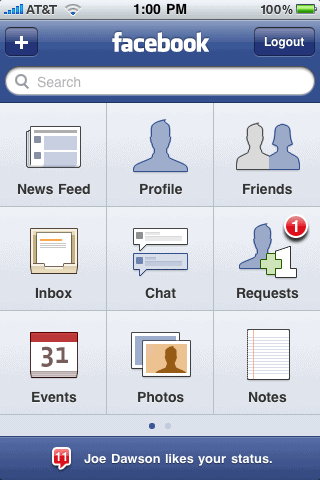
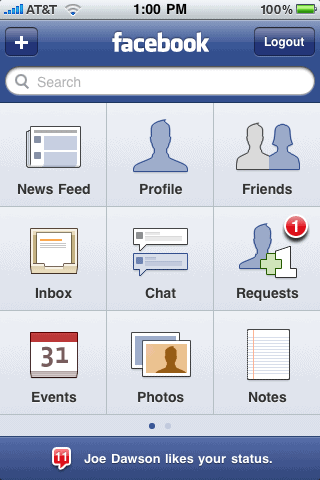
    Facebook also launched its standalone Facebook for iPhone app in July 2008.

    facebook for iphone

    But it was 2009 that Facebook changed the way people used social media and the internet in general with the introduction of a simple yet very effective feature – the “Like” button.

    Facebook Like Button

    The “Like button” is one of the simplest features ever to be added on Facebook but it has been effective in influencing what was to be posted on Facebook and the internet in general.

    facebook like button
    Source: Verge

    The Like button was actually going to be called the “awesome button” after Mark Zuckerberg chose the name for it. The symbol for like button was considered from a set of signs containing a star, thumbs up and plus sign.

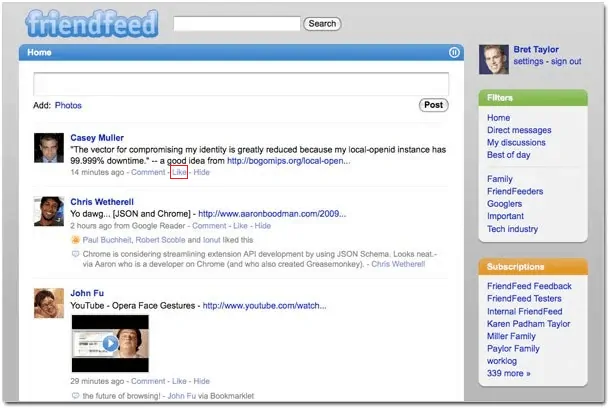
    Facebook was also not the first to introduce the like button; FriendFeed, a social aggregator site operating around the same time as Facebook had already launched a “like” feature back in 2007, while Facebook launched its “like” feature only on February 9, 2009.

    friendfeed
    Source: Wired

    Ironically, within months after Facebook introduced the Like button on its site, it acquired FriendFeed on August 10, 2009.

    Soon after, Facebook reached 500 million monthly active users in July 2010. Facebook had a great run during 2010, especially with its acquisitions. Facebook acquired the following startups and companies in order to improve and offer newer features on its site –

    • Divvyshot (Photo Management) – Facebook Photos
    • ShareGrove (Forums) – Facebook Groups
    • Hot Potato (Check-ins/Status Updates) – Facebook Places

    Facebook Introduces Timeline

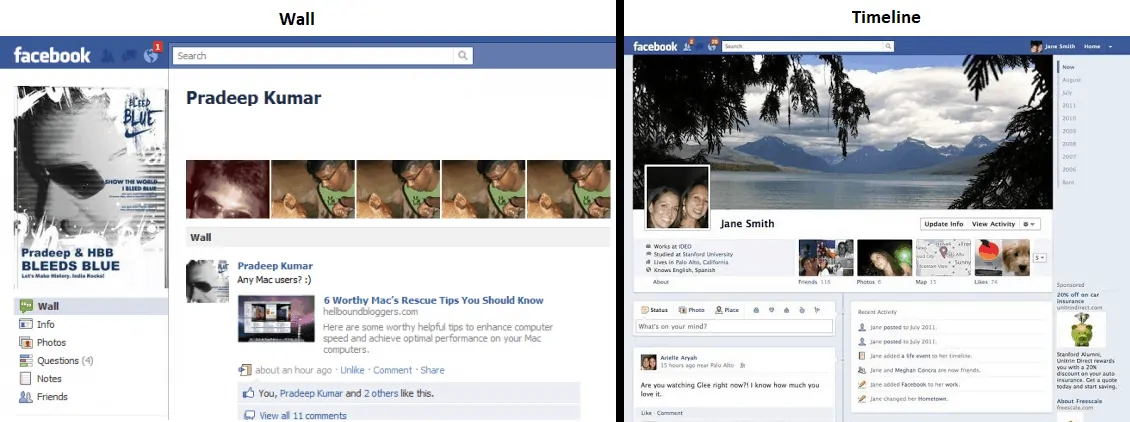
    In June 2011, Facebook replaced the “Facebook wall” with the introduction of Facebook Timeline. This new feature allowed users to arrange posts in chronological order and grouped various items into their respective categories.

    facebook wall vs facebook timeline

    This was a major (and jarring) change from the previous “wall”, majorly focused on telling the “story of the users’ life”, allowing for the inclusion of interactable posts and pictures.

    Facebook Introduces Messenger App

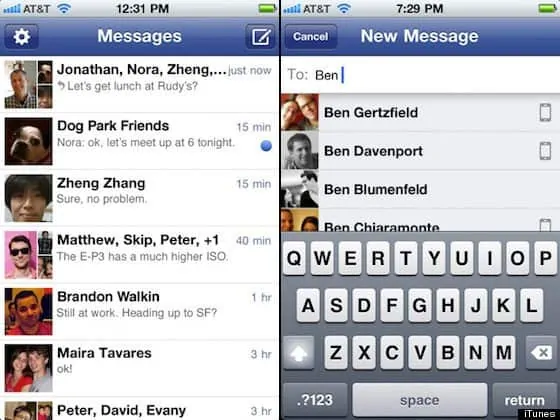
    Facebook had quite an uneventful 2011 in terms of product releases and updates, with the only major product released being the Facebook Messenger for iOS and Android. The instant messaging app allowed Facebook users to send messages, photos, videos, and documents to other users using the internet.

    facebook messenger
    Source: Huffington Post

    In December 2011, Facebook shifted its operations to a bigger headquarters in Menlo Park, California. The 10 building campus was the former space of Sun Microsystems and until then, Facebook had been moving around from one location to another within Palo Alto.

    facebook menlo park

    Soon after the launch of Facebook Messenger and shifting to its new headquarters, Facebook announced that it would acquire Instagram for $1 billion.

    Facebook Buys Instagram

    In April 2012, Facebook acquired Instagram – a photo-sharing app – for about $1 billion, which made it Facebook’s biggest ever acquisition ever.

    facebook instagram
    Source: Brand Driven Digital

    Instagram received $1 billion as cash and stocks and with the acquisition of Instagram, Facebook established a stable footing in the mobile sector – a space that was seen as a weakness for Facebook since Facebook Messenger was not doing as expected.

    The next big milestone for Facebook was its announcement of going public.

    Facebook IPO

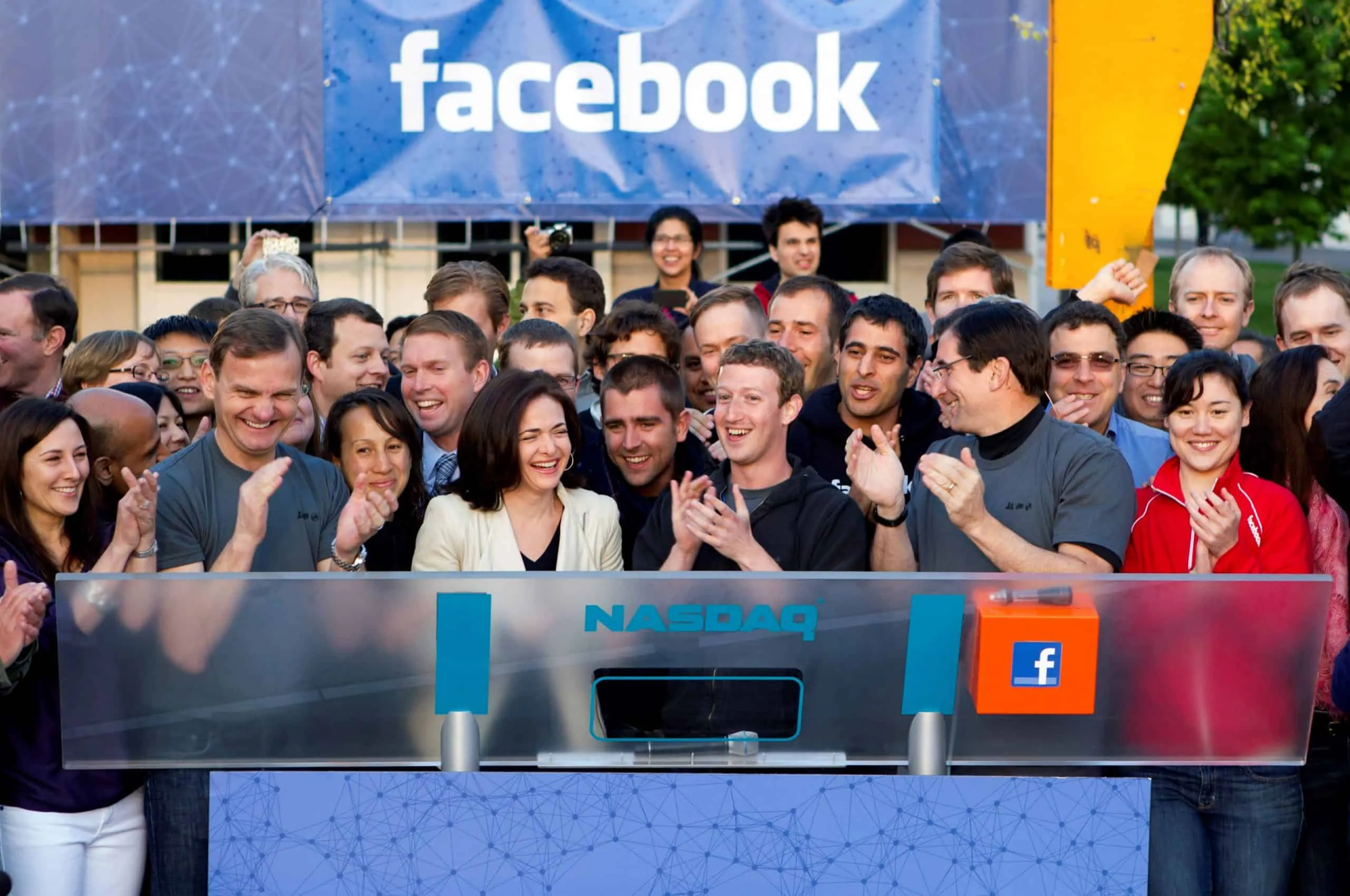
    Facebook filed for its initial public offering on February 1, 2012, and went public on May 18, 2012 – a month after it acquired Instagram for a billion dollars – and was considered to be one of the biggest and most anticipated IPOs of all time. At the time of filing the IPO, Facebook announced that it had around 845 million active users and over 2.7 billion daily likes and comments.

    facebook ipo
    Source: Fortune

    The Facebook IPO was valued at $38 per share, raising $16 billion at launch. This meant if you had invested $1,000 during the IPO, it would amount to $4,992 ($192/share as of February 2020). After the IPO, Mark Zuckerberg retained a 22% ownership stake in Facebook.

    Also, within four months after its IPO, Facebook hit the 1 billion monthly user mark becoming the first service of its kind to reach such user numbers. It took Facebook only 8 years to reach the billion-user mark – which meant that Facebook was being used by 1 out of every 7 people on the planet at that point.

    facebook users
    Source: Statista

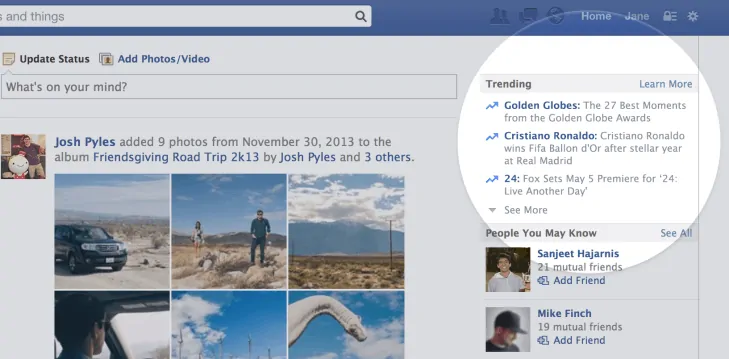
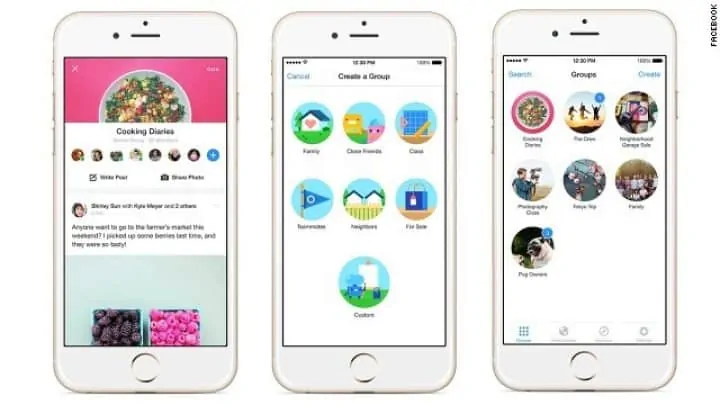
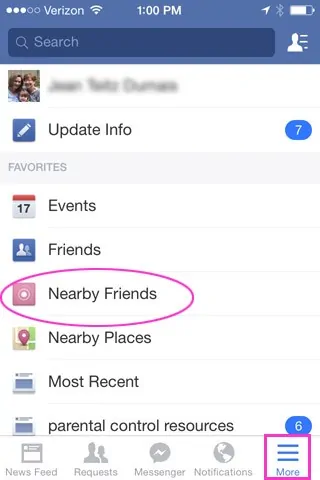
    Facebook kept introducing newer products and incremental updates – with most of them focussed on the social network site – for about the next two years. A few notable ones include –

    trending on fb
    Source: TechCrunch
  • Facebook Group App
  • facebook group app
    Source: CNN
  • Nearby Friends
  • facebook nearby friends
    Source: Be Web Smart

    It was from 2014 onwards that Facebook truly started diversifying rather than sticking to its social media stronghold.

    Venturing Away From Facebook

    Facebook Buys WhatsApp

    facebook acquires whatsapp
    Source: WhatsApp

    WhatsApp is an ad-free mobile app that allows its user to send unlimited messages, make voice and video call to their contacts for free. Since WhatsApp uses the Internet to provide its services, the users incur no carrier charges, just the internet data charges alone. This makes the calls and messages virtually free of cost.

    In February 2014, Facebook announced its plans to acquire WhatsApp for $16 billion, which was then increased to $19 billion after negotiations. But in reality, Facebook actually paid WhatsApp $22 billion since a portion of the payment was with Facebook’s shares and its share prices rose up to $77 from $68 at the time of closing the deal in October.

    With the earlier acquisition of Instagram and now with WhatsApp, Facebook cemented its footing in the mobile sector.

    Facebook Buys Oculus

    oculus rift
    Source: Amazon

    Oculus VR makes virtual headsets and had started out as a Kickstarter campaign. Oculus had created its Kickstarter campaign in 2012 and raised 2.5 million dollars to create its first VR headset.

    Facebook bought Oculus in March 2014, just a month after it had acquired WhatsApp for $2 billion. Oculus had been around for only 2 years, functioning as a Kickstarter at the time of purchase.

    This acquisition of Oculus helped Facebook diversify away from social media and into the world of VR.

    Facebook Buys Chainspace

    facebook enters crypto
    Source: Chainspace

    Chainspace is a blockchain startup developing a distributed ledger platform based on smart contracts.

    In February 2019, Facebook acquired Chainspace for an undisclosed amount and integrated its team into Facebook. This showed that Facebook was looking to enter the blockchain space and was confirmed a few months later with Facebook announcing the launch of its very own cryptocurrency.

    Facebook Cryptocurrency

    While rumours arose about Facebook’s move into crypto space from its acquisitions and hiring patterns back in December 2017 itself, the acquisition of Chainspace further solidified the rumours.

    In June 2019, Facebook announced that it will launch its very own cryptocurrency platform Libra – a digital currency.

    facebook libra
    Source: CNet

    Here’s what we know about Libra till date –

    • Facebook plans to integrate Libra into Facebook and its apps such as WhatsApp, Facebook Messenger, Instagram and such, allowing its users to be able to conduct monetary transfers from within the app.
    • Libra is supposed to be regulated by the non-profit Facebook subsidiary Calibra – for the time being.
    • As of writing, eight of the founding partners – PayPal, Mastercard, Visa, Mercado Pago, eBay, Stripe, Booking Holdings, and Vodafone – stopped supporting and left Libra.
    • Libra and Mark Zuckerberg were warned by the government that the cryptocurrency would not launch without the approval of various regulatory agencies.

    Facebook launching a cryptoasset that is regulated by one of its (non-profit) subsidiaries raised a lot of eyebrows from the public as well as the government due to previous privacy scandals and litigations.

    Facebook Data Breaches & Scandals

    Facebook has a long history of neglecting its users and their privacy. Here’s a timeline of notable Facebook’s scandals and breaches –

    • 2005 – Beacons feature shared the purchasing history of users to other sites without user consent
    • 2008 – Technical glitch revealed birth-dates of over 80 million Facebook users
    • 2009 to 2014 – The Federal Trade Commission (FTC) gets involved since earlier Facebook allowed private information of its users to be made public without warning
    • 2013Data breach: Facebook bug unintentionally discloses a software flaw that exposed 6 million users’ email addresses and phone numbers
    • 2014 to 2018The Cambridge Analytica scandal
    • 2018Data breach: Due to poor security measures, hackers were able to steal digital login codes of up to 50 million users’ accounts
    • 2019 – Data breach #1: Data of 540 million Facebook users exposed
    • Data breach #2: Facebook “unintentionally” grabbed email contacts data from over 1.5 million
    • Data breach #3: The phone numbers, names and user IDs of over 267 million Facebook users were exposed

    Facebook In 2020s

    Facebook has been increasing its focus on bringing about better security measures and providing more privacy for its users in order to regain the lost trust from the numerous data breaches and scandals.

    Facebook has also been acquiring a lot of companies – mainly in the fields of Machine Learning, Artificial Intelligence, and facial recognition and has been diversifying into other industries – cryptocurrency, VR, Internet Services, marketplaces and such.

    Go On, Tell Us What You Think!

    Did we miss something? Come on! Tell us what you think about our article on History of Facebook in the comments section.

  • What Is Sales? – Sales vs. Marketing vs. Business Development

    What Is Sales? – Sales vs. Marketing vs. Business Development

    The term ‘sales’ includes all the activities involved in selling an offering in exchange for something of value. Many consider sales to be the food that the business needs to survive in the long run. But while the term ‘sale’ refers to the actual transaction, the term ‘sales’ also encompasses all the activities which lead to this transaction.

    Sales Definition

    Sales is a process that results in a transaction between two or more parties in which the buyer receives the offering and the seller gets something of value in return which is usually money.

    Few keywords and keyphrases to note in this definition –

    • Sales is a process: While ‘sale’ is a transaction, sales is a process that results in this transaction.
    • Buyer: The party or parties which make the purchase.
    • Seller: The party or parties that offer a product or service for sale.
    • Something of value in return: Sales always involves the buyer paying for the offering in the form of money or another asset. A transaction that doesn’t involve payment isn’t considered a sale.

    Knowing these keywords and keyphrases is important as they form an integral part of the legal definition of sales:

    Sales is an agreement by which one of the contracting parties gives a thing and passes the title to it, in exchange for a certain price in current money.

    The Importance Of Sales

    The sales department often plays a pivotal role in the success of a business. It is the only department that is responsible to bring money to the organisation.

    Besides this, it is also responsible for –

    Conversions

    While marketing and other departments are responsible to generate interest among the customers, sales is the department that makes the customer move ahead of the interest stage of the funnel to the final conversion.

    Customer Acquisition

    Sales also helps in acquiring customers who were not aware of the offering before. The process also involves cold-calling, cold-emailing, and other efforts to bring in more customers. And more customers mean more profits to the organisation.

    Customer Retention

    Salespersons often develop a relationship with the customers which makes these customers remain with the business for a long time.

    Business Growth

    Business grows when customers buy its offerings and repeat the purchase. Sales is responsible for just that.

    Sales Example

    A perfect example of sales would be the process involved in encouraging an individual to purchase a house. While a sale is said to occur when the buyer pays for the house and receives the right to ownership in return, the sales process includes a lot more. It starts with the buyer (prospect) receiving a call from the seller, him meeting the seller and getting answers, him negotiating for the final price, and him conducting the sale.

    Types Of Sales

    Sales can be categorized into several types according to the audience it is targeted to, motive, offering sold, and channels used.

    Types Of Sales According To The Target Audience

    • B2B Sales: B2B is a sales type where businesses sell offerings to other businesses rather than end customers.
    • B2C Sales: B2C is a sales type where businesses sell offerings to end consumers for final consumption.

    Types Of Sales According To How The Sales Is Performed

    • Inside Sales: Inside sales refer to the sale process where a salesperson sells remotely, typically from an office, without even meeting the prospects.
    • Outside/Traditional Sales: Outside sales refer to the sales process where the salesperson sells after actually meeting the prospects.

    Sales Types According To The Offering Sold

    • Product sales: Sale of tangible products like CDs, laptops, and digital products like software.
    • Service sales: Sale of intangible products like consultancy, website development, etc.

    Sales Types According To Sales Channels

    • Online Sales: Using internet channels like e-commerce, online stores like Shopify, etc. to sell.
    • Offline Sales: Using offline channels like personal selling, supermarkets, etc. to sell.
    • Telesales: Selling over the telephone.
    • Affiliate Sales: Taking the help of other people or businesses to sell and providing them with a commission for every sale because of them.
    • Outsourced Sales: Outsourcing sales to a third party on a contract basis.

    Sales vs Marketing

    Marketing is a set of activities and processes aimed at-

    • Developing an offering that proves to be valuable to the customers
    • Communicating about the offering to the prospective and existing customers
    • Transacting with buyers the offering in exchange for money or similar assets.
    • Delivering the offering as promised

    Sales, on the other hand, is a part of marketing and is focused only on the transaction aspect and activities which result in this transaction.

    Sales vs Business Development

    Business development is the process of creating long-term value for a business through the development of relationships, markets and customers. In simple terms, it is a long-term activity focused on the growth of the business by –

    • Building relationships with existing and prospective customers as well as various stakeholders of the company
    • Exploring new market opportunities and finding new markets to expand the business
    • Making the most out of the customers by using various sales and marketing activities.

    Sales, on the other hand, is just a part of business development that is focused on getting the most out of the existing and new customers.

    Go On, Tell Us What You Think!

    Did we miss something? Come on! Tell us what you think about our article on what is sales in the comments section.

  • The 12 Biggest Amazon Competitors

    The 12 Biggest Amazon Competitors

    Amazon reached the trillion-dollar valuation just a month after Apple hit the trillion-dollar mark in August 2018. This puts Amazon as the second-fastest industry to ever get to a trillion-dollar valuation.

    And unlike Apple, which deals with technology primarily, Amazon boasts a much diverse portfolio of operations

    • E-commerce
    • Brick & Mortar
    • Cloud computing
    • Artificial intelligence
    • Digital distribution
    • Grocery

    Amazon’s current valuation remains close to a trillion dollars at the time of writing and its presence in various different sectors definitely makes Amazon the major target for most businesses.

    Let’s look at a few of the biggest competitors of Amazon.

    Amazon Ecommerce Competitors

    Amazon has always faced stiff competition in the eCommerce sector. China, in particular, has proved to be a difficult country for Amazon to crack. China is the world’s largest eCommerce economy and its in-house e-commerce giants have proven to provide quite the competition for Amazon, even on the global market.

    amazon ecommerce competitors
    Source: Oberlo

    Alibaba

    alibaba

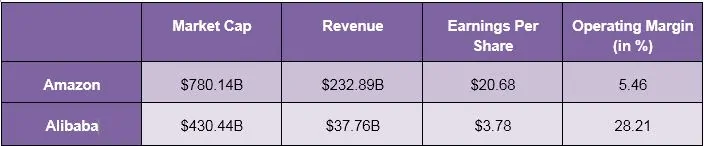
    On a global scale, Alibaba doesn’t come quite close to Amazon in terms of market capitalization and market share. Here’s a chart comparing Amazon and Alibaba based on various different statistics –

    amazon vs alibaba
    Source: YourStory

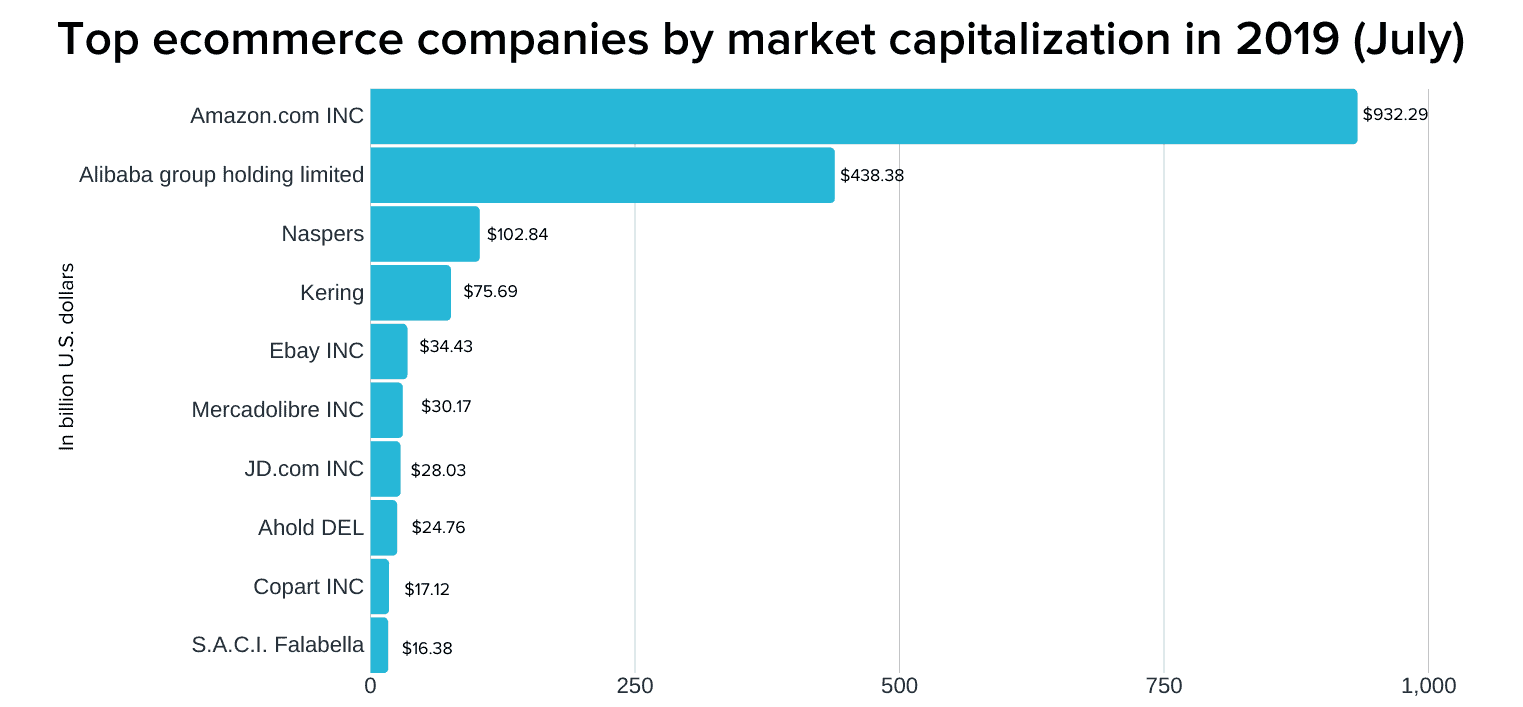
    Alibaba’s market cap of about $430.44 billion in July 2019, makes it the second-largest e-commerce company in the world. Amazon’s market capitalization as of mid-2019 was well over $780 billion. While Amazon’s global presence is quite solid, the majority of Alibaba’s revenue figures are from their Chinese operations alone. Alibaba is forming up to be a formidable opponent in the global market as well.

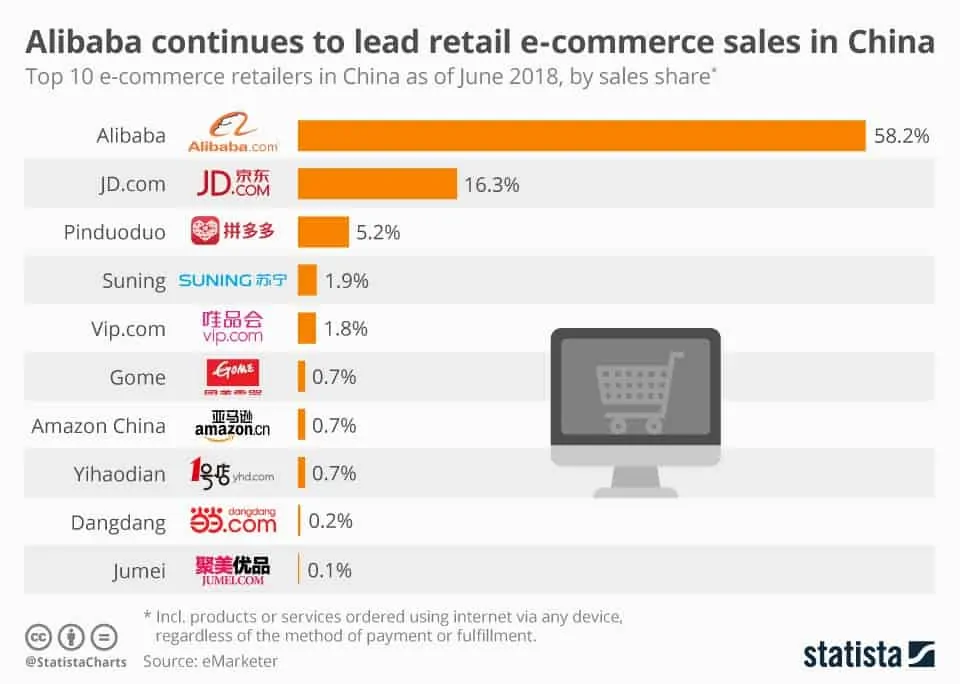
    This reflects well when we look at the Chinese market – Alibaba beats Amazon in almost every field. Here’s a chart depicting the sales share of the various eCommerce retailers in China by mid-2018 –

    alibaba market cap
    Source: Statista

    Alibaba made up for 58.2% of the entirety of e-commerce sales within China in mid-2018. Amazon, with just 0.7% of the e-commerce sales, has a long way to go within China.

    Amazon vs Alibaba

    Alibaba was founded on 4 April 1999 by Jack Ma as a B2B e-commerce site and soon branched out into B2C markets and various other fields.

    Alibaba now is quite similar to Amazon in terms of the different industries that both operate. Both cater to the B2C and B2B market, have their own cloud computing services, and their own digital distribution services and such.

    Amazon entered the Chinese market in 2004 and during the early years, it grew quite quickly and even held 16% of the market share at one time – a far cry from the current 0.7%. The reason that led to Amazon’s defeat lies in the fact that local players like Alibaba were able to provide to the local tastes while Amazon failed to.

    JD.com

    JD com logo

    JD or Jingdong is the Chinese e-commerce site that is considered to be a potential competitor to Amazon, especially in the B2C market. JD is for B2C just as Alibaba is for B2B within China.

    With a market capitalization of $28 billion in mid-2019, JD easily ranks among the top 10 e-commerce companies in the world – it is currently ranked 7th in the list of world’s top e-commerce retailers. It is to be noted that while Amazon has larger global operations, JD’s sales and revenue figures are mostly from operating within China.

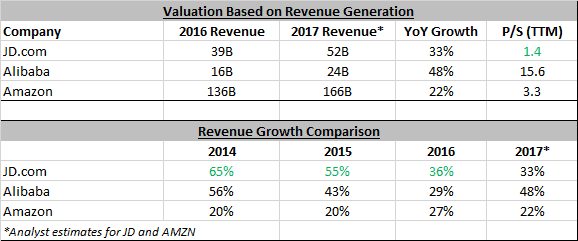
    JD holds the top spot in the B2C e-commerce space within China. The rate of growth shown by JD year on year has been high –

    china amazon alternative

    This makes JD one of Amazon’s major competitors within and outside the Chinese market – since it is also looking to expand into markets other than China in the near future.

    Amazon vs JD

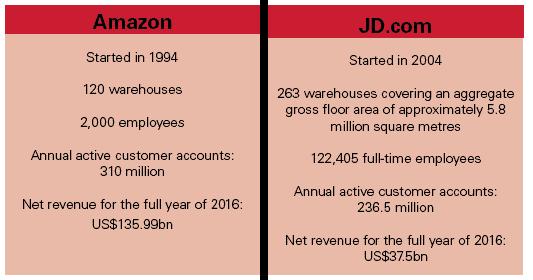
    JD was founded in 1998 and its presence began only in 2004 with the launch of its online retail store, around the same time as Amazon entered the Chinese market. JD.com, formerly known as 360buy, started out as an online store for buying magneto-optical storage disks but later diversified into other consumer segments. It is now currently is the second-largest e-commerce brand and the largest B2C e-commerce site in China.

    amazon vs jd
    Source: Supply Chain Asia

    JD caters to the B2C market and sells consumer electronics and products via its online portal. It acquires its inventory by buying from the manufacturers and selling them at competitive prices. Amazon was not able to match the speed and prices offered by such competitors and has started focusing on improving “cross-border” sales within the Chinese market.

    eBay

    ebay logo

    eBay has always been a major competitor to Amazon in the e-commerce space though both are known for selling different things and to different audiences. eBay had a market capitalization of about $34 billion in mid-2019, making it one of the biggest competitors to Amazon within and outside of the US.

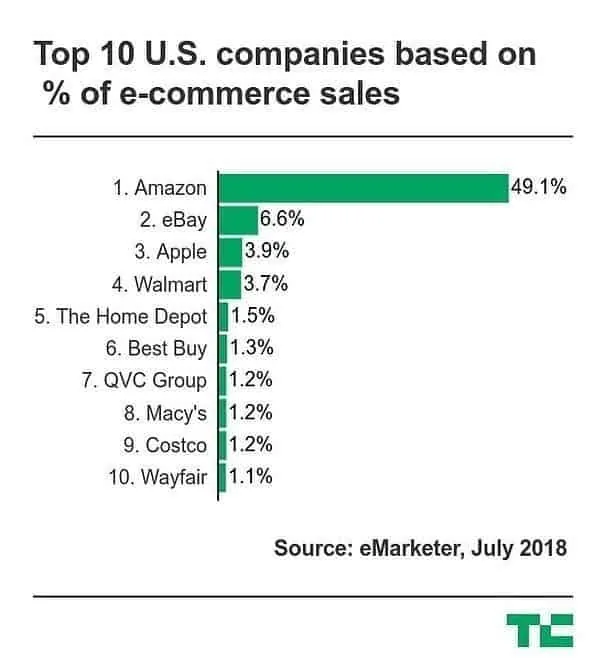
    eBay is the closest competitor towards Amazon in terms of e-commerce sales, especially within the US –

    top ecommerce companies
    Source: TechCrunch

    In mid-2018, eBay accounted for 6.6% of all e-commerce sales within the US, placing it right below Amazon. Though it is a far cry from Amazon’s 50% of the e-commerce sales, eBay has held its position steadily to date.

    Amazon vs eBay

    eBay was founded on September 3, 1995, a year after Amazon was launched and facilitates Consumer to Consumer (C2C) and Business to Consumer sales via its online website. eBay currently operates in 27 countries and is primarily known for its C2C model where customers can sell their used products to other customers, making eBay a popular platform for buying and selling second-hand consumer goods. Amazon, on the other hand, has its operations mainly focussed on B2C – providing a platform for businesses to sell their products to consumers online.

    Amazon Offline Competitors (Same Target Audience)

    Amazon’s target group doesn’t rely on e-commerce shopping alone, many do go out and buy products offline, even though they are available online on Amazon. Nevertheless, these offline competitors have started their online operations and are eating Amazon’s market share.

    Walmart

    walmart

    Walmart, the multinational retail chain consisting of hypermarkets, supermarkets, and grocery stores and is considered to be one of the top competitors of Amazon, especially in the consumer retail and electronics industry.

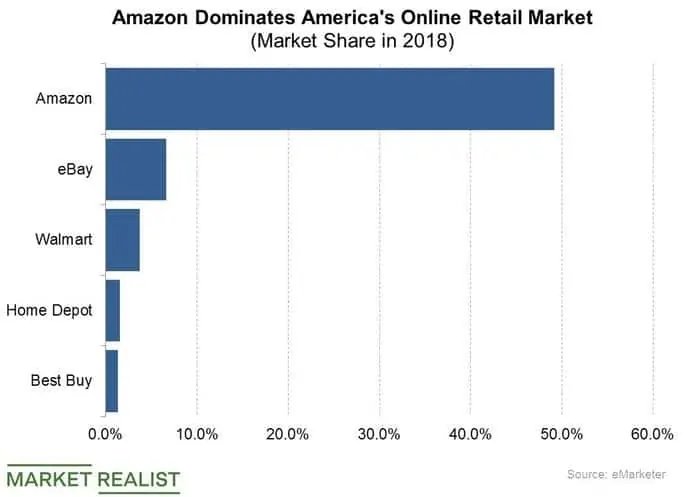
    A market share of 3.7% in 2018 helped Walmart place among the top 3, within the US online retail market and has shown steady growth year on year.

    amazon vs walmart
    Source: eMarketer

    Walmart and its combined forces of brick and mortar, as well as online stores, has proven to be quite the competition to Amazon – especially in the physical retail space.

    Amazon vs Walmart

    Walmart was founded in 1962 as a department store and currently operates as a multinational discount department store chain. Walmart entered the e-commerce space with its very own online store in 1996 under the same name.

    Walmart’s online stores allow customers to purchase goods and products from the store without ever leaving the comfort of their homes – which also includes the same discounts as one would get if they were to visit a physical Walmart location. Amazon, on the other hand, has more of an online presence than offline.

    The Home Depot

    The Home Depot

    The Home Depot is similar to Walmart in terms of competing with Amazon – it operates as a brick and mortar retailer with an online store that reflects the products within the store for consumers to buy from.

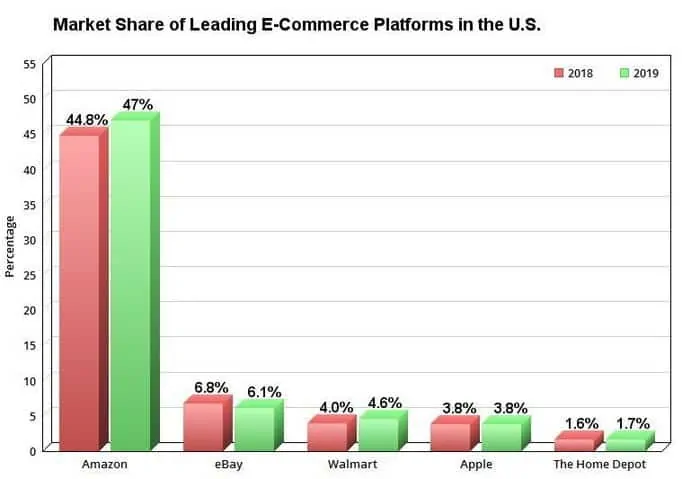
    With a market share of 1.6% in 2018, The Home Depot held the fifth position in terms of the largest e-commerce platforms in the US.

    amazon vs home depot
    Source: The Motley Fool

    The Home Depot, similar to Walmart, has been growing at a steady pace and benefits from its offline as well as an online presence.

    Amazon vs The Home Depot

    The Home Depot was founded in 1978 and is currently America’s largest home improvement retailer. The Home Depot helps provide tools, construction materials, and tools and services and launched its online store in late 2000 in order to sell its products with prices mimicking that of its physical stores.

    Amazon and The Home Depot basically go head to head in the “home improvement” category and The Home Depot has been preparing to combat Amazon by providing faster deliveries and better online shopping experience. This makes The Home Depot a developing competitor to Amazon in the physical space.

    Amazon Web Services Competitors

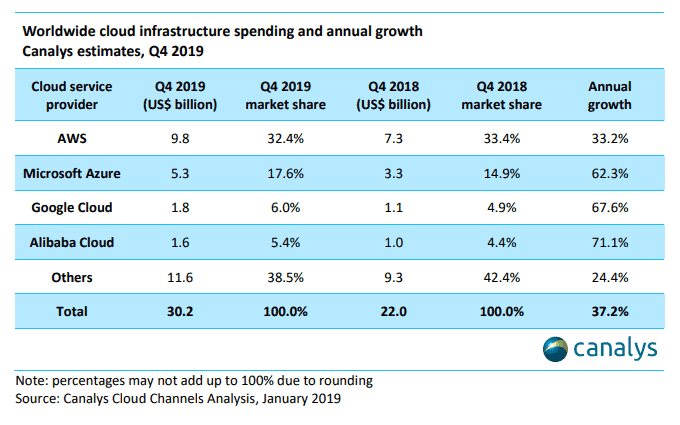
    Amazon’s cloud service platform – Amazon Web Services – has held the top spot for a long time and leads the cloud industry by a wide margin. But in recent times, offerings from companies like Microsoft and Google have managed to make a dent in the market, taking some of the market share away from Amazon.

    aws vs azure vs google cloud
    Source: Canalys

    Microsoft Azure

    Microsoft Azure

    Microsoft Azure, the cloud service offering from Microsoft, held over 17% of the cloud market share in Q4 of 2019. This makes Azure the second largest global cloud infrastructure and platform provider. Azure has also shown high levels of year-over-year growth placing it as a direct competitor to Amazon in the cloud computing sector.

    AWS vs Azure

    Both AWS and Azure are quite similar to one another in the fact that the cloud services offered by them are primarily focussed on “enterprise” users. While Azure leveraged on Microsoft’s previous experience, amazon has risen to the challenge with big reinvestments of its yearly revenue back into growing AWS.

    Google Cloud Platform

    Google Cloud Platform

    Google Cloud Platform (GCP) acts more of an alternative to AWS and Azure than being seen as a one-click solution.

    The Google Cloud Platform comes in third with a market share of 6% in Q4 2019 and it has been fluctuating between the third and fourth place for the last few years against the rising competition from Alibaba Cloud and IBM Cloud. But Google Cloud Platform has shown promising growth that makes it a viable competitor to Amazon in the near future.

    AWS vs Google

    Amazon Web Services (AWS) is the more mature of the two with a powerful global network to provide for some of the world’s most complex IT environments. While Amazon offers over 140 different services across computing, IoT, mobile, networking, and enterprise applications to its users, GCP still lacks in the number of services that it offers and is generally the lesser flexible of the two.

    aws vs google cloud
    Source: Synergy Research Group

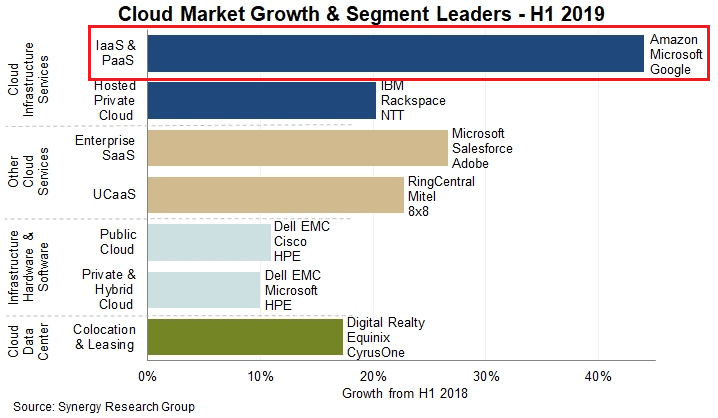
    Google Cloud Platform is more popular among Infrastructure-as-a-Service (IaaS) and Platform-as-a-Service (PaaS) rather than Enterprise use cases – and the enterprise is where most of the money lies. Google plans to combat this by investing more in improving their enterprise operations and obtaining newer partnerships.

    Amazon’s Competitors In Artificial Intelligence

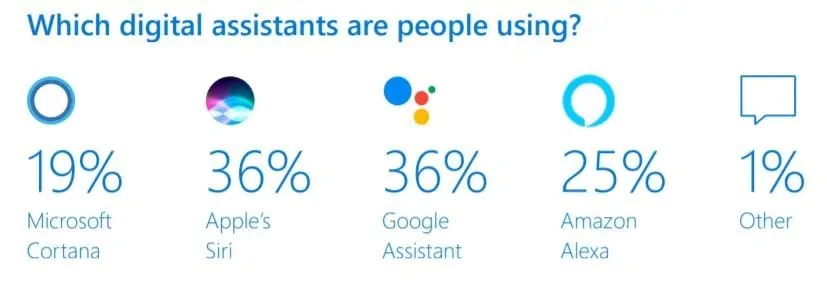
    While Amazon also provides AI services to users on its AWS platform, its most mainstream use of AI is in helping power its virtual assistant Alexa. Alexa faces heavy competition from two other industry heavyweights – Apple and Google – equally.

    google assistant vs alexa vs siri
    Source: Voicebot.ai

    Google Assistant

    Google Assistant

    The Google Assistant is available on a variety of devices and currently is among the market leader, alongside Apple’s Siri, with 36% of the market share.

    The Google Assistant is more generally focussed while Amazon’s Alexa is quite capable enough of helping you in the day to day task and has the added benefit of being able to place orders from Amazon with just a voice command.

    Apple’s Siri

    Siri

    Apple’s Siri is quite popular even though it’s available only within the Apple ecosystem. For a virtual assistant that is locked into a single ecosystem, it has managed to hold the first place for a very long time since it enjoyed two advantages –

    • Siri was one of the first commercial AI virtual assistants to hit the market
    • Due to the high sales of Apple’s iPhones which bundles Siri within its software interface

    It was only in late 2019 that Google Assistant was able to get to equal footing and both now hold the first spot with a market share of 36%.

    Amazon’s Competitors in Digital Distribution

    Amazon is quite diversified. Apart from its e-commerce and cloud services, Amazon has its own digital distribution service: Amazon Prime Video and Amazon Prime Music and a production studio: Amazon Studios.

    Netflix

    netflix

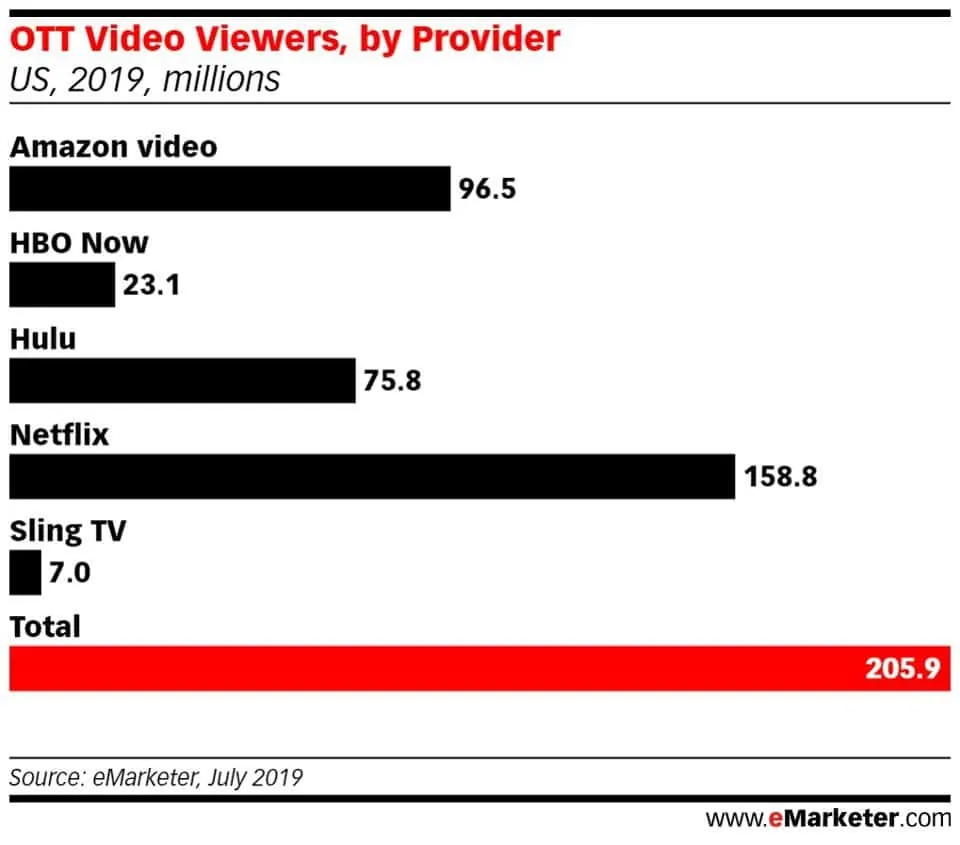
    Netflix is the company to beat for Amazon to reach the top spot. With over 158 million viewers in mid-2019, Netflix has held the top spot among digital distribution services in the US and world over.

    netflix subscribers 2019
    Source: eMarketer

    Netflix has reigned supreme in the digital distribution field with its slew of originals produced under its own banner and the various different TV shows and series.

    Amazon vs Netflix

    Amazon and Netflix have a similar approach in terms of providing digital distribution services.

    Both follow a subscription model and have over 100 million users on their platforms. Netflix has also been in the market for far longer than Amazon Prime – it was launched in 1997 while Amazon launched its Prime Video service a full decade later in 2007.

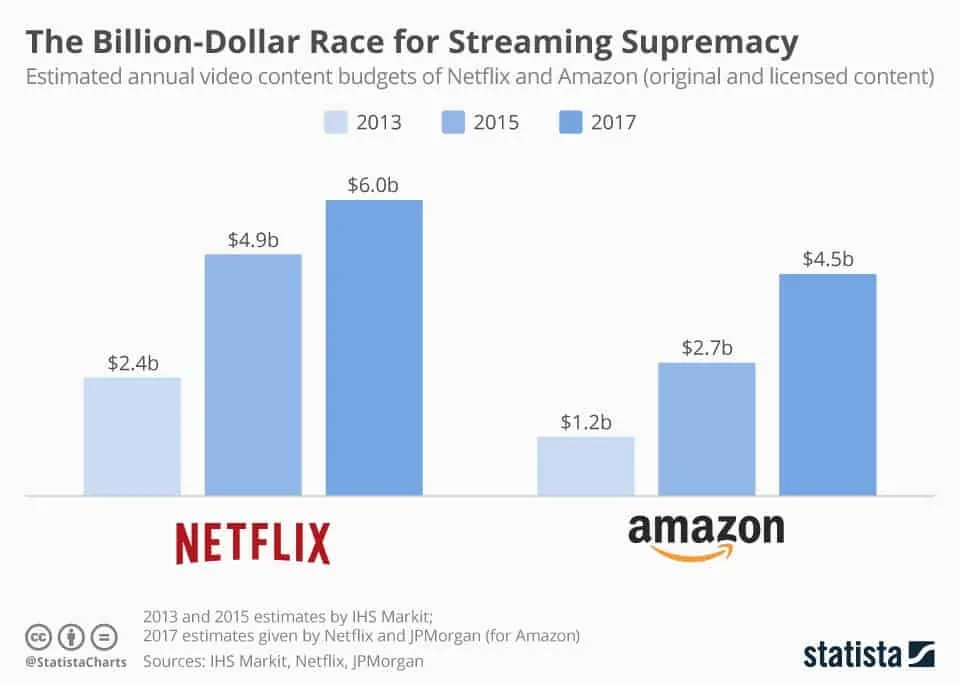
    Both have their own production studios for creating movies and television shows exclusively for their platforms. Netflix and Amazon invest heavily in their studios and into improving their platforms – with Netflix and Amazon investing about $6 billion and $4.5 billion respectively.

    amazon vs netflix
    Source: Statista

    Both Amazon and Netflix have shown steady growth year-over-year, but it might take a while for Amazon to catch up to Netflix, making Netflix a major competitor to Amazon.

    Spotify

    Spotify

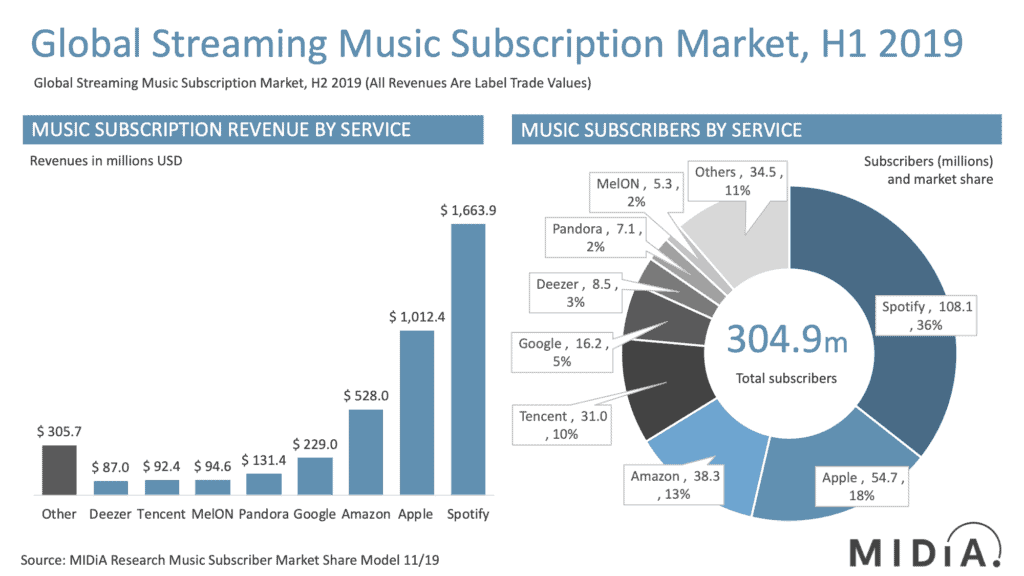
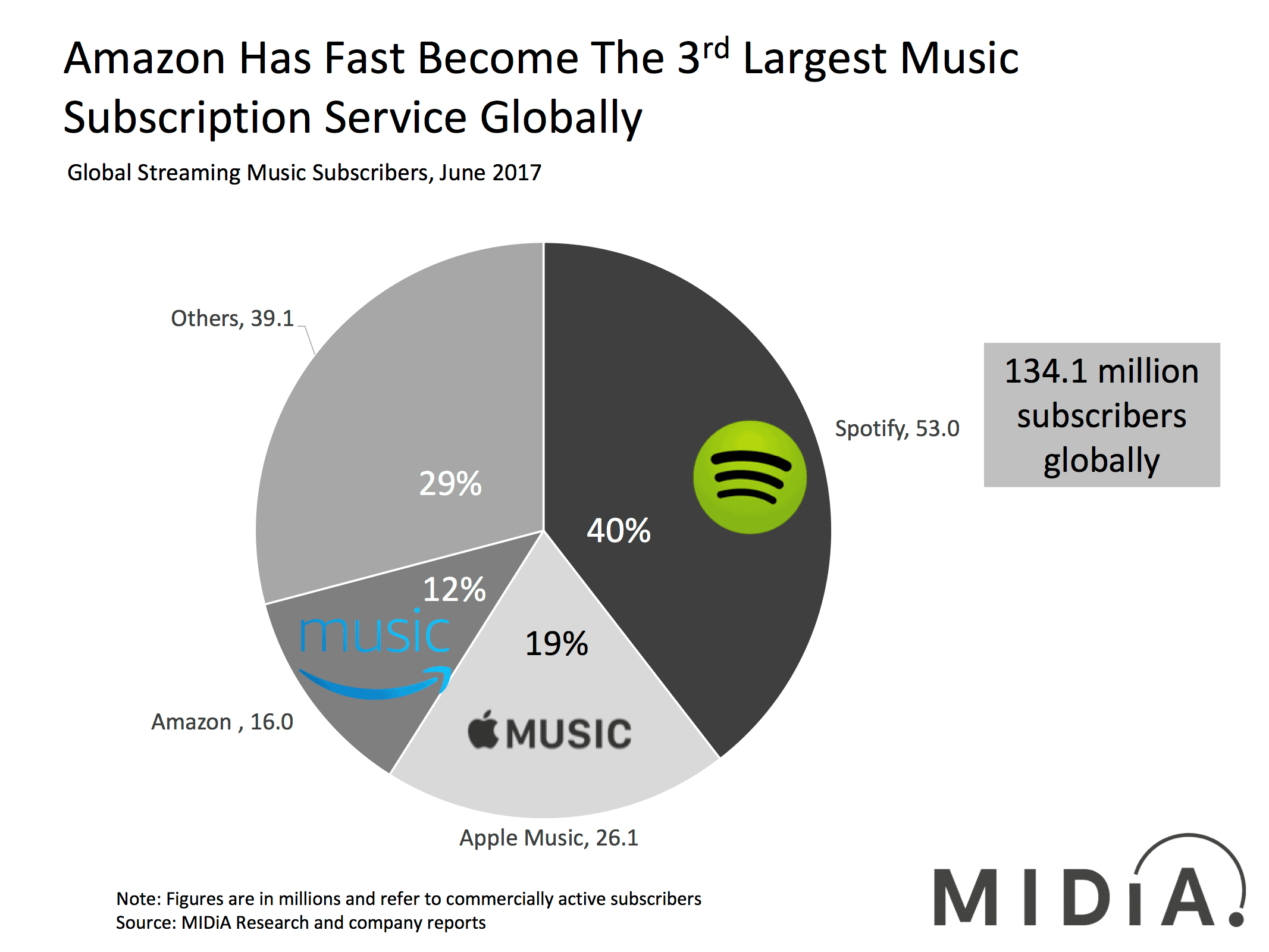
    Spotify is an online music streaming service that provides its users with access to millions of songs, albums, and playlists. Spotify had 36% of the music subscription market share with over 108 million users subscribed to its platform at the end of the first half of 2019.

    spotify statistics
    Source: MIDiA

    Spotify has always held a clear edge over Amazon’s own offering – Amazon Prime Music – by having both free and paid offerings.

    Amazon vs Spotify

    Spotify was launched in 2006, a year before Amazon Music was launched and managed to rise to the top by offering a simple, easy to use platform for streaming music over the internet.

    Though Spotify has held the top spot in the music streaming industry, Amazon has managed to grow quite quickly since its launch in 2007.

    amazon music vs spotify
    Source: MIDiA

    The quick growth can be attributed to Amazon Prime Video and Music service being bundled with a single Amazon Prime subscription, which also offers various other features and services.

    Amazon’s Competitors in Grocery

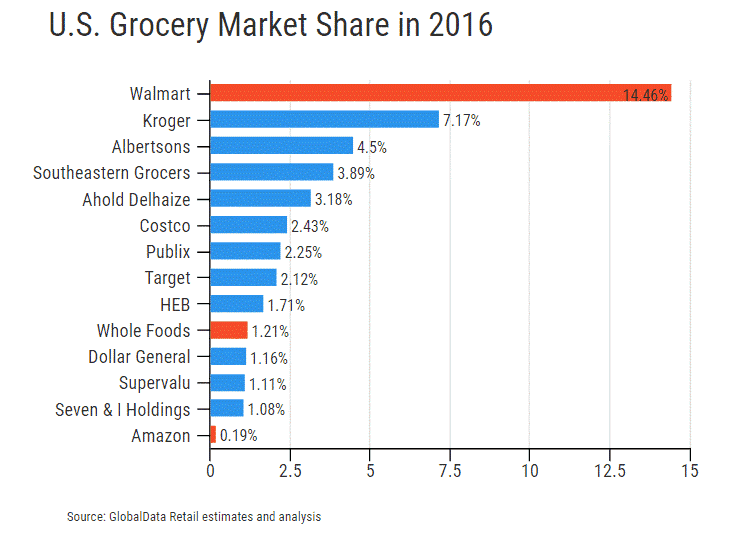
    Amazon’s foray into groceries and departmental stores started out with the acquisition of Whole Foods Market, a multinational supermarket and departmental chain in August 2017. The growth of in-store sales was slow during the first few years and has still got a long way to go before catching up to the big-name players of the physical retail sector.

    us grocery market share 2016

    Amazon has had a quite small in-store market share – before and even after it acquired Whole Foods. Before Amazon purchased Whole Foods, both held a measly market share of 1.21% and 0.19% in the US grocery sector respectively.

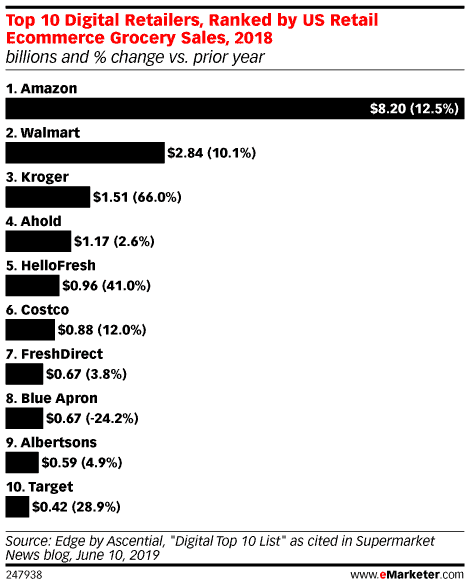
    It is a different story in the online grocery space – Amazon holds the top spot and the closest competition to it does not even come close.

    Kroger

    Kroger

    While Walmart poses a larger threat to Amazon in terms of online grocery sales, it is Kroger that has shown serious growth year-over-year, making it a potential threat to Amazon.

    kroger vs amazon
    Source: emarketer

    Kroger, as of mid-2018, was ranked third with over $1.5 billion in online grocery sales – not quite as impressive as Walmart’s $2.84 billion and not even touching Amazon’s $8.2 billion in sales. But its year-on-year growth figures have been impressive – in 2018, Kroger increased its sales by 64% over its previous year and it has managed to grow at a steady pace ever since. This makes Kroger a worthy competitor to Amazon in the grocery sector.

    Go On, Tell Us What You Think!

    Did we miss something? Come on! Tell us what you think about our article on Amazon competitors in the comments section.

  • What Is A Webinar? – Features, Types, & Benefits

    What Is A Webinar? – Features, Types, & Benefits

    Holding and conducting seminars are some of the most taxing and time-consuming deals for individuals and businesses alike.

    This is even more apparent when the target audience is not one available locally – gathering everyone in the same location for training or workshops becomes an overwhelming task.

    The amount of time, money, resource and planning required is not economical or feasible to hold seminars.

    Enter webinar – a solution that uses the internet to solve the issues faced in hosting and attending seminars.

    What Is A Webinar?

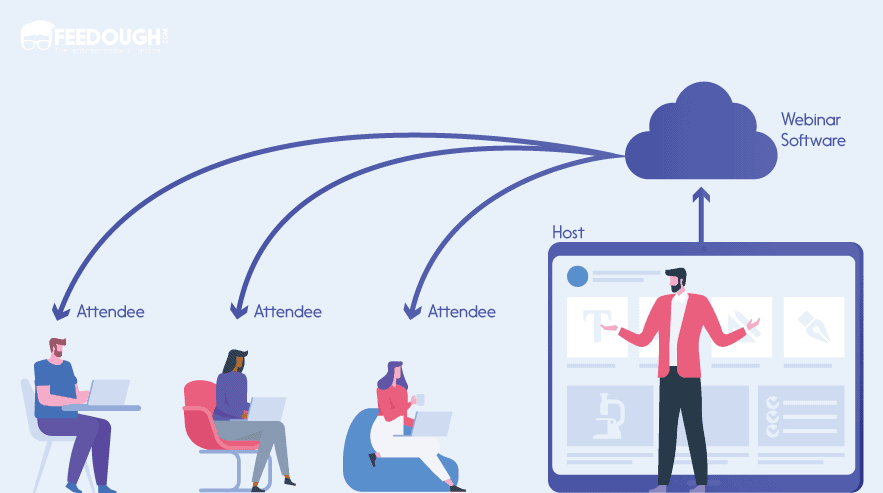
    Webinar essentially means seminar sessions held over the internet. The term is the portmanteau of two terms “Web” and “Seminar” and refers to a web-based conference which is either conducted live or presented pre-recorded. Since it is held online, anyone with appropriate equipment and access can attend a webinar from anywhere using the internet.

    When expanded, the webinar definition can be put as “an online seminar, workshop or lecture where the speaker(s) deliver presentations and share information to large audiences.”

    A webinar, just like its offline counterpart, is a live event with a specified date and time of occurrence. It allows for the easy presentations of slideshows and documents that would generally be done during a face-to-face gathering.

    Webinars come under the category of web conferencing – a general term encompassing various other online conferencing methods.

    This brings us to –

    Features Of Webinar

    Here are some of the basic features of webinars commonly available throughout different webinar software and services –

    • Real-time audio, video and text-based communication
    • Easy presentation of slideshows, documents and screen content
    • Sharing, downloading and recording of complete lectures and sharing or viewing them afterwards
    • Surveys, polls, MCQs, exams, and quizzes

    Webinars help presenters interact with their audiences using various elements such as chats, surveys, polls, quizzes, and questionnaires. Attendees can also share the webinar event using social media sites for others to join.

    If you show up late to a seminar, you miss a portion of it. But there are different types of webinars, some of which help mitigate this issue.

    Types Of Webinars

    Webinars can be classified into three types based on the release and availability of content –

    1. Live Webinars
    2. On-Demand Webinars
    3. Automated Webinars

    Live Webinars

    Webinars are usually one-time events that occur during a specified date and time. There are no options for scrubbing or pausing a webinar. It goes on just as it would in a seminar taken by a person. Show up late, and you miss a portion of the webinar.

    On-Demand Webinars

    Considered a great marketing tool, on-demand webinars allow audiences who have signed up to view it later on at the time of their liking. Based on the features of the webinar software used, it can even allow for the usage of interactive elements such as polls and quizzes to be used by the viewer.

    Automated Webinars

    Automated webinars work in an orderly fashion –

    • The presenter records and uploads the webinar to the platform
    • The date and time of release are set
    • The webinar is streamed live to the audience when the specified date and time arrive.

    But this raises the question –

    What is the difference between a webinar and a video conference?

    Let’s find out.

    Difference Between Webinar and Video Conference

    Webinar
    Video Conference
    A webinar takes place over the internet and enables presentations to be made by the speaker(s) to a large audience.
    A video conference takes place over the internet and is used by individuals and businesses alike to interact with one another.
    Webinars are usually used to share ideas, experiences, and educate others on various topics.
    Video conferences are usually used to meet, interact, and conduct live meetings and briefings.
    Webinar usually allows for one-way communication, i.e. from the presenter to the audience. But there are provisions, though limited in number, for the audience members to be able to interact with the presenter.
    A video conference allows for full-duplex communication between all participants at all times.
    Webinars allow for easy scalability and the ability to add a lot more participants.
    Video conferencing is limited in terms of scalability. Increasing the number of participants generally decreases productivity due to the nature of video conferencing.

    Even though webinars and video conferencing use the same underlying technology of live video streaming, their use cases differ.

    This raises the question –

    How do webinars work if they are quite different from regular video conferencing? Does hosting a webinar require special “webinar software”?

    How Does A Webinar Work?

    how webinar works

    Setting up a webinar involves similar steps and software to set up a video conference. Now, let’s look at how to create a webinar.

    Creating a Webinar

    Here’s a list of steps to be followed in order to ease into the nitty-gritty of creating a webinar –

    1. Use a professional SAAS to host your webinar.
    2. Set a date and time for your webinar
    3. Select and prepare your webinar topic and content, respectively
    4. Promote your webinar – tease the webinar to the world by using social media and landing pages to raise awareness and interest; usage of hashtags are recommended for better reach.
    5. Practice before going LIVE – check your equipment and their settings.
    6. You’re all set! Best of luck on your webinar.

    While a webinar can be created and held using regular video conferencing software that allows for group calls like Skype, Google Hangouts, it is not advisable to do so. The video conferencing software and services are optimised for making group video calls and not exactly for conducting webinars. Many software and services are optimised to provide you with specific tools and make your webinars look more professional.

    Webinar Software

    Here’s a list of free and paid webinar software and services that can help you get started –

    Once a webinar is created, all that is left is to send out the invites, share the link on social media – if it is a public webinar – and promote it for maximum reach.

    Participating In A Webinar

    Participating in a webinar has become quite easy because all it takes to join one is to click on the webinar link and register using any of your internet-connected devices. The said device used for registration and viewing should have –

    • Stable connection to a high-speed network
    • The necessary software required to access the webinar (if required)
    • Good video and audio output capability

    Most of the devices owned by many can support webinars right out of the box without a lot of setups – except for installing the webinar software if required.

    Once registered, you are able to participate in the webinar at the specified date and time. It is to be noted that the method of joining and participating in a webinar varies based on the webinar software used to create the webinar.

    This brings us to –

    The benefits of a webinar over holding a regular seminar.

    Benefits Of A Webinar

    Webinar offers a lot of advantages and removes many of the limitations posed by offline seminars. While a seminar has the following drawbacks to it –

    • Requires physical presence
    • Not independent and flexible
    • Lesser number of interactive options
    • Takes a lot of time, money and planning to hold just a single seminar

    Webinars take the best of both worlds and help provide users with a seamless and flexible experience. Here’s the list of benefits of hosting a webinar –

    Low Cost

    A webinar helps save on travel costs and significantly reduces the amount spent by organisers and attendees for creating or attending a seminar. Webinars also tend to be mostly free while providing a lot of value to viewers and businesses respectively. This makes webinars a lot more cost-effective than holding seminars.

    Convenient

    Since webinars are held online, it allows people to host and view them right from the comfort of their home or office. Most of the gadgets we own come more than equipped to host or attend a webinar, making it even more convenient. All that is required is a stable internet connection to connect and view the webinar.

    Worldwide Reach

    A person can host a webinar for audiences worldwide for a fraction of the cost. It is easier to reach a larger audience pool that includes people from all over the world, instead of just your locality by hosting a webinar. Compared to this, the travel expenses for hosting a seminar for a large group or attending a seminar in another country itself would come out to be higher than the amount that would allow you to create or watch webinars for months.

    Interactive

    Webinars are quite interactive – with all the surveys, polls and questionnaires, it is bound to keep the audience interested and helps make the webinar much easier to understand. Webinars also help manage a larger audience since everyone tends to receive their very own video and audio stream, giving it a more personalised touch.

    Promotes Brand Image

    Webinars act as a platform for businesses to reach their target audience and make direct contact with them. This tends to improve brand recognition, perceived quality, and status of the presenter (individual, brand, or business representative) in the eyes of their audience members.

    Obtain Sales Leads

    In order to attend a webinar, a viewer has to be interested in it to voluntarily register. This proves to be a valuable data collection and lead generation tool. Since only the interested people voluntarily sign up, webinars help businesses generate a long list of potential sales leads and customers within no time. Webinars can also be used to increase sales by converting viewers into potential customers. This can be done by selling to the viewers while educating them about the product simultaneously.

    Final Thoughts

    Webinars can be successfully used in a lot of industries and fields. They are convenient for both attendees, speakers and organisers on the whole. This is why webinars have risen to become one of the most important sales tools for individuals and businesses alike.

    Go On, Tell Us What You Think!

    Did we miss something? Come on! Tell us what you think about our article on What is a Webinar in the comments section.

  • Accelerator vs. Incubator: A Comprehensive Comparison

    Accelerator vs. Incubator: A Comprehensive Comparison

    The terms startup accelerator and startup incubator might seem like they have the same meaning: to help your business grow. They are often interchangeably used, but both differ a lot from one another. While one helps established businesses grow quickly, the other helps flesh out the details in starting a new business.

    Let’s look at what accelerators and incubators actually are and the differences between them in detail.

    What Is A Startup Incubator?

    A startup incubator or business incubator is a collaborative program designed to help your very early-stage startup to develop until it is able to sustain itself in the market.

    In simple terms – incubators incubate new ideas and help new entrepreneurs convert their ideas into a business model and eventually into a working business. Incubators usually don’t provide any funding to the startups.

    It is also important to note that startup incubators are usually non-profit. This fits their line of work quite well and this means that they are usually run by academic or government institutions.

    What Is A Startup Accelerator?

    Startup accelerator or business accelerator is an organisation that helps your developing startup to grow by providing structured guidance, mentorship, access to investors and other support.

    Accelerator helps young startups and businesses grow quickly during their starting stages by providing years’ worth of learning in short periods of time rather than letting them learn by scratch. They also often provide funding to the startups to kickstart their growth.

    The nature of the functioning of accelerators means that it is usually run by established, successful companies and are usually for-profit.

    This clearly sets both, incubators and accelerators, quite apart from one another. It helps if you look at how incubators and accelerators differ from one another in the various other aspects too.

    Business Accelerator vs. Incubator

    Incubators
    Accelerators
    Purpose
    Mentorship and long-term focus
    Structured guidance
    Working Time-frame
    Flexible and over a longer period of time
    Shorter and well-defined timelines
    Joining
    Focused
    Restricted
    Raising Funds
    Not the main focus
    Usually provided
    Funded By
    Usually not-for-profit; funded by government and academic institutions
    Usually for-profit; funded by established businesses and corporations

    Purpose

    Incubation and acceleration aren’t the same. Incubators incubate very-early stage businesses by helping them convert their ideas into businesses. Accelerators, on the other hand, accelerate already running businesses that have some potential.

    Incubator

    Startup incubators help new entrepreneurs flesh out their business ideas by providing them with the following resources –

    • Infrastructure
    • Networking
    • Financial advisory/ Intellectual property teams/ Legal advisory
    • Contacts for potential investors
    • Manufacturing
    • Initial financial support
    • Training and guidance

    Incubators help them convert their business idea into a successful business with a proper business model.

    Accelerator

    A startup accelerator or business accelerator help early-stage startups in becoming successful and accelerating their growth by providing them with structured guidance. This guidance is usually taken from the practices followed by other successful ventures and moulded to fit the current startup and help boost their growth and sales.

    Apart from the structured guidance, accelerators also provide businesses and startups with –

    • Resources focused on achieving increased growth within a short span. This includes infrastructure, mentorship, seminar, and workshops
    • Funding in exchange for equity in the company
    • Legal guidance
    • Networking opportunity

    Working Time-frame

    Incubation period could be different for different businesses. Usually, startups work with incubators for a longer period compared to working with accelerators who have fixed time-frame cohorts.

    Incubator

    Due to the nature of incubators and businesses in general, joining and working with incubators usually means that both work together for longer periods. Incubators look to get a new business get started from scratch.

    Incubators also tend to work on an open-ended basis – incubators tend to keep in touch with and provide help and resources even after the business has been established.

    Accelerator

    Accelerators are usually laser-focused on achieving growth numbers quickly. Hence they tend to take the best and optimum approach possible in the shortest time, leading to accelerators working with businesses and startups for much shorter periods of time compared to incubators.

    It goes without mentioning that accelerators tend to work on a more close-ended basis – the businesses or startups are required to present their growth numbers at the end of the accelerator program. Once the specified growth target has been achieved, it tends to focus on the next business at hand and long term support varies according to the accelerator.

    Joining

    Joining an incubator is far easier than joining an accelerator. Accelerator provides a business with a lot of resources. Hence, it has a rigorous selection procedure as well.

    Incubator

    Joining a business incubator usually involves relocating to a shared coworking space that houses other yet-to-be-launched businesses. It is also easier to get into an incubator compared to an accelerator – all you need to have is a valid idea to get into one. The rest is provided by the incubator in making sure the finer details are all fleshed out to be made into a functioning business.

    Accelerator

    Joining a business accelerator usually doesn’t involve in the shifting of the business operation but requires the founders and employees to focus most of their time in executing the plans formulated by the accelerator after lengthy discussions and analysis.

    But joining an accelerator program is stricter than joining an incubator – the startup or business must be up and running along with some initial traction on its part to be selected by an accelerator. Accelerators also tend to prefer startups and businesses who have already identified an MVP (Minimum Viable Product).

    Raising Funds

    A startup doesn’t require much funds at the time of validating an idea or converting it into a business. However, it may require additional funds to accelerate an already running business. Hence, accelerators focus more on helping startups raise funds.

    Incubator

    Startup incubators do not focus much on raising funds, especially during earlier stages of fleshing out the business idea. Though it acts as a platform for entrepreneurs and startups to network and also meet potential funding prospects, the act of raising funds is pushed to later stages.

    Instead, incubators focus on making the idea into something that will attract investors to it and provide entrepreneurs with the necessary training and preparation to raise funds.

    Accelerator

    Accelerators, with their shorter time-frames, generally tend to focus on the act of raising funds quickly after laying out the necessary course of action for the startup or business.

    Accelerators generally provide in-house funding and tend to have a larger network of investors, VCs and angel investors within their reach. This helps it quickly gain funding rather than waiting to get noticed by an investor.

    Funded By

    Incubators are often not-for-profit organisations while accelerators are for-profit organisations backed by big businesses.

    Incubator

    Most business incubators are not-for-profit organizations funded by government or academic institutions. This fits well with their nature of operation in the fact that it provides a nurturing environment for newer businesses to take off from their ideation stage.

    Accelerator

    A business accelerator or startup accelerator is generally run by other established companies and businesses – this helps them provide the necessary guidance and support from previous learning experience for faster and quicker growth. In these cases, accelerators are usually for-profit ventures.

    Equity

    Since accelerators offer more resources, they expect more equity compared to incubators.

    Incubators

    Since Incubators are not-for-profit organisations that usually doesn’t invest in your startups, they usually take very little or no equity.

    Accelerators

    Since accelerators also provide funding to the startups, they take some equity in it as well.

    Examples

    The difference between incubators and accelerators can be better understood by witnessing live examples. Here are a few:

    Business Incubators

    CodeLaunch

    CodeLaunch is a competition conducted annually between people as well as groups on technology startup ideas. The competition usually targets very early-stage startups and help them connect their ideas with investors.

    Centre for Innovation Incubation and Entrepreneurship

    CIIE is an academic incubator backed by IIM Ahmedabad, a top business school in India in association with the Government of India and the Gujarat Government. It provides very-early stage startups with the following resources –

    • seed-funding,
    • incubation,
    • mentoring,
    • training,
    • knowledge dissemination. and
    • best practice research.

    Business Accelerators

    Techstars

    Techstars is a USA based seed accelerator which currently operates in 150+ countries and provides mentorship based acceleration program along with some funding to companies with disruptive models.

    500 Startups

    500 Startups provide a four-month-long seed program for pre-series A companies to help them grow their company and their offering. This business accelerator invests in almost all types of companies and provides help in the form of – hands-on learning, office space, mentorship, and an investment of $100,000 for 5% share of the company.

    Final Thoughts

    To sum it up, incubators help take care of the ideation and launch phase while accelerators help newer businesses grow quickly, with emphasis on quick growth, from their starting stages.

    In the end, joining either – incubator or accelerator – depends on what you want to achieve; start a business or grow an established one quickly.

    If you are looking to flesh out your business idea, an incubator is your best option. Incubators act as a platform for newcomers (and even established ones) to be able to network with like-minded people and businesses. This has always proved to be valuable in the long run.

    Accelerators can help refine your business’ existing model but more importantly – improve its functioning by using the knowledge obtained previously from successful businesses to increase sales and develop your startup/business.

    Go On, Tell Us What You Think!

    Did we miss something? Come on! Tell us what you think about our article on Accelerator vs. Incubator in the comments section.

  • How To Get A Startup Idea? [Comprehensive Guide]

    How To Get A Startup Idea? [Comprehensive Guide]

    Startup ideas are great. They make us feel like we are onto something.

    Something really big.

    And for some people, coming up with these ideas is as easy as finding the right song on Spotify. For others, it’s nearly impossible.

    Take this for example –

    I’ve been living in this city for the last 20 years. And it was my duty to go out almost every morning to buy milk, eggs, and bread before breakfast. Of course, there were times when I didn’t want to go out and just wished for my groceries to get delivered directly to my apartment. And while I wished, a guy saw an opportunity. He created a company called Milk Basket and delivered milk and groceries to my doorstep every morning on a subscription model.

    And this is everyone’s story.

    I think the reason why not many people get business ideas is that they fail to recognise that the problem they wish to get solved is actually a startup idea.

    How Do You Get A Startup Idea?

    Well, there’s not an easy answer here. But it’s easier to define how ideal startup idea should look like. It should –

    • Solve an actual problem that exists in the market.
    • Offer a solution that is really required by at least some people.
    • Have the potential for growth.

    If you already have an idea in mind which satisfies all the three conditions, bang on. Stop reading this article and start building your business model. But if you don’t, let’s start with satisfying the first condition –

    The Problem

    Imagine –

    It’s a nice morning, you’re taking a shower in warm water and suddenly it strikes. A problem no one has addressed to yet. You know you would buy it if a solution is developed, you know your neighbours would do the same. You come out of the shower, do some research, find a team, and release your solution. People like it and you become their favourite entrepreneur.

    Sounds nice, right? It’s just that not many are this lucky. Many, just like me, have to go through a proper ideation process to find a milestone named problem which leads to the path of the solution and eventually success.

    So, how do we identify a problem?

    I’d say, start from within.

    Be Your Own Target Audience

    It’s easiest to look out for problems you face yourself. Be your own target audience. What are the problems you face that can be solved with an offering you’ll actually pay for?

    Here’s a story –

    Two good friends once went to attend a conference on future tech. They learned many new things, expanded their network, and had such fun that they forgot that it was already late. To their dismay, that night the pair was unable to get a cab. These two friends that we just talked about were Travis Kalanick and Garrett Camp, the founders of Uber.

    There are innumerable problems that you face yourself and most of them are not being targeted yet. Take our lifestyle for example. We are so engrossed in the digital devices, social media, and the virtual world that we ignore the fact that this is a big problem for us, and that a digital detox would be a great startup idea.

    Won’t it?

    Notice More

    Another great way to identify a problem is to notice your surroundings. Maybe, you’ve spent the last 10 years working with a bookstore brand. Their sales are declining and they can’t find out why. You’re a millennial who knows a bit about trends and who knows that the new generation is more inclined towards ebooks, audiobooks, videos, podcasts and other digital products. You understand the problem and have the ability to device a perfect solution because of your experience.

    That’s the perfect startup idea for you.

    For those who remember Yahoo! as their go-to portal during their teen years know how annoying the experience was. The website was bombarded with ads as it was the most common revenue generation source back then.

    Just like many of the users, two employees were also annoyed by ads and wanted to develop a platform which capitalized on network effect like Yahoo! but didn’t monetize with ads. This pair was Brian Acton and Jan Koum who later developed the no-ads instant messaging application – Whatsapp.

    You learn a lot more by noticing. Notice the trends, notice shifting demands, and notice repressed demands. Telegram is gaining popularity because of the WhatsApp’s customers’ repressed demands related to privacy.

    Seek and Validate

    Now, there are times, or I’d say most of the times when these two techniques don’t work. You just can’t find a problem in your life.

    So, how do you get a startup idea then?

    Well, you assume that a problem exists and then you validate it.

    I call it the deliberate idea — a not-so-recommended process but a process followed by many of the entrepreneurs I know. Many do succeed in this, but many fail miserably and even sink investor’s money with them.

    The process goes like this –

    You find what motivates you the most or the most profitable niche for you to start a business in. It could relate to –

    • Fun or hobbies,
    • The industry you currently work in, or
    • Any promising industry you’ve come across.

    Once selected, understand how the industry works. Go out and talk to people. Research what is missing and is it worth a problem to solve. List down all the problems. List down all the assumptions related to that problem. And then follow the negation process.

    Negate everything that doesn’t seem viable.

    Negate everything people are not willing to buy.

    Now, this might seem easy theoretically. In reality, it isn’t. Entrepreneurs fail because they are not able to negate what they should.

    Let me give you an example.

    If I go out and ask pet owners if they would like to use a social network especially for pet owners, most of them will say yes. Many will even create an account on it as well. But not many of them will use it for the long run.

    Why?

    Well, they don’t know.

    Might be because pets are for their friends and not tools to help them connect with other people. Or because Facebook is doing that job just good. They’ll instead join a pet owners group on Facebook and get the job done.

    So, this takes us to the next condition you need to fulfil before calling that idea a perfect startup idea –

    The Solution

    Identifying problems is just 50% of the job. Success and failure depend on the solution you provide to solve that problem.

    So, how do you come up with the solution?

    Well, it’s simple. You can either –

    Do what the target group does to solve the problem. Just brand your solution, do it effectively and efficiently, and charge something for it. Take a barber for example. You’d anyhow shave your beard if there weren’t a barber who does that job for you.

    There are a lot many examples, like grocery delivery, and even recipe delivery. All you have to do is to help them save time and efforts and do things better than they would have done

    Another thing you can do is to pay attention to what your customers wish for. “Ah, I wish I were able to book a cab on my mobile phone”, “I wish we were able to order the food even before we reach the restaurant”, “Why can’t my beautician come at home? I’m too tired today”.

    Problems usually give a lot of hints towards the most preferred solution. You just need to make sure to listen properly

    And that there’s a minimum audience pool to give it a go.

    The Minimum Audience Pool

    There should be at least some people who really want your solution and are ready to pay for it. By really, I mean there must be a target group who’d want your solution even when you roll out your MVP or a very crappy version which just solves the problem, no-frills attached, nothing else.

    This can either be a small number of people belonging to a greater group or a great number of people belonging to a small group. Doesn’t matter. All you need is their approval.

    And to get that, you need to do a bit more than just making them fill up google forms.

    Take Buffer for example. It’s a simple social media post scheduler for Facebook, Twitter, Instagram and other social media networks. It is actually a pioneer in this industry.

    So, back in the days, when there weren’t any such tools, the founders of buffer assumed that this problem existed, but they wanted to validate the demand before actually investing their time and money in this product. So, they released the leanest MVP anyone can think of – a simple landing page with a plans and pricing button.

    This is what was written on the landing page

    “Tweet more consistently with Buffer”, followed by how this tool works. This description was further followed by a plans and pricing button which took you to the plans and pricing page. The page had three plans to choose from – $0 plan, $5 plan, and $20 plan. Once you select the plan, you didn’t go to the checkout page but to a signup page which said the product isn’t ready and you can sign up to receive a reminder whenever it’s ready.

    Buffer mvp landing page

    Now, as I said before, it is hard to know if there’s an audience pool who’ll really use your product. But what Buffer founders had was a definite yes to their solution.

    Why, you ask?

    Well, no one would browse three different pages on a website just to give his email for a product he isn’t interested in.

    The result?

    The company is today valued over $60 million and is operating in profits.

    Definitely, they did a lot more than just creating a perfect MVP. Now the tool several other social media networks than Twitter. Which brings us to the last condition for getting a perfect startup idea –

    Think Of A Solution That Has Potential For Growth

    You might have heard this a lot – start small and grow big.

    Let me tell you what they mean when they say this.

    Facebook initially started as a platform to help university students connect with other students of the same university. Amazon started as an online marketplace for books. WhatsApp started as a status application.

    You see the trend here?

    None of the big companies started as we know them today. Keep this in mind. Don’t go on solving the problem of world hunger from your garage. Look for the small problems that have high potential. Problems whose solutions can be extended to solve other problems as well.

    Big problems like plastic use can be solved by creating smaller solutions like non-plastic single-use bottles. But why only single-use bottles and not single-use pens?

    It’s simple – because they pollute the most.

    Do you get what I am trying to say?

    Honestly, when it comes to ideating, I’d suggest you follow the KISS approach. Keep it simple, silly.

    It’s very simple to find out what’s missing in your life. What you will pay for. Noticing is even easier. It’s human nature, after all. It’s easy to notice the problems of others. Solutions need some work though. But noticing and validating helps overcome that hurdle as well.

    All you’ll need is to develop an entrepreneurial mindset.

    Go On, Tell Us What You Think!

    Did we miss something? Come on! Tell us what you think about our article on how to get a startup idea in the comments section.

  • What Is Corporate Communications? – Importance & Components

    What Is Corporate Communications? – Importance & Components

    A popular T-shirt brand sends out a new Instagram promo about a flash sale. Someone slips a brochure from a new local deli under a student’s dorm room door. The video of the latest launch from a major tech brand is up on YouTube. The daily newspaper features an apology statement from a sneaker brand about the defects in their latest product line.

    Different kinds of content, one team behind it all – corporate communications.

    What Is Corporate Communications?

    Corporate communications is the entire set of activities concerned with sharing company communications with both internal and external stakeholders to create a favourable point of view and a uniform image of the company on all channels.

    Internal stakeholders include employees at all levels and across all departments. External stakeholders include customers, suppliers, the press, the government, lawyers, consumer rights bodies and any other individual or group that is impacted by what the company is doing. Any company-related statement that a company spokesperson makes to anyone, be it a group of employees or a journalist or a politician, is a part of corporate communications.

    Objectives Of Corporate Communications

    Just like any other business department, the corporate communications department has its own set of objectives which it works towards, and its performance is measured based on how far it has reached or fallen short of those objectives. While the corporate communications objectives may differ from company to company, they are usually variants of the following –

    Improving Awareness

    Much of what the corporate communications team does focuses on making different audiences more aware of a company’s products or views. There are different ways of doing this. For instance, some teams might do one-on-one meetings with journalists who regularly write about the company. Other forms of awareness-related communication include newsletters about what the company has been doing or policy about responding promptly to employee questions.

    Goal-Oriented Action

    Corporate communication isn’t just about sharing knowledge. The team often sets specific, measurable goals that they work towards completing within a certain timeframe. For instance, the team might want to bring the company’s positive approval ratings up by 10% or increase positive media coverage by 50%. Typically, the team will do some research on the industry space and undertake some surveys before deciding on goals so that they can be feasible.

    Profit-Oriented Action

    A lot of activities that the corporate communications team is involved in aren’t directly measurable in terms of revenue versus cost. However, some of the team’s objectives have to deal directly with returns on investment. For example, the team might want to bring up media inquiries by a certain percentage or meet company sales goals without more than a 10% increase in marketing costs.

    The Importance Of Corporate Communications

    Every company needs to send out the right communications at the right time. But companies can’t just send out whatever they like. Their messages – across all media, both online and offline – need to be purposeful, consistent and well-timed. This is where the corporate communications team plays a huge role. Here are some of the reasons why corporate communications should be a priority for every business.

    Become More Recognisable

    Any communication sent out should consistently reflect the story that a company wants to tell, be it the purpose behind what they do or the kind of work culture they promote. Having a strong corporate communications strategy helps to create this consistency. With a consistent brand identity, people find it easier to know what the company is all about. The more they see consistent messages, logos and catchwords across different platforms, the likelier they are to remember the brand and what it stands for. This will help increase customer loyalty and allow members of the press to easily mention and quote the company.

    Control External Impact

    When a company has a strong corporate communications strategy, they are in charge of what external audiences are saying about them. Sending out the right press statements and social media announcements at the right time will show the world that they care about keeping audiences updated on what’s happening, whether it’s positive or negative. This brings down the possibility of misinformation spreading about the company.

    Improve Employee Loyalty

    Employees like to be in the know about what their company is doing. By keeping employee communications consistent and timely, the company makes its employees a part of the conversation and helps them feel empowered. This creates stronger feelings of loyalty on their part towards their employer and motivates them to work better.

    The Components Of Corporate Communications

    Essentially speaking, every communication sent out by the company to internal or external audiences is the job of corporate communications. We can divide the role of this team into four main components, which are as follows.

    Corporate Identity

    Corporate identity consists of the set of attributes or features that the company’s members feel are unique to and aptly describe the company. It is the corporate communications team that defines this identity for the most part – the communications, written and visual, that they share with internal and external stakeholders go a long way in shaping what the stakeholders believe the company is all about.

    Corporate Branding

    The main idea behind corporate branding is to create a positive impression of a company and its products to the public. This entails uniting a group of products or businesses under a single name and visual identity (such as a set of symbols), which then becomes the “brand”. The corporate communications team plays a big role in this, especially when the branding process involves presenting the features of the product or company to the potential buyer in a way that induces them to buy.

    Corporate Reputation

    Corporate reputation refers to different stakeholders’ perceptions of a company based on its ability to live up to their expectations. These stakeholders could be buyers, employees or investors – anyone who has a vested interest in the company. Corporate communications teams influence corporate reputation for the better by sharing the right kinds of press content online and managing search results to boost the company’s online presence.

    Customer Communications

    While it’s usually the marketing team that takes care of customer management, the corporate communications strategy and marketing strategy often overlap a lot. This is why the corporate communications team contributes toward customer-oriented material like marketing flyers, newsletters, brochures, emails and social media posts.

    Internal Communications

    It isn’t just customers who need to know what the company is doing. Employees across all divisions have to be kept in the loop about new products, services, events, changes of staff, policy changes and other important pieces of information. The corporate communications team takes care of this by sending out emails, newsletters, blog posts and memos that employees can read to stay updated. The team may also organise group sessions where announcements are shared and employees are invited to voice any opinions or suggestions they might have.

    Media Relations

    It’s essential for a company to stay in touch with what the general public is saying about it. This is where corporate communications comes in. From organising and preparing material for press conferences to sending out press releases to keeping an eye on the news for mentions of the company or its stakeholders, the team does it all.

    Investor Relations

    For any company, keeping financial stakeholders happy is a top priority. These could be shareholders for a public company or angel investors for a startup. The corporate communications team interacts with the investors to build a positive relationship with them. They also work on content that boosts the company’s image both online and offline so that investors are more confident about where they’re putting their money.

    Crisis Communications

    A ‘crisis’ is basically any unforeseen event that could potentially damage the company’s reputation externally, internally or both. In case a crisis occurs – such as a workplace accident or product defects coming to light – the corporate communications team drafts a strategy to address it. This could include answers to questions posed by the press, statements issued by senior company executives to media publications, official announcements on company social media pages and any communications with attorneys or politicians.

    Corporate Communications vs. Public Relations vs. Marketing Communications

    A lot of the time, the functions of these three departments overlap. All of them involve written and oral communication and all of them have the basic objective of creating a positive image of the company in the eyes of different stakeholders. Here’s how we can distinguish these functions.

    Corporate Communications vs. Public Relations

    Corporate communications is concerned with all of the communications – internal and external – that a company puts out. From website content and newsletters to employee emails and minutes of meetings, the corporate communications team handles it all.

    Public relations, on the other hand, is concerned specifically with communications that go out to the press, consumer forums, government/legal bodies and other external stakeholders. The PR team uses press releases, corporate statements, presentations and public activities to generate public interest in and a favourable perception of what the company is doing.

    PR works closely with corporate communications to prepare suitable communication pieces to share with those stakeholders. The two teams may also work together to identify new audiences to communicate with.

    Corporate Communications vs. Marketing Communications

    As mentioned above, corporate communications reaches out to all the stakeholders of the company. Marketing communications, on the other hand, concerns itself solely with the company’s customers. These communications support the sales function by promoting the company’s products through online and offline media.

    Again, both the teams tend to work closely together given how much they overlap. The corporate communications team helps to identify and draft material for new consumer audiences, while the marketing communications team brings in useful sales insights that can be incorporated into internal and external communications.

    How Can Businesses Improve Their Corporate Communications?

    Corporate communications may seem like a fairly easy job – agree upon a message and send it out everywhere. But a surprisingly large number of companies either look at communications as a secondary priority or don’t have a clear communications strategy at all. Improving corporate communications isn’t an overnight job – it may take months or even years to see real results. But there are several steps one can take in the right direction today. Here are some important tips that every company should keep in mind for their communications strategy.

    Having A Consistent Message

    Many companies end up botching their communications because they aren’t clear on the kind of message they want to send out. It is thus essential to decide on a consistent message or set of messages and make sure that everyone understands and agrees with that message. That way, every communication they send out will link back to the rest and help their audience associate that consistent message with their company.

    Hiring A Talented And Qualified Team

    Corporate communications is a highly specialised business activity and requires a comprehensive skill set to do well. The team members should have excellent writing and speaking skills, be comfortable handling large amounts of data, have strong critical thinking abilities and be rational during times of crisis. All the team members should be chosen with care and supplied with all the training and resources they need to do their job well.

    Giving The Communications Team Autonomy

    No team can function well if they’re constantly micro-managed, and corporate communications team is no different. The communications team members should be given the flexibility to design new messages and explore new channels as they see fit, as long as the messages are aligned with the company’s business goals. Senior executives should be encouraged to take the help of the team when preparing press statements or interview responses. The communications team was hired for their expertise in communications – it’s important to give them the authority to do what they’re good at without being supervised all the time.

    Making It Easy For Employees To Participate

    A company’s employees are also its brand ambassadors. They are in a unique position to vouch for the company as they have an inside view of what’s going on. This should be used to the company’s advantage by making it easy for employees to share opinions and suggestions. They should be encouraged to post about their workplace on social media. There should also be an internal platform – such as a Slack channel – where everyone can freely post their thoughts on company activities or present new ideas. By giving employees control, the company is helping them feel more empowered, which would encourage them to share positive opinions.

    Go On, Tell Us What You Think!

    Did we miss something?  Come on! Tell us what you think about our article on corporate communications in the comments section.